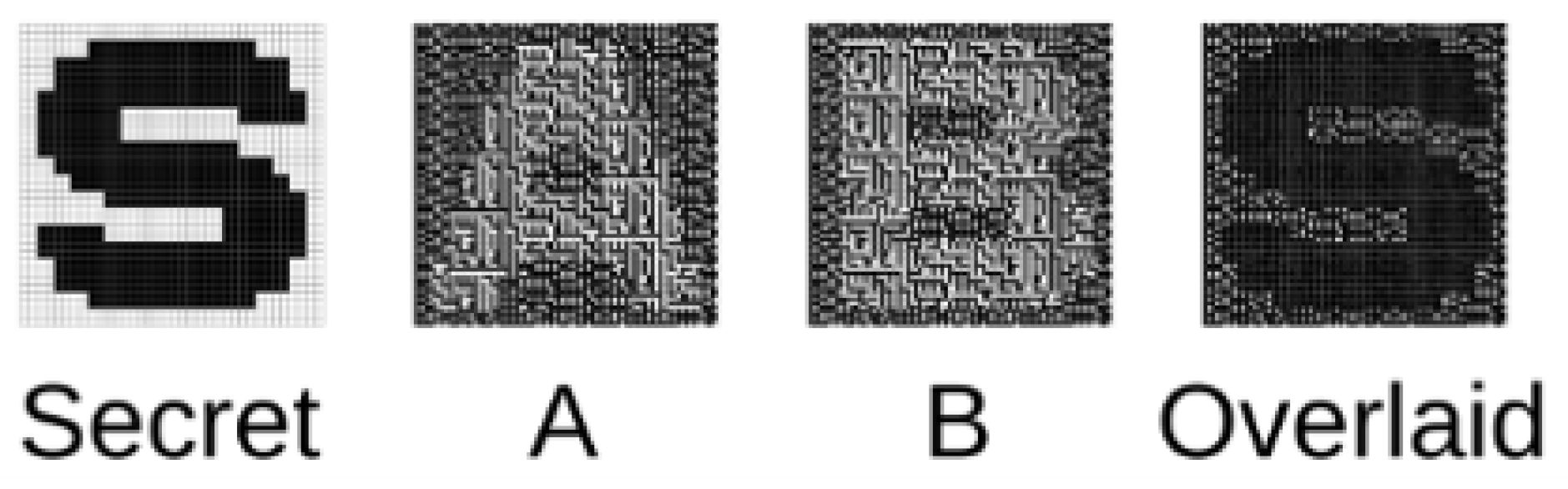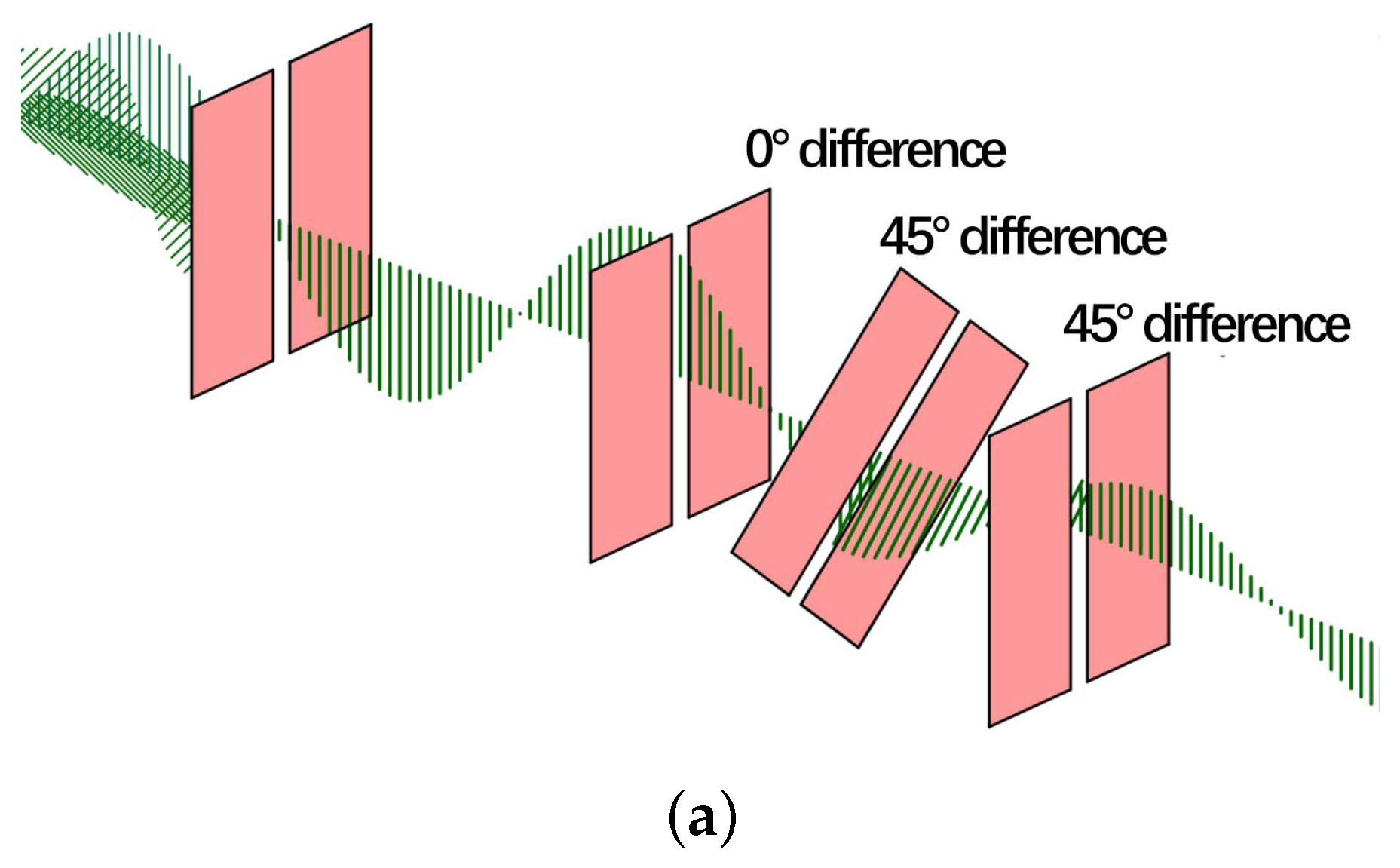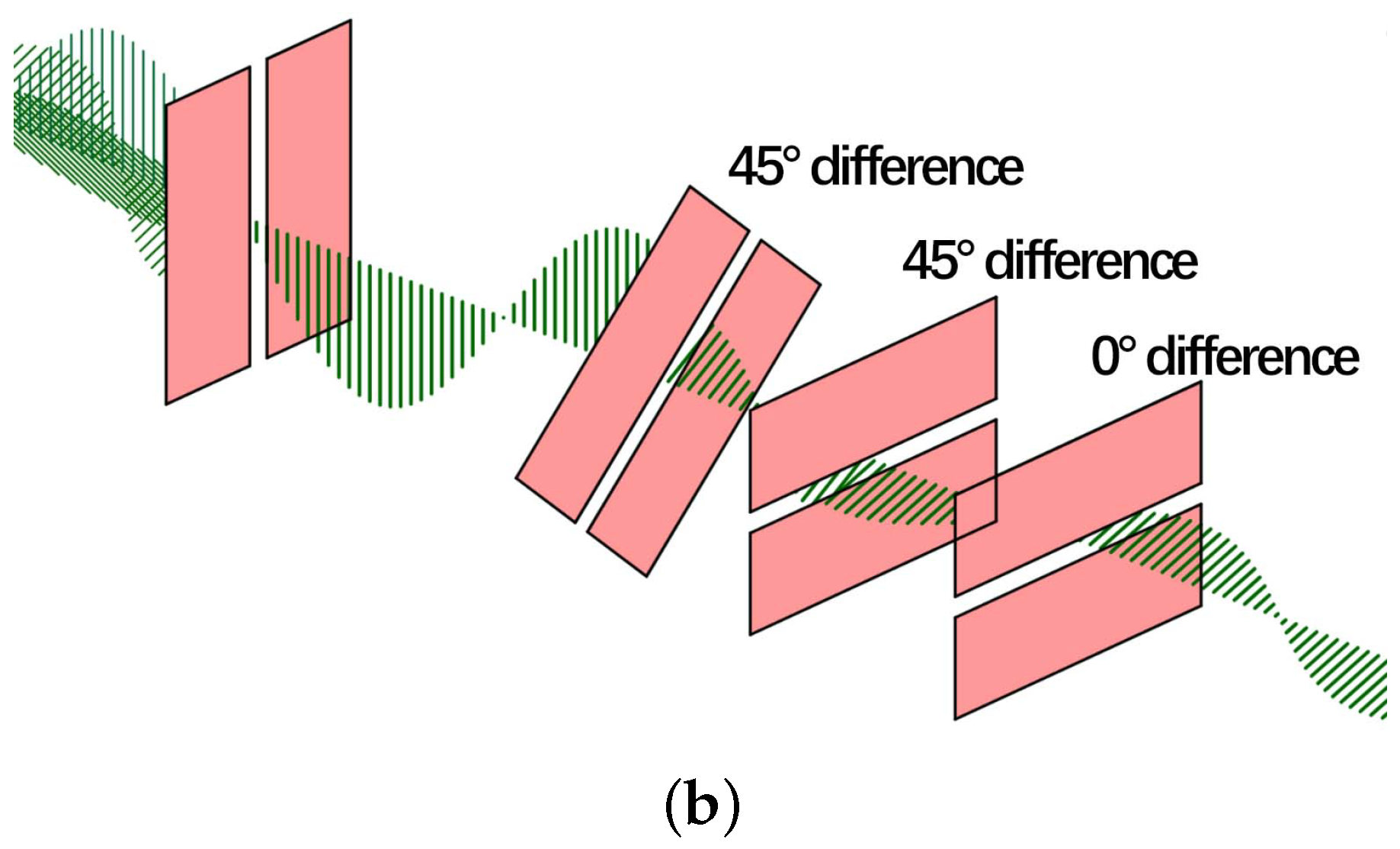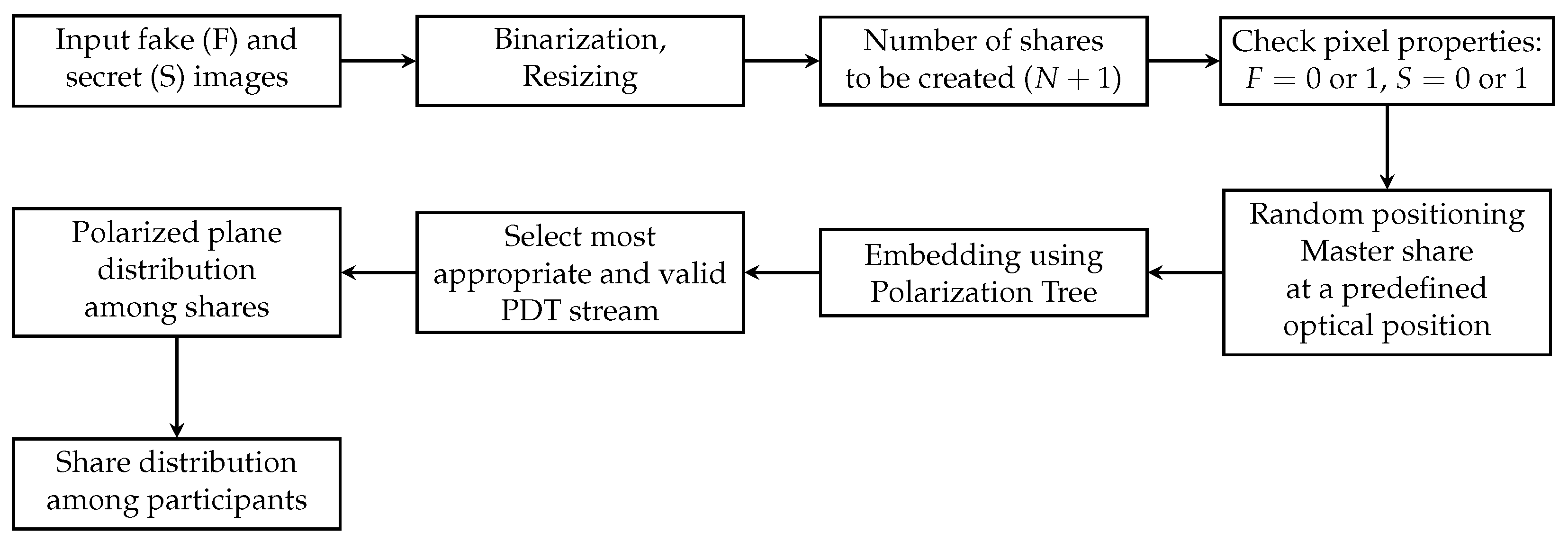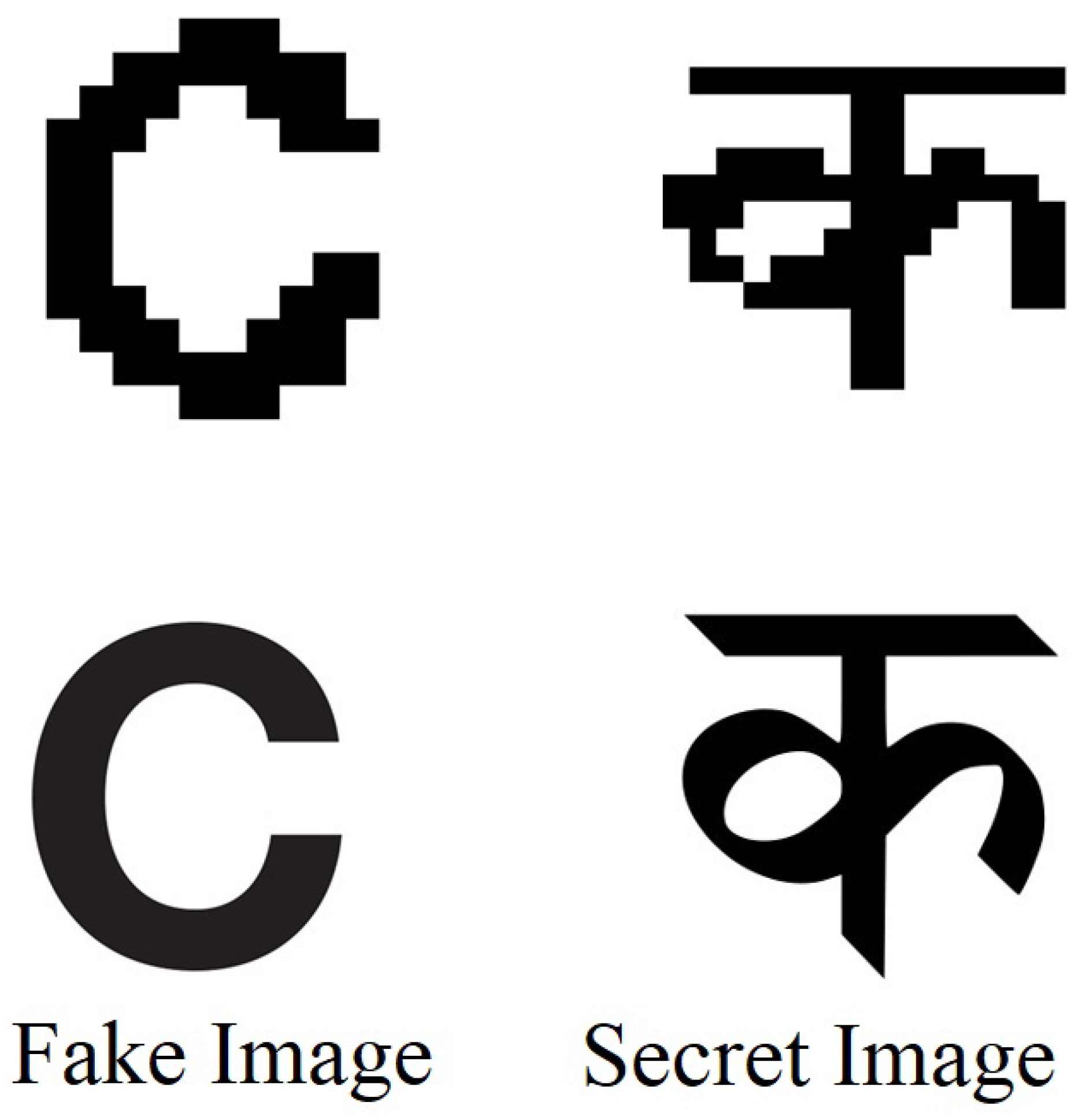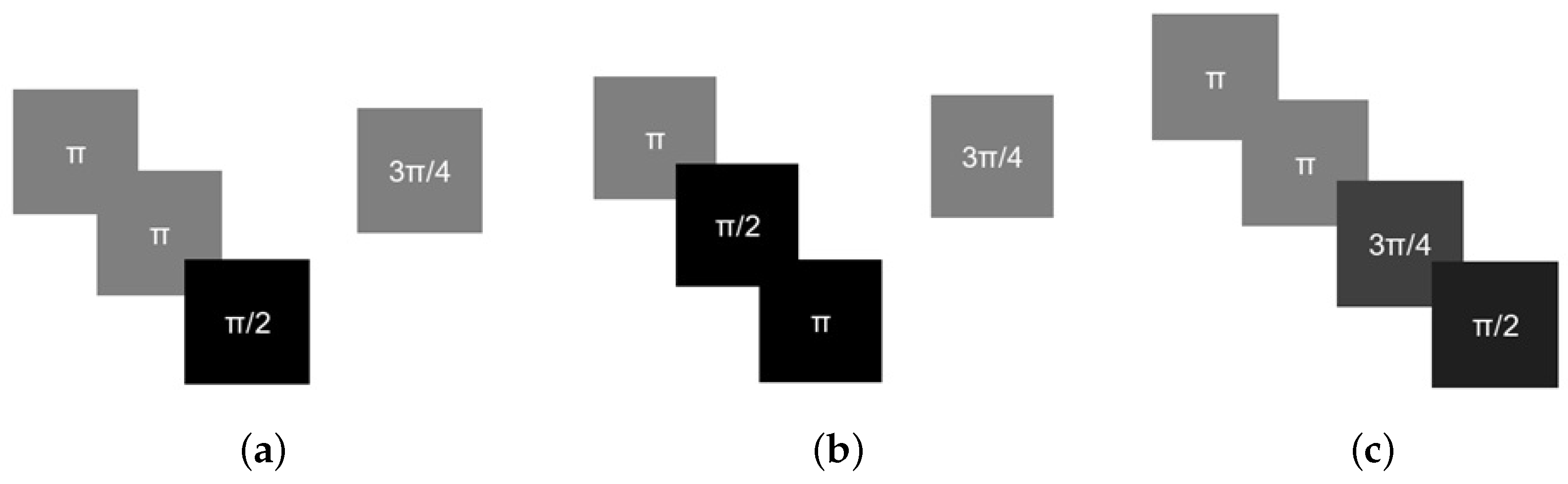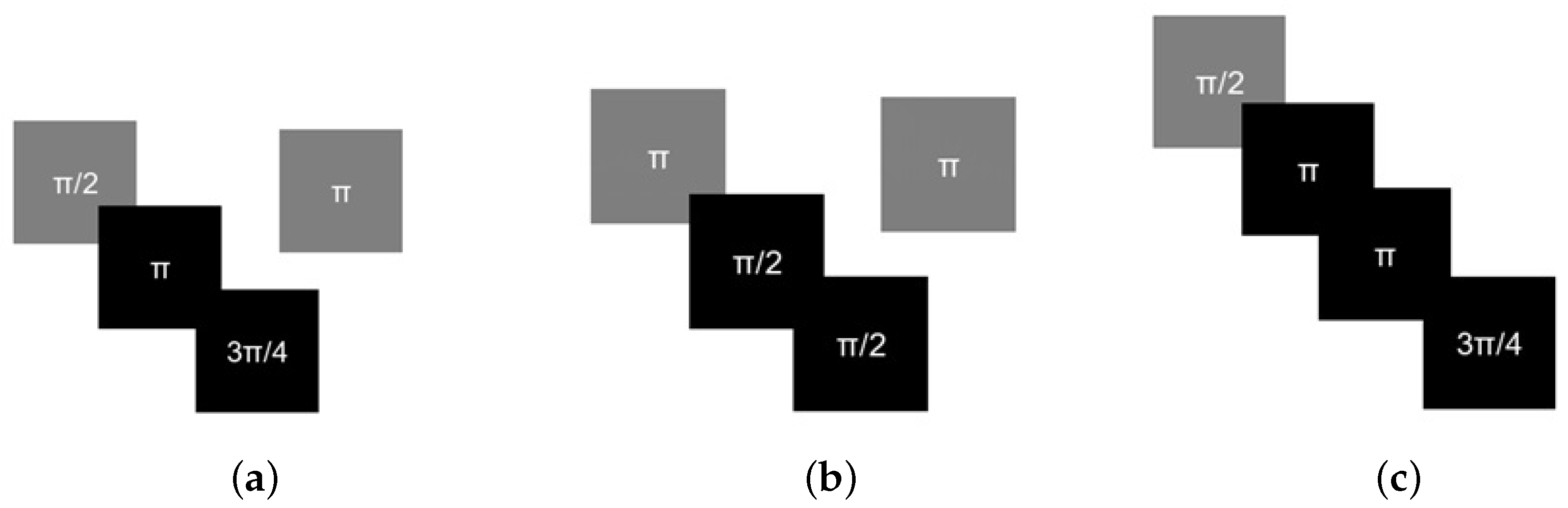

Probability Distribution Tree-Based Dishonest-Participant-Resistant Visual Secret Sharing Using Linearly Polarized Shares

Abstract
1. Introduction
2. Research Background
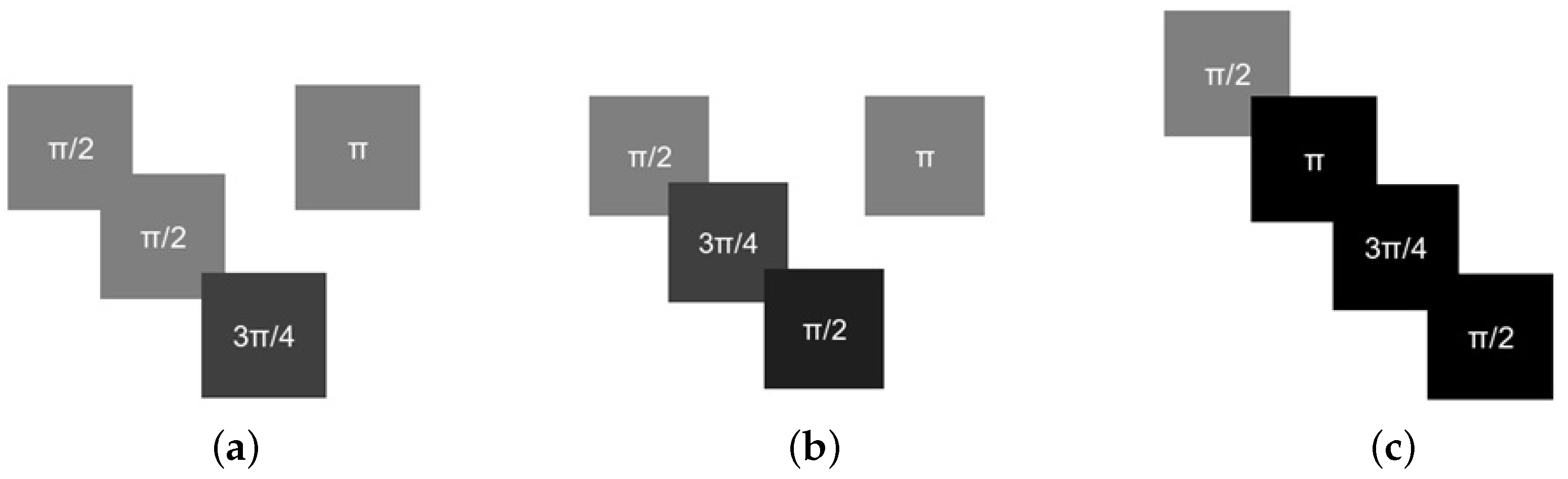
2.1. VSS, Binarization and Probability Distribution Tree
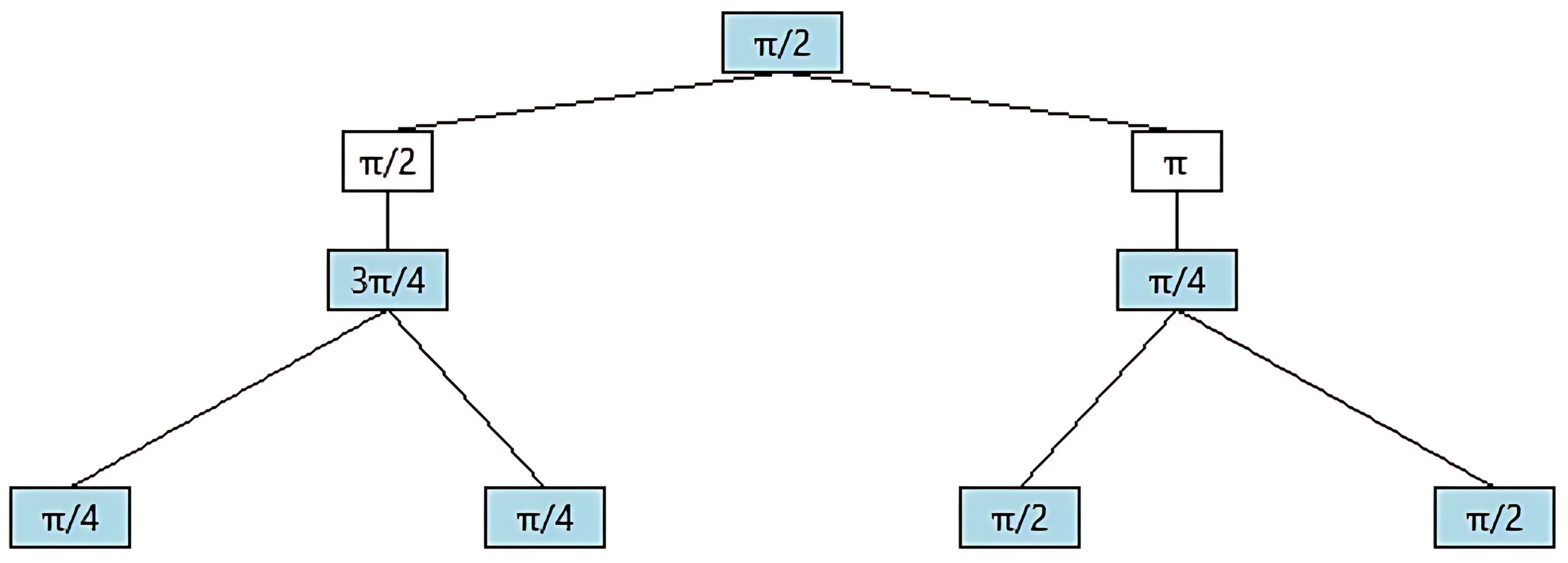
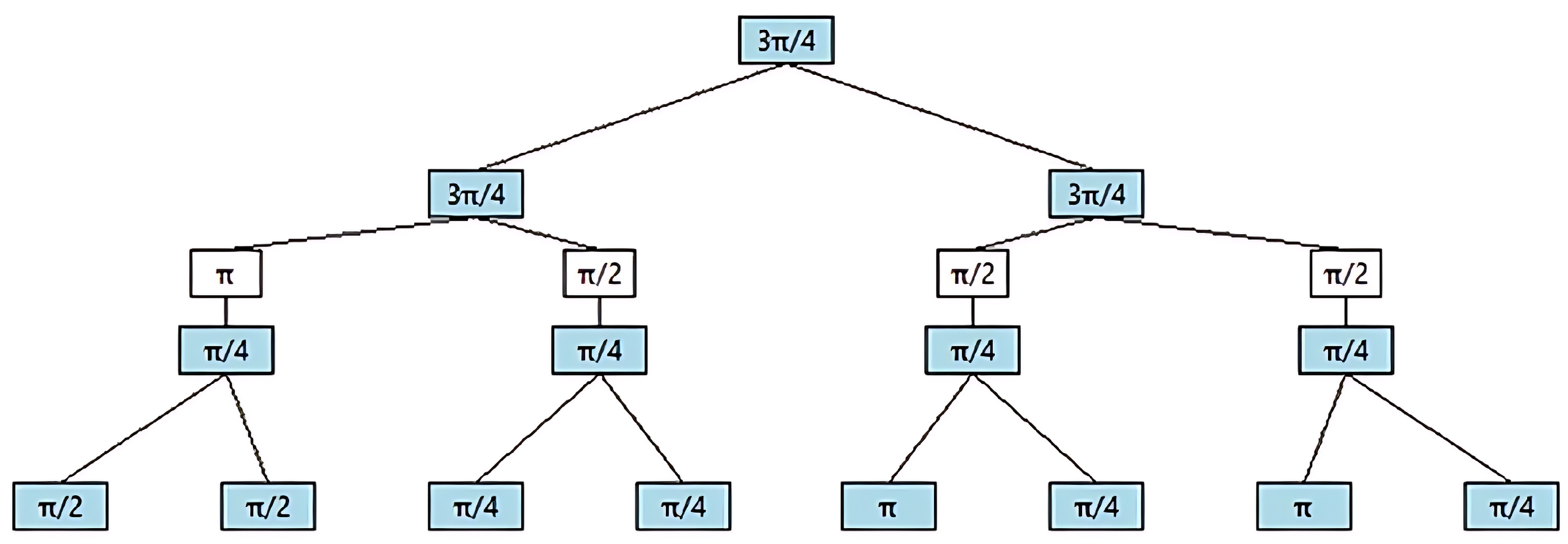
2.2. PDT Construction and Selection Rule
| Algorithm 1 Generate tree sequences for , | |
| 1: | Input: Total number of shares to be created |
| 2: | nodes ← empty list |
| 3: | polarizer_types |
| 4: | probability_map |
| 5: | for level to steps do |
| 6: | level_node_count |
| 7: | for to level_node_count do |
| 8: | index |
| 9: | if level then |
| 10: | random_char ← select from polarizer_types using probability_map |
| 11: | else |
| 12: | parent_index |
| 13: | parent_char ← nodes[parent_index] |
| 14: | adjust_probabilities(probability_map, parent_char) |
| 15: | random_char ← select from polarizer_types using updated probability_map |
| 16: | end if |
| 17: | nodes[index] ← random_char |
| 18: | end for |
| 19: | end for |
| 20: | return nodes |
| 21: | Function: adjust_probabilities(probability_map, parent_char) |
| 22: | if parent_char then |
| 23: | probability_map |
| 24: | else if parent_char then |
| 25: | probability_map |
| 26: | else if parent_char then |
| 27: | probability_map |
| 28: | else if parent_char then |
| 29: | probability_map |
| 30: | end if |
| Note: All evaluations assume the predefined optical ordering that includes the master share. Bias polarization selection to promote light transmission under both stacking conditions. | |
| Algorithm 2 Generate tree sequences for , | |
| 1: | Function: adjust_probabilities(probability_map, parent_char) |
| 2: | if parent_char = then |
| 3: | probability_map ← { : 0, : 0.2, : 0.6, : 0.2 } |
| 4: | else if parent_char = then |
| 5: | probability_map ← { : 0.2, : 0, : 0.2, : 0.6 } |
| 6: | else if parent_char = then |
| 7: | probability_map ← { : 0.6, : 0.2, : 0, : 0.2 } |
| 8: | else if parent_char = then |
| 9: | probability_map ← { : 0.2, : 0.6, : 0.2, : 0 } |
| 10: | end if |
| Note: All evaluations assume the predefined optical ordering that includes the master share. Bias polarization selection to suppress light transmission under authorized stacking. | |
| Algorithm 3 Generate tree sequences for , | |
| 1: | Function: adjust_probabilities(probability_map, parent_char) |
| 2: | if parent_char = then |
| 3: | probability_map ← { : 0.5, : 0.25, : 0, : 0.25 } |
| 4: | else if parent_char = then |
| 5: | probability_map ← { : 0.25, : 0.5, : 0.25, : 0 } |
| 6: | else if parent_char = then |
| 7: | probability_map ← { : 0, : 0.25, : 0.5, : 0.25 } |
| 8: | else if parent_char = then |
| 9: | probability_map ← { : 0.25, : 0, : 0.25, : 0.5 } |
| 10: | end if |
| 11: | Function: adjust_probabilities_level(probability_map, parent_char) |
| 12: | if parent_char = then |
| 13: | probability_map ← { : 0, : 0, : 1, : 0 } |
| 14: | else if parent_char = then |
| 15: | probability_map ← { : 0, : 0, : 0, : 1 } |
| 16: | else if parent_char = then |
| 17: | probability_map ← { : 1, : 0, : 0, : 0 } |
| 18: | else if parent_char = then |
| 19: | probability_map ← { : 0, : 1, : 0, : 0 } |
| 20: | end if |
| Note: All evaluations assume the predefined optical ordering that includes the master share. Enforce high intensity under unauthorized stacking and low intensity under authorized stacking. | |
| Algorithm 4 Generate tree sequences for , | |
| 1: | Function: adjust_probabilities(probability_map, parent_char) |
| 2: | if parent_char = then |
| 3: | probability_map ← { : 0.5, : 0, : 0.25, : 0.25 } |
| 4: | else if parent_char = then |
| 5: | probability_map ← { : 0, : 0.5, : 0.25, : 0.25 } |
| 6: | else if parent_char = then |
| 7: | probability_map ← { : 0.25, : 0.25, : 0.5, : 0 } |
| 8: | else if parent_char = then |
| 9: | probability_map ← { : 0.25, : 0.25, : 0, : 0.5 } |
| 10: | end if |
| 11: | Function: adjust_probabilities_level(probability_map, parent_char) |
| 12: | if parent_char = then |
| 13: | probability_map ← { : 0, : 0.5, : 0, : 0.5 } |
| 14: | else if parent_char = then |
| 15: | probability_map ← { : 0.5, : 0, : 0.5, : 0 } |
| 16: | else if parent_char = then |
| 17: | probability_map ← { : 0, : 0.5, : 0, : 0.5 } |
| 18: | else if parent_char = then |
| 19: | probability_map ← { : 0.5, : 0, : 0.5, : 0 } |
| 20: | end if |
| 21: | Function: adjust_probabilities_opp(probability_map, parent_char) |
| 22: | if parent_char = then |
| 23: | probability_map ← { : 0, : 0, : 1, : 0 } |
| 24: | else if parent_char = then |
| 25: | probability_map ← { : 0, : 0, : 0, : 1 } |
| 26: | else if parent_char = then |
| 27: | probability_map ← { : 1, : 0, : 0, : 0 } |
| 28: | else if parent_char = then |
| 29: | probability_map ← { : 0, : 1, : 0, : 0 } |
| 30: | end if |
| Note: All evaluations assume the predefined optical ordering that includes the master share. Enforce high intensity under authorized stacking and low intensity under unauthorized stacking. | |
2.3. Threat Model and Security Goals
2.3.1. Threat Model
- Adversarial capability: Dishonest participants may obtain up to N ordinary shares through collusion. They can arbitrarily stack these shares in any order, perform repeated stacking trials, and visually observe the reconstructed outputs. The adversary may adaptively change stacking permutations based on previously observed results.
- Physical access assumptions: The adversary has physical access to the distributed ordinary shares and can observe their polarization behavior through stacking. However, the adversary does not possess specialized optical measurement equipment capable of precisely estimating polarizer orientation angles at the pixel level, nor can they alter the encoded polarization orientations of a share without destroying its physical structure.
- Master share restriction: The master share is never accessible to any ordinary participants. Any stacking attempt that does not include the master share is considered unauthorized.
- Knowledge assumptions: The adversary may know the general design of the scheme, including the set of allowed polarizer orientations and the use of probability-driven assignment. However, the adversary does not know the per-pixel polarization realizations selected by the PDT. The fake image embedded in the scheme is also unknown to the adversary; however, the security of the proposed method does not rely on secrecy of the fake image.
2.3.2. Threat Mitigation Categories
- Cheating detection and verification, where dishonest behavior is identified by detecting invalid or modified shares before or during reconstruction;
- Cheater deception, where unauthorized reconstruction attempts are deliberately misled to produce meaningless noise or a plausible but incorrect image.
2.3.3. Security Goals
- Correctness: When the master share and a qualified set of ordinary shares are stacked together according to the prescribed optical ordering, the secret image is reconstructed with sufficient visual fidelity to be correctly recognized, despite minor distortions caused by polarization overlap and optical variability.
- Confidentiality against unauthorized stacking: Any stacking attempt that excludes the master share reveals no meaningful information about the secret image. Unauthorized reconstructions should not enable reliable inference of secret pixels beyond random guessing.
- Fake-image enforcement (cheater deception): Unauthorized stacking of ordinary shares results in a visually plausible fake image or random noise, rather than a degraded or partial version of the secret. This enforces semantic misdirection rather than simple quality degradation.
- Resistance to adaptive and repeated trials: Repeated stacking attempts and adaptive permutation strategies using ordinary shares do not improve the adversary’s ability to infer the secret image, due to the probabilistic polarization assignment governed by the PDT.
2.3.4. Distinction from Prior Polarization-Based Stacking Methods
- Identical stacking strategies across different pixels do not exhibit uniform or predictable behavior;
- Unauthorized stacking does not converge toward partial disclosure even under repeated trials;
- Fake-image enforcement emerges as a systematic outcome rather than a coincidental artifact of polarization mismatch.
2.4. Definitions
2.4.1. Average Light Transmission ()
2.4.2. Contrast ()
2.4.3. Visual Recognizability ()
2.4.4. Security ()
3. Related Work
3.1. Recent Developments in VSS
3.2. Dishonest Participation
3.3. Polarization-Based Techniques
3.4. Probabilistic Approaches
4. Proposed Method
4.1. Step 1: Before Embedding
4.2. Step 2: Embedding Process
4.3. Share Creation and Distribution
5. Experimental Results and Analysis
5.1. Results
5.1.1. Average Light Transmission
5.1.2. Controlled Outcomes
5.1.3. Resistance to Manipulation
5.1.4. Unpredictability
5.1.5. Redundancy and Authentication Mechanism
5.1.6. Peak Signal-to-Noise Ratio (PSNR) Evaluation
5.1.7. Structural Similarity Index (SSIM) Evaluation
5.1.8. Visual Information Fidelity (VIF) Evaluation
5.2. Comparison with Existing Visual Secret Sharing Schemes
5.3. Analysis
5.3.1. Limitations and Future Work
5.3.2. Application Scenarios and Usage
6. Conclusions
Author Contributions
Funding
Data Availability Statement
Conflicts of Interest
References
- Naor, M.; Shamir, A. Visual cryptography. In Workshop on the Theory and Application of Cryptographic Techniques; Springer: Berlin/Heidelberg, Germany, 1994; pp. 1–12. [Google Scholar] [CrossRef]
- Blundo, C.; De Bonis, A.; De Santis, A. Improved schemes for visual cryptography. Des. Codes Cryptogr. 2001, 24, 255–278. [Google Scholar] [CrossRef]
- Shyu, S.J. Efficient visual secret sharing scheme for color images. Pattern Recognit. 2006, 39, 866–880. [Google Scholar] [CrossRef]
- Chen, T.H.; Tsao, K.H. Visual secret sharing by random grids revisited. Pattern Recognit. 2009, 42, 2203–2217. [Google Scholar] [CrossRef]
- Chen, T.H.; Tsao, K.H. Threshold visual secret sharing by random grids. J. Syst. Softw. 2011, 84, 1197–1208. [Google Scholar] [CrossRef]
- Chen, T.H.; Tsao, K.H. User-friendly random-grid-based visual secret sharing. IEEE Trans. Circuits Syst. Video Technol. 2011, 21, 1693–1703. [Google Scholar] [CrossRef]
- Pang, L.; Miao, D.; Lian, C. User-friendly random-grid-based visual secret sharing for general access structures. Secur. Commun. Netw. 2016, 9, 966–976. [Google Scholar] [CrossRef]
- Chao, H.C.; Fan, T.Y. XOR-based progressive visual secret sharing using generalized random grids. Displays 2017, 49, 6–15. [Google Scholar] [CrossRef]
- Yan, X.; Liu, X.; Yang, C.N. An enhanced threshold visual secret sharing based on random grids. J. -Real Image Process. 2018, 14, 61–73. [Google Scholar] [CrossRef]
- Fang, W.P. Friendly progressive visual secret sharing. Pattern Recognit. 2008, 41, 1410–1414. [Google Scholar] [CrossRef]
- Hou, Y.C.; Quan, Z.Y.; Tsai, C.F.; Chen, A.L.P. Block-based progressive visual secret sharing. Inf. Sci. 2013, 233, 290–304. [Google Scholar] [CrossRef]
- Chao, H.C.; Fan, T.Y. Random-grid based progressive visual secret sharing scheme with adaptive priority. Digit. Signal Process. 2017, 68, 69–80. [Google Scholar] [CrossRef]
- Yan, X.; Lu, Y. Progressive visual secret sharing for general access structure with multiple decryptions. Multimed. Tools Appl. 2018, 77, 2653–2672. [Google Scholar] [CrossRef]
- Sridhar, S.; Sudha, G.F. Quality improved (k,n) priority based progressive visual secret sharing. Multimed. Tools Appl. 2020, 79, 11459–11486. [Google Scholar] [CrossRef]
- Wu, X.; Luo, Z. Block-based progressive visual cryptography scheme with uniform progressive recovery and consistent background. J. Vis. Commun. Image Represent. 2022, 88, 103631. [Google Scholar] [CrossRef]
- Panchbhai, V.V.; Varade, S.W. Hybrid approach to enhance security and friendliness of visual secret sharing scheme. In Proceedings of the 10th International Conference on Emerging Trends in Engineering and Technology—Signal and Information Processing (ICETET-SIP), Nagpur, India, 29–30 April 2022; IEEE: New York, NY, USA, 2022; pp. 1–6. [Google Scholar] [CrossRef]
- Liu, Z.; Zhu, G.; Zhang, Y.; Zhang, H.; Kwong, S. An efficient cheating-detectable secret image sharing scheme with smaller share sizes. J. Inf. Secur. Appl. 2024, 81, 103709. [Google Scholar] [CrossRef]
- Liu, J.; Yan, X.; Sun, L.; Liu, J. Fake and dishonest participant location scheme in secret image sharing. Math. Biosci. Eng. 2021, 18, 2473–2495. [Google Scholar] [CrossRef]
- Harn, L.; Lin, C. Detection and identification of cheaters in (t,n) secret sharing scheme. Des. Codes Cryptogr. 2009, 52, 15–24. [Google Scholar] [CrossRef]
- Yan, X.; Li, L.; Sun, L.; Chen, J.; Wang, S. Fake and dishonest participant immune secret image sharing. Acm Trans. Multimed. Comput. Commun. Appl. 2023, 19, 139. [Google Scholar] [CrossRef]
- Huang, S.Y.; Lo, A.H.; Juan, J.S. XOR based meaningful (n,n) visual multi-secret sharing scheme. Appl. Sci. 2022, 12, 10368. [Google Scholar] [CrossRef]
- Rawat, A.S.; Singh, M.; Deshmukh, M. Meaningful shares based single secret sharing scheme using Chinese remainder theorem and XOR operation. In Proceedings of the International Conference on Signal Processing and Integrated Networks (SPIN), Noida, India, 23–24 March 2023. [Google Scholar] [CrossRef]
- Huang, S.Y.; Lo, A.H.; Juan, J.S. (n,n) XOR-based visual multi-secrets sharing scheme with meaningful shares. In Proceedings of the IEEE International Conference on Knowledge Innovation and Invention (ICKII); IEEE: New York, NY, USA, 2023; pp. 172–176. [Google Scholar] [CrossRef]
- Ulutaş, M. Meaningful share generation for increased number of secrets in visual secret-sharing scheme. Math. Probl. Eng. 2010, 2010, 1–18. [Google Scholar] [CrossRef]
- Kapadiya, V.J.; Desai, L.S.; Meghrajani, Y.K. Visual secret sharing technique for meaningful shares using Boolean operation. In Proceedings of the International Conference on Advanced Computation and Telecommunication (ICACAT), Bhopal, India, 28–29 December 2018; IEEE: New York, NY, USA, 2018. [Google Scholar] [CrossRef]
- Liu, Z.; Liu, T.; Yan, B.; Pan, J.; Yang, H. Multitone reconstruction visual cryptography based on phase periodicity. J. Vis. Commun. Image Represent. 2023, 93, 103827. [Google Scholar] [CrossRef]
- Yamamoto, H.; Imagawa, T.; Suyama, S. Visual cryptography by use of polarization. In Proceedings of the IS&T/SPIE Electronic Imaging, San Jose, CA, USA, 17–21 January 2010. [Google Scholar] [CrossRef]
- Huang, C.; Juan, J.S. A (t,n)-threshold visual secret sharing based on polarization. In Proceedings of the IEEE International Conference on Knowledge Innovation and Invention (ICKII), Hokkaido, Japan, 11–13 August 2023; IEEE: New York, NY, USA, 2023. [Google Scholar] [CrossRef]
- Li, Z.; Zhang, D.; Liu, J.; Zhang, J.; Shao, L.; Wang, X.; Jin, R.; Zhu, W. Polarization-Assisted Visual Secret Sharing Encryption in Metasurface Hologram. Adv. Photonics Res. 2021, 2, 2100175. [Google Scholar] [CrossRef]
- Liu, Z.-N.; Yan, B.; Liu, T.; Pan, J.-S.; Yang, H.-M. Multi-secret Sharing Visual Cryptography for Grayscale Images by Polarization. In Smart Innovation, Systems and Technologies; Springer: Berlin/Heidelberg, Germany, 2023; pp. 375–384. [Google Scholar] [CrossRef]
- Wang, R.; Wang, L.; Chen, K. Extended dual-message QR codes with visual secret sharing. IEEE Sens. Lett. 2025, 9, 6005504. [Google Scholar] [CrossRef]
- Yang, Y.-G.; Cheng, W.; Xu, G.-B.; Jiang, D.-H.; Zhou, Y.-H.; Shi, W.-M.; Jiang, D.-H. A verifiable variable threshold visual image secret sharing scheme. Multimed. Syst. 2025, 31, 218. [Google Scholar] [CrossRef]
- Wang, R.; Li, L.; Yan, X.; Yan, W.; Liu, Y.; Yang, G. Meaningful secret image sharing with improved visual quality. Signal Process. 2025, 230, 109861. [Google Scholar] [CrossRef]
- Sharobim, B.K.; Hosam, M.; Abd-El-Hafiz, S.K.; Sayed, W.S.; Said, L.A.; Radwan, A.G. Software and hardware realizations for different designs of chaos-based secret image sharing systems. J.-Real Image Process. 2024, 21, 3. [Google Scholar] [CrossRef]
- Darweesh, N.T.; Sagheer, A.M. Proposed multilevel secret images-sharing scheme. In Lecture Notes in Networks and Systems; Springer Nature: Singapore, 2024; pp. 539–555. [Google Scholar] [CrossRef]
- Bhat, K.; Jinwala, D.; Prasad, Y.; Zaveri, M.A. Addressing escalating threats: A secret image sharing scheme with adjustable threshold resilience against external adversaries and colluding participants. Int. J. Commun. Netw. Distrib. Syst. 2025, 31, 89–122. [Google Scholar] [CrossRef]
- Wu, Z.; Liu, Y.; Jia, X. A novel hierarchical secret image sharing scheme with multi-group joint management. Mathematics 2020, 8, 448. [Google Scholar] [CrossRef]
- Jana, B.; Samanta, A.; Giri, D. Hierarchical visual secret sharing scheme using steganography. In Springer Proceedings in Mathematics and Statistics; Springer: New Delhi, India, 2015; pp. 363–389. [Google Scholar] [CrossRef]
- Chen, H.-B.; Hsu, H.-C.; Huang, C.-W.; Juan, J.S.-T. An easy-to-implement construction for (k,n)-threshold progressive visual secret sharing schemes. J. Inf. Secur. Appl. 2024, 83, 103757. [Google Scholar] [CrossRef]
- Wu, X.; An, N.; Xu, Z. Sharing multiple secrets in XOR-based visual cryptography by non-monotonic threshold property. IEEE Trans. Circuits Syst. Video Technol. 2023, 33, 88–103. [Google Scholar] [CrossRef]
- MokhtariArdakan, M.; Ramezani, R.; Latif, A. Visual secret sharing of gray and color images using fuzzy random grids. Appl. Soft Comput. 2023, 146, 110648. [Google Scholar] [CrossRef]
- Muhammed, A.; Pais, A.R. A novel cancelable fingerprint template generation mechanism using visual secret sharing. In Lecture Notes in Computer Science; Springer: Berlin/Heidelberg, Germany, 2024; pp. 357–365. [Google Scholar] [CrossRef]
- Jain, A.; Soni, S. Visual cryptography and image processing based approach for secure transactions in banking sector. In Proceedings of the 2nd International Conference on Telecommunication and Networks (TEL-NET), Noida, India, 10–11 August 2017; IEEE: New York, NY, USA, 2017; pp. 1–5. [Google Scholar] [CrossRef]
- Chen, Y.-C.; Horng, G. Cheating in (halftone-secret) visual cryptography: Analysis of blind authentication schemes. J. Vis. Commun. Image Represent. 2022, 85, 103489. [Google Scholar] [CrossRef]
- Yadav, M.; Ranvijay. Cheating prevention and detection technique in visual secret sharing. Ingénierie Systèmes D’Information 2020, 25, 453–460. [Google Scholar] [CrossRef]
- Bhagate, S.B.; Kulkarni, P.J. Cheating prevention in improved extended progressive visual cryptography scheme. In Advances in Intelligent Systems and Computing; Springer: Singapore, 2019; pp. 585–595. [Google Scholar] [CrossRef]
- Jia, X.; Wang, D.; Chu, Q.; Chen, Z. An efficient XOR-based verifiable visual cryptographic scheme. Multimed. Tools Appl. 2018, 78, 8207–8223. [Google Scholar] [CrossRef]
- Lin, C.-H.; Chen, T.-H.; Wu, Y.-T.; Tsao, K.-H.; Lin, K.-S. Multi-factor cheating prevention in visual secret sharing by hybrid codebooks. J. Vis. Commun. Image Represent. 2014, 25, 1543–1557. [Google Scholar] [CrossRef]
- Cui, G.-H.; Yan, B.; Pan, J.-S.; Yang, H.-M. Multi-tone meaningful visual cryptography scheme based on optical axis angle superposition. Opt. Commun. 2025, 583, 131711. [Google Scholar] [CrossRef]
- Ning, M.; Zhong, H.; Gu, Z.; Zhang, L.-E.; Qu, N.; Ding, J.; Li, T.; Li, L. Enhanced optical encryption via polarization-dependent multi-channel metasurfaces. Nanophotonics 2025, 14, 495–502. [Google Scholar] [CrossRef]
- Wang, J.; Lin, W.; Zhang, H.; Liang, H.; Duan, S.; Yao, Y.; Liu, B. High-fidelity decryption technology for visual cryptography based on incoherent optical polarization XNOR operation. Opt. Express 2024, 32, 34172. [Google Scholar] [CrossRef] [PubMed]
- Yang, C.-N. New visual secret sharing schemes using probabilistic method. Pattern Recognit. Lett. 2004, 25, 481–494. [Google Scholar] [CrossRef]
- D’Arco, P.; De Prisco, R.; De Santis, A.; Pérez del Pozo, A.; Vaccaro, U. Probabilistic secret sharing. In Proceedings of the 43rd International Symposium on Mathematical Foundations of Computer Science (MFCS 2018), LIPIcs, Liverpool, UK, 27–31 August 2018; dblp: Trier, Germany, 2018; Volume 117, pp. 64:1–64:16. [Google Scholar] [CrossRef]





| Symbol | Description |
|---|---|
| N | Number of ordinary shares distributed to participants |
| M | Master share (unique, not distributed to participants) |
| Total number of shares, including N ordinary shares and one master share | |
| Spatial resolution of the secret and fake images | |
| Set of allowed polarization orientations | |
| Pixel value of the fake image at location | |
| Pixel value of the fake image at location after stacking | |
| Pixel value of the secret image at location | |
| Pixel value of the secret image at location after stacking | |
| Incident light intensity | |
| Transmitted light intensity after stacking |
| Pixel (Fake Image) | Pixel (Secret Image) | Algorithm |
|---|---|---|
| 1 | 1 | Algorithm 1 |
| 0 | 0 | Algorithm 2 |
| 1 | 0 | Algorithm 3 |
| 0 | 1 | Algorithm 4 |
| Secret Pixel | Fake Pixel | Intensity After Stacking | Properties |
|---|---|---|---|
| 0 | For any random orientations of the polarizers, a black pixel is produced. Node streams with mostly random polarizers or with a higher number of opposite polarizers are suitable. | ||
| Max: 0.51 Min: (for ) | The contrast condition should be maintained when stacking ordinary shares. Similar polarizer orientations reduce randomness and increase predictability. | ||
| Max: 0.51 Min: (overall) | The contrast condition should be maintained when stacking all shares. Similar polarizer orientations reduce randomness and increase predictability. | ||
| (strict) 0 (for ) | Node streams containing only one opposite polarizer and mostly similar polarizers are suitable. |
| Image Resolution | Authorized Stacking PSNR (dB) | Unauthorized Stacking PSNR (dB) | Remarks |
|---|---|---|---|
| 6.7 to 7.6 | 4.4 to 5.0 | Clear pixel-level separation despite small image size | |
| 7.1 to 8.0 | 4.3 to 4.8 | Improved stability with increased resolution | |
| 6.8 to 7.8 | 4.2 to 4.9 | Consistent behavior across scales | |
| 6.2 to 7.9 | 4.1 to 4.8 | Scalable reconstruction quality |
| Configuration | Stacking Sequence Type | Representative | PSNR (dB) | Interpretation |
|---|---|---|---|---|
| OMO | Authorized | , M, | ∼7.8 | Recognizable secret reconstruction |
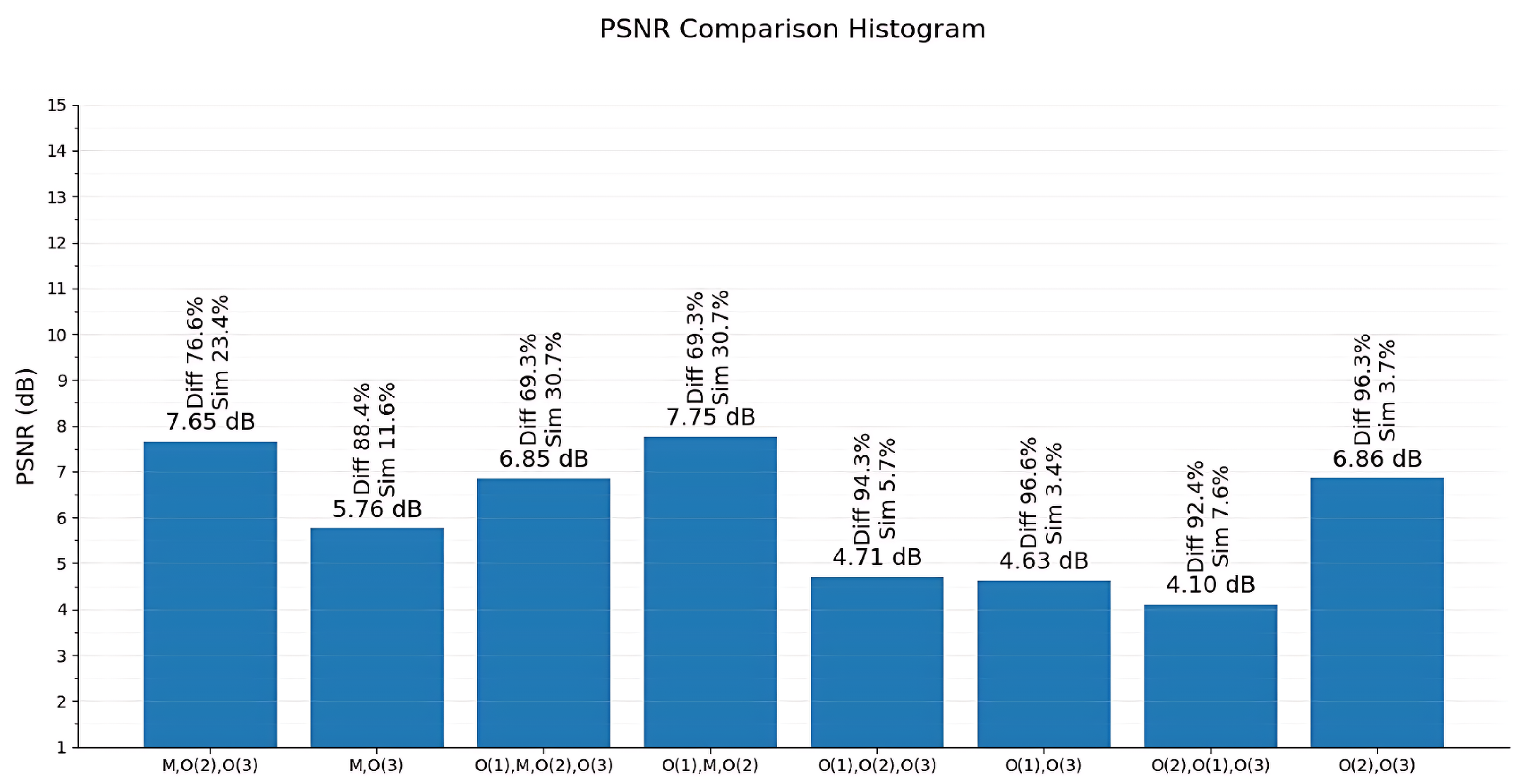
| OMO | Partial Authorized | M, , | ∼8.4 to 8.7 | Pixel similarity without full structure |
| OMO | Unauthorized | , | ∼4.8 | Fake or noise output |
| OMOO | Authorized | , M, , | ∼6.8 | Stable authorized reconstruction |
| OOMO | Authorized | , , M, | ∼6.9 | Master-position invariant behavior |
| OOMOO | Authorized | , , M, , | ∼6.2 | Scalable reconstruction with more shares |
| Any | Unauthorized | Ordinary shares only | 4.0 to 4.9 | No meaningful pixel-level similarity |
| Image Resolution | Authorized SSIM Range | Unauthorized SSIM Range | Observation |
|---|---|---|---|
| 0.57 to 0.65 | −0.06 to 0.05 | Structural separation visible even at low resolution | |
| 0.55 to 0.62 | −0.16 to 0.03 | Improved stability with increased resolution | |
| 0.49 to 0.56 | −0.08 to 0.04 | Clear authorized vs. unauthorized distinction | |
| 0.39 to 0.49 | −0.03 to 0.02 | Consistent structural preservation at higher resolution |
| Configuration | Stacking Type | Representative Pattern | SSIM | Structural Interpretation |
|---|---|---|---|---|
| OMO | Authorized | , M, | ∼0.49 | Clearly recognizable structure |
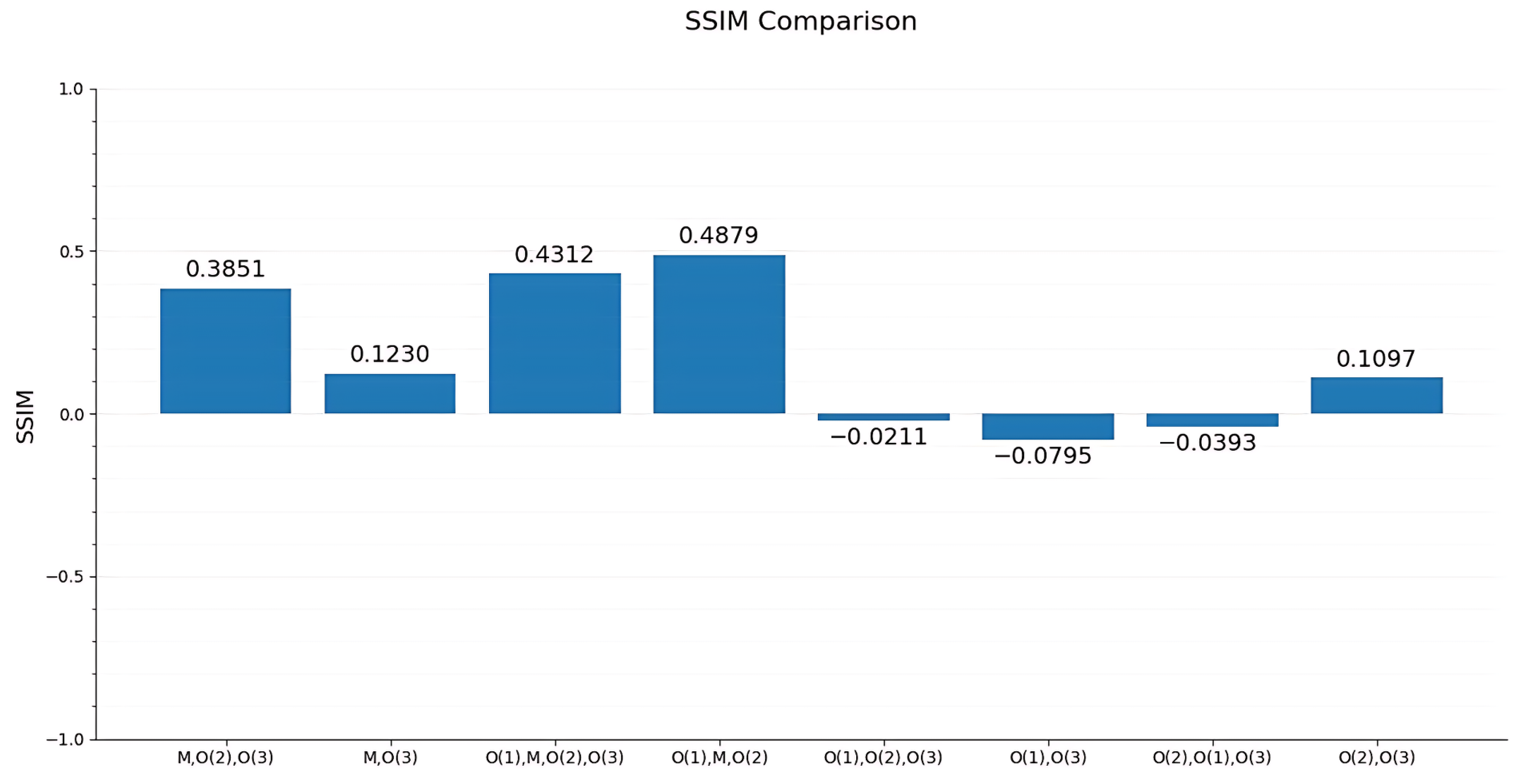
| OMO | Partial | M, , | ∼0.38–0.41 | Partial structural preservation |
| OMOO | Authorized | , M, , | ∼0.43 | Stable structural reconstruction |
| OOMO | Authorized | , , M, | ∼0.43 | Master-position invariant |
| OOMOO | Authorized | , , M, , | ∼0.39 | Scalable structural fidelity |
| Any | Unauthorized | Ordinary shares only | ≈0 or negative | No meaningful structure |
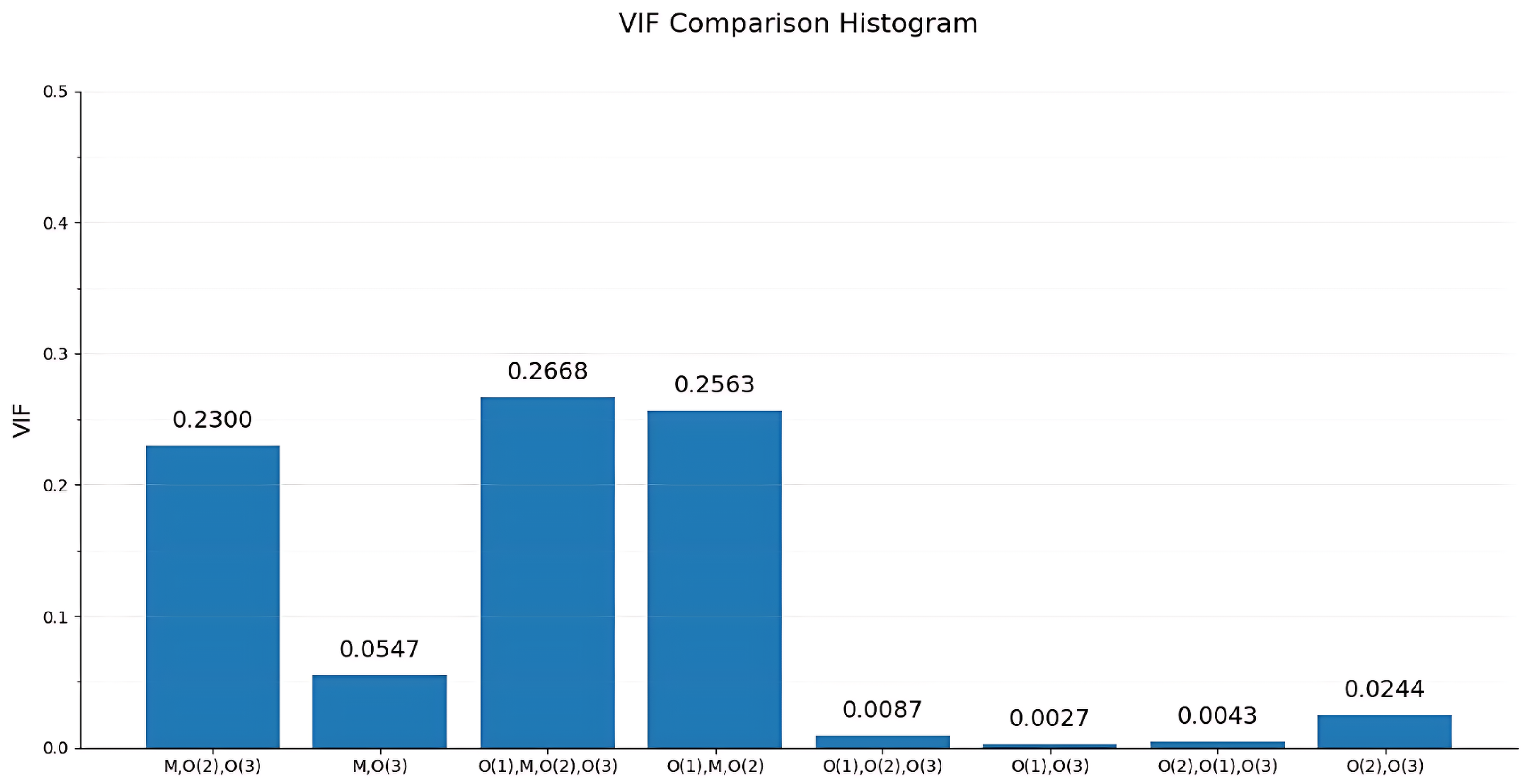
| Image Resolution | Authorized VIF Range | Unauthorized VIF Range | Observation |
|---|---|---|---|
| 0.16 to 0.21 | 0.00 to 0.03 | Limited but distinguishable perceptual information | |
| 0.22 to 0.24 | 0.00 to 0.02 | Improved visual fidelity with resolution | |
| ∼0.24 | ≈0 | Stable perceptual separation | |
| 0.25 to 0.29 | ≈0 | Strong perceptual recognizability |
| Configuration | Stacking Type | Representative Pattern | VIF | Perceptual Interpretation |
|---|---|---|---|---|
| OMO | Authorized | , M, | ∼0.26 | Clearly recognizable |
| OMO | Partial | M, , | ∼0.20 | Partial visual information |
| OMOO | Authorized | , M, , | ∼0.27 | Stable perceptual fidelity |
| OOMO | Authorized | , , M, | ∼0.26 | Master-position invariant |
| OOMOO | Authorized | , , M, , | ∼0.29 | Enhanced perceptual fidelity |
| Any | Unauthorized | Ordinary shares only | ≈0 | No perceptual information |
| Aspect | Classical/Random-Grid VSS | Polarization-Based VSS | Verifiable/Cheating-Prevention VSS | Proposed Scheme |
|---|---|---|---|---|
| Uses polarization | No | Yes | No or limited | Yes |
| Probabilistic share assignment | No | No | No | Yes (PDT-based) |
| Explicit master share | No | Limited or implicit | No | Yes |
| Authorized reconstruction requirement | Threshold-based | Orientation-dependent | Threshold + verification | Master-controlled optical ordering |
| Unauthorized reconstruction outcome | Noise or degraded secret | Partial information leakage possible | Rejected or flagged | Fake image or random output |
| Cheating mitigation approach | Passive degradation | Passive degradation | Cheater detection | Active deception |
| Resistance to adaptive stacking | Limited | Limited | Depends on verification | High |
| Additional verification overhead | No | No | Yes | No |
Disclaimer/Publisher’s Note: The statements, opinions and data contained in all publications are solely those of the individual author(s) and contributor(s) and not of MDPI and/or the editor(s). MDPI and/or the editor(s) disclaim responsibility for any injury to people or property resulting from any ideas, methods, instructions or products referred to in the content. |
© 2026 by the authors. Licensee MDPI, Basel, Switzerland. This article is an open access article distributed under the terms and conditions of the Creative Commons Attribution (CC BY) license.
Share and Cite
JadidAhabab, S.; Rai, L. Probability Distribution Tree-Based Dishonest-Participant-Resistant Visual Secret Sharing Using Linearly Polarized Shares. Algorithms 2026, 19, 153. https://doi.org/10.3390/a19020153
JadidAhabab S, Rai L. Probability Distribution Tree-Based Dishonest-Participant-Resistant Visual Secret Sharing Using Linearly Polarized Shares. Algorithms. 2026; 19(2):153. https://doi.org/10.3390/a19020153
Chicago/Turabian StyleJadidAhabab, Shuvroo, and Laxmisha Rai. 2026. "Probability Distribution Tree-Based Dishonest-Participant-Resistant Visual Secret Sharing Using Linearly Polarized Shares" Algorithms 19, no. 2: 153. https://doi.org/10.3390/a19020153
APA StyleJadidAhabab, S., & Rai, L. (2026). Probability Distribution Tree-Based Dishonest-Participant-Resistant Visual Secret Sharing Using Linearly Polarized Shares. Algorithms, 19(2), 153. https://doi.org/10.3390/a19020153