

Optimized Energy Consumption of Electric Vehicles with Driving Pattern Recognition for Real Driving Scenarios




Abstract
1. Introduction
2. DPR for Roadway and Traffic Type Classification
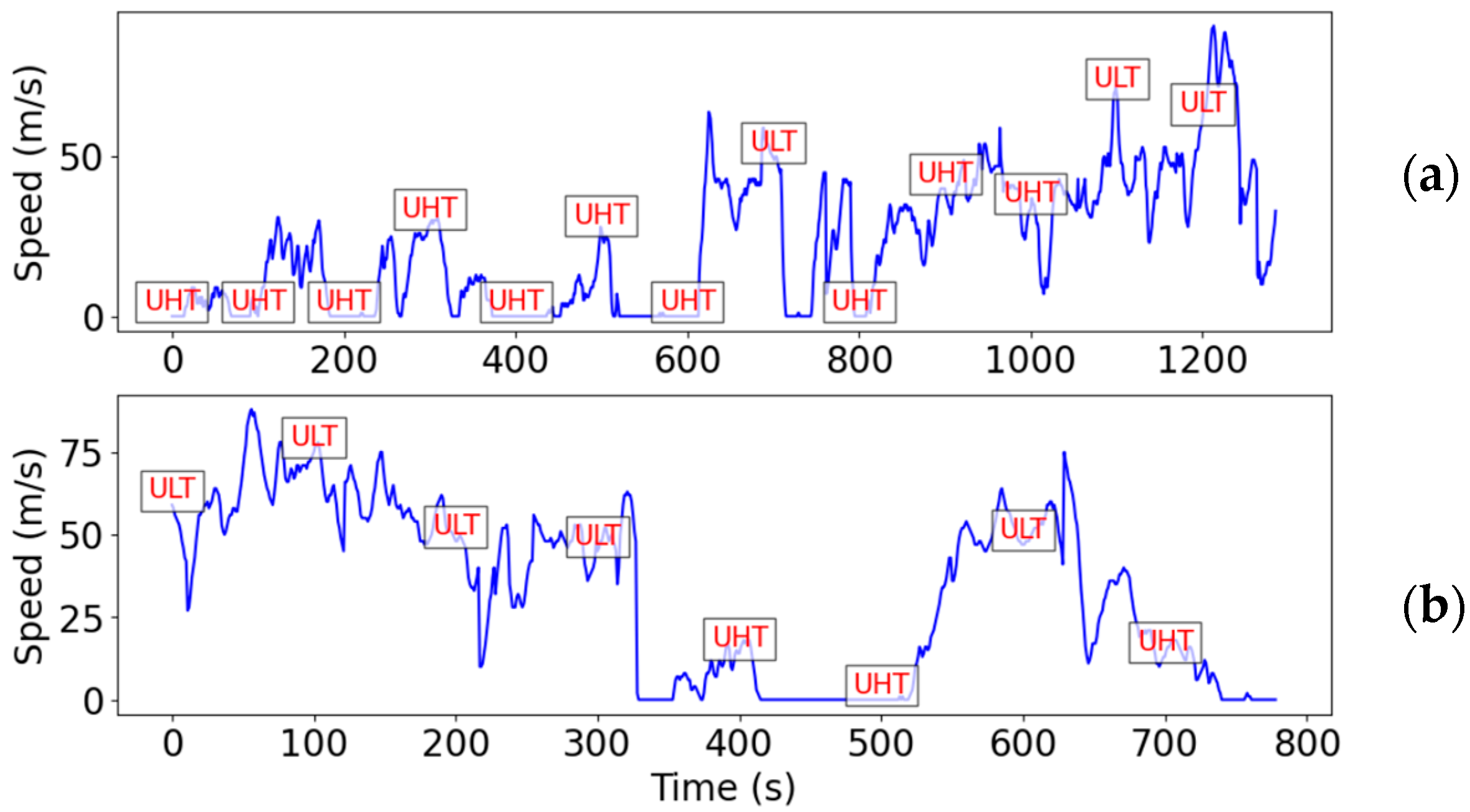
2.1. Data Analysis and Formation of RDPs
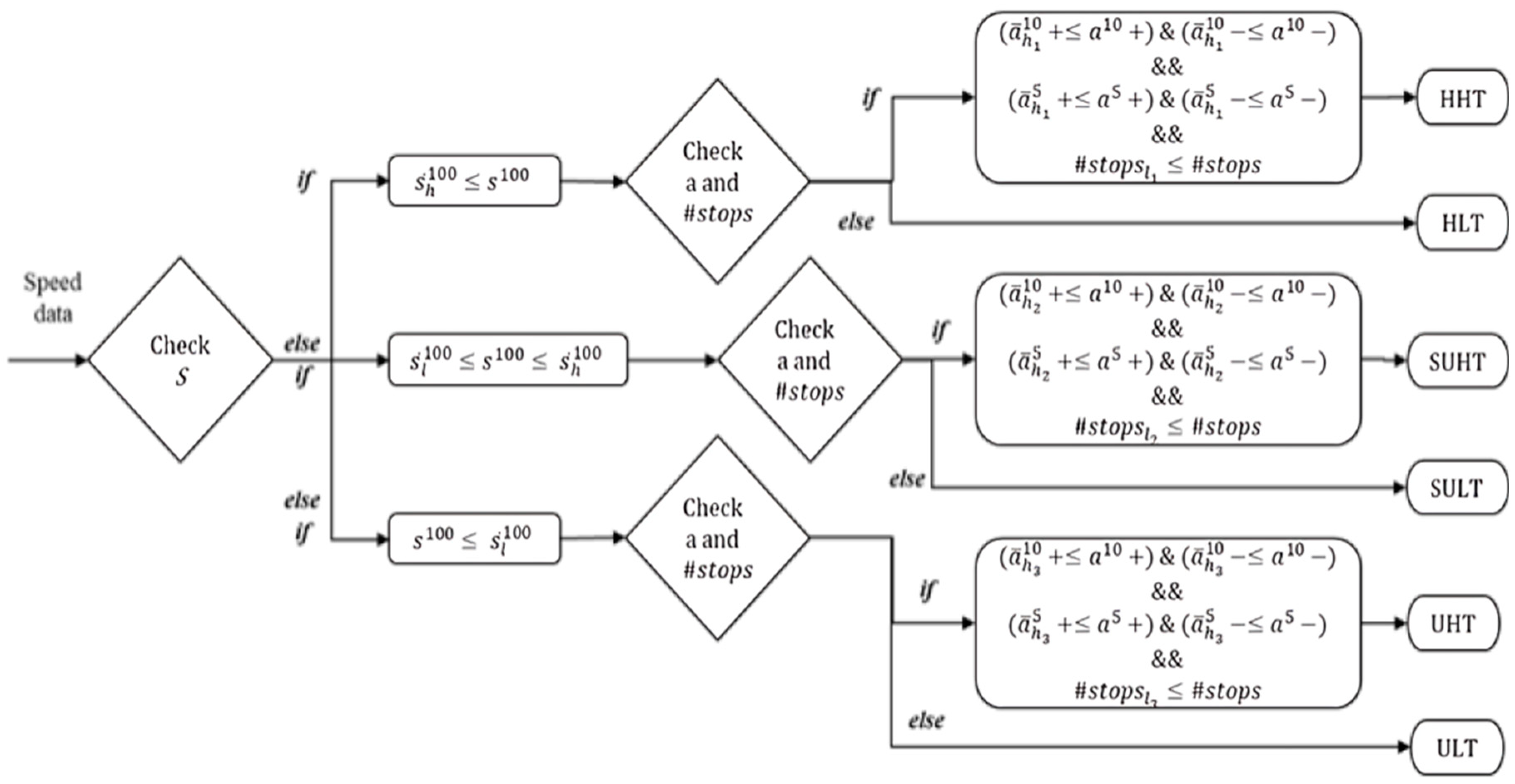
- Case 1: If , then an estimate is made about the roadway type being a highway. If , , , , and , the traffic condition is considered to be high traffic, and otherwise low traffic type.
- Case 2: If then the road condition is considered to be suburban. If , , , , and , then the traffic condition is considered to be high traffic, and otherwise low traffic type.
- Case 3: If then the road condition is considered to be urban. If , , , , and , then the traffic condition is considered to be high traffic, and otherwise low traffic type.
2.2. Classification Employing MLPNN
2.3. Energy Consumption of the EV
2.4. EMS Problem Formulation Using SQP
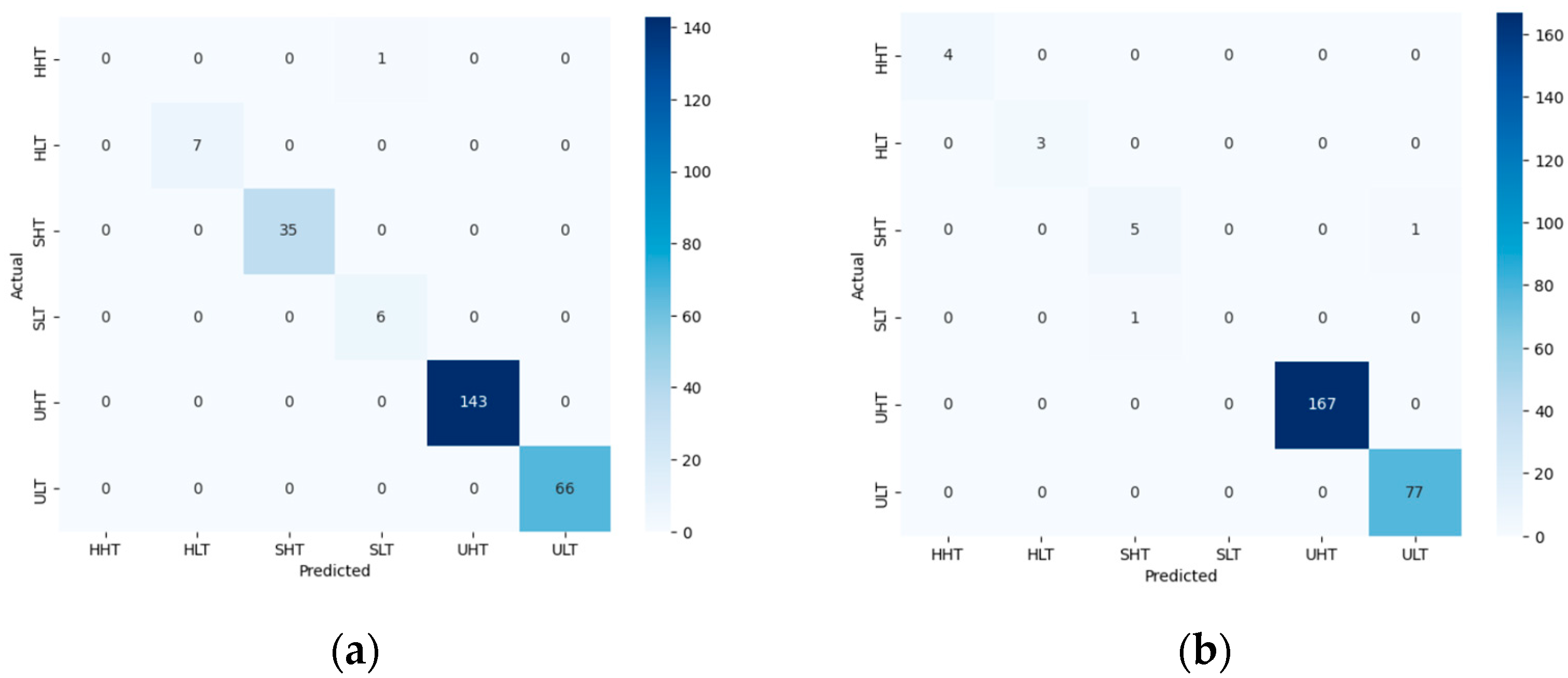
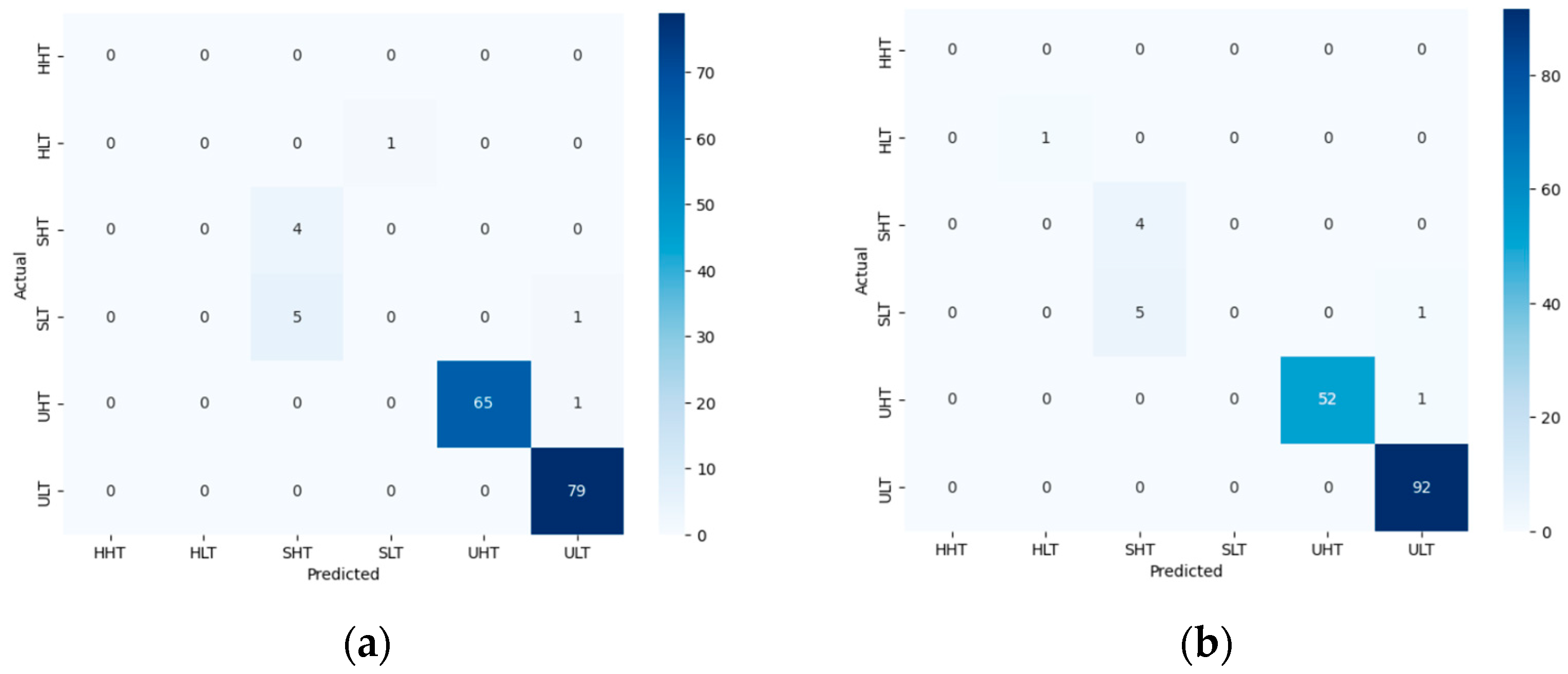
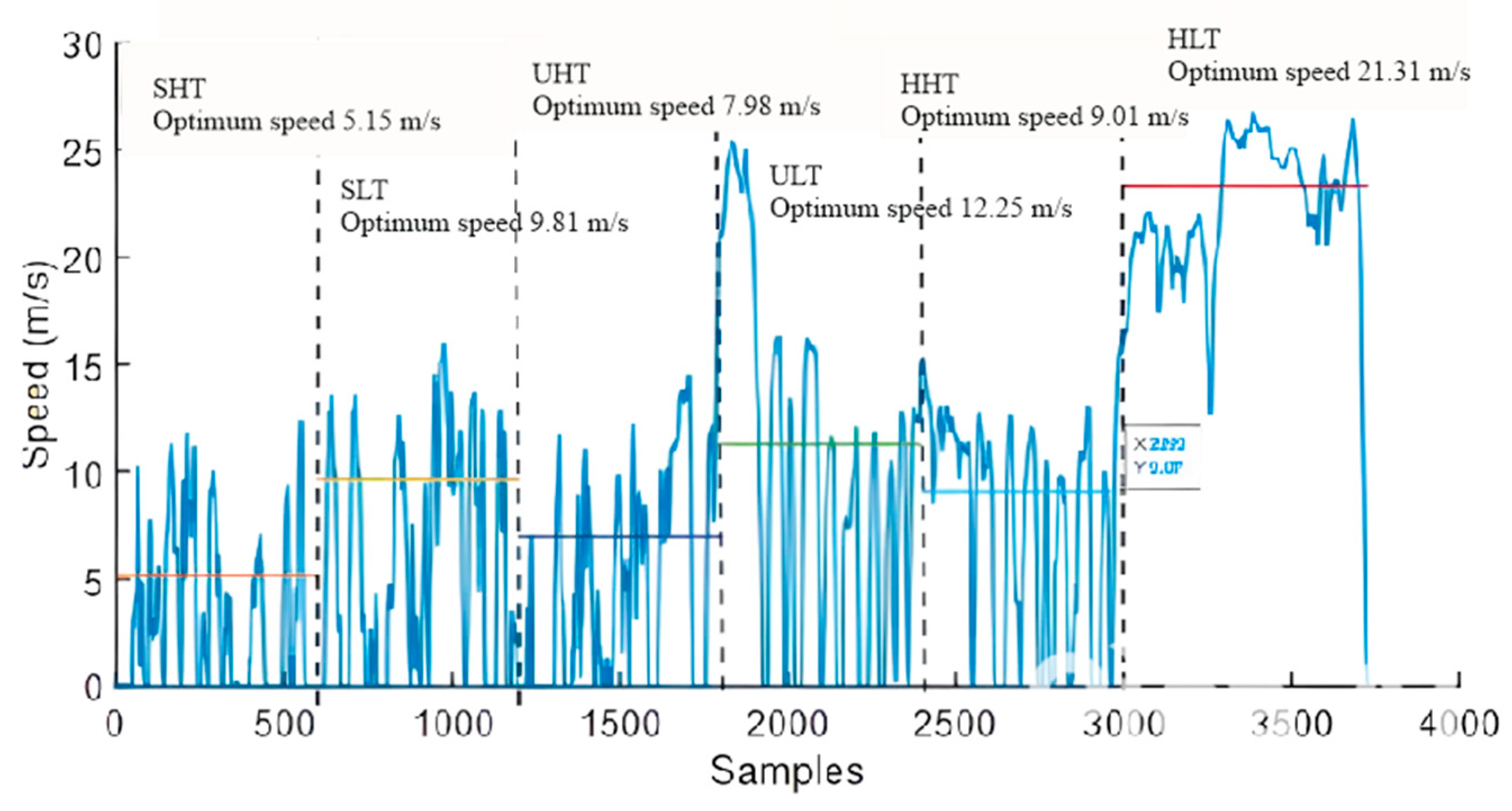
3. Results and Discussion
4. Conclusions
Author Contributions
Funding
Data Availability Statement
Conflicts of Interest
References
- Al-Dhaifallah, M.; Ali, Z.M.; Alanazi, M.; Dadfar, S.; Fazaeli, M.H. An efficient short-term energy management system for a microgrid with renewable power generation and electric vehicles. Neural Comput. Appl. 2021, 33, 16095–16111. [Google Scholar] [CrossRef] [Scilit]
- Aldosary, A.; Rawa, M.; Ali, Z.M.; Latifi, M.; Razmjoo, A.; Rezvani, A. Energy management strategy based on short-term resource scheduling of a renewable energy-based microgrid in the presence of electric vehicles using θ-modified krill herd algorithm. Neural Comput. Appl. 2021, 33, 10005–10020. [Google Scholar] [CrossRef] [Scilit]
- Zhang, F.; Xiao, L.; Coskun, S.; Pang, H.; Xie, S.; Liu, K.; Cui, Y. Comparative study of energy management in parallel hybrid electric vehicles considering battery ageing. Energy 2023, 264, 123219. [Google Scholar] [CrossRef] [Scilit]
- Kong, H.; Yan, J.; Wang, H.; Fan, L. Energy management strategy for electric vehicles based on deep Q-learning using Bayesian optimization. Neural Comput. Appl. 2020, 32, 14431–14445. [Google Scholar] [CrossRef] [Scilit]
- Son, N.N.; Van Cuong, N. Neuro-evolutionary for time series forecasting and its application in hourly energy consumption prediction. Neural Comput. Appl. 2023, 35, 21697–21707. [Google Scholar] [CrossRef] [Scilit]
- Zhang, J.; Xu, F.; Zhang, Y.; Shen, T. ELM-based driver torque demand prediction and real-time optimal energy management strategy for HEVs. Neural Comput. Appl. 2020, 32, 14411–14429. [Google Scholar] [CrossRef] [Scilit]
- Ali, M.A.; Moulik, B. On the role of intelligent power management strategies for electrified vehicles: A review of predictive and cognitive methods. IEEE Trans. Transp. Electrif. 2022, 1, 368–383. [Google Scholar] [CrossRef] [Scilit]
- Hu, J.; Niu, X.; Jiang, X.; Zu, G. Energy management strategy based on driving pattern recognition for a dual-motor battery electric vehicle. Int. J. Energy Res. 2019, 43, 3346–3364. [Google Scholar] [CrossRef] [Scilit]
- Zhou, B.; Zhao, Z. Multi-objective optimization of electric vehicle routing problem with battery swap and mixed time windows. Neural Comput. Appl. 2022, 34, 7325–7348. [Google Scholar]
- Zhang, S.; Xiong, R. Adaptive energy management of a plug-in hybrid electric vehicle based on driving pattern recognition and dynamic programming. Appl. Energy 2015, 155, 68–78. [Google Scholar] [CrossRef] [Scilit]
- Hu, J.; Liu, D. Intelligent energy management strategy of hybrid energy storage system for electric vehicle based on driving pattern recognition. Energy 2020, 198, 117298. [Google Scholar] [CrossRef] [Scilit]
- Zhang, R.; Tao, J.; Zhou, H. Fuzzy optimal energy management for fuel cell and supercapacitor systems using neural network based driving pattern recognition. IEEE Trans. Fuzzy Syst. 2019, 27, 45–57. [Google Scholar] [CrossRef] [Scilit]
- Wei, Z.; Xu, Z.; Halim, D. Study of HEV power management control strategy based on driving pattern recognition. Energy Procedia 2016, 88, 847–853. [Google Scholar] [CrossRef] [Scilit]
- Kandi Dayeni, M.; Soleymani, M. Intelligent energy management of a fuel cell vehicle based on traffic condition recognition. Clean Technol. Environ. Policy 2016, 18, 1945–1960. [Google Scholar] [CrossRef] [Scilit]
- Zhou, Y.; Ravey, A.; Péra, M.C. Multi-mode predictive energy management for fuel cell hybrid electric vehicles using Markov driving pattern recognizer. Appl. Energy 2020, 258, 114057. [Google Scholar] [CrossRef] [Scilit]
- Lei, Z.; Cheng, D.; Liu, Y.; Qin, D.; Zhang, Y.; Xie, Q. A dynamic control strategy for hybrid electric vehicles based on parameter optimization for multiple driving cycles and driving pattern recognition. Energies 2017, 10, 54. [Google Scholar] [CrossRef] [Scilit]
- Keulen, T.V.; De Jager, B.; Kessels, J.; Steinbuch, M. Energy management in hybrid electric vehicles: Benefit of prediction. IFAC Proc. 2010, 43, 264–269. [Google Scholar] [CrossRef] [Scilit]
- Yokoi, Y.; Ichikawa, S.; Doki, S.; Okuma, S.; Naitou, T.; Shiimado, T.; Miki, N. Driving pattern prediction for an energy management system of hybrid electric vehicles in a specific driving course. In Proceedings of the 30th Annual Conference of IEEE Industrial Electronics Society, Busan, Republic of Korea, 2–6 November 2004; Volume 2, pp. 1727–1732. [Google Scholar]
- He, H.; Sun, C.; Zhang, X. A method for identification of driving patterns in hybrid electric vehicles based on a LVQ Neural Network. Energies 2022, 9, 3363–3380. [Google Scholar] [CrossRef] [Scilit]
- Kajiwara, S. Driver-condition detection using a thermal imaging camera and neural networks. Int. J Automot. Technol. 2021, 22, 1505–1515. [Google Scholar] [CrossRef] [Scilit]
- Mehranfar, S.; Banagar, I.; Moradi, J.; Andwari, A.M.; Könnö, J.; Gharehghani, A.; Rabiei, M.; Kurvinen, E. The perspective of energy storage systems advancements and challenges for electric vehicle applications; metric, mechanism, mode, and mitigation framework. Future Sustain. 2024, 2, 22–32. [Google Scholar] [CrossRef] [Scilit]
- Habib, A.R.R.; Butler, K. Environmental and economic comparison of hydrogen fuel cell and battery electric vehicles. Future Technol. 2022, 1, 25–33. [Google Scholar] [CrossRef] [Scilit]
- Moulik, B.; Kaur, S.; Ranjan, S.; Dixit, S. Analysing the Energy Consumption of Urban Electric Vehicles for Real Driving Scenarios. IETE J. Res. 2024, 70, 5799–5809. [Google Scholar] [CrossRef] [Scilit]
- Li, M.; Wu, X.; He, X.; Yu, G.; Wang, Y. An eco-driving system for electric vehicles with signal control under V2X environment. Trans. Res. Part C Emerg. Technol. 2018, 93, 335–350. [Google Scholar]
- Zhang, Y.; Liu, Y.; Huang, Y.; Chen, Z.; Li, G.; Hao, W.; Cunningham, G.; Early, J. An optimal control strategy design for plug-in hybrid electric vehicles based on internet of vehicles. Energy 2021, 228, 120631. [Google Scholar]
- López-Rojas, A.D.; Cruz-Villar, C.A. Neural networks as an approximator for a family of optimization algorithm solutions for online applications. Neural Comput. Appl. 2024, 36, 3125–3140. [Google Scholar]
- Khalik, Z.; Padilla, G.P.; Romijn, T.C.J.; Donkers, M.C.F. Vehicle energy management with ecodriving: A sequential quadratic programming approach with dual decomposition. In Proceedings of the 2018 Annual American Control Conference (ACC), Milwaukee, WI, USA, 27–29 June 2018; pp. 4002–4007. [Google Scholar]



| Characteristic Features | Different Standard Drive Cycles | |||
|---|---|---|---|---|
| NYCC | Artemis Urban | UDDS | HWFET | |
| Avg. Drive Speed (m/s) | 4.62 | 6.19 | 10.16 | 21.6 |
| No. of Stops | 7 | 14 | 14 | 1 |
| S.D. (σ) of Speed (m/s) | 3.39 | 4.46 | 5.96 | 4.44 |
| 5 s Avg. Speed (m/s) | 3.19 | 4.91 | 8.75 | 21.577 |
| 10 s Avg. Speed (m/s) | 3.21 | 4919 | 8.79 | 21.71 |
| 100 s Avg. Speed (m/s) | 3.11 | 4.7 | 8.98 | 21.78 |
| 1 s Avg. Acceleration (m/s2) | 3.19 | 4.91 | 8.75 | 21.577 |
| 5 s Avg. Acceleration (m/s2) | 3.21 | 4.919 | 8.79 | 21.71 |
| 10 s Avg. Acceleration (m/s2) | 3.11 | 4.77 | 8.98 | 21.78 |
| Hyperparameters | Specifications |
|---|---|
| Input layer | 10 inputs |
| Hidden layer | 4 neurons |
| Output layer | 6 outputs |
| Activation function | ReLU |
| Loss function | Cross-entropy |
| Learning rate | Function of quadratic approximation of loss |
| Optimizer | Gradient descent |
| Training data | 19,922 speed data values |
| Train-test split | 80–20% |
| Parameter | Specifications |
|---|---|
| Vehicle mass | 2000 kg |
| Frontal area | 1.6 m2 |
| Aerodynamic drag coefficient | 0.3 |
| Rolling resistance coefficient | 0.01 |
| Wheel radius | 0.28 m |
| Battery capacity | 70 kWh |
| Test Routes | Source | Destination | Distance Traveled | Road Type | Time of Data Collection |
|---|---|---|---|---|---|
| Test route 1 | 12.58532° N 77.4335° E | 12.5523° N 77.4106° E | 12.4 km | Urban | Early morning and evening |
| Test route 2 | 23.0306° N 88.1351° E | 23.0962° N 88.0814° E | 15.2 km | Highway | Early morning and evening |
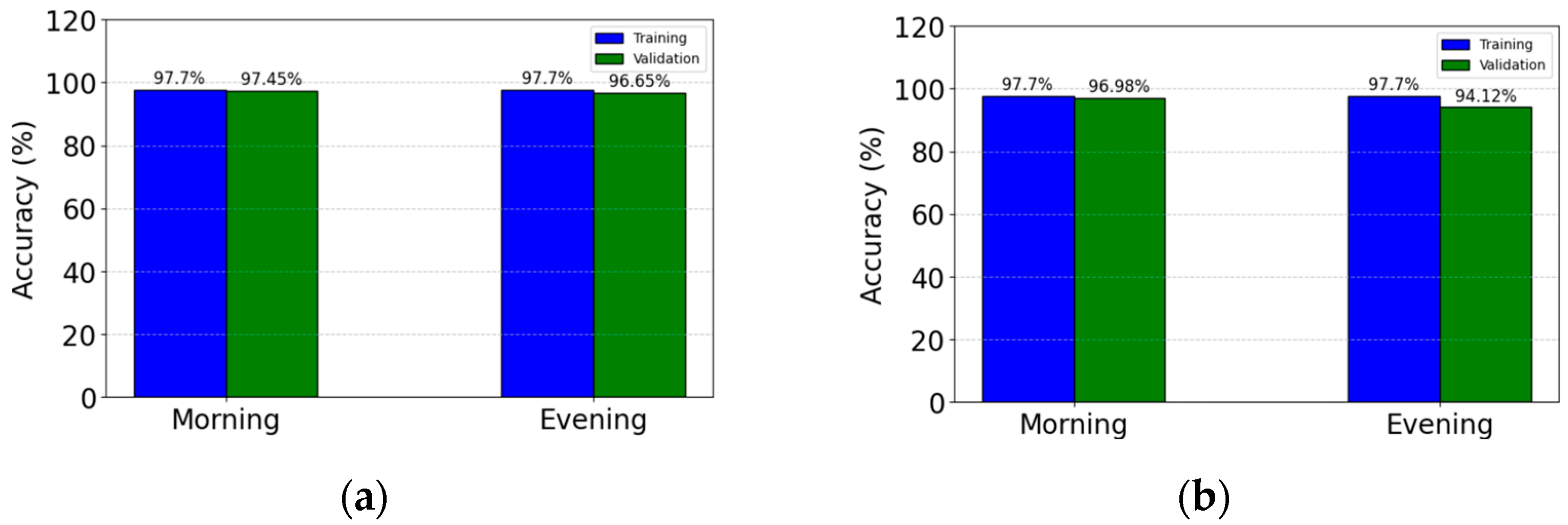
| Speed Sampling Interval | Acceleration Sampling Interval | Training Accuracy | Training Loss | Validation Accuracy | Validation Loss |
|---|---|---|---|---|---|
| Data collection timing: early morning | |||||
| 100 s | 100 s | 0.7750 | 0.9920 | 0.7566 | 0.8190 |
| 10 s | 0.9777 | 0.0229 | 0.9622 | 0.0239 | |
| 5 s | 0.9745 | 0.0265 | 0.9961 | 0.0260 | |
| Data collection timing: evening | |||||
| 100 s | 100 s | 0.4580 | 0.8997 | 0.5632 | 0.8921 |
| 10 s | 0.9777 | 0.0452 | 0.9665 | 0.1479 | |
| 5 s | 0.9710 | 0.0322 | 0.9691 | 0.1098 | |
| Test route 1 | ||
| F-score | p-value | |
| Speed | 612.2230 | 0.00145 |
| Positive acceleration | 123.9876 | 0.00169 |
| Negative acceleration | 97.8761 | 0.00213 |
| No. of stops | 12.67 | 0.0315 |
| Test route 2 | ||
| F-score | p-value | |
| Speed | 997.2367 | 0.00345 |
| Positive acceleration | 432.2166 | 0.00193 |
| Negative acceleration | 398.1298 | 0.00321 |
| No. of stops | 2.11 | 0.0398 |
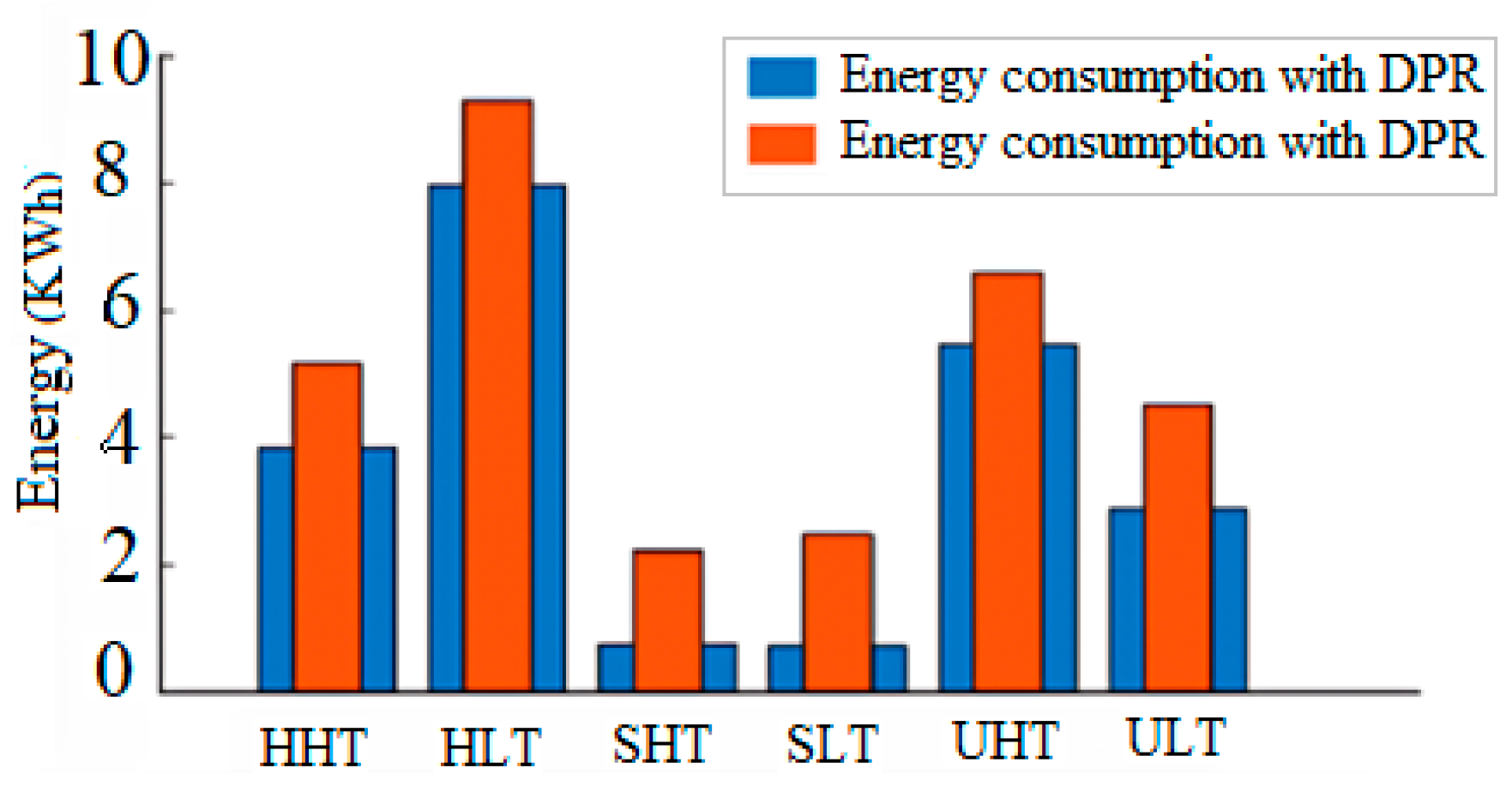
| RDPs | Energy Consumption (kWh) | Error Observed (kWh) |
|---|---|---|
| Highway High Traffic | 3.825 | 5.1 |
| Highway Low Traffic | 7.96 | 7.2 |
| Suburban High Traffic | 0.985 | 0.9 |
| Suburban Low Traffic | 0.964 | 0.5 |
| Urban High Traffic | 5.46 | 3.3 |
| Urban Low Traffic | 2.87 | 2.7 |
| Representative Pattern | Optimum Speed (m/s) | Optimum Energy (kWh) |
|---|---|---|
| Highway High Traffic | 9.07 | 3.1356 |
| Highway Low Traffic | 23.31 | 4.94 |
| Suburban High Traffic | 5.171 | 0.565 |
| Suburban Low Traffic | 9.61 | 0.552 |
| Urban High Traffic | 6.996 | 2.94 |
| Urban Low Traffic | 11.25 | 1.351 |
Disclaimer/Publisher’s Note: The statements, opinions and data contained in all publications are solely those of the individual author(s) and contributor(s) and not of MDPI and/or the editor(s). MDPI and/or the editor(s) disclaim responsibility for any injury to people or property resulting from any ideas, methods, instructions or products referred to in the content. |
© 2025 by the authors. Licensee MDPI, Basel, Switzerland. This article is an open access article distributed under the terms and conditions of the Creative Commons Attribution (CC BY) license (https://creativecommons.org/licenses/by/4.0/).
Share and Cite
Moulik, B.; Kaur, S.; Ijaz, M. Optimized Energy Consumption of Electric Vehicles with Driving Pattern Recognition for Real Driving Scenarios. Algorithms 2025, 18, 204. https://doi.org/10.3390/a18040204
Moulik B, Kaur S, Ijaz M. Optimized Energy Consumption of Electric Vehicles with Driving Pattern Recognition for Real Driving Scenarios. Algorithms. 2025; 18(4):204. https://doi.org/10.3390/a18040204
Chicago/Turabian StyleMoulik, Bedatri, Sanmukh Kaur, and Muhammad Ijaz. 2025. "Optimized Energy Consumption of Electric Vehicles with Driving Pattern Recognition for Real Driving Scenarios" Algorithms 18, no. 4: 204. https://doi.org/10.3390/a18040204
APA StyleMoulik, B., Kaur, S., & Ijaz, M. (2025). Optimized Energy Consumption of Electric Vehicles with Driving Pattern Recognition for Real Driving Scenarios. Algorithms, 18(4), 204. https://doi.org/10.3390/a18040204