

Abstract
In this paper, algorithms for calculating different types of generalized trigonometric and hyperbolic functions are developed and presented. The main attention is focused on the Ateb-functions, which are the inverse functions to incomplete Beta-functions. The Ateb-functions can generalize every kind of implementation where trigonometric and hyperbolic functions are used. They have been successfully applied to vibration motion modeling, data protection, signal processing, and others. In this paper, the Fourier transform’s generalization for periodic Ateb-functions in the form of Ateb-transform is determined. Continuous and discrete Ateb-transforms are constructed. Algorithms for their calculation are created. Also, Ateb-transforms with one and two parameters are considered, and algorithms for their realization are built. The quantum calculus generalization for hyperbolic Ateb-functions is constructed. Directions for future research are highlighted.
1. Introduction
The inspiration for this article is [1]. If the constructions of simple trigonometric functions are fascinating and their formulas elegant, their generalizations should retain these same properties. In this article, algorithms are presented for the generalized trigonometric function in the form of calculation Ateb-functions. First introduced in the late nineteenth century in [2], these functions were reintroduced and named Ateb-functions in [3]. Though considered rare or specific [4], Ateb-functions have been the focus of significant theoretical development and practical implementations since the 1960s, with continuous progress to this day.
The theory of Ateb-functions has seen significant advancements as detailed in [5,6,7]. In these works, the authors demonstrate that periodic Ateb-functions serve as solutions to a system of differential equations that model vibrational motion. Additionally, the application of Ateb-functions for data protection is explored in [8,9]. The Ateb-Gabor filter, an extension of the traditional Gabor filter, was introduced in [10,11] and has proven to be an effective tool for information protection. Initial quantum research findings are discussed in [12].
The theory of Ateb-functions and Ateb-transforms is advanced in this article, making significant contributions to modern applied mathematics. Additionally, a generalization of Ateb-functions for quantum calculus is introduced. The primary goal of this research is to develop algorithms for calculating Ateb-transforms. The research also explores the generalization of hyperbolic Ateb-functions in fractional calculus. The paper is structured as follows: Section 2 provides a brief overview of the Ateb-function theory. Section 3 introduces the well-known definitions and Ateb-function properties. The algorithms for the calculation of hyperbolic Ateb-functions are developed in Section 4. In Section 5, a Fourier transform generalization named Ateb-transform is introduced for the continuous case. Ateb-transforms in a discrete case are considered in Section 6. The algorithms for their calculus are developed. In Section 7, the Ateb-function generalization for quantum calculus is constructed. The conclusion summarizes the investigation and suggests directions for future research.
2. State of the Art
The concept of Ateb-functions is intricately associated with asymptotic techniques in engineering [13], as evidenced in various studies [8,9]. Following the influential publication of [3], significant advancements in Ateb-functions throughout the 20th century were primarily made at the University of Novi Sad in Serbia and Lviv Polytechnic National University in Ukraine. More than a hundred scholarly articles by Serbian researchers have enriched this area of study. Although this paper does not aim to provide an exhaustive review of these contributions, it is worth highlighting a few significant works, such as the recent research presented in [7], which offers analytical solutions for a model that illustrates oscillatory motion with two degrees of freedom and Van der Pol coupling. Furthermore, book [6] delves into various aspects of modeling oscillatory motion.
The theory of Ateb-functions began to take shape in Ukraine through the work published in [14,15]. The integration and differentiation formulas for these functions are presented in [16]. Their use in generating noise signals is thoroughly examined in [9], highlighting the benefit of being able to modify the characteristics of the noise signal by choosing suitable parameters for the Ateb-functions. Furthermore, periodic Ateb-functions are utilized for modeling traffic in computer network as discussed in [17]. Reference [18] also investigates how analytical solutions using Ateb-functions can be employed to analyze the effects of oscillation amplitude and the elastic properties of board materials on the oscillation frequency of machine control components.
In the 21st century, there has been a notable increase in research surrounding Ateb-functions across various regions. Reference [19] discusses these functions using alternative terminology, labeling them as generalized trigonometric functions without specifically mentioning Ateb-functions. In [20], the authors derive analytical solutions for nonlinear oscillators that extend an isotonic potential. The relationship between Ateb-functions and other forms of generalized trigonometric functions is introduced in [21] and further examined in [22]. Additionally, fractional calculus related to trigonometric and other functions, along with their characteristics, is elaborated upon in [23,24,25,26]. Despite their specific properties, Ateb-functions find extensive applications in various areas of mathematical modeling. Expanding their framework within fractional calculus is anticipated to greatly enhance their utility for different applications.
3. Definitions and Properties of Ateb-Functions
In this section, we show the nonlinear first-order differential equation system solution based on Ateb-functions. The results presented in this section are based mainly on references [3,8,9].
The concept of Ateb-functions facilitates the analytical solution of differential equation systems that characterize highly nonlinear processes in a medium with one degree of freedom
where and are some real constants, and
Ateb-functions are mathematically defined through the inversion of the incomplete Beta-function. This approach not only defines these functions but also inspired their name, as Ateb is derived from inversing the term Beta. An incomplete Beta-function is defined by the next formula
where p and q are real numbers. In the special case where , Equation (3) is simplified to the first-kind Euler integral:
which represents the Beta-function, denoted as .
For each x from the interval [0, 1], functions and defined by expressions (3) and (4), are non-negative and satisfy the following properties:
Let us discuss two specific cases:
where m and n are determined by Formula (2). When p > 0 and q > 0, then the Beta-function is well defined and determined. For other real values of p and q, the Beta function heads to infinity at or at .
Ateb-functions for values (5) are named periodical, and those for values (6) are named hyperbolic or aperiodic Ateb-functions. System (1), if parameters m, n satisfy Formula (5), describes oscillatory motion, and, if m, n satisfy Formula (6), it describes hyperbolic or aperiodic motion.
If m = 1 and n is defined by (2), then system (1) can be rewritten as:
where depends on the parameters in Formula (2).
Let us evaluate the expression
where parameters m, n are determined by (5) and (2). Let us perform the placement of variable
Equation (8) is transformed into the following expression
In Formula (10), has a dependence from variable v, and from the parameters m and n. For the construction of Ateb-functions, we study the inverse dependence of v from . This function is unique-valued m and n, and the Ateb-sinus has a notation
Analogously, by substitution of the expression from Formula (8) we obtain the following formula
For function u from for integral (12), there is a dependence m and n which is presented as Ateb-cosines and is noted as
Then, we prove the equation for Ateb-functions with periodical properties
From (10) and (12), it is clear: if n = m = 1, then we obtain the main trigonometrical identity and , so Ateb-functions are generalizations for simple trigonometrical functions.
Also, it is proven that periodic Ateb-functions have period where
In (15), is a Gamma-function.
For the creation of solutions for the differential equation system (1) in the case of (6) conditions, hyperbolic Ateb-functions are introduced.
Let us study the next expression
where is an independent variable , and m and n are parametrical variables, that are defined by expressions (2) and satisfy aperiodic conditions:
Let us perform the variable substitution ; then, we obtain
The dependence V from , and from the parameters m and n, from the integral (18), is called hyperbolic Ateb-sine and is noted
In a similar way, by the variable substitution , we obtain for the integral (15)
The inverse dependence U from variable , and from the parameters m and n is named hyperbolic Ateb-cosines. It is noted as
Hyperbolic Ateb-functions are defined in the interval, which can be calculated with the following formula:
So hyperbolic Ateb-functions are defined in the interval
4. Methods for Implementing Calculations of Hyperbolic Ateb-Functions
We use the Fourier series expansion to implement the calculations of Ateb-functions. Here is a well-known theorem from mathematical analysis: if a periodic function with period is piecewise monotone and bounded on the interval , then the Fourier series constructed for this function is convergent at all points in this interval. For hyperbolic Ateb-sine and Ateb-cosine, these conditions are executed in the interval So these functions can be expanded on this segment with a Fourier series. Since hyperbolic functions are differentiable, the Fourier series are convergent in the interval And the hyperbolic cosine is an even function, so we obtain
where
Since the hyperbolic sine is an odd function, we obtain the following Fourier series
Coefficients in this series are calculated according to the formulas
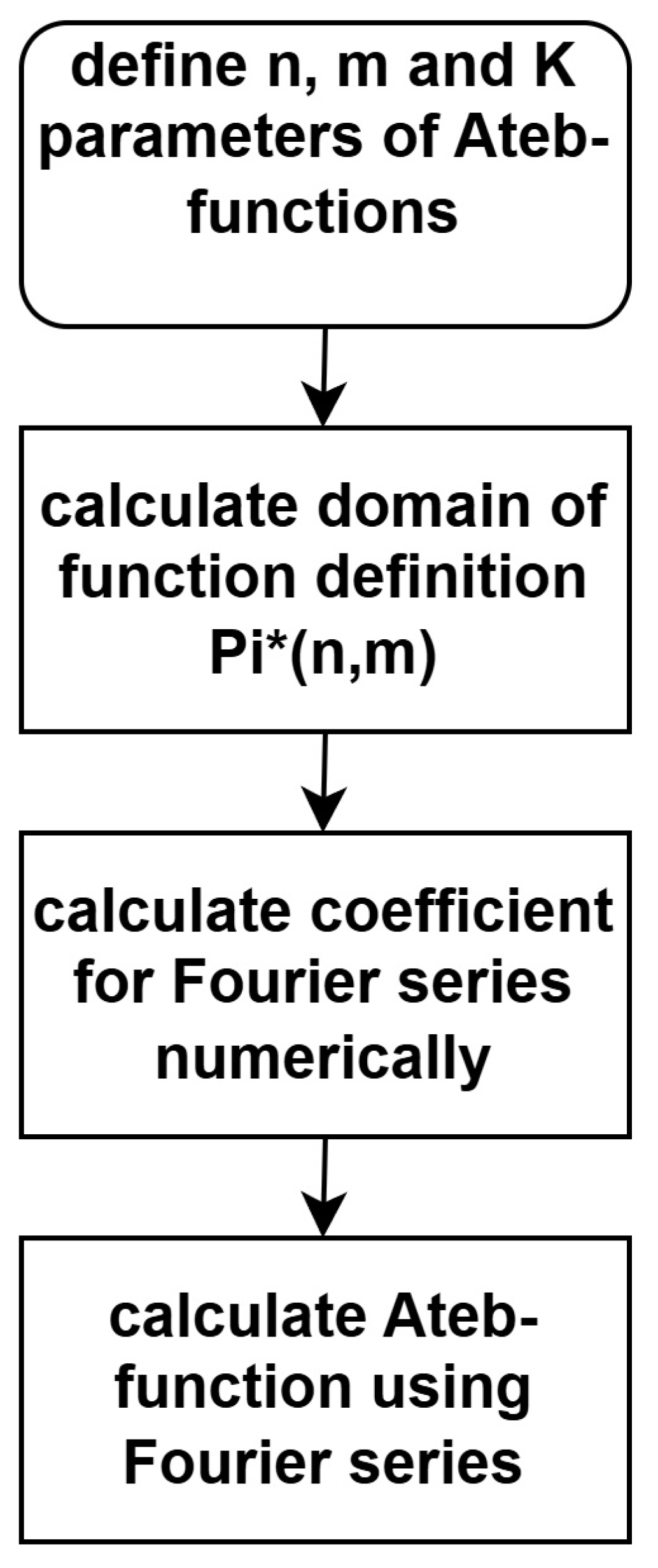
The algorithm for hyperbolic Ateb-sine calculation contains the following stages (see Figure 1)
Figure 1.
Schema for hyperbolic Ateb-function calculations.
- Define parameters , and K-count of elements in Fourier series;
- Calculate interval according to Formula (23);
- Define step h for numerical calculation integrals and calculate coefficients of Fourier series according to Formula (27);
- Calculate according to Formula (24).
For this algorithm’s practical realization, we used , and quadrature formulas to calculate the defined integral. When we have a value of to obtain the value of with the same parameters of n and m, we have two choices. The first one is the realization of the same scheme for calculation:
- Define parameters , and K-count of elements in Fourier series (this step is the same as for hyperbolic sine);
- Calculate interval according to Formula (23) (this step is also realized for hyperbolic sine);
- Define step h for numerical calculation integrals for coefficients of Fourier series according to Formula (25);
- Calculate according to Formula (26).
The second way for the calculation of hyperbolic cosine is using Formula (22). It is clear that the second way is easier and needs a lower count of calculations.
5. Algorithms for Calculation Space Transform Based on Ateb-Functions
Orthogonal trigonometric transform-based methods are widely used in the modeling and development of information transformation and protection systems. A signal can be converted from the time domain to the frequency domain using a Fourier transform. In this section, at the beginning, we construct Fourier transforms for Ateb-functions. After that, we propose the Fourier transform’s generalization based on Ateb-functions.
5.1. Orthogonal Trigonometric Transforms for Hyperbolic Ateb-Functions
Let us construct orthogonal trigonometric Fourier transforms for Ateb-functions.
These formulas are utilized to build a continuous spectrum of Ateb-functions. Taking into account the oddness of the hyperbolic Ateb-sine , it has the ability to be depicted as a direct sine Fourier transform
Then, Ateb-sine can be depicted by the inverse sine Fourier transform according to the expression
Operating the property of the hyperbolic Ateb-cosine, that is even, we represent it in the form of the direct cosine Fourier transform
Then, Ateb-cosine is shown by the inverse cosine Fourier transform according to the expression
Now, we construct the Fourier transform generalization. A method of orthogonal transforms based on periodic Ateb-functions is developed. In the following, we will name it orthogonal Ateb-transform (OAT). The possibility of constructing OAT is grounded on the following statements. First, in [3], it is shown that Ateb-functions are a generalized case of ordinary trigonometric functions. Secondly, in [27], the orthonormality of the system of periodic Ateb-functions is proved. In [8], methods and algorithms for calculating Ateb-functions depending on the parameters are developed, which allows the proposed OAT method to be successfully used.
We will consider transforms based on periodic Ateb-functions.
5.2. Orthogonal Ateb-Transform with One Parameter
Let us consider that ; in that condition, Ateb-sine and Ateb-cosine are presented as and . Let be a real function; then, Ateb-transform can be shown in the following form
where
If we note that Ateb-cosine is even and Ateb-sine is odd, we obtain inverse Ateb-transform with the following formula
where is a half-period of Ateb-function. The right part of Formula (35) depends on the parameter n.
The properties, i.e., the rate of increase or decrease, of the period of the Ateb-functions and will vary depending on n. The dependence of the Ateb-function on the parameter n allows us to choose the form of and corresponding to .
For the existence of the Ateb-transform for the function , it is sufficient to fulfill the same conditions that are sufficient for the existence of the orthogonal Fourier transform.
5.3. Orthogonal Ateb-Transform with Two Parameters
Let be a real function; then, we construct a generalization of the known Fourier transform Ateb-transform in the form
where
where is the Ateb-cosine and is the Ateb-sine function. Taking into account the expression (14), we obtain the formula for the inverse transform.
where are half-period Ateb-functions.
5.4. Method for Calculating Ateb-Transforms
In this section, we describe how to realize algorithms for the calculation of continuous Ateb-transform.
- Define parameters n and m of Ateb-transform and function , the spectrum of which we will calculate;
- Control the periodic conditions;
- Calculate the period ;
- For current point w from the interval , calculate the values for and , then calculate and , and then calculate Ateb-transform according to Formula (36).
The cosine and sine Fourier transforms are used for continuous functions. However, for problems related to information technology, it is more appropriate to use discrete functions and transforms. In this case, the discrete Fourier transform is used. Therefore, in the following sections, we will consider the construction of discrete Ateb-transforms.
6. Construction of Discrete Ateb-Transforms
6.1. One-Dimensional Discrete Ateb-Transform
Let us consider discrete Ateb-transforms (DATs). Let the signal be given in the form of a discrete sequence . Let us consider the functions and given by the following formulas
where p is the harmonic number, N is the sample size, is the Ateb-cosine function, is the Ateb-sine function.
Then, the direct DAP is given by the formula
We obtain an expression for the inverse transform in the form
The input signal is formally transformed into the signal under the action of the direct and inverse DAT. However, for fixed values of the parameters m, n, the value of the signal can be reproduced.
6.2. Algorithms for Calculation of Discrete Ateb-Transform
Here, we will describe the algorithm for the calculation of discrete Ateb-transform with two parameters according to Formula (42).
- Define parameters m and n;
- Control periodic condition;
- Define dimension of discrete signal N;
- Define two N-dimensional arrays S for input signal and X for output signal;
- Calculate period of function. Define other index k = 0 as array index.
- Define the sums for calculation coefficients and and current index for sum .
- Calculate elements and as current elements for summarizing;
- Calculate
- Calculate
- If , then else go to step 6;
- If , then output array X.
As the results of the algorithm realization we have the spectrum of discrete signal created with discrete Ateb-transform.
7. Generalization of Hyperbolic Ateb-Functions to the Quantum Calculus
At the beginning, we present all definitions from q-analysis, which we need for future constructions. There, we introduced q-analysis, where the q-derivative is defined by the following formula [12]
The q-analog for a real number, also called the q-bracket or q-number of b, is defined by the following formula [28]
The q-analog of the definite integral on a closed interval is defined by the following formula [29]
The analog for the Gamma-function -function is constructed as
where An incomplete -function is presented by the following formula
Let us construct the -generalization for hyperbolic q-Ateb-functions. The generalization for the quantum calculus in a periodic case is presented in [30]. In conditions (6), we will have an aperiodic (hyperbolic) case. Let us introduce the expression
If we consider the inverse dependency V from , where conditions (6) are satisfied, we obtain the q-analog of hyperbolic Ateb-sine and we propose the following notation
Let us introduce the following expression
In conditions (6), Formula (51) presents the inverse dependency u from ; it is named q-analog hyperbolic Ateb-cosine, and it is denoted as
It is clear that if , and in expressions (49)–(52), we obtain in the limit the usual hyperbolic functions. They are clearly the properties below, which follow from the definition of the q-analog of Ateb-functions.
Extending the functions to the case of quantum calculus will provide new applications of these functions for solving future mathematical modeling problems.
8. Conclusions
The swift evolution of computing power has facilitated the creation of novel mathematical constructs and broadened their applications. A notable instance of this development are the q-Ateb-functions. Initially introduced in the 1960s, the computation of Ateb-functions as inverses of the incomplete Beta-functions presented considerable difficulties. However, significant advancements occurred around the turn of the century, allowing for the straightforward calculation of Ateb-functions on personal computers.
This paper briefly outlines the applications of Ateb-functions and proposes generalizations of the Fourier transform that leverage these functions for both continuous and discrete scenarios, accompanied by algorithms for their computation in each case. Additionally, it presents a generalization of hyperbolic Ateb-functions applicable to quantum calculus, further enhancing their potential uses. Looking ahead, future research is expected to delve into the applications of q-Ateb-functions, with intentions to create a numerical implementation for their calculation and to establish further properties. As scientific inquiry progresses, it is anticipated that new and unforeseen applications for q-Ateb-functions will arise.
Funding
This research received no external funding.
Data Availability Statement
The original contributions presented in this study are included in the article. Further inquiries can be directed to the corresponding author.
Acknowledgments
The author would like to thank the Armed Forces of Ukraine for providing security to perform this work. This work has become possible only because of the resilience and courage of the Ukrainian Army.
Conflicts of Interest
The author declares no conflicts of interest.
Abbreviations
The following abbreviations are used in this manuscript:
| DAT | Discrete Ateb-transform |
| OAT | Orthogonal Ateb-transform |
References
- Kowalenko, V. Algorithms for Various Trigonometric Power Sums. Algorithms 2024, 17, 373. [Google Scholar] [CrossRef]
- Lundberg, E. Om Hypergoniometriska Funktioner af Komplexa Variabla; Förf: Stockholm, Norvey, 1879. [Google Scholar]
- Rosenberg, R. The Ateb(h) and their proporties. Quart. Appl. Math. 1963, 21, 37–47. [Google Scholar] [CrossRef]
- Abramowitz, M.; Stegun, I. Handbook of Mathematical Functions, 9th ed.; Cambridge University Press: New York, NY, USA, 2016; p. 416. [Google Scholar]
- Cveticanin, L. Generalized Krylov-Bogoliubov Method for Solving Strong Nonlinear Vibration. In Lectures on Nonlinear Dynamics; Springer: Cham, Switzerland, 2024; p. F1825. [Google Scholar] [CrossRef]
- Cveticanin, L. Strong Nonlinear Oscillators. In Mathematical Engineering. Analytical Solution; Springer: Cham, Switzerland; Berlin, Germany, 2018; pp. 1–296. [Google Scholar] [CrossRef]
- Kraljevic, S.; Zukovic, M.; Cveticanin, L. Oscillatory systems with two degrees of freedom and van der Pol coupling: Analytical approach. Math. Methods Appl. Sci. 2025, 48, 2474–2492. [Google Scholar] [CrossRef]
- Nazarkevych, M. Methods for Increasing the Efficiency of Printing Protection by Means of Ateb-Functions: Monograph; Publishing House of the National University «Lviv Polytechnic»: Lviv, Ukraine, 2011; 188p. (In Ukrainian) [Google Scholar]
- Dronyuk, I. Information Protection Technologies on Tangible Media: Monograph; Publishing House of the National University «Lviv Polytechnic»: Lviv, Ukraine, 2017; 200p. (In Ukrainian) [Google Scholar]
- Dronyuk, I.; Nazarkevych, M.; Poplavska, Z. Gabor filters generalization based on ateb-functions for information security. Adv. Intell. Syst. Comput. 2018, 659, 195–206. [Google Scholar] [CrossRef]
- Nazarkevych, M.; Logoyda, M.; Troyan, O.; Vozniy, Y.; Shpak, Z. The ateb-gabor filter for fingerprinting. Adv. Intell. Syst. Comput. 2020, 1080, 247–255. [Google Scholar] [CrossRef]
- Kac, V.; Cheung, P. Quantum Calculus; Springer: New York, NY, USA, 2002. [Google Scholar]
- Andrianov, I.; Awrejcewicz, J. Asymptotic Methods for Engineers; CRC Press: Boca Raton, FL, USA, 2024. [Google Scholar] [CrossRef]
- Senik, P.M. On Ateb-functions. Proc. Ukr. Acad. Sci. Ser. A 1968, 1, 23–27. [Google Scholar]
- Senik, P.M. Inversion of the incomplete beta function. Ukr. Math. J. 1969, 21, 271–278. [Google Scholar] [CrossRef]
- Drohomyretska, K.T. Integration of Some Ateb-Functions; Physical and Mathematical Sciences; Bulletin of the State University «Lviv Polytechnic»: Lviv, Ukraine, 1997; Volume 46, pp. 108–110. (In Ukrainian) [Google Scholar]
- Demydov, I.; Dronyuk, I.; Fedevych, O.; Romanchuk, V. Traffic Fluctuations Optimization for Telecommunication SDP Segment Based on Forecasting Using Ateb-Functions. In Lecture Notes on Data Engineering and Communications Technologies; Springer: Cham/Berlin, Germany, 2019; Volume 20. [Google Scholar] [CrossRef]
- Rebot, D.; Shcherbovskykh, S.; Stefanovych, T.; Topilnytskyy, V. Vibration Effect Modelling Based Ateb-Functions for Printed Circuit Boards of Control Machines. In Proceedings of the IEEE 17th International Conference on Advanced Trends in Radioelectronics, Telecommunications and Computer Engineering, Lviv, Ukraine, 8–12 October 2024; pp. 370–373. [Google Scholar] [CrossRef]
- Edmunds, D.E.; Gurka, P.; Lang, J. Properties of generalized trigonometric functions. J. Approx. Theory 2012, 164, 47–56. [Google Scholar] [CrossRef]
- Ghose-Choudhury, A.; Ghosh, A.; Guha, P.; Pandey, A. On purely nonlinear oscillators generalizing an isotonic potential. Int. J. Non-Linear Mech. 2018, 106, 55–59. [Google Scholar] [CrossRef]
- Ghosh, A.; Bhamidipati, C. Action-angle variables for the purely nonlinear oscillator. Int. J. Non-Linear Mech. 2019, 116, 167–172. [Google Scholar] [CrossRef]
- Cveticanin, L.; Vujkov, S.; Cveticanin, D. Application of Ateb and generalized trigonometric functions for nonlinear oscillators. Arch. Appl. Mech. 2020, 90, 2579–2587. [Google Scholar] [CrossRef]
- Cieśliński, J. New definitions of exponential, hyperbolic and trigonometric functions on time scales. J. Math. Anal. Appl. 2012, 44, 8–22. [Google Scholar] [CrossRef]
- Al-Omari, S.K. On a q-Laplace–type integral operator and certain class of series expansion. Math. Methods Appl. Sci. 2020, 44, 8322–8332. [Google Scholar] [CrossRef]
- Al-Omari, S.K. The q-Sumudu transform and its certain properties in a generalized q-calculus theory. Adv. Differ. Equ. 2021, 10, 247–255. [Google Scholar] [CrossRef]
- Alatawi, M.S.; Khan, W.A.; Ryoo, C.S. Explicit Properties of q-Cosine and q-Sine Array-Type Polynomials Containing Symmetric Structures. Symmetry 2022, 14, 1675. [Google Scholar] [CrossRef]
- Sokil, B.I. Nonlinear Oscillations of Mechanical Systems and Analytical Methods of Their Research. Ph.D. Thesis, National University “Lviv Polytechnic”, Lviv, Ukraine, 2001; 36p. (In Ukrainianan). [Google Scholar]
- Gosper, R.W. Experiments and Discoveries in q-Trigonometry. In Symbolic Computation, Number Theory, Special Functions, Physics and Combinatorics. In Proceedings of the Conference Held at the University of Florida, Gainesville, FL, USA, 11–13 November 1999; Garvan, F.G., Ismail, M.E.H., Eds.; Kluwer: Dordrecht, The Netherlands, 2001; pp. 79–105. [Google Scholar]
- Koekoek, R.; Swarttouw, R.F. The Askey-Scheme of Hypergeometric Orthogonal Polynomials and its q-Analogue. Delft Fac. Tech. Math. Inform. Rep. 1998, 98, 18–19. [Google Scholar]
- Dronyuk, I.M.; Shpak, Z.Y.; Demyda, B.A. Investigation of time scaling for the inverted Beta functions. Ukr. J. Inf. Technol. 2019, 1, 72–75. [Google Scholar] [CrossRef]
Disclaimer/Publisher’s Note: The statements, opinions and data contained in all publications are solely those of the individual author(s) and contributor(s) and not of MDPI and/or the editor(s). MDPI and/or the editor(s) disclaim responsibility for any injury to people or property resulting from any ideas, methods, instructions or products referred to in the content. |
© 2025 by the author. Licensee MDPI, Basel, Switzerland. This article is an open access article distributed under the terms and conditions of the Creative Commons Attribution (CC BY) license (https://creativecommons.org/licenses/by/4.0/).