

Optimizing Navigation in Mobile Robots: Modified Particle Swarm Optimization and Genetic Algorithms for Effective Path Planning

Abstract
1. Introduction
2. Background
2.1. Types of Distance Formula
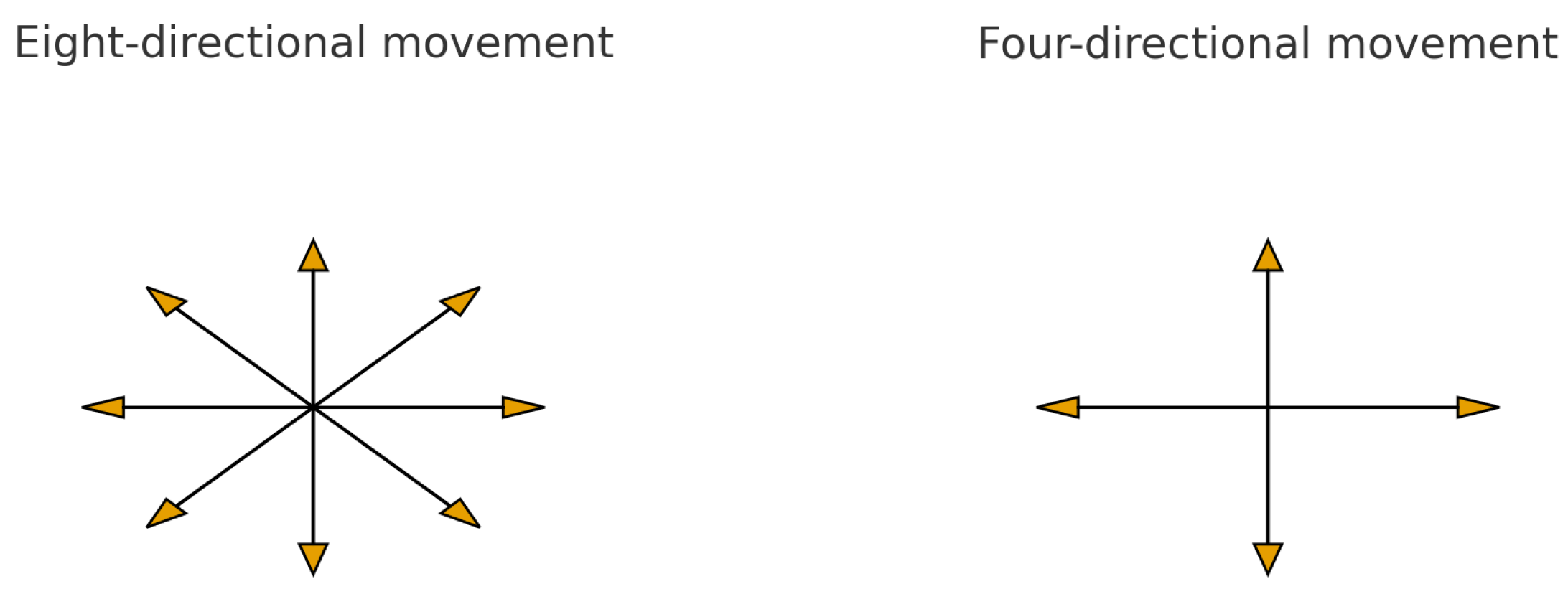
2.2. Basics of Manhattan Distance
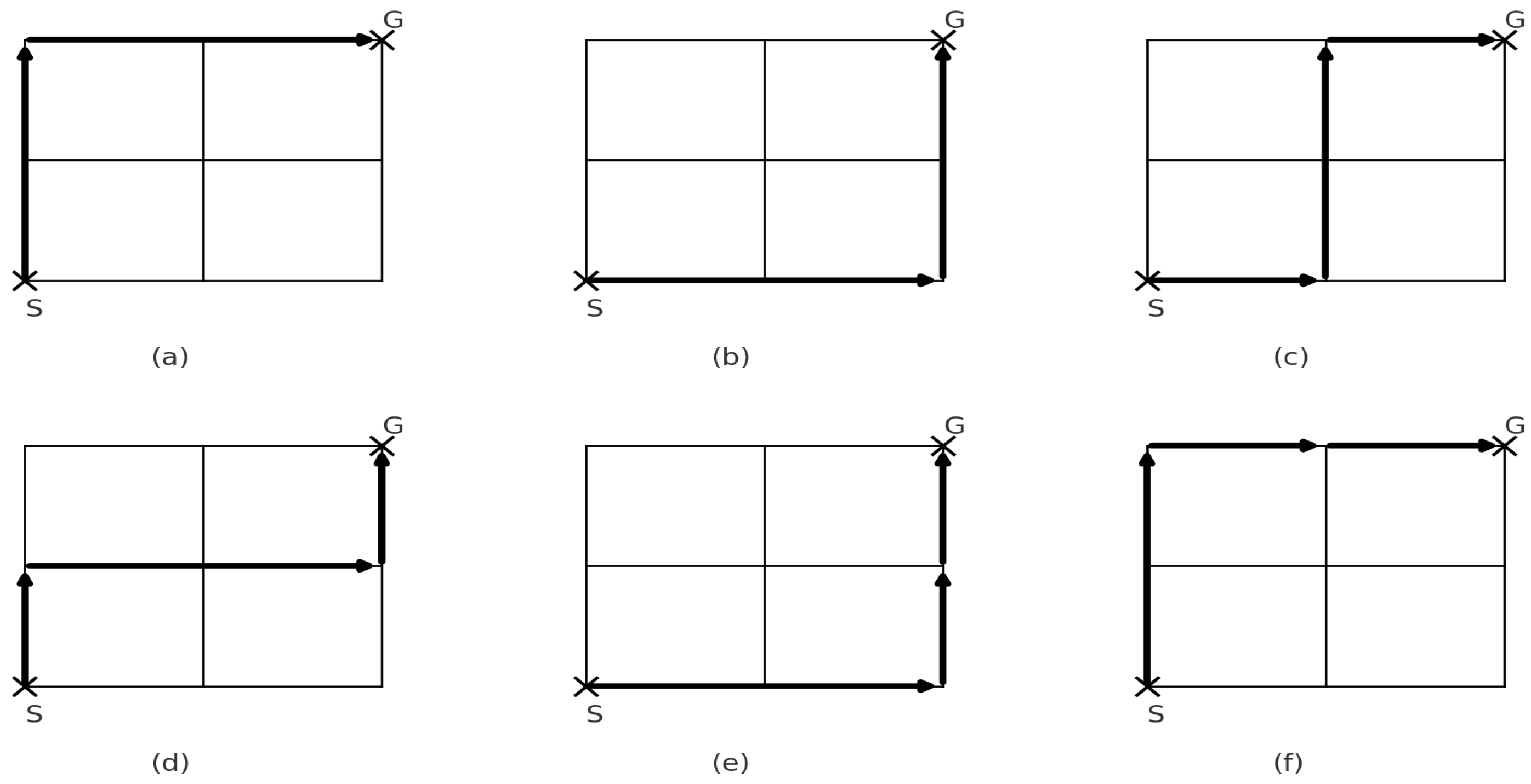
- Multiple finite paths exist between two points, each with a length equal to the Manhattan distance.
- Two steps can be taken along a straight line of the exact length of the Manhattan distance.
- Movement is constrained to one horizontal direction.
- The other point lies within a square at a specific Manhattan distance.
2.3. Artificial Intelligence Algorithms
2.3.1. Genetic Algorithm
- (a)
- Using a grid map to represent the search environment.
- (b)
- Selecting only necessary nodes on the grid map for the robot’s navigation.
- (c)
- Assigning each location on the grid map a corresponding identifier.
- (d)
- Identifying the number of static obstacles in the search area.
- (e)
- Determining the critical path if the source and destination nodes are known.
- (f)
- Tuning the hyperparameters of the GA.
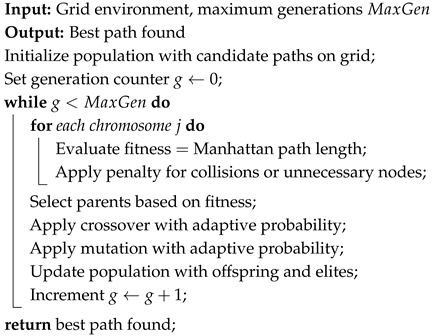
| Algorithm 1: Improved Genetic Algorithm (IGA) for robot path planning |
 |
2.3.2. Particle Swarm Optimization
- Particle Starting Point: Marks the initial phase of the particle trajectory, with positions and velocities initially generated randomly within search boundaries.
- Checking for Obstacles: Particles evaluate potential obstructions in the pursuit space, updating positions based on conditional statements.
- Evaluating Fitness Function: Particle fitness is assessed based on spatial incorporation and problem parameters.
- Finding the Best Global Particle Location: Each particle’s optimal position is determined by averaging distance appreciation over known regions.
- Calculating New Velocity and Position: Particle positions and velocities are updated iteratively to seek the best solution.
- Checking and Modifying Infeasible Paths: Conditional statements determine the feasibility of paths, allowing for adjustments if obstacles are encountered.
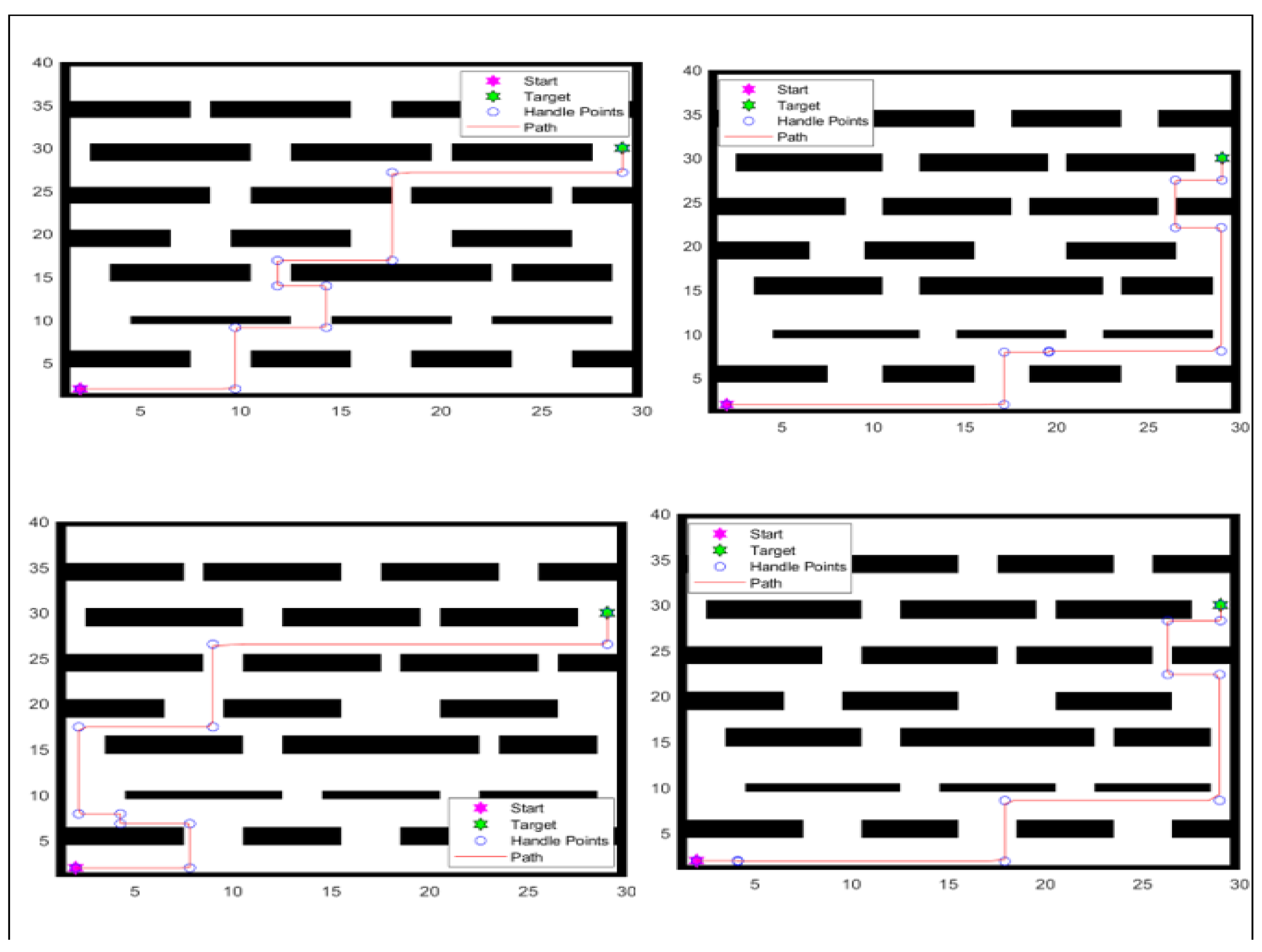
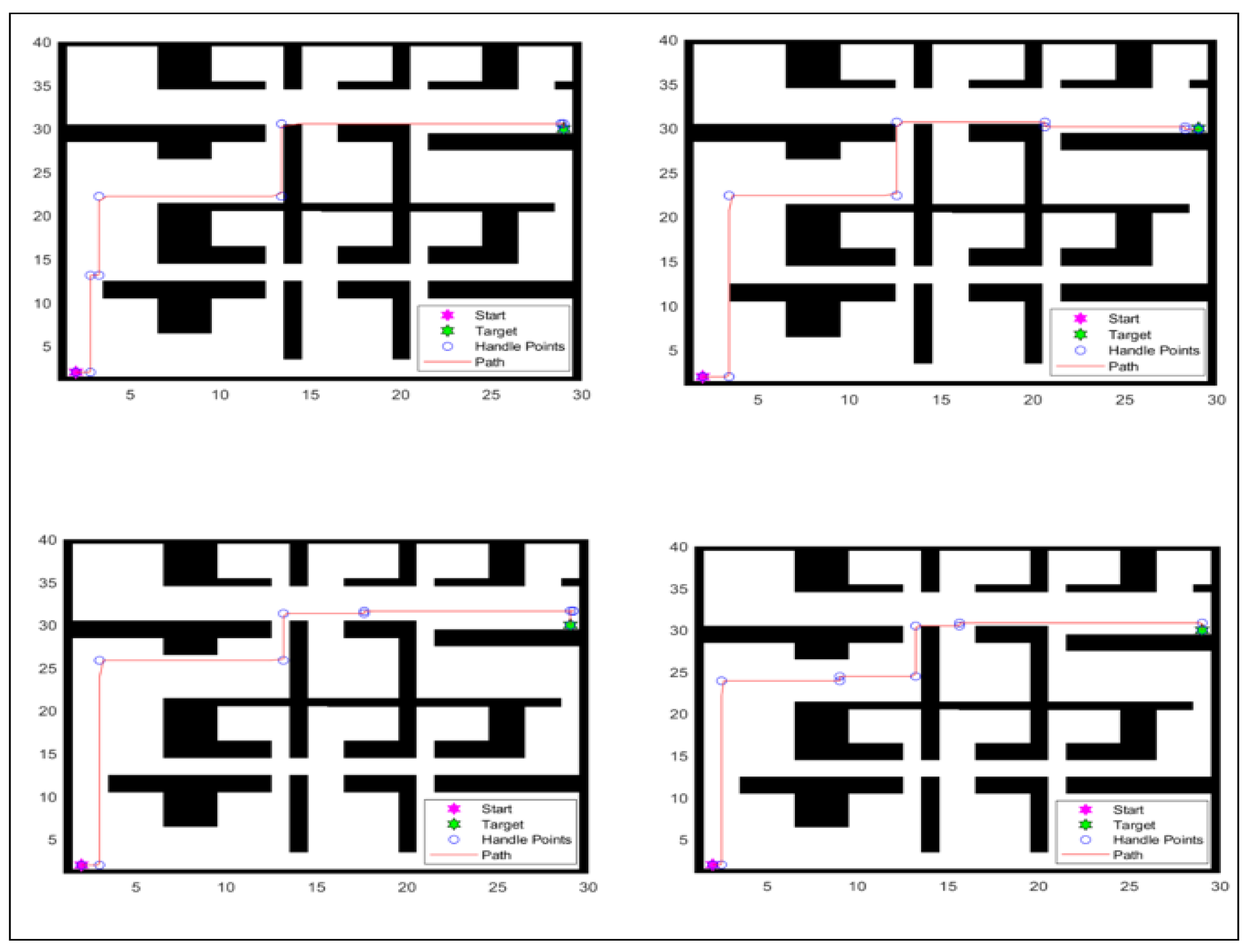
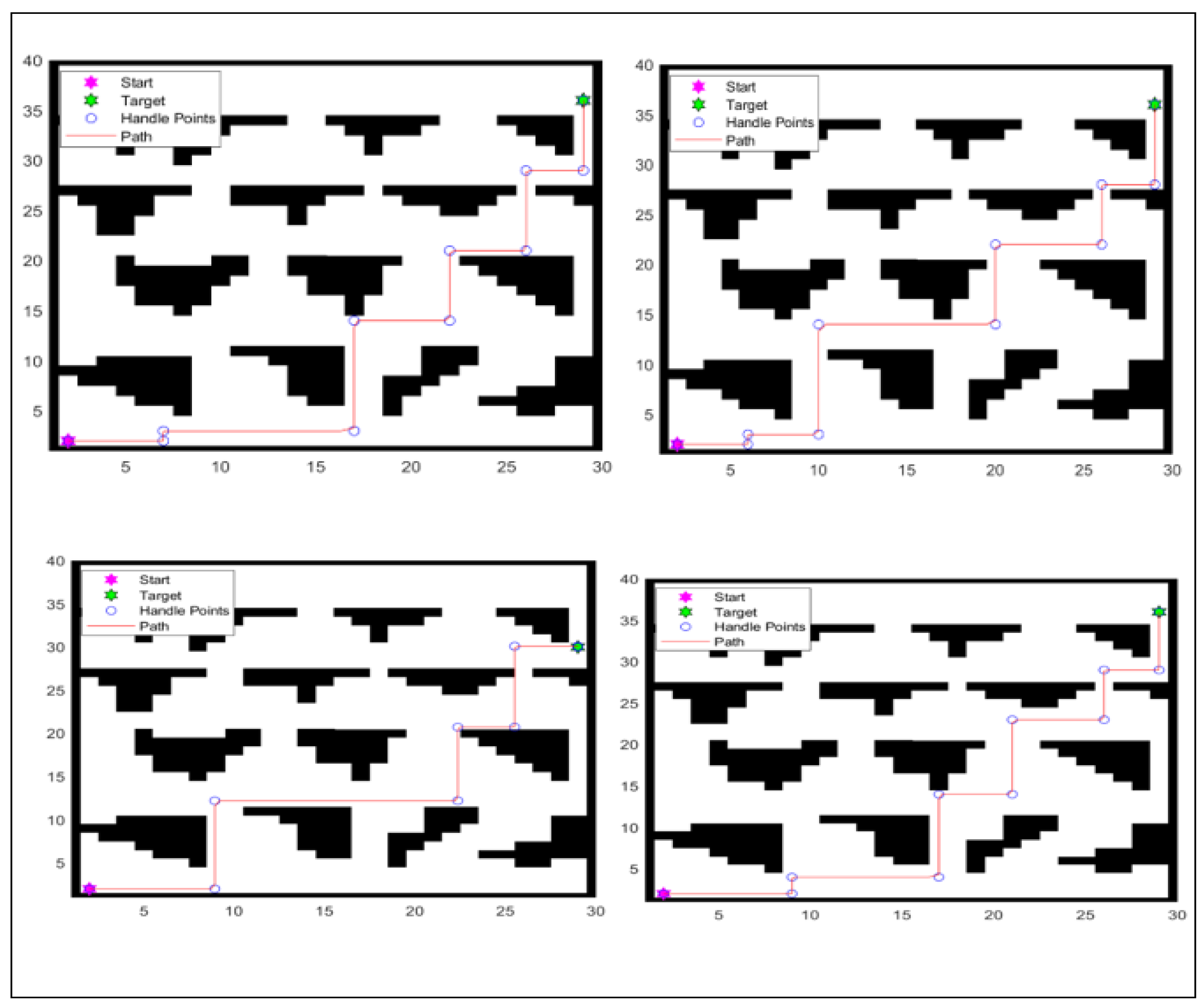
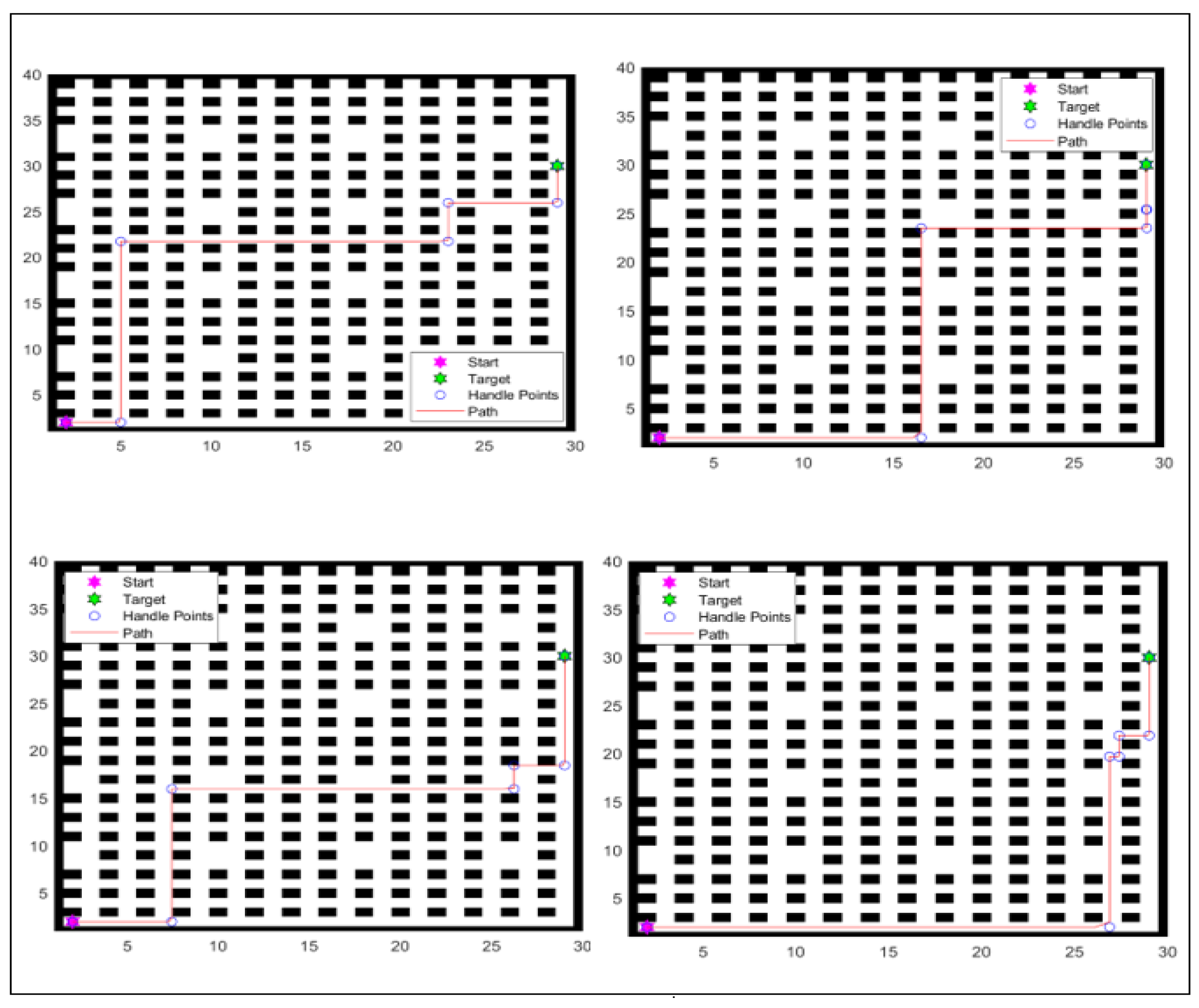
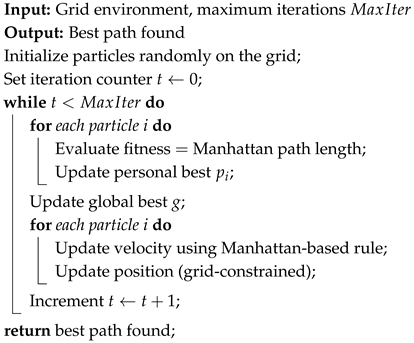
- Modification of Path-Planning Algorithm: This study focuses on modifying the PSO algorithm to move as Manhattan movements, ensuring efficient movement with minimal rotation. The research compares and evaluates various algorithms across different maps with varying obstacle densities to achieve successful path planning.
| Algorithm 2: Manhattan-based PSO (IPSO) for robot path planning |
 |
- vq = sign(v_i);
- step = min(abs(v_i), D_man(x_i, g));
- x_new = x_old + vq .* step;
3. Literature Survey
4. Methodology
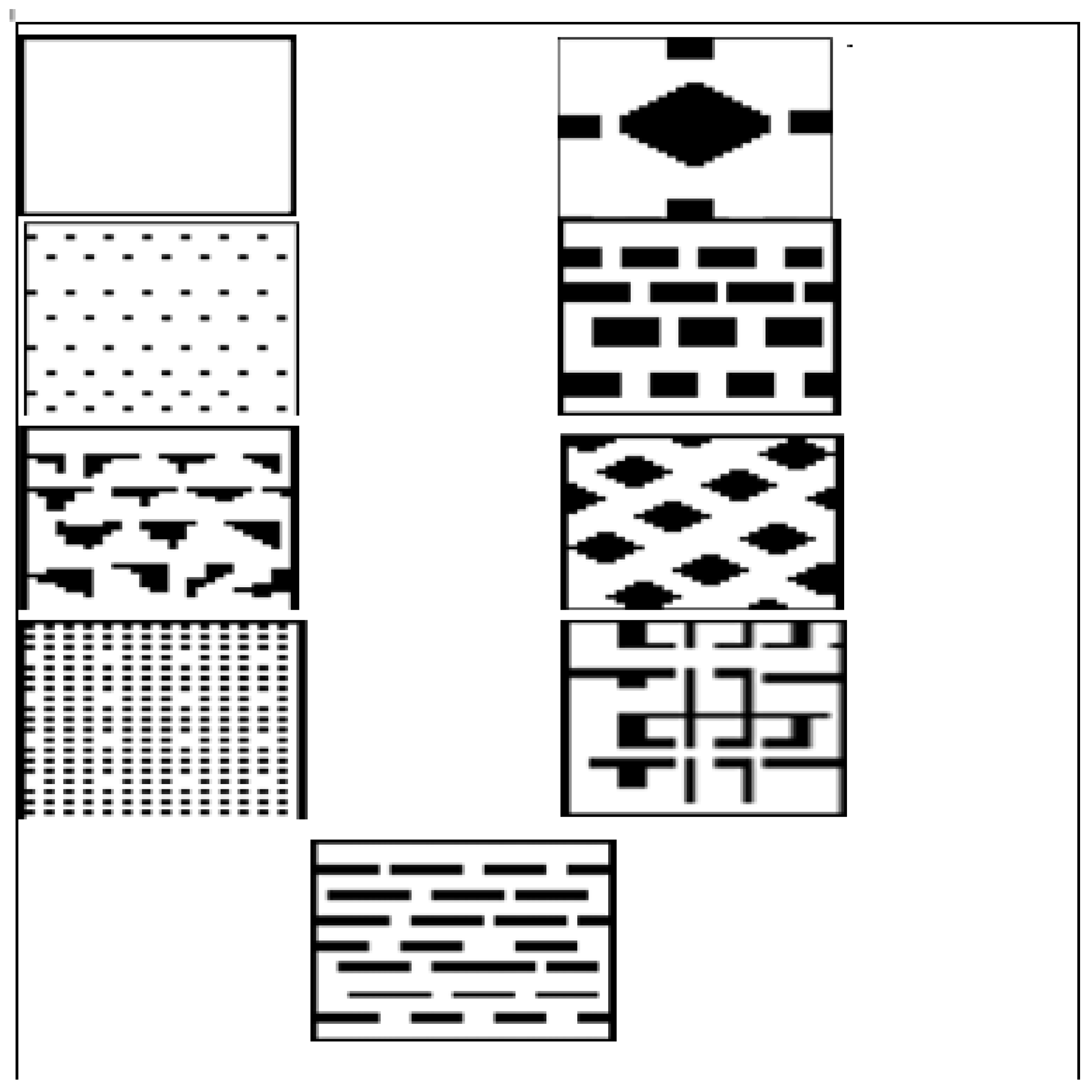
Operating Environment
5. Experiments and Results
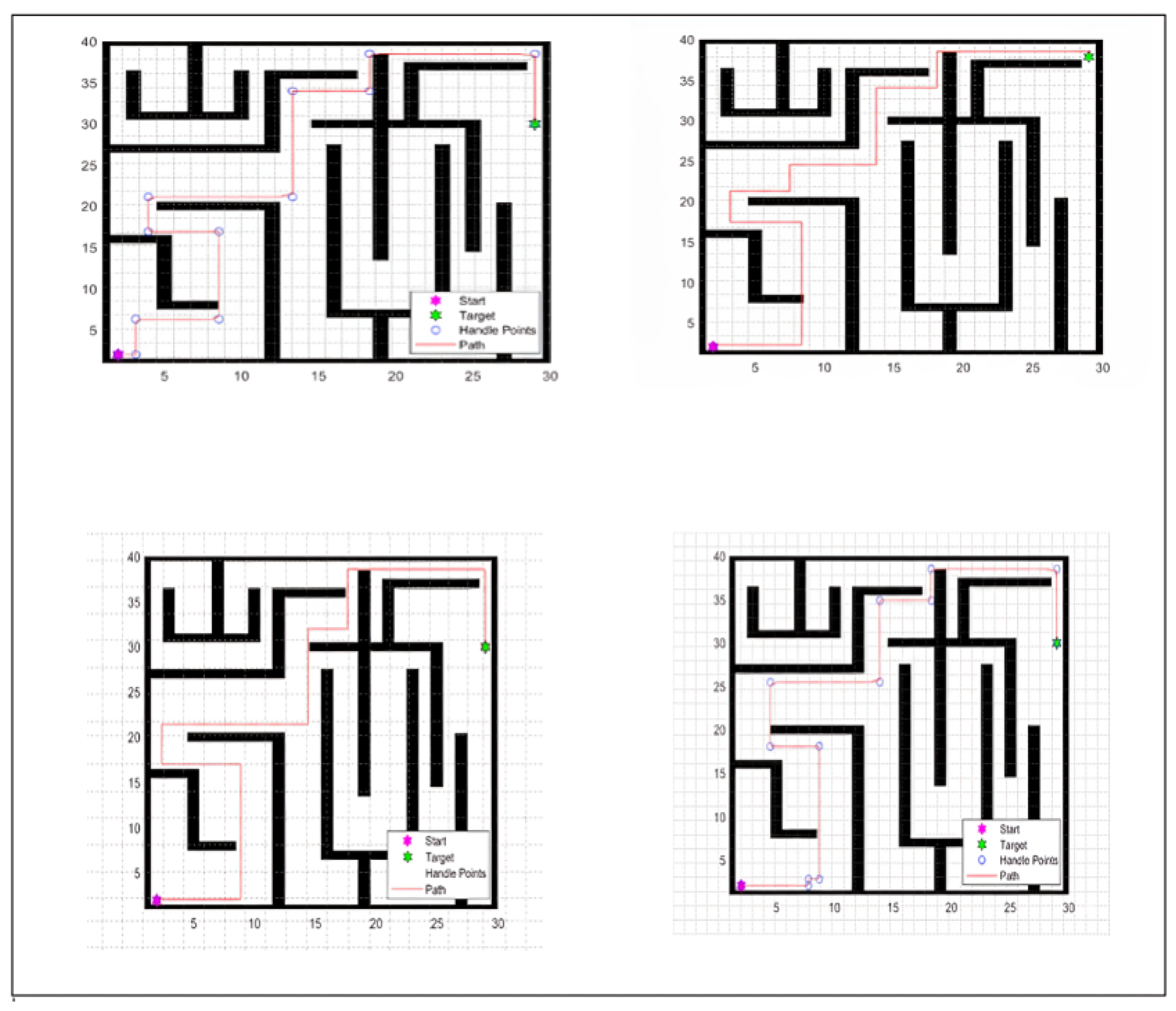
5.1. Experiment Zero [20]

5.2. Experiment One
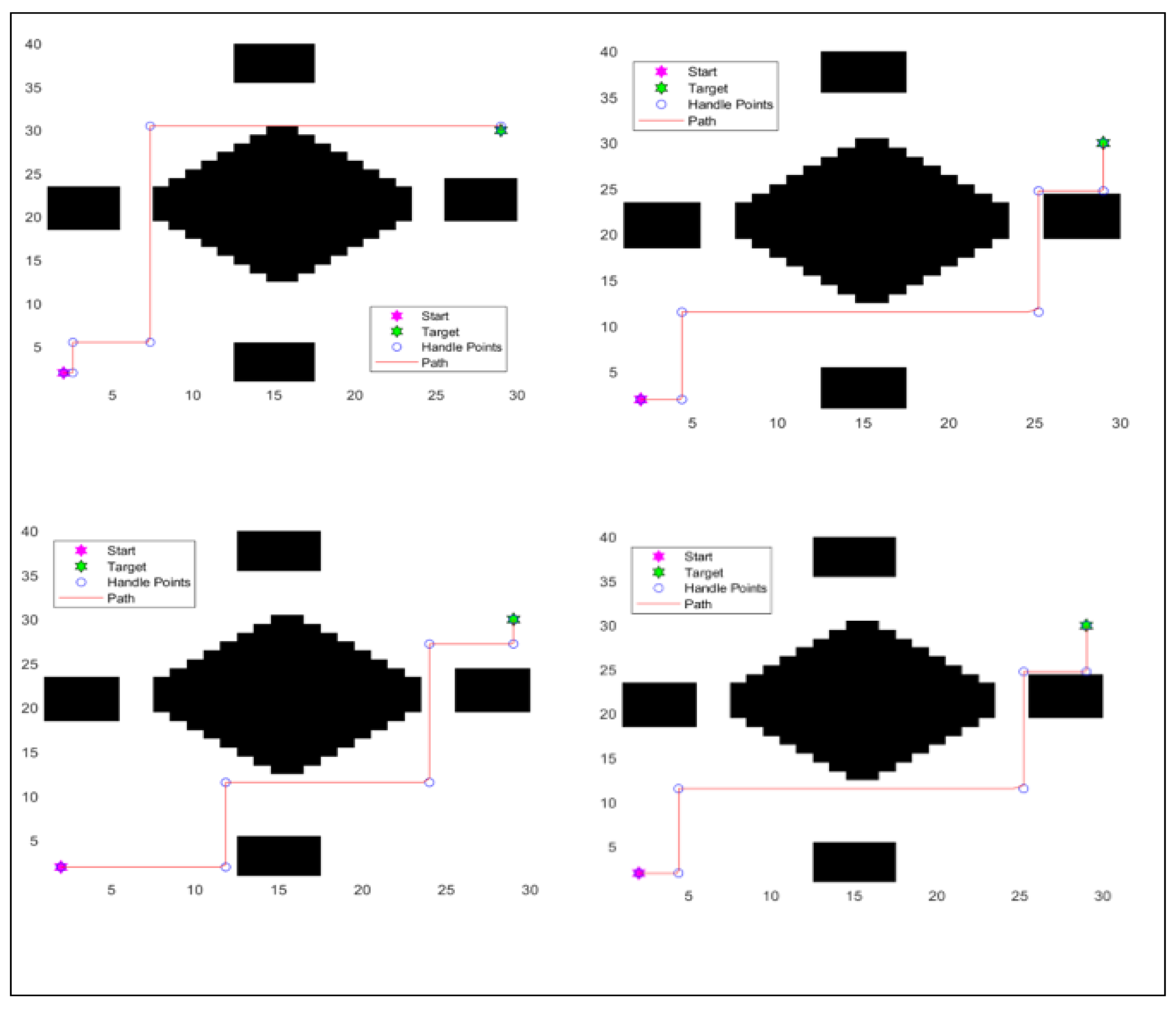
5.3. Experiment Two
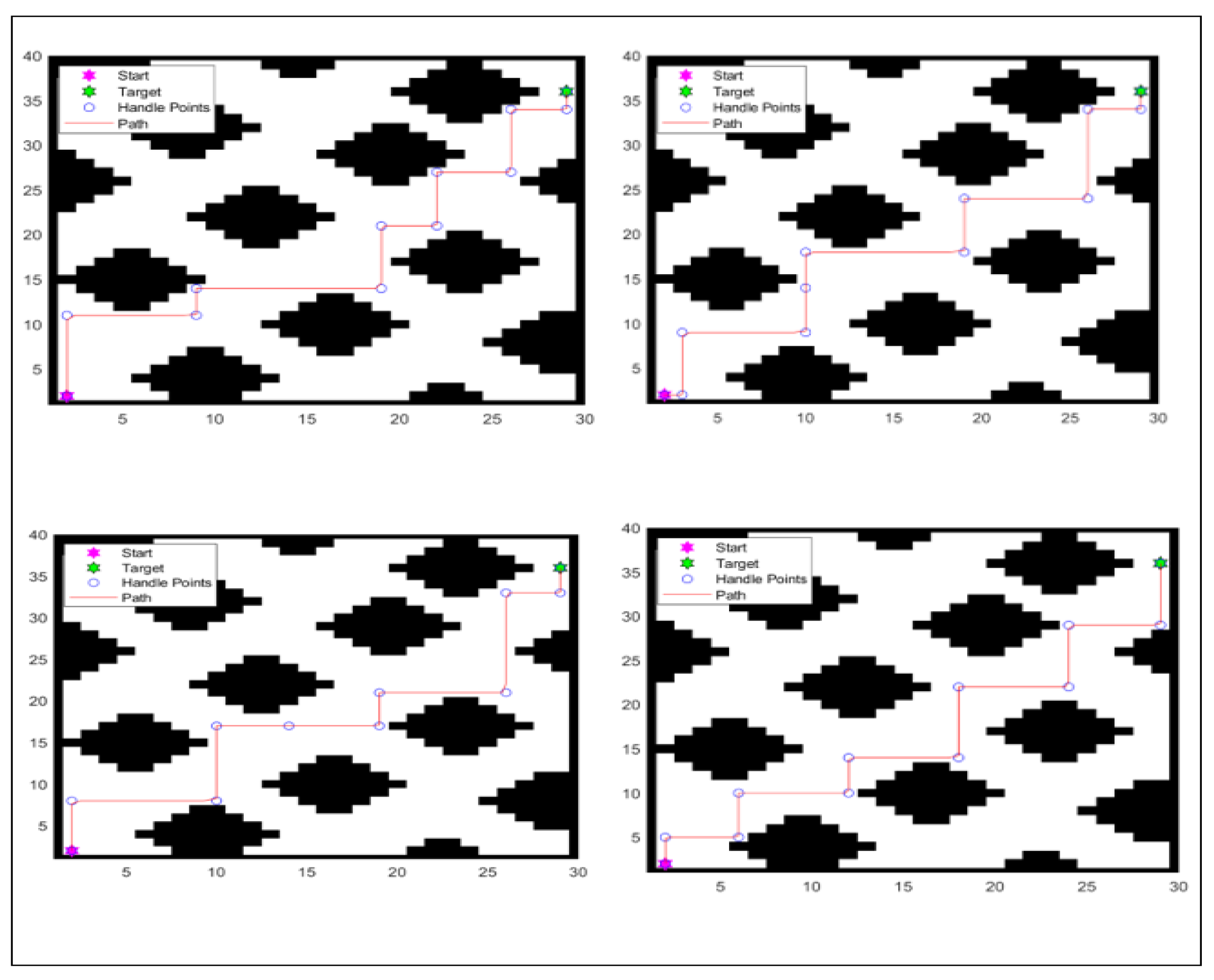
5.4. Experiment Three
6. Additional Experiments (Experiments Four to Eight)
6.1. Fourth Experiment’s Results
6.2. Fifth Experiment’s Results
7. Conclusions and Future Work
Author Contributions
Funding
Data Availability Statement
Conflicts of Interest
Abbreviations
| PSO | Particle Swarm Optimization |
| GA | Genetic Algorithm |
| MPSO | Manhattan-Based Particle Swarm Optimization |
| MGA | Manhattan-Based Genetic Algorithm |
| MRPP | Mobile Robot Path Planning |
| AMR | Autonomous Mobile Robot |
| AGV | Automated Guided Vehicle |
| SLAM | Simultaneous Localization and Mapping |
| Manhattan Distance Metric | |
| Number of Pivot Nodes in the Planned Path | |
| Mutation Rate | |
| Inertia Weight (PSO Parameter) | |
| Cognitive and Social Acceleration Constants | |
| Objective (Cost) Function for a Candidate Path | |
| Collision and Penalty Weight Coefficients | |
| SD | Standard Deviation |
| CI | Confidence Interval |
References
- Marques, B.; Junqueira, G.; Alves, J.; Pedrosa, E. Mobile Robots Meet Augmented Reality Technologies: Transforming Human-Robot Interaction in Industry 4.0 Scenarios. In Proceedings of the Companion of the 2024 ACM/IEEE International Conference on Human-Robot Interaction, Boulder, CO, USA, 11–15 March 2024; pp. 740–744. [Google Scholar]
- Pachayapan, K.; Abdulsalam, I.; Subramanian, S.; Sudhakaran, S.; Suresh, Y. Gas detecting robot for mining operations. In Proceedings of the AIP Conference Proceedings; AIP Publishing: Melville, NY, USA, 2024; Volume 3042. [Google Scholar]
- Kurniawan, J.; Syafaat, M.; Kasiyanto, K.; Widiatmoko, D.; Maulana, R.; Putra, Z.N. Omni wheel robot movement exploration using a control system for military surveillance with integrated sensor. TEKNOSAINS J. Sains Teknol. Inform. 2025, 12, 110–121. [Google Scholar] [CrossRef] [Scilit]
- Schwaiger, S.; Muster, L.; Novotny, G.; Schebek, M.; Wöber, W.; Thalhammer, S.; Böhm, C. Semi-Autonomous Mobile Search and Rescue Robot for Radiation Disaster Scenarios. arXiv 2024, arXiv:2406.14385. [Google Scholar] [CrossRef] [Scilit]
- Wang, M.; Cong, M.; Du, Y.; Zhong, H.; Liu, D. Bio-inspired mobile robot design and autonomous exploration strategy for underground special space. Robot. Intell. Autom. 2024, 44, 382–393. [Google Scholar] [CrossRef] [Scilit]
- Huang, A.; Kim, W.Y.; Chen, T.; Jang, J.; Lee, K.H. Pitch Angle Control of the Self-Balancing Cargo Platform in an Agricultural Mobile Robot Using a 3-RPS Parallel Mechanism. Precis. Agric. Sci. Technol. 2024, 6, 151–164. [Google Scholar]
- Lyu, H. Entertainment robot simulation in interactive art process based on deep learning algorithms and gesture recognition. Entertain. Comput. 2025, 52, 100827. [Google Scholar] [CrossRef] [Scilit]
- Abdallaoui, S.; Aglzim, E.H.; Chaibet, A.; Kribèche, A. Thorough review analysis of safe control of autonomous vehicles: Path planning and navigation techniques. Energies 2022, 15, 1358. [Google Scholar] [CrossRef] [Scilit]
- Farooq, M.U.; Eizad, A.; Bae, H.K. Power solutions for autonomous mobile robots: A survey. Robot. Auton. Syst. 2023, 159, 104285. [Google Scholar] [CrossRef] [Scilit]
- Soori, M.; Arezoo, B.; Dastres, R. Optimization of energy consumption in industrial robots, a review. Cogn. Robot. 2023, 3, 142–157. [Google Scholar] [CrossRef] [Scilit]
- Rajchandar, K.; Kothandaraman, D.; Manoharan, G.; Kabanda, G. Robotics and its Navigation Techniques: The Present and Future Revelations. In Handbook of Artificial Intelligence and Wearables; CRC Press: Boca Raton, FL, USA, 2024; pp. 189–204. [Google Scholar]
- Ab Wahab, M.N.; Nefti-Meziani, S.; Atyabi, A. A comparative review on mobile robot path planning: Classical or meta-heuristic methods? Annu. Rev. Control 2020, 50, 233–252. [Google Scholar] [CrossRef] [Scilit]
- Kopp, T.; Baumgartner, M.; Seeger, M.; Kinkel, S. Perspectives of managers and workers on the implementation of automated-guided vehicles (AGVs)—A quantitative survey. Int. J. Adv. Manuf. Technol. 2023, 126, 5259–5275. [Google Scholar] [CrossRef] [Scilit]
- Holland, J.H. Adaptation in Natural and Artificial Systems: An Introductory Analysis with Applications to Biology, Control, and Artificial Intelligence; MIT Press: Cambridge, MA, USA, 1992. [Google Scholar]
- Kennedy, J.; Eberhart, R. Particle swarm optimization. In Proceedings of the ICNN’95-International Conference on Neural Networks, Perth, Australia, 7 November–1 December 1995; IEEE: Piscataway, NJ, USA, 1995; Volume 4, pp. 1942–1948. [Google Scholar]
- Suriyan, K.; Nagarajan, R. Particle swarm optimization in biomedical technologies: Innovations, challenges, and opportunities. In Emerging Technologies for Health Literacy and Medical Practice; IGI Global: Hershey, PA, USA, 2024; pp. 220–238. [Google Scholar]
- Zhang, Z.; Li, J.; Lei, Z.; Zhu, Q.; Cheng, J.; Gao, S. Reinforcement learning-based particle swarm optimization for wind farm layout problems. Energy 2024, 313, 134050. [Google Scholar] [CrossRef] [Scilit]
- Yi, J.; Yu, P.; Huang, T.; Xu, Z. Optimization of Transformer heart disease prediction model based on particle swarm optimization algorithm. In Proceedings of the 2024 6th International Conference on Frontier Technologies of Information and Computer (ICFTIC), Qingdao, China, 8–10 November 2024; IEEE: Piscataway, NJ, USA, 2024; pp. 1109–1113. [Google Scholar]
- Gad, A.G. Particle swarm optimization algorithm and its applications: A systematic review. Arch. Comput. Methods Eng. 2022, 29, 2531–2561. [Google Scholar] [CrossRef] [Scilit]
- Mohamed, A.; Bahgat, A.; Rashad, H.; Ibrahim, A. Comparison of Path Planning between Improved Informed and Uninformed Algorithms for Mobile Robot. Int. J. Adv. Comput. Sci. Appl. 2022, 13. [Google Scholar] [CrossRef] [Scilit]
- Song, B.; Wang, Z.; Zou, L. An improved PSO algorithm for smooth path planning of mobile robots using continuous high-degree Bezier curve. Appl. Soft Comput. 2021, 100, 106960. [Google Scholar] [CrossRef] [Scilit]
- Ab Wahab, M.N.; Nazir, A.; Khalil, A.; Ho, W.J.; Akbar, M.F.; Noor, M.H.M.; Mohamed, A.S.A. Improved genetic algorithm for mobile robot path planning in static environments. Expert Syst. Appl. 2024, 249, 123762. [Google Scholar] [CrossRef] [Scilit]
- Lamini, C.; Benhlima, S.; Elbekri, A. Genetic algorithm based approach for autonomous mobile robot path planning. Procedia Comput. Sci. 2018, 127, 180–189. [Google Scholar] [CrossRef] [Scilit]
- Jawad, M.M.; Hadi, E.A. A Comparative study of various intelligent algorithms based path planning for Mobile Robots. J. Eng. 2019, 25, 83–100. [Google Scholar] [CrossRef] [Scilit]
- Raja, P.; Pugazhenthi, S. Optimal path planning of mobile robots: A review. Int. J. Phys. Sci. 2012, 7, 1314–1320. [Google Scholar] [CrossRef] [Scilit]
- Rafai, A.N.A.; Adzhar, N.; Jaini, N.I. A review on path planning and obstacle avoidance algorithms for autonomous mobile robots. J. Robot. 2022, 2022, 2538220. [Google Scholar] [CrossRef] [Scilit]
- Thabit, S.; Mohades, A. Multi-robot path planning based on multi-objective particle swarm optimization. IEEE Access 2018, 7, 2138–2147. [Google Scholar] [CrossRef] [Scilit]
- Sun, R.; Tang, C.; Zheng, J.; Zhou, Y.; Yu, S. Multi-robot path planning for complete coverage with genetic algorithms. In Proceedings of the International Conference on Intelligent Robotics and Applications, Shenyang, China, 8–11 August 2019; Springer: Berlin/Heidelberg, Germany, 2019; pp. 349–361. [Google Scholar]
- Liu, L.; Wang, X.; Yang, X.; Liu, H.; Li, J.; Wang, P. Path planning techniques for mobile robots: Review and prospect. Expert Syst. Appl. 2023, 227, 120254. [Google Scholar] [CrossRef] [Scilit]


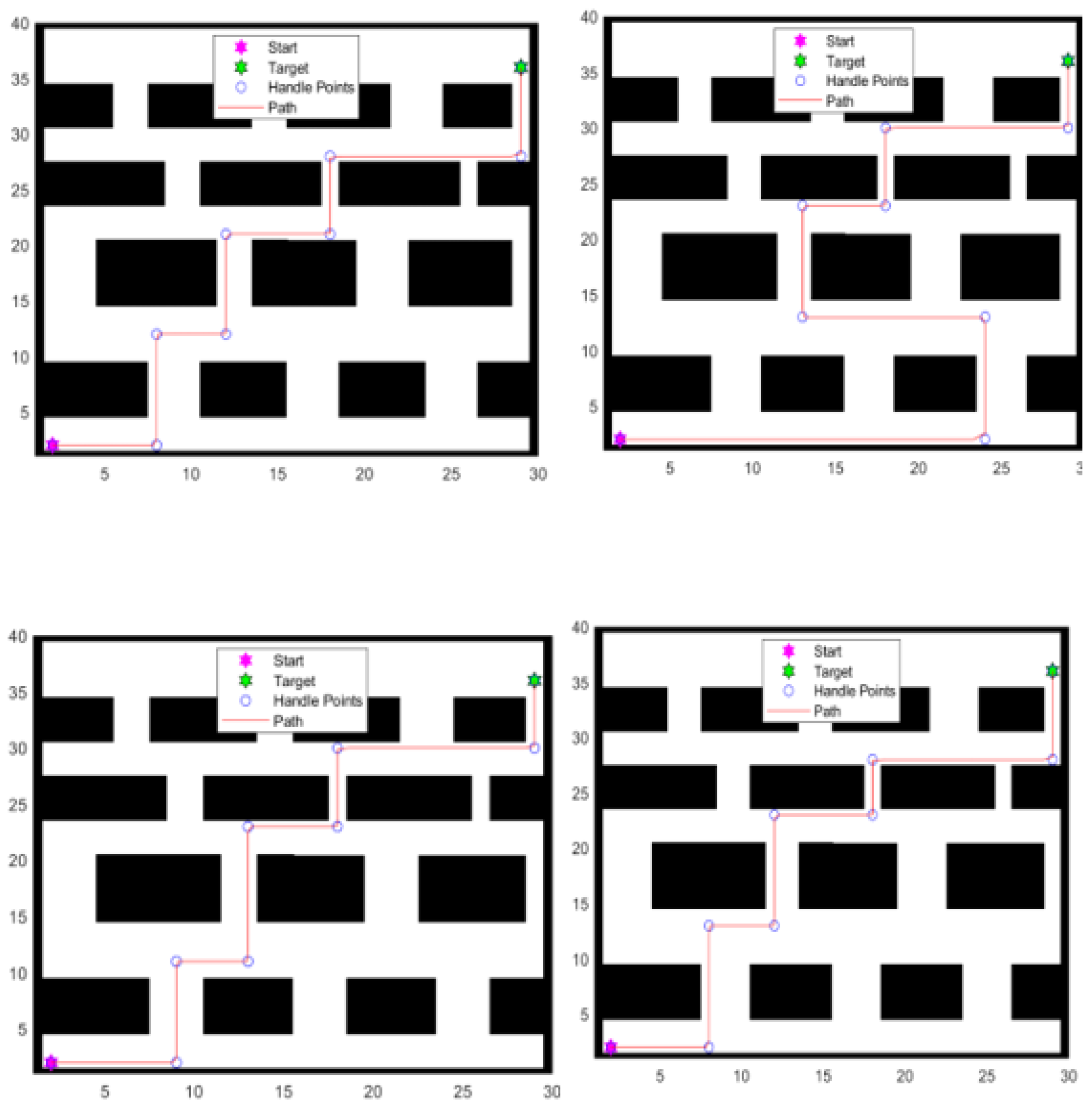


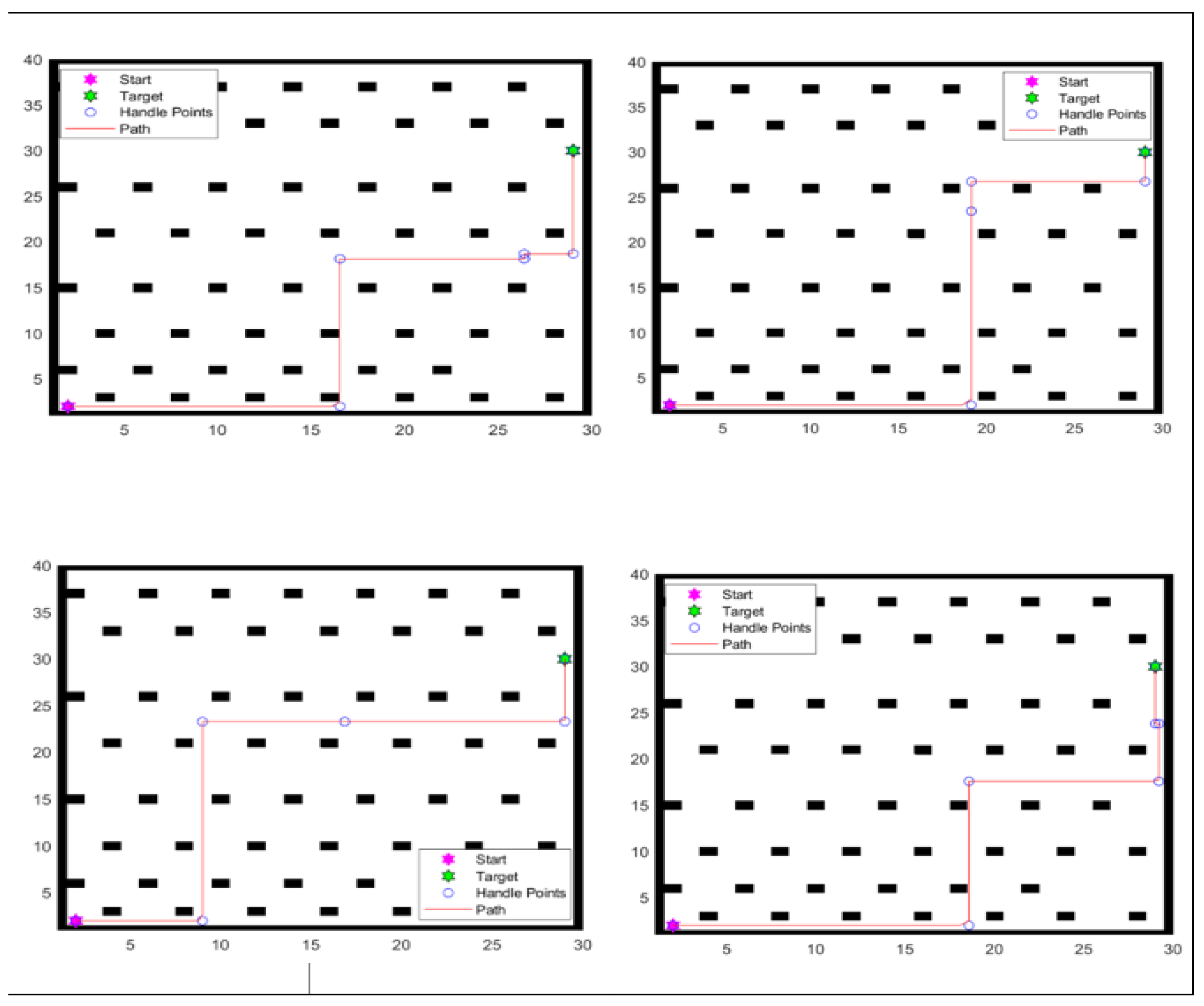


| Reference | Name |
|---|---|
| No, of Iterations | 1000 |
| Grid Size | 30 × 40 |
| Start Point | [2,2] |
| Endpoint | [29,36] |
| No of runs every experiment | 100 runs for every experiment |
| Reference | Name |
|---|---|
| Maximum Number of Iterations | 1000 |
| Population Size | 10 |
| Personal Learning Coefficient c1 | 0.7 |
| Global Learning Coefficient c2 | 0.7 |
| Velocity Max | 6 |
| Velocity Min | 1 |
| Alpha | 0.1 |
| Inertia Weight | 0.9 |
| Damping Ratio | 0.9 |
| Reference | Name |
|---|---|
| Maximum Number of Iterations | 1000 |
| Population Size | 10 |
| Crossover | 0.7 |
| Mutation Rate | 0.7 |
| Number of Bits | 6 |
| Number of Runs | 100 |
| Number of Successful Runs | 100 |
| Number of Pivots | Number of Runs | Number of Successful Runs |
|---|---|---|
| 4 | 100 | 100 |
| 6 | 100 | 100 |
| 8 | 100 | 100 |
| 10 | 100 | 100 |
| C1 Personal Learning Coefficient | Relation Between the Number of Population and Number of Pivots Successful Runs Out of 100 | |||||||||
|---|---|---|---|---|---|---|---|---|---|---|
| C2 Global Learning Coefficient | ||||||||||
| 0.1 | 0.2 | 0.3 | 0.4 | 0.5 | 0.6 | 0.7 | 0.8 | 0.9 | 1 | |
| 0.1 | 76 | 70 | 67 | 64 | 63 | 62 | 60 | 58 | 51 | 40 |
| 0.2 | 83 | 74 | 71 | 69 | 61 | 58 | 55 | 51 | 47 | 43 |
| 0.3 | 89 | 78 | 75 | 71 | 63 | 63 | 63 | 62 | 51 | 48 |
| 0.4 | 91 | 81 | 78 | 74 | 67 | 66 | 63 | 62 | 55 | 50 |
| 0.5 | 93 | 85 | 80 | 75 | 70 | 64 | 63 | 63 | 59 | 53 |
| 0.6 | 94 | 85 | 81 | 76 | 73 | 71 | 65 | 64 | 60 | 58 |
| 0.7 | 95 | 86 | 84 | 78 | 75 | 75 | 66 | 65 | 63 | 60 |
| 0.8 | 95 | 89 | 85 | 83 | 79 | 78 | 67 | 66 | 65 | 61 |
| 0.9 | 96 | 90 | 89 | 85 | 80 | 79 | 65 | 69 | 67 | 65 |
| 1 | 97 | 91 | 90 | 89 | 82 | 80 | 73 | 71 | 70 | 69 |
| Number of Pivots | Number of Runs | Number of Successful Runs |
|---|---|---|
| 4 | 100 | 0 |
| 6 | 100 | 0 |
| 8 | 100 | 100 |
| 10 | 100 | 100 |
| Parameters of GA | Value |
|---|---|
| Maximum Number of Iterations | 1000 |
| Population Size | 100 |
| Number of Pivots | 10 |
| Crossover Percentage | 0.1 |
| Mutation Percentage | 0.5 |
| Mutation Rate | 0.1 |
| Number of Bits | 6 |
| Number of Runs | 100 |
| Number of Successful Runs | 97 |
| Reference | Name |
|---|---|
| Maximum Number of Iterations | 1000 |
| Population Size | 10 |
| Personal Learning Coefficient c1 | 0.7 |
| Global Learning Coefficient c2 | 0.7 |
| Velocity Max | 6 |
| Velocity Min | 1 |
| Alpha | 0.1 |
| Inertia Weight | 0.9 |
| Damping Ratio | 0.9 |
| Reference | Name |
|---|---|
| Maximum Number of Iterations | 1000 |
| Population Size | 100 |
| No of Pivots | 8 |
| Cross over percentage | 0.1 |
| Mutation Rate | 0.5 |
| Number of Bits | 6 |
| Number of Runs | 100 |
| Number of Successful Runs | 96 |
| Number of Pivots | Number of Runs | Number of Successful Runs |
|---|---|---|
| 4 | 100 | 0 |
| 6 | 100 | 97 |
| 8 | 100 | 99 |
| 10 | 100 | 100 |
| Number of Pivots | Number of Runs | Number of Successful Runs |
|---|---|---|
| 4 | 100 | 0 |
| 6 | 100 | 92 |
| 8 | 100 | 98 |
| 10 | 100 | 100 |
| 4 Pivots | 6 Pivots | 8 Pivots | |||
|---|---|---|---|---|---|
| Number of runs | 100 | Number of runs | 100 | Number of runs | 100 |
| Number of runs | 0 | Number of runs | 96 | Number of runs | 100 |
Disclaimer/Publisher’s Note: The statements, opinions and data contained in all publications are solely those of the individual author(s) and contributor(s) and not of MDPI and/or the editor(s). MDPI and/or the editor(s) disclaim responsibility for any injury to people or property resulting from any ideas, methods, instructions or products referred to in the content. |
© 2025 by the authors. Licensee MDPI, Basel, Switzerland. This article is an open access article distributed under the terms and conditions of the Creative Commons Attribution (CC BY) license (https://creativecommons.org/licenses/by/4.0/).
Share and Cite
Amr, M.; Bahgat, A.; Rashad, H.; Ibrahim, A.; Youssef, A. Optimizing Navigation in Mobile Robots: Modified Particle Swarm Optimization and Genetic Algorithms for Effective Path Planning. Algorithms 2025, 18, 719. https://doi.org/10.3390/a18110719
Amr M, Bahgat A, Rashad H, Ibrahim A, Youssef A. Optimizing Navigation in Mobile Robots: Modified Particle Swarm Optimization and Genetic Algorithms for Effective Path Planning. Algorithms. 2025; 18(11):719. https://doi.org/10.3390/a18110719
Chicago/Turabian StyleAmr, Mohamed, Ahmed Bahgat, Hassan Rashad, Azza Ibrahim, and Ayman Youssef. 2025. "Optimizing Navigation in Mobile Robots: Modified Particle Swarm Optimization and Genetic Algorithms for Effective Path Planning" Algorithms 18, no. 11: 719. https://doi.org/10.3390/a18110719
APA StyleAmr, M., Bahgat, A., Rashad, H., Ibrahim, A., & Youssef, A. (2025). Optimizing Navigation in Mobile Robots: Modified Particle Swarm Optimization and Genetic Algorithms for Effective Path Planning. Algorithms, 18(11), 719. https://doi.org/10.3390/a18110719