
Article

Following the Writer’s Path to the Dynamically Coalescing Reactive Chains Design Pattern

by
João Paulo Oliveira Marum
1,*,
H. Conrad Cunningham
2,*,
J. Adam Jones
3 and
Yi Liu
4
1
Department of Electrical Engineering and Computer Science, Syracuse University, 3-127 CST, Syracuse, NY 13244, USA
2
Department of Computer and Information Science, University of Mississippi, 201 Weir Hall, University, MS 38677, USA
3
Department of Computer Science and Engineering, Mississippi State University, 143 Rice Hall, Mississippi State, MS 39762, USA
4
Department of Computer and Information Science, University of Massachusetts Dartmouth, 302E Dion Building, Dartmouth, MA 02747, USA
*
Authors to whom correspondence should be addressed.
Algorithms 2024, 17(2), 56; https://doi.org/10.3390/a17020056
Submission received: 22 October 2023 / Revised: 17 January 2024 / Accepted: 22 January 2024 / Published: 25 January 2024
(This article belongs to the Special Issue Algorithms for Virtual and Augmented Environments)

Abstract

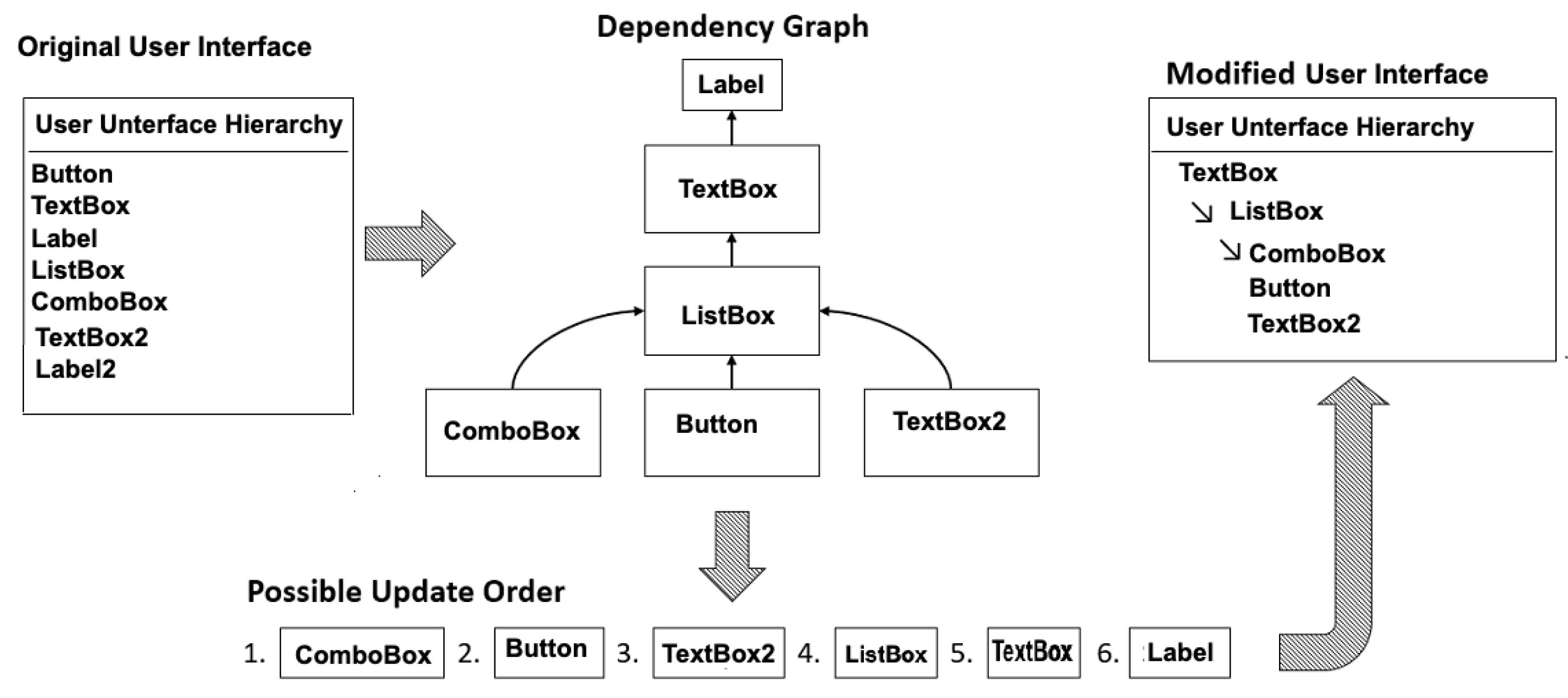
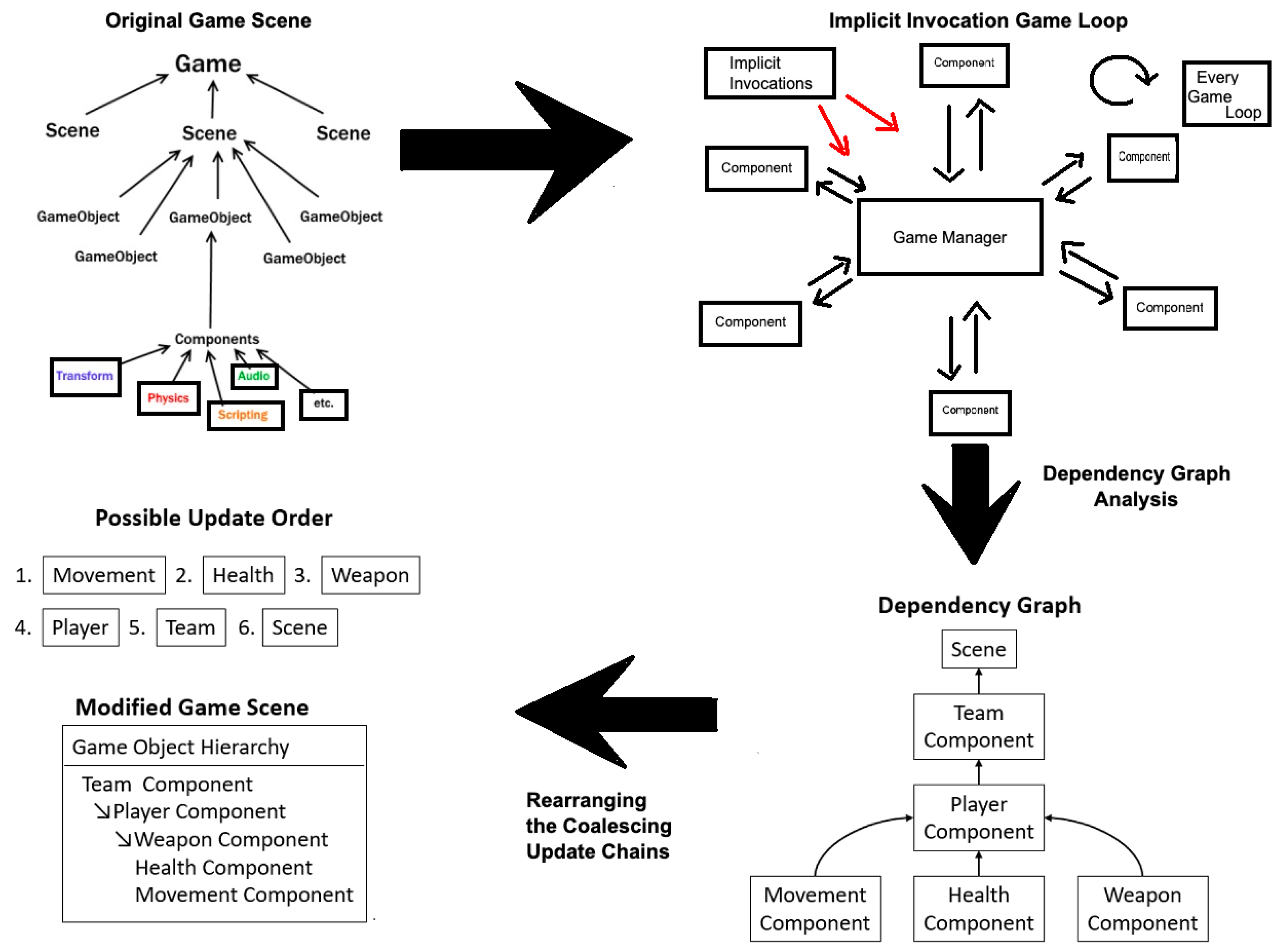
Two recent studies addressed the problem of reducing transitional turbulence in applications developed in C# on .NET. The first study investigated this problem in desktop and Web GUI applications and the second in virtual and augmented reality applications using the Unity3D game engine. The studies used similar solution approaches, but both were somewhat embedded in the details of their applications and implementation platforms. This paper examines these two families of applications and seeks to extract the common aspects of their problem definitions and solution approaches and codify the problem-solution pair as a new software design pattern. To do so, the paper adopts Wellhausen and Fiesser’s writer’s path methodology and follows it systematically to discover and write the pattern, recording the reasoning at each step. To evaluate the pattern, the paper applies it to an arbitrary C#/.NET GUI application. The resulting design pattern is named Dynamically Coalescing Reactive Chains (DCRC). It enables the approach to transitional turbulence reduction to be reused across a range of related applications, languages, and user interface technologies. The detailed example of the writer’s path can assist future pattern writers in navigating through the complications and subtleties of the pattern-writing process.
Keywords: design pattern; writer’s path; event-based architecture; implicit invocation; reactive programming; transitional turbulence; dependency graph design pattern; writer’s path; event-based architecture; implicit invocation; reactive programming; transitional turbulence; dependency graph