Article

An Efficient Approach to Manage Natural Noises in Recommender Systems

1
College of Computer Science and Technology, Chongqing University of Posts and Telecommunications, Chongqing 400065, China
2
Key Laboratory of Data Science and Complex System Management, Chongqing University of Posts and Telecommunications, Chongqing 400065, China
3
School of Information and Communication Technology, Griffith University, Southport, QLD 4215, Australia
*
Authors to whom correspondence should be addressed.
Algorithms 2023, 16(5), 228; https://doi.org/10.3390/a16050228
Submission received: 15 February 2023 / Revised: 7 April 2023 / Accepted: 25 April 2023 / Published: 27 April 2023
(This article belongs to the Special Issue New Trends in Algorithms for Intelligent Recommendation Systems)

Abstract

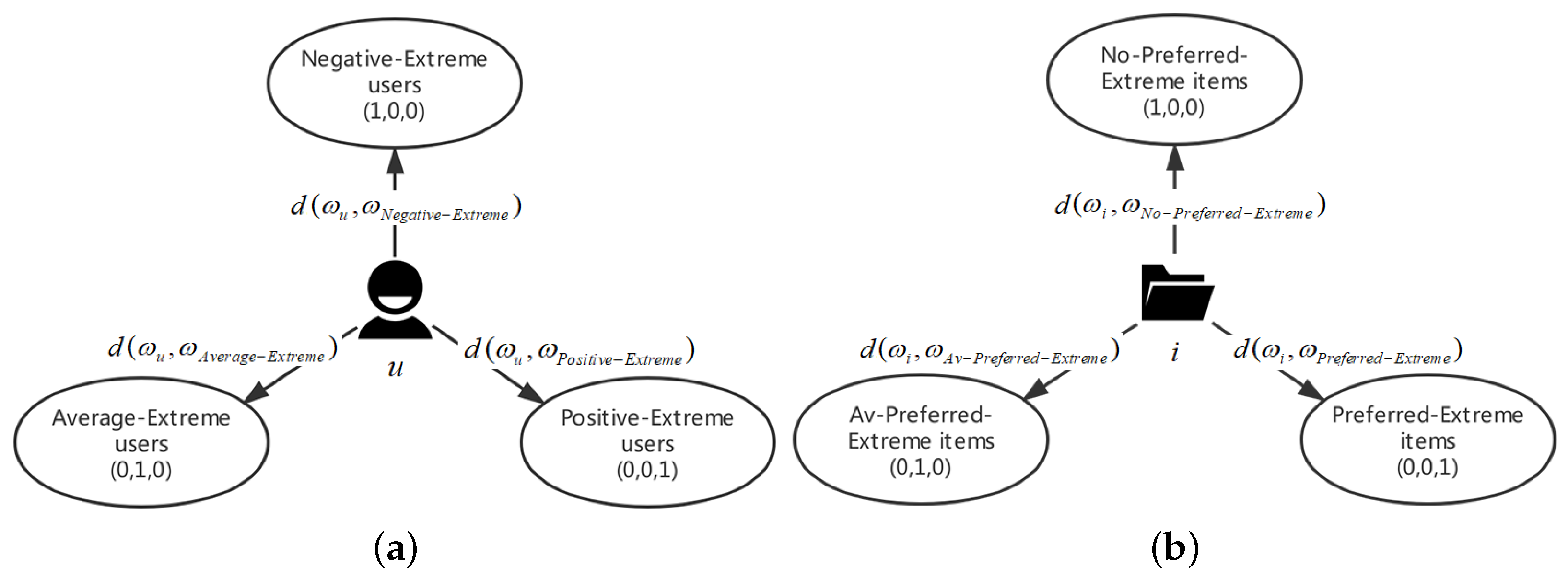
Recommender systems search the underlying preferences of users according to their historical ratings and recommend a list of items that may be of interest to them. Rating information plays an important role in revealing the true tastes of users. However, previous research indicates that natural noises may exist in the historical ratings and mislead the recommendation results. To deal with natural noises, different methods have been proposed, such as directly removing noises, correcting noise by re-predicting, or using additional information. However, these methods introduce some new problems, such as data sparsity and introducing new sources of noise. To address the problems, we present a new approach to managing natural noises in recommendation systems. Firstly, we provide the detection criteria for natural noises based on the classifications of users and items. After the noises are detected, we correct them with threshold values weighted by probabilities. Experimental results show that the proposed method can effectively correct natural noise and greatly improve the quality of recommendations.
Keywords: recommender system; natural noise; collaborative filtering; data sparsity recommender system; natural noise; collaborative filtering; data sparsity