
Article

A Truly Robust Signal Temporal Logic: Monitoring Safety Properties of Interacting Cyber-Physical Systems under Uncertain Observation

1
CISPA Helmholtz Center for Information Security, Stuhlsatzenhaus 5, 66123 Saarbrücken, Germany
2
Department of Computing Science, Carl von Ossietzky Universität, Ammerländer Heerstraße 114-118, 26129 Oldenburg, Germany
*
Author to whom correspondence should be addressed.
Algorithms 2022, 15(4), 126; https://doi.org/10.3390/a15040126
Submission received: 15 March 2022 / Revised: 8 April 2022 / Accepted: 9 April 2022 / Published: 11 April 2022
(This article belongs to the Special Issue Algorithms for Reliable Estimation, Identification and Control II)

Abstract

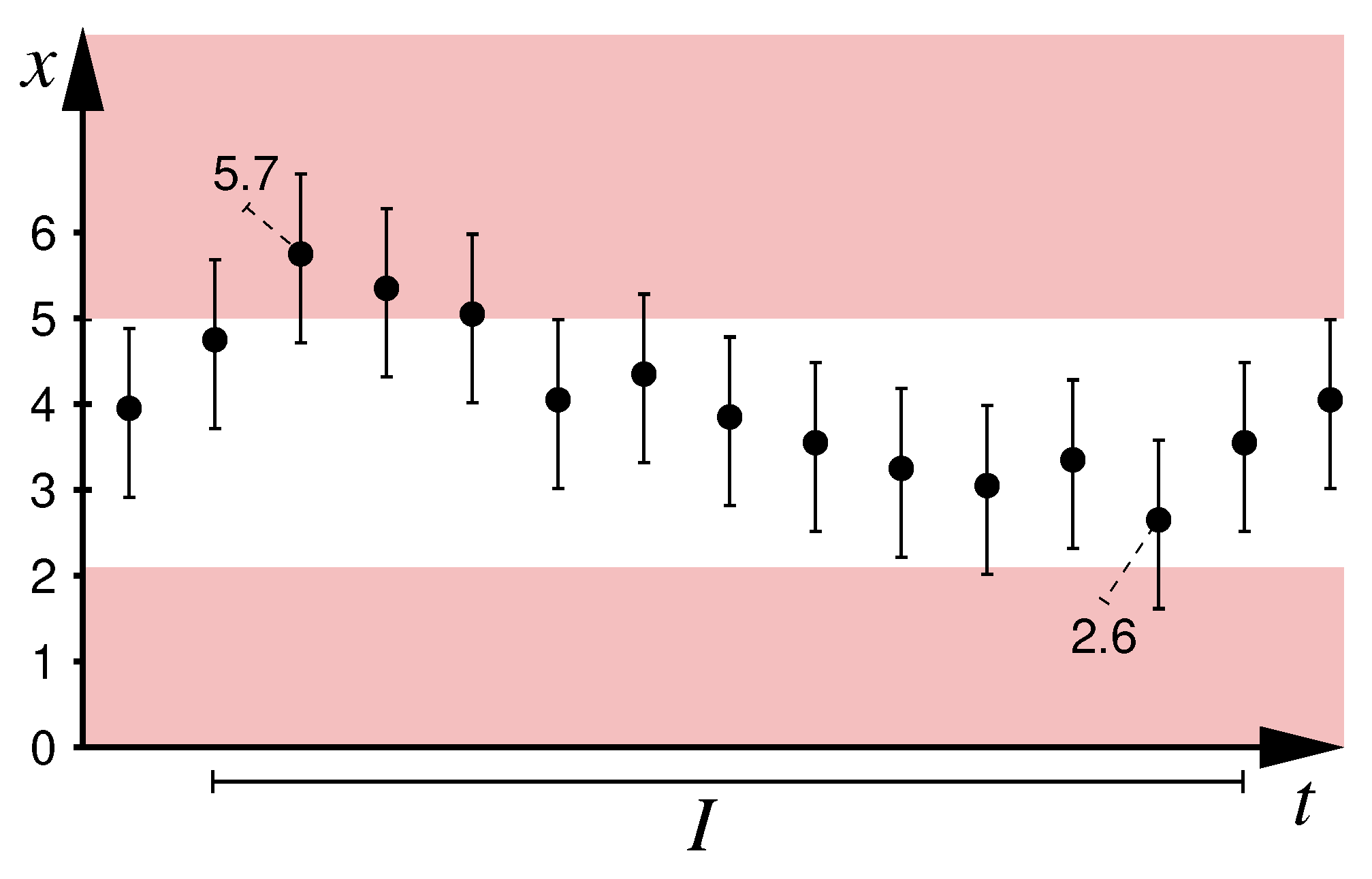
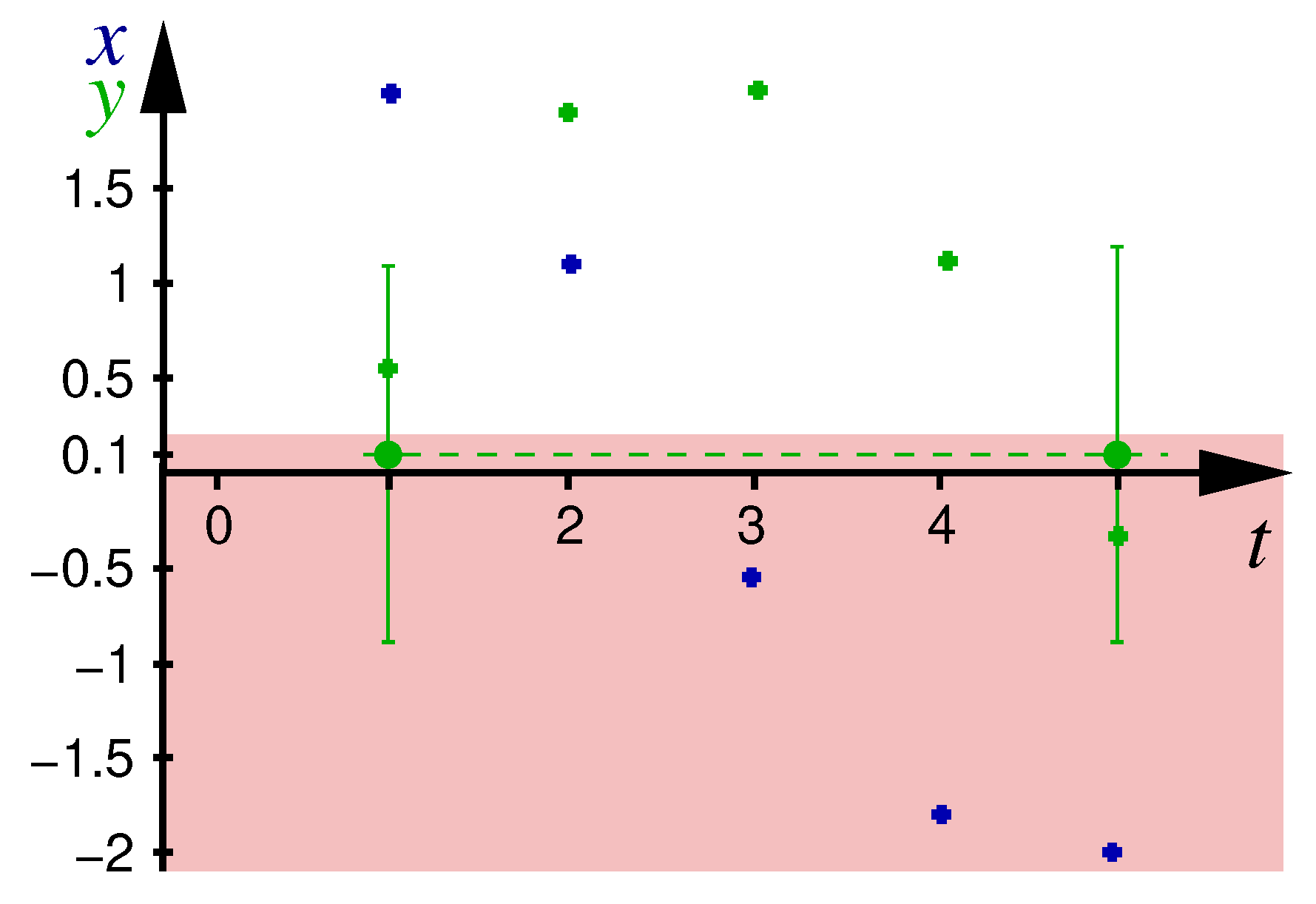
Signal Temporal Logic is a linear-time temporal logic designed for classifying the time-dependent signals originating from continuous-state or hybrid-state dynamical systems according to formal specifications. It has been conceived as a tool for systematizing the monitoring of cyber-physical systems, supporting the automatic translation of complex safety specifications into monitoring algorithms, faithfully representing their semantics. Almost all algorithms hitherto suggested do, however, assume perfect identity between the sensor readings, informing the monitor about the system state and the actual ground truth. Only recently have Visconti et al. addressed the issue of inexact measurements, taking up the simple model of interval-bounded per-sample error that is unrelated, in the sense of chosen afresh, across samples. We expand their analysis by decomposing the error into an unknown yet fixed offset and an independent per-sample error and show that in this setting, monitoring of temporal properties no longer coincides with collecting Boolean combinations of state predicates evaluated in each time instant over best-possible per-sample state estimates, but can be genuinely more informative in that it infers determinate truth values for monitoring conditions that interval-based evaluation remains inconclusive about. For the model-free as well as for the linear model-based case, we provide optimal evaluation algorithms based on affine arithmetic and SAT modulo theory, solving over linear arithmetic. The resulting algorithms provide conclusive monitoring verdicts in many cases where state estimations inherently remain inconclusive. In their model-based variants, they can simultaneously address the issues of uncertain sensing and partial observation.
Keywords: signal temporal logic; online monitoring; uncertain information; partial observation signal temporal logic; online monitoring; uncertain information; partial observation