Doping with Multiscale Hybrid Particles Enhances the Thermal Conductivity and Insulation Properties of Epoxy Resin Composites

 ,
,
Abstract
1. Introduction
2. Sample Preparation and Experimental Methods
2.1. Experimental Raw Materials
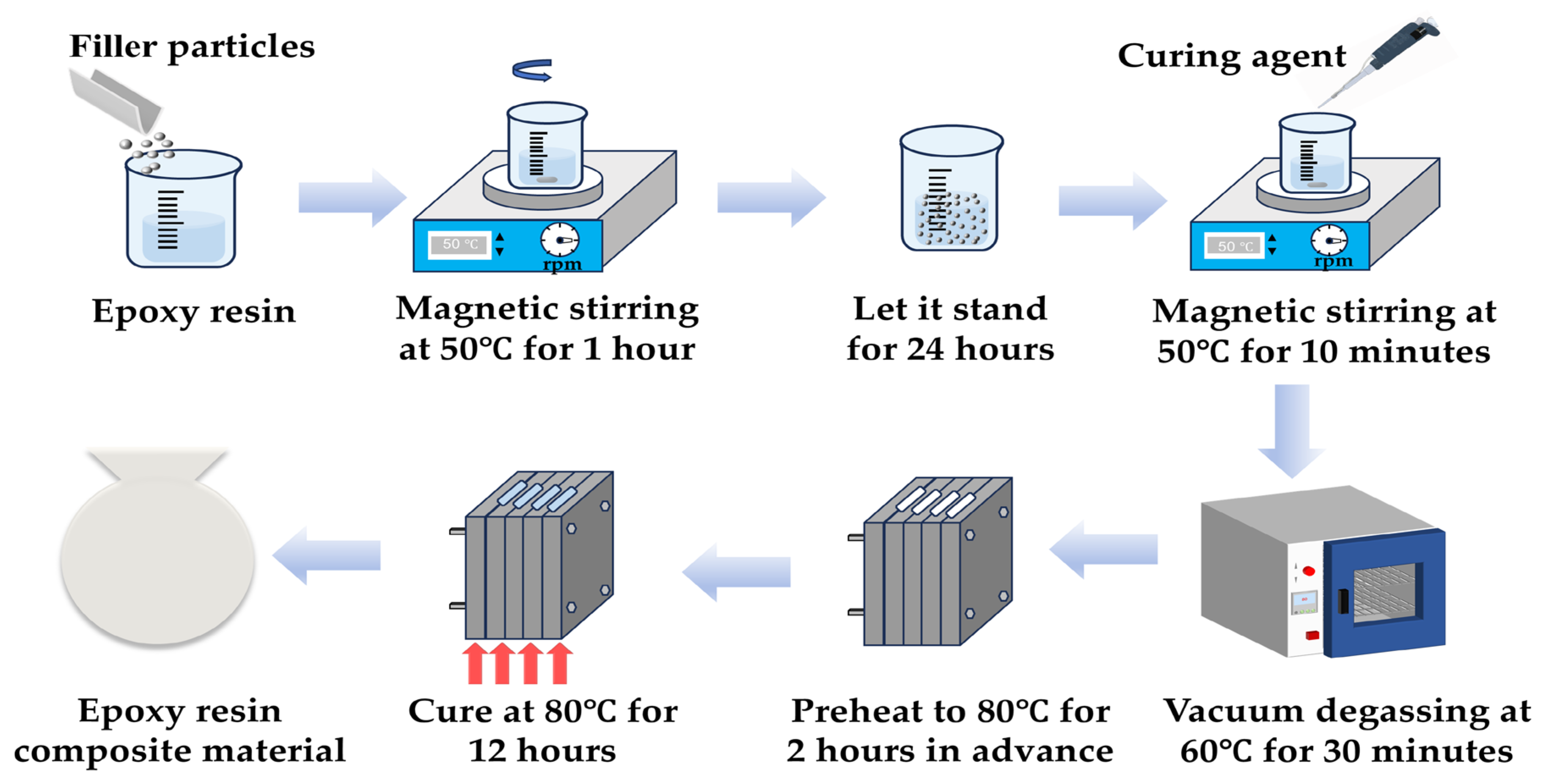
2.2. Sample Preparation
2.3. Characterization and Simulation Methods
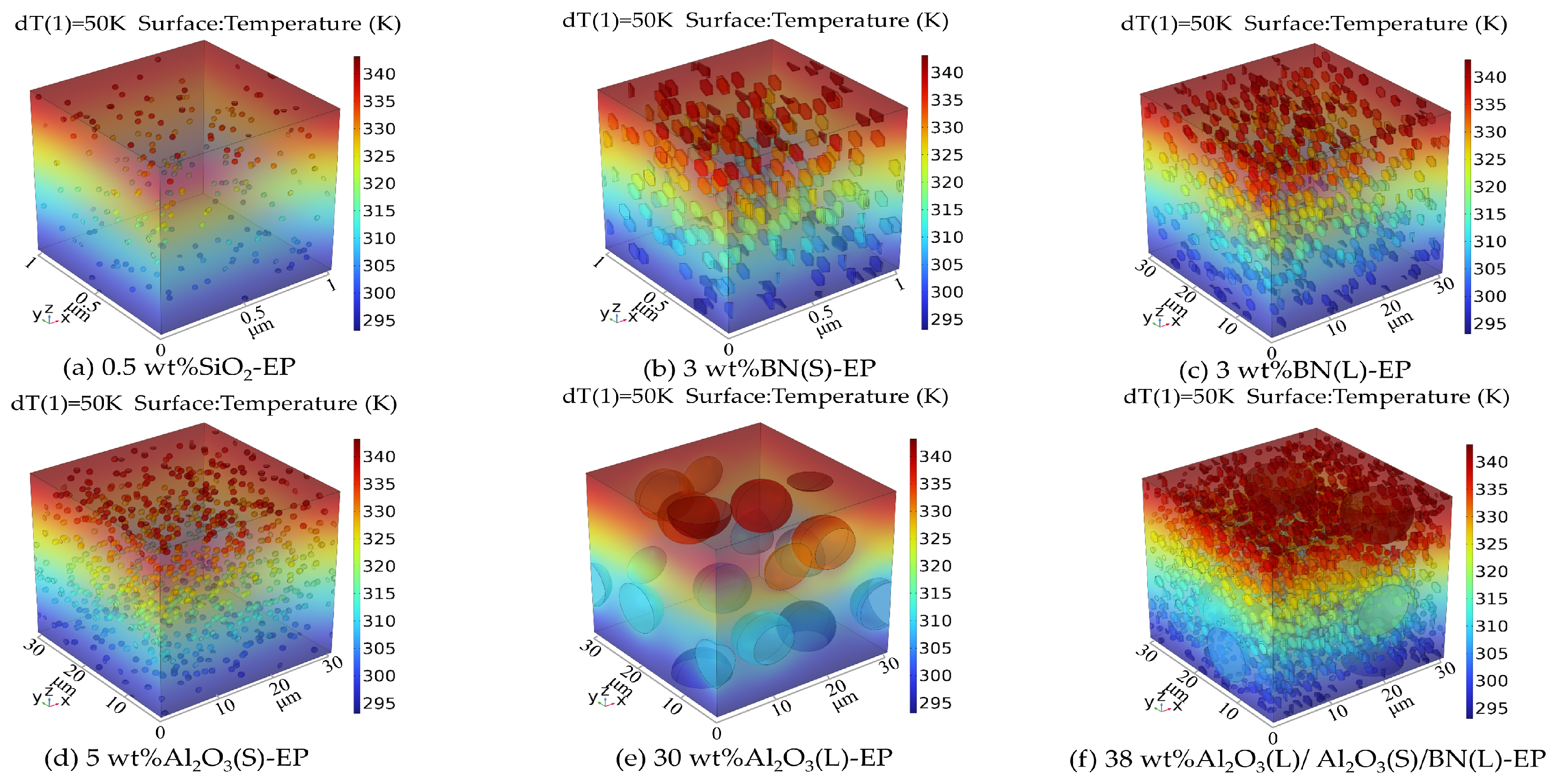
2.3.1. Finite Element Modeling
2.3.2. SEM Observation
2.3.3. Thermal Conductivity Measurement
2.3.4. Dielectric Performance Measurement
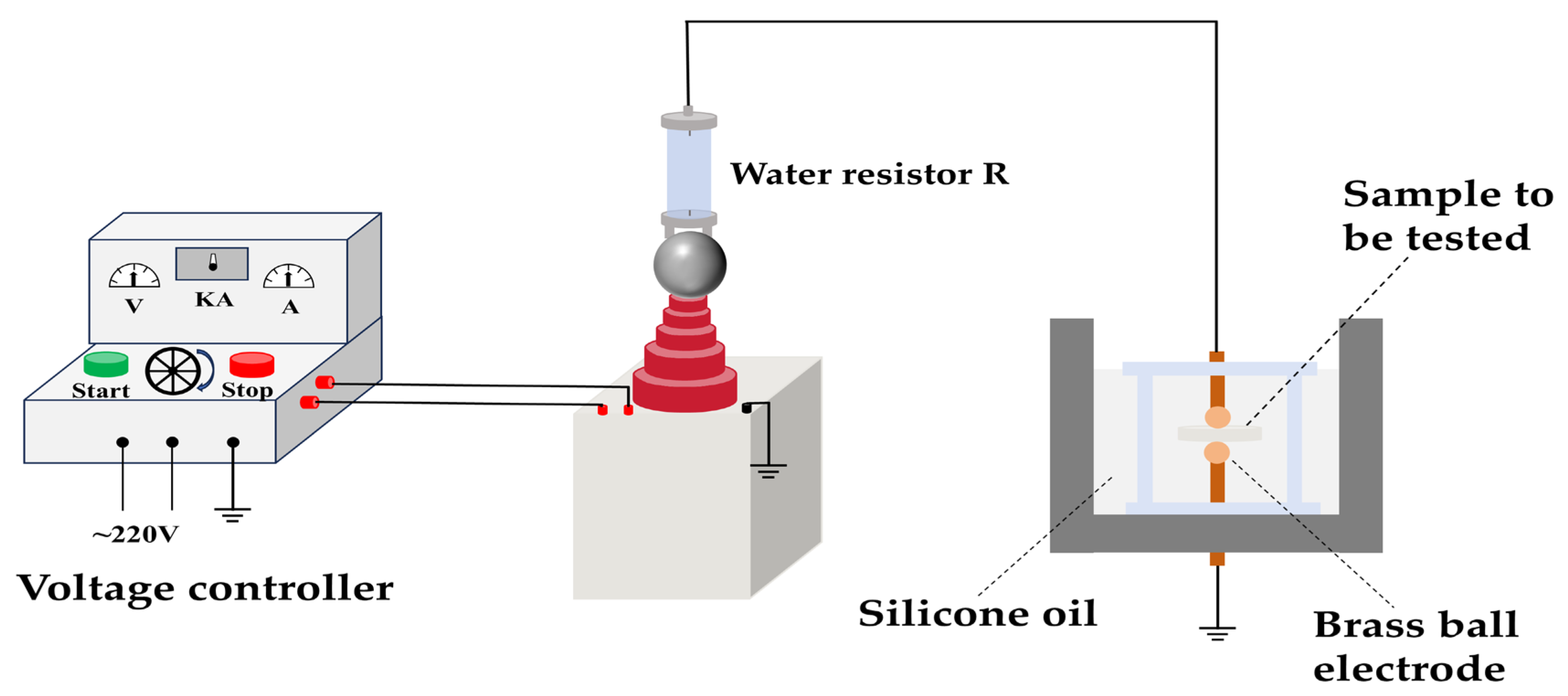
2.3.5. Breakdown Field Strength Measurement
3. Simulation Results
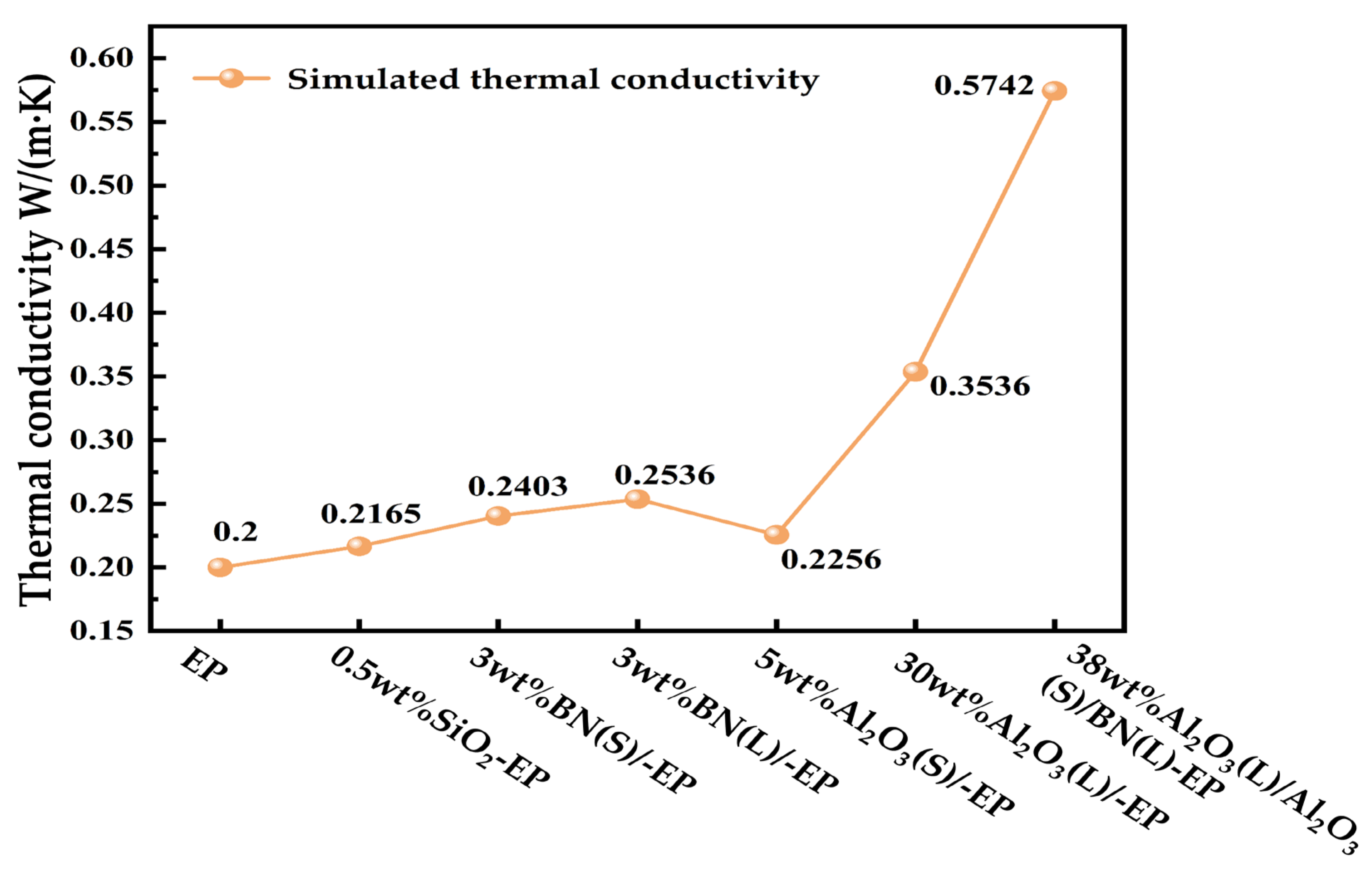
3.1. Thermal Conductivity Simulation
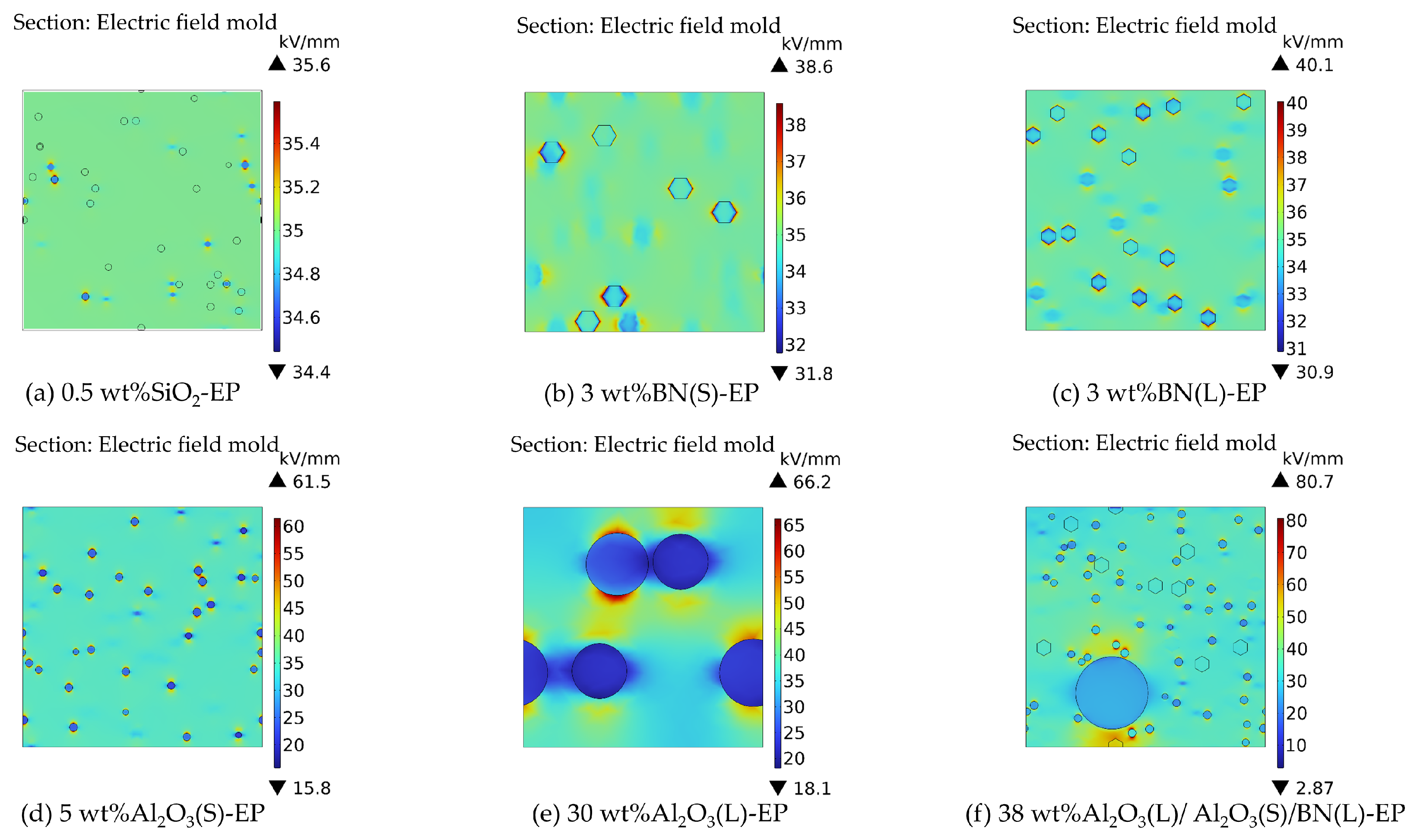
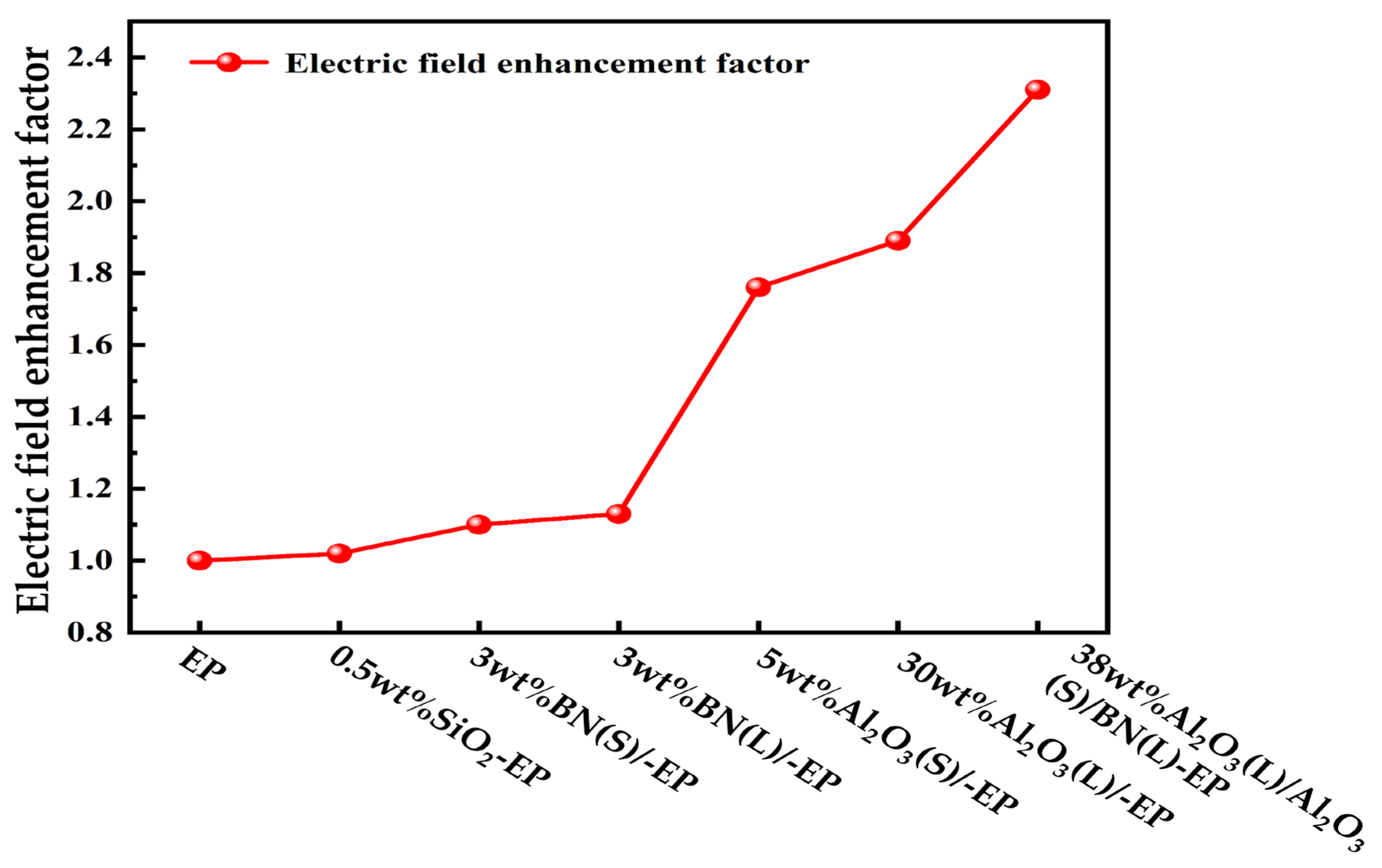
3.2. Electric Field Distribution Simulation
4. Experimental Results and Discussion
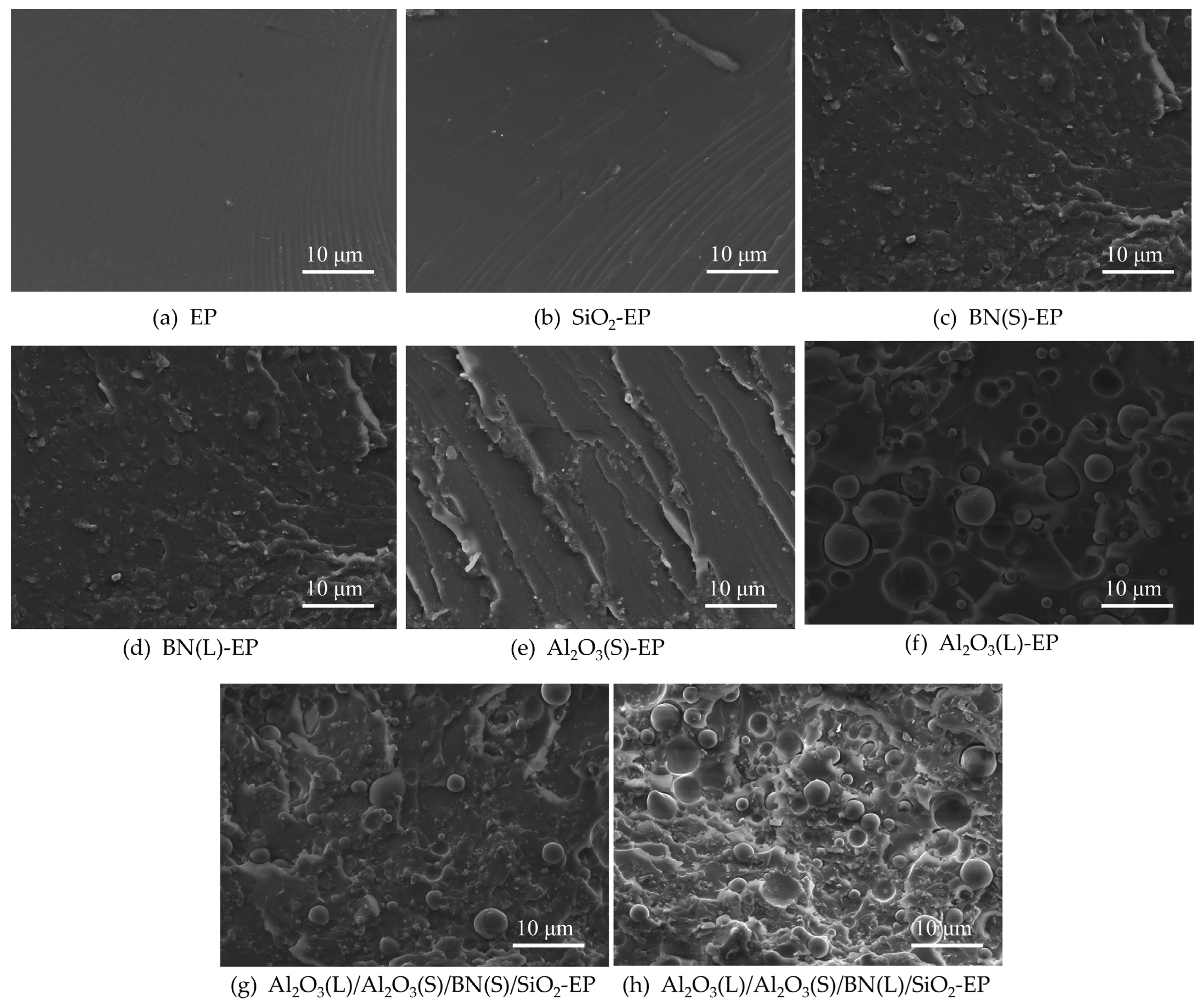
4.1. SEM Characterization
4.2. Thermal Conductivity
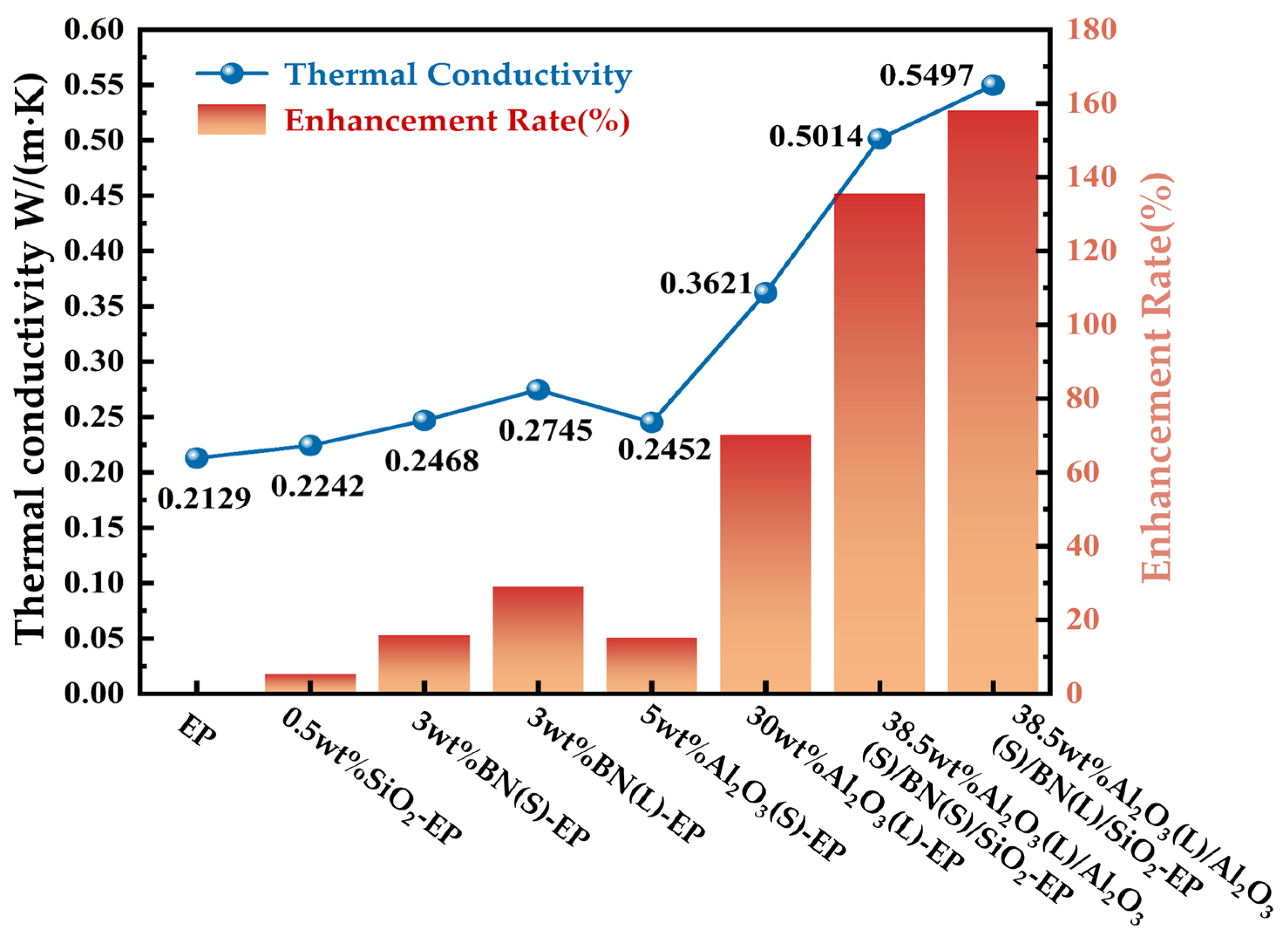
4.2.1. Thermal Conductivity Results
4.2.2. Discussion of Thermal Conductivity Results
4.3. Dielectric Properties
4.3.1. Dielectric Property Results
4.3.2. Discussion of Dielectric Properties
4.4. Breakdown Characteristics
4.4.1. Breakdown Strength Results
4.4.2. Discussion of Breakdown Strength
5. Conclusions
- (1)
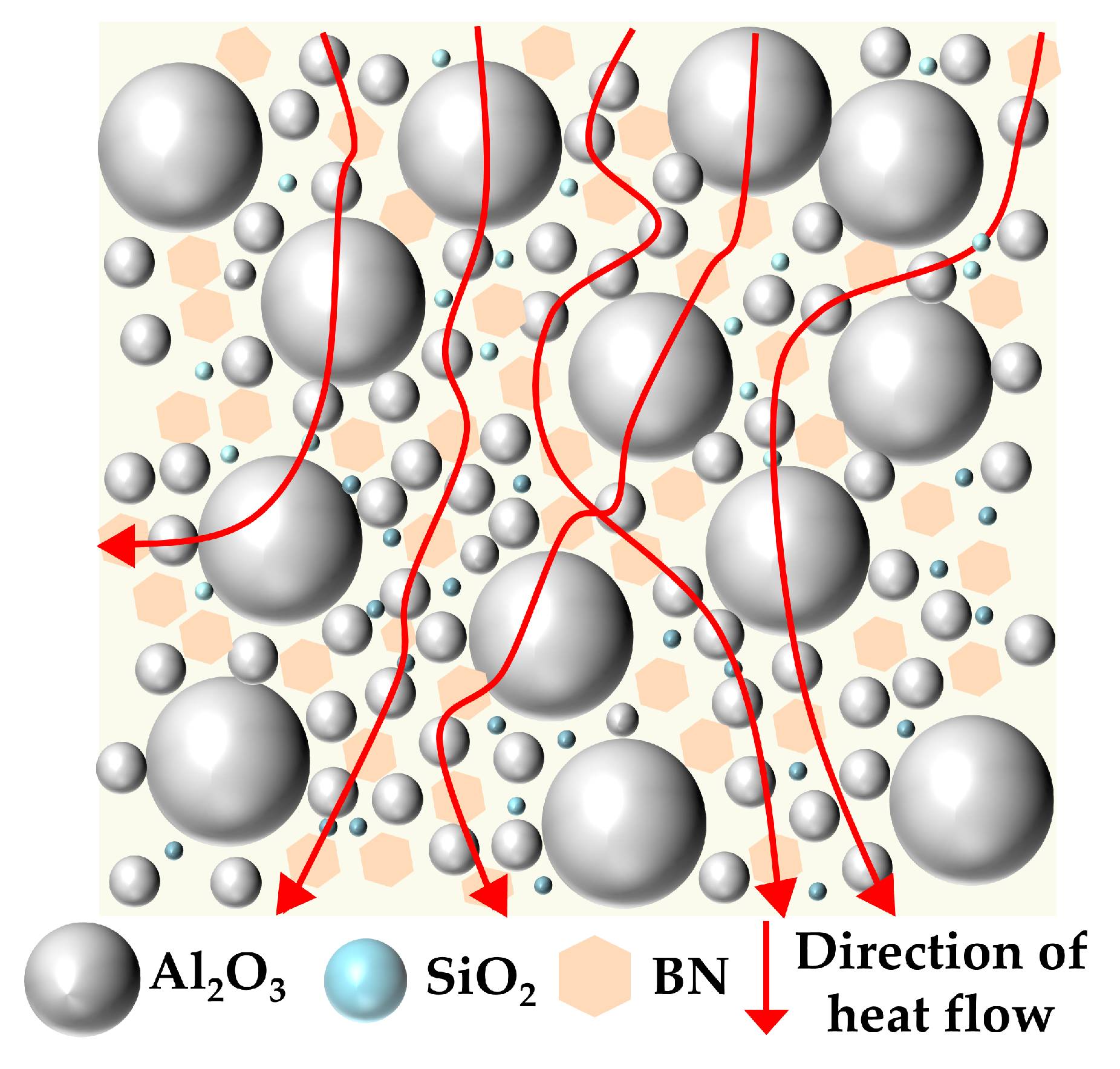
- By compounding spherical Al2O3 with large and small particle sizes, Platelet BN, and spherical SiO2, the thermal conductivity of the composite material is increased to 0.5497 W/(m·K) at a total filler content of 38.5 wt%, which is 158.2% higher than that of pure EP. The underlying mechanism is that multi-scale particles synergistically construct a continuous thermally conductive network structure. That is, large particle size Al2O3 forms a thermal conductivity framework, small particle size Al2O3 fills the gaps, platelet BN bridges particles to increase the contact area, and nano-SiO2 enhances interfacial compatibility and reduces phonon scattering.
- (2)
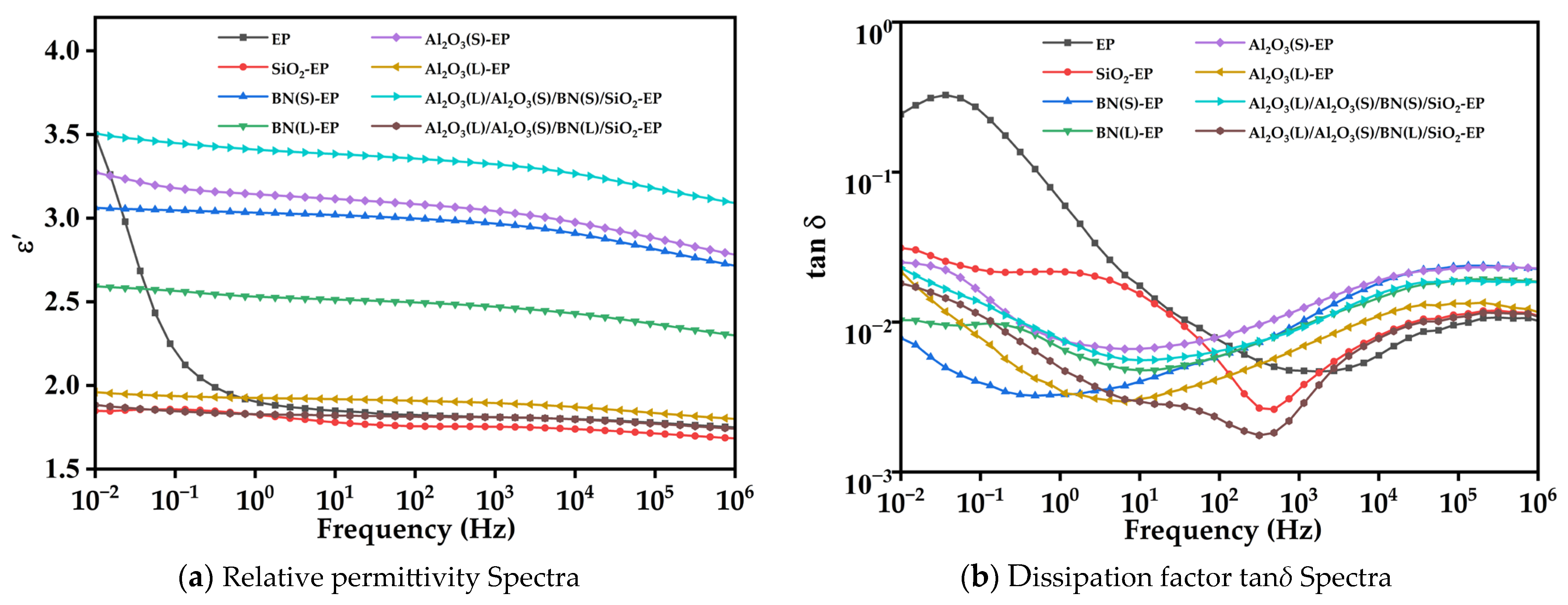
- Compared to pure EP, the SiO2-EP and Al2O3(L)/Al2O3(S)/BN(L)/SiO2-EP composites exhibit reduced ε′ values. Their tanδ is lower in the low-frequency region and comparable to that of pure EP at high frequencies. This behavior is attributed to the interfacial regions formed between the micro/nano particles and the epoxy matrix, which restrict the segmental motion of polymer chains and dipole polarization, thereby further decreasing tanδ.
- (3)
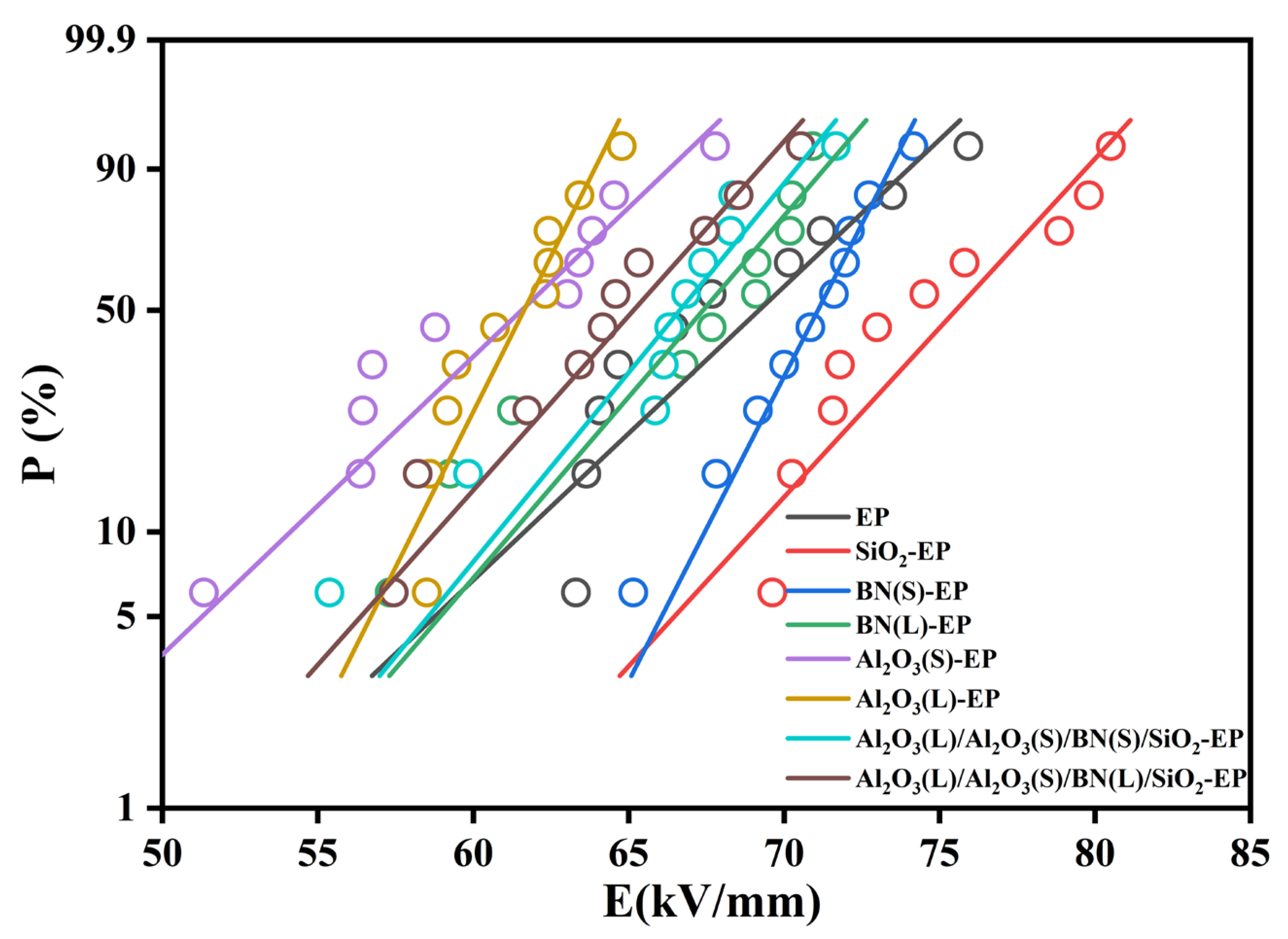
- The SiO2-EP composite exhibits the highest breakdown strength of 76.43 kV/mm, which can be attributed to the more uniform distribution of smaller particles that minimizes internal electric field distortion. In contrast, the Al2O3(L)/Al2O3(S)/BN(L)/SiO2-EP composite shows a reduced breakdown strength of 65.99 kV/mm. This reduction is attributed to the high filler loading of multiple particles, which introduces more internal defects and exacerbates electric field distortion at the particle-matrix interfaces. Nevertheless, this value still satisfies the basic insulation requirements for generator main insulation.
6. Outlook
Author Contributions
Funding
Data Availability Statement
Conflicts of Interest
References
- Hu, C.; Yin, X.; Yang, Z.; Chen, Y.; Pan, Y. Study on the performance of a new type of Tongma epoxy polyplastic glass powder mica tape for main insulation of stator winding of large motor. Large Electr. Eng. Technol. 2020, 6, 40–44. [Google Scholar]
- Zhao, X.; Zhang, H.; Sun, Y.; Zhang, T. Improved thermal conductivity of anticorona insulation paint for high-voltage motor application. J. Mater. Sci. Mater. Electron. 2023, 34, 1860. [Google Scholar] [CrossRef]
- Jin, Y.; Liu, J.; Hu, X. Effect of electrical and mechanical properties of epoxy insulating materials on tracking characteristics. Aging Appl. Synth. Mater. 2022, 51, 75–76, 89. [Google Scholar]
- Liu, W.; Bian, W.; Yu, X. Research on High Thermal Conductivity Epoxy Resin Composites and Their Application in Electric Motors. Micro Spec. Electr. Mach. 2022, 50, 51–56. [Google Scholar]
- Yu, T.; Li, X.; Yang, X.; Hu, Z.; Ji, C. Improving the Thermal Physical Properties of Epoxy Resin Composites by Dually Modified Boron Nitride Using Polydopamine Silane. Mater. Rep. 2024, 38, 258–263. [Google Scholar]
- Wang, W.; Li, C.; Lu, C.; Xia, Y. Preparation and Application of High Thermal Conductivity and Low Glue Mica Tape. Insul. Mater. 2017, 50, 97–105. [Google Scholar]
- Bian, W.; Yao, T.; Chen, M.; Zhang, C.; Shao, T.; Yang, Y. The synergistic effects of the micro-BN and nano-Al2O3 in micro-nano composites on enhancing the thermal conductivity for insulating epoxy resin. Compos. Sci. Technol. 2018, 168, 420–428. [Google Scholar] [CrossRef]
- Cao, J.; Yan, H.; Li, D.; Wang, Y.; Li, W. Influence of the Variable Cross-Section Stator Ventilation Structure on the Temperature of an Induction Motor. Energies 2021, 14, 5249. [Google Scholar] [CrossRef]
- Tang, C.; Yu, Z.; Fu, J.; Yang, J. Analysis and optimization of a high-speed generator’s cooling structure based on Taguchi method. Case Stud. Therm. Eng. 2024, 63, 105250. [Google Scholar] [CrossRef]
- Nika, L.D.; Pokatilov, P.E.; Askerov, S.A.; Balandin, A.A. Phonon thermal conduction in graphene: Role of Umklapp and edge roughness scattering. Phys. Rev. B 2009, 79, 155413. [Google Scholar] [CrossRef]
- Pan, H.; Dong, Q.; Yang, L.; Liu, C.; Pei, K. Research Progress on Intrinsic Thermal Conductive Insulating Liquid Crystal Epoxy Resin. Coat. Ind. 2024, 54, 82–88. [Google Scholar]
- Zhang, T.; Shi, Z.Z.; Wu, J.X.; Zhang, C.H.; Feng, Y.; Chi, Q.G. Research Progress of Filled High Thermal Conductivity Epoxy Resin Composites. Insul. Mater. 2022, 55, 10–22. [Google Scholar]
- Jiang, P.; Chen, J.; Huang, X. Research status of high thermal conductivity insulating polymer nanocomposites. High Volt. Eng. 2017, 43, 2791–2799. [Google Scholar]
- Wen, Y.; Chen, C.; Ye, Y.; Xue, Z.; Liu, H.; Zhou, X.; Zhang, Y.; Li, D.; Xie, X.; Mai, Y.W. Advances on Thermally Conductive Epoxy-Based Composites as Electronic Packaging Underfill Materials—A Review. Adv. Mater. 2022, 34, e2201023. [Google Scholar] [CrossRef]
- Wang, Q.; Gao, Z.; Liu, H.; Wu, S.; Song, Q.; Zhao, Y.; Xiao, L.; Yin, X.; Lu, Z.; Cai, J.; et al. Enhanced Thermal Conductivity of Epoxy Composites Fabricated with Boron Nitride and Multi-Walled Carbon Nanotubes. ACS Appl. Eng. Mater. 2023, 1, 1856–1865. [Google Scholar] [CrossRef]
- Wang, W.; Yang, L.; Zheng, M.; Ge, F.; Ma, H. Enhanced thermal conductivity of epoxy composites via bridged Al2O3 network with in situ formed silver nanoparticles. Polym. Compos. 2021, 43, 330–338. [Google Scholar] [CrossRef]
- Pawelski-Hoell, C.; Bhagwat, S.; Altstädt, V. Thermal, fire, and mechanical properties of solvent-free processed BN/boehmite-filled prepregs. Polym. Eng. Sci. 2019, 59, 1840–1852. [Google Scholar] [CrossRef]
- Feng, Q.K.; Liu, C.; Zhang, D.L.; Song, Y.H.; Sun, K.; Xu, H.P.; Dang, Z.M. Particle packing theory guided multiscale alumina filled epoxy resin with excellent thermal and dielectric performances. J. Mater. 2022, 8, 1058–1066. [Google Scholar] [CrossRef]
- Yao, T.; Bian, W.; Yang, Y. Thermal conductivity and insulating properties of micron boron nitride-nano alumina composite epoxy materials. High Volt. Eng. 2021, 47, 251–259. [Google Scholar]
- Strauchs, A. Effects of SiO2 nanofiller on the properties of epoxy resin based syntactic foam. IEEE Trans. Dielectr. Electr. Insul. 2012, 19, 400–407. [Google Scholar] [CrossRef]
- Li, Y.; Yang, Y.; Yan, S.; Lei, Z.; Guo, M. Mitigation of electrical treeing at high temperature in nano-SiO2 doped epoxy resin. High Volt. 2023, 8, 640–649. [Google Scholar] [CrossRef]
- Song, Y.H.; Yin, L.J.; Zhong, S.L.; Feng, Q.K.; Wang, H.; Zhang, P.; Xu, H.P.; Liang, T.; Dang, Z.M. A processable high thermal conductivity epoxy composites with multi-scale particles for high-frequency electrical insulation. Adv. Compos. Hybrid Mater. 2024, 7, 115. [Google Scholar] [CrossRef]
- Ma, W.; Tian, F.; Xiong, W.; Yao, J. Research on Thermal Conductivity and Electrical Insulation Properties of Epoxy Resin/BN Micro-nano Composites. Insul. Mater. 2019, 52, 36–42. [Google Scholar]
- Li, Y.; Tian, M.; Lei, Z.; Xu, X.; Wang, S. Effects of Adding Silica Nanoparticles on Dielectric and Space Charge Properties of Epoxy Resin. High Volt. Eng. 2018, 44, 1870–1877. [Google Scholar]
- Todd, G.M.; Shi, G.F. Complex Permittivity of Composite Systems: A Comprehensive Interphase Approach. IEEE Trans. Dielectr. Electr. Insul. 2005, 12, 601–611. [Google Scholar] [CrossRef]
- Nelson, K.J.; Fothergill, C.J. Internal charge behaviour of nanocomposites. Nanotechnology 2004, 15, 586–595. [Google Scholar] [CrossRef]
- Kochetov, R.; Andritsch, T.; Morshuis, P.H.; Smit, J.J. Anomalous behaviour of the dielectric spectroscopy response of nanocomposites. IEEE Trans. Dielectr. Electr. Insul. 2012, 19, 107–117. [Google Scholar] [CrossRef]
- Tanaka, T. Dielectric Nanocomposites with Insulating Properties. IEEE Trans. Dielectr. Electr. Insul. 2005, 12, 914–928. [Google Scholar] [CrossRef]
- Liu, J.; Li, X.; Wei, X. Dielectric Response Characteristics of Epoxy-Mica Composite Insulation during Curing Process. Electr. Mach. Control 2014, 18, 22–28. [Google Scholar]
- Gao, Y.; Wang, X.; Li, N.; Xu, B.; Wang, J.; Du, B. Research Progress on the Characterization Method of Carrier Traps in Polymer Insulating Materials and the Effect of Traps on Insulation Breakdown. High Volt. Eng. 2019, 45, 2219–2230. [Google Scholar]
- Du, B.; Cui, B.; Xu, H.; Li, J.; Fu, M.; Hou, S. Arc Resistance and Dielectric Properties of Polyethylene/BN High Thermal Conductivity Composites. High Volt. Technol. 2018, 44, 1412–1420. [Google Scholar]
- Gao, H.; Liang, L.; Shan, Z.; Fu, Q.; Chen, Q.; Liu, L.; Weng, L.; Guan, S.; Feng, C.; Huang, C.; et al. Thermal conductivity and dielectric properties of high thermal conductive adhesives in the large generator insulation materials. Electr. Eng. 2022, 104, 1811–1820. [Google Scholar] [CrossRef]



| Group | Sample Name | Mass Fraction wt% | |||||
|---|---|---|---|---|---|---|---|
| EP | SiO2 (30 nm) | BN (50 nm) | BN (1 μm) | Al2O3 (1 μm) | Al2O3 (10 μm) | ||
| G1 | EP | 100 | |||||
| G2 | 0.5 wt%SiO2-EP | 99.5 | 0.5 | ||||
| G3 | 3 wt%BN(S)-EP | 97 | 3 | ||||
| G4 | 3 wt%BN(L)-EP | 97 | 3 | ||||
| G5 | 5 wt%Al2O3(S)-EP | 95 | 5 | ||||
| G6 | 30 wt%Al2O3(L)-EP | 70 | 30 | ||||
| G7 | 38.5 wt%Al2O3(L)/Al2O3(S)/ BN(S)/SiO2-EP | 61.5 | 0.5 | 3 | 5 | 30 | |
| G8 | 38.5 wt%Al2O3(L)/Al2O3(S)/ BN(L)/SiO2-EP | 61.5 | 0.5 | 3 | 5 | 30 | |
| Material | Specific Heat Capacity/(J/(Kg·K)) | Density/(kg/m3) | Thermal Conductivity/(W/(m·K)) | Relative Permittivity |
|---|---|---|---|---|
| Epoxy resin | 1150 | 1200 | 0.2 | 3.87 |
| Al2O3 particles | 800 | 3970 | 30 | 3.9 |
| BN particles | 700 | 2280 | 300 | 4.8 |
| SiO2 particles | 750 | 2000 | 1 | 9.8 |
| Group | Sample Name | Mass Fraction wt% | |||||
|---|---|---|---|---|---|---|---|
| EP | SiO2 (30 nm) | BN (50 nm) | BN (1 μm) | Al2O3 (1 μm) | Al2O3 (10 μm) | ||
| S1 | EP | 100 | |||||
| S2 | 0.5 wt%SiO2-EP | 99.5 | 0.5 | ||||
| S3 | 3 wt%BN(S)-EP | 97 | 3 | ||||
| S4 | 3 wt%BN(L)-EP | 97 | 3 | ||||
| S5 | 5 wt%Al2O3(S)-EP | 95 | 5 | ||||
| S6 | 30 wt%Al2O3(L)-EP | 70 | 30 | ||||
| S7 | 38 wt%Al2O3(L)/Al2O3(S)/ BN(L)-EP | 62 | 3 | 5 | 30 | ||
| Filler | Thermal Conductivity Input (W·m−1·K−1) | Effective Thermal Conductivity of Composite (W·m−1·K−1) | Relative Variation |
|---|---|---|---|
| Al2O3 | 24 | 0.3492 | −1.2 |
| Al2O3 | 30 (reference) | 0.3536 | 0 |
| Al2O3 | 36 | 0.3568 | 0.90 |
| BN | 240 | 0.2522 | −0.55 |
| BN | 300 (reference) | 0.2536 | 0 |
| BN | 360 | 0.2552 | 0.63 |
| SiO2 | 0.8 | 0.21503 | −0.07 |
| SiO2 | 1 (reference) | 0.21650 | 0 |
| SiO2 | 1.2 | 0.21686 | 0.02 |
| Group | Sample Name | Breakdown Field Strength E0 | Improvement Percentage Compared to EP/% |
|---|---|---|---|
| G1 | EP | 70.12 | 0 |
| G2 | 0.5 wt%SiO2-EP | 76.43 | 8.99 |
| G3 | 3 wt%BN(S)-EP | 71.67 | 2.21 |
| G4 | 3 wt%BN(L)-EP | 72.13 | 2.87 |
| G5 | 5 wt%Al2O3(S)-EP | 68.22 | −2.71 |
| G6 | 30 wt%Al2O3(L)-EP | 62.41 | −10.99 |
| G7 | 38.5 wt%Al2O3(L)/Al2O3(S)/BN(S)/SiO2-EP | 67.45 | −3.81 |
| G8 | 38.5 wt%Al2O3(L)/Al2O3(S)/BN(L)/SiO2-EP | 65.99 | −5.89 |
Disclaimer/Publisher’s Note: The statements, opinions and data contained in all publications are solely those of the individual author(s) and contributor(s) and not of MDPI and/or the editor(s). MDPI and/or the editor(s) disclaim responsibility for any injury to people or property resulting from any ideas, methods, instructions or products referred to in the content. |
© 2026 by the authors. Licensee MDPI, Basel, Switzerland. This article is an open access article distributed under the terms and conditions of the Creative Commons Attribution (CC BY) license.
Share and Cite
Xie, Z.; Zhang, Y.; He, M.; Li, Y.; Wang, M.; Xin, C.; Lei, Z. Doping with Multiscale Hybrid Particles Enhances the Thermal Conductivity and Insulation Properties of Epoxy Resin Composites. Materials 2026, 19, 1751. https://doi.org/10.3390/ma19091751
Xie Z, Zhang Y, He M, Li Y, Wang M, Xin C, Lei Z. Doping with Multiscale Hybrid Particles Enhances the Thermal Conductivity and Insulation Properties of Epoxy Resin Composites. Materials. 2026; 19(9):1751. https://doi.org/10.3390/ma19091751
Chicago/Turabian StyleXie, Zhihui, Yue Zhang, Mingpeng He, Yuanyuan Li, Menghan Wang, Cheng Xin, and Zhipeng Lei. 2026. "Doping with Multiscale Hybrid Particles Enhances the Thermal Conductivity and Insulation Properties of Epoxy Resin Composites" Materials 19, no. 9: 1751. https://doi.org/10.3390/ma19091751
APA StyleXie, Z., Zhang, Y., He, M., Li, Y., Wang, M., Xin, C., & Lei, Z. (2026). Doping with Multiscale Hybrid Particles Enhances the Thermal Conductivity and Insulation Properties of Epoxy Resin Composites. Materials, 19(9), 1751. https://doi.org/10.3390/ma19091751