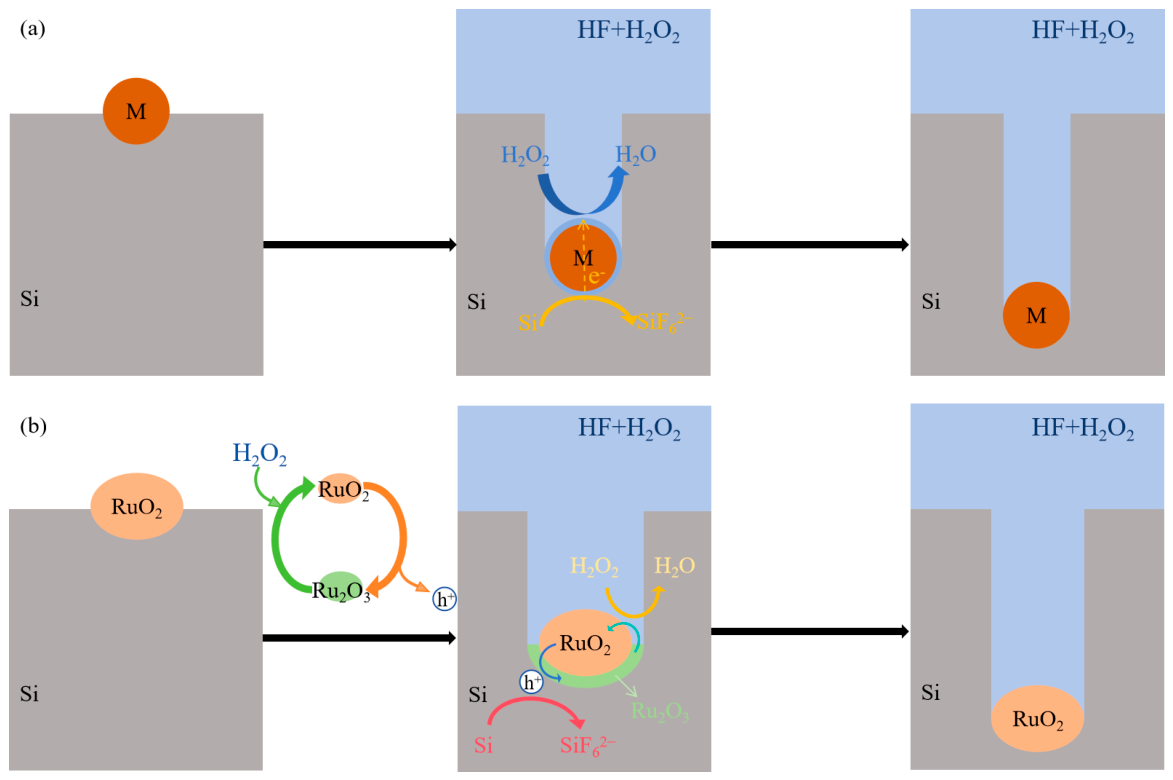
The Mechanism of Ruthenium Oxide Catalyzed Electroless Etching of Silicon in Oxidizing HF Solution



Abstract
1. Introduction
2. Materials and Methods
2.1. Materials
2.2. Sample Preparation
2.3. Characterization and Electrochemical Measurements
3. Results and Discussion
4. Conclusions
Supplementary Materials
Author Contributions
Funding
Data Availability Statement
Conflicts of Interest
References
- Shim, B.; Park, K.-R.; Kim, H.; Kim, C.; Song, Y.; Kim, W.-B. Scalable fabrication of ultra-long silicon nanowires via H2O2-enhanced MACE for flexible hydrogen sensors. Chem. Eng. J. 2025, 520, 165632. [Google Scholar] [CrossRef]
- Surdo, S.; Barillaro, G. Voltage-and Metal-assisted Chemical Etching of Micro and Nano Structures in Silicon: A Comprehensive Review. Small 2024, 20, e2400499. [Google Scholar] [CrossRef]
- Huo, C.; Wang, J.; Fu, H.; Li, X.; Yang, Y.; Wang, H.; Mateen, A.; Farid, G.; Peng, K.Q. Metal-Assisted Chemical Etching of Silicon in Oxidizing HF Solutions: Origin, Mechanism, Development, and Black Silicon Solar Cell Application. Adv. Funct. Mater. 2020, 30, 2005744. [Google Scholar] [CrossRef]
- Suh, J.; Lee, J.; Kim, J.; Cho, M.; Kim, J.; Oh, J.M.; Han, H.; Lee, H.S.; Oh, J. High Aspect Ratio Silicon Nanohole Arrays via Electric-Field-Incorporated Metal-Assisted Chemical Etching. ACS Appl. Mater. Interfaces 2025, 17, 31212–31220. [Google Scholar] [CrossRef]
- Hu, Y.; Peng, K.-Q.; Qiao, Z.; Huang, X.; Zhang, F.-Q.; Sun, R.-N.; Meng, X.-M.; Lee, S.-T. Metal-Catalyzed Electroless Etching of Silicon in Aerated HF/H2O Vapor for Facile Fabrication of Silicon Nanostructures. Nano Lett. 2014, 14, 4212–4219. [Google Scholar] [CrossRef] [PubMed]
- Gries, S.; Brinker, M.; Zeller-Plumhoff, B.; Rings, D.; Krekeler, T.; Longo, E.; Greving, I.; Huber, P. Wafer-Scale Fabrication of Hierarchically Porous Silicon and Silica by Active Nanoparticle-Assisted Chemical Etching and Pseudomorphic Thermal Oxidation. Small 2023, 19, e2206842. [Google Scholar] [CrossRef] [PubMed]
- Huang, W.; Wu, J.; Li, W.; Chen, G.; Chu, C.; Li, C.; Zhu, Y.; Yang, H.; Chao, Y. Fabrication of Silicon Nanowires by Metal-Assisted Chemical Etching Combined with Micro-Vibration. Materials 2023, 16, 5483. [Google Scholar] [CrossRef]
- Alhmoud, H.; Brodoceanu, D.; Elnathan, R.; Kraus, T.; Voelcker, N.H. A MACEing silicon: Towards single-step etching of defined porous nanostructures for biomedicine. Prog. Mater. Sci. 2021, 116, 100636. [Google Scholar] [CrossRef]
- Cho, H.; Han, Y.; Kim, G.; Jeong, J.; Lee, S.; Ahn, Y.; Hong, S.B.; Park, S.; Park, I.; Jang, S.E.; et al. Ultrafast Room-Temperature Nanofabrication via Ozone-Based Gas-Phase Metal-Assisted Chemical Etching for High-Performance Silicon Photodetectors. Adv. Funct. Mater. 2025, 35, 2502010. [Google Scholar] [CrossRef]
- Lai, R.A.; Hymel, T.M.; Narasimhan, V.K.; Cui, Y. Schottky Barrier Catalysis Mechanism in Metal-Assisted Chemical Etching of Silicon. ACS Appl. Mater. Interfaces 2016, 8, 8875–8879. [Google Scholar] [CrossRef]
- Chen, Y.; Zhang, C.; Li, L.; Zhou, S.; Chen, X.; Gao, J.; Zhao, N.; Wong, C.P. Hybrid Anodic and Metal-Assisted Chemical Etching Method Enabling Fabrication of Silicon Carbide Nanowires. Small 2019, 15, 1803898. [Google Scholar] [CrossRef] [PubMed]
- Qin, Y.; Liu, D.; Zhang, T.; Cui, Z. Ultrasensitive Silicon Nanowire Sensor Developed by a Special Ag Modification Process for Rapid NH3 Detection. ACS Appl. Mater. Interfaces 2017, 9, 28766–28773. [Google Scholar] [CrossRef]
- Azeredo, B.P.; Lin, Y.W.; Avagyan, A.; Sivaguru, M.; Hsu, K.; Ferreira, P. Direct Imprinting of Porous Silicon via Metal-Assisted Chemical Etching. Adv. Funct. Mater. 2016, 26, 2929–2939. [Google Scholar] [CrossRef]
- Han, Y.; Jeong, J.; Cho, H.; Ahn, Y.; Park, S.; Kim, H.; Shin, J.Y.; Park, M.J.; Kim, T.; Um, H.D. Decoding Directional Control in Metal-Assisted Chemical Etching via Catalyst Architecture. Adv. Mater. 2025, 37, e2502840. [Google Scholar] [CrossRef] [PubMed]
- Wang, S.-D.; Chen, T.-W. Texturization of diamond-wire-sawn multicrystalline silicon wafer using Cu, Ag, or Ag/Cu as a metal catalyst. Appl. Surf. Sci. 2018, 444, 530–541. [Google Scholar] [CrossRef]
- Lu, Y.-T.; Barron, A.R. In-Situ Fabrication of a Self-Aligned Selective Emitter Silicon Solar Cell Using the Gold Top Contacts to Facilitate the Synthesis of a Nanostructured Black Silicon Antireflective Layer Instead of an External Metal Nanoparticle Catalyst. ACS Appl. Mater. Interfaces 2015, 7, 11802–11814. [Google Scholar] [CrossRef]
- Long, J.; Xie, C.; Zhang, X.; Zhang, H.; Chen, X.; Lin, G.; Liu, H.; Chen, Y.; Lu, R.; Chen, X. Fabrication of large-area uniform silicon nanohole arrays with high aspect ratio by ultrasound-enhanced metal-assisted chemical etching. Surf. Interfaces 2025, 72, 107144. [Google Scholar] [CrossRef]
- Li, S.; Ma, W.; Zhou, Y.; Chen, X.; Xiao, Y.; Ma, M.; Wei, F.; Yang, X. Fabrication of p-type porous silicon nanowire with oxidized silicon substrate through one-step MACE. J. Solid State Chem. 2014, 213, 242–249. [Google Scholar] [CrossRef]
- Tong, H.; Yin, J.; Cao, R.; Chen, X.; Lu, S.; Gao, W.; Zou, J.; Jin, Q. One-Step liquid-phase metal-assisted chemical etching process for morphology-controllable fabrication of ordered silicon nanocone arrays. Surf. Interfaces 2026, 80, 108253. [Google Scholar] [CrossRef]
- Canevali, C.; Alia, M.; Fanciulli, M.; Longo, M.; Ruffo, R.; Mari, C.M. Influence of doping elements on the formation rate of silicon nanowires by silver-assisted chemical etching. Surf. Coat. Technol. 2015, 280, 37–42. [Google Scholar] [CrossRef]
- Torralba, E.; Le Gall, S.; Lachaume, R.; Magnin, V.; Harari, J.; Halbwax, M.; Vilcot, J.-P.; Cachet-Vivier, C.; Bastide, S. Tunable Surface Structuration of Silicon by Metal Assisted Chemical Etching with Pt Nanoparticles Under Electrochemical Bias. ACS Appl. Mater. Interfaces 2016, 8, 31375–31384. [Google Scholar] [CrossRef] [PubMed]
- Kolasinski, K.W. The mechanism of galvanic/metal-assisted etching of silicon. Nanoscale Res. Lett. 2014, 9, 432. [Google Scholar] [CrossRef]
- Kubota, W.; Ishizuka, R.; Utsunomiya, T.; Ichii, T.; Sugimura, H. Chemical etching of silicon assisted by graphene oxide. Jpn. J. Appl. Phys. 2019, 58, 050924. [Google Scholar] [CrossRef]
- Kato, Y.; Adachi, S. Fabrication and optical characterization of Si nanowires formed by catalytic chemical etching in Ag2O/HF solution. Appl. Surf. Sci. 2012, 258, 5689–5697. [Google Scholar] [CrossRef]
- Liu, H.; Zhao, L.; Diao, H.; Wang, W. HF/HCl/H2O/MnO2 System for High-Performance Texturization on Multi-Crystalline Silicon. ECS J. Solid State Sci. Technol. 2020, 9, 125002. [Google Scholar] [CrossRef]
- Peng, K.; Wu, Y.; Fang, H.; Zhong, X.; Xu, Y.; Zhu, J. Uniform, Axial-Orientation Alignment of One-Dimensional Single-Crystal Silicon Nanostructure Arrays. Angew. Chem. Int. Ed. 2005, 44, 2737–2742. [Google Scholar] [CrossRef]
- Peng, K.; Lu, A.; Zhang, R.; Lee, S.T. Motility of Metal Nanoparticles in Silicon and Induced Anisotropic Silicon Etching. Adv. Funct. Mater. 2008, 18, 3026–3035. [Google Scholar] [CrossRef]
- Peng, K.-Q.; Yan, Y.-J.; Gao, S.-P.; Zhu, J. Synthesis of Large-Area Silicon Nanowire Arrays via Self-Assembling Nanoelectrochemistry. Adv. Mater. 2002, 14, 1164–1166. [Google Scholar] [CrossRef]
- Gayrard, M.; Voronkoff, J.; Boissière, C.; Montero, D.; Rozes, L.; Cattoni, A.; Peron, J.; Faustini, M. Replacing Metals with Oxides in Metal-Assisted Chemical Etching Enables Direct Fabrication of Silicon Nanowires by Solution Processing. Nano Lett. 2021, 21, 2310–2317. [Google Scholar] [CrossRef] [PubMed]
- Qin, Y.; Cao, B.; Zhou, X.-Y.; Xiao, Z.; Zhou, H.; Zhao, Z.; Weng, Y.; Lv, J.; Liu, Y.; He, Y.-B.; et al. Orthorhombic (Ru, Mn)2O3: A superior electrocatalyst for acidic oxygen evolution reaction. Nano Energ. 2023, 115, 108727. [Google Scholar] [CrossRef]
- Jebakumar Immanuel Edison, T.N.; Atchudan, R.; Lee, Y.R. Facile synthesis of carbon encapsulated RuO2 nanorods for supercapacitor and electrocatalytic hydrogen evolution reaction. Int. J. Hydrogen Energy 2019, 44, 2323–2329. [Google Scholar] [CrossRef]
- Ji, Q.; Tang, B.; Zhang, X.; Wang, C.; Tan, H.; Zhao, J.; Liu, R.; Sun, M.; Liu, H.; Jiang, C.; et al. Operando identification of the oxide path mechanism with different dual-active sites for acidic water oxidation. Nat. Commun. 2024, 15, 8089. [Google Scholar] [CrossRef] [PubMed]
- Ping, X.; Liu, Y.; Zheng, L.; Song, Y.; Guo, L.; Chen, S.; Wei, Z. Locking the lattice oxygen in RuO2 to stabilize highly active Ru sites in acidic water oxidation. Nat. Commun. 2024, 15, 2501. [Google Scholar] [CrossRef]
- Donakowski, M.D.; Mansour, A.N.; Pala, I.R.; Chervin, C.N.; DeSario, P.A.; Long, J.W.; Rolison, D.R. Trapping a Ru2O3 Corundum-like Structure at Ultrathin, Disordered RuO2 Nanoskins Expressed in 3D. J. Phys. Chem. C 2018, 122, 28895–28900. [Google Scholar] [CrossRef]
- Riga, J.; Noel, C.T.; Pireaux, J.-J.; Caudano, R.; Verbist, J.; Gobillon, Y. Electronic Structure of Rutile Oxides TiO2, RuO2 and IrO2 Studied by X-ray Photoelectron Spectroscopy. Phys. Scr. 1977, 16, 351–354. [Google Scholar] [CrossRef]
- Sayan, Ş.; Süzer, Ş.; Uner, D.O. XPS and in-situ IR investigation of Ru/SiO2 catalyst. J. Mol. Struct. 1997, 410–411, 111–114. [Google Scholar] [CrossRef]



| MACE (Noble Metals: Ag, Au, Pt, etc.) | OACE (This Work: RuO2) | |
|---|---|---|
| Charge transfer | Oxidant (e.g., H2O2) injects holes into silicon. | RuO2 particles inject holes into silicon. |
| Catalyst behavior | The valence state of the catalyst remains unchanged; Metal particles move directionally. | The valence state of the catalyst changes; RuO2 particles move directionally. |
| Reaction pathways | The oxidant (e.g., H2O2) injects holes into silicon through the catalyst, and the oxidized silicon dissolves in the HF solution. | RuO2 is reduced to Ru2O3 after injecting holes into silicon, and the oxidized silicon dissolves in the HF solution. Ru2O3 is reoxidized to RuO2 by H2O2. |
Disclaimer/Publisher’s Note: The statements, opinions and data contained in all publications are solely those of the individual author(s) and contributor(s) and not of MDPI and/or the editor(s). MDPI and/or the editor(s) disclaim responsibility for any injury to people or property resulting from any ideas, methods, instructions or products referred to in the content. |
© 2026 by the authors. Licensee MDPI, Basel, Switzerland. This article is an open access article distributed under the terms and conditions of the Creative Commons Attribution (CC BY) license.
Share and Cite
Bai, B.; Li, Y.; Xu, W.; Lu, P.; Luo, J.; Wu, J.; Peng, K.-Q. The Mechanism of Ruthenium Oxide Catalyzed Electroless Etching of Silicon in Oxidizing HF Solution. Materials 2026, 19, 1734. https://doi.org/10.3390/ma19091734
Bai B, Li Y, Xu W, Lu P, Luo J, Wu J, Peng K-Q. The Mechanism of Ruthenium Oxide Catalyzed Electroless Etching of Silicon in Oxidizing HF Solution. Materials. 2026; 19(9):1734. https://doi.org/10.3390/ma19091734
Chicago/Turabian StyleBai, Bing, Yingqi Li, Wei Xu, Peiao Lu, Jiakun Luo, Jinyu Wu, and Kui-Qing Peng. 2026. "The Mechanism of Ruthenium Oxide Catalyzed Electroless Etching of Silicon in Oxidizing HF Solution" Materials 19, no. 9: 1734. https://doi.org/10.3390/ma19091734
APA StyleBai, B., Li, Y., Xu, W., Lu, P., Luo, J., Wu, J., & Peng, K.-Q. (2026). The Mechanism of Ruthenium Oxide Catalyzed Electroless Etching of Silicon in Oxidizing HF Solution. Materials, 19(9), 1734. https://doi.org/10.3390/ma19091734