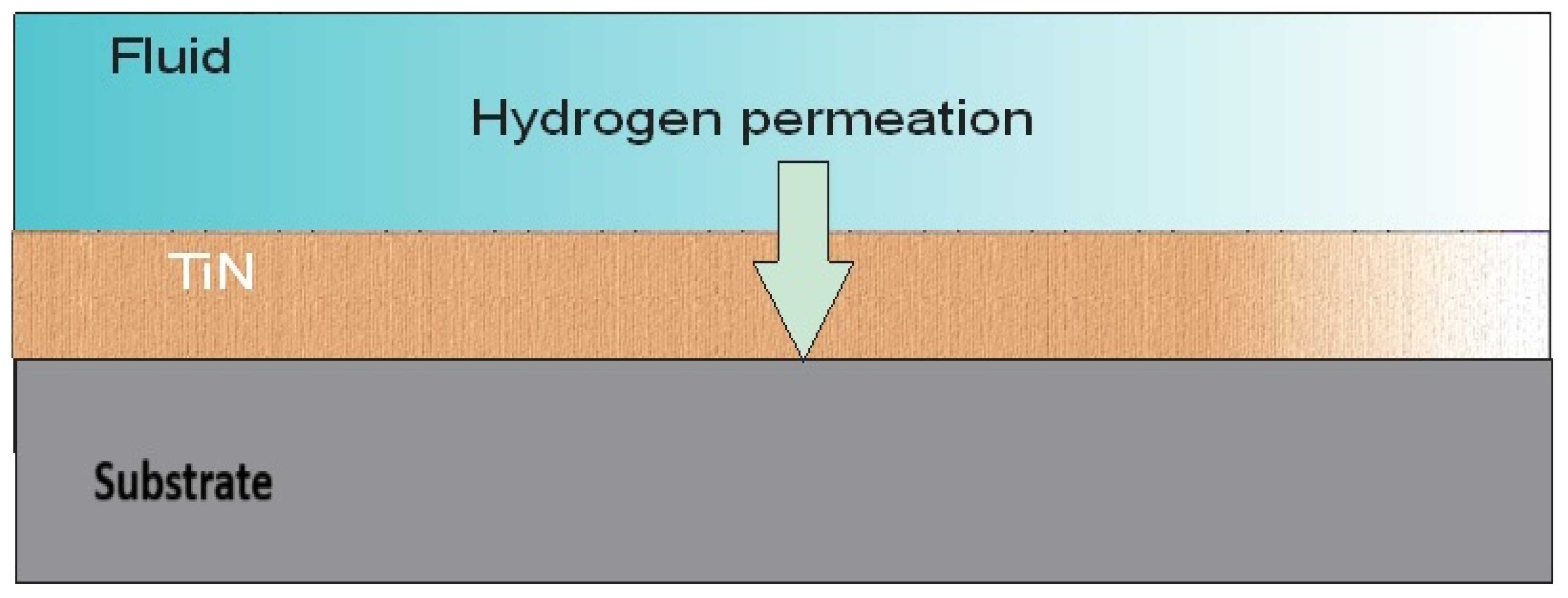
Assessment of HIPIMS-Deposited TiN Nanostructured Thin Films as Hydrogen Permeation Barriers on Carbon Steel




Abstract
1. Introduction
2. Materials and Methods
2.1. Substrate Material and Specimen Preparation
2.2. TiN Coating Deposition
2.3. Electrochemical Hydrogen Permeation Measurements
2.4. Experimental Setup
- ○
- ○
- Effective Diffusion Coefficient (Deff): Effective diffusion coefficient of atomic hydrogen based on elapsed time corresponding to J(t)/Jss = 0.63 Equation (4) [11].
- ○
- ○
- Barrier Efficiency () Equation (6):
3. Results
3.1. Hydrogen Permeation Evaluation
3.1.1. Hydrogen Permeation Transients
3.1.2. Permeation Behavior of Uncoated Carbon Steel (Reference Specimen)
3.1.3. Permeation Evaluation Curves Behavior of TiN-Coated Carbon Steel (Barrier Specimen)
3.2. Quantification of Hydrogen Diffusion Parameters
3.3. Surface Morphology Composition
4. Discussion
4.1. Interpretation of Permeation Curve Dynamics
4.1.1. Rise Rate and Permeation Kinetics
4.1.2. Peak Current Density and Hydrogen Trapping
4.1.3. Steady-State Permeation Current Density
4.2. Correlation with TiN Barrier Mechanisms
4.2.1. Lag Time Enhancement and Intrinsic Low Permeability
4.2.2. Steady-State Flux Reduction
4.3. Impact of Experimental Variables and System Stability
4.4. Comparison with Reference Systems and Literature Context
5. Conclusions and Future Work
- ○
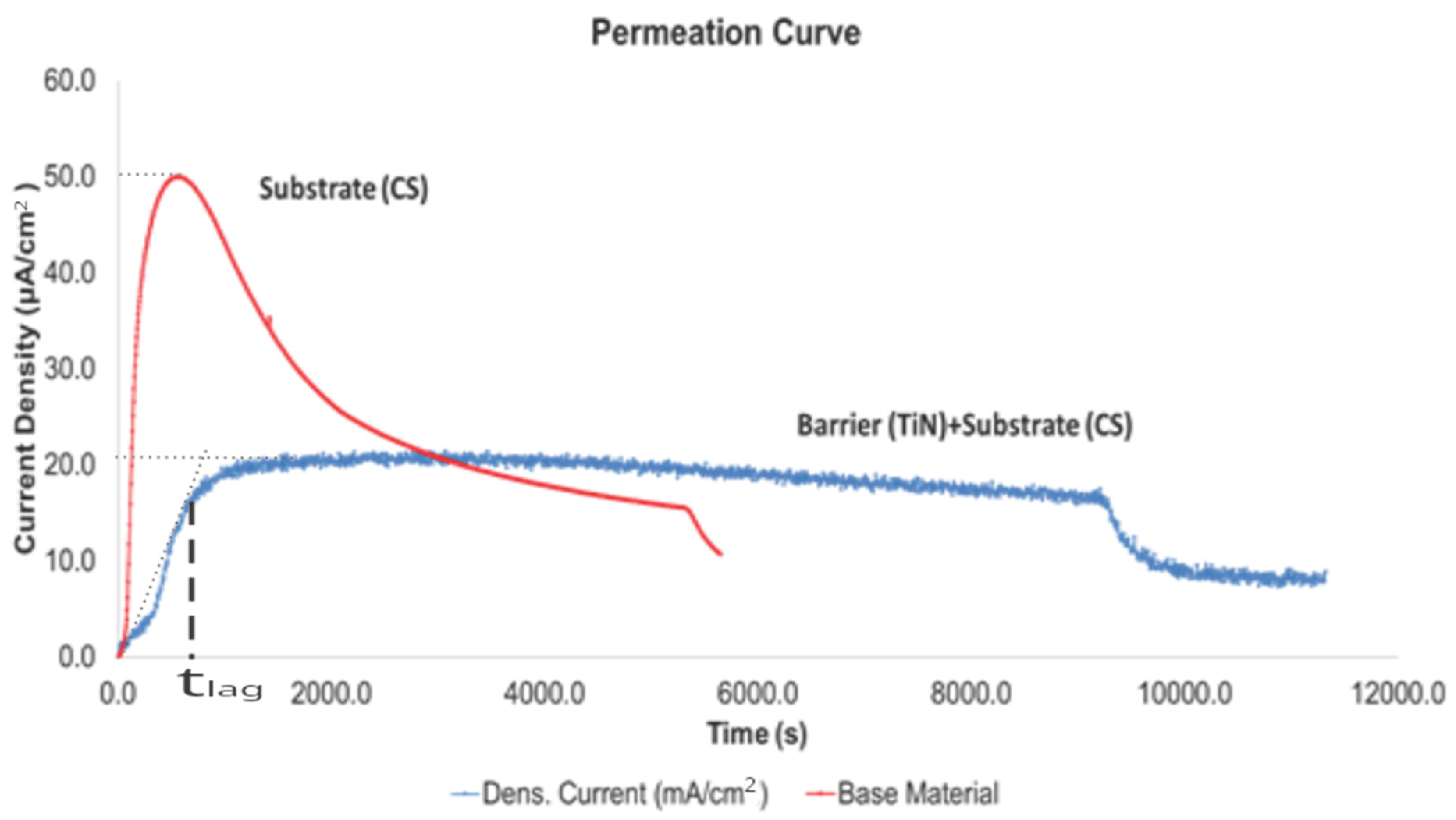
- Quantitative validation of barrier performance. The TiN/CS composite system exhibited a lag time of tlag = 570 s, a mean effective diffusion coefficient of Deff = 2.69 × 10⁻¹⁰ m2 s−1 (averaged across four independent time-parameter methods), a steady-state permeation current density of Jss = 21.5 μA cm−2, a permeation reduction factor PRF = 2.32, and a barrier efficiency of η = 56.9%. All derived parameters are numerically self-consistent and were independently verified through cross-method calculation, confirming the internal reliability of the experimental dataset.
- ○
- Effective suppression of hydrogen transport kinetics. Relative to the uncoated SAE 1020 reference, the HIPIMS-TiN coating reduced the composite effective diffusion coefficient by 3.8-fold (from Deff, CS ≈ 1.03 × 10⁻⁹ m2s−1 to Deff, TiN/CS = 2.61 × 10⁻¹⁰ m2s−1) and increased the time lag (tlag, TiN/CS = 570 s). The hydrogen oxidation current density at steady state decreased from Jss, peak, CS ≈ 50 µA cm−2 to Jss, TiN/CS = 21.5 µA cm−2, yielding a Permeation Reduction Factor PRFpeak = 2.33 and a barrier efficiency η = 57.1%, in addition to a Permeation Reduction Factor PRFss = 1.09 and a barrier efficiency η = 8.5%. The smooth, monotonic, overshoot-free TiN/CS transient further confirms TiN-limited composite transport and full mechanical coating integrity throughout the 12,000 s experiment.
- ○
- Reduction in steady-state permeation flux. The TiN-coated specimens exhibited a significantly lower steady-state permeation current density (≈21.5 μA cm−2) compared with the uncoated carbon steel reference (≈50 μA cm−2), corresponding to a reduction of approximately 56% in the hydrogen flux reaching the detection side of the membrane. This consistent reduction in flux, maintained for the entire experimental period, offers quantitative evidence of the coating’s sustained and efficient ability to prevent hydrogen from entering.
- ○
- Significant delay in hydrogen breakthrough. The lag time of 570 s measured for the TiN/CS system represents a substantial retardation of hydrogen entry into the steel substrate relative to the uncoated reference, for which no discernible induction period was observed. This extended induction period is attributed to the combined effect of the intrinsically low hydrogen diffusivity and solubility of the dense TiN crystal lattice, together with the interfacial trapping contribution at the TiN/steel boundary region.
- ○
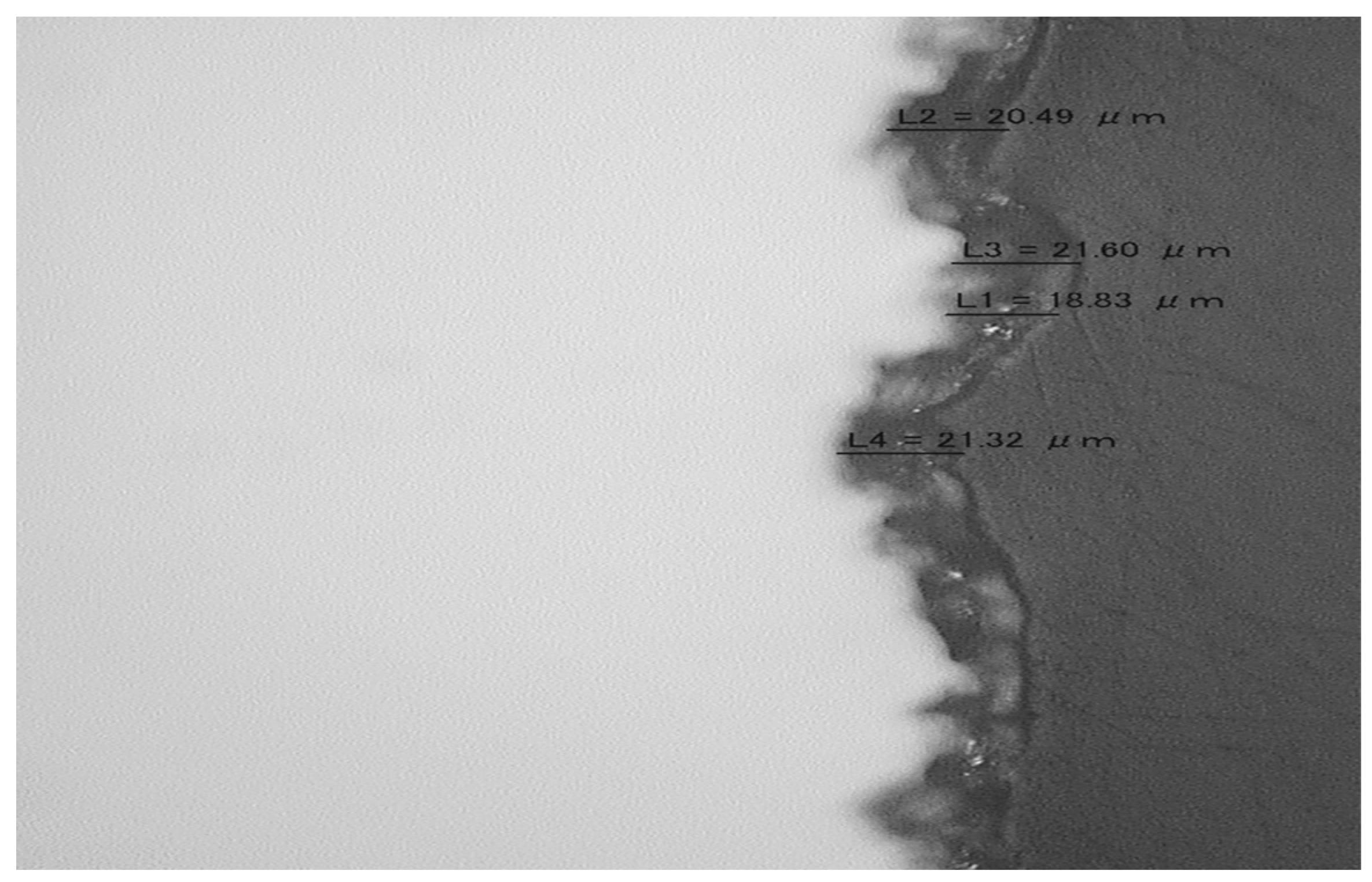
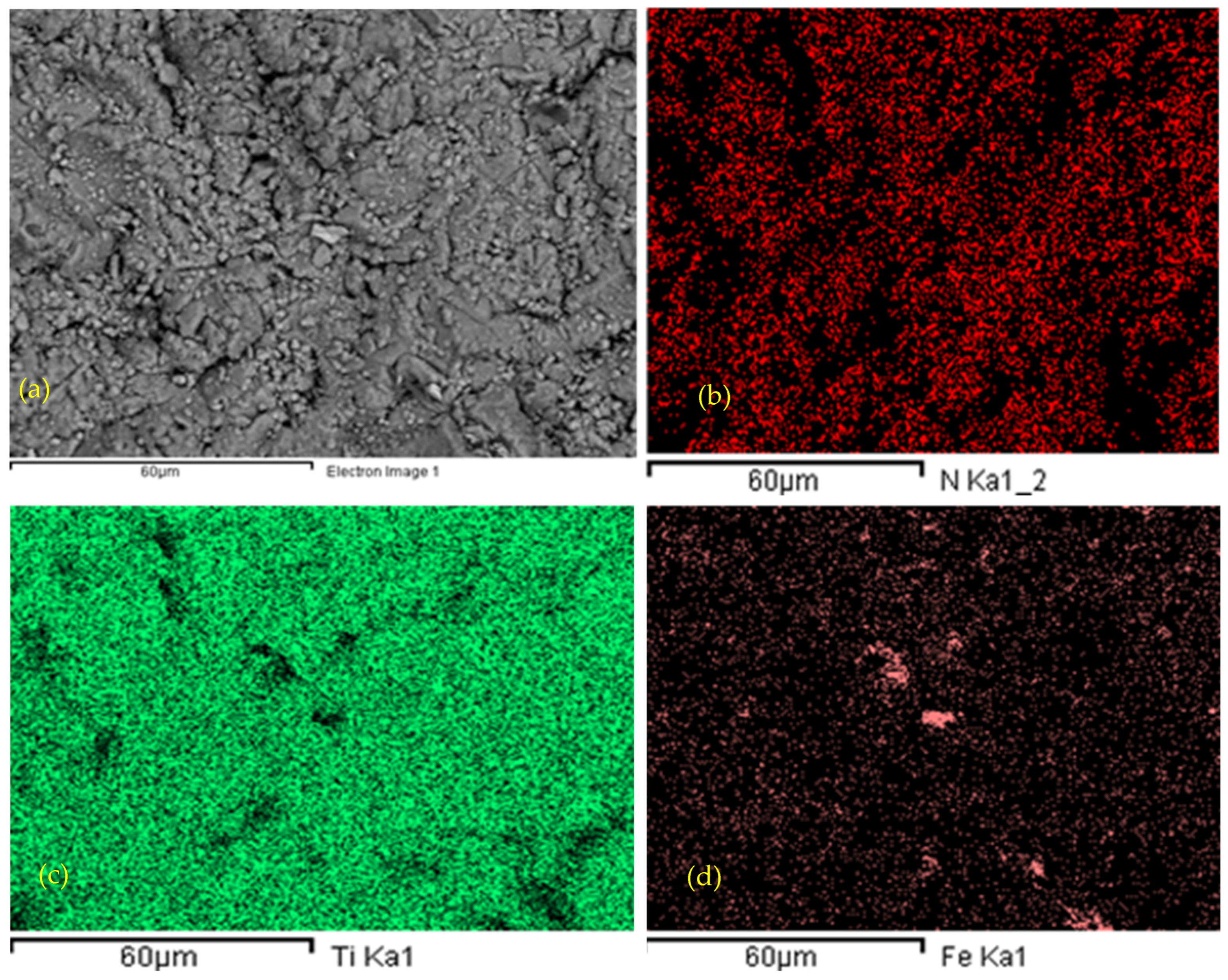
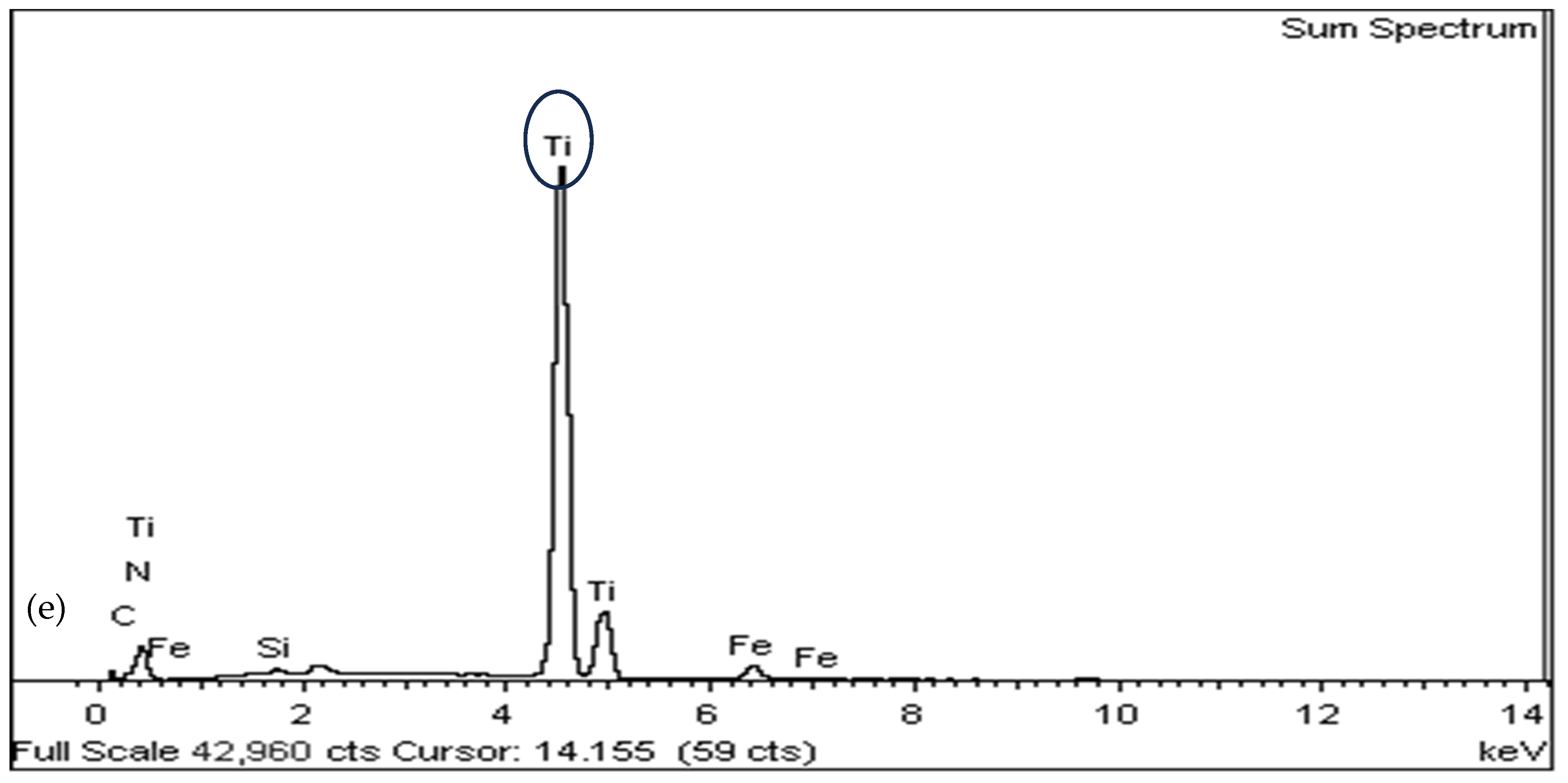
- Microstructural integrity and coating quality. SEM-EDS analysis confirmed that the HiPIMS-deposited TiN film was dense, compositionally uniform, under the tested conditions. The consistent hydrogen permeation curve for the TiN/CS system indirectly but strongly suggests the coating remained mechanically sound and adhered well during the electrochemical test, showing no cracks or delamination. These microstructural qualities are directly due to the high ionization and energetic deposition inherent to the HiPIMS process
- ○
- Relevance to hydrogen technology applications. The deposition of a TiN thin film onto carbon steel constitutes an effective strategy for mitigating hydrogen-assisted degradation of steel substrates, which is of critical importance for the safe and reliable deployment of hydrogen-based energy technologies. The present results are consistent with the broader literature on nitride-based barrier, which have been identified as promising candidates for improving the hydrogen barrier properties of ferritic steels [19].
- ○
- The bilayer lag-time methodology employed in this work provides a robust and transferable analytical framework for quantifying the hydrogen barrier performance of composite coating–substrate systems, and its application to other alloy families and commercial coating systems represents a natural extension of the present investigation. Furthermore, the research program will be extended to evaluate the performance of hydrogen barrier under hydrogen sulfide (H2S) and wet H2S service environments, which are highly relevant to upstream oil and gas applications where hydrogen-induced cracking constitutes a critical integrity concern.
- ○
- Scalability and applicability. The present results establish TiN HiPIMS as a viable candidate material for hydrogen barrier applications. Future work should include: (i) high-resolution cross-sectional SEM/TEM for definitive microstructural characterization; (ii) XRD, WDS or XPS to determine Ti:N stoichiometry; (iii) permeation testing under H2S and wet H2S service conditions, variable-temperature permeation, and triplicate replication of permeation transients; and (iv) evaluation of scalable deposition methods. In addition, quantitative residual stress measurements and surface roughness analysis by contact profilometry, adhesion and Rockwell C testing, thermal TDS, and Pd-overlayer experiments should be carried out for each condition identified.
Author Contributions
Funding
Institutional Review Board Statement
Informed Consent Statement
Data Availability Statement
Conflicts of Interest
References
- Ilyushechkin, A.; Schoeman, L.; Carter, L.; Shwe Hla, S. Material Challenges and Hydrogen Embrittlement Assessment for Hydrogen Utilisation in Industrial Scale. Hydrogen 2023, 4, 599–619. [Google Scholar] [CrossRef] [Scilit]
- Gangloff, R.P. Environment-Induced Cracking of Metals; NACE International: Houston, TX, USA, 1988. [Google Scholar]
- Xiao, S.; Meng, X.; Shi, K. Hydrogen Permeation Barriers and Preparation Techniques: A Review. J. Vac. Sci. Technol. A 2022, 40, 60803. [Google Scholar] [CrossRef] [Scilit]
- Nagumo, M. Michihiko Nagumo Fundamentals of Hydrogen Embrittlement; Springer: Singapore, 2016. [Google Scholar]
- Balueva, A.V.; Dashevskiy, I.N.; Magana, J. A New Model For Hydrogen-Induced Crack (HIC) Growth in Metal Alloy Pipelines Under Extreme Pressure. Procedia Struct. Integr. 2020, 28, 873–885. [Google Scholar] [CrossRef] [Scilit]
- Sugurmaran, A.A.; Purandare, Y.; Mandal, P.; Ehiasarian, A.P.; Khan, I.; Hovsepian, P.E. Effect of the Degree of High Power Impulse Magnetron Sputtering (HIPIMS) Utilisation on the Corrosion Properties of TiN Films. In Proceedings of the Society of Vacuum Coaters 56th (2013) Annual Technical Conference Proceedings; Society of Vacuum Coaters: Albuquerque, NM, USA, 2014; pp. 423–432. [Google Scholar]
- Li, Y.; Barzagli, F.; Liu, P.; Zhang, X.; Yang, Z.; Xiao, M.; Huang, Y.; Luo, X.; Li, C.; Luo, H.; et al. Mechanism and Evaluation of Hydrogen Permeation Barriers: A Critical Review. Ind. Eng. Chem. Res. 2023, 62, 15752–15773. [Google Scholar] [CrossRef] [Scilit]
- ASTM G148–97; Practice for Evaluation of Hydrogen Uptake, Permeation, and Transport in Metals by an Electrochemical Technique. Proceedings of Royal Society: London, UK, 2011; Volume 270.
- ISO 17081; Method of Measurement of Hydrogen Permeation and Determination of Hydrogen Uptake and Transport in Metals by an Electrochemical Technique. ISO: Geneva, Switzerland, 2013.
- Rodrigues, J. Hydrogen Permeation in Metals and Alloys: A Brief Review. Int. J. Dev. Res. 2022, 12, 58509–58516. [Google Scholar] [CrossRef] [Scilit]
- Biggio, D.; Elsener, B.; Rossi, A. Ni-P Coatings as Hydrogen Permeation Barriers—A Review. Coatings 2025, 15, 365. [Google Scholar] [CrossRef] [Scilit]
- Zajec, B. Hydrogen Permeation Barrier Recognition of Defective Barrier Film from Transient Permeation Rate. Int. J. Hydrog. Energy 2011, 36, 7353–7361. [Google Scholar] [CrossRef] [Scilit]
- Jin, P.; Robbins, W.; Bota, G. Effect of Sulfur Compounds on Formation of Protective Scales in Naphthenic Acid Corrosion in Non-Turbulent Flow. Corros. Sci. 2018, 131, 223–234. [Google Scholar] [CrossRef] [Scilit]
- William, D. Callister Materials Science and engineering. Mater. Sci. Eng. 1980, 42, 181. [Google Scholar]
- Tamura, M. Hydrogen Permeation Characteristics of TiN-Coated Stainless Steels. J. Mater. Sci. Eng. A 2015, 5. [Google Scholar] [CrossRef] [Scilit]
- Zhang, L.; Hu, S.; Yan, G.; Yu, W.; Shen, S. Misfit Dislocation Network and Mechanical Behaviour of Fe/TiN Interface under Uniaxial Loading. Comput. Mater. Sci. 2025, 257, 113977. [Google Scholar] [CrossRef] [Scilit]
- Saito, K.; Inayoshi, S.; Ikeda, Y.; Yang, Y.; Tsukahara, S. TiN Thin Film on Stainless Steel for Extremely High Vacuum Material. J. Vac. Sci. Technol. A Vac. Surf. Film. 1995, 13, 556–561. [Google Scholar] [CrossRef] [Scilit]
- Song, R.H.; Pyun, S. Hydrogen Permeation Through a Bilayer of Fe/Electrodeposited Ni. Electrochem. Soc. 1990, 137, 1051–1056. [Google Scholar] [CrossRef] [Scilit]
- Wetegrove, M.; Duarte, M.J.; Taube, K.; Rohloff, M.; Gopalan, H.; Scheu, C.; Dehm, G.; Kruth, A. Preventing Hydrogen Embrittlement: The Role of Barrier Coatings for the Hydrogen Economy. Hydrogen 2023, 4, 307–322. [Google Scholar] [CrossRef] [Scilit]
- Raab, S. Hydrogen Uptake and Permeation in Steels for Oil and Gas Production and Comparison with ARMCOTM-Fe. Master’s Thesis, Montanuniversität Leoben, Leoben, Austria, 2022. [Google Scholar]
- Gonzalez, R.; Rodríguez-Prieto, A.; Camacho, A.M. Electrochemical Evaluation of Magnetron Sputtering Thin-Films to Prevent Hydrogen Damage in Steel Substrates. In Proceedings of the 4th International Conference on Materials Design and Applications (MDA), Porto, Portugal, 7–8 July 2022. [Google Scholar]



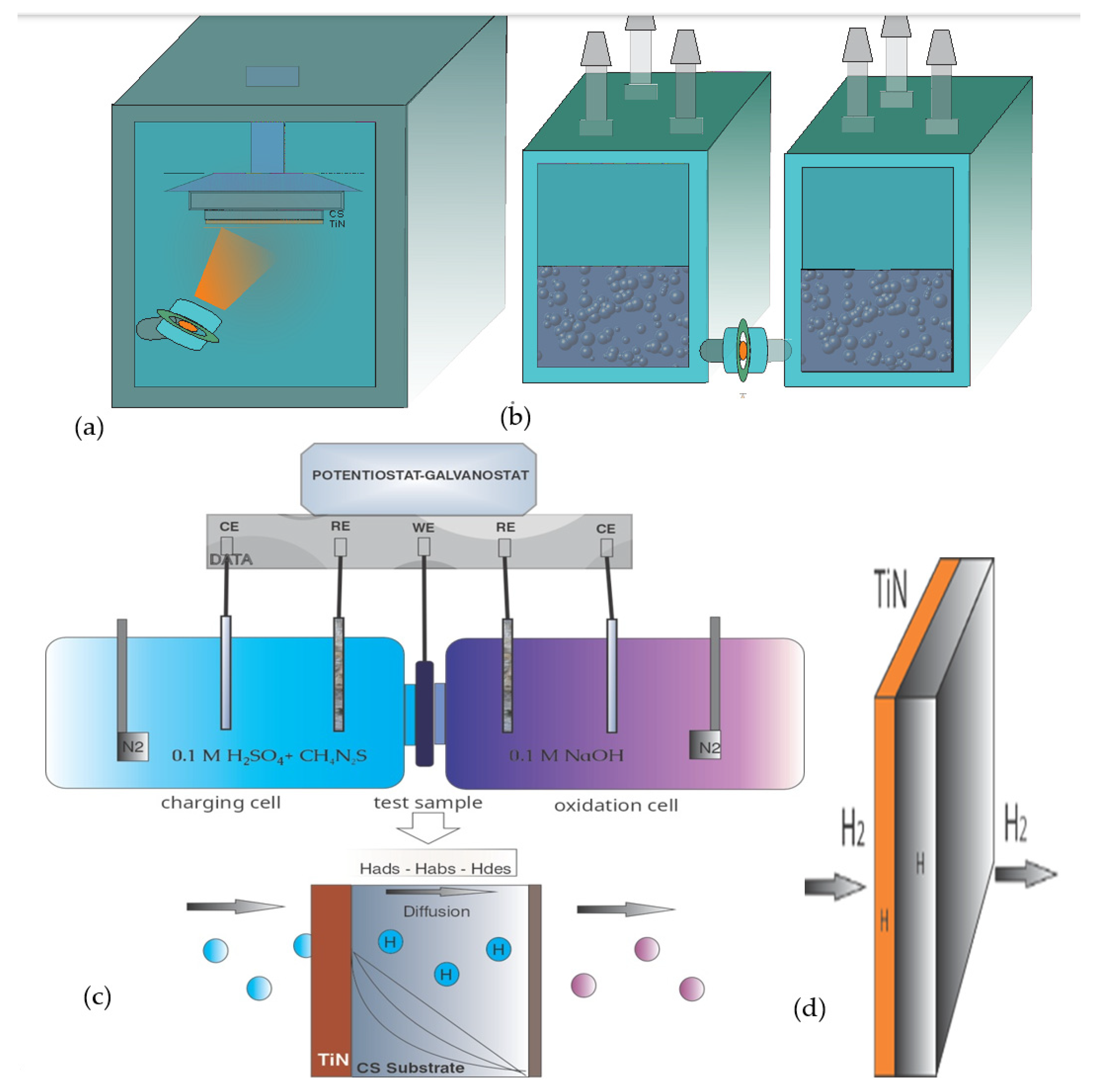
| Test | Cell | Volume | Reactive |
|---|---|---|---|
| Electrochemical hydrogen permeation | Generation Cell/Reduction | 500 mL | CH4N2S/5g/L |
| H2SO4/0.1 M | |||
| Distilled water | |||
| Sensing Cell/oxidation | 500 mL | NaOH/0.1 M | |
| Distilled water |
| Parameter of Analysis | Substrate (CS) | Barrier (TiN + CS) | Correlation and Significance |
|---|---|---|---|
| Permeation Curve Shape | Rapid rise, prominent peak, high plateau. | Slow, delayed rise, no significant peak, low plateau. | Indicates a fundamental change in hydrogen transport from rapid diffusion to a slow, barrier-controlled process. |
| Peak Current Density | >50 µA/cm2 | ~20 µA/cm2 | The TiN coating prevents the high initial flux of hydrogen, suggesting it limits hydrogen entry at the surface. |
| Steady-State Current (Iss) | ~0 µA/cm2 | ~20 µA/cm2 | The steady-state flux through the coated sample is 60% lower, proving a sustained and effective barrier action. |
| Time to Reach Steady-State | Relatively short (<500 s) | Significantly longer (>8000 s) | Confirms that the TiN layer acts as a diffusion barrier, increasing the time required to establish a steady-state concentration gradient. |
| Diffusion Coeff. (D) | Higher (typical for steel) | Lower (2.68 × 10⁻¹⁰ m2/s) | The composite system’s D is dominated by the low-diffusive TiN layer, quantifying the slowing effect on hydrogen transport. |
| Barrier Efficiency (η) | 0% (Baseline) | 56%peak/8.5%ss | Provides a clear, quantitative measure of the coating’s effectiveness in preventing hydrogen permeation, relation is a percentage%. |
| Variable | Symbol | Value | Units | Description |
|---|---|---|---|---|
| Sample Thickness | L | 0.97 | mm | Distance that hydrogen must travel to pass through the sample. |
| Area of the charged electrode | Ac | 1.246 | cm2 | Total surface area of the electrode where the electric charge is applied. |
| Area of the detection electrode | As | 1.038 | cm2 | Surface area of the electrode where the permeation current is measured. Exposed area of sample in the oxidation cell. |
| Charging current | Ic | 9.092 | mA | Intensity of the electric current applied to introduce hydrogen into the sample. |
| Charging current density | Ic’ | 7.291 | mA/cm2 | Charging current per unit area. |
| Start time of charging | t0 | 3665 | s | Time at which the application of the charging current begins. |
| Initial current | I0 | −5.38 × 10⁻⁷ | A | Value of the current before applying the charge. |
| Limiting current | Isat | 0.02153 | mA/cm2 | Maximum value of the permeation current reached. |
| Saturation concentration | Csat | 8.063; 1.02 | mol H/m3; ppm | Maximum concentration of hydrogen can be dissolved in the material. |
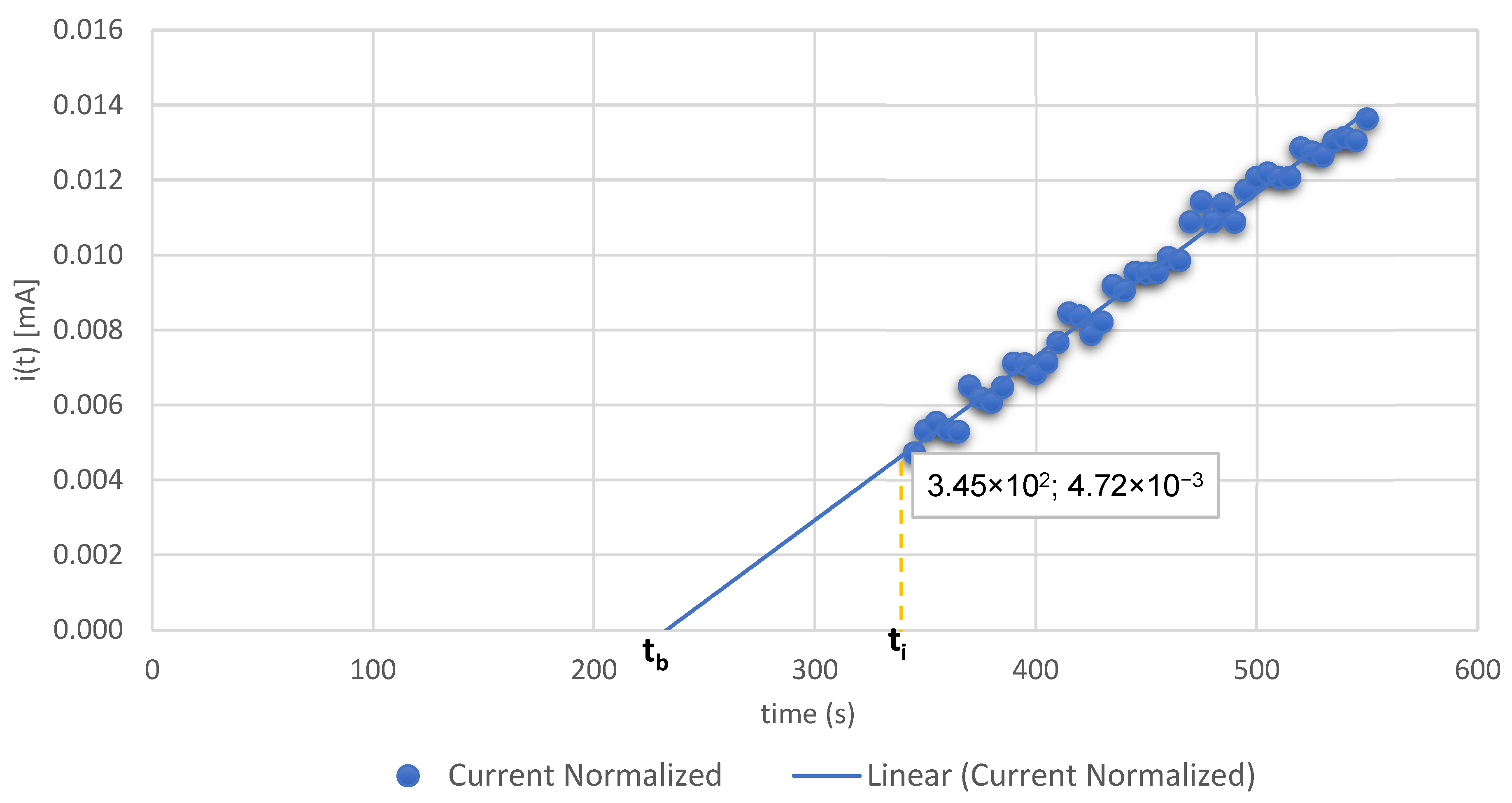
| Time lag | tlag | 570 | s | Time taken for the permeation current to reach half of its steady state value. J(t)/Jss = 0.63, tlag = L2/6*Dapp, D = L2/(6 × tlag) (7) |
| Mean time | t1/2 | 465 | s | The average time for hydrogen atoms to diffuse through the material, is the time to reach 50% of the steady-state current. |
| Advance time | tb | 233 | s | Time corresponding to the point of inflection in the permeation curve. elapsed time measured extrapolating the linear portion of the rising permeation current transient to J(t) = O(s) |
| Inflection time | ti | 345 | s | Time at which the permeation curve changes its curvature. |
| Diffusion coefficient | Deff | 2.68 × 10⁻¹⁰ | m2/s | The rate at which hydrogen atoms diffuse through the material sample. Average diffusion coefficient. |
| Diffusion coefficient (tlag) | D (tlag) | 2.75 × 10⁻¹⁰ | m2/s | Time taken for the permeation current to reach a steady value and the diffusion coefficient of hydrogen in the material, respectively. |
| Diffusion coefficient (t1/2) | D(t1/2) | 2.79 × 10⁻¹⁰ | m2/s | Diffusion coefficient of hydrogen in the material, t 1/2. |
| Diffusion coefficient (tb) | D(tb) | 2.64 × 10⁻¹⁰ | m2/s | Diffusion coefficient of hydrogen in the material, tb. D = L2/(15.3 × tb) (8) |
| Diffusion coefficient (ti) | D(ti) | 2.55 × 10⁻¹⁰ | m2/s | Diffusion coefficient of hydrogen in the material, ti. |
Disclaimer/Publisher’s Note: The statements, opinions and data contained in all publications are solely those of the individual author(s) and contributor(s) and not of MDPI and/or the editor(s). MDPI and/or the editor(s) disclaim responsibility for any injury to people or property resulting from any ideas, methods, instructions or products referred to in the content. |
© 2026 by the authors. Licensee MDPI, Basel, Switzerland. This article is an open access article distributed under the terms and conditions of the Creative Commons Attribution (CC BY) license.
Share and Cite
González-Durán, R.; Rodríguez-Prieto, A.; Camacho, A.M. Assessment of HIPIMS-Deposited TiN Nanostructured Thin Films as Hydrogen Permeation Barriers on Carbon Steel. Materials 2026, 19, 1623. https://doi.org/10.3390/ma19081623
González-Durán R, Rodríguez-Prieto A, Camacho AM. Assessment of HIPIMS-Deposited TiN Nanostructured Thin Films as Hydrogen Permeation Barriers on Carbon Steel. Materials. 2026; 19(8):1623. https://doi.org/10.3390/ma19081623
Chicago/Turabian StyleGonzález-Durán, Raúl, Alvaro Rodríguez-Prieto, and Ana María Camacho. 2026. "Assessment of HIPIMS-Deposited TiN Nanostructured Thin Films as Hydrogen Permeation Barriers on Carbon Steel" Materials 19, no. 8: 1623. https://doi.org/10.3390/ma19081623
APA StyleGonzález-Durán, R., Rodríguez-Prieto, A., & Camacho, A. M. (2026). Assessment of HIPIMS-Deposited TiN Nanostructured Thin Films as Hydrogen Permeation Barriers on Carbon Steel. Materials, 19(8), 1623. https://doi.org/10.3390/ma19081623