Review

Ga-Based Liquid Metals: Advances in Interface Thermal and Electrical Regulations for Power Electronics Integration


1
School of Mechanical Science and Engineering, Huazhong University of Science and Technology, Luoyu Road 1037, Wuhan 430074, China
2
School of Materials Science and Engineering, Huazhong University of Science and Technology, Luoyu Road 1037, Wuhan 430074, China
*
Author to whom correspondence should be addressed.
Materials 2026, 19(8), 1599; https://doi.org/10.3390/ma19081599
Submission received: 31 December 2025 / Revised: 11 February 2026 / Accepted: 13 April 2026 / Published: 16 April 2026

Abstract

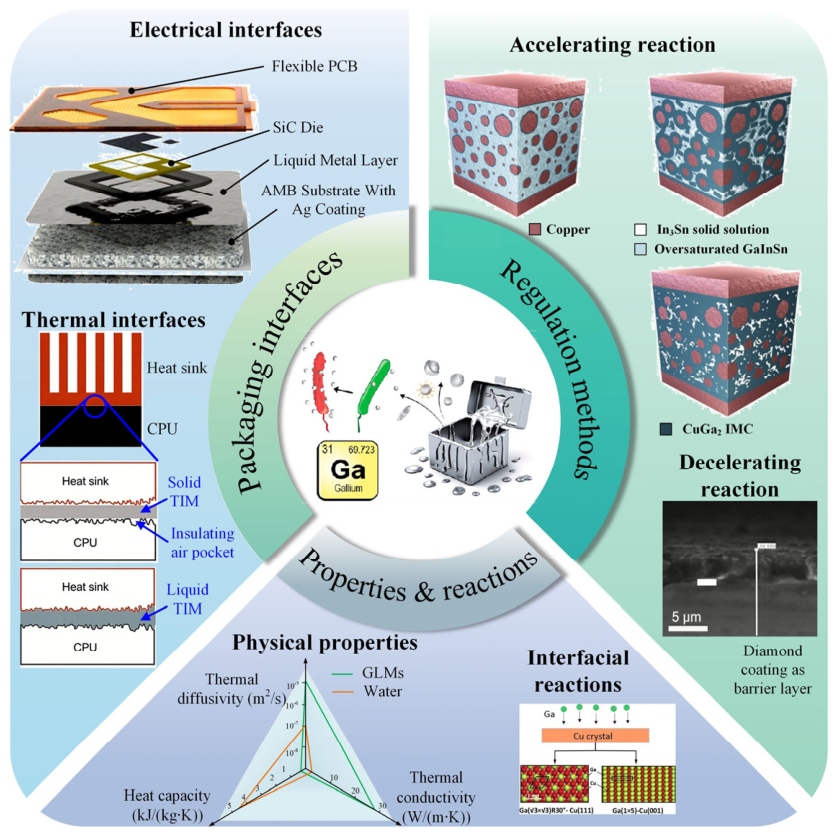
Ga-based liquid metals (GLMs) have been considered as promising thermal and electrical interface materials for advanced power electronics, combining high thermal conductivity (some types even >30 W/m·K) with fluidity at room temperature. This review systematically evaluates the dual roles of GLMs in power electronics packaging. Their function in thermal management as both thermal interface materials and active cooling media is first examined, followed by an analysis of their capabilities in forming electrical interconnections via low-temperature bonding in fluidic and solid states. However, reliable integration remains challenging due to interfacial reactions and instability with metal substrates. We discuss interfacial mechanisms with Cu and common metallizations, along with emerging regulation strategies such as surface coatings and process acceleration techniques. By examining these interfacial interactions, this work aims to guide the selection and design of surface modification strategies to either promote or inhibit reactions as needed, supporting the development of robust power electronic packaging.

Graphical Abstract

1. Introduction

1.1. Recent Progress in Power Electronics Packaging

Driven by quick developments in the electric vehicle, aerospace and energy industry, there is a growing need for semiconductors with superior operational performance and reliability [1]. To meet these demands, wide bandgap (WBG) semiconductors, including SiC and GaN, have emerged as promising candidates. They are widely regarded as the next-generation electronics, poised to replace conventional Si devices in high-power applications [2]. The main advantages of WBG devices are enabled by their wide bandgap, which affords them a higher breakdown voltage, faster switching frequency and greatly diminished switching losses [3]. The theoretical maximum operating temperature of WBG semiconductors exceeds 600 °C, which is significantly higher than the upper limit (~200 °C) of conventional Si devices [4].
To keep pace with the rapid development of WBG devices, the related packaging systems must meet more stringent mechanical, electrical and thermal requirements [5]. Currently, packaging and integration capabilities are the major bottleneck that limits the full potential of WBG devices [6]. The conventional interconnection materials are not sufficiently stable at elevated temperatures exceeding 200 °C [7]. This is critical in die-attach, which refers to the electrical interconnection between the die and the substrate [8]. Moreover, thermal interface materials (TIMs) play a critical role in power electronic packaging by bridging the thermal paths between the heat-generating chip and heat sink [9]. As heat-flux densities continuously rise in power modules, the properties of TIMs directly dictate their maximum operating performance [10].
Recently, Ga-based liquid metals (GLMs) have emerged as promising materials for both thermal and electrical interfaces in power electronics packaging. GLMs are ideal candidates for TIMs, as they uniquely combine the metal-like thermal conductivity and liquid-like conformability [11]. This enables them to effectively eliminate air gaps and wet rough surfaces spontaneously, thereby minimizing interfacial thermal resistance [12]. At the same time, GLMs enable low-temperature transient liquid-phase bonding (TLPB) by serving as a reactive metallic solvent [13]. Their low melting point allows immediate liquid-phase bonding below regular Sn-based soldering and nano Ag sintering technology [14]. The rapid inter-diffusion with substrate metals forms refractory intermetallic compounds (IMCs) that create high-temperature capable joints [15]. These advantages of low-temperature bonding and high-temperature serving performance make GLMs promising for high-power electronics integration.

1.2. Power Electronics Packaging Failure Induced by Packaging Interfaces

The reliability of power electronics highly depends on the packaging interfaces, which are formed by the interfacial reactions during both bonding and serving processes [16]. It has been calculated that 55% of die-attach failures were caused by the cracks that usually initiate at the die/solder interface [17]. Thus, the interfacial reactions during joint formation ultimately determine the failure mechanism and in-service lifetime. The metallization deposited on the surfaces of components is another critical factor as it can highly influence the interfacial reactions and the formation of microstructure [18], thereby altering the failure mechanisms of the joints [19].
The coefficient of thermal expansion (CTE) mismatch is a critical challenge to the reliability of power electronics packaging, which usually leads to interfacial failures. Different materials expand or contract at different rates during temperature changes, which develops high thermal stress at the interfaces [20]. These stresses can cause failures such as cracks, delamination and bondline fatigue. In 2.5D packaging, CTE mismatch between the substrate and the printed circuit board is the main reason for the fatigue behavior of board-level ball grid array (BGA) solder joints [21]. In high-power module packaging that uses nano Ag sintering technology, the CTE mismatch between the Ag layer and the die or ceramic substrate causes cracks at the interface edges during thermal cycling [22]. This damages the heat dissipation path and electrical connection [23]. Notably, when fluidic GLMs are applied, the interfacial thermal stress induced by CTE mismatch is expected to be decoupled. Consequently, the associated interfacial failure mechanism may differ, which warrants further investigation.

1.3. Scope of Review

Despite the significant research on GLMs for electrical or thermal connections that have been published in recent years, few studies have analyzed the applications and regulation strategies of interfacial reaction to address power electronics reliability. There is a pressing need to bridge the existing knowledge gap to elaborate the thermal and electrical interface, in order to optimize the suitable serving interface by matching specific GLMs. The initial motivation to develop various thermal and electrical interfaces is primarily to address the use of conventional TIMs and interconnection materials. However, the uses of thermal and electrical interfaces are, nowadays, much wider given the new emerging GLMs, which are anticipated to be applicable for the harsh serving environment of high-power electronics.
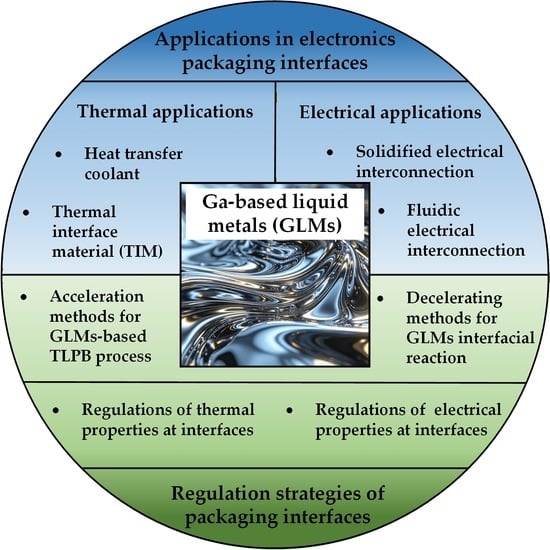
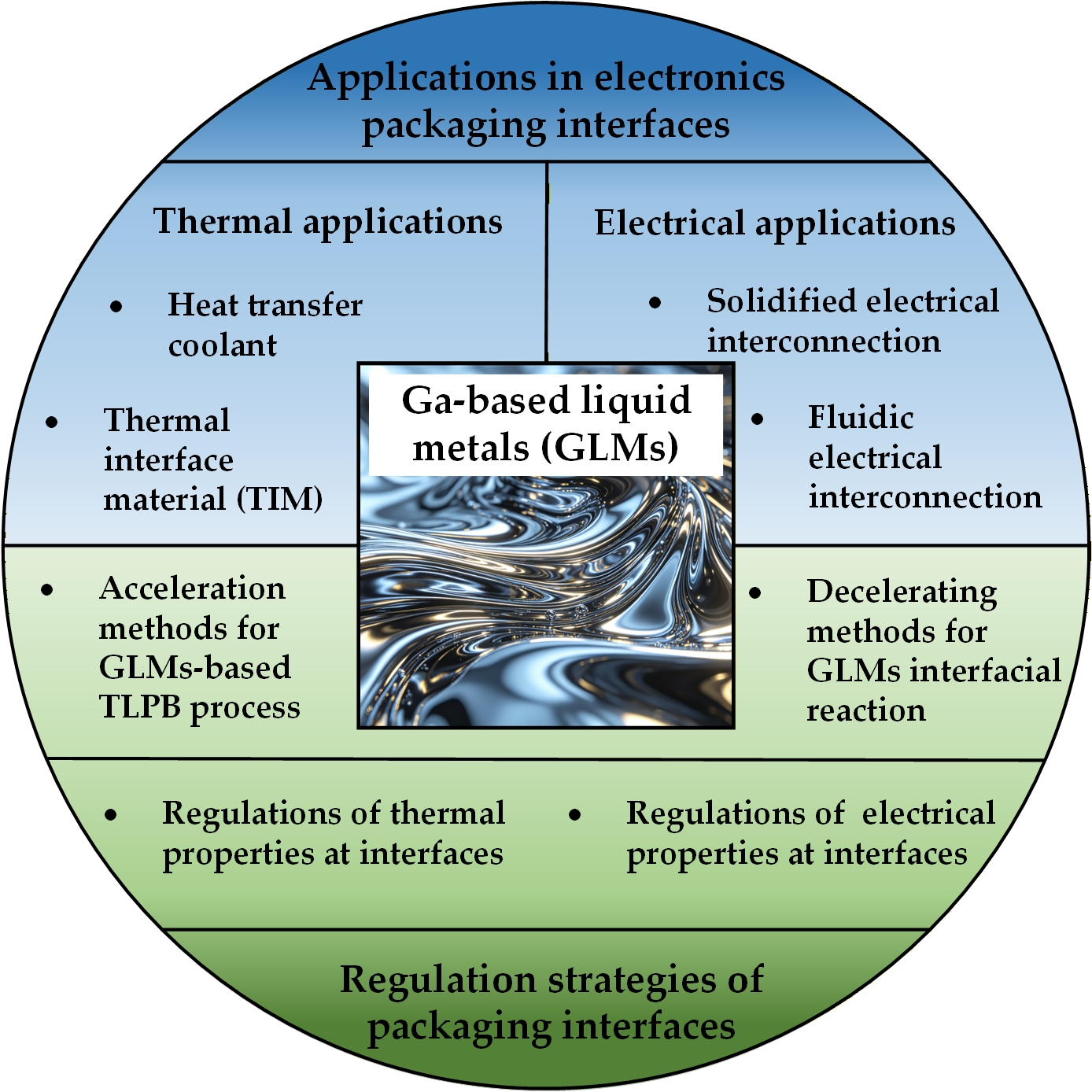
In this review paper, the thermal and electrical interfaces of GLMs as well as their regulation methods were reviewed in line with power electronics applications, as shown in Figure 1. Subsequently, the advantages of employing GLMs as thermal and electrical interface materials are analyzed. Motivated by a detailed analysis of interfacial reaction-induced reliability failures in WBG power modules under harsh conditions, effective regulation strategies have been proposed to ensure robust service performance. The accelerating interfacial reaction methods with GLMs were used for the TLPB process to form the electrical interconnection structure. On the other hand, the decelerating interfacial reaction methods with GLMs were applied to maintain stability. Finally, the guidance and recommendations are provided for the optimization of thermal and electrical interfaces applied in future reliable WBG power module integrations.

2. Applications of GLMs in Electronics Packaging Interfaces

2.1. GLMs Applied on Thermal Interfaces

2.1.1. GLMs Applied as Thermal Interface Materials (TIMs)
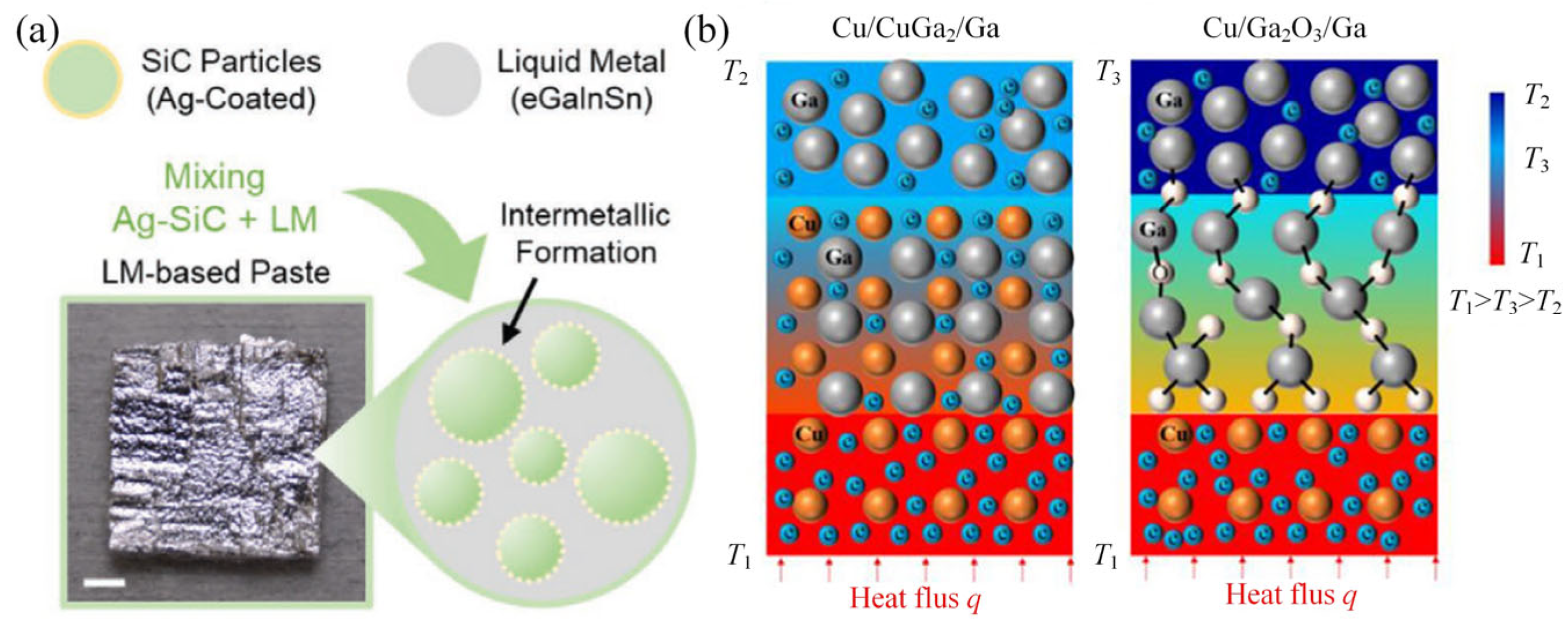
GLMs are regarded as the promising next-generation TIMs for power electronics thermal management [27]. By enhancing interfacial wetting and reducing contact thermal resistance, it can significantly improve the heat dissipation for high-power modules [28]. The excellent fluidity of GLMs enables them to eliminate air gaps, thereby inducing low thermal interface resistance. In addition, GLMs have advantages including self-healing capabilities, high thermal stability and non-flammability, which allow them to serve in harsh thermal interfaces. However, the high mobility of GLMs also faces challenges such as leakage and corrosion when in direct contact with metal heat sinks. Therefore, advanced strategies need to be developed to maintain high thermal conductivity and prevent leakage in the applications of power electronics (Figure 2a).
Liu et al. [29] demonstrated that GLM-based TIMs reduce chip temperature by up to 9.8 °C at 90 W load, outperforming conventional thermal grease. Their study also indicated that thinner TIM layers and larger interface areas enhance heat dissipation. Zhang et al. [30] achieved a significant reduction in thermal boundary resistance at the Ga/Cu interface by forming a CuGa2 IMC layer. As illustrated in Figure 2b, this reduction was attributed to the transition of heat carriers from phonons to electrons and the strengthening of interfacial bonding from van der Waals forces to metallic bonds. Wu et al. [27] achieved excellent wetting of GLMs on Cu substrates, forming a stable thermal interface with minimal leakage and attaining a low total thermal resistance of 2.5–3 K·mm2/W, which is substantially lower than the conventional thermal greases. Lin et al. [31] conducted a microstructural analysis of GLM interfaces used as TIMs. They showed that heat treatment transformed brittle CuGa2 into more stable Cu9Ga4, thereby improving both joint strength and thermal performance. Chen et al. [12] developed a sandwich-structured thermal pad in which a GLM/Ni-coated Cu core is encapsulated within an insulating polymer shell. This design achieved a high thermal conductivity of 12.41 W/(m·K) while effectively preventing GLM leakage and ensuring electrical insulation. Tan et al. [32] infiltrated an eutectic Ga-based alloy into a Ni-plated Cu mesh to produce a high-performance TIM, which led to a significant temperature reduction in chip cooling tests. Kim et al. [33] enhanced the thermal conductivity of GLMs by adding Cu flakes, finding that 5 wt% Cu offered the optimal balance between high thermal conductivity and low thermal contact resistance, thus improving its effectiveness as a TIM. Kuang et al. [34] fabricated a high-performance TIM by infiltrating GLMs into Cu nanowire arrays, achieving an extremely low total thermal contact resistance of 3.20 mm2∙K/W, which is 86.3% lower than that of commercial thermal grease.
Figure 2. (a) Example of GLM applied as TIM; (b) schematic of the microscopic interfacial heat transfer mechanism [30,35].
Materials 19 01599 g002
As listed in the typical studies of GLMs applied as TIM shown in Table 1, the primary challenges center on achieving and maintaining low interfacial thermal resistance [36]. A fundamental barrier is the native Ga2O3 oxide layer, which causes poor wettability (~145° contact angle) and creates a phonon-conducting interface mismatched with the electron-dominated heat transfer in metals, resulting in weak van der Waals bonding and high thermal resistance [30]. Interfacial engineering can dramatically improve wetting, bonding strength and heat transport efficiency. One key method is the in situ formation of a CuGa2 IMC layer, achievable through processes like HCl treatment [30]. The overall role of CuGa2 remains complex because studies indicate that its spontaneous formation can increase electrical resistivity and may contribute to long-term corrosion [37]. Beyond these issues, the practical implementation of GLM–TIMs faces the ongoing challenge of ensuring long-term reliability against leakage and substrate corrosion, as well as balancing the surface modifications for electrical insulation [27].

2.1.2. GLMs Applied as Heat Transfer Coolant
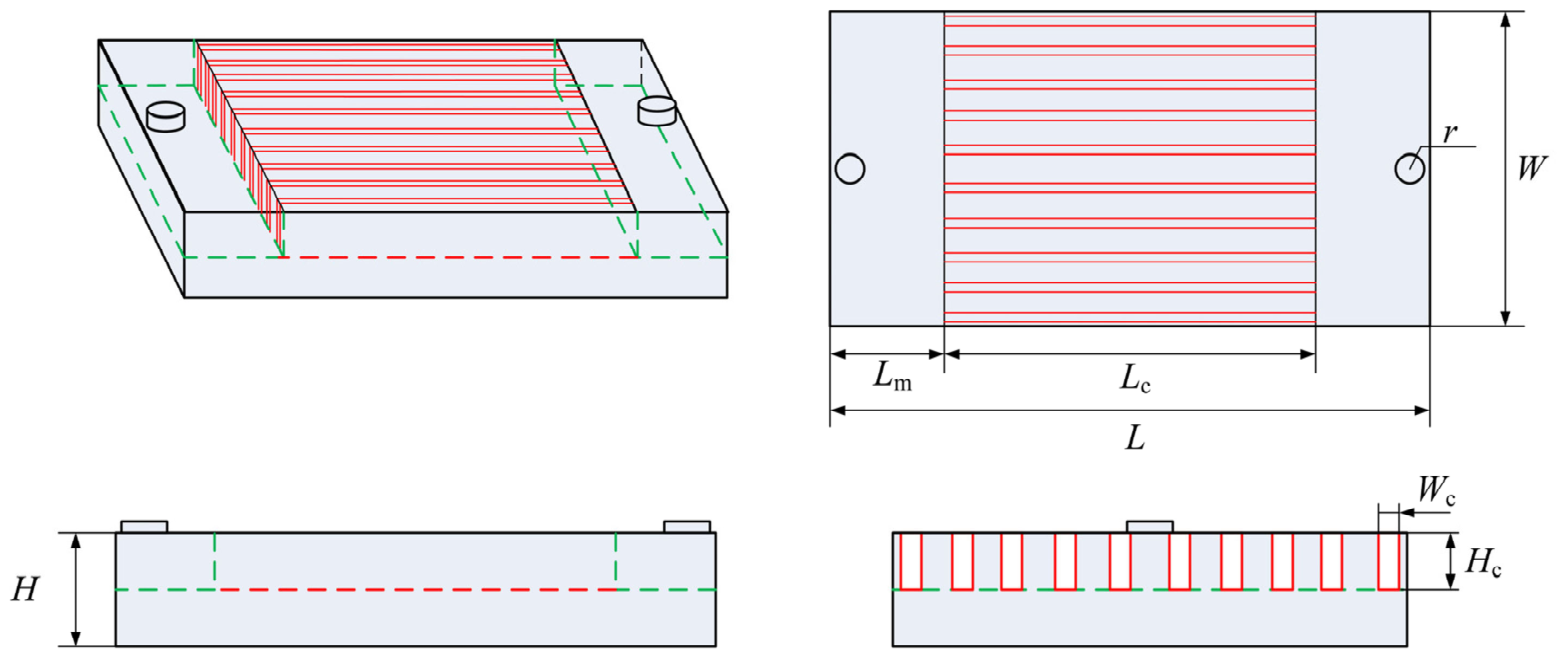
Microchannel cooling has emerged as an effective strategy to address the thermal management challenges of high heat-flux electronics, owing to its large surface-area-to-volume ratio and reduction in thermal boundary layers [44]. As the power density of electronic devices continues to rise, conventional liquid coolants such as deionized water increasingly struggle to meet the thermal requirements at heat-flux levels exceeding 500 W·cm−2 [45]. Their inherently limited thermal conductivity and boiling point often lead to flow instabilities, local boiling and even thermal failure, thereby constraining the advancement of microchannel cooling technologies. In this context, GLMs can offer significant promise as the next-generation coolants since they combine the advantages of metal and fluid. Liu et al. [46] proposed the use of GLMs as a coolant for effective chip cooling, which exhibited thermal conductivities of approximately 30 W·m−1·K−1, which is several tens of times greater than water. In addition, the boiling points of GLMs are generally above 2000 °C, which enable stable single-phase operation across a remarkably wide temperature range [47]. Their chemical stability, non-flammability and compatibility with common microfabrication materials further facilitate intimate interfacial contact and reduce thermal contact resistance. These unique attributes have driven growing interest in GLM-based microchannel cooling, positioning GLMs as a transformative solution to overcome long-standing performance bottlenecks in microchannel cooling, as shown in Figure 3.
Previous studies have demonstrated the potential of GLMs as a heat transfer coolant. Zhang et al. [48] proposed an optimized GLM-based microchannel heat sink and conducted a comparative study against a water-cooled configuration. The results showed that the EGaInSn (eutectic Ga-In-Sn) coolant required a larger channel width than the water-based system and sustained a maximum heat flux of 1504 W·cm−2. It significantly exceeded the 1003 W·cm−2 achieved by the water-cooled counterpart, thereby demonstrating the performance advantages of GLM-based coolants in high heat-flux applications. In addition, Tawk et al. [49] compared the thermal resistance of Cu–water and Cu–GaIn microchannels. Their study demonstrated that the thermal resistance of GLMs-based microchannels was reduced by 48% compared with water at identical pumping power, highlighting the superior energy efficiency of GLM coolants.
Reducing hydraulic resistance, increasing flow velocity and minimizing thermal interfacial resistance are central to enhancing the thermal performance of GLM-based microchannel systems. Building on these principles, a series of subsequent studies has proposed and experimentally verified various design strategies, further underscoring the potential of GLMs in high heat-flux thermal management. Deng et al. [50] developed a two-stage multichannel GLM-based cooling system tailored for chip arrays, which investigated the heat sink and heat source temperatures of the GLM-based and pure water-cooling system with a heat-flux densities of 100 W/cm2. Using a GLM-based coolant in mini-channels with a width of 9.5 mm, the system achieved a convective heat transfer coefficient of approximately 20,000 W·m−2·K−1 at 50 W heating power and a flow rate of 3 mL·s−1. As it is three times that of comparable water-based systems, the superior cooling capability of GLMs under high heat-flux conditions was highlighted. Zhang et al. [51] proposed an innovative manifold-microchannel heat sink architecture employing GLMs as the working fluid. Experimental characterization revealed that the optimized flow distribution significantly enhanced the convective heat transfer coefficient to the order of 3.5 × 10⁵ W·m−2·K−1. This structure enabled stable dissipation of heat loads approaching 1000 W·cm−2, which showed much better performance than conventional water-cooled manifold systems. Collectively, these advances demonstrate the exceptional heat dissipation capability of GLMs and illustrate how tailored channel designs can further elevate their performance, which established a solid foundation for future power electronics thermal management.
Figure 3. The structure of the liquid metal-based microchannel heat sink [52].
Materials 19 01599 g003
Typical works of GLMs applied as microchannel coolant are summarized in Table 2, which exhibit that there are still challenges related to their unfavorable fluidic properties and interfacial behavior [53]. High viscosity and density lead to significant flow resistance and pumping power requirements, making larger channel geometries (>1.5 mm) more practical [54]. Furthermore, poor wetting on common substrate (e.g., Ni) can cause high interfacial thermal resistance, while the need for compatible coatings and complex system optimization to manage extreme pressure drops (>3 MPa) presents substantial technical difficulties [44,49].

2.2. GLMs Applied in Electrical Interfaces

2.2.1. Solidified GLMs for Electrical Interconnection

Low-temperature interconnection is desirable in power electronics packaging to mitigate CTE mismatch when integrating dissimilar materials [55]. As room temperature liquids, GLMs can be solidified via the TLPB process at significantly lower temperatures by serving as the reactive metallic solvent [56]. For instance, Liu et al. [57] demonstrated that eutectic Ga-Sn (EGaSn) alloy can form solid joints with Au-coated Cu substrates at room temperature through the formation of CuGa2. Synchrotron X-ray fluorescence microscopy revealed that trace amounts of Au from the coating migrate to the top of the interfacial CuGa2 layer.
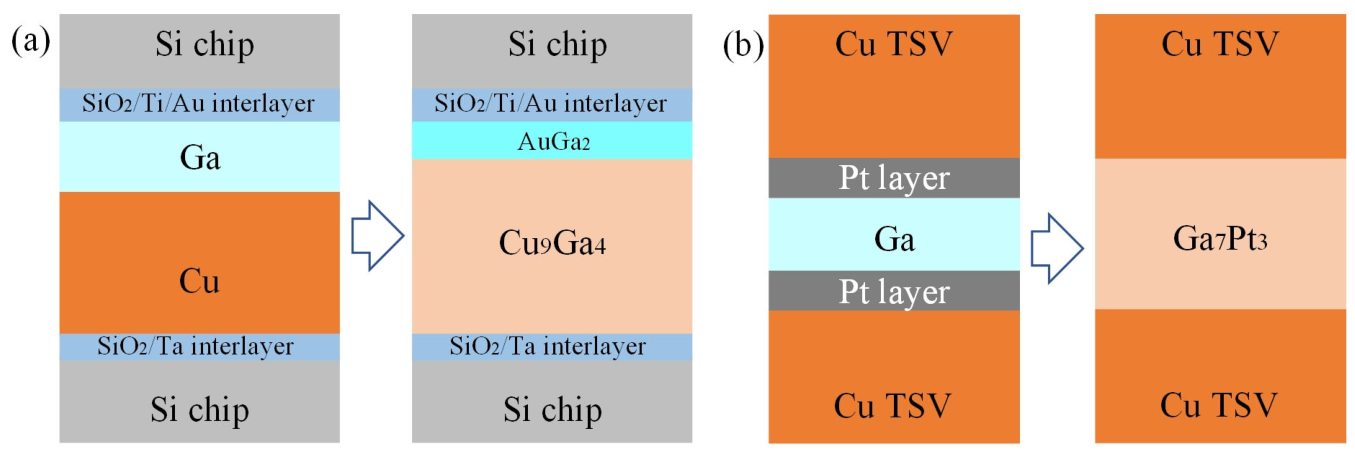
As shown in Figure 4a, Joerg et al. [58] performed the Cu/Ga TLPB process at room temperature followed by annealing, which triggered a phase transition from CuGa2 to Cu9Ga4 at the interface. This transformation significantly enhanced the mechanical strength of the bond, achieving shear strengths up to 90 MPa after treatment at 90 °C for 200 h. Lin et al. [59] developed a Ga-based soldering method using Pt under-bump metallurgy (UBM) to create ductile solid-solution joints for Cu-Cu interconnection over a period up to 24 h (Figure 4b). By adjusting the relative amounts of Ga and Pt, the process can produce either a desirable ductile face-cantered cubic (FCC) solid-solution joint with isolated precipitates when Ga significantly exceeds Pt, or a continuous brittle intermetallic layer when Ga is insufficient relative to Pt. These results demonstrate that GLMs can form TLPB joints at relatively low temperature with good mechanical properties. However, this process is time-consuming which usually needs dozens or even hundreds of hours. Therefore, it would be beneficial to develop interfacial reaction to accelerate this GLM-based TLPB process.

2.2.2. GLMs for Fluidic Electrical Interconnection

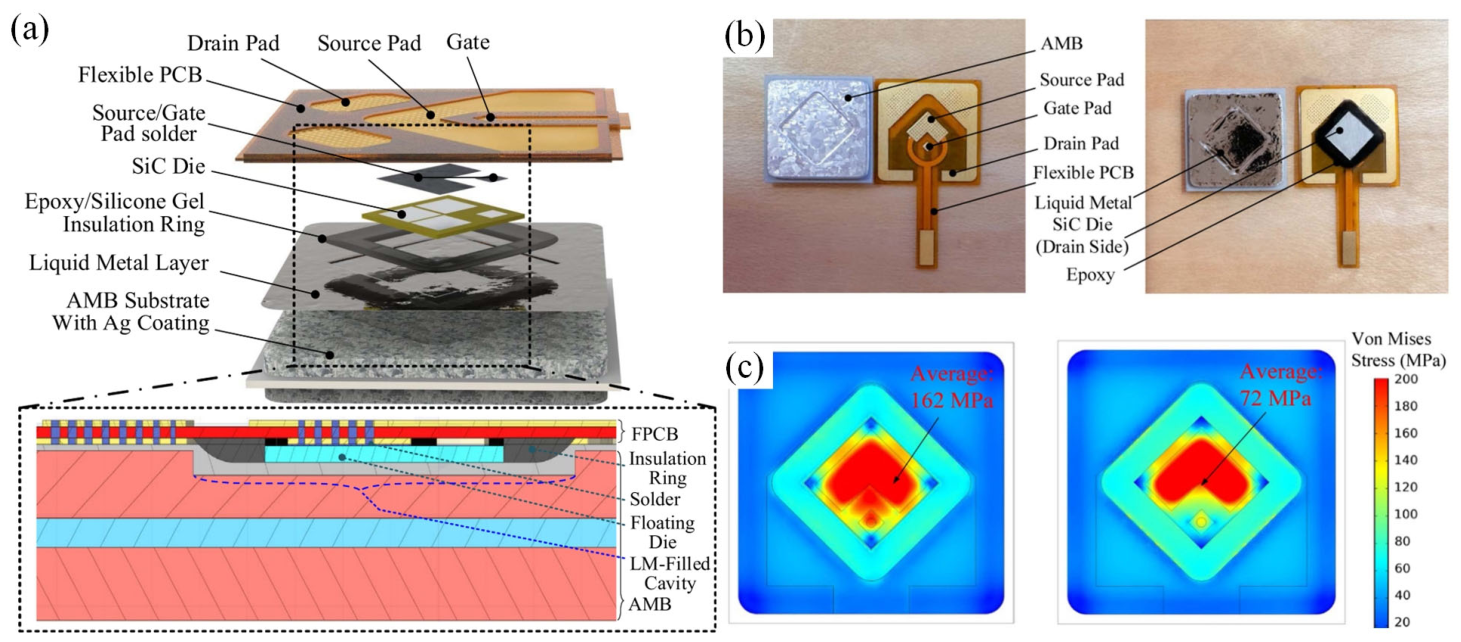
Fluid-state electrical interconnection based on GLMs has shown potential in power electronics packaging due to its unique combination of metallic thermal conductivity and fluidic deformability. Fluidic interconnection can effectively alleviate thermal–mechanical stress between the die and substrate, thereby improving heat transfer and enhancing long-term reliability in high-power modules [60]. As exhibited in Figure 5, Liu et al. [61] demonstrated a GaInAg-based fluidic interconnection and floating die structure that minimizes thermomechanical stress by allowing self-adaptive movement of the die, achieving a stress by over 60% compared to conventional solder joints. Zhang et al. [24] reported a SiC half-bridge power module utilizing GLM interconnection, achieving low thermal resistance (0.08 K·W−1) and maintaining structural integrity under high-temperature cycling. Li et al. [62] further confirmed that GLM packaging for press-pack IGBT modules enhances both electrical interface uniformity and heat dissipation performance compared to the conventional Sn-based solders.
Table 3 presents representative research on GLMs applied as fluidic electrical interconnects. These applications face several key challenges, primarily concerning interfacial instability and material compatibility [63]. The spontaneous formation of resistive IMCs (e.g., CuGa2) at interfaces, especially with common conductors like Cu, degrades electrical conductivity and long-term reliability [64]. In humid environments, controlling wetting behavior and preventing corrosion are critical since poor adhesion or oxidation can increase contact resistance and cause failure [65]. Furthermore, while barrier coatings can mitigate reactions, they may also reduce conductivity or increase electrical resistance [64]. The inherent high surface tension and potential for component separation in pastes also pose challenges for achieving uniform and durable electrical interconnections [60].
Overall, GLM-based fluidic interconnections represent a transformative strategy for next-generation power electronics. They bridge mechanical compliance with superior heat conduction, supporting reduced interfacial stress while enabling ultrahigh heat-flux dissipation (>1000 W·cm−2). The electrical advantages of GLMs in power modules arise from their high electrical conductivity, which meets interconnection requirements. In addition, their unique fluidic nature enables adaptive deformation to form conformal contact with device surfaces, thereby reducing interfacial contact resistance effectively.

3. Properties of Regular GLMs and Interfacial Reaction with Cu

3.1. General Properties of Regular GLMs

Ga is a post-transition metal with a melting point of 29.76 °C and a viscosity of 1.99 cps, which is similar to water [71]. Its unusual behavior can be explained by its unique electronic structure, which features both covalent and metallic bonding, as well as the formation of Ga dimers that influence its phase changes. [72]. The CTE of Ga is approximately 18.3 × 10⁻⁶ K−1, which is close to Cu (16.9 × 10⁻⁶ K−1) [73]. GLMs have garnered attention in electronic packaging area due to their excellent thermal and electrical properties, liquid-state characteristics and low viscosity [74]. The development of low-temperature GLM-based TLPB processes effectively reduced energy consumption and minimized the risk of damage to heat-sensitive electronic components [75].
In addition to pure Ga, certain Ga-based alloys exhibit lower melting points, broadening their applications range [76]. Alloying Ga with metals such as In, Sn, Zn, Cd or Pb enables the formation of eutectic alloys with lower melting points [77]. For instance, the eutectic Ga-In alloy (EGaIn), composed of 75.5 at% Ga and 24.5 at% In, has a melting point of 15.4 °C [71]. The melting point of EGaIn can be tuned by varying the addition ratio of Ga and In. Another example is EGaInSn (eutectic Ga-In-Sn), which has a melting point of 13.2 °C [71]. The physical properties of Ga, EGaIn and EGaInSn are listed in Table 4.
As electronic devices advance toward higher power density, frequency and temperature conditions, the Joule heating and switching losses generated during operation have increased significantly, leading to a sharp rise in die junction temperatures [78]. In this context, the thermal management performance of interconnect materials has become a critical bottleneck that limits the reliability and lifetime of electronic devices. GLMs, including Ga, EGaIn and EgaInSn, exhibit excellent thermal conductivity for efficient heat transfer [79]. Furthermore, their liquid-state properties help mitigate thermal–mechanical stresses induced by non-uniform thermal fields. By suppressing failure modes such as thermal fatigue and electromigration, GLMs ensure the long-term operation of electronic devices in harsh environments.
GLMs are viscous fluids that retain metallic properties, with positive ions and free electrons that remain mobile, resulting in high electrical conductivity. Seungho et al. [80] employed first-principle molecular dynamics simulations along with the Kubo–Greenwood (K-G) and Ziman–Faber (Z-F) theoretical approaches to calculate the electrical conductivity of liquid Ga, EGaIn and EGaInSn. The results demonstrated that the incorporation of In and Sn into Ga to form eutectic alloys increases atomic structural disorder, leading to enhanced electron scattering, shortening of the electron mean free path, and a consequent reduction in the electrical conductivity of GLMs.

3.2. Interfacial Reaction Between GLMs and Cu-Based Substrates

In a standard module, the substrate is typically structured in a sandwich-like configuration. Its core consists of a thick and electrically insulating ceramic sheet, which is clad on both sides with conductive layers to form the circuit [81]. Cu is the most common upper conductor metal in a substrate due to its excellent electrical and thermal conductivity [82]. Therefore, it is the most possible that GLMs would form the thermal or electrical interfaces with Cu. However, Cu is easily oxidized when served in a humid or oxygen-containing environment, making a protective layer necessary [83]. For instance, Cu can dissolve quickly in Pb-free molten solders, resulting in an unstable microstructure that poses a potential reliability risk to bonded structures [84].
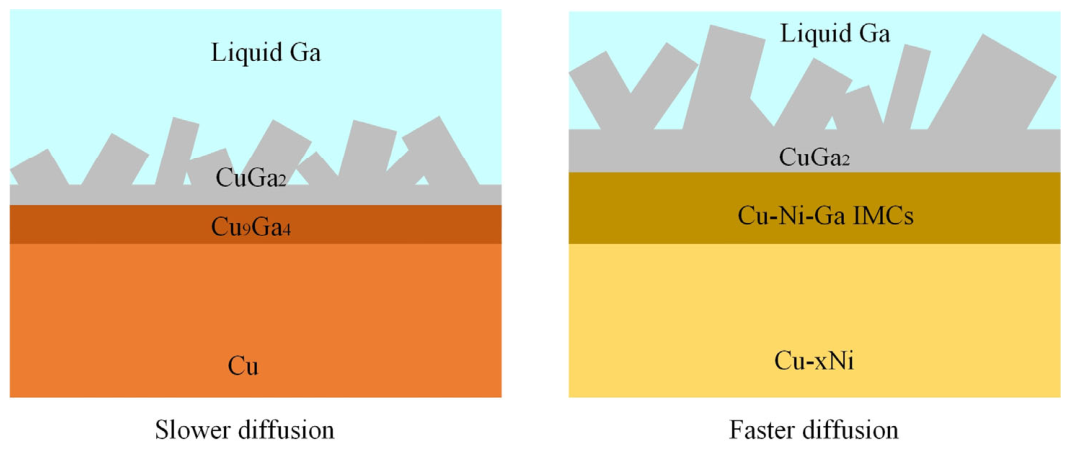
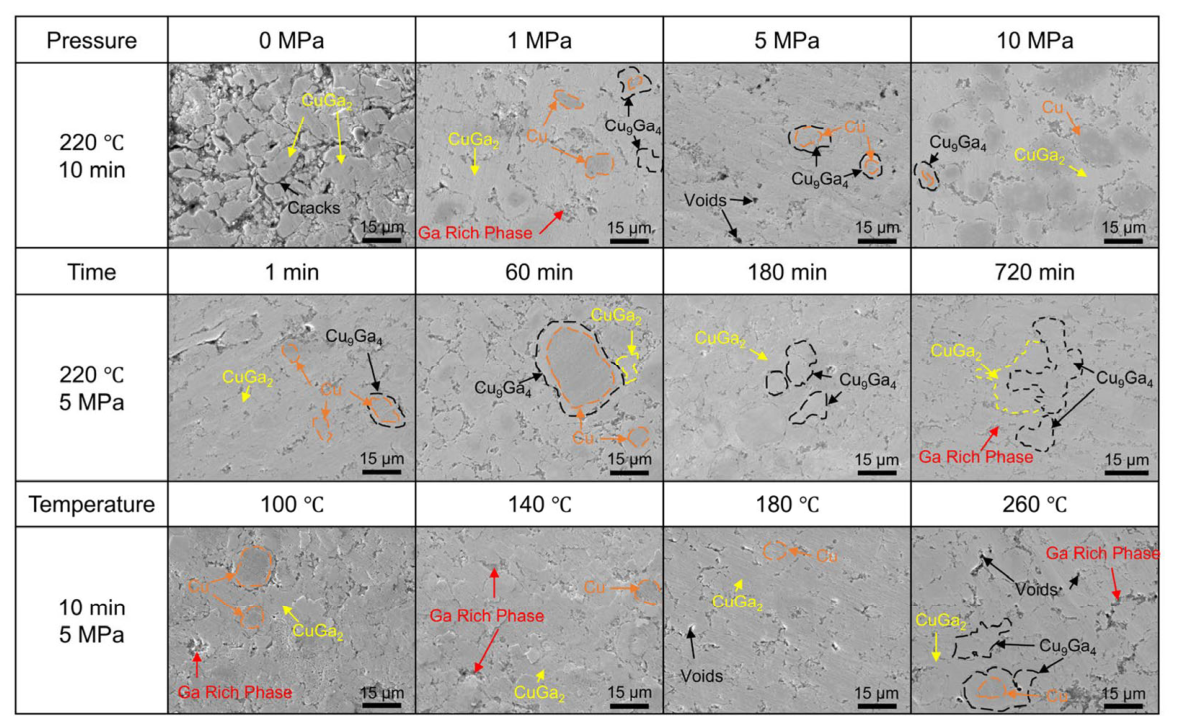
Ga can dissolve in the FCC Cu-rich phase with a solubility of up to 20 at.%, leading to the formation of several IMCs over a wide temperature range. Consequently, GLMs have emerged as promising candidates for enabling TLPB at low processing temperatures [85]. This approach facilitates the formation of full-IMC structures that exhibit excellent mechanical and thermal stability under high-temperature service conditions [86]. Within the temperature range of room temperature to 300 °C, the interfacial reaction between Ga and the Cu substrate primarily involves the formation of two IMC phases including θ-CuGa2 and γ3-Cu9Ga4. At temperatures between 150 and 240 °C, the reacting interface exhibits a layered structure of Cu/γ3-Cu9Ga4/θ-CuGa2/liquid Ga, where γ3-Cu9Ga4 forms a thin planar layer and θ-CuGa2 develops a thick scallop-like morphology [87]. The θ- CuGa2 phase decomposes at approximately 254–264 °C with the reaction 9θ-CuGa2→γ3-Cu9Ga4+14Ga. With increasing reaction time or temperature, the formation of γ1-Cu9Ga4 and γ2-Cu9Ga4 phases may also occur [88]. When the temperature increases to 280–300 °C, θ-CuGa2 becomes thermodynamically unstable and decomposes, leaving only the scallop-shaped γ3-Cu9Ga4 phase at the interface [86]. Notably, Cu dissolves preferentially at defect-rich sites, forming basin-type morphologies where θ-CuGa2 nucleates. Thereby, IMC detachment and subsequent diffusion-limited growth then lead to a continuous θ-CuGa2 layer and γ3-Cu9Ga4 formation [79]. The typical microstructures of GLM-Cu TLPB joints composed by CuGa2 and Cu9Ga4 IMCs are shown in Figure 6 [89].
Compared with traditional Sn-based IMCs, CuGa2 exhibits lower thermal expansion anisotropy, hardness and elastic modulus, making it is more favorable for micro-solder joints due to improved interconnection reliability [86]. However, the slow reaction kinetics between pure Cu substrates and Ga significantly constrain their practical applicability. Liu et al. [90] demonstrated that Ni alloying alters the interfacial reaction pathway in Cu. During the reaction between Ga and a Cu-10Ni substrate, not only CuGa2 is formed; a nanocrystalline Ga-5Ni layer and a Ni-substituted phase are formed. The presence of Ni markedly accelerates IMC growth, with the rate-controlling mechanism transitioning from volume-diffusion-dominated growth to a hybrid mechanism governed by both interfacial reaction and lattice diffusion [90], as illustrated in Figure 7. Systematic investigations of Cu-xNi substrates containing 2–14 wt% Ni revealed that the Cu-6Ni composition yields the highest IMC growth rate in Cu-xNi/Ga/Cu-xNi joints. In contrast, excessive Ni content (e.g., 14 wt%) promotes the formation of additional phases such as Ga7Ni3 [91].
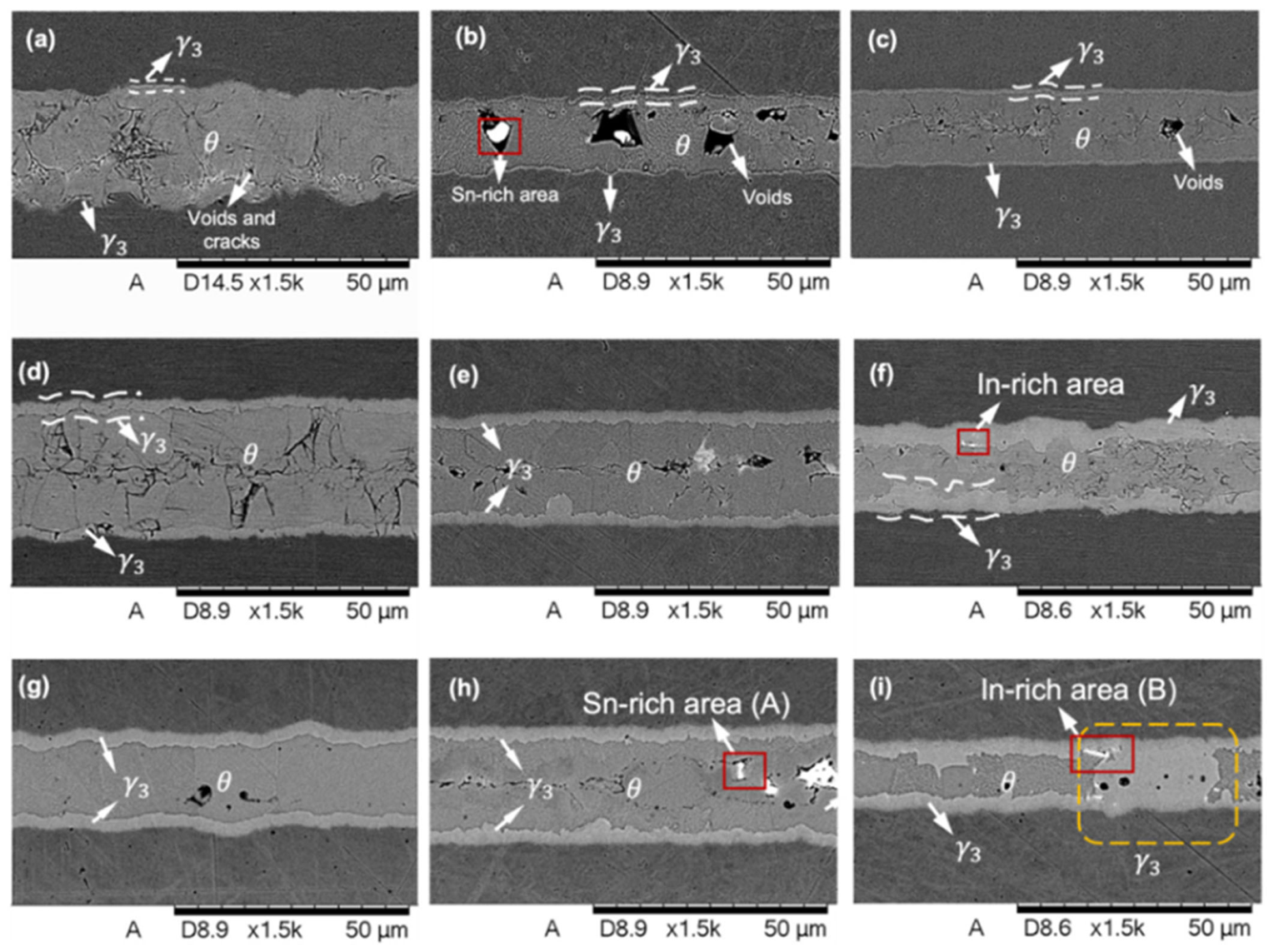
EGaIn (Ga-24.5% In, eutectic point 15.5 °C) and EGaInSn alloy (Ga-21.5% In-10% Sn, eutectic point 13.2 °C) [60] are the representative Ga-based alloys with low melting point and high fluidity. Chen et al. [85] investigated the application of TLPB using pure Ga, eutectic GaIn and GaSn with Cu. The study found that the reaction between EGaIn and Cu primarily forms the interfacial phases θ-CuGa2 and γ3-Cu9Ga4. Atoms did not incorporate into these IMCs but segregated between their grains and formed a thin liquid layer. The presence of the In element accelerated Cu atom diffusion and promoted the formation of the γ3-Cu9Ga4 phase. The porosity in the joints was reduced and the joint reliability was thereby enhanced. The final Ga-based IMC joints comprise γ3 and θ layers, with residual Sn- and In-rich regions segregated at the IMC interfaces. Figure 8 presents cross-sectional SEM images of Cu/Ga/Cu, Cu/GaSn/Cu, and Cu/EGaIn/Cu joints following the TLPB process [85]. Although the mixing enthalpy of Sn-Ga is comparable to that of Cu-Ga, the diffusion barrier effect of the θ-CuGa2 layer suppresses Cu-Sn reactions. Consequently, θ-CuGa2 remains the dominant interfacial product, which is accompanied by limited Sn segregation between IMC grains [85]. Gao et al. [92] examined liquid–solid interfacial reactions in EGaInSn/Cu couples under isothermal and non-isothermal conditions (140–310 °C), emphasizing the influence of temperature and thermal gradients on CuGa2 formation. Their results indicated that tetragonal CuGa2 is the predominant product below 310 °C. Its growth mechanism and preferred orientation change markedly with temperature. At a fixed hot-side temperature, thermal gradients have little effect on CuGa2 morphology but can enhance directional Cu diffusion, thereby accelerating IMC growth.

4. Regulation Strategies of Packaging Interfaces

4.1. Acceleration Methods for GLM-Based TLPB Process

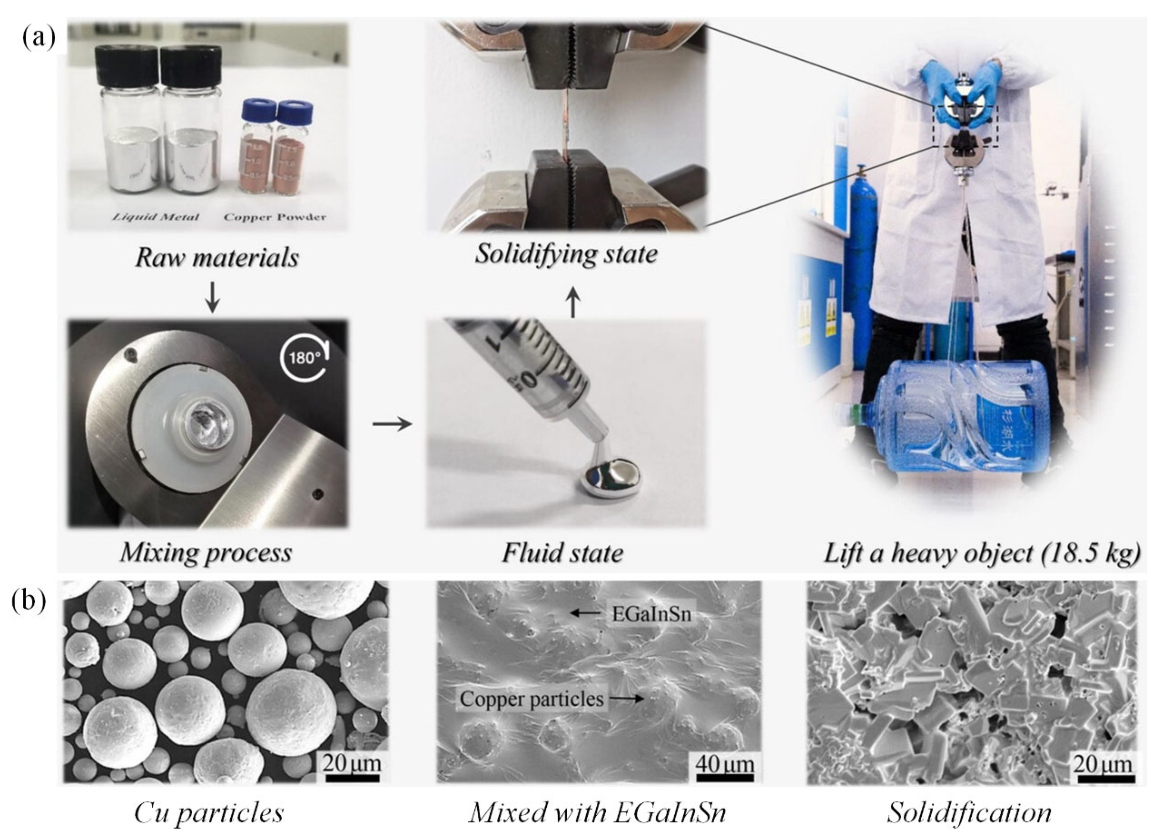
TLPB is a promising interconnect method for WBG semiconductor power devices. However, the wide application is limited by the long processing time required to form the full-IMC joints [93]. Increasing the contact area is a potential strategy to accelerate TLPB. By introducing materials with high specific surface area, atomic diffusion and IMC formation are promoted. In particular, open-cell metal foams are used as reinforcing phases to enhance interfacial reaction due to their three-dimensional continuous network structure. This structure shortens the diffusion distance and increases the grain boundary diffusion pathways, thereby reducing the time needed to form the full-IMC joint. For instance, for a regular Cu/Sn (6 μm)/Cu structure to form a full Cu-Sn IMC at 260 °C, it requires 120 min [94]. In comparison, the TLPB processing time for a Sn/Cu foam composite solder is shortened by 96%. As shown in Figure 9, Zheng et al. [9] achieved rapid TLPB by mixing EGaInSn with micro Cu particles. After solidification at room or moderately elevated temperatures (20−60 °C), the composite formed a robust bond with Cu substrates [9].
In addition, the use of metal form or mesh as an enhancement phase refines IMC grains, thereby promoting their mechanical properties [95]. The large Cu6Sn5 grains in the middle area underwent typical brittle fracture. By applying Cu foam/SAC305 composite solder, the shear strength of the joints was significantly increased by 27% in a shorter time [96]. This improvement in strength and ductility of the TLPB joints is attributed to the combined effect of the ductile three-dimensional continuous Cu-foam framework and fine-grain strengthening from Cu–Sn IMCs [95]. Compared with the pure Sn solder joints, the foam Ni/Ag composite solder with 7075 Al [97] and 2024 Al alloy [98] has significantly increased the shear strength by 37% and 344.8%, respectively. Ni foam improves the tensile strength of SAC105 and SAC105-0.3Ti solder joints, which are, respectively, increased by 65.5% and 62.5% compared with the base solder joints [99]. At relatively low temperatures, the interfacial reaction between GLMs and Cu is relatively slow. To achieve the desired bonding strength, the reaction time at low temperatures may need to be prolonged, potentially lasting tens of hours [9]. In particular, dense oxide films can hinder the wetting of GLMs and reduce the efficiency of interfacial reactions in certain scenarios, which are the potential challenge for low-temperature TLPB [100].
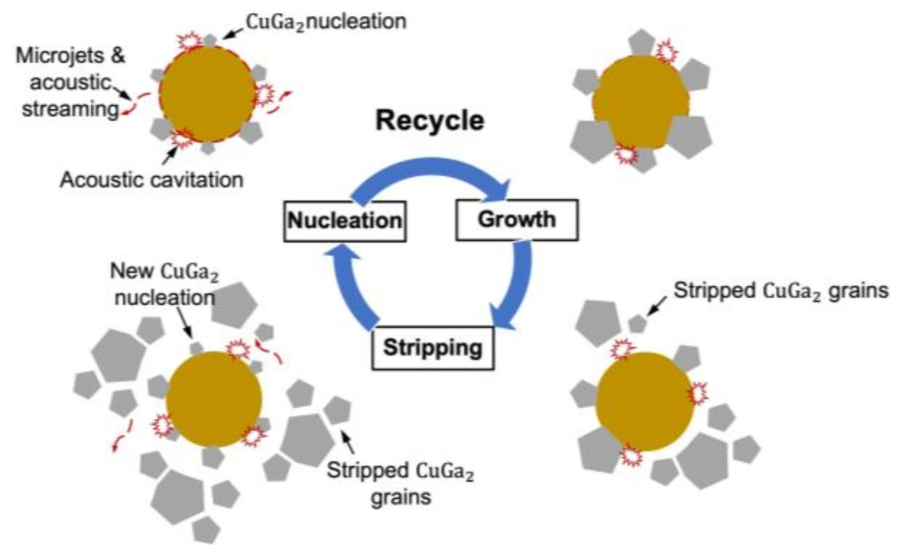
Ultrasonic technology has long been used for rapid wire bonding, as ultrasonic waves can reduce the temperature required for plastic deformation [101]. Ultrasonic-assisted soldering has also been developed, relying on the ultrasonic acoustic cavitation effect that appears when ultrasonic signal is propagated in the liquid medium [102]. This phenomenon can generate numerous cavitation bubbles within the molten solder. The subsequent collapse of these bubbles creates high-speed liquid jets that continuously impinge on the solid surface, effectively removing surface oxide layers and improving solder wettability [103]. Furthermore, cavitation bubbles collapsed near the reaction interface, producing microjets and acoustic streaming, and releasing localized heat and enhancing mass transfer. These effects collectively accelerate interfacial reactions. With continuous ultrasonic application, the cyclic formation and collapse of cavitation bubbles disrupt and detach the IMC grains that have formed on the reaction surface. This allows the liquid solder to contact the freshly exposed substrate through the fractured IMC layer, thereby shortening the diffusion path across the reaction interface. Throughout this process, the nucleation, growth, and detachment of IMCs occur cyclically, resulting in finer-grained IMCs and consequently superior mechanical properties, as shown in Figure 10 [15].
Ultrasonic vibration represents a promising approach for shortening the GLM-based TLPB process. In related studies, Zhao et al. [104] reported that the efficiency of the solid Al dissolution in liquid Sn with ultrasound was improved remarkably, and the activation energy of dissolution was reduced markedly. Li et al. [100] found that the bonding speed of 7075-Al alloy joints using Ni-mesh-reinforced SAC305 composite solder could be accelerated with appropriate ultrasonic treatment, resulting in improved shear strength. Liu et al. [2] found that the TLPB assisted by ultrasonic vibration can accelerate the interfacial reactions between Zn-5Al and Cu or Ni substrate under ambient conditions. The uniform full-IMC joints can be formed within 1 min and 3 min on Cu and Ni substrate, respectively, without flux applied. Chen et al. [15] demonstrated that the ultrasonic vibration considerably accelerates the bonding process with Cu-Ga paste, enabling the formation of full-IMC joints with a uniform microstructure within 5 min under low-temperature conditions.

4.2. Decelerating Methods for GLM Interfacial Reaction

Metallization is one of the most popular methods to decelerate the interfacial reaction, offering a wide choice of finish materials and manufacturing routes [105]. It is commonly applied for enhancing solderability and preventing substrate dissolution and oxidation [106]. Ni coatings with thicknesses of several micrometers are often employed as a diffusion barrier to protect the underlying Cu substrate, as Ni reacts significantly slower than Cu during soldering [107]. Ag and Au finishes are used to prevent surface oxidation, which also provide excellent chemical stability for long-term storage [108]. The most common coating structures include immersion Ag (ImAg) [109], electroless Ni/immersion Au (ENIG) [110] and electroless Ni/immersion Ag (ENImAg) [111].
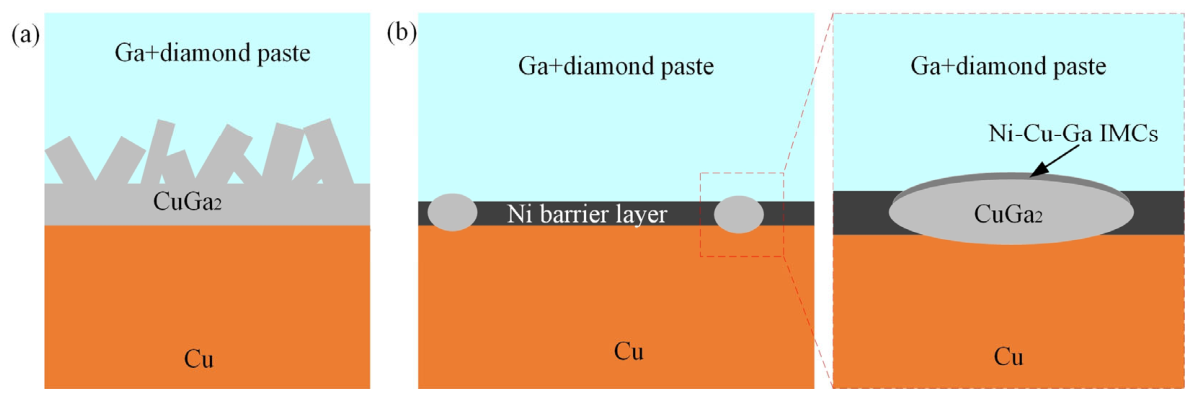
Metallization with Ni is widely employed as the diffusion barrier layer for GLM-based fluidic interconnections. In ENIG structures, the electroless Ni layer suppresses Ga infiltration and delays IMC growth at the interface. When liquid Ga alloys contact Ni, the reaction typically forms Ga-Ni IMCs such as Ga7Ni3, which grow with relatively slow kinetics and exhibit a self-limiting characteristic that restricts further diffusion [112,113]. These IMCs evolve through reaction-controlled or mixed growth mechanisms at moderate temperatures, resulting in significantly lower dissolution rates than Cu-Ga systems. However, Ni metallization can be gradually consumed by GLMs at 160 °C [114]. Electrodeposited Ni-W coatings exhibit negligible degradation when exposed to Ga-Sn-Zn alloys below 250 °C, maintaining a dense and continuous microstructure even after extended aging [115]. Such behavior indicates that alloying elements like W effectively reduce Ga diffusivity and enhance the thermal robustness of the barrier layer. Compared with the Ni layer, the Au cap in ENIG does not provide substantial reaction resistance. Liquid Ga reacts rapidly with Au to produce a single AuGa2 layer with fast growth kinetics, making Au prone to spalling and local delamination during prolonged contact [116]. As shown in Figure 11, electroless Ni or Ni-P coatings effectively block Ga wetting and suppress interfacial dissolution, ensuring stable thermal resistance during repeated thermal cycling [43]. Overall, pure Ni metallization could effectively decelerate GLM-induced interfacial reactions at relatively low-temperature, novel metallization; protection methods are still demanding at elevated thermal conditions.
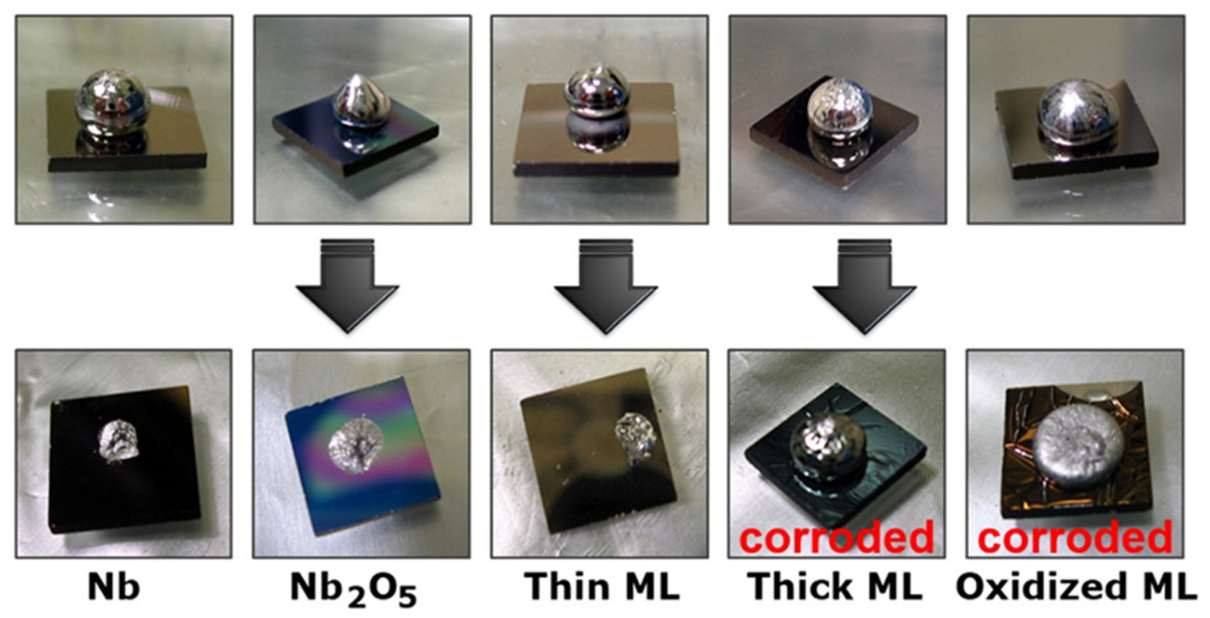
Refractory metals, such as Nb and Ta, have been regarded as potential diffusion barrier layers for GLM interconnects due to their high melting points and chemical stability [117]. A 70 nm Nb layer can withstand Ga for 30 h at 200 ℃, showing better performance than regular Ni barrier layers in high-temperature conditions [118]. In multilayer Nb/NbOx coatings, Ga diffusion was still observed at elevated temperatures, indicating that although the oxide layer provides a better barrier effect than pure Nb coatings, it still cannot completely prevent interfacial diffusion. This behavior is illustrated in Figure 12, which shows the interactions between Ga and different Nb/NbOx coatings [118]. The Ga-Nb phase diagram shows that Ga exhibits finite solubility in Nb at high temperatures, which can lead to interfacial degradation when the barrier layer is thin. Ga-Nb intermediate phases are thermodynamically possible, and although their formation requires elevated temperatures, the presence of Ga-rich liquid accelerates the local dissolution of Nb and limits its long-term reliability as a barrier material [119].
Ta exhibits superior resistance to Ga due to its very low Ga solubility and the sluggish formation of IMCs. Under high-pressure and high-temperature conditions, Ta remains essentially inert to liquid Ga up to ~500 °C, showing negligible lattice expansion and no detectable dissolution [120]. Only at temperatures above 600−700 °C does Ta begin to form Ga3Ta, and the reaction rate remains very slow compared to other metal–Ga interfaces. This stability originates from Ta’s strong bonding and limited mutual solubility, making it one of the most Ga-resistant refractory metals. However, thin Ta coatings may not replicate the same level of protection as bulk Ta. Studies on nanoscale barrier reveal that 100 nm Ta layers do not effectively block Ga migration under thermal cycling, as Ga can penetrate through grain boundaries or microdefects [121]. Therefore, although Ta is intrinsically more chemically inert compared to Ga and Nb, structural optimization remains necessary before it can serve as a reliable protection layer in fluidic interconnections.

4.3. Regulations of Thermal and Electrical Properties at Interfaces

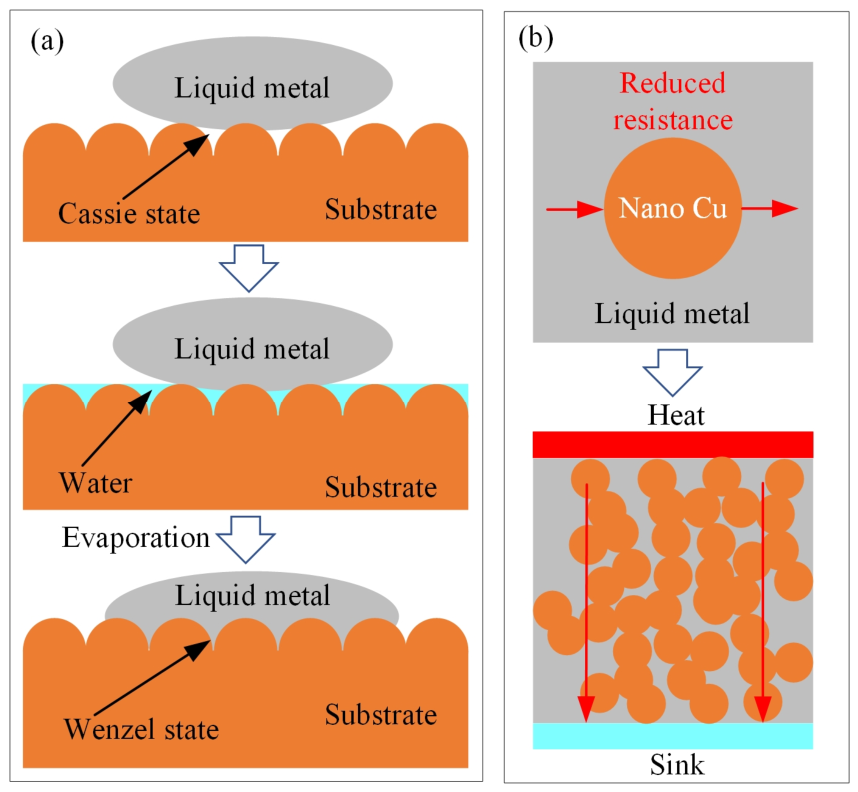
To regulate the interfacial thermal properties of GLMs, several effective strategies have been promoted by enhancing wetting, forming conductive intermetallic layers and constructing composite thermal pathways. For instance, as shown in Figure 13a, infiltration driven by water evaporation can transition GLM wetting from the Cassie to Wenzel state on microstructure Cu, substantially increasing the contact area and reducing interfacial thermal resistance [122]. Chemically induced in situ formation of a CuGa2 intermetallic layer through HCl treatment will replace the insulating Ga2O3 oxide, switching heat transfer from phonon-dominated to more efficient electron-dominated transport and greatly improving interfacial thermal conductivity [30]. Additionally, as shown in Figure 13b, compositing GLMs with high thermal conductivity fillers, such as adding 4 vol% Cu nanoparticles, can raise the thermal conductivity of the TIM by ~180% without undermining fluidity [38]. Furthermore, employing pre-structured materials like vertically aligned graphene films or Cr-coated diamond particles helps to establish continuous three-dimensional heat conduction networks, further lowering interfacial thermal resistance and improving stability under thermal cycling [36,39]. In summary, these approaches demonstrate that proper interfacial engineering and material design are promising to optimize the thermal performance of GLMs.
To regulate the interfacial electrical properties of GLM interconnects, key strategies focus on suppressing undesirable interfacial reactions and establishing stable, low-resistance contacts. Effective diffusion barrier layers like Ni-Co or electrodeposited Ni-W coatings can successfully block the formation of high-resistivity intermetallic compounds (e.g., CuGa2) and maintain stable interfaces at elevated temperatures [123]. Alternatively, promoting the controlled formation of a thin, continuous IMC layer like CuGa2/Cu9Ga4 at the interface can itself act as a protective barrier, resulting in a low and stable contact resistance (~2.5–10 mΩ) during long-term service conditions [63]. Furthermore, surface treatments such as HCl vapor can significantly improve initial wettability and interfacial bonding, enabling reliable electrical performance comparable to traditional solders [69]. The selection of substrate crystallography is critical because interfaces with higher adhesion energy, such as Cu(111)/CuGa2, provide greater mechanical and electrical stability [70]. Therefore, the choice of regulation methods involves a balance among long-term resistance stability, corrosion inhibition and compatibility with the operating environment.

5. Summary

This study provides a comprehensive review on the properties, applications and interfacial regulation strategies with GLMs for power electronics integration. Certain applications and advantages of GLMs in terms of serving as thermal and electrical interfaces are elaborated based on their unique properties, where potential technical challenges are yet to be addressed. Given the actual needs in the applications, potential interfacial regulation strategies can be proposed to fulfill the future reliability requirement due to increasing power density. The key conclusions can be summarized as follows.
(1) Owing to their high thermal and electrical conductivity and low melting point, GLMs offer various advantages for thermal management and low-temperature bonding, which are potentially viable for the integration of high-power modules. However, purposely altering or regulating the interfacial interactions for a specific application can ultimately govern long-term reliability in service and operation, which is primarily determined by the interactive interfacial reactions between GLMs and metallic substrates, where a surface coating may be necessary to achieve the goals.
(2) For thermal management, the primary cause of failure is attributed to the interfacial reactions in the applications of GLMs as TIMs or heat transfer. The Cu substrate can react with Ga and Ga-based alloys at room temperature, resulting in the formation of IMCs, which can lead to interfacial failure. Protective Ni-based metallizations such as ENIG or Ni-W layers are proven to be effective in retarding the interfacial reactions to certain extents, which, hence, improves reliability. However, the refinery metals such as Nb and Ta coatings are the most desirable in enabling the sufficient protection of the underlying Cu substrate at elevated temperatures (>200 °C), which is likely to occur under high-power density conditions.
(3) The main challenges of GLMs applied for thermal management centered on balancing interfacial performance with fluidic properties. As a coolant, the high viscosity and density of GLMs lead to significant flow resistance and pumping power consumption, limiting their application in smaller channels, while their poor wettability on common substrate materials introduces high thermal resistance, and system optimization is often limited by high pressure drops. As a TIM, their high interfacial thermal resistance mainly stems from poor wettability caused by the Ga2O3 surface oxide layer and the phonon–electron heat carrier mismatch. Although interface modification (e.g., forming a CuGa2 IMC layer) can significantly improve wettability and heat transfer efficiency, the effect of CuGa2 formation on thermal conductivity remains debated. Some studies suggest it increases electrical resistance and may promote corrosion, while others demonstrate that it enables efficient electron-dominated heat transfer. Furthermore, long-term reliability issues like substrate corrosion and leakage, as well as the complexity and compatibility demand of interfacial modifications, pose key challenges for both applications.
(4) For electrical connections using GLMs, both liquid-state and solid-state interconnection can be applied, subject to the specific applications. Interconnects via liquid GLMs can effectively decouple the interfacial thermal stress induced by CTE mismatch during the cycles of operation, but preventing the leakage of confined GLMs at the interfaces is critical to ensuring enhanced electrical conductivity. The TLPB process can be a tangible route of forming the interconnects, with GLMs reacting with metal substrate at a low temperature, thereby creating a full-IMC joint which is able to serve under a high-temperature regime. However, TLPB at low temperatures can be extremely time-consuming. To reduce the interfacial reaction time, it is practical to accelerate the inter-diffusion in TLPB processes by increasing the reactive contact area with GLMs by incorporating a metal (e.g., Cu) foam or mixing GLMs with micro/nano-metal particles. Ultrasonic vibration can also be applied to assist the inter-diffusion, thus speeding up the TLPB interfacial reactions, as the result of enhanced wettability and atomic inter-diffusion due to the breakdown of surface oxides resulted from effective acoustic interruptions.
(5) The challenges of GLMs were applied as fluidic conductive interconnects, primarily due to interfacial instability and material compatibility issues. Their inherent poor wettability caused by the native Ga2O3 layer leads to high and unstable contact resistance, which is further worsened in high-humidity environments. The spontaneous formation of IMCs like CuGa2 improves interfacial bonding but often degrades electrical conductivity due to their higher resistivity. Long-term reliability is threatened by the corrosion of substrate metals (especially Cu), potential component separation within the GLM paste, and failure mechanisms like GLM pump out. Furthermore, while barrier coatings such as Ni-W, diamond or noble metals can mitigate interfacial reactions, they also introduce limitations in electrical conductivity, thermal performance and cost. Consequently, designing a fluidic electrical interface that is stable, low-resistance and durable remains a persistent engineering challenge.

Author Contributions

Organization of the structure of the manuscript, C.L. (Canyu Liu); writing of the whole manuscript, C.L. (Canyu Liu), T.L., Z.H., X.L., J.Z., G.W., G.L. and W.L.; reviewing and editing the manuscript, C.L. (Canyu Liu) and C.L. (Changqing Liu); supervision, C.L. (Changqing Liu). All authors have read and agreed to the published version of the manuscript.

Funding

This research received no external funding.

Data Availability Statement

No new data were created or analyzed in this study. Data sharing is not applicable.

Conflicts of Interest

The authors declare no conflict of interest.

Abbreviations

The following abbreviations are used in this manuscript:
GLMsGa-based liquid metals
TLPBTransient liquid-phase bonding
TIMsThermal interface materials
WBGWide bandgap
IMCIntermetallic compounds
CTECoefficient of thermal expansion
BGABall grid array
UBMUnder-bump metallurgy
FCCFace-cantered cubic

References

  1. Huo, F.; Chen, C.; Member, S.; Zhang, Z.; Lee, S.; Kim, D.; Zhang, Y.; Suetake, A.; Kazutaka, T.; Yamaguchi, Y.; et al. The Impact of Sintered Ag—Al Interconnects on the Power Cycling Reliability of Die Attachments. IEEE Trans. Power Electron. 2025, 41, 3099–3116. [Google Scholar] [CrossRef]
  2. Liu, C.; Liu, A.; Su, Y.; Chen, Y.; Zhou, Z.; Liu, C. Ultrasonically enhanced flux-less bonding with Zn-5Al alloy under ambient condition for high-temperature electronics interconnects. J. Manuf. Process. 2022, 73, 139–148. [Google Scholar] [CrossRef]
  3. Sattari, R.; Van Zeijl, H.; Zhang, G. A Thin-film Reconfigurable SiC Thermal Test Chip for Reliability Monitoring in Harsh Environments. In Proceedings of the 2023 IEEE 73rd Electronic Components and Technology Conference (ECTC), Orlando, FL, USA, 30 May–2 June 2023; IEEE: Piscataway, NJ, USA, 2023; pp. 1309–1313. [Google Scholar] [CrossRef]
  4. Zhao, P.; Gao, X.; Zhao, B.; Wang, S.; Zhang, D.; Wu, X.; Huang, S.; Li, D.; Wu, J. Investigation on nano-grinding process of GaN using molecular dynamics simulation: Nano-grinding parameters effect. J. Manuf. Process. 2023, 102, 429–442. [Google Scholar] [CrossRef]
  5. Peng, X.; Wang, Y.; Ye, Z.; Huang, J.; Yang, J.; Chen, S.; Zhao, X. Microstructural evolution and performance of high-tin-content Cu40Sn60 (wt.%) core/shell powder TLPS bonding joints. J. Manuf. Process. 2022, 75, 853–862. [Google Scholar] [CrossRef]
  6. Lee, H.; Smet, V.; Tummala, R.; Fellow, L. A Review of SiC Power Module Packaging Technologies: Challenges, Advances, and Emerging Issues. IEEE J. Emerg. Sel. Top. Power Electron. 2020, 8, 239–255. [Google Scholar] [CrossRef]
  7. Zou, Y.S. Review A review of interconnect materials used in emerging memory device packaging: First- and second-level interconnect materials. J. Mater. Sci. Mater. Electron. 2021, 32, 27133–27147. [Google Scholar] [CrossRef]
  8. Paknejad, S.A.; Mannan, S.H. Review of silver nanoparticle based die attach materials for high power/temperature applications. Microelectron. Reliab. 2017, 70, 1–11. [Google Scholar] [CrossRef]
  9. Zheng, Z.; Wei, S.; Yang, Y.; Zhang, D.; Yang, D.; Li, W.; Guo, J. Low-Temperature Solidifiable Liquid Metal with Ultrahigh Thermal Conductivity Enabled by Spontaneous Phase Transition for Electronics’ Safety and Long-Life Cooling. Adv. Eng. Mater. 2023, 25, 2201817. [Google Scholar] [CrossRef]
  10. Weiting, C.; Shenxin, Y.U.; Yue, Y.A.O.; Zeyang, A.N.; Antong, B.I.; Wenyi, Z.; Shaoxi, W.; Yucheng, W. Liquid Metal-Based Chip Cooling Technologies: A Review. J. Therm. Sci. 2025, 34, 2009–2045. [Google Scholar] [CrossRef]
  11. Handschuh-Wang, S.; Wang, T.; Zhang, Z.; Liu, F.; Han, P.; Liu, X. Long-Term Corrosion of Eutectic Gallium, Indium, and Tin (EGaInSn) Interfacing with Diamond. Materials 2024, 17, 2683. [Google Scholar] [CrossRef]
  12. Chen, S.; Li, R.; Hu, H.; Guo, J.; Wei, S.; Li, W. Improving the thermal, mechanical, and insulating characteristics of thermal interface materials with liquid metal-based diphase structure. J. Mater. Sci. 2024, 59, 19125–19137. [Google Scholar] [CrossRef]
  13. Liu, S. The Interfacial Reactions Between Ga-based Alloys and Common Substrates Used in Microelectronics; The University of Queensland: St Lucia, QLD, Australia, 2019. [Google Scholar]
  14. Du, L.; Schaffar, G.; Jiao, W.; Liu, K.; Poelma, R.H.; Maier-Kiener, V.; Fan, J.; Kiener, D.; van Driel, W.D.; Fan, X.; et al. Tailoring microstructure and mechanical properties of sintered Cu nanoparticles. Acta Mater. 2025, 300, 121501. [Google Scholar] [CrossRef]
  15. Chen, Y.; Zhou, Z.; Liu, C. Ultrasonic-accelerated TLPB with Ga-Cu Paste Solder for Low-temperature Electronics Interconnects. In Proceedings of the 2023 24th International Conference on Electronic Packaging Technology, Shihezi, China, 8–11 August 2023; IEEE: Piscataway, NJ, USA, 2023; pp. 1–6. [Google Scholar] [CrossRef]
  16. Liu, C.; Liu, C. An analytical review on interfacial reactions in high-temperature die-attach: The insights into the effect of surface metallization and filler materials. MATEC Web of Conf. 2024, 401, 02015. [Google Scholar] [CrossRef]
  17. Yan, L.; Yao, J.; Dai, Y.; Zhang, S.; Bai, W.; Gao, K.; Yang, H.; Wang, Y. Study of thermal stress fluctuations at the die-attach solder interface using the finite element method. Electron 2022, 11, 62. [Google Scholar] [CrossRef]
  18. Wu, N.; Hu, Y.; Sun, S. Microstructure Characterization and Interfacial Reactions between Au-Sn Solder and Different Back Metallization Systems of GaAs MMICs. Materials 2020, 13, 1266. [Google Scholar] [CrossRef]
  19. Wang, M.; Mei, Y.; Hu, W.; Li, X.; Lu, G.Q. Pressureless Sintered-silver as die attachment for bonding Si and SiC chips on Silver, Gold, Copper, and Nickel Metallization for Power Electronics Packaging: The Practice and Science. IEEE J. Emerg. Sel. Top. Power Electron. 2022, 10, 2645–2655. [Google Scholar] [CrossRef]
  20. Liu, J.; Chen, T.; Nie, Q.; Liu, J.; He, P.; Paik, K.W.; Zhang, S. Unexpected dual cracks in chip-ceramic substrate interconnect: Unveiling the mechanism behind simultaneous cracking at both the top and bottom of a solder joint. Eng. Fail. Anal. 2025, 167, 108942. [Google Scholar] [CrossRef]
  21. Shao, S.; Niu, Y.; Wang, J.; Liu, R.; Park, S.; Lee, H.; Yip, L.; Refai-Ahmed, G. Design guideline on board-level thermomechanical reliability of 2.5D package. Microelectron. Reliab. 2020, 111, 113701. [Google Scholar] [CrossRef]
  22. Su, Y.; Fu, G.; Liu, C.; Liu, C.; Long, X. Fatigue crack evolution and effect analysis of Ag sintering die-attachment in SiC power devices under power cycling based on phase-field simulation. Microelectron. Reliab. 2021, 126, 114244. [Google Scholar] [CrossRef]
  23. Ren, H.; Zou, G.; Jia, Q.; Deng, Z.; Du, C.; Wang, W.; Liu, L. Thermal stress reduction strategy for high-temperature power electronics with Ag sintering. Microelectron. Reliab. 2021, 127, 114379. [Google Scholar] [CrossRef]
  24. Mu, W.; Janabi, A.; Shillaber, L.; Hu, B.; Long, T. A SiC Half-bridge Power Module Based on Liquid Metal Packaging for High Performance and Low Thermal Stress. In Proceedings of the Conference Proceedings—IEEE Applied Power Electronics Conference and Exposition—APEC, Atlanta, GA, USA, 16–20 March 2025; IEEE: Piscataway, NJ, USA, 2025; pp. 2597–2602. [Google Scholar]
  25. Maivald, P.; Sridar, S.; Xiong, W. Thermal Conductivity Determination of Ga-In Alloys for Thermal Interface Materials Design. Thermo 2022, 2, 1–13. [Google Scholar] [CrossRef]
  26. Lee, S.W.; Subramanian, A.; Zamudio, F.B.; Zhong, J.Q.; Kozlov, S.M.; Shaikhutdinov, S.; Cuenya, B.R. Interaction of Gallium with a Copper Surface: Surface Alloying and Formation of Ordered Structures. J. Phys. Chem. C 2023, 127, 20700–20709. [Google Scholar] [CrossRef]
  27. Wu, Z.; Wang, W.; Bao, D.; Wei, S.; Li, R.; Guo, J. Wetting characteristics and interfacial heat-transfer performance of non-contact jetted liquid-metal arrays. Appl. Therm. Eng. 2025, 263, 125258. [Google Scholar] [CrossRef]
  28. Zhao, Z.; Soni, S.; Lee, T.; Nijhuis, C.A.; Xiang, D. Smart Eutectic Gallium–Indium: From Properties to Applications. Adv. Mater. 2023, 35, 2203391. [Google Scholar] [CrossRef]
  29. Liu, B.; Gao, W.; Duan, L.; Li, Q.; Gong, S.; Li, R. Performance analysis of Gallium-based liquid metal as thermal interface material for chip heat dissipation. Int. J. Therm. Sci. 2025, 218, 110121. [Google Scholar] [CrossRef]
  30. Zhang, X.; Dong, Y.; Du, Y.; Yang, L.; Ma, W.; Cao, B. Improving the Thermal Performance of Liquid Metal Thermal Interface Materials: The Role of Intermetallic Compounds at the Gallium/Copper Interface. Adv. Mater. Interfaces 2025, 12, 2500041. [Google Scholar] [CrossRef]
  31. Yi, B.; Ting, L.; Lin, C.; Li, C.; Shih, K.; Hsiao, C.; Hsuan, P.; Jui, T.; Kuo, C. Joint Interface Microstructure Analysis of Gallium—Based Thermal Interface Material During Reflow. J. Electron. Mater. 2024, 53, 6471–6481. [Google Scholar] [CrossRef]
  32. Tan, L.; Zhang, J.; Shen, J. Liquid metal/metal porous skeleton with high thermal conductivity and stable thermal reliability. J. Mater. Sci. 2023, 58, 17829–17842. [Google Scholar] [CrossRef]
  33. Kim, J.B.; Kang, D.G.; Noh, T.; Kim, S.; Jung, S.B. Enhancement of Ga—21.5 In—10 Sn Eutectic Alloy Based Thermal Interface Material Incorporating Cu Flake. In Proceedings of the 2023 IEEE 73rd Electronic Components and Technology Conference (ECTC), Orlando, FL, USA, 30 May–2 June 2023; IEEE: Piscataway, NJ, USA, 2023; pp. 1730–1734. [Google Scholar] [CrossRef]
  34. Kuang, H.; Wu, B.; Wang, J.; Fu, J.; Yu, C.; Zhang, J.; Ji, Y. Enhanced interface heat transfer based on gallium-based liquid metal infiltrated into vertically aligned copper nanowire arrays. Appl. Therm. Eng. 2023, 233, 121119. [Google Scholar] [CrossRef]
  35. Kong, W.; Wang, Z.; Casey, N.; Korah, M.M.; Uppal, A.; Green, M.D.; Rykaczewski, K.; Wang, R.Y. High Thermal Conductivity in Multiphase Liquid Metal and Silicon Carbide Soft Composites. Adv. Mater. Interfaces 2021, 8, 2100069. [Google Scholar] [CrossRef]
  36. Wei, S.; Wang, W.; Zhou, L.; Guo, J. Improving the heat conduction and mechanical properties of thermal interface materials by constructing diphase continuous structure reinforced by liquid metal. Compos. Part A Appl. Sci. Manuf. 2022, 162, 107149. [Google Scholar] [CrossRef]
  37. He, D.; Liu, G.; Liu, J.; Xie, H.; Yue, D.; Chen, Z.; Wei, C.; Xu, X.; Xie, H. Study of effects of corrosion temperature on corrosion resistance of Cu-C alloys to liquid Ga. Corros. Sci. 2023, 211, 110917. [Google Scholar] [CrossRef]
  38. Ki, S.; Shim, J.; Oh, S.; Koh, E.; Seo, D.; Ryu, S.; Kim, J.; Nam, Y. Gallium-based liquid metal alloy incorporating oxide-free copper nanoparticle clusters for high-performance thermal interface materials. Int. J. Heat Mass Transf. 2021, 170, 121012. [Google Scholar] [CrossRef]
  39. Liu, G.; Shang, K.; Chen, S.; Shen, J. Macro/micro synergistic thermal conductivity enhancement in liquid metal-based phase change composites for thermal management in electronic devices. Compos. Sci. Technol. 2025, 264, 111120. [Google Scholar] [CrossRef]
  40. Ma, J.L.; Dong, H.X.; He, Z.Z. Electrochemically enabled manipulation of gallium-based liquid metals within porous copper. Mater. Horizons 2018, 5, 675–682. [Google Scholar] [CrossRef]
  41. Wang, H.; Xing, W.; Chen, S.; Song, C.; Dickey, M.D.; Deng, T. Liquid Metal Composites with Enhanced Thermal Conductivity and Stability Using Molecular Thermal Linker. Adv. Mater. 2021, 33, 2103104. [Google Scholar] [CrossRef] [PubMed]
  42. Cui, Y.; Liang, F.; Yang, Z.; Xu, S.; Zhao, X.; Ding, Y.; Lin, Z.; Liu, J. Metallic Bond-Enabled Wetting Behavior at the Liquid Ga/CuGa2 Interfaces. ACS Appl. Mater. Interfaces 2018, 10, 9203–9210. [Google Scholar] [CrossRef] [PubMed]
  43. Liu, G.; Zhang, Y.; Ma, C.; Tang, Q.; Li, H.; Chen, S.; Shen, J. Corrosion inhibition of Ga-based thermal interface materials with Ni coating on Cu substrate. Surf. Coat. Technol. 2024, 493, 131286. [Google Scholar] [CrossRef]
  44. Wang, Y.; Bi, A.; Chen, K.; Yu, S.; Gao, W.; Zhang, W.; Wu, Y.; Li, Z.; Wang, S. Liquid metal microfluidic cooling system for high-efficiency thermal management via learning-based genetic algorithm. Eng. Appl. Artif. Intell. 2025, 161, 112324. [Google Scholar] [CrossRef]
  45. An, K.; Su, Z.; Zhang, M.; Deng, Y. Liquid metal-based micro/mini-channel heat transfer: Progress, challenges, and opportunities. Appl. Therm. Eng. 2024, 250, 123551. [Google Scholar] [CrossRef]
  46. Ma, K.Q.; Liu, J.; Xiang, S.H.; Xie, K.W.; Zhou, Y.X. Study of thawing behavior of liquid metal used as computer chip coolant. Int. J. Therm. Sci. 2009, 48, 964–974. [Google Scholar] [CrossRef]
  47. Wang, S.; Zhao, X.; Luo, J.; Zhuang, L.; Zou, D. Liquid metal (LM) and its composites in thermal management. Compos. Part A Appl. Sci. Manuf. 2022, 163, 107216. [Google Scholar] [CrossRef]
  48. Zhang, R.; Hodes, M.; Lower, N.; Wilcoxon, R. Water-based microchannel and galinstan-based minichannel cooling beyond 1 kw/cm2 heat flux. IEEE Trans. Compon. Packag. Manuf. Technol. 2015, 5, 762–770. [Google Scholar] [CrossRef]
  49. Tawk, M.; Avenas, Y.; Kedous-Lebouc, A.; Petit, M. Numerical and experimental investigations of the thermal management of power electronics with liquid metal mini-channel coolers. IEEE Trans. Ind. Appl. 2013, 49, 1421–1429. [Google Scholar] [CrossRef]
  50. Deng, Y.; Zhang, M.; Jiang, Y.; Liu, J. Two-stage multichannel liquid–metal cooling system for thermal management of high-heat-flux-density chip array. Energy Convers. Manag. 2022, 259, 115591. [Google Scholar] [CrossRef]
  51. Zhang, M.; Gao, Q.; Zhao, Z.; Guo, L.; Li, X.; Zhang, C. Liquid metal manifold microchannel heat sink for ultra-high heat flux cooling. Appl. Therm. Eng. 2024, 248, 123117. [Google Scholar] [CrossRef]
  52. Wu, T.; Wang, L.; Tang, Y.; Yin, C.; Li, X. Flow and Heat Transfer Performances of Liquid Metal Based Microchannel Heat Sinks under High Temperature Conditions. Micromachines 2022, 13, 95. [Google Scholar] [CrossRef] [PubMed]
  53. Li, C.; Chen, Q.; Hu, Y.; Zou, J.; Su, L.; Shang, Y. Comparative study of thermal and flow performance of microchannel scheme and multi-jet microchannel scheme using liquid metal and water as coolants. Int. J. Therm. Sci. 2025, 211, 109682. [Google Scholar] [CrossRef]
  54. Peng, B.; Wang, M. Research on liquid cooling test technology of ceramic substrate packaging embedded microchannel. In Proceedings of the 25th International Conference on Electronic Packaging Technology (ICEPT), Tianjin, China, 7–9 August 2024; IEEE: Piscataway, NJ, USA, 2024; pp. 1–6. [Google Scholar]
  55. Broughton, J.; Smet, V.; Tummala, R.R.; Joshi, Y.K. Review of Thermal Packaging Technologies for Automotive Power Electronics for Traction Purposes. J. Electron. Packag. Trans. ASME 2018, 140, 040801. [Google Scholar] [CrossRef]
  56. Hao, Q.; Tan, X.F.; Liu, S.; McDonald, S.D.; Yasuda, H.; Nogita, K. In Situ Observation of the Ga- and Cu-Based Substrate Reaction by Synchrotron Microradiography. ACS Appl. Electron. Mater. 2023, 5, 7004–7014. [Google Scholar] [CrossRef]
  57. Liu, S.Q.; Qu, D.D.; McDonald, S.D.; Nogita, K. The interaction of Sn-Ga alloys and Au coated Cu substrates. Solid State Phenom. 2018, 273, 3–8. [Google Scholar] [CrossRef]
  58. Froemel, J.; Baum, M.; Wiemer, M.; Gessner, T. Low-Temperature Wafer Bonding Using Solid-Liquid Inter-Diffusion Mechanism. J. Microelectromech. Syst. 2015, 24, 1973–1980. [Google Scholar] [CrossRef]
  59. Lin, S.K.; Chang, H.M.; Cho, C.L.; Liu, Y.C.; Kuo, Y. kai Formation of solid-solution Cu-to-Cu joints using Ga solder and Pt under bump metallurgy for three-dimensional integrated circuits. Electron. Mater. Lett. 2015, 11, 687–694. [Google Scholar] [CrossRef]
  60. Baker, N.; Bęczkowski, S.; Iannuzzo, F.; Pedersen, K.; Aunsborg, T.; Jørgensen, A.B.; Lemmon, A.; Gupta, S.; Garcia, R.; Mshar, A. LIME: Liquid Metal Packaging for Power Semiconductors. In Proceedings of the PCIM Conference 2025; International Exhibition and Conference for Power Electronics, Intelligent Motion, Renewable Energy and Energy Management, Nürnberg, Germany, 6–8 May 2025; pp. 418–427. [Google Scholar] [CrossRef]
  61. Mu, W.; Janabi, A.; Hu, B.; Shillaber, L.; Long, T. Liquid Metal Fluidic Connection and Floating Die Structure for Ultralow Thermomechanical Stress of SiC Power Electronics Packaging. IEEE Trans. Power Electron. 2024, 39, 7808–7814. [Google Scholar] [CrossRef]
  62. Wang, X.; Li, H.; Yao, R.; Lai, W.; Liu, R.; Yu, R.; Chen, X.; Li, J. Thermal Contact Resistance Optimization of Press-Pack IGBT Device Based on Liquid Metal Thermal Interface Material. IEEE Trans. Power Electron. 2022, 37, 5411–5421. [Google Scholar] [CrossRef]
  63. Lee, S.; Ma, J.; Hioki, Y.; Nakano, K.; Yoshida, K.; Waugh, M.D.; Zare, M.; Jeong, J.; Dickey, M.D. Practical Considerations for Gallium-Based Liquid Metal for Stretchable Electronics: Metal Contacts and Strain Cycling. ACS Appl. Electron. Mater. 2025, 7, 10610–10619. [Google Scholar] [CrossRef]
  64. Gao, Z.; Wang, C.; Gao, N.; Guo, S.; Chen, Y.; Chai, Z.; Wang, Y.; Ma, H. Electrodeposited Ni-W coatings as the effective reaction barrier at Ga-21.5In-10Sn/Cu interfaces. Surf. Interfaces 2022, 30, 101838. [Google Scholar] [CrossRef]
  65. Meyyappan, K.; Arrington, K.; Tadayon, P.; Murtagian, G.; Lin, Z.; Ouvarov-Bancalero, V.; Tran, D.; Nekkanty, S. Gallium-Based Liquid-Metal Alloys: Challenges and Risk Management in High-Humidity Environments. Adv. Eng. Mater. 2024, 26, 2400399. [Google Scholar] [CrossRef]
  66. Manikam, V.R.; Razak, K.A.; Cheong, K.Y. Sintering of silver-aluminum nanopaste with varying aluminum weight percent for use as a high-temperature die-attach material. IEEE Trans. Compon. Packag. Manuf. Technol. 2012, 2, 1940–1948. [Google Scholar] [CrossRef]
  67. Handschuh-Wang, S.; Wang, T.; Zhu, L.; Xu, Y.; Huang, L.; Gan, T.; Tang, Y.; Zhou, X. Corrosion-Resistant Functional Diamond Coatings for Reliable Interfacing of Liquid Metals with Solid Metals. ACS Appl. Mater. Interfaces 2020, 12, 40891–40900. [Google Scholar] [CrossRef]
  68. Kim, B.; Sohn, Y. Analysis of intermetallic compound formation in the React. Liq. Ga/Solid Pd interface. Surf. Interfaces 2022, 30, 101951. [Google Scholar] [CrossRef]
  69. Ozutemiz, K.B.; Wissman, J.; Ozdoganlar, O.B.; Majidi, C. EGaIn–Metal Interfacing for Liquid Metal Circuitry and Microelectronics Integration. Adv. Mater. Interfaces 2018, 5, 1701596. [Google Scholar] [CrossRef]
  70. Guo, S.; Wang, C.; Wang, L.; Chai, Z.; Chen, Y.; Ma, H.; Wang, Y.; Gao, Z. Insights into the atomic scale structure, bond characteristics and electrical property of Cu/CuGa2 (001) interface: An experimental and first-principles investigation. J. Mater. Sci. Mater. Electron. 2023, 34, 1646. [Google Scholar] [CrossRef]
  71. Daeneke, T.; Khoshmanesh, K.; Mahmood, N.; De Castro, I.A.; Esrafilzadeh, D.; Barrow, S.J.; Dickey, M.D.; Kalantar-Zadeh, K. Liquid metals: Fundamentals and applications in chemistry. Chem. Soc. Rev. 2018, 47, 4073–4111. [Google Scholar] [CrossRef]
  72. Wang, H.; Chen, S.; Zhu, X.; Yuan, B.; Sun, X.; Zhang, J.; Yang, X. Review Phase transition science and engineering of gallium-based liquid metal. Matter 2022, 5, 2054–2085. [Google Scholar] [CrossRef]
  73. Zhu, L.; Wang, B.; Handschuh-Wang, S.; Zhou, X. Liquid Metal–Based Soft Microfluidics. Small 2020, 16, 1903841. [Google Scholar] [CrossRef] [PubMed]
  74. Wu, X.; Fang, H.; Ma, X.; Yan, S. Gallium-Based Liquid Metals: Optical Properties, Applications, and Challenges. Adv. Opt. Mater. 2023, 11, 2301180. [Google Scholar] [CrossRef]
  75. Lin, Y.; Genzer, J.; Dickey, M.D. Attributes, Fabrication, and Applications of Gallium-Based Liquid Metal Particles. Adv. Sci. 2020, 7, 2000192. [Google Scholar] [CrossRef] [PubMed]
  76. Handschuh-Wang, S.; Stadler, F.J.; Zhou, X. Critical Review on the Physical Properties of Gallium-Based Liquid Metals and Selected Pathways for Their Alteration. J. Phys. Chem. C 2021, 125, 20113–20142. [Google Scholar] [CrossRef]
  77. Yang, X.H.; Tan, S.C.; Liu, J. Numerical investigation of the phase change process of low melting point metal. Int. J. Heat Mass Transf. 2016, 100, 899–907. [Google Scholar] [CrossRef]
  78. Zhou, J.Y.; Wang, Z.; Wei, C.; Fei, J.B.; Ke, C.B.; Zhang, X.P. Three-dimensional Simulation of Effects of Electro-Thermo-Mechanical Multi-physical Fields on Cu Protrusion and Performance of Micro-bump Joints in TSVs Based High Bandwidth Memory (HBM) Structures. In Proceedings of the 2020 IEEE 70th Electronic Components and Technology Conference (ECTC), Orlando, FL, USA, 3–30 June 2020; IEEE: Piscataway, NJ, USA, 2020; pp. 1659–1664. [Google Scholar] [CrossRef]
  79. Liu, S.; Sweatman, K.; McDonald, S.; Nogita, K. Ga-based alloys in microelectronic interconnects: A review. Materials 2018, 11, 1384. [Google Scholar] [CrossRef]
  80. Yu, S.; Kaviany, M. Electrical, thermal, and species transport properties of liquid eutectic Ga-In and Ga-In-Sn from first principles. J. Chem. Phys. 2014, 140, 064303. [Google Scholar] [CrossRef]
  81. Khazaka, R.; Mendizabal, L.; Henry, D.; Hanna, R. Survey of high-temperature reliability of power electronics packaging components. IEEE Trans. Power Electron. 2015, 30, 2456–2464. [Google Scholar] [CrossRef]
  82. Zhang, Y.; Zhu, Y.; Cai, H.; Li, Y.; Song, J.; Sun, Y.; Yang, Z.; Ding, G. Coexistent improvement of thermal and mechanical performance at Si/Cu joint by thickness-controlled Sn-Ag bond layer. J. Manuf. Process. 2023, 101, 104–113. [Google Scholar] [CrossRef]
  83. Huang, H.; Guo, X.; Bu, F.; Huang, G. Corrosion behavior of immersion silver printed circuit board copper under a thin electrolyte layer. Eng. Fail. Anal. 2020, 117, 104807. [Google Scholar] [CrossRef]
  84. Bui, Q.V.; Nam, N.D.; Choi, D.H.; Lee, J.B.; Lee, C.Y.; Kar, A.; Kim, J.G.; Jung, S.B. Corrosion protection of ENIG surface finishing using electrochemical methods. Mater. Res. Bull. 2010, 45, 305–308. [Google Scholar] [CrossRef]
  85. Chen, Y.; Liu, C.; Zhou, Z.; Liu, C. Transient liquid phase bonding with Ga-based alloys for electronics interconnections. J. Manuf. Process. 2022, 84, 1310–1319. [Google Scholar] [CrossRef]
  86. Liu, S.; McDonald, S.; Gu, Q.; Matsumura, S.; Qu, D.; Sweatman, K.; Nishimura, T.; Nogita, K. Properties of CuGa2 Formed Between Liquid Ga and Cu Substrates at Room Temperature. J. Electron. Mater. 2020, 49, 128–139. [Google Scholar] [CrossRef]
  87. Lin, S.K.; Cho, C.L.; Chang, H.M. Interfacial reactions in Cu/Ga and Cu/Ga/Cu couples. J. Electron. Mater. 2014, 43, 204–211. [Google Scholar] [CrossRef]
  88. Liu, S.; Yang, W.; Kawami, Y.; Gu, Q.; Matsumura, S.; Qu, D.; Mcdonald, S.; Nogita, K. Effects of Ni and Cu Antisite Substitution on the Phase Stability of CuGa2 from Liquid Ga/Cu-Ni Interfacial Reaction. ACS Appl. Mater. Interfaces 2019, 11, 32523–32532. [Google Scholar] [CrossRef]
  89. Wang, B.; He, S.; Zhang, G.; Liu, M.; He, K.; Huang, W.; Pan, K. Study on Microstructure and Properties of Micron Copper Powder-Liquid Metal Gallium Composite Interconnect Joint. Materials 2026, 19, 314. [Google Scholar] [CrossRef]
  90. Liu, S.; Zeng, G.; Yang, W.; McDonald, S.; Gu, Q.; Matsumura, S.; Nogita, K. Interfacial Reactions between Ga and Cu-10Ni Substrate at Low Temperature. ACS Appl. Mater. Interfaces 2020, 12, 21045–21056. [Google Scholar] [CrossRef]
  91. Liu, S.; Tan, X.F.; McDonald, S.D.; Gu, Q.; Matsumura, S.; Nogita, K. Interfacial reactions between Ga and Cu-xNi (x=0, 2, 6, 10, 14) substrates and the strength of Cu-xNi/Ga/Cu-xNi joints. Intermetallics 2021, 133, 107168. [Google Scholar] [CrossRef]
  92. Gao, Z.; Wang, C.; Chai, Z.; Chen, Y.; Shen, C.; Yao, K.; Zhao, N.; Wang, Y.; Ma, H. Interfacial reactions at Ga-21.5In–10Sn/Cu liquid-solid interfaces under isothermal and non-isothermal conditions. Mater. Chem. Phys. 2022, 282, 125960. [Google Scholar] [CrossRef]
  93. Zhu, L.; Ren, J.; Huang, M.L. Ultrasonic-assisted rapid fabrication of Cu foam/Cu-Sn IMC composite interlayers for high-temperature die-attach applications. Mater. Charact. 2025, 224, 115100. [Google Scholar] [CrossRef]
  94. Yao, P.; Li, X.; Han, X.; Xu, L. Shear strength and fracture mechanism for full Cu-Sn IMCs solder joints with different Cu3Sn proportion and joints with conventional interfacial structure in electronic packaging. Solder. Surf. Mt. Technol. 2025, 31, 6–19. [Google Scholar] [CrossRef]
  95. Zhu, L.; Ren, J.; Huang, F.F.; Huang, M.L. High-performance full IMC/Cu foam composite joints prepared by transient liquid phase soldering for high temperature application. Mater. Chem. Phys. 2025, 343, 131045. [Google Scholar] [CrossRef]
  96. Yi, X.; Zhang, R.; Hu, X. Study on the microstructure and mechanical property of Cu-foam modified Sn3.0Ag0.5Cu solder joints by ultrasonic-assisted soldering. J. Manuf. Process. 2021, 64, 508–517. [Google Scholar] [CrossRef]
  97. Xiao, Y.; Song, Z.; Li, S.; Li, D.; Zhang, Z.; Li, M.; Goodall, R. Materials Science & Engineering A Bonding and strengthening mechanism of ultrasonically soldered 7075 Al joint using Ni-foam/Sn composite solder foil. Mater. Sci. Eng. A 2020, 791, 139691. [Google Scholar] [CrossRef]
  98. Niu, W.; Xiao, Y.; Wan, C.; Li, D.; Fu, H.; He, H. Materials Science & Engineering A Ultrasonic bonding of 2024 Al alloy using Ni-foam/Sn composite solder at ambient temperature. Mater. Sci. Eng. A 2024, 771, 138663. [Google Scholar] [CrossRef]
  99. Wu, C.; Zhang, L.; Sun, L.; Huang, P.; Guo, X. Interfacial reaction and strengthening mechanism of thermo-compression bonding foam Ni reinforced SAC105 and SAC105–0.3Ti solder joints. Mater. Charact. 2024, 215, 114216. [Google Scholar] [CrossRef]
  100. Li, D.; Xiao, Y.; Zhang, Y.; Zhao, Y.; Zhang, J.; Luo, D. Ultrasonic-assisted soldering of 7075 Al alloy joint using Ni mesh reinforced SAC305 composite solder: Microstructure, bonding ratio, and mechanical properties. Ultrason. Sonochem. 2025, 120, 107430. [Google Scholar] [CrossRef] [PubMed]
  101. Tang, J.; Li, L.; Zhang, G.; Zhang, J.; Liu, P. Finite element modeling and analysis of ultrasonic bonding process of thick aluminum wires for power electronic packaging. Microelectron. Reliab. 2022, 139, 114859. [Google Scholar] [CrossRef]
  102. Vanhille, C.; Campos-Pozuelo, C. Acoustic cavitation mechanism: A nonlinear model. Ultrason. Sonochem. 2012, 19, 217–220. [Google Scholar] [CrossRef]
  103. Maassen, K.F.; Brown, J.S.; Choi, H.; Thompson, L.L.; Bostwick, J.B. Acoustic analysis of ultrasonic assisted soldering for enhanced adhesion. Ultrasonics 2020, 101, 106003. [Google Scholar] [CrossRef] [PubMed]
  104. Zhao, D.; Du, W.; Guo, S.; Xiu, Z.; Xu, Z.; Yan, J. Ultrasonic dissolution of solid Al in liquid Sn during soldering: Modeling and equation, trend prediction, accelerating effect. Ultrason. Sonochem. 2024, 111, 107142. [Google Scholar] [CrossRef]
  105. Chen, C.; Kim, D.; Zhang, Z.; Wakasugi, N.; Liu, Y.; Hsieh, M.C.; Zhao, S.; Suetake, A.; Suganuma, K. Interface-Mechanical and Thermal Characteristics of Ag Sinter Joining on Bare DBA Substrate during Aging, Thermal Shock and 1200 W/cm2 Power Cycling Tests. IEEE Trans. Power Electron. 2022, 37, 6647–6659. [Google Scholar] [CrossRef]
  106. Muhd Amli, S.F.; Mohd Salleh, M.A.A.; Mohd Said, R.; Abdul Razak, N.R.; Wahab, J.A.; Ramli, M.I.I. Effect of surface finish on the wettability and electrical resistivity of Sn-3.0Ag-0.5Cu solder. IOP Conf. Ser. Mater. Sci. Eng. 2019, 701, 012029. [Google Scholar] [CrossRef]
  107. Wang, M.; Mei, Y.; Li, X.; Burgos, R.; Boroyevich, D.; Lu, G.Q. Pressureless Silver Sintering on Nickel for Power Module Packaging. IEEE Trans. Power Electron. 2019, 34, 7121–7125. [Google Scholar] [CrossRef]
  108. Laurila, T.; Vuorinen, V.; Kivilahti, J.K. Interfacial reactions between lead-free solders and common base materials. Mater. Sci. Eng. R Rep. 2005, 49, 1–60. [Google Scholar] [CrossRef]
  109. Yi, P.; Xiao, K.; Dong, C.; Zou, S.; Li, X. Effects of mould on electrochemical migration behaviour of immersion silver finished printed circuit board. Bioelectrochemistry 2018, 119, 203–210. [Google Scholar] [CrossRef]
  110. Xu, Q.; Mei, Y.; Li, X.; Lu, G.Q. Correlation between interfacial microstructure and bonding strength of sintered nanosilver on ENIG and electroplated Ni/Au direct-bond-copper (DBC) substrates. J. Alloys Compd. 2016, 675, 317–324. [Google Scholar] [CrossRef]
  111. Dele-Afolabi, T.T.; Ansari, M.N.M.; Azmah Hanim, M.A.; Oyekanmi, A.A.; Ojo-Kupoluyi, O.J.; Atiqah, A. Recent advances in Sn-based lead-free solder interconnects for microelectronics packaging: Materials and technologies. J. Mater. Res. Technol. 2023, 25, 4231–4263. [Google Scholar] [CrossRef]
  112. Lee, D.; Kim, C.L.; Sohn, Y. Formation and growth of intermetallic compounds during reactions between liquid gallium and solid nickel. Materials 2021, 14, 5694. [Google Scholar] [CrossRef] [PubMed]
  113. Peng, J.; Wang, T.; Zhang, S. Growth Kinetics of Ni3Ga7 in Ni/Ga System During Interfacial Reaction Diffusion. Crystals 2025, 15, 520. [Google Scholar] [CrossRef]
  114. Kim, B.; Kim, C.L.; Sohn, Y. A Study on the Interfacial Reactions between Gallium and Cu/Ni/Au(Pd) Multilayer Metallization. Materials 2023, 16, 6186. [Google Scholar] [CrossRef]
  115. Dobosz, A.; Berent, K.; Bigos, A.; Gancarz, T. Interfacial phenomena between liquid alloy and Ni substrate covered by Ni–W layer. Mater. Lett. 2020, 277, 128299. [Google Scholar] [CrossRef]
  116. Choi, H.; Sohn, Y. Interfacial reactions between liquid Ga and solid Au. Mater. Lett. 2023, 330, 133220. [Google Scholar] [CrossRef]
  117. Skliarova, H.; Azzolini, O.; Cherenkova-Dousset, O.; Johnson, R.R.; Palmieri, V. Niobium-based sputtered thin films for corrosion protection of proton-irradiated liquid water targets for [18F] production. J. Phys. D. Appl. Phys. 2014, 47, 045306. [Google Scholar] [CrossRef]
  118. Skliarova, H.; Renzelli, M.; Azzolini, O.; De Felicis, D.; Bemporad, E.; Johnson, R.R.; Palmieri, V. Niobium-niobium oxide multilayered coatings for corrosion protection of proton-irradiated liquid water targets for [18F] production. Thin Solid Films 2015, 591, 316–322. [Google Scholar] [CrossRef]
  119. Tamim, R.; Rapaud, O.; Boulesteix, R.; Maître, A. Thermodynamic assessment of the Ga–Gd, Ga–Nb and Gd–Nb binary phase diagrams towards the Ga–Gd–Nb system. Calphad Comput. Coupling Phase Diagr. Thermochem. 2023, 82, 102596. [Google Scholar] [CrossRef]
  120. Fujinaga, Y.; Murakami, Y. Chemical reaction between tantalum and gallium under high pressure. Mater. Trans. 2003, 44, 377–380. [Google Scholar] [CrossRef]
  121. Stagon, S.; Blaser, N.; Bevill, G.; Nuszkowski, J. Nanoscale Barrier Layers to Enable the Use of Gallium-Based Thermal Interface Materials with Aluminum. J. Mater. Eng. Perform. 2020, 29, 5132–5138. [Google Scholar] [CrossRef]
  122. Liu, Z.; Wang, N.; Hou, Y.; Wang, J. Cassie-to-Wenzel transition of liquid metal onlaser-structured substrates via water evaporation for reducing thermal contact resistance. Appl. Phys. Lett. 2025, 126, 251601. [Google Scholar] [CrossRef]
  123. Huang, Y.; Wang, L.; Ma, H.; Su, X.; Zhao, N.; Ma, H. Study of Ga-21.5In-10Sn/Cu Liquid-Solid Interfacial Reaction and Reaction Barrier Layer. In Proceedings of the 2024 25th International Conference on Electronic Packaging Technology (ICEPT), Tianjin, China, 7–9 August 2024; IEEE: Piscataway, NJ, USA, 2024; pp. 1–6. [Google Scholar] [CrossRef]
Figure 1. Summary of GLMs applied in power electronics integration [9,11,24,25,26].
Materials 19 01599 g001
Figure 4. (a) Schematic of the interface prepared for Cu/Ga TLPB process; (b) schematic cross-sections of the Cu/Pt/Ga/Pt/Cu sandwich couples.
Materials 19 01599 g004
Figure 5. (a) Structure of the GLM-based SiC module; (b) prototype of GLM-based packaging and experimental setup; (c) thermomechanical stress comparison of the die and the substrate with solder-based packaging and GLM-based packaging [61].
Materials 19 01599 g005
Figure 6. Micrographs of GLM-Cu TLPB joints under different bonding parameters [89].
Materials 19 01599 g006
Figure 7. Interfacial reactions between Ga and Cu or Cu-xNi substrate.
Materials 19 01599 g007
Figure 8. The cross-section SEM images of Cu-Cu joints after 90 min reaction: (a) Cu/Ga/Cu, (b) Cu/GaSn/Cu and (c) Cu/EGaIn/Cu at 150 °C, (d) Cu/Ga/Cu, (e) Cu/GaSn/Cu and (f) Cu/EGaIn/Cu at 220 °C and (g) Cu/Ga/Cu, (h) Cu/GaSn/Cu and (i) Cu/EGaIn/Cu at 220 °C, 1 MPa [85].
Materials 19 01599 g008
Figure 9. (a) EGaInSn/Cu composite preparation and transition phenomenon; (b) SEM images of EGaInSn/Cu composites [9].
Materials 19 01599 g009
Figure 10. Schematic diagram of Ga-Cu IMC growth and strip on Cu particle surface during the ultrasonic-assisted TLPB process [15].
Materials 19 01599 g010
Figure 11. (a) Diffusion between Ga + diamond paste and Cu substrates; (b) effect of Ni-based barrier layer.
Materials 19 01599 g011
Figure 12. The liquid Ga-resistant test with Nb-based coatings [118].
Materials 19 01599 g012
Figure 13. (a) GLM wetting transition from the Cassie to Wenzel state; (b) GLM thermal properties improved by high thermal conductivity fillers.
Materials 19 01599 g013
Table 1. Typical studies of GLMs applied as TIMs.
GLMs InvestigatedInterfacial Materials with GLMsMain ConclusionRef.
Ga-based alloyCr-coated diamond particlesCr-coated diamond particles form a 3D thermal network with LM; pressure-induced exudation reacts with Cu to form a low thermal resistance interface (0.206 K·mm2/W).[36]
EGaInCuHeat treatment forms a stable CuGa2/In(Ga)/LM interfacial structure, improving bond and inhibiting leakage.[27]
GaCuCu-C alloys exhibit superior corrosion resistance to liquid Ga compared to pure Cu, especially at elevated temperatures.[37]
EGaInSnCu nano particlesAdding 4 vol% Cu nanoparticles increases thermal conductivity by ~180% to 64.8 W·m−1·K−1 without compromising fluidity.[38]
Carbon nanotube (CNT)-coated GLM particlesVertically aligned graphene film (VAGF)VAGF-based composite significantly lowers LED operating temperature (by 42 °C) and maintains stable performance over many thermal cycles.[39]
EGaInPorous copperElectrochemical wetting in NaOH enables rapid LM infusion into porous Cu, forming a super-wetting CuGa2 coating.[40]
GaCuHCl treatment removes oxides, enabling in situ formation of a CuGa2 interlayer which dramatically improves wetting and electron-dominated heat transfer at the interface.[30]
GaCuSurface-modifying copper particles with 3-chloropropyltriethoxysilane (CPTES) enhances interfacial thermal conductance and acts as a diffusion barrier, boosting composite thermal conductivity to 65.9 W·m−1·K−1.[41]
GaCuGa2Abnormal wetting of Ga on CuGa2 is driven by strong metallic bonding due to favorable electron exchange, not traditional wetting theory.[42]
GaCu and NiCharge redistribution simulations indicate the formation of polar chemical bonds at the Cu-Ga interface, explaining enhanced bonding.[43]
Table 2. Typical studies of GLMs as microchannel coolants.
GLMs InvestigatedInterfacial Materials with GLMsMain ConclusionRef.
Ga-based alloyCr-coated diamond particlesCr-coated diamond particles form a 3D thermal network with LM; pressure-induced exudation reacts with Cu to form a low thermal resistance interface (0.206 K·mm2/W).[36]
EGaInCuHeat treatment forms a stable CuGa2/In(Ga)/LM interfacial structure, improving bond and inhibiting leakage.[27]
GaCuCu-C alloys exhibit superior corrosion resistance to liquid Ga compared to pure Cu, especially at elevated temperatures.[37]
EGaInSnCu nano particlesAdding 4 vol% Cu nanoparticles increases thermal conductivity by ~180% to 64.8 W·m−1·K−1 without compromising fluidity.[38]
Carbon nanotube (CNT)-coated LM particlesVertically aligned graphene film (VAGF)VAGF-based composite significantly lowers LED operating temperature (by 42 °C) and maintains stable performance over many thermal cycles.[39]
EGaInPorous copperElectrochemical wetting in NaOH enables rapid LM infusion into porous Cu, forming a super-wetting CuGa2 coating.[40]
GaCuHCl treatment removes oxides, enabling in situ formation of a CuGa2 interlayer which dramatically improves wetting, bonding, and electron-dominated heat transfer at the Ga/Cu interface.[30]
GaCuSurface-modifying copper particles with 3-chloropropyltriethoxysilane (CPTES) enhances interfacial thermal conductance and acts as a diffusion barrier, boosting composite thermal conductivity to 65.9 W·m−1·K−1.[41]
GaCuGa2Abnormal wetting of Ga on CuGa2 is driven by strong metallic bonding due to favorable electron exchange, not traditional wetting theory.[42]
GaCu and NiCharge redistribution simulations indicate the formation of polar chemical bonds at the Cu-Ga interface, explaining enhanced bonding.[43]
Table 3. Typical studies of GLMs for fluidic electrical interconnects.
GLMsSubstrate/Contact MaterialMain ConclusionRef.
EGaIn and
EGaInSn
Au/Ni/Cu multilayer coatingEGaIn shows better long-term contact resistance stability than EGaInSn. Humidity accelerates interface degradation, requiring environmental sealing for reliability.[65]
Ga mixed with Ga-oxideCuLM’s liquid state provides immunity to thermomechanical stress, dramatically improving power cycling life. Corrosion remains a key challenge, and adding Ga-oxide increases viscosity for better shape control.[60]
Ga mixed with Ga-oxideCuGLM encapsulation improves thermal performance, tripling diode lifetime and reducing transient thermal impedance by 25% with low-temperature processing. However, reliability is limited by corrosion, pump out, intermetallic growth, and component separation.[66]
EGaInSnTi substrate with B-doped diamond coatingThe boron (B)-doped diamond coating exhibits superlyophobicity (contact angle >155°) and a low contact resistance of 0.84 Ω with Galinstan. Despite a resistivity three to four orders of magnitude higher than copper, it maintains stable electrical contact for 3000 min while serving as an anti-adhesion and diffusion barrier.[67]
GaInAgAg coatingReplacing solder with a GLM die-attach layer decouples thermal strain, reducing chip stress by 56% while maintaining a comparable on-state resistance (15.98 mΩ vs. 15.53 mΩ for solder), offering a major mechanical benefit with minimal impact on electrical performance.[61]
EGaInCu, Sn, Ag electrodesThe stable IMC layer that forms at the EGaIn/Cu interface acts as an effective diffusion barrier while maintaining a low contact resistance of ~2.5–10 mΩ for 1000 hours at 100 °C. Cu is a reliable electrode for GLM interconnects, and its durability can be further enhanced through material and design improvements.[63]
GaPd (Palladium)Pd serves as an effective wetting layer, with IMC growth kinetics shifting from interfacial reaction control to diffusion control as temperature increases.[68]
EGaInCr/Cu bilayerHCl vapor treatment enables reliable electrical interfacing on Cr/Cu, with performance matching solder paste, as Ga diffusion is blocked by the Ni layer.[69]
EGaInSnCuThe Cu(111)/CuGa2(001) interface exhibits the strongest adhesion and stability, but CuGa2 formation has minimal impact on overall interfacial electron transport.[70]
EGaInSnElectrodeposited Ni-W coatingThe Ni-W coating effectively blocks the formation of high-resistivity IMC (e.g., CuGa2) at the GLM/Cu interface at temperatures up to 410 °C, with high electrical resistivity (~70–120 nΩ·m) and low thermal conductivity (~20–40 W/(m·K)).[64]
Table 4. Physical properties of typical GLMs [28,49,73].
MaterialMelting Point (°C)Boiling Point (°C)Viscosity (10−7·m2·s−1)Specific Heat (J·kg−1·K−1)Electrical Conductivity (106·S·m−1)Thermal Conductivity (W·m−1·K−1)
Ga29.7624033.24397.63.729.4
EGaIn15.520002.73503.442.2
EGaInSn13.2 α>13002.983923.144.8
α Note: The melting point of EGaInSn is often given as −19 °C which refers to the freezing temperature (which differs from the melting point due to supercooling).
Disclaimer/Publisher’s Note: The statements, opinions and data contained in all publications are solely those of the individual author(s) and contributor(s) and not of MDPI and/or the editor(s). MDPI and/or the editor(s) disclaim responsibility for any injury to people or property resulting from any ideas, methods, instructions or products referred to in the content.