Communication

(FeNiMnMgCuCo)3O4 High-Entropy Cathode for Zinc-Ion Batteries
Analytical & Testing Center, Huazhong University of Science and Technology, Wuhan 430074, China
*
Author to whom correspondence should be addressed.
Materials 2026, 19(8), 1520; https://doi.org/10.3390/ma19081520
Submission received: 6 February 2026 / Revised: 1 April 2026 / Accepted: 6 April 2026 / Published: 10 April 2026
(This article belongs to the Special Issue Advanced Electrode Materials for Batteries: Design and Performance)

Highlights

What are the main findings?
  • A novel high-entropy cathode (FeNiMnMgCuCo)3O4 is designed and synthesized for aqueous zinc-ion batteries.
  • The material exhibits a high reversible capacity of 341.3 mA h g−1 at 0.1 A g−1.
  • The material possesses excellent cycling stability (76.1% retention after 1000 cycles at 3 A g−1).
  • Multi-element coexistence in mixed valence states and high configurational entropy (~1.78 R) enhance stability.
  • The high-entropy design effectively promotes Zn2+ diffusion and redox kinetics while suppressing structural degradation during cycling.
What are the implications of the main findings?
  • This work demonstrates a high-entropy cathode material with practical potential.
  • This work provides new research insights for optimizing zinc-ion storage performance through composition design and entropy regulation.
  • This work will be of significant interest to researchers in the fields of electrochemistry and energy storage.

Abstract

As a result of the high safety, low cost, and environmental benignity, aqueous zinc-ion batteries are regarded as one of the most promising candidates for next-generation large-scale energy storage systems. However, their further development is constrained by performance bottlenecks in existing cathode materials, including capacity, cycle life, and reaction kinetics. In this study, a high-entropy design strategy is employed to synthesize the metal oxide (FeNiMnMgCuCo)3O4 with a cubic spinel structure, and its electrochemical performance as a cathode for zinc-ion batteries is systematically evaluated. The prepared (FeNiMnMgCuCo)3O4 high-entropy cathode exhibits high reversible capacity (341.3 mA h g−1 at 0.1 A g−1) and remarkable long-term cycling stability (76.1% retention after 1000 cycles at 3 A g−1). This work not only demonstrates a high-entropy cathode material with practical potential but also provides new research insights for optimizing zinc-ion storage performance through composition design and entropy regulation.

1. Introduction

To meet the urgent demand for sustainable energy storage technologies, developing novel electrochemical energy storage systems that combine high performance, high safety, and low cost is of great significance [1,2,3,4]. Although lithium-ion batteries have been extensively applied in consumer electronics and electric vehicles, their further advancement is hindered by multiple bottlenecks, including constraints on lithium resource scarcity, escalating manufacturing costs, and safety risks caused by flammable electrolytes [5,6,7,8,9]. In this context, aqueous zinc-ion batteries have been used as a promising alternative for next-generation energy storage, owing to their inherent safety, environmental benignity, cost-effectiveness, and abundant zinc resources [10,11,12,13,14,15,16]. However, the commercialization of zinc-ion batteries remains critically impeded by the poor performance of cathode materials. Conventional cathode materials (such as manganese-based and vanadium-based oxides) generally suffer from low intrinsic conductivity, high zinc ion (Zn2+) diffusion barriers, and irreversible structural degradation during cycling [17,18,19,20,21,22]. These issues make it difficult for the batteries to meet practical requirements in terms of actual capacity, rate performance, and long-term cycling stability [23]. Therefore, developing novel high-performance cathode materials capable of efficiently and reversibly storing zinc ions is crucial for advancing this technology toward practical application.
Over the past few years, the design concept of high-entropy materials has offered a promising strategy to breaking through the performance bottlenecks of traditional cathode materials. High-entropy oxides (HEOs) are composed of multiple primary metal ions in a near-equimolar ratio. Their distinctive “high-entropy effect” can induce significant lattice distortion and synergistic “cocktail effects”, thereby effectively modulating the electronic structure of the material and enhancing intrinsic electronic conductivity [21,24,25]. Simultaneously, the distorted lattice can effectively facilitate rapid ion transport, significantly improving the diffusion kinetics of Zn2+ [26]. More importantly, the high-entropy system has excellent configurational entropy stability thermodynamically, which can maintain the integrity of the structural framework during repeated ion insertion/extraction processes, thereby ensuring outstanding cycle life [27]. Collectively, these characteristics make high-entropy oxides a highly promising material platform for advanced energy storage applications.
Herein, we report the rational design and successful synthesis of a high-entropy spinel oxide (FeNiMnMgCuCo)3O4, and for the first time comprehensively evaluate its performance as a cathode of aqueous zinc-ion batteries. The precise chemical composition was determined via inductively coupled plasma optical emission spectroscopy (ICP-OES). Subsequently, the crystal structure, microstructure, elemental distribution, and chemical states of the material were systematically characterized using X-ray diffraction (XRD), field-emission scanning/transmission electron microscopy (SEM/TEM), energy-dispersive X-ray spectroscopy (EDS), and X-ray photoelectron spectroscopy (XPS). The electrochemical evaluation results revealed that the (FeNiMnMgCuCo)3O4 cathode delivers a high reversible specific capacity of 341.3 mA h g−1 at a current density of 0.1 A g−1. Notably, it retains 76.1% of its initial capacity after 1000 cycles at 3 A g−1, underscoring its robust electrochemical performance. This work not only confirms the effectiveness of the multi-component high-entropy design strategy in boosting the performance of electrode materials for zinc-ion batteries, but also offers fresh insights for developing next-generation high-performance energy storage materials through entropy engineering.

2. Materials and Methods

(FeNiMnMgCuCo)3O4 was synthesized via a hydrothermal method followed by subsequent heat treatment. In particular, stoichiometric amounts (1 mmol each) of MgCl2·6H2O, CoCl2·6H2O, MnCl2·4H2O, FeCl3·6H2O, NiCl2·6H2O, and CuCl2·2H2O were dissolved in 40 mL of deionized water. While stirring continuously, 1.25 mmol of hexadecyltrimethylammonium bromide (CTAB) was added as a surfactant, followed by the addition of 36 mmol of urea as a precipitating agent, forming a homogeneous precursor solution. The mixture was then transferred to a polytetrafluoroethylene (PTFE)-lined stainless steel autoclave, and subjected to a hydrothermal reaction at 135 °C for 6 h. After cooling naturally to room temperature, the precipitate was collected by vacuum filtration following repeated centrifugation and washing with alternating deionized water and ethanol. The resulting filter cake was dried in a vacuum oven at 60 °C for 24 h to obtain the precursor powder. Finally, the precursor was calcined in a muffle furnace under an air atmosphere, heated at a rate of 5 °C/min to 900 °C, and held at this temperature for 2 h to ensure annealing and crystallization, yielding the target high-entropy oxide powder.
The as-synthesized samples were characterized using various analytical techniques. The elemental composition was quantified using inductively coupled plasma optical emission spectrometry (ICP-OES, Prodigy Plus, Teledyne Leeman Labs, Windsor, CT, USA). The crystal structure was analyzed via X-ray diffraction (XRD, Empyrean, Malvern Panalytical, Eindhoven, The Netherlands) equipped with Cu Kα radiation (λ = 1.5406 Å) at a scanning rate of 5° min−1. The morphology and microstructure were examined using field-emission scanning electron microscopy (SEM, JSM-IT800, JEOL Ltd., Akishima, Japan) and transmission electron microscopy (TEM, ARM-200F, JEOL Ltd., Akishima, Japan). The elemental uniformity of the material was verified by energy-dispersive X-ray spectroscopy (EDS, Octane Elite Super, EDAX Inc., Mahwah, NJ, USA). The surface chemical states were investigated using X-ray photoelectron spectroscopy (XPS, AXIS-ULTRA DLD-600W, Shimadzu Corporation, Manchester, UK) with Al Kα excitation, with binding energies calibrated against the C 1s peak at 284.8 eV.
The electrochemical performance of the as-prepared samples was evaluated in CR2032 coin cells configured with the prepared material as the working electrode. Specifically, the obtained (FeNiMnMgCuCo)3O4 powder, carbon black, and polyvinylidene difluoride (PVDF) were mixed in an 8:1:1 weight ratio and thoroughly ground to form a homogeneous mixture. Subsequently, N-methyl-2-pyrrolidone (NMP) solvent was added to the mixture to create a homogeneous slurry. After that, the resulting slurry was spin-coated onto carbon paper, followed by drying in a vacuum oven at 75 °C for 14 h to fabricate the working electrode (with the prepared samples loading of 2.0–2.5 mg cm−2). Finally, CR2032 coin cells were assembled in ambient air using the prepared working electrode, a glass fiber separator, an aqueous electrolyte consisting of 2.0 M ZnSO4 and 0.1 M MnSO4, and a Zn foil as the counter electrode. The electrochemical tests and long-term cycling tests were conducted using a CHI600E electrochemical workstation (CH Instruments, Inc., Austin, TX, USA) and a LANHE CT2001A battery test system (LANHE Tech., Wuhan, China), respectively.

3. Results and Discussion

3.1. Material Characterization

The elemental composition of the as-synthesized (FeNiMnMgCuCo)3O4 powder was quantitatively analyzed via ICP-OES. As summarized in Table 1, the measured mass fractions of each metallic element are Fe (18.6%), Ni (11.9%), Mn (15.1%), Mg (5.7%), Cu (12.2%), and Co (16.1%). The corresponding molar fractions at cation sites are calculated to be Fe (0.22), Ni (0.14), Mn (0.18), Mg (0.15), Cu (0.13), and Co (0.18), which confirms the successful incorporation of all six target elements into the oxide lattice. Based on these atomic fractions, the configuration entropy (ΔSconfig) can be calculated using the Boltzmann formula: Δ S config = R i = 1 n x i l n x i . Here, R represents the gas constant (8.314 J mol−1 K−1), and x i denotes the mole fraction of the i-th element. The calculated configurational entropy value is approximately 1.78 R, which is in line with the thermodynamic definition of a high-entropy material (typically considered high-entropy when configuration entropy exceeds 1.5 R). Therefore, it can be concluded that the material has a high entropy characteristic.
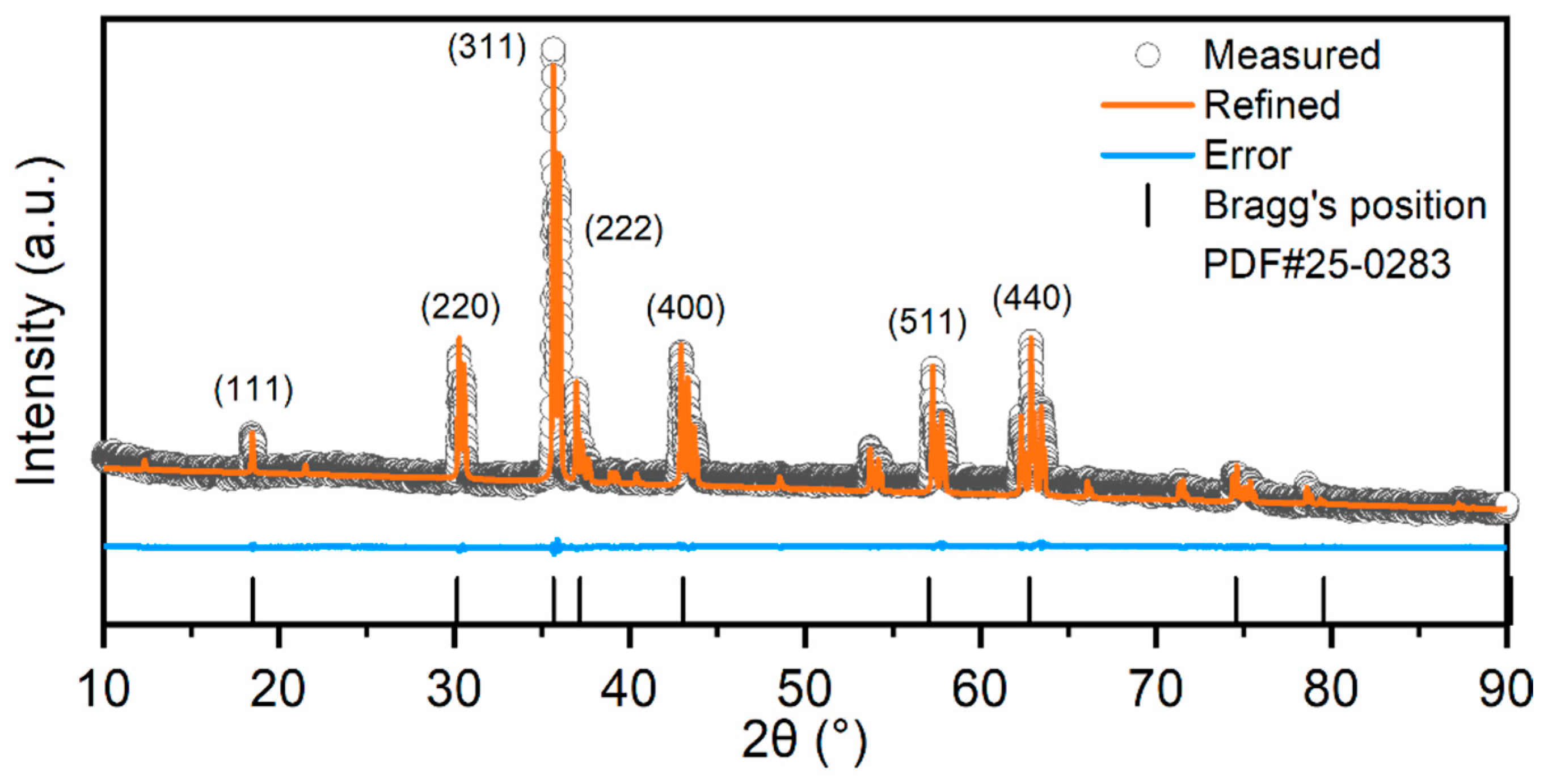
The crystal structure of the as-synthesized samples was investigated via X-ray diffraction (XRD). As illustrated in Figure 1, the XRD pattern exhibits sharp and intense diffraction peaks at 18.2°, 30.2°, 35.3°, 36.9°, 42.9°, 57.2°, and 62.8°, indicating good crystallinity of the material. All observed diffraction peaks corresponded accurately with the standard pattern for the cubic spinel structure (PDF#25-0283, CuFe2O4), and are indexed to the (111), (220), (311), (222), (400), (422), (511), and (440) crystal planes, respectively. Notably, no discernible diffraction signals from other impurities were detected, suggesting that the synthesized (FeNiMnMgCuCo)3O4 exhibits a single cubic spinel phase with high phase purity.
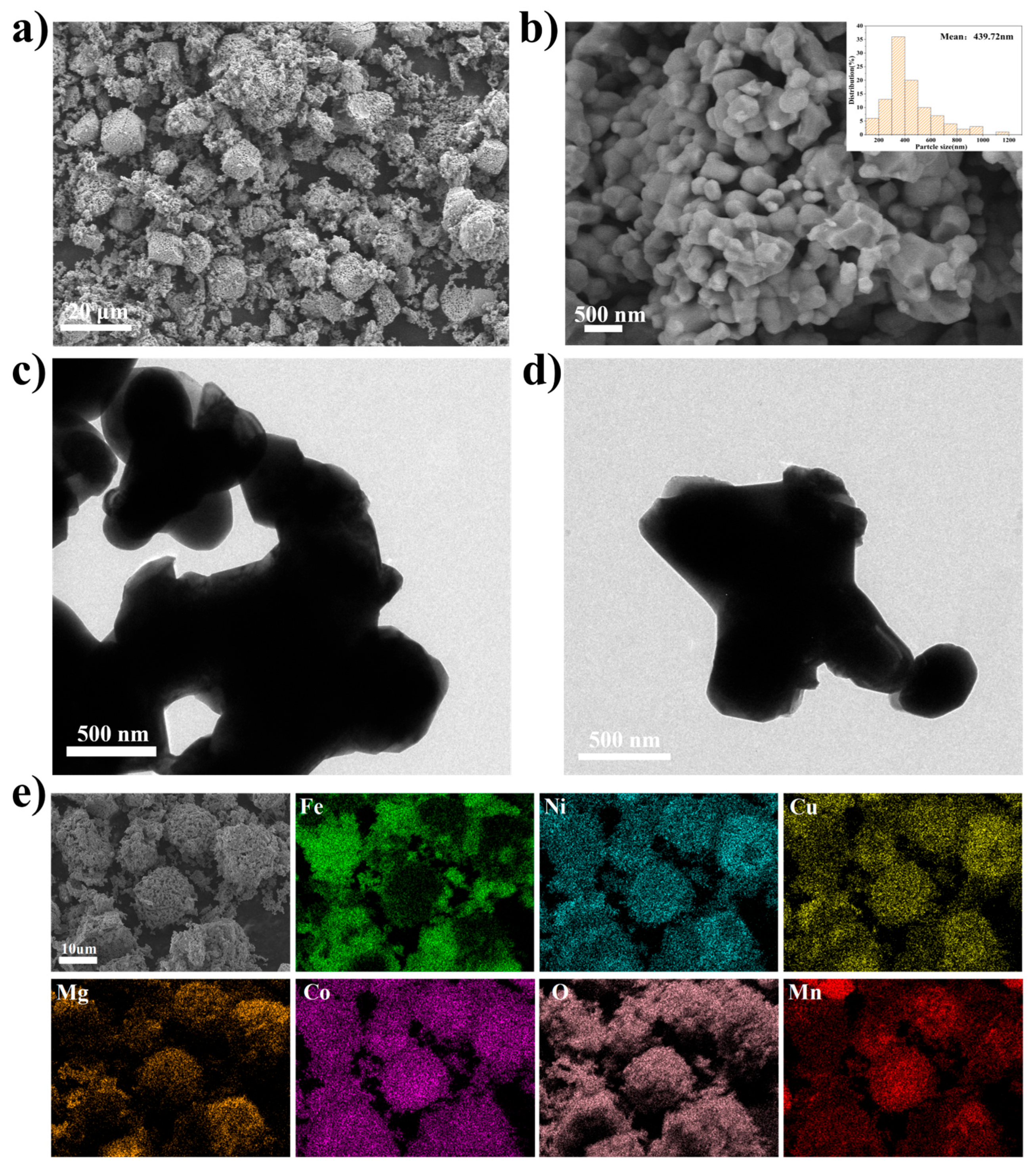
The morphology and microstructure of the as-synthesized samples were further investigated by field-emission scanning electron microscopy (SEM) and field-emission transmission electron microscopy (TEM). The low-magnification SEM image (Figure 2a) reveals that the sample consists of irregular agglomerates composed of numerous nanoparticles. The high-magnification SEM image (Figure 2b), along with the corresponding particle size distribution histogram (inset), demonstrates that the constituent particles are solid nanoparticles with good crystallinity, and their diameters are mainly in the range of 200 to 700 nm. The TEM images (Figure 2c,d) corroborate these observations. Collectively, these results indicate that (FeNiMnMgCuCo)3O4 exhibits a microstructure composed of densely packed, crystalline nanoparticles. This nanoscale particle structure enhances the interfacial area between the electrode and electrolyte, thereby facilitating efficient ion and electron transport. Furthermore, the elemental uniformity of the material was verified by energy-dispersive spectroscopy (EDS). The result (Figure 2e) shows that the six elements are evenly distributed within the representative particles, verifying that all six cations are homogeneously incorporated into the (FeNiMnMgCuCo)3O4 lattice.
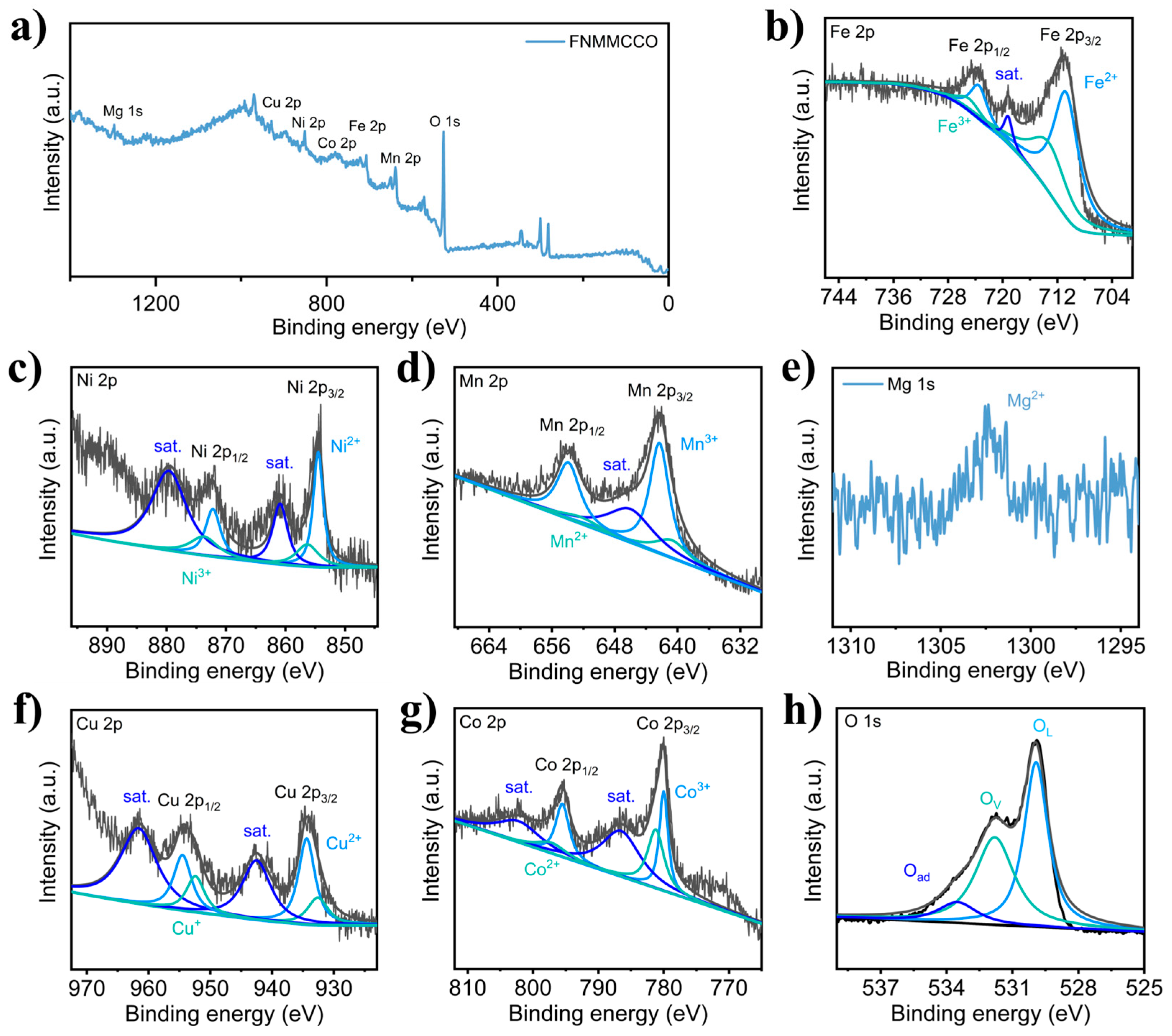
X-ray photoelectron spectroscopy (XPS) was utilized to systematically investigate the elemental composition and surface chemical valence states of (FeNiMnMgCuCo)3O4. As shown in Figure 3a, the survey spectrum displays the presence of characteristic peaks for Fe, Ni, Mn, Mg, Cu, and Co, confirming the coexistence of all six target metal elements, and aligning with the results of EDS analysis. In the high-resolution Fe 2p spectrum (Figure 3b), the binding energy peaks observed at 710.9 eV and 723.7 eV are assigned to the 2p3/2 and 2p1/2 orbitals of Fe2+, respectively. Concurrently, the peaks at 714.2 eV and 725.6 eV are attributed to the Fe3+ state, while a distinct satellite peak at 719.1 eV further corroborates the coexistence of mixed Fe valence states.
The Ni 2p spectrum (Figure 3c) exhibits characteristic Ni2+ peaks at 854.5 eV (Ni 2p3/2) and 872.1 eV (Ni 2p1/2), while contributions from Ni3+ are observed at 856.3 eV and 873.9 eV, accompanied by satellite peaks at 860.8 eV and 879.7 eV, respectively. Similarly, the Mn 2p spectrum (Figure 3d) can be decomposed into two pairs of peaks. The peaks appearing at 640.9 eV and 652.6 eV are attributed to Mn2+, while the peaks at 642.2 eV and 653.9 eV belong to Mn3+, with their satellite peaks located at 646.3 eV.
The Mg 1s spectrum (Figure 3e) displays a symmetrical peak at 1302.3 eV, which is consistent with the Mg2+ state. Notably, the relative signal intensity of Mg observed via XPS is lower than expected based on the stoichiometry determined by inductively coupled plasma optical emission spectroscopy (ICP-OES). This discrepancy can be attributed to the following reasons. First, the sensitivity of XPS is dictated by the photoionization cross-section of specific orbitals. Since Mg possesses a significantly lower atomic number compared to the co-existing transition metals, the photoionization cross-section of the Mg 1s orbitals is substantially smaller than that of the Fe, Ni, and Co 2p orbitals. Consequently, the probability of photoelectron emission from Mg atoms is inherently lower, resulting in weaker peak intensities even at comparable concentrations. Second, this effect is exacerbated by matrix effects and signal competition. The dominant signals from transition metals can overshadow the relatively weak Mg response. Furthermore, the Mg region is susceptible to high background noise from secondary electrons and potential interference from surface contaminants. Collectively, these factors result in an apparent underestimation of Mg content in XPS relative to bulk techniques like ICP-OES.
The analysis of the Cu 2p spectrum (Figure 3f) indicates that the stronger peaks at 934.3 eV and 954.5 eV are typical characteristics of Cu2+, along with the prominent satellite peaks (located at 942.6 eV and 961.3 eV). As for the peaks located at 932.6 eV (Cu 2p3/2) and 952.5 eV (Cu 2p1/2), it is difficult to determine whether they belong to Cu+ or Cu0 solely based on the binding energy. Combined with the preparation conditions of the material (high-temperature calcination under air conditions), it can be inferred that these peaks correspond to Cu+. The peaks at 779.9 eV (Co 2p3/2) and 795.5 eV (Co 2p1/2) in the Co 2p spectrum (Figure 3g) indicate the presence of Co3+, while the peaks at 781.2 eV and 797.2 eV correspond to Co2+, with their satellite peaks located at 786.3 eV and 801.8 eV respectively.
Deconvolution analysis of the O 1s spectrum (Figure 3h) further reveals the diversity of the oxygen environment. The main peak at 529.9 eV corresponds to lattice oxygen (OL), the peak at 531.8 eV is attributed to oxygen vacancies (Ovs), while the weak peak at 533.9 eV relates to surface-adsorbed oxygen (Oad). The presence of oxygen vacancies typically enhances electronic conductivity and facilitates ion migration, which is beneficial for electrochemical performance. Collectively, the XPS test results indicate the presence of all the expected metal elements, and Fe, Ni, Mn, Cu, and Co coexist in mixed valence states. This multi-valence environment, combined with a significant oxygen vacancy concentration, jointly constitutes the unique electronic structure of the high-entropy oxide. It is expected to facilitate the enhancement in the intrinsic electrical conductivity of the material and optimize its electrochemical reaction activity.

3.2. Electrochemical Performance

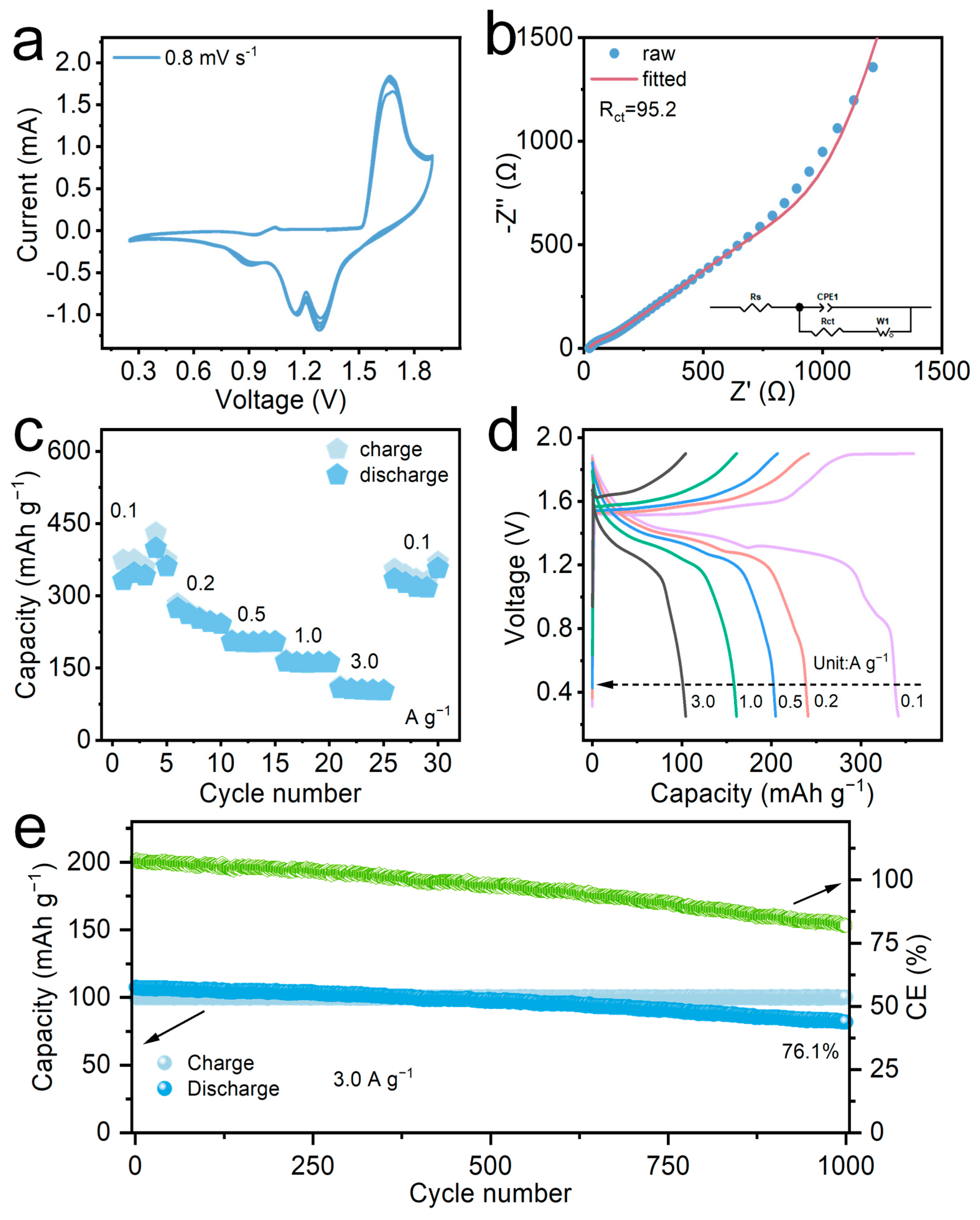
The electrochemical performance of the (FeNiMnMgCuCo)3O4 high-entropy cathode was systematically evaluated by using CR2032 coin cells, which were assembled with (FeNiMnMgCuCo)3O4 as the cathode, zinc foil as the anode, and a 2.0 M ZnSO4 + 0.1 M MnSO4 aqueous solution as the electrolyte. In zinc-ion batteries, the pre-addition of Mn2+ to the electrolyte can effectively suppresses the dissolution and loss of manganese in the cathode material through the common-ion effect, thereby significantly enhancing the cycling stability. The Zn2+ storage behavior was comprehensively investigated through cyclic voltammetry (CV), electrochemical impedance spectroscopy (EIS), galvanostatic charge–discharge (GCD), and long-cycle stability tests. The CV curve (Figure 4a) displays a pair of distinct and stable redox peaks at approximately 1.66/1.28 V, corresponding to the reversible extraction/insertion process of Zn2+. This redox potential range aligns closely with the reaction characteristics of typical manganese-based oxides in zinc sulfate electrolytes. Combined with the fact that multiple elements (Fe, Ni, Co, Cu) in XPS exhibit mixed valence states, it can be inferred that the oxidation–reduction peaks may correspond to a complex multi-electron reaction centered on Mn and facilitated by the synergy of other transition metal elements. The EIS test results (Figure 4b) reveal a small semicircle in the high-frequency region, corresponding to a low charge transfer resistance, indicating rapid charge transfer kinetics at the electrode–electrolyte interface. After equivalent circuit fitting, the charge transfer resistance (Rct) is determined to be 95.2 Ω, further confirming the rapid interface charge transfer kinetics. The rate performance curves shown in Figure 4c further imply the favorable kinetic properties of this material. The (FeNiMnMgCuCo)3O4 electrode exhibits reversible capacity response over a wide current density range, highlighting its excellent rate performance. At current densities of 0.1, 0.2, 0.5, 1.0, and 3.0 A g−1, the specific discharge capacities reached 341.3, 240.7, 204.5, 160.8, and 104.1 mA h g−1, respectively (Figure 4d). Long-cycle performance testing further corroborates the structural stability of this electrode. As illustrated in Figure 4e, after 1000 cycles at a high current density of 3.0 A g−1, the electrode retains a discharge specific capacity of 81.9 mA h g−1, corresponding to a high-capacity retention rate of 76.1%, demonstrating excellent long-cycle life and structural robustness. As for the continuous decay in Coulombic efficiency (CE) observed during cycling, it might be attributed to the cumulative effects of transition metal dissolution (particularly Mn and Fe via disproportionation reactions), parasitic hydrogen evolution reactions (HERs), and the instability of the solid–electrolyte interphase (SEI) in aqueous systems. Nevertheless, compared with the cathodes recently reported for ZIBs, (FeNiMnMgCuCo)3O4 has a high specific capacity and a wide voltage range (Table 2). The overall electrochemical performance indicates that the (FeNiMnMgCuCo)3O4 high-entropy oxide cathode successfully balances high capacity, rapid reaction kinetics, and long-term cycling stability. These can be attributed to the stable crystal framework inherent to its high-entropy structure, optimized electronic conductivity, and a multi-ion-coordinated redox reaction mechanism, which collectively mitigate structural degradation and capacity loss during the cycling process, underscoring the significant application potential of this material system in aqueous zinc-ion batteries.

4. Conclusions

In summary, a high-entropy spinel oxide, (FeNiMnMgCuCo)3O4, has been rationally designed, successfully synthesized, and systematically evaluated as a promising cathode material for aqueous zinc-ion batteries. Comprehensive characterization confirms that the material exhibits a single cubic spinel phase with irregular nanoparticle morphology, along with a homogeneous distribution of all six constituent metal elements (Fe, Ni, Mn, Mg, Cu, Co) in mixed-valence states. The high configurational entropy (~1.78 R) provides a thermodynamic foundation for structural stability. The (FeNiMnMgCuCo)3O4 cathode delivers a high reversible capacity of 341.3 mA h g−1 at 0.1 A g−1, while retaining 76.1% of its initial capacity after 1000 cycles at a high current density of 3.0 A g−1, underscoring its exceptional long-term cycling stability. This study not only validates the effectiveness of the multi-component high-entropy strategy in enhancing zinc-ion battery cathode material performance but also provides new insights for designing high-performance, long-life energy storage materials through entropy engineering.

Author Contributions

Conceptualization, R.J. and N.D.; methodology, R.J.; validation, H.C. and Y.C.; investigation, N.D.; resources, R.J.; data curation, N.D. and H.C.; writing—original draft preparation, N.D.; writing—review and editing, R.J.; visualization, H.C.; supervision, Y.C.; project administration, R.J.; funding acquisition, R.J. All authors have read and agreed to the published version of the manuscript.

Funding

This research was funded by the Experimental Technology Research Project of Huazhong University of Science and Technology, Laboratory and Equipment Department of Huazhong University of Science and Technology (No. 2025a-2-58).

Institutional Review Board Statement

Not applicable.

Informed Consent Statement

Not applicable.

Data Availability Statement

The original contributions presented in this study are included in the article. Further inquiries can be directed to the corresponding author.

Acknowledgments

The authors are grateful to the Analytical and Testing Center, Huazhong University of Science and Technology for technical assistance.

Conflicts of Interest

The authors declare no conflicts of interest.

References

  1. Gibb, B.C. Carnot batteries for dispatchable renewables. Nat. Chem. 2025, 17, 629–631. [Google Scholar] [CrossRef]
  2. Ihlbrock, L.; Sehnal, A.; Gutsch, M.; Lux, S. Future energy demand for automotive and stationary lithium- and sodium-ion battery production towards a European circular economy. Energy Environ. Sci. 2025, 18, 8724–8743. [Google Scholar] [CrossRef]
  3. He, R.J.; Zhong, W.; Wu, Y.K.; Liu, W.; Cai, C.Y.; Cheng, S.J.; Huang, L.; Xie, J. Two-Layer Graphite Anode for Energy and Power Densified LiFePO4 Battery. Adv. Mater. 2025, 37, 2501185. [Google Scholar] [CrossRef] [PubMed]
  4. Sun, T.; Feng, Y.H.; Zanocco, C.; Flora, J.; Majumdar, A.; Rajagopal, R. Solar and battery can reduce energy costs and provide affordable outage backup for US households. Nat. Energy 2025, 10, 1025–1040. [Google Scholar] [CrossRef]
  5. Durmus, Y.E.; Zhang, H.; Baakes, F.; Desmaizieres, G.; Hayun, H.; Yang, L.T.; Kolek, M.; Küpers, V.; Janek, J.; Mandler, D.; et al. Side by Side Battery Technologies with Lithium-Ion Based Batteries. Adv. Energy Mater. 2020, 10, 2000089. [Google Scholar] [CrossRef]
  6. Chen, Y.M.; Shadike, Z. Shatter existing lifetime limit of lithium-ion battery. Joule 2025, 9, 101920. [Google Scholar] [CrossRef]
  7. Yang, X.Z.; Zhang, H.Y.; Liu, Q.; Jiang, G.B. The Li-ion battery industry and its challenges. Nat. Rev. Chem. 2025, 9, 497–498. [Google Scholar] [CrossRef]
  8. Fang, J.L.; Wan, G.Y.; Zheng, M.T.; Liu, T.F.; Lu, J. Recycling of Spent Lithium-Ion Batteries in View of Lithium. Adv. Energy Mater. 2025, 15, 2501318. [Google Scholar] [CrossRef]
  9. Ran, Y.; Zhao, H.P.; Lei, Y. A review on strategies toward high-mass-loading aqueous zinc-ion batteries. J. Mater. Chem. A 2026, 14, 8452–8482. [Google Scholar] [CrossRef]
  10. Tong, H.; Wu, C.Q.; Deng, Y.X.; Li, L.; Guan, C.Y.; Tao, Z.; Fang, J.H.; Yao, T.Y.; Xu, Z.M.; Zhang, X.G.; et al. Dendrite-Free Zn Anode Modified with Prussian Blue Analog for Ultra Long-Life Zn-Ion Capacitors. Adv. Funct. Mater. 2024, 34, 2405318. [Google Scholar] [CrossRef]
  11. Li, Y.X.; Zhang, D.Y.; Wang, B.; Li, Y.; Li, Z.Y.; Cao, Y.Z.; Liu, Z.; Ying, T.T.; Li, S.Y.; Li, Y. In-situ Self-Assembled organic anion interfacial layer on Zn anode surface for boosting the stability of aqueous zinc ion energy storage devices. Chem. Eng. J. 2024, 502, 158147. [Google Scholar] [CrossRef]
  12. Yang, G.J.; Zhang, Q.; Liu, Z.L.; Song, J.; Yin, Z.Y.; Zhao, Y.X.; Jiang, S.H.; Han, J.Q.; Li, X.; Yang, H.Q.; et al. Pore Sieving and Surficial Charge-Driven Desolvation for High Spatial Charge Density Carbon Cathodes in Zinc-Ion Hybrid Capacitors. Adv. Energy Mater. 2025, 15, 2501358. [Google Scholar] [CrossRef]
  13. Shen, W.T.; Chen, D.; Song, B.R.; Chen, W.T.; Zhang, Y.M.; Miao, C.L.; Liu, Q.S.; Xu, Z.M.; Shen, L.F. Cell to cell: A biomimetic hydrated deep eutectic electrolyte for wide-temperature zinc-ion capacitors. Energy Storage Mater. 2025, 82, 104663. [Google Scholar] [CrossRef]
  14. Ni, J.; Chen, W.J.; Zhang, X.Y.; Xu, H.; Zhang, M.H.; Wu, X.L. Nitrogen doped hierarchical porous carbon for supercapacitors and zinc ion hybrid capacitors. Ind. Chem. Mater. 2025, 3, 475–484. [Google Scholar] [CrossRef]
  15. Zhu, Y.R.; Zhao, R.; Xu, Y.T.; Chen, W.H.; Hu, Z.L.; Xi, L.J.; Xie, Y.J.; Hou, H.S.; Liu, T.C.; Amine, K.; et al. Anion Vacancies Coupling with Heterostructures Enable Advanced Aerogel Cathode for Ultrafast Aqueous Zinc-Ion Storage. Adv. Mater. 2025, 37, 2419582. [Google Scholar] [CrossRef]
  16. Song, W.H.; Jiang, B.Y.; Wang, Y.L.; Ma, Q.; Wu, B.; Ye, L.Q.; Xu, J.T.; Fujishige, M.; Takeuchi, K.; Endo, M.; et al. Building Powerful Zinc-Ion Hybrid Capacitors by an Energy Drink-Inspired Strategy. Small 2025, 21, 2412842. [Google Scholar] [CrossRef]
  17. Qu, W.T.; Cai, Y.; Chen, B.H.; Zhang, M. Heterointerface Engineering-Induced Oxygen Defects for the Manganese Dissolution Inhibition in Aqueous Zinc Ion Batteries. Energy Environ. Mater. 2024, 7, e12645. [Google Scholar] [CrossRef]
  18. Gao, Y.X.; Zhou, J.; Qin, L.P.; Xu, Z.M.; Liu, Z.X.; Wang, L.B.; Cao, X.X.; Fang, G.Z.; Liang, S.Q. Crystal plane induced in-situ electrochemical activation of manganese-based cathode enable long-term aqueous zinc-ion batteries. Green Energy Environ. 2023, 8, 1429–1436. [Google Scholar] [CrossRef]
  19. Li, Z.J.; Liu, Y.X.; Yang, S.; Pan, Z.H.; Liu, C.C.; Zhao, X.L.; Yang, X.W. Probing Capacity Decay in Vanadium Oxide Cathodes of Aqueous Zinc-Ion Batteries Using Operando EQCM-D. Acs. Energy Lett. 2025, 10, 2821–2830. [Google Scholar] [CrossRef]
  20. He, Q.; Wang, Y.Z.; Wu, Q.; Han, X.R.; Hu, T.; Wang, C.; Shen, Z.; Shi, L.; Chen, J.Y.; Ma, Y.W.; et al. Phase-Transition Intervention Engineered Amorphous Vanadium Oxide for High-Performance Aqueous Zinc-Ion Batteries. Angew. Chem. Int. Ed. 2025, 64, e17305. [Google Scholar] [CrossRef] [PubMed]
  21. Shi, H.Y.; Fu, H.L.; Xue, G.J.; Lian, Y.; Zhao, J.; Zhang, H.H. Progress of vanadium-based oxides as cathode materials for aqueous zinc-ion batteries. Coord. Chem. Rev. 2025, 545, 216984. [Google Scholar] [CrossRef]
  22. Jiang, R.Z.; Cai, Y.C.; Yan, D.C. High-Performance High-Entropy Oxide (FeMnAlCrTi)3O4 as a Cathode Material for Aqueous Zinc-Ion Batteries. Electron. Mater. Lett. 2026. [Google Scholar] [CrossRef]
  23. Pan, M.Z.; Liao, X.L.; Li, Z.; Deng, Y.W.; Chen, Y.; Bian, G.B. Semi-Supervised Medical Image Segmentation Guided by Bi-Directional Constrained Dual-Task Consistency. Bioengineering 2023, 10, 225. [Google Scholar] [CrossRef]
  24. Ouyang, B.; Zeng, Y. The rise of high-entropy battery materials. Nat. Commun. 2024, 15, 973. [Google Scholar] [CrossRef]
  25. Nandan, R.; Nam, H.N.; Phung, Q.M.; Nara, H.; Henzie, J.; Yamauchi, Y. Mesoporous Single-Crystal High-Entropy Alloy. J. Am. Chem. Soc. 2025, 147, 18651–18661. [Google Scholar] [CrossRef] [PubMed]
  26. Ran, B.; Li, H.X.; Cheng, R.Q.; Yang, Z.H.; Zhong, Y.; Qin, Y.H.; Yang, C.; Fu, C.P. High-Entropy Oxides for Rechargeable Batteries. Adv. Sci. 2024, 11, 2401034. [Google Scholar] [CrossRef]
  27. Li, R.R.; Qin, X.; Li, X.L.; Zhu, J.X.; Zheng, L.R.; Li, Z.T.; Zhou, W.D. High-Entropy and Multiphase Cathode Materials for Sodium-Ion Batteries. Adv. Energy Mater. 2024, 14, 2400127. [Google Scholar] [CrossRef]
  28. Jin, Y.; Zou, L.F.; Liu, L.L.; Engelhard, M.H.; Patel, R.L.; Nie, Z.M.; Han, K.S.; Shao, Y.Y.; Wang, C.M.; Zhu, J.; et al. Joint Charge Storage for High-Rate Aqueous Zinc–Manganese Dioxide Batteries. Adv. Mater. 2019, 31, 1900567. [Google Scholar] [CrossRef] [PubMed]
  29. Liu, Y.Z.; Qin, Z.M.; Yang, X.P.; Liu, J.; Liu, X.X.; Sun, X.Q. Voltage induced lattice contraction enabling superior cycling stability of MnO2 cathode in aqueous zinc batteries. Energy Storage Mater. 2023, 56, 524–531. [Google Scholar] [CrossRef]
  30. Zhang, N.; Dong, Y.; Jia, M.; Bian, X.; Wang, Y.Y.; Qiu, M.D.; Xu, J.Z.; Liu, Y.C.; Jiao, L.F.; Cheng, F.Y. Rechargeable Aqueous Zn−V2O5 Battery with High Energy Density and Long Cycle Life. ACS Energy Lett. 2018, 3, 1366–1372. [Google Scholar] [CrossRef]
  31. Huang, H.; Liu, H.; Wang, Y.; Li, Y.; Li, Q. Suppressing the Phase Transformation in Cubic Prussian Blue Analogues via a High-Entropy Strategy for Efficient Zinc-Ion Storage. Materials 2025, 18, 3409. [Google Scholar] [CrossRef] [PubMed]
Figure 1. XRD pattern of (FeNiMnMgCuCo)3O4.
Materials 19 01520 g001
Figure 2. (a,b) SEM images, (c,d) TEM images, (e) SEM images and corresponding EDS mappings of (FeNiMnMgCuCo)3O4.
Materials 19 01520 g002
Figure 3. (a) XPS survey spectrum of (FeNiMnMgCuCo)3O4. XPS spectra of (b) Fe 2p, (c) Ni 2p, (d) Mn 2p, (e) Mg 1s, (f) Cu 2p, (g) Co 2p, and (h) O 1s.
Materials 19 01520 g003
Figure 4. (a) CV curve. (b) EIS curve. (c) Rate capability. (d) Charge–discharge curves. (e) Long cycle performance.
Materials 19 01520 g004
Table 1. ICP-OES results of (FeNiMnMgCuCo)3O4.
ElementsNormalized Molar
Fraction
Normalized AtomWt. (%)
Fe0.221.3218.6
Ni0.140.8111.9
Mn0.181.0915.1
Mg0.150.925.7
Cu0.130.7612.2
Co0.181.0916.1
Table 2. Performance comparison of recently reported cathodes for ZIBs with (FeNiMnMgCuCo)3O4.
CathodeElectrolyteVoltage Window (V vs. Zn2+/Zn)CyclesCapacity
(mA h g−1)
Ref.
δ-MnO21 M Zn(TFSI)2 + 0.1 M Mn(TFSI)21.0–1.893% capacity retention at 6.16 A g−1 after 4000 cycles171 mA h g−1 at 1.54 A g−1[28]
α-MnO23 M ZnSO40.2–2.280.1% capacity retention at 1 A g−1 after 6000 cycles323 mA h g−1 at 0.1 A g−1[29]
commercial V2O53 M Zn(CF3SO3)20.2–1.691.1% capacity retention at 5 A g−1 after 4000 cycles465 mA h g−1 at 0.2 A g−1[30]
Prussian blue analog (HEPBA)2 M ZnSO4 + 0.2 M MnSO40.5–1.884.7% capacity retention at 0.5 A g−1 after 600 cycles132.1 mA h g−1 at 0.1 A g−1[31]
(FeNiMnMgCuCo)3O42 M ZnSO4 + 0.1 M MnSO40.25–1.976.1% capacity retention at 3 A g−1 after 1000 cycles341.3 mA h g−1 at 0.1 A g−1This work
Disclaimer/Publisher’s Note: The statements, opinions and data contained in all publications are solely those of the individual author(s) and contributor(s) and not of MDPI and/or the editor(s). MDPI and/or the editor(s) disclaim responsibility for any injury to people or property resulting from any ideas, methods, instructions or products referred to in the content.