Molecular Dynamics Simulation of the Mechanical Properties of Nanolayered Zr-Nb Alloys: Effects of Orientation and Layer Thickness

Abstract
1. Introduction
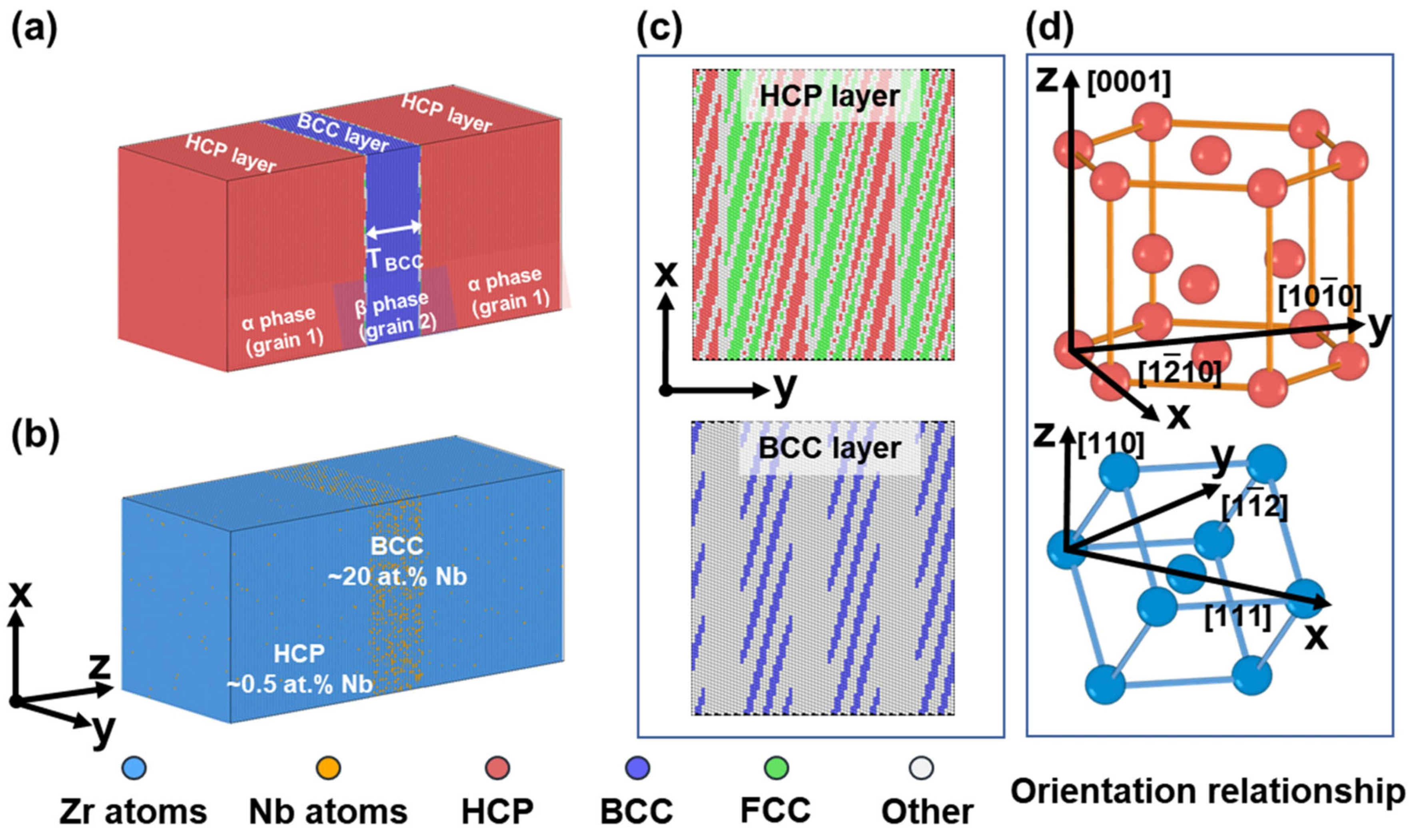
2. Methodology
3. Results and Discussion
3.1. Effect of Loading Direction
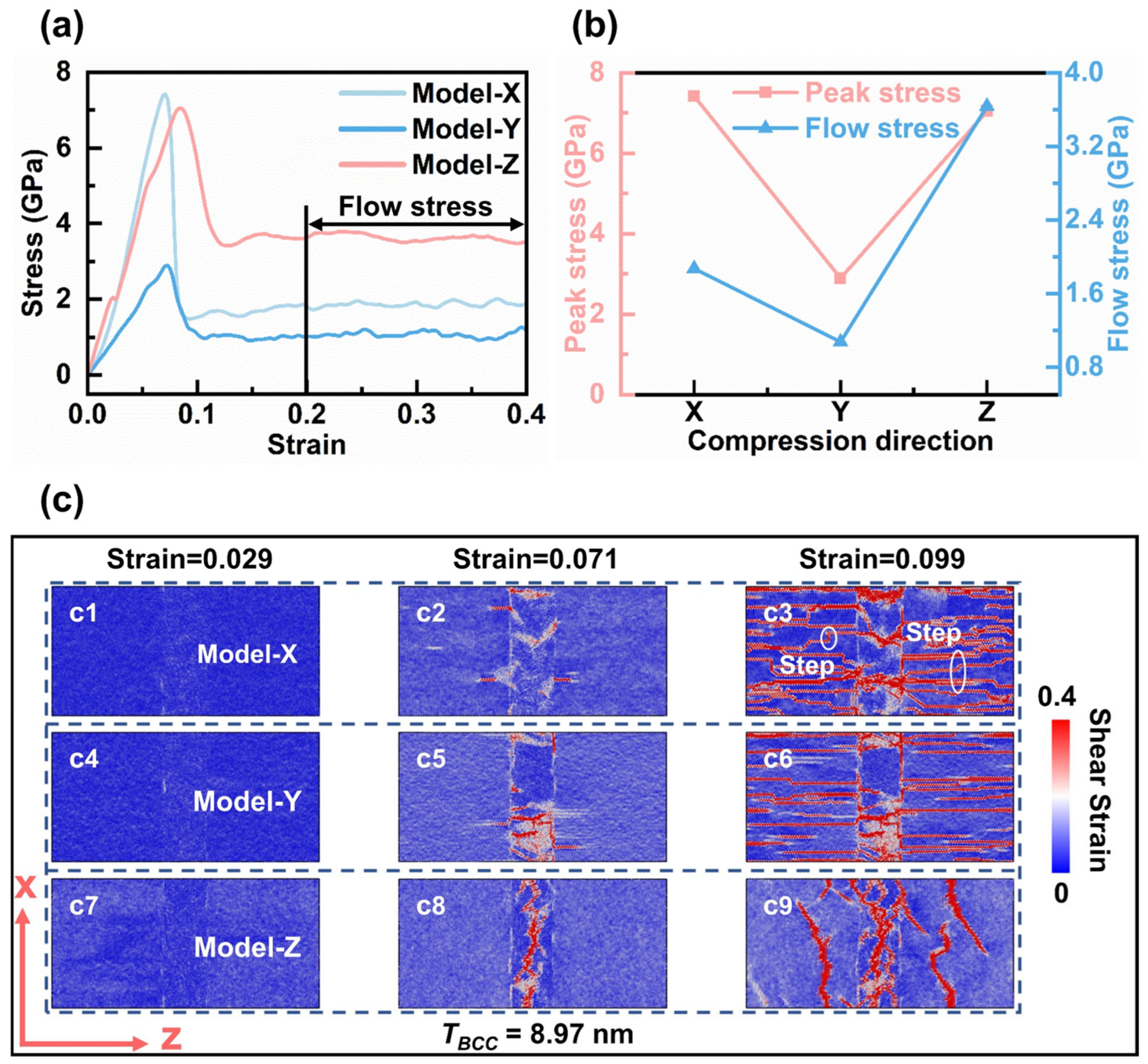
3.1.1. Stress–Strain Curve
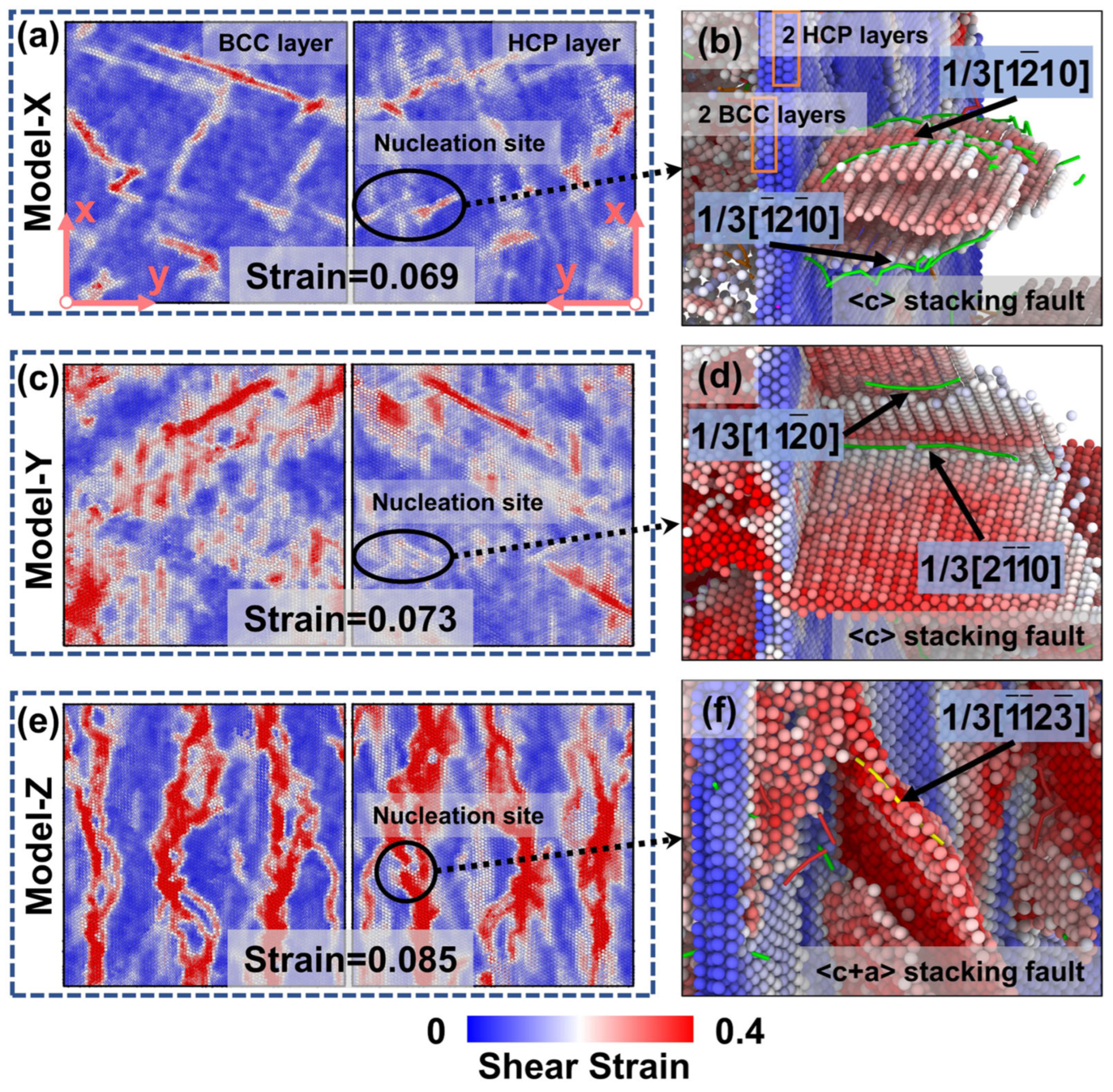
3.1.2. Local Deformation Modes
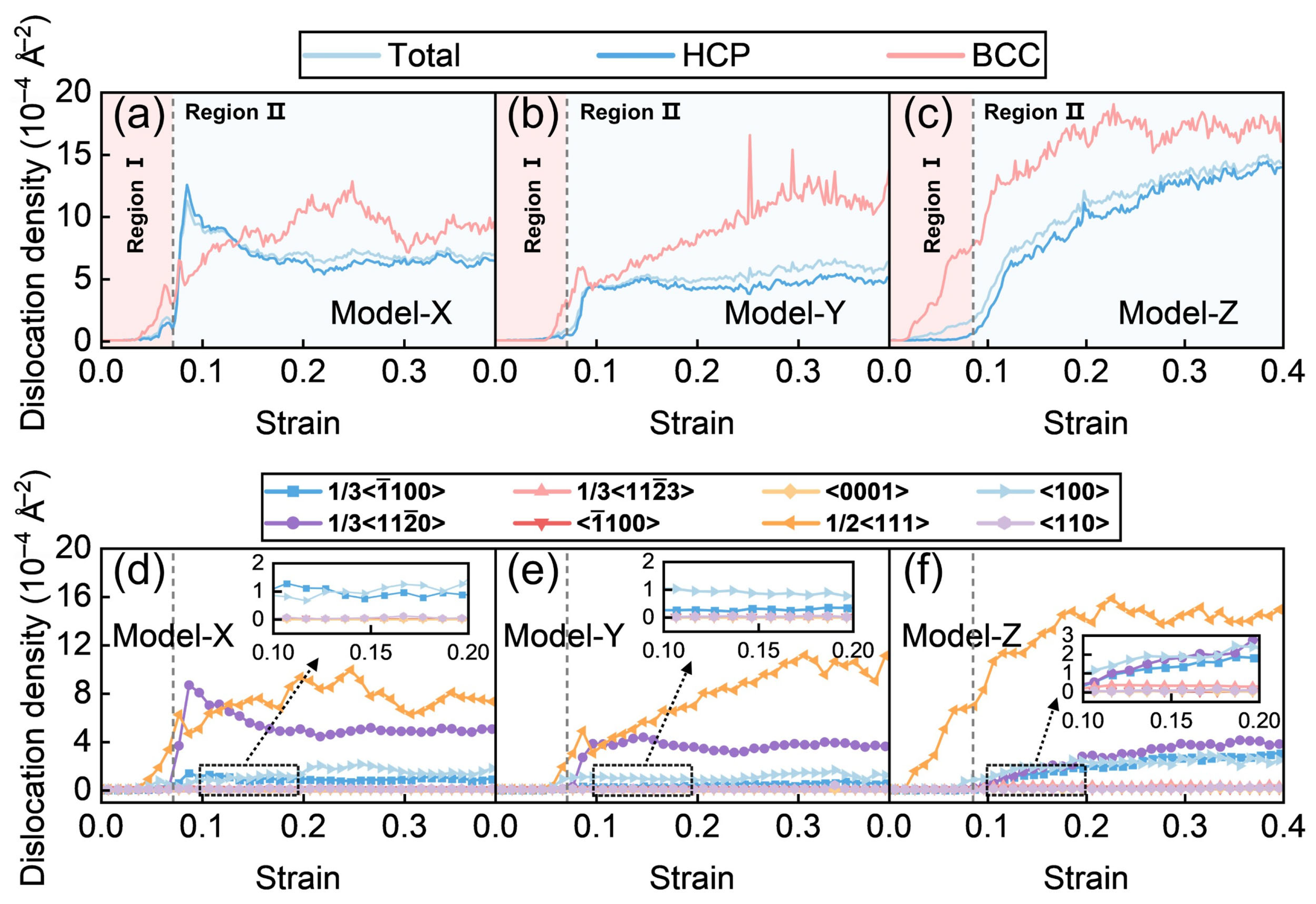
3.1.3. Dislocation Analysis
3.1.4. Relationship Between Stress Distribution and Dislocation Evolution
3.2. Influence of BCC Layer Thickness
3.2.1. Mechanical Response and Peak Stress Transition
3.2.2. Dislocation and Phase Transformation Analysis
4. Conclusions
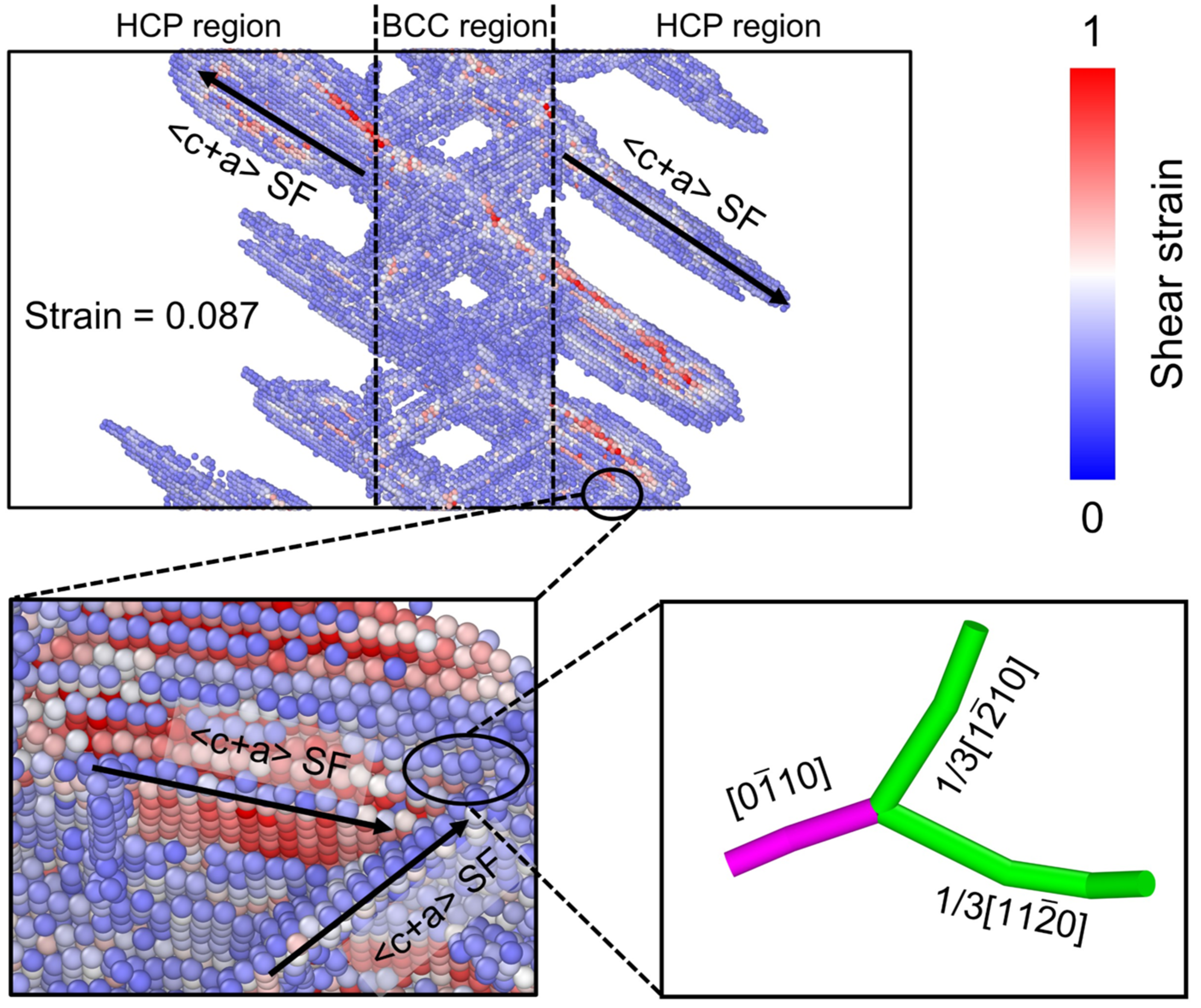
- The strain coordination at the interface determines the deformation mode. When the loading orientation promotes compatibility of strain across the HCP/BCC interface, the sustained plastic behavior of the metastable BCC phase facilitates SF nucleation, dislocation transmission, and activation of <c + a> slip in the HCP phase. This cooperative deformation enhances the capacity for strain hardening and delays instability. In contrast, strain incompatibility suppresses BCC plasticity and limits high-CRSS slip activation.
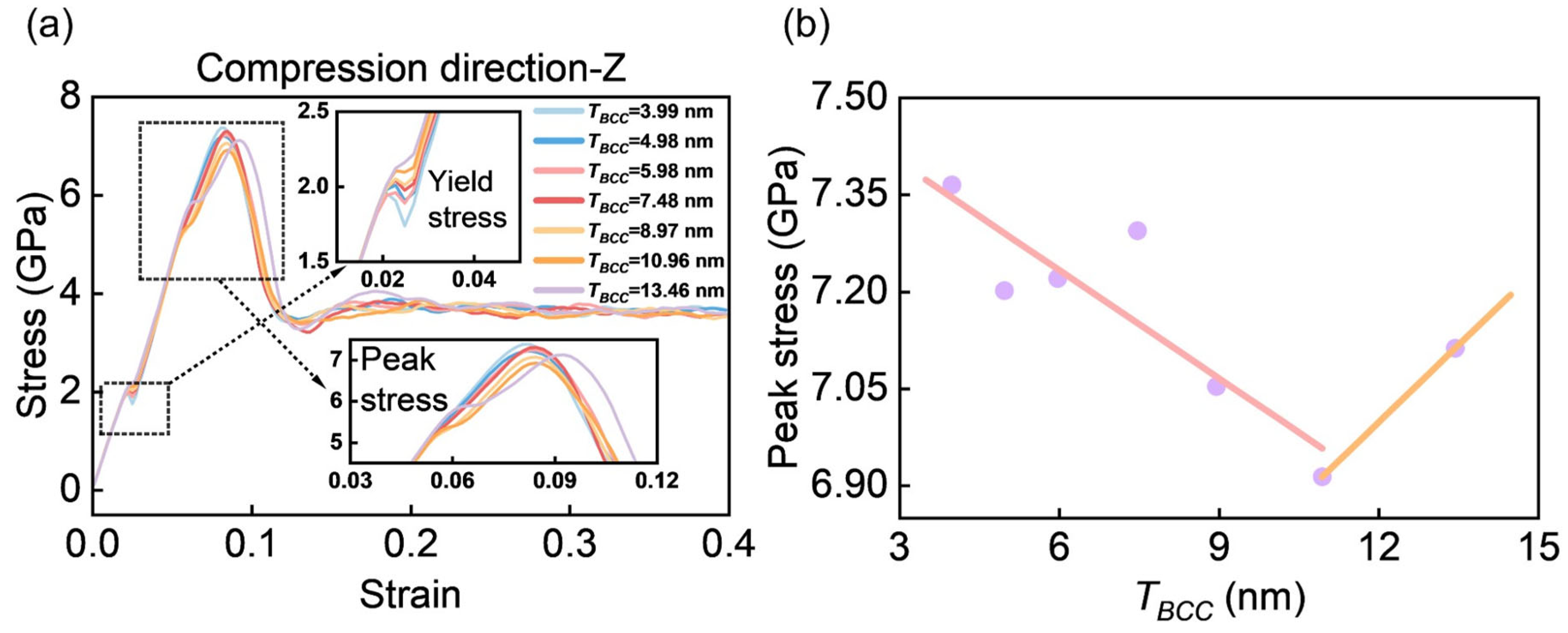
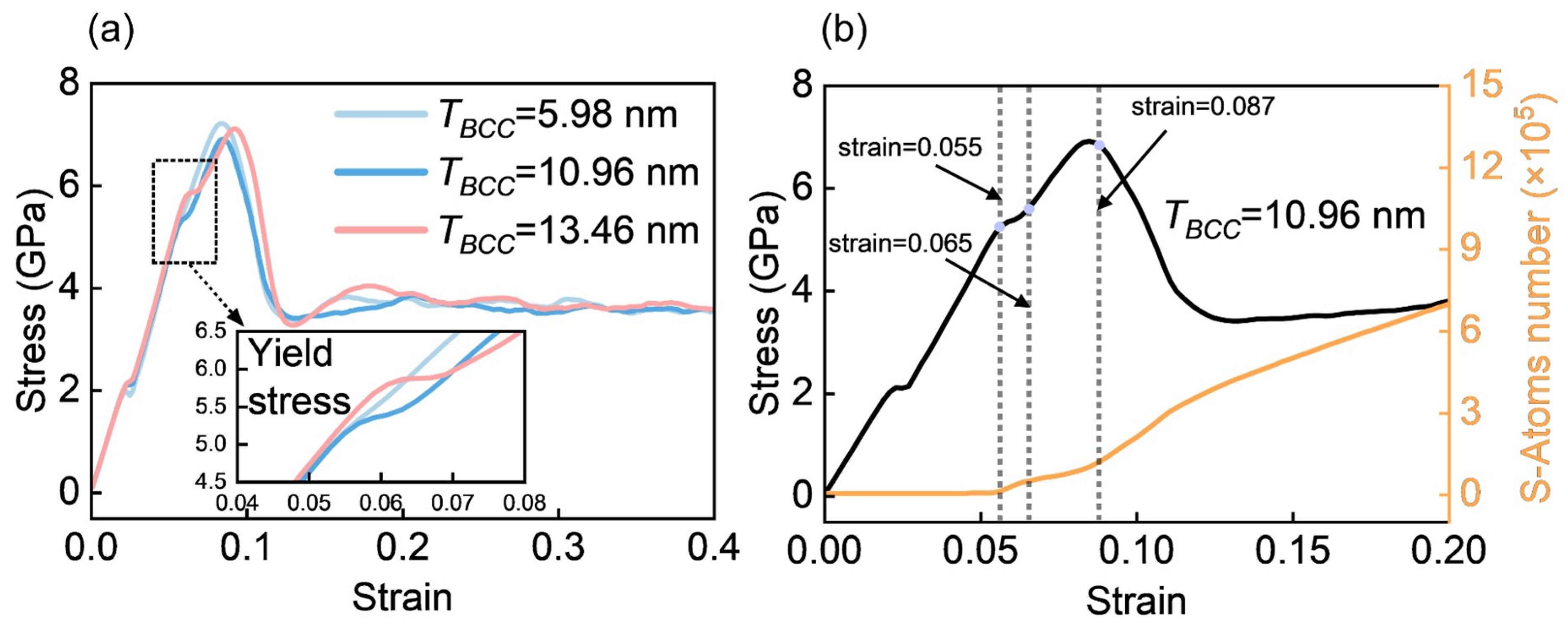
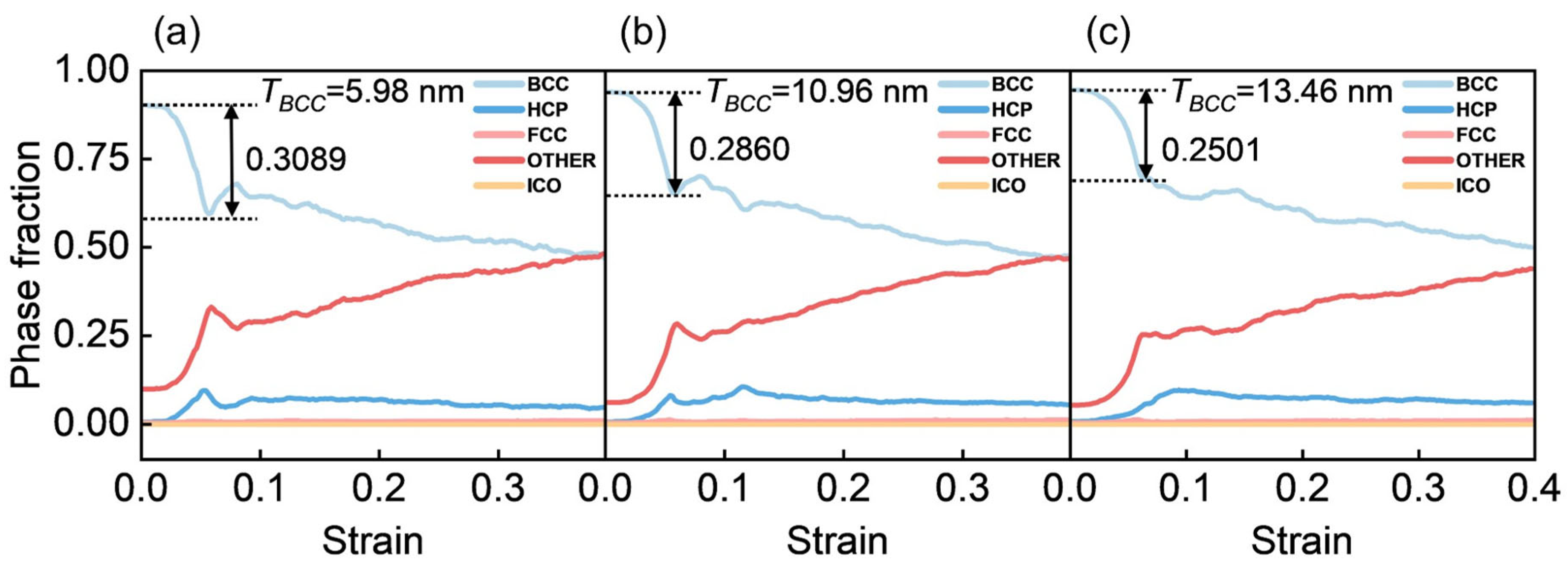
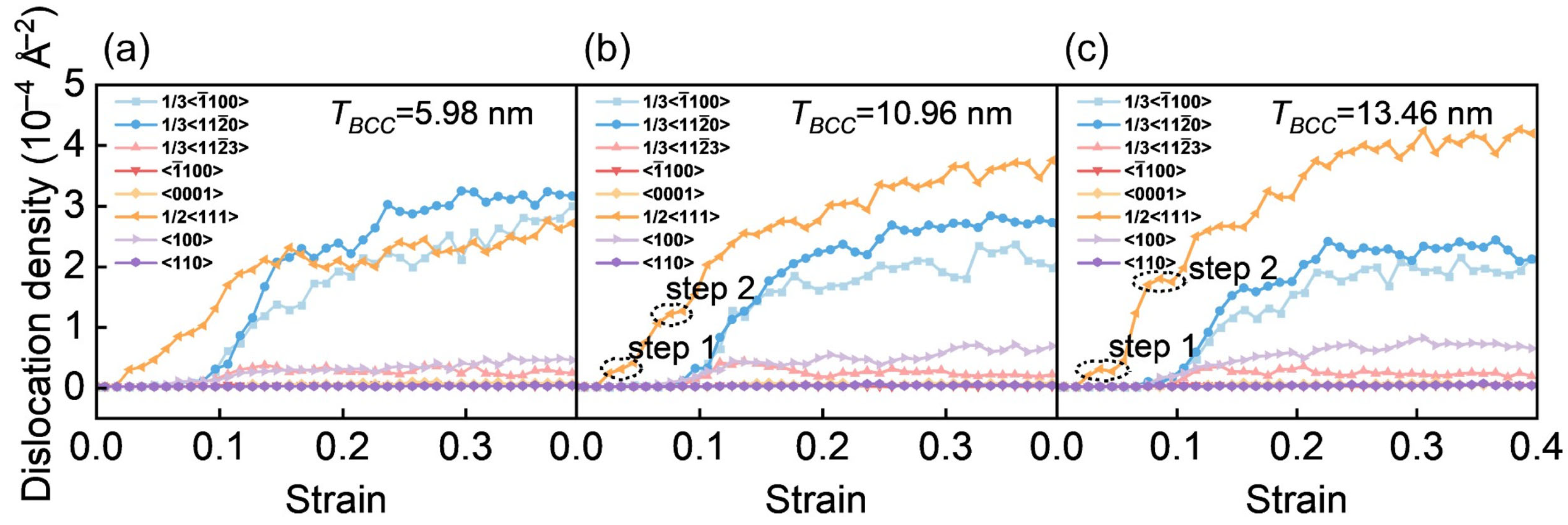
- The thickness of BCC layer induces a non-monotonic peak stress transition influenced by competition mechanisms. For TBCC < 10.96 nm, the stress-induced β-phase transformation is the dominant mechanism for strengthening. Increasing TBCC suppresses this transformation activity, leading to a reduction in peak strength. When TBCC exceeds the transition thickness (~10.96 nm), spatial effects become dominant, causing a shift in the governing mechanism from transformation-induced hardening to dislocation-mediated strengthening.
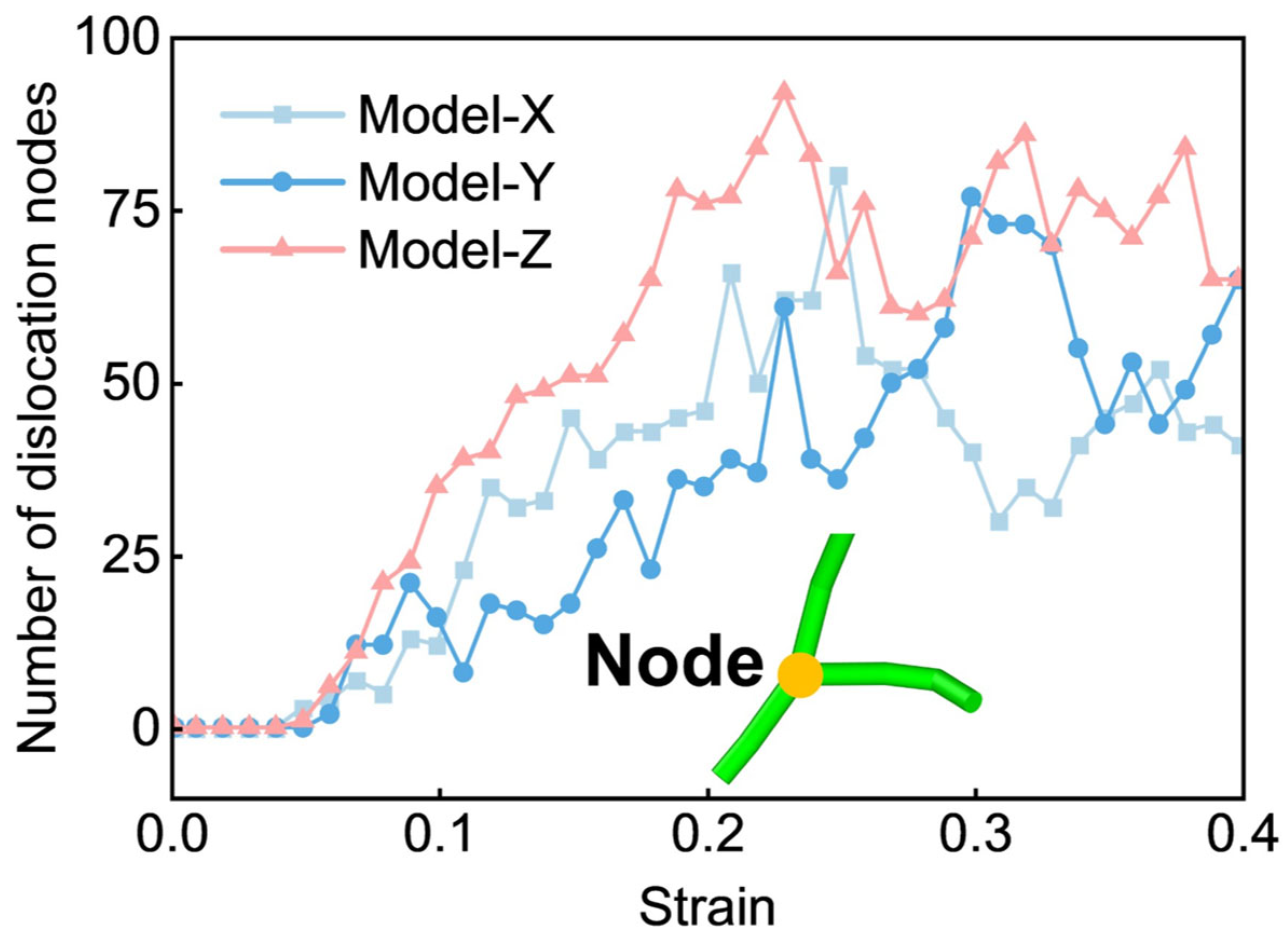
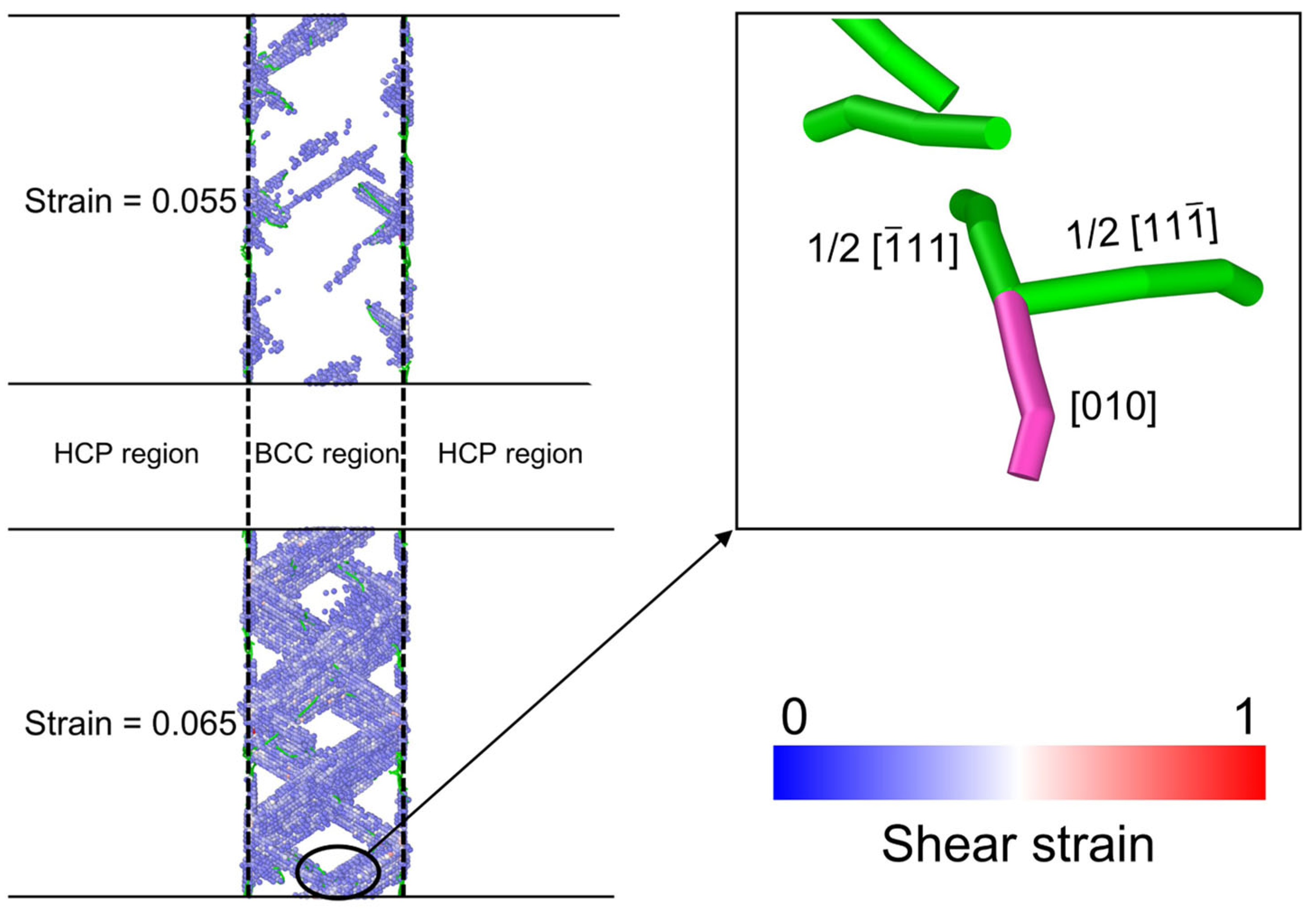
- The stage-wise dislocation evolution stabilizes plastic flow at large TBCC values. Thick BCC layers exhibit step-like increments in dislocation density due to intensified interactions among 1/2<111> dislocations and enhanced SF propagation. This dynamic balance between dislocation multiplication and annihilation stabilizes strain hardening and ultimately influences the delayed peak stress behavior.
Supplementary Materials
Author Contributions
Funding
Data Availability Statement
Acknowledgments
Conflicts of Interest
References
- Song, G.; Zhang, C.; Xin, Y.; Huang, X.; Wu, P.; Zhou, J.; Zhu, W.; Zhou, X. The mechanism for the self-accommodation microstructure of α variants during phase transformation of the Zr–2.5Nb alloy. J. Mater. Sci. Technol. 2025, 224, 92–104. [Google Scholar] [CrossRef]
- Li, J.; Cui, Y.; Wu, H.; Chen, G. Deformation mechanism of Zr–Sn–Nb–Fe cladding tube under various stress states. Mater. Sci. Eng. A 2020, 771, 138593. [Google Scholar] [CrossRef]
- Wang, S.; Giuliani, F.; Ben Britton, T. Slip–hydride interactions in Zircaloy-4: Multiscale mechanical testing and characterisation. Acta Mater. 2020, 200, 537–550. [Google Scholar] [CrossRef]
- Holt, R.A. In-reactor deformation of cold-worked Zr-2.5Nb pressure tubes. J. Nucl. Mater. 2008, 372, 182–214. [Google Scholar] [CrossRef]
- Griffiths, M.; Winegar, J.E.; Buyers, A. The transformation behaviour of the β-phase in Zr-2.5Nb pressure tubes. J. Nucl. Mater. 2008, 383, 28–33. [Google Scholar] [CrossRef]
- Kulkarni, R.V.; Krishna, K.V.M.; Neogy, S.; Srivastava, D.; Ramadasan, E.; Shriwastaw, R.S.; Rath, B.N.; Saibaba, N.; Jha, S.K.; Dey, G.K. Mechanical properties of Zr-2.5%Nb pressure tube material subjected to heat treatments in α plus β phase field. J. Nucl. Mater. 2014, 451, 300–312. [Google Scholar] [CrossRef]
- Zhilyaev, A.P.; Sabirov, I.; Gonzalez-Doncel, G.; Molina-Aldareguia, J.; Srinivasarao, B.; Perez-Prado, M.T. Effect of Nb additions on the microstructure, thermal stability and mechanical behavior of high pressure Zr phases under ambient conditions. Mater. Sci. Eng. A 2011, 528, 3496–3505. [Google Scholar] [CrossRef]
- Yang, Z.N.; Wang, X.B.; Liu, F.; Zhang, F.C.; Chai, L.J.; Qiu, R.S.; Chen, L.Y. Effect of intercritical annealing temperature on microstructure and mechanical properties of duplex Zr-2.5Nb alloy. J. Alloys Compd. 2019, 776, 242–249. [Google Scholar] [CrossRef]
- Muránsky, O.; Daymond, M.R.; Bhattacharyya, D.; Zanellato, O.; Vogel, S.C.; Edwards, L. Load partitioning and evidence of deformation twinning in dual-phase fine-grained Zr–2.5%Nb alloy. Mater. Sci. Eng. A 2013, 564, 548–558. [Google Scholar] [CrossRef]
- Zhang, J.W.; Beyerlein, I.J.; Han, W.Z. Hierarchical 3D Nanolayered Duplex-Phase Zr with High Strength, Strain Hardening, and Ductility. Phys. Rev. Lett. 2019, 122, 255501. [Google Scholar] [CrossRef]
- Zou, X.W.; Beyerlein, I.J.; Han, W.Z. Hierarchical nanolayered structures-enabled record-high fracture resistant zircaloy. Acta Mater. 2024, 279, 120300. [Google Scholar] [CrossRef]
- Jiang, S.; Peng, R.L.; Máthis, K.; Yan, H.-L.; Farkas, G.; Hegedues, Z.; Lienert, U.; Moverare, J.; Zhao, X.; Zuo, L.; et al. Shear banding-induced <c+a> slip enables unprecedented strength-ductility combination of laminated metallic composites. J. Mater. Sci. Technol. 2022, 110, 260–268. [Google Scholar] [CrossRef]
- Long, F.; Balogh, L.; Brown, D.W.; Mosbrucker, P.; Skippon, T.; Judge, C.D.; Daymond, M.R. Effect of neutron irradiation on deformation mechanisms operating during tensile testing of Zr-2.5Nb. Acta Mater. 2016, 102, 352–363. [Google Scholar] [CrossRef]
- Callisti, M.; Polcar, T. Combined size and texture-dependent deformation and strengthening mechanisms in Zr/Nb nano-multilayers. Acta Mater. 2017, 124, 247–260. [Google Scholar] [CrossRef]
- Ham, B.; Zhang, X. High strength Mg/Nb nanolayer composites. Mater. Sci. Eng. A 2011, 528, 2028–2033. [Google Scholar] [CrossRef]
- Ji, W.; Gao, S.; Jarlöv, A.; Shen, X.; Tian, Y.; Wu, M.S.; Gao, H.; Zhou, K. Designing Maximal Strength in Nanolamellar Eutectic High-Entropy Alloys. Adv. Mater. 2025, 37, 2500149. [Google Scholar] [CrossRef]
- Cai, S.; Daymond, M.R.; Holt, R.A.; Gharghouri, M.A.; Oliver, E.C. Evolution of interphase and intergranular stresses in Zr-2.5Nb during room temperature deformation. Mater. Sci. Eng. A 2009, 501, 166–181. [Google Scholar] [CrossRef]
- Li, W.; Yu, W.; Xu, Q.; Zhou, J.; Nan, H.; Yin, Y.; Feng, X.; Shen, X. Effects of γ/γ interfaces in TiAl lamellae subjected to uniaxial tensile loading. Comput. Mater. Sci. 2020, 172, 109361. [Google Scholar] [CrossRef]
- Li, W.; Yin, Y.; Xu, Q.; Zhou, J.; Nan, H.; Ji, X.; Shen, X.; Feng, X.; Yu, W.; Tu, Z.; et al. Tensile behavior of γ/α2 interface system in lamellar TiAl alloy via molecular dynamics. Comput. Mater. Sci. 2019, 159, 397–402. [Google Scholar] [CrossRef]
- Ma, G.C.; Fan, J.L.; Gong, H.R. Mechanical behavior of Cu-W interface systems upon tensile loading from molecular dynamics simulations. Comput. Mater. Sci. 2018, 152, 165–168. [Google Scholar] [CrossRef]
- Kong, X.F.; Beyerlein, I.J.; Liu, Z.R.; Yao, B.N.; Legut, D.; Germann, T.C.; Zhang, R.F. Stronger and more failure-resistant with three-dimensional serrated bimetal interfaces. Acta Mater. 2019, 166, 231–245. [Google Scholar] [CrossRef]
- Yadav, S.K.; Shao, S.; Chen, Y.; Wang, J.; Liu, X.Y. Atomistic modeling of Mg/Nb interfaces: Shear strength and interaction with lattice glide dislocations. J. Mater. Sci. 2017, 53, 5733–5744. [Google Scholar] [CrossRef]
- Lin, B.; Li, J.; Wang, Z.; Wang, J. Dislocation nucleation from Zr-Nb bimetal interfaces cooperating with the dynamic evolution of interfacial dislocations. Int. J. Plast. 2020, 135, 102830. [Google Scholar] [CrossRef]
- AlMotasem, A.T.; Daghbouj, N.; Sen, H.S.; Mirzaei, S.; Callisti, M.; Polcar, T. Influence of HCP/BCC interface orientation on the tribological behavior of Zr/Nb multilayer during nanoscratch: A combined experimental and atomistic study. Acta Mater. 2023, 249, 118832. [Google Scholar] [CrossRef]
- Ju, S.P.; Huang, P.X.; Chen, H.L.; Chen, H.T.; Chen, H.Y.; Wu, D.Y. Tailoring strength and ductility in dual-phase high-entropy alloys: Insights from deep learning molecular dynamics simulation on FCC/BCC thickness ratios. J. Mater. Res. Technol. 2024, 33, 6810–6819. [Google Scholar] [CrossRef]
- Plimpton, S. Fast parallel algorithms for short-range molecular dynamics. J. Comput. Phys. 1995, 117, 1–19. [Google Scholar] [CrossRef]
- Starikov, S.; Smirnova, D. Optimized interatomic potential for atomistic simulation of Zr-Nb alloy. Comput. Mater. Sci. 2021, 197, 110581. [Google Scholar] [CrossRef]
- Starikov, S.; Abbass, A.; Drautz, R.; Mrovec, M. Disordering complexion transition of grain boundaries in bcc metals: Insights from atomistic simulations. Acta Mater. 2023, 261, 119399. [Google Scholar] [CrossRef]
- Lin, J.; Chen, S.; Bai, Y.; Zhang, S.; Wang, T.; Zhao, J. Atomistic simulations of the interaction of edge dislocations with β-Nb precipitates in Zr-Nb alloys. J. Phys. D Appl. Phys. 2024, 57, 305502. [Google Scholar] [CrossRef]
- Hasan, M.M.; Srinivasan, S.G.; Choudhuri, D. Transformation- and twinning-induced plasticity in phase-separated bcc Nb-Zr alloys: An atomistic study. J. Mater. Sci. 2024, 59, 4728–4747. [Google Scholar] [CrossRef]
- Chen, Z.; Zeng, Z.; Li, H.; Song, S.; Xiang, H.; Peng, X. Microstructure evolution and spallation of CoCrFeNi/Al multilayers subjected to shock loading. Phys. B 2025, 714, 417425. [Google Scholar] [CrossRef]
- Zhang, J.; Qian, L.; Yang, W.; Wang, J.; Yang, X.-S. Dislocation nucleation and shear sliding at dual-phase high-entropy alloy semi-coherent interface with atomic complexity. Acta Mater. 2025, 293, 121118. [Google Scholar] [CrossRef]
- Niu, Y.; Zhao, D.; Zhu, B.; Wang, S.; Zhang, Z.; Zhao, H. Research on the effects of chemical short-range order on strengthening and toughening mechanisms of FCC/BCC dual-phase high-entropy alloys at micro/nano-scale. Mater. Today Commun. 2024, 41, 111064. [Google Scholar] [CrossRef]
- Abdolrahim, N.; Zbib, H.M.; Bahr, D.F. Multiscale modeling and simulation of deformation in nanoscale metallic multilayer systems. Int. J. Plast. 2014, 52, 33–50. [Google Scholar] [CrossRef]
- Han, R.Q.; Song, H.Y.; Wang, J.Y.; Li, Y.L. Strengthening mechanism of Al matrix composites reinforced by nickel-coated graphene: Insights from molecular dynamics simulation. Phys. B Condens. Matter 2021, 601, 412620. [Google Scholar] [CrossRef]
- Su, M.J.; Deng, Q.; An, M.R.; Liu, L.T.; Ma, C.B. Molecular dynamics study of the tensile behaviors of Ti(0 0 0 1)/Ni(1 1 1) multilayered nanowires. Comput. Mater. Sci. 2019, 158, 149–158. [Google Scholar] [CrossRef]
- Sha, Z.-D.; Branicio, P.S.; Lee, H.P.; Tay, T.E. Strong and ductile nanolaminate composites combining metallic glasses and nanoglasses. Int. J. Plast. 2017, 90, 231–241. [Google Scholar] [CrossRef]
- Tran, A.-S.; Fang, T.-H. Size effect and interfacial strength in nanolaminated Cu/CuxTa100-x composites using molecular dynamics. Comput. Mater. Sci. 2020, 184, 109890. [Google Scholar] [CrossRef]
- Chen, Y.; Shao, S.; Liu, X.Y.; Yadav, S.K.; Li, N.; Mara, N.; Wang, J. Misfit dislocation patterns of Mg-Nb interfaces. Acta Mater. 2017, 126, 552–563. [Google Scholar] [CrossRef]
- Cai, S.; Daymond, M.R.; Holt, R.A. Deformation of high β-phase fraction Zr-Nb alloys at room temperature. Acta Mater. 2012, 60, 3355–3369. [Google Scholar] [CrossRef]
- Huang, Z.; Li, T.; Fang, Y.; Smith, J.; Li, B.; Brozena, A.; Dong, Q.; Zhang, Q.; Du, Y.; Mao, S.X.; et al. Phase Changes of Multielemental Alloy Nanoparticles at Elevated Temperatures. ACS Nano 2025, 19, 13457–13465. [Google Scholar] [CrossRef]
- Zhao, Y.; Li, H.; Huang, Y. The structure, mechanical, electronic and thermodynamic properties of bcc Zr-Nb alloy: A first principles study. J. Alloys Compd. 2021, 862, 158029. [Google Scholar] [CrossRef]
- Antillon, E.; Woodward, C.; Rao, S.I.; Akdim, B. Chemical short range order strengthening in BCC complex concentrated alloys. Acta Mater. 2021, 215, 117012. [Google Scholar] [CrossRef]
- Metropolis, N.; Rosenbluth, A.W.; Rosenbluth, M.N.; Teller, A.H.; Teller, E. Equation of State Calculations by Fast Computing Machines. J. Chem. Phys. 1953, 21, 1087–1092. [Google Scholar] [CrossRef]
- Stukowski, A. Visualization and analysis of atomistic simulation data with OVITO-the Open Visualization Tool. Modell. Simul. Mater. Sci. Eng. 2010, 18, 015012. [Google Scholar] [CrossRef]
- Tsuzuki, H.; Branicio, P.S.; Rino, J.P. Structural characterization of deformed crystals by analysis of common atomic neighborhood. Comput. Phys. Commun. 2007, 177, 518–523. [Google Scholar] [CrossRef]
- Stukowski, A.; Albe, K. Extracting dislocations and non-dislocation crystal defects from atomistic simulation data. Modell. Simul. Mater. Sci. Eng. 2010, 18, 085001. [Google Scholar] [CrossRef]
- Shimizu, F.; Ogata, S.; Li, J. Theory of shear banding in metallic glasses and molecular dynamics calculations. Mater. Trans. 2007, 48, 2923–2927. [Google Scholar] [CrossRef]
- Sansoz, F.; Ke, X. Hall–Petch strengthening limit through partially active segregation in nanocrystalline Ag-Cu alloys. Acta Mater. 2022, 225, 117560. [Google Scholar] [CrossRef]
- Vu, T.N.; Pham, V.T.; Fang, T.H. Influences of grain size, temperature, and strain rate on mechanical properties of Al0.3CoCrFeNi high-entropy alloys. Mater. Sci. Eng. A 2022, 858, 144158. [Google Scholar] [CrossRef]
- Zhang, L.; Lu, C.; Tieu, K. A review on atomistic simulation of grain boundary behaviors in face-centered cubic metals. Comput. Mater. Sci. 2016, 118, 180–191. [Google Scholar] [CrossRef]
- Yang, W.; Ayoub, G.; Salehinia, I.; Mansoor, B.; Zbib, H. Multiaxial tension/compression asymmetry of Ti/TiN nano laminates: MD investigation. Acta Mater. 2017, 135, 348–360. [Google Scholar] [CrossRef]
- Wan, P.; Huang, Q.; Li, M.; Qu, P.; Wang, P.; Zhou, H.; Wang, H. Orientation effect on α/β phase interface mediated deformation mechanism in titanium alloy. Comput. Mater. Sci. 2024, 231, 112616. [Google Scholar] [CrossRef]
- Wu, Z.; Curtin, W.A. Mechanism and energetics of <c + a> dislocation cross-slip in hcp metals. Proc. Natl. Acad. Sci. USA 2016, 113, 11137–11142. [Google Scholar] [CrossRef]
- Gong, J.; Benjamin Britton, T.; Cuddihy, M.A.; Dunne, F.P.E.; Wilkinson, A.J. <a> Prismatic, <a> basal, and <c+a> slip strengths of commercially pure Zr by micro-cantilever tests. Acta Mater. 2015, 96, 249–257. [Google Scholar] [CrossRef]
- Wang, L.; Xu, C.; Zhu, B.; Liu, J.; Liang, N.; Liu, R.; Cao, Y.; Zhao, Y. Short-range ordering suppresses mechanical annealing in CoCrNi alloy nanopillars. Int. J. Mech. Sci. 2025, 287, 109979. [Google Scholar] [CrossRef]
- Friedman, L.H.; Chrzan, D.C. Scaling theory of the Hall-Petch relation for multilayers. Phys. Rev. Lett. 1998, 81, 2715–2718. [Google Scholar] [CrossRef]
- Li, Z.; Pradeep, K.G.; Deng, Y.; Raabe, D.; Tasan, C.C. Metastable high-entropy dual-phase alloys overcome the strength–ductility trade-off. Nature 2016, 534, 227–230. [Google Scholar] [CrossRef] [PubMed]
- Sun, F.; Zhang, J.Y.; Marteleur, M.; Gloriant, T.; Vermaut, P.; Laillé, D.; Castany, P.; Curfs, C.; Jacques, P.J.; Prima, F. Investigation of early stage deformation mechanisms in a metastable β titanium alloy showing combined twinning-induced plasticity and transformation-induced plasticity effects. Acta Mater. 2013, 61, 6406–6417. [Google Scholar] [CrossRef]
- Sun, B.; Ouyang, W.; Ren, J.; Mi, L.; Guo, W. Fcc→bcc→hcp successive phase transformations in the strained ultrathin copper film: A molecular dynamic simulation study. Mater. Chem. Phys. 2019, 223, 171–182. [Google Scholar] [CrossRef]
- Wang, Z.; Li, S.; Lian, H.; Zhao, Y.; Li, Z.; Zhai, Y.; Long, H.; Wang, L.; Han, X. Shape memory of bcc structured high-entropy-alloy nanowires during room temperature deformation. Microstructures 2025, 5, 2025044. [Google Scholar] [CrossRef]
- Li, P.; Zhao, C.; Jiang, Y.; Cao, F.; Xiao, P.; Song, Y.; Hong, Z.; Gou, S.; Liang, S. The relationship between deformation mechanisms and mechanical properties in nanocrystalline Cu/Ag-bilayer alloy. J. Alloys Compd. 2024, 986, 174091. [Google Scholar] [CrossRef]
- Dong, H.; Xu, T.; Ning, T.; Liu, M.; Wu, D.; Ma, H.; Feng, Z.; Narayanaswamy, B.; Su, R.; Wang, T. Atomic simulations on the deformation mechanisms in nano-crystalline Ni–Al series Ni-based superalloy based on grain size, strain rate and temperature. J. Mater. Res. Technol. 2023, 23, 77–89. [Google Scholar] [CrossRef]
- Chandiran, E.; Ogawa, Y.; Ueji, R.; Somekawa, H. An inverse Hall-Petch relationship during room-temperature compression of commercially pure magnesium. J. Alloys Compd. 2023, 930, 167443. [Google Scholar] [CrossRef]


Disclaimer/Publisher’s Note: The statements, opinions and data contained in all publications are solely those of the individual author(s) and contributor(s) and not of MDPI and/or the editor(s). MDPI and/or the editor(s) disclaim responsibility for any injury to people or property resulting from any ideas, methods, instructions or products referred to in the content. |
© 2026 by the authors. Licensee MDPI, Basel, Switzerland. This article is an open access article distributed under the terms and conditions of the Creative Commons Attribution (CC BY) license.
Share and Cite
Deng, F.; Liu, G.; Yan, J.; Zhou, Y.; Ouyang, Y. Molecular Dynamics Simulation of the Mechanical Properties of Nanolayered Zr-Nb Alloys: Effects of Orientation and Layer Thickness. Materials 2026, 19, 1398. https://doi.org/10.3390/ma19071398
Deng F, Liu G, Yan J, Zhou Y, Ouyang Y. Molecular Dynamics Simulation of the Mechanical Properties of Nanolayered Zr-Nb Alloys: Effects of Orientation and Layer Thickness. Materials. 2026; 19(7):1398. https://doi.org/10.3390/ma19071398
Chicago/Turabian StyleDeng, Fugen, Guiyu Liu, Jianhao Yan, Yulu Zhou, and Yifang Ouyang. 2026. "Molecular Dynamics Simulation of the Mechanical Properties of Nanolayered Zr-Nb Alloys: Effects of Orientation and Layer Thickness" Materials 19, no. 7: 1398. https://doi.org/10.3390/ma19071398
APA StyleDeng, F., Liu, G., Yan, J., Zhou, Y., & Ouyang, Y. (2026). Molecular Dynamics Simulation of the Mechanical Properties of Nanolayered Zr-Nb Alloys: Effects of Orientation and Layer Thickness. Materials, 19(7), 1398. https://doi.org/10.3390/ma19071398