Acoustic Emission Mechanisms and Fracture Mechanisms in Reinforced Concrete Beams Under Cyclic Loading and Unloading

Highlights
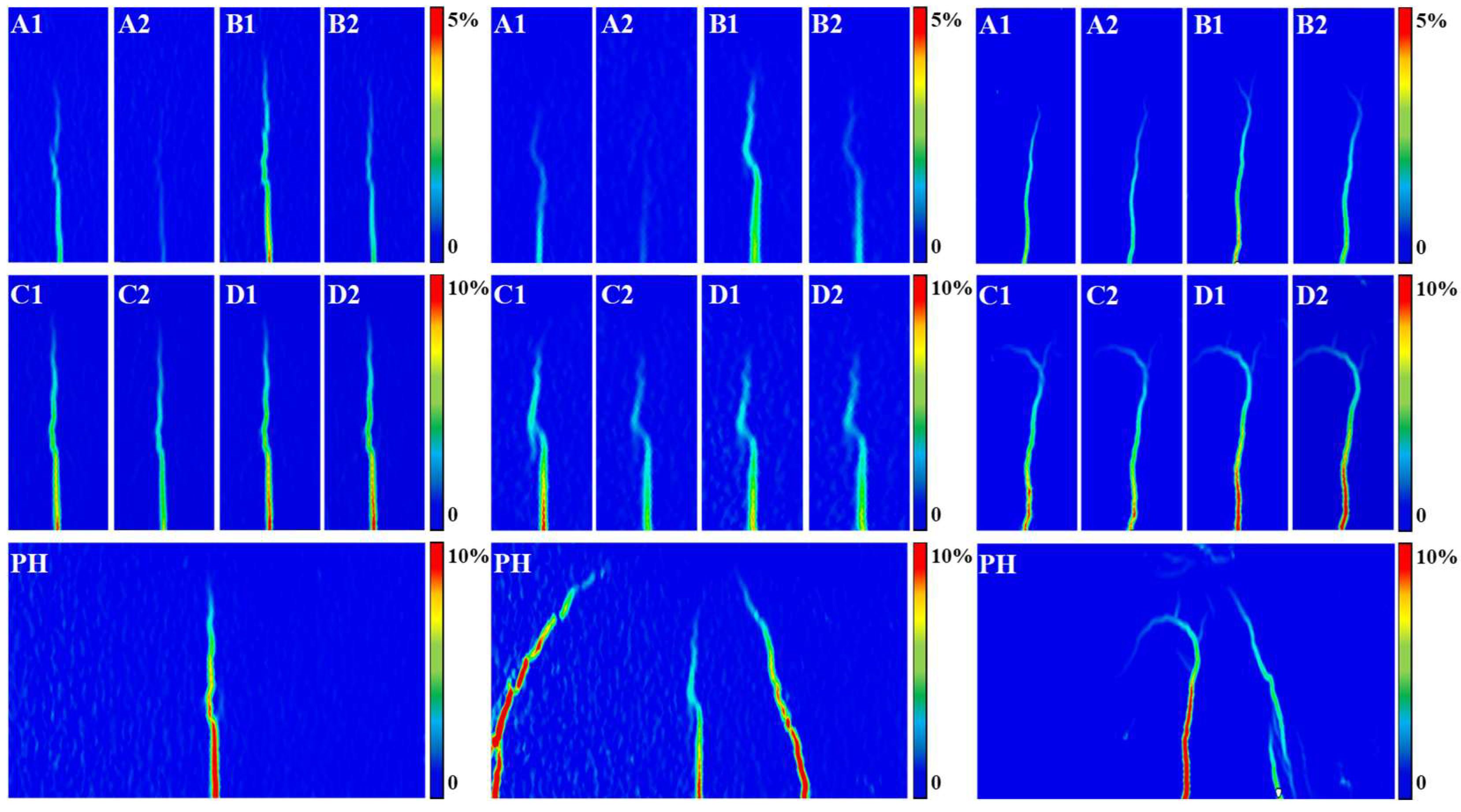
- The correlation between mesoscopic fracture mechanisms and acoustic emission mechanisms in reinforced concrete beams under cyclic loading is revealed by integrating acoustic emission and digital image correlation techniques.
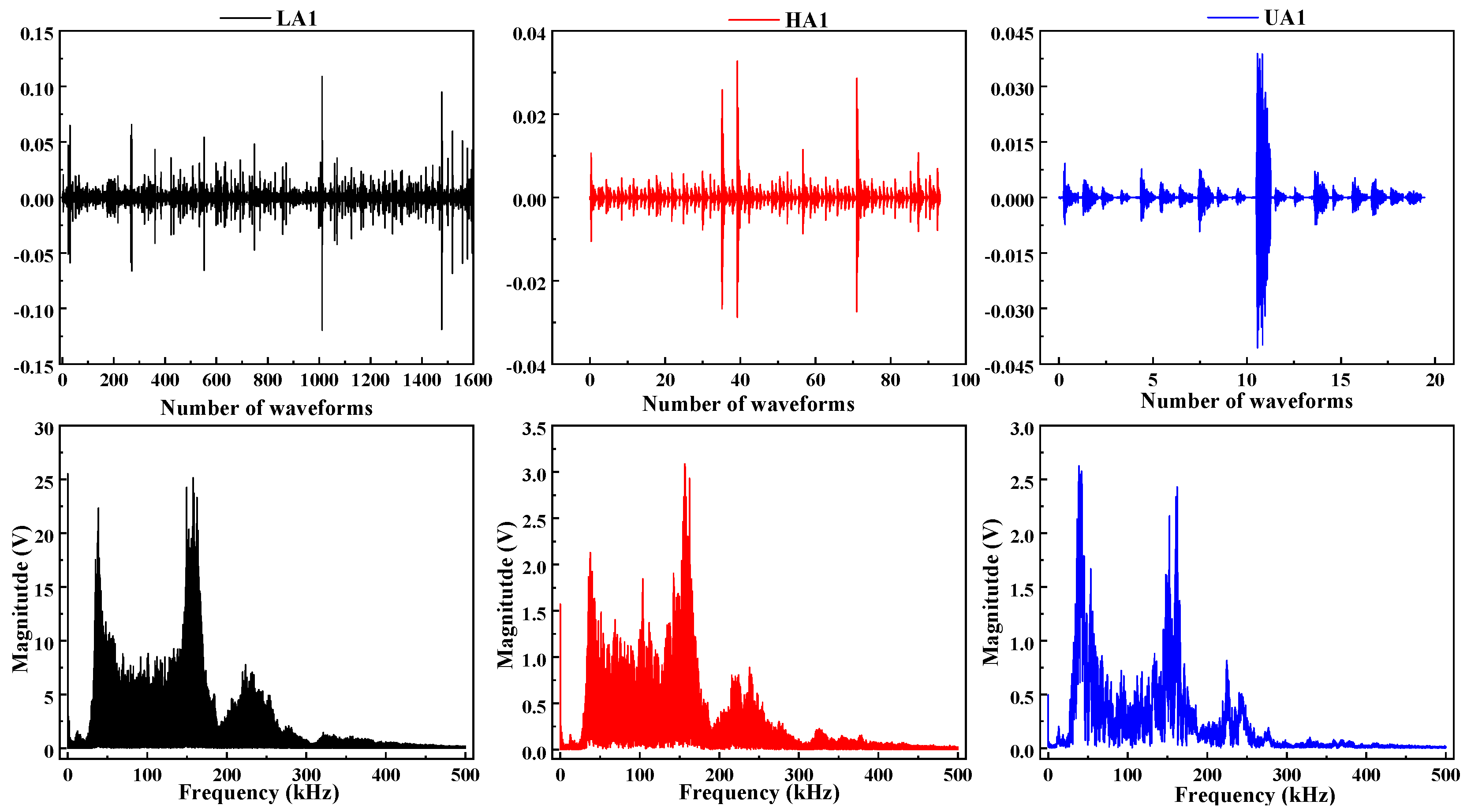
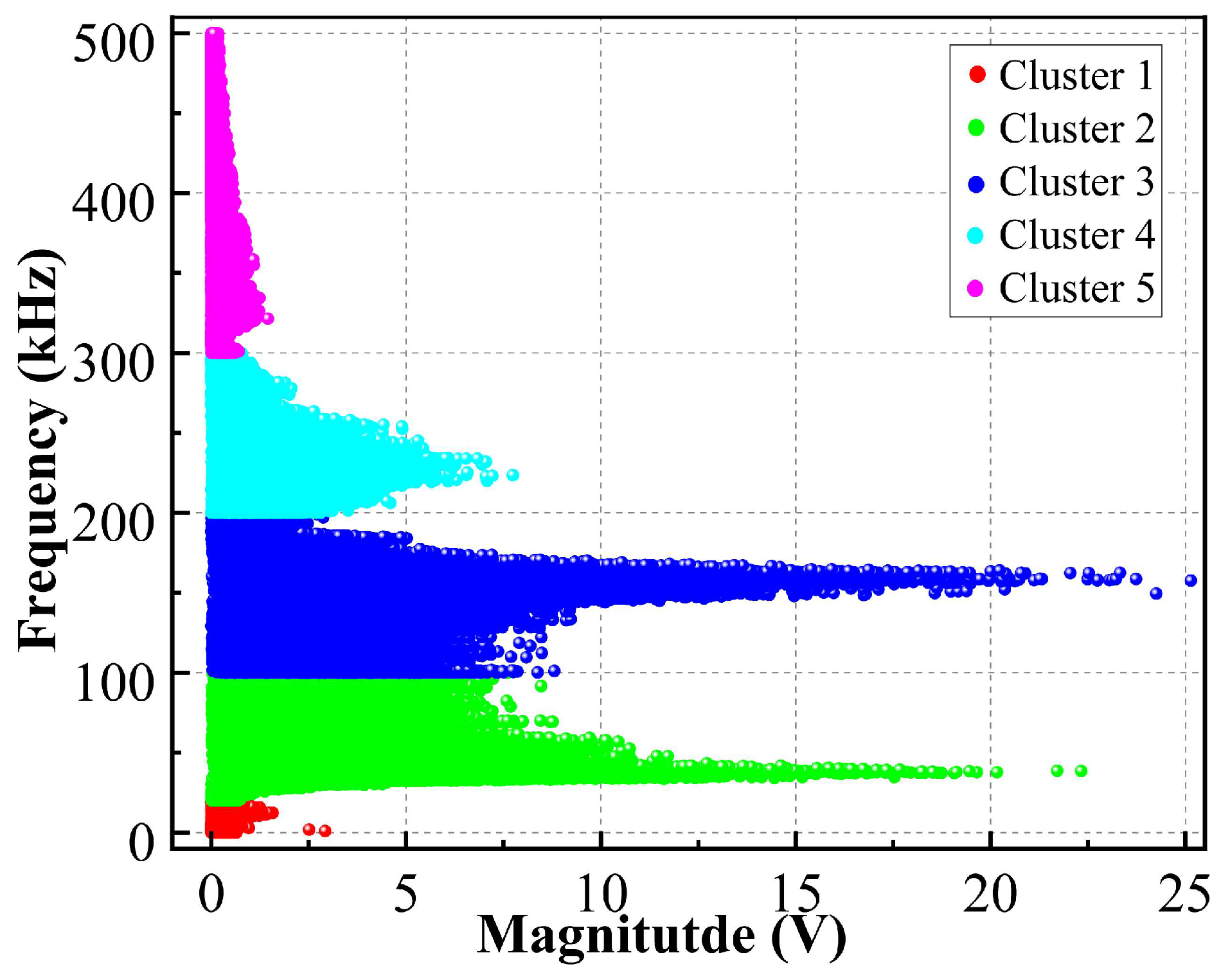
- Acoustic emission signals with distinct spectral characteristics are excited by mesoscopic fracture mechanisms corresponding to different damage stages.
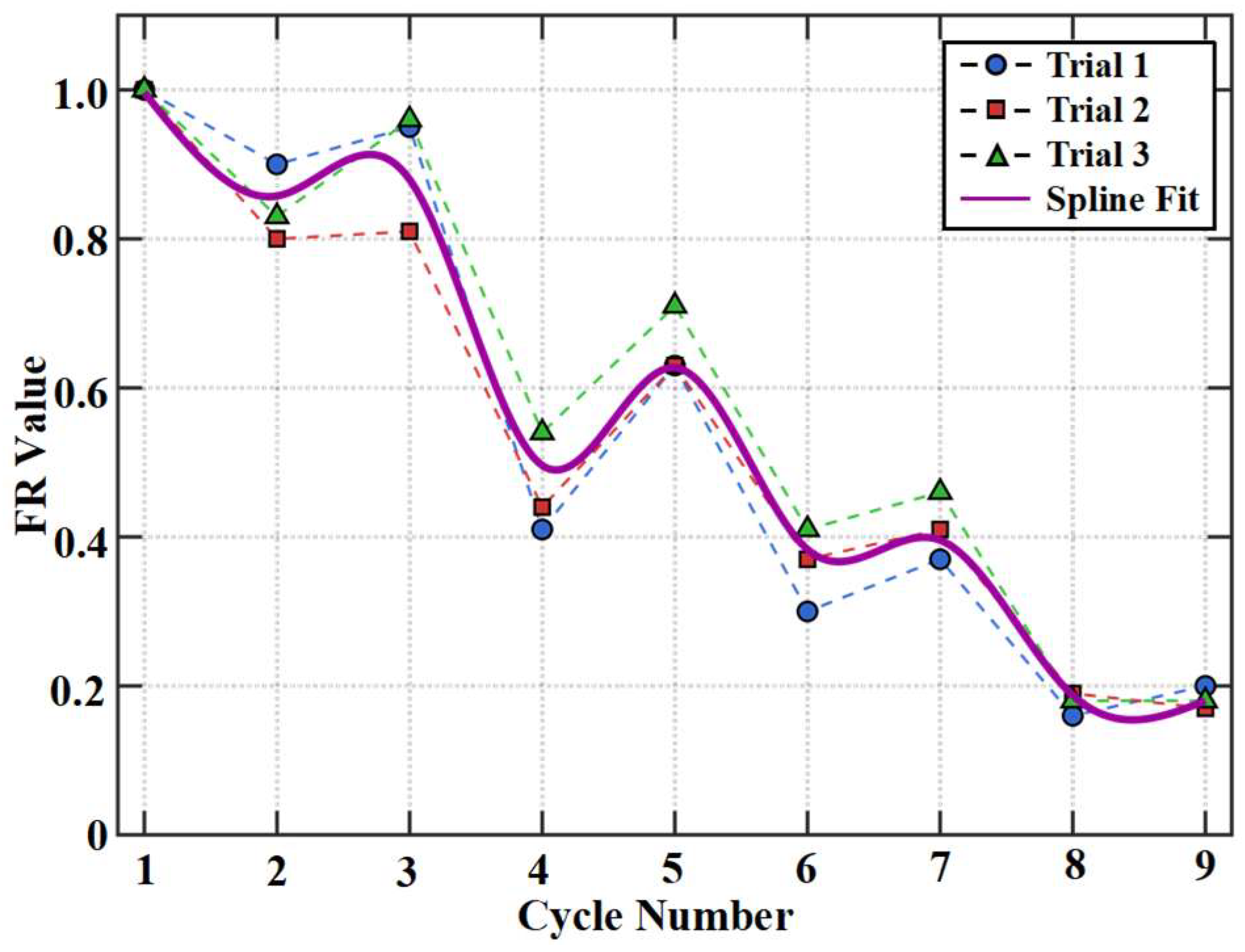
- Compared to macro-mechanical indicators such as fracture energy, the acoustic emission parameter Felicity Ratio enables earlier quantification of irreversible damage accumulation.
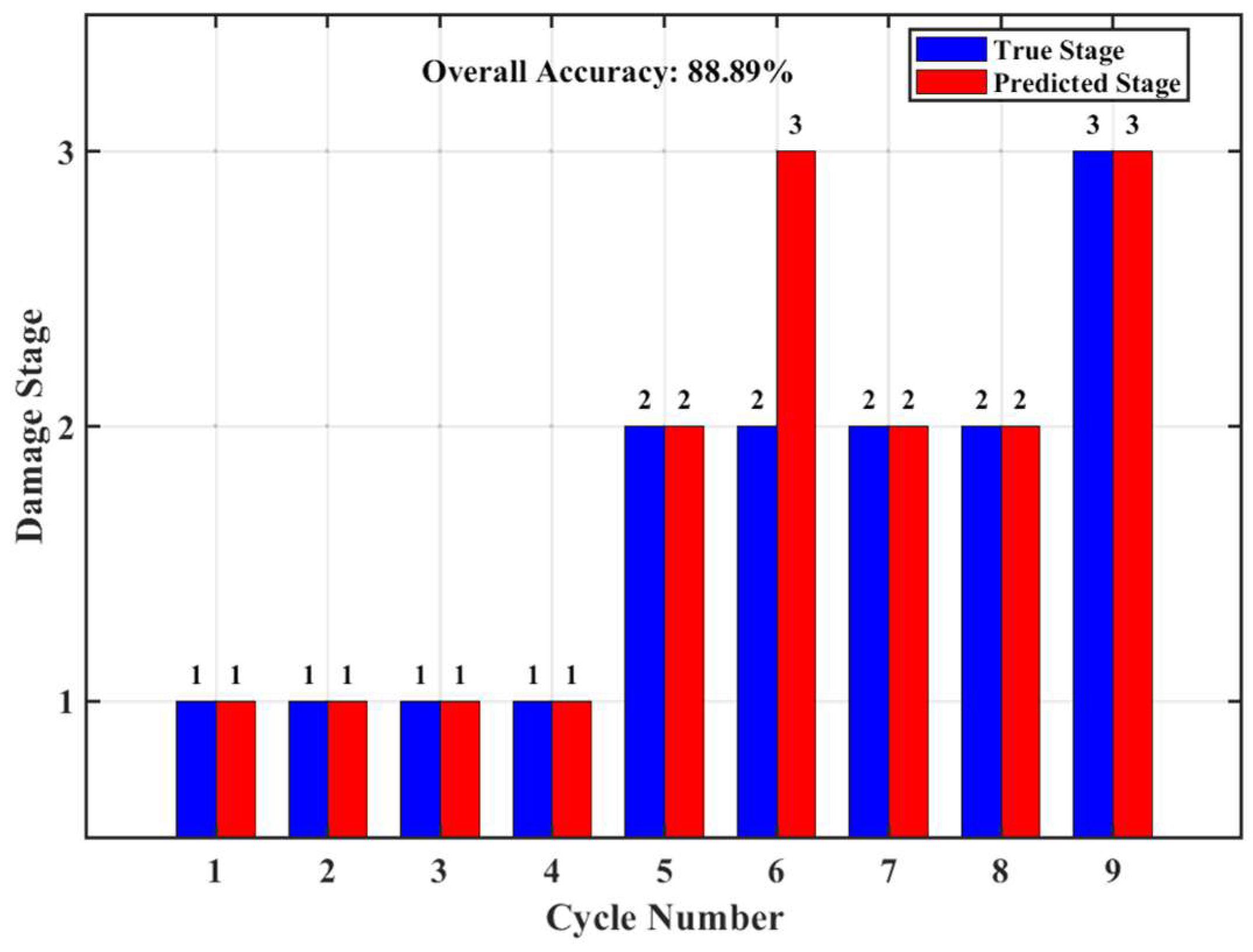
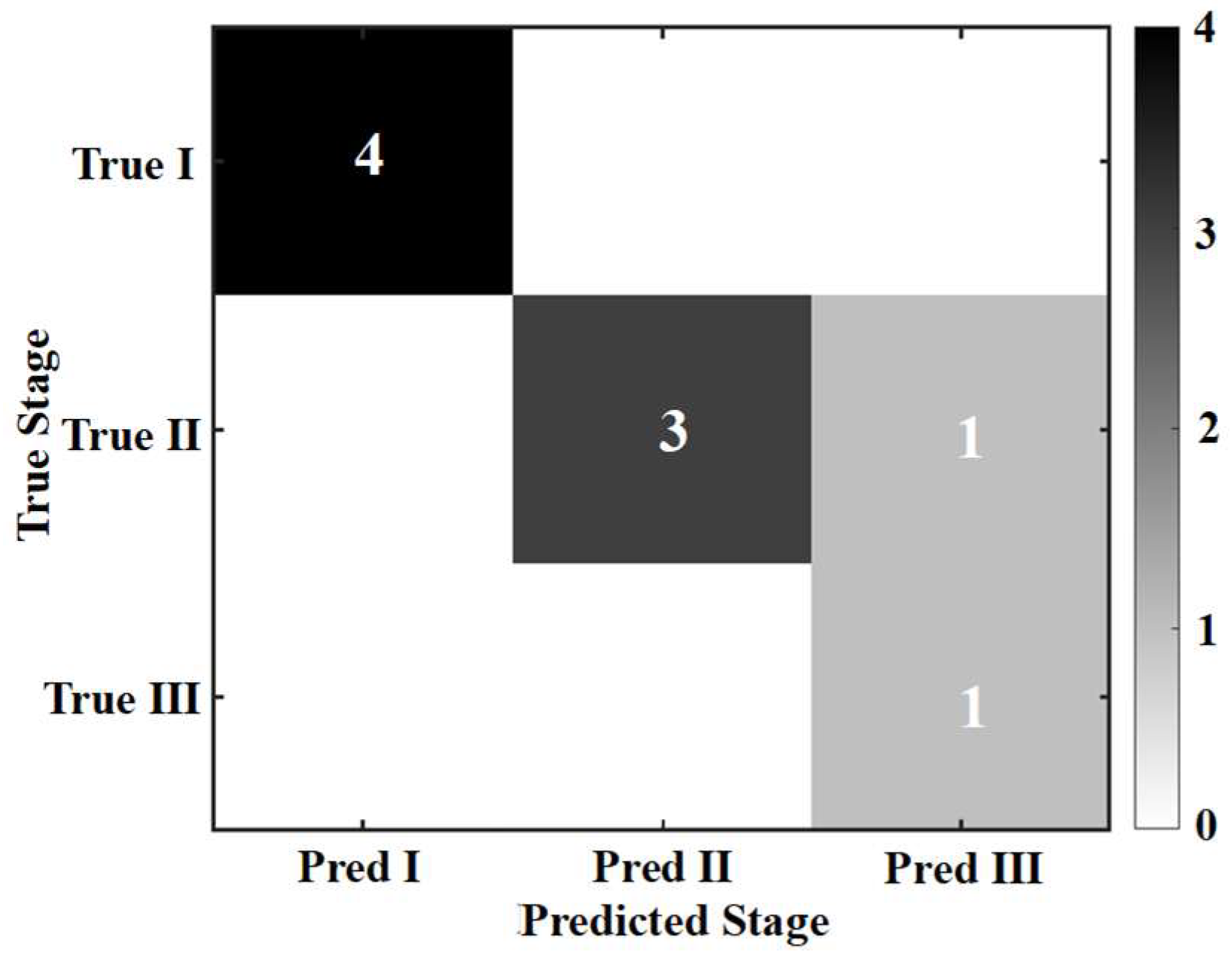
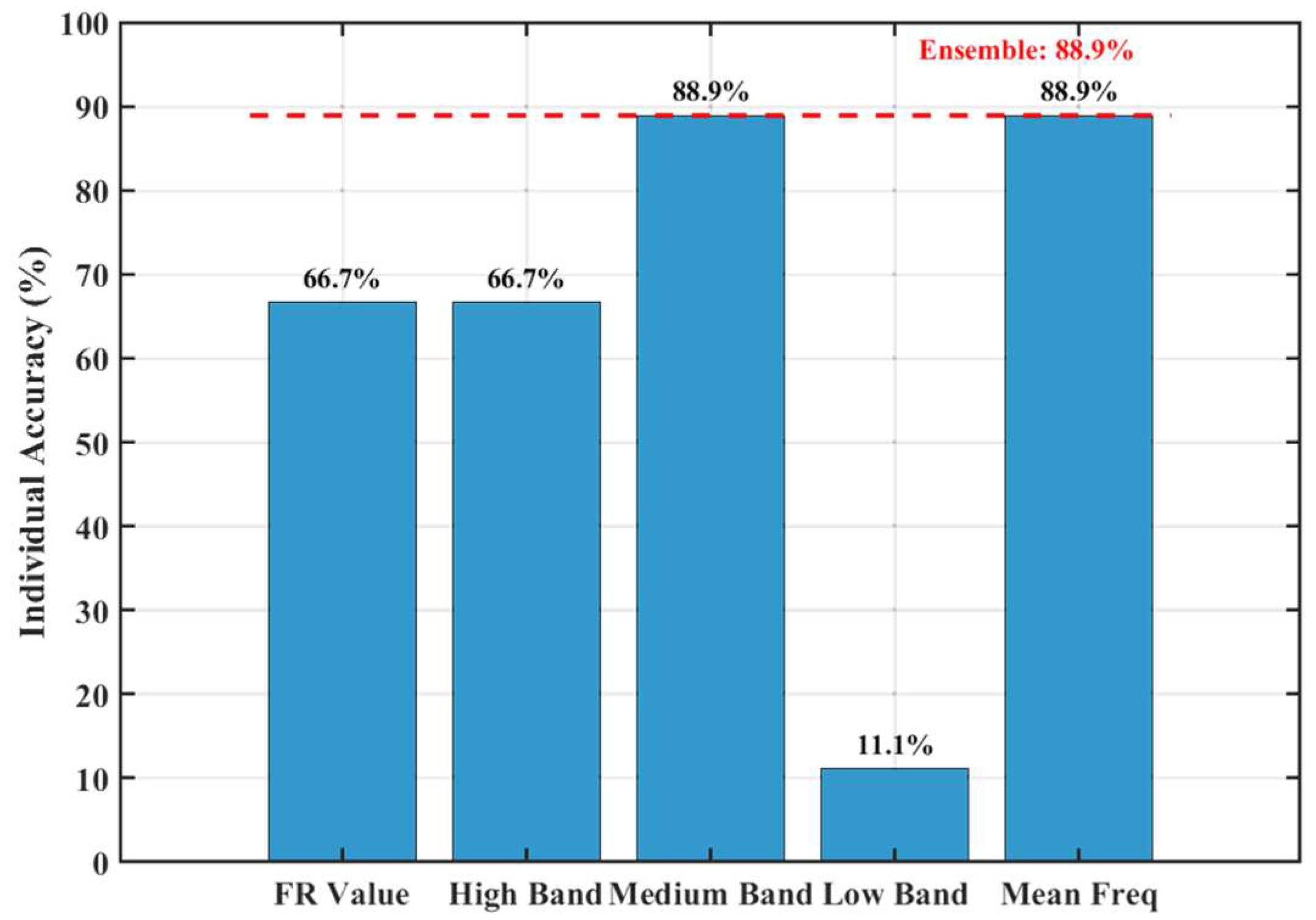
- An FR-Freq damage model incorporating both time-domain and frequency-domain acoustic emission features is proposed, achieving damage stage identification with an accuracy of 88.89%.
Abstract
1. Introduction
2. Experiment and Methods
2.1. Sample Preparation
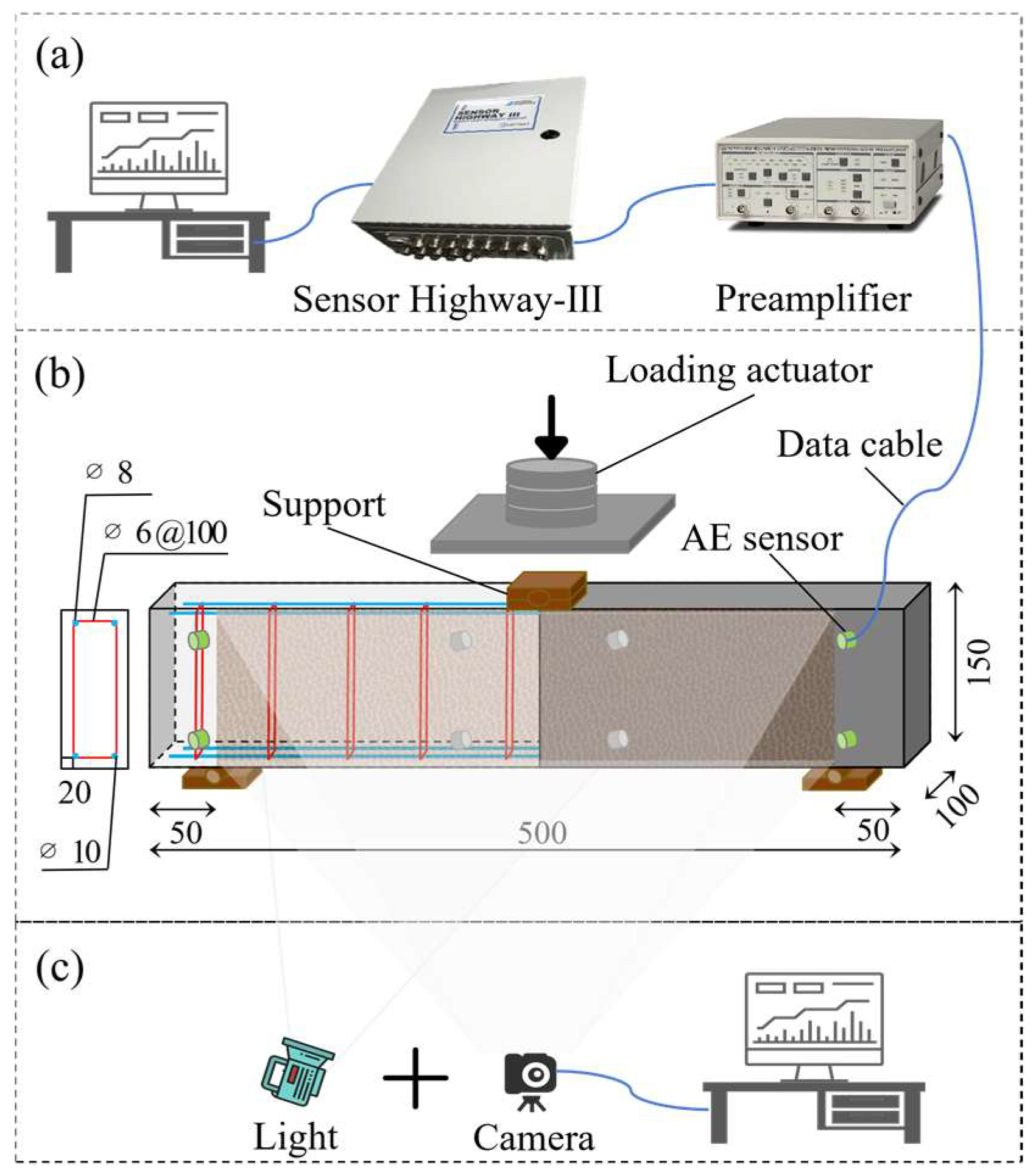
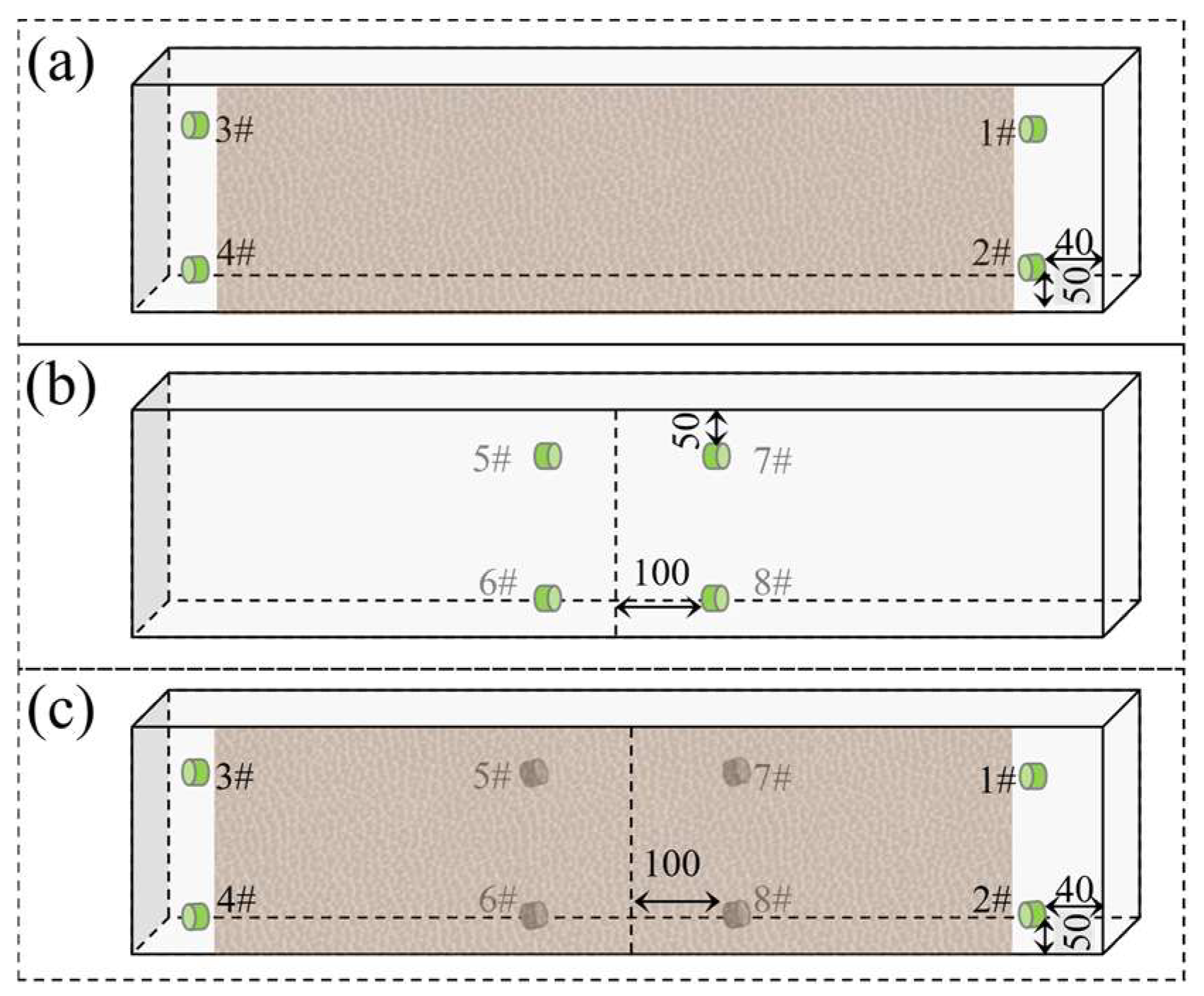
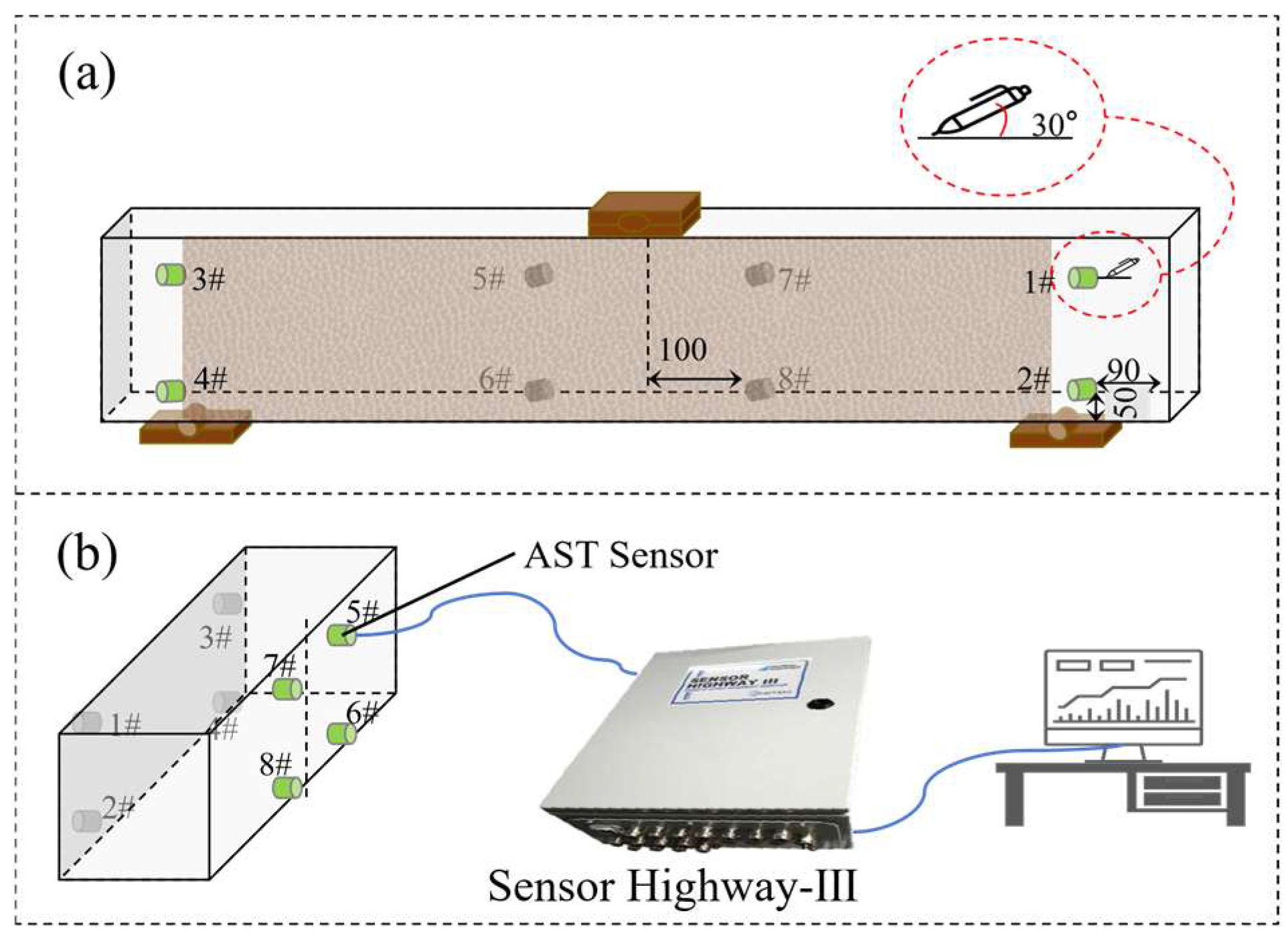
2.2. Test System
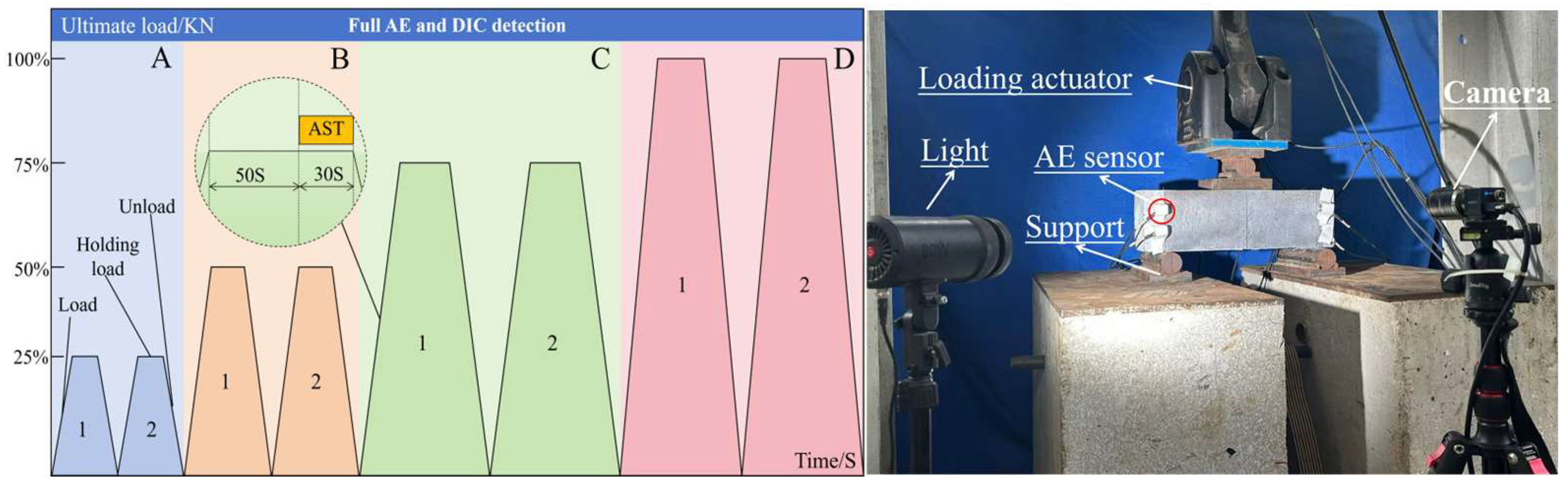
2.3. Testing Procedure
3. Results of Loading Test
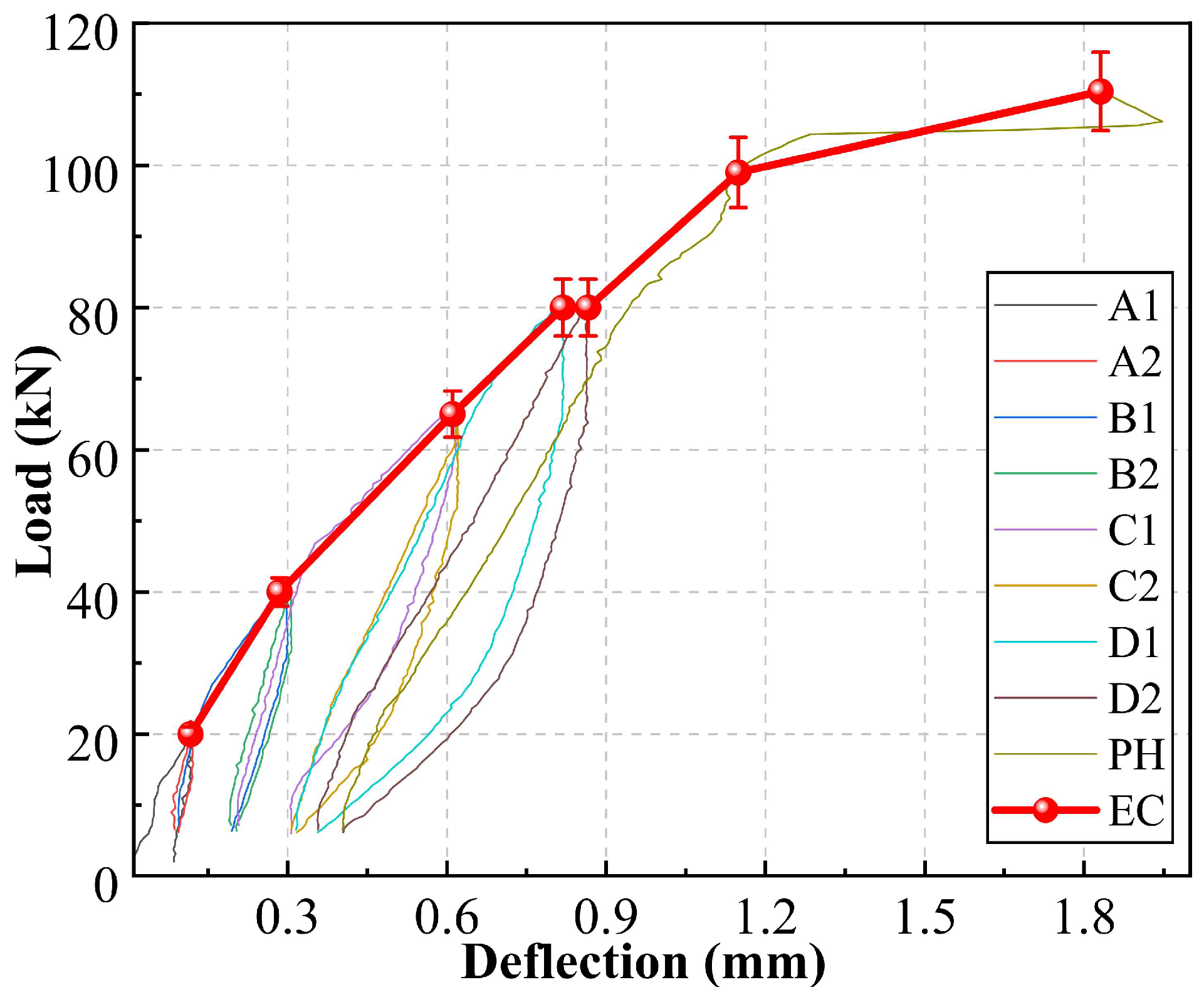
3.1. Load-Deflection Curves
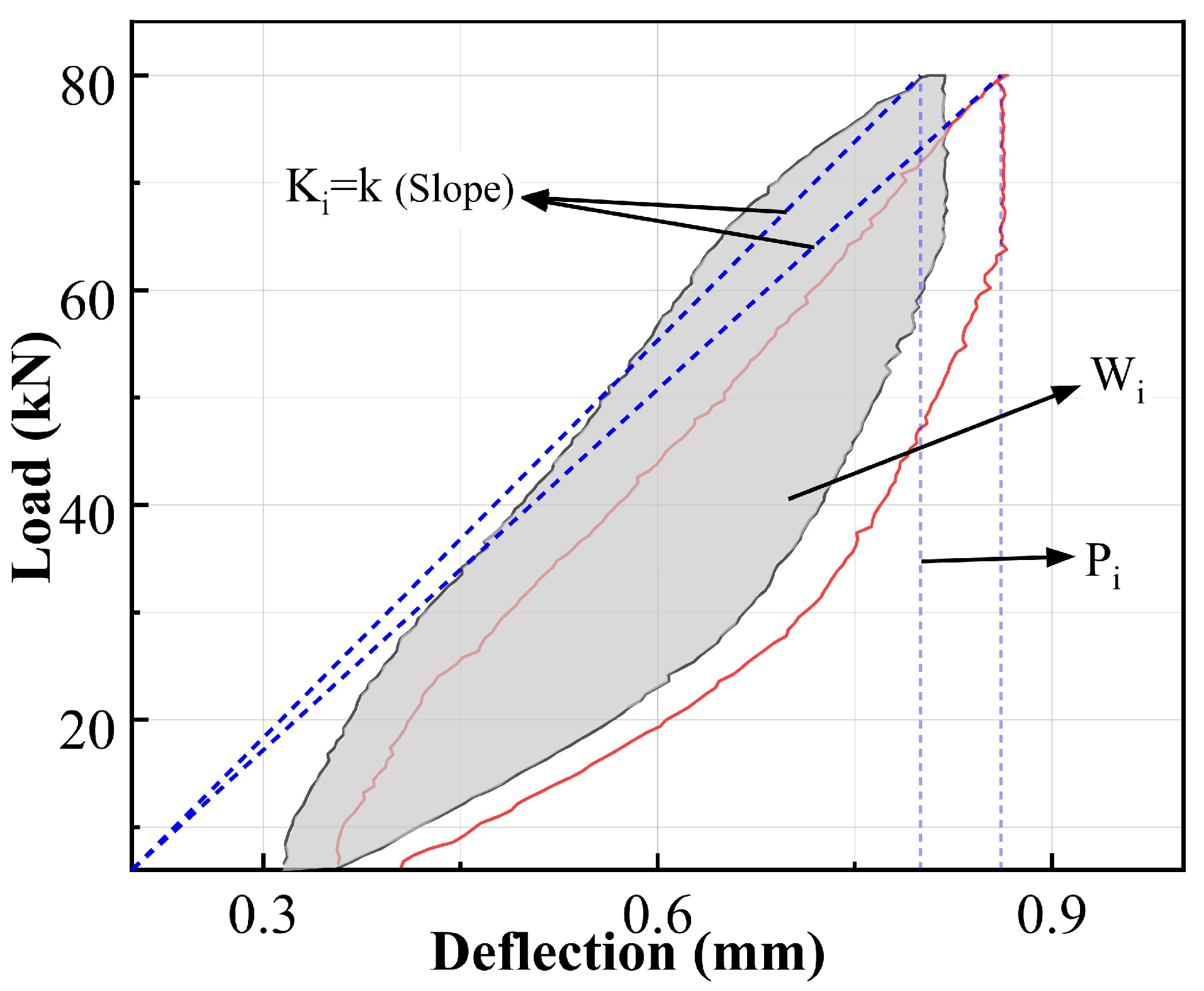
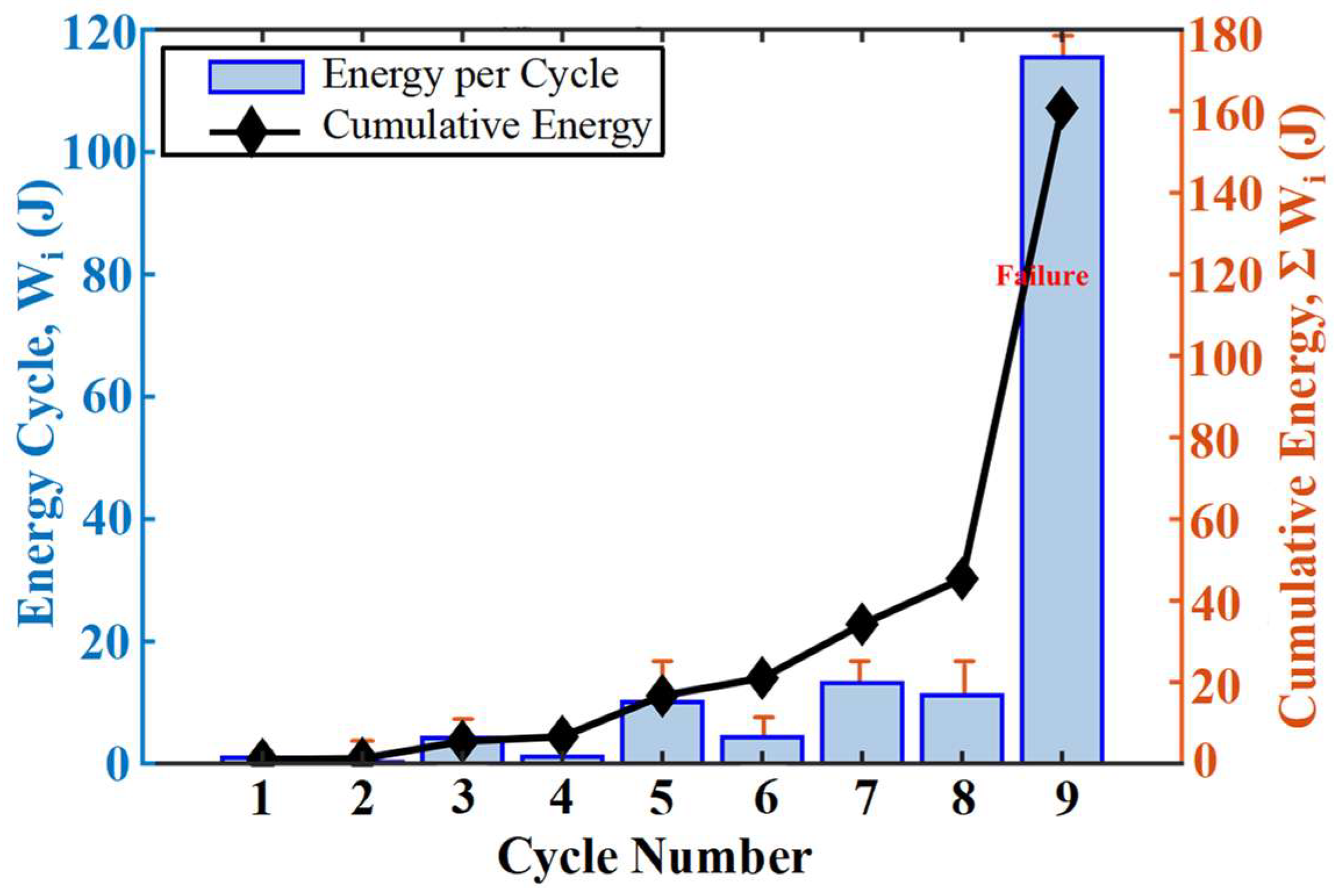
3.2. Energy Dissipation
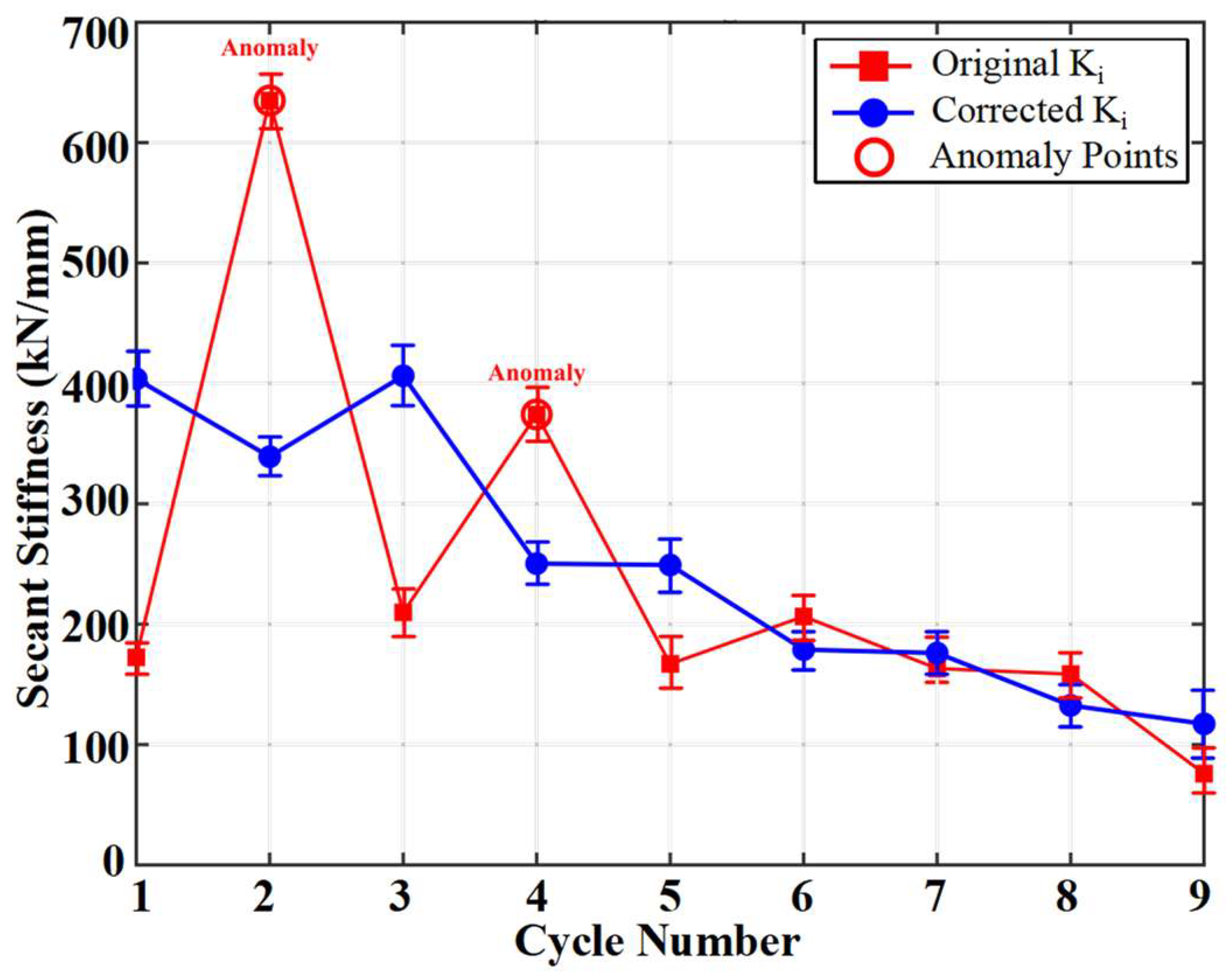
3.3. Stiffness
3.4. Felicity Ratio Analysis
3.5. Failure Modes
4. AE Analysis
4.1. Frequency-Domain Analysis
4.2. Frequency Bandwidth Energy Evolution
5. Development of Damage Model
5.1. Feature Selection
5.2. FR-Freq Damage Model Development
6. Conclusions and Prospects
Author Contributions
Funding
Institutional Review Board Statement
Informed Consent Statement
Data Availability Statement
Acknowledgments
Conflicts of Interest
Abbreviations
| RC | Reinforced concrete |
| AE | acoustic emission |
| DIC | Digital image correlation |
| FR | Felicity Ratio |
References
- Zhou, C.; Ren, Z.; Huang, Z.; Shi, L.; Xun, C.; Huang, W.; Lin, Y. Damage hysteresis dynamic model of tangled metal wire based on higher-order dry friction. Mech. Syst. Signal Process. 2024, 208, 111073. [Google Scholar] [CrossRef]
- Liu, Z.; Ziehl, P. Evaluation of reinforced concrete beam specimens with acoustic emission and cyclic load test methods. ACI Struct. J. 2009, 106, 288. [Google Scholar] [CrossRef]
- Fazzini, M.; Mistou, S.; Dalverny, O.; Robert, L. Study of image characteristics on digital image correlation error assessment. Opt. Lasers Eng. 2010, 48, 335–339. [Google Scholar] [CrossRef]
- Li, X.; Miao, T.; Liu, T.; Chen, R.; Yu, A. Acoustic emission evaluation and localization correction of concrete damage considering stress levels. Case Stud. Constr. Mater. 2025, 22, e04281. [Google Scholar] [CrossRef]
- Dvořák, R.; Chobola, Z.; Plšková, I.; Hela, R.; Bodnárová, L. Classification of thermally degraded concrete by acoustic resonance method and image analysis via machine learning. Materials 2023, 16, 1010. [Google Scholar] [CrossRef]
- Yu, A.; Liu, T.; Miao, T.; Chen, X.; Deng, X.; Fu, F. Signal Recognition and Prediction of Water-Bearing Concrete Under Axial Compression Using Acoustic Emission and Machine Learning. Struct. Control Health Monit. 2025, 2025, 6633988. [Google Scholar] [CrossRef]
- He, J.; Ding, X.; Yang, W.; Yang, H.; Liu, L. Predicting the effect of the loading rate on the fracture toughness of hydraulic asphalt concrete based on the weibull distribution. Materials 2024, 17, 803. [Google Scholar] [CrossRef] [PubMed]
- Sun, Y.; Yu, F.; Lv, J. Research on the characteristics of acoustic emission activities of granite and marble under different loading methods. Lithosphere 2023, 2023, 2773795. [Google Scholar] [CrossRef]
- Krishna, Y.; Raju, G.; Desarkar, M.S. Damage characterization of CFRP composites under compression using acoustic emission time–frequency analysis and unsupervised deep learning. Mech. Syst. Signal Process. 2025, 238, 113224. [Google Scholar] [CrossRef]
- Xu, Z.; Sun, Y.; Zhao, G.; Lu, J. Classification of PCCP-Damage Acoustic-Emission Signals Using the ACW-GA-PSO-BPNN Method. Case Stud. Constr. Mater. 2025, 23, e05626. [Google Scholar] [CrossRef]
- Triantis, D.; Stavrakas, I.; Loukidis, A.; Pasiou, E.D.; Kourkoulis, S.K. Spatio-temporal distribution of the sources of acoustic events in notched fiber-reinforced concrete beams under three-point bending. Materials 2023, 16, 5118. [Google Scholar]
- Vishwakarma, V.; Ray, S. Probability-based prediction of crack propagation in lightly reinforced concrete beams using acoustic emission technique. Appl. Acoust. 2026, 241, 111035. [Google Scholar]
- Li, S.; Chen, S.H.; Li, M.; Wu, G.-M.; Wang, C.; Hou, S.-T.; Jiang, N. Separation method for acoustic emission signals of prestressing steel strand fracture and concrete cracking. Measurement 2025, 245, 116607. [Google Scholar]
- Fiedler, M.; Xu, R.; Marx, S. Analysis of the relationships between mechanical conditions and acoustic emission signal characteristics from prestressing steel wire breaks. Eng. Fract. Mech. 2025, 324, 111210. [Google Scholar] [CrossRef]
- Fan, X.; Liu, S.; Wei, D.; Ge, F. Fracture characteristics and damage evolution of early-age concrete under cyclic loading: Insights from AE and DIC techniques. Eng. Fract. Mech. 2025, 330, 111685. [Google Scholar] [CrossRef]
- Liu, M.; Lu, J.; Ming, P.; Song, J. AE-based damage identification of concrete structures under monotonic and fatigue loading. Constr. Build. Mater. 2023, 377, 131112. [Google Scholar] [CrossRef]
- Radhika, V.; Kishen, J. A comparative study of crack growth mechanisms in concrete through acoustic emission analysis: Monotonic versus fatigue loading. Constr. Build. Mater. 2024, 432, 136568. [Google Scholar] [CrossRef]
- Wang, J.; Xie, X.; Li, W.; Chen, X.; Zhang, X.; Fan, N.; Wang, T.; Zhang, H. Damage-fracture evolution mechanism of rock bridge structures in flawed sandstone under cyclic disturbance: Insights from DIC-AE. Theor. Appl. Fract. Mech. 2025, 105180. [Google Scholar]
- Wu, Z.; Yin, N.; Wang, W.; Zhou, F.; Xu, Z.; Zhang, Z. Tribo-Informatics Approach for Monitoring the Coefficient of Friction and Its Fluctuation in Sliding Contact Based on Sound and Vibration Multi-Signals. Tribol. Int. 2025, 214, 111130. [Google Scholar] [CrossRef]
- Guo, R.; Zhang, X.; Lin, X.; Huang, S. Active and passive monitoring of corrosion state of reinforced concrete based on embedded cement-based acoustic emission sensor. J. Build. Eng. 2024, 89, 109276. [Google Scholar] [CrossRef]
- Liu, D.; Zhang, W.; Jian, Y.; Tang, Y.; Cao, K. Damage precursors of sulfate erosion concrete based on acoustic emission multifractal characteristics and b-value. Constr. Build. Mater. 2024, 419, 135380. [Google Scholar] [CrossRef]
- Sagar, R.V.; Prasad, B.; Kumar, S. An experimental study on cracking evolution in concrete and cement mortar by the b-value analysis of acoustic emission technique. Cem. Concr. Res. 2012, 42, 1094–1104. [Google Scholar] [CrossRef]
- Feng, X.; Liu, H.; Chen, X.; Chang, W.; Xia, K.; Guo, Q.; Liu, L.; Li, M. Acoustic emission characteristics and cracking mechanism analysis of anisotropic shale containing a circular hole under uniaxial compression. Theor. Appl. Fract. Mech. 2025, 135, 104771. [Google Scholar] [CrossRef]
- Zhao, Y.; Zhao, Q.; Yang, T.; Chen, Y.; Zhang, P.; Liu, H. Investigation of crack propagation and acoustic emission characteristics in jointed rock under freeze–thaw cycles based on DEM. Int. J. Min. Sci. Technol. 2025, 35, 1171–1195. [Google Scholar] [CrossRef]
- Wang, L.; Liu, Z.Q.; Li, C.; Tian, Z.; Hu, X. Cracking characteristics of warm-mix recycled fiber asphalt mixture under Mode I, Mode III, and mixed-Mode I/III based on acoustic emission technology. Constr. Build. Mater. 2025, 484, 141673. [Google Scholar] [CrossRef]
- Zhao, J.; Chen, Z.; Liu, X.; Li, X.; Deng, E. Seismic performance of steel fiber reinforced concrete column with untensioned prestressing steel strands. Constr. Build. Mater. 2025, 505, 144765. [Google Scholar] [CrossRef]
- Senol, H.; Ulus, H.; Yildirim, C.; Al-Nadhari, A.; Topal, S.; Yildiz, M. Assessing fracture toughness performance of adhesively bonded carbon fiber/epoxy composite joints accompanied by acoustic emission inspection: Effect of surface treatment methods. Eng. Fract. Mech. 2025, 321, 111119. [Google Scholar] [CrossRef]
- Wang, S.; Zheng, T.; Kong, D.; Wang, L.; He, Y.; Fang, Z.; Liu, Z.; Hu, N.; Bi, F. Bond behavior between plain round bars and phosphogypsum-based composite cementitious materials with bond-slip damage analysis using acoustic emission technology. Constr. Build. Mater. 2025, 505, 144836. [Google Scholar] [CrossRef]
- Li, J.; Li, Z.; Chen, J.; Huang, Y.; Sun, K.; Niu, J. Assessment of the bond-slip behavior of rebar in fiber-reinforced self-compacting lightweight aggregate concrete via the acoustic emission technique. J. Build. Eng. 2024, 89, 109054. [Google Scholar] [CrossRef]
- Kannan, V.P.; Barile, C. Significance of statistical testing and data integration in acoustic emission analysis. Appl. Acoust. 2026, 242, 111099. [Google Scholar] [CrossRef]
- Zhang, F.; Yang, Y.; Naaktgeboren, M.; Hendriks, M.A. Probability density field of acoustic emission events: Damage identification in concrete structures. Constr. Build. Mater. 2022, 327, 126984. [Google Scholar] [CrossRef]
- Du, W.; Liu, Z.; Yang, H.; Wu, Q.; Jiao, Y. Flexural Fracture Modes and Damage Evolution in UHPC under Four-Point-Bending: A Dual-Path Framework Integrating Random Forest and HDBSCAN Using Acoustic Emission Features. J. Build. Eng. 2025, 114, 114380. [Google Scholar] [CrossRef]
- Eshraghi, A.; Kodjo, S.A.; Rivard, P.; Shams, G. Machine-learning-based crack mode classification in plain concrete considering acoustic emission wave propagation effects. Constr. Build. Mater. 2025, 489, 142188. [Google Scholar] [CrossRef]
- Rather, A.; Laskar, A.; Banerjee, S. Monitoring bond degradation and predicting failure modes in GFRP-reinforced concrete beams using information entropy analysis of acoustic emission waveforms. Constr. Build. Mater. 2025, 498, 144014. [Google Scholar] [CrossRef]
- He, J.; Qiao, C.; Farnam, Y. Durability evaluation of reinforced concrete with surface treatment of soy methyl ester-polystyrene under freeze-thaw cycles and calcium chloride. Cem. Concr. Compos. 2023, 137, 104927. [Google Scholar]
- Hu, Z.; Yang, Y.; Zhang, H. Durability and Damage Evolution of Steel Fiber and Nano-SiO2 Reinforced Concrete Under Freeze-Thaw and Salt Erosion Environments Based on Acoustic Emission and Computed Tomography Analysis. J. Build. Eng. 2025, 115, 114595. [Google Scholar] [CrossRef]
- JGJ 55-2011; Specification for Mix Proportion Design of Ordinary Concrete. China Architecture & Building Press: Beijing, China, 2011.
- GB 175-2023; Common Portland Cement. Standards Press of China: Beijing, China, 2023.
- GB/T 14684-2022; Sand for Construction. Standards Press of China: Beijing, China, 2022.
- GB 50010-2010; Code for Design of Concrete Structures. China Architecture & Building Press: Beijing, China, 2011.
- Khalilpour, S.; BaniAsad, E.; Dehestani, M. A review on concrete fracture energy and effective parameters. Cem. Concr. Res. 2019, 120, 294–321. [Google Scholar] [CrossRef]
- Arora, K.; Chakraborty, T.; Rao, K.S. Experimental study on stiffness degradation of rock under uniaxial cyclic sinusoidal compression loading. Rock Mech. Rock Eng. 2019, 52, 4785–4797. [Google Scholar] [CrossRef]
- Tian, Y.; Yu, R.; Zhang, Y. Application of felicity effect in crack stress identification and quantitative damage assessment of limestone. Rock Mech. Rock Eng. 2020, 53, 2907–2913. [Google Scholar] [CrossRef]
- Nordlund, E.; Li, C. Acoustic Emission and the Kaiser Effect in Rock Materials; ARMA: Badhoevedorp, The Netherlands, 1990; p. ARMA-90-1043. [Google Scholar]
- Yuan, R.; Li, Y.; Zhao, X. Experimental verification and theoretical analysis on Felicity effect of acoustic emission in concrete. Key Eng. Mater. 2007, 353, 2333–2336. [Google Scholar] [CrossRef]
- Shahidi, F.; Shafaie, V.; Ghodousian, O.; Emamian, S.A.; Movahedi Rad, M. Numerical investigation of bonding in stone-clad Façades: Comparative analysis with and without mechanical anchorage. J. Infrastruct. Preserv. Resil. 2025, 6, 36. [Google Scholar] [CrossRef]


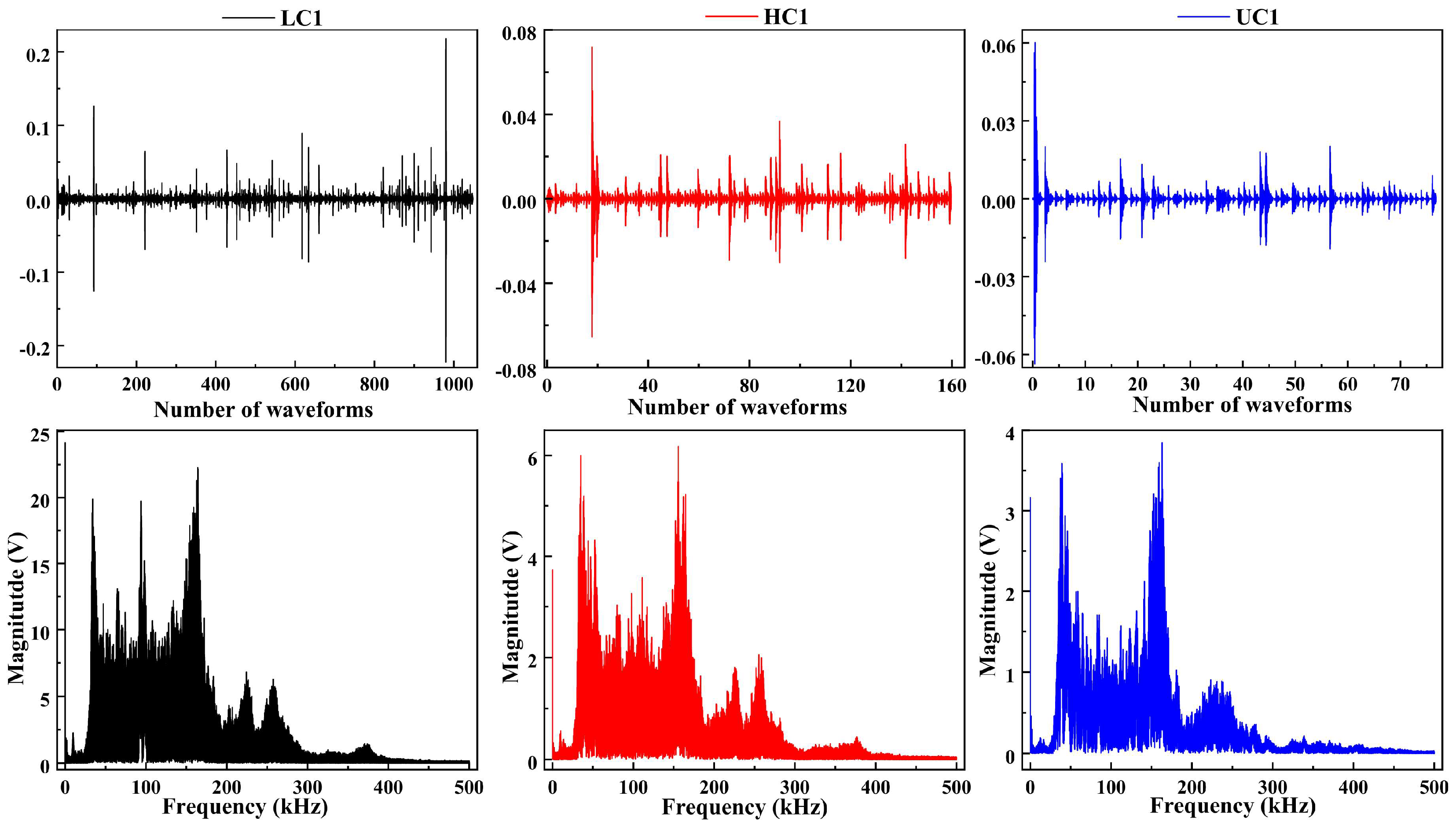

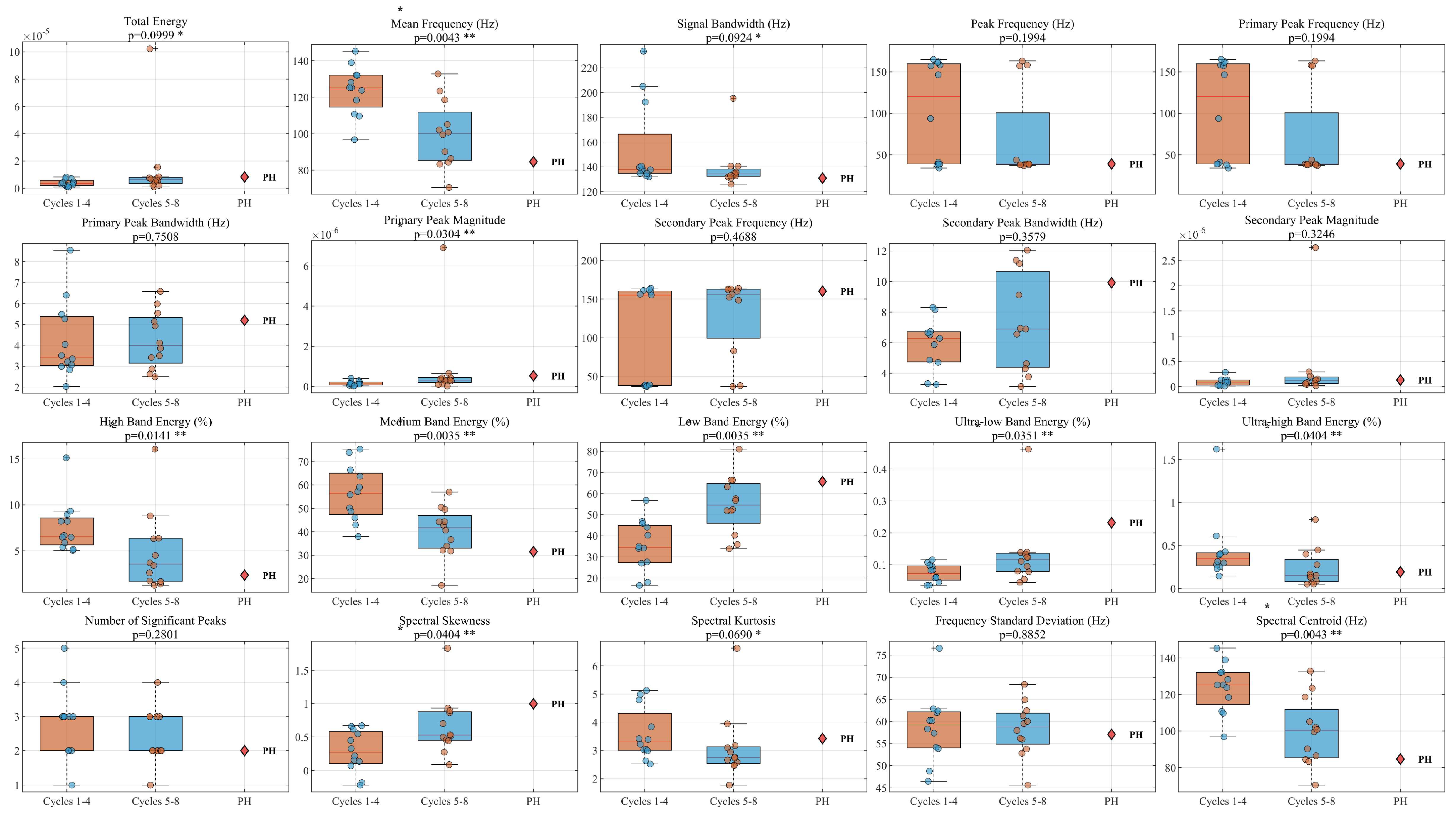


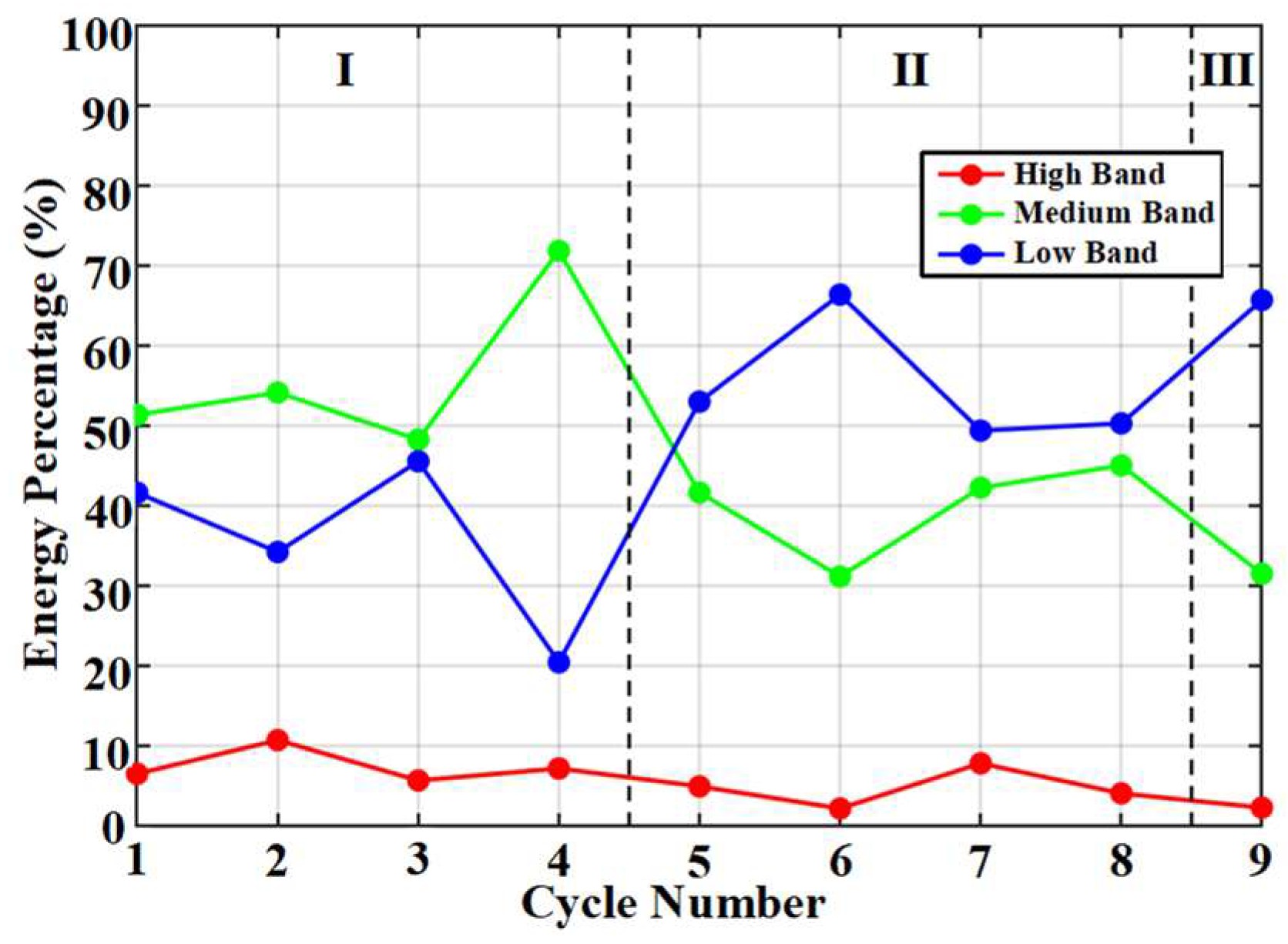
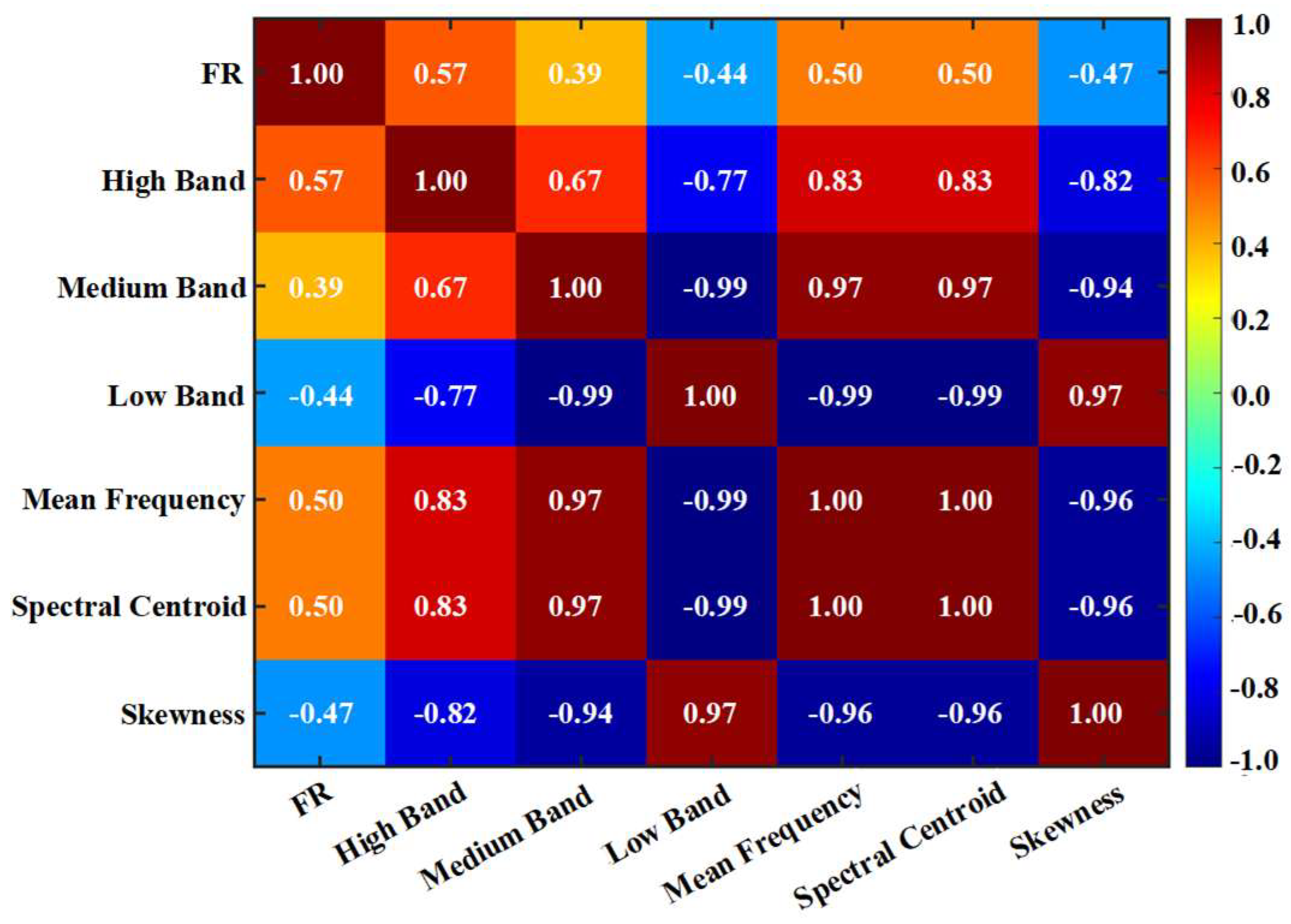


| Material | Water (kg) | Cement (kg) | Sand (kg) | Gravel (kg) |
|---|---|---|---|---|
| Mix Proportion | 232.00 | 464.00 | 655.00 | 1069.00 |
| Diameter (mm) | Nominal Area (mm2) | Tensile Strength fy (MPa) | Ultimate Tensile Strength (MPa) | Elasticity Modulus Es (N/mm2) | Yield Strain (×10−6) | Percentage Elongation |
|---|---|---|---|---|---|---|
| 8 | 50.3 | 450 | 618 | 2.13 | 2220 | -- |
| 10 | 78.5 | 445 | 615 | 2.18 | 2171 | 25.2 |
| Cycle Number | Secant Stiffness Ki (kN/mm) * | Corrected Ki (kN/mm) | Single Cycle Fracture Energy Wi (J) * | Peak Load Pmax (kN) | Peak Deflection δmax * (mm) |
|---|---|---|---|---|---|
| 1 | 172.56 | 403.74 | 0.99 | 20 | 0.116 |
| 2 | 634.92 | 339.08 | 0.27 | 20 | 0.119 |
| 3 | 209.75 | 406.28 | 4.21 | 40 | 0.285 |
| 4 | 374.18 | 250.3 | 1.13 | 40 | 0.301 |
| 5 | 166.97 | 249.19 | 10.08 | 65 | 0.597 |
| 6 | 206.41 | 178.85 | 4.32 | 65 | 0.621 |
| 7 | 163.17 | 176.03 | 13.16 | 80 | 0.806 |
| 8 | 158.51 | 132.53 | 11.16 | 80 | 0.862 |
| 9 | 75.91 | 117.21 | 115.44 | 109.8 * | 1.849 |
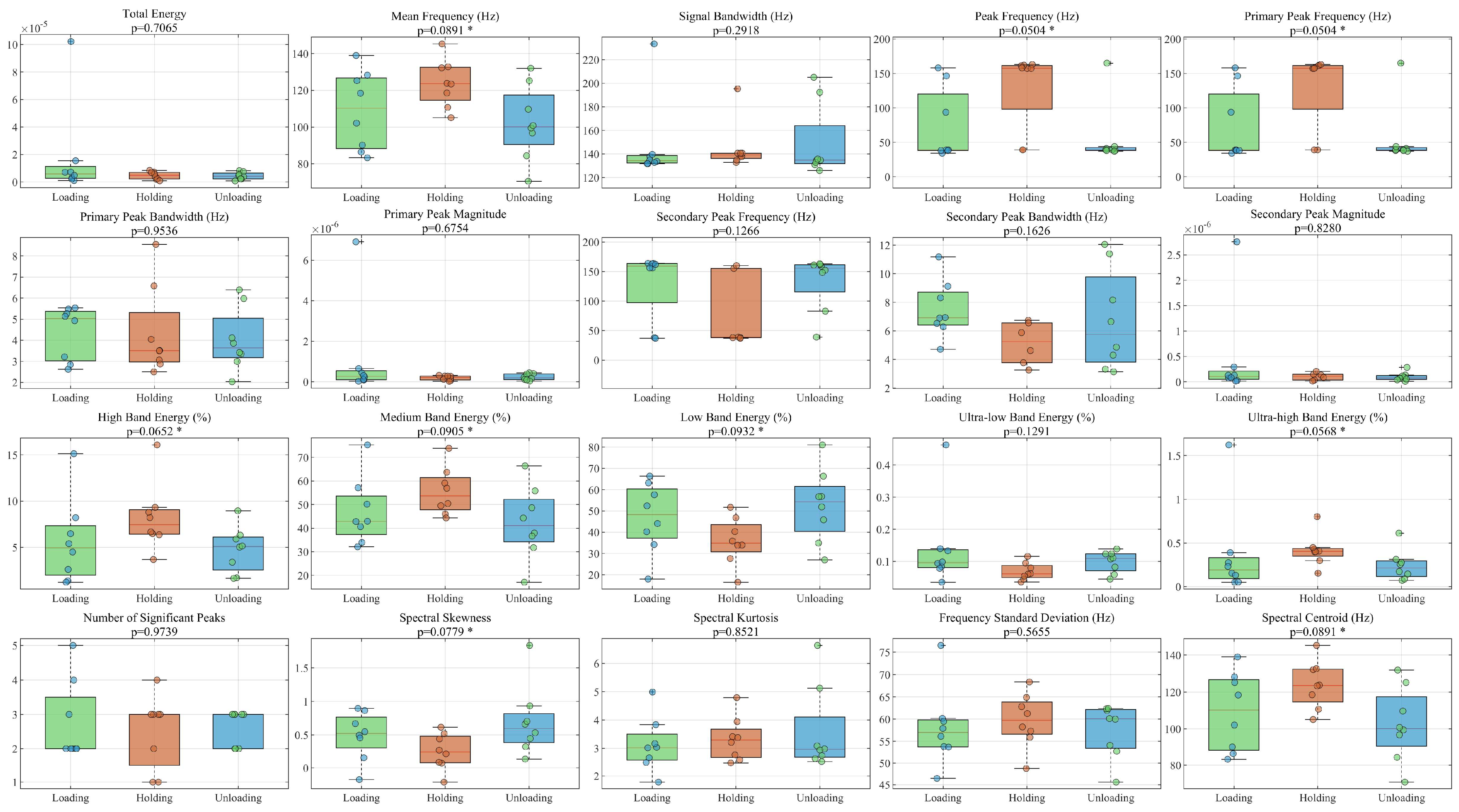
| Feature | Different Damage Stages p | Different Damage Stages ε2 | Loading, Holding, and Unloading Phases p | Loading, Holding, and Unloading Phases ε2 |
|---|---|---|---|---|
| Total Energy | 0.0999 | 0.0004 | 0.7065 | 0.0001 |
| Mean Frequency | 0.0043 | 0.0018 | 0.0891 | 0.0003 |
| Signal Bandwidth | 0.0924 | 0.0005 | 0.2918 | 0.0001 |
| Peak Frequency | 0.1994 | 0 | 0.0504 | 0 |
| Primary Peak Frequency | 0.1994 | 0 | 0.0504 | 0 |
| Primary Peak Bandwidth | 0.7508 | 0 | 0.9536 | 0 |
| Primary Peak Magnitude | 0.0304 | 0 | 0.6754 | 0 |
| Secondary Peak Frequency | 0.4688 | 0 | 0.1266 | 0 |
| Secondary Peak Bandwidth | 0.3579 | 0 | 0.1626 | 0 |
| Secondary Peak Magnitude | 0.3246 | 0 | 0.8280 | 0 |
| High Band Energy | 0.0141 | 0.0012 | 0.0652 | 0.0004 |
| Medium Band Energy | 0.0035 | 0.0019 | 0.0905 | 0.0003 |
| Low Band Energy | 0.0035 | 0.0019 | 0.0932 | 0.0002 |
| Ultra-low Band Energy | 0.0035 | 0.0018 | 0.1291 | 0.0003 |
| Ultra-high Band Energy | 0.0404 | 0.0008 | 0.0568 | 0.0004 |
| Number of Significant Peaks | 0.2801 | 0 | 0.9739 | 0 |
| Spectral Skewness | 0.0404 | 0.0008 | 0.0779 | 0.0003 |
| Spectral Kurtosis | 0.069 | 0.0006 | 0.8521 | 0.0001 |
| Frequency Standard | 0.8852 | 0 | 0.5655 | 0 |
| Spectral Centroid | 0.0043 | 0.0018 | 0.0891 | 0.0003 |
| Feature | FR | Ehigh | Emedium | Elow | fmean |
|---|---|---|---|---|---|
| Threshold 1 | 0.29 | 3.6 | 35.8 | 60.2 | 92.2 |
| Threshold 2 | 0.6 | 6.2 | 48.2 | 45.1 | 111.8 |
Disclaimer/Publisher’s Note: The statements, opinions and data contained in all publications are solely those of the individual author(s) and contributor(s) and not of MDPI and/or the editor(s). MDPI and/or the editor(s) disclaim responsibility for any injury to people or property resulting from any ideas, methods, instructions or products referred to in the content. |
© 2026 by the authors. Licensee MDPI, Basel, Switzerland. This article is an open access article distributed under the terms and conditions of the Creative Commons Attribution (CC BY) license.
Share and Cite
Yu, A.; Miao, T.; Liu, T.; Yang, Y.; Chen, Z. Acoustic Emission Mechanisms and Fracture Mechanisms in Reinforced Concrete Beams Under Cyclic Loading and Unloading. Materials 2026, 19, 521. https://doi.org/10.3390/ma19030521
Yu A, Miao T, Liu T, Yang Y, Chen Z. Acoustic Emission Mechanisms and Fracture Mechanisms in Reinforced Concrete Beams Under Cyclic Loading and Unloading. Materials. 2026; 19(3):521. https://doi.org/10.3390/ma19030521
Chicago/Turabian StyleYu, Aiping, Tianjiao Miao, Tao Liu, Yuhan Yang, and Zhehan Chen. 2026. "Acoustic Emission Mechanisms and Fracture Mechanisms in Reinforced Concrete Beams Under Cyclic Loading and Unloading" Materials 19, no. 3: 521. https://doi.org/10.3390/ma19030521
APA StyleYu, A., Miao, T., Liu, T., Yang, Y., & Chen, Z. (2026). Acoustic Emission Mechanisms and Fracture Mechanisms in Reinforced Concrete Beams Under Cyclic Loading and Unloading. Materials, 19(3), 521. https://doi.org/10.3390/ma19030521