Research Progress and Prospects on Poisoning Mechanism and Anti-Poisoning Modification of Cerium-Based NH3-SCR Denitrification Catalysts


Highlights
- The poisoning and deactivation mechanisms of Ce-based NH3-SCR catalysts exposed to industrial sintering flue gas are systematically categorized and elaborated.
- Element doping strategies for boosting the anti-SO2, anti-heavy metal and anti-water tolerance of CeO2 catalysts are comprehensively summarized and contrasted.
- The intrinsic rules of electronic structure and oxygen vacancy regulation for anti-poisoning performance are clarified to guide catalyst structural design.
- Prospects are proposed for the industrialized application of robust Ce-based denitrification materials under complex flue gas conditions.
Abstract
1. Introduction
2. Characteristics of Complex Industrial Flue Gases and Overview of Multi-Pollutant Synergistic Poisoning
3. Denitrification Deactivation Mechanism of Cerium-Based Catalysts in Industrial Flue Gases
3.1. SO2-Induced Denitrification Deactivation Mechanism
3.1.1. Chemical Poisoning
3.1.2. Physical Blockage
3.2. Heavy Metal Poisoning Mechanism
3.2.1. Lead (Pb) Poisoning
3.2.2. Cadmium (Cd) and Arsenic (As) Poisoning
3.2.3. Zinc (Zn) and Mercury (Hg) Poisoning
3.3. Alkali Metal/Alkaline Earth Metal Poisoning Mechanism

3.4. Inhibitory Effect of H2O
3.5. Poisoning Mechanisms of Other Pollutants

3.6. Multi-Pollutant Synergistic Poisoning Mechanism
4. Modification Strategies and Performance Optimization of Cerium-Based Catalysts
4.1. Rare Earth Element Doping Modification

4.2. Modification of Cerium-Based Catalysts by Transition Metal Elements
4.2.1. Mn Doping
4.2.2. Fe Doping

4.2.3. Cu Doping
4.3. Non-Metal Element Doping Modification of Cerium-Based Catalysts
4.3.1. Sulfur Doping Modification
4.3.2. Nitrogen Doping Modification
4.3.3. Phosphorus Doping Modification
4.3.4. Boron (B) Doping Modification
4.3.5. Fluorine (F) Doping Modification
4.4. Support Modification Technology
4.4.1. Porous Molecular Sieve Supports
4.4.2. Metal Oxide Supports
4.4.3. Carbon-Based Supports
4.5. Core-Shell Encapsulation Modification
4.5.1. Modification Mechanism of Core-Shell Structure
4.5.2. Typical Core-Shell Catalyst Systems
5. Conclusions
- (1)
- Relying on the reversible Ce3+/Ce4+ redox cycle, high oxygen storage-release capacity, and tunable surface acidity, cerium-based catalysts have emerged as promising alternatives to conventional vanadium- and noble metal-based NH3-SCR denitrification catalysts, serving as environmentally benign core materials. They exhibit distinct merits, including low toxicity, minimal secondary pollution, and superior low-temperature adaptability, thereby demonstrating significant industrial application potential in the denitrification of industrial flue gas from steel sintering, hazardous waste incineration, and related processes.
- (2)
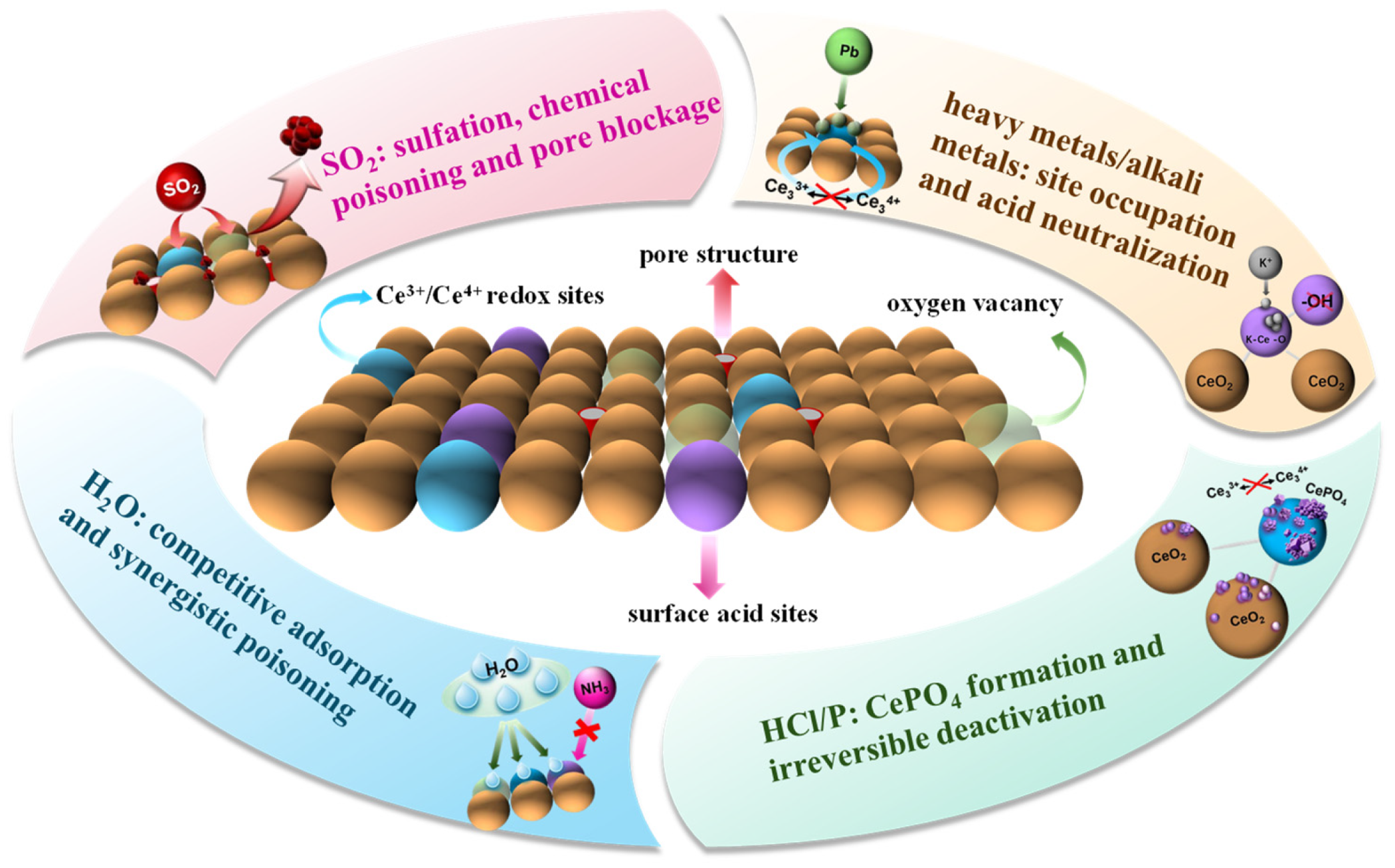
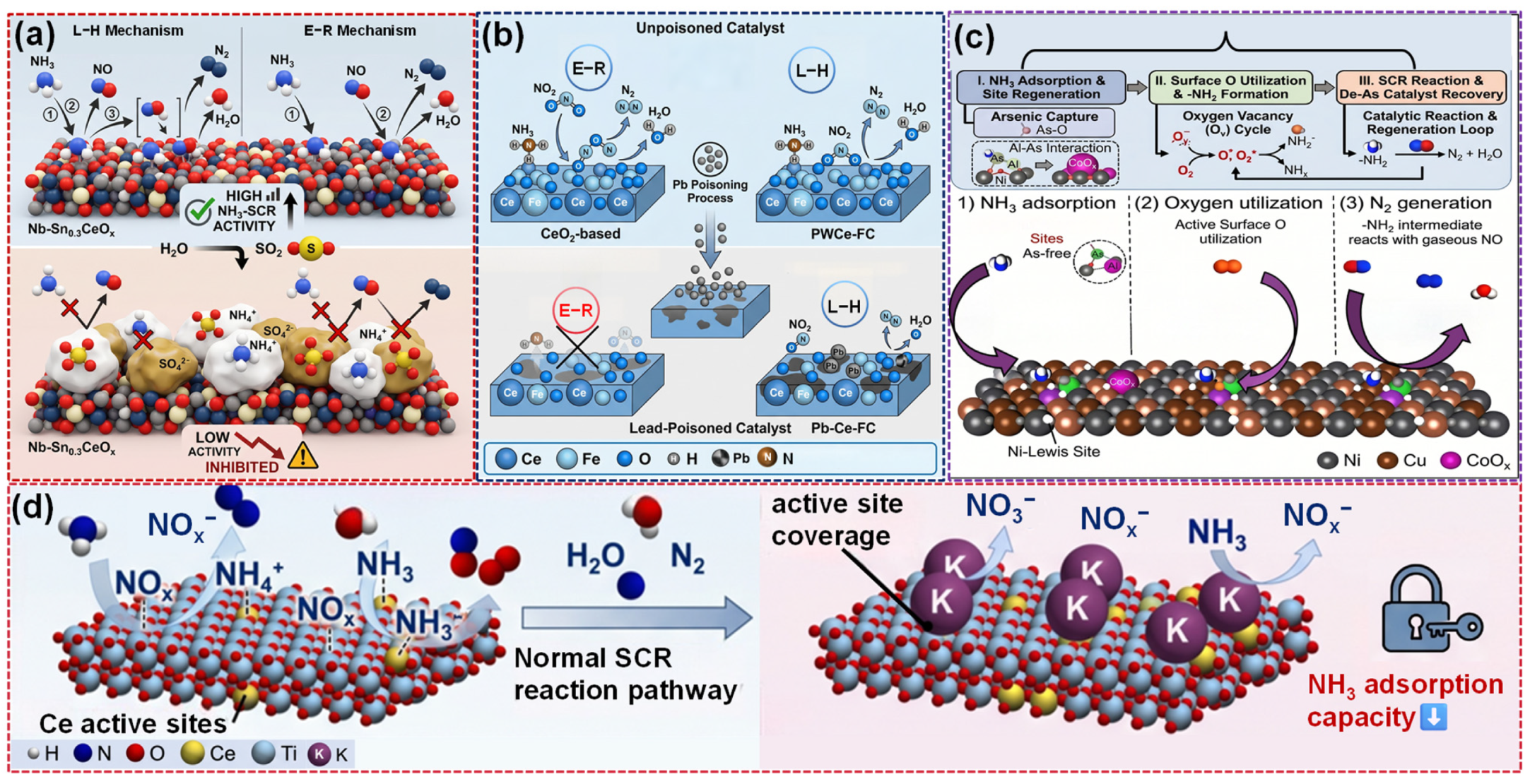
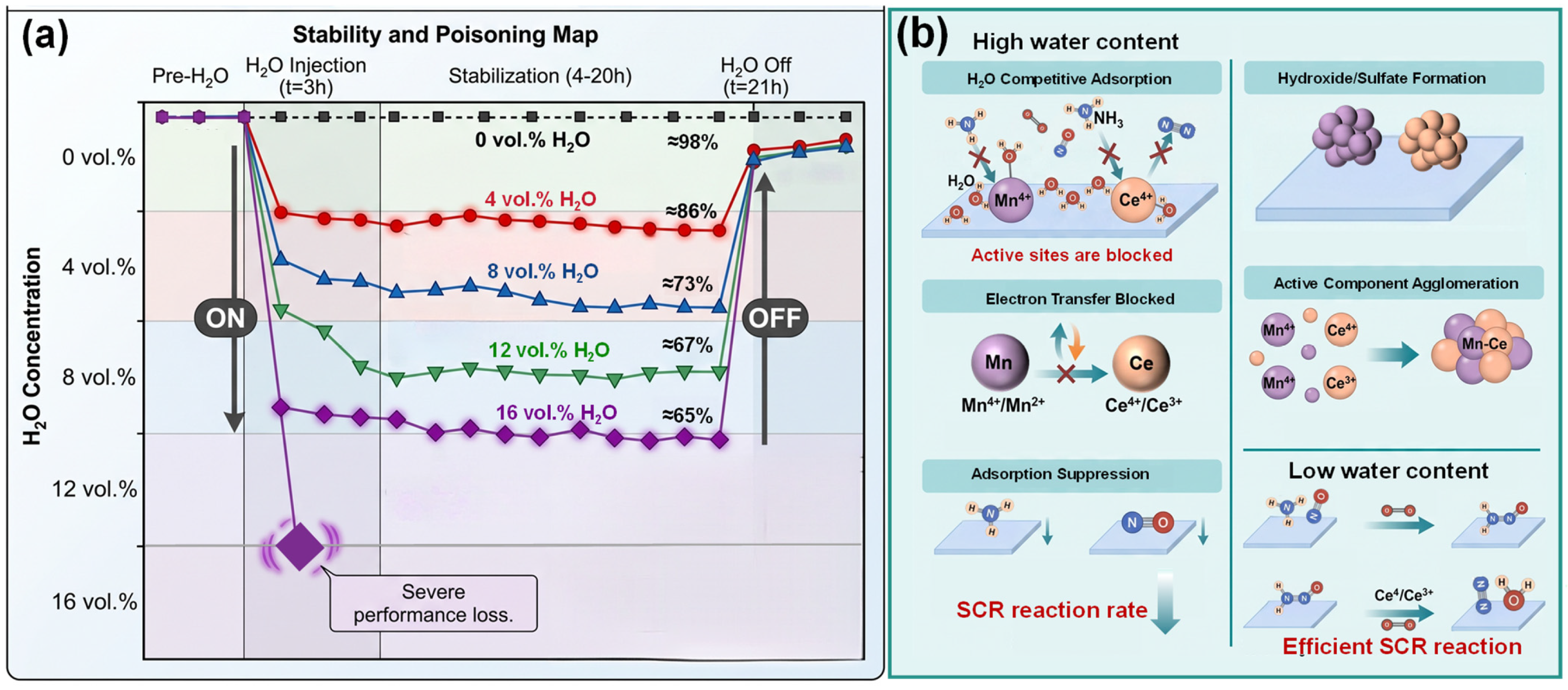
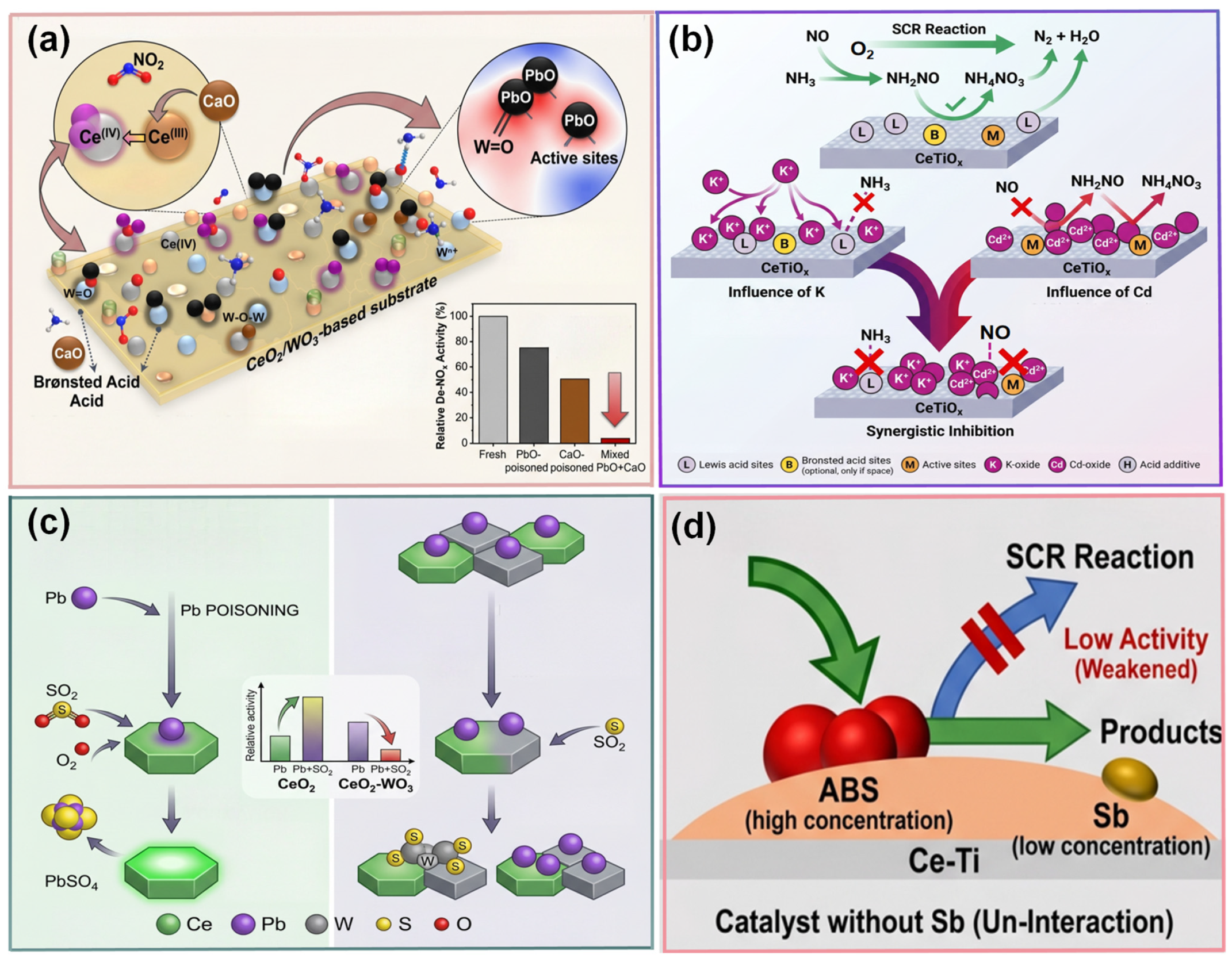
- Complex industrial flue gas typically contains multiple impurities, including SO2, heavy metals, alkali/alkaline earth metals, H2O, P, HCl, and chlorobenzene, which induce catalyst deactivation via synergistic chemical poisoning and physical masking mechanisms. Moreover, the combined poisoning effect of multiple pollutants is substantially more severe than that of individual species, representing a critical bottleneck limiting practical engineering applications. Specifically, SO2 poisoning arises from the synergistic interaction between sulfate formation (chemical poisoning) and ammonium salt deposition (physical blockage). Heavy metals deactivate catalysts in a species-dependent manner by disrupting active sites, redox cycles, and surface structures. Alkali metals primarily deactivate catalysts through neutralization of surface acid sites and deterioration of redox properties. The inhibitory effect of H2O is strongly concentration-dependent, with high concentrations directly interrupting the electron transfer processes within the catalyst system.
- (3)
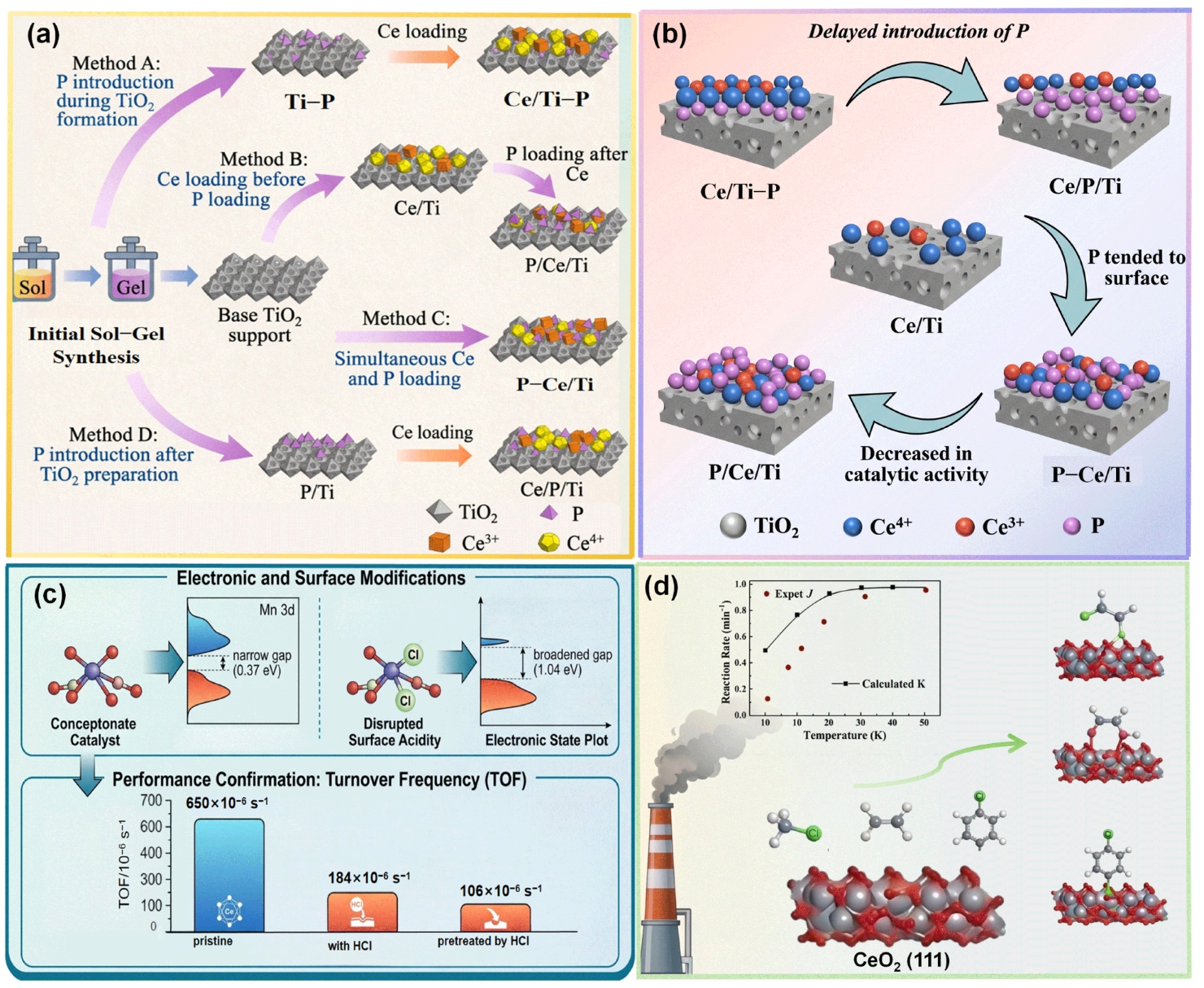
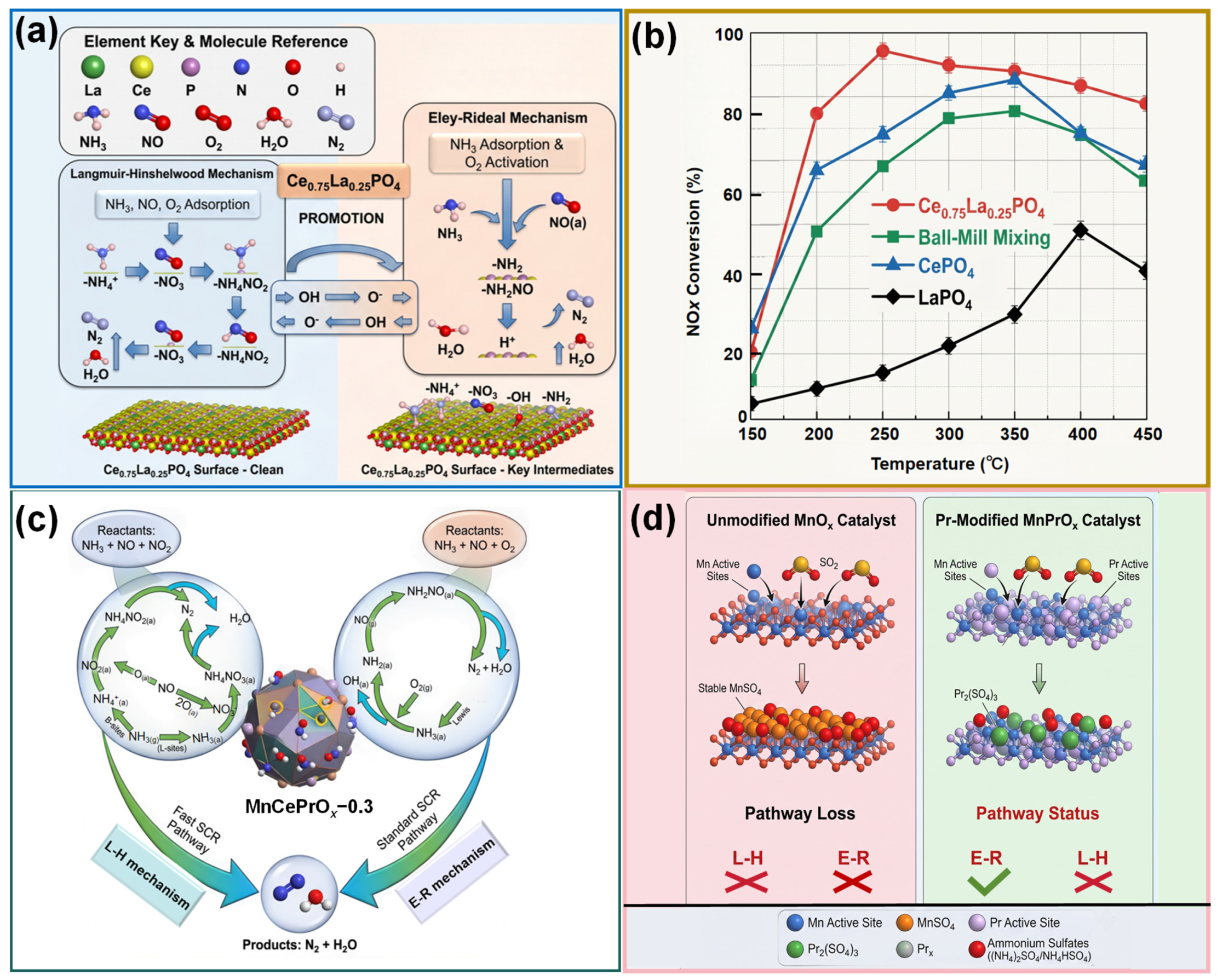
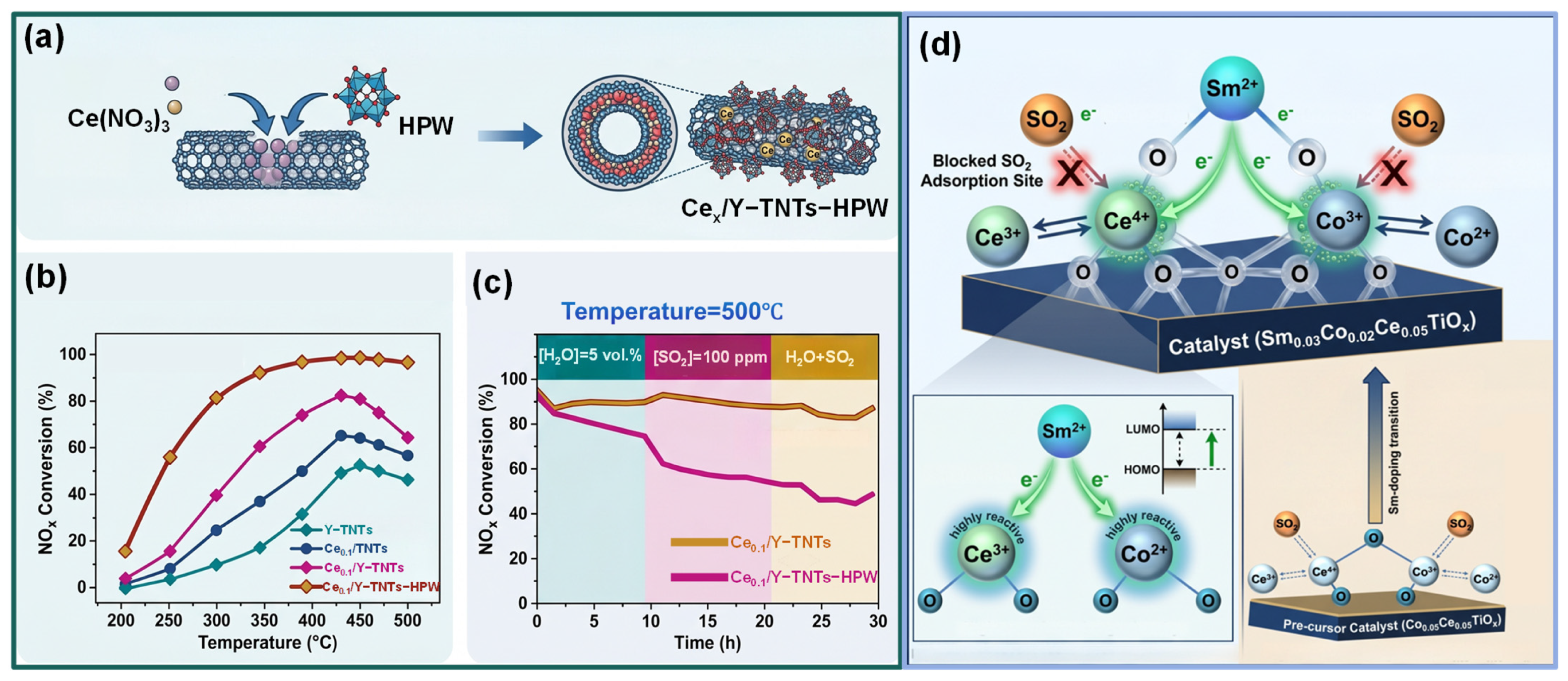
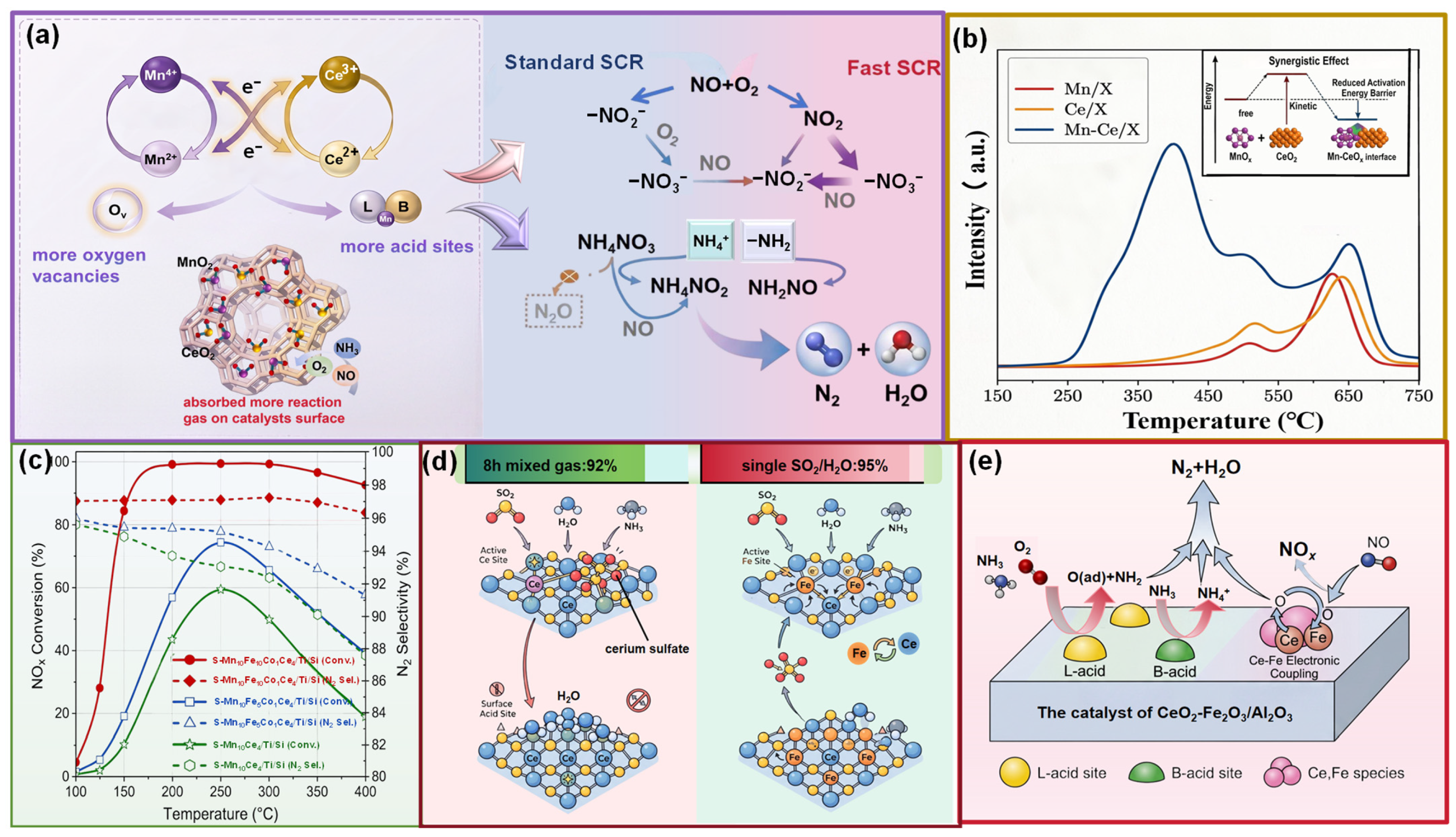
- Elemental doping modification is widely recognized as an effective strategy to enhance the anti-poisoning performance of cerium-based catalysts. Rare earth doping can modulate the electronic structure, promote oxygen vacancy formation, optimize acid site distribution, and thereby improve both anti-poisoning resistance and structural stability. Transition metal (Mn, Fe, Cu) doping confers enhanced low-temperature activity, broadened resistance to sulphur and water over a wide-temperature range, and enables precise regulation of catalytic performance in the medium-to-low temperature window through synergistic effects. Non-metal (S, N, P) doping offers a novel pathway by transforming typical “poisons” (e.g., sulphur species) into active intermediates, stabilizing crystal structures, and suppressing high-temperature sintering. The integration of these three modification strategies enables the simultaneous enhancement of denitrification activity, anti-poisoning capability, and long-term operational stability.
- (4)
- From the perspective of industrial flue gas governance, the optimized anti-poisoning cerium-based catalysts can fully adapt to the harsh working conditions of steel sintering flue gas with high pollutant concentration, fluctuating temperature and complex components. In compliance with China’s ultra-low emission standards for the iron and steel industry, this series of catalysts can stably control NOx emissions below 35 mg/m3, effectively solving the long-standing technical difficulties of denitrification for sintering flue gas. As a green alternative to traditional vanadium-based catalysts, it can eliminate the risk of heavy metal leakage and secondary pollution in industrial operations, and greatly reduce the operation and maintenance pressure of environmental protection facilities in iron and steel enterprises.
6. Prospects
- (1)
- In terms of atmospheric environmental protection, the large-scale popularization of high-performance cerium-based SCR catalysts will significantly cut down NOx emissions from key industrial sources. Nitrogen oxides are major precursors of haze, photochemical smog and acid rain. Efficient denitrification using cerium-based catalysts helps reduce regional air pollution, improve ambient air quality, and protect terrestrial and aquatic ecosystems.
- (2)
- For low-carbon development and carbon neutrality goals, cerium-based catalysts have prominent advantages in the whole life cycle. Compared with traditional catalysts, their preparation process consumes less energy and produces fewer carbon emissions. Meanwhile, excellent low-temperature activity enables the denitrification system to operate at a lower temperature, reducing the heat supply demand of flue gas and cutting the energy consumption and carbon footprint of industrial enterprises. The popularization of this green catalytic technology can help traditional high-emission industries, such as iron and steel, realize energy saving, emission reduction and low-carbon transformation, and boost the implementation of national carbon peaking and carbon neutrality strategies.
- (3)
- From the industrial and social benefits, China is rich in rare earth resources, and the industrialization of cerium-based denitrification catalysts can drive the high-value utilization of domestic rare earth resources, extend the rare earth industrial chain, and promote the upgrading of regional green environmental protection industries. In addition, the localization and popularization of low-cost, high-performance cerium-based catalysts can lower the threshold of industrial flue gas denitrification technology, enable more small and medium-sized industrial enterprises to meet ultra-low emission requirements, and promote the overall green and sustainable development of the manufacturing industry.
Author Contributions
Funding
Data Availability Statement
Conflicts of Interest
References
- Lin, D.; Zhang, L.; Liu, Z.; Wang, B.; Han, Y. Progress of selective catalytic reduction denitrification catalysts at wide temperature in carbon neutralization. Front. Chem. 2022, 10, 946133. [Google Scholar] [CrossRef] [PubMed]
- Zhao, S.; Peng, J.; Ge, R.; Wu, S.; Zeng, K.; Huang, H.; Yang, K.; Sun, Z. Research progress on selective catalytic reduction (SCR) catalysts for NO removal from coal-fired flue gas. Fuel Process Technol. 2022, 236, 107432. [Google Scholar] [CrossRef]
- Huang, Z.; Gong, D.; Peng, C.; Chen, J.; Luo, J.; Xu, Y.; Yang, L. Numerical simulation study on combustion of low calorific value waste blended with biomass. ACS Omega 2024, 9, 14297–14309. [Google Scholar] [CrossRef] [PubMed]
- Ciupek, B.; Urbaniak, R.; Kinalska, D.; Nadny, Z. Flue gas recirculation system for biomass heating boilers—Research and technical applications for reductions in nitrogen oxides (NOx) emissions. Energies 2024, 17, 259. [Google Scholar] [CrossRef]
- GB 28662-2012; Emission Standard of Air Pollutants for Sintering and Pelletizing Industry of Iron and Steel. Ministry of Ecology and Environment of the People’s Republic of China: Beijing, China, 2012.
- Yu, J.; Xu, R.; Zhang, J.; Zheng, A. A review on reduction technology of air pollutant in current China’s iron and steel industry. J. Clean. Prod. 2023, 414, 137659. [Google Scholar] [CrossRef]
- Shen, Z.; Xing, X.; Guo, P.; Ren, S.; Wei, D.; Meng, H. Insight into the Cd resistance mechanism of MoCuMnOx/CeO2 catalyst for simultaneously NH3-SCR denitration and CO oxidation: Directional capture of Cd by MoOx. Chem. Eng. J. 2026, 527, 171626. [Google Scholar] [CrossRef]
- She, Y.; Li, J.; Shen, Z.; Xing, X.; Ding, Z.; Li, H.; Meng, H.; Niu, W. Low temperature sintering flue gas NH3-SCR denitrification mechanism of embedded 7Mn3Ce/AC catalyst. J. Environ. Chem. Eng. 2024, 12, 114610. [Google Scholar] [CrossRef]
- Lv, T.-Y.; Cui, Z.-L.; Guo, R.-T. Application of layered double hydroxides (LDHs) derived catalysts for selective catalytic reduction of NOx with NH3. Fuel 2026, 412, 138206. [Google Scholar] [CrossRef]
- Li, J.; Zhang, B.; Shen, K.; Zhang, Y. Progress of wide-temperature denitrification over vanadium-based catalysts for NH3-SCR in flue gas from coal-fired boilers. J. Fuel Chem. Technol. 2025, 53, 1726–1738. [Google Scholar] [CrossRef]
- Li, Y.; Zhang, T.; Niu, X.; Zhu, Y. Vanadium-based catalysts for selective catalytic reduction of NOx with ammonia: Synthesis, poisoning mechanism, regeneration methods and research prospects. Fuel 2024, 365, 131184. [Google Scholar] [CrossRef]
- Won, J.M.; Kim, J.T.; Jeong, S.K.; Hwang, S.-M. Primary factors affecting denitrification efficiency of V-based catalysts in low-temperature selective catalytic reduction using NH3. Appl. Surf. Sci. 2021, 566, 150632. [Google Scholar] [CrossRef]
- Zhao, S.; Peng, J.; Ge, R.; Yang, K.; Wu, S.; Qian, Y.; Xu, T.; Gao, S.; Chen, Y.; Sun, Z. Poisoning and regeneration of commercial V2O5-WO3/TiO2 selective catalytic reduction (SCR) catalyst in coal-fired power plants. Process Saf. Environ. Prot. 2022, 168, 971–992. [Google Scholar] [CrossRef]
- Wu, Y.-W.; Zhou, X.-Y.; Zhou, J.-L.; Hu, Z.; Cai, Q.; Lu, Q. A comprehensive review of the heavy metal issues regarding commercial vanadium-titanium-based SCR catalyst. Sci. Total Environ. 2023, 857, 159712. [Google Scholar] [CrossRef] [PubMed]
- Zhuang, Z.; Guan, B.; Zhu, L.; Hu, X.; Zhu, C.; Zhao, S.; Chen, J.; Shu, K.; Dang, H.; Gao, J.; et al. Pd/F-Al2O3 catalyst for N2O-NH3-SCR with ultrahigh low-temperature activity and resistance to inhibitory gases: Property research of being rich in oxygen vacancies with free electrons and reaction mechanisms. Chem. Eng. J. 2025, 522, 167265. [Google Scholar] [CrossRef]
- Li, J.; Yao, P.; Huang, Y.; Li, Y.; Wang, J.; Chen, Y.; Xu, H. Revealing the effects of introducing Fe on the N2 selectivity of Pt-SSZ-13 catalyst for ammonia selective catalytic oxidation. Catal. Sci. Technol. 2025, 15, 7129. [Google Scholar] [CrossRef]
- Kim, K.; Lee, Y.; Hong, G.; Ahn, S.; Kim, B.; Lee, S.; Jeon, Y.; Roh, H. A study on the activity recovery behavior of noble metal catalysts against sulfur poisoning. Catal. Today 2024, 425, 114361. [Google Scholar] [CrossRef]
- Yin, Y.; Luo, B.; Sun, Y.; Xie, P.; Xiong, H.; Zhu, T.; Li, A. Activation of lattice oxygen in ceria by plasma exsolution of MoOx with atomic dispersion for NOx abatement. ACS Catal. 2024, 14, 5236–5246. [Google Scholar] [CrossRef]
- Chen, L.; Wang, Y.; Wang, X.; Wang, Q.; Li, B.; Li, S.; Zhang, S.; Li, W. Bronsted acid enhanced hexagonal cerium phosphate for the selective catalytic reduction of NO with NH3: In situ DRIFTS and DFT investigation. J. Hazard. Mater. 2022, 424, 127334. [Google Scholar] [CrossRef] [PubMed]
- Hu, C.; Liu, C.; Du, K.; Pang, C.; Zhu, Z.; Qian, G. Energy-saving catalyst Fe/Ce-Mn-TiO2 for efficient low temperature NH3-SCR of NOx with high water content. J. Environ. Chem. Eng. 2023, 11, 110440. [Google Scholar] [CrossRef]
- Zhao, Q.; Zhang, G.; Huang, X.; Zhang, H.; Feng, C.; Tang, Z. Enhancement effect of Lewis acid-base pair derived from mortise-tenon structure catalyst on high-temperature NH3-SCR: Oxygen vacancy confinement and interfacial electron rearrangement. Appl. Catal. B Environ. 2026, 385, 126329. [Google Scholar] [CrossRef]
- Pei, Z.; Fu, Z.; Wang, H.; Xu, J.; Zhao, H.; Han, S.; Ni, H.; Guo, T. Influences of glycerol-assisted ultrasonic modification on the ultra-low temperature NH3-SCR MnFeOx catalysts. Fuel 2025, 380, 133130. [Google Scholar] [CrossRef]
- Farrauto, R.; Heck, R. Catalytic converters: State of the art and perspectives. Catal. Today 1999, 51, 351. [Google Scholar] [CrossRef]
- Sartoretti, E.; Novara, C.; Chiodoni, A.; Giorgis, F.; Piumetti, M.; Bensaid, S.; Russo, N.; Fino, D. Nanostructured ceria-based catalysts doped with La and Nd: How acid-base sites and redox properties determine the oxidation mechanisms. Catal. Today 2022, 390–391, 117. [Google Scholar] [CrossRef]
- Zhu, L.; Yao, J.; Ma, G.; Cao, P.; Wu, S.; Li, Z. NH3-SCR performance and SO2 resistance comparison of CeO2 based catalysts with Fe/Mo additive surface decoration. Chem. Eng. J. 2022, 428, 131372. [Google Scholar] [CrossRef]
- Wang, F.; Li, S.; You, R.; Han, Z.; Yuan, W.; Zhu, B.; Gao, Y.; Yang, H.; Wang, Y. Unraveling the synergy between MnOx and CeO2 in MnOx-CeO2 SCR catalysts based on experimental and DFT studies. Appl. Surf. Sci. 2023, 638, 158124. [Google Scholar] [CrossRef]
- Song, L.; Liu, C.; Bian, C.; Cheng, X.; Li, X.; Cheng, Y.; Li, S.; Fan, X.; He, H. Structural properties and low-temperature NH3-SCR activity of CeO2-MnO mixed oxides catalyst in the microwave field. Catal. Today 2024, 437, 114768. [Google Scholar] [CrossRef]
- Liu, Z.; Shen, M.; Wang, S.; Zhang, C.; Shen, G.; Wang, Y.; Li, X.; Jia, L.; Li, W.; Gao, F. CeO2/Cu-SSZ-13 composite NH3-SCR catalysts for breaking the trade-off between low-temperature activity and N2O formation. Appl. Catal. B Environ. 2026, 386, 126361. [Google Scholar] [CrossRef]
- Yang, S.; Ren, S.; Yang, H.; Li, X.; Zheng, C.; Li, X.; Chai, S.; Chai, Y.; Xu, C. Morphology regulation of CuO/CeO2 catalyst for simultaneous NH3-SCR denitration and CO oxidation. J. Environ. Chem. Eng. 2025, 13, 118868. [Google Scholar] [CrossRef]
- Yang, R.; Li, Z.; Cui, J.; Ma, Y.; Yang, C. Modulating the low-temperature NH3-SCR activity of bimetallic MOF-derived MnCeOx/C catalyst via the molar ratio of manganese and cerium. Adv. Powder Technol. 2025, 36, 105102. [Google Scholar] [CrossRef]
- Yan, Q.; Hou, X.; Liu, G.; Li, Y.; Zhu, T.; Xing, Y.; Wang, Q. Recent advances in layered double hydroxides (LDHs) derived catalysts for selective catalytic reduction of NOx with NH3. J. Hazard. Mater. 2020, 400, 123260. [Google Scholar] [CrossRef] [PubMed]
- Liu, Z.; Shen, M.; Wang, S.; Zhang, C.; Shen, G.; Li, X.; Li, W.; Gao, F. CeO2/H-SSZ-13 composite NH3-SCR catalysts achieve unprecedented high-temperature N2 selectivity. J. Catal. 2026, 453, 116459. [Google Scholar] [CrossRef]
- Deng, Z.; Li, H.; Pang, X.; Liu, W.; Ji, J.; Li, G.; Peng, H. CeNbOx/SSZ-13 catalysts with zeolite-protected active sites for broad-temperature NH3-SCR and enhanced resistance to K-poisoning. Appl. Catal. B Environ. 2026, 384, 126176. [Google Scholar] [CrossRef]
- Farhan, A.; Khalid, A.; Maqsood, N.; Iftekhar, S.; Sharif, H.M.A.; Qi, F.; Sillanpää, M.; Asif, M.B. Progress in layered double hydroxides (LDHs): Synthesis and application in adsorption, catalysis and photoreduction. Sci. Total Environ. 2024, 912, 169160. [Google Scholar] [CrossRef] [PubMed]
- Sonti, S.; Sun, C.; Chen, Z.; Kowalski, R.M.; Kowalski, J.S.; Donadio, D.; Ahn, S.-H.; Kulkarni, A.R. Stability and dynamics of zeolite-confined gold nanoclusters. J. Chem. Theory Comput. 2024, 20, 8261. [Google Scholar] [CrossRef] [PubMed]
- Wang, Y.; Song, Z.; Zhou, M.; Zhang, X.; Chen, X.; Huang, Z.; Liu, W.; Gao, H.; Gu, D.; Yu, H. Sequential sulfidation engineering in Ce-Zr catalysts: Acid site evolution steering reaction pathway optimization for NH3-SCR systems. J. Alloys Compd. 2025, 1038, 182795. [Google Scholar] [CrossRef]
- Du, P.; Chen, C.; Chen, X.; Dong, C.; Cao, Y.; Jia, W.; Guo, Z.; Liu, S. Ho-doping enhanced CuO/CeO2 nanorods for low-temperature synergistic NH3-SCR and CO oxidation under oxygen-rich conditions. J. Environ. Chem. Eng. 2025, 13, 118432. [Google Scholar] [CrossRef]
- Fu, S.; Zhao, R.; Li, H.; Pan, D.; Bao, J.; Song, L.; Zhu, C. DFT-guided mechanistic elucidation of Ce-Sn-Sm catalysts for NH3-SCR: Dual Sulfur/water resistance and redox-acidic synergetic pathways. Fuel 2026, 406, 137117. [Google Scholar] [CrossRef]
- Liu, J.; Huo, Y.; Shi, X.; Liu, Z.; Shan, Y.; Yu, Y.; Shan, W.; He, H. Insight into the remarkable enhancement of NH3-SCR performance of Ce-Sn oxide catalyst by tungsten modification. Catal. Today 2023, 410, 36–44. [Google Scholar] [CrossRef]
- Shen, Z.; Xing, X.; She, Y.; Guo, P.; Ren, S.; Niu, W.; Li, J.; Li, H.; Meng, H. Unveiling the promoting mechanism of Mo on the performance of CuCeOx catalyst for simultaneously NH3-SCR denitration and CO oxidation under oxygen-rich conditions. Sep. Purif. Technol. 2025, 355, 129561. [Google Scholar] [CrossRef]
- Bian, X.; Lv, K.; Cai, M.; Cen, P.; Wu, W. Effects of flue gas impurities on the performance of rare earth denitration catalysts. Catalysts 2022, 12, 808. [Google Scholar] [CrossRef]
- Wang, F.; Cai, Q.; Gao, J.; He, X.; Ji, Y.; Shen, B. Synthesis of hollow structured MnCeOx@PrCeOx catalyst for low temperature NH3-SCR with enhanced SO2 resistance. Appl. Surf. Sci. 2025, 685, 162067. [Google Scholar] [CrossRef]
- Xu, W.; He, H.; Yu, Y. Deactivation of a Ce/TiO2 catalyst by SO2 in the selective catalytic reduction of NO by NH3. J. Phys. Chem. C 2009, 113, 4426–4432. [Google Scholar] [CrossRef]
- Peng, Y.; Wang, D.; Li, B.; Wang, C.; Li, J.; Crittenden, J.; Hao, J. Impacts of Pb and SO2 poisoning on CeO2-WO3/TiO2-SiO2 SCR catalyst. Environ. Sci. Technol. 2017, 51, 11943–11949. [Google Scholar] [CrossRef] [PubMed]
- An, D.; Yang, S.; Zou, W.; Sun, J.; Tan, W.; Ji, J.; Tong, Q.; Sun, C.; Li, D.; Dong, L. Unraveling the SO2 poisoning effect over the lifetime of MeOx (Me = Ce, Fe, Mn) catalysts in low-temperature NH3-SCR: Interaction of reaction atmosphere with surface species. J. Phys. Chem. C 2022, 126, 12168–12177. [Google Scholar] [CrossRef]
- Zou, J.; Impeng, S.; Wang, F.; Lan, T.; Wang, L.; Wang, P.; Zhang, D. Compensation or aggravation: Pb and SO2 copoisoning effects over ceria-based catalysts for NOx reduction. Environ. Sci. Technol. 2022, 56, 13368–13378. [Google Scholar] [CrossRef] [PubMed]
- Yan, L.; Wang, F.; Wang, P.; Impeng, S.; Liu, X.; Han, L.; Yan, T.; Zhang, D. Unraveling the unexpected offset effects of Cd and SO2 deactivation over CeO2-WO3/TiO2 catalysts for NOx reduction. Environ. Sci. Technol. 2020, 54, 7697–7705. [Google Scholar] [CrossRef] [PubMed]
- Xu, Z.; Xiong, J.; Li, Y.; Guo, J.; Wang, B.; Zhu, T. Mechanism of ammonium bisulfate deposition on V1M5/Ti catalysts with synergistic effects of V and M (M = Ce, Co, Fe, and Mn) in low-temperature NH3-SCR. Catal. Sci. Technol. 2024, 14, 1931. [Google Scholar] [CrossRef]
- Shi, W.; Liu, J.; Zhu, Y.; Zhao, L.; Wang, Y.; Chen, Z.; Peng, X.; Shi, X.; Yu, Y.; He, H. Extruded monolith MnOx-CeO2-TiO2 catalyst for NH3-SCR of low temperature flue gas from an industry boiler: Deactivation and recovery. J. Rare Earths 2023, 41, 1336–1343. [Google Scholar] [CrossRef]
- Zhang, K.; Luo, N.; Huang, Z.; Zhao, G.; Chu, F.; Yang, R.; Tang, X.; Wang, G.; Gao, F.; Huang, X. Recent advances in low-temperature NH3-SCR of NOx over Ce-based catalysts: Performance optimizations, reaction mechanisms and anti-poisoning countermeasures. Chem. Eng. J. 2023, 476, 146889. [Google Scholar] [CrossRef]
- Wang, X.; Liu, Y.; Wu, Z. The poisoning mechanisms of different zinc species on a ceria-based NH3-SCR catalyst and the co-effects of zinc and gas-phase sulfur/chlorine species. J. Colloid. Interface Sci. 2020, 566, 153–162. [Google Scholar] [CrossRef] [PubMed]
- Chen, L.; Xing, X.; Wang, M.; Chen, Z.; Li, X.; Ren, S. Revealing different lead species of PbCl2, Pb(NO3)2, PbSO4 and PbCO3 poisoning effects on Mn-Ce/CuX catalyst for low-temperature NH3-SCR of NO. Sep. Purif. Technol. 2024, 330, 125376. [Google Scholar] [CrossRef]
- Zheng, J.; Gui, X. Potassium Poisoning effects on sol-gel Mn/TiO2 catalyst for selective catalytic reduction (SCR) of NOx with NH3 at low temperature. Chem. Sel. 2023, 8, e202202315. [Google Scholar] [CrossRef]
- Su, Z.; Ren, S.; Yang, J.; Yao, L.; Zhou, Y.; Chen, Z.; Zhang, T. Poisoning effect comparison of ZnCl2 and ZnSO4 on Mn-Ce/AC catalyst for low-temperature SCR of NO. Chem. Sel. 2020, 5, 9226–9234. [Google Scholar] [CrossRef]
- Wu, Y.; Hu, Z.; Zhou, J.; Zhao, H.; Yu, Y.; Zhou, X.; Cai, Q.; Zhang, B.; Lu, Q. Improvement in the resistance to KCl and PbCl2 synergistic poisoning of the commercial SCR catalyst by Ce(SO4)2 modification: A combined experimental and spin-polarized DFT study. J. Environ. Chem. Eng. 2023, 11, 109649. [Google Scholar] [CrossRef]
- Guo, X.; Wang, Y.; Bai, Z.; Yang, L.; Liu, B.; Zhang, J. Ce-doped Fe-Beta zeolite for efficient high-temperature phosphorus poisoning mitigation in NH3-SCR system. Chem. Eng. J. 2025, 522, 167899. [Google Scholar] [CrossRef]
- Geng, X.; Zhu, B.; Sun, Y.; Chen, J.; Zhou, X.; Li, M.; Xu, M. Microscopic impact mechanism of alkali earth metal poisoning and Ce modification on the deNOx over the γ-Fe2O3 (0 0 1) surface. Appl. Surf. Sci. 2023, 608, 155178. [Google Scholar] [CrossRef]
- Li, S.; Yu, H.; Lan, T.; Shi, L.; Cheng, D.; Han, L.; Zhang, D. NOx reduction against alkali poisoning over Ce(SO4)2-V2O5/TiO2 catalysts by constructing the Ce4+-SO42− pair sites. Chin. Chem. Lett. 2024, 35, 108240. [Google Scholar] [CrossRef]
- Liu, Y.; Cen, W.; Wu, Z.; Weng, X.; Wang, H. SO2 poisoning structures and the effects on pure and Mn doped CeO2: A first principles investigation. J. Phys. Chem. C 2012, 116, 22930–22937. [Google Scholar] [CrossRef]
- Ren, D.; Gui, K.; Gu, S. Comparison of sulfur poisoning resistance of Ce/Mn doped γ-Fe2O3 (0 0 1) surface in NH3-SCR reaction with DFT method. Appl. Surf. Sci. 2021, 561, 149847. [Google Scholar] [CrossRef]
- Li, T.Y.; Wey, M.Y. Advancements in SO2 tolerance for low-temperature NH3-SCR through tailoring oxidation ability and pore size in MnCe-based catalysts. J. Environ. Manag. 2025, 391, 126524. [Google Scholar] [CrossRef] [PubMed]
- Zheng, F.; Liu, C.; Ma, X.; Zhou, Z.; Liu, J. Review on NH3-SCR for simultaneous abating NOx and VOCs in industrial furnaces: Catalysts’ composition, mechanism, deactivation and regeneration. Fuel Process Technol. 2023, 247, 107773. [Google Scholar] [CrossRef]
- Bai, Y.; Li, H.; Tong, D.; Niu, X.; Li, Z.; Zhu, Y. Improving low-temperature NH3-SCR denitration activity and resistance to H2O and SO2 over Nb-modified NbaSn0.3CeOx catalysts by enhancing acidity to compensate for its weak oxidation ability. Sep. Purif. Technol. 2024, 329, 125212. [Google Scholar] [CrossRef]
- Rodriguez, J.; Jirsak, T.; Freitag, A.; Hanson, J.; Larese, J.; Chaturvedi, S. Interaction of SO2 with CeO2 and Cu/CeO2 catalysts: Photoemission, XANES and TPD studies. Catal. Lett. 1999, 62, 113. [Google Scholar] [CrossRef]
- Song, J.; Sun, X.; Zhang, G.; Cheng, S.; Xu, Y.; Yang, Y. Recent advances in improving SO2 resistance of Ce-based catalysts for NH3-SCR: Mechanisms and strategies. Mol. Catal. 2024, 564, 114347. [Google Scholar] [CrossRef]
- Li, L.; Kunwar, M.; Zhu, C.; Zhong, J.; Francisco, J.S.; Cheng, X. Near-barrierless ammonium bisulfate formation via a loop-structure promoted proton-transfer mechanism on the surface of water. J. Am. Chem. Soc. 2016, 138, 1816–1819. [Google Scholar] [CrossRef] [PubMed]
- Xie, Q.; An, D.; Zhou, L.; Li, T.; Hu, Z.; Chen, M.; Ma, M.; Zhang, L.; Sun, J.; Dong, L. Deactivation induced by metal sulfate over MnCeOx catalyst in NH3-SCR reaction at low temperature. J. Rare Earths 2024, 42, 1056–1065. [Google Scholar] [CrossRef]
- Zeng, P.; Zhou, Z.; Liu, L.; Yu, X.; Li, X.; Li, M. Wide-temperature NOx removal via NH3-SCR enabled by synergistic atomically dispersed Ce-V dual sites: Anti-sulfur performance and new insight on the role of NH4HSO4. Fuel 2026, 407, 137594. [Google Scholar] [CrossRef]
- She, Y.; Meng, H.; Shen, Z.; Niu, W.; Peng, C.; Li, K.; Miao, H.; Xing, X.; Zhang, Z. Unveiling the effect of W and Co on PbO resistance over FeCe catalyst for low-temperature NH3-SCR of NO. J. Hazard. Mater. 2025, 487, 137221. [Google Scholar] [CrossRef] [PubMed]
- Wang, X.; Peng, J.; Wang, Y.; Guo, N.; Li, T.; Li, H.; Ren, D.; Gui, K. Poisoning mechanism of different Cd precursors on Fe-Ce/TiO2 catalyst for selective catalytic reduction of NOx with NH3. J. Environ. Chem. Eng. 2023, 11, 109625. [Google Scholar] [CrossRef]
- Jiang, S.; Li, T.; Zheng, J.; Zhang, H.; Li, X.; Zhu, T. Unveiling the remarkable arsenic resistance origin of alumina promoted cerium-tungsten catalysts for NH3-SCR. Environ. Sci. Technol. 2020, 54, 14740–14749. [Google Scholar] [CrossRef] [PubMed]
- Li, X.; Li, X.; Zhu, T.; Peng, Y.; Li, J.; Hao, J. Extraordinary deactivation offset effect of arsenic and calcium on CeO2-WO3 SCR catalysts. Environ. Sci. Technol. 2018, 52, 8578–8587. [Google Scholar] [CrossRef] [PubMed]
- Li, H.; Wu, S.; Wu, C.; Wang, J.; Li, L.; Shi, K. SCR atmosphere induced reduction of oxidized mercury over CuO-CeO2/TiO2 catalyst. Environ. Sci. Technol. 2015, 49, 7373–7379. [Google Scholar] [CrossRef] [PubMed]
- Wu, W.; Zeng, Z.; Lu, P.; Xing, Y.; Wei, J.; Yue, H.; Li, R. Simultaneous oxidation of Hg0 and NH3-SCR of NO by nanophase CexZryMnzO2 at low temperature: The interaction and mechanism. Environ. Sci. Pollut. Res. 2018, 25, 14471–14485. [Google Scholar] [CrossRef] [PubMed]
- Wang, X.; Fang, Q.; Wang, J.; Gui, K.; Rhys Thom, H. Effect of CaCO3 on catalytic activity of Fe-Ce/Ti catalysts for NH3-SCR reaction. RSC Adv. 2020, 10, 44876. [Google Scholar] [CrossRef] [PubMed]
- Zhou, L.; Li, C.; Zhao, L.; Zeng, G.; Gao, L.; Wang, Y.; Yu, M. The poisoning effect of PbO on Mn-Ce/TiO2 catalyst for selective catalytic reduction of NO with NH3 at low temperature. Appl. Surf. Sci. 2016, 389, 532. [Google Scholar] [CrossRef]
- Kang, K.; Yao, X.; Huang, Y.; Cao, J.; Rong, J.; Zhao, W.; Luo, W.; Chen, Y. Insights into the co-doping effect of Fe3+ and Zr4+ on the anti-K performance of CeTiOx catalyst for NH3-SCR reaction. J. Hazard. Mater. 2021, 416, 125821. [Google Scholar] [CrossRef] [PubMed]
- Li, M.; Guo, R.; Hu, C.; Sun, P.; Pan, W.; Liu, S.; Sun, X.; Liu, S.; Liu, J. The enhanced resistance to K deactivation of Ce/TiO2 catalyst for NH3-SCR reaction by the modification with P. Appl. Surf. Sci. 2018, 436, 814–822. [Google Scholar] [CrossRef]
- Jiang, Y.; Liu, T.; Lai, C.; Yang, Z.; Lin, R.; Wang, X.; Zhu, X. Deactivation of CeO2-TiO2 catalyst by K2SO4 for NH3-SCR: An experimental and DFT study. Appl. Surf. Sci. 2021, 547, 149196. [Google Scholar] [CrossRef]
- Jiang, Y.; Wang, X.; Bao, C.; Huang, S.; Zhang, X.; Wang, X. Poisoning effect of CaO on CeO2/TiO2 catalysts for selective catalytic reduction of NO with NH3. Korean J. Chem. Eng. 2017, 34, 1874–1881. [Google Scholar] [CrossRef]
- Su, Z.; Ren, S.; Chen, Z.; Yang, J.; Zhou, Y.; Zhang, L.; Chen, Y. Deactivation effect of CaO on Mn-Ce/AC catalyst for SCR of NO with NH3 at low temperature. Catalysts 2020, 10, 873. [Google Scholar] [CrossRef]
- Fu, Y.; Sun, Y.; Shan, Y.; Chen, J.; Du, J.; He, G.; He, H. Unexpected promotion effect of H2O on the selective catalytic reduction of NOx with NH3 over Cu-SSZ-39 catalysts. Environ. Sci. Technol. 2024, 58, 3520–3529. [Google Scholar] [CrossRef] [PubMed]
- Ma, L.; Li, Z.; Zhao, H.; Zhang, T.; Yan, N.; Li, J. Understanding the water effect for selective catalytic reduction of NOx with NH3 over Cu-SSZ-13 catalysts. ACS ESandT Eng. 2022, 2, 1684. [Google Scholar] [CrossRef]
- Liu, W.; Kou, M.; Yang, S.; Cao, P. Inhibitory effect and mechanism of varying water vapor content on a monolithic low-temperature NH3-selective catalytic reduction catalyst. Process Saf. Environ. Prot. 2025, 204, 108137. [Google Scholar] [CrossRef]
- Zhang, R.; Lu, Z.; Wang, J.; Shen, Y. Balancing active sites and redox capacity via structural engineering: A strategy to enhance H2O/SO2 tolerance of CeMnOx catalyst for low-temperature NH3-SCR deNOx. J. Environ. Chem. Eng. 2025, 13, 118623. [Google Scholar] [CrossRef]
- Arfaoui, J.; Ghorbel, A.; Petitto, C.; Debay, G. Effect of acidic components (SO42− and WO3) on the surface acidity, redox ability and NH3-SCR activity of new CeO2-TiO2 nanoporous aerogel catalysts: A comparative study. Inorg. Chem. Commun. 2022, 140, 109494. [Google Scholar] [CrossRef]
- Wang, A.; Wang, J.; Sheti, S.; Dahlin, S.; Han, J.; Woo, J.; Xie, K.; Pettersson, L.; Olsson, L. A deactivation mechanism study of phosphorus-poisoned diesel oxidation catalysts: Model and supplier catalysts. Catal. Sci. Technol. 2020, 10, 5602. [Google Scholar] [CrossRef]
- Wang, J.; Zhang, J.; Xing, C.; Jin, T.; Liu, J.; Ju, M.; Tang, X. Unique responses of Cu-SSZ-13 toward phosphorus: Al atoms on zeolite framework versus varied Cu species. Chem. Eng. J. 2023, 455, 140379. [Google Scholar] [CrossRef]
- Yu, S.; Zeng, Y.; Zhan, M.; Zhang, S.; Zhao, Z. Sensitivity of phosphorus introduction stage to the catalytic activity of CeO2/TiO2 catalysts for selective catalytic reduction of NOx with NH3. Appl. Surf. Sci. 2025, 698, 163075. [Google Scholar] [CrossRef]
- Xue, H.; Guo, X.; Guo, Q.; Xue, Z.; Yu, J.; Meng, T.; Mao, D. Promotional effects of phosphotungstic acid on the alkali metals poisoning resistance of MnOx catalyst for NH3-SCR. Fuel 2025, 390, 134728. [Google Scholar] [CrossRef]
- Wu, H.; Li, J.; Gao, M.; Chen, Y.; Ren, S.; Yang, J.; Liu, Q. Deactivation mechanisms and strategies to mitigate deactivation of iron-based catalysts in NH3-SCR for NOx reduction: A comprehensive review. Sep. Purif. Technol. 2025, 358, 130268. [Google Scholar] [CrossRef]
- Wang, Q.; Lin, F.; Zhou, J.; Zhang, J.; Jin, J. Effect of HCl and o-DCBz on NH3-SCR of NO over MnOx/TiO2 and MnOx -CeO2/TiO2 catalysts. Appl. Catal. A Gen. 2020, 605, 117801. [Google Scholar] [CrossRef]
- Liu, X.; Yang, Z.; Jia, L.; Duan, K.; Gao, J.Y.; Chang, Y.; Liu, T.C. Study on Deactivation mechanism of catalytic oxidation of formaldehyde over CexZr1-xOy. J. Environ. Pollut. Control 2022, 5, 102. [Google Scholar]
- Miran, H.A.; Altarawneh, M.; Jiang, Z.T.; Oskierski, H.; Almatarneh, M.; Dlugogorski, B.Z. Decomposition of selected chlorinated volatile organic compounds by ceria (CeO2). Catal. Sci. Technol. 2017, 7, 3902. [Google Scholar] [CrossRef]
- Xiong, S.; Chen, J.; Huang, N.; Yan, T.; Peng, X.; Li, J. The poisoning mechanism of gaseous HCl on low-temperature SCR catalysts: MnOx-CeO2 as an example. Appl. Catal. B Environ. 2020, 267, 118668. [Google Scholar] [CrossRef]
- Zhang, F.; Tian, G.; Wang, H.; Wang, H.; Zhang, C.; Cui, Y.; Huang, J.; Shu, Y. CeO2/TiO2 monolith catalyst for the selective catalytic reduction of NOx with NH3: Influence of H2O and SO2. Chem. Res. Chin. Univ. 2016, 32, 461–467. [Google Scholar] [CrossRef]
- Wang, D.; Luo, J.; Yang, Q.; Yan, J.; Zhang, K.; Zhang, W.; Peng, Y.; Li, J.; Crittenden, J. Deactivation mechanism of multipoisons in cement furnace flue gas on selective catalytic reduction catalysts. Environ. Sci. Technol. 2019, 53, 6937–6944. [Google Scholar] [CrossRef] [PubMed]
- Shen, Z.; Liu, X.; Impeng, S.; Zhang, C.; Yan, T.; Wang, P.; Zhang, D. Alkali and heavy metal copoisoning resistant catalytic reduction of NOx via liberating lewis acid sites. Environ. Sci. Technol. 2022, 56, 5141–5149. [Google Scholar] [CrossRef] [PubMed]
- Wang, W.; Luo, Z.; Zhao, G.; Gao, S.; Wang, X. The copoisoning effects of antimony and ammonium bisulfate on ceria-based catalysts for NOx reduction. Ind. Eng. Chem. Res. 2024, 63, 18380–18389. [Google Scholar] [CrossRef]
- Das, D.; Prakash, J.; Goutam, U.K.; Manna, S.; Gupta, S.K.; Sudarshan, K. Oxygen vacancy and valence engineering in CeO2 through distinct sized ion doping and their impact on oxygen reduction reaction catalysis. Dalton Trans. 2022, 51, 18572–18582. [Google Scholar] [CrossRef] [PubMed]
- Kim, H.; Shin, D.; Jeong, H.; Jang, M.G.; Lee, H.; Yong, J. Design of an ultrastable and highly active ceria catalyst for CO oxidation by rare-earth- and transition-metal Co-doping. ACS Catal. 2020, 10, 14877–14886. [Google Scholar] [CrossRef]
- Tan, Y.; Li, F.; Zhao, B.; Chen, W.; Tian, M. Hydrothermal synthesis of a Ce-Zr-Ti mixed oxide catalyst with enhanced catalytic performance for a NH3-SCR reaction. Langmuir 2021, 37, 14823–14832. [Google Scholar] [CrossRef] [PubMed]
- Tan, S.; Ren, C.; Yan, K.; Li, X.; Li, N. La-promoted oxygen vacancy formation in CePO4 catalysts: Unraveling Ce-La interactions and reaction mechanisms for enhanced low-temperature NH3-SCR performance. J. Energy Inst. 2025, 123, 102241. [Google Scholar] [CrossRef]
- Li, R.; Yue, T.; Zheng, Y.; Li, G.; Gao, J.; Tong, Y.; Wang, J.; Ma, M.; Su, W. Promotional mechanism of La-Mn-Fe modification on activated coke for NH3-SCR of NOx at low temperatures. Fuel 2024, 371, 132016. [Google Scholar] [CrossRef]
- Wu, T.; Ren, S.; Guo, R.; Li, C.; You, Y.; Guo, S.; Pan, W. The promotion effect of Pr doping on the catalytic performance of MnCeOx catalysts for low-temperature NH3-SCR. Fuel 2024, 357, 129917. [Google Scholar] [CrossRef]
- Zhai, G.; Han, Z.; Du, H.; Gao, Y.; Pan, X. An investigation on the promoting effect of Pr modification on SO2 resistance over MnOx catalysts for selective reduction of NO with NH3. Environ. Sci. Pollut. Res. 2021, 29, 17295. [Google Scholar] [CrossRef] [PubMed]
- Chen, Y.; Wang, J.; Yan, Z.; Liu, L.; Zhang, Z.; Wang, X. Promoting effect of Nd on the reduction of NO with NH3 over CeO2 supported by activated semi-coke: An in situ DRIFTS study. Catal. Sci. Technol. 2015, 5, 2251. [Google Scholar] [CrossRef]
- La Greca, E.; Kharlamova, T.S.; Grabchenko, M.V.; Svetlikhnyi, V.A.; Pantaleo, G.; Consentino, L.; Stonkus, O.; Vodyankina, O.; Liotta, L. Influence of Y doping on catalytic activity of CeO2, MnOx, and CeMnOx catalysts for selective catalytic reduction of NO by NH3. Catalysts 2023, 13, 901. [Google Scholar] [CrossRef]
- Zhao, X.; Ma, M.; Liu, Z.; Niu, X.; Zhu, Y. Selective catalytic reductive removal of NOx with decreased interference from SO2 and H2O by use of Sm-modified SmxCo0.05-xCe0.05Ti0.9Oycatalysts. J. Colloid. Interface Sci. 2022, 611, 9–21. [Google Scholar] [CrossRef] [PubMed]
- Liu, H.; Fan, Z.; Sun, C.; Yu, S.; Feng, S.; Chen, W.; Chen, D.; Tang, C.; Gao, F.; Dong, L. Improved activity and significant SO2 tolerance of samarium modified CeO2-TiO2 catalyst for NO selective catalytic reduction with NH3. Appl. Catal. B Environ. 2019, 244, 671–683. [Google Scholar] [CrossRef]
- Sun, R.; Lyu, Y.; Song, C.; Wang, C.; Lyu, G.; Dong, X.; Tian, L.; Liu, X.; Xu, Y. Insights into the role of Ce and Sm in improving low-temperature NH3-SCR performance over Ce-Sm/Cu-SSZ-13 coupled catalysts. Fuel 2026, 406, 136963. [Google Scholar] [CrossRef]
- Chen, L.; Ren, S.; Jiang, Y.; Liu, L.; Wang, M.; Yang, J.; Chen, Z.; Liu, W.; Liu, Q. Effect of Mn and Ce oxides on low-temperature NH3-SCR performance over blast furnace slag-derived zeolite X supported catalysts. Fuel 2022, 320, 123969. [Google Scholar] [CrossRef]
- Yao, X.; Ma, K.; Zou, W.; He, S.; An, J.; Yang, F.; Dong, L. Influence of preparation methods on the physicochemical properties and catalytic performance of MnOx-CeO2 catalysts for NH3-SCR at low temperature. Chin. J. Catal. 2017, 38, 146–159. [Google Scholar] [CrossRef]
- Qiu, L.; Li, D.; Li, H.; Ren, Z.; Zhu, Z.; Ouyang, F.; Guo, M. Improvement of sulfur and water resistance with Fe-modified S-MnCoCe/Ti/Si catalyst for low-temperature selective catalytic reduction of NO with NH3. Chemosphere 2022, 302, 134740. [Google Scholar] [CrossRef] [PubMed]
- Zhang, K.; Wang, J.; Guan, P.; Li, N.; Gong, Z.; Zhao, R.; Liu, H.; Wu, W. Low-temperature NH3-SCR catalytic characteristic of Ce-Fe solid solutions based on rare earth concentrate. Mater. Res. Bull. 2020, 128, 110871. [Google Scholar] [CrossRef]
- Wang, X.; Guo, N.; Peng, J.; Wang, Y.; Li, H.; Ren, D.; Gui, K. Excellent operating temperature window and H2O/SO2 resistances of Fe-Ce catalyst modified by different sulfation strategies for NH3-SCR reaction. Environ. Sci. Pollut. Res. 2023, 30, 50635–50648. [Google Scholar] [CrossRef] [PubMed]
- Zhang, W.; Tang, Y.; Xiao, W.; Ruan, M.; Yin, Y.; Song, Q.; Xie, K.; Qin, C.; Dong, M.; Zhou, Y.; et al. Promotional mechanism of enhanced denitration activity with Cu modification in a Ce/TiO2-ZrO2 catalyst for a low temperature NH3-SCR system. RSC Adv. 2022, 12, 378. [Google Scholar] [CrossRef] [PubMed]
- Ma, Y.; Li, Z.; Zhao, N.; Shi, M.; Sun, Y.; Nan, Z.; Wang, L. One-pot synthesis of CNT-SAPO-34 composite supported copper and cerium catalysts with excellent surface resistance to SO2 and H2O in NH3-SCR. J. Rare Earths 2023, 41, 1344–1352. [Google Scholar] [CrossRef]
- Tan, W.; Wang, J.; Li, L.; Liu, A.; Song, G.; Guo, K.; Luo, Y.; Liu, F.; Gao, F.; Dong, L. Gas phase sulfation of ceria-zirconia solid solutions for generating highly efficient and SO2 resistant NH3-SCR catalysts for NO removal. J. Hazard. Mater. 2020, 388, 121729. [Google Scholar] [CrossRef] [PubMed]
- Huang, Z.; Fan, Z.; Yu, Z.; Wang, R.; Sun, J.; Wang, X.; Zou, W.; Dong, L. Enhanced NOx catalytic reduction by NH3 over polymeric sulfur species in CeO2 via tailoring Ce-O bonds. Inorg. Chem. 2025, 64, 20517–20526. [Google Scholar] [CrossRef] [PubMed]
- Liu, J.; Jia, B.; Wei, J.; Liu, J.; Liu, X.; Wang, Y.; Zhao, Y.; Li, G.; Zhang, G. Enhanced low-temperature NH3-SCR performance via acid-modified CuCeO catalysts with balanced redox and acidity. J. Energy Inst. 2025, 121, 102179. [Google Scholar] [CrossRef]
- Sun, X.; Liu, Q.; Liu, S.; Zhang, X.; Liu, S. Improvement of low-temperature NH3-SCR catalytic performance over nitrogen-doped MOx -Cr2O3-LaxO3/TiO2-N (M = Cu, Fe, Ce) catalysts. RSC Adv. 2021, 11, 22780. [Google Scholar] [CrossRef] [PubMed]
- Jiang, J.; Hua, M.; Gu, M.; Jia, Y.; Guo, L.; Long, H.; Yu, J.; Zhang, S. Complex nitrogen modified promotion on vanadium phosphorus oxide catalysts with amorphous phases for low-temperature NH3-SCR of NOx. J. Environ. Sci. 2026, 162, 621–631. [Google Scholar] [CrossRef] [PubMed]
- Nelson, N.; Wang, Z.; Naik, P.; Manzano, J.; Pruski, M.; Slowing, I.I. Phosphate modified ceria as a Brønsted acidic/redox multifunctional catalyst. J. Mater. Chem. A 2017, 5, 4455. [Google Scholar] [CrossRef]
- Larese, C.; Cabello Galisteo, F.; López Granados, M.; Mariscal, R.; Fierro, J.; Furió, M.; Ruiz, R.F. Deactivation of real three way catalysts by CePO4 formation. Appl. Catal. B Environ. 2003, 40, 305. [Google Scholar] [CrossRef]
- Zeng, Y.; Wang, Y.; Hongmanorom, P.; Wang, Z.; Zhang, S.; Chen, J.; Zhong, Q.; Kawi, S. Active sites adjustable phosphorus promoted CeO2/TiO2 catalysts for selective catalytic reduction of NOx by NH3. Chem. Eng. J. 2021, 409, 128242. [Google Scholar] [CrossRef]
- Zhang, G.; Huang, X.; Tang, Z. New insight into the synergistic promotion effect of phosphorus and molybdenum on the ceria-titanium catalysts for superior SCR performance. Mol. Catal. 2019, 478, 110562. [Google Scholar] [CrossRef]
- Han, R.; Qi, M.; Mao, Z.; Lin, X.; Wu, P. The electronic structure, magnetic and optical properties of B-doped CeO2 (111) surface by first-principles. Phys. Lett. A 2020, 384, 126526. [Google Scholar] [CrossRef]
- Wolf, M.; Larsson, E.; Hermansson, K. Oxygen chemistry of halogen-doped CeO2(111). Phys. Chem. Chem. Phys. 2021, 23, 19375. [Google Scholar] [CrossRef] [PubMed]
- Kettner, M.; Ševčíková, K.; Duchoň, T.; Kúš, P.; Rafaj, Z.; Nehasil, V. Morphology and CO oxidation reactions on anion doped CeOxFy/Rh (111) and CeOx/Rh (111) inverse catalysts. J. Phys. Chem. C 2016, 120, 26782. [Google Scholar] [CrossRef]
- Li, M.; Chen, C.; Chen, W.; Pan, Y.; Liu, Y. High-valent W-doped CeO2 regulates Cu-Cd-SSZ-13 for enhancing NH3-SCR performance. Nanoscale 2026, 18, 11298. [Google Scholar] [CrossRef] [PubMed]
- Pu, Y.; Wang, P.; Jiang, W.; Dai, Z.; Yang, L.; Jiang, X.; Jiang, Z.; Yao, L. A novel CNTs functionalized CeO2/CNTs-GAC catalyst with high NO conversion and SO2 tolerance for low temperature selective catalytic reduction of NO by NH3. Chemosphere 2021, 284, 131377. [Google Scholar] [CrossRef] [PubMed]
- Han, X.; Bian, M.; Liu, K.; Yang, X.; Zheng, D.; Yang, X.; Zhang, Y. Influence of particle size of CeO2 nanospheres encapsulated in SBA-15 mesopores on SO2 Tolerance during NH3-SCR Reaction. Catalysts 2024, 14, 151. [Google Scholar] [CrossRef]
- Hu, C.; Huang, H.; Yan, Y.; Hu, Y.; Liu, S.; Wen, H. Simple synthesis of CeO2 nanoparticle composites in situ grown on carbon nanotubes for phenol detection. Front. Chem. 2022, 9, 907777. [Google Scholar] [CrossRef] [PubMed]



| Poisoning Condition | Test Atmosphere and Duration | NOx Conversion Loss (%) | Relative Oxygen Vacancy Ratio (Fresh Catalyst = 100%) | Main Deactivation Mode | Ref. |
|---|---|---|---|---|---|
| Single SO2 poisoning | 200 ppm SO2, 12 h | 29 | 71 | Chemical sulfation; active site occupation | [63] |
| Single H2O poisoning (8 vol%) | 8 vol% H2O, 16 h | 27 | 85 | Competitive adsorption of reactants | [84] |
| Alkali metal (K) poisoning | K-containing flue gas, 20 h | ~30 | 55 | Surface acid neutralization; oxygen vacancy elimination | [78] |
| Heavy metal (Pb) poisoning | 3 wt% Pb loading, 24 h | >30 | 62 | Ce-O bond fracture; reaction pathway transformation | [97] |
| Doping Type | Optimal Temperature Range (°C) | Maximum NOx Conversion (%) | Main Anti-Poisoning Performance | Core Technical Advantages | Ref. |
|---|---|---|---|---|---|
| Sulfur (S) doping | 250~300 | >90 | Excellent SO2 resistance | Convert sulfur poisons into active sites; enrich Brønsted acid sites | [119,120] |
| Nitrogen (N) doping | 220~460 | Nearly 100 | Good H2O and hydrothermal resistance | Inhibit TiO2 phase transformation; optimize surface acidity | [122] |
| Phosphorus (P) doping | 240 | 98 | High anti-sintering ability | Increase specific surface area; stabilize crystal structure | [126] |
| Boron (B) doping | 230~380 | >88 | Superior long-term SO2 resistance | Regulate electronic structure; protect Ce active sites from sulfation | [128] |
| Fluorine (F) doping | 210~450 | Nearly 100 | Outstanding alkali and hydrothermal resistance | Generate abundant oxygen vacancies; enhance lattice stability | [129] |
| Modification Technology | Core Modification Mechanism | Advantages | Limitations | Applicable Working Conditions | Ref. |
|---|---|---|---|---|---|
| Single rare earth doping | Regulate electronic structure; induce oxygen vacancies; optimize surface acid sites | Simple preparation; low cost; good structural stability | Limited comprehensive anti-poisoning performance; single regulation mode | Medium-temperature flue gas, low-pollution industrial scenarios | [103,104,105] |
| Transition metal doping (Mn/Fe/Cu) | Construct new redox cycles; optimize low-temperature reaction kinetics | Excellent low-temperature activity; wide active temperature window | Vulnerable to sulfur poisoning under long-term operation | Low-temperature industrial flue gas | [112,114,118] |
| Non-metal doping (S/N/P/F/B) | Transform poisons into active sites; enhance anti-sintering and acidity | Outstanding anti-sulfur and anti-sintering ability | Partial activity loss after long-term use | High-sulfur, high-temperature flue gas | [119,122,126,128,130] |
| Support modification | Disperse active components; build mass transfer channels; interfacial synergism | Improve anti-sintering and anti-blockage ability | support failure under extremely high-humidity conditions | Dust-containing industrial flue gas | [132] |
| Core-shell encapsulation | Physical isolation and molecular sieving; interfacial synergistic catalysis | Fundamental anti-poisoning effect; long service life | Complicated synthesis; high production cost; slight activity decline | Complex multi-pollutant flue gas (industrial sintering) | [133] |
Disclaimer/Publisher’s Note: The statements, opinions and data contained in all publications are solely those of the individual author(s) and contributor(s) and not of MDPI and/or the editor(s). MDPI and/or the editor(s) disclaim responsibility for any injury to people or property resulting from any ideas, methods, instructions or products referred to in the content. |
© 2026 by the authors. Licensee MDPI, Basel, Switzerland. This article is an open access article distributed under the terms and conditions of the Creative Commons Attribution (CC BY) license.
Share and Cite
Zhao, Q.; Qu, Z.; Gu, S.; An, S.; Ren, S.; Chai, Y. Research Progress and Prospects on Poisoning Mechanism and Anti-Poisoning Modification of Cerium-Based NH3-SCR Denitrification Catalysts. Materials 2026, 19, 3223. https://doi.org/10.3390/ma19153223
Zhao Q, Qu Z, Gu S, An S, Ren S, Chai Y. Research Progress and Prospects on Poisoning Mechanism and Anti-Poisoning Modification of Cerium-Based NH3-SCR Denitrification Catalysts. Materials. 2026; 19(15):3223. https://doi.org/10.3390/ma19153223
Chicago/Turabian StyleZhao, Qi, Zhuoya Qu, Suqian Gu, Shengli An, Shan Ren, and Yifan Chai. 2026. "Research Progress and Prospects on Poisoning Mechanism and Anti-Poisoning Modification of Cerium-Based NH3-SCR Denitrification Catalysts" Materials 19, no. 15: 3223. https://doi.org/10.3390/ma19153223
APA StyleZhao, Q., Qu, Z., Gu, S., An, S., Ren, S., & Chai, Y. (2026). Research Progress and Prospects on Poisoning Mechanism and Anti-Poisoning Modification of Cerium-Based NH3-SCR Denitrification Catalysts. Materials, 19(15), 3223. https://doi.org/10.3390/ma19153223