Article

Comparative Study of Machine Learning Models for Optimal Prediction of Printed-Line Features in Material Extrusion Additive Manufacturing


1
School of Information Engineering, Suzhou University, Suzhou 234000, China
2
KAIST InnoCORE PRISM-AI Center, Korea Advanced Institute of Science and Technology (KAIST), Daejeon 34141, Republic of Korea
*
Author to whom correspondence should be addressed.
Materials 2026, 19(14), 3092; https://doi.org/10.3390/ma19143092
Submission received: 14 June 2026 / Revised: 9 July 2026 / Accepted: 14 July 2026 / Published: 17 July 2026

Abstract

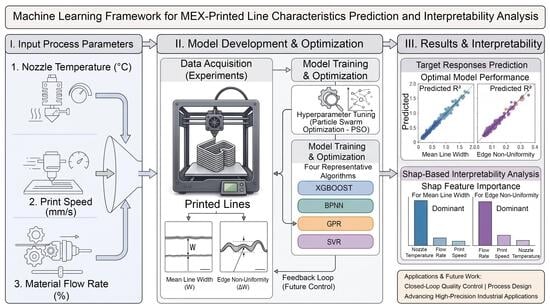
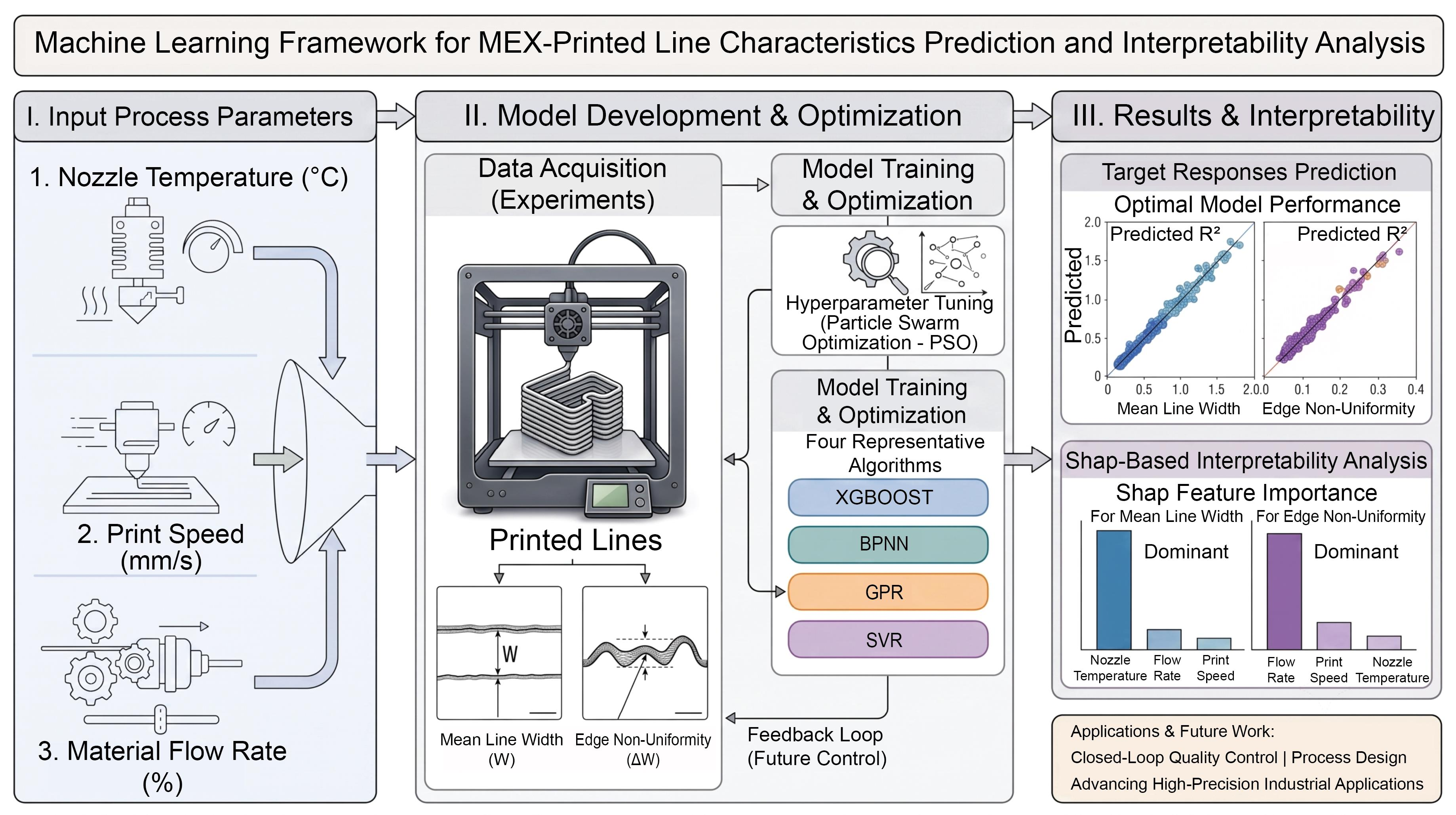
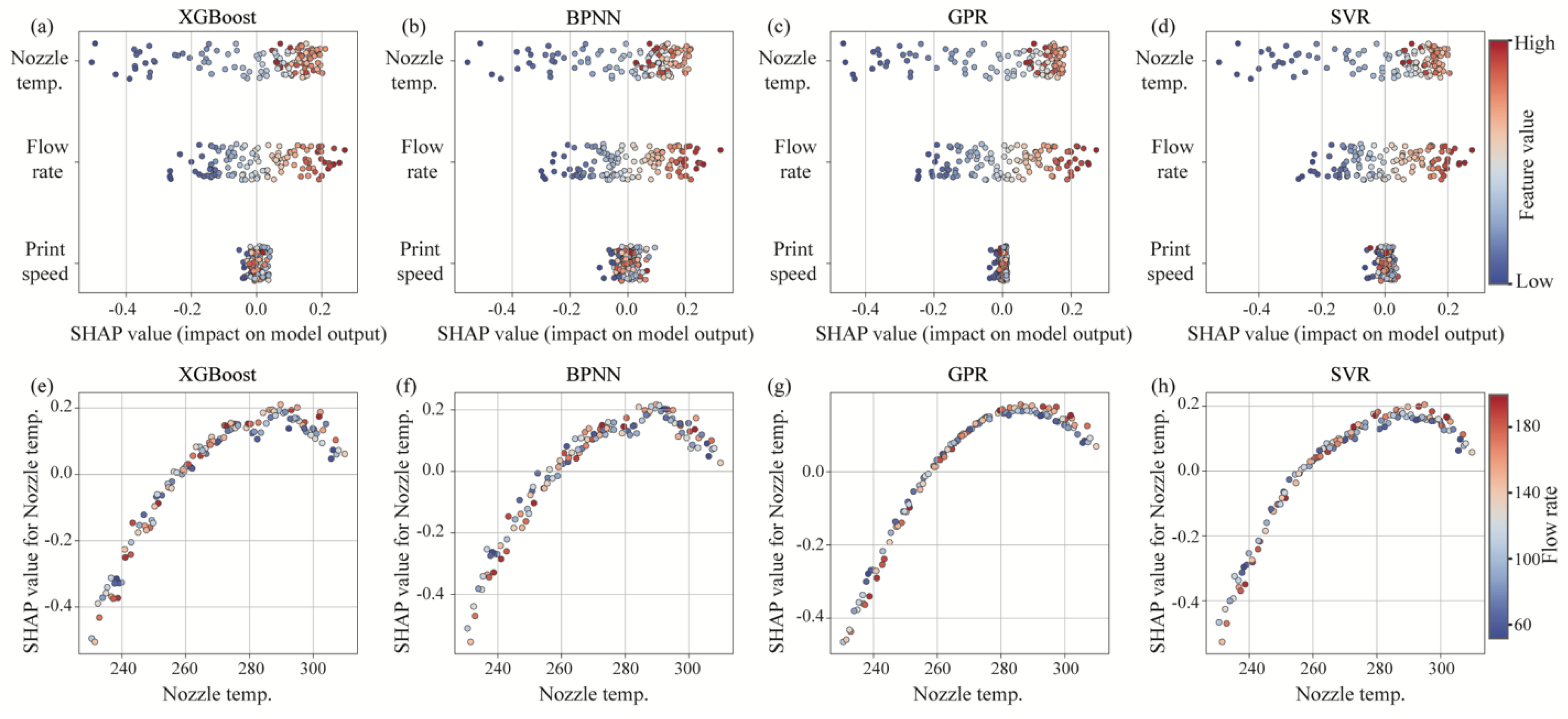
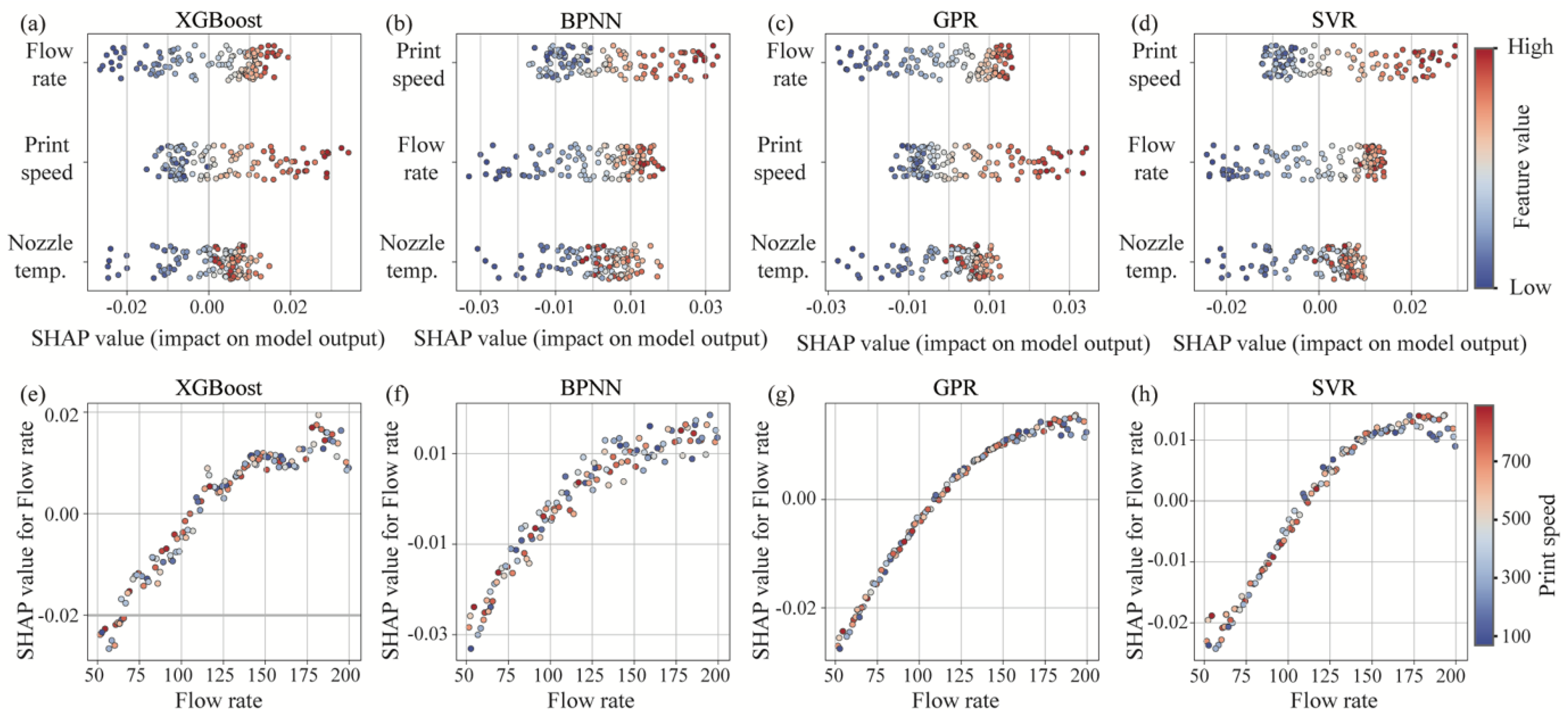
Material extrusion (MEX), commonly known as fused deposition modeling (FDM), has become a widely adopted additive manufacturing (AM) technology owing to its low equipment cost and broad polymer compatibility. However, the geometric fidelity of the printed line often suffers from defects that compromise overall part quality. Specifically, residual edge non-uniformity degrades surface finish, while uncontrolled line width variability causes undesired gaps or overlaps that undermine mechanical performance. Therefore, ensuring an accurate line width and low edge non-uniformity is essential for advancing material extrusion toward high-precision industrial applications. In this study, a machine learning framework is proposed for the rapid prediction and analysis of printed line characteristics. Nozzle temperature, print speed, and material flow rate were considered as input process parameters. Mean line width and edge non-uniformity were taken as the target responses. Four representative machine learning algorithms (XGBoost, BPNN, GPR, and SVR) were adopted for model development. To enhance predictive accuracy, these models were optimized using Particle Swarm Optimization for automatic hyperparameter tuning. Subsequently, comparative evaluations identified GPR as the optimal predictive model. Furthermore, a SHAP-based interpretability analysis was conducted, revealing that nozzle temperature dominates line width, while the flow rate governs edge non-uniformity. Consequently, this interpretable and computationally efficient surrogate modeling approach provides a robust foundation for future closed-loop quality control and inverse process design.
Keywords: material extrusion; additive manufacturing; fused deposition modeling; machine learning; process optimization; edge non-uniformity; Gaussian process regression; explainable artificial intelligence material extrusion; additive manufacturing; fused deposition modeling; machine learning; process optimization; edge non-uniformity; Gaussian process regression; explainable artificial intelligence
Graphical Abstract