This is an early access version, the complete PDF, HTML, and XML versions will be available soon.
Article

Buckwheat Husk Biochars as Adsorbents for Cationic Dye Removal: Effect of Pyrolysis Temperature on Adsorption Performance


by
Beata Doczekalska
1,*,
Krzysztof Kuśmierek
2,
Monika Bartkowiak
1 and
Andrzej Świątkowski
2
1
Faculty of Forestry and Wood Technology, Department of Chemical Wood Technology, Poznan University of Life Sciences, 60-637 Poznan, Poland
2
Faculty of Advanced Technologies and Chemistry, Institute of Chemistry, Military University of Technology, 00-908 Warsaw, Poland
*
Author to whom correspondence should be addressed.
Materials 2026, 19(14), 2981; https://doi.org/10.3390/ma19142981
Submission received: 12 June 2026 / Revised: 29 June 2026 / Accepted: 7 July 2026 / Published: 10 July 2026

Abstract

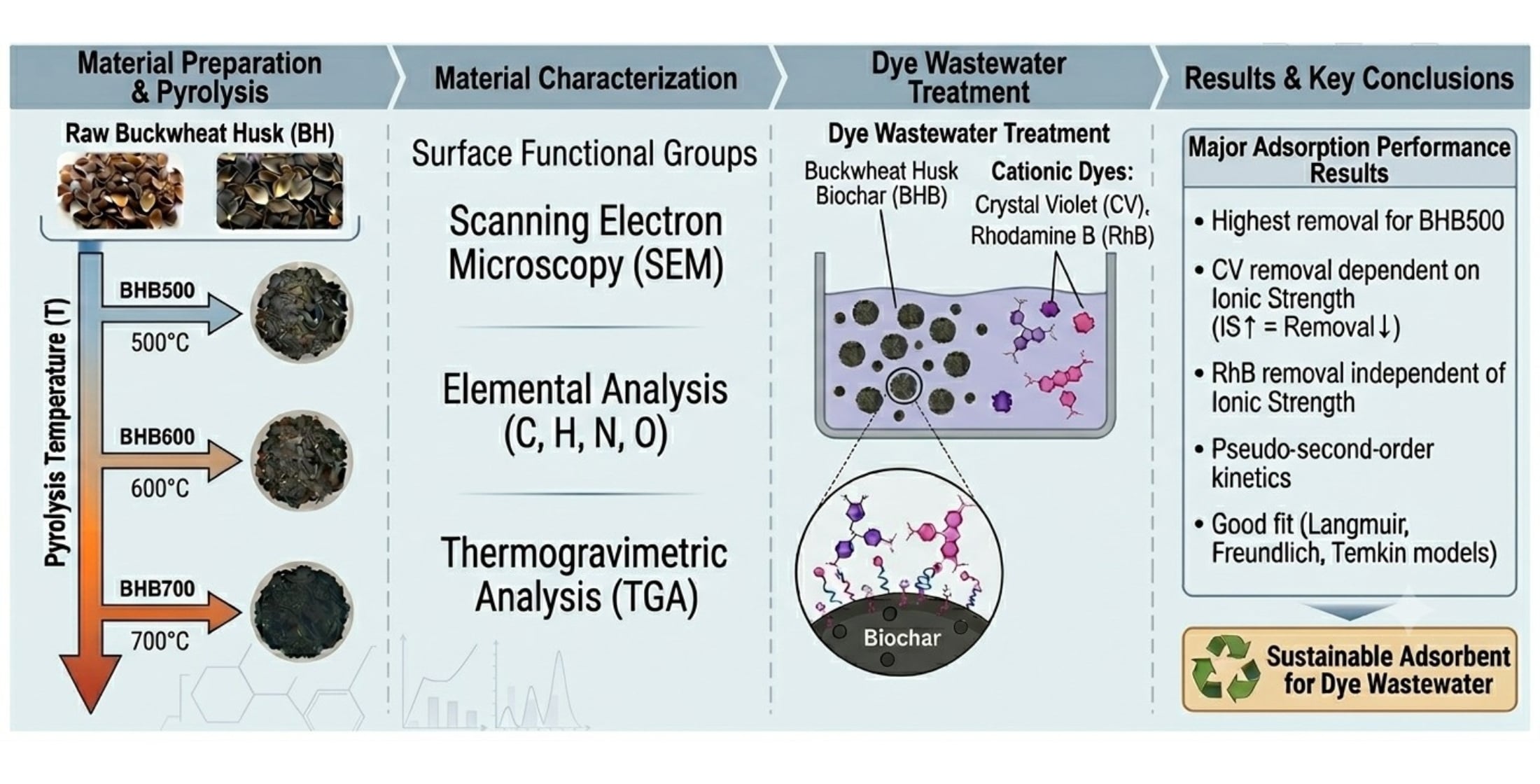
Agricultural waste-derived biochars have recently attracted increasing attention as sustainable adsorbents for wastewater treatment. In this study, biochars (BHBs) produced from buckwheat husks at 500, 600, and 700 °C were investigated as novel adsorbents for the removal of the cationic dyes Crystal Violet (CV) and Rhodamine B (RhB) from aqueous solutions. The obtained materials were characterized using thermogravimetric analysis and surface functional group analysis to evaluate the influence of pyrolysis temperature on their physicochemical properties. The effects of initial adsorbent dose, solution pH, and ionic strength were assessed, while adsorption kinetics and equilibrium isotherms were analyzed to elucidate the adsorption mechanisms. It was found that the adsorption of both dyes depended on pH. CV adsorption was lowest in an acidic environment and increased with increasing pH from 3 to 9. RhB was most effectively adsorbed in an acidic environment. Its adsorption decreased as the pH increased from 3 to around 5, after which it stabilized. The adsorption of CV decreased with increasing ionic strength of the solution, whereas the adsorption efficiency of RhB remained unaffected. The adsorption kinetics of CV and RhB on BHBs were found to follow a pseudo-second-order mechanism controlled by film diffusion. The Langmuir, Freundlich, and Temkin models all provided good fits to the equilibrium experiments. The adsorption capacities of BHBs for CV and RhB decreased with increasing pyrolysis temperature and surface alkalinity of the biochars (BHB700 < BHB600 < BHB500). The adsorption capacities of biochars ranged from 41.00 mg/g (BHB700) to 56.10 mg/g (BHB500) for CV and from 9.74 mg/g (BHB700) to 13.24 mg/g (BHB500) for RhB. The study highlights the potential of buckwheat husk-derived biochars as sustainable adsorbents for the treatment of dye-contaminated wastewater and provides insight into the relationship between pyrolysis conditions and adsorption performance.
Keywords: buckwheat husk; biochar; adsorption; Crystal Violet; Rhodamine B buckwheat husk; biochar; adsorption; Crystal Violet; Rhodamine B
Graphical Abstract