Article

Higher Tc and Upper Critical Field in Novel Misfit Layered Compound Obtained by Indium-Addition Synthesis


1
College of Science and Technology, Nihon University, 1-8-14, Surugadai, Kanda, Chiyoda 101-8308, Tokyo, Japan
2
University of Yamanashi Core Facility Center, Yamanashi University, 4-3-11, Takeda, Kofu 400-8511, Yamanashi, Japan
3
Center of Crystal Science and Technology, Yamanashi University, 7-32, Miyamae, Kofu 400-0021, Yamanashi, Japan
*
Author to whom correspondence should be addressed.
Materials 2026, 19(13), 2868; https://doi.org/10.3390/ma19132868 (registering DOI)
Submission received: 22 May 2026 / Revised: 25 June 2026 / Accepted: 1 July 2026 / Published: 5 July 2026
(This article belongs to the Section Materials Physics)

Abstract

Indium-addition synthesis of a misfit layered compound (SnSe)1.16(NbSe2) was found to obtain a novel sample (In-sample) with another stacking structure in (SnSe)1.16(NbSe2), causing the increase in the superconducting transition temperature Tc and the in-plane upper critical field μ0 H c 2 in - plane (0). Crystal structure analysis using single crystals revealed that the In-sample has a significantly elongated lattice constant along the c axis due to thickening of the layer other than the NbSe2, while retaining the original misfit layered structure. The Tc increased from 3.6 K to 5.4 K in the In-sample. Furthermore, the in-plane upper critical fields μ0 H c 2 in - plane (0) exceeded the Pauli limit μ0Hp, reaching 29.4 T (μ0Hp ~ 10 T). The coherence length along the c axis was reduced in the In-sample, indicating enhanced two-dimensionality. These results suggest that the In-sample not only has another stacking structure but also exhibits higher Tc and μ0Hc2.

1. Introduction

Superconductivity in a material without spatial inversion symmetry has been extensively investigated due to the appearance of novel properties, such as the topological or parity-mixed superconducting state, the superconducting diode effect, and others [1,2,3]. Although these materials are rare, the range of candidate substances has been expanded to include materials without local spatial inversion symmetry [4]. One of the candidates is a misfit layered compound. Misfit layered compounds (MX)m(TX)n (m, n = layer numbers) have a unique crystal structure: insulating monochalcogenide MX layers (M = Sn, Pb and Bi) and conducting dichalcogenide TX2 layers (T: transition metal, X = S, Se and Te) are alternately stacked through Van der Waals forces. The spatial inversion symmetry is broken locally at the boundary between the MX layer and the TX2 layer because these layers have different lattices: MX and TX2 layers have a NaCl-type square lattice and a triangular prism lattice [5,6,7,8,9]. Misfit layered compounds with metallic properties often show superconductivity [10,11,12,13,14,15]. The superconducting temperature Tc value varies by the number of MX and TX2 layers [16]. Furthermore, this unique crystal structure gives rise to distinctive properties, such as a quite high upper critical magnetic field (μ0Hc2). Here, we focus on NbSe2-based misfit layered compounds (MSe)m(NbSe2)n (M = Sn, Bi, Pb, La).
The (MSe)m(NbSe2)n system features a structure in which superconducting 2H-NbSe2 layers are alternately stacked with insulating MSe layers [17]. A Tc of (SnSe)m(NbSe2)n is approximately 4 K for (m, n) = (1, 1), and approximately 5 K for (m, n) = (1, 2). The in-plane upper critical field (μ0 H c 2 in - plane ) reaches the Pauli limit (μ0Hp) when (m, n) = (1, 1) but increases to approximately 1.5 times μ0Hp when (m, n) = (1, 2) [18,19]. In the case of (LaSe)m(NbSe2)n, the μ0 H c 2 in - plane reaches nearly 10 times μ0Hp for (m, n) = (1, 1), and approximately twice μ0Hp for (m, n) = (1, 2) [20]. (PbSe)m(NbSe2)n for (m, n) = (1, 1) also shows a higher μ0 H c 2 in - plane exceeding μ0Hp [21]. On the other hand, (BiSe)1.10(NbSe2) does not have a higher μ0 H c 2 in - plane but shows an anisotropic superconducting property with two-fold symmetry in the in-plane: the upper critical magnetic field along the b axis (μ0 H c 2 | | b ) is about twice as large as that along the a axis (μ0 H c 2 | | a ) [22,23]. These novel superconducting states appear in the conducting NbSe2 layer. However, the bulk NbSe2 does not show these novel properties: the NbSe2 single crystal has a Tc of about 7.2 K, which is higher than that of the NbSe2-based misfit layered compound. The μ0Hc2(0) along the inter-plane and the in-plane of NbSe2 are 4.1 T and 12.3 T (0.9 μ0Hp) [24]. These results suggest that the insertion of the MX layer between the NbSe2 layers enhances μ0Hc2(0) and decreases Tc. However, the mechanism for the change in these superconducting properties in the misfit layered compound has not been revealed so far. An elucidation of the mechanism is essential because the novel superconducting state in the misfit compound can be controlled.
In this study, we demonstrated that Indium (In)-addition synthesis stabilized a novel sample with a different stacking structure (In-sample) compared with (SnSe)1.16(NbSe2), which exhibits an enhanced superconducting state. Single crystals of (SnSe)1.16(NbSe2) with or without Indium addition were successfully obtained by the molten salt flux method. The lattice constant along the c axis of the In-sample increased in comparison with (SnSe)1.16(NbSe2), which originates from the layer other than NbSe2 thickening, while maintaining the misfit stacking structure. The Tc increased from 3.6 K to 5.6 K in the In-sample. The H c 2 | | a /Hp (0) and H c 2 | | b /Hp (0) increased twice in value compared to (SnSe)1.16(NbSe2). These results indicate that the In-sample exhibits an enhanced superconducting state relative to (SnSe)1.16(NbSe2).

2. Experimental/Methods

Single crystal samples were synthesized using the molten salt flux method. In the molten salt flux method, the target single crystals are obtained together with byproducts. Therefore, after synthesis, the target crystals were picked up from the obtained products. Since the composition of the obtained crystals often differs from the nominal starting composition, compositional analysis is necessary to determine the actual composition. We prepared two types of samples, with or without the addition of In. A sample without In addition (denoted as the ref. sample) was prepared to weigh to a stoichiometric ratio of Se: Nb: Sn = 5.16: 2: 1.16 mol% to a total of 0.8 g. The other sample with the In addition (denoted as the In-sample) was also prepared with a ratio of Se: Nb: In: Sn = 5.16: 2: 0.8: 0.2 mol% to a total of 0.8 g. The purities of the reagents are as follows: Se (99.9%; Kojundo Chemical Laboratory Co., Ltd., Sakado, Saitama, Japan), Nb (99.9%; Kojundo Chemical Laboratory Co., Ltd., Sakado, Saitama, Japan), In (99.99%; Soekawa Rikagaku Co., Ltd., Itabashi, Tokyo, Japan) and Sn (99.99%; Kojundo Chemical Laboratory Co., Ltd., Sakado, Saitama, Japan). A mixture of KCl (99.9%; Kojundo Chemical Laboratory Co., Ltd., Sakado, Saitama, Japan) and CsCl (99.9%; Iwatani Corporation, Osaka-shi, Osaka, Japan) was used as the flux, weighed at a 3: 5 mol% ratio to a total of 5 g. The metallic elements were first mixed in an agate mortar, followed by the addition of KCl and CsCl, and thoroughly mixed again. The mixture was then vacuum sealed in a quartz tube and sintered in an electric furnace. The thermal process is as follows: the temperature is increased to 700 °C, followed by slow cooling to 600 °C at a rate of v (°C/h). The rate of v is 0.5 for the ref. sample and 1.0 for the In-sample. After sintering, the mixture in the quartz tube was taken out and immersed in pure water to remove the flux. The obtained single crystals were characterized by X-ray diffraction (XRD; Ultima IV, Rigaku, Akishima, Tokyo, Japan), Scanning Electron Microscopy (SEM; S-2150, Hitachi High-Tech Corporation, Minato, Tokyo, Japan) with Energy Dispersive X-ray Spectroscopy (EDX; S-775X1, HORIBA, Ltd., Minami, Kyoto, Japan) for compositional analysis, and Transmission Electron Microscopy (TEM; Tecnai Osiris, Thermo Fisher Scientific, Hillsboro, OR, USA) measurements for structural confirmation. The XRD measurements were performed using Cu Kα radiation over the 2θ range of 10–70°. For compositional analysis, EDX spectra were measured on freshly cleaved crystal surfaces. The measurement was carried out over several regions of approximately 50 × 50 μm2, and five different spots were measured in each region. A composition was determined from the average of these measurements. In addition, some samples were measured by synchrotron X-ray diffraction at BL02B1 in SPring-8 (2024B1917). Superconducting properties were evaluated using PPMS (PPMS; Quantum Design, Inc., San Diego, CA, USA) and MPMS (MPMS; Quantum Design, Inc., San Diego, CA, USA). The current was applied along the a axis for electrical resistivity measurements. In addition, the magnetic fields were applied along the a, b, and c axes when the upper critical field was evaluated. A previous report on (BiSe)1.10(NbSe2) showed the streak on the crystal surface along the b axis [23]. An analogous streak was observed on the surface of both the ref. and In-samples. We therefore identified the direction parallel to the streak as the b axis and another direction perpendicular to it as the a axis. For the magnetization measurements, a thin platelet-like single crystal with approximate dimensions of 1 mm × 1 mm × 10 μm was used. The magnetic field was applied perpendicular to the platelet plane, namely along the c axis.

3. Results and Discussions

XRD results for each sample are shown in Figure 1. The peaks corresponding to the (00l) planes were observed because the X-ray was irradiated onto the ab-plane of the single crystals. The period of the (00l) planes was estimated to be 12.32(2) Å for the ref. sample and 14.73(4) Å for the In-sample. This result indicates that the interlayer distance along the c axis is expanded in the In-sample.
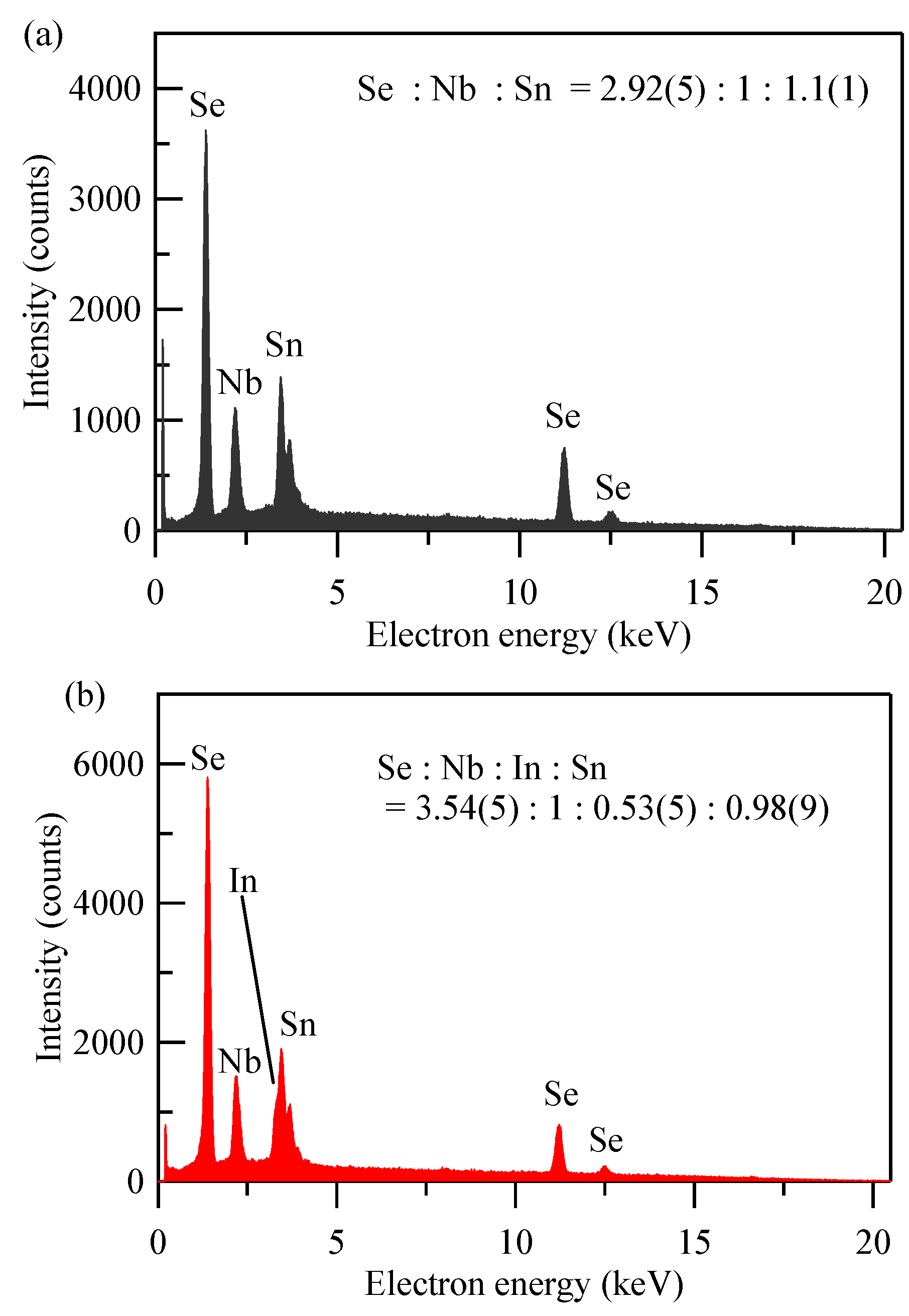
Compositional analysis results using SEM-EDX measurements are depicted in Figure 2. To examine the crystal homogeneity, SEM-EDX measurements were performed at multiple points on the sample surface. Composition ratios were calculated from this multi-point analysis. The atomic ratio for the ref. sample is Se: Nb: Sn = 2.92(5): 1: 1.1(1), while that for the In-sample is Se: Nb: In: Sn = 3.54(5): 1: 0.53(5): 0.98(9). These results indicate that single crystals of (SnSe)1.16(NbSe2) and the In-sample with the above composition were obtained under the present synthesis conditions. However, this compositional change cannot be explained by a simple intercalation or a partial substitution of In for Sn in the ref. sample, as discussed later. Furthermore, the composition is independent of the measurement locations, indicating that a crystal with little inhomogeneity is obtained.
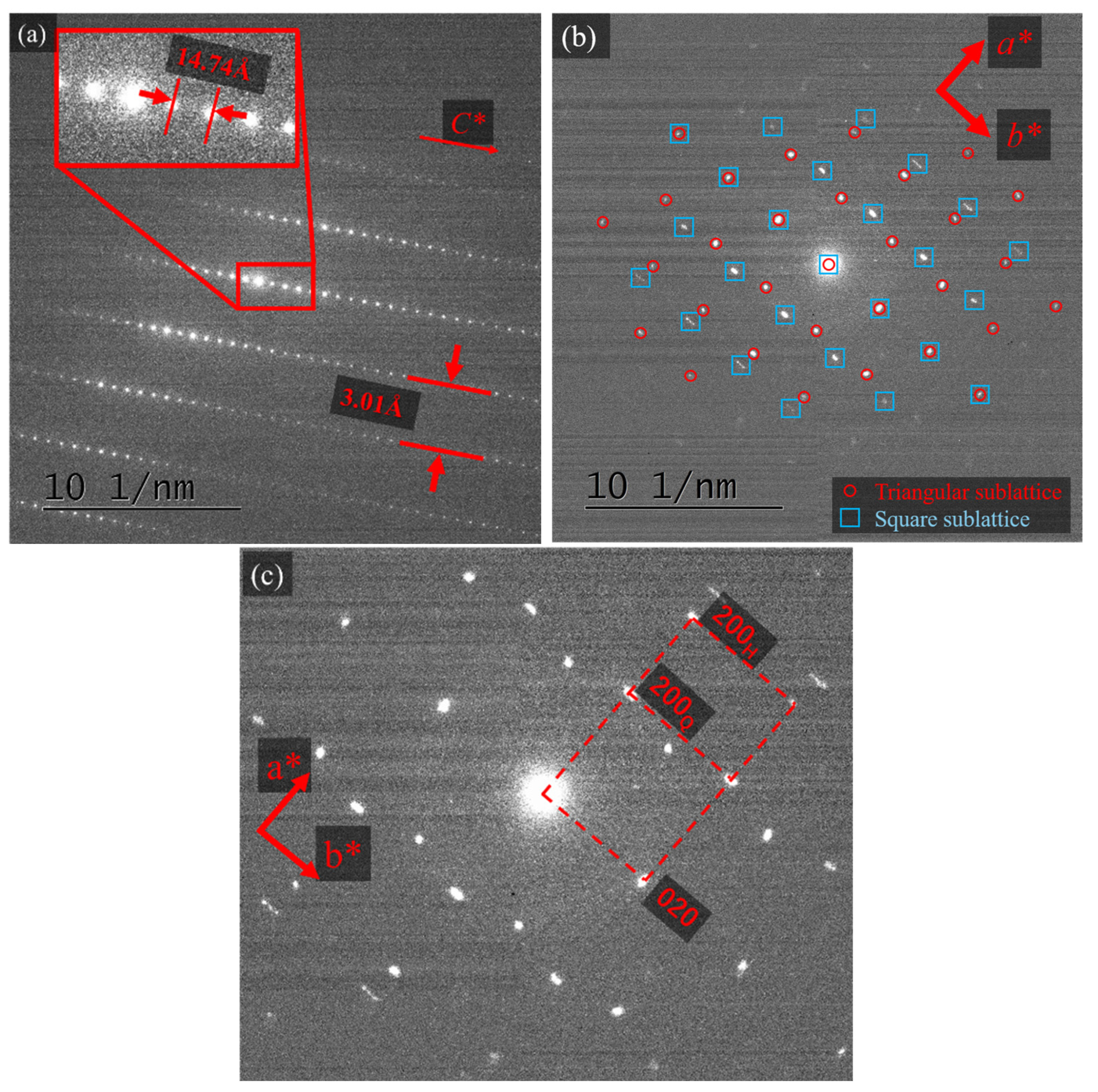
Crystal structure analysis was performed using TEM and synchrotron XRD measurements of the In-sample to obtain more information about the crystal structure. SAED patterns obtained by TEM measurements are depicted in Figure 3. Figure 3a shows the diffraction patterns of the a*c*-plane. The stacking period along the c axis is approximately 14.77 Å, consistent with the XRD results. The diffraction pattern of the a*b*-plane in Figure 3b shows distinct patterns composed of triangular lattice spots (red circles) and square lattice spots (blue squares). These patterns are analogous to a previous TEM study of a misfit compound (SbS)1+δ(NbS2) [25]. Its analogous patterns indicate that the In-sample remains a misfit stacking structure consisting of a layer with a triangular lattice and a square lattice. Lattice constants of the In-sample are calculated from Figure 3 and summarized in Table 1. The lattice constants along the a and b axes are close to those of previous results [18,19]. The lattice mismatch factor δ = 2 ∙ ( a NbSe 2 / a SnSe ) – 1 is 0.17, which is an analogous value of 0.16 in the ref. sample.
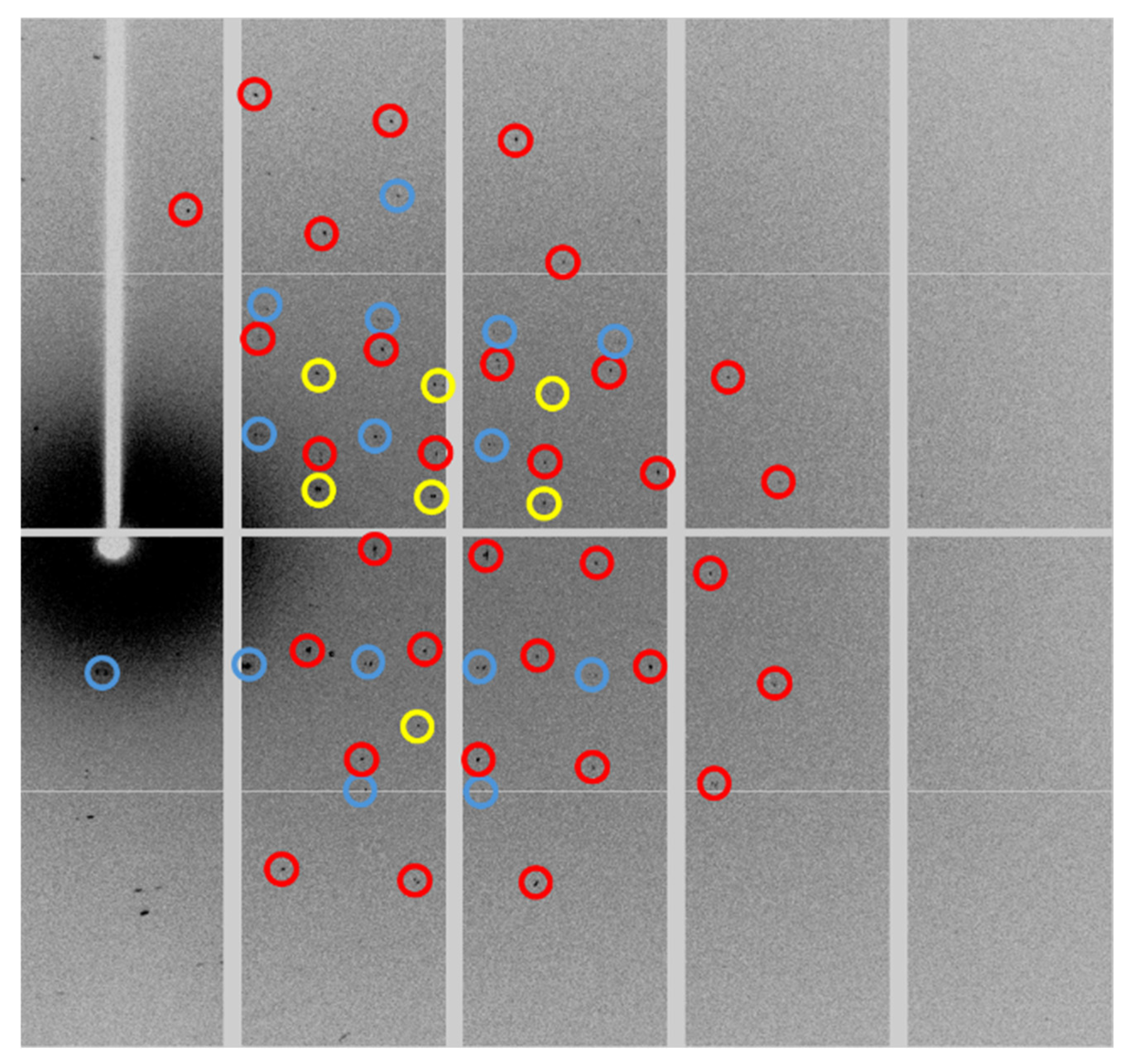
The crystal structure of the In-sample was also evaluated by the synchrotron XRD measurement at Spring-8. Figure 4 shows representative X-ray diffraction images. Diffraction spots attributed to the triangular and square lattices are clearly identified. The lattice constants obtained from these X-ray diffraction patterns are summarized in Table 1. These values are close to those obtained from the SAED patterns. These findings demonstrate that the In-sample not only keeps the misfit stacking structure but also has an enlarged lattice constant along the c axis. It is noted that the spots highlighted in yellow in Figure 4 could not be observed in the TEM images. These spots correspond to the reflection from a diagonal direction of the square lattice.
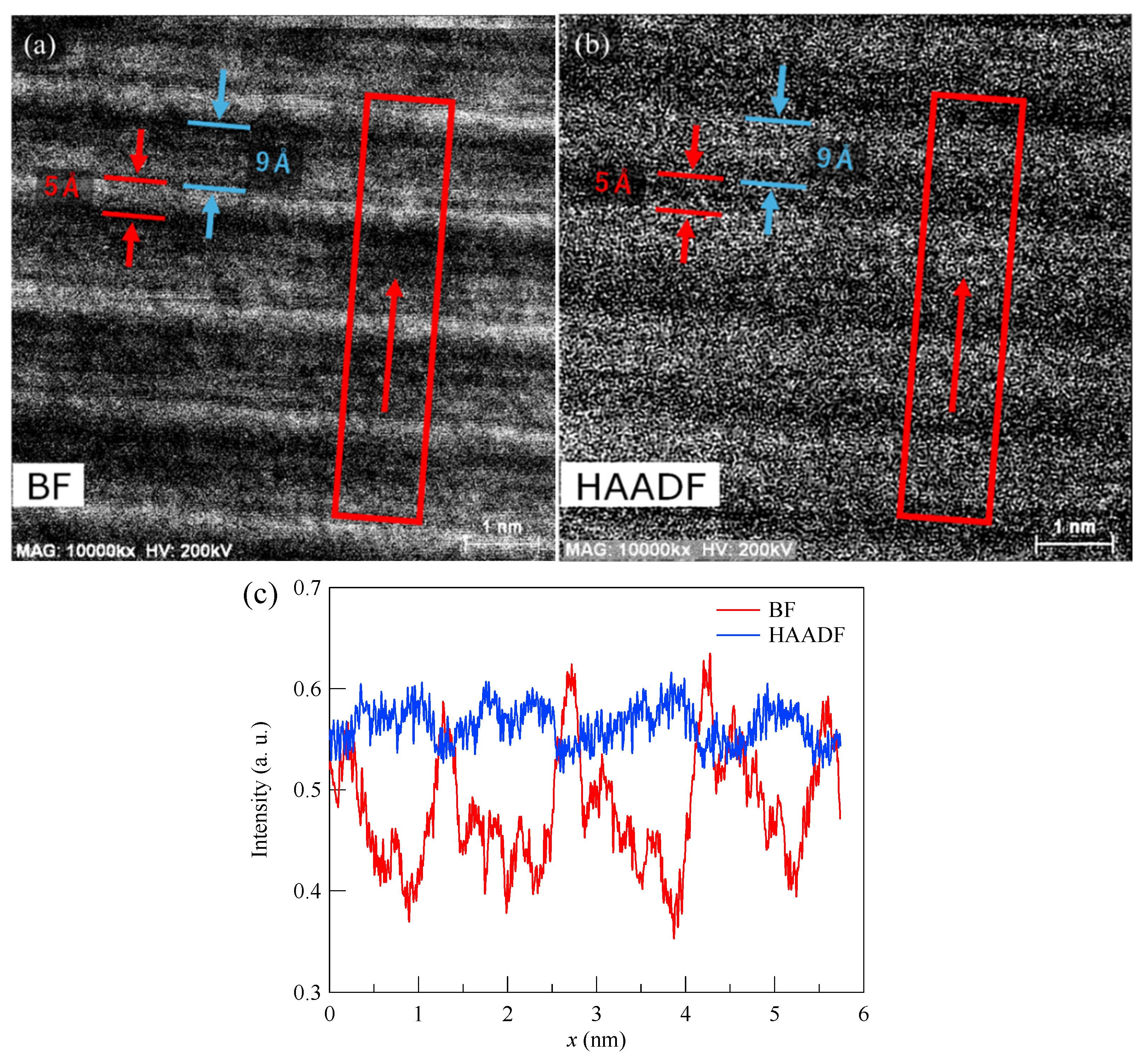
In order to determine which of the triangular and square lattice layers is thicker, Bright-Field (BF) and High-Angle Annular Dark-Field (HAADF) images were obtained, as shown in Figure 5. Both images indicate that two layers with different thicknesses are stacked on top of each other. The thickness of each layer is estimated to be approximately 5 Å and 9 Å. The 5 Å layer is brighter in the BF image but darker in the HAADF image, indicating that it consists of lighter elements such as Nb and Se. On the other hand, the 9 Å layer is composed of heavier elements such as Sn and In, as indicated by the same comparison of images. This contrast difference between layers is also confirmed by the line-cut intensity profiles shown in Figure 5c. This BF (HAADF) image and the lattice constants of the triangular lattice in Table 1 indicate that the 5 Å layer is the NbSe2 layer. A previous report supports this result: both the SnSe and NbSe2 layers have a thickness of approximately 6 Å [26]. On the other hand, the 9 Å layer is not determined to be the SnSe layer, although the lattice constants along the a and b axes are analogous to those of (SnSe)1.16(NbSe2) [26]. The type of the 9 Å layer is discussed later. These results suggest that the enlarged layer in the In-sample is not the NbSe2 layer but rather the other layer (9 Å layer), resulting in an increased c axis lattice constant.
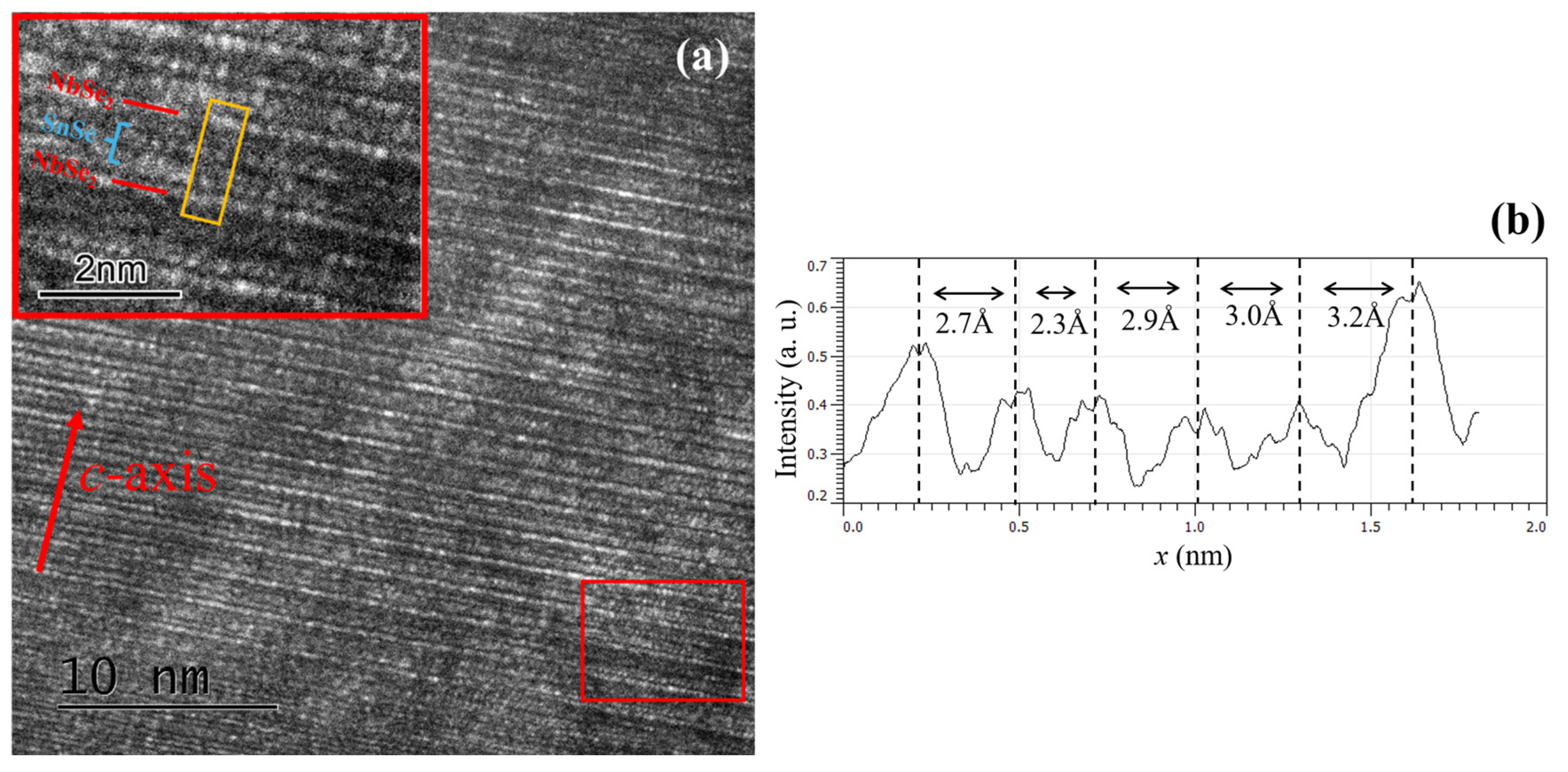
Figure 6a shows a high-resolution (HR) image of the ac-plane of the In-sample. Brighter stripes are observed along the c axis. A line profile along the c axis is shown in Figure 6b, which corresponds to the orange square in the inset of Figure 6a. Based on a previous TEM measurement of (SnSe)1.16(NbSe2), the Nb atoms in the NbSe2 layers are brighter than the other atoms in the HR image [27]. Thus, two peaks, located on both sides and of higher intensity, are attributed to Nb atoms in the NbSe2 layer. The distance of these peaks is approximately 14 Å, which is consistent with the TEM, XRD and SC-XRD results. Furthermore, the four intermediate peaks between the Nb-related peaks are considered to originate from the structure of the 9 Å layers.
Here, we discuss the crystal structure of the In-sample. The In-sample has an enlarged lattice constant along the c axis compared with the ref. sample, which is attributed to the expansion of the 9 Å layers consisting of Sn, In and Se ions. The possibilities for the origins of the expansion are as follows: (1) a substitution of In for Sn in SnSe layers or (2) an intercalation of In between layers in the ref. sample. However, this is not the case, as shown below. (1, 2-1) The composition of Se/Nb deviates from three, which should remain approximately three when the In ion is substituted or intercalated into the ref. sample. (1, 2-2) The lattice expansion is too large to be explained by intercalation. (1, 2-3) The TEM measurements and SAED patterns revealed no intercalated atoms or layers. These results indicate that the In-samples are neither the In-substituted nor the In-intercalated ref. sample (SnSe)1.16(NbSe2).
The case (2)′, where (InSe2) layers are inserted into (SnSe)1.16(NbSe2), i.e., (SnSe)1.16(NbSe2)(InSe2)x, is not considered as follows [28,29]. (2′-1) The (SnSe)1.16(NbSe2)(InSe2)x should have three types of layers in an alternating stacking structure. However, in the out-of-plane TEM images and in the BF and HAADF images obtained in this study, only two types of stacked layers were observed. Furthermore, the line-cut profiles of the TEM images showed four peaks between the NbSe2 layers, which cannot be explained by a simple stacking of SnSe and InSe2 layers, as in the previous study [28]. (2′-2) The electron diffraction patterns taken with the incident beam perpendicular to the layers showed that only the spots originating from the NbSe2 and the square lattice layers were present. If InSe2 layers were present, additional diffraction spots corresponding to InSe2 should appear, but such spots are not detected. (2′-3) The composition analysis also does not support the insertion of InSe2 layers. The EDX composition of the In-sample is Se: Nb: In: Sn = 3.54(5): 1: 0.53(5): 0.98(9). The ratio of Se to In ion becomes Se: In = 0.56: 0.53, where the contribution from SnSe and NbSe2 layers (Se: 0.98 + 2.00 = 2.98) is subtracted in the Se composition. This ratio is not consistent with InSe2. For this reason, the composition analysis also does not support the formation of additional InSe2 layers. From the considerations of (2′-1, 2, 3), we concluded that the insertion of discrete InSe2 layers is unlikely.
Another scenario is (3) the insertion of two SnSe layers, where In is partially substituted for Sn, between the NbSe2 layers. Based on the above discussion of the square lattice layer, it is highly likely that the thick layer corresponds to two {(Sn,In)Se} layers. Previous reports have shown that the thickness of a single SnSe layer was approximately 6 Å. Therefore, a simple double-SnSe-layer model would give a total thickness of about 12 Å, which is larger than the experimentally observed value of 9 Å. However, partial substitution of In for Sn may reduce the layer thickness because the ionic radius of In3+ is smaller than that of Sn2+. In fact, the presence of In is confirmed by both EDX and WDS measurements. These results support the interpretation that a partially In-substituted double {(Sn,In)Se} layer is present in our compound. By subtracting the NbSe2 component from the EDX composition of the In-sample (Se: Nb: In: Sn = 3.54: 1: 0.53: 0.98), we obtained Se: (In + Sn) = 1.54: 1.51. This composition is comparable to {(Sn, In)Se}1.5(NbSe2), indicating that the stacking structure consists of two (Sn, In)Se layers and one NbSe2 layer. In this case, the expansion of SnSe layers in the In-sample is well explained. This structure aligns with observations from BF, HAADF, and SAED images; it consists of a thick SnSe layer and thin NbSe2 layers. Therefore, we finally suggest that the In-sample is (SnSe)2(NbSe2), where the In ion partially substitutes for the Sn site. On the other hand, an ideal value of 1 + δ is 1.16 estimated from the misfit layered compounds (SnSe)1.16(NbSe2). Thus, the composition with two insulating layers is expected to be {(Sn, In)Se}2.32(NbSe2). This result suggests that the defect is present in either the (In, Sn)Se or NbSe2 layer. Therefore, further investigation of the crystal structure of the defects and related aspects is necessary to determine the detailed structure.
Next, we will compare the main experimental results between the In-sample and ref. sample of (SnSe)1.16(NbSe2). This comparison is not intended to evaluate a simple doping effect, because the In-sample most likely has a different stacking structure and composition from the ref. sample. As discussed above, the In-sample is most likely an In-substituted (SnSe)2(NbSe2). The reason for this comparison is that the superconducting properties, such as the upper critical fields, have not been studied in (SnSe)2(NbSe2), although superconductivity with Tc ~ 1.9 K has been reported for (SnSe)2(NbSe2) [27]. (SnSe)1.16(NbSe2) was therefore chosen as a reference to compare with the In-sample, in which the superconducting NbSe2 layer is effectively a single layer in the unit cell, allowing us to discuss these superconducting properties quantitatively.
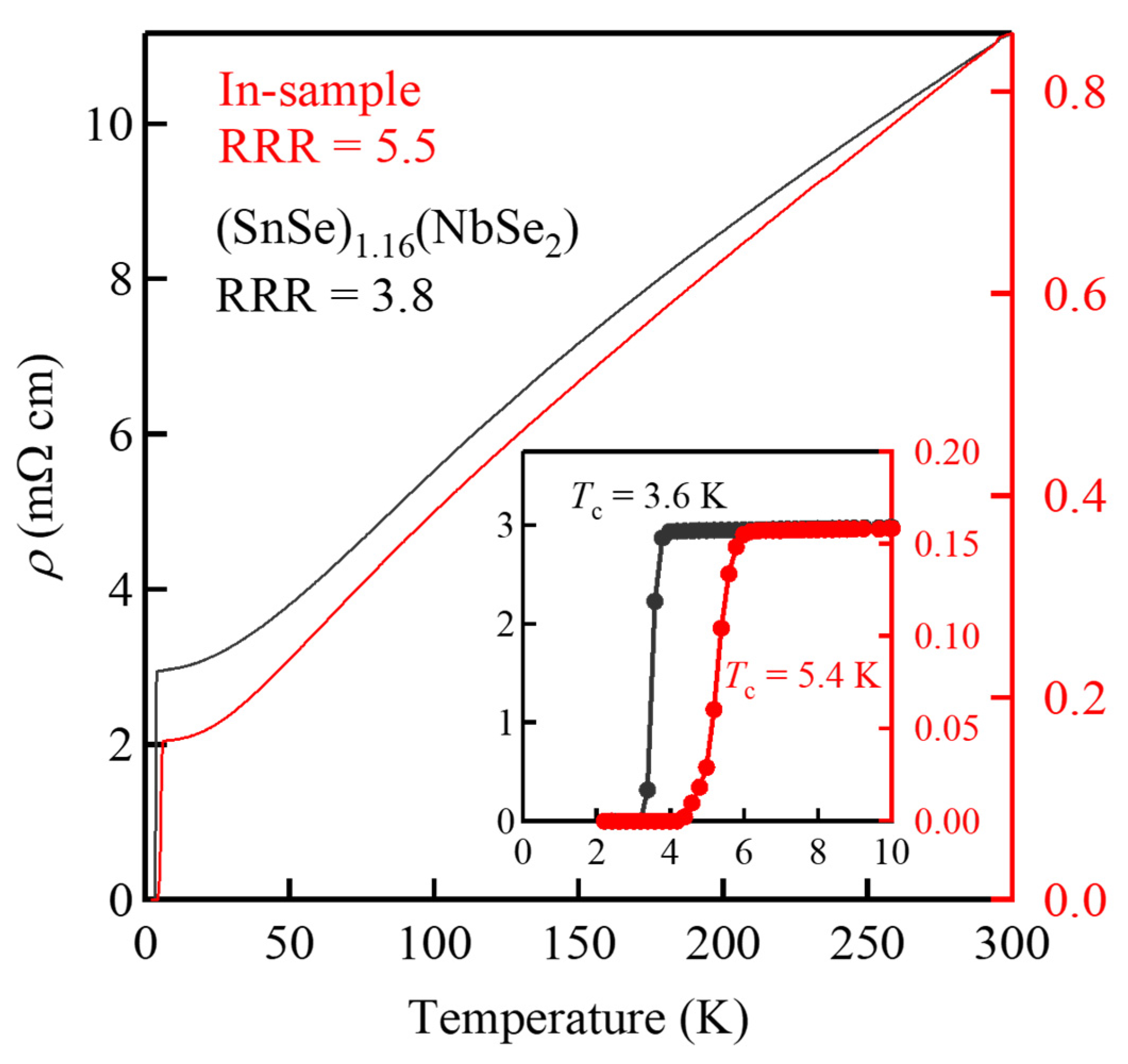
Figure 7 shows the temperature dependence of the resistivity measurements for the ref. and In-samples. The current is applied along the a axis. Metallic behavior and superconducting transition are observed in both samples. The resistivity of the In-sample is lower than that of the ref. sample by more than one order of magnitude for the entire temperature range. This decrease in resistivity may be attributed to a change in carrier density induced by In-substitution. Furthermore, the higher residual resistivity ratio (RRR) of the In-sample may be attributed to improved crystallinity, although the underlying mechanism remains unclear.
The Tc is defined as the temperature at which the electrical resistivity decreases to 50% of its normal state value. The Tc is 3.6 K for the ref. samples, which is consistent with the previous report [18]. On the other hand, the Tc of the In-sample increases to 5.4 K.
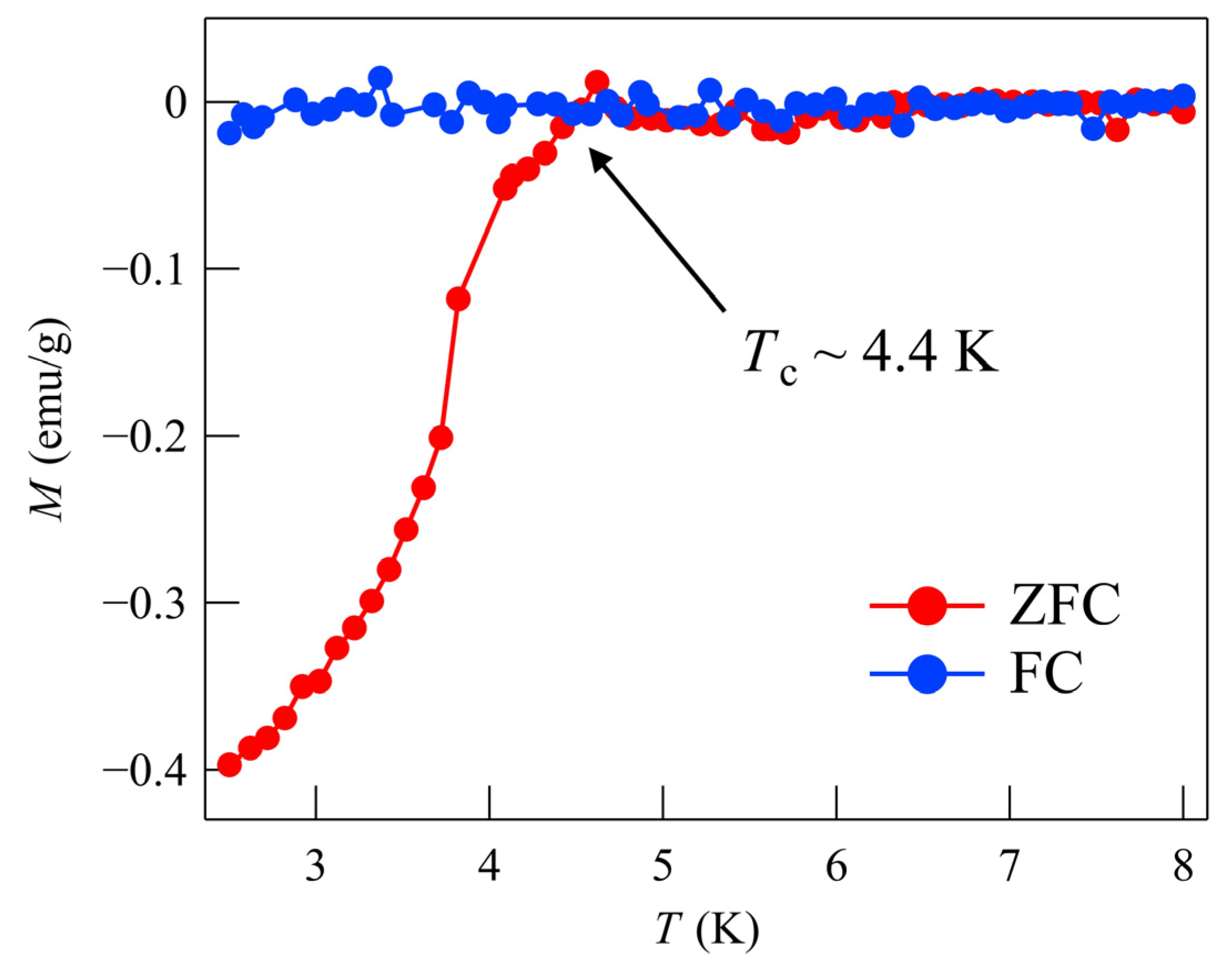
The temperature dependence of magnetic susceptibility is shown in Figure 8. A superconducting transition is observed at Tc ~ 4.4 K. The zero-resistivity temperature, Tczero, is approximately 4.2 K, which is close to the onset temperature of the diamagnetic signal in the M(T) measurement, approximately 4.4 K. A similar relationship between the zero-resistivity temperature in ρ(T) and the magnetic onset temperature in M(T) has also been reported for the ref. compound, (SnSe)1.16(NbSe2) [18]. Therefore, the ρ(T) and M(T) results are reasonably consistent. It is noted that the ZFC signal is not saturated until 2.5 K. It is possible that a lower temperature is required for saturation to be observed, or that the In distribution in the In-sample broadened the transition. Further M(T) measurements at lower temperatures are needed to confirm this discussion.
The apparent shielding fraction assuming the (SnSe)2(NbSe2) structure is calculated to be about 320% at 2.5 K. This value exceeds 100% because of the large demagnetization effect arising from the thin platelet-like sample shape. Using the approximation formula proposed by Prozorov and Kogan [30], the demagnetization factor was estimated to be N ~ 0.985 for the present measurement geometry. After correcting the apparent shielding fraction using this demagnetization factor, the shielding fraction is estimated to be approximately 77%. The superconducting transition of the In-sample is broader than that of the ref. sample. This broadening may be attributed to a slight inhomogeneity in the In distribution in the In-sample, as the additional phase is not detected by laboratory and synchrotron XRD or TEM measurements.
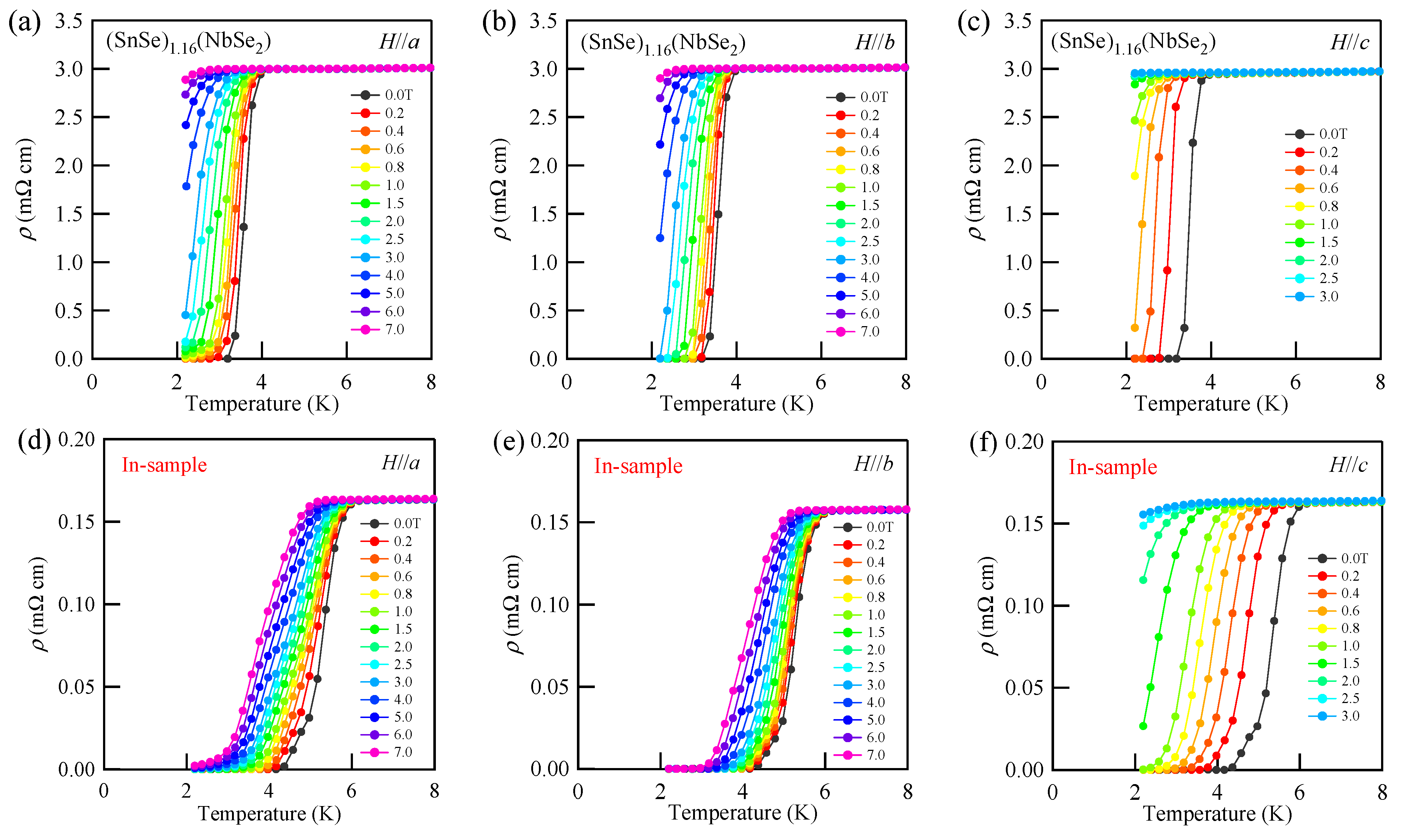
Figure 9 shows the temperature dependence of the electrical resistivity under magnetic fields for the ref. (a–c) and In-samples (d–f). Superconductivity for both samples is robust to the magnetic field along the in-plane (Figure 9a,b,d,e) compared to that along the c axis (Figure 9c,f). This trend originated from the two-dimensional electronic structure due to the layered structure.
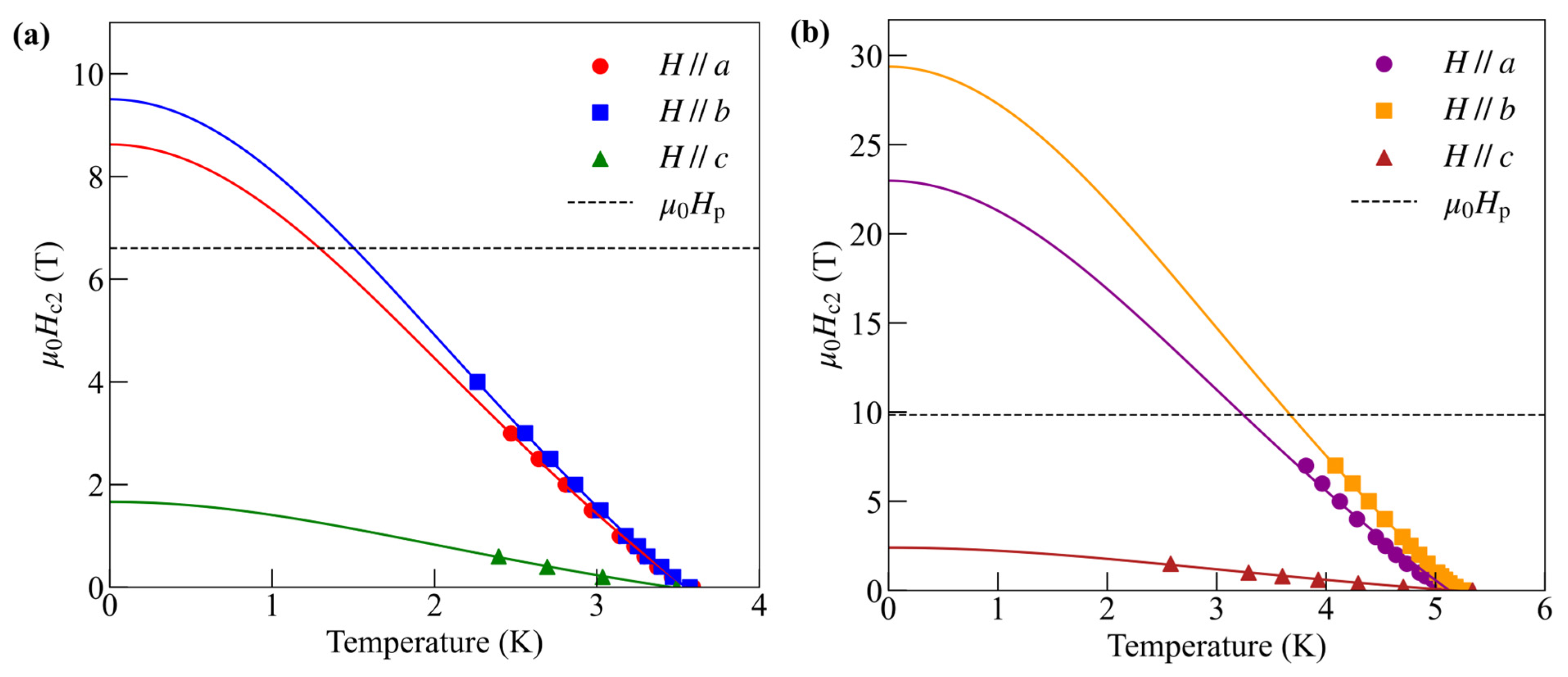
The temperature dependence of the upper critical field along the a, b, and c axes calculated from Figure 9 is presented in Figure 10. The solid lines in Figure 10 are the fitting lines estimated for an anisotropic two-band superconductor in the Ginzburg–Landau (GL) scenario, expressed as follows [31]:
μ 0 H c 2 T = μ 0 H c 2 0 1 T / T c 2 / 1 + T / T c 2
The reason for adopting the two-band model is that NbSe2 has been reported to exhibit multiband superconductivity [32,33,34]. Furthermore, the upper critical fields of NbSe2-based misfit superconductors have also been estimated using this model [18,19]. Therefore, this model was also used to estimate the μ0Hc2 in the In-sample.
In this paper, μ0Hc2(T) values along the a, b and c axes are denoted as μ0 H c 2 | | a , μ0 H c 2 | | b and μ0 H c 2 | | c , respectively. The upper critical field values at 0 K are estimated from the fitting lines. (SnSe)1.16(NbSe2) has μ0 H c 2 | | a (0) = 8.6 T, μ0 H c 2 | | b (0) = 9.5 T and μ0 H c 2 | | c (0) = 1.7 T. The In-sample has μ0 H c 2 | | a (0) = 23.0 T, μ0 H c 2 | | b (0) = 29.4 T, and μ0 H c 2 | | c (0) = 2.4 T. The In-sample exhibited higher μ0Hc2 values than the ref. sample in all directions. The μ0 H c 2 | | a and μ0 H c 2 | | b of the ref. sample show an analogous temperature dependence. On the other hand, the μ0 H c 2 | | b in the In-sample has a higher value in comparison with that of μ0 H c 2 | | a , indicating the in-plane anisotropy between μ0 H c 2 | | a and μ0 H c 2 | | b is enhanced slightly in the In-sample. These results demonstrate that the In-sample exhibits higher Tc, μ0Hc2 and in-plane anisotropy of μ0Hc2 than the ref. sample. A previous study of (BiSe)1.10(NbSe2) showed that μ0 H c 2 | | b was larger than μ0 H c 2 | | a for all temperature ranges, consistent with the current study [22]. However, the in-plane anisotropy of (BiSe)1.10(NbSe2) is larger than the In-sample. This difference may be attributed to differences in Bi and Sn in the MX layers. The origin of this difference is an open question so far.
The value of μ0Hc2 can be expressed using the anisotropic Ginzburg–Landau relation:
μ 0 H c 2 i 0 =   Φ 0 2 π ξ j 0 ξ k 0
where Φ0 is the flux quantum and ξ represents the coherence length. The indices of i, j and k represent the cyclic permutation of the directions a, b, and c. The coherence lengths ξi (i = a, b, c) along each axis were calculated using this equation and the experimental values of μ0Hc2. All values are summarized in Table 2. The H c 2 | | a ( 0 ) /Hp and H c 2 | | b ( 0 ) /Hp of the In-sample are higher than those of the ref. sample. The coherence length along the c axis, ξc, is significantly smaller than the thickness of the SnSe layers separating the superconducting NbSe2 layers in both ref. and In-samples. In particular, the ξc of the In-sample is lower than that of the ref. sample. This fact indicates that the two-dimensional electronic structure is enhanced in the In-samples. Since the enhanced two-dimensionality can increase the orbital upper critical field for magnetic fields applied parallel to the layers, the μ0Hp restricts the in-plane μ0Hc2. However, the in-plane μ0Hc2 in our sample exceeds the μ0Hp. The NbSe2 thin film also shows higher in-plane μ0Hc2 (~4 μ0Hp in trilayers to ~10 μ0Hp in a monolayer), which is discussed in Ising pairing in superconductivity [35]. Similar behavior has also been reported in NbSe2-based misfit layered compounds. For instance, (PbSe)1.14(NbSe2)3 showed higher in-plane μ0Hc2 (~4 μ0Hp). The angular dependence of μ0Hc2, TDO (tunnel diode oscillator) measurements, and theoretical calculations suggest that Ising superconductivity and the FFLO state are realized, depending on the magnetic field [14]. (LaSe)1.14(NbSe2)n (n = 1, 2) also has such a higher in-plane μ0Hc2(~10 μ0Hp and ~5 μ0Hp) [36]. The possibility of Ising superconductivity is discussed based on strong spin–orbit coupling, as confirmed by ARPES, NMR, and first-principles calculations [36,37]. Therefore, the μ0Hc2 value for exceeding the Pauli paramagnetic limit is suggestive of the existence of the Ising superconductivity. Based on these previous studies related to NbSe2 and NbSe2-based misfit layered compounds, a similar phenomenon may occur in the Pauli-limit-exceeding in-plane μ0Hc2 observed in the present In-sample. However, direct experimental evidence for Ising superconductivity, such as angular-dependent μ0Hc2 measurements or TDO measurements, was not obtained in this study. Therefore, the origin of the large in-plane μ0Hc2 cannot be determined from the present results alone, and further experimental studies are required.

4. Discussion

We discussed the origin of the In-sample properties compared with (SnSe)1.16(NbSe2). First, we recall the stacking structure of the In-sample. The c axis of the In-sample expands, which is due to the thickening of the layer other than NbSe2. This expansion is expected to separate the conductive NbSe2 layers, thereby enhancing the two-dimensionality of the NbSe2 layers. This enhancement results in an increase in μ0Hc2 along the in-plane directions (a and b axes), as NbSe2 thin films and (LaSe)1.14(NbSe2)n. The In-sample also exhibits a higher Tc than the ref. sample. One possibility leading to a higher Tc is (1) a change in the number of SnSe layers. However, previous studies on (SnSe)m(NbSe2) have reported that Tc decreases with increasing m [27,38]. Therefore, this scenario cannot account for the observed Tc enhancement. The other possibility is (2) a change in the carrier density of the NbSe2 layer. It has been reported that Tc decreases with electron doping and increases with hole doping in NbSe2 by an ionic liquid gate [39,40]. Furthermore, in misfit layered compounds (MSe)(NbSe2) (M = Sn, Bi, Pb, La), the MSe layer has been shown to act as an electron donor to the NbSe2 layer, suggesting that the insertion of a SnSe layer may reduce Tc compared to pristine NbSe2 [41,42]. Indeed, the Tc of (MSe)(NbSe2) is lower than that of pristine NbSe2 [18,20,21,22,23,24]. In addition, the reported relationship between Tc and the number of MSe layers, described by (1), is consistent with this result: Tc decreases as the number of MSe layers increases [27,38]. Furthermore, previous studies on (SnSe)1.16(NbSe2)n (n = 1, 2) reported that the hole carrier density decreases with increasing the number of SnSe layers, accompanied by a decrease in Tc [19]. In (LaSe)1.14(NbSe2)n (n = 1, 2), the n = 2 sample has a higher hole carrier density than the n = 1 sample [36]. Based on these previous studies, changes in carrier density affect Tc in (MSe)(NbSe2). Therefore, the In-sample may also alter the carrier state of the NbSe2 layer due to differences in valence between the In and Sn ions, contributing to the change in Tc. This suggestion is consistent with the decrease in resistivity relative to the ref. sample, as shown in Figure 7. However, Hall-effect measurements, carrier concentration analysis, and valence-state measurements have not been performed in the present study. Therefore, the detailed mechanism of the Tc enhancement cannot be determined from the present results alone. To confirm the suggestion, an evaluation of the carrier concentration and valence of the In ion is needed.

5. Conclusions

We investigated the novel sample (In-sample) obtained by the In-addition synthesis in (SnSe)1.16(NbSe2). In the In-sample, the layer other than the NbSe2 layer is thicker, as confirmed by XRD and TEM measurements. On the other hand, the misfit stacking structure was maintained after the In addition. The Tc of the In-sample increased to 5.4 K in comparison to 3.6 K for the ref. sample. The H c 2 | | a ( 0 ) /Hp and H c 2 | | b ( 0 ) /Hp were 1.3 and 1.4 for the ref. sample, while they were 2.3 and 3.0 for the In-sample. The calculated ξa(0) and ξb(0) were almost the same value between the ref. and In-samples. However, the ξc(0) in the In-sample is smaller than that of the ref. sample, which is related to the increase in the thickness of the layer other than NbSe2. This small ξc(0) causes a substantial rise in μ0 H c 2 | | a ( 0 ) and μ0 H c 2 | | b ( 0 ) . Therefore, the enhanced superconducting properties of the In-sample are likely associated with both In incorporation and the accompanying structural modification. These results are essential for controlling the novel superconducting state in misfit layered compounds with higher μ0Hc2.

Author Contributions

Conceptualization, S.K. and S.D.; Methodology, S.K. and S.D.; Formal analysis, S.K.; Investigation, S.K., C.Y., J.Y. and M.N.; Resources, S.K., C.Y., J.Y., M.N. and S.D.; Data curation, S.K., C.Y., J.Y. and M.N.; Writing—original draft, S.K.; Writing—review & editing, S.K. and S.D.; Visualization, S.K.; Supervision, T.W. and S.D.; Project administration, S.D.; Funding acquisition, S.D. All authors have read and agreed to the published version of the manuscript.

Funding

This work was partly supported by the Iketani Science and Technology Foundation, the Nihon University College of Science and Technology Grants-in-Aid, and Research Institute of Science and Technology Nihon University College of Science and Technology Grants-in-Aid for Start-up Research in Japan. The synchrotron XRD experiments for some samples were performed at SPring-8 with the approval of the Japan Synchrotron Radiation Research Institute (JASRI) (Proposal No. 2024B1917).

Data Availability Statement

The original contributions presented in this study are included in the article. Further inquiries can be directed to the corresponding author.

Conflicts of Interest

The authors declare no conflict of interest.

References

  1. Ando, F.; Miyasaka, Y.; Li, T.; Ishizuka, J.; Arakawa, T.; Shiota, Y.; Moriyama, T.; Yanase, Y.; Ono, T. Observation of superconducting diode effect. Nature 2020, 584, 373–376. [Google Scholar] [CrossRef] [PubMed]
  2. Smidman, M.; Salamon, M.B.; Yuan, H.Q.; Agterberg, D.F. Superconductivity and spin–orbit coupling in non-centrosymmetric materials: A review. Rep. Prog. Phys. 2017, 80, 036501. [Google Scholar] [CrossRef] [PubMed]
  3. Fischer, M.H.; Sigrist, M.; Agterberg, D.F.; Yanase, Y. Superconductivity and Local Inversion-Symmetry Breaking. Annu. Rev. Condens. Matter Phys. 2023, 14, 153–172. [Google Scholar] [CrossRef]
  4. Ng, N.; McQueen, T.M. Misfit layered compounds: Unique, tunable heterostructured materials with untapped properties. APL Mater. 2022, 10, 100901. [Google Scholar] [CrossRef]
  5. Meerschaut, A. Misfit layer compounds. Curr. Opin. Solid State Mater. Sci. 1996, 1, 250–259. [Google Scholar] [CrossRef]
  6. Aliev, S.B.; Tenne, R. Quaternary Misfit Compounds—A Concise Review. Crystals 2020, 10, 468. [Google Scholar] [CrossRef]
  7. Lorenz, T.; Joswig, J.-O.; Seifert, G. Two-dimensional and tubular structures of misfit compounds: Structural and electronic properties. Beilstein J. Nanotechnol. 2014, 5, 2171–2178. [Google Scholar] [CrossRef] [PubMed]
  8. Khadiev, A.; Sreedhara, M.B.; Hettler, S.; Novikov, D.; Arenal, R.; Tenne, R. Misfit Layered Compounds: Insights into Chemical, Kinetic, and Thermodynamic Stability of Nanophases. Acc. Chem. Res. 2024, 57, 3243–3253. [Google Scholar] [CrossRef] [PubMed]
  9. Wiegers, G.A. Misfit Layer Compounds Based on Double Layers MX and Sandwiches TX2 (M = Sn, Pb, Sb, Bi, Ln; T = Ti, V, Cr, Nb, Ta; X = S, Se). Jpn. J. Appl. Phys. 1993, 32, 705. [Google Scholar] [CrossRef]
  10. Wiegers, G.A. Misfit layer compounds: Structures and physical properties. Prog. Solid State Chem. 1996, 24, 1–139. [Google Scholar] [CrossRef]
  11. Sankar, R.; Peramaiyan, G.; Muthuselvam, I.P.; Wen, C.-Y.; Xu, X.; Chou, F.C. Superconductivity in a Misfit Layered (SnS)1.15(TaS2) Compound. Chem. Mater. 2018, 30, 1373–1378. [Google Scholar] [CrossRef]
  12. Giang, N.; Xu, Q.; Hor, Y.S.; Williams, A.J.; Dutton, S.E.; Zandbergen, H.W.; Cava, R.J. Superconductivity at 2.3 K in the misfit compound (PbSe)1.16(TiSe2)2. Phys. Rev. B 2010, 82, 024503. [Google Scholar] [CrossRef]
  13. Nader, A.; Lafond, A.; Briggs, A.; Meerschaut, A.; Roesky, R. Structural characterization and superconductivity in the misfit layer compound (LaSe)1.14(NbSe2). Synth. Met. 1998, 97, 147–150. [Google Scholar] [CrossRef]
  14. Itahashi, Y.M.; Nohara, Y.; Chazono, M.; Matsuoka, H.; Arioka, K.; Nomoto, T.; Kohama, Y.; Yanase, Y.; Iwasa, Y.; Kobayashi, K. Misfit layered superconductor (PbSe)1.14(NbSe2)3 with possible layer-selective FFLO state. Nat. Commun. 2025, 16, 7022. [Google Scholar] [CrossRef] [PubMed]
  15. Agarwal, T.; Patra, C.; Manna, P.; Srivastava, S.; Mishra, P.; Sharma, S.; Singh, R.P. Anomalous magnetotransport in the superconducting architecturally misfit layered system (PbS)1.13TaS2. Phys. Rev. B 2025, 112, 014501. [Google Scholar] [CrossRef]
  16. Grosse, C.; Alemayehu, M.B.; Falmbigl, M.; Mogilatenko, A.; Chiatti, O.; Johnson, D.C.; Fischer, S.F. Superconducting ferecrystals: Turbostratically disordered atomic-scale layered (PbSe)1.14(NbSe2)n thin films. Sci. Rep. 2016, 6, 33457. [Google Scholar] [CrossRef] [PubMed]
  17. Wiegers, G.A.; Zhou, W.Y. The misfit layer compound (SnSe)1.16NbSe2. Mat. Res. Bull. 1991, 26, 879–885. [Google Scholar] [CrossRef]
  18. Bai, H.; Yang, X.; Liu, Y.; Zhang, M.; Wang, M.; Li, Y.; Ma, J.; Tao, Q.; Xie, Y.; Cao, G.-H.; et al. Superconductivity in a misfit layered compound (SnSe)1.16(NbSe2). J. Phys. Condens. Matter 2018, 30, 355701. [Google Scholar] [CrossRef] [PubMed]
  19. Bai, H.; Qiao, L.; Li, M.; Ma, J.; Yang, X.; Li, Y.; Tao, Q.; Xu, Z.-A. Multi-band Superconductivity in a misfit layered compound (SnSe)1.16(NbSe2)2. Mater. Res. Express 2020, 7, 016002. [Google Scholar] [CrossRef]
  20. Samuely, P.; Szabó, P.; Kacmarcik, J.; Meerschaut, A.; Cario, L.; Jansen, A.G.M.; Cren, T.; Kuzmiak, M.; Šofranko, O.; Samuely, T. Extreme in-plane upper critical magnetic fields of heavily doped quasi-two-dimensional transition metal dichalcogenides. Phys. Rev. B 2021, 104, 224507. [Google Scholar] [CrossRef]
  21. Zhong, H.; Zhang, H.; Zhang, H.; Bao, T.; Zhang, K.; Xu, S.; Luo, L.; Rousuli, A.; Yao, W.; Denlinger, J.D.; et al. Revealing the two-dimensional electronic structure and anisotropic superconductivity in a natural van der Waals superlattice (PbSe)1.14NbSe2. Phys. Rev. Mater. 2023, 7, L041801. [Google Scholar] [CrossRef]
  22. Matsuzawa, S.; Kitano, H.; Pyon, S.; Tamegai, T. Two-dimensional Superconductivity in Misfit Layered Compound (BiSe)1.10NbSe2. J. Phys. Conf. Ser. 2023, 2545, 012002. [Google Scholar] [CrossRef]
  23. Matsuzawa, S.; Pyon, S.; Tamegai, T. Characterizations of Anisotropic Superconductivity in (BiSe)1+δNbSe2. J. Phys. Conf. Ser. 2022, 2323, 012008. [Google Scholar] [CrossRef]
  24. Zehetmayer, M.; Weber, H.W. Experimental evidence for a two-band superconducting state of NbSe2 single crystals. Phys. Rev. B 2010, 82, 014524. [Google Scholar] [CrossRef]
  25. Gómez-Herrero, A.; Landa-Cánovas, A.R.; Otero-Díaz, L.C. TEM study of the (SbS)1+δ(NbS2)n, (n=1, 2, 3; δ~1.14, 1.20) misfit layer phases. J. Solid State Chem. 2015, 230, 357–368. [Google Scholar] [CrossRef]
  26. Alemayehu, M.B.; Falmbigl, M.; Ta, K.; Johnson, D.C. Effect of Local Structure of NbSe2 on the Transport Properties of ([SnSe]1.16)1(NbSe2)n Ferecrystals. Chem. Mater. 2015, 27, 2158–2164. [Google Scholar] [CrossRef]
  27. Shu, R.; Nagao, M.; Yamamoto, C.; Yamanaka, J.; Maruyama, Y.; Watauchi, S.; Tanaka, I. Growth and characterization of superconducting bulk crystal [(SnSe)1+δ]m(NbSe2) misfit layer compounds. J. Alloys Compd. 2024, 978, 173486. [Google Scholar] [CrossRef]
  28. Niu, R.; Li, J.; Zhen, W.; Xu, F.; Weng, S.; Yue, Z.; Meng, X.; Xia, J.; Hao, N.; Zhang, C. Enhanced Superconductivity and Critical Current Density Due to the Interaction of InSe2 Bonded Layer in (InSe2)0.12NbSe2. J. Am. Chem. Soc. 2024, 146, 1244–1249. [Google Scholar] [CrossRef] [PubMed]
  29. Liu, H.; Li, Y.; Ge, J.; Liu, Y.; Liu, S.; Wang, H.; Xing, Y. Transport properties of (InSe2)xNbSe2 with enhanced Tc and Hc2. Phys. Rev. B 2025, 111, 094517. [Google Scholar] [CrossRef]
  30. Prozorov, R.; Kogan, V.G. Effective Demagnetizing Factors of Diamagnetic Samples of Various Shapes. Phys. Rev. Appl. 2018, 10, 014030. [Google Scholar] [CrossRef]
  31. Changjan, A.; Udomsamuthirun, P. The critical magnetic field of anisotropic two-band magnetic superconductors. Solid State Commun. 2011, 151, 988–992. [Google Scholar] [CrossRef]
  32. Yokoya, T.; Kiss, T.; Chainani, A.; Shin, S.; Nohara, M.; Takagi, H. Fermi Surface Sheet-Dependent Superconductivity in 2H-NbSe2. Science 2001, 294, 2518–2520. [Google Scholar] [CrossRef] [PubMed]
  33. Boaknin, E.; Tanatar, M.A.; Paglione, J.; Hawthorn, D.; Ronning, F.; Hill, R.W.; Sutherland, M.; Taillefer, L.; Sonier, J.; Hayden, S.; et al. Heat Conduction in the Vortex State of NbSe2: Evidence for Multiband Superconductivity. Phys. Rev. Lett. 2003, 90, 117003. [Google Scholar] [CrossRef] [PubMed]
  34. Huang, C.L.; Lin, J.-Y.; Chang, Y.T.; Sun, C.P.; Shen, H.Y.; Chou, C.C.; Berger, H.; Lee, T.K.; Yang, H.D. Experimental evidence for a two-gap structure of superconducting NbSe2: A specific-heat study in external magnetic fields. Phys. Rev. B 2007, 76, 212504. [Google Scholar] [CrossRef]
  35. Xi, X.; Wang, Z.; Zhao, W.; Park, J.-H.; Law, K.T.; Berger, H.; Forró, L.; Shan, J.; Mak, K.F. Ising pairing in superconducting NbSe2 atomic layers. Nat. Phys. 2016, 12, 139–143. [Google Scholar] [CrossRef]
  36. Samuely, T.; Wickramaratne, D.; Gmitra, M.; Jaouen, T.; Šofranko, O.; Volavka, D.; Kuzmiak, M.; Haniš, J.; Szabó, P. Protection of Ising spin-orbit coupling in bulk misfit superconductors. Phys. Rev. B 2023, 108, L220501. [Google Scholar] [CrossRef]
  37. Shan, M.; Li, S.; Yang, Y.; Zhao, D.; Li, J.; Nie, L.; Wu, Z.; Zhou, Y.; Zheng, L.; Kang, B.; et al. Anisotropic Spin Fluctuations Induced by Spin-Orbit Coupling in a Misfit Layer Compound (LaSe)1.14(NbSe2). Adv. Sci. 2024, 11, 2403824. [Google Scholar] [CrossRef] [PubMed]
  38. Alemayehu, M.B.; Falmbigl, M.; Ta, K.; Grosse, C.; Westover, R.D.; Bauers, S.R.; Fischer, S.F.; Johnson, D.C. Structural and Electrical Properties of ([SnSe]1+δ)m(NbSe2)1 Compounds: Single NbSe2 Layers Separated by Increasing Thickness of SnSe. Chem. Mater. 2015, 27, 867–875. [Google Scholar] [CrossRef]
  39. Xi, X.; Berger, H.; Forró, L.; Shan, J.; Mak, K.F. Gate Tuning of Electronic Phase Transitions in Two-Dimensional NbSe2. Phys. Rev. Lett. 2016, 117, 106801. [Google Scholar] [CrossRef] [PubMed]
  40. Yoshida, M.; Ye, J.; Nishizaki, T.; Kobayashi, N.; Iwasa, Y. Electrostatic and electrochemical tuning of superconductivity in two-dimensional NbSe2 crystals. Appl. Phys. Lett. 2016, 108, 202602. [Google Scholar] [CrossRef]
  41. Leriche, R.T.; Palacio-Morales, A.; Campetella, M.; Tresca, C.; Sasaki, S.; Brun, C.; Debontridder, F.; David, P.; Arfaoui, I.; Šofranko, O.; et al. Misfit Layer Compounds: A Platform for Heavily Doped 2D Transition Metal Dichalcogenides. Adv. Funct. Mater. 2021, 31, 2007706. [Google Scholar] [CrossRef]
  42. Zullo, L.; Marini, G.; Cren, T.; Calandra, M. Misfit Layer Compounds as Ultratunable Field Effect Transistors: From Charge Transfer Control to Emergent Superconductivity. Nano Lett. 2023, 23, 6658–6663. [Google Scholar] [CrossRef] [PubMed]
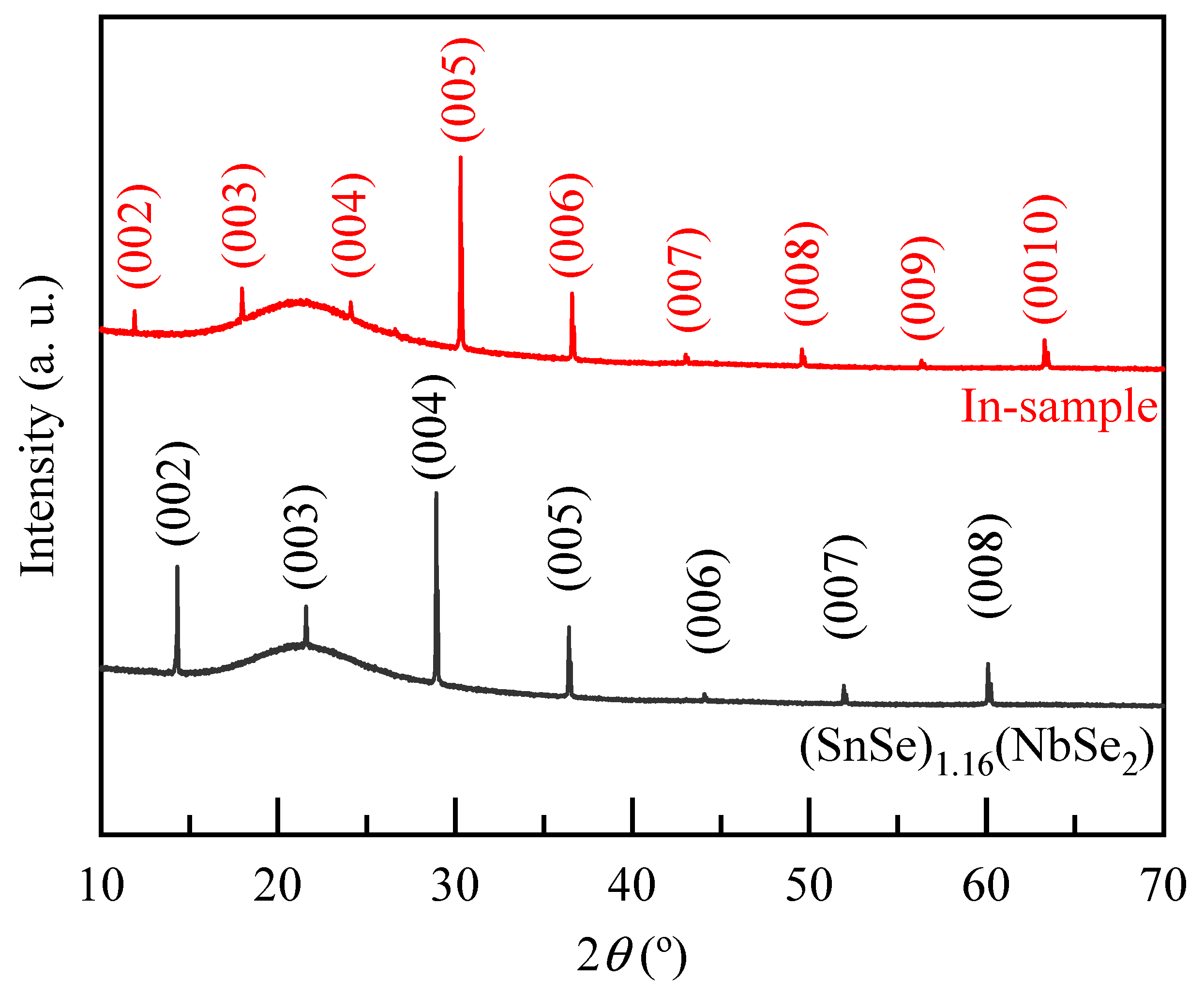
Figure 1. XRD patterns reflected (00l) of the ref. sample (SnSe)1.16(NbSe2) and the In-sample.
Materials 19 02868 g001
Figure 2. Spectra of EDX measurements of each sample: (a) ref. sample and (b) In-sample.
Materials 19 02868 g002
Figure 3. Selected area electron diffraction (SAED) patterns of the In-sample obtained via TEM measurements: (a) a*c*-plane, (b) a*b*-plane and (c) magnified figure of (b).
Materials 19 02868 g003
Figure 4. Synchrotron X-ray diffraction images of the (hk0) plane for the In-sample single crystals. Diffraction spots originating from NbSe2 are marked with red circles, and those from the other layers are marked with blue and yellow circles.
Materials 19 02868 g004
Figure 5. (a) Bright-Field (BF) out-of-plane image of the In-sample, and (b) High-Angle Annular Dark-Field (HAADF) image. (c) Intensity profiles obtained from line-cut analyses along the stacking direction in the BF image (a) and the HAADF image (b). The regions and directions used for the line-profile analyses are indicated by red squares and arrows in (a,b), respectively.
Materials 19 02868 g005
Figure 6. (a) High-resolution out-of-plane image of the In-sample single crystal. The inset figure is an enlarged view of the red square. (b) Line profile corresponding to the orange square highlighted in (a).
Materials 19 02868 g006
Figure 7. Temperature dependence of electrical resistivity for the ref. and In-samples. The inset shows an enlarged view near the superconducting transition.
Materials 19 02868 g007
Figure 8. Temperature dependence of the magnetic susceptibility for the In-sample. This measurement was performed on the same crystal used for the resistivity measurements. A magnetic field of 10 Oe was applied along the c axis.
Materials 19 02868 g008
Figure 9. Temperature dependence of electrical resistivity under magnetic fields. Results of the magnetic field along the a, b, and c axes in (SnSe)1.16(NbSe2) (ac) and the In-sample (df).
Materials 19 02868 g009
Figure 10. μ0Hc2-Tc phase diagram for the ref. sample (a) and In-sample (b). The dashed lines in both graphs represent the Pauli limit (μ0Hp), calculated as 1.86Tc.
Materials 19 02868 g010
Table 1. Summary of the lattice parameters for the ref. sample and the In-sample. The lattice parameters for the In-sample were independently calculated from the SAED patterns and from the single-crystal X-ray diffraction (SC-XRD) measurements. For the ref. sample, the lattice parameters were taken from powder XRD, as reported in previous work [18].
In-Sample(SnSe)1.16(NbSe2) [18]
Subsystema (Å)b (Å)c (Å)methoda (Å)b (Å)c (Å)method
Square5.76(8)5.88(6)14.8(1)SAED5.9405.96812.340P-XRD
Triangular3.38(4)5.88(6) 3.4445.96824.68
Square5.6285.93514.398SC-XRD
Triangular3.3845.919
Table 2. Lattice constants along the c axis, Tc, μ0Hc2(0) for each axis, Hc2/Hp, and coherence lengths for each sample.
(SnSe)1.16(NbSe2)In-Sample
c12.3214.77
Tc3.65.4
μ0 H c 2 | | a (0)8.623.0
μ0 H c 2 | | b (0)9.529.4
μ0 H c 2 | | c (0)1.72.4
H c 2 | | a (0)/Hp1.32.3
H c 2 | | b (0)/Hp1.43.0
H c 2 | | c (0)/Hp0.30.2
ξa (Å)13.410.3
ξb (Å)14.813.2
ξc (Å)2.61.1
γab1.11.3
γac5.29.6
γbc5.712
Disclaimer/Publisher’s Note: The statements, opinions and data contained in all publications are solely those of the individual author(s) and contributor(s) and not of MDPI and/or the editor(s). MDPI and/or the editor(s) disclaim responsibility for any injury to people or property resulting from any ideas, methods, instructions or products referred to in the content.