


Temperature-Adaptive Carrier Regulation and Enhanced Thermoelectric Performance in n-Type PbTe via Deep-Shallow Co-Doping

 , and
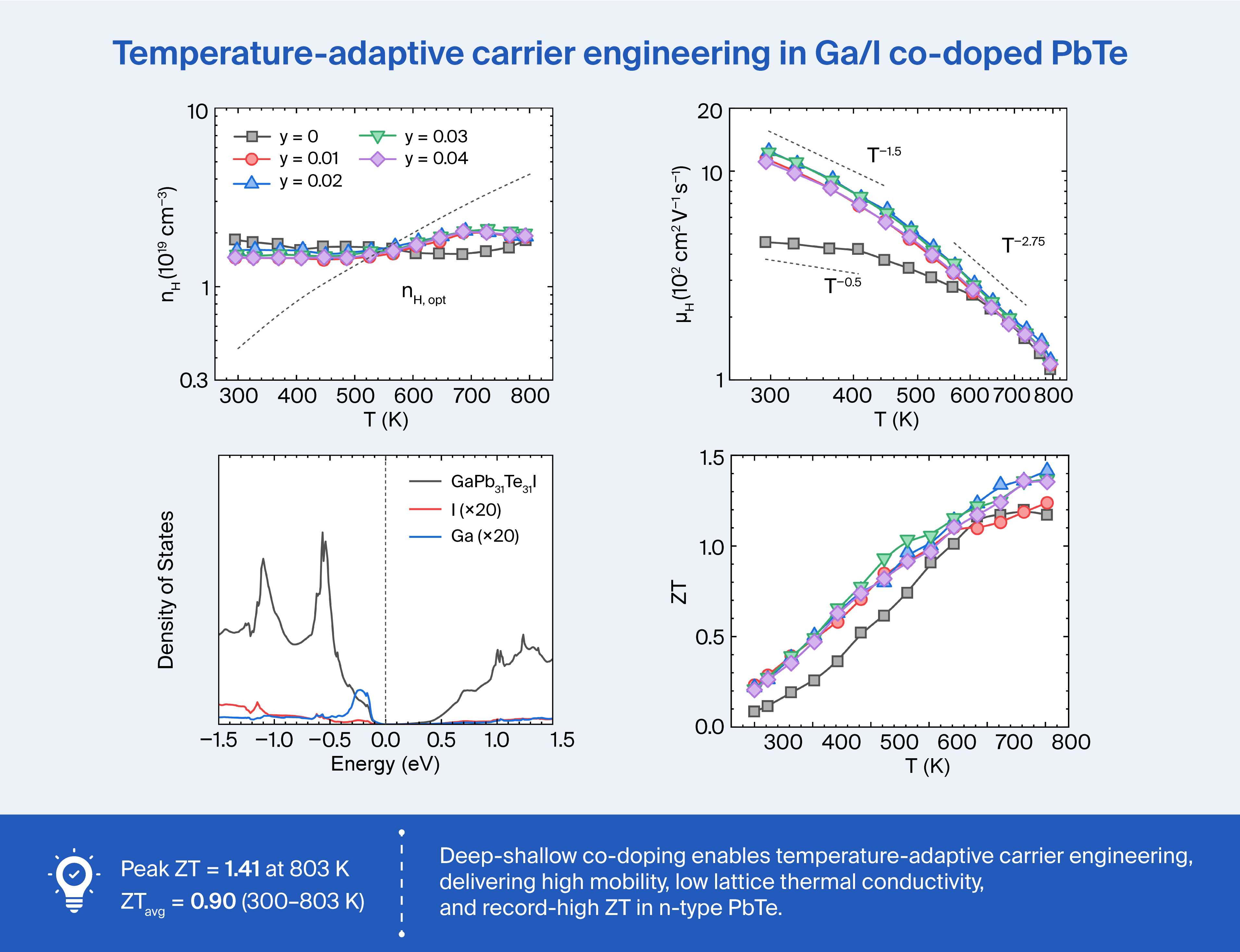
, and Abstract
Share and Cite
Song, A.; Zhao, P.; Wang, B.; Wang, D.; Chen, C.; Shen, T.; Li, H.; Xu, B.; Tian, Y. Temperature-Adaptive Carrier Regulation and Enhanced Thermoelectric Performance in n-Type PbTe via Deep-Shallow Co-Doping. Materials 2026, 19, 2832. https://doi.org/10.3390/ma19132832
Song A, Zhao P, Wang B, Wang D, Chen C, Shen T, Li H, Xu B, Tian Y. Temperature-Adaptive Carrier Regulation and Enhanced Thermoelectric Performance in n-Type PbTe via Deep-Shallow Co-Doping. Materials. 2026; 19(13):2832. https://doi.org/10.3390/ma19132832
Chicago/Turabian StyleSong, Aihua, Peng Zhao, Binhao Wang, Dan Wang, Chen Chen, Tao Shen, Hang Li, Bo Xu, and Yongjun Tian. 2026. "Temperature-Adaptive Carrier Regulation and Enhanced Thermoelectric Performance in n-Type PbTe via Deep-Shallow Co-Doping" Materials 19, no. 13: 2832. https://doi.org/10.3390/ma19132832
APA StyleSong, A., Zhao, P., Wang, B., Wang, D., Chen, C., Shen, T., Li, H., Xu, B., & Tian, Y. (2026). Temperature-Adaptive Carrier Regulation and Enhanced Thermoelectric Performance in n-Type PbTe via Deep-Shallow Co-Doping. Materials, 19(13), 2832. https://doi.org/10.3390/ma19132832
