Mixed-Mode Dynamic Stress Intensity Factors and Fracture Analysis Using Ordinary State-Based Peridynamics

 ,
,  and
and 
Abstract
1. Introduction
2. Peridynamic Theory
2.1. 2D OSPD Model
2.2. Numerical Implementation
3. Interaction Integral Method
4. Numerical Results and Discussion of DSIFs
4.1. Mode I Cracked Plate Under Static and Quasi-Static Analyses
4.2. Mixed-Mode Cracked Plate Under Static and Quasi-Static Analyses
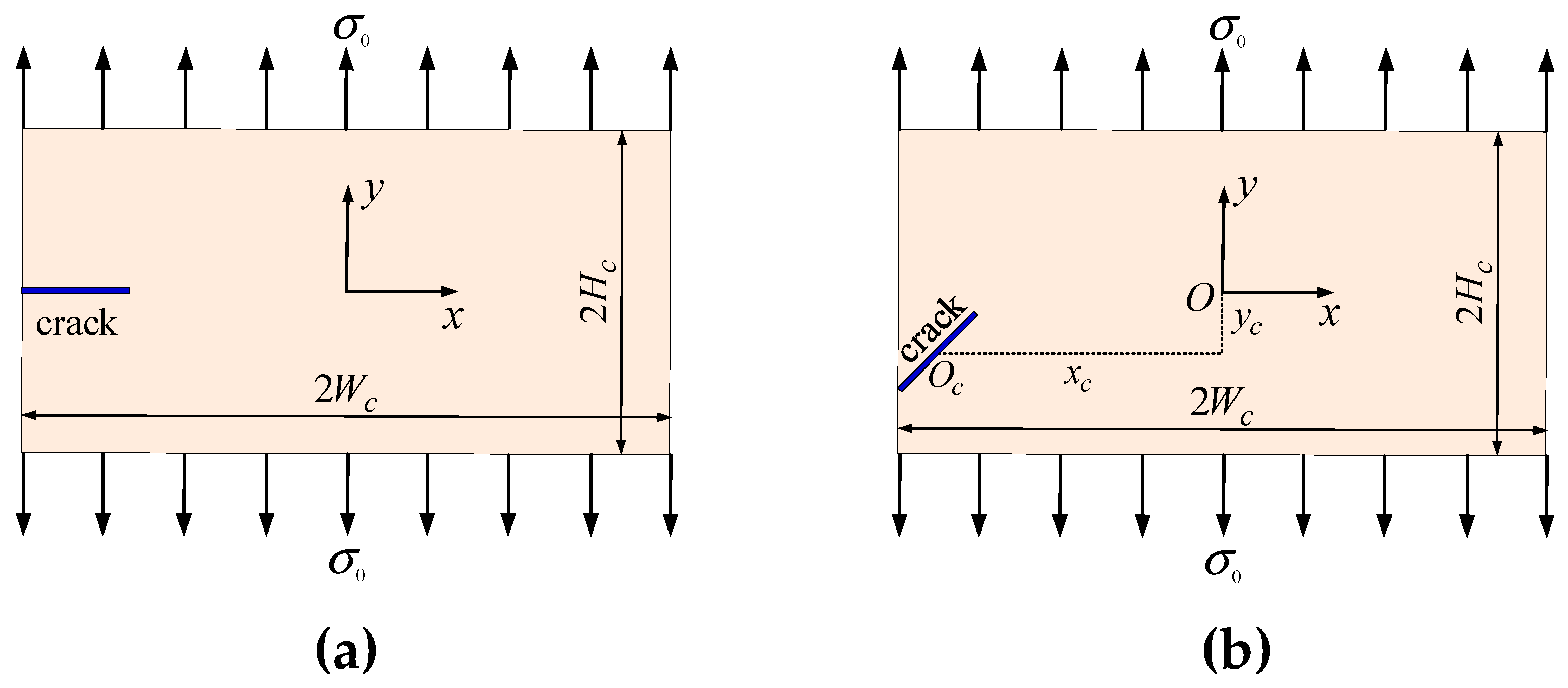
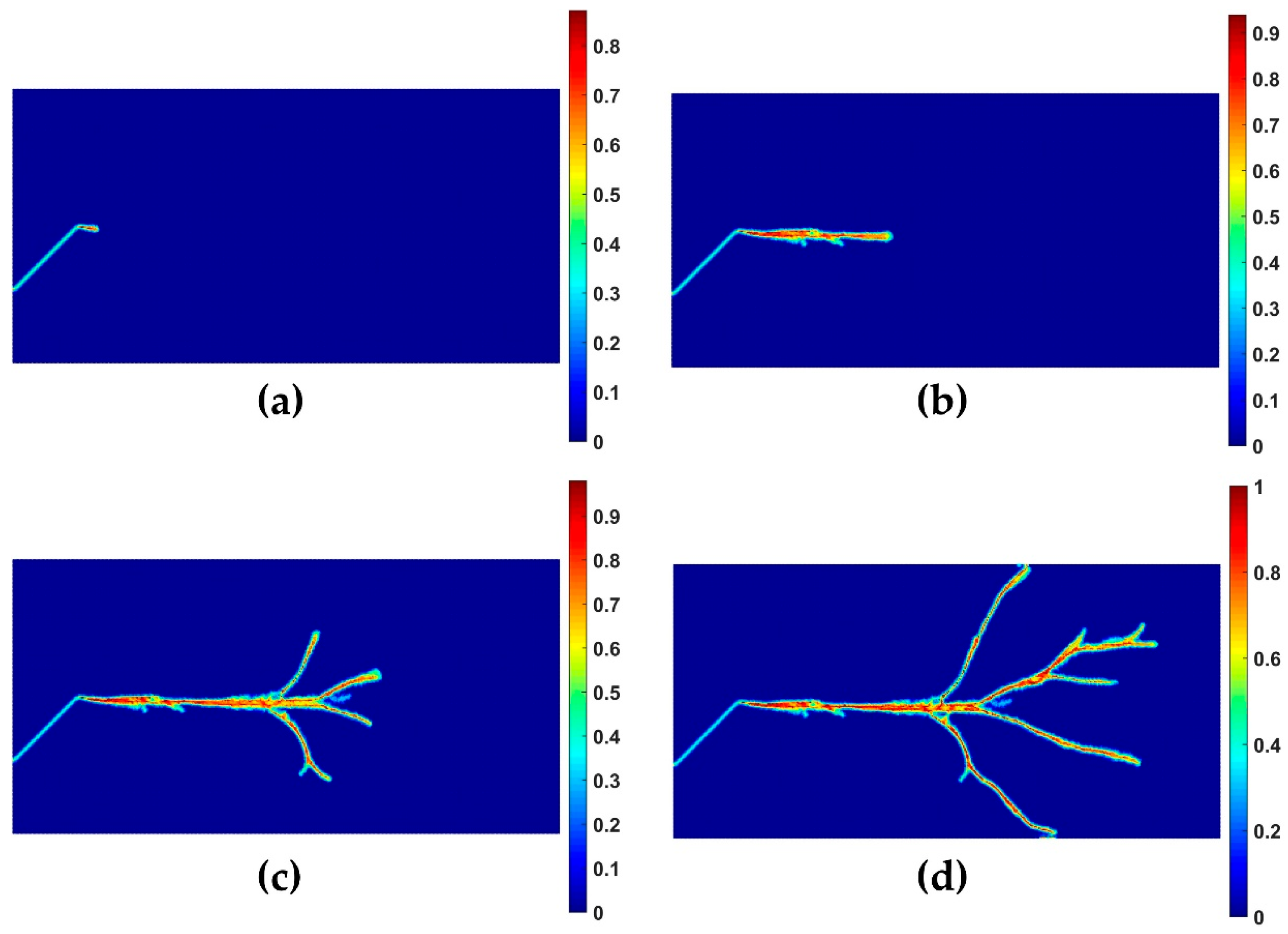
4.3. Mixed-Mode Cracked Plate Under Dynamic Fracture and Crack Branching
5. Conclusions
Author Contributions
Funding
Data Availability Statement
Conflicts of Interest
References
- Sedmak, A. Fatigue crack growth simulation by extended finite element method: A review of case studies. Fatigue Fract. Eng. Mater. Struct. 2024, 47, 1819–1855. [Google Scholar] [CrossRef]
- Gontarz, J.; Podgórski, J. Prediction of crack path in concrete-like composite using extended finite element method. Adv. Sci. Technol. Res. J. 2025, 19, 239–254. [Google Scholar] [CrossRef]
- Salmon, L.; Blanc, V.; Garajeu, M.; Helfer, T.; Socié, A.; Lejeunes, S. A thermo-mechanical cohesive zone model for damage and healing in brittle solids. Comput. Mech. 2026, 77, 501–520. [Google Scholar] [CrossRef]
- Zhu, Y.; Zhang, Y.; Xiang, L. Crack Propagation Behavior Modeling of Bonding Interface in Composite Materials Based on Cohesive Zone Method. Buildings 2025, 15, 1717. [Google Scholar] [CrossRef]
- Aliabadi, M.; Brebbia, C. Boundary element formulations in fracture mechanics: A review. WIT Trans. Eng. Sci. 2025, 13, 1–17. [Google Scholar] [CrossRef]
- Fedelinski, P. Analysis of closed branched and intersecting cracks by the boundary element method. Acta Mech. 2022, 233, 1213. [Google Scholar] [CrossRef]
- Al Mahmoud, Z.; Safaei, B.; Sahmani, S.; Asmael, M.; Shahzad, M.A.; Zeeshan, Q.; Qin, Z. Implementation of different types of meshfree technique in computational solid mechanics: A comprehensive review across nano, micro, and macro scales. Arch. Comput. Methods Eng. 2024, 31, 725–838. [Google Scholar] [CrossRef]
- Ng, K.C.; Chen, H.; Low, W.C. Meshfree simulation of dynamic brittle and quasi-brittle fracture using a local damage model based on lattice particle method. Theor. Appl. Fract. Mech. 2024, 131, 104386. [Google Scholar] [CrossRef]
- Ahmadian, H.; Mehraban, M.R.; Ayatollahi, M.R.; Navidtehrani, Y.; Bahrami, B. Phase-field approach for fracture prediction of brittle cracked components. Eng. Fract. Mech. 2024, 309, 110417. [Google Scholar] [CrossRef]
- Hesammokri, P.; Isaksson, P. Numerical analyses of brittle crack growth experiments in compression using a modified phase-field theory. Int. J. Solids Struct. 2024, 296, 112815. [Google Scholar] [CrossRef]
- Silling, S.A. Reformulation of elasticity theory for discontinuities and long-range forces. J. Mech. Phys. Solids 2000, 48, 175–209. [Google Scholar] [CrossRef]
- Silling, S.A.; Lehoucq, R.B. Peridynamic theory of solid mechanics. Adv. Appl. Mech. 2010, 44, 73–168. [Google Scholar]
- Huang, D.; Lu, G.; Wang, C.; Qiao, P. An extended peridynamic approach for deformation and fracture analysis. Eng. Fract. Mech. 2015, 141, 196–211. [Google Scholar] [CrossRef]
- Guan, J.; Yan, X.; Guo, L. An improved bond-based peridynamic model with shear bonds for eliminating rigid body rotation. Theor. Appl. Fract. Mech. 2022, 119, 103369. [Google Scholar] [CrossRef]
- Zhang, H.; Qiao, P. A state-based peridynamic model for quantitative fracture analysis. Int. J. Fract. 2018, 211, 217–235. [Google Scholar] [CrossRef]
- Ahmadi, M.; Sadighi, M.; Hosseini-Toudeshky, H. Microstructure-based deformation and fracture modeling of particulate reinforced composites with ordinary state-based peridynamic theory. Compos. Struct. 2022, 279, 114734. [Google Scholar] [CrossRef]
- Sun, W.; Liew, J.; Gong, M.; Yin, B. Toughening mechanisms of fiber-reinforced composites: A micromechanical heterogeneous peridynamic model. Compos. Struct. 2025, 368, 119285. [Google Scholar] [CrossRef]
- Silling, S.A.; Bobaru, F. Peridynamic modeling of membranes and fibers. Int. J. Non-Linear Mech. 2005, 40, 395–409. [Google Scholar] [CrossRef]
- Wang, M.; Li, L.; Ma, J.; Wu, J.; Du, X. Homogenized and Multiscale Peridynamics Model for Damage and Fracture of Fiber-Reinforced Cementitious Composites. J. Build. Eng. 2026, 120, 115372. [Google Scholar] [CrossRef]
- Che, L.; Liu, S.; Zhang, B.; Fang, G.; Liang, J. Micromechanical modeling for fiber-reinforced composites based on element-based peridynamics. Compos. Part A 2025, 194, 108919. [Google Scholar] [CrossRef]
- Ha, Y.D.; Bobaru, F. Studies of dynamic crack propagation and crack branching with peridynamics. Int. J. Fract. 2010, 162, 229–244. [Google Scholar] [CrossRef]
- Ou, X.; Yao, X.; Han, F. An adaptive coupling modeling between peridynamics and classical continuum mechanics for dynamic crack propagation and crack branching. Eng. Fract. Mech. 2023, 281, 109096. [Google Scholar] [CrossRef]
- Zhang, Y.; Deng, H.; Deng, J.; Liu, C.; Yu, S. Peridynamic simulation of crack propagation of non-homogeneous brittle rock-like materials. Theor. Appl. Fract. Mech. 2020, 106, 102438. [Google Scholar]
- Ru, Y.; Yong, H.; Zhou, Y. Fracture analysis of bulk superconductors under electromagnetic force. Eng. Fract. Mech. 2018, 199, 257–273. [Google Scholar] [CrossRef]
- Shen, H.; Yong, H.; Zhou, Y. Modelling of dynamic fracture in bulk superconductor during pulsed field magnetization using ordinary state-based peridynamics. Eur. J. Mech. A/Solids 2024, 103, 105138. [Google Scholar] [CrossRef]
- Xiao, Y.; Wu, J.; Shen, H.; Hu, X.; Yong, H. Damage behavior in Bi-2212 round wire with 3D elastoplastic peridynamic. Acta Mech. Sin. 2023, 39, 422431. [Google Scholar] [CrossRef]
- Zhou, Z.; Zhang, D.; Gao, C.; Li, Z.; Li, M.; Liu, G. A PD-FEM approach for fast solving static failure problems and its engineering application. Eng. Fract. Mech. 2022, 262, 108269. [Google Scholar] [CrossRef]
- Liu, Z.; Chen, X.; Cheng, W. A novel transitional element-based approach for PD-FEM coupling: Theoretical development. Int. J. Simul. Model 2025, 24, 321–332. [Google Scholar] [CrossRef]
- Sun, W.; Lu, W.; Bao, F.; Ni, P. A PD-FEM coupling approach for modeling thermal fractures in brittle solids. Theor. Appl. Fract. Mech. 2021, 116, 103129. [Google Scholar] [CrossRef]
- Griffith, A.A., VI. The phenomena of rupture and flow in solids. Philos. Trans. A Math. Phys. Eng. Sci. 1921, 221, 163–198. [Google Scholar] [CrossRef]
- Irwin, G.R. Analysis of stresses and strains near the end of a crack traversing a plate. J. Appl. Mech. 1957, 24, 361–364. [Google Scholar] [CrossRef]
- Rice, J.R. A path independent integral and the approximate analysis of strain concentration by notches and cracks. J. Appl. Mech. 1968, 35, 379–386. [Google Scholar] [CrossRef]
- Yau, J. A mixed-mode crack analysis of isotropic solids using conservation laws of elasticity. J. Appl. Mech. 1987, 47, 615–642. [Google Scholar] [CrossRef]
- Stern, M.; Becker, E.; Dunham, R. A contour integral computation of mixed-mode stress intensity factors. Int. J. Fract. 1976, 12, 359–368. [Google Scholar] [CrossRef]
- Hu, W.; Ha, Y.D.; Bobaru, F.; Silling, S.A. The formulation and computation of the nonlocal J-integral in bond-based peridynamics. Int. J. Fract. 2012, 176, 195–206. [Google Scholar] [CrossRef]
- Breitenfeld, M.S.; Geubelle, P.H.; Weckner, O.; Silling, S. Non-ordinary state-based peridynamic analysis of stationary crack problems. Comput. Methods Appl. Mech. Eng. 2014, 272, 233–250. [Google Scholar] [CrossRef]
- Panchadhara, R.; Gordon, P.A. Application of peridynamic stress intensity factors to dynamic fracture initiation and propagation. Int. J. Fract. 2016, 201, 81–96. [Google Scholar] [CrossRef]
- Le, Q.; Bobaru, F. Surface corrections for peridynamic models in elasticity and fracture. Comput. Mech. 2018, 61, 499–518. [Google Scholar] [CrossRef]
- Zhu, N.; Oterkus, E. Calculation of stress intensity factor using displacement extrapolation method in peridynamic framework. J. Mech. 2020, 36, 235–243. [Google Scholar] [CrossRef]
- Zhang, H.; Qiao, P. On the computation of energy release rates by a peridynamic virtual crack extension method. Comput. Methods Appl. Mech. Eng. 2020, 363, 112883. [Google Scholar] [CrossRef]
- Stenström, C.; Eriksson, K. The J-area integral applied in peridynamics. Int. J. Fract. 2021, 228, 127–142. [Google Scholar] [CrossRef]
- Le, M.-Q. Mode-I stress intensity factor by peridynamic stresses. Theor. Appl. Fract. Mech. 2023, 123, 103721. [Google Scholar] [CrossRef]
- Jung, J.; Seok, J. Mixed-mode fatigue crack growth analysis using peridynamic approach. Int. J. Fatigue 2017, 103, 591–603. [Google Scholar] [CrossRef]
- Zou, G.; Chen, H. Path-dependent J-integrals under mixed-mode loads of mode I and mode II. Theor. Appl. Fract. Mech. 2018, 96, 380–386. [Google Scholar] [CrossRef]
- Li, X.; Hao, Z. A two-dimensional non-ordinary state-based peridynamic model based on three-body potential for elastic brittle fracture analysis: X. Li, Z. Hao. Int. J. Fract. 2023, 239, 211–232. [Google Scholar] [CrossRef]
- Mirsayar, M. A generalized model for dynamic mixed-mode fracture via state-based peridynamics. Fatigue Fract. Eng. Mater. Struct. 2023, 46, 244–258. [Google Scholar] [CrossRef]
- Imachi, M.; Tanaka, S.; Bui, T.Q. Mixed-mode dynamic stress intensity factors evaluation using ordinary state-based peridynamics. Theor. Appl. Fract. Mech. 2018, 93, 97–104. [Google Scholar] [CrossRef]
- Dai, M.-J.; Tanaka, S.; Oterkus, S.; Oterkus, E. Mixed-mode stress intensity factors evaluation of flat shells under in-plane loading employing ordinary state-based peridynamics. Theor. Appl. Fract. Mech. 2021, 112, 102841. [Google Scholar] [CrossRef]
- Silling, S.A.; Epton, M.; Weckner, O.; Xu, J.; Askari, E. Peridynamic states and constitutive modeling. J. Elast. 2007, 88, 151–184. [Google Scholar] [CrossRef]
- Madenci, E.; Oterkus, S. Ordinary state-based peridynamics for plastic deformation according to von Mises yield criteria with isotropic hardening. J. Mech. Phys. Solids 2016, 86, 192–219. [Google Scholar] [CrossRef]
- Madenci, E.; Oterkus, E. Peridynamic Theory and Its Applications; Springer: Berlin/Heidelberg, Germany, 2013. [Google Scholar]
- Ru, Y.; Yong, H.; Zhou, Y. Numerical simulation of dynamic fracture behavior in bulk superconductors with an electromagnetic-thermal model. Supercond. Sci. Technol. 2019, 32, 074001. [Google Scholar] [CrossRef]
- Silling, S.A.; Lehoucq, R.B. Convergence of peridynamics to classical elasticity theory. J. Elast. 2008, 93, 13–37. [Google Scholar] [CrossRef]
- Kilic, B.; Madenci, E. An adaptive dynamic relaxation method for quasi-static simulations using the peridynamic theory. Theor. Appl. Fract. Mech. 2010, 53, 194–204. [Google Scholar] [CrossRef]
- Huang, D.; Lu, G.; Qiao, P. An improved peridynamic approach for quasi-static elastic deformation and brittle fracture analysis. Int. J. Mech. Sci. 2015, 94, 111–122. [Google Scholar] [CrossRef]
- Raju, I.; Newman, J., Jr. Stress-intensity factors for a wide range of semi-elliptical surface cracks in finite-thickness plates. Eng. Fract. Mech. 1979, 11, 817–829. [Google Scholar] [CrossRef]
- Raju, I.; Shivakumar, K. An equivalent domain integral method in the two-dimensional analysis of mixed mode crack problems. Eng. Fract. Mech. 1990, 37, 707–725. [Google Scholar] [CrossRef]
- Song, S.H.; Paulino, G.H. Dynamic stress intensity factors for homogeneous and smoothly heterogeneous materials using the interaction integral method. Int. J. Solids Struct. 2006, 43, 4830–4866. [Google Scholar] [CrossRef]
- Anderson, T.L.; Anderson, T.L. Fracture Mechanics: Fundamentals and Applications; CRC Press: Boca Raton, FL, USA, 2005. [Google Scholar]
- Erdogan, F.; Sih, G. On the crack extension in plates under plane loading and transverse shear. J. Basic Eng. AMSE 1963, 85, 519–525. [Google Scholar] [CrossRef]
- Murakami, Y. Stress Intensity Factors Handbook; Pergamon: New York, NY, USA, 1987. [Google Scholar]
- Fedelinski, P.; Aliabadi, M.; Rooke, D. The dual boundary element method: Ĵ-integral for dynamic stress intensity factors. Int. J. Fract. 1994, 65, 369–381. [Google Scholar]
- Murti, V.; Valliappan, S. The use of quarter point element in dynamic crack analysis. Eng. Fract. Mech. 1986, 23, 585–614. [Google Scholar] [CrossRef]
- Bobaru, F.; Zhang, G. Why do cracks branch? A peridynamic investigation of dynamic brittle fracture. Int. J. Fract. 2015, 196, 59–98. [Google Scholar] [CrossRef]
- Agwai, A.; Guven, I.; Madenci, E. Predicting crack propagation with peridynamics: A comparative study. Int. J. Fract. 2011, 171, 65–78. [Google Scholar] [CrossRef]
- Ramulu, M.; Kobayashi, A. Mechanics of crack curving and branching—A dynamic fracture analysis. Int. J. Fract. 1985, 27, 187–201. [Google Scholar] [CrossRef]








Disclaimer/Publisher’s Note: The statements, opinions and data contained in all publications are solely those of the individual author(s) and contributor(s) and not of MDPI and/or the editor(s). MDPI and/or the editor(s) disclaim responsibility for any injury to people or property resulting from any ideas, methods, instructions or products referred to in the content. |
© 2026 by the authors. Licensee MDPI, Basel, Switzerland. This article is an open access article distributed under the terms and conditions of the Creative Commons Attribution (CC BY) license.
Share and Cite
Ru, Y.; Li, F.; Li, X.; Wang, C.; Yang, Q.; Zheng, S.; Zhou, L.; Wang, X. Mixed-Mode Dynamic Stress Intensity Factors and Fracture Analysis Using Ordinary State-Based Peridynamics. Materials 2026, 19, 2560. https://doi.org/10.3390/ma19122560
Ru Y, Li F, Li X, Wang C, Yang Q, Zheng S, Zhou L, Wang X. Mixed-Mode Dynamic Stress Intensity Factors and Fracture Analysis Using Ordinary State-Based Peridynamics. Materials. 2026; 19(12):2560. https://doi.org/10.3390/ma19122560
Chicago/Turabian StyleRu, Yanyun, Fei Li, Xingyu Li, Caidan Wang, Qianlong Yang, Shuqin Zheng, Lei Zhou, and Xu Wang. 2026. "Mixed-Mode Dynamic Stress Intensity Factors and Fracture Analysis Using Ordinary State-Based Peridynamics" Materials 19, no. 12: 2560. https://doi.org/10.3390/ma19122560
APA StyleRu, Y., Li, F., Li, X., Wang, C., Yang, Q., Zheng, S., Zhou, L., & Wang, X. (2026). Mixed-Mode Dynamic Stress Intensity Factors and Fracture Analysis Using Ordinary State-Based Peridynamics. Materials, 19(12), 2560. https://doi.org/10.3390/ma19122560