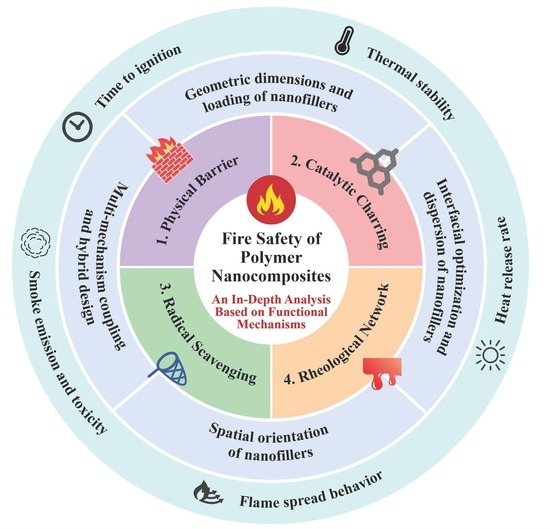
Fire Safety of Polymer Nanocomposites: An In-Depth Analysis Based on Functional Mechanisms



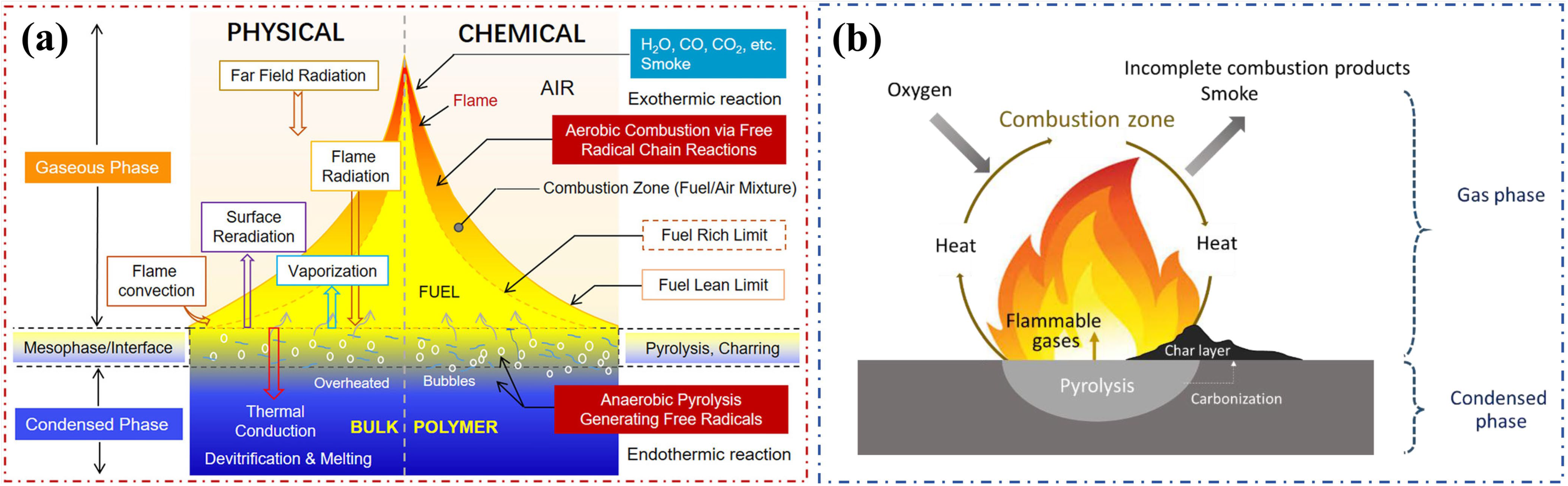
Abstract
1. Introduction
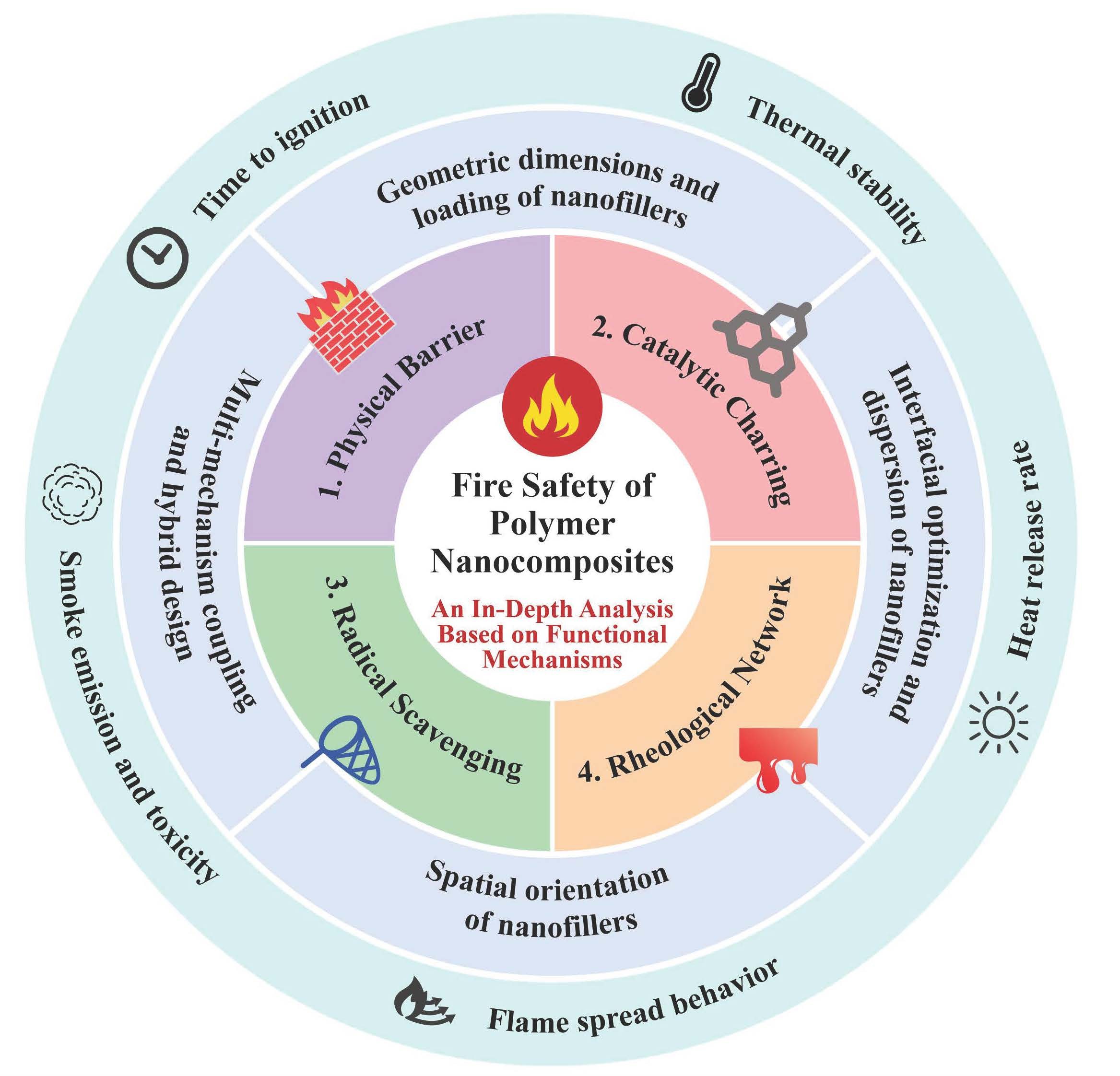
2. Flame-Retardant Functional Mechanisms of Nanomaterials
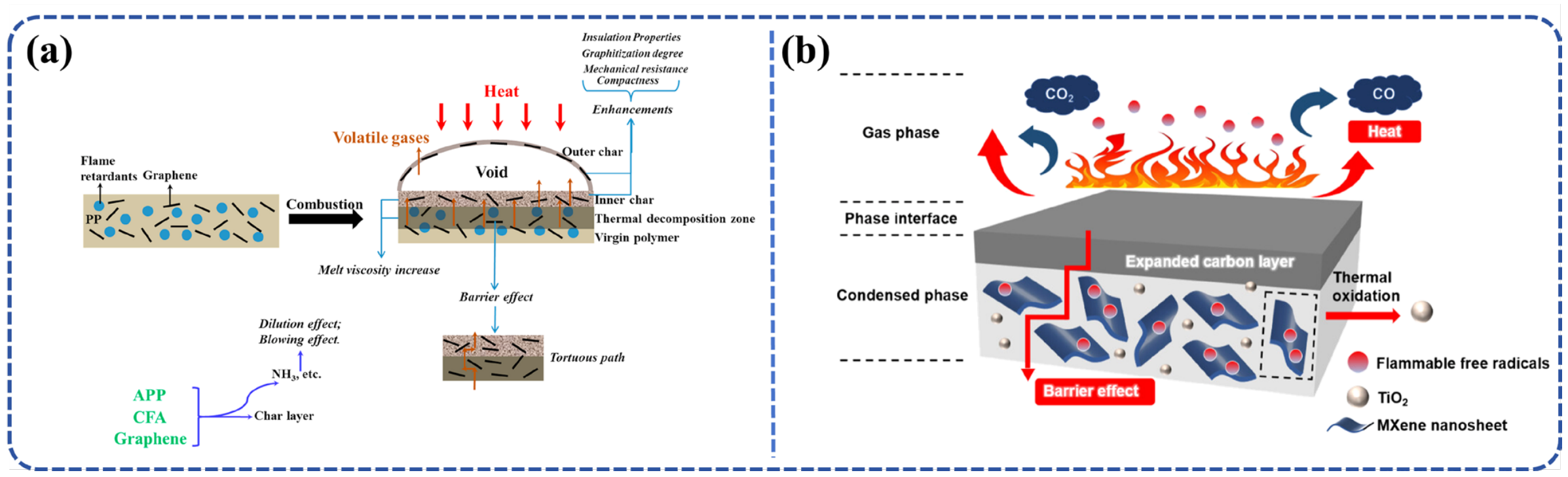
2.1. Physical Barrier Effect
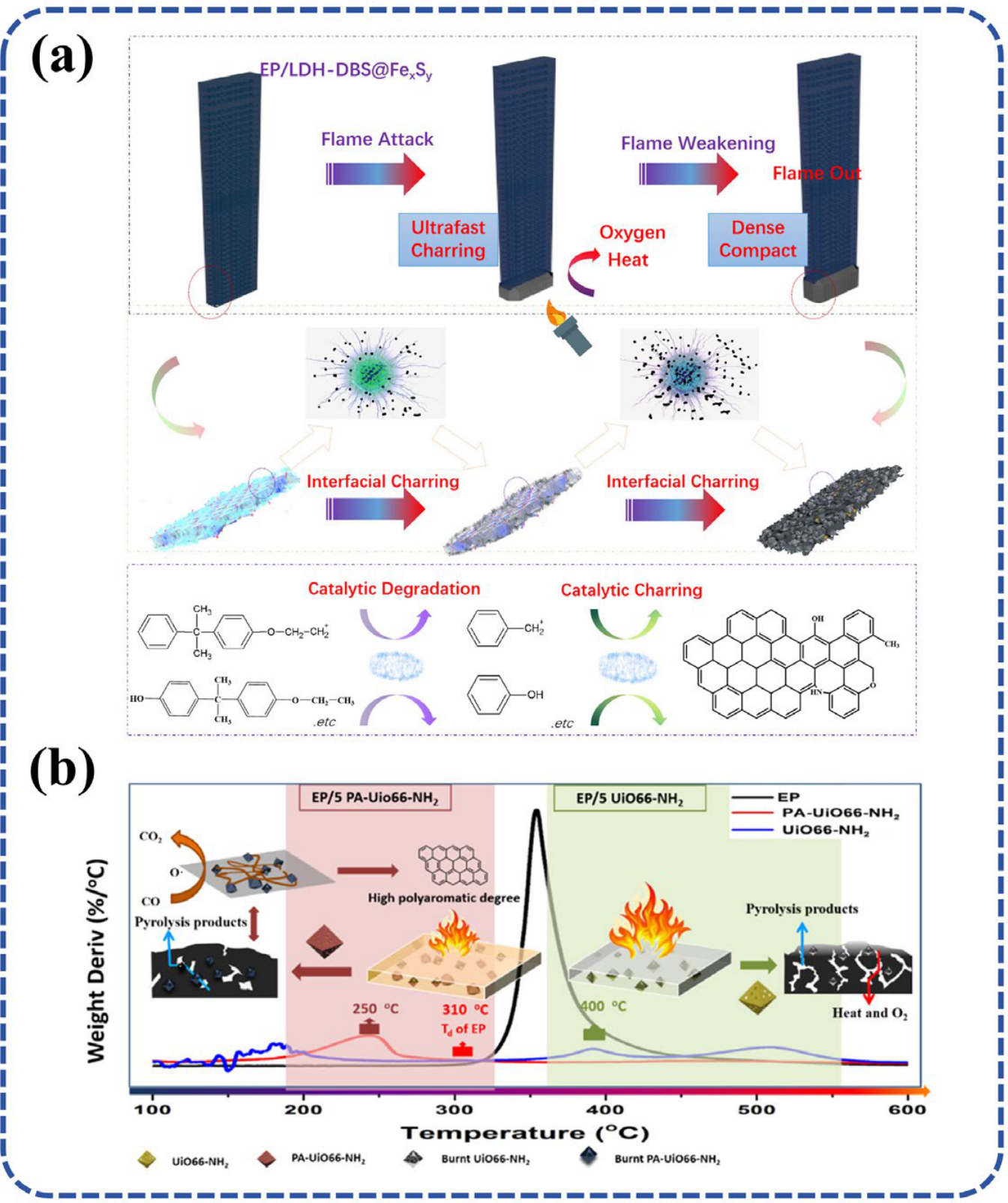
2.2. Catalytic Charring Effect
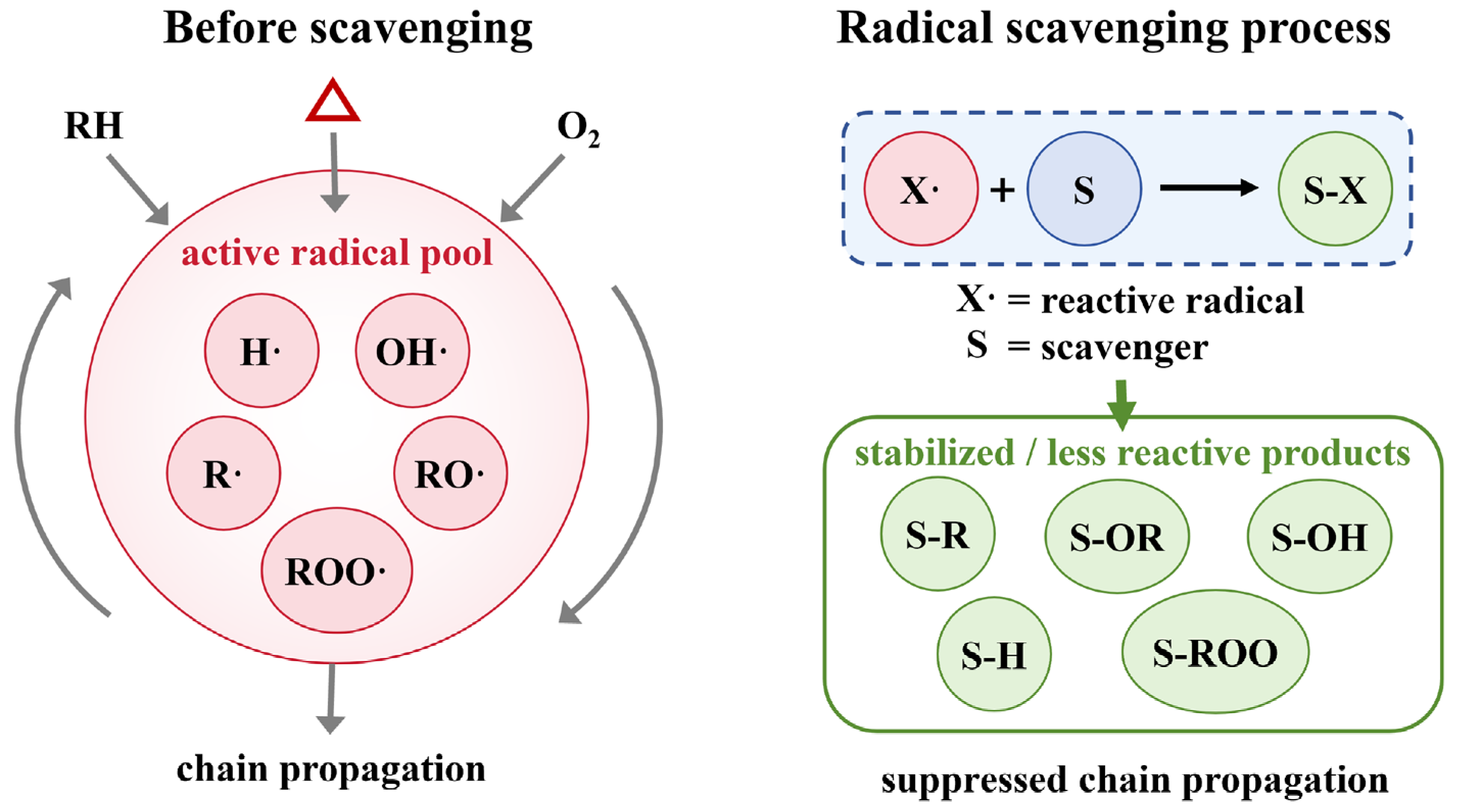
2.3. Free-Radical Scavenging and Chain-Reaction Intervention
2.4. Viscoelastic Network and Anti-Dripping
3. Key Regulatory Factors of “Structure-Mechanism-Property” Relationships
3.1. Geometric Dimensions and Loading of Nanofillers
3.2. Interfacial Optimization and Dispersion of Nanofillers
3.3. Spatial Orientation of Nanofillers

3.4. Multi-Mechanism Coupling and Hybrid Design
4. Impact of Nanomaterials on Polymer Fire Behavior
4.1. Time to Ignition

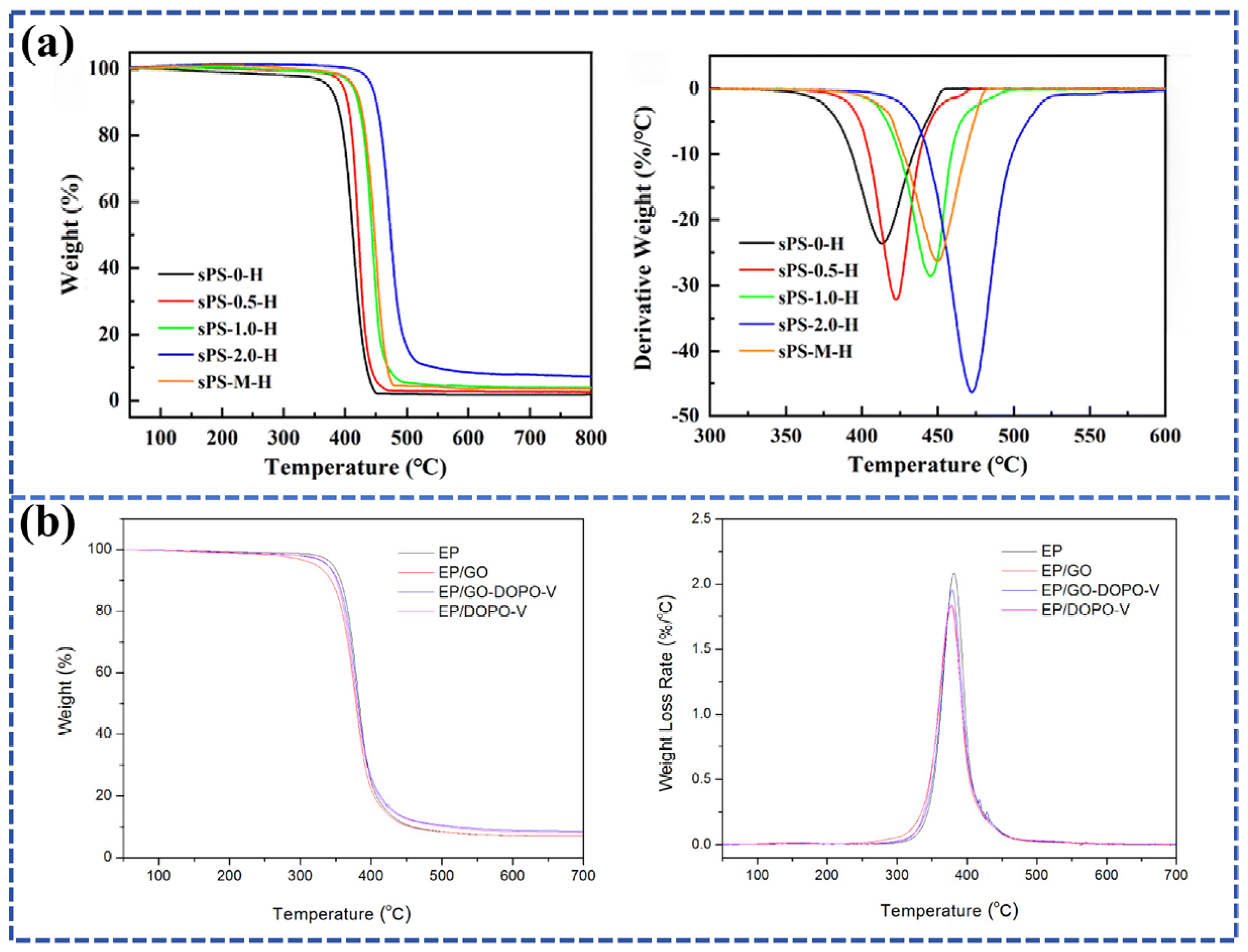
4.2. Thermal Stability
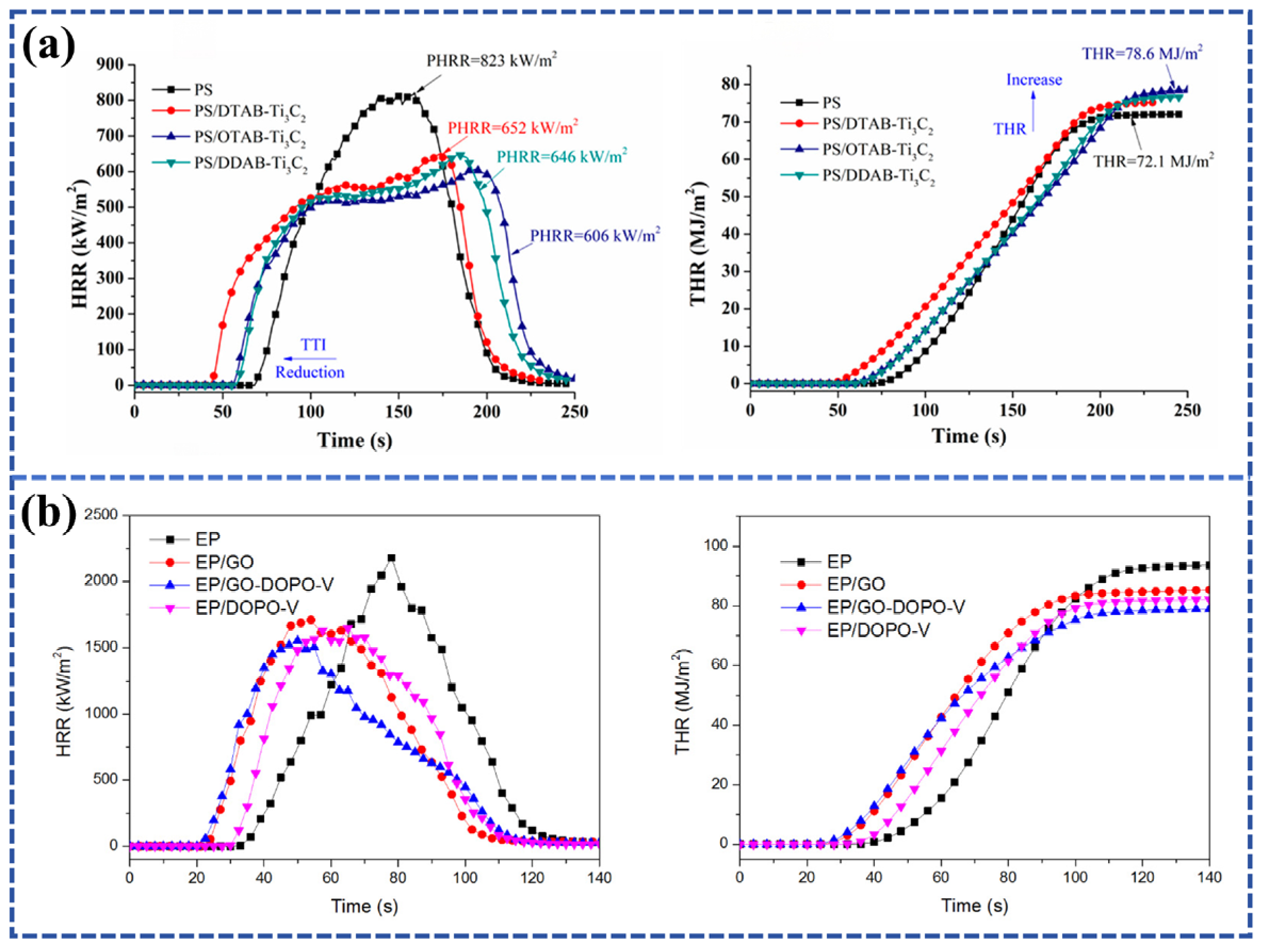
4.3. Heat Release Rate
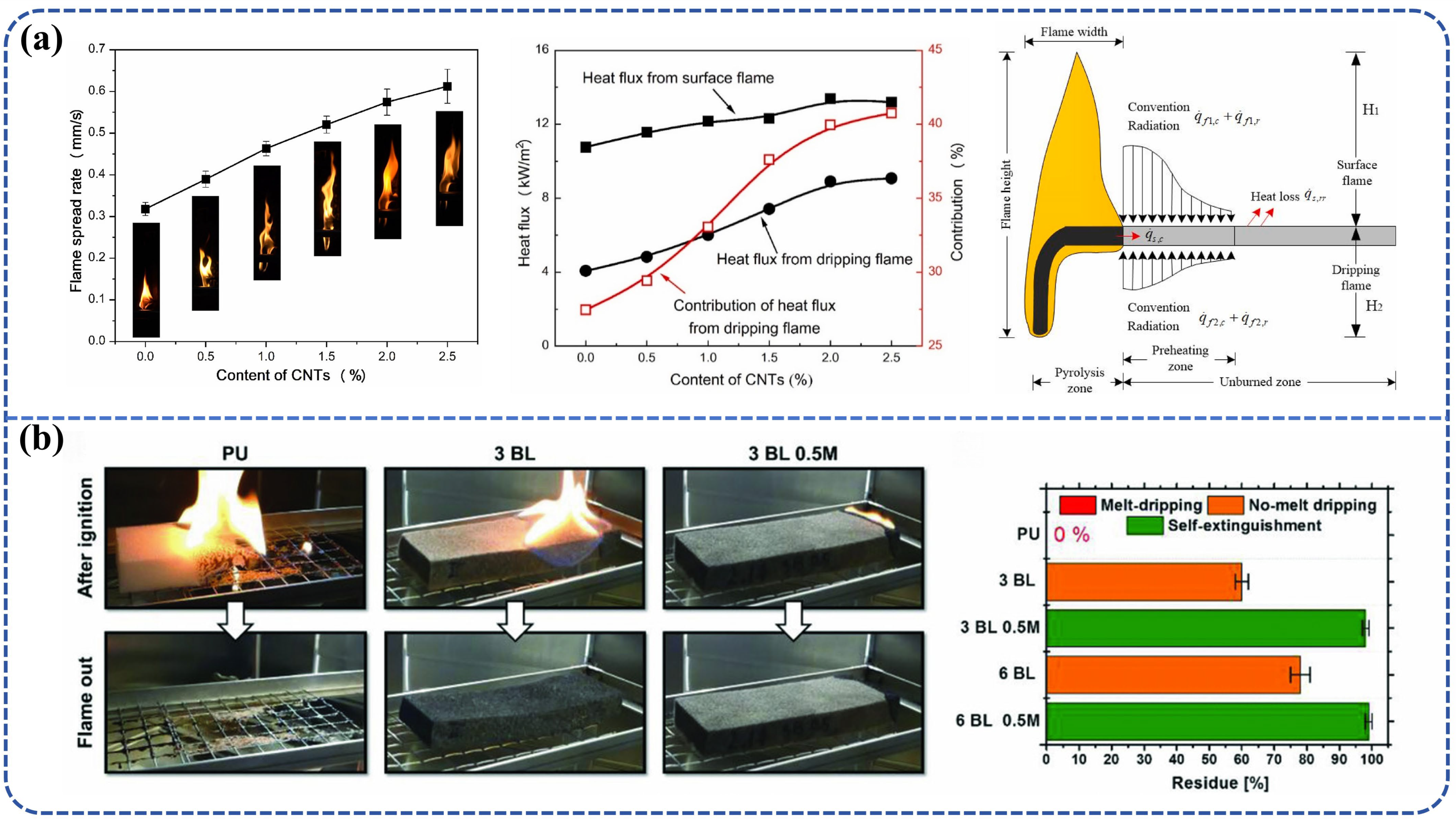
4.4. Flame Spread Behavior

4.5. Smoke Emission and Toxicity
5. Conclusions and Perspectives
Author Contributions
Funding
Data Availability Statement
Conflicts of Interest
Abbreviations
| 1D | one-dimensional |
| 2D | two-dimensional |
| ATH | aluminum trihydroxide |
| BP | black phosphorus |
| CNT | carbon nanotube |
| DOPO | 9,10-dihydro-9-oxa-10-phosphaphenanthrene-10-oxide |
| DTG | derivative thermogravimetry |
| EBA | ethylene-butyl acrylate copolymer |
| EP | epoxy resin |
| EVA | ethylene-vinyl acetate copolymer |
| FED | fractional effective dose |
| FSR | flame spread rate |
| GO | graphene oxide |
| h-BN | hexagonal boron nitride |
| HNT | halloysite nanotube |
| HRR | heat release rate |
| IFR | intumescent flame retardant |
| LDH | layered double hydroxide |
| LLDPE | linear low-density polyethylene |
| LOI | limiting oxygen index |
| MARHE | maximum average rate of heat emission |
| MMT | montmorillonite |
| MOF | metal–organic framework |
| MWCNT | multi-walled carbon nanotube |
| PA6 | polyamide 6 |
| PC | polycarbonate |
| PE | polyethylene |
| PHRR | peak heat release rate |
| PLA | polylactic acid |
| PMMA | poly(methyl methacrylate) |
| PP | polypropylene |
| PS | polystyrene |
| PSPR | peak smoke production rate |
| PU | polyurethane |
| RGO | reduced graphene oxide |
| SPR | smoke production rate |
| sPS | syndiotactic polystyrene |
| SWNT | single-walled carbon nanotube |
| TGA | thermogravimetric analysis |
| THR | total heat release |
| TPU | thermoplastic polyurethanes |
| TSP | total smoke production |
| TSR | total smoke release |
| TTI | time to ignition |
| UL-94 | Underwriters Laboratories 94 |
| ZIF-67 | zeolitic imidazolate framework-67 |
References
- Qiu, X.; Wang, Y.; Wu, C.; Ding, L.; Lin, J.; Gao, W.; Chi, Y.; Ma, M.; Huang, W. Flame-Retardant Thermoplastic Polyurethane-Based Nanocomposites: Research Status, Prospects and Challenges. Polym. Adv. Technol. 2025, 36, e70227. [Google Scholar] [CrossRef]
- Kumar, S.; Dhawan, R.; Shukla, S.K. Flame Retardant Polymer Nanocomposites: An Overview. Macromol. Symp. 2023, 407, 2200089. [Google Scholar] [CrossRef]
- Laoutid, F.; Bonnaud, L.; Alexandre, M.; Lopez-Cuesta, J.M.; Dubois, P. New prospects in flame retardant polymer materials: From fundamentals to nanocomposites. Mater. Sci. Eng. R-Rep. 2009, 63, 100–125. [Google Scholar] [CrossRef]
- Hull, T.R.; Stec, A.A.; Nazare, S. Fire retardant effects of polymer nanocomposites. J. Nanosci. Nanotechnol. 2009, 9, 4478–4486. [Google Scholar] [CrossRef] [PubMed]
- Kim, Y.; Lee, S.; Yoon, H. Fire-Safe Polymer Composites: Flame-Retardant Effect of Nanofillers. Polymers 2021, 13, 540. [Google Scholar] [CrossRef]
- Chen, Y.; Feng, Q.; Nie, Y.; Zhang, J.; Yang, L. A Review of Combustion and Flame Spread over Thermoplastic Materials: Research Advances and Prospects. Fire 2023, 6, 125. [Google Scholar] [CrossRef]
- Guo, K.-Y.; Wu, Q.; Mao, M.; Chen, H.; Zhang, G.-D.; Zhao, L.; Gao, J.-F.; Song, P.; Tang, L.-C. Water-based hybrid coatings toward mechanically flexible, super-hydrophobic and flame-retardant polyurethane foam nanocomposites with high-efficiency and reliable fire alarm response. Compos. Part B-Eng. 2020, 193, 108017. [Google Scholar] [CrossRef]
- Zhang, M.; Li, M.; Wang, Y.; Sun, J. Experimental study of thermal shrinkage and melt dripping properties of expanded polystyrene under various heat fluxes. J. Build. Eng. 2022, 60, 105179. [Google Scholar] [CrossRef]
- McKenna, S.T.; Birtles, R.; Dickens, K.; Walker, R.G.; Spearpoint, M.J.; Stec, A.A.; Hull, T.R. Flame retardants in UK furniture increase smoke toxicity more than they reduce fire growth rate. Chemosphere 2018, 196, 429–439. [Google Scholar] [CrossRef]
- Hull, T.R.; Stec, A.A.; Lebek, K.; Price, D. Factors affecting the combustion toxicity of polymeric materials. Polym. Degrad. Stab. 2007, 92, 2239–2246. [Google Scholar] [CrossRef]
- Sai, T.; Ran, S.; Guo, Z.; Song, P.; Fang, Z. Recent advances in fire-retardant carbon-based polymeric nanocomposites through fighting free radicals. SusMat 2022, 2, 411–434. [Google Scholar] [CrossRef]
- Ahmed, L.; Zhang, B.; Hatanaka, L.C.; Mannan, M.S. Application of polymer nanocomposites in the flame retardancy study. J. Loss Prev. Process Ind. 2018, 55, 381–391. [Google Scholar] [CrossRef]
- Norouzi, M.; Zare, Y.; Kiany, P. Nanoparticles as Effective Flame Retardants for Natural and Synthetic Textile Polymers: Application, Mechanism, and Optimization. Polym. Rev. 2015, 55, 531–560. [Google Scholar] [CrossRef]
- Mu, X.; Jin, Z.; Chu, F.; Cai, W.; Zhu, Y.; Yu, B.; Song, L.; Hu, Y. High-performance flame-retardant polycarbonate composites: Mechanisms investigation and fire-safety evaluation systems establishment. Compos. Part B-Eng. 2022, 238, 109873. [Google Scholar] [CrossRef]
- Higginbotham, A.L.; Lomeda, J.R.; Morgan, A.B.; Tour, J.M. Graphite oxide flame-retardant polymer nanocomposites. ACS Appl. Mater. Interfaces 2009, 1, 2256–2261. [Google Scholar] [CrossRef]
- Yang, Y.; Diaz Palencia, J.L.; Wang, N.; Jiang, Y.; Wang, D.-Y. Nanocarbon-Based Flame Retardant Polymer Nanocomposites. Molecules 2021, 26, 4670. [Google Scholar] [CrossRef]
- Shan, G.; Jin, W.; Chen, H.; Zhao, M.; Surampalli, R.; Ramakrishnan, A.; Zhang, T.; Tyagi, R.D. Flame-Retardant Polymer Nanocomposites and Their Heat-Release Rates. J. Hazard. Toxic Radioact. Waste 2015, 19, 04015006. [Google Scholar] [CrossRef]
- Isah, M.; Shehzad, F.; Al-Harthi, M.A. Advances in Graphene-Based Flame-Retardant for Polystyrene Applications: Synthesis, Mechanisms, and Future Perspectives. Polymers 2025, 17, 1811. [Google Scholar] [CrossRef]
- Attia, N.F.; Elashery, S.E.A.; Zakria, A.M.; Eltaweil, A.S.; Oh, H. Recent advances in graphene sheets as new generation of flame retardant materials. Mater. Sci. Eng. B-Adv. Funct. Solid-State Mater. 2021, 274, 115460. [Google Scholar] [CrossRef]
- Kashiwagi, T.; Du, F.; Winey, K.I.; Groth, K.M.; Shields, J.R.; Bellayer, S.P.; Kim, H.; Douglas, J.F. Flammability properties of polymer nanocomposites with single-walled carbon nanotubes: Effects of nanotube dispersion and concentration. Polymer 2005, 46, 471–481. [Google Scholar] [CrossRef]
- Kashiwagi, T.; Du, F.; Douglas, J.F.; Winey, K.I.; Harris, R.H.; Shields, J.R. Nanoparticle networks reduce the flammability of polymer nanocomposites. Nat. Mater. 2005, 4, 928–933. [Google Scholar] [CrossRef]
- Hou, Y.; Xu, Z.; An, R.; Zheng, H.; Hu, W.; Zhou, K. Recent progress in black phosphorus nanosheets for improving the fire safety of polymer nanocomposites. Compos. Part B-Eng. 2023, 249, 110404. [Google Scholar] [CrossRef]
- Yue, X.; Li, C.; Ni, Y.; Xu, Y.; Wang, J. Flame retardant nanocomposites based on 2D layered nanomaterials: A review. J. Mater. Sci. 2019, 54, 13070–13105. [Google Scholar] [CrossRef]
- Alli, Y.A.; Bamisaye, A.; Ejeromedoghene, O.; Jimoh, O.O.; Oni, S.O.; Ezeamii, G.C.; Ozoemezim, C.; Ogunlaja, A.S.; Abdul Rashid, S.; Kandola, B.K. Recent advancement in MXene-based nanomaterials for flame retardant polymers and composites. Adv. Ind. Eng. Polym. Res. 2025, 8, 322–340. [Google Scholar] [CrossRef]
- Zhan, W.; Feng, X.; Li, L.; Chen, C.; Chen, L.; Kong, Q.; Chen, M.; Zhang, Q.; Jiang, J. Review of MXene Nanosheet-Based Composites for Fire-Retardant Applications. ACS Appl. Nano Mater. 2024, 7, 22360–22378. [Google Scholar] [CrossRef]
- Zhang, Z.; Qin, J.; Zhang, W.; Pan, Y.-T.; Wang, D.-Y.; Yang, R. Synthesis of a novel dual layered double hydroxide hybrid nanomaterial and its application in epoxy nanocomposites. Chem. Eng. J. 2020, 381, 122777. [Google Scholar] [CrossRef]
- Gao, Y.; Wu, J.; Wang, Q.; Wilkie, C.A.; O’Hare, D. Flame retardant polymer/layered double hydroxide nanocomposites. J. Mater. Chem. A 2014, 2, 10996. [Google Scholar] [CrossRef]
- Idumah, C.I. Molybdenum disulfide polymeric nanoarchitectures and applications: A review. Polym. Eng. Sci. 2023, 63, 2700–2718. [Google Scholar] [CrossRef]
- Wang, X.; Xing, W.; Feng, X.; Song, L.; Hu, Y. MoS2/Polymer Nanocomposites: Preparation, Properties, and Applications. Polym. Rev. 2017, 57, 440–466. [Google Scholar] [CrossRef]
- Cai, W.; Wang, B.-B.; Wang, X.; Zhu, Y.-L.; Li, Z.-X.; Xu, Z.-M.; Song, L.; Hu, W.-Z.; Hu, Y. Recent Progress in Two-Dimensional Nanomaterials Following Graphene for Improving Fire Safety of Polymer (Nano)Composites. Chin. J. Polym. Sci. 2021, 39, 935–956. [Google Scholar] [CrossRef]
- Gilman, J.W. Flammability and thermal stability studies of polymer layered-silicate (clay) nanocomposites. Appl. Clay Sci. 1999, 15, 31–49. [Google Scholar] [CrossRef]
- Vahidi, G.; Bajwa, D.S.; Shojaeiarani, J.; Stark, N.; Darabi, A. Advancements in traditional and nanosized flame retardants for polymers—A review. J. Appl. Polym. Sci. 2021, 138, e50050. [Google Scholar] [CrossRef]
- Kashiwagi, T.; Harris, R.H.; Zhang, X.; Briber, R.M.; Cipriano, B.H.; Raghavan, S.R.; Awad, W.H.; Shields, J.R. Flame retardant mechanism of polyamide 6–clay nanocomposites. Polymer 2004, 45, 881–891. [Google Scholar] [CrossRef]
- Wang, Z.; Song, R.J.; Du, X.H.; Meng, X.Y.; Jiang, Z.W.; Tang, T. Structural Evolution and Composition Change in the Surface Region of Polypropylene/Clay Nanocomposites Annealed at High Temperatures. Chin. J. Polym. Sci. 2009, 27, 879–888. [Google Scholar] [CrossRef]
- Yuan, B.; Fan, A.; Yang, M.; Chen, X.; Hu, Y.; Bao, C.; Jiang, S.; Niu, Y.; Zhang, Y.; He, S.; et al. The effects of graphene on the flammability and fire behavior of intumescent flame retardant polypropylene composites at different flame scenarios. Polym. Degrad. Stab. 2017, 143, 42–56. [Google Scholar] [CrossRef]
- Zhang, J.; Li, Z.; Zhang, L.; Yang, Y.; Wang, D.-Y. Green Synthesis of Biomass Phytic Acid-Functionalized UiO-66-NH2 Hierarchical Hybrids Toward Fire Safety of Epoxy Resin. ACS Sustain. Chem. Eng. 2019, 8, 994–1003. [Google Scholar] [CrossRef]
- Jiang, W.; Hao, J.; Han, Z. Study on the thermal degradation of mixtures of ammonium polyphosphate and a novel caged bicyclic phosphate and their flame retardant effect in polypropylene. Polym. Degrad. Stab. 2012, 97, 632–637. [Google Scholar] [CrossRef]
- Bourbigot, S.; Duquesne, S. Fire retardant polymers: Recent developments and opportunities. J. Mater. Chem. 2007, 17, 2283–2300. [Google Scholar] [CrossRef]
- Tao, Y.; Liu, T.; Fu, W.; Fan, Y.; Ni, X. The catalytic pyrolysis of titanium in the highly charring metal-coordinated flame retardant synthesized for use in polyamide 66. Polym. Degrad. Stab. 2025, 242, 111725. [Google Scholar] [CrossRef]
- Tang, H.; Xue, B.; Xiao, Y.; Liu, Z.; Lei, Y.; Chen, M.; Huang, F.; Li, Y.; Chen, B.; Chen, D.; et al. Synergistic enhancement of mechanical and flame-retardant properties in PEEK via MOF-on-MOF hybrid nanofillers. Compos. Part B-Eng. 2026, 310, 113127. [Google Scholar] [CrossRef]
- Yang, D.; Hu, Y.; Song, L.; Nie, S.; He, S.; Cai, Y. Catalyzing carbonization function of α-ZrP based intumescent fire retardant polypropylene nanocomposites. Polym. Degrad. Stab. 2008, 93, 2014–2018. [Google Scholar] [CrossRef]
- Tang, E.; Li, Z.; Wu, Z.; Jiang, L.-Y.; Bi, Q.-Q.; Zhang, H.; Zhang, L.; Ran, S.-Y.; de la Vega, J.; Wang, D.-Y. Ultrafast catalytic charring towards anti-flammable thermoplastic polyurethane with superior dripping suppression and fire protection. Polym. Degrad. Stab. 2023, 213, 110369. [Google Scholar] [CrossRef]
- Sun, X.; Pan, Y.-T.; Wang, W.; Yang, R. Surface modification of MOFs towards flame retardant polymer composites. RSC APPL. Interfaces 2025, 2, 14–24. [Google Scholar] [CrossRef]
- Chen, W.; Liu, P.; Liu, Y.; Liu, Z. Recent advances in Two-dimensional Ti3C2Tx MXene for flame retardant polymer materials. Chem. Eng. J. 2022, 446, 137239. [Google Scholar] [CrossRef]
- Lyu, P.; Hou, Y.; Hu, J.; Liu, Y.; Zhao, L.; Feng, C.; Ma, Y.; Wang, Q.; Zhang, R.; Huang, W.; et al. Composites Filled with Metal Organic Frameworks and Their Derivatives: Recent Developments in Flame Retardants. Polymers 2022, 14, 5279. [Google Scholar] [CrossRef]
- Kiliaris, P.; Papaspyrides, C.D. Polymer/layered silicate (clay) nanocomposites: An overview of flame retardancy. Prog. Polym. Sci. 2010, 35, 902–958. [Google Scholar] [CrossRef]
- Yu, S.; Cheng, C.; Li, K.; Wang, J.; Wang, Z.; Zhou, H.; Wang, W.; Zhang, Y.; Quan, Y. Fire-safe epoxy composite realized by MXenes based nanostructure with vertically arrayed MOFs derived from interfacial assembly strategy. Chem. Eng. J. 2023, 465, 143039. [Google Scholar] [CrossRef]
- Zhang, J.; Fernández-Blázquez, J.P.; Li, X.-L.; Wang, R.; Zhang, X.; Wang, D.-Y. A facile technique to investigate the char strength and fire retardant performance towards intumescent epoxy nanocomposites containing different synergists. Polym. Degrad. Stab. 2022, 202, 110000. [Google Scholar] [CrossRef]
- He, L.; Chen, T.; Wang, T.; Zhao, H.-B.; Deng, J.-N.; Li, T.-T.; Fu, Z.-C.; Dong, Q.; Chen, M.-J. Extra strong Cu2+-doped intumescent char to protect epoxy resin against fire. Compos. Part B-Eng. 2023, 253, 110539. [Google Scholar] [CrossRef]
- Bi, Q.Q.; Zhang, L.; Li, Z.; Tang, E.; Hu, B.; Tian, S.; Zeng, Q.; Hobson, J.; Wang, D.Y. Tailored Catalysis Inducing Exceptionally Fire-Safe and Mechanically Reinforced Epoxy at An Ultralow Loading. ACS Appl. Mater. Interfaces 2023, 15, 59838–59853. [Google Scholar] [CrossRef]
- Schartel, B. Phosphorus-Based Flame Retardancy Mechanisms-Old Hat or a Starting Point for Future Development? Materials 2010, 3, 4710–4745. [Google Scholar] [CrossRef]
- Yin, S.; Du, Y.; Lv, W.; Jiang, Y.; Feng, D.; Xie, Y.; Xie, D.; Mei, Y. Comparative study on the flame retardancy, pyrolysis behavior, and flame retardant pathways of black phosphorus in polyurethane and polypropylene. Eur. Polym. J. 2024, 213, 113134. [Google Scholar] [CrossRef]
- Zhao, L.; Cao, Z.; Fang, Z.; Guo, Z. Influence of fullerene on the kinetics of thermal and thermo-oxidative degradation of high-density polyethylene by capturing free radicals. J. Therm. Anal. Calorim. 2013, 114, 1287–1294. [Google Scholar] [CrossRef]
- Yin, S.; Ren, X.; Lian, P.; Zhu, Y.; Mei, Y. Synergistic Effects of Black Phosphorus/Boron Nitride Nanosheets on Enhancing the Flame-Retardant Properties of Waterborne Polyurethane and Its Flame-Retardant Mechanism. Polymers 2020, 12, 1487. [Google Scholar] [CrossRef]
- Zhang, T.; Xie, H.; Xie, S.; Hu, A.; Liu, J.; Kang, J.; Hou, J.; Hao, Q.; Liu, H.; Ji, H. A Superior Two-Dimensional Phosphorus Flame Retardant: Few-Layer Black Phosphorus. Molecules 2023, 28, 5062. [Google Scholar] [CrossRef]
- Jayaweera, T.M.; Melius, C.F.; Pitz, W.J.; Westbrook, C.K.; Korobeinichev, O.P.; Shvartsberg, V.M.; Shmakov, A.G.; Rybitskaya, I.V.; Curran, H.J. Flame inhibition by phosphorus-containing compounds over a range of equivalence ratios. Combust. Flame 2005, 140, 103–115. [Google Scholar] [CrossRef]
- Huo, S.; Song, P.; Yu, B.; Ran, S.; Chevali, V.S.; Liu, L.; Fang, Z.; Wang, H. Phosphorus-containing flame retardant epoxy thermosets: Recent advances and future perspectives. Prog. Polym. Sci. 2021, 114, 101366. [Google Scholar] [CrossRef]
- Guo, Z.; Wang, Z.; Fang, Z. Fabrication of 9,10-dihydro-9-oxa-10-phosphaphenanthrene-10-oxide-decorated fullerene to improve the anti-oxidative and flame-retardant properties of polypropylene. Compos. Part B-Eng. 2020, 183, 107672. [Google Scholar] [CrossRef]
- Matzen, M.; Kandola, B.; Huth, C.; Schartel, B. Influence of Flame Retardants on the Melt Dripping Behaviour of Thermoplastic Polymers. Materials 2015, 8, 5621–5646. [Google Scholar] [CrossRef]
- Wang, Y.; Jow, J.; Su, K.; Zhang, J. Dripping behavior of burning polymers under UL94 vertical test conditions. J. Fire Sci. 2012, 30, 477–501. [Google Scholar] [CrossRef]
- Kashiwagi, T.; Mu, M.; Winey, K.; Cipriano, B.; Raghavan, S.R.; Pack, S.; Rafailovich, M.; Yang, Y.; Grulke, E.; Shields, J.; et al. Relation between the viscoelastic and flammability properties of polymer nanocomposites. Polymer 2008, 49, 4358–4368. [Google Scholar] [CrossRef]
- Xu, W.; Zhang, B.; Xu, B.; Li, A. The flame retardancy and smoke suppression effect of heptaheptamolybdate modified reduced graphene oxide/layered double hydroxide hybrids on polyurethane elastomer. Compos. Part A-Appl. Sci. Manuf. 2016, 91, 30–40. [Google Scholar] [CrossRef]
- Costa, F.R.; Wagenknecht, U.; Jehnichen, D.; Goad, M.A.; Heinrich, G. Nanocomposites based on polyethylene and Mg–Al layered double hydroxide. Part II. Rheological characterization. Polymer 2006, 47, 1649–1660. [Google Scholar] [CrossRef]
- Eslami, H.; Grmela, M.; Bousmina, M. Linear and nonlinear rheology of polymer/layered silicate nanocomposites. J. Rheol. 2010, 54, 539–562. [Google Scholar] [CrossRef]
- Akhina, H.; Ramya, K.A.; Gopinathan Nair, M.R.; Saiter-Fourcin, A.; Garda, M.R.; Deshpande, A.P.; Kalarikkal, N.; Thomas, S. Influence of reduced graphene oxide on flow behaviour, glass transition temperature and secondary crystallinity of plasticized poly(vinyl chloride). RSC Adv. 2020, 10, 29247–29256. [Google Scholar] [CrossRef]
- Tripathi, S.N.; Rao, G.S.S.; Mathur, A.B.; Jasra, R. Polyolefin/graphene nanocomposites: A review. RSC Adv. 2017, 7, 23615–23632. [Google Scholar] [CrossRef]
- Lewin, M.; Zhang, J.; Pearce, E.; Zammarano, M. Polyamide 6 treated with pentabromobenzyl acrylate and layered silicates. Polym. Adv. Technol. 2010, 21, 825–834. [Google Scholar] [CrossRef]
- Dittrich, B.; Wartig, K.-A.; Hofmann, D.; Mülhaupt, R.; Schartel, B. Flame retardancy through carbon nanomaterials: Carbon black, multiwall nanotubes, expanded graphite, multi-layer graphene and graphene in polypropylene. Polym. Degrad. Stab. 2013, 98, 1495–1505. [Google Scholar] [CrossRef]
- Turski Silva Diniz, A.; Huth, C.; Schartel, B. Dripping and decomposition under fire: Melamine cyanurate vs. glass fibres in polyamide 6. Polym. Degrad. Stab. 2020, 171, 109048. [Google Scholar] [CrossRef]
- Schartel, B.; Bartholmai, M.; Knoll, U. Some comments on the use of cone calorimeter data. Polym. Degrad. Stab. 2005, 88, 540–547. [Google Scholar] [CrossRef]
- Seah, D.G.J.; Dasari, A. Understanding the influence of melt dripping on UL94 test response in a PA11 system. Polym. Test. 2023, 118, 107893. [Google Scholar] [CrossRef]
- Morgan, A.B.; Gilman, J.W. An overview of flame retardancy of polymeric materials: Application, technology, and future directions. Fire Mater. 2012, 37, 259–279. [Google Scholar] [CrossRef]
- McClory, C.; McNally, T.; Baxendale, M.; Pötschke, P.; Blau, W.; Ruether, M. Electrical and rheological percolation of PMMA/MWCNT nanocomposites as a function of CNT geometry and functionality. Eur. Polym. J. 2010, 46, 854–868. [Google Scholar] [CrossRef]
- Mittal, V. Polymer Layered Silicate Nanocomposites: A Review. Materials 2009, 2, 992–1057. [Google Scholar] [CrossRef]
- dos Anjos, E.G.R.; Brazil, T.R.; de Melo Morgado, G.F.; Montagna, L.S.; Braga, N.F.; Antonelli, E.; Marini, J.; Rezende, M.C.; Passador, F.R. Influence of MWCNT aspect ratio on the rheological, electrical, electromagnetic shielding, and mechanical properties of polycarbonate melt mixed nanocomposites. J. Polym. Res. 2023, 30, 89. [Google Scholar] [CrossRef]
- Liu, Q.; Zhao, Y.; Gao, S.; Yang, X.; Fan, R.; Zhi, M.; Fu, M. Recent advances in the flame retardancy role of graphene and its derivatives in epoxy resin materials. Compos. Part A-Appl. Sci. Manuf. 2021, 149, 106539. [Google Scholar] [CrossRef]
- Yuan, Y.; Lin, W.; Xu, L.; Wang, W. Recent Progress in Thermoplastic Polyurethane/MXene Nanocomposites: Preparation, Flame-Retardant Properties and Applications. Molecules 2024, 29, 3880. [Google Scholar] [CrossRef]
- Han, Z.; Zhang, W.; Song, X.; Vahabi, H.; Pan, Y.-T.; Zhang, W.; Yang, R. Fast char formation induced by POSS confining Co-MOF hollow prisms in epoxy composites with mitigated heat and smoke hazards. Chem. Eng. J. 2023, 474, 145682. [Google Scholar] [CrossRef]
- Ma, R.; Hou, Y.; Zhang, W.; Pan, Y.-T.; Huo, S.; Shi, C. MOF-based nanocomposites in polymer matrix: Progress and prospects. Adv. Compos. Hybrid Mater. 2025, 8, 351. [Google Scholar] [CrossRef]
- Pan, Y.-T.; Zhang, Z.; Yang, R. The rise of MOFs and their derivatives for flame retardant polymeric materials: A critical review. Compos. Part B-Eng. 2020, 199, 108265. [Google Scholar] [CrossRef]
- Zhou, X.; Ran, S.; Hu, H.; Fang, Z. Improving flame-retardant efficiency by incorporation of fullerene in styrene–butadiene–styrene block copolymer/aluminum hydroxide composites. J. Therm. Anal. Calorim. 2016, 125, 199–204. [Google Scholar] [CrossRef]
- Guo, Q.; Yuan, Y.; Xu, L.; Wang, W. Recent Advances in MXene-Based Flame Retardants for Enhancing Fire Safety in Thermoplastic Resins. Fire 2025, 8, 73. [Google Scholar] [CrossRef]
- Wang, Q.; Mao, Y.; Dong, Y.; Yang, X.; Zhong, B.; Liu, Y. Insight into the carbon nanotube agglomeration deteriorated fire safety of epoxy. Diam. Relat. Mater. 2023, 140, 110443. [Google Scholar] [CrossRef]
- Azani, M.-R.; Hassanpour, A. High-performance polymer nanocomposites: Advanced fabrication methods and critical insights. J. Polym. Res. 2024, 31, 168. [Google Scholar] [CrossRef]
- Yang, X.; Zhu, J.; Qiu, L.; Li, D. Bioinspired effective prevention of restacking in multilayered graphene films: Towards the next generation of high-performance supercapacitors. Adv. Mater. 2011, 23, 2833–2838. [Google Scholar] [CrossRef]
- FitzPatrick, J.; Gogotsi, Y. MXene polymer composites: A review. MRS Bull. 2025, 50, 1351–1363. [Google Scholar] [CrossRef]
- Chen, C.; Buffet, J.C.; O’Hare, D. Surface modification of aqueous miscible organic layered double hydroxides (AMO-LDHs). Dalton Trans. 2020, 49, 8498–8503. [Google Scholar] [CrossRef]
- Cui, Y.; Kumar, S.; Rao Kona, B.; van Houcke, D. Gas barrier properties of polymer/clay nanocomposites. RSC Adv. 2015, 5, 63669–63690. [Google Scholar] [CrossRef]
- Yu, B.; Yuen, A.C.Y.; Xu, X.; Zhang, Z.C.; Yang, W.; Lu, H.; Fei, B.; Yeoh, G.H.; Song, P.; Wang, H. Engineering MXene surface with POSS for reducing fire hazards of polystyrene with enhanced thermal stability. J. Hazard. Mater. 2021, 401, 123342. [Google Scholar] [CrossRef]
- Si, J.Y.; Tawiah, B.; Sun, W.L.; Lin, B.; Wang, C.; Yuen, A.C.Y.; Yu, B.; Li, A.; Yang, W.; Lu, H.D.; et al. Functionalization of MXene Nanosheets for Polystyrene Towards High Thermal Stability and Flame Retardant Properties. Polymers 2019, 11, 976. [Google Scholar] [CrossRef]
- Nabipour, H.; Wang, X.; Song, L.; Hu, Y. Metal-organic frameworks for flame retardant polymers application: A critical review. Compos. Part A-Appl. Sci. Manuf. 2020, 139, 106113. [Google Scholar] [CrossRef]
- Sun, Z.; Wang, S.; Hu, X. Polymer-Functionalized Nanocatalysts: Engineering Interfaces and Microenvironments for Enhanced Catalysis. Polymers 2026, 18, 465. [Google Scholar] [CrossRef]
- Wu, S.; Peng, S.; Wang, C.H. Multifunctional Polymer Nanocomposites Reinforced by Aligned Carbon Nanomaterials. Polymers 2018, 10, 542. [Google Scholar] [CrossRef]
- Ho, D.H.; Choi, Y.Y.; Ki, S.Y.; Kim, D.-H.; Cho, J.H. Getting in line: Filler alignment strategies for anisotropic composite fabrication. Compos. Part B-Eng. 2025, 305, 112626. [Google Scholar] [CrossRef]
- Niu, H.; Guo, H.; Kang, L.; Ren, L.; Lv, R.; Bai, S. Vertical Alignment of Anisotropic Fillers Assisted by Expansion Flow in Polymer Composites. Nano-Micro Lett. 2022, 14, 153. [Google Scholar] [CrossRef] [PubMed]
- Zhang, H.; Hussain, I.; Brust, M.; Butler, M.F.; Rannard, S.P.; Cooper, A.I. Aligned two- and three-dimensional structures by directional freezing of polymers and nanoparticles. Nat. Mater. 2005, 4, 787–793. [Google Scholar] [CrossRef] [PubMed]
- Kojima, Y.; Usuki, A.; Kawasumi, M.; Okada, A.; Kurauchi, T.; Kamigaito, O. Sorption of water in nylon 6-clay hybrid. J. Appl. Polym. Sci. 1993, 49, 1259–1264. [Google Scholar] [CrossRef]
- Idris, A.; Muntean, A.; Mesic, B. A review on predictive tortuosity models for composite films in gas barrier applications. J. Coat. Technol. Res. 2022, 19, 699–716. [Google Scholar] [CrossRef]
- Fu, H.; Fang, R.; Tian, C.; Qian, W.; Cao, S.; Zhang, Z.; Xu, X.; Yao, C.; Wang, Z.; He, D. High-performance thermal interface materials enabled by vertical alignment of lightweight and soft graphene foams. Nano Res. 2024, 17, 9293–9299. [Google Scholar] [CrossRef]
- Lee, C.; Park, S.M.; Kim, S.; Choi, Y.S.; Park, G.; Kang, Y.C.; Koo, C.M.; Kim, S.J.; Yoon, D.K. Field-induced orientational switching produces vertically aligned Ti3C2Tx MXene nanosheets. Nat. Commun. 2022, 13, 5615. [Google Scholar] [CrossRef]
- Gurijala, A.; Zando, R.B.; Faust, J.L.; Barber, J.R.; Zhang, L.; Erb, R.M. Castable and Printable Dielectric Composites Exhibiting High Thermal Conductivity via Percolation-Enabled Phonon Transport. Matter 2020, 2, 1015–1024. [Google Scholar] [CrossRef]
- Lu, H.; Shi, H.; Sun, L.; Wang, K.; Zhang, X. Flame retardant and superhydrophobic composites via oriented arrangement of boron nitride nanosheets. J. Mater. Sci. 2021, 56, 19955–19968. [Google Scholar] [CrossRef]
- Liu, J.; Jia, L.; Li, K.; Guo, Y.; Zhang, G.; Tang, K.; Yuan, B. Alignment or disorder: Which structure is more effective for enhancing the flame retardancy of PMMA/MWCNT composites? Compos. Part A-Appl. Sci. Manuf. 2026, 205. [Google Scholar] [CrossRef]
- Alongi, J.; Han, Z.; Bourbigot, S. Intumescence: Tradition versus novelty. A comprehensive review. Prog. Polym. Sci. 2015, 51, 28–73. [Google Scholar] [CrossRef]
- He, W.; Song, P.; Yu, B.; Fang, Z.; Wang, H. Flame retardant polymeric nanocomposites through the combination of nanomaterials and conventional flame retardants. Prog. Mater. Sci. 2020, 114, 100687. [Google Scholar] [CrossRef]
- Lu, C.; Gao, X.-P.; Yao, D.-H.; Cao, C.-L.; Luo, Y.-J. Improving flame retardancy of linear low-density polyethylene/nylon 6 blends via controlling localization of clay and intumescent flame-retardant. Polym. Degrad. Stab. 2018, 153, 75–87. [Google Scholar] [CrossRef]
- Zhang, S.; Lu, C.; Gao, X.-P.; Yao, D.-H.; He, Y.-X. Tailoring the Localization of Carbon Nanotubes and Ammonium Polyphosphate in Linear Low-Density Polyethylene/Nylon-6 Blends for Optimizing Their Flame Retardancy. J. Nanomater. 2019, 2019, 597494. [Google Scholar] [CrossRef]
- Wang, Y.; Liu, B.; Chen, R.; Wang, Y.; Han, Z.; Wang, C.; Weng, L. Synergistic Effect of Nano-Silica and Intumescent Flame Retardant on the Fire Reaction Properties of Polypropylene Composites. Materials 2023, 16, 4759. [Google Scholar] [CrossRef]
- Lecouvet, B.; Sclavons, M.; Bailly, C.; Bourbigot, S. A comprehensive study of the synergistic flame retardant mechanisms of halloysite in intumescent polypropylene. Polym. Degrad. Stab. 2013, 98, 2268–2281. [Google Scholar] [CrossRef]
- Yuan, B.; Sun, Y.; Chen, X.; Shi, Y.; Dai, H.; He, S. Poorly-/well-dispersed graphene: Abnormal influence on flammability and fire behavior of intumescent flame retardant. Compos. Part A-Appl. Sci. Manuf. 2018, 109, 345–354. [Google Scholar] [CrossRef]
- Fina, A.; Camino, G. Ignition mechanisms in polymers and polymer nanocomposites. Polym. Adv. Technol. 2011, 22, 1147–1155. [Google Scholar] [CrossRef]
- Zhang, G.; Qi, C.; Yuan, B.; Chen, Y. Ignition model of thermally conductive polymer composite for exploration of the relationship between thermal conductivity and time to ignition. Constr. Build. Mater. 2025, 489, 142009. [Google Scholar] [CrossRef]
- Kashiwagi, T.; Grulke, E.; Hilding, J.; Groth, K.; Harris, R.; Butler, K.; Shields, J.; Kharchenko, S.; Douglas, J. Thermal and flammability properties of polypropylene/carbon nanotube nanocomposites. Polymer 2004, 45, 4227–4239. [Google Scholar] [CrossRef]
- Zope, I.S.; Dasari, A.; Yu, Z.Z. Influence of Polymer-Clay Interfacial Interactions on the Ignition Time of Polymer/Clay Nanocomposites. Materials 2017, 10, 935. [Google Scholar] [CrossRef]
- Jin, X.; Zhang, J.; Zhu, Y.; Zhang, A.; Wang, R.; Cui, M.; Wang, D.Y.; Zhang, X. Highly efficient metal-organic framework based intumescent poly(L-lactic acid) towards fire safety, ignition delay and UV resistance. Int. J. Biol. Macromol. 2023, 250, 126127. [Google Scholar] [CrossRef] [PubMed]
- Guo, H.; Wang, Y.; Li, C.; Zhou, K. Construction of sandwich-structured CoAl-layered double hydroxide@zeolitic imidazolate framework-67 (CoAl-LDH@ZIF-67) hybrids: Towards enhancing the fire safety of epoxy resins. RSC Adv. 2018, 8, 36114–36122. [Google Scholar] [CrossRef] [PubMed]
- Trapani, G.; Arrigo, R.; Sisani, M.; Bastianini, M.; Frache, A. Layered Double Hydroxide Nanocomposite Coatings for Improved Flame Retardancy of Polyethylene-Based Copolymers. Polymers 2025, 17, 3189. [Google Scholar] [CrossRef] [PubMed]
- Shen, R.; Zhang, G.; Niu, Y.; Yin, Y.; Zhang, Z.; Yuan, B. Simultaneously enhanced thermal conductivity and delayed time to ignition in polypropylene via constructing boron nitride segregated structure. Constr. Build. Mater. 2025, 495, 143640. [Google Scholar] [CrossRef]
- Bikiaris, D. Can nanoparticles really enhance thermal stability of polymers? Part II: An overview on thermal decomposition of polycondensation polymers. Thermochim. Acta 2011, 523, 25–45. [Google Scholar] [CrossRef]
- Leszczyńska, A.; Njuguna, J.; Pielichowski, K.; Banerjee, J.R. Polymer/montmorillonite nanocomposites with improved thermal properties. Thermochim. Acta 2007, 453, 75–96. [Google Scholar] [CrossRef]
- Chrissafis, K.; Bikiaris, D. Can nanoparticles really enhance thermal stability of polymers? Part I: An overview on thermal decomposition of addition polymers. Thermochim. Acta 2011, 523, 1–24. [Google Scholar] [CrossRef]
- Zhang, T.; Wang, S.; Qiu, R.; Yang, X.; Zhu, F. MXene/sPS nanocomposites: Rheological, electrical conductivity, polymorphism, mechanical, thermal, and flammability properties. RSC Adv. 2024, 14, 25793–25801. [Google Scholar] [CrossRef]
- Wu, F.; Bao, X.; Wang, J. One-Step Reduction of Graphene Oxide with Phosphorus/Silicon-Containing Compound and Its Flame Retardancy in Epoxy Resin. Polymers 2021, 13, 3985. [Google Scholar] [CrossRef]
- Lan, J.; Li, D.; Zhong, W.; Luo, W.; Zhang, H.; Chen, M. Bio-Inspired Iron-Loaded Polydopamine Functionalized Montmorillonite as an Environmentally Friendly Flame Retardant for Epoxy Resin. Molecules 2023, 28, 5354. [Google Scholar] [CrossRef]
- Babrauskas, V.; Peacock, R.D. Heat release rate: The single most important variable in fire hazard. Fire Saf. J. 1992, 18, 255–272. [Google Scholar] [CrossRef]
- Wang, L.; He, X.; Wilkie, C.A. The Utility of Nanocomposites in Fire Retardancy. Materials 2010, 3, 4580–4606. [Google Scholar] [CrossRef]
- Yuan, G.; Yang, B.; Chen, Y.; Jia, Y. Preparation of novel phosphorus-nitrogen-silicone grafted graphene oxide and its synergistic effect on intumescent flame-retardant polypropylene composites. RSC Adv. 2018, 8, 36286–36297. [Google Scholar] [CrossRef]
- Zou, B.; Qiu, S.; Ren, X.; Zhou, Y.; Zhou, F.; Xu, Z.; Zhao, Z.; Song, L.; Hu, Y.; Gong, X. Combination of black phosphorus nanosheets and MCNTs via phosphoruscarbon bonds for reducing the flammability of air stable epoxy resin nanocomposites. J. Hazard. Mater. 2020, 383, 121069. [Google Scholar] [CrossRef]
- Leventon, I.T.; Korver, K.T.; Stoliarov, S.I. A generalized model of flame to surface heat feedback for laminar wall flames. Combust. Flame 2017, 179, 338–353. [Google Scholar] [CrossRef]
- Zhou, Y.; Xu, B.; Zhang, X.; Yang, Y. A comparative study on horizontal flame spread behaviors of thermoplastic polymers with different melt flow indexes under external radiation. Therm. Sci. Eng. Prog. 2022, 35, 101463. [Google Scholar] [CrossRef]
- Zhang, Y.; Ma, C.; Yang, M.; Yuan, D.; Tang, K.; Li, C.; Mao, B. Can additive carbon nanotubes reduce the PMMA fire risk? Fire Saf. J. 2023, 136, 103757. [Google Scholar] [CrossRef]
- Zhang, M.; Wang, Y.; Li, M.; Gou, F.; Sun, J. Experimental investigation of downward discrete flame spread of the thermoplastic material in exterior insulation walls: Melt-flowing and -dripping. Fire Saf. J. 2023, 136, 103754. [Google Scholar] [CrossRef]
- Yang, H.; Yu, B.; Song, P.; Maluk, C.; Wang, H. Surface-coating engineering for flame retardant flexible polyurethane foams: A critical review. Compos. Part B-Eng. 2019, 176, 107185. [Google Scholar] [CrossRef]
- Chen, Y.; Li, C.; Yuan, D.; Zhang, Y.; Yang, M.; Tang, K. Experimental study on flame spread over PMMA composites with addition of carbon nanotubes. Case Stud. Therm. Eng. 2023, 52, 103621. [Google Scholar] [CrossRef]
- Holder, K.M.; Cain, A.A.; Plummer, M.G.; Stevens, B.E.; Odenborg, P.K.; Morgan, A.B.; Grunlan, J.C. Carbon Nanotube Multilayer Nanocoatings Prevent Flame Spread on Flexible Polyurethane Foam. Macromol. Mater. Eng. 2015, 301, 665–673. [Google Scholar] [CrossRef]
- Carosio, F.; Maddalena, L.; Gomez, J.; Saracco, G.; Fina, A. Graphene Oxide Exoskeleton to Produce Self-Extinguishing, Nonignitable, and Flame Resistant Flexible Foams: A Mechanically Tough Alternative to Inorganic Aerogels. Adv. Mater. Interfaces 2018, 5, 1801288. [Google Scholar] [CrossRef]
- Stec, A.A. Fire toxicity—The elephant in the room? Fire Saf. J. 2017, 91, 79–90. [Google Scholar] [CrossRef]
- Crewe, R.J.; Lyons, A.G.; Hull, T.R.; Stec, A.A. Asphyxiant yields from common polymers in under-ventilated fires in the large instrumented fire enclosure (LIFE). Fire Saf. J. 2017, 91, 982–988. [Google Scholar] [CrossRef]
- Molyneux, S.; Stec, A.A.; Hull, T.R. The effect of gas phase flame retardants on fire effluent toxicity. Polym. Degrad. Stab. 2014, 106, 36–46. [Google Scholar] [CrossRef]
- Yuan, H.; Qian, X.; Song, L.; Lu, H. Polymer/Layered Compound Nanocomposites: A Way to Improve Fire Safety of Polymeric Materials. Fire Saf. Sci. 2014, 11, 66–82. [Google Scholar] [CrossRef]
- Cai, W.; Li, Z.; Mu, X.; He, L.; Zhou, X.; Guo, W.; Song, L.; Hu, Y. Barrier function of graphene for suppressing the smoke toxicity of polymer/black phosphorous nanocomposites with mechanism change. J. Hazard. Mater. 2021, 404, 124106. [Google Scholar] [CrossRef]
- Lin, B.; Yuen, A.C.Y.; Li, A.; Zhang, Y.; Chen, T.B.Y.; Yu, B.; Lee, E.W.M.; Peng, S.; Yang, W.; Lu, H.D.; et al. MXene/chitosan nanocoating for flexible polyurethane foam towards remarkable fire hazards reductions. J. Hazard. Mater. 2020, 381, 120952. [Google Scholar] [CrossRef]
- Goller, S.M.; Krüger, S.; Schartel, B. No business as usual: The effect of smoke suppressants commonly used in the flame retardant PA6.6 on smoke and fire properties. Polym. Degrad. Stab. 2023, 209, 110276. [Google Scholar] [CrossRef]
- Liu, X.; Hao, J.; Gaan, S. Recent studies on the decomposition and strategies of smoke and toxicity suppression for polyurethane based materials. RSC Adv. 2016, 6, 74742–74756. [Google Scholar] [CrossRef]
- Ren, H.; Qing, K.; Chen, Y.; Lin, Y.; Duan, X. Smoke suppressant in flame retarded thermoplastic polyurethane composites: Synergistic effect and mechanism study. Nano Res. 2021, 14, 3926–3934. [Google Scholar] [CrossRef]
- Wang, J.; Wei, Y.; Wang, Z.; He, X.; Wang, C.; Lin, H.; Deng, Y. MOFs-derived self-sacrificing template strategy to double-shelled metal oxides nanocages as hierarchical interfacial catalyst for suppressing smoke and toxic gases releases of epoxy resin. Chem. Eng. J. 2022, 432, 134328. [Google Scholar] [CrossRef]




| System | Acidic Species or Active Sites | Supported Role in Catalytic Charring | Refs. |
|---|---|---|---|
| Polyphosphate/APP-based systems | Phosphoric or polyphosphoric acid species generated during thermal decomposition | Provide acid sources that catalyze dehydration and cross-linking reactions, promoting char formation in intumescent systems. | [13,37] |
| α-ZrP-based intumescent systems | Proton acid sites and Lewis acid sites associated with α-zirconium phosphate | Catalyze carbonization/dehydrogenation and promote carbonaceous char formation in intumescent PP systems. | [41] |
| Phytic-acid-functionalized UiO-66-NH2 | Phosphate-rich groups introduced by phytic acid on UiO-66-NH2 | Regulates epoxy pyrolysis and promotes compact, cross-linked char formation. | [36] |
| Nanofiller Type | Main Action Mechanism | Advantage | Disadvantage |
|---|---|---|---|
| Layered silicates/MMT | Intercalated or exfoliated layers create tortuous paths and may accumulate in the surface char, slowing heat, oxygen, and volatile transport. | Representative barrier-type nanofillers; useful for lowering heat-release rate when dispersion and exfoliation are sufficient. | Effectiveness depends on polymer–clay interfacial chemistry and dispersion; some organoclay systems may promote earlier degradation or shorten TTI. |
| LDHs | Layered barrier effect, endothermic decomposition, gas dilution, and formation of metal-containing residues that can support char formation. | Composition and interlayer chemistry are tunable; suitable for hybrid fillers and coating-type designs. | Performance is formulation-dependent; relatively high loading or poor dispersion can limit processing and mechanical benefits. |
| CNTs | Formation of a percolated network that modifies high-temperature rheology, improves melt strength, and stabilizes residue structures. | Can reduce PHRR at low loading when well dispersed; particularly relevant to melt-rheology and dripping control. | Dispersion is difficult; improved static cone-calorimeter metrics do not necessarily imply reduced flame spread in dripping-prone systems. |
| Graphene/GO | Two-dimensional barrier effect, char reinforcement, and functionalized interfaces for coupling with phosphorus-, nitrogen-, silicon-, or metal-containing species. | Strong platform for barrier-enhanced and chemically functionalized hybrid flame-retardant systems. | Restacking and poor compatibility reduce efficiency; excessive network reinforcement may interfere with intumescent expansion. |
| MXenes | Two-dimensional barrier effect combined with surface-termination-mediated interfacial regulation and transition-metal-containing condensed-phase action. | Surface chemistry enables modification and hybridization; useful for coupling barrier effects with char/smoke regulation. | Oxidation stability, restacking, and surface chemistry must be controlled to maintain performance. |
| MOFs/MOF derivatives | Metal nodes or derived metal oxides catalyze charring and can promote smoke/toxic-gas suppression in suitable systems. | Highly tunable metal nodes, ligands, and derivative structures; useful for catalytic char formation and smoke suppression. | Thermal stability, synthesis complexity, and matrix compatibility can limit direct generalization across polymers. |
| BP | Phosphorus-containing radical intervention combined with condensed-phase charring and nanosheet barrier effects. | Can provide both gas-phase and condensed-phase flame-retardant contributions, especially in protected or hybrid systems. | Sensitive to oxygen and moisture; premature decomposition may affect ignition behavior if not stabilized. |
| C60/DOPO-functionalized C60 | C60 can trap macromolecular radicals; DOPO functionalization introduces phosphorus-containing radical-quenching activity. | Useful for discussing radical-intervention nanofillers beyond conventional barrier-dominated mechanisms. | Evidence is system-specific and usually requires good dispersion and complementary condensed-phase protection. |
| Hybrid nanofillers | Couple barrier effects, catalytic charring, radical intervention, and/or rheological regulation. | Suitable for multi-mechanism design and multi-objective fire-safety optimization. | Synergy is not automatic; mismatched decomposition windows, phase localization, or melt rheology may cause antagonistic effects. |
Disclaimer/Publisher’s Note: The statements, opinions and data contained in all publications are solely those of the individual author(s) and contributor(s) and not of MDPI and/or the editor(s). MDPI and/or the editor(s) disclaim responsibility for any injury to people or property resulting from any ideas, methods, instructions or products referred to in the content. |
© 2026 by the authors. Licensee MDPI, Basel, Switzerland. This article is an open access article distributed under the terms and conditions of the Creative Commons Attribution (CC BY) license.
Share and Cite
Liu, J.; Li, K.; Zhang, G.; Yuan, B. Fire Safety of Polymer Nanocomposites: An In-Depth Analysis Based on Functional Mechanisms. Materials 2026, 19, 2558. https://doi.org/10.3390/ma19122558
Liu J, Li K, Zhang G, Yuan B. Fire Safety of Polymer Nanocomposites: An In-Depth Analysis Based on Functional Mechanisms. Materials. 2026; 19(12):2558. https://doi.org/10.3390/ma19122558
Chicago/Turabian StyleLiu, Junfan, Kangping Li, Guangyi Zhang, and Bihe Yuan. 2026. "Fire Safety of Polymer Nanocomposites: An In-Depth Analysis Based on Functional Mechanisms" Materials 19, no. 12: 2558. https://doi.org/10.3390/ma19122558
APA StyleLiu, J., Li, K., Zhang, G., & Yuan, B. (2026). Fire Safety of Polymer Nanocomposites: An In-Depth Analysis Based on Functional Mechanisms. Materials, 19(12), 2558. https://doi.org/10.3390/ma19122558