Fracture Performance and Crack Propagation Mechanism of Basalt Fiber-Reinforced Asphalt Mixtures: Effects of Gradation, Mortar and Test Conditions


Abstract
1. Introduction
2. Materials and Methods
2.1. Raw Materials
2.1.1. Asphalt Binder
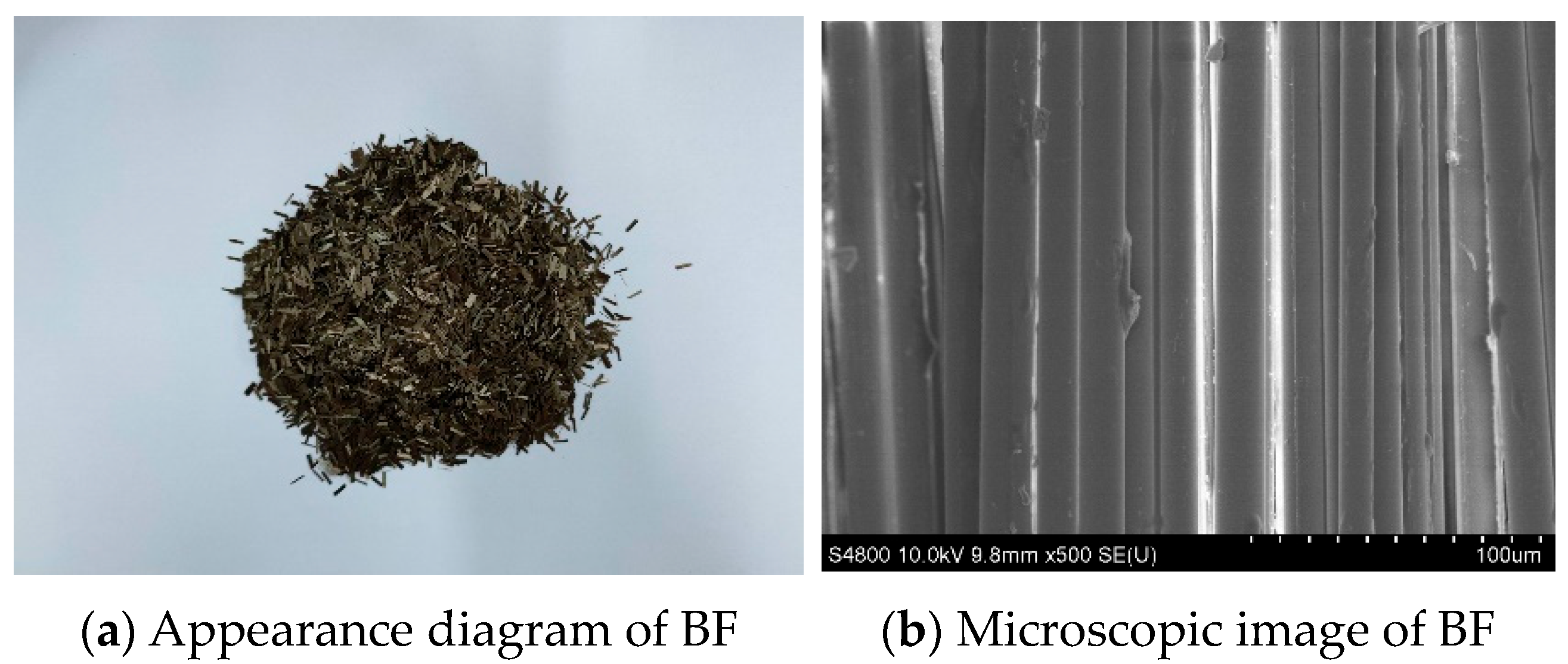
2.1.2. Basalt Fiber
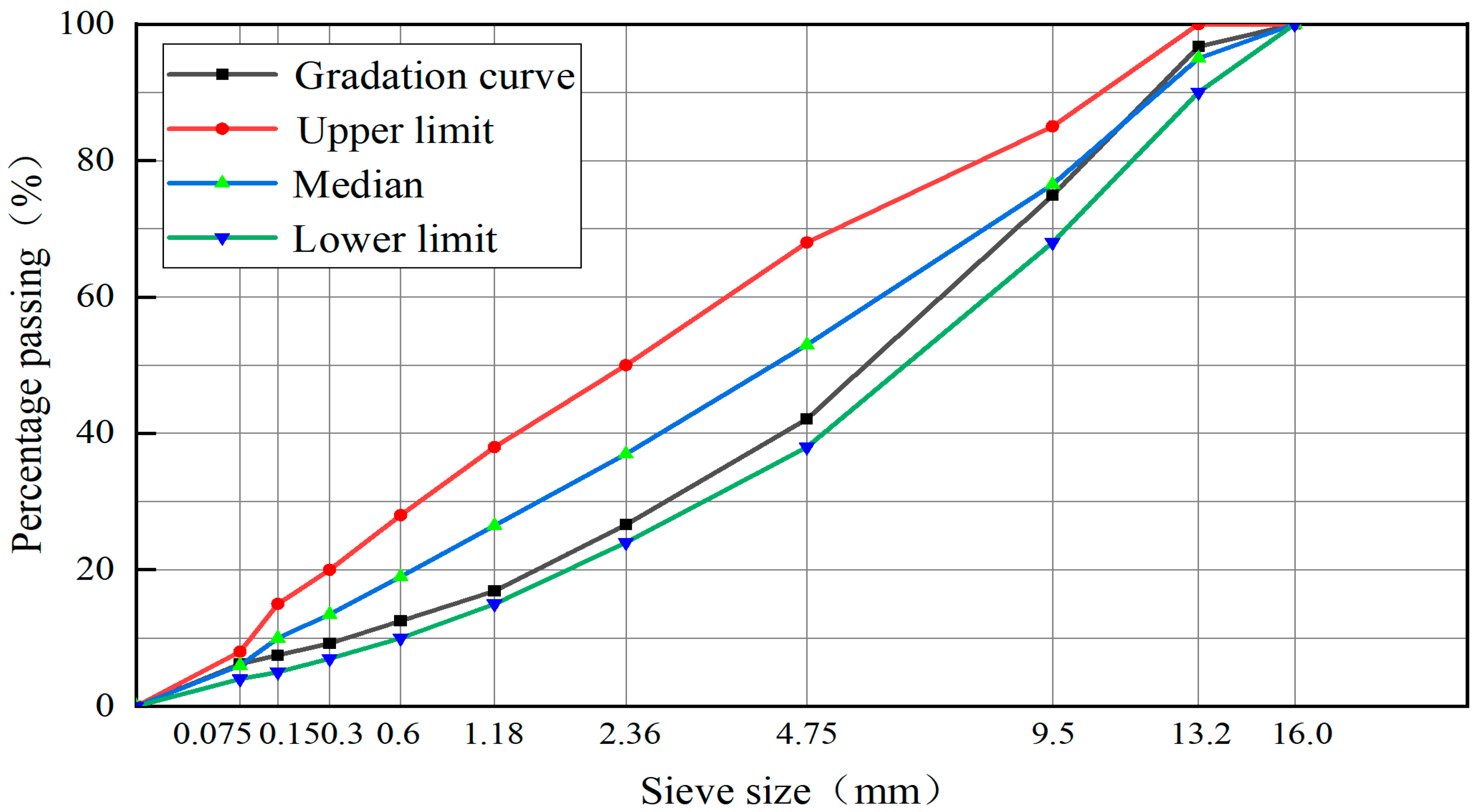
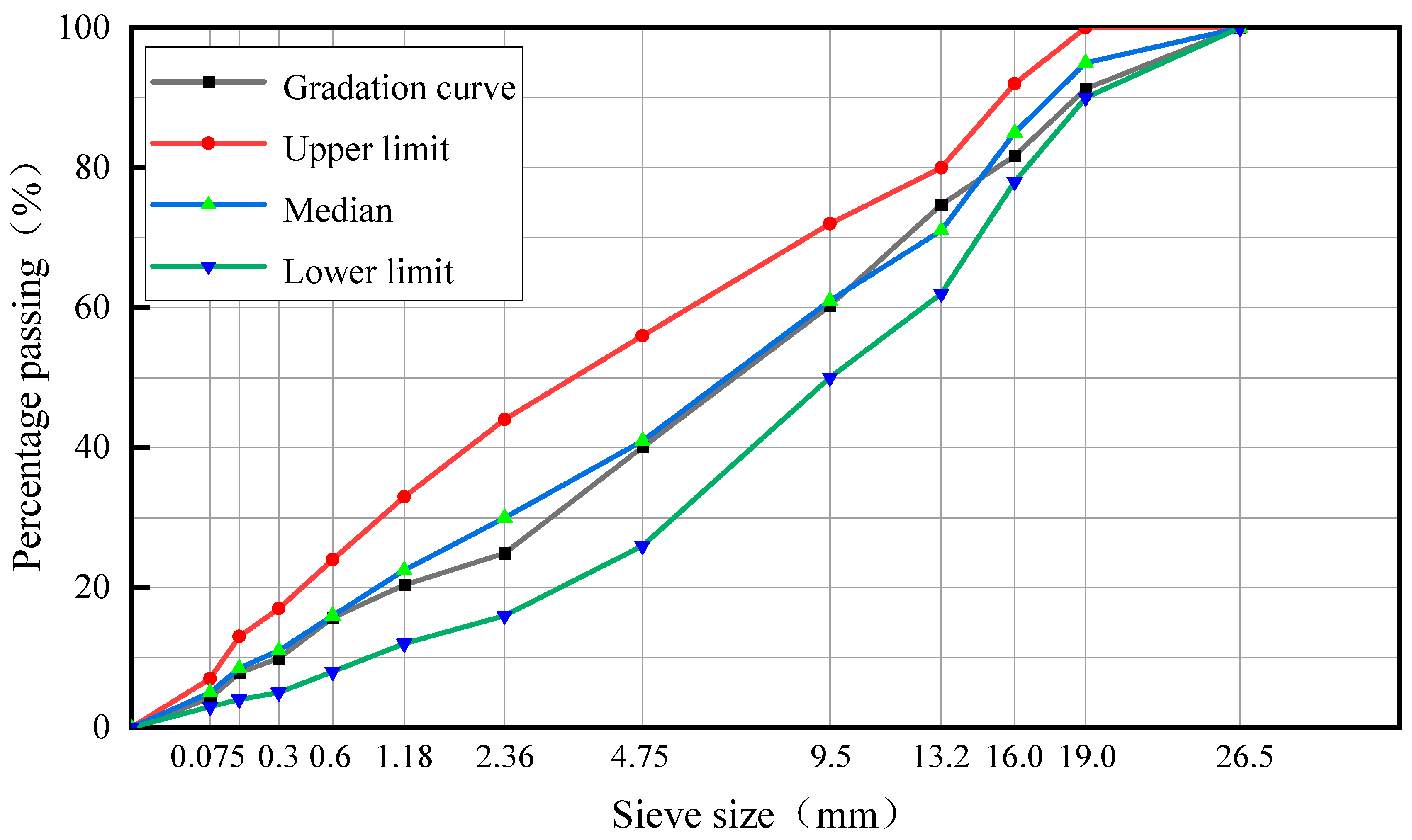
2.1.3. Aggregate
2.2. Preparation of Fiber-Reinforced Asphalt Mixture and Mortar
2.3. Test Methods
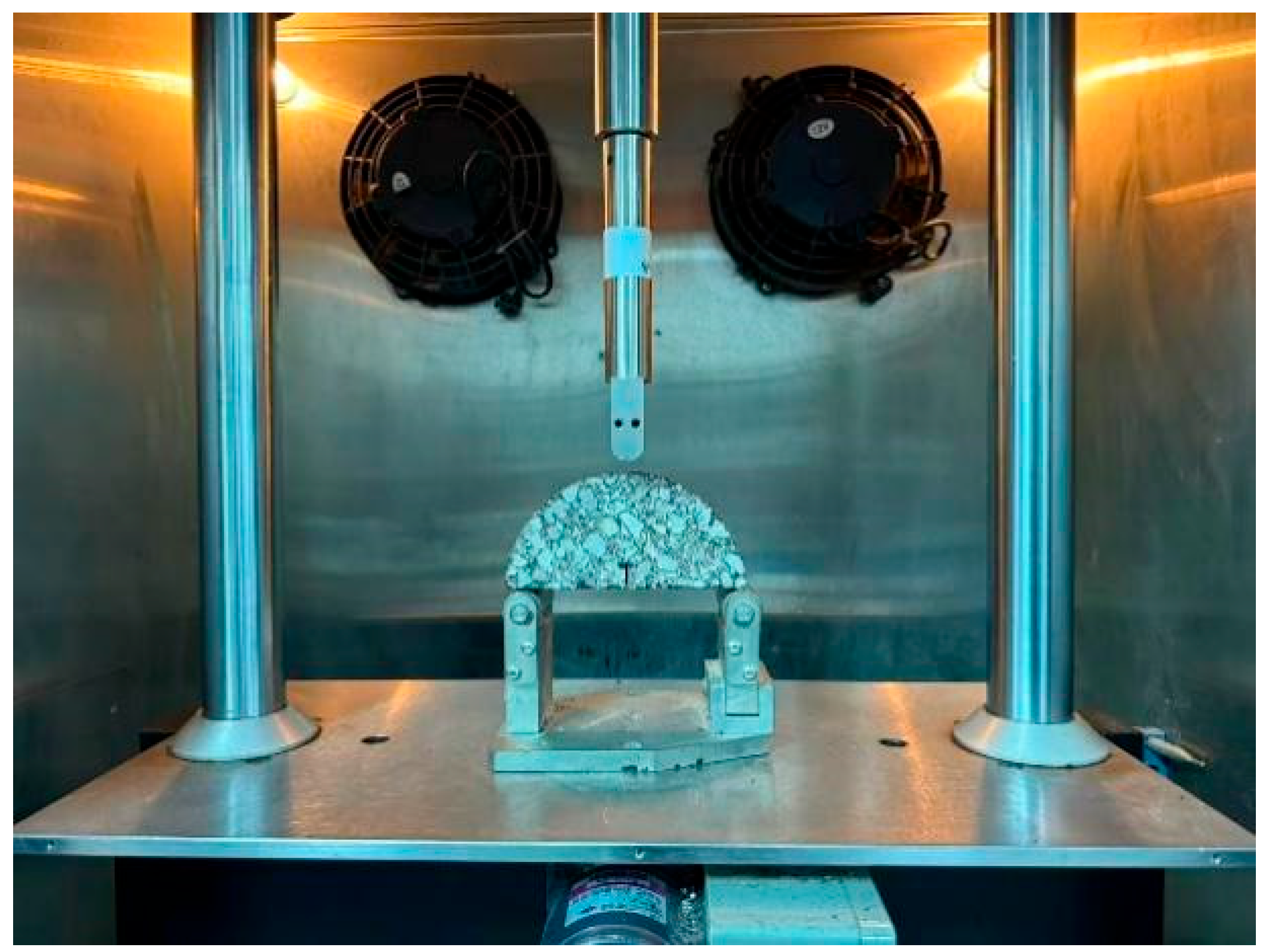
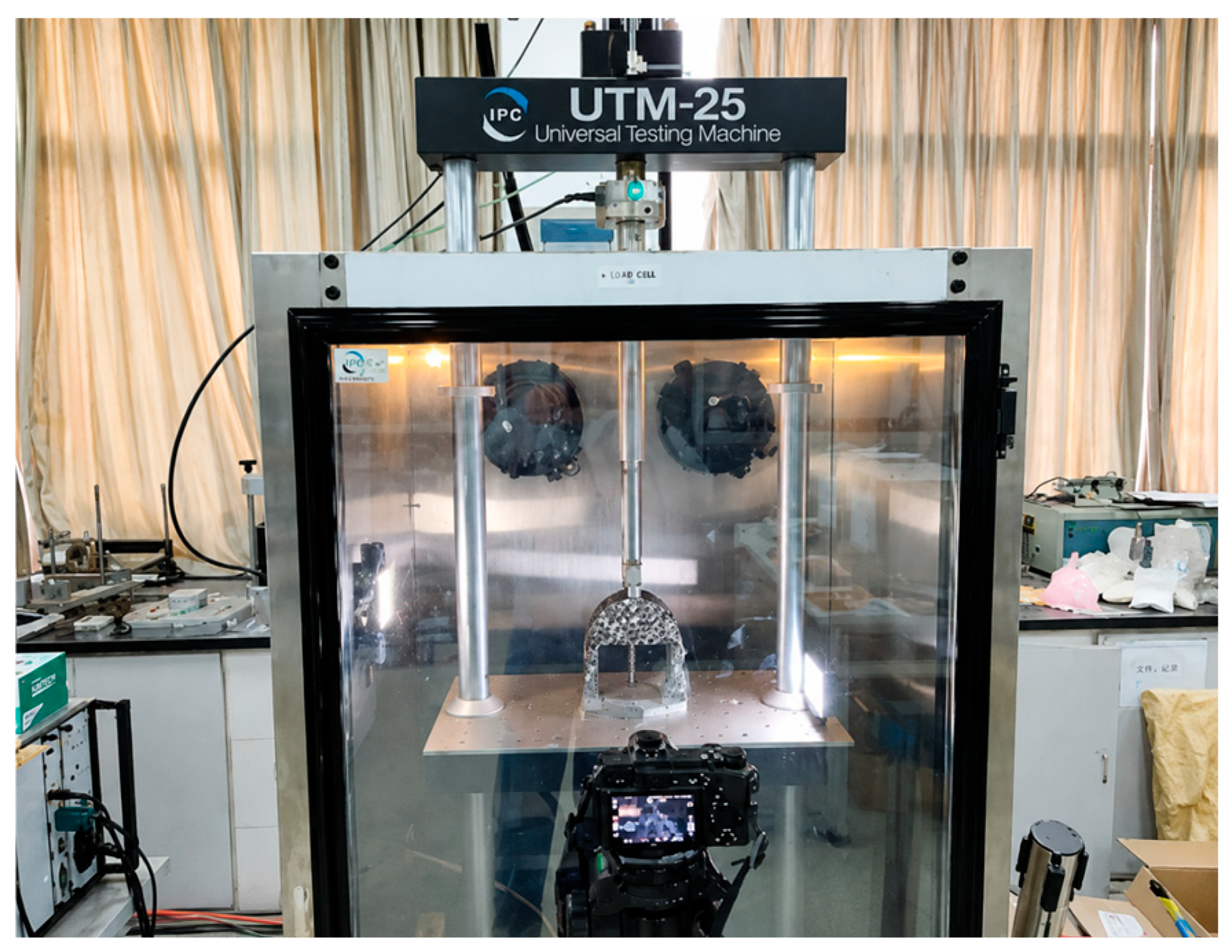
2.3.1. SCB Test
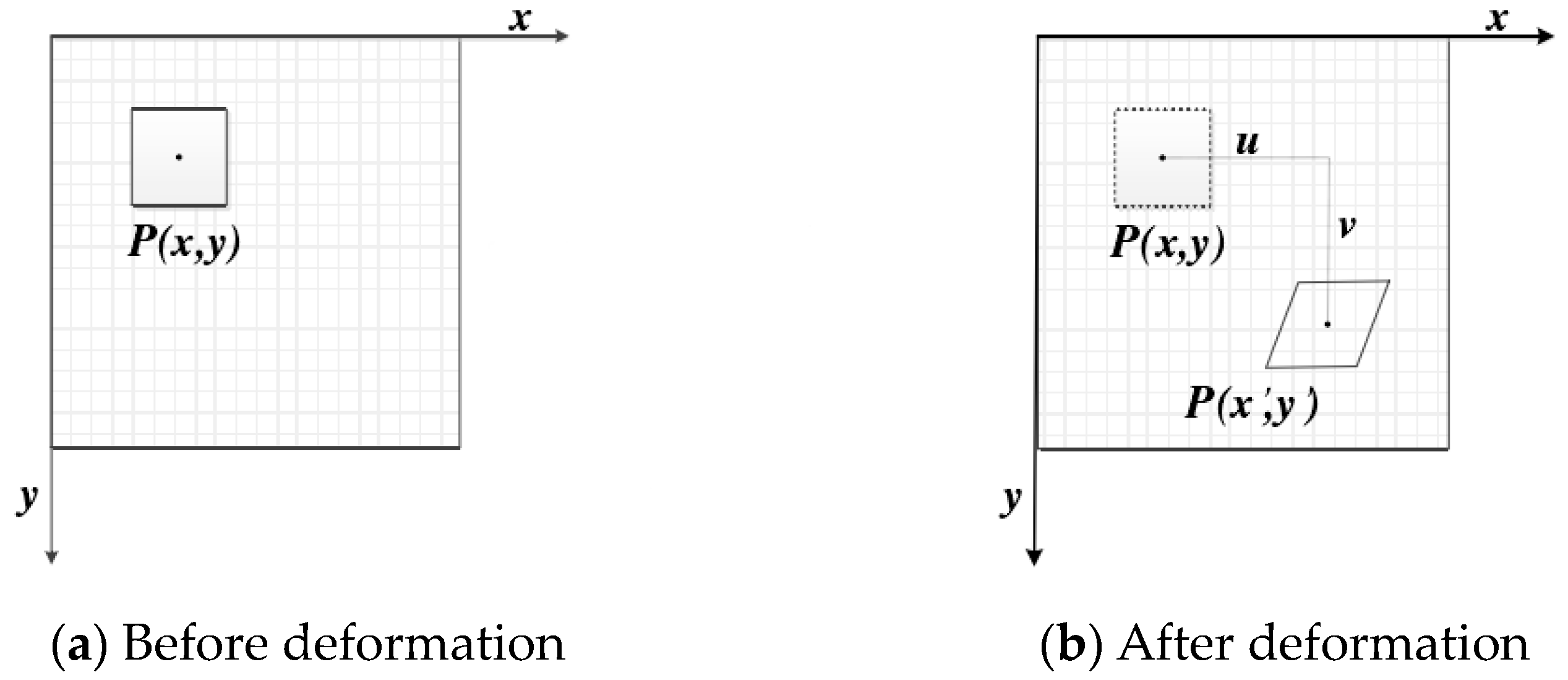
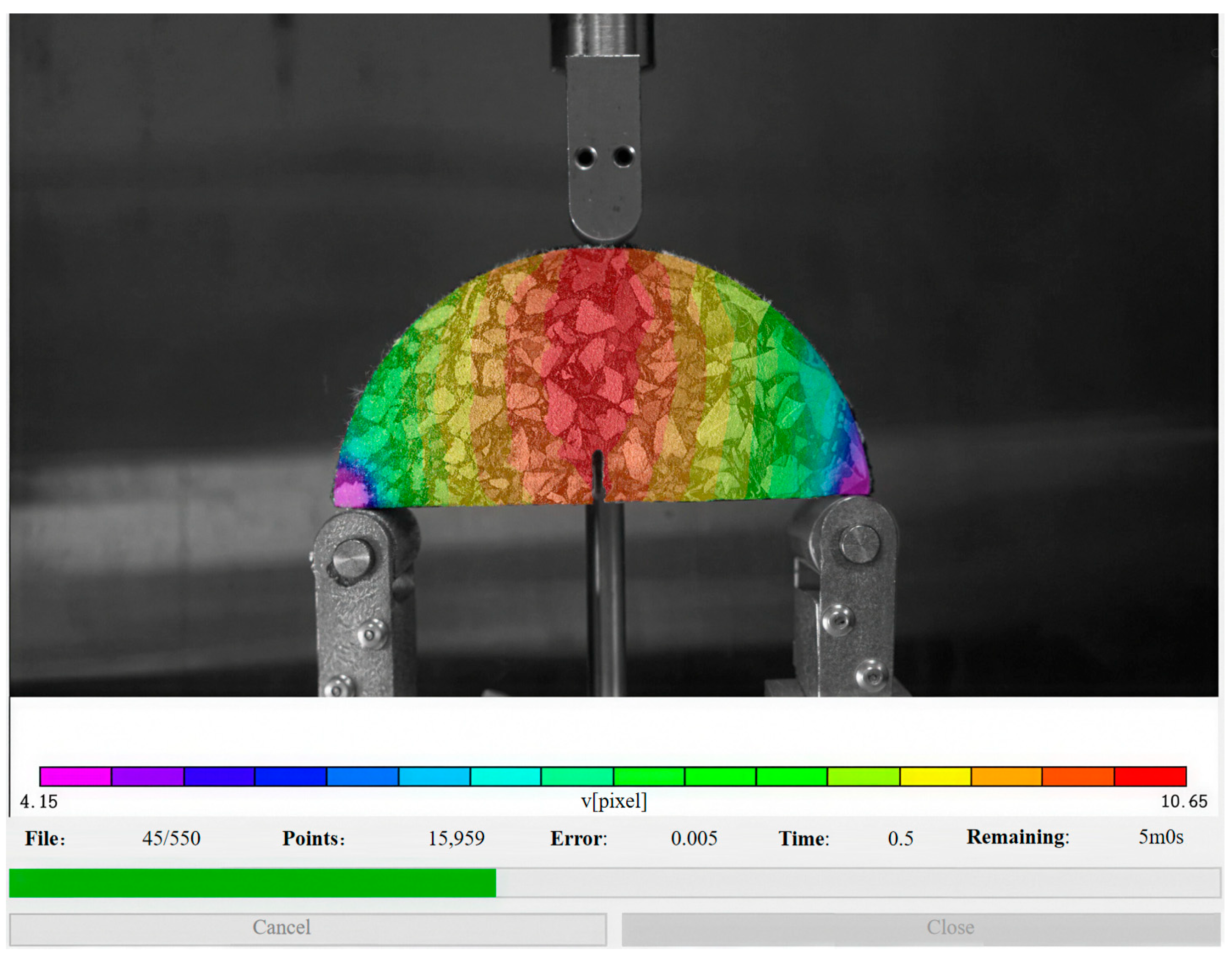
2.3.2. Digital Image Correlation (DIC)
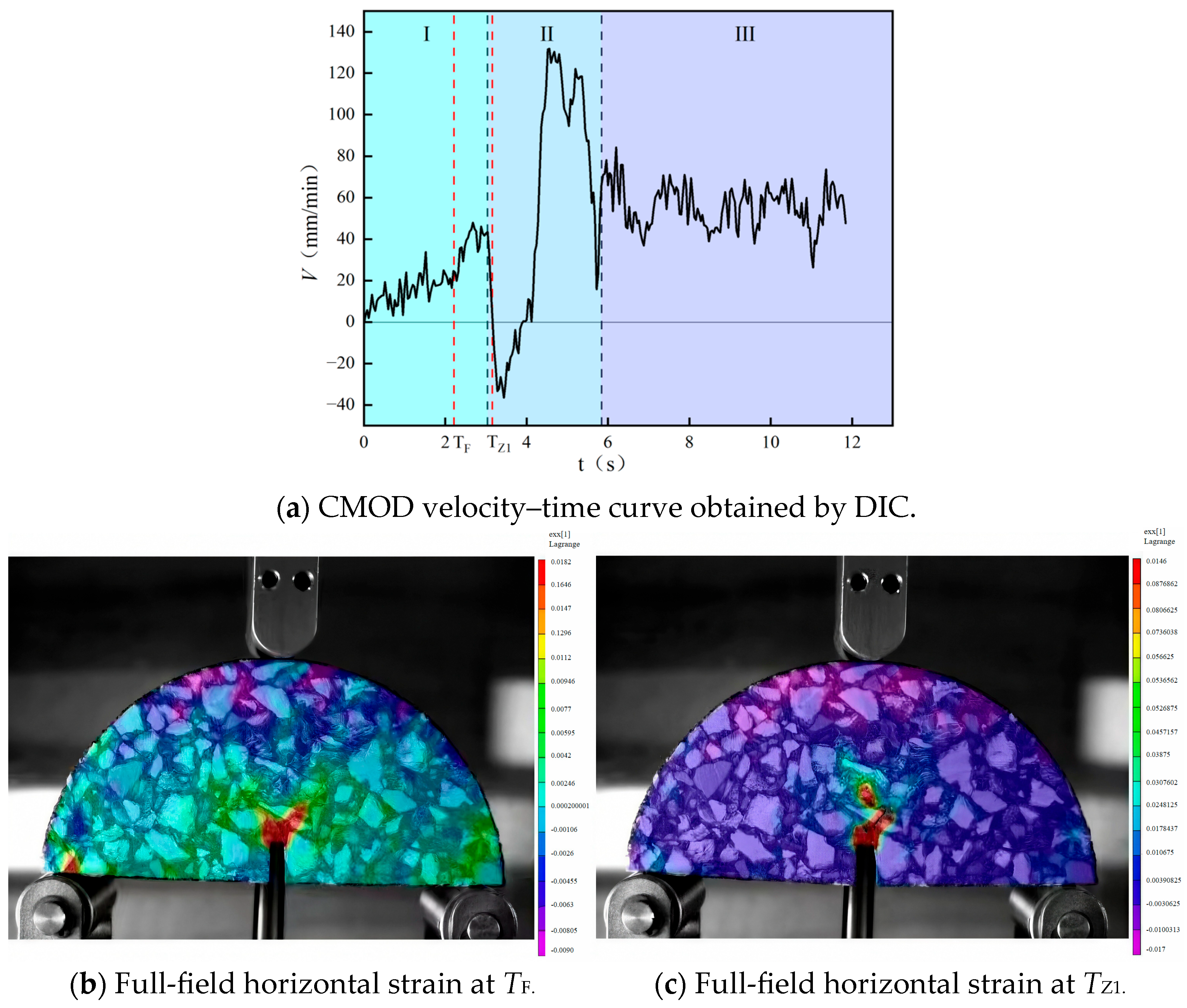
2.3.3. Synchronous Fracture Characterization Method Based on SCB and DIC
3. Results and Discussion
3.1. Effect of Aggregate Gradation on Fracture Performance of Fiber-Reinforced Asphalt Mixtures
3.1.1. Effect of Nominal Maximum Aggregate Size (NMAS)
3.1.2. Asphalt Mortar
3.2. Effect of Testing Conditions on Cracking Performance of Fiber-Reinforced Asphalt Mixtures
3.2.1. Loading Rate
3.2.2. Testing Temperature
3.3. Cracking Paths of Fiber-Reinforced Asphalt Mixtures and Mortars
4. Conclusions
- (1)
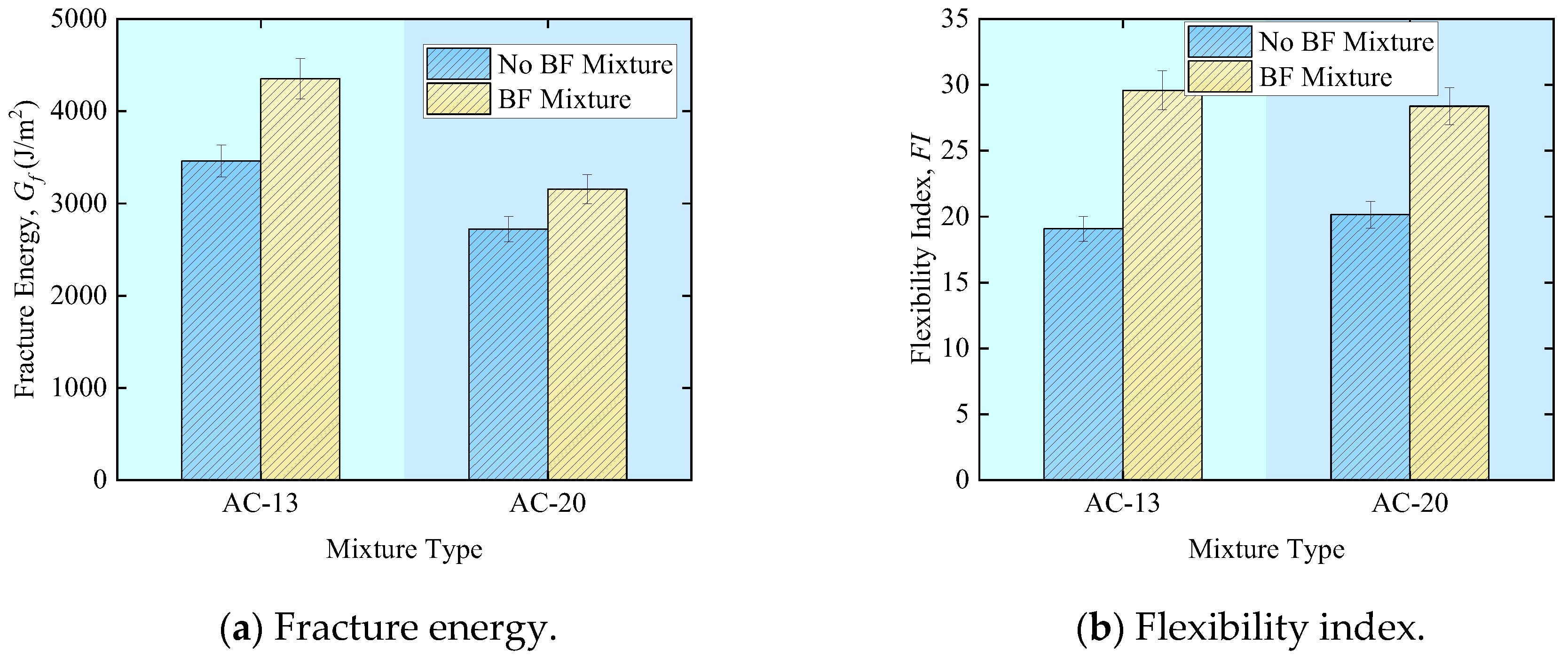
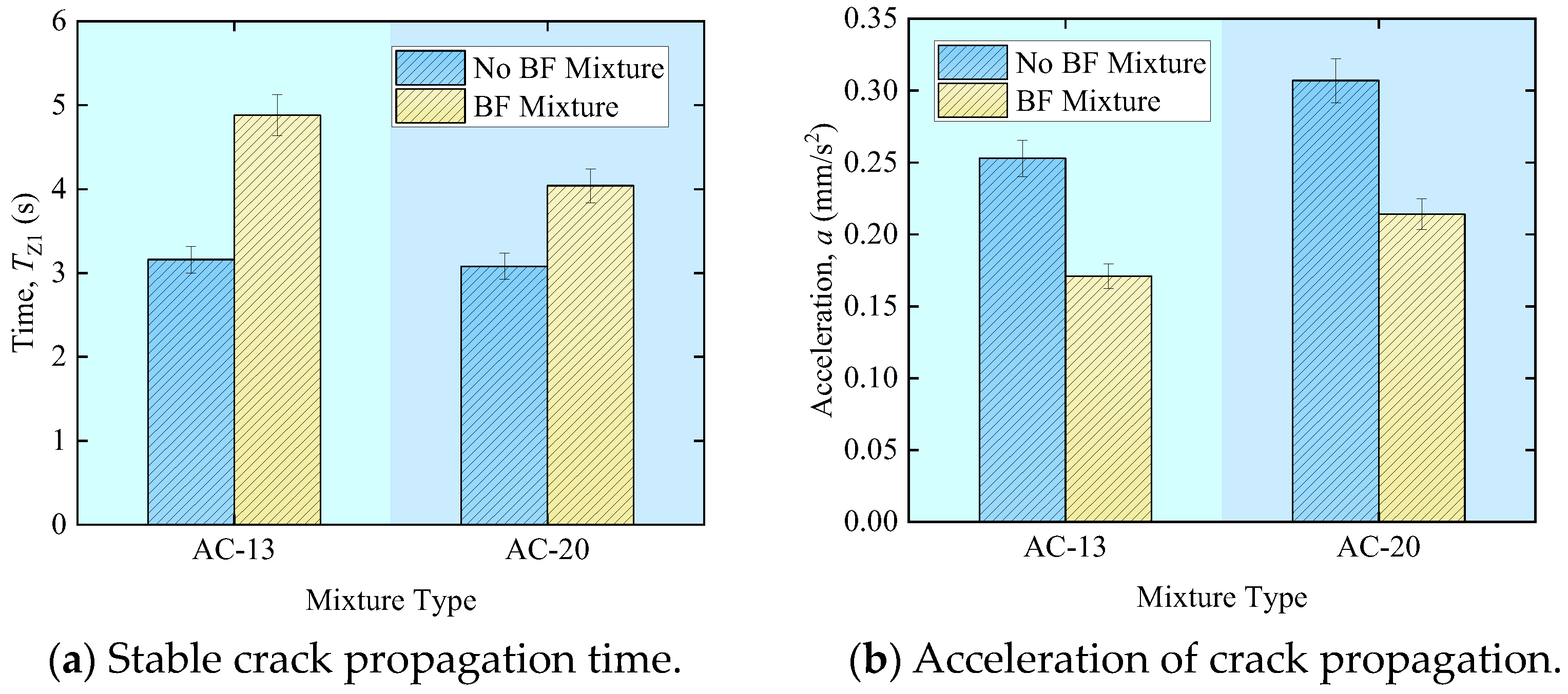
- The reinforcing effect of 6 mm basalt fibers on the fracture energy of asphalt mixtures is influenced by the nominal maximum aggregate size of the asphalt mixture, also associated with the differences in asphalt binder content imposed by the Marshall mix design procedure, showing a greater enhancement in the AC-13 mixture than in the AC-20 mixture.
- (2)
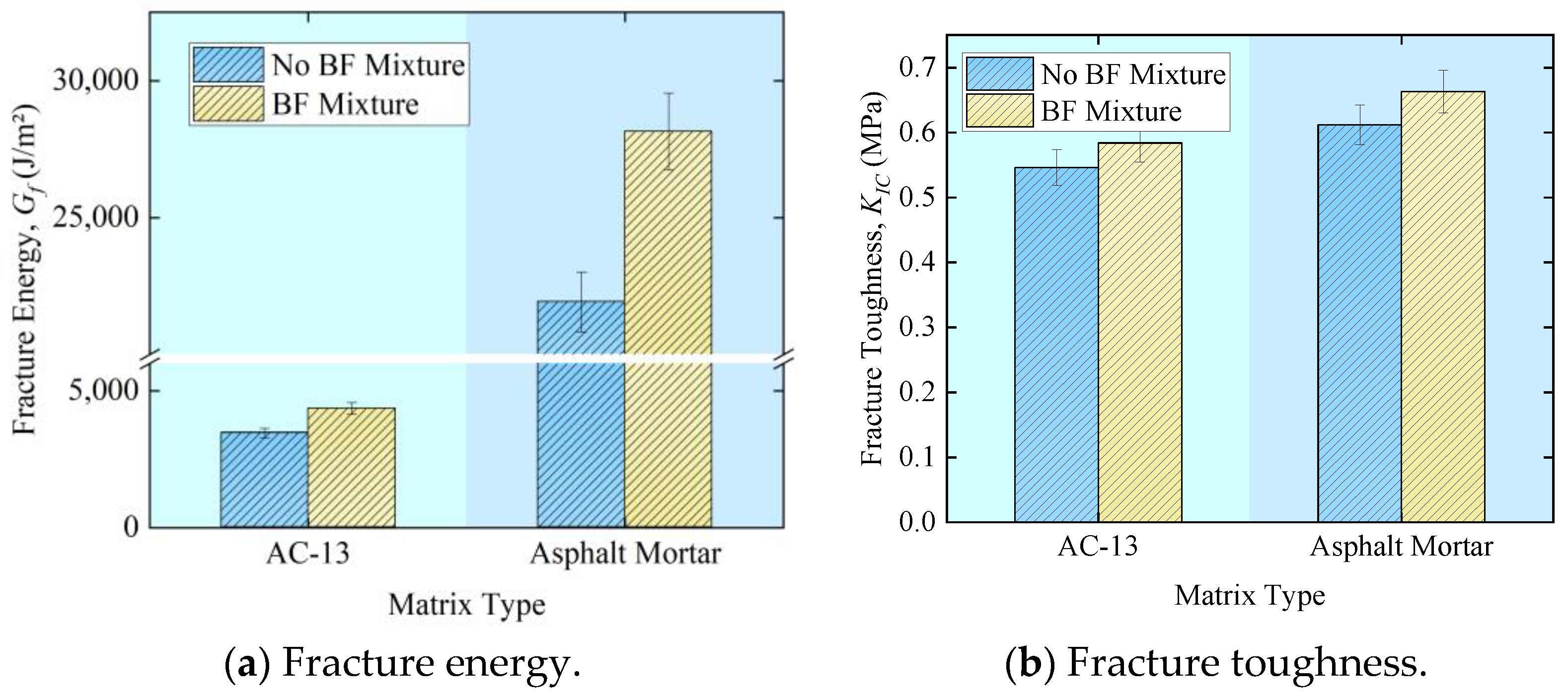
- A consistent enhancement in fracture performance is observed between the asphalt mixture and the asphalt mortar after BF incorporation. Under the same test conditions, the addition of fibers increased the fracture energy by 25.8% for the mixture and by 28.4% for the mortar, while fracture toughness increased by 6.9% and 8.3%, respectively. This suggests that the improvement in the fracture parameters of the mixture is closely related to that of the mortar; the observed differences are also associated with the differences in asphalt binder content imposed by the Marshall mix design procedure.
- (3)
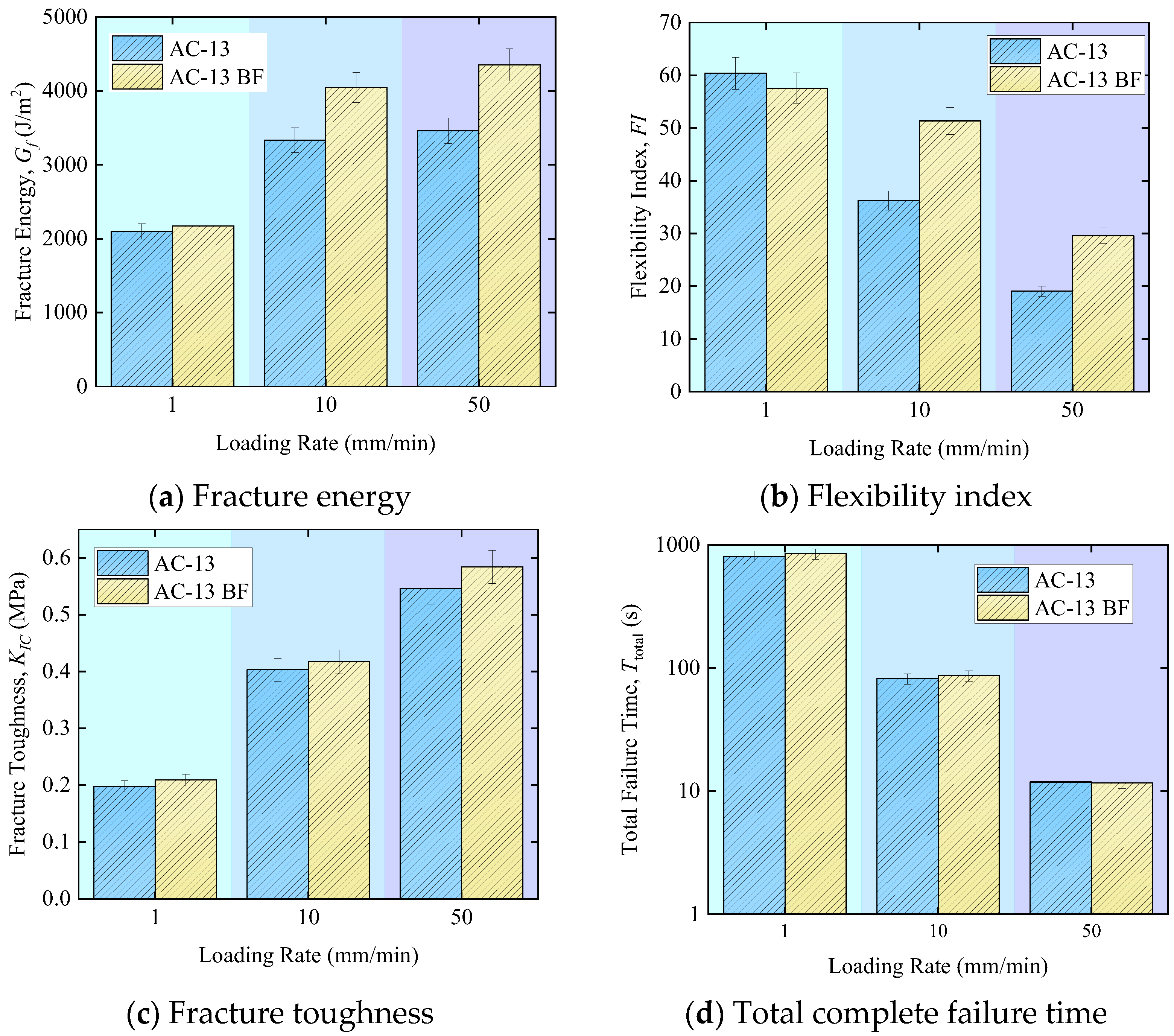
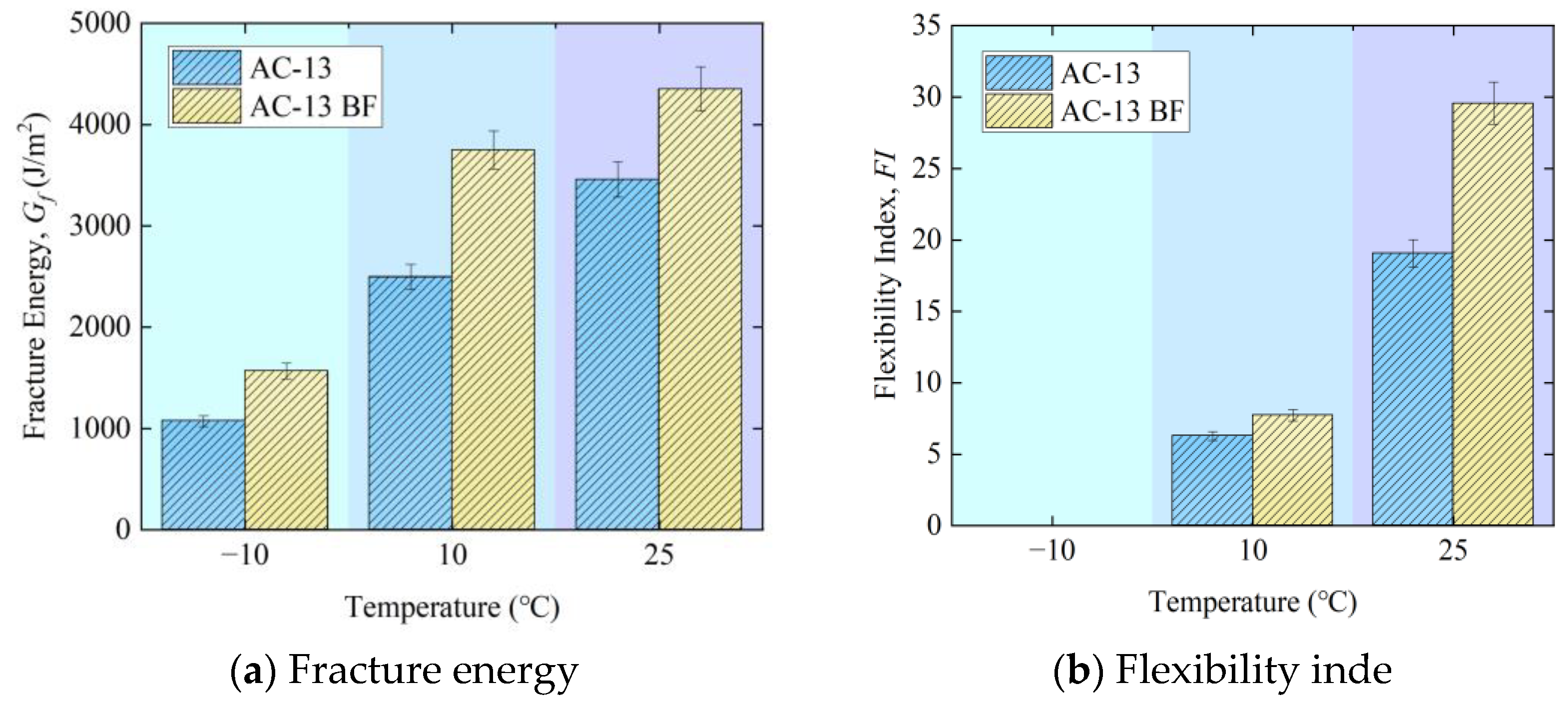
- Testing conditions severely interfere with the efficacy boundaries of fibers; the lower loading rate reduces the reinforcement effect due to viscoelastic stress relaxation. Low temperatures enhance the relative crack resistance efficiency of basalt fibers.
- (4)
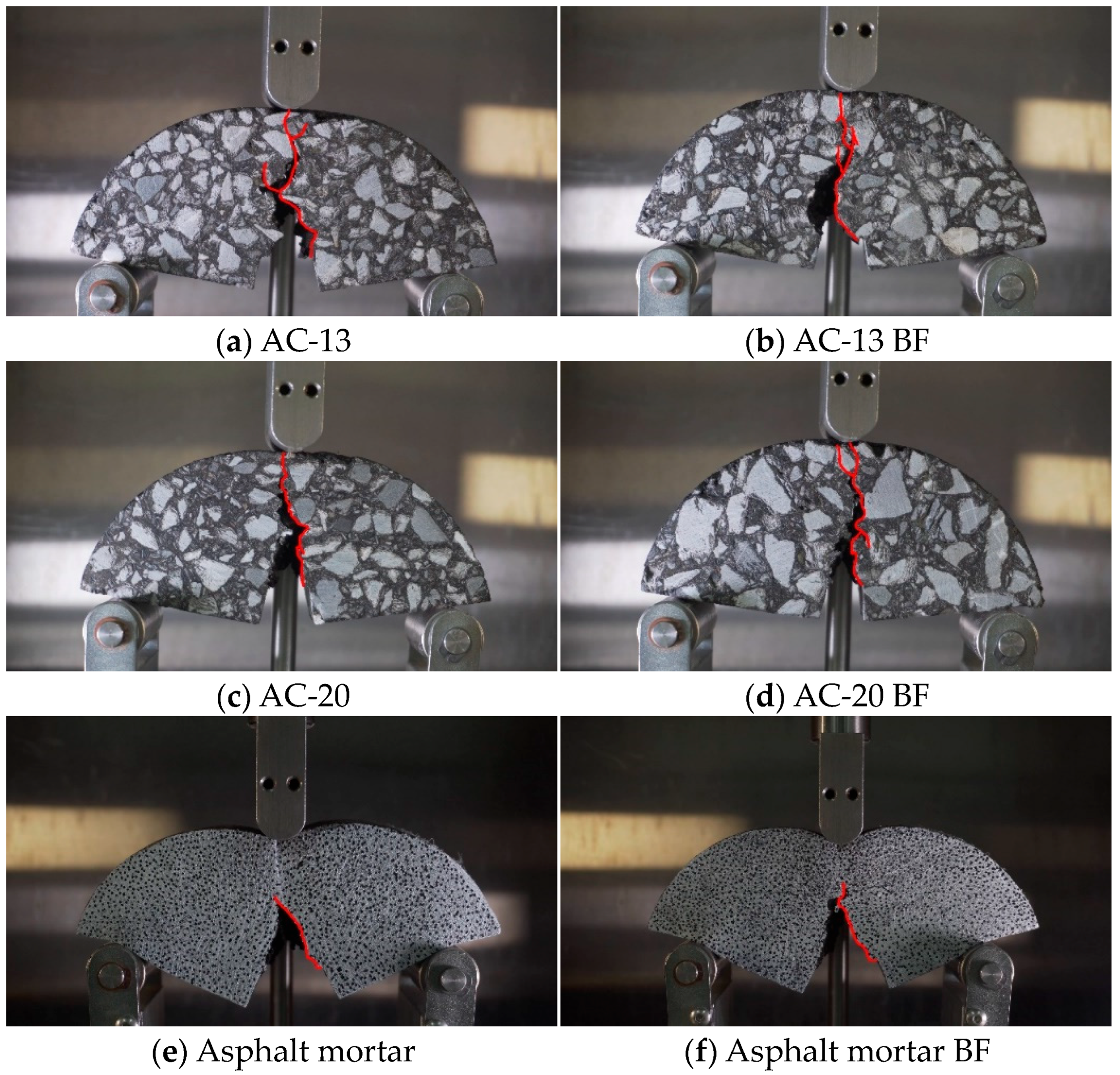
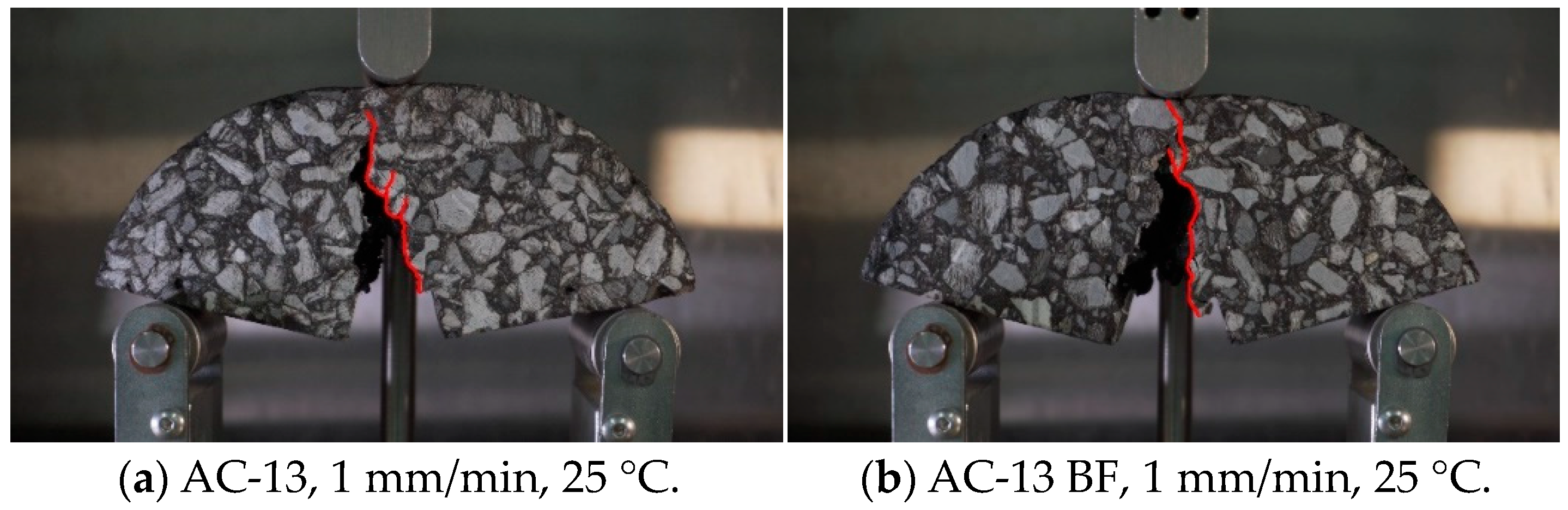
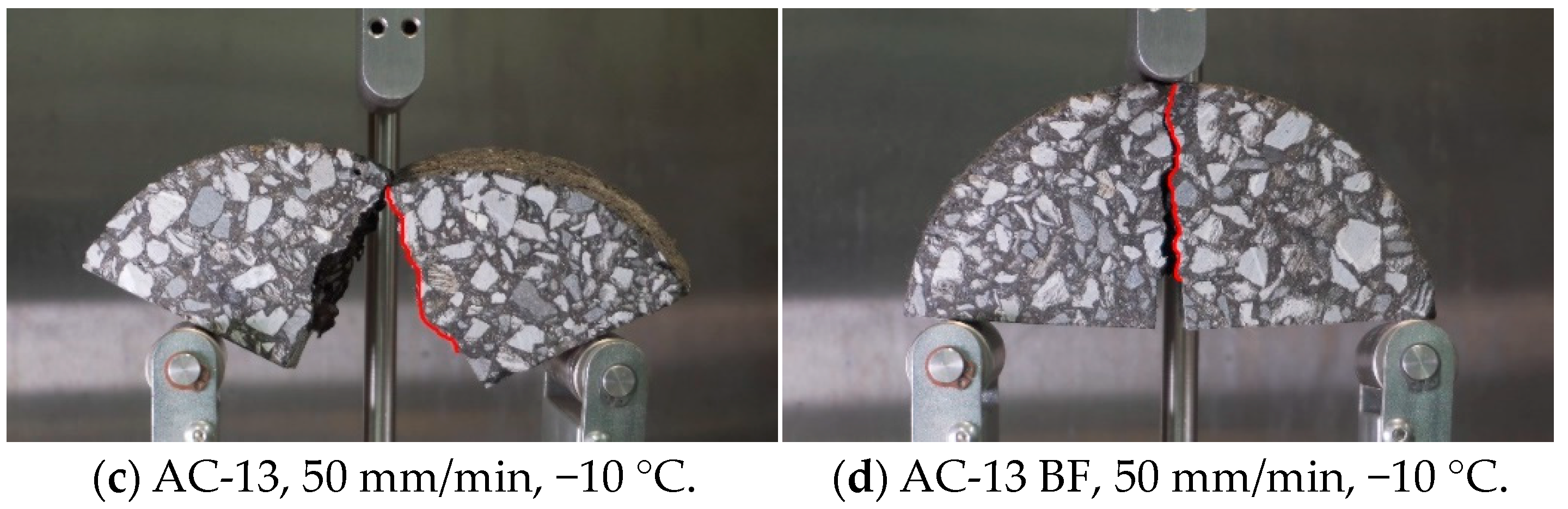
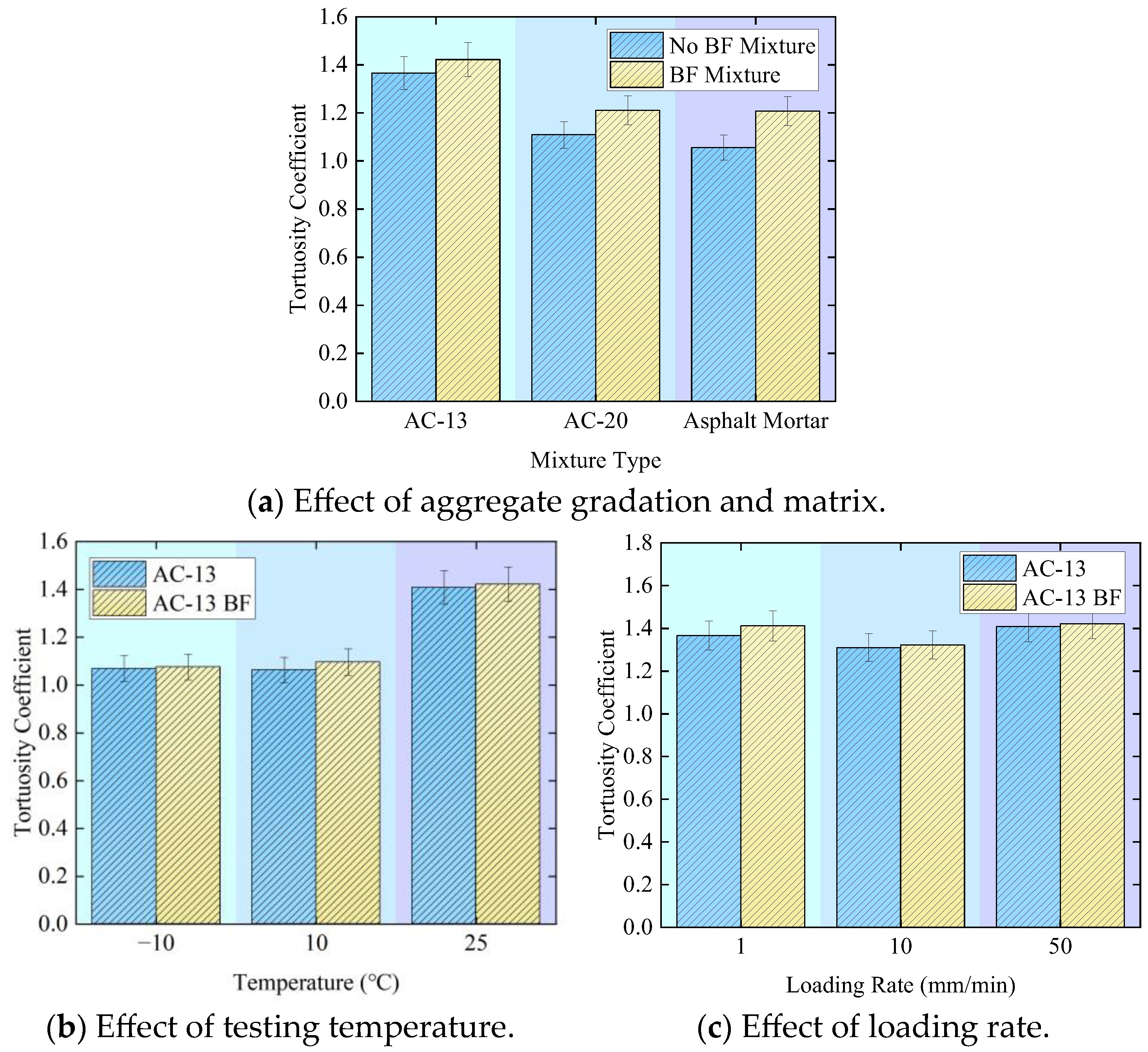
- The addition of fibers increases the crack tortuosity coefficient, forcing cracks to change directions and dissipate more energy. However, environmental temperature maintains absolute control over the geometric path.
Author Contributions
Funding
Data Availability Statement
Conflicts of Interest
References
- Li, X.-J.; Marasteanu, M.O. Using Semi Circular Bending Test to Evaluate Low Temperature Fracture Resistance for Asphalt Concrete. Exp. Mech. 2010, 50, 867–876. [Google Scholar] [CrossRef]
- Saha, G.; Biligiri, K.P. Fracture Properties of Asphalt Mixtures Using Semi-Circular Bending Test: A State-of-the-Art Review and Future Research. Constr. Build. Mater. 2016, 105, 103–112. [Google Scholar] [CrossRef]
- Meng, Y.; Kong, W.; Gou, C.; Deng, S.; Hu, Y.; Chen, J.; Fan, L. A Review on Evaluation of Crack Resistance of Asphalt Mixture by Semi-Circular Bending Test. J. Road Eng. 2023, 3, 87–97. [Google Scholar] [CrossRef]
- Qin, X.; Shen, A.; Guo, Y.; Li, Z.; Lv, Z. Characterization of Asphalt Mastics Reinforced with Basalt Fibers. Constr. Build. Mater. 2018, 159, 508–516. [Google Scholar] [CrossRef]
- Wu, B.; Meng, W.; Xia, J.; Xiao, P. Influence of Basalt Fibers on the Crack Resistance of Asphalt Mixtures and Mechanism Analysis. Materials 2022, 15, 744. [Google Scholar] [CrossRef]
- Guo, Y.; Tataranni, P.; Sangiorgi, C. The Use of Fibres in Asphalt Mixtures: A State of the Art Review. Constr. Build. Mater. 2023, 390, 131754. [Google Scholar] [CrossRef]
- Hui, Y.; Men, G.; Xiao, P.; Tang, Q.; Han, F.; Kang, A.; Wu, Z. Recent Advances in Basalt Fiber Reinforced Asphalt Mixture for Pavement Applications. Materials 2022, 15, 6826. [Google Scholar] [CrossRef] [PubMed]
- Pei, Z.; Lou, K.; Kong, H.; Wu, B.; Wu, X.; Xiao, P.; Qi, Y. Effects of Fiber Diameter on Crack Resistance of Asphalt Mixtures Reinforced by Basalt Fibers Based on Digital Image Correlation Technology. Materials 2021, 14, 7426. [Google Scholar] [CrossRef]
- Xu, J.; Liu, M.; Kang, A.; Wu, Z.; Kou, C.; Zhang, Y.; Xiao, P. Effect of Fiber Characteristic Parameters on the Synergistic Action and Mechanism of Basalt Fiber Asphalt Mortar. Constr. Build. Mater. 2024, 438, 137234. [Google Scholar] [CrossRef]
- Cai, C.; Lou, K.; Qian, F.; Xiao, P. Influence of Basalt Fiber Morphology on the Properties of Asphalt Binders and Mixtures. Materials 2024, 17, 5358. [Google Scholar] [CrossRef] [PubMed]
- Kong, L.; Xu, J.; Yang, H.; Wu, P.; Li, X.; Ma, D.; Wang, Z.; Ren, D.; Ai, C. Enhancing Crack Resistance in Basalt Fiber Asphalt Mixtures: A Full-Field Time-Domain Investigation of Stress Distribution and Pore Structure Optimisation. Int. J. Pavement Eng. 2025, 26, 2460746. [Google Scholar] [CrossRef]
- Ren, D.; Luo, W.; Su, S.; Wang, Z.; Kong, L.; Ai, C. Study on Crack Resistance of Basalt Fiber Reinforced Asphalt Mixture Modified by Titanate Coupling Agent Based on Digital Image Correlation. Constr. Build. Mater. 2024, 437, 136934. [Google Scholar] [CrossRef]
- Zhou, H.; Li, M.; Jin, G.; Guo, M.; Jiang, Y. Combined Effects of Basalt Fiber Geometrical Characteristics on Pavement Performance of Asphalt Mixtures. PLoS ONE 2025, 20, e0316173. [Google Scholar] [CrossRef]
- Ji, X.; Yuan, Y.; Huang, Y.; Shao, J.; Li, S. Performance Study of Asphalt Mixtures Reinforced with Gradated Basalt Fibers of Mixed Lengths. Materials 2024, 17, 4706. [Google Scholar] [CrossRef] [PubMed]
- Zhao, H.; Guan, B.; Xiong, R.; Zhang, A. Investigation of the Performance of Basalt Fiber Reinforced Asphalt Mixture. Appl. Sci. 2020, 10, 1561. [Google Scholar] [CrossRef]
- Wang, X.; Zhang, J.; Li, K.; Ding, Y.; Geng, L. Cracking Analysis of Asphalt Mixture Using Semi-Circle Bending Method. Iran. J. Sci. Technol. Trans. Civ. Eng. 2021, 45, 269–279. [Google Scholar] [CrossRef]
- Pirmohammad, S.; Amani, B.; Shokorlou, Y.M. The Effect of Basalt Fibres on Fracture Toughness of Asphalt Mixture. Fatigue Fract. Eng. Mater. Struct. 2020, 43, 1446–1460. [Google Scholar] [CrossRef]
- Saha, G.; Biligiri, K.P. Fracture Damage Evaluation of Asphalt Mixtures Using Semi-Circular Bending Test Based on Fracture Energy Approach. Eng. Fract. Mech. 2015, 142, 154–169. [Google Scholar] [CrossRef]
- Yang, S.; Jiang, J.; Leng, Z.; Ni, F. Feasibility and Performance of the Semi-Circular Bending Test in Evaluating the Low-Temperature Performance of Asphalt Mortar. Constr. Build. Mater. 2021, 269, 121305. [Google Scholar] [CrossRef]
- Meng, Y.; Lu, Y.; Kong, W.; Chen, J.; Zhang, C.; Meng, F. Study on the Influence Factors of Fatigue Properties of Large-Stone Asphalt Mixtures Based on Semi-Circular Bending Tests. Constr. Build. Mater. 2024, 414, 134947. [Google Scholar] [CrossRef]
- Wu, H.; Xiao, P.; Fei, Z.; Kang, A.; Wu, X. Evaluation of SMA-13 Asphalt Mixture Reinforced by Different Types of Fiber Additives. Materials 2024, 17, 5468. [Google Scholar] [CrossRef]
- Meng, Y.; Chen, J.; Kong, W.; Wang, Z.; Lu, Y.; Chen, P. Research on the Influence of Parameters on the Fracture Performance of the Large Stone Asphalt Mixture Based on the Semi-Circular Bending Test. Constr. Build. Mater. 2024, 422, 135720. [Google Scholar] [CrossRef]
- Vaseghi, Z.; Pirmohammad, S.; Momeni, R. Impact of SCB Specimen Size, Temperature, Loading Rate, and Loading Mode on Fracture Behavior of Asphalt Mixture Using Response Surface Method. Fatigue Fract. Eng. Mater. Struct. 2025, 48, 382–403. [Google Scholar] [CrossRef]
- He, J.; Ding, X.; Yang, W.; Yang, H.; Liu, L. Predicting the Effect of the Loading Rate on the Fracture Toughness of Hydraulic Asphalt Concrete Based on the Weibull Distribution. Materials 2024, 17, 803. [Google Scholar] [CrossRef] [PubMed]
- Pirmohammad, S.; Momeni, R.; Khanghahi, S.H. Effect of SCB Specimen Size on Mode I Fracture Parameters of Asphalt Concrete at Low and Intermediate Temperatures. Theor. Appl. Fract. Mech. 2024, 130, 104314. [Google Scholar] [CrossRef]
- Song, W.; Yan, W.; Wu, H. Effect of Specimen Size on Mode I Fracture Performance of Hot Mix Asphalt at the Low Temperature. Theor. Appl. Fract. Mech. 2024, 130, 104309. [Google Scholar] [CrossRef]
- Buttlar, W.G.; Hill, B.C.; Kim, Y.R.; Kutay, M.E.; Millien, A.; Montepara, A.; Paulino, G.H.; Petit, C.; Pop, I.O.; Romeo, E.; et al. Digital Image Correlation Techniques to Investigate Strain Fields and Cracking Phenomena in Asphalt Materials. Mater. Struct. 2014, 47, 1373–1390. [Google Scholar] [CrossRef]
- Seo, Y.; Kim, Y.; Witczak, M.W.; Bonaquist, R. Application of Digital Image Correlation Method to Mechanical Testing of Asphalt-Aggregate Mixtures. Transp. Res. Rec. J. Transp. Res. Board 2002, 1789, 162–172. [Google Scholar] [CrossRef]
- Guo, Q.; Wang, H.; Gao, Y.; Jiao, Y.; Liu, F.; Dong, Z. Investigation of the Low-Temperature Properties and Cracking Resistance of Fiber-Reinforced Asphalt Concrete Using the DIC Technique. Eng. Fract. Mech. 2020, 229, 106951. [Google Scholar] [CrossRef]
- Jiang, J.; Ni, F.; Wu, F.; Sadek, H.; Lv, Q. Evaluation of the Healing Potential of Asphalt Mixtures Based on a Modified Semi-Circular Bending Test. Constr. Build. Mater. 2019, 196, 284–294. [Google Scholar] [CrossRef]
- Gao, C.; Wu, W. Using ESEM to Analyze the Microscopic Property of Basalt Fiber Reinforced Asphalt Concrete. Int. J. Pavement Res. Technol. 2018, 11, 374–380. [Google Scholar] [CrossRef]
- Stewart, C.M.; Garcia, E. Fatigue Crack Growth of a Hot Mix Asphalt Using Digital Image Correlation. Int. J. Fatigue 2019, 120, 254–266. [Google Scholar] [CrossRef]
- Zieliński, P.; Klimczak, M.; Tekieli, M.; Strzępek, M. An Evaluation of the Fracture Properties of Asphalt Concrete Mixes Using the Semi-Circular Bending Method and Digital Image Correlation. Materials 2025, 18, 967. [Google Scholar] [CrossRef]
- JTG F40; Technical Specification for Construction of Highway Asphalt Pavement. Ministry of Transport of the People’s Republic of China: Beijing, China, 2004.
- JT/T 533-2020; Fibers for Asphalt Pavement. Ministry of Transport of the People’s Republic of China: Beijing, China, 2020.
- JTG 3410-2025; Highway Engineering Asphalt and Asphalt Mixture Test Procedures. Ministry of Transport of the People’s Republic of China: Beijing, China, 2025.
- Im, S.; Ban, H.; Kim, Y.-R. Characterization of Mode-I and Mode-II Fracture Properties of Fine Aggregate Matrix Using a Semicircular Specimen Geometry. Constr. Build. Mater. 2014, 52, 413–421. [Google Scholar] [CrossRef]
- Abdul Hassan, N.; Airey, G.D.; Hainin, M.R. Characterisation of Micro-Structural Damage in Asphalt Mixtures Using Image Analysis. Constr. Build. Mater. 2014, 54, 27–38. [Google Scholar] [CrossRef]
- Hofman, R. Description of Semi-Circular Bending (SCB) Test, Version 3.1; DWW Report No. IL-R-98.37; Dienst Weg- en Waterbouwkunde: Delft, The Netherlands, 1999. [Google Scholar]
- Lu, H.; Cary, P.D. Deformation Measurements by Digital Image Correlation: Implementation of a Second-Order Displacement Gradient. Exp. Mech. 2000, 40, 393–400. [Google Scholar] [CrossRef]
- Tong, W. An Evaluation of Digital Image Correlation Criteria for Strain Mapping Applications. Strain 2005, 41, 167–175. [Google Scholar] [CrossRef]
- Pan, B.; Qian, K.; Xie, H.; Asundi, A. Two-Dimensional Digital Image Correlation for in-Plane Displacement and Strain Measurement: A Review. Meas. Sci. Technol. 2009, 20, 062001. [Google Scholar] [CrossRef]



| Item | BF | Test Method |
|---|---|---|
| Length/mm | 6 | Appendix H |
| Diameter/μm | 16 | Appendix H |
| Elongation at break/% | 4.83 | Appendix S |
| Tensile strength/MPa | 2563 | Appendix S |
| Apparent density/g·cm−3 | 2.53 | Appendix J |
| Aggregate Particle Size/mm | 2.36 | 1.18 | 0.6 | 0.3 | 0.15 | 0.075 |
|---|---|---|---|---|---|---|
| Passing rate/% | 100 | 71.0 | 49.6 | 33.8 | 20.9 | 10.3 |
Disclaimer/Publisher’s Note: The statements, opinions and data contained in all publications are solely those of the individual author(s) and contributor(s) and not of MDPI and/or the editor(s). MDPI and/or the editor(s) disclaim responsibility for any injury to people or property resulting from any ideas, methods, instructions or products referred to in the content. |
© 2026 by the authors. Licensee MDPI, Basel, Switzerland. This article is an open access article distributed under the terms and conditions of the Creative Commons Attribution (CC BY) license.
Share and Cite
Fei, Z.; Lou, K.; Xu, W.; Jia, S.; Zhang, C.; Wu, Z. Fracture Performance and Crack Propagation Mechanism of Basalt Fiber-Reinforced Asphalt Mixtures: Effects of Gradation, Mortar and Test Conditions. Materials 2026, 19, 2443. https://doi.org/10.3390/ma19122443
Fei Z, Lou K, Xu W, Jia S, Zhang C, Wu Z. Fracture Performance and Crack Propagation Mechanism of Basalt Fiber-Reinforced Asphalt Mixtures: Effects of Gradation, Mortar and Test Conditions. Materials. 2026; 19(12):2443. https://doi.org/10.3390/ma19122443
Chicago/Turabian StyleFei, Ziyun, Keke Lou, Wentong Xu, Silin Jia, Cong Zhang, and Zhengguang Wu. 2026. "Fracture Performance and Crack Propagation Mechanism of Basalt Fiber-Reinforced Asphalt Mixtures: Effects of Gradation, Mortar and Test Conditions" Materials 19, no. 12: 2443. https://doi.org/10.3390/ma19122443
APA StyleFei, Z., Lou, K., Xu, W., Jia, S., Zhang, C., & Wu, Z. (2026). Fracture Performance and Crack Propagation Mechanism of Basalt Fiber-Reinforced Asphalt Mixtures: Effects of Gradation, Mortar and Test Conditions. Materials, 19(12), 2443. https://doi.org/10.3390/ma19122443