Molecular Design of Underwater Adhesive Copolymers: Synergy Between Long-Chain Alkyl Crystallization–Melting Switching and Carboxyl Group Interfacial Interactions

Abstract
1. Introduction
2. Materials and Methods
2.1. Materials
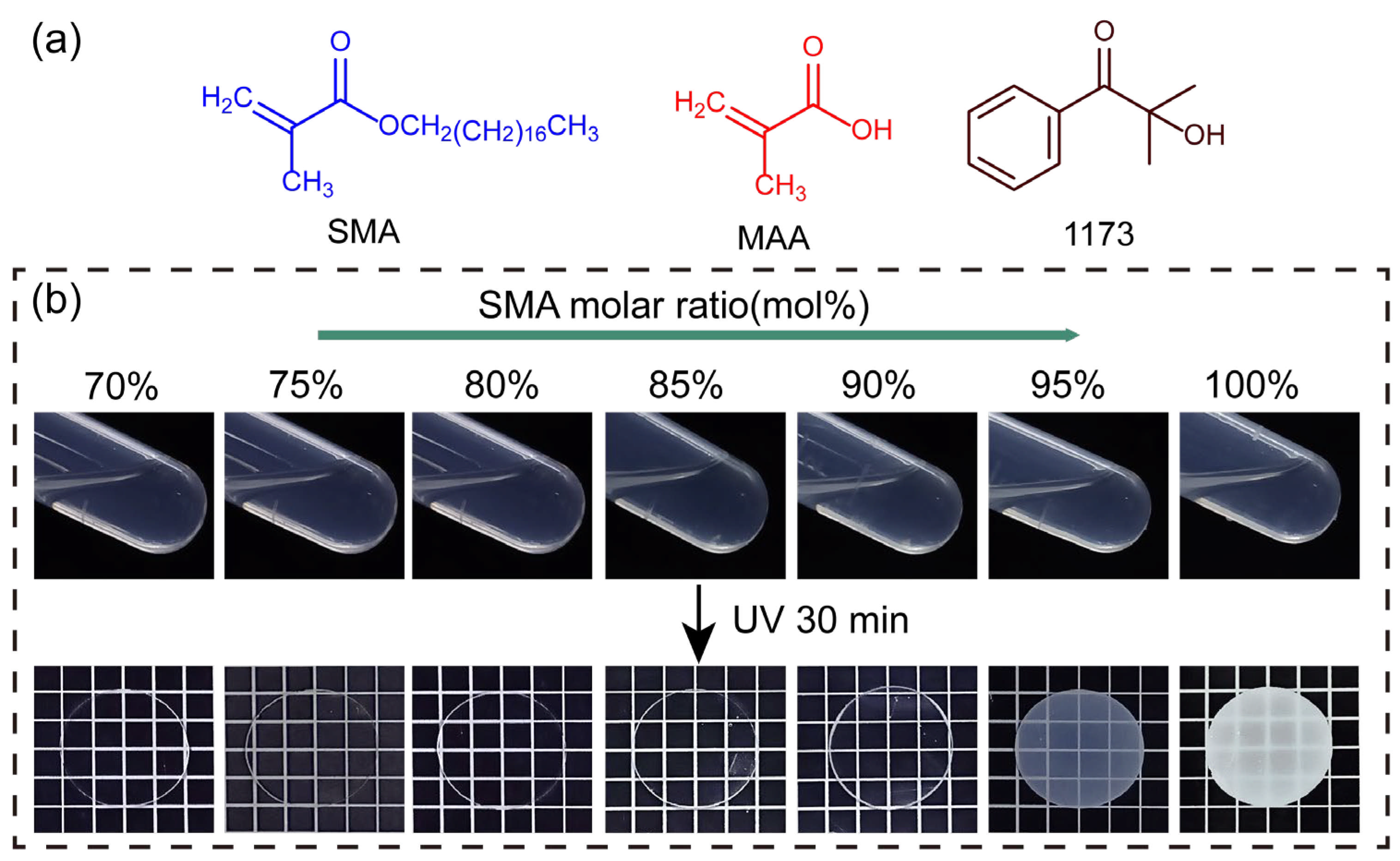
2.2. Synthesis of the Copolymer
2.3. Characterisation Techniques
2.3.1. Tensile Test
2.3.2. Lap-Shear Tests
2.3.3. Fourier Transform Infrared Spectroscopy Characterization (FTIR)
2.3.4. Rheological Characterization
2.3.5. Differential Scanning Calorimetry (DSC)
2.3.6. Low-Field Nuclear Magnetic Resonance (NMR) Characterization
3. Results
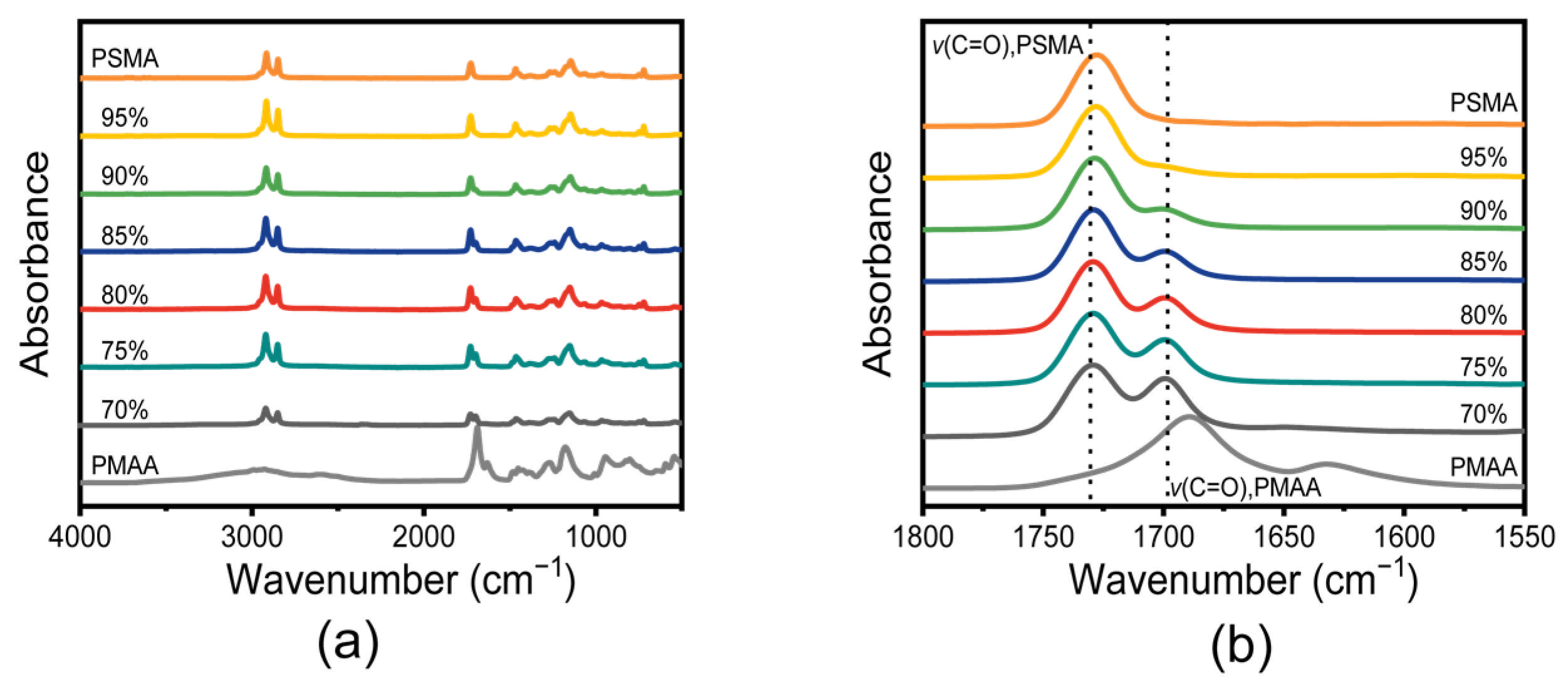
3.1. FTIR Analysis
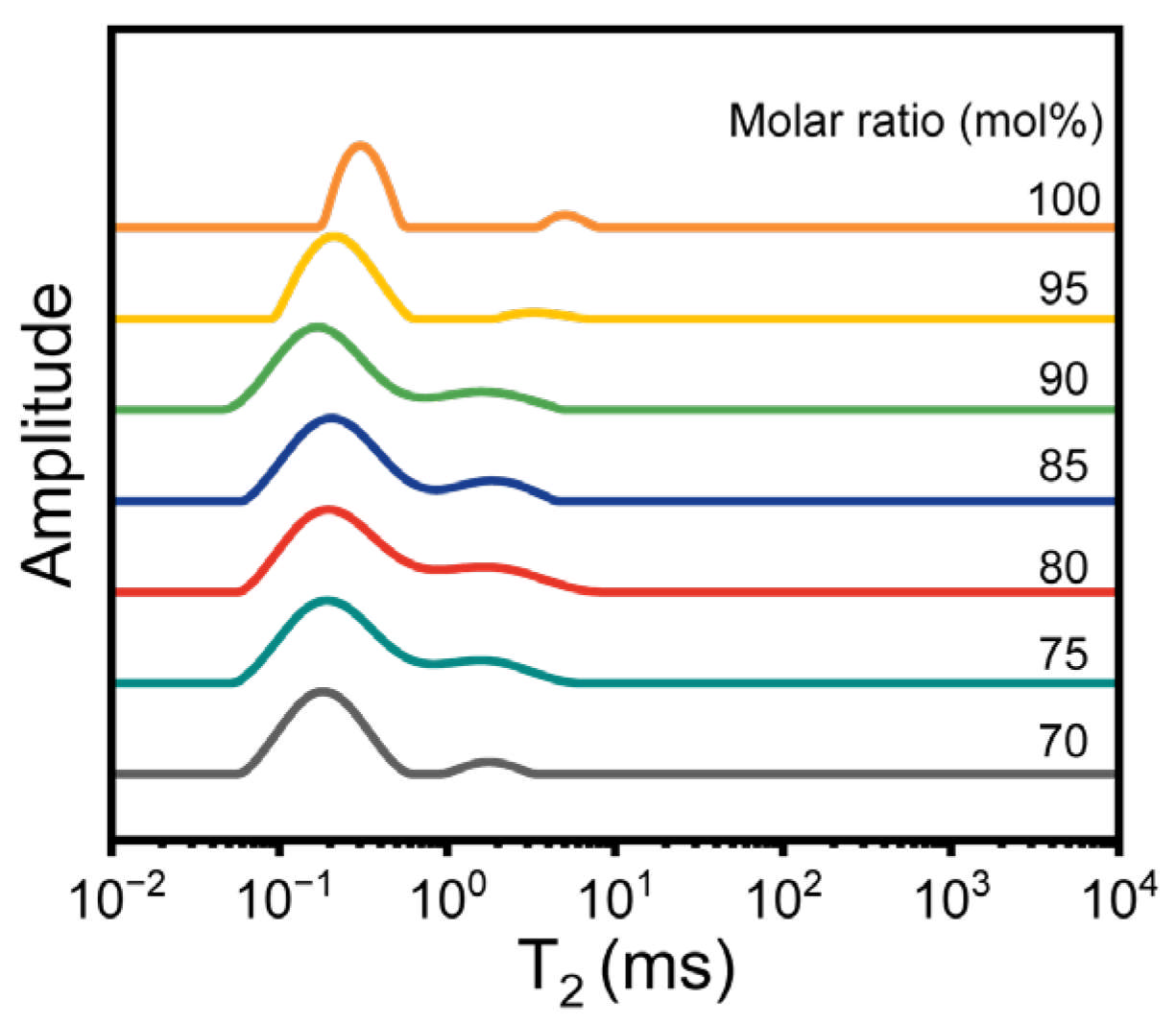
3.2. Low-Field NMR Analysis
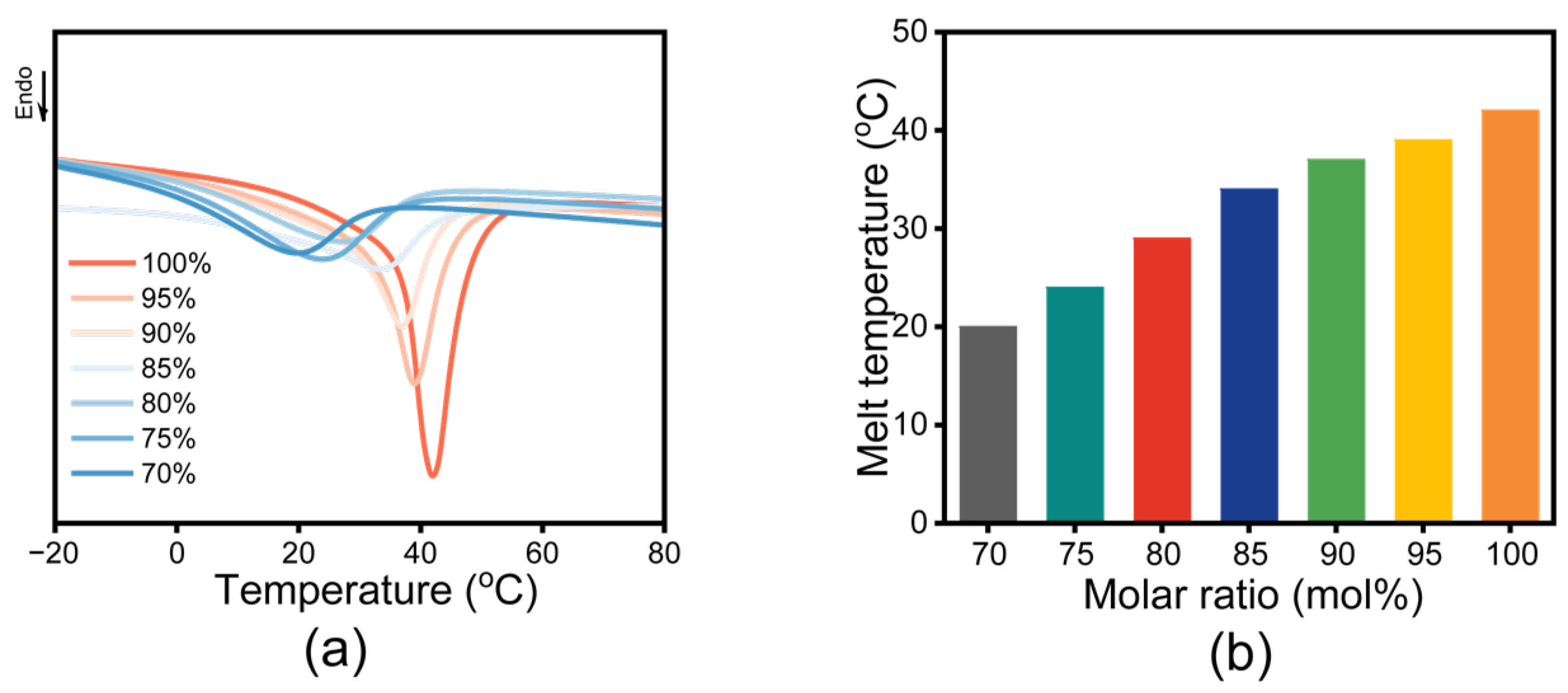
3.3. DSC Analysis
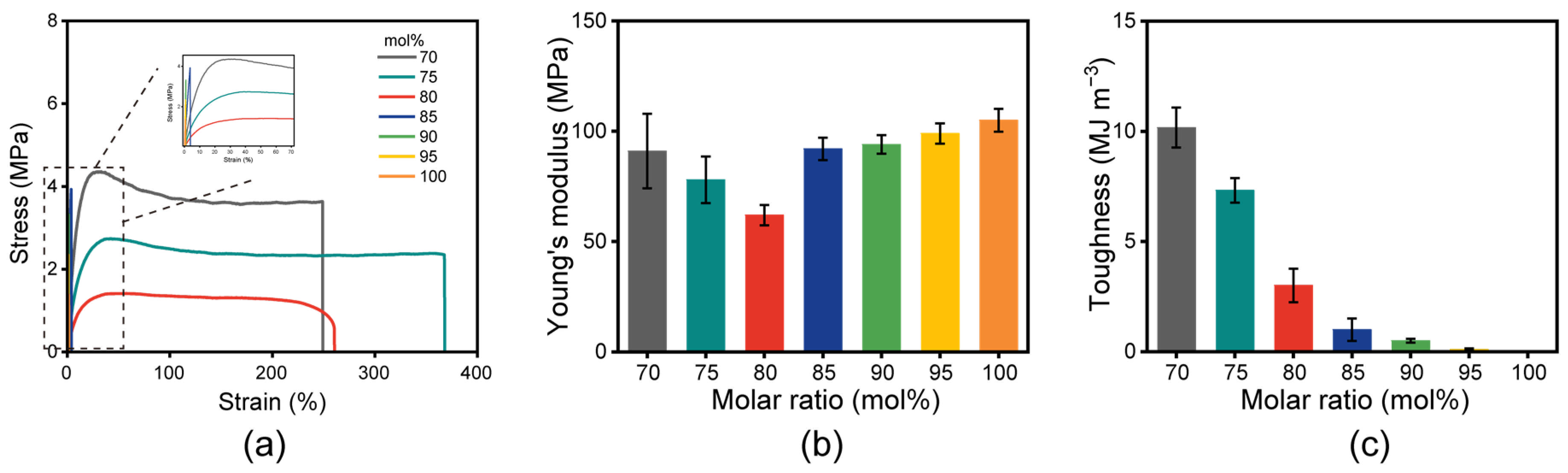
3.4. Mechanical Properties Analysis
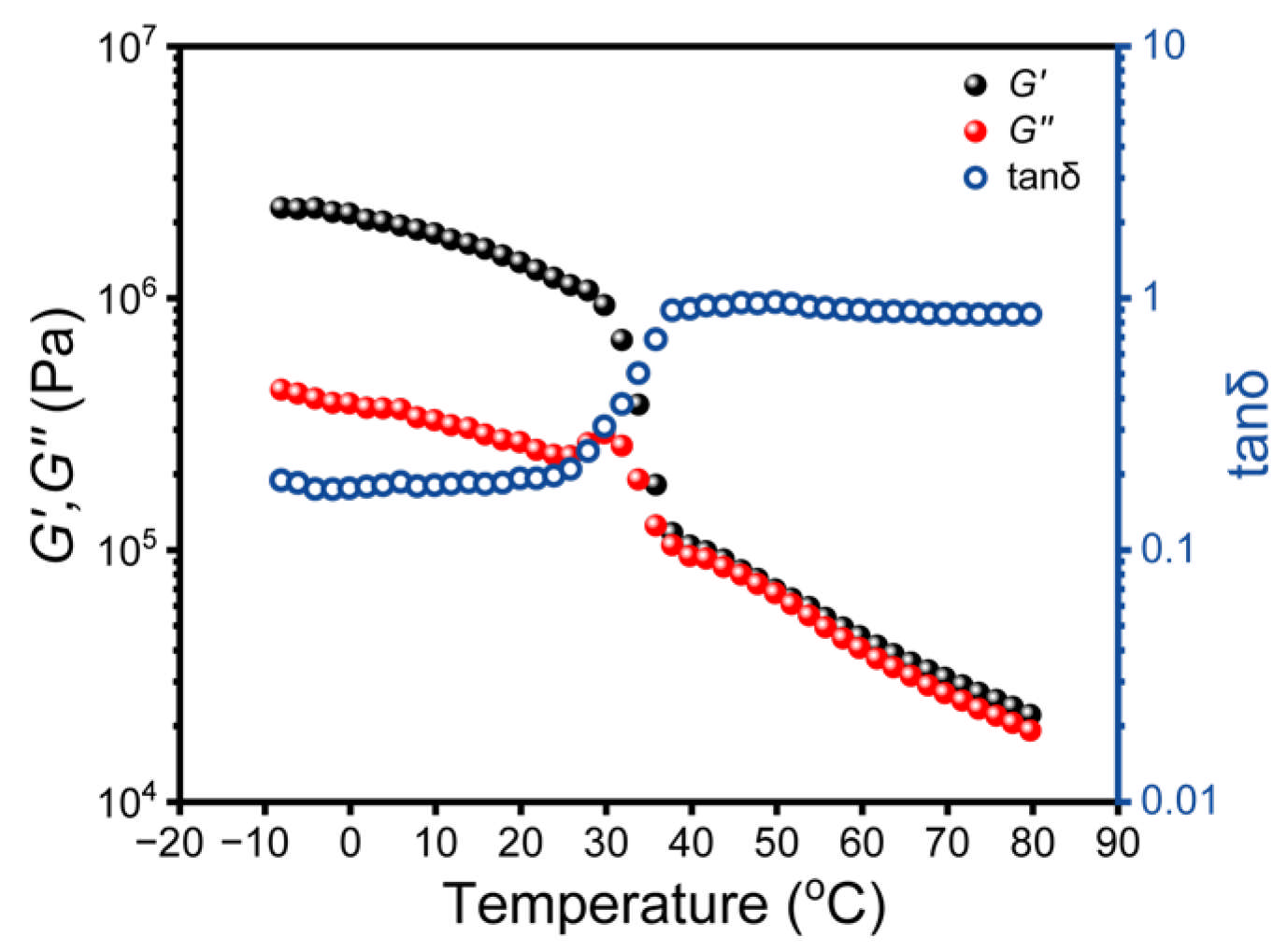
3.5. Rheological Analysis
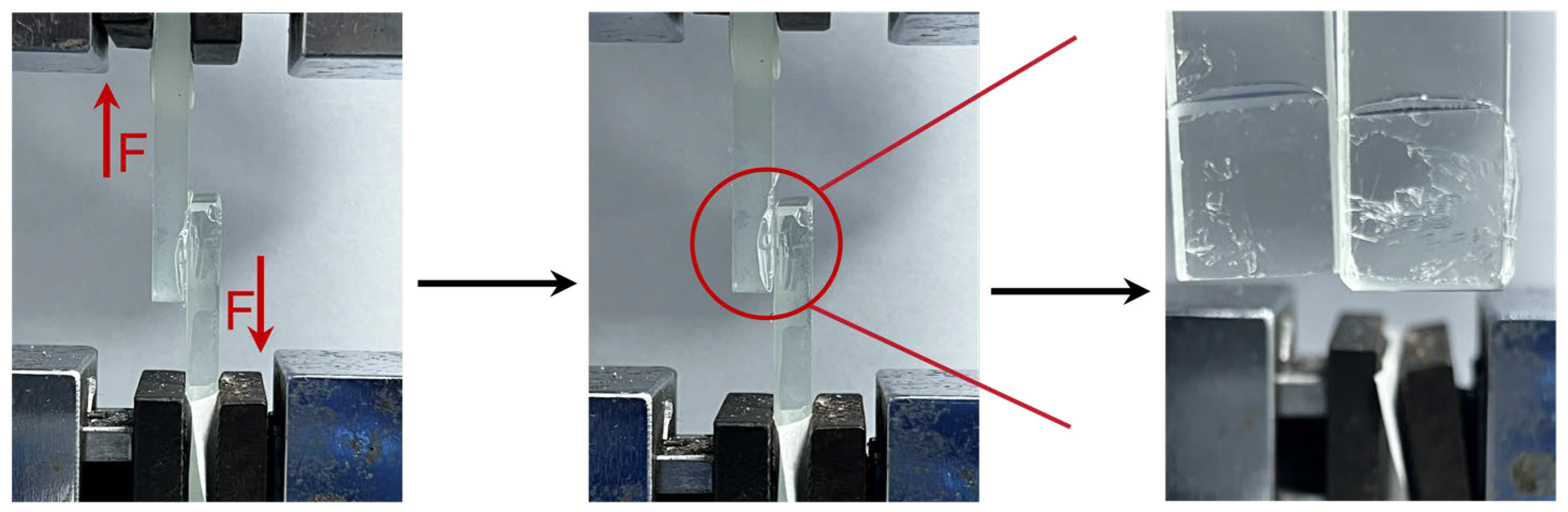
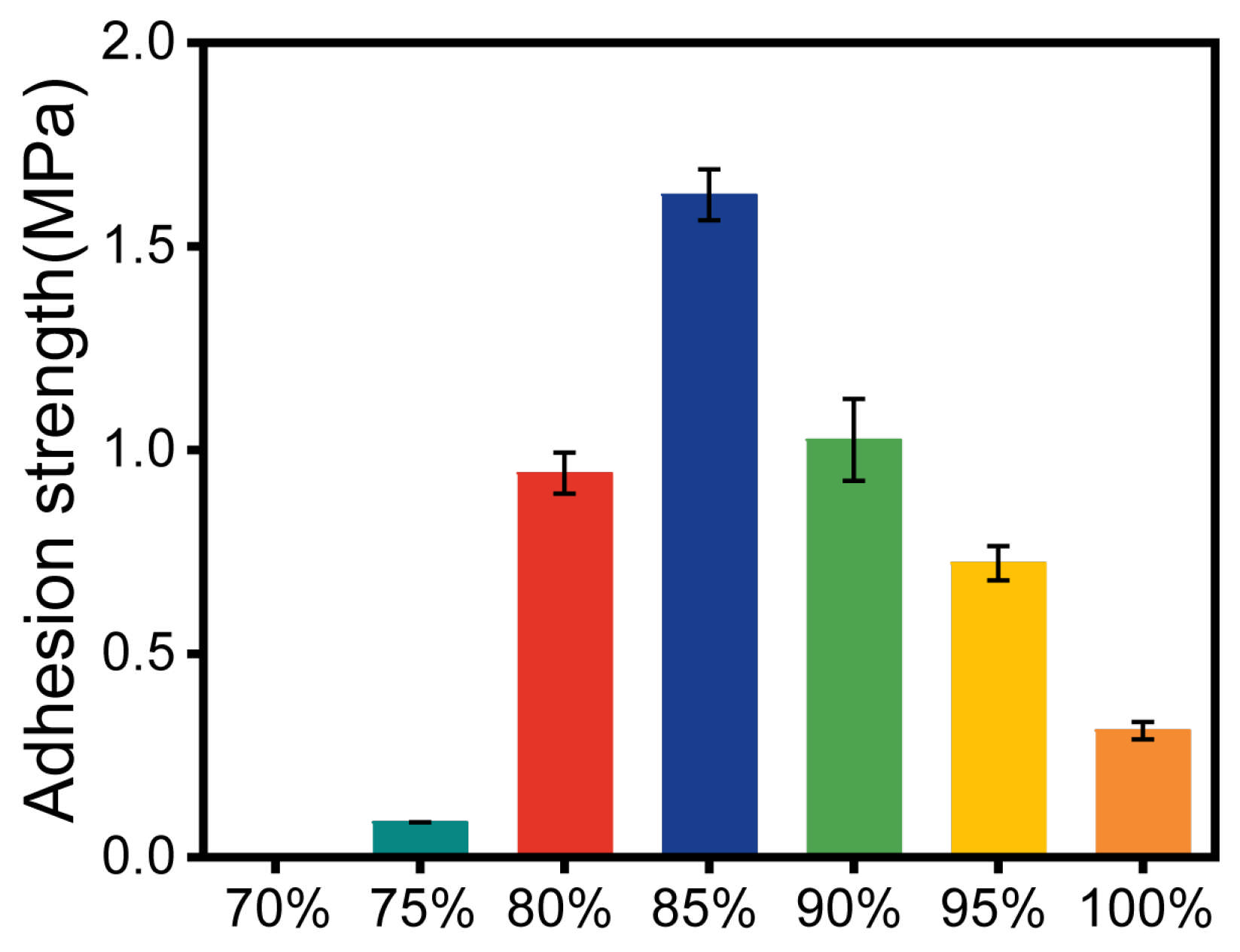
3.6. Dry Adhesion Analysis
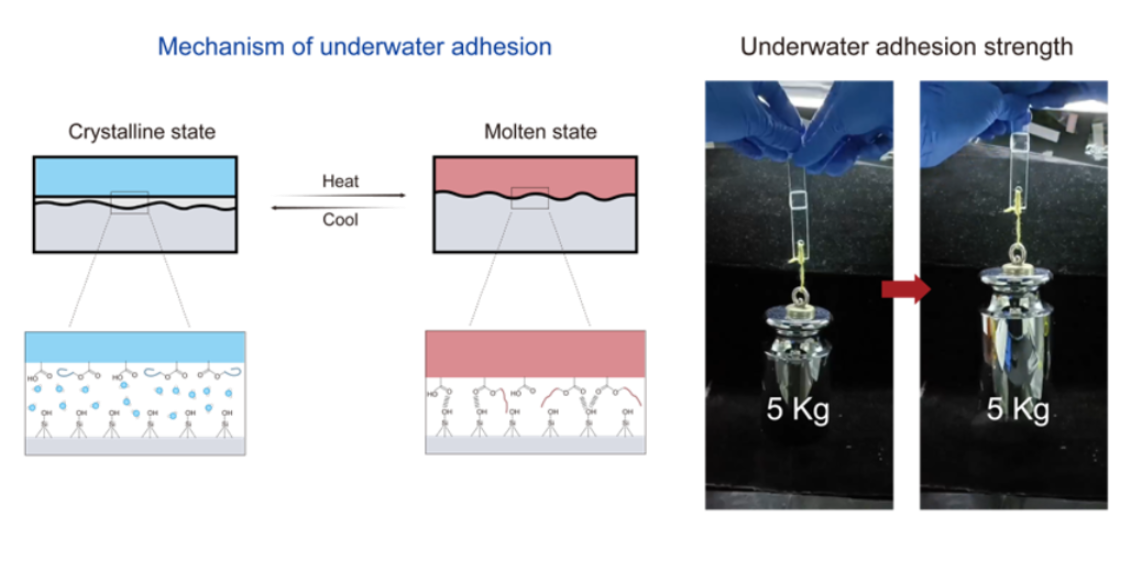
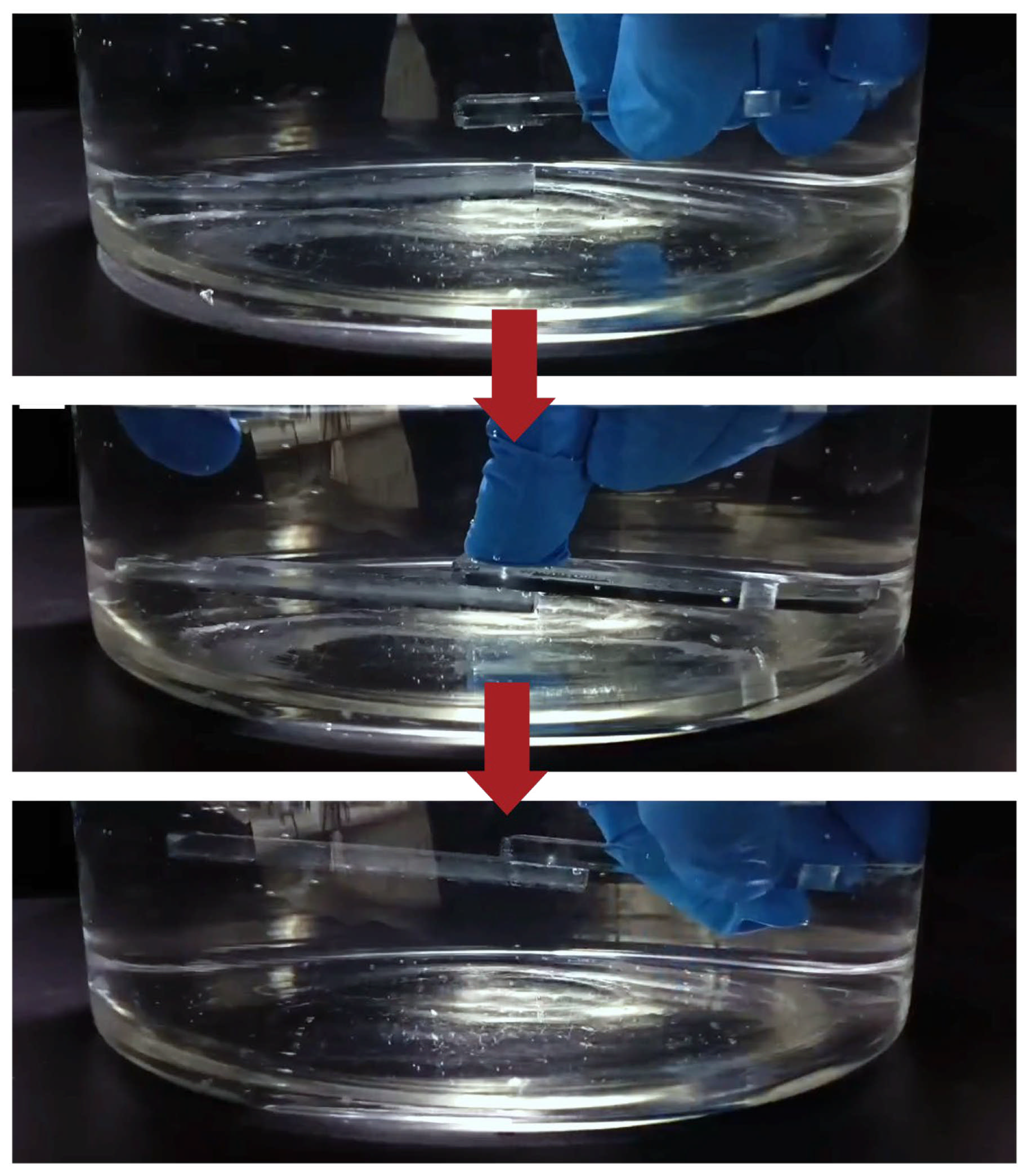
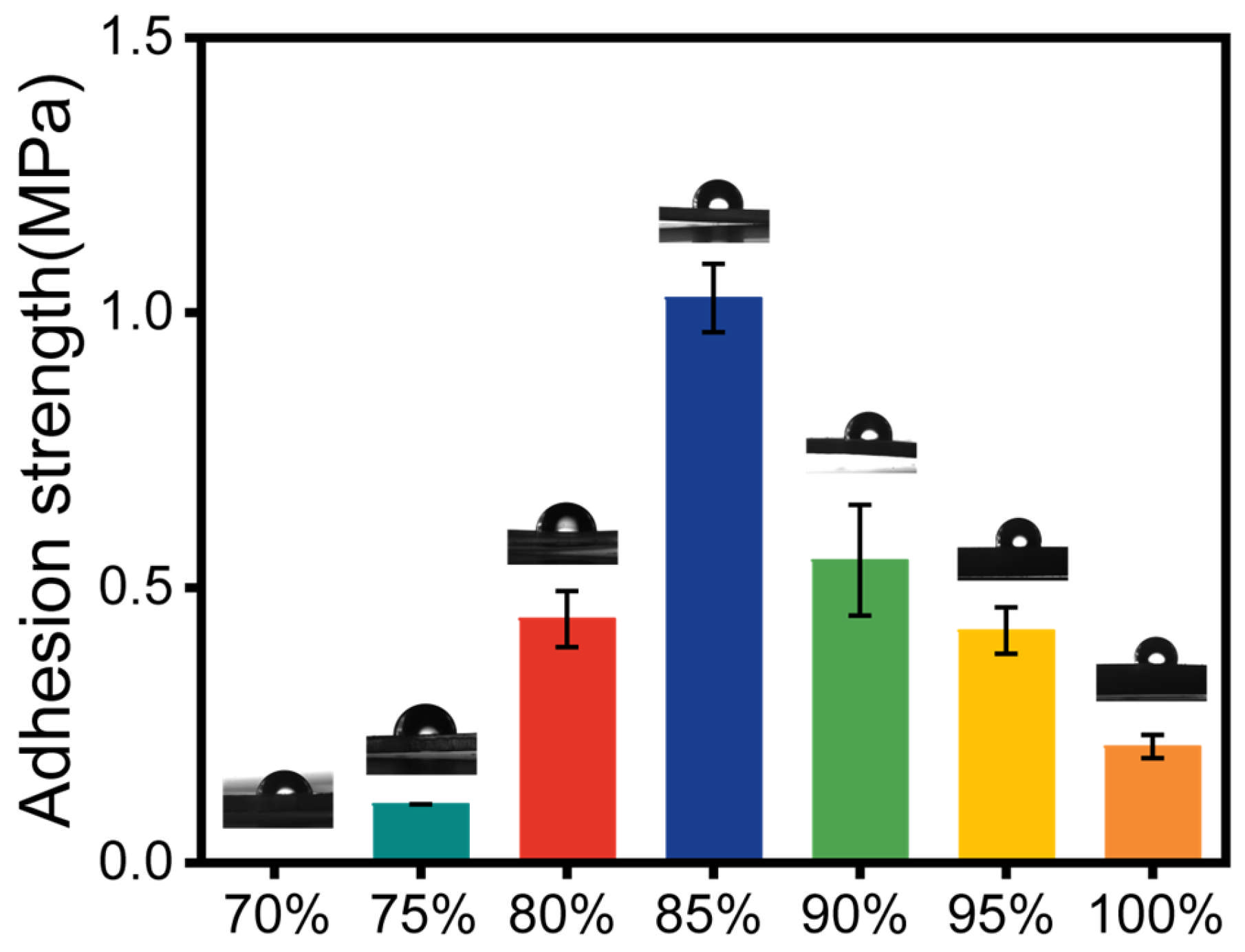
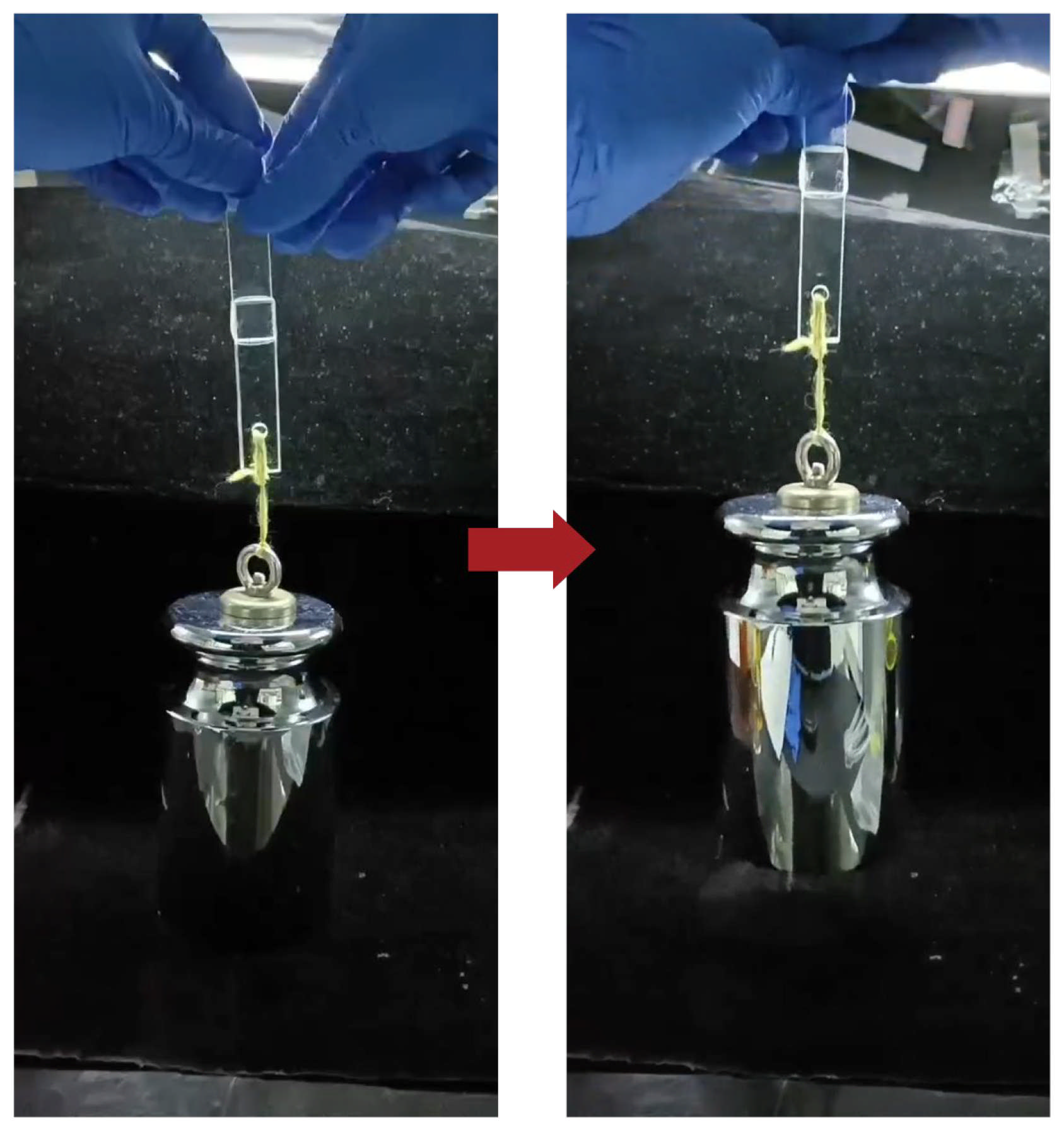
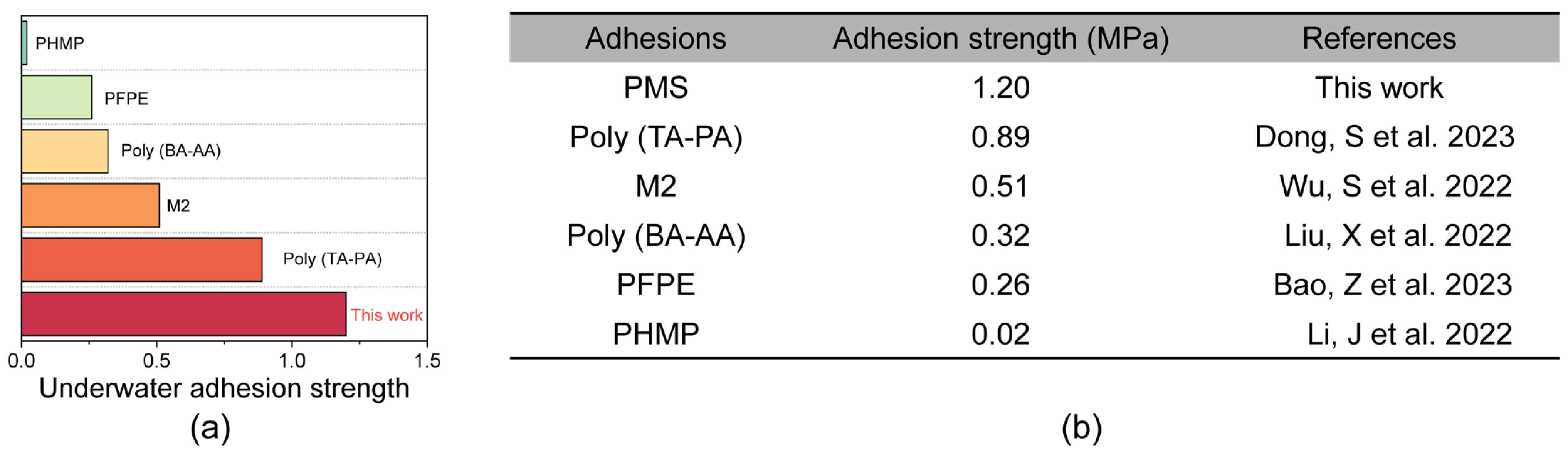
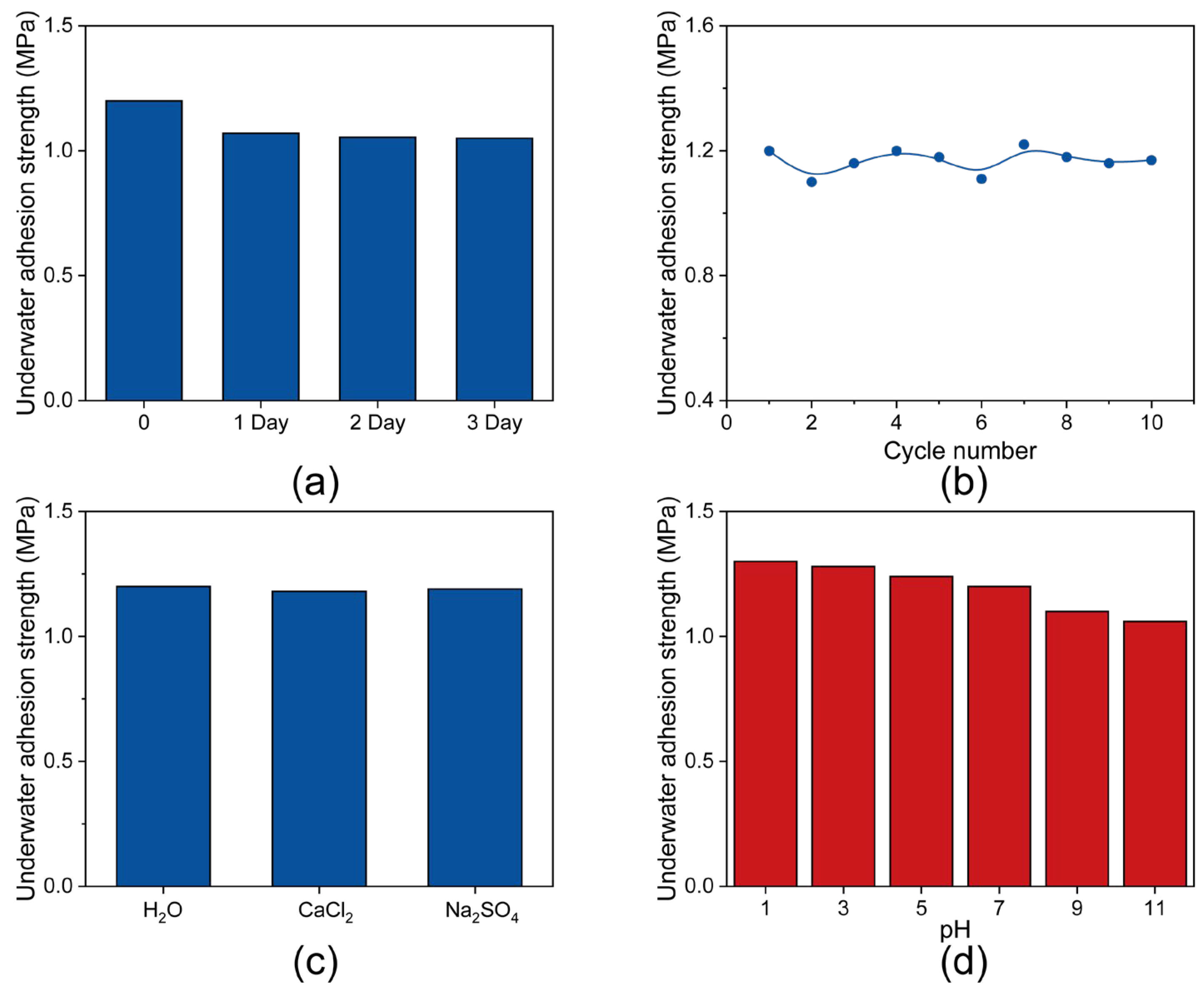
3.7. Underwater Adhesion Analysis
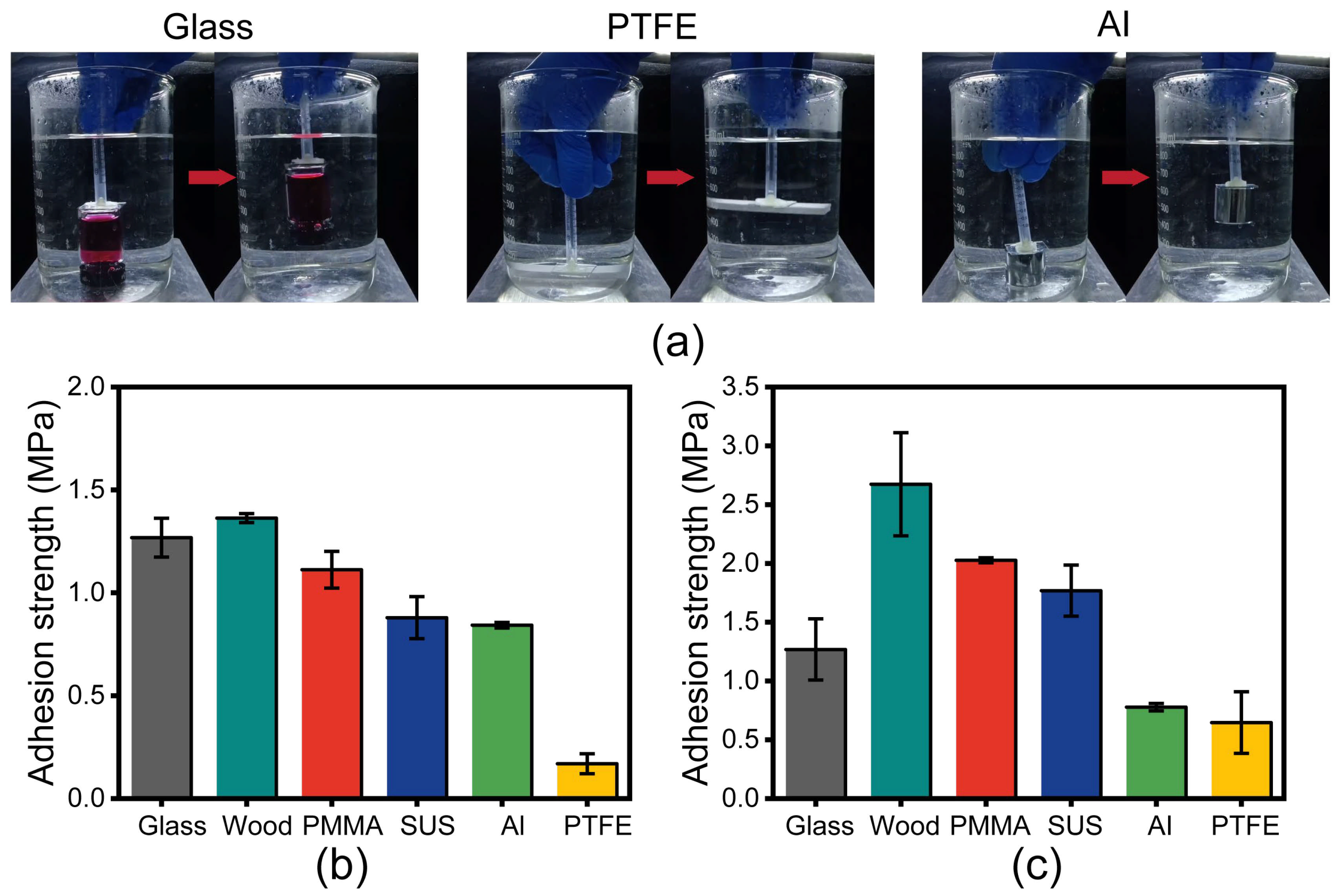
3.8. Substrate Universality of Underwater Adhesion
4. Conclusions
Author Contributions
Funding
Data Availability Statement
Conflicts of Interest
References
- Yan, R.; Xu, Z.; Yi, H.; Xu, C.; Xu, H.; Qi, X.; Dong, X.; Hu, C.; Li, Z.; Jiang, X. Bioinspired Janus Universal Adhesive Patch: Bridging the Contrasting Interface of Soft Tissues and Medical Devices. Adv. Funct. Mater. 2025, 35, 2422130. [Google Scholar] [CrossRef]
- Hu, B.; Zhan, F.; Wang, S.; Wang, L.; Song, G. Robust mussel-inspired adhesives sourced from sustainable lignin. Innov. Mater. 2026, 4, 100187. [Google Scholar] [CrossRef]
- Shi, Z.; Xu, X.; Xue, T.; Niu, W.; Yang, Y.; Li, W.; Pan, J.; Xu, J.; Xu, X.; Zhang, F. Human annular ligament-inspired recyclable underwater adhesive with strong cohesion and adhesion. Chem. Eng. J. 2025, 524, 169350. [Google Scholar] [CrossRef]
- Xia, Y.; Zhang, W.; Tian, J.; Xia, Y. Analysis of Factors Influencing the Bonding Performance at the FFRP-Timber Interface. Materials 2026, 19, 991. [Google Scholar] [CrossRef]
- Chan, C.-S.N.; Chan, W.-Y.; Ng, S.-P.; Kan, C.-W.; Chiu, W.-K.; Ng, C.-H. Enhancing Plant Fibre-Reinforced Polymer Composites for Biomedical Applications Using Atmospheric Pressure Plasma Treatment. Materials 2026, 19, 504. [Google Scholar] [CrossRef]
- Huang, P.; Zhang, H.; Zeng, H. Mussel-Inspired Molecular Strategies for Fabricating Functional Materials With Underwater Adhesion and Self-Healing Properties. Adv. Mater. 2025, 37, 2501542. [Google Scholar] [CrossRef]
- Sun, H.; Qu, X.; Wang, Q.; Guo, Y.; Dong, X. Dynamic regulation of interfacial adhesion in biomedical hydrogels. Chem. Soc. Rev. 2026, 55, 469–503. [Google Scholar] [CrossRef]
- Deng, Y.; Ni, H.; Tang, Y.; Liu, B.; Ding, H.; Wang, G.; Zheng, S.Y.; Yang, J. Biomimetic underwater adhesives based on IL-mediated coacervation. Mater. Horiz. 2026, 13, 840–850. [Google Scholar] [CrossRef]
- Luo, Q.; Zhou, T.; Liang, Y.; Zhang, Y.; Lin, B. Nano-lignin@TA-AgNPs reinforced green adhesives: High-performance systems for harsh environments. Int. J. Biol. Macromol. 2026, 339, 149882. [Google Scholar] [CrossRef]
- Wang, S.; Wu, X.; Li, J.; Zhao, J.; Wang, S.; Sun, Y.; Wang, Z.; Xu, X. Reusable and closed-loop recyclable underwater adhesives via printable multi-dynamic networks. Chem. Eng. J. 2025, 524, 169574. [Google Scholar] [CrossRef]
- Zhao, Z.-H.; Zhao, P.-C.; Zhao, Y.; Zuo, J.-L.; Li, C.-H. An Underwater Long-Term Strong Adhesive Based on Boronic Esters with Enhanced Hydrolytic Stability. Adv. Funct. Mater. 2022, 32, 2201959. [Google Scholar] [CrossRef]
- Yang, R.; Zhang, X.; Chen, B.; Yan, Q.; Yin, J.; Luan, S. Tunable backbone-degradable robust tissue adhesives via in situ radical ring-opening polymerization. Nat. Commun. 2023, 14, 6063. [Google Scholar] [CrossRef] [PubMed]
- Negre, A.; Sy, K.; Sabri, H.; Kalani, K.; Wang, H.L.; Agossa, K. Cyanoacrylate Adhesive Versus Sutures for Free Gingival Graft Fixation: A Systematic Review and Meta-Analysis of Clinical Outcomes. J. Esthet. Restor. Dent. 2025, 37, 2368–2378. [Google Scholar] [CrossRef] [PubMed]
- Fu, M.; Jin, K.; Zhang, Y.; Polley, R.; Zhang, R.; Yang, S.; Liu, D. An Epoxy Adhesive Mimicking the Mussel Mucin Used for Bonding Under Seawater. Small 2025, 21, 2504762. [Google Scholar] [CrossRef]
- Hu, Y.; Liu, Y.; Cui, C.; Cai, W.; Ma, C.; Min, R.; Wang, A.; Yang, Y.; Zhang, S.; Jiang, J. Hydroxylated MXene as a nano-binder: Concurrently strengthening interfaces and toughening matrix in carbon fiber/epoxy composites. Compos. Sci. Technol. 2026, 273, 111426. [Google Scholar] [CrossRef]
- Jiang, W.; Sun, Z.; Wang, R.; Zhao, X.; Zhou, X.; Wei, Y.; Shen, C.; Fang, Y.; Niu, L.; Deng, X.; et al. Redefining interfacial adhesion of linear ionic polyurethanes through supramolecular combinatorial strategy for the restoration of cultural heritage materials. Mater. Today 2025, 91, 271–285. [Google Scholar] [CrossRef]
- Jiang, Y.; Zhang, Z.; Xuan, C.; Shi, X. PEG-based polyurethane bioadhesive for wet and adaptable adhesion to circumcision wounds. Regen. Biomater. 2025, 12, rbaf018. [Google Scholar] [CrossRef]
- Guo, X.; Wang, A.; Sheng, N.; He, Y.; Liu, W.; Li, Z.; Luo, F.; Li, J.; Tan, H. Janus Polyurethane Adhesive Patch with Antibacterial Properties for Wound Healing. ACS Appl. Mater. Interfaces 2024, 16, 15970–15980. [Google Scholar] [CrossRef]
- Hur, S.J.; Jeon, Y.; Jeong, H.; Shim, J.; Shin, J.; Choi, K.Y.; Choi, U.H.; Kim, H.J. Biodegradable polyurethane non-tackifier pressure-sensitive adhesive derived from cashew nut shells. Green Chem. 2026, 28, 6184–6193. [Google Scholar] [CrossRef]
- Zhang, J.; Wang, M.; Yao, X.; Liu, J.; Yan, B. Thioctic Acid-Based Solvent-Free and Recoverable Adhesive for Dry/Wet Environments. ACS Appl. Mater. Interfaces 2024, 16, 54685–54692. [Google Scholar] [CrossRef]
- Hu, S.; Chen, X.; Ni, S.; Wang, Z.; Fu, Y.; Qin, M.; Zhang, Y. Formaldehyde-Free, High-Bonding Performance, Fully Lignin-Based Adhesive Cross-Linked by Glutaraldehyde. ACS Appl. Polym. Mater. 2025, 7, 859–867. [Google Scholar] [CrossRef]
- Zhou, Y.; Zhao, Z.-H.; Zeng, Y.; Tian, S.; Sun, F.; Cheng, Y.; Li, Y.; Fu, Z.; Fu, J. Ultra-Robust and Tough Epoxy Resin Enabled by Pulley Mechanism-Based Curing Agent for Strong and Reversible Adhesion. Adv. Funct. Mater. 2025, 35, e17052. [Google Scholar] [CrossRef]
- Wang, C.; Huo, S.; Ye, G.; Cao, C.-F.; Hong, M.; Pan, Y.-T.; Song, P.; Wang, H.; Wang, T.; Liu, Z. Tick-inspired, self-healing, and strongly-adhesive coatings with biodegradability and phosphorus-free fire retardancy. J. Mater. Sci. Technol. 2026, 260, 229–240. [Google Scholar] [CrossRef]
- Bao, R.; Liu, M.; Li, Y.; Liu, Q.; Wang, S. Advancements of nanoparticle-based adhesive materials. Mater. Horiz. 2026. [Google Scholar] [CrossRef] [PubMed]
- Peng, W.; Lai, Y.; Jiang, Y.; Zhang, Y.; Kan, Z.; Dai, C.; Shen, J.; Liu, P. Charge balance transition enabled Janus hydrogel for robust wet-tissue adhesion and anti-postoperative adhesion. Bioact. Mater. 2025, 52, 123–138. [Google Scholar] [CrossRef]
- Ma, X.; Zhou, X.; Ding, J.; Huang, B.; Wang, P.; Zhao, Y.; Mu, Q.; Zhang, S.; Ren, C.; Xu, W. Hydrogels for underwater adhesion: Adhesion mechanism, design strategies and applications. J. Mater. Chem. A 2022, 10, 11823–11853. [Google Scholar] [CrossRef]
- Zhang, C.; Dou, R.; Xing, W.; Liu, Q.; Cai, L.; Xia, W.; Wu, H.; Fu, W.; Xu, D. A novel adhesive with exceptional underwater adhesion properties, capable of complete curing in aquatic environments. J. Mater. Res. Technol. 2024, 33, 8758–8767. [Google Scholar] [CrossRef]
- Ren, J.; Du, G.; Liu, S.; Yang, H.; Ran, X.; Liu, C.; Liu, T.; Li, Z.; Zhou, X.; Gao, W.; et al. High-strength, self-initiated, wide pH range of underwater adhesive suitable for different severe environments. Chem. Eng. J. 2023, 455, 140640. [Google Scholar] [CrossRef]
- Huang, G.; Tang, Z.; Peng, S.; Zhang, P.; Sun, T.; Wei, W.; Zeng, L.; Guo, H.; Guo, H.; Meng, G. Modification of Hydrophobic Hydrogels into a Strongly Adhesive and Tough Hydrogel by Electrostatic Interaction. Macromolecules 2022, 55, 156–165. [Google Scholar] [CrossRef]
- Sun, Y.; Duan, Y.; Welbourn, R.; Dong, Z.; Löser, L.; Lamsal, B.; Saalwaechter, K.; Ai, S.; Mahmoudi, N.; Qu, X.; et al. Dynamic hydrogels with self-adaptable adhesion property induced by chain movement of amphiphilic macromolecules. Chem. Eng. J. 2025, 526, 170946. [Google Scholar] [CrossRef]
- Liu, Q.; Nian, G.; Yang, C.; Qu, S.; Suo, Z. Bonding dissimilar polymer networks in various manufacturing processes. Nat. Commun. 2018, 9, 846. [Google Scholar] [CrossRef]
- Wang, W.; Yao, H.; Xia, J.; Wan, X.; Wu, J. Chitosan-based immunomodulatory bioadhesive hydrogel promotes liver hemostasis and repair. Carbohydr. Polym. 2025, 353, 123268. [Google Scholar] [CrossRef]
- Fan, M.; Yang, J.; Zhen, L.; Zhu, J.; Liang, K.; Li, J. A mussel-inspired wet-adhesive prolonged-acting antibacterial hydrogels for the treatment of periodontitis. Chem. Eng. J. 2025, 509, 161262. [Google Scholar] [CrossRef]
- Kim, T.Y.; Son, K.; Moon, C.-H.; Yook, K.-Y.; Kim, S.A.; Ham, H.; Lee, Y.; Lee, S.I.; Jo, Y.; Yu, Y.; et al. Quinone-mediated, tissue-adaptive double-network hydrogel for instant hemostasis and wet-tissue adhesion. Nat. Commun. 2026, 17, 7263. [Google Scholar] [CrossRef]
- Li, J.; Zhang, Y.; Zhang, Q.; Cai, C.; Li, F.; Dong, S. Supramolecular Pressure-Sensitive Adhesives with Rapid, Strong, Water-Resistant, and Underwater Adhesion. Adv. Mater. Interfaces 2023, 10, 2202005. [Google Scholar] [CrossRef]
- Huang, X.; Shangguan, Z.; Zhang, Z.-Y.; Yu, C.; He, Y.; Fang, D.; Sun, W.; Li, Y.-C.; Yuan, C.; Wu, S.; et al. Visible-Light-Induced Reversible Photochemical Crystal–Liquid Transitions of Azo-Switches for Smart and Robust Adhesives. Chem. Mater. 2022, 34, 2636–2644. [Google Scholar] [CrossRef]
- Niu, W.; Zhu, J.; Zhang, W.; Liu, X. Simply Formulated Dry Pressure-Sensitive Adhesives for Substrate-Independent Underwater Adhesion. ACS Mater. Lett. 2022, 4, 410–417. [Google Scholar] [CrossRef]
- Nogusa, T.; Cooper, C.B.; Yu, Z.; Zheng, Y.; Shi, Y.; Bao, Z. Tunable, reusable, and recyclable perfluoropolyether periodic dynamic polymers with high underwater adhesion strength. Matter 2023, 6, 2439–2453. [Google Scholar] [CrossRef]
- He, S.; Guo, B.; Sun, X.; Shi, M.; Zhang, H.; Yao, F.; Sun, H.; Li, J. Bio-Inspired Instant Underwater Adhesive Hydrogel Sensors. ACS Appl. Mater. Interfaces 2022, 14, 45869–45879. [Google Scholar] [CrossRef]


Disclaimer/Publisher’s Note: The statements, opinions and data contained in all publications are solely those of the individual author(s) and contributor(s) and not of MDPI and/or the editor(s). MDPI and/or the editor(s) disclaim responsibility for any injury to people or property resulting from any ideas, methods, instructions or products referred to in the content. |
© 2026 by the authors. Licensee MDPI, Basel, Switzerland. This article is an open access article distributed under the terms and conditions of the Creative Commons Attribution (CC BY) license.
Share and Cite
Liu, H.; Hou, L. Molecular Design of Underwater Adhesive Copolymers: Synergy Between Long-Chain Alkyl Crystallization–Melting Switching and Carboxyl Group Interfacial Interactions. Materials 2026, 19, 2407. https://doi.org/10.3390/ma19112407
Liu H, Hou L. Molecular Design of Underwater Adhesive Copolymers: Synergy Between Long-Chain Alkyl Crystallization–Melting Switching and Carboxyl Group Interfacial Interactions. Materials. 2026; 19(11):2407. https://doi.org/10.3390/ma19112407
Chicago/Turabian StyleLiu, Han, and Lei Hou. 2026. "Molecular Design of Underwater Adhesive Copolymers: Synergy Between Long-Chain Alkyl Crystallization–Melting Switching and Carboxyl Group Interfacial Interactions" Materials 19, no. 11: 2407. https://doi.org/10.3390/ma19112407
APA StyleLiu, H., & Hou, L. (2026). Molecular Design of Underwater Adhesive Copolymers: Synergy Between Long-Chain Alkyl Crystallization–Melting Switching and Carboxyl Group Interfacial Interactions. Materials, 19(11), 2407. https://doi.org/10.3390/ma19112407