Repair Performance of Additively and Subtractively Manufactured Permanent Crown Materials: A Combined Mechanical and Optical Evaluation


 and
and 
Highlights
- CAD/CAM materials showed higher repair bond strength than 3D-printed resins.
- Tribochemical silica coating yielded the highest bond strength across all groups.
- Additively manufactured materials exhibited greater color change after aging.
- Aging increased color mismatch, but values remained clinically acceptable.
- Repair performance depends on both material type and surface treatment.
Abstract
1. Introduction
2. Materials and Methods
2.1. Specimen Preparation
2.2. Surface Treatment Protocols
2.3. Repair Procedure
2.4. Micro-Shear Bond Strength (µSBS) Testing
2.5. Optical Evaluation
2.6. Statistical Analysis
3. Results
3.1. Micro-Shear Bond Strength
3.2. Failure Mode Analysis
3.3. Color Mismatch (ΔE00)
3.4. Color Stability (ΔE00_RepairChange and ΔE00_SubChange)
4. Discussion
5. Conclusions
Author Contributions
Funding
Institutional Review Board Statement
Informed Consent Statement
Data Availability Statement
Acknowledgments
Conflicts of Interest
Abbreviations
| APA | Airborne Particle Abrasion |
| CAD/CAM | Computer-Aided Design/Computer-Aided Manufacturing |
| CT | CrownTec |
| ΔE00 | Color difference (CIEDE2000 formula) |
| ΔE00_mismatch | Color mismatch between repair and substrate |
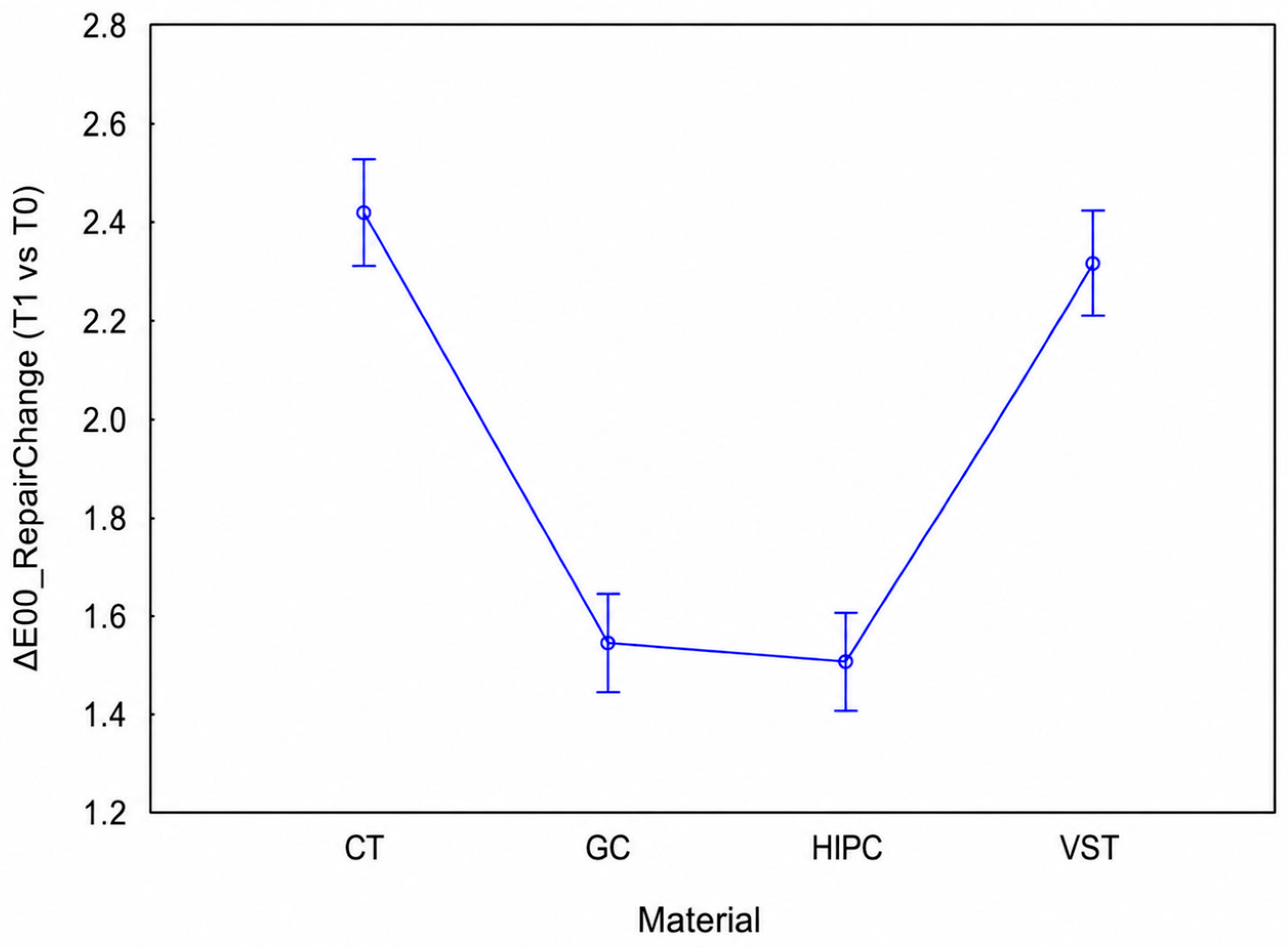
| ΔE00_RepairChange | Color change of repair area (T1 vs. T0) |
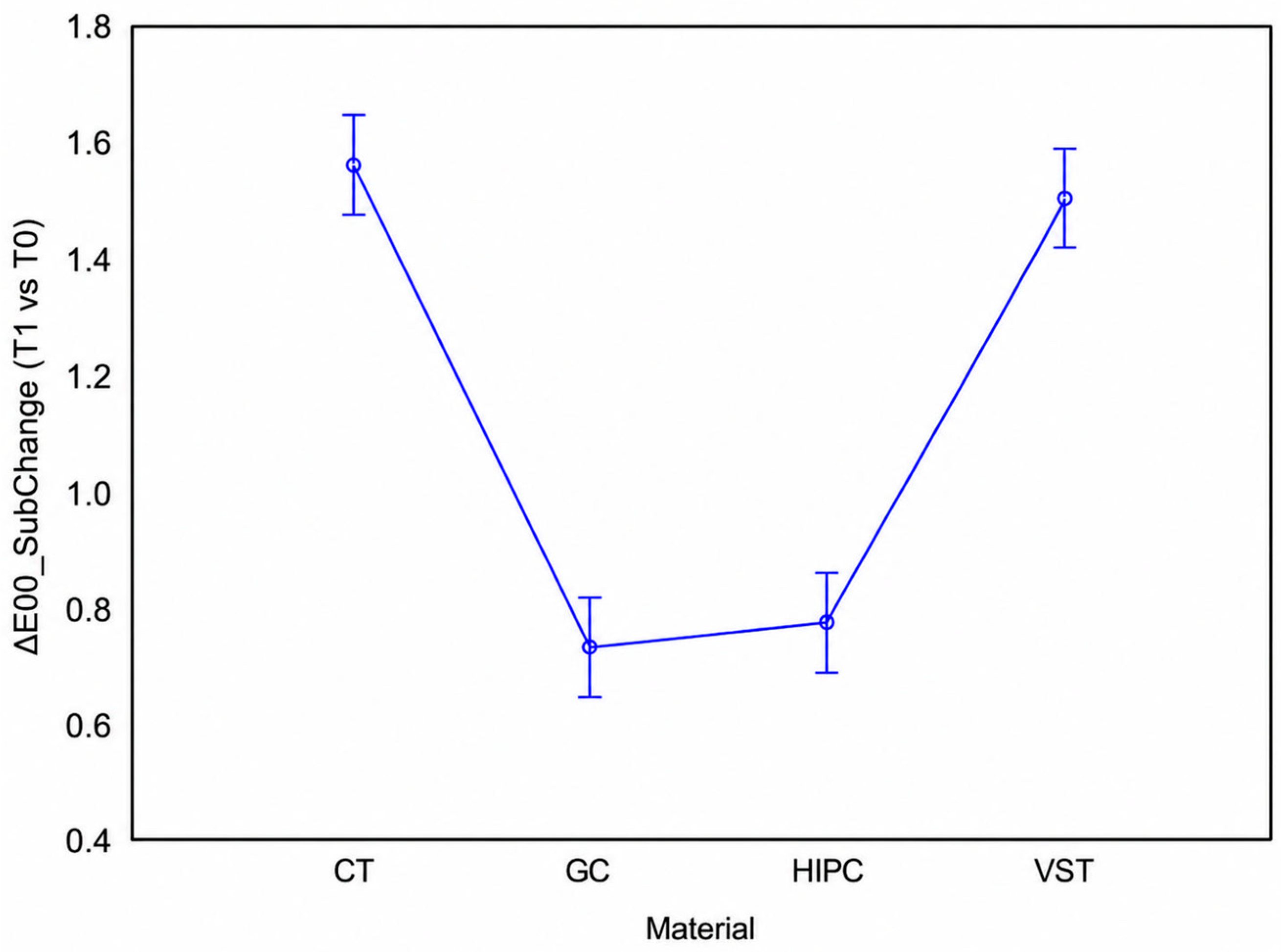
| ΔE00_SubChange | Color change of substrate area (T1 vs. T0) |
| GC | GC Cerasmart |
| HIPC | HIPC Plus |
| LT | Laser Treatment |
| µSBS | Micro-shear Bond Strength |
| T0 | Baseline measurement |
| T1 | Post-aging measurement |
| TSC | Tribochemical Silica Coating |
| VST | VarseoSmile TriniQ |
References
- Mandurino, M.; Cortili, S.; Coccoluto, L.; Greco, K.; Cantatore, G.; Gherlone, E.F.; Vichi, A.; Paolone, G. Mechanical Properties of 3D Printed vs. Subtractively Manufactured Composite Resins for Permanent Restorations: A Systematic Review. Materials 2025, 18, 985. [Google Scholar] [CrossRef]
- Tavares, M.J.; Amaral, F.L.; Basting, R.T.; Turssi, C.P.; França, F.M. Effect of different design and surface treatment on the load-to-failure of ceramic repaired with composite. Acta Odontol. Latinoam. 2024, 37, 88–95. [Google Scholar] [CrossRef]
- Albergardi, A.B.S.; Limírio, J.P.J.O.; Gomes, J.M.L.; Pesqueira, A.A.; Pellizzer, E.P. Effect of surface treatments on the bond strength of resin-repaired resin matrix CAD-CAM ceramic: A scoping review. J. Dent. 2025, 154, 105594. [Google Scholar] [CrossRef]
- Hoffmann, M.; Coldea, A.; Stawarczyk, B. Mechanical Properties of Novel 3D-Printed Restorative Materials for Definitive Dental Applications. Materials 2025, 18, 4662. [Google Scholar] [CrossRef]
- Gul, B.C.; Demirci, F.; Baki, N.; Bahce, E.; Özcan, M. Mechanical analysis of 3D printed dental restorations manufactured using different resins and validation with FEM analysis. BMC Oral Health 2025, 25, 131. [Google Scholar] [CrossRef]
- Dimitrova, M.; Kazakova, R.; Vlahova, A. Comparative Study of the Fracture Resistance of 3D-Printed and Prefabricated Artificial Teeth for Removable Dentures. Polymers 2024, 16, 3381. [Google Scholar] [CrossRef]
- Mudhaffer, S.; Haider, J.; Silikas, N.; Satterthwaite, J. Edge strength of definitive 3D-printed restorative resin materials. Dent. Mater. 2025, 41, 745–754. [Google Scholar] [CrossRef]
- Greil, V.; Mayinger, F.; Reymus, M.; Stawarczyk, B. Water sorption, water solubility, degree of conversion, elastic indentation modulus, edge chipping resistance and flexural strength of 3D-printed denture base resins. J. Mech. Behav. Biomed. Mater. 2023, 137, 105565. [Google Scholar] [CrossRef] [PubMed]
- Quinn, G.D.; Giuseppetti, A.A.; Hoffman, K.H. Chipping fracture resistance of dental CAD/CAM restorative materials: Part I—Procedures and results. Dent. Mater. 2014, 30, e99–e111. [Google Scholar] [CrossRef] [PubMed]
- Song, M.G.; Ko, K.H.; Huh, Y.H.; Park, C.J.; Cho, L.R. Edge Chipping Resistance and Flexural Strength of CAD-CAM Ceramics Before and After Thermomechanical Aging. J. Esthet. Restor. Dent. 2025, 37, 1096–1104. [Google Scholar] [CrossRef] [PubMed]
- Özkardeş, M.H.; Özel, H.B.; Kahramanoğlu, E. Effect of thermomechanical aging on fracture strength of anterior crowns fabricated with different CAD-CAM materials. J. Adv. Prosthodont. 2025, 17, 158–168. [Google Scholar] [CrossRef] [PubMed]
- Sasany, R.; Yilmaz, B. Marginal discrepancy and fracture load of thermomechanically fatigued crowns fabricated with different CAD-CAM techniques. J. Prosthodont. 2023, 32, 602–607. [Google Scholar] [CrossRef] [PubMed]
- Baladhandayutham, B.; Lawson, N.C.; Burgess, J.O. Fracture load of ceramic restorations after fatigue loading. J. Prosthet. Dent. 2015, 114, 266–271. [Google Scholar] [CrossRef]
- Limones, A.; Sabatini, G.P.; Molinero-Mourelle, P.; Fonseca, M.; Yilmaz, B.; Peutzfeldt, A.; Çakmak, G. The effect of mechanical and chemical surface pretreatment on the repair bond strength of resins used in additive or subtractive manufacturing of definitive prostheses. J. Prosthet. Dent. 2025, 135, 821.e1–821.e11. [Google Scholar] [CrossRef]
- Taokhampu, N.; Lekatana, H.; Palasuk, J. Bond strength of aged provisional 3D-printed methacrylate resin with different surface treatments and repair materials. BMC Oral Health 2025, 25, 789. [Google Scholar] [CrossRef]
- Yildirim-Manav, E.; Yazici-Akbiyik, S.; Yikici-Çöl, C. Repair bond strength of composite resin to additively manufactured permanent resin materials: A comparative evaluation of light-cure, self-cure, and dual-cure universal adhesives. BMC Oral Health 2025, 25, 1728. [Google Scholar] [CrossRef]
- Lankes, V.; Reymus, M.; Liebermann, A.; Stawarczyk, B. Bond strength between temporary 3D printable resin and conventional resin composite: Influence of cleaning methods and air-abrasion parameters. Clin. Oral Investig. 2023, 27, 31–43. [Google Scholar] [CrossRef]
- Dederichs, M.; Badr, Z.; Viebranz, S.; Nietzsche, S.; Schulze-Späte, U.; Schmelzer, A.S.; Lehmann, T.; Guentsch, A. Effect of surface conditioning on the adhesive bond strength of 3D-printed resins used in permanent fixed dental prostheses. J. Dent. 2025, 155, 105621. [Google Scholar] [CrossRef]
- Dogan, E.; Cevval Ozkocak, B.B. The efficacy of Er,Cr:YSGG laser and contemporary universal adhesive systems on composite resin repair bond strength: An in vitro study. Odontology 2024, 112, 1197–1208. [Google Scholar] [CrossRef]
- Fonseca, R.G.; Haneda, I.G.; Almeida-Júnior, A.A.; de Oliveira Abi-Rached, F.; Adabo, G.L. Efficacy of air-abrasion technique and additional surface treatment at titanium/resin cement interface. J. Adhes. Dent. 2012, 14, 453–459. [Google Scholar] [CrossRef] [PubMed]
- Htat, H.L.; Prawatvatchara, W.; Techapiroontong, S.; Lee, J.H.; Limpuangthip, N. Effect of mechanical and chemical surface treatments on the repairing of milled and 3D-printed denture bases. Sci. Rep. 2024, 14, 23413. [Google Scholar] [CrossRef]
- Turkes Basaran, E.; Kazak, M.; Gokce, K.; Benderli Gokce, Y. Effects of chemical surface pretreatments on the surface roughness and shear bond strength of fiber post-resin cement interfaces: A preliminary in vitro study. PeerJ 2025, 13, e19853. [Google Scholar] [CrossRef]
- Çağlayan, E.; Sasany, R.; Bolat, B.N.; Hartavi, D.; Batgerel, O.E.; Ucar, S.M.; Umurca, D.G. Optical properties of repaired additively manufactured resin composites and zirconia and subtractively manufactured ceramics: A comparative study of composite resins. BMC Oral Health 2025, 25, 144. [Google Scholar] [CrossRef]
- Çakmak, G.; Donmez, M.B.; de Paula, M.S.; Akay, C.; Fonseca, M.; Kahveci, Ç.; Abou-Ayash, S.; Yilmaz, B. Surface roughness, optical properties, and microhardness of additively and subtractively manufactured CAD-CAM materials after brushing and coffee thermal cycling. J. Prosthodont. 2025, 34, 68–77. [Google Scholar] [CrossRef]
- Al-Turki, L.; Merdad, Y.; Abuhaimed, T.A.; Sabbahi, D.; Almarshadi, M.; Aldabbagh, R. Repair bond strength of dental computer-aided design/computer-aided manufactured ceramics after different surface treatments. J. Esthet. Restor. Dent. 2020, 32, 726–733. [Google Scholar] [CrossRef] [PubMed]
- Nogueira, I.O.; Pereira, C.N.B.; Abreu, L.G.; Diniz, I.M.A.; Magalhães, C.S.; Silveira, R.R.D. Do different protocols affect the success rate or bond strength of glass-ceramics repaired with composite resin? A systematic review and meta-analysis. J. Prosthet. Dent. 2025, 133, 1157–1171. [Google Scholar] [CrossRef] [PubMed]
- Shi, H.Y.; Pang, R.; Yang, J.; Fan, D.; Cai, H.; Jiang, H.B.; Han, J.; Lee, E.S.; Sun, Y. Overview of Several Typical Ceramic Materials for Restorative Dentistry. BioMed Res. Int. 2022, 2022, 8451445. [Google Scholar] [CrossRef] [PubMed]
- Da Rosa, L.S.; Pilecco, R.O.; Soares, P.M.; Rippe, M.P.; Pereira, G.K.R.; Valandro, L.F.; Kleverlaan, C.J.; Feilzer, A.J.; Tribst, J.P.M. Repair protocols for indirect monolithic restorations: A literature review. PeerJ 2024, 12, e16942. [Google Scholar] [CrossRef]
- Zhang, S.; Wang, X.; Yang, J.; Chen, H.; Jiang, X. Micromechanical interlocking structure at the filler/resin interface for dental composites: A review. Int. J. Oral Sci. 2023, 15, 21. [Google Scholar] [CrossRef]
- Duan, Y.; Griggs, J.A. Effect of elasticity on stress distribution in CAD/CAM dental crowns: Glass ceramic vs. polymer-matrix composite. J. Dent. 2015, 43, 742–749. [Google Scholar] [CrossRef]
- Pratap, B.; Gupta, R.K.; Bhardwaj, B.; Nag, M. Resin based restorative dental materials: Characteristics and future perspectives. Jpn. Dent. Sci. Rev. 2019, 55, 126–138. [Google Scholar] [CrossRef] [PubMed]
- İşisağ, Ö.; Kanık, Ö. Effect of Different Composite Resin Types on the Repair Strength of Resin MatrixCeramics: An in Vitro Study. NEU Dent. J. 2025, 7, 51–64. [Google Scholar] [CrossRef]
- Duarte, S., Jr.; Phark, J.H. Advances in Dental Restorations: A Comprehensive Review of Machinable and 3D-Printed Ceramic-Reinforced Composites. J. Esthet. Restor. Dent. 2025, 37, 257–276. [Google Scholar] [CrossRef]
- Alt, V.; Hannig, M.; Wöstmann, B.; Balkenhol, M. Fracture strength of temporary fixed partial dentures: CAD/CAM versus directly fabricated restorations. Dent. Mater. 2011, 27, 339–347. [Google Scholar] [CrossRef]
- Lakkala, P.; Munnangi, S.R.; Bandari, S.; Repka, M. Additive manufacturing technologies with emphasis on stereolithography 3D printing in pharmaceutical and medical applications: A review. Int. J. Pharm. X 2023, 5, 100159. [Google Scholar] [CrossRef]
- Rahman, M.; Islam, S.; Mubasshira; Islam, S.; Ahammad, R.; Islam, A.; Hasib, A.; Rahman, S.; Moshwan, R.; Ehsan, M.M.; et al. Polymer Composites in Additive Manufacturing: Current Technologies, Applications, and Emerging Trends. Polymers 2026, 18, 192. [Google Scholar] [CrossRef]
- Çelik, E.; Şahin, S.C.; Dede, D.Ö. Effect of surface treatments on the bond strength of indirect resin composite to resin matrix ceramics. J. Adv. Prosthodont. 2019, 11, 223–231. [Google Scholar] [CrossRef]
- Çelik, E.; Sahin, S.C.; Dede, D.Ö. Shear Bond Strength of Nanohybrid Composite to the Resin Matrix Ceramics After Different Surface Treatments. Photomed. Laser Surg. 2018, 36, 424–430. [Google Scholar] [CrossRef]
- Şişmanoğlu, S.; Gürcan, A.T.; Yıldırım-Bilmez, Z.; Turunç-Oğuzman, R.; Gümüştaş, B. Effect of surface treatments and universal adhesive application on the microshear bond strength of CAD/CAM materials. J. Adv. Prosthodont. 2020, 12, 22–32. [Google Scholar] [CrossRef]
- Arkoy, S.; Ulusoy, M. Effect of Different Surface Treatments on Repair Bond Strength of CAD/CAM Resin-Matrix Ceramics. Materials 2022, 15, 6314. [Google Scholar] [CrossRef] [PubMed]
- Arpa, C.; Ceballos, L.; Fuentes, M.V.; Perdigão, J. Repair bond strength and nanoleakage of artificially aged CAD-CAM composite resin. J. Prosthet. Dent. 2019, 121, 523–530. [Google Scholar] [CrossRef]
- Nasiry Khanlar, L.; Revilla-León, M.; Barmak, A.B.; Ikeda, M.; Alsandi, Q.; Tagami, J.; Zandinejad, A. Surface roughness and shear bond strength to composite resin of additively manufactured interim restorative material with different printing orientations. J. Prosthet. Dent. 2023, 129, 788–795. [Google Scholar] [CrossRef]
- Kagaoan, Z.; Liu, X.; Cameron, A.; Aarts, J.; Choi, J.J.E. Factors influencing the bond strength of additively manufactured crown materials in dentistry: A systematic review of in vitro studies. J. Dent. 2024, 144, 104908. [Google Scholar] [CrossRef] [PubMed]
- Jouhar, R. Effect of adhesive strategy on the shear bond strength of monochromatic and nanohybrid composite resins to glass ionomer cements in the sandwich technique. Front. Dent. Med. 2026, 7, 1728691. [Google Scholar] [CrossRef]
- Paravina, R.D.; Ghinea, R.; Herrera, L.J.; Bona, A.D.; Igiel, C.; Linninger, M.; Sakai, M.; Takahashi, H.; Tashkandi, E.; Perez Mdel, M. Color difference thresholds in dentistry. J. Esthet. Restor. Dent. 2015, 27, S1–S9. [Google Scholar] [CrossRef] [PubMed]
- Bozoğulları, H.N.; Temizci, T. Evaluation of the color stability, stainability, and surface roughness of permanent composite-based milled and 3D printed CAD/CAM restorative materials after thermocycling. Appl. Sci. 2023, 13, 11895. [Google Scholar] [CrossRef]
- Koca, B.; Akarsu, S.; Karademir, S.A.; Atasoy, S. Comparison of color stability of different 3-D printed resins. J. Health Sci. Med. 2025, 8, 988–994. [Google Scholar] [CrossRef]



| Material | Manufacturer | Type | Composition | Manufacturing Method | Batch Number |
|---|---|---|---|---|---|
| HIPC Plus | Bredent GmbH, Senden, Germany | CAD/CAM polymer composite | Highly cross-linked polymer matrix reinforced with ceramic fillers | Subtractive (CAD/CAM milling) | 567845 |
| GC Cerasmart | GC Corp., Tokyo, Japan | Nanohybrid resin-ceramic | Resin matrix with nano-ceramic fillers (barium glass and silica) | Subtractive (CAD/CAM milling) | 2408287 |
| VarseoSmile TriniQ | BEGO, Bremen, Germany | Permanent crown resin | Methacrylate-based photopolymer resin with inorganic fillers | Additive (3D printing) | 602284 |
| CrownTec | Saremco Dental, Rebstein, Switzerland | Permanent crown resin | Methacrylate-based photopolymer resin with ceramic fillers | Additive (3D printing) | F654 |
| Source | F | p | η2 |
|---|---|---|---|
| Material | 198.880 | <0.001 * | 0.847 |
| Surface treatment | 193.876 | <0.001 * | 0.782 |
| Material × Surface treatment | 12.739 | <0.001 * | 0.414 |
| Surface Treatment | CT (MPa) | GC (MPa) | HIPC (MPa) | VST (MPa) |
|---|---|---|---|---|
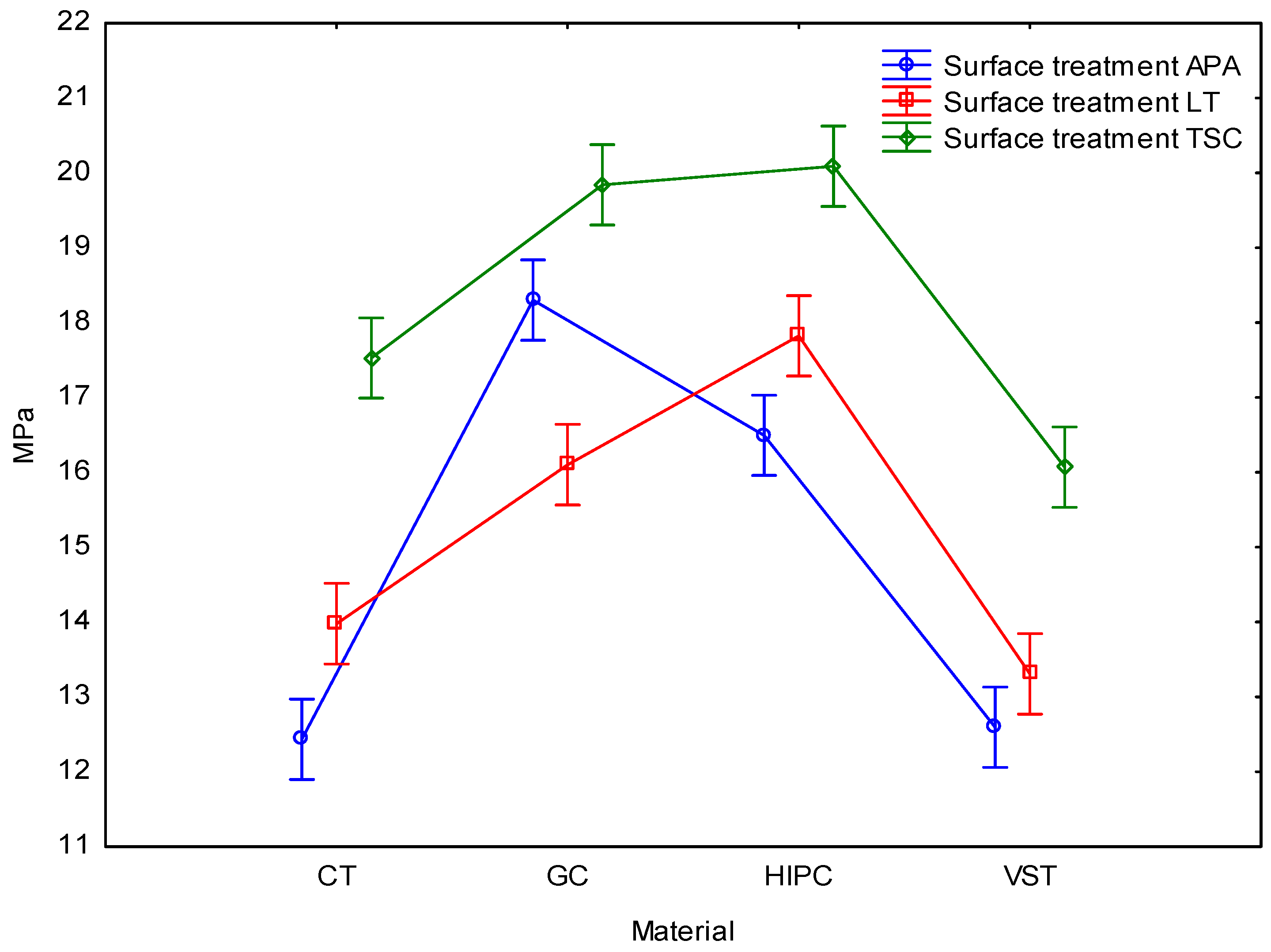
| APA | 12.434 ± 0.529 c | 18.302 ± 1.457 a | 16.494 ± 1.546 b | 12.594 ± 0.508 c |
| LT | 13.977 ± 0.717 c | 16.101 ± 0.386 b | 17.822 ± 0.530 a | 13.306 ± 0.197 c |
| TSC | 17.527 ± 0.470 a | 19.840 ± 0.721 a | 20.087 ± 1.349 a | 16.067 ± 0.455 b |
| Total | 14.646 ± 2.240 | 18.081 ± 1.817 | 18.134 ± 1.916 | 13.989 ± 1.574 |
| Material | Adhesive n (%) | Cohesive n (%) | Mixed n (%) |
|---|---|---|---|
| CT | 2 (6.7) | 8 (26.7) | 20 (66.7) |
| GC | 2 (6.7) | 10 (33.3) | 18 (60.0) |
| HIPC | 2 (6.7) | 7 (23.3) | 21 (70.0) |
| VST | 0 (0.0) | 5 (16.7) | 25 (83.3) |
| Surface treatment | |||
| APA | 3 (7.5) | 8 (20.0) | 29 (72.5) |
| LT | 2 (5.0) | 6 (15.0) | 32 (80.0) |
| TSC | 1 (2.5) | 16 (40.0) | 23 (57.5) |
| Source | F (T0) | p (T0) | η2 (T0) | F (T1) | p (T1) | η2 (T1) |
|---|---|---|---|---|---|---|
| Material | 0.033 | 0.992 | 0.001 | 1.097 | 0.354 | 0.030 |
| Surface treatment | 0.217 | 0.806 | 0.004 | 0.630 | 0.534 | 0.012 |
| Material × Surface treatment | 3.209 | 0.006 * | 0.151 | 0.805 | 0.568 | 0.043 |
Disclaimer/Publisher’s Note: The statements, opinions and data contained in all publications are solely those of the individual author(s) and contributor(s) and not of MDPI and/or the editor(s). MDPI and/or the editor(s) disclaim responsibility for any injury to people or property resulting from any ideas, methods, instructions or products referred to in the content. |
© 2026 by the authors. Licensee MDPI, Basel, Switzerland. This article is an open access article distributed under the terms and conditions of the Creative Commons Attribution (CC BY) license.
Share and Cite
Karagözoğlu, İ.; Parlar Öz, Ö.; Demirkol, N.; Eyüboğlu, T.F.; Özcan, M. Repair Performance of Additively and Subtractively Manufactured Permanent Crown Materials: A Combined Mechanical and Optical Evaluation. Materials 2026, 19, 2406. https://doi.org/10.3390/ma19112406
Karagözoğlu İ, Parlar Öz Ö, Demirkol N, Eyüboğlu TF, Özcan M. Repair Performance of Additively and Subtractively Manufactured Permanent Crown Materials: A Combined Mechanical and Optical Evaluation. Materials. 2026; 19(11):2406. https://doi.org/10.3390/ma19112406
Chicago/Turabian StyleKaragözoğlu, İrem, Özge Parlar Öz, Nermin Demirkol, Tan Fırat Eyüboğlu, and Mutlu Özcan. 2026. "Repair Performance of Additively and Subtractively Manufactured Permanent Crown Materials: A Combined Mechanical and Optical Evaluation" Materials 19, no. 11: 2406. https://doi.org/10.3390/ma19112406
APA StyleKaragözoğlu, İ., Parlar Öz, Ö., Demirkol, N., Eyüboğlu, T. F., & Özcan, M. (2026). Repair Performance of Additively and Subtractively Manufactured Permanent Crown Materials: A Combined Mechanical and Optical Evaluation. Materials, 19(11), 2406. https://doi.org/10.3390/ma19112406