This is an early access version, the complete PDF, HTML, and XML versions will be available soon.
Article

Preparation and Properties of Transparent, Thermally Insulating, and Flexible SiO2 Aerogels

1
Chongqing Anting Environmental Protection Technology Co., Ltd., Chongqing 400064, China
2
Jiangsu Key Laboratory of Process Enhancement and New Energy Equipment Technology, School of Mechanical and Power Engineering, Nanjing Tech University, Nanjing 211816, China
3
Special Equipment Safety Supervision Inspection Institute of Jiangsu Province, Nanjing 210036, China
4
Technology Innovation Center of Safety Operations and Maintenance for Oil and Gas Storage and Transportation Equipment Facilities for Jiangsu Province Market Regulation, Nanjing 210036, China
*
Authors to whom correspondence should be addressed.
Materials 2026, 19(11), 2401; https://doi.org/10.3390/ma19112401
Submission received: 21 April 2026 / Revised: 22 May 2026 / Accepted: 1 June 2026 / Published: 4 June 2026
(This article belongs to the Section Construction and Building Materials)

Abstract

SiO2 aerogels are promising candidates for energy-efficient glazing because of their low thermal conductivity and optical transparency; however, conventional formulations often fail to reconcile optical, thermal, and mechanical performance. This work aimed to resolve this bottleneck via controllable sol–gel synthesis and ambient pressure drying. Using methyltrimethoxysilane (MTMS) as the single silicon source, this study systematically explored the effects of alkaline catalyst type, water-to-MTMS ratio, and surfactant selection, and further developed an MTMS–dimethyl dimethoxy silicane (DMDMS) composite silicon source. Tetramethylammonium hydroxide (TMAOH) catalysis, a water-to-MTMS molar ratio of 7:1, and Pluronic F-127 (F127) surfactant yielded a uniform, hydrophobic aerogel with 93.50% porosity and 89.74% transmittance at 800 nm. The optimized composite system (MTMS:DMDMS = 9:1, 6 mL water, 2.0 g F127) enhanced compressive strength by 22.4% relative to pure MTMS aerogel, with 70.15% visible transmittance and thermal conductivity of 0.027 W/(m·K). These results demonstrate that multi-parameter formulation control can achieve a practical balance among mechanical robustness, optical transparency, and thermal insulation. This study provides a theoretical and process foundation for the engineering application of high-performance transparent thermal insulation materials.
Keywords: SiO2 aerogel; composite silicon source; transparency; thermal insulation; flexibility SiO2 aerogel; composite silicon source; transparency; thermal insulation; flexibility
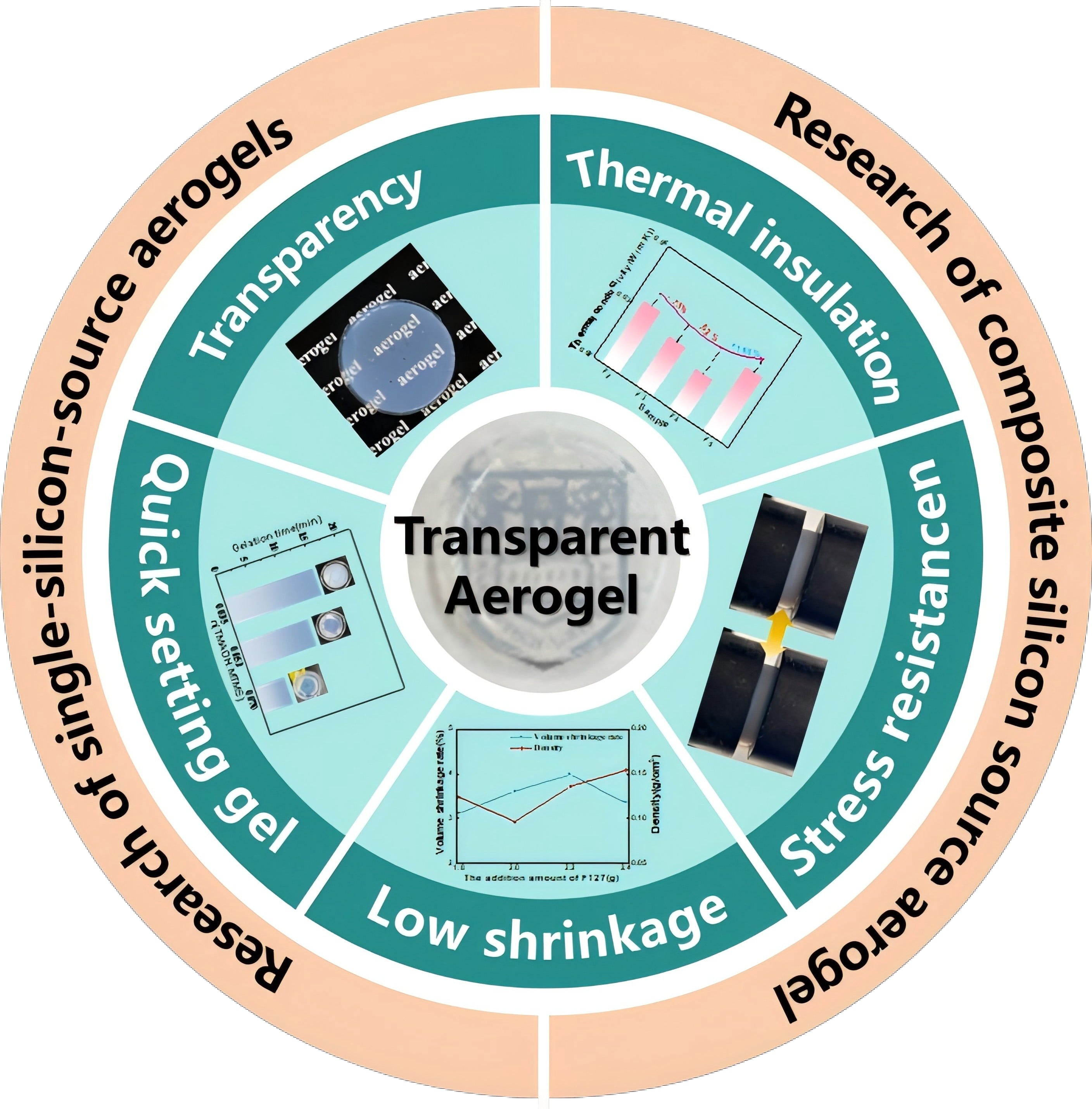
Graphical Abstract