Nature-Inspired Trojan Materials as Invisible Enablers of Advanced Humidity Sensors
 , , , , ,
Abstract
1. Introduction
2. Nature-Inspired Materials: Concepts and Mechanisms
2.1. Plant-Inspired Materials
2.2. Animal-Inspired Materials
2.3. Membrane-Inspired Systems
3. Trojan Materials: Invisible Performance Enhancers
Concept and Examples of Trojan Materials in Humidity Sensors
4. Humidity Sensing Mechanisms
5. Classes of Bioinspired Self-Sensing Materials with Trojan Materials
5.1. Conductive and Ionic Polymers
5.2. Polymer Composites
5.3. Hydrogel- and Water-Compatible Systems
5.4. Advantages and Limitations of Trojan Materials
6. Benchmark Humidity Sensors
7. Challenges and Future Directions
8. Conclusions
Author Contributions
Funding
Data Availability Statement
Conflicts of Interest
References
- Steffen, W.; Richardson, K.; Rockström, J.; Cornell, S.E.; Fetzer, I.; Bennett, E.M.; Biggs, R.; Carpenter, S.R.; de Vries, W.; de Wit, C.A.; et al. Planetary boundaries: Guiding human development on a changing planet. Science 2015, 347, 1259855–1259865. [Google Scholar] [CrossRef]
- Rockström, J.; Steffen, W.; Noone, K.; Persson, Å.; Chapin, F.; Lambin, E.; Lenton, T.; Scheffer, M.; Folke, C.; Schellnhuber, H.; et al. A safe operating space for humanity. Nature 2009, 461, 472–475. [Google Scholar] [CrossRef]
- Constantinou, C.; Christodoulou, E. On making peace with nature: Visions and challenges towards an ecological diplomacy. Rev. Int. Stud. 2024, 50, 579–599. [Google Scholar] [CrossRef]
- Won, M.; Oh, G.; Lee, H.; Kim, J.; Kim, D. Humidity Sensors Based on Cellulose Nanofiber Fabricated on a Three-Dimensional (3D) Curved Surface. Nanomaterials 2023, 13, 3005. [Google Scholar] [CrossRef]
- Khan, M.; Abbas, Y.; Abunahla, H.; Reseq, M.; Alazzam, A.; Alamoodi, N.; Mohammad, B. Biocompatible humidity sensor using paper cellulose fiber/GO matrix for human health and environment monitoring. Sens. Actuators B-Chem. 2023, 393, 134188. [Google Scholar] [CrossRef]
- Guo, H.; Lan, C.; Zhou, Z.; Sun, P.; Wei, D.; Li, C. Transparent, flexible, and stretchable WS2 based humidity sensors for electronic skin. Nanoscale 2017, 9, 6246–6253. [Google Scholar] [CrossRef]
- Lu, J.; Xu, X.; Zhang, H.; Huang, M.; Wang, Y.; Feng, Z.; Wang, Y. All-printed MXene/WS2-based flexible humidity sensor for multi-scenario applications. Sens. Actuators B-Chem. 2025, 422, 136605. [Google Scholar] [CrossRef]
- Ding, S.; Jin, X.; Wang, B.; Niu, Z.; Ma, J.; Zhao, X.; Yang, M.; Wang, C.; Shi, Q.; Li, X. Integrating Ti3C2Tx MXene Nanosheets with Thermoplastic Polyurethane Nanofibers as Wearable Humidity Sensors for Noninvasive Sleep Monitoring and Noncontact Sensing. ACS Appl. Nano Mater. 2023, 6, 11810–11821. [Google Scholar] [CrossRef]
- Zhang, Y.; Zhang, M.; Li, J.; Zhang, Y.; Liu, Z.; Yang, X.; Zhang, J.; Yang, J.; Yuan, L. Spider Silk-Based Improved Multimode Interference Structure for Humidity Sensing. IEEE Sens. J. 2020, 20, 7069–7073. [Google Scholar] [CrossRef]
- Sajid, M.; Khattak, Z.; Rahman, K.; Hassan, G.; Choi, K. Progress and future of relative humidity sensors: A review from materials perspective. Bull. Mater. Sci. 2022, 45, 238. [Google Scholar] [CrossRef]
- Yoshida, A.; Wang, Y.F.; Tachibana, S.; Hasegawa, A.; Sekine, T.; Takeda, Y.; Hong, J.; Kumaki, D.; Shiba, T.; Tokito, S. Printed, all-carbon-based flexible humidity sensor using a cellulose nanofiber/graphene nanoplatelet composite. Carbon Trends 2022, 7, 100166. [Google Scholar] [CrossRef]
- Rogers, J.; Someya, T.; Huang, Y. Materials and Mechanics for Stretchable Electronics. Science 2010, 327, 1603–1607. [Google Scholar] [CrossRef]
- Kuzubasoglu, B. Recent Studies on the Humidity Sensor: A Mini Review. ACS Appl. Electron. Mater. 2022, 4, 4797–4807. [Google Scholar] [CrossRef]
- Tan, C.; Duan, Z.; Zhang, M.; Wu, Y.; Yuan, Z.; Jiang, Y.; Tai, H. Proton conduction of polyaniline for electrochemical humidity sensor. Sens. Actuators B-Chem. 2026, 446, 138661. [Google Scholar] [CrossRef]
- Zhu, Z.; Horiuchi, T.; Kruusamäe, K.; Chang, L.; Asaka, K. The effect of ambient humidity on the electrical response of ion-migration-based polymer sensor with various cations. Smart Mater. Struct. 2016, 25, 055024. [Google Scholar] [CrossRef]
- Jia, C.; Huang, J.; Fu, L.; Xiang, Y.; Chen, Y.; Yue, H.; Zhao, Q.; Gu, W.; Wu, Y.; Zhang, J. A Novel Differential Capacitive Humidity Sensor on SIW Re-Entrant Cavity Microwave Resonators With PEDOT:PSS Film. IEEE Sens. J. 2022, 22, 6576–6585. [Google Scholar] [CrossRef]
- Tseng, S.; Chiu, L.; Hsu, S.; Kuo, C. High performance flexible and self-powered humidity sensors based on LiCl/LIPG composites. Sens. Actuators B Chem. 2025, 422, 136569. [Google Scholar] [CrossRef]
- Vincent, J.; Bogatyreva, O.; Bogatyrev, N.; Bowyer, A.; Pahl, A. Biomimetics: Its practice and theory. J. R. Soc. Interface 2006, 3, 471–482. [Google Scholar] [CrossRef]
- Liao, K.; Wang, F.; Shen, Q.; Liu, Y.; Mei, Z.; Wang, H.; Zhang, S.; Ma, S.; Wang, L. Advances in humidity sensors based on Self-Powered technology. Chem. Eng. J. 2025, 505, 159480. [Google Scholar] [CrossRef]
- Deng, M.; Li, Y.; Yang, X.; Ren, Z.; Yin, J.; Zhang, Q.; Huang, T.; Yao, Q.; Zhou, X.; Wang, L.; et al. A Leaf-Inspired Self-Powered Humidity Sensor With Enhanced Voltage Output and Rapid Response/Recovery. Adv. Funct. Mater. 2026, 36, e26115. [Google Scholar] [CrossRef]
- Vafaiee, M.; Ejehi, F.; Mohammadpour, R. CNT-PDMS foams as self-powered humidity sensors based on triboelectric nanogenerators driven by finger tapping. Sci. Rep. 2023, 13, 370–379. [Google Scholar] [CrossRef]
- Zheng, N.; Xue, J.; Jie, Y.; Cao, X.; Wang, Z.L. Wearable and humidity-resistant biomaterials-based triboelectric nanogenerator for high entropy energy harvesting and self-powered sensing. Nano Res. 2022, 15, 6213–6219. [Google Scholar] [CrossRef]
- Pasalwad, K.A.; Baby, N.; Edjenguele, A.; Sadhasivam, S.; Palanisamy, G.; Magdum, S.S.; Thangarasu, S.; Oh, T.H. Progress on polymer-based materials and composites for humidity sensor applications: From materials aspects to sensor performances. J. Mater. Chem. A 2025, 13, 23248–23311. [Google Scholar] [CrossRef]
- Liu, D.; Huyan, C.; Wang, Z.; Guo, Z.; Zhang, X.; Torun, H.; Mulvihill, D.; Xu, B.B.; Chen, F. Conductive polymer based hydrogels and their application in wearable sensors: A review. Mater. Horiz. 2023, 10, 2800–2823. [Google Scholar] [CrossRef] [PubMed]
- Aljabali, A.A.A.; Alkaraki, A.; Gammoh, O.; Qnais, E.; Alqudah, A.; Mishra, V.; Mishra, Y.; El-Tanani, M. Design, structure, and application of conductive polymer hybrid materials: A comprehensive review of classification, fabrication, and multifunctionality. RSC Adv. 2025, 15, 27493–27523. [Google Scholar] [CrossRef] [PubMed]
- Zhang, J.; Baeckens, S.; Van Damme, R.; Wanieck, K. Overlooked sources of inspiration in biomimetic research. Sci. Rep. 2025, 15, 25590. [Google Scholar] [CrossRef]
- Neinhuis, C.; Barthlott, W. Characterization and distribution of water-repellent, self-cleaning plant surfaces. Ann. Bot. 1997, 79, 667–677. [Google Scholar] [CrossRef]
- Ivanova, E.; Hasan, J.; Webb, H.; Truong, V.; Watson, G.; Watson, J.; Baulin, V.; Pogodin, S.; Wang, J.; Tobin, M.; et al. Natural Bactericidal Surfaces: Mechanical Rupture of Pseudomonas aeruginosa Cells by Cicada Wings. Small 2012, 8, 2489–2494. [Google Scholar] [CrossRef]
- Hanlon, R. Cephalopod dynamic camouflage. Curr. Biol. 2007, 17, R400–R404. [Google Scholar] [CrossRef]
- Wang, B.; Yang, W.; Sherman, V.; Meyers, M. Pangolin armor: Overlapping, structure, and mechanical properties of the keratinous scales. Acta Biomater. 2016, 41, 60–74. [Google Scholar] [CrossRef] [PubMed]
- Fratzl, P.; Weinkamer, R. Nature’s hierarchical materials. Prog. Mater. Sci. 2007, 52, 1263–1334. [Google Scholar] [CrossRef]
- Bhushan, B. Biomimetics: Lessons from nature—An overview. Philos. Trans. R. Soc. A—Math. Phys. Eng. Sci. 2009, 367, 1445–1486. [Google Scholar] [CrossRef] [PubMed]
- Wijerathne, B.; Liao, T.; Jiang, X.; Zhou, J.; Sun, Z. Plant-inspired surfaces and interfaces for sustainable technologies. Mater. Futures 2025, 4, 012301. [Google Scholar] [CrossRef]
- Reyssat, E.; Mahadevan, L. Hygromorphs: From pine cones to biomimetic bilayers. J. R. Soc. Interface 2009, 6, 951–957. [Google Scholar] [CrossRef] [PubMed]
- Li, P.; Madhaiyan, G.; Shin, Y.; Tsai, H.; Meng, H.; Horng, S.; Zan, H. Facile Fabrication of a Bio-Inspired Leaf Vein-Based Ultra-Sensitive Humidity Sensor with a Hygroscopic Polymer. Polymers 2022, 14, 5030. [Google Scholar] [CrossRef]
- Li, Z.; Xu, W.; Song, K.; Zhang, J.; Liu, Q.; El-Bahy, Z.; Melhi, S.; Qiu, H.; Amin, M.; Ye, X.; et al. Cellulose nanofibers-based composite film with broadening MXene layer spacing and rapid moisture separation for humidity sensing and humidity actuators. Int. J. Biol. Macromol. 2024, 278, 134383. [Google Scholar] [CrossRef]
- Lapshuda, V.; Koval, V.; Barbash, V.; Dusheiko, M.; Yashchenko, O.; Malyuta, S. Flexible Humidity Sensors Based on Nanocellulose. In Proceedings of the 2022 IEEE 41ST International Conference on Electronics and Nanotechnology (Elnano); IEEE: New York, NY, USA, 2022; pp. 208–212. [Google Scholar]
- Guan, X.; Hou, Z.; Wu, K.; Zhao, H.; Liu, S.; Fei, T.; Zhang, T. Flexible humidity sensor based on modified cellulose paper. Sens. Actuators B Chem. 2021, 339, 129879. [Google Scholar] [CrossRef]
- Ragazzini, I.; Castagnoli, R.; Gualandi, I.; Cassani, M.C.; Nanni, D.; Gambassi, F.; Scavetta, E.; Bernardi, E.; Ballarin, B. A resistive sensor for humidity detection based on cellulose/polyaniline. RSC Adv. 2022, 12, 28217–28226. [Google Scholar] [CrossRef]
- Devesa, S.; Benzarti, Z.; Costa, M.; Cavaleiro, D.; Faia, P.; Carvalho, S. Cellulose/TiO2 Humidity Sensor. Sensors 2025, 25, 1506. [Google Scholar] [CrossRef]
- Calvert, P. Hydrogels for Soft Machines. Adv. Mater. 2009, 21, 743–756. [Google Scholar] [CrossRef]
- Yu, J.; Feng, Y.; Sun, D.; Ren, W.; Shao, C.; Sun, R. Highly Conductive and Mechanically Robust Cellulose Nanocomposite Hydrogels with Antifreezing and Antidehydration Performances for Flexible Humidity Sensors. ACS Appl. Mater. Interfaces 2022, 14, 10886–10897. [Google Scholar] [CrossRef]
- Pan, K.; Chen, C.; Li, X.; Zhu, D.; Chen, K.; Wang, K.; Qian, X.; Dong, X.; Xu, M.; Sun, H.; et al. A bee-inspired multisensory spiking neuron with Humid-Visual fused perception for authenticity recognition. Chem. Eng. J. 2025, 512, 162479. [Google Scholar] [CrossRef]
- Parker, A.; Lawrence, C. Water capture by a desert beetle. Nature 2001, 414, 33–34. [Google Scholar] [CrossRef]
- Zhai, L.; Berg, M.; Cebeci, F.; Kim, Y.; Milwid, J.; Rubner, M.; Cohen, R. Patterned superhydrophobic surfaces:: Toward a synthetic mimic of the Namib Desert beetle. Nano Lett. 2006, 6, 1213–1217. [Google Scholar] [CrossRef] [PubMed]
- Cheng, Y.; Kuo, C.; Lian, B. Chameleon-Inspired Colorimetric Sensors for Real-Time Detections with Humidity. Micromachines 2023, 14, 2254. [Google Scholar] [CrossRef]
- Zheng, Y.; Bai, H.; Huang, Z.; Tian, X.; Nie, F.; Zhao, Y.; Zhai, J.; Jiang, L. Directional water collection on wetted spider silk. Nature 2010, 463, 640–643. [Google Scholar] [CrossRef]
- Bai, H.; Ju, J.; Sun, R.; Chen, Y.; Zheng, Y.; Jiang, L. Controlled Fabrication and Water Collection Ability of Bioinspired Artificial Spider Silks. Adv. Mater. 2011, 23, 3607–3735. [Google Scholar] [CrossRef]
- Liu, K.; Jiang, L. Bio-inspired design of multiscale structures for function integration. Nano Today 2011, 6, 155–175. [Google Scholar] [CrossRef]
- Khan, M.; Hassan, G.; Bae, J. Bio-compatible organic humidity sensor based on natural inner egg shell membrane with multilayer crosslinked fiber structure. Sci. Rep. 2019, 9, 5824. [Google Scholar] [CrossRef] [PubMed]
- Nie, D.; Zhang, S.; Zheng, Y.; Hu, X.; Chen, J.; Yan, Z.; Zhou, J.; Ma, L.; Lin, N. Surface functionalization of water transportation management yarns for bioinspired humidity sensors. Chem. Eng. J. 2026, 530, 173386. [Google Scholar] [CrossRef]
- Li, C.; Liu, J.; Peng, H.; Sui, Y.; Song, J.; Liu, Y.; Huang, W.; Chen, X.; Shen, J.; Ling, Y.; et al. A Camel Nose-Inspired Highly Durable Neuromorphic Humidity Sensor with Water Source Locating Capability. ACS Nano 2022, 16, 1511–1522. [Google Scholar] [CrossRef]
- Li, T.; Zhao, T.; Zhang, H.; Yuan, L.; Cheng, C.; Dai, J.; Xue, L.; Zhou, J.; Liu, H.; Yin, L.; et al. A skin-conformal and breathable humidity sensor for emotional mode recognition and non-contact human-machine interface. npj Flex. Electron. 2024, 8, 3. [Google Scholar] [CrossRef]
- Wang, Y.; Gong, G.; Li, H.; Liu, S.; Wang, G.; Qin, W.; Xie, J.; Li, C. Flexible MXene/bamboo cellulose aerogel membrane humidity sensor for non-contact monitoring of human health signals. Diam. Relat. Mater. 2026, 163, 113445. [Google Scholar] [CrossRef]
- Yousaf, H.; Javed, M.; Bashir, M.; Shaukat, R.; Mahmood, H. Highly Stable and Temperature-Independent Humidity Sensor Based on PEO/PVA Polymer Composite. J. Compos. Sci. 2025, 9, 85. [Google Scholar] [CrossRef]
- Li, T.; Li, L.; Sun, H.; Xu, Y.; Wang, X.; Luo, H.; Liu, Z.; Zhang, T. Porous Ionic Membrane Based Flexible Humidity Sensor and its Multifunctional Applications. Adv. Sci. 2017, 4, 1600404–1600411. [Google Scholar] [CrossRef] [PubMed]
- Peng, Y.; Swanson, J.M.J.; Kang, S.-G.; Zhou, R.; Voth, G.A. Hydrated Excess Protons Can Create Their Own Water Wires. J. Phys. Chem. B 2015, 119, 9212–9218. [Google Scholar] [CrossRef]
- Anton, N.; Jakhmola, A.; Vandamme, T.F. Trojan microparticles for drug delivery. Pharmaceutics 2012, 4, 1–25. [Google Scholar] [CrossRef]
- Wu, J.; Wang, S.; Liu, S.; Liu, F.; Zhou, F. Immunoadjuvant Nanoparticles as Trojan Horses for Enhanced Photo-Immunotherapy in the Treatment of Triple-Negative Breast Cancer. Front. Pharmacol. 2022, 13, 883428. [Google Scholar] [CrossRef] [PubMed]
- Nelson, D.; Fisher, S.; Robinson, B. The “Trojan Horse” Approach to Tumor Immunotherapy: Targeting the Tumor Microenvironment. J. Immunol. Res. 2014, 2014, 789069. [Google Scholar] [CrossRef]
- Shi, N.; Qi, X.; Xiang, B.; Zhang, Y. A survey on “Trojan Horse” peptides: Opportunities, issues and controlled entry to “Troy”. J. Control. Release 2014, 194, 53–70. [Google Scholar] [CrossRef]
- Li, X.; Cai, F.; Cao, J.; Fu, N.; Dong, Z.; Long, N.; Zhao, J.; Yao, Y. Graphene oxide/cellulose nanofiber-based capacitive humidity sensor with high sensitivity. Sens. Actuators A Phys. 2024, 368, 115064. [Google Scholar] [CrossRef]
- Kumari, P.; Kumar, A.; Yadav, A.; Gupta, G.; Gupta, G.; Shivagan, D.; Bapna, K. Chitosan-Based Highly Sensitive Viable Humidity Sensor for Human Health Monitoring. ACS Omega 2023, 8, 39511–39522. [Google Scholar] [CrossRef]
- Lin, W.; Lin, Y.; Wu, R.; Chavali, M. Gr/3D-ZnO Nanocomposites as Humidity Sensors with Enhanced Sensing Response. Polymers 2021, 13, 1623. [Google Scholar] [CrossRef]
- Liu, C.; Wang, J.; Wan, J.; Yu, C. MOF-on-MOF hybrids: Synthesis and applications. Coord. Chem. Rev. 2021, 432, 213743. [Google Scholar] [CrossRef]
- Fonseca, J.; Gong, T.; Jiao, L.; Jiang, H.-L. Metal–organic frameworks (MOFs) beyond crystallinity: Amorphous MOFs, MOF liquids and MOF glasses. J. Mater. Chem. A 2021, 9, 10562–10611. [Google Scholar] [CrossRef]
- Jung, D.; Kim, J.; Lee, G.S. Enhanced humidity-sensing response of metal oxide coated carbon nanotube. Sens. Actuators A Phys. 2015, 223, 11–17. [Google Scholar] [CrossRef]
- Zou, W.; Wu, C.; Zhao, W. Humidity-Sensing Performance of TiO2/RGO and α-Fe2O3/RGO Composites. Sensors 2025, 25, 691. [Google Scholar] [CrossRef]
- Zhang, Y.; Chen, Y.; Zhang, Y.; Cong, H.; Fu, B.; Wen, S.; Ruan, S. A novel humidity sensor based on NH2-MIL-125(Ti) metal organic framework with high responsiveness. J. Nanoparticle Res. 2013, 15, 2014. [Google Scholar] [CrossRef]
- Yin, Y.-Y.; Xing, Y.; Li, M.-W.; Li, Y.-N.; Wang, J.-N.; Li, T.; Zhang, L.-X. A 3D pillared-layer cadmium (II) metal-organic framework for chemiresistive humidity sensing with high performance. Inorg. Chem. Commun. 2018, 97, 49–55. [Google Scholar] [CrossRef]
- Zhang, J.; Sun, L.; Chen, C.; Liu, M.; Dong, W.; Guo, W.; Ruan, S. High performance humidity sensor based on metal organic framework MIL-101(Cr) nanoparticles. J. Alloys Compd. 2017, 695, 520–525. [Google Scholar] [CrossRef]
- Zhang, Y.; Fu, B.; Liu, K.; Zhang, Y.; Li, X.; Wen, S.; Chen, Y.; Ruan, S. Humidity sensing properties of FeCl3-NH2-MIL-125(Ti) composites. Sens. Actuators B Chem. 2014, 201, 281–285. [Google Scholar] [CrossRef]
- Zhang, Y.; Xiong, J.; Chen, C.; Li, Q.; Liu, J.; Zhang, Z. Regulating the dissociation of LiCl and transportation of Li ions within UiO-66-NH2 framework for humidity sensing applications with superb comprehensive performances. J. Alloys Compd. 2020, 818, 152854–152862. [Google Scholar] [CrossRef]
- Zou, J.; Zhang, K.; Zhang, Q. Giant Humidity Response Using a Chitosan-Based Protonic Conductive Sensor. IEEE Sens. J. 2016, 16, 8884–8889. [Google Scholar] [CrossRef]
- Liu, Y.; Yan, L.; Cai, H.; Zong, H.; Chen, L. A novel and ultrasensitive NH2-MIL-125/silicon nanoporous pillar array-based capacitive humidity sensor. MRS Commun. 2021, 11, 504–509. [Google Scholar] [CrossRef]
- Dhonge, B.P.; Ray, S.S.; Mwakikunga, B. Electronic to protonic conduction switching in Cu2O nanostructured porous films: The effect of humidity exposure. RSC Adv. 2017, 7, 21703–21712. [Google Scholar] [CrossRef]
- Serban, B.-C.; Dumbravescu, N.; Buiu, O.; Bumbac, M.; Dumbravescu, C.; Brezeanu, M.; Pachiu, C.; Nicolescu, C.-M.; Romanitan, C.; Brincoveanu, O. Carbon Nano-Onions–Polyvinyl Alcohol Nanocomposite for Resistive Monitoring of Relative Humidity. Sensors 2025, 25, 3047. [Google Scholar] [CrossRef]
- Wieland, M.; Dingler, C.; Merkle, R.; Maier, J.; Ludwigs, S. Humidity-Controlled Water Uptake and Conductivities in Ion and Electron Mixed Conducting Polythiophene Films. ACS Appl. Mater. Interfaces 2020, 12, 6742–6751. [Google Scholar] [CrossRef]
- Kreuer, K.-D. Proton Conductivity: Materials and Applications. Chem. Mater. 1996, 8, 610–641. [Google Scholar] [CrossRef]
- Tomczykowa, M.; Plonska-Brzezinska, M.E. Conducting Polymers, Hydrogels and Their Composites: Preparation, Properties and Bioapplications. Polymers 2019, 11, 350. [Google Scholar] [CrossRef]
- Ma, Z.; Shi, W.; Yan, K.; Pan, L.; Yu, G. Doping engineering of conductive polymer hydrogels and their application in advanced sensor technologies. Chem. Sci. 2019, 10, 6232–6244. [Google Scholar] [CrossRef]
- Onorato, J.W.; Luscombe, C.K. Morphological effects on polymeric mixed ionic/electronic conductors. Mol. Syst. Des. Eng. 2019, 4, 310–324. [Google Scholar] [CrossRef]
- Keene, S.T.; Gueskine, V.; Berggren, M.; Malliaras, G.G.; Tybrandt, K.; Zozoulenko, I. Exploiting mixed conducting polymers in organic and bioelectronic devices. Phys. Chem. Chem. Phys. 2022, 24, 19144–19163. [Google Scholar] [CrossRef]
- Jia, M.; Rolandi, M. Soft and Ion-Conducting Materials in Bioelectronics: From Conducting Polymers to Hydrogels. Adv. Healthc. Mater. 2020, 9, 1901372–1901380. [Google Scholar] [CrossRef]
- Farahani, H.; Wagiran, R.; Hamidon, M.N. Humidity Sensors Principle, Mechanism, and Fabrication Technologies: A Comprehensive Review. Sensors 2014, 14, 7881–7939. [Google Scholar] [CrossRef]
- Agmon, N. The Grotthuss mechanism. Chem. Phys. Lett. 1995, 244, 456–462. [Google Scholar] [CrossRef]
- Turetta, N.; Stoeckel, M.-A.; Furlan de Oliveira, R.; Devaux, F.; Greco, A.; Cendra, C.; Gullace, S.; Gicevičius, M.; Chattopadhyay, B.; Liu, J.; et al. High-Performance Humidity Sensing in π-Conjugated Molecular Assemblies through the Engineering of Electron/Proton Transport and Device Interfaces. J. Am. Chem. Soc. 2022, 144, 2546–2555. [Google Scholar] [CrossRef]
- Manjunatha, B.; Shetty, S.; Saquib, M.; Rao, S.; Nayak, R.; Kamath, V.; Selvakumar, M. Influence of CuO on the performance of conducting polymer matrix for screen-printed humidity sensing applications. Microchim. Acta 2026, 193, 164. [Google Scholar] [CrossRef]
- Qian, J.; Tan, R.; Feng, M.; Shen, W.; Lv, D.; Song, W. Humidity Sensing Using Polymers: A Critical Review of Current Technologies and Emerging Trends. Chemosensors 2024, 12, 230. [Google Scholar] [CrossRef]
- De Aguiar, M.; Leal, A.; De Melo, C.; Alves, K. Polypyrrole-coated electrospun polystyrene films as humidity sensors. Talanta 2021, 234, 122636. [Google Scholar] [CrossRef]
- Xiao, C.; Liu, X.; Zhao, Y.; Huang, C.; Zhou, N.; Mao, H. Flexible humidity sensors for diverse applications. Microsyst. Nanoeng. 2025, 11, 221. [Google Scholar] [CrossRef]
- Yu, Y.; Ma, Z.; Miao, X.; Cui, Y.; Song, Y.; Liu, S.; Fei, T.; Zhang, T. Humidity sensors based on cross-linked poly(ionic liquid)s for low humidity sensing. Sens. Actuators B Chem. 2024, 399, 134840. [Google Scholar] [CrossRef]
- Ravikiran, Y.T.; Chethan, B. Humidity sensing studies on conducting polymers: Polyaniline and polypyrrole. Inorg. Chem. Commun. 2022, 145, 110019. [Google Scholar] [CrossRef]
- Namsheer, K.; Rout, C. Conducting polymers: A comprehensive review on recent advances in synthesis, properties and applications. RSC Adv. 2021, 11, 5659–5697. [Google Scholar] [CrossRef]
- Morris, D.R.P.; Liu, S.P.; Villegas Gonzalez, D.; Gostick, J.T. Effect of Water Sorption on the Electronic Conductivity of Porous Polymer Electrolyte Membrane Fuel Cell Catalyst Layers. ACS Appl. Mater. Interfaces 2014, 6, 18609–18618. [Google Scholar] [CrossRef]
- Bilugali Mahadevaswamy, M.; Aradhya, R.; Jagannathan, S.R. Impact of water diffusion on electrical properties of epoxy nanocomposites. J. Adhes. Sci. Technol. 2024, 38, 1880–1894. [Google Scholar] [CrossRef]
- van der Pol, T.P.A.; Keene, S.T.; Saes, B.W.H.; Meskers, S.C.J.; Salleo, A.; van de Burgt, Y.; Janssen, R.A.J. The Mechanism of Dedoping PEDOT:PSS by Aliphatic Polyamines. J. Phys. Chem. C 2019, 123, 24328–24337. [Google Scholar] [CrossRef]
- Xie, T.; Abdul Rahman, A.F.; Abu Bakar, A.; Arsad, A. Design and Optimization of Metal Oxide-Based Humidity Sensors: A Review on Mechanisms and Material Engineering. J. Clust. Sci. 2025, 36, 148. [Google Scholar] [CrossRef]
- da Silva, E.A.; Duc, C.; Redon, N.; Wojkiewicz, J. Humidity Sensor Based on PEO/PEDOT:PSS Blends for Breath Monitoring. Macromol. Mater. Eng. 2021, 306, 2100489–2100498. [Google Scholar] [CrossRef]
- Imali, D.; Perera, E.; Kaumal, M.; Dissanayake, D. Fabrication and characterization of a flexible and disposable impedance-type humidity sensor based on polyaniline (PAni). RSC Adv. 2023, 13, 6396–6411. [Google Scholar] [CrossRef]
- Gamboa, J.; Paulo-Mirasol, S.; Estrany, F.; Torras, J. Recent Progress in Biomedical Sensors Based on Conducting Polymer Hydrogels. ACS Appl. Bio Mater. 2023, 6, 1720–1741. [Google Scholar] [CrossRef]
- Bornemann, S.; Zhou, Y.; Panambur, S.; Jedermann, R.; Lussem, B. PEDOT:PSS Films for Paper-Based Humidity and Moisture Sensing in Fiber-Reinforced Polymers. ACS Appl. Electron. Mater. 2026, 8, 2090–2098. [Google Scholar] [CrossRef]
- Grocke, G.L.; Dong, B.X.; Taggart, A.D.; Martinson, A.B.F.; Niklas, J.; Poluektov, O.G.; Strzalka, J.W.; Patel, S.N. Structure–Transport Properties Governing the Interplay in Humidity-Dependent Mixed Ionic and Electronic Conduction of Conjugated Polyelectrolytes. ACS Polym. Au 2022, 2, 275–286. [Google Scholar] [CrossRef] [PubMed]
- Yu, Y.; Zhang, W.; Song, Y.; Cui, Y.; Liu, S.; Fei, T.; Zhang, T. Application of partially zwitterionic poly(ionic liquid)s in humidity sensors. J. Colloid Interface Sci. 2025, 684, 192–200. [Google Scholar] [CrossRef]
- Panwar, V.; Mohanty, S.; Anoop, G. Agro-based micropore-structured ionic polymer sensor with enhanced ionic conduction and flexibility. Sens. Actuators A Phys. 2021, 325, 112716. [Google Scholar] [CrossRef]
- Shaikh, S.; Khanzode, P.; Bogle, K.; Narwade, V. Ultrafast, Fabric-Based Polyvinyl Alcohol-Polyaniline Humidity Sensor for Wearable and Noninvasive Health Monitoring. Adv. Eng. Mater. 2025, 27, e202501739–e202501748. [Google Scholar] [CrossRef]
- Chethan, B.; Prasad, V.; Mathew, S.; Jan, H. Polyaniline/Graphene oxide composite as an Ultra-Sensitive humidity sensor. Inorg. Chem. Commun. 2024, 166, 112633. [Google Scholar] [CrossRef]
- Dubourg, G.; Segkos, A.; Katona, J.; Radovic, M.; Savic, S.; Niarchos, G.; Tsamis, C.; Crnojevic-Bengin, V. Fabrication and Characterization of Flexible and Miniaturized Humidity Sensors Using Screen-Printed TiO2 Nanoparticles as Sensitive Layer. Sensors 2017, 17, 1854. [Google Scholar] [CrossRef]
- Anisimov, Y.; Evitts, R.; Cree, D.; Wilson, L. Polyaniline/Biopolymer Composite Systems for Humidity Sensor Applications: A Review. Polymers 2021, 13, 2722. [Google Scholar] [CrossRef] [PubMed]
- Parangusan, H.; Bhadra, J.; Ahmad, Z.; Mallick, S.; Touati, F.; Al-Thani, N. Humidity sensor based on poly(lactic acid)/PANI-ZnO composite electrospun fibers. RSC Adv. 2021, 11, 28735–28743. [Google Scholar] [CrossRef]
- Femandes, L.; Correia, D.; Pereira, N.; Tubio, C.; Lanceros-Méndez, S. Highly Sensitive Humidity Sensor Based on Ionic Liquid-Polymer Composites. ACS Appl. Polym. Mater. 2019, 1, 2723–2730. [Google Scholar] [CrossRef]
- Lee, J.; Cho, D.; Jeong, Y. A resistive-type sensor based on flexible multi-walled carbon nanotubes and polyacrylic acid composite films. Solid-State Electron. 2013, 87, 80–84. [Google Scholar] [CrossRef]
- Hou, J.; Zhu, X.; Zheng, L.; Li, W.; Gao, J.; Huang, H.; Li, Y.; Xu, M.; Wang, X. Ultrahigh-Response Humidity Sensor Arrays Based on a Graphene/Polymer Composite for Contactless Gesture Monitoring. ACS Mater. Au 2025, 5, 1061–1069. [Google Scholar] [CrossRef]
- Kim, H.; Kang, J.; Hwang, J.; Shin, U. Wearable CNTs-based humidity sensors with high sensitivity and flexibility for real-time multiple respiratory monitoring. Nano Converg. 2022, 9, 35. [Google Scholar] [CrossRef]
- Kafy, A.; Akther, A.; Shishir, M.; Kim, H.; Yun, Y.; Kim, J. Cellulose nanocrystal/graphene oxide composite film as humidity sensor. Sens. Actuators A-Phys. 2016, 247, 221–226. [Google Scholar] [CrossRef]
- Zhang, Z.; Ma, H.; Si, F.; Liu, Q.; Li, J.; Tian, L.; Ding, J.; Zhang, W.; Fan, X. Highly Sensitive Flexible Humidity Sensor Based on Bacterial Cellulose/MXene/Graphene Oxide Composite Film. ACS Appl. Electron. Mater. 2025, 7, 9946–9954. [Google Scholar] [CrossRef]
- Tulliani, J.; Inserra, B.; Ziegler, D. Carbon-Based Materials for Humidity Sensing: A Short Review. Micromachines 2019, 10, 232. [Google Scholar] [CrossRef]
- Kumar, A.; Gupta, G.; Bapna, K.; Shivagan, D. Semiconductor-metal-oxide-based nano-composites for humidity sensing applications. Mater. Res. Bull. 2023, 158, 112053. [Google Scholar] [CrossRef]
- Song, J.; Fan, M.; Zhang, R.; Qu, M.; Tang, P.; Wang, H.; Bin, Y. Highly sensitive humidity sensor based on composite film of partially reduced graphene oxide and bacterial cellulose. Biosens. Bioelectron. 2024, 257, 116296. [Google Scholar] [CrossRef] [PubMed]
- Al-Hamry, A.; Pasti, I.; Kanoun, O. Titanium Dioxide/Graphene Oxide Nanocomposite-Based Humidity Sensors with Improved Performance. J. Compos. Sci. 2025, 9, 60. [Google Scholar] [CrossRef]
- Harith, Z.; Batumalay, M.; Irawati, N.; Harun, S.; Ahmad, H. Polymer microfiber coated with ZnO for humidity sensing. J. Phys. Conf. Ser. 2019, 1151, 012019. [Google Scholar] [CrossRef]
- Karamat, S.; Alahmadi, A.; Kanwal, S.; Masud, M.; Imran, Z.; Talha, M.; Kashif, M. Enhanced humidity sensing behavior of polymer-assisted WO3/ ZnO composite. J. Mater. Res. Technol. 2025, 38, 1198–1208. [Google Scholar] [CrossRef]
- Feng, D.; Zheng, H.; Sun, H.; Li, J.; Xi, J.; Deng, L.; Guo, Y.; Jiang, B.; Zhao, J. SnO2/polyvinyl alcohol nanofibers wrapped tilted fiber grating for high-sensitive humidity sensing and fast human breath monitoring. Sens. Actuators B Chem. 2023, 388, 133807. [Google Scholar] [CrossRef]
- Hasanah, N.; Azmi, A.; Hidayatulloh, P.; Syahrul, S.; Amirullah, M.; Wiranto, G.; Rahmawati, A.; Hermida, I. Design, Fabrication, and Characterization of PVA-SnO2 based Humidity Sensor. In Proceedings of the 2022 International Conference on Radar, Antena, Microwave, Electronics, and Telecommunications (ICRAMET): Emerging Science and Industrial Innovation Electronics and Telecommunication; IEEE: New York, NY, USA, 2022; pp. 10–15. [Google Scholar]
- Zhang, H.; Zhang, H.; Jia, Z.; Chen, C.; Yang, C.; Dou, Q.; Li, X.; Ma, X.; Ding, P. Design of humidity sensor based on poly(sodium 4-styrenesulfonate) modified SnO2 for visual monitoring of plant growth environments. J. Colloid Interface Sci. 2025, 692, 137540. [Google Scholar] [CrossRef]
- Singh, P.; Kushwaha, C.; Shukla, S.; Dubey, G. Synthesis and Humidity Sensing Properties of NiO Intercalated Polyaniline Nanocomposite. Polym.-Plast. Technol. Mater. 2019, 58, 139–147. [Google Scholar] [CrossRef]
- Zhou, P.; Zhang, Z.; Mo, F.; Wang, Y. A Review of Functional Hydrogels for Flexible Chemical Sensors. Adv. Sens. Res. 2024, 3, 2300021–2300041. [Google Scholar] [CrossRef]
- Zhang, Y.; Li, X.; Wu, W.; Zhang, Y.; Jiao, T. Recent progress of hydrogels applied to intelligent window: A review. J. Environ. Chem. Eng. 2025, 13, 120414. [Google Scholar] [CrossRef]
- Luo, Y.; Li, J.; Ding, Q.; Wang, H.; Liu, C.; Wu, J. Functionalized Hydrogel-Based Wearable Gas and Humidity Sensors. Nano-Micro Lett. 2023, 15, 136. [Google Scholar] [CrossRef] [PubMed]
- Nabeel, M.; Jaber, H.; Taieh, N.; Li, Y.; Gou, G.; Kovács, T. Reliability of flexible pressure sensors under sweat, moisture, and environmental stress: Mechanisms, materials, packaging, and data-driven mitigation. Sens. Actuators A Phys. 2026, 403, 117723. [Google Scholar] [CrossRef]
- Zhang, J.; Huang, C.; Chen, Y.; Wang, H.; Gong, Z.; Chen, W.; Ge, H.; Hu, X.; Zhang, X. Polyvinyl alcohol: A high-resolution hydrogel resist for humidity-sensitive micro-/nanostructure. Nanotechnology 2020, 31, 425303–425308. [Google Scholar] [CrossRef] [PubMed]
- Afnas, V.; Unnikrishnan, G.; Budhe, S.; Manaf, O.; Ameen, J. PVA/gelatin/chitin ternary blend as a humidity sensing material. J. Mater. Sci.-Mater. Electron. 2022, 33, 2031–2043. [Google Scholar] [CrossRef]
- Hong, F.; Qiu, P.; Wang, Y.; Ren, P.; Liu, J.; Zhao, J.; Gou, D. Chitosan-based hydrogels: From preparation to applications, a review. Food Chem.-X 2024, 21, 101095. [Google Scholar] [CrossRef]
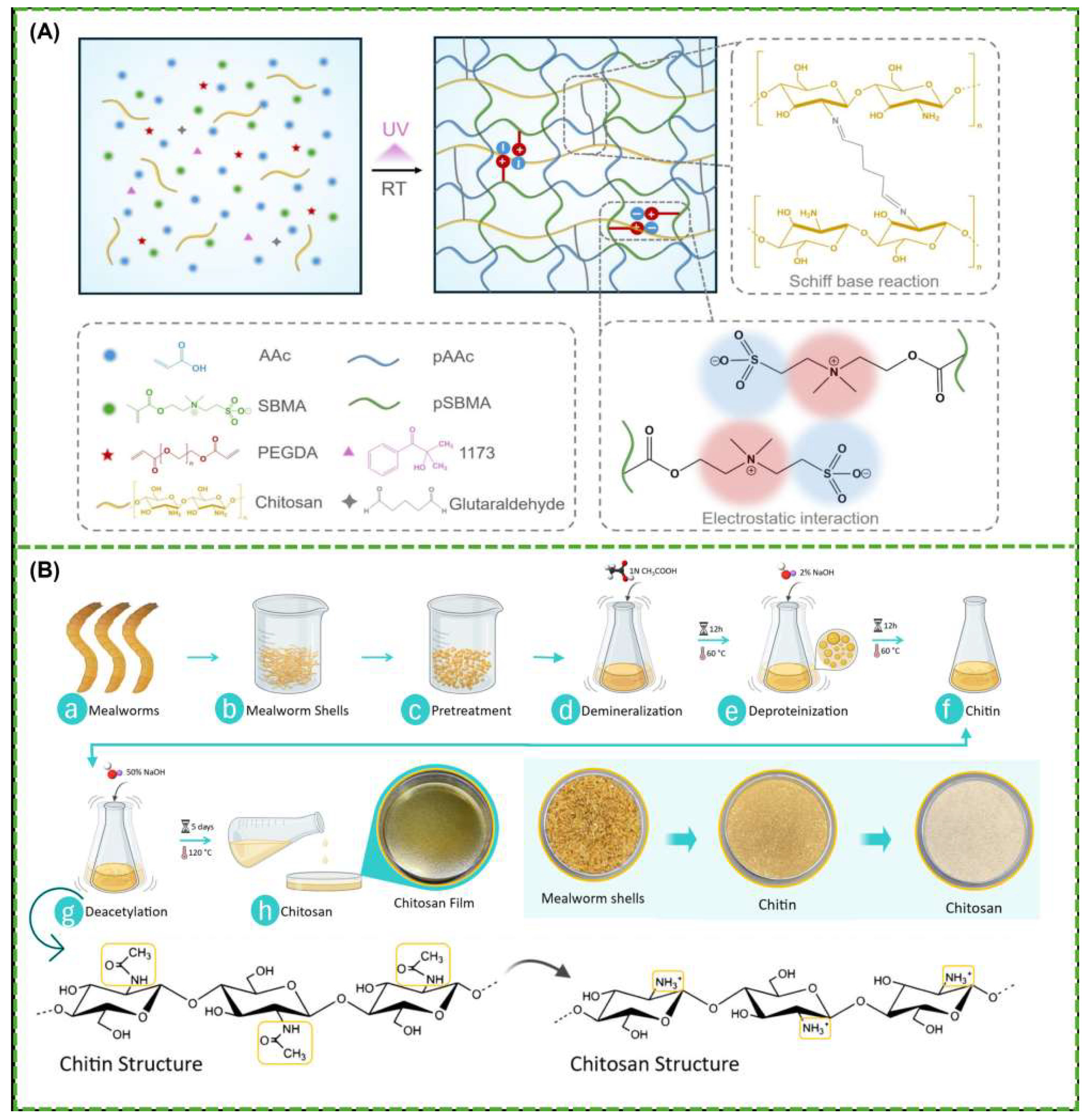
- Nettey-Oppong, E.; Muhammad, R.; Ackah, E.; Yang, H.; Ali, A.; Jeong, H.; Kim, S.; Seok, Y.; Choi, S. Development of a Sustainable Flexible Humidity Sensor Based on Tenebrio molitor Larvae Biomass-Derived Chitosan. Sensors 2025, 25, 575. [Google Scholar] [CrossRef]
- Wei, Y.; Shaukat, R.; Villaos, R.; Wu, Z.; Huang, L.; Larsson, J.; Zhang, R.; Shi, Y. Turning moisture into a benefit: Chitosan-reinforced pSBMA/pAAc hydrogel for wear-resistant, humidity-enhanced and anti-biofouling TENG. Chem. Eng. J. 2026, 531, 174308. [Google Scholar] [CrossRef]
- Huang, L.; Hu, Q.; Gao, S.; Liu, W.; Wei, X. Recent progress and applications of cellulose and its derivatives-based humidity sensors: A review. Carbohydr. Polym. 2023, 318, 121139. [Google Scholar] [CrossRef]
- Pinming, C.; Sukgorn, N.; Suhatcho, T.; Saetang, B.; Kerdkhong, P.; Maboonchuay, T.; Chalapat, K.; Siraleartmukul, K. Humidity Sensor Using Carboxymethyl Cellulose Hydrogel Membrane. In Proceedings of the 2016 13TH IInternational Conference on Electrical Engineering/Electronics Computer, Telecommunications and Information Technology (ECTI-CON); IEEE: New York, NY, USA, 2016. [Google Scholar]
- Lu, H.; Liang, H.; Liu, J.; Zhou, H.; Pi, M.; Li, M.; Yan, B.; Li, W.; Cui, W.; Ran, R. Hydrogel-based intelligent greenhouse films for simultaneous fogging prevention and indoor environmental monitoring. Chem. Eng. J. 2023, 475, 146204. [Google Scholar] [CrossRef]
- Syrovy, T.; Maronová, S.; Kubersky, P.; Ehman, N.; Vallejos, M.; Pretl, S.; Felissia, F.; Area, M.; Chinga-Carrasco, G. Wide range humidity sensors printed on biocomposite films of cellulose nanofibril and poly(ethylene glycol). J. Appl. Polym. Sci. 2019, 136, 47920–47929. [Google Scholar] [CrossRef]
- Farea, M.; Bhanuse, G.; Mohammed, H.; Farea, M.; Sallam, M.; Shirsat, S.; Tsai, M.; Shirsat, M. Ultrahigh sensitive and selective room-temperature carbon monoxide gas sensor based on polypyrrole/titanium dioxide nanocomposite. J. Alloys Compd. 2022, 917, 165397. [Google Scholar] [CrossRef]
- Ahmad, W.; Jabbar, B.; Ahmad, I.; Jan, B.; Stylianakis, M.; Kenanakis, G.; Ikram, R. Highly Sensitive Humidity Sensors Based on Polyethylene Oxide/CuO/Multi Walled Carbon Nanotubes Composite Nanofibers. Materials 2021, 14, 1037. [Google Scholar] [CrossRef] [PubMed]
- Dong, X.; Li, D.; Chen, A.; Zheng, D. Humidity Sensing in Extreme Environments: Mechanisms, Materials, Challenges, and Future Directions. Chemosensors 2026, 14, 20. [Google Scholar] [CrossRef]
- Mansoor, S.; Iqbal, S.; Popescu, S.; Kim, S.; Chung, Y.; Baek, J. Integration of smart sensors and IOT in precision agriculture: Trends, challenges and future prospectives. Front. Plant Sci. 2025, 16, 1587869. [Google Scholar] [CrossRef]
- T.T.M. Elektronik. SHT Series Humidity Sensors. TME. Available online: https://www.tme.eu/en/news/about-product/page/43548/sht-series-humidity-sensors/ (accessed on 23 April 2026).
- Bosch Sensortec. BME280 Humidity Sensor. Bosch Sensortec. Available online: https://www.bosch-sensortec.com/en/products/environmental-sensors/humidity-sensors-bme280 (accessed on 23 April 2026).
- T.T.M. Elektronik. Low Voltage Humidity Sensors. TME. Available online: https://www.tme.eu/Document/20d790489a1f59cc156466cf8838fef6/HIH-5031.pdf (accessed on 23 April 2026).
- Vaisala. HUMICAP® Humidity Sensors. 2021. Available online: https://docs.vaisala.com/ (accessed on 23 April 2026).
- Process Sensing Technologies. Humidity Probes and Sensors. Process Sensing Technologies. Available online: https://www.processsensing.com/en-us/humidity/probes-sensors/ (accessed on 23 April 2026).
- Sensirion AG. SHT35-DIS-B Digital Humidity and Temperature Sensor. Sensirion. Available online: https://pt.mouser.com/c/sensors/environmental-sensors/board-mount-humidity-sensors/ (accessed on 23 April 2026).
- Adafruit. DHT11 Basic Temperature-Humidity Sensor (Product ID 386). Available online: https://www.adafruit.com/product/386 (accessed on 23 April 2026).
- Adafruit. AM2302 (Wired DHT22) Temperature-Humidity Sensor. Available online: https://www.adafruit.com/product/385 (accessed on 23 April 2026).
- Transfer Multisort Elektronik (TME). SONOFF AM2301 Temperature and Humidity Sensor. Available online: https://www.tme.eu/en/details/sonoff-am2301/building-automation/sonoff/am2301/ (accessed on 23 April 2026).
- Sunrom Technologies. Sunrom Part#322. Available online: https://www.sunrom.com/download/322.pdf (accessed on 23 April 2026).
- Aosong Electronics. Digital Humidity and Temperature Sensor DHT22 (AM2302). Available online: https://cdn-shop.adafruit.com/datasheets/Digital+humidity+and+temperature+sensor+AM2302.pdf (accessed on 23 April 2026).
- Ghosh, S.; Yang, C.-J.; Lai, J.-Y. Hollow nanoarchitectures: Materials engineering, nanochemistry, and biomedical applications. Prog. Mater. Sci. 2026, 158, 101634. [Google Scholar] [CrossRef]
- TDK. Available online: https://product.tdk.com/en/products/sensor/sensor/humidity/index.html (accessed on 23 April 2026).
- Figaro. Available online: https://www.figaro.co.jp/en/product/docs/tgs2616-c00_technical_information%28en%29_rev01.pdf (accessed on 23 April 2026).
- Ku, C.; Chung, C. Advances in Humidity Nanosensors and Their Application: Review. Sensors 2023, 23, 2328. [Google Scholar] [CrossRef] [PubMed]
- Zhou, T.; Zhang, T. Recent Progress of Nanostructured Sensing Materials from 0D to 3D: Overview of Structure-Property-Application Relationship for Gas Sensors. Small Methods 2021, 5, 2100515–2100546. [Google Scholar] [CrossRef]
- Process Sensing Technologies. Capacitive Sensor Technology. Available online: https://www.processsensing.com/en-us/blog/capacitive-sensor-technology.htm (accessed on 23 April 2026).
- Zhang, Z.; Chen, M.; Alem, S.; Tao, Y.; Chu, T.; Xiao, G.; Ramful, C.; Griffin, R. Printed flexible capacitive humidity sensors for field application. Sens. Actuators B Chem. 2022, 359, 131620. [Google Scholar] [CrossRef]
- Texas Instruments. Sensor Accuracy with Long-Term Drift. Available online: https://www.ti.com/document-viewer/lit/html/SSZT152 (accessed on 23 April 2026).
- Tripathy, A.; Pramanik, S.; Manna, A.; Bhuyan, S.; Shah, N.; Radzi, Z.; Abu Osman, N. Design and Development for Capacitive Humidity Sensor Applications of Lead-Free Ca,Mg,Fe,Ti-Oxides-Based Electro-Ceramics with Improved Sensing Properties via Physisorption. Sensors 2016, 16, 1135. [Google Scholar] [CrossRef] [PubMed]
- Process Sensing Technologies. Humidity Sensors. Available online: https://www.processsensing.com/en-us/industrial-safety-sensors/humidity-sensors/ (accessed on 23 April 2026).
- Process Sensing Technologies. Moisture Sensing Technologies. Available online: https://www.processsensing.com/en-us/technologies/moisture-sensing-technologies/ (accessed on 23 April 2026).
- Ohmic Instruments Inc. Choosing a Humidity Sensor. Available online: https://www.ohmicinstruments.com/article-choosing-a-humidity-sensor (accessed on 23 April 2026).
- Gkoupidenis, P.; Zhang, Y.; Kleemann, H.; Ling, H.; Santoro, F.; Fabiano, S.; Salleo, A.; van de Burgt, Y. Organic mixed conductors for bioinspired electronics. Nat. Rev. Mater. 2024, 9, 134–149. [Google Scholar] [CrossRef]



| Trojan Material | Sensor Type | Mechanism of Enhancement | Key Benefits | Ref. |
|---|---|---|---|---|
| Chitosan | Resistive | Adsorption enhancer; Interfacial mediators for ionic transport | Fast adsorption and desorption rates; High sensitivity; High reproducibility; Biocompatible; Nontoxicity; Excellent reversibility; | [62,68] |
| Graphene oxide/cellulose nanofiber | Capacitive | Interfacial mediators for ionic transport Adsorption enhancer | Fast response/recovery time; Low hysteresis; High sensitivity | [61] |
| ZnO/Graphene | Resistive | Energy-barrier modulation | Fast response and recovery times; Low hysteresis; High sensitivity | [63] |
| TiO2/Graphene | Resistive | Energy-barrier modulation | High sensitivity High Stability Cost-effectiveness | [67] |
| NH2-Mil-125(Ti)/Si-NPA (MOFs composites) | Capacitive | Adsorption enhancer | High sensitivity; Low hysteresis; High reproducibility; Low response and recovery times | [69] |
| CNTs/MnO2 | Resistive | Energy-barrier modulation | High stability; High sensitivity; Fast response and recovery times; Flexible sensor | [66] |
| Theoretical Dimension | Standard Functional Filler | Dopant Modifier | Nanocomposite Reinforcement | Trojan Material (Unified Approach) |
|---|---|---|---|---|
| Adsorption Mechanism | Passive and strictly surface-bound; Limited to the exposed external surface area | Alters local chemical hydrophilicity but yields no gain in effective surface area | Acts as an inert or physical barrier; Reduces humidity diffusion pathways | Adsorption Enhancer: Creates anti-aggregation 3D templates or tailored microporous channels for active capillary condensation |
| Energy Barrier Modulation | Creates parallel conductive pathways without altering the intrinsic matrix junctions | Statically alters the electronic band structure by creating lattice defects/oxygen vacancies | Entirely neutral toward the electronic energy profile | Barrier Modulator: Dynamically regulates band bending at the heterojunction via interfacial field effects upon H2O exposure |
| Ionic Transport Kinetics | Tortuous and discontinuous charge conduction across poor particle-to-particle interfaces | Negligible contribution; Strictly focused on the host lattice’s intrinsic electronic conduction | Blocks ionic pathways, severely increasing mass transfer resistance | Interfacial Mediator: Provides continuous, hydrophilic nanostructured highways that optimize the Grotthuss mechanism in confined spaces |
| Governing Physical Law | Classical Percolation Theory | Kröger–Vink Defect Thermodynamics/Crystal Field Theory | Continuum Mechanics/Rule of Mixtures | Interfacial Field Effect; Quantum Confinement; Grotthuss Proton Diffusion |
| Impact on sensor performance | Non-linear response; Baseline drift; Premature saturation | May improve baseline conductivity but risks distorting or collapsing the active phase | Enhances structural and mechanical robustness; Passive toward signal transduction | Ultra-high sensitivity; Rapid response/recovery kinetics; Minimized hysteresis |
| Material System | Sensor Type | Components | Enhancement Mechanism | Performance Indicators | Ref. |
|---|---|---|---|---|---|
| Conductive/Ionic Systems | |||||
| PEO/PVA | Resistive | PEO/PVA polymer | PEO enhances ionic conductivity, while PVA improves water adsorption and thermal stability, enabling a temperature-independent response | RH range: 10–60% Sensitivity: High Response time: 9 s Recovery time: 16 s Hysteresis: 12.5%RH Applications: Environmental monitoring | [55] |
| Polyaniline (PANI) | Impedance | PANI | Humidity-induced protonation and hydrogen bonding in PANI increase ionic conductivity and reduce impedance | RH range: 0–97% Sensitivity: 1.1701 Ω/%RH Response time: ≈150–220 s Recovery time: ≈150 s Hysteresis: ≈2.1%RH Applications: Environmental sensing | [98] |
| PEDOT:PSS | Resistive | PEDOT:PSS | Humidity-induced PSS swelling increases PEDOT spacing, reducing charge transport and increasing resistance | RH range: 20–80% Sensitivity: ≈480% ∆R Applications: Structural health monitoring | [100] |
| PS/PPy | Resistive | PPy on electrospun PS | High-surface-area electrospun fibres with a PPy conductive coating improve water adsorption and proton conduction | RH range: 11–97% Sensitivity: ≈128.6% Response time: ≈55 s Recovery time: ≈77 s Applications: Environmental monitoring | [89] |
| PIL film | Impedance | Cross-linked PIL (ionic polymer) | Ionic groups enhance adsorption and dissociation, promoting ionic conduction | RH range: 5–35% Sensitivity: 48.0 (5–35%RH) Response time: ≈1 s Recovery time: ≈10 s Hysteresis: 0.2%RH Applications: Low humidity monitoring | [91] |
| Zwitterionic PIL film | Impedance | Zwitterionic polymers (SB-type) | Zwitterionic groups regulate adsorption/desorption, enhancing ionic conduction and fast recovery | RH range: 11–95% Sensitivity: 4862.8 Response time: ≈1 s Recovery time: ≈15 s Hysteresis: 0.6%RH Applications: Humidity sensing (fast-response systems) | [103] |
| Composite Systems | |||||
| TiO2 nanoparticles-based paste (water, propylene glycol, n-propanol, HPC, Solsperse 40000) | Resistive | TiO2 nanoparticles-based paste | Increases active sites for water adsorption and diffusion | RH range: 5–70% Response time: 40 s–3 min Recovery time: 50 s Application: environmental monitoring | [107] |
| Potato peel cellulose/TiO2 | Resistive | TiO2 nanoparticles incorporated into potato peel cellulose | Improves adsorption and conduction | Response time: almost linear in the range 0–100% Sensitivity: 241 for RH = 100% Application: low-cost humidity sensing | [40] |
| PPy/ TiO2 | Resistive | TiO2 nanoparticles and PPY | Facilitate water vapor adsorption and increases conductivity | RH range: 11 –97% Response time: 75 s Recovery time: 98 s Sensitivity: 94% | [109] |
| PLA/PANI–ZnO | Resistive | electrospun fibers | Enhances water adsorption and conductivity | RH range: 20–90% Response time: 85 s Recovery time: 120 s Hysteresis: ≈4.2% at low RH and ≈8.9% at 70% RH Application: humidity sensing | [110] |
| PMMA/ZnO | optical | PMMA microfiber coated with ZnO | The transmission of the microfiber coated with ZnO nanorods coating decreases linearly with the increase in humidity | RH range: 50–80% Sensitivity: 0.2159 dBm/% Linearity: more than 98% Resolution: 1.7 Application: humidity sensing | [111] |
| PVP/ WO3/ZnO | Resistive | electrospun fibers | Creating additional paths for charge transport increases conductivity | RH range: 11–97% Hysteresis: ≈7% Sensitivity: high Response time: 9 s Recovery time: 1 s Application: testing fruit freshness, healthcare product moisture control, and multiple industrial applications | [112] |
| PPy/CuO | Resistive | PPy/CuO nanocomposite conductive ink | Enhances surface area and porosity; creates more adsorption sites for water molecules | RH range: 22–97% Hysteresis: negligible Response time: 50 s Recovery time: 60 s Application: humidity sensing | [87] |
| PEO/CuO/MWCNTs | Capacitive | PEO/CuO/MWCNTs: 3% composite nanofibers | Increases dielectric constant and active sites | RH range: 30–90% Sensitivity: 53,837.6% Response time: 20 s Recovery time: 11 s Application: monitoring of health and medical facilities, environmental measurements, engineering instruments and remote control of various electronic devices | [113] |
| PVA/SnO2 | Resistive | Multilayer structure (alumina substrate, interdigitated silver electrodes, PVA–SnO2 layer) | Adds hydrophilic adsorption sites | RH range: 50–90% Sensitivity: 53,837.6% Response time: 167 s Recovery time: 559 s Application: humidity sensing | [114] |
| PANi/NiO | Resistive | NiO nanoparticles incorporated into PANi matrix | Increases water absorption and conductivity | RH range: 5–90 Sensitivity: 7.929 kΩ/RH Response time: 60 s Recovery time: 90 s Application: humidity sensing | [115] |
| PANi/GO | Resistive | Interdigitated electrodes + PANI–GO composite film | Provides functional groups provides high surface area; enhances water adsorption; facilitates ion transport | RH range: 7–97% Sensitivity: 93.4% Hysteresis: negligible Response time: 4 s Recovery time: 7 s Application: ultra-sensitive sensing | [106] |
| Bacterial cellulose/partially rGO | Resistive | Composite film | Promotes hydrogen-bond network for proton transport | RH range: 0–100% Hysteresis: low Response time: ≈13 s Recovery time: ≈47 s Application: human health monitoring and noncontact sensing | [116] |
| Water-borne polyurethane/hydroxyethyl cellulose/xanthan gum/glycerol/graphene | Resistive | PET substrate + Interdigitated chromium /gold electrodes + graphene polymer composite sensing film | Facilitate water adsorption | RH range: 35%, 57%, and 79% Sensitivity: ≈ 1123% Response time: 61.1 s Recovery time: 92 s Application: respiratory detection and contactless gesture monitoring | [117] |
| PM-embedded Chit/CNT | Resistive | PI substrate + Au/Ni electrode + sensing film (PM-embedded Chit/CNT) | Provides a highly conductive pathway | RH range: 30–100% Sensitivity: 56.7–111.1% Hysteresis: very low (−0.29 to 0.30% RH) Response time: 10–40 s Recovery time: 10–40 s Application: human healthcare monitoring system | [118] |
| Hydrogel Systems | |||||
| PVA/gelatin/chitin | Resistive | Ternary polymer blend | Moisture uptake enhances ionic charge transport | RH range: 11–84% Response time: 15 min | [119] |
| Chitosan/PVA | Resistive | Laminate polymer composite | Water-induced proton conduction through hydrogen-bonds | RH range: 6–97% Sensitivity: 2.43 kΩ/%RH Response time: 18.22 s Recovery time: 22.39 s Applications: environmental monitoring, smart agriculture and industrial process control | [120] |
| Chitosan-pSBMA/pAAc | Triboelectric | Interpenetrating polymer network | Materials-level approach | RH range: 28–80% Applications: marine environments | [121] |
| CMC cross-linked with epichlorohydrin | Resistive | Cross-linked polymer | Cross-linking | RH range: 53%, 75%, 84% and 93% Response time: 100 s | [122] |
| PNAGA/PAAm with glycerol and sodium chloride | Resistive | Crosslinked long-chain polymers | Enrichment with free ions and glycerol to introduce ionic conductivity | Applications: intelligent greenhouse and agricultural films | [123] |
| CNF/PEG | Impedance | Biocomposite film | Plasticizer improves ductility and flexibility of the films | RH range: 20–90% Response time: 200/265 (with PEG) s Recovery time: 1020/490 (with PEG) s Applications: packaging | [124] |
Disclaimer/Publisher’s Note: The statements, opinions and data contained in all publications are solely those of the individual author(s) and contributor(s) and not of MDPI and/or the editor(s). MDPI and/or the editor(s) disclaim responsibility for any injury to people or property resulting from any ideas, methods, instructions or products referred to in the content. |
© 2026 by the authors. Licensee MDPI, Basel, Switzerland. This article is an open access article distributed under the terms and conditions of the Creative Commons Attribution (CC BY) license.
Share and Cite
Oliveira, D.S.; Vieira, E.S.; Martins, G.V.; Costa, J.J.; Meira, R.M.; Ramos, C.A.; Campanhã, D.; Vilão, G.; Alves, J.; Santos, P.F.; et al. Nature-Inspired Trojan Materials as Invisible Enablers of Advanced Humidity Sensors. Materials 2026, 19, 2402. https://doi.org/10.3390/ma19112402
Oliveira DS, Vieira ES, Martins GV, Costa JJ, Meira RM, Ramos CA, Campanhã D, Vilão G, Alves J, Santos PF, et al. Nature-Inspired Trojan Materials as Invisible Enablers of Advanced Humidity Sensors. Materials. 2026; 19(11):2402. https://doi.org/10.3390/ma19112402
Chicago/Turabian StyleOliveira, Daniela S., Elizabeth S. Vieira, Gabriela V. Martins, Joana J. Costa, Rafaela M. Meira, Carlos A. Ramos, Daniela Campanhã, Gina Vilão, Joaquim Alves, P. Filipe Santos, and et al. 2026. "Nature-Inspired Trojan Materials as Invisible Enablers of Advanced Humidity Sensors" Materials 19, no. 11: 2402. https://doi.org/10.3390/ma19112402
APA StyleOliveira, D. S., Vieira, E. S., Martins, G. V., Costa, J. J., Meira, R. M., Ramos, C. A., Campanhã, D., Vilão, G., Alves, J., Santos, P. F., & Moreira, F. T. C. (2026). Nature-Inspired Trojan Materials as Invisible Enablers of Advanced Humidity Sensors. Materials, 19(11), 2402. https://doi.org/10.3390/ma19112402