Corrosion-Induced Crack Quantification in Reinforced Concrete with Portland and Slag-Blended Cement Under Accelerated Exposure



Abstract
1. Introduction
1.1. Mechanisms of Corrosion in Cementitious Materials
1.2. Experimental Methods for Accelerated Corrosion
1.3. Approaches for Monitoring Damage Progression; In Cement-Based Materials
1.4. Training AI Models Using Experimentally Validated Numerical Simulations
2. Research Aims, Scope and Novelty
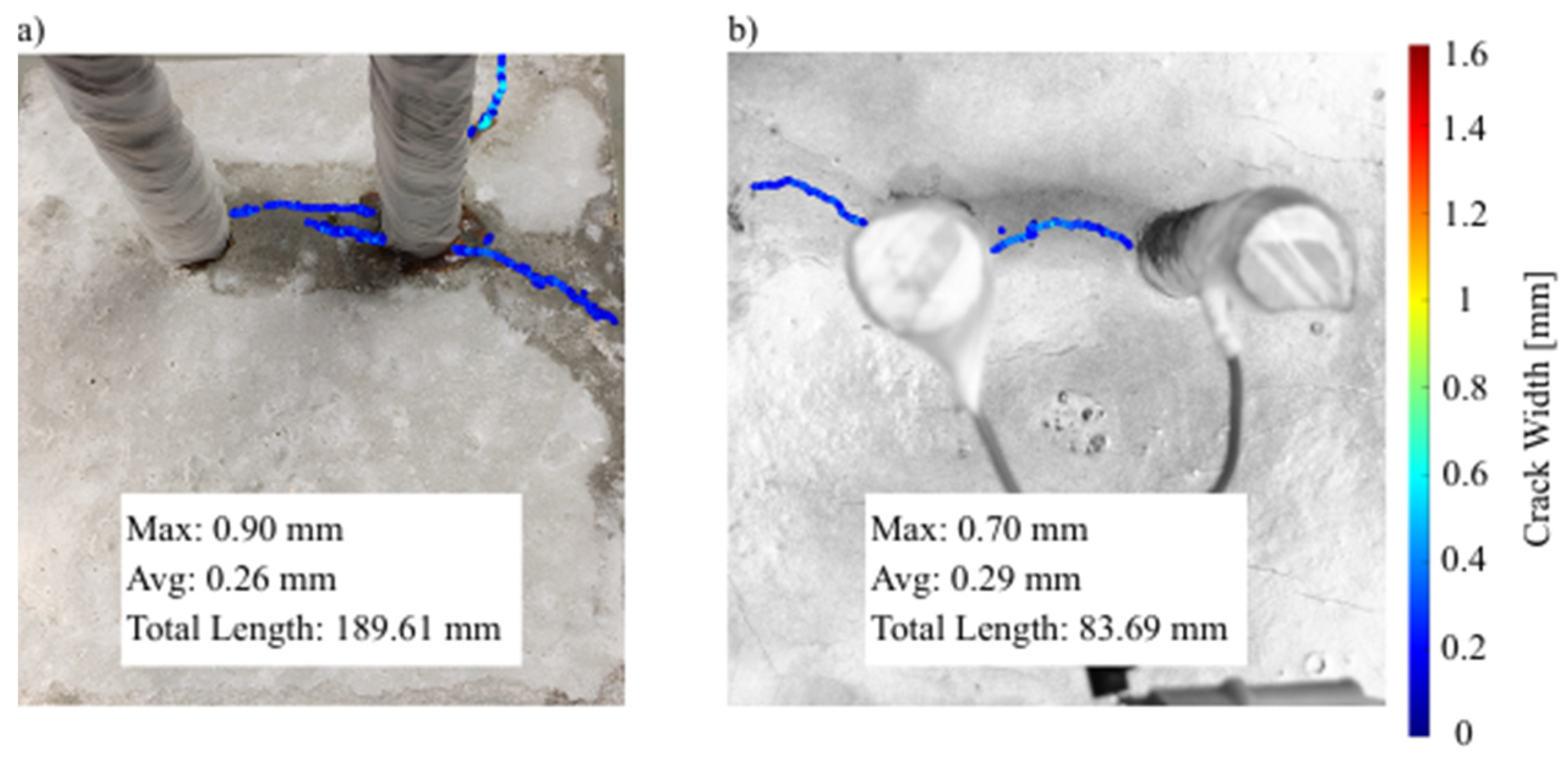
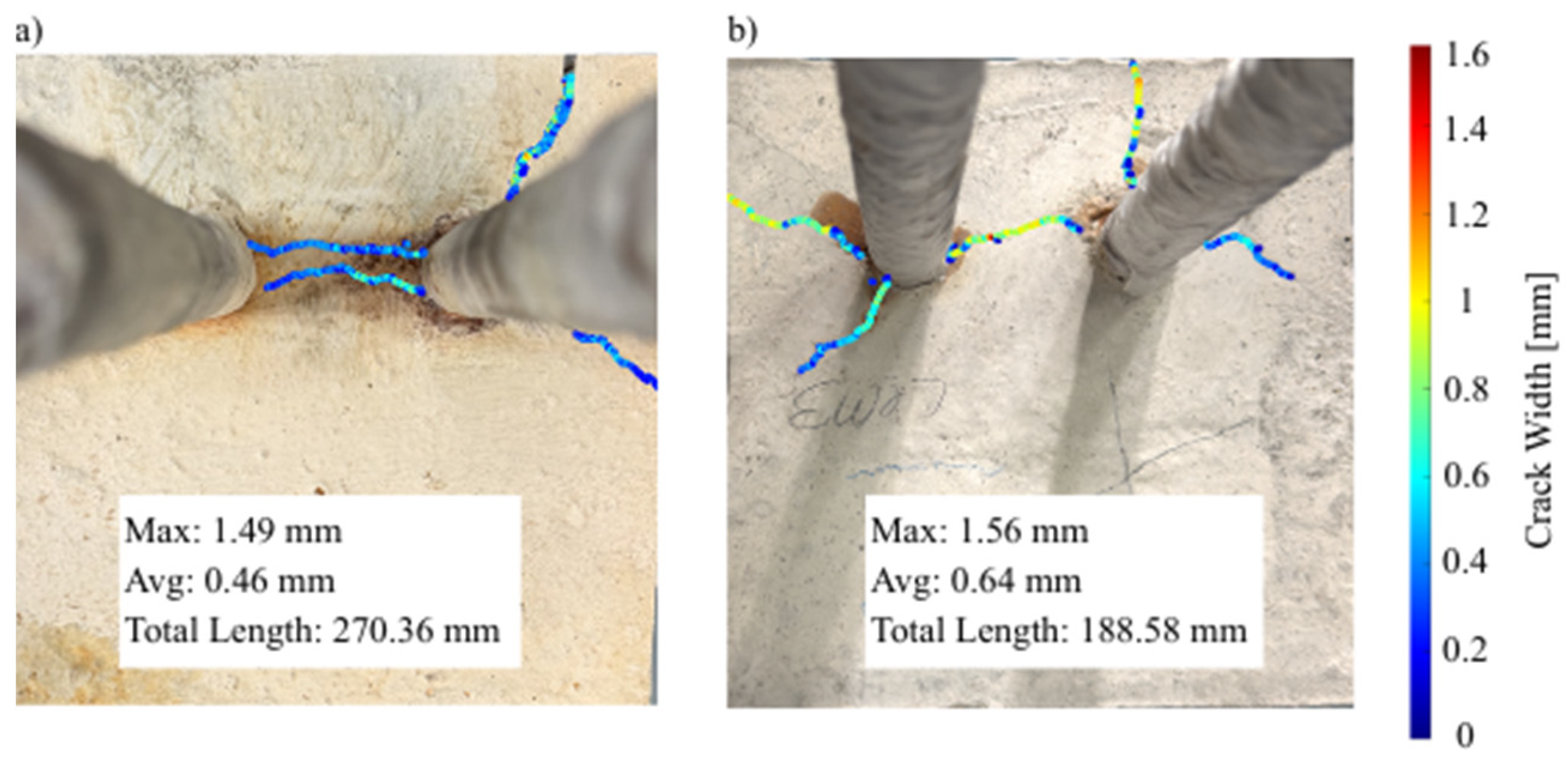
- Crack Control Mechanism of SBC: Instead of investigating durability issues only [42], we conducted quantitative tests regarding the delay time and crack propagation rate between SBC and PC when the two are subjected to equivalent electrochemical loading.
- Reference Data for Mesoscale Modeling: The necessary high-quality data (time series data on crack width, crack length, and crack density) needed to calibrate fracture simulations through 3D modeling techniques like the LDPM and FDEM were supplied, which do not yet have any integrated data validation with respect to electromechanics [41].
- Empirical Database for Driven Assessment: A highly accurate empirical foundation for training future physics-aware neural networks was developed, which requires simultaneous electrochemical and mechanical boundary conditions for modeling structural deterioration [42].
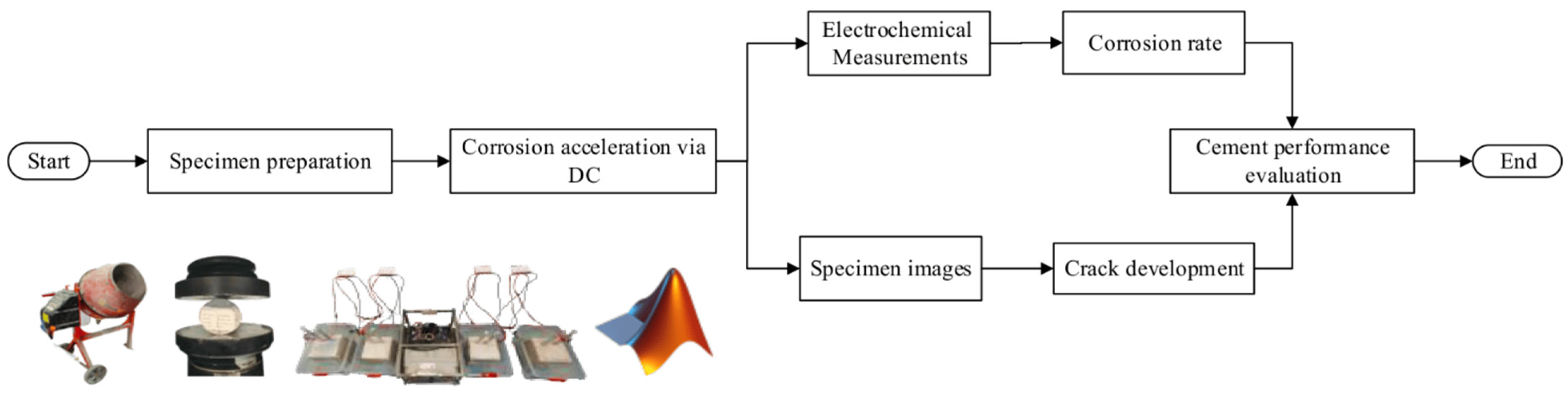
3. Research Methodology
4. Experimental Program and Procedures
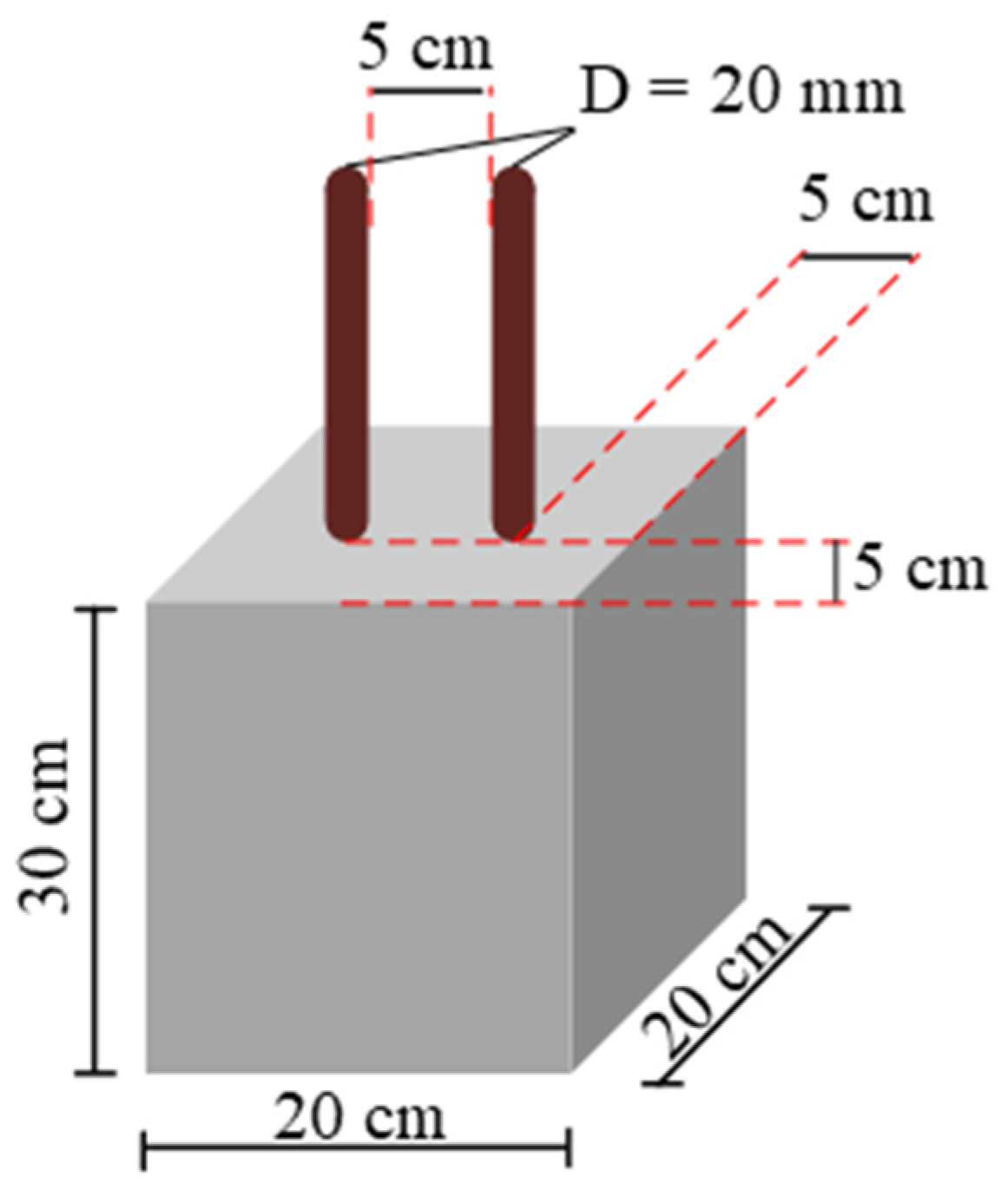
4.1. Specimen Preparation
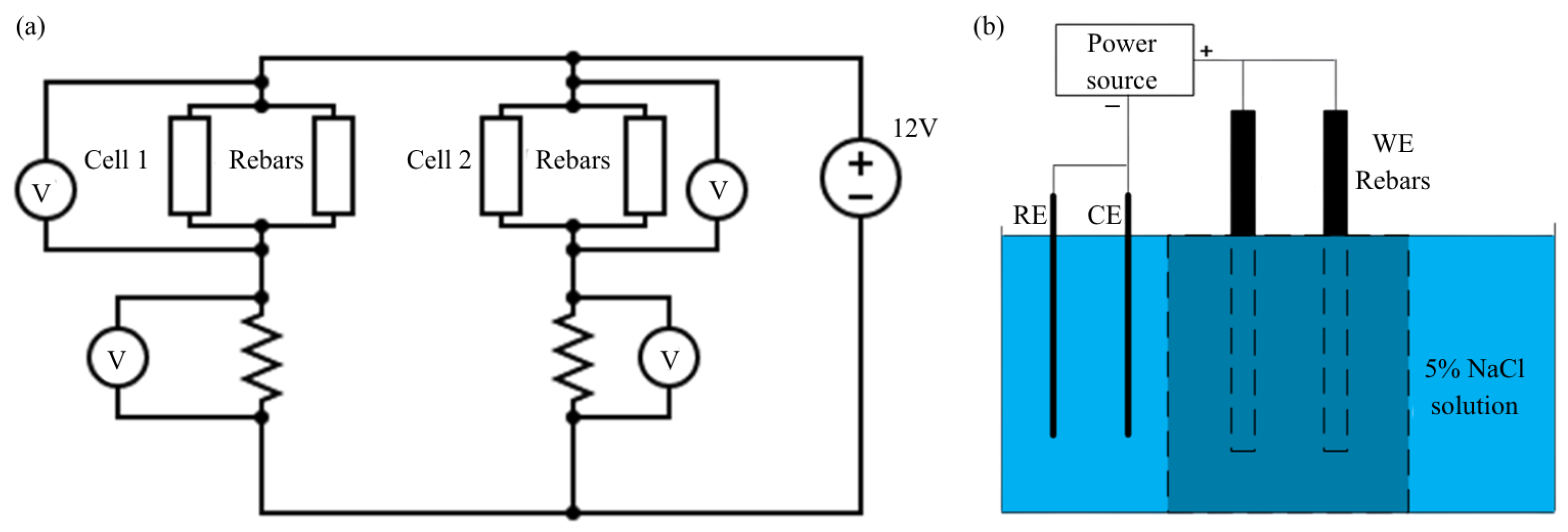
4.2. Experimental Set-Up
4.3. Quantitative Image Analysis and Crack Characterization
5. Results and Discussion
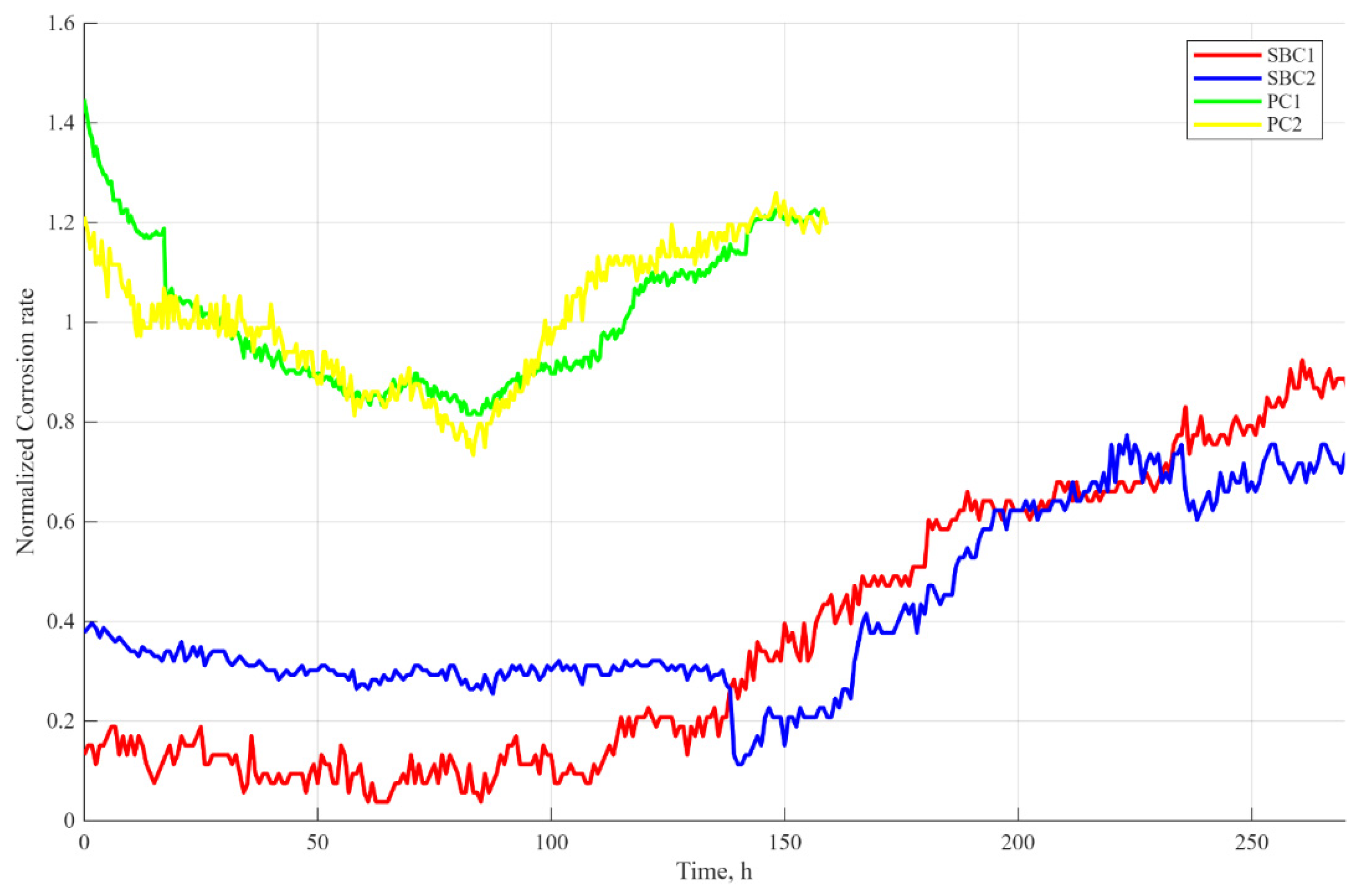
5.1. Electrochemical Corrosion Monitoring (DC Testing)
5.2. Visual Comparison of Crack Propagation at Identical Corrosion Exposure
5.3. Validation of the Experimental Results
6. Conclusions
7. Future Work
Author Contributions
Funding
Institutional Review Board Statement
Informed Consent Statement
Data Availability Statement
Acknowledgments
Conflicts of Interest
Abbreviations
| PC | Portland Cement |
| SBC | Slag-Blended Cement |
| DC | Direct Current |
| RC | Reinforced Concrete |
| LDPM | Lattice Discrete Particle Method |
| FDEM | Finite Discrete Element Method |
| DIC | Digital Image Correlation |
| GGBS | Ground Granulated Blast-furnace Slag |
| C–S–H | Calcium Silicate Hydrate |
| C3A | Tri-Calcium Aluminate |
| AFm | Aluminate Ferrite mono-substituent |
| ITZ | Interfacial Transition Zone |
| CH | Calcium Hydroxide |
| MATLAB | Matrix Laboratory |
| NDE | Nondestructive Evaluation |
| AE | Acoustic Emission |
| IE | Impact-Echo |
| PINN | Physics-Informed Neural Network |
| AI | Artificial Intelligence |
| WE | Working Electrode |
| CE | Counter Electrode |
| RGB | Red, Green and Blue |
| UCS | Unconfined Compressive Strength |
| BD | Brazilian Disc |
| MPa | MegaPascal |
| mm | millimeter |
| µA/cm2 | MicroAmperes per square centimeter |
References
- Nie, Q.; Zhou, C.; Shu, X.; He, Q.; Huang, B. Chemical, Mechanical, and Durability Properties of Concrete with Local Mineral Admixtures under Sulfate Environment in Northwest China. Materials 2014, 7, 3772. [Google Scholar] [CrossRef] [PubMed]
- Wan, L.S.; Hirata, M.; Oyamoto, T.; Kanda, T.; Tan, K.H. Synergistic Impact of Temperature and Pore Saturation on Corrosion in Carbonated Reinforced Concrete. Case Stud. Constr. Mater. 2025, 22, e04364. [Google Scholar] [CrossRef]
- Fujiwara, K.; Tani, J.; Hironaga, M. Prediction of Corrosion Products of Iron at a Low-Level Radioactive Waste Disposal Facility in Japan. Mater. Corros. 2021, 72, 235–244. [Google Scholar] [CrossRef]
- Alhede, A.; Dijkstra, J.; Tengattini, A.; Lundgren, K. Characterisation of Steel Corrosion and Matrix Damage in Reinforced Mortar Combining Analytical, Electrical and Image-Based Techniques. Cem. Concr. Res. 2025, 190, 107792. [Google Scholar] [CrossRef]
- Bastidas, D.M.; Ress, J.; Martin, U.; Bosch, J.; La Iglesia, A.; Bastidas, J.M. Crystallization Pressure and Volume Variation during Rust Development in Marine and Urban-Continental Environments: Critical Factors Influencing Exfoliation. Rev. Metal. 2020, 56, 164. [Google Scholar] [CrossRef]
- Sánchez Montero, J.; Saura Gómez, P.; Torres Martín, J.E.; Chinchón-Payá, S.; Rebolledo Ramos, N. Variation of Corrosion Rate, Vcorr, during the Carbonation-Induced Corrosion Propagation Period in Reinforced Concrete Elements. Materials 2024, 17, 101. [Google Scholar] [CrossRef]
- Šavija, B.; Luković, M.; Pacheco, J.; Schlangen, E. Cracking of the Concrete Cover Due to Reinforcement Corrosion: A Two-Dimensional Lattice Model Study. Constr. Build. Mater. 2013, 44, 626–638. [Google Scholar] [CrossRef]
- Lu, C.H.; Liu, R.G.; Jin, W.L. A Model for Predicting Time to Corrosion-Induced Cover Cracking in Reinforced Concrete Structures. In Proceedings of the Fracture Mechanics of Concrete and Concrete Structures—Assessment, Durability, Monitoring and Retrofitting of Concrete Structures, Jeju, Republic of Korea, 23–28 May 2010. [Google Scholar]
- Šavija, B.; Schlangen, E. Chloride Ingress in Cracked Concrete- a Literature Review. RILEM Bookseries 2012, 3, 133–142. [Google Scholar]
- Richardson, J.M.; Biernacki, J.J.; Stutzman, P.E.; Bentz, D.P. Stoichiometry of Slag Hydration with Calcium Hydroxide. J. Am. Ceram. Soc. 2002, 85, 947–953. [Google Scholar] [CrossRef]
- He, P.; Liu, L.; Yu, J. Experimental Study on Chloride Transport of Blast-Furnace Slag Blended Concrete with Crystalline Admixture under Seawater Wet Dry Cycle. Case Stud. Constr. Mater. 2025, 22, e04880. [Google Scholar] [CrossRef]
- Roy, D.M. Hydration, Microstructure, and Chloride Diffusion of Slag-Cement Pastes and Mortars; American Concrete Institute: Farmington Hills, MI, USA, 1989; Volume SP-114. [Google Scholar]
- Suryavanshi, A.K.; Scantlebury, J.D.; Lyon, S.B. Mechanism of Friedel’s Salt Formation in Cements Rich in Tri-Calcium Aluminate. Cem. Concr. Res. 1996, 26, 717–727. [Google Scholar] [CrossRef]
- Duraman, S.B.; Richardson, I.G. Microstructure & Properties of Steel-Reinforced Concrete Incorporating Portland Cement and Ground Granulated Blast Furnace Slag Hydrated at 20 °C. Cem. Concr. Res. 2020, 137, 106193. [Google Scholar] [CrossRef]
- Andrade, C.; Alonso, C.; Molina, F.J. Cover Cracking as a Function of Bar Corrosion: Part I-Experimental Test. Mater. Struct. 1993, 26, 453–464. [Google Scholar] [CrossRef]
- Yalciner, H.; Kumbasaroglu, A. Experimental Study to Predict Bond-Slip Behavior of Corroded Reinforced Concrete Columns. ACI Struct. J. 2022, 119, 51734795. [Google Scholar] [CrossRef]
- Peng, H.; Avadh, K.; Nagai, K. Analysis of Non-Uniform Local Strain in Corroded Reinforcing Bar in Concrete Using Digital Image Correlation. J. Adv. Concr. Technol. 2023, 21, 42–57. [Google Scholar] [CrossRef]
- Hassan, A.H.; El-Nemr, A.; Goebel, L.; Krueger, M.; Koenke, C. Bond Behavior of Steel Reinforcement in Alkali-Activated Slag Concrete Exposed to Ambient and Elevated Temperatures. Case Stud. Constr. Mater. 2025, 23, e05559. [Google Scholar] [CrossRef]
- Shah, A.A.; Ribakov, Y.; Zhang, C. Efficiency and Sensitivity of Linear and Non-Linear Ultrasonics to Identifying Micro and Macro-Scale Defects in Concrete. Mater. Des. 2013, 50, 905–916. [Google Scholar] [CrossRef]
- Shah, A.A.; Ribakov, Y. Effectiveness of Nonlinear Ultrasonic and Acoustic Emission Evaluation of Concrete with Distributed Damages. Mater. Des. 2010, 31, 3777–3784. [Google Scholar] [CrossRef]
- Cheng, C.C.; Sansalone, M. Effects on Impact-Echo Signals Caused by Steel Reinforcing Bars and Voids around Bars. ACI Mater. J. 1993, 90, 421–434. [Google Scholar] [CrossRef]
- Shalabi, A.F.; Baghabra Al-Amoudi, O.S.; Al-Osta, M.A.; Wudil, Y.S.; Gondal, M.A.; Ahmad, S.; Al-Dulaijan, S.U.; Ibrahim, M.; Al-Nahari, E. Investigating Chloride-Induced Corrosion in Reinforced Concrete Structures Using Laser-Induced Breakdown Spectroscopy. Case Stud. Constr. Mater. 2024, 21, e03981. [Google Scholar] [CrossRef]
- Gartner, N.; Hren, M.; Kosec, T.; Legat, A. Characterization of Steel Corrosion in Alkali-Activated Mortars Using Advanced Techniques. Case Stud. Constr. Mater. 2025, 23, e05165. [Google Scholar] [CrossRef]
- Cheng, C.C.; Lin, Y.C.; Yu, C.P.; Hsu, K.T. A Quick Method to Construct 3-D Velocity Contour Map for Assessing Anomalies in Concrete. Constr. Build. Mater. 2021, 285, 122765. [Google Scholar] [CrossRef]
- Li, Z.; Jin, Z.; Gao, Y.; Zhao, T.; Wang, P.; Li, Z. Coupled Application of Innovative Electromagnetic Sensors and Digital Image Correlation Technique to Monitor Corrosion Process of Reinforced Bars in Concrete. Cem. Concr. Compos. 2020, 113, 103730. [Google Scholar] [CrossRef]
- López-Pérez, G.; Pérez-Bernal, J.L.; Flores-Alés, V.; Martín-del-Río, J.J.; Borreguero, M.; Alducin-Ochoa, J.M. Application of Digital Image Processing to Mortar Crack Analysis. Bol. Soc. Esp. Ceram. Vidr. 2024, 63, 216–221. [Google Scholar] [CrossRef]
- De Maio, U.; Garro, A.; Greco, F.; Pranno, A.; Silvestri, A. Vibration-Based Damage Identification in Concrete Beams via a Decomposed Deep Learning Approach. Prog. Eng. Sci. 2026, 2026, 100280. [Google Scholar] [CrossRef]
- Kabele, P. Multiscale Framework for Modeling of Fracture in High Performance Fiber Reinforced Cementitious Composites. Eng. Fract. Mech. 2007, 74, 194–209. [Google Scholar] [CrossRef]
- Bažant, Z.P.; Tabbara, M.R.; Kazemi, M.T.; Pijaudier-Cabot, G. Random Particle Model for Fracture of Aggregate or Fiber Composites. J. Eng. Mech. 1990, 116, 1686–1705. [Google Scholar] [CrossRef]
- Lilliu, G.; van Mier, J.G.M. 3D Lattice Type Fracture Model for Concrete. Eng. Fract. Mech. 2003, 70, 927–941. [Google Scholar] [CrossRef]
- Schauffert, E.A.; Cusatis, G.; Pelessone, D.; O’Daniel, L.; Baylot, J.T. Lattice Discrete Particle Model for Fiber-Reinforced Concrete. II: Tensile Fracture and Multiaxial Loading Behavior. J. Eng. Mech. 2012, 138, 834–841. [Google Scholar] [CrossRef]
- Sherzer, G.; Gao, P.; Schlangen, E.; Ye, G.; Gal, E. Upscaling Cement Paste Microstructure to Obtain the Fracture, Shear, and Elastic Concrete Mechanical LDPM Parameters. Materials 2017, 10, 242. [Google Scholar] [CrossRef]
- Tatone, B.S.A.; Grasselli, G. A Calibration Procedure for Two-Dimensional Laboratory-Scale Hybrid Finite-Discrete Element Simulations. Int. J. Rock Mech. Min. Sci. 2015, 75, 56–72. [Google Scholar] [CrossRef]
- Mahabadi, O.K.; Randall, N.X.; Zong, Z.; Grasselli, G. A Novel Approach for Micro-Scale Characterization and Modeling of Geomaterials Incorporating Actual Material Heterogeneity. Geophys. Res. Lett. 2012, 39, 1–6. [Google Scholar] [CrossRef]
- Sherzer, G.L.; Alghalandis, Y.F.; Peterson, K.; Shah, S. Comparative Study of Scale Effect in Concrete Fracturing via Lattice Discrete Particle and Finite Discrete Element Models. Eng. Fail. Anal. 2022, 135, 106062. [Google Scholar] [CrossRef]
- Chakurkar, P.S.; Vora, D.; Patil, S.; Mishra, S.; Kotecha, K. Data-Driven Approach for AI-Based Crack Detection: Techniques, Challenges, and Future Scope. Front. Sustain. Cities 2023, 5, 1253627. [Google Scholar] [CrossRef]
- Haghighat, E.; Juanes, R. SciANN: A Keras/TensorFlow Wrapper for Scientific Computations and Physics-Informed Deep Learning Using Artificial Neural Networks. Comput. Methods Appl. Mech. Eng. 2021, 373, 113552. [Google Scholar] [CrossRef]
- Yang, Y.; Zhou, C.; Peng, J. Prediction of Flexural Capacity of Corroded Reinforced Concrete Beams by Physics-Informed Neural Network. Case Stud. Constr. Mater. 2025, 23, e05475. [Google Scholar] [CrossRef]
- Korec, E.; Jirásek, M.; Wong, H.S.; Martínez-Pañeda, E. Unravelling the Interplay between Steel Rebar Corrosion Rate and Corrosion-Induced Cracking of Reinforced Concrete. Cem. Concr. Res. 2024, 186, 107647. [Google Scholar] [CrossRef]
- Sahin, T.; Wolff, D.; Von Danwitz, M.; Popp, A. Towards a Hybrid Digital Twin: Fusing Sensor Information and Physics in Surrogate Modeling of a Reinforced Concrete Beam. In Proceedings of the 2024 Sensor Data Fusion: Trends, Solutions, Applications (SDF 2024), Bonn, Germany, 25–27 November 2024. [Google Scholar]
- Castorena-González, J.H.; Martin, U.; Gaona-Tiburcio, C.; Núñez-Jáquez, R.E.; Almeraya-Calderón, F.M.; Bastidas, J.M.; Bastidas, D.M. Modeling Steel Corrosion Failure in Reinforced Concrete by Cover Crack Width 3D FEM Analysis. Front. Mater. 2020, 7, 41. [Google Scholar] [CrossRef]
- Lv, X.; Yang, L.; Li, J.; Wang, F. Roles of Fly Ash, Granulated Blast-Furnace Slag, and Silica Fume in Long-Term Resistance to External Sulfate Attacks at Atmospheric Temperature. Cem. Concr. Compos. 2022, 133, 104696. [Google Scholar] [CrossRef]
- Praveenkumar, N.; Rao, N.M.; Moodley, M.K.; Sherzer, G.L.; Madhuri, K.V.; Bhattacharyya, A.; Babu, A.; Subbaiah, G.C.V.; Chebrolu, L.R.; Gayatri, B.S.S.S. Structural, Optical, and Photoluminescence Properties of Cadmium-Doped Zinc Phosphide Nanoparticles Synthesized by Solid-State Reaction. J. Electron. Mater. 2026, 55, 3034–3044. [Google Scholar] [CrossRef]



| Test Type | Day | PC | SBC |
|---|---|---|---|
| Compressive | 7 | 43.7 | 33.3 |
| Compressive | 28 | 55.3 | 51.9 |
| Compressive | 65 | 60.7 | 60.0 |
| Tensile | 65 | 4.3 | 4.5 |
Disclaimer/Publisher’s Note: The statements, opinions and data contained in all publications are solely those of the individual author(s) and contributor(s) and not of MDPI and/or the editor(s). MDPI and/or the editor(s) disclaim responsibility for any injury to people or property resulting from any ideas, methods, instructions or products referred to in the content. |
© 2026 by the authors. Licensee MDPI, Basel, Switzerland. This article is an open access article distributed under the terms and conditions of the Creative Commons Attribution (CC BY) license.
Share and Cite
Krauze, B.; Ribakov, Y.; Lifshitz Sherzer, G. Corrosion-Induced Crack Quantification in Reinforced Concrete with Portland and Slag-Blended Cement Under Accelerated Exposure. Materials 2026, 19, 2278. https://doi.org/10.3390/ma19112278
Krauze B, Ribakov Y, Lifshitz Sherzer G. Corrosion-Induced Crack Quantification in Reinforced Concrete with Portland and Slag-Blended Cement Under Accelerated Exposure. Materials. 2026; 19(11):2278. https://doi.org/10.3390/ma19112278
Chicago/Turabian StyleKrauze, Bar, Yuri Ribakov, and Gili Lifshitz Sherzer. 2026. "Corrosion-Induced Crack Quantification in Reinforced Concrete with Portland and Slag-Blended Cement Under Accelerated Exposure" Materials 19, no. 11: 2278. https://doi.org/10.3390/ma19112278
APA StyleKrauze, B., Ribakov, Y., & Lifshitz Sherzer, G. (2026). Corrosion-Induced Crack Quantification in Reinforced Concrete with Portland and Slag-Blended Cement Under Accelerated Exposure. Materials, 19(11), 2278. https://doi.org/10.3390/ma19112278