The Effect of Heat Treatment on the Microstructure and Mechanical Properties of P91 Steel for High-Temperature Applications


 , and
, and
Abstract
1. Introduction
2. Materials and Methods
3. Results and Discussion
3.1. Mechanical Properties
3.2. Fractographic Test Results
3.3. Microstructural Evolution
4. Conclusions
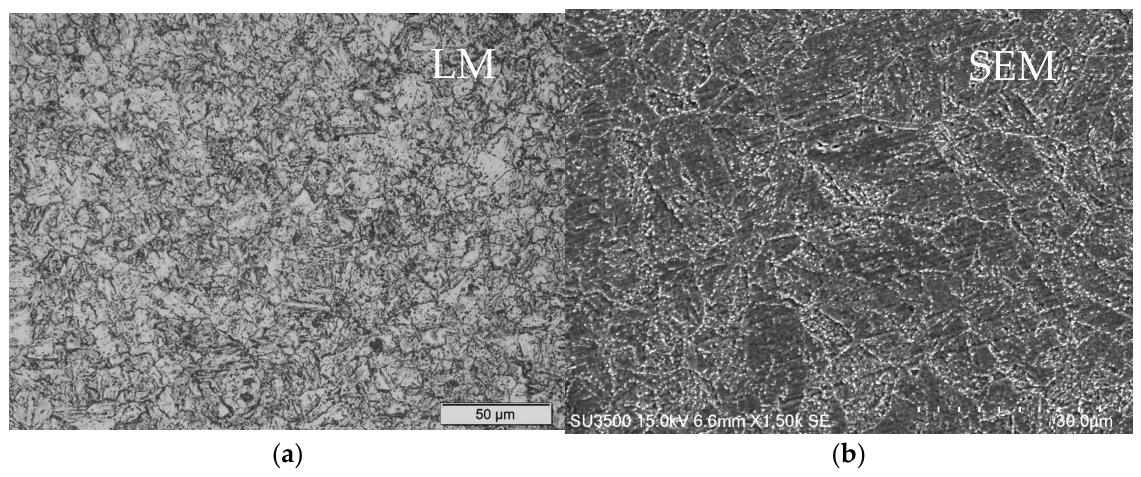
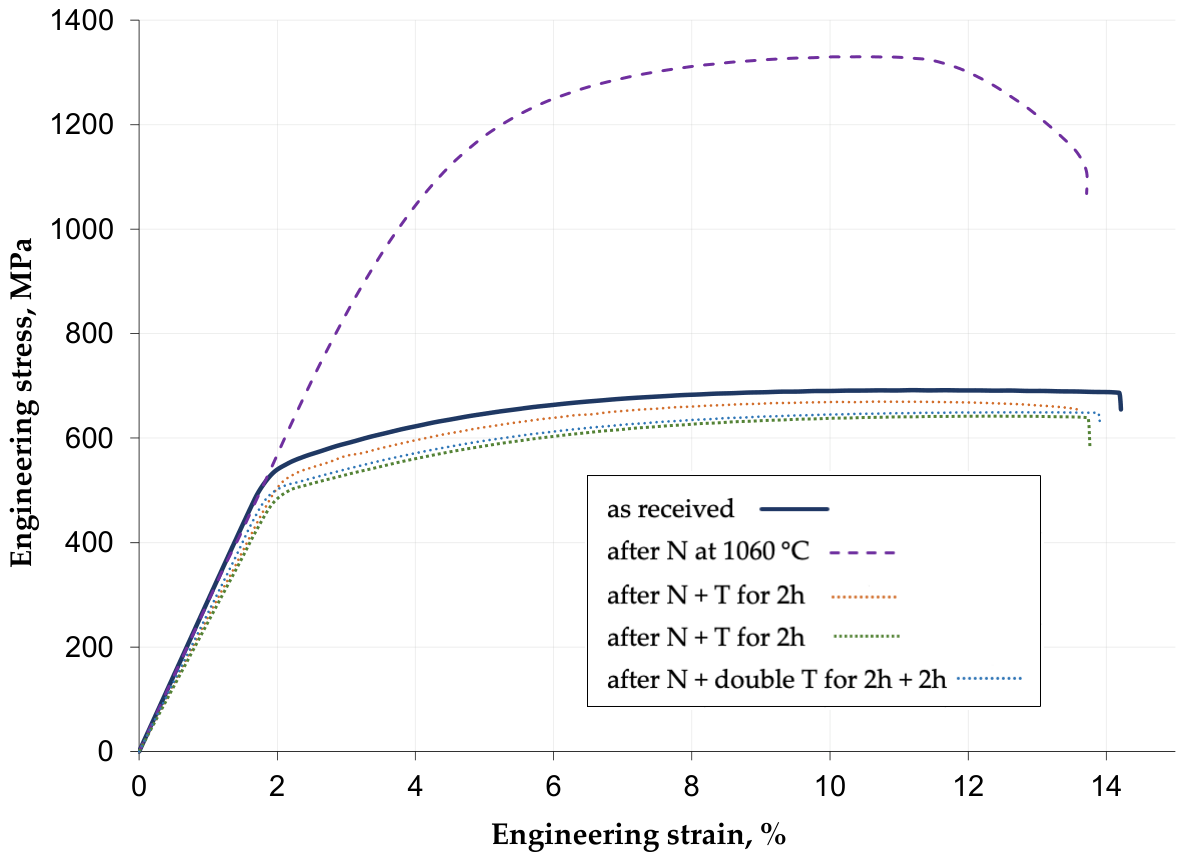
- P91 steel (X10CrWMoVNb9-1) in the post-operation condition exhibits strength properties similar to those of the material in the as-received condition (before operation), according to the manufacturer’s certificate, i.e., Rm = 692 MPa, R0.2 = 543 MPa. A noticeable decrease in ductility in the post-operation material (A = 11.9%) compared to the total elongation value of the material in the as-received condition (according to the manufacturer’s certificate, A = 23%) is characteristic of the material when exposed to long-term operation at elevated temperatures.
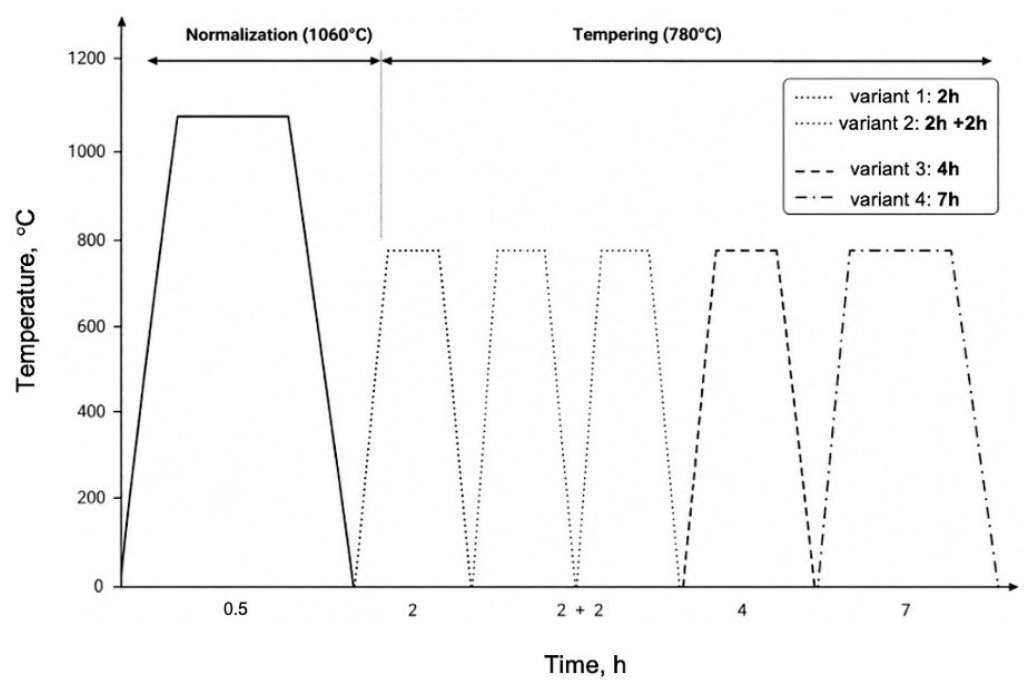
- Normalization at 1060 °C for 30 min with air cooling led to an almost twofold increase in tensile strength (Rm = 1330 MPa) and a significant increase in yield strength (Rp0.2 = 992 MPa), with a simultaneous further decrease in plasticity (A = 9.9%), which indicated the formation of a hard and brittle microstructure.
- The use of a high-temperature tempering (780 °C) contributed to a reduction in tensile strength (Rm = 649 MPa after a tempering time of 7 h), while maintaining useful ductility (A = 11.5%). This suggests the effectiveness of the tempering process in reducing stresses and stabilizing the tempered martensitic microstructure.
- A balanced combination of tensile strength (UTS = 631–670 MPa), yield strength (YS = 491–537 MPa), elongation (EL = 11.0–11.6%), and hardness (239–265 HV0.5) was obtained for samples tempered for 2–4 h and after double tempering. These tempering conditions resulted in comparable mechanical responses and tempered martensitic microstructures characterized by relatively uniform precipitate distribution, associated with a balanced strength–ductility relationship after heat treatment.
- The hardness of the samples correlated with the tensile test results: the highest hardness (433 HV0.5) was obtained after normalization, while tempering led to a significant reduction in hardness (to the range of 239–303 HV0.5).
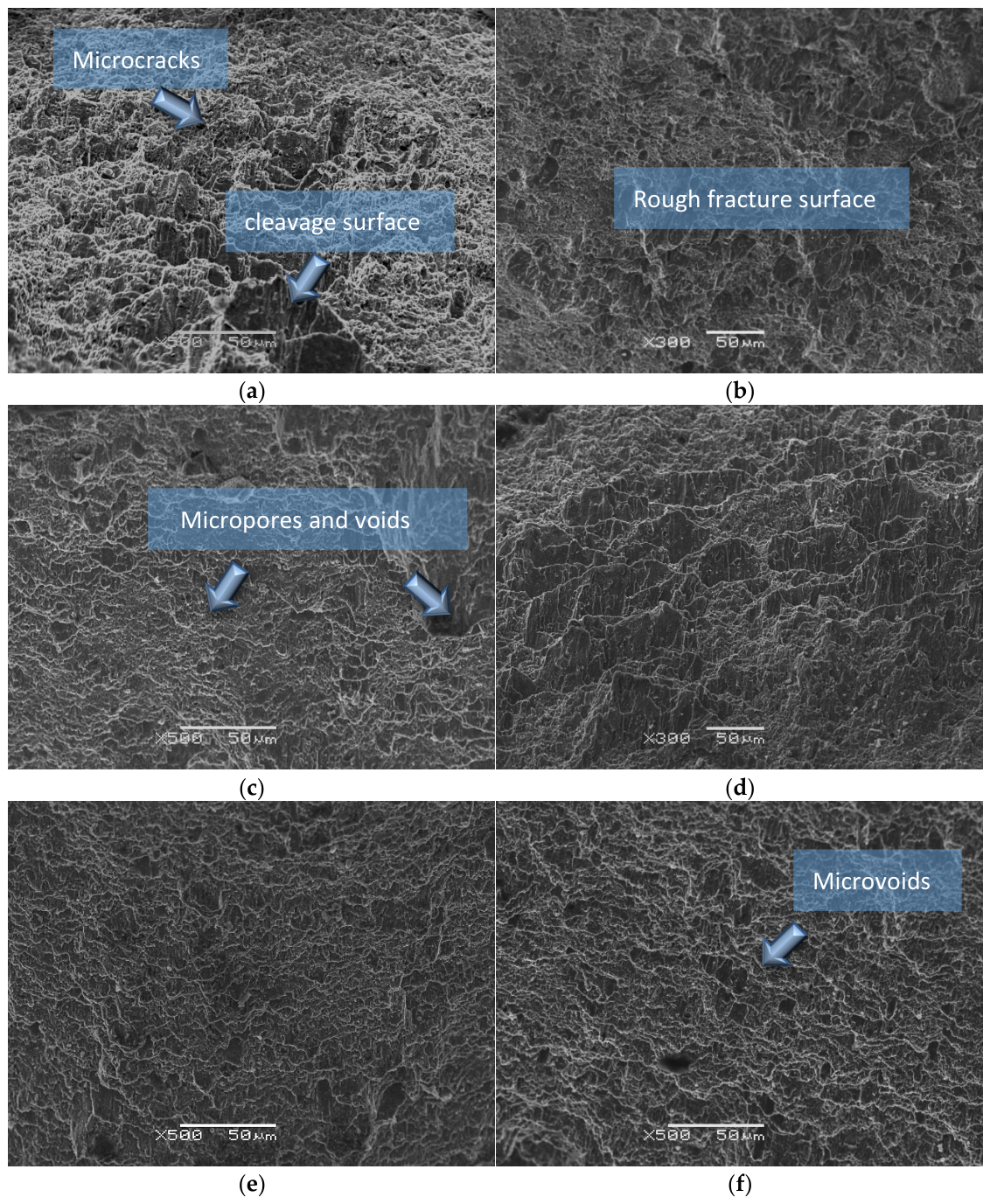
- The fractographic studies indicated predominantly ductile fracture features of the samples tempered for 4 h and after double tempering (2 h + 2 h), including the presence of relatively uniformly distributed microvoids and cavities on the fracture surface.
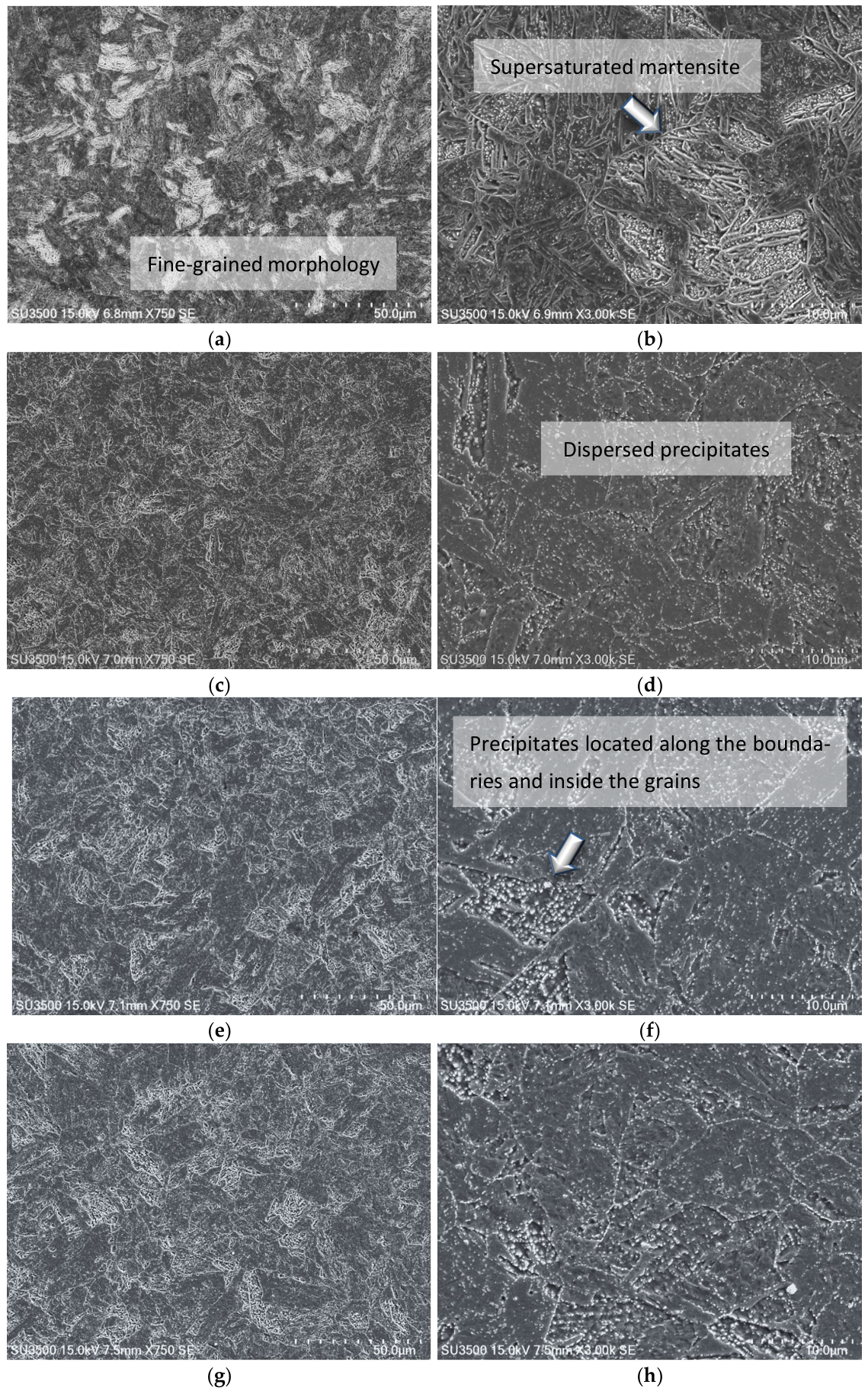
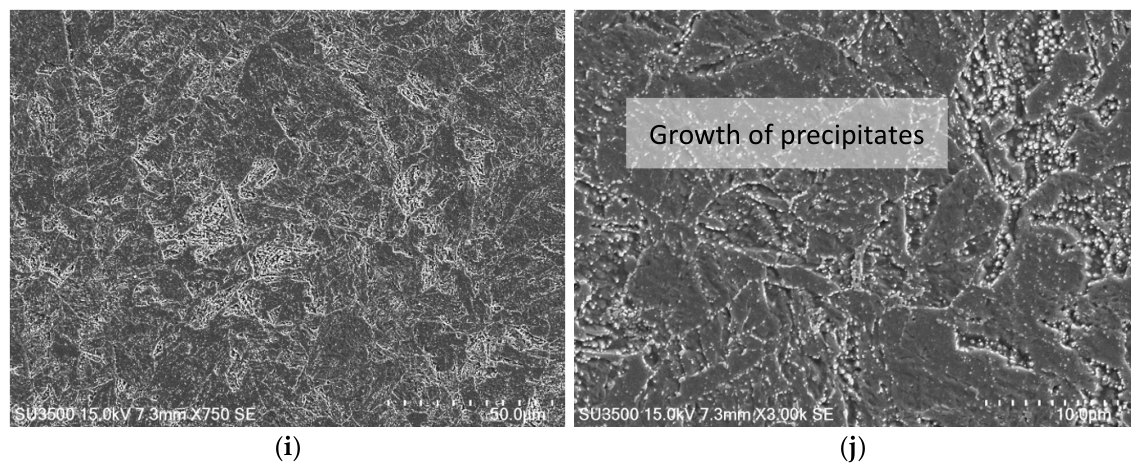
- The microstructural studies indicated that samples tempered for 4 h and after double tempering for 2 h + 2 h exhibited a less distinct tempered martensite lath structure, together with a relatively uniform distribution of precipitates along the grain boundaries and within the matrix. The observed precipitate dispersion suggested that these tempering conditions promoted the recovery of the martensitic structure and contributed to a more uniform microstructural arrangement. The quantitative analysis revealed an average grain size of 29–30 µm, a precipitate size of 0.26–0.30 µm, and a precipitate surface fraction of approximately 2%, suggesting relatively stable precipitate distribution and improved microstructural uniformity.
Author Contributions
Funding
Institutional Review Board Statement
Informed Consent Statement
Data Availability Statement
Conflicts of Interest
Abbreviations
| SEM | scanning electron microscopy |
| LM | light microscopy |
| UTS | ultimate tensile strength |
| YS | yield strength |
| EL | total elongation |
| N | normalization |
| T | tempering |
References
- Dobrzański, J. Materiałoznawcza Interpretacja Trwałości Stali Dla Energetyki; International OCSCO World Press: Gliwice, Poland, 2011; Volume 3, pp. 15–37. [Google Scholar]
- Żurek, Z.H.; Dobmann, G.; Rockstroh, B.; Kukla, D. Diagnostyka eksploatacyjna stali w energetyce. Masz. Elektr.-Zesz. Probl. 2016, 1, 169–176. [Google Scholar]
- Brózda, J. Stale żarowytrzymałe nowej generacji, ich spawalność i własności złączy spawanych. Cel stosowania stali żarowytrzymałych nowej generacji, ich charakterystyka i wynikające korzyści. Biul. Inst. Spaw. 2004, 1, 41–49. [Google Scholar]
- Golański, G. Mechanical properties of P91 and PB2 steel after long-term ageing at 620 °C. J. Met. Mater. 2021, 73, 2–6. [Google Scholar] [CrossRef]
- Hald, J. Microstructure and long-term creep properties of 9–12% Cr steels. Int. J. Press. Vessel. Pip. 2008, 85, 30–37. [Google Scholar] [CrossRef]
- Sirohi, S.; Pandey, C.; Goyal, A. Goyal, Role of the Ni-based filler (IN625) and heat-treatment on the mechanical performance of the GTA welded dissimilar joint of P91 and SS304H steel. J. Manuf. Process. 2021, 65, 174–189. [Google Scholar] [CrossRef]
- Yan, P.; Liu, Z. Toughness evolution of 9Cr-3W-3Co martensitic heat resistant steel during ong time aging. Mater. Sci. Eng. A 2016, 650, 290–294. [Google Scholar] [CrossRef]
- Saini, N.; Pandey, C.; Mahapatra, M.M. Characterization and evaluation of mechanical properties of CSEF P92 steel for varying normalizing temperature. Mater. Sci. Eng. A 2017, 688, 250–261. [Google Scholar] [CrossRef]
- Pickering, F.B.; Strang, A.; Gooch, D.J. Historical development and microstructure of high chromium ferritic steels for high temperature applications, Microstructural development and stability in high chromium ferritic power plant steels. Inst. Mater. 1997, 667, 1–30. [Google Scholar]
- Pawłowski, B. Heat and Thermochemical Treatment of Steel; Wydawnictwo Naukowe AGH: Kraków, Poland, 2005; pp. 175–202. [Google Scholar]
- Pandey, C.; Giri, A.; Mahapatra, M.M. Evolution of phases in P91 steel in various heat treament conditions and their effect on microstructure stability and mechanical properties. Mater. Sci. Eng. A 2016, 664, 58–74. [Google Scholar] [CrossRef]
- Pandey, C.; Mahapatra, M.M.; Kumar, P.; Kumar, S.; Sirohi, S. Effect of post weld heat treatments on microstructure evolution and type IV cracking behavior of the P91 steel welds joint. J. Mech. Work. Technol. 2019, 266, 140–154. [Google Scholar] [CrossRef]
- Pandey, C.; Giri, A.; Mahapatra, M.M. Effect of normalizing temperature on microstructural stability and mechanical properties of creep strength enhanced ferritic P91 steel. Mater. Sci. Eng. A 2016, 657, 173–184. [Google Scholar] [CrossRef]
- Golański, G.; Kępa, J. The Effect of Ageing Temperatures on Microstructure and Mechanical Properties of GX12CrMoVNbN9-1 (GP91) Cast Steel. Arch. Met. Mater. 2012, 57, 575–582. [Google Scholar] [CrossRef][Green Version]
- Golański, G.; Kolan, C.; Trzeszczyński, J. Mikrostruktura i właściwości mechaniczne stali P91 po długotrwałej eksploatacji w temperaturze 560 °C. Energetyka 2022, 3, 155–157. [Google Scholar]
- Murty, K.L.; Charit, I. Structural materials for Gen-IV nuclear reactors: Challenges and opportunities. J. Nucl. Mater. 2008, 383, 189–195. [Google Scholar] [CrossRef]
- Hernas, A. Materiały do budowy kotłów na parametry nadkrytyczne. Nowa Energ. 2013, 5–6, 34–36. [Google Scholar]
- Sun, X.; Che, C.; Qian, G.; Wang, X. Microstructure, hardness and creep properties for P91 steel after long-term service in a ultra-supercritical power plant. Int. J. Press. Vessel. Pip. 2024, 212, 105330. [Google Scholar] [CrossRef]
- Golański, G.; Urbańczyk, P. Nowoczesne Stale Ferrytyczne i Austenityczne dla Energetyki—Charakterystyka; Agenda Wydawnicza SIMP: Warszawa, Poland, 2018. [Google Scholar]
- Śliwa, T.; Górka, J. Fractographic and Structural Characterization of P91 Steel after Heat Treatment. J. Mater. Eng. Perform. 2016, 25, 4228–4235. [Google Scholar]
- Golański, G.; Kurek, A. Influence of Heat Treatment on Microstructure and Properties of P91 Steel. Arch. Metall. Mater. 2013, 58, 1115–1119. [Google Scholar]
- PN-EN 10216-2 Standard; Seamless Steel Tubes for Pressure Purposes—Technical Delivery Conditions—Part 2: Non-Alloy and Alloy Steel Tubes with Specified Elevated Temperature Properties. Polish Committee for Standardization: Warsaw, Poland, 2025.
- Bonetti, R.; Neate, N.C.; Morris, A.; Shipway, P.H. Microstructure evolution and deformation mechanisms of service-exposed P91 steel via interrupted uniaxial creep tests at 660 °C. J. Mater. Res. Technol. 2024, 33, 3529–3549. [Google Scholar] [CrossRef]
- Viswanathan, R. Damage Mechanisms and Life Assessment of High-Temperature Components; ASM International: Materials Park, OH, USA, 2008. [Google Scholar]
- Zieliński, A.; Dobrzański, J. Struktura i właściwości stali P91 po eksploatacji i regeneracji. Inż. Mater. 2005, 143, 17–21. [Google Scholar]
- Zhou, H.; Li, J.; Liu, J.; Yu, P.; Liu, X.; Fan, Z.; Hu, A.; He, Y. Significant reduction in creep life of P91 steam pipe elbow caused by an aberrant microstructure after short term service. Sci. Rep. 2024, 14, 5216. [Google Scholar] [CrossRef]
- Gu, Z.; Zhong, M.; Minkov, A.; Panteleyenko, F.; Wang, C. Enhanced creep lifetime in P91 steel weldments via stabilizing tempered martensite structre. Int. J. Press. Veddels Pip. 2024, 212, 105361. [Google Scholar] [CrossRef]



| P91, X10CrWMoVNb9-1 | ||||||||||
|---|---|---|---|---|---|---|---|---|---|---|
| Chemical composition of steel, wt% | ||||||||||
| C | Si | Ni | V | Cu | Mn | Cr | Mo | Nb | N | Fe |
| 0.09 | 0.26 | ≤0.4 | 0.21 | ≤0.3 | 0.56 | 8.49 | 1.03 | 0.1 | 0.06 | rest |
| Chemical composition of steel according to the PN_EN 10216-2 standard | ||||||||||
| 0.08–0.12 | 0.2–0.5 | ≤0.4 | 0.18–0.25 | ≤0.3 | 0.3–0.6 | 8.0–9.5 | 0.85–1.05 | 0.06–0.1 | 0.03–0.06 | rest |
| Condition | UTS, MPa | YS, MPa | YS/UTS | EL, % | HV0.5 |
|---|---|---|---|---|---|
| As-received | 692 ± 8 | 543 ± 8 | 0.78 | 11.9 ± 1.1 | 254 ± 5 |
| After N 1. at 1060 °C | 1330 ± 14 | 992 ± 5 | 0.75 | 9.9 ± 0.9 | 433 ± 16 |
| After N + T 2. for 2 h | 670 ±10 | 537 ± 11 | 0.8 | 11.0 ± 1.0 | 239 ± 9 |
| After N + T for 4 h | 642 ± 7 | 497 ± 7 | 0.77 | 11.2 ± 0.8 | 240 ± 12 |
| After N + double T for 2 h + 2 h | 631 ± 11 | 491 ± 10 | 0.78 | 11.6 ± 0.6 | 265 ± 14 |
| After N + T for 7 h | 649 ± 5 | 511 ± 14 | 0.79 | 11.5 ± 0.3 | 303 ± 20 |
| Condition | , [μm] | , [μm] | , [%] |
|---|---|---|---|
| As-received | 28.0 | 0.25 | 3.0 |
| After N 1. at 1060 °C | 18.0 | 0.14 | 1.0 |
| After N + T 2. for 2 h | 26.0 | 0.21 | 1.5 |
| After N + T for 4 h | 29.0 | 0.26 | 2.0 |
| After N + double T for 2 h + 2 h | 30.0 | 0.30 | 2.2 |
| After N + T for 7 h | 34.0 | 0.43 | 3.0 |
Disclaimer/Publisher’s Note: The statements, opinions and data contained in all publications are solely those of the individual author(s) and contributor(s) and not of MDPI and/or the editor(s). MDPI and/or the editor(s) disclaim responsibility for any injury to people or property resulting from any ideas, methods, instructions or products referred to in the content. |
© 2026 by the authors. Licensee MDPI, Basel, Switzerland. This article is an open access article distributed under the terms and conditions of the Creative Commons Attribution (CC BY) license.
Share and Cite
Kowalczyk-Skoczylas, K.; Gawron, A.; Aniołek, K.; Matyja, E.; Skwarski, M. The Effect of Heat Treatment on the Microstructure and Mechanical Properties of P91 Steel for High-Temperature Applications. Materials 2026, 19, 2281. https://doi.org/10.3390/ma19112281
Kowalczyk-Skoczylas K, Gawron A, Aniołek K, Matyja E, Skwarski M. The Effect of Heat Treatment on the Microstructure and Mechanical Properties of P91 Steel for High-Temperature Applications. Materials. 2026; 19(11):2281. https://doi.org/10.3390/ma19112281
Chicago/Turabian StyleKowalczyk-Skoczylas, Karolina, Agata Gawron, Krzysztof Aniołek, Edyta Matyja, and Mateusz Skwarski. 2026. "The Effect of Heat Treatment on the Microstructure and Mechanical Properties of P91 Steel for High-Temperature Applications" Materials 19, no. 11: 2281. https://doi.org/10.3390/ma19112281
APA StyleKowalczyk-Skoczylas, K., Gawron, A., Aniołek, K., Matyja, E., & Skwarski, M. (2026). The Effect of Heat Treatment on the Microstructure and Mechanical Properties of P91 Steel for High-Temperature Applications. Materials, 19(11), 2281. https://doi.org/10.3390/ma19112281