Effect of Bacillus subtilis and Paenibacillus polymyxa on the Compressive Strength and Self-Healing of Type IP Concrete
 , ,
, ,
Abstract
1. Introduction
2. Theoretical Background
2.1. Biorepair and Microbially Induced Calcium Carbonate Precipitation (MICP)
2.2. Bacterial Strains Used
2.3. Mix Design Methods
3. Materials and Methods
3.1. Aggregate Properties and Bacterial Culture
3.2. Biorepair Solution
3.3. Concrete Production and Experimental Design
3.4. Statistical Analysis
3.5. Injection Process
3.6. Water Replacement Process
3.7. Compressive Strength Testing and Microscopic Observation
4. Results
4.1. Compressive Strength of Standard Concrete
4.2. Effect of Cracking on Compressive Strength
4.3. Results of the Injection Group
4.4. Results of the Water Replacement Group
4.5. Observation of Crystal Formations Consistent with Calcium Carbonate
4.6. Cost Analysis
5. Discussion
6. Conclusions
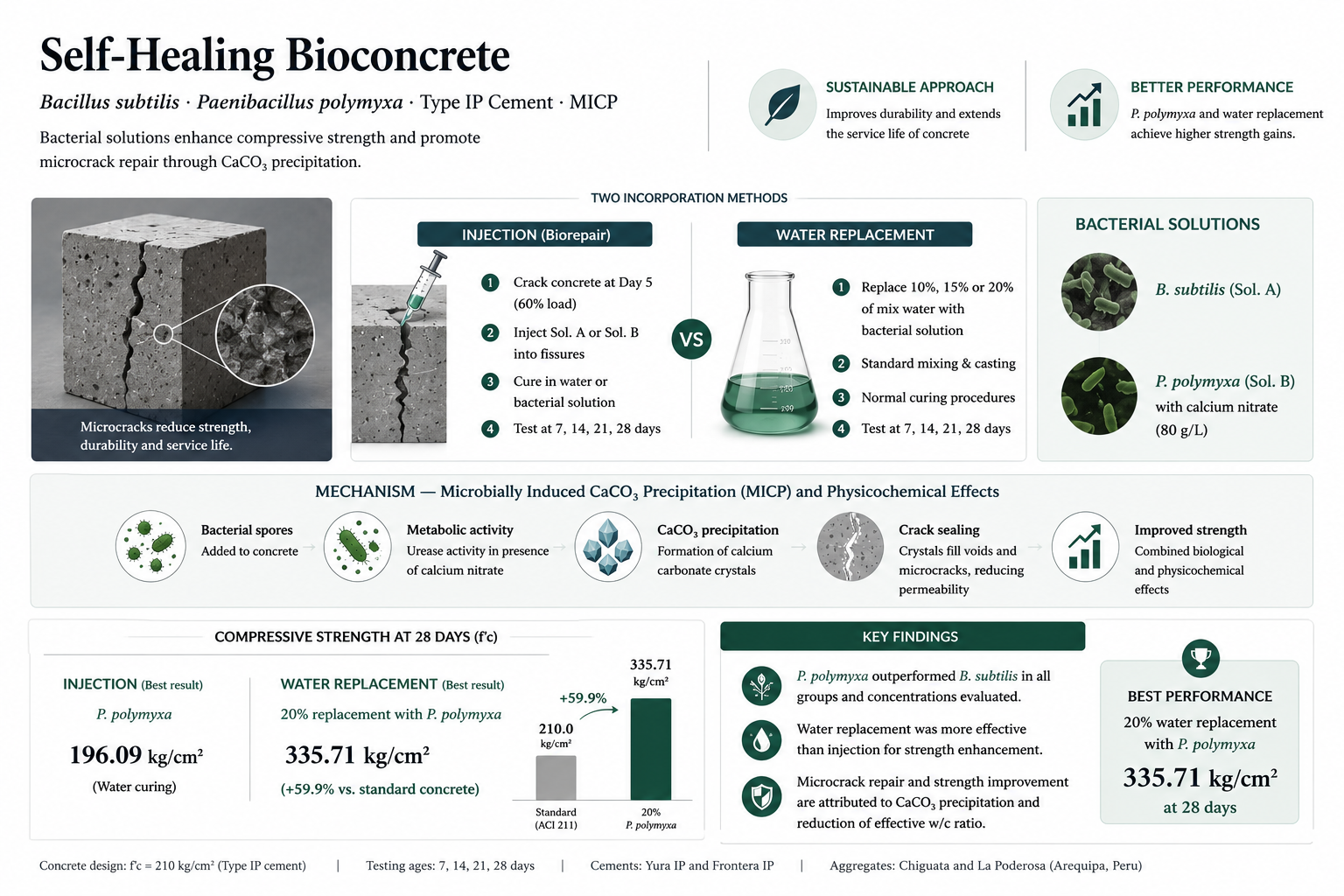
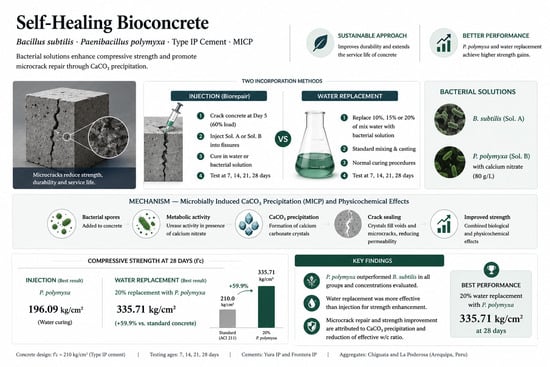
- The incorporation of Bacillus subtilis and Paenibacillus polymyxa was associated with improvements in compressive strength and microcrack sealing, potentially through mechanisms consistent with calcium carbonate precipitation.
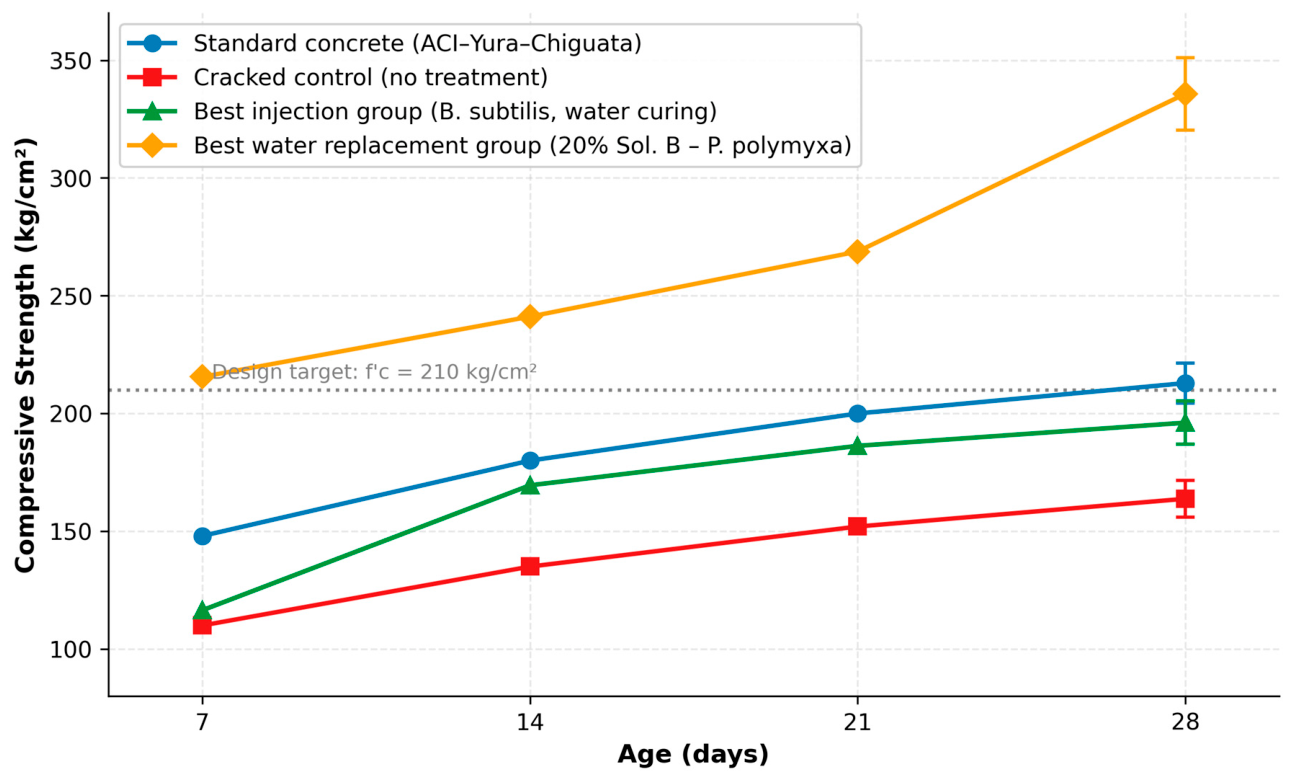
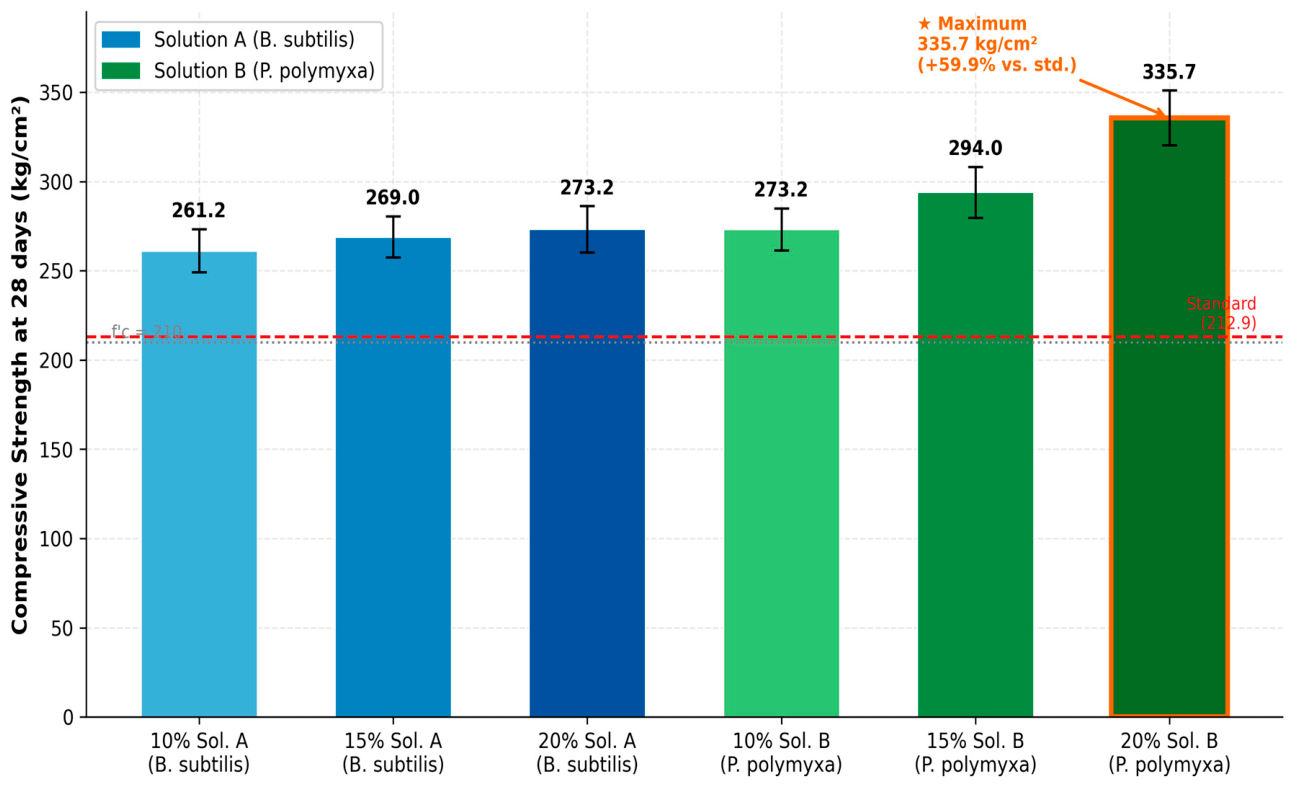
- The water replacement method showed higher performance than the injection method, reaching a maximum compressive strength of 335.71 kg/cm2 at 28 days under the evaluated experimental conditions.
- Among the evaluated bacterial strains, under the evaluated experimental conditions, P. polymyxa showed higher compressive strength values compared with B. subtilis.
- Although part of the observed strength increase may be explained by the reduction in the effective water-to-cement ratio, the results suggest that additional mechanisms potentially associated with bacterial activity and microstructural modifications may also have contributed. However, these effects could not be independently isolated or quantitatively validated under the present experimental design.
- Crystal formations morphologically consistent with CaCO3 were observed; however, their mineralogical composition was not confirmed, representing a limitation of the study.
- The increase in bacterial solution replacement percentage improved the cost–benefit ratio, suggesting potential economic feasibility under the evaluated conditions.
Author Contributions
Funding
Institutional Review Board Statement
Informed Consent Statement
Data Availability Statement
Acknowledgments
Conflicts of Interest
References
- Andrew, R.M. Global CO2 Emissions from Cement Production, 1928–2018. Earth Syst. Sci. Data 2019, 11, 1675–1710. [Google Scholar] [CrossRef]
- Yamasamit, N.; Srichandr, P.; Tongsri, R.; Munbodh, K. Effect of Bacillus subtilis on Mechanical and Self-Healing Properties in Mortar with Different Crack Widths and Curing Conditions. Sci. Rep. 2023, 13, 7844. [Google Scholar] [CrossRef]
- Sierra Beltrán, M.G.; Mera, W.; Jonkers, H. Self-Repairing Concrete with Bacteria and Reinforced with Natural Fibers: Principles and Applications in Ecuador. Alternativas 2016, 17, 207–214. [Google Scholar] [CrossRef]
- Singh, P.; Kaur, I. A Review of Different Bacteria Carriers Used in Self-Healing Mechanism. Mater. Today Proc. 2020, 32, 955–960. [Google Scholar] [CrossRef]
- Jonkers, H.M.; Thijssen, A.; Muyzer, G.; Copuroglu, O.; Schlangen, E. Application of Bacteria as Self-Healing Agent for the Development of Sustainable Concrete. Ecol. Eng. 2010, 36, 230–235. [Google Scholar] [CrossRef]
- Mendoza Nina, R.; Sánchez Quijano, H. Analysis of Concrete Strength Using Bacillus Genus Bacteria and Biopolymers as Biorepairers. Bachelor’s Thesis, Universidad Nacional de San Antonio Abad del Cusco, Cusco, Peru, 2017. [Google Scholar]
- Asenjo Alarcón, D. Influence of Bacterial Additive Incorporation on Controlled Cracking Repair in Concrete. Bachelor’s Thesis, Universidad Nacional de Cajamarca, Cajamarca, Peru, 2019. [Google Scholar]
- Santos, A. Application of Bioconcrete to Repair Cracking in the Settling Tanks of the La Atarjea Water Treatment Plant. Bachelor’s Thesis, Universidad Nacional de Ingeniería, Lima, Peru, 2021. [Google Scholar]
- Goodfellow, M.; Kämpfer, P.; Busse, H.-J.; Trujillo, M.E.; Suzuki, K.; Ludwig, W.; Whitman, W.B. (Eds.) Bergey’s Manual of Systematic Bacteriology, 2nd ed.; Springer: New York, NY, USA, 2009; Volume 3. [Google Scholar] [CrossRef]
- Song, M.; Ju, T.; Meng, Y.; Han, S.; Lin, L.; Jiang, J. A Review on the Applications of Microbially Induced Calcium Carbonate Precipitation in Solid Waste Treatment and Soil Remediation. Chemosphere 2022, 290, 133229. [Google Scholar] [CrossRef] [PubMed]
- Seifan, M.; Samani, A.K.; Berenjian, A. Bioconcrete: Next Generation of Self-Healing Concrete. Appl. Microbiol. Biotechnol. 2016, 100, 2591–2602. [Google Scholar] [CrossRef] [PubMed]
- Prošek, Z.; Ryparová, P.; Tesárek, P. Application of Bacteria as Self-Healing Agent for the Concrete and Microscopic Analysis of the Microbial Calcium Precipitation Process. Key Eng. Mater. 2020, 846, 237–242. [Google Scholar] [CrossRef]
- Schwantes-Cezario, N.; Peres, M.V.N.; Fruet, T.K.; Nogueira, G.S.F.; Toralles, B.M.; Cezario, D.S. Crack Filling in Concrete by Addition of Bacillus subtilis Spores—Preliminary Study. DYNA 2018, 85, 132–139. [Google Scholar] [CrossRef]
- Padda, K.P.; Puri, A. Paenibacillus polymyxa: A Prominent Biofertilizer and Biocontrol Agent for Sustainable Agriculture. In Agriculturally Important Microbes for Sustainable Agriculture; Meena, V.S., Ed.; Springer: Singapore, 2017. [Google Scholar] [CrossRef]
- ACI 211.1-91; Standard Practice for Selecting Proportions for Normal, Heavyweight, and Mass Concrete. American Concrete Institute: Farmington Hills, MI, USA, 2002.
- Rivva López, E. Naturaleza y Materiales del Concreto, 2nd ed.; ACI Capítulo Peruano: Lima, Peru, 2010. [Google Scholar]
- Lenz, S.K.; Pelisser, E.; Gleize, P.J.P.; Pawlicowski, A. Influence of Different Bacterial Strains on Cracks Self-Healing in Cement-Based Matrices with and without Incorporated Air. J. Build. Pathol. Rehabil. 2023, 8, 61. [Google Scholar] [CrossRef]
- Chetty, K.; Ukrainczyk, N.; Koenders, E. Long-Term Self-Healing Efficiency of Bioconcrete Based on Integrated Sulfate- and Nitrate-Reducing Bacterial Granules. J. Mater. Civ. Eng. 2023, 35, MTENG-15060. [Google Scholar] [CrossRef]
- Hungria, R.; Mirski, R.; Barnat-Hunek, D. Optimizing the Self-Healing Efficiency of Hydrogel-Encapsulated Bacteria in Concrete. J. Mater. Civ. Eng. 2023, 35, MTENG-15271. [Google Scholar] [CrossRef]
- Handore, A.V.; Raut, S.; Gawande, A.; Giri, P.; Rana, A. Bioconcrete: The Promising Perspective for Eco-Friendly Construction. In Handbook of Solid Waste Management; Chowdhury, S., Ed.; Springer: Cham, Switzerland, 2022; pp. 567–584. [Google Scholar] [CrossRef]
- Pacheco, F.L. Analysis of the Self-Regeneration of Cementitious Matrices Through Different Methods of Insertion of Chemical and Bacterial Solutions. Rev. ALCONPAT 2022, 12, 32–46. [Google Scholar] [CrossRef]
- Castro Alonso, M.J.; Montañez Hernández, L.E.; Gutiérrez Ortega, N.L.; Moctezuma Zárate, M.G. Improved Strength and Durability of Concrete Through Metabolic Activity of Ureolytic Bacteria. Environ. Sci. Pollut. Res. 2018, 24, 21451–21458. [Google Scholar] [CrossRef]
- Girish Shamanna, S.; Thippeswamy, S. An Experimental Study on Self-Remediating Bacterial Concrete. Int. J. Eng. Res. Technol. 2021, 10, 283–293. [Google Scholar]
- Gudainiyan, J.; Kumar, A.; Parashar, A.K.; Sharma, P.; Sharma, N. An Experimental Analysis on Bagasse Ash Based Concrete Incorporated Bacillus subtilis Bacteria. AIP Conf. Proc. 2023, 2721, 020008. [Google Scholar] [CrossRef]
- Yadav, P.; Kumar, S. Application of Bacillus subtilis for Self-Healing and Improving Durability of Concrete. AIP Conf. Proc. 2023, 2721, 020053. [Google Scholar] [CrossRef]
- Malušá, E.; Tosi, P.; Fontenla Razzeto, P. Two Species-Specific TaqMan-Based Quantitative Polymerase Chain Reaction Assays for the Detection in Soil of Paenibacillus polymyxa Inocula. J. Appl. Microbiol. 2022, 134, lxac048. [Google Scholar] [CrossRef]
- Babitha Benjamin, Z.; Subbulakshmi, S.; Jegan, J. Bacterial Consortium Development and Optimization for Crack Controlling Cement Mortar. J. Build. Eng. 2023, 77, 107501. [Google Scholar] [CrossRef]
- Hassan, A.F.; Abd-Elmonem, A.I.; Ibrahim, R.S. Enhanced Fracture and Durability Resilience Using Bio-Triggered Sisal Fibers in Concrete. J. Build. Eng. 2023, 76, 107008. [Google Scholar] [CrossRef]
- Wiktor, V.; Jonkers, H.M. Quantification of Crack-Healing in Novel Bacteria-Based Self-Healing Concrete. Cem. Concr. Compos. 2011, 33, 763–770. [Google Scholar] [CrossRef]
- Nodehi, M.; Ozbakkaloglu, T.; Gholampour, A. Effect of Supplementary Cementitious Materials on Properties of Self-Healing Concrete: A Review. J. Build. Eng. 2022, 47, 103800. [Google Scholar] [CrossRef]



| Property | La Poderosa | Unit | Chiguata | Unit | Chiguata B2 | Unit | Material |
|---|---|---|---|---|---|---|---|
| Sp. gravity Yura IP | 2.83 | g/cm3 | 2.83 | g/cm3 | 2.83 | g/cm3 | Cement |
| Sp. gravity Frontera IP | 2.89 | g/cm3 | 2.89 | g/cm3 | 2.89 | g/cm3 | Cement |
| Specific gravity (fine) | 2.58 | g/cm3 | 2.43 | g/cm3 | 2.43 | g/cm3 | Fine agg. |
| Absorption (fine) | 1.49 | % | 1.27 | % | 0.97 | % | Fine agg. |
| Fineness modulus (fine) | 2.62 | — | 2.74 | — | 2.99 | — | Fine agg. |
| Loose unit wt. (fine) | 1505 | kg/m3 | 1364.9 | kg/m3 | 1201.1 | kg/m3 | Fine agg. |
| Specific gravity (coarse) | 2.64 | g/cm3 | 2.30 | g/cm3 | 2.50 | g/cm3 | Coarse agg. |
| Absorption (coarse) | 0.62 | % | 1.77 | % | 0.72 | % | Coarse agg. |
| Fineness modulus (coarse) | 6.31 | — | 6.94 | — | 6.79 | — | Coarse agg. |
| Nominal max. size | 1/2″ | — | 1/2″ | — | 1/2″ | — | Coarse agg. |
| Experimental Group | Chiguata ACI | Chiguata FM | La Poderosa ACI/FM | No. of Designs |
|---|---|---|---|---|
| Control pattern | 1–2 | 3–4 | 5–8 | 8 |
| Cracked pattern (control) | 9–10 | 11–12 | 13–16 | 8 |
| Exp. Subtilis injection—water curing | 17–18 | 19–20 | 21–24 | 8 |
| Exp. Polymyxa injection—water curing | 25–26 | 27–28 | 29–32 | 8 |
| Exp. Subtilis injection—Sol. A curing | 33–34 | 35–36 | 37–40 | 8 |
| Exp. Polymyxa injection—Sol. B curing | 41–42 | 43–44 | 45–48 | 8 |
| Exp. water replacement 10%—Sol. A | 49–50 | 51–52 | 53–56 | 8 |
| Exp. water replacement 15%—Sol. A | 65–66 | 67–68 | 69–72 | 8 |
| Exp. water replacement 20%—Sol. A | 81–82 | 83–84 | 85–88 | 8 |
| Exp. water replacement 10%—Sol. B | 57–58 | 59–60 | 61–64 | 8 |
| Exp. water replacement 15%—Sol. B | 73–74 | 75–76 | 77–80 | 8 |
| Exp. water replacement 20%—Sol. B | 89–90 | 91–92 | 93–96 | 8 |
| TOTAL | 96 designs/1248 specimens |
| Method | Cement | Quarry | f′c 28 d ± SD (kg/cm2) | CV (%) | Meets f′c = 210 |
|---|---|---|---|---|---|
| ACI 211 | Yura IP | Chiguata | 212.9 ± 8.5 | 4.0 | Yes |
| ACI 211 | Frontera IP | Chiguata | 233.9 ± 10.2 | 4.4 | Yes |
| ACI 211 | Yura IP | La Poderosa | 238.2 ± 9.1 | 3.8 | Yes |
| ACI 211 | Frontera IP | La Poderosa | 233.9 ± 11.0 | 4.7 | Yes |
| Fineness Mod. | Yura IP | Chiguata | 163.8 ± 7.8 | 4.8 | Ref. * |
| Fineness Mod. | Frontera IP | Chiguata | 147.7 ± 6.5 | 4.4 | Ref. * |
| Group | f′c 28 d ± SD (kg/cm2) | Δ vs. Cracked | Δ vs. Standard |
|---|---|---|---|
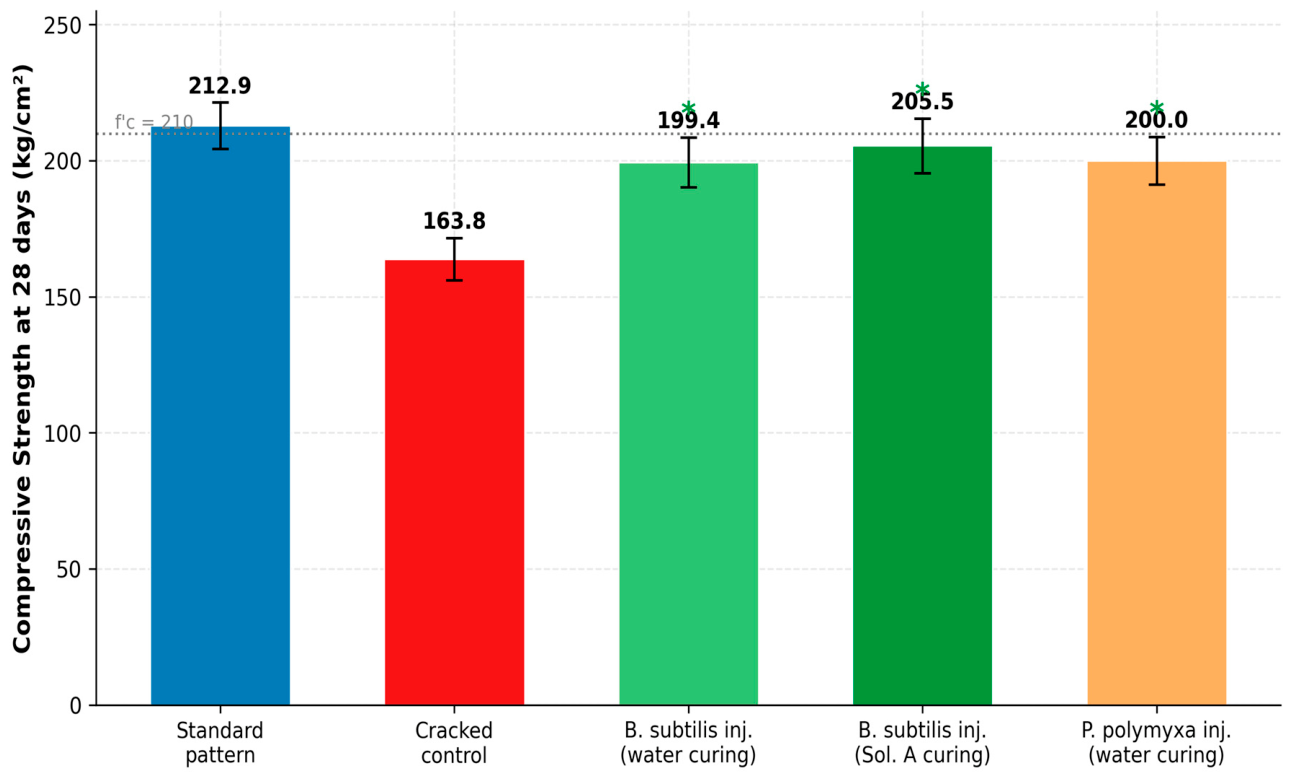
| Standard pattern | 212.9 ± 8.5 | — | — |
| Cracked pattern (control) | 163.8 ± 7.8 | — | −23.1% |
| Exp. B. subtilis injection (water curing) | 199.4 ± 9.2 | +21.8% * | −6.3% |
| Exp. B. subtilis injection (Sol. A curing) | 205.5 ± 10.1 | +25.5% * | −3.5% |
| Exp. P. polymyxa injection (water curing) | 200.0 ± 8.8 | +22.1% * | −6.0% |
| Group | Max. f′c ± SD (kg/cm2) | Optimal Design | Exp. w/c | H2O adj. (mL) | Δ vs. Std. | Δ Abrams Est. |
|---|---|---|---|---|---|---|
| Repl. 10% Sol. A | 261.2 ± 12.1 | D51: FM–Yura–Chig. | 0.5543 | −40 | +23.7% * | +8.2% |
| Repl. 15% Sol. A | 269.0 ± 11.5 | D69: ACI–Yura–LP | 0.5411 | −180 | +27.9% * | +10.5% |
| Repl. 20% Sol. A | 273.2 ± 13.0 | D86: FM–Front.–LP | 0.5261 | −340 | +29.8% * | +12.8% |
| Repl. 10% Sol. B | 273.2 ± 11.8 | D64: FM–Front.–LP | 0.5355 | −240 | +29.7% * | +11.2% |
| Repl. 15% Sol. B | 294.0 ± 14.2 | D77: ACI–Yura–LP | 0.5242 | −360 | +39.9% * | +13.1% |
| Repl. 20% Sol. B ★ | 335.7 ± 15.3 | D94: ACI–Front.–LP | 0.5158 | −450 | +59.9% * | +15.4% |
Disclaimer/Publisher’s Note: The statements, opinions and data contained in all publications are solely those of the individual author(s) and contributor(s) and not of MDPI and/or the editor(s). MDPI and/or the editor(s) disclaim responsibility for any injury to people or property resulting from any ideas, methods, instructions or products referred to in the content. |
© 2026 by the authors. Licensee MDPI, Basel, Switzerland. This article is an open access article distributed under the terms and conditions of the Creative Commons Attribution (CC BY) license.
Share and Cite
Rivas Torres, B.R.; Mendoza Tejada, O.G.; Francisco Gamarra Tuco, R.; Ita-Balta, Y.; Farfán-Delgado, F.; Manrique-Sam, C. Effect of Bacillus subtilis and Paenibacillus polymyxa on the Compressive Strength and Self-Healing of Type IP Concrete. Materials 2026, 19, 2277. https://doi.org/10.3390/ma19112277
Rivas Torres BR, Mendoza Tejada OG, Francisco Gamarra Tuco R, Ita-Balta Y, Farfán-Delgado F, Manrique-Sam C. Effect of Bacillus subtilis and Paenibacillus polymyxa on the Compressive Strength and Self-Healing of Type IP Concrete. Materials. 2026; 19(11):2277. https://doi.org/10.3390/ma19112277
Chicago/Turabian StyleRivas Torres, Baruc Ronel, Olenka Guibell Mendoza Tejada, Rubén Francisco Gamarra Tuco, Yuma Ita-Balta, Fernando Farfán-Delgado, and Cecilia Manrique-Sam. 2026. "Effect of Bacillus subtilis and Paenibacillus polymyxa on the Compressive Strength and Self-Healing of Type IP Concrete" Materials 19, no. 11: 2277. https://doi.org/10.3390/ma19112277
APA StyleRivas Torres, B. R., Mendoza Tejada, O. G., Francisco Gamarra Tuco, R., Ita-Balta, Y., Farfán-Delgado, F., & Manrique-Sam, C. (2026). Effect of Bacillus subtilis and Paenibacillus polymyxa on the Compressive Strength and Self-Healing of Type IP Concrete. Materials, 19(11), 2277. https://doi.org/10.3390/ma19112277