This is an early access version, the complete PDF, HTML, and XML versions will be available soon.
Open AccessReview
Carbon Materials Derived from Waste Streams: From Processing Pathways to Structure–Property–Function Relationships
by
Sharif H. Zein
 Sharif H. Zein
1
Faculty of Engineering, Sohar University, Sohar 311, Oman
2
Faculty of Science and Engineering, School of Engineering, University of Hull, Hull HU6 7RX, UK
Materials 2026, 19(10), 2146; https://doi.org/10.3390/ma19102146 (registering DOI)
Submission received: 22 April 2026
/
Revised: 14 May 2026
/
Accepted: 15 May 2026
/
Published: 20 May 2026
Abstract
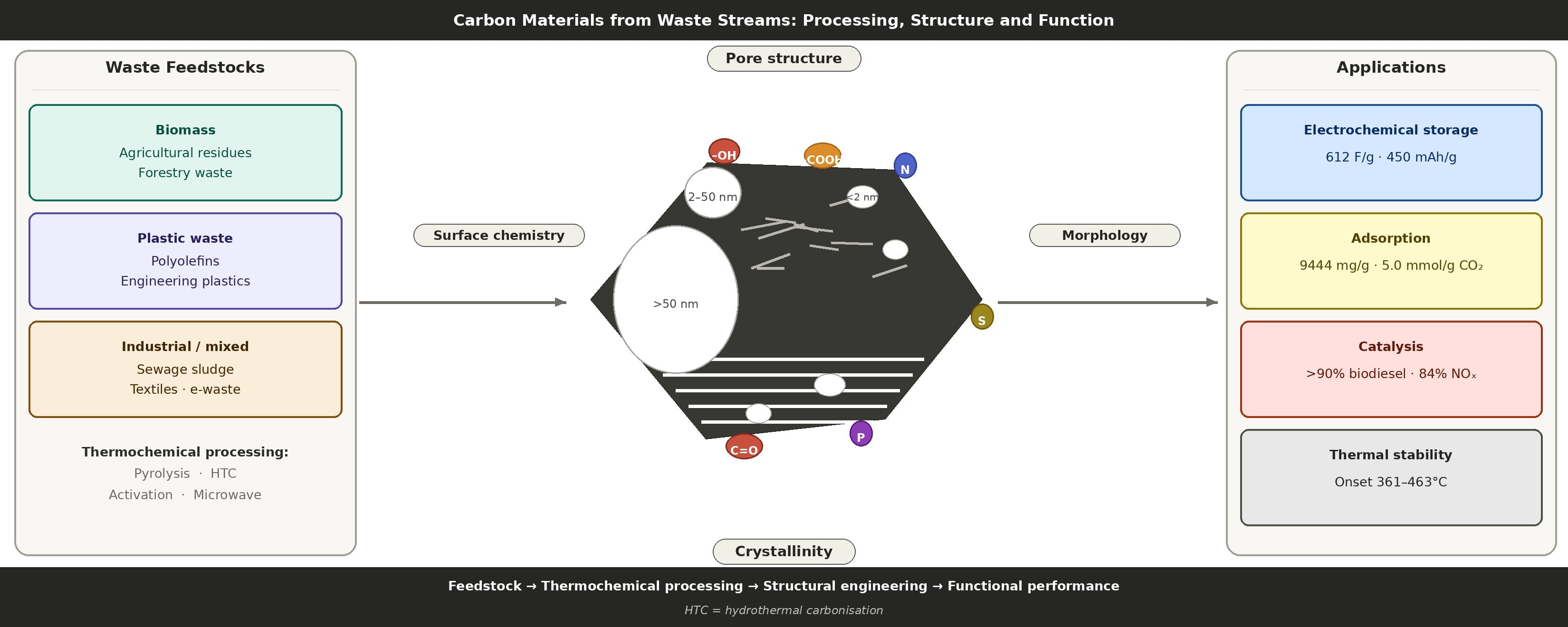
The accelerating generation of waste streams is observed globally. Spanning lignocellulosic biomass, plastic waste, sewage sludge, and industrial residues, this review presents both an urgent management challenge and a compelling materials opportunity. Carbon materials derived from these waste streams offer a sustainable route to functional carbons applicable in electrochemical energy storage, adsorption, heterogeneous catalysis, and high-temperature applications. Yet their rational design remains constrained by incomplete understanding of the relationships between feedstock composition, processing pathway, structural characteristics, and functional performance. This review provides an integrated analysis of waste-derived carbon materials from processing pathways to structure–property–function relationships. The principal feedstock categories are examined for their compositional characteristics and implications for carbon yield and structure. Five primary processing routes are assessed. The five routes examined are pyrolysis, hydrothermal carbonisation, physical and chemical activation, and microwave-assisted processing. They are assessed comparatively with emphasis on structural outcomes and governing parameters. The resulting structural characteristics are discussed. These are morphology, hierarchical pore architecture, surface chemistry, heteroatom doping, and crystallinity. They are discussed alongside their characterisation methods and known limitations as performance predictors. Structure–property relationships are examined quantitatively. Heteroatom-doped hierarchical porous carbons achieve 612 F/g specific capacitance. Turbostratic hard carbons deliver 450 mAh/g sodium storage with over 90% retention. Hierarchical porous carbons demonstrate CO2 uptake of 5.0 mmol/g and dye adsorption exceeding 9000 mg/g under optimised laboratory conditions; these values reflect individual studies and are not directly comparable across systems. Biomass-derived sulfonated carbon catalysts sustain biodiesel yields above 90% over multiple cycles. Challenges of feedstock variability, process scalability, environmental compliance, and economic feasibility are addressed, and machine learning-guided design, standardised characterisation methodology, and circular economy policy frameworks are identified as key enablers for translating laboratory performance into industrial reality.
Share and Cite
MDPI and ACS Style
Zein, S.H.
Carbon Materials Derived from Waste Streams: From Processing Pathways to Structure–Property–Function Relationships. Materials 2026, 19, 2146.
https://doi.org/10.3390/ma19102146
AMA Style
Zein SH.
Carbon Materials Derived from Waste Streams: From Processing Pathways to Structure–Property–Function Relationships. Materials. 2026; 19(10):2146.
https://doi.org/10.3390/ma19102146
Chicago/Turabian Style
Zein, Sharif H.
2026. "Carbon Materials Derived from Waste Streams: From Processing Pathways to Structure–Property–Function Relationships" Materials 19, no. 10: 2146.
https://doi.org/10.3390/ma19102146
APA Style
Zein, S. H.
(2026). Carbon Materials Derived from Waste Streams: From Processing Pathways to Structure–Property–Function Relationships. Materials, 19(10), 2146.
https://doi.org/10.3390/ma19102146
Note that from the first issue of 2016, this journal uses article numbers instead of page numbers. See further details
here.
Article Metrics
Article metric data becomes available approximately 24 hours after publication online.