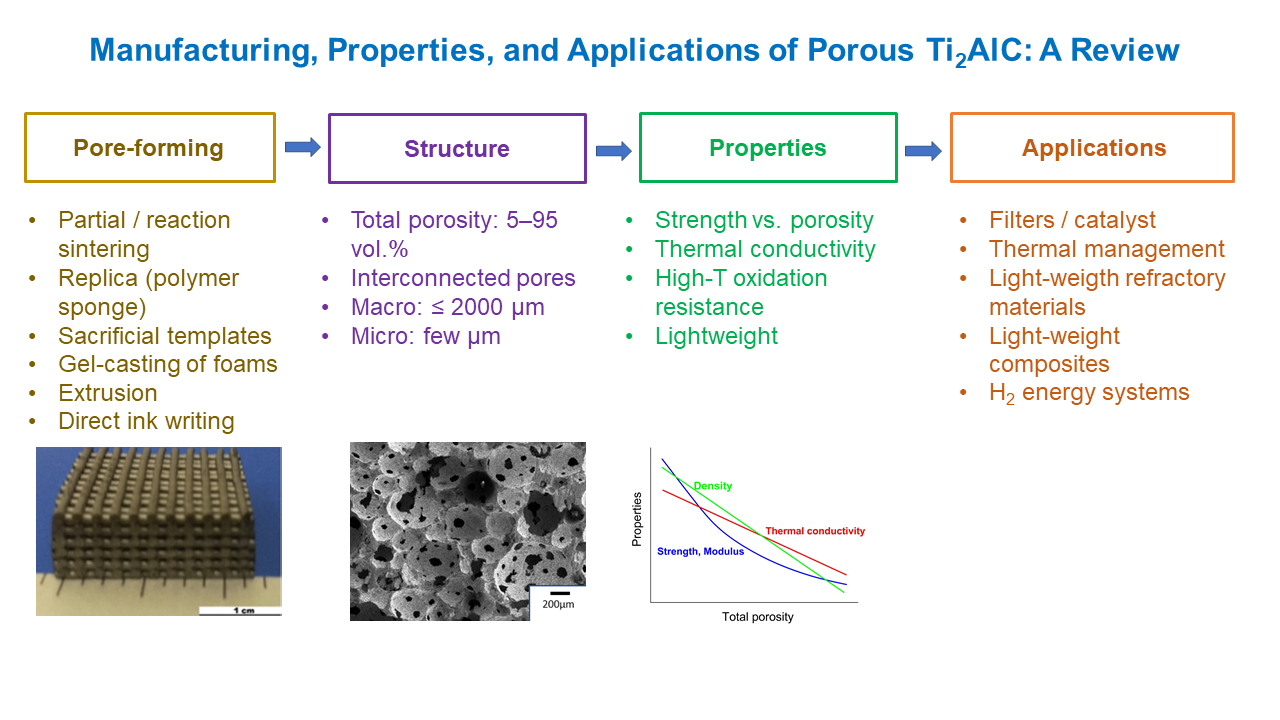
Manufacturing, Properties, and Applications of Porous Ti2AlC: A Review


Abstract
1. Introduction
2. Manufacturing of Porous Ti2AlC
2.1. Incomplete Sintering
2.2. Sacrificial Template Method
2.3. Replica Method
2.4. Gel Casting of Foams
2.5. Extrusion of Honeycomb Structures
2.6. Direct Ink Writing
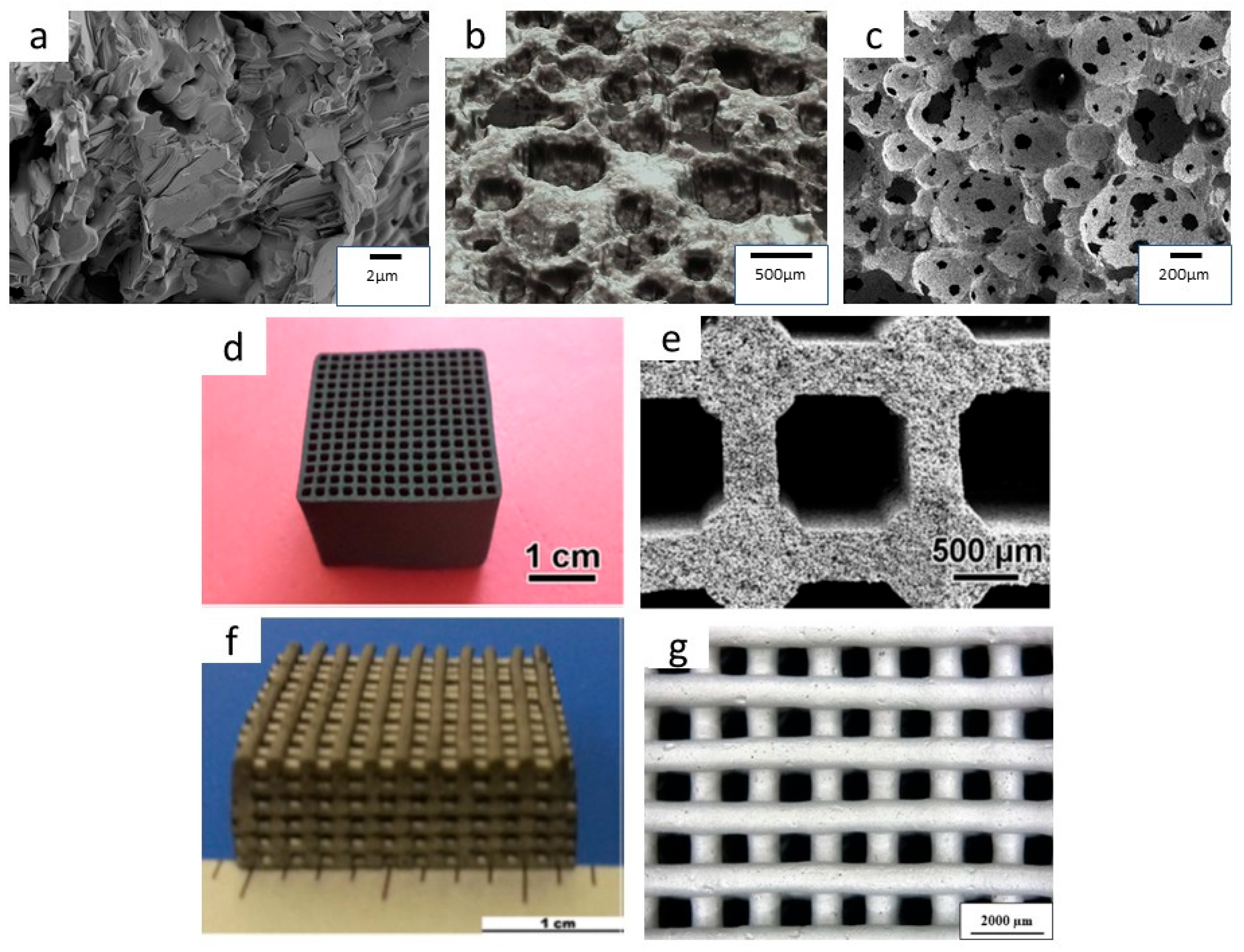
2.7. Comparison of Fabrication Methods for Porous Ti2AlC
3. Mechanical and Physicochemical Properties of Porous Ti2AlC
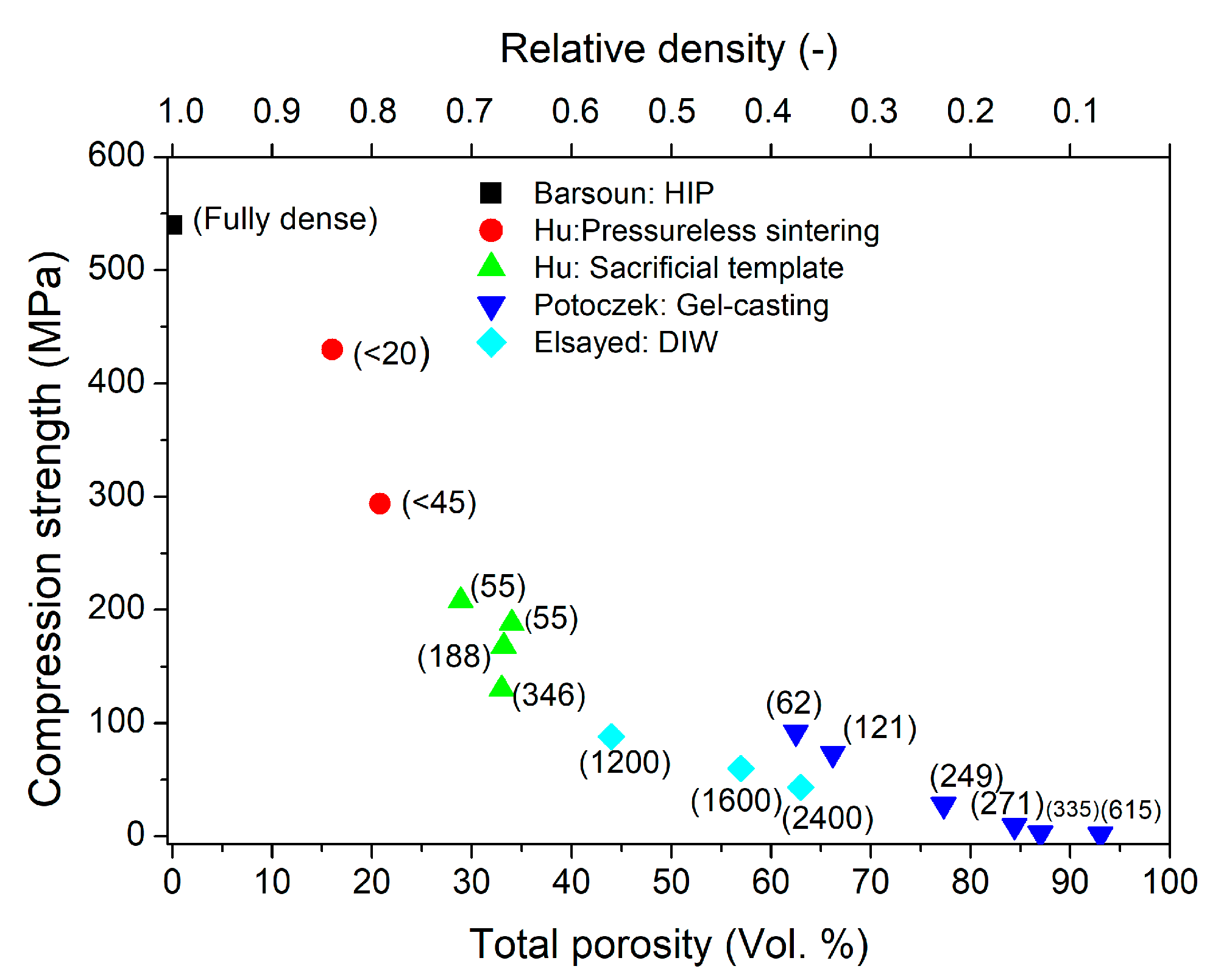
3.1. Compressive Strength
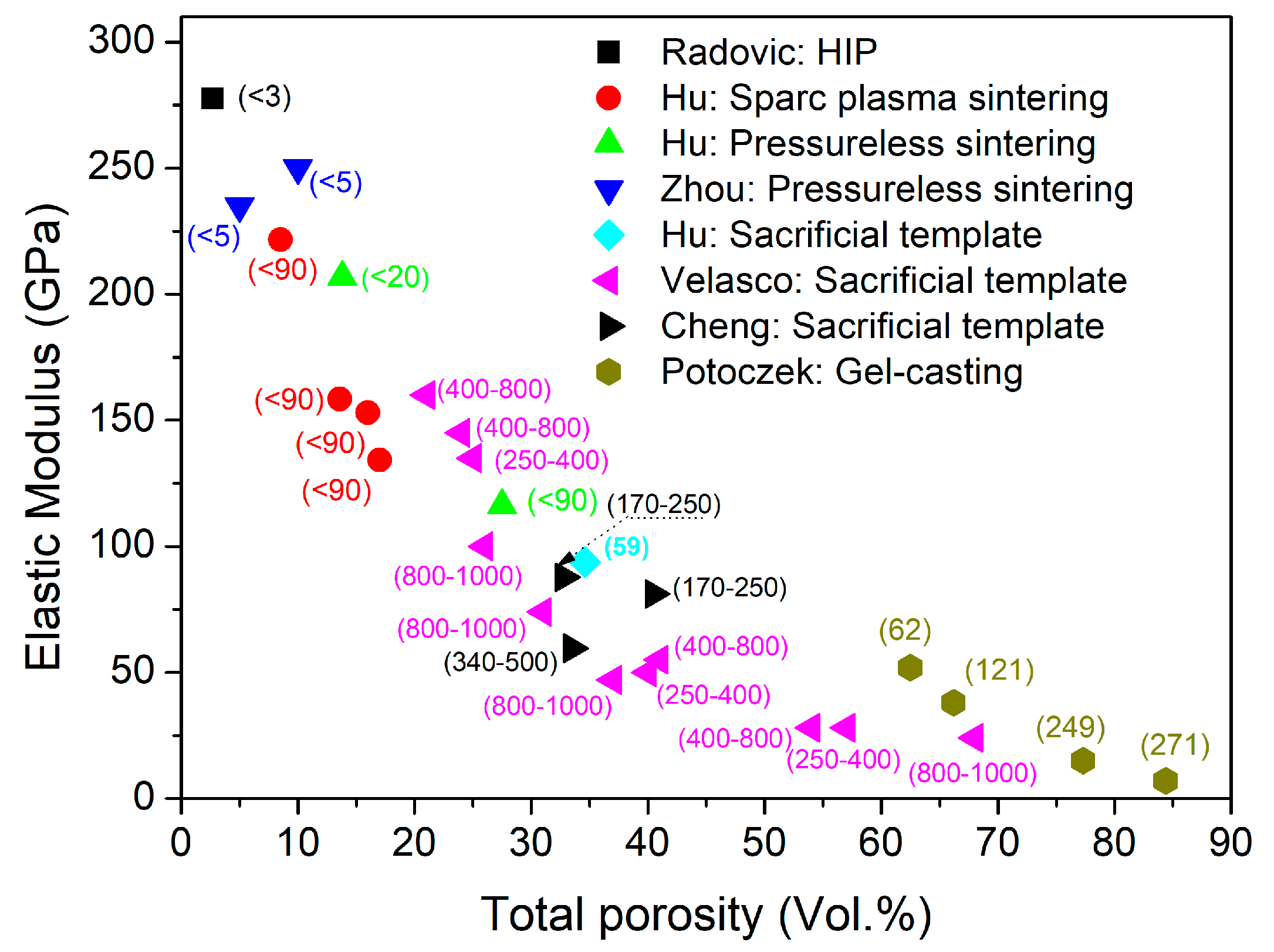
3.2. Elastic Modulus
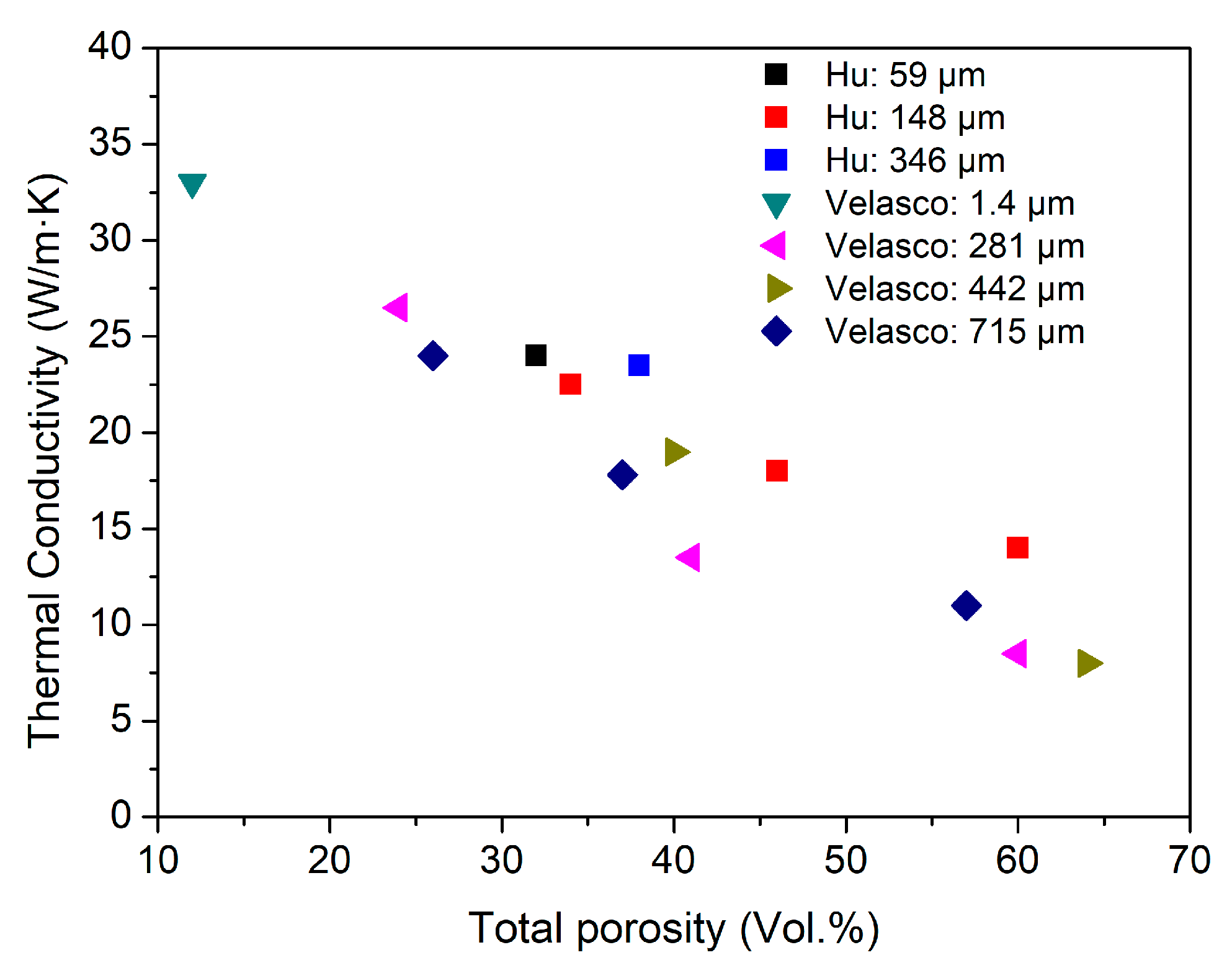
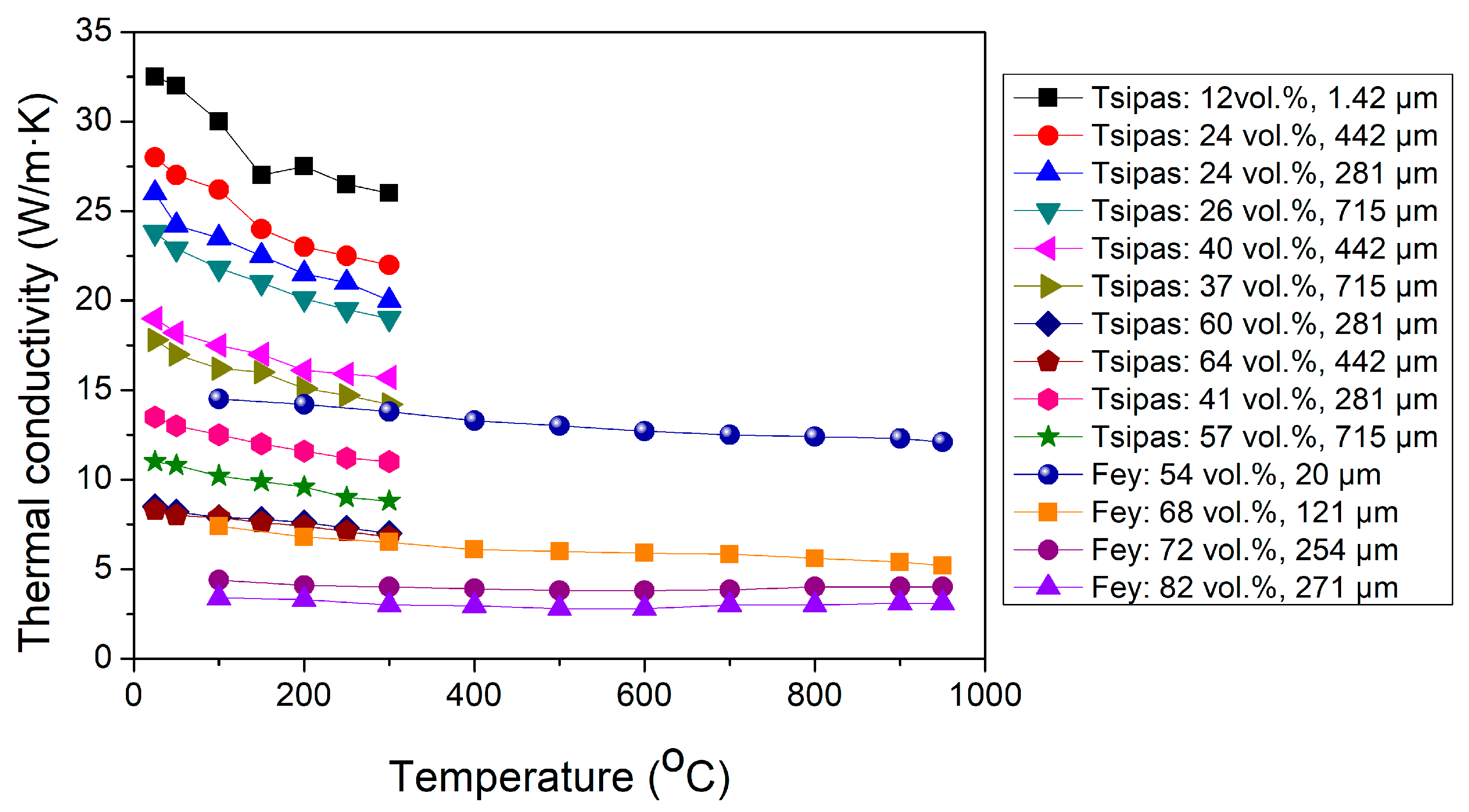
3.3. Thermal Conductivity
3.4. High-Temperature Oxidation Resistance
3.5. Permeability
3.6. Electrical Resistivity
4. Potential Applications of Porous Ti2AlC and Related MAX Phases
4.1. Automobile Industry–Environmental Protection
4.2. Filters for Zn Metallurgy
4.3. Advanced Thermal Management Systems
4.4. Light Creep Resistance Refractory Materials
4.5. Membrane Supports for H2 Cleaning
4.6. Electrodes for H2 Evolution Reaction
4.7. Hydrogen Storage Materials
4.8. Lightweight Interpenetrating Metal/MAX Phase Composites
5. Conclusions and Future Outlook
Funding
Data Availability Statement
Conflicts of Interest
References
- Nowotny, V.H. Strukturchemie Einiger Verbindungen der Übergangsmetalle mit den Elementen C, Si, Ge, Sn. Prog. Solid State Chem. 1971, 5, 27–70. [Google Scholar] [CrossRef]
- Nowotny, V.H.; Schuster, J.C.; Rogl, P. Structural Chemistry of Complex Carbides and Related Compounds. J. Solid State Chem. 1982, 44, 126–133. [Google Scholar] [CrossRef]
- Barsoum, M.W.; El-Raghy, T. Synthesis and Characterization of a Remarkable Ceramic Ti3SiC2. J. Am. Ceram. Soc. 1996, 79, 1953–1956. [Google Scholar] [CrossRef]
- Barsoum, M.W. MAX Phases: Properties of Machinable Ternary Carbides and Nitrides; Wiley-VCH: Weinheim, Germany, 2013; ISBN 978-3-527-32602-8. [Google Scholar]
- Barsoum, M.W.; Radovic, M. Elastic and Mechanical Properties of the MAX Phases. Annu. Rev. Mater. Res. 2011, 41, 195–227. [Google Scholar] [CrossRef]
- Barsoum, M.W.; Ali, M.; El-Raghy, T. Processing and characterization of Ti2AlC, Ti2AlN, and Ti2AlC0.5N0.5. Metall. Mater. Trans. A 2000, 31, 1857–1865. [Google Scholar] [CrossRef]
- Hettinger, J.D.; Lofland, S.E.; Finkel, P.; Meehan, T.; Palma, J.; Harrell, K.; Gupta, S.; Ganguly, A.; El-Raghy, T.; Barsoum, M.W. Electrical Transport, Thermal Transport, and Elastic Properties of M2AlC (M = Ti, Cr, Nb, and V). Phys. Rev. B 2005, 72, 115120. [Google Scholar] [CrossRef]
- Wang, X.H.; Zhou, Y.C. Layered Machinable and Electrically Conductive Ti2AlC and Ti3AlC2 Ceramics: A Review. J. Mater. Sci. Technol. 2010, 26, 385–416. [Google Scholar] [CrossRef]
- Li, Z.; Zhang, Y.; Wang, K.; Wang, Z.; Ma, G.; Ke, P.; Wang, A. Highly Dense Passivation-Enhanced Corrosion Resistance of Ti2AlC MAX Phase Coating in 3.5 wt.% NaCl Solution. Corros. Sci. 2024, 228, 111820. [Google Scholar] [CrossRef]
- Wang, X.H.; Zhou, Y.C. High-Temperature Oxidation Behavior of Ti2AlC in Air. Oxid. Met. 2003, 59, 304–320. [Google Scholar] [CrossRef]
- Xiao, J.; Yang, T.; Wang, C.; Xue, J.; Wang, Y. Investigations on Radiation Tolerance of Mn+1AXn Phases: Study of Ti3SiC2, Ti3AlC2, Cr2AlC, Cr2GeC, Ti2AlC, and Ti2AlN. J. Am. Ceram. Soc. 2015, 98, 1323–1331. [Google Scholar] [CrossRef]
- Su, R.; Zhang, H.; Liu, L.; Shi, L.; Wen, H. Reversible phase transformation in Ti2AlC films during He radiation and subsequent annealing. J. Eur. Ceram. Soc. 2021, 41, 6309–6318. [Google Scholar] [CrossRef]
- Suh, M.; Lee, D.H.; Sloof, W.G.; Lee, K.S. Effect of Temperature on the Healing Capacity and Mechanical Properties of Ti2AlC MAX Phase Ceramics. Int. J. Appl. Ceram. Technol. 2024, 21, 2757–2770. [Google Scholar] [CrossRef]
- Alam, M.S.; Chowdhury, M.A.; Khandaker, T.; Hossain, M.S.; Islam, M.S.; Islam, M.M.; Hasan, M.K. Advancements in MAX Phase Materials: Structure, Properties, and Novel Applications. RSC Adv. 2024, 14, 26995–27041. [Google Scholar] [CrossRef]
- Sun, Z.M. Progress in Research and Development on MAX Phases: A Family of Layered Ternary Compounds. Int. Mater. Rev. 2011, 56, 143–166. [Google Scholar] [CrossRef]
- Radovic, M.; Barsoum, M.W. MAX Phases: Bridging the Gap Between Metals and Ceramics. Am. Ceram. Soc. Bull. 2013, 92, 20–27. [Google Scholar]
- Chen, X.; Be, G. Toughening Mechanisms in Nanolayered MAX Phase Ceramics—A Review. Materials 2017, 10, 366. [Google Scholar] [CrossRef] [PubMed]
- Gonzalez-Julian, J. Processing of MAX Phases: From Synthesis to Applications. J. Am. Ceram. Soc. 2021, 104, 659–690. [Google Scholar] [CrossRef]
- Colombo, P. In Praise of Pores. Science 2008, 322, 381–383. [Google Scholar] [CrossRef]
- Gibson, L.J.; Ashby, M.F. Cellular Solids: Structure and Properties, 2nd ed.; Cambridge University Press: Cambridge, UK, 1997; ISBN 978-0-521-56451-0. [Google Scholar]
- Hammel, E.C.; Ighodaro, O.R.; Okoli, O.I. Processing and Properties of Advanced Porous Ceramics: An Application-Based Review. Ceram. Int. 2014, 40, 15351–15370. [Google Scholar] [CrossRef]
- Ohji, T.; Fukushima, M. Macro-Porous Ceramics: Processing and Properties. Int. Mater. Rev. 2012, 57, 115–131. [Google Scholar] [CrossRef]
- Scheffler, M.; Colombo, P. (Eds.) Cellular Ceramics: Structure, Manufacture, Properties and Applications; Wiley-VCH: Weinheim, Germany, 2005; ISBN 978-3-527-31320-4. [Google Scholar]
- Colombo, P. Conventional and Novel Processing Methods for Cellular Ceramics. Philos. Trans. R. Soc. A. 2006, 364, 109–124. [Google Scholar] [CrossRef]
- Studart, A.R.; Gonzenbach, U.T.; Tervoort, E.; Gauckler, L.J. Processing Routes to Macroporous Ceramics: A Review. J. Am. Ceram. Soc. 2006, 89, 1771–1789. [Google Scholar] [CrossRef]
- Liu, Q.; Zhai, W. Hierarchical Porous Ceramics with Distinctive Microstructures by Emulsion-Based Direct Ink Writing. ACS Appl. Mater. Interfaces 2022, 14, 32196–32205. [Google Scholar] [CrossRef] [PubMed]
- Zhou, A.G.; Barsoum, M.W.; Basu, S.; Kalidindi, S.R.; El-Raghy, T. Incipient and Regular Kink Bands in Fully Dense and 10 vol.% Porous Ti2AlC. Acta Mater. 2006, 54, 1631–1639. [Google Scholar] [CrossRef]
- Hu, L.; Benitez, R.; Basu, S.; Karaman, I.; Radovic, M. Processing and Characterization of Porous Ti2AlC with Controlled Porosity and Pore Size. Acta Mater. 2012, 60, 6266–6277. [Google Scholar] [CrossRef]
- Velasco, B.; Gordo, E.; Tsipas, S.A. MAX Phase Ti2AlC Foams Using a Leachable Space-Holder Material. J. Alloys Compd. 2015, 646, 1036–1042. [Google Scholar] [CrossRef]
- Velasco, B.; Tsipas, S.A.; Ferrari, B.; Gordo, E. MAX Phase Foams Produced via Powder Metallurgy Process Using Water Soluble Space Holder. Powder Metall. 2015, 58, 95–99. [Google Scholar] [CrossRef]
- Velasco, B.; Gordo, E.; Hu, L.; Radovic, M.; Tsipas, S.A. Influence of Porosity on Elastic Properties of Ti2AlC and Ti3SiC2 MAX Phase Foams. J. Alloys Compd. 2018, 764, 24–33. [Google Scholar] [CrossRef]
- Tsipas, S.A.; Tabares, E.; Weissgaerber, T.; Hutsch, T.; Sket, F.; Velasco, B. Thermophysical Properties of Porous Ti2AlC and Ti3SiC2 Produced by Powder Metallurgy. J. Alloys Compd. 2021, 857, 158145. [Google Scholar] [CrossRef]
- Gonzalez-Julian, J.; Bram, M. Processing and Characterization of Porous Ti2AlC Using Space Holder Technique. Key Eng. Mater. 2016, 704, 197–203. [Google Scholar] [CrossRef]
- Bowen, C.R.; Thomas, T. Macro-Porous Ti2AlC MAX-Phase Ceramics by the Foam Replication Method. Ceram. Int. 2015, 41, 12178–12185. [Google Scholar] [CrossRef]
- Potoczek, M.; Guzi de Moraes, E.; Colombo, P. Ti2AlC Foams Produced by Gel-Casting. J. Eur. Ceram. Soc. 2015, 35, 2445–2452. [Google Scholar] [CrossRef]
- Fey, T.; Stumpf, M.; Chmielarz, A.; Colombo, P.; Greil, P.; Potoczek, M. Microstructure, Thermal Conductivity and Simulation of Elastic Modulus of MAX-Phase (Ti2AlC) Gel-Cast Foams. J. Eur. Ceram. Soc. 2018, 38, 3424–3432. [Google Scholar] [CrossRef]
- Potoczek, M.; Chmielarz, A.; Innocentini, M.D.M.; Silva, I.C.P.; Colombo, P.; Winiarska, B. Porosity Effect on Microstructure, Mechanical and Fluid Dynamic Properties of Ti2AlC by Direct Foaming and Gel-Casting. J. Am. Ceram. Soc. 2018, 101, 5346–5357. [Google Scholar] [CrossRef]
- Fang, X.; Wang, X.; Zhang, H.; Li, Z.; Li, J.; Zhou, Y. A Cost-Efficient Fabrication Strategy for Conductive Ti2AlC Honeycomb Monolith Using Elemental Powders. Adv. Eng. Mater. 2015, 17, 1344–1350. [Google Scholar] [CrossRef]
- Elsayed, H.; Chmielarz, A.; Potoczek, M.; Fey, T.; Colombo, P. Direct Ink Writing of Three-Dimensional Ti2AlC Porous Structures. Addit. Manuf. 2019, 28, 365–372. [Google Scholar] [CrossRef]
- Cheng, F.; Kim, S.-M.; Reddy, J.N. Computational Modelling of the Plastic-Damage Behavior of Porous MAX Phase With Aligned Ellipsoid-Like Pores Under Uniaxial Compression. Int. J. Solids Struct. 2015, 63, 121–138. [Google Scholar] [CrossRef]
- Radovic, M.; Barsoum, M.W.; Ganguly, A.; Zhen, T.; Finkel, P.; Kalidindi, S.R.; Lara-Curzio, E. On the Elastic Properties and Mechanical Damping of Ti3SiC2, Ti3GeC2, Ti3Si0.5Al0.5C2 and Ti2AlC in the 300–1573 K Temperature Range. Acta Mater. 2006, 54, 2757–2767. [Google Scholar] [CrossRef]
- Spriggs, R.M. Expression for Effect of Porosity on Elastic Modulus of Polycrystalline Refractory Materials, Particularly Aluminium Oxide. J. Am. Ceram. Soc. 1961, 44, 628–629. [Google Scholar] [CrossRef]
- Hasselman, D.P.H. On the Porosity Dependence of the Elastic Moduli of Polycrystalline Refractory Materials. J. Am. Ceram. Soc. 1962, 45, 452–453. [Google Scholar] [CrossRef]
- Ramakrishnan, N.; Arunachalam, V.S. Effective Elastic Moduli of Porous Solids. J. Mater. Sci. 1990, 25, 3930–3937. [Google Scholar] [CrossRef]
- Ramakrishnan, N.; Arunachalam, V.S. Effective Elastic Moduli of Porous Ceramic Materials. J. Am. Ceram. Soc. 1993, 76, 2745–2752. [Google Scholar] [CrossRef]
- Barsoum, M.W.; Salama, I.; El-Raghy, T.; Golczewski, J.; Porter, W.D.; Wang, H.; Seifert, H.J.; Aldinger, F. Thermal and Electrical Properties of Nb2AlC, (Ti,Nb)2AlC and Ti2AlC. Metall. Mater. Trans. A 2002, 33, 2775–2779. [Google Scholar] [CrossRef]
- Bai, Y.; He, X.; Zhu, C.; Chen, G. Microstructures, Electrical, Thermal, and Mechanical Properties of Bulk Ti2AlC Synthesized by Self-Propagating High-Temperature Combustion Synthesis with Pseudo Hot Isostatic Pressing. J. Am. Ceram. Soc. 2012, 95, 358–364. [Google Scholar] [CrossRef]
- Kannuluik, W.G.; Carman, E.H. The Temperature Dependence of the Thermal Conductivity of Air. Aust. J. Sci. Res. Ser. A Phys. Sci. 1951, 4, 305–314. [Google Scholar] [CrossRef]
- Yu, W.; Vallet, M.; Levraut, B.; Gauthier-Brunet, V.; Dubois, S. Oxidation Mechanisms in Bulk Ti2AlC: Influence of the Grain Size. J. Eur. Ceram. Soc. 2020, 40, 1820–1828. [Google Scholar] [CrossRef]
- Potoczek, M.; Dąbek, J.; Brylewski, T. Oxidation Behavior of Ti2AlC MAX-Phase Foams in the Temperature Range of 600–1000 °C. J. Therm. Anal. Calorim. 2023, 148, 4119–4127. [Google Scholar] [CrossRef]
- Kofstad, P. High Temperature Oxidation of Metals; John Wiley & Sons: New York, NY, USA, 1966; ISBN 978-0471497752. [Google Scholar]
- Gonzalez-Julian, J.; Onrubia, S.; Bram, M.; Broeckmann, C.; Vassen, R.; Guillon, O. High-Temperature Oxidation and Compressive Strength of Cr2AlC MAX Phase Foams with Controlled Porosity. J. Am. Ceram. Soc. 2018, 101, 542–552. [Google Scholar] [CrossRef]
- Araki, W.; Matsumoto, A.; Arai, Y.; Yamada, N.; Malzbender, J.; Gonzalez-Julian, J. Lifetime Estimation of Cr2AlC MAX Phase Foam Based on Long-term Oxidation and Fracture Mechanisms. Materialia 2020, 12, 100718. [Google Scholar] [CrossRef]
- Wang, Z.; Jiang, Y.; He, Y. Oxidation Behavior of Reactively Synthesized Porous Ti3(Si,Al)C2 Compound at 800 °C in Ambient Air. Ceram. Int. 2019, 45, 15482–15487. [Google Scholar] [CrossRef]
- Zhai, H.X.; Ai, M.X.; Huang, Z.Y.; Zhou, Y.; Li, S.B.; Zhang, Z.L. Unusual Microstructures and Strength Characteristics of Cu/Ti3AlC2 Cermet. Key Eng. Mater. 2007, 336–338, 1394–1396. [Google Scholar] [CrossRef]
- Ai, M.X.; Zhai, H.X.; Huang, Z.Y. Interformational Exfoliation of Ti3AlC2 Induced by Cu. Key Eng. Mater. 2007, 336–338, 1371–1373. [Google Scholar] [CrossRef]
- Huang, Z.Y.; Zhai, H.X.; Ai, M.X. A New Cu-Ti3AlC2 Cermet Exhibiting Excellent Tribological Properties. Key Eng. Mater. 2007, 336–338, 1436–1438. [Google Scholar] [CrossRef]
- Sun, Z.; Liang, Y.; Li, M.; Zhou, Y. Preparation of Reticulated MAX-Phase Support with Morphology-Controllable Nanostructured Ceria Coating for Gas Exhaust Catalyst Devices. J. Am. Ceram. Soc. 2010, 93, 2591–2597. [Google Scholar] [CrossRef]
- Liu, X.; Zhang, H.; Jiang, Y.; He, Y. Characterization and Application of Porous Ti3SiC2 Ceramic Prepared Through Reactive Synthesis. Mater. Des. 2015, 79, 94–98. [Google Scholar] [CrossRef]
- Cao, Y.; Guo, C.; Yu, Y.; Ma, J.; Wu, D.; Zou, Y. Performances of Loop Heat Pipe with the Novel Bi-Porous Quaternary MAX Phase Ti3(Al,Si)C2 Capillary Wick. Vacuum 2022, 202, 111185. [Google Scholar] [CrossRef]
- Araki, W.; Gonzalez-Julian, J.; Malzbender, J. High Temperature Compressive Creep of Dense and Porous Cr2AlC in Air. J. Eur. Ceram. Soc. 2019, 39, 3660–3667. [Google Scholar] [CrossRef]
- Kashkarov, E.; Krinitcyn, M.; Dyussambayev, A.; Pirozhkov, A.; Koptsev, M. Structure and Properties of Porous Ti3AlC2-Doped Al2O3 Composites Obtained by Slip Casting Method for Membrane Application. Materials 2023, 16, 1537. [Google Scholar] [CrossRef] [PubMed]
- Yang, J.; Fan, Y.; Liu, Y.; Zhang, C.; Zou, H.; Xiong, L.; Li, X. Self-supporting Porous High-Entropy MAX Electrode for Highly Active Electrocatalyst H2 Evolution in Alkali Solution. J. Porous Mater. 2022, 29, 693–704. [Google Scholar] [CrossRef]
- De, S.K.; Bhattacharyya, S. Hydrogen Adsorption by a Porous Bimetallic Solid Solution Carbide MAX Phases Synthesized in an Open Atmosphere. J. Energy Storage 2023, 73, 109009. [Google Scholar] [CrossRef]
- Newnham, R.F.; Skinner, D.P.; Cross, L.E. Connectivity and Piezoelectric-Pyroelectric Composites. Mater. Res. Bull. 1978, 13, 525–536. [Google Scholar] [CrossRef]
- Hu, L.; O’Neil, M.; Erturun, V.; Benitez, R.; Proust, G.; Karaman, I.; Radovic, M. High-Performance Metal/Carbide Composites with Far-From-Equilibrium Compositions and Controlled Microstructures. Sci. Rep. 2016, 6, 35523. [Google Scholar] [CrossRef]
- Amini, S.; Ni, C.; Barsoum, M.W. Processing, Microstructural Characterization and Mechanical Properties of a Ti2AlC/Nanocrystalline Mg-Matrix Composite. Compos. Sci. Technol. 2009, 69, 414–420. [Google Scholar] [CrossRef]
- Kontsos, A.; Loutas, T.; Kostopoulos, V.; Hazeli, K.; Anasori, B.; Barsoum, M.W. Nanocrystalline Mg–MAX Composites: Mechanical Behavior Characterization via Acoustic Emission Monitoring. Acta Mater. 2011, 59, 5716–5727. [Google Scholar] [CrossRef]
- Anasori, B.; Caspi, E.N.; Barsoum, M.W. Fabrication and Mechanical Properties of Pressureless Melt Infiltrated Magnesium Alloy Composites Reinforced with TiC and Ti2AlC Particles. Mater. Sci. Eng. A 2014, 618, 511–522. [Google Scholar] [CrossRef]
- Zhou, C.; Wu, X.; Ngai, T.L.; Li, L.; Ngai, S.; Chen, Z. Al Alloy/Ti3SiC2 Composites Fabricated by Pressureless Infiltration with Melt-Spun Al Alloy Ribbons. Ceram. Int. 2018, 44, 6026–6032. [Google Scholar] [CrossRef]
- Tian, Z.; Hu, F.; Zhang, P.; Fan, Y.; Shamshirgar, A.S.; Wu, S.; Cai, L.; Bai, Y.; Wu, X.; Rosen, J.; et al. High-Entropy Engineering of A-Site in MAX Phases Toward Superior Microwave Absorption Properties. Matter 2025, 8, 102367. [Google Scholar] [CrossRef]
- Guo, M.; Cao, G.; Pan, H.; Guo, J.; Chen, C.; Zhang, B.; Hu, J. Recent Progress in Synthesis of MAX Phases and Oxidation & Corrosion Mechanism: A Review. Mater. Res. Lett. 2024, 12, 765–796. [Google Scholar] [CrossRef]
- Hu, W.; Huang, Z.; Wang, Y.; Li, X.; Zhai, H.; Zhou, Y.; Chen, L. Layered Ternary MAX Phases and Their MX Particulate Derivative Reinforced Metal Matrix Composite: A Review. J. Alloys Compd. 2021, 856, 157313. [Google Scholar] [CrossRef]



| Method | Main Processing Parameters | Total Porosity Open Porosity Pore Size | Ref. |
|---|---|---|---|
| Incomplete sintering | Forming the pellets by pressing Reducing the sintering temperature and/or the sintering time | Up to several vol.% n.r. A few µm | [27] |
| Sacrificial template | Mixing Ti2AlC with space holder powders Cold pressing Dissolution of the space holder, drying, and sintering at 1400 °C | 20–70 vol.% 15–65 vol.% 40–1000 µm | [28,29,30,31,32,33] |
| Replica method | Preparation of Ti2AlC with modificatory additives Impregnation of the polyurethane foam Removing the excess slip and drying Foam pyrolysis at 800 °C, sintering at 1400 °C | Vol.%-n.r., Open porosity is predominant 10 ppi | [34] |
| Gel casting of foams | Preparation of Ti2AlC slurry Mixing Ti2AlC slurry with agarose solution at 60 °C Adding surfactants and mechanical foaming Gelation, drying, and sintering at 1400 °C | 50–93 vol.% 40–92 vol.% 20–615 µm | [35,36,37] |
| Honeycomb extrusion | Preparation of plastic feed material for extrusion containing Ti, Al, graphite powders, water, and organic additives Extrusion, drying Isothermal treatment at 650 °C to dissipate the latent heat from reactions between Ti, Al and C powders; sintering at 1400 °C | Channel size: 1000 µm Open porosity is predominant Micropore size: 2–15 µm | [38] |
| Direct ink writing (DIW) | Preparation of Ti2AlC paste with the binder (polyethylene glycol, polyvinyl alcohol). Extrusion through a conical nozzle Obtaining filaments for building tetragonal lattices Drying, sintering at 1400 °C | 44, 57 and 63 vol.% Open porosity is predominant Pore size as a spacing between filaments: 1200, 1600 and 2400 µm | [39] |
| Porous MAX Phase | Manufacturing Method | Total Porosity and Pore Size | Oxidation Conditions | Scale Composition | Ref. |
|---|---|---|---|---|---|
| Ti2AlC | Sacrificial template: saccharose as the space holder, isostatic pressing at 400 MPa, pressureless sintering | 20 vol.% 250–400 µm | Cyclic T = 1000 °C t = 10 cycles of 24 h | TiO2 (rutile), α-Al2O3 | [32] |
| Ti2AlC | Gel casting of foams, pressureless sintering | 87 vol.% 335 ± 138 µm | Continuous T = 600–1000 °C t = 6.5 h | TiO2 (anatase), TiO2 (rutile) and α-Al2O3 | [50] |
| Ti3SiC2 | Sacrificial template: saccharose as the space holder, isostatic pressing at 400 Mpa, pressureless sintering | 20–60 vol.% 250–1000 µm | Cyclic T =900 °C t = 10 cycles of 24 h, | SiO2 (β-tridymite) TiO2 (rutile) | [32] |
| Cr2AlC | Sacrificial template, NH4HCO3 as the space holder, uniaxial pressing at 200 MPa pressureless sintering | 35–75 vol.% 90–400 µm | Continuous T = 800–1300 °C t = 1 h, heating rate to oxidation temperature: 10 °C/min | α-Al2O3 as the major phase and small amounts of Cr7C3 and Cr3C2 | [52] |
| Cr2AlC | Sacrificial template, NH4HCO3 as the space holder, uniaxial pressing at 200 MPa, pressureless sintering | 53 vol.% 180–250 µm | Continuous T = 900–1200 °C t = up to 100 h | Al2O3 as the major phase and small amounts of Cr7C3 and Cr3C2 | [53] |
| Ti3(Si,Al)C2 | Reaction synthesis of elemental powders | 42.9 vol.% 5.3 µm | Continuous T = 800 °C t = 100 h | TiO2 (rutile) Al3Ti5O2 | [54] |
| MAX Phase | Processing Route | Application | Required Properties | Ref. |
|---|---|---|---|---|
| Ti2AlC | Extrusion, drying, reactive sintering | Conductive honeycomb in automobile | Good thermal stability, high mechanical strength, good erosion resistance, low heat capacity, good thermal shock resistance, electrical conductivity | [38] |
| Ti3AlC2/CeO2 | Replication of a polymeric foam, sintering, CeO2 deposition | Catalyst for gas exhaust devices in automobile | Good thermal stability, high mechanical strength, good erosion resistance, low heat capacity, good thermal shock resistance, electrical conductivity | [58] |
| Ti3SiC2 | Reactive sintering | Filters for Zn(SO4)2 solutions | Permeability, corrosion resistance in concentrated acids | [59] |
| Ti3(Al,Si)C2 | Sacrificial template, pressureless sintering | Loop heat pipes | Large capillary pumping capability, good thermal shock resistance, chemical and oxidation resistance, good machinability | [60] |
| Cr2AlC | Sacrificial template, pressureless sintering | Light refractory material with high creep resistance | Ability to carry loads for long periods of time without significant deformation, | [61] |
| Ti3AlC2/Al2O3 | Slip casting, drying, pressureless sintering | Membrane support for hydrogen cleaning | Sufficient mechanical strength, permeability | [62] |
| V2Snx(FeCoNi)1.2−xC (x = 0.4–0.8) | Reactive sintering | Electrodes for H2 evolution | Chemical resistance in alkaline solutions | [63] |
| TiVAlxC (x = 1.1–1.5) | Molten-salt-shielded synthesis | Hydrogen storage | Elevated operating temperature, several wt.% hydrogen capacity, reversible adsorption/desorption | [64] |
| Ti2AlC Ti3SiC2 | Sacrificial template, pressureless sintering | Preforms for interpenetrating phase composites | Accepted compression strength, open porosity | [64,65,66,67,68,69,70] |
Disclaimer/Publisher’s Note: The statements, opinions and data contained in all publications are solely those of the individual author(s) and contributor(s) and not of MDPI and/or the editor(s). MDPI and/or the editor(s) disclaim responsibility for any injury to people or property resulting from any ideas, methods, instructions or products referred to in the content. |
© 2026 by the author. Licensee MDPI, Basel, Switzerland. This article is an open access article distributed under the terms and conditions of the Creative Commons Attribution (CC BY) license.
Share and Cite
Potoczek, M. Manufacturing, Properties, and Applications of Porous Ti2AlC: A Review. Materials 2026, 19, 2113. https://doi.org/10.3390/ma19102113
Potoczek M. Manufacturing, Properties, and Applications of Porous Ti2AlC: A Review. Materials. 2026; 19(10):2113. https://doi.org/10.3390/ma19102113
Chicago/Turabian StylePotoczek, Marek. 2026. "Manufacturing, Properties, and Applications of Porous Ti2AlC: A Review" Materials 19, no. 10: 2113. https://doi.org/10.3390/ma19102113
APA StylePotoczek, M. (2026). Manufacturing, Properties, and Applications of Porous Ti2AlC: A Review. Materials, 19(10), 2113. https://doi.org/10.3390/ma19102113