Machine Learning-Based Prediction of Stacking Fault Energy in High-Manganese Steels: A Comparative Study of Ensemble and Kernel Methods


Abstract
1. Introduction
2. Database, Data Pre-Processing and Methodology
2.1. Data Collection and Preprocessing
2.2. Methodology
3. Results
3.1. Dataset Characterization
3.2. Correlation Analysis
3.3. Model Performance
3.4. Feature Importance Analysis
3.5. Residual Analysis and SFE Composition Design Maps
3.6. Limitations and Future Directions
4. Conclusions
- (1)
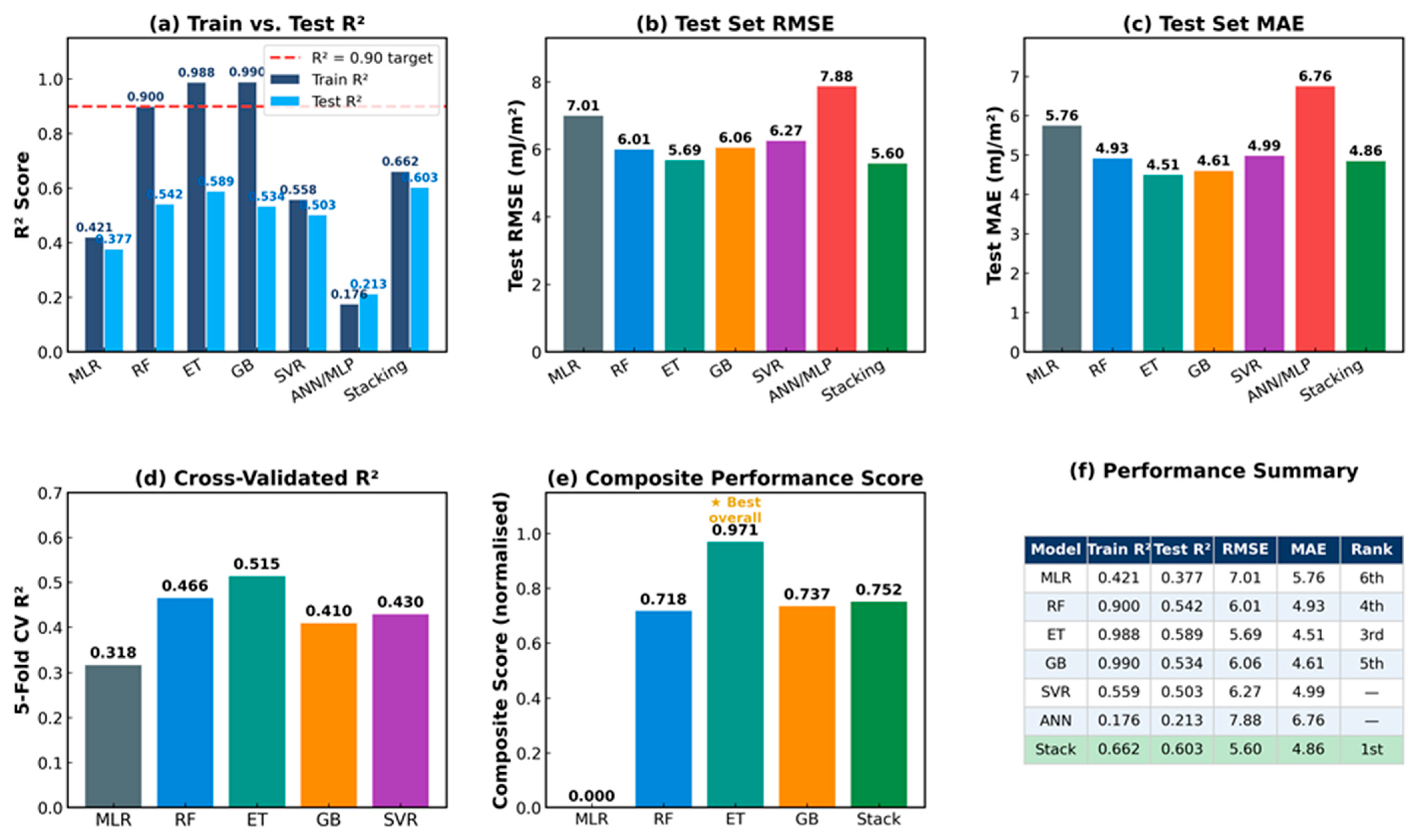
- ET (train R2 = 0.988), GB (train R2 = 0.990), and RF (train R2 = 0.900) all achieved train R2 ≥ 0.90, confirming that the alloy composition alone is a sufficient predictor of SFE in Fe–Mn–C–Si–Al–Cr–Ni–N systems within the studied compositional space.
- (2)
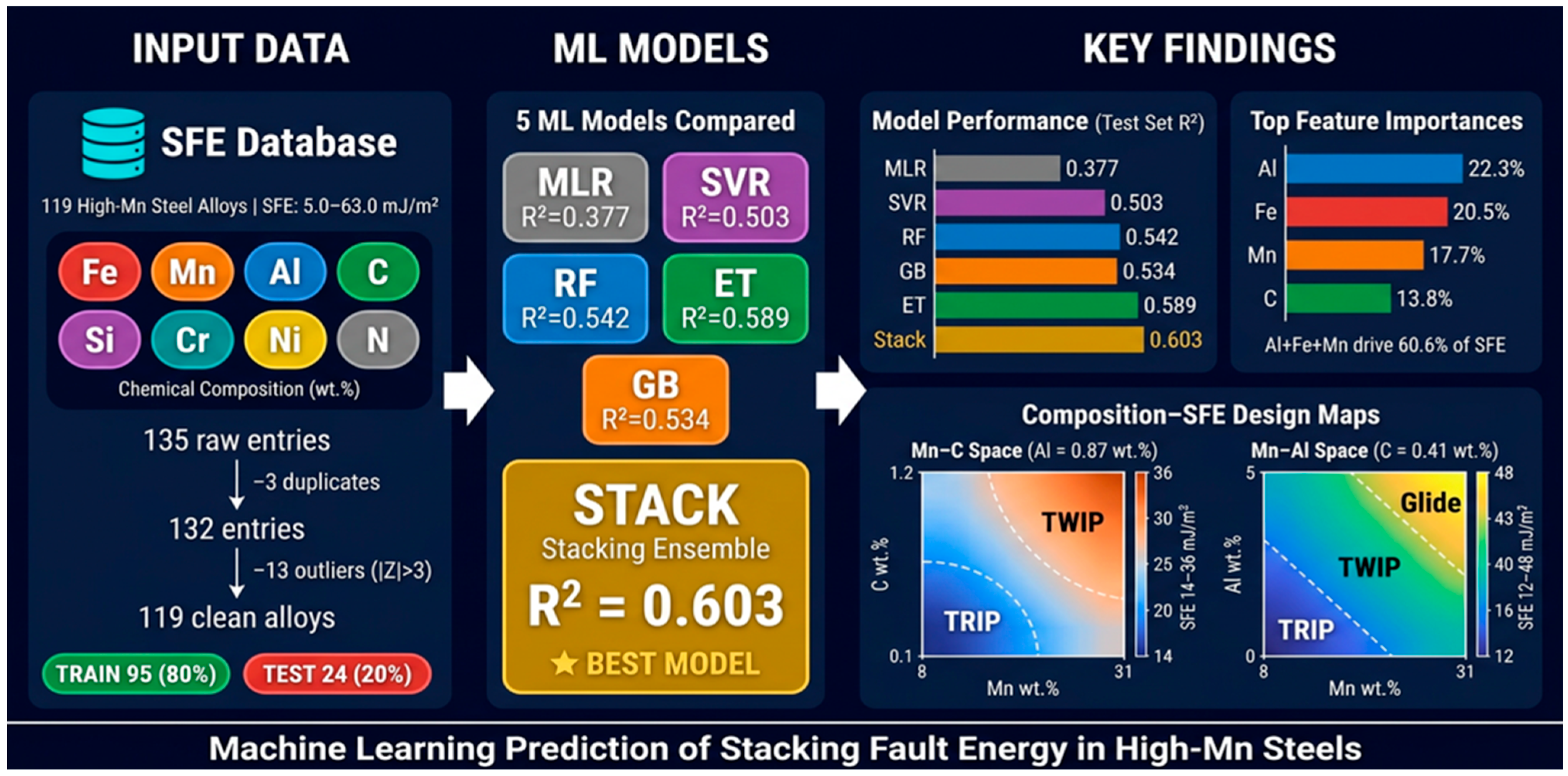
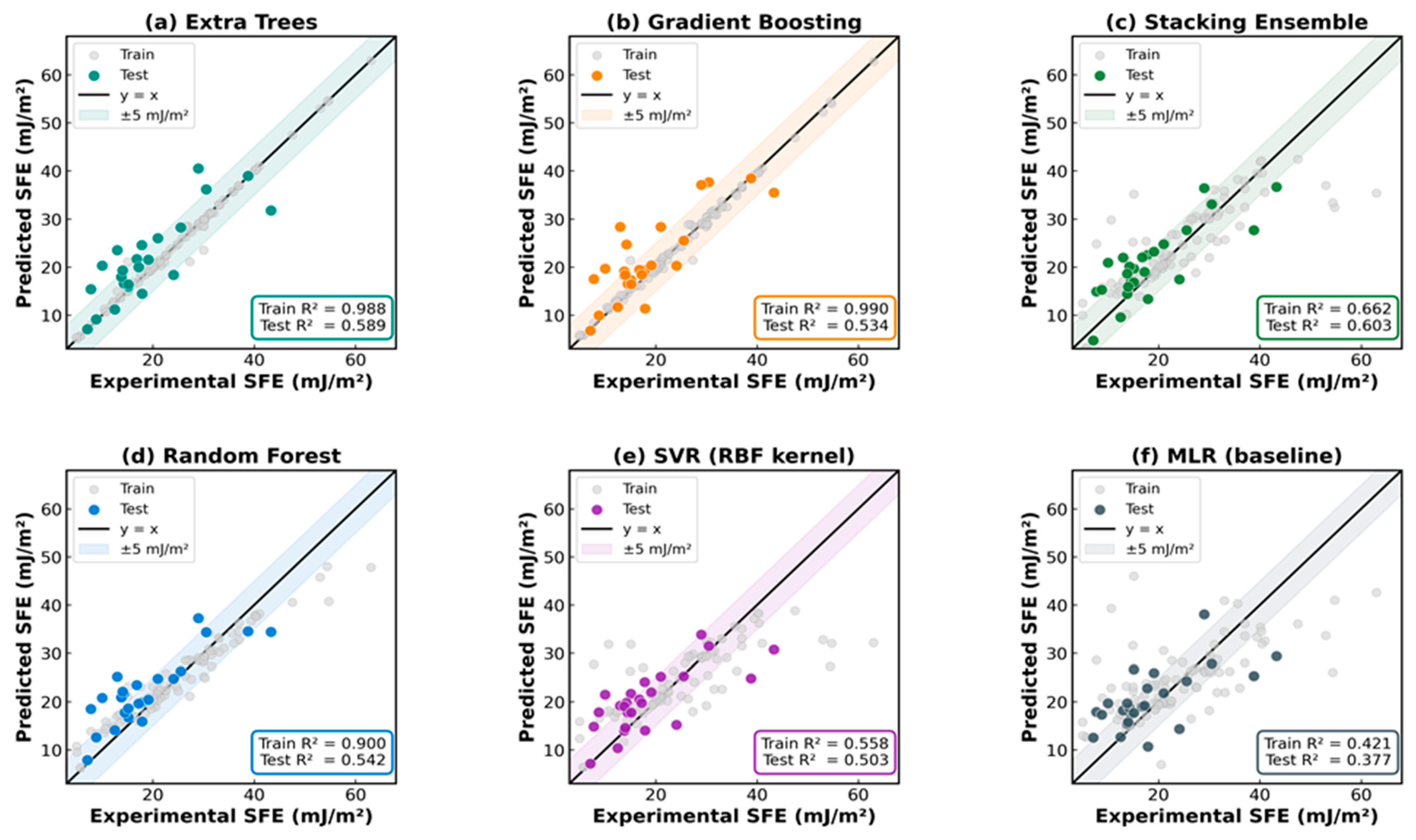
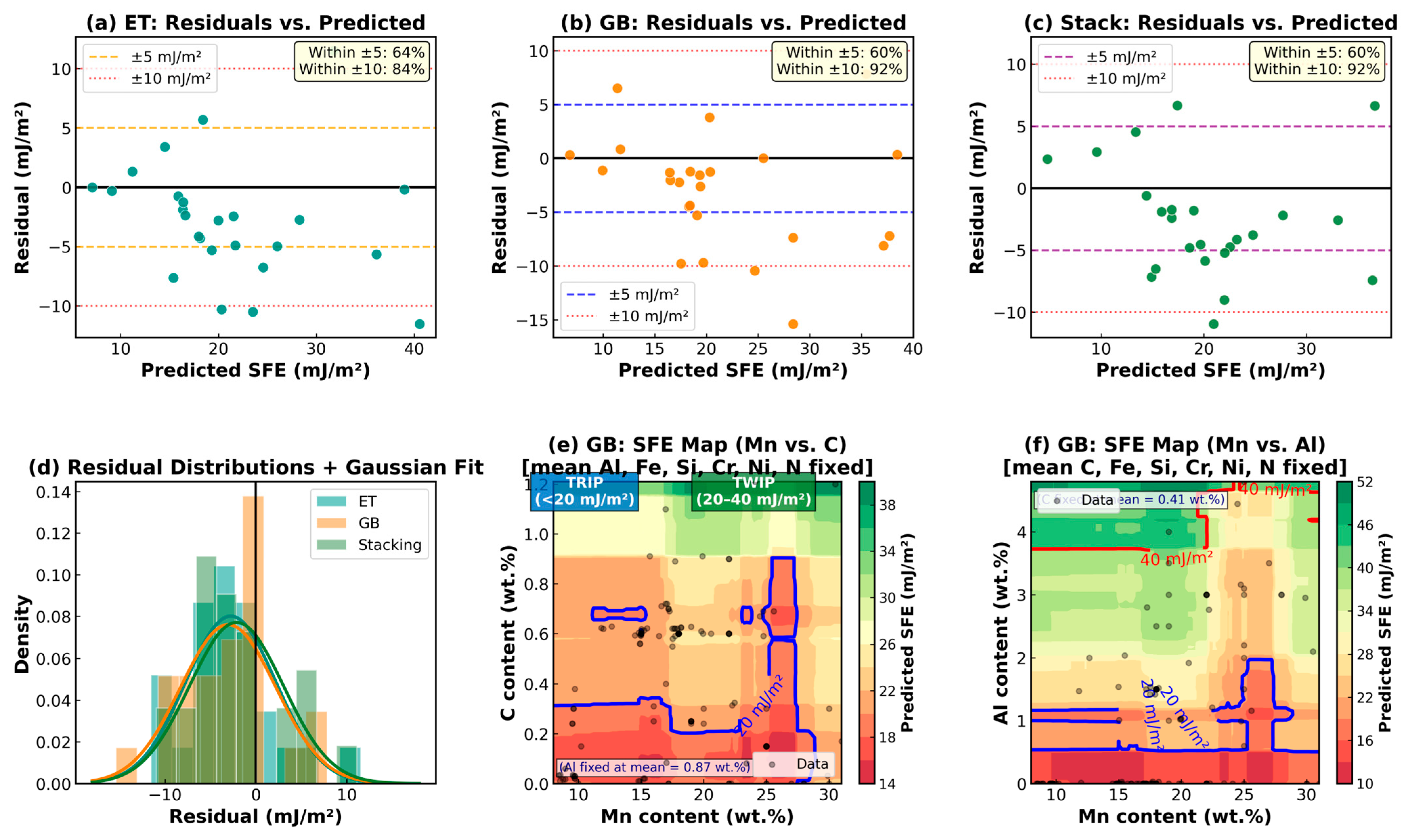
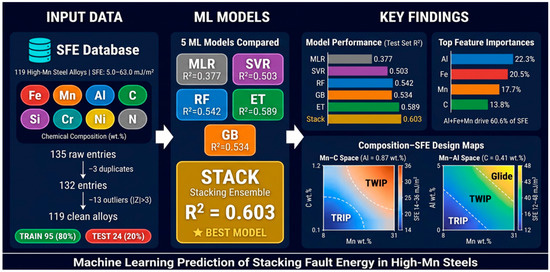
- The stacking ensemble (RF + GB + SVR base learners, ridge meta-learner) delivers the best test generalization (R2 = 0.603, RMSE = 5.60 mJ/m2, MAE = 4.86 mJ/m2), outperforming all individual learners. ET achieved the highest composite normalized performance score among the individual models (CV R2 = 0.515).
- (3)
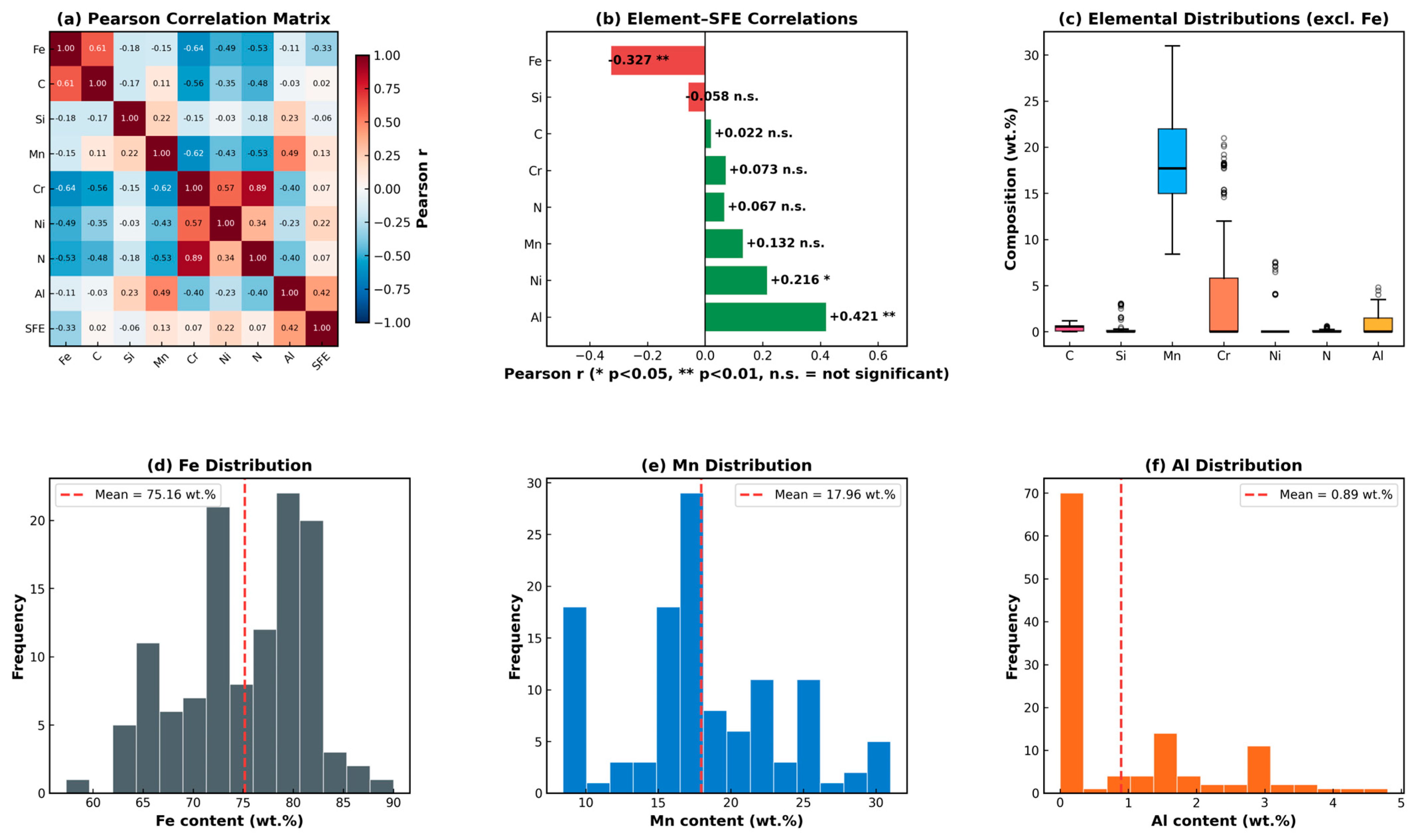
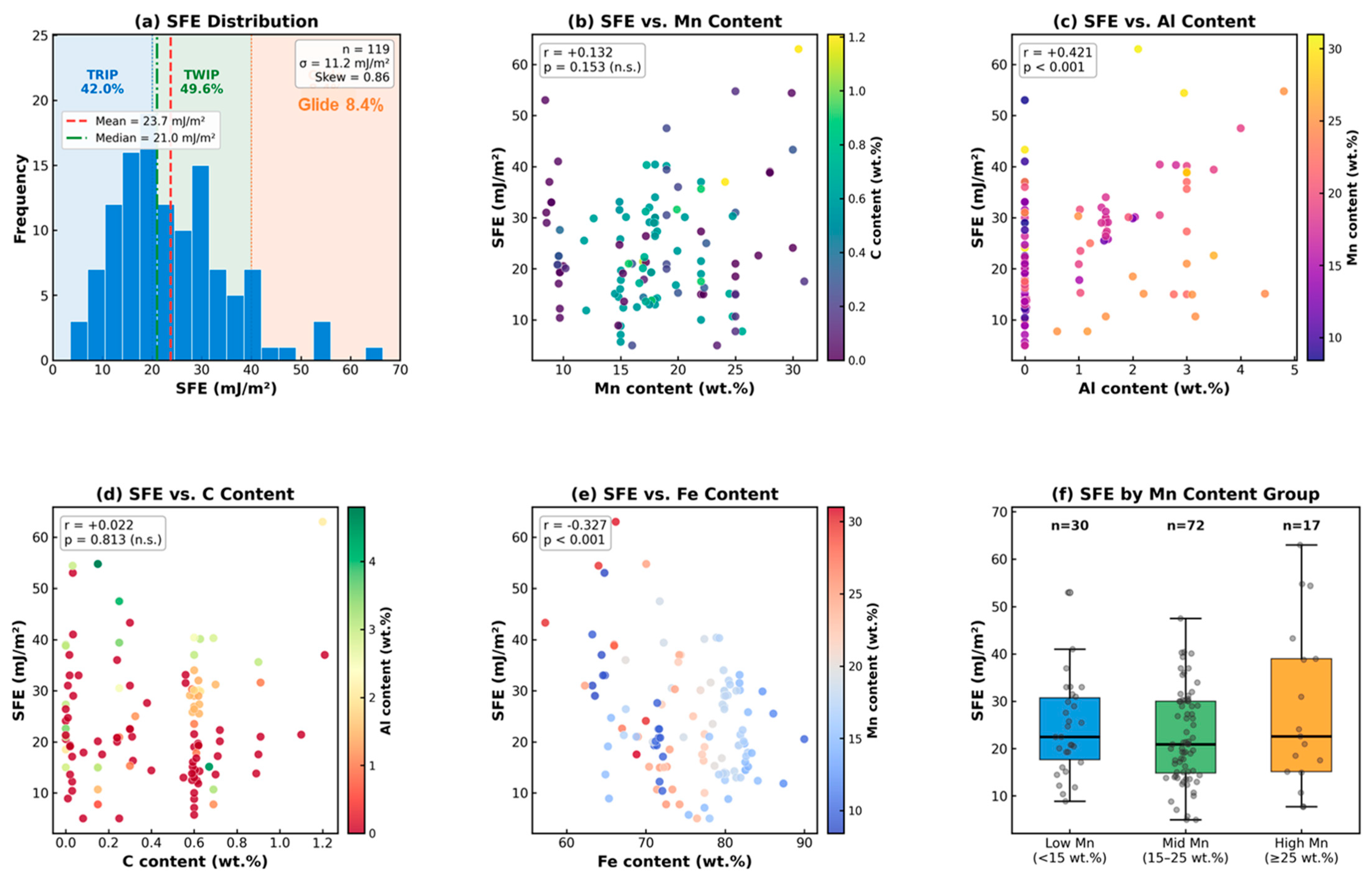
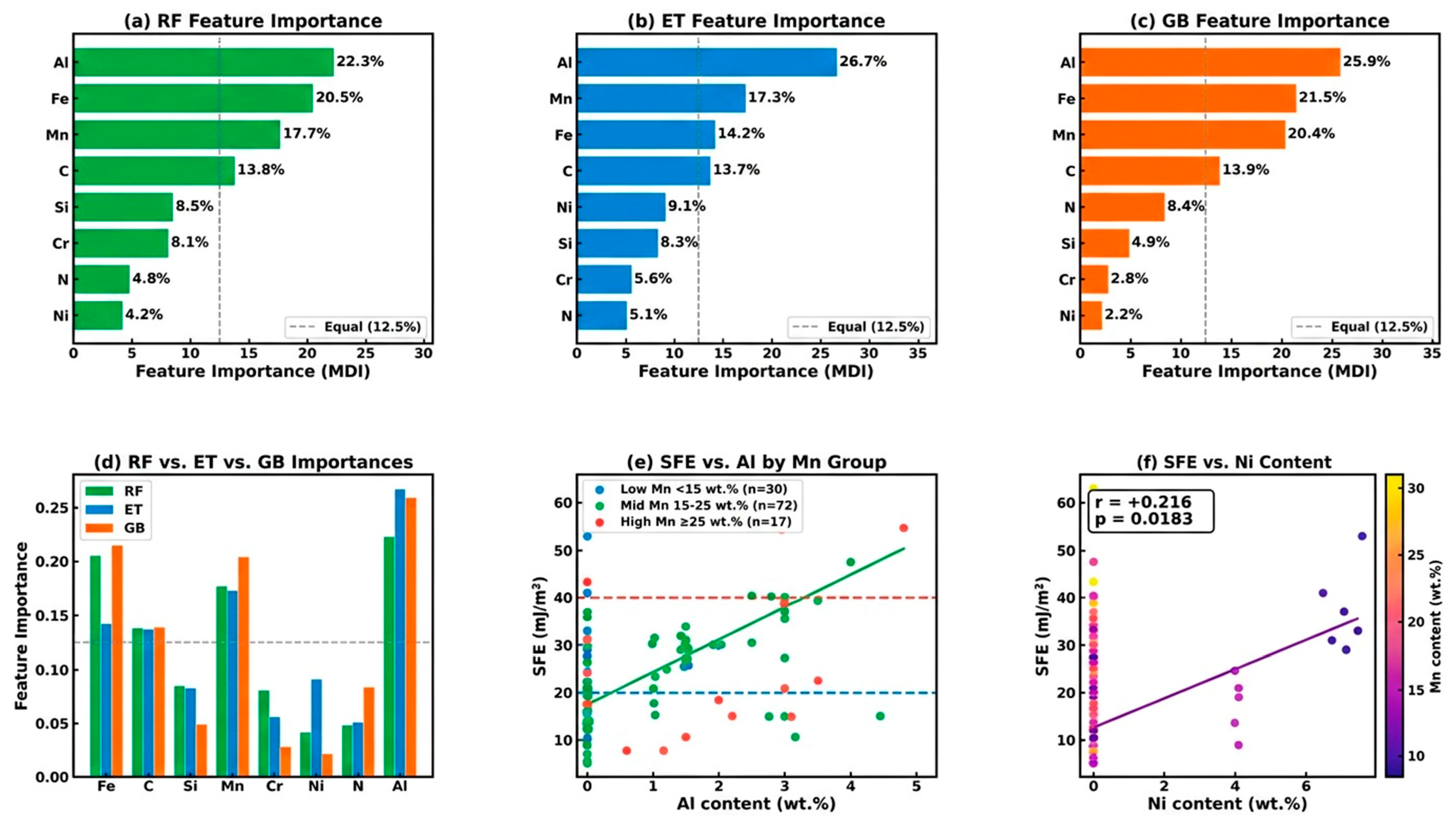
- Al was the most influential feature, as indicated by both the Pearson correlation (r = +0.421, p < 0.001) and RF/ET/GB feature importance (22.3–26.7%). Fe and Mn ranked second and third, respectively. Mn and C showed near-zero linear correlations despite substantial RF importance, confirming strong nonlinear compositional interactions that ensemble models capture but linear regression cannot.
- (4)
- Residual diagnostics confirm no systematic model bias; 60–64% of test residuals fall within ±5 mJ/m2 and 84–92% within ±10 mJ/m2, fully consistent with the ±3–5 mJ/m2 inherent inter-laboratory measurement scatter in the aggregated SFE database.
- (5)
- GB-derived SFE design maps reveal that in the Mn–C space (at mean Al = 0.87 wt.%), only the TRIP/TWIP boundary (~20 mJ/m2) isoline is accessible, while in the Mn–Al space the 40 mJ/m2 TWIP/Glide isoline is also reachable at Al ≥ ~3.5 wt.%, confirming Al as the primary compositional lever for accessing the dislocation-glide regime in high-Mn steels.
Supplementary Materials
Author Contributions
Funding
Data Availability Statement
Conflicts of Interest
References
- Grässel, O.; Krüger, L.; Frommeyer, G.; Meyer, L.W. High Strength Fe–Mn–(Al, Si) TRIP/TWIP Steels Development—Properties—Application. Int. J. Plast. 2000, 16, 1391–1409. [Google Scholar] [CrossRef]
- De Cooman, B.C.; Estrin, Y.; Kim, S.K. Twinning-Induced Plasticity (TWIP) Steels. Acta Mater. 2018, 142, 283–362. [Google Scholar] [CrossRef]
- Tiwari, S.; Narayana, P.L.; Ishtiaq, M.; Wang, X.-S.; Park, N.; Reddy, N.S. Artificial Neural Network-Based Prediction of Stacking Fault Energy in Fe-Cr-Mn-C-N Steels. Can. Metall. Q. 2025, 65, 1451–1459. [Google Scholar] [CrossRef]
- Pierce, D.T.; Jiménez, J.A.; Bentley, J.; Raabe, D.; Wittig, J.E. The Influence of Stacking Fault Energy on the Microstructural and Strain-Hardening Evolution of Fe–Mn–Al–Si Steels during Tensile Deformation. Acta Mater. 2015, 100, 178–190. [Google Scholar] [CrossRef]
- Saeed-Akbari, A.; Mosecker, L.; Schwedt, A.; Bleck, W. Characterization and Prediction of Flow Behavior in High-Manganese Twinning Induced Plasticity Steels: Part i. Mechanism Maps and Work-Hardening Behavior. Metall. Mater. Trans. A Phys. Metall. Mater. Sci. 2012, 43, 1688–1704. [Google Scholar] [CrossRef]
- Olson, G.B.; Cohen, M. A General Mechanism of Martensitic Nucleation: Part I. General Concepts and the FCC HCP Transformation. Metall. Trans. A 1976, 7, 1897–1904. [Google Scholar] [CrossRef]
- Dumay, A.; Chateau, J.-P.; Allain, S.; Migot, S.; Bouaziz, O. Influence of Addition Elements on the Stacking-Fault Energy and Mechanical Properties of an Austenitic Fe–Mn–C Steel. Mater. Sci. Eng. A 2008, 483–484, 184–187. [Google Scholar] [CrossRef]
- Chaudhary, N.; Abu-Odeh, A.; Karaman, I.; Arróyave, R. A Data-Driven Machine Learning Approach to Predicting Stacking Faulting Energy in Austenitic Steels. J. Mater. Sci. 2017, 52, 11048–11076. [Google Scholar] [CrossRef]
- Wang, X.; Xiong, W. Stacking Fault Energy Prediction for Austenitic Steels: Thermodynamic Modeling vs. Machine Learning. Sci. Technol. Adv. Mater. 2020, 21, 626–634. [Google Scholar] [CrossRef] [PubMed]
- Liu, Y.; Zhao, T.; Ju, W.; Shi, S. Materials Discovery and Design Using Machine Learning. J. Mater. 2017, 3, 159–177. [Google Scholar] [CrossRef]
- Agrawal, A.; Choudhary, A. Perspective: Materials Informatics and Big Data: Realization of the “Fourth Paradigm” of Science in Materials Science. APL Mater. 2016, 4, 053208. [Google Scholar] [CrossRef]
- Tiwari, S.; Heo, S.; Park, N.; Reddy, N.G.S. Modeling Mechanical Properties of Industrial C-Mn Cast Steels Using Artificial Neural Networks. Metals 2025, 15, 790. [Google Scholar] [CrossRef]
- Tiwari, S.; Dash, K.; Park, N.; Reddy, N.G.S. Machine Learning-Based Prediction of Atmospheric Corrosion Rates Using Environmental and Material Parameters. Coatings 2025, 15, 888. [Google Scholar] [CrossRef]
- Tiwari, S.; Ahn, H.; Reddy, M.H.; Park, N.; Reddy, N.G.S. Mechanical Property Prediction of Industrial Low-Carbon Hot-Rolled Steels Using Artificial Neural Networks. Materials 2025, 18, 2966. [Google Scholar] [CrossRef]
- Ishtiaq, M.; Tiwari, S.; Panigrahi, B.B.; Seol, J.B.; Reddy, N.S. Neural Network-Based Modeling of the Interplay between Composition, Service Temperature, and Thermal Conductivity in Steels for Engineering Applications. Int. J. Thermophys. 2024, 45, 137. [Google Scholar] [CrossRef]
- Liu, C.; Su, H. Prediction and Rational Design of Stacking Fault Energy of Austenitic Alloys Based on Interpretable Machine Learning and Chemical Composition. Steel Res. Int. 2024, 95, 2400225. [Google Scholar] [CrossRef]
- Song, L.; Wang, C.; Li, Y.; Wei, X. Predicting Stacking Fault Energy in Austenitic Stainless Steels via Physical Metallurgy-Based Machine Learning Approaches. J. Mater. Inform. 2025, 5, 2. [Google Scholar] [CrossRef]
- Castañeda, J.A.; Zambrano, O.A.; Alcázar, G.A.; Rodríguez, S.A.; Coronado, J.J. Stacking Fault Energy Determination in Fe-Mn-Al-C Austenitic Steels by X-Ray Diffraction. Metals 2021, 11, 1701. [Google Scholar] [CrossRef]
- Kawahara, Y.; Teranishi, R.; Takushima, C.; Hamada, J.; Kaneko, K. Effect of Nitrogen Addition on the Stacking-Fault Energies in Si-Added Austenitic Stainless Steel. ISIJ Int. 2021, 61, 1029–1036. [Google Scholar] [CrossRef]
- Lee, S.-J.; Ushioda, K.; Fujii, H. Evaluation of Stacking-Fault Energy in Fe-Mn Based Twinning-Induced Plasticity Steels after Friction Stir Welding. Mater. Charact. 2019, 147, 379–383. [Google Scholar] [CrossRef]
- Lee, S.-J.; Fujii, H.; Ushioda, K. Thermodynamic Calculation of the Stacking Fault Energy in Fe-Cr-Mn-C-N Steels. J. Alloys Compd. 2018, 749, 776–782. [Google Scholar] [CrossRef]
- Lee, S.-J.; Sun, Y.; Fujii, H. Stacking-Fault Energy, Mechanical Twinning and Strain Hardening of Fe-18Mn-0.6C-(0, 1.5)Al Twinning-Induced Plasticity Steels during Friction Stir Welding. Acta Mater. 2018, 148, 235–248. [Google Scholar] [CrossRef]
- Jeong, K.; Jin, J.-E.; Jung, Y.-S.; Kang, S.; Lee, Y.-K. The Effects of Si on the Mechanical Twinning and Strain Hardening of Fe–18Mn–0.6C Twinning-Induced Plasticity Steel. Acta Mater. 2013, 61, 3399–3410. [Google Scholar] [CrossRef]
- Yoo, J.; Choi, K.; Zargaran, A.; Kim, N.J. Effect of Stacking Faults on the Ductility of Fe-18Mn-1.5Al-0.6C Twinning-Induced Plasticity Steel at Low Temperatures. Scr. Mater. 2017, 137, 18–21. [Google Scholar] [CrossRef]
- Song, R.; Cai, C.; Liu, S.; Feng, Y.; Pei, Z. Stacking Fault Energy and Compression Deformation Behavior of Ultra-High Manganese Steel. Procedia Eng. 2017, 207, 1809–1814. [Google Scholar] [CrossRef]
- Yang, H.K.; Doquet, V.; Zhang, Z.F. Fatigue Crack Growth in Two TWIP Steels with Different Stacking Fault Energies. Int. J. Fatigue 2017, 98, 247–258. [Google Scholar] [CrossRef]
- Brasche, F.; Haase, C.; Barrales-Mora, L.A.; Molodov, D.A. Comparative Study of the Influence of Reversion- and Recovery- Annealing on the Mechanical Behavior of High-Manganese Steels with Varying Stacking Fault Energy. Steel Res. Int. 2018, 89, 1700377. [Google Scholar] [CrossRef]
- Zambrano, O.A. Stacking Fault Energy Maps of Fe–Mn–Al–C–Si Steels: Effect of Temperature, Grain Size, and Variations in Compositions. J. Eng. Mater. Technol. 2016, 138, 041010. [Google Scholar] [CrossRef]
- Lu, J.; Hultman, L.; Holmström, E.; Antonsson, K.H.; Grehk, M.; Li, W.; Vitos, L.; Golpayegani, A. Stacking Fault Energies in Austenitic Stainless Steels. Acta Mater. 2016, 111, 39–46. [Google Scholar] [CrossRef]
- Lee, S.-J.; Jung, Y.-S.; Baik, S.-I.; Kim, Y.-W.; Kang, M.; Woo, W.; Lee, Y.-K. The Effect of Nitrogen on the Stacking Fault Energy in Fe–15Mn–2Cr–0.6C–XN Twinning-Induced Plasticity Steels. Scr. Mater. 2014, 92, 23–26. [Google Scholar] [CrossRef]
- Kim, J.; Lee, S.-J.; De Cooman, B.C. Effect of Al on the Stacking Fault Energy of Fe–18Mn–0.6C Twinning-Induced Plasticity. Scr. Mater. 2011, 65, 363–366. [Google Scholar] [CrossRef]
- Kim, J.; De Cooman, B.C. On the Stacking Fault Energy of Fe-18 Pct Mn-0.6 Pct C-1.5 Pct Al Twinning-Induced Plasticity Steel. Metall. Mater. Trans. A 2011, 42, 932–936. [Google Scholar] [CrossRef]
- Lee, T.-H.; Ha, H.-Y.; Hwang, B.; Kim, S.-J.; Shin, E. Effect of Carbon Fraction on Stacking Fault Energy of Austenitic Stainless Steels. Metall. Mater. Trans. A 2012, 43, 4455–4459. [Google Scholar] [CrossRef]
- Tian, X.; Li, H.; Zhang, Y. Effect of Al Content on Stacking Fault Energy in Austenitic Fe–Mn–Al–C Alloys. J. Mater. Sci. 2008, 43, 6214–6222. [Google Scholar] [CrossRef]
- Stoltz, R.E.; Vander Sande, J.B. The Effect of Nitrogen on Stacking Fault Energy of Fe-Ni-Cr-Mn Steels. Metall. Trans. A 1980, 11, 1033–1037. [Google Scholar] [CrossRef]
- Xiong, R.; Peng, H.; Wang, S.; Si, H.; Wen, Y. Effect of Stacking Fault Energy on Work Hardening Behaviors in Fe–Mn–Si–C High Manganese Steels by Varying Silicon and Carbon Contents. Mater. Des. 2015, 85, 707–714. [Google Scholar] [CrossRef]
- Mahato, B.; Shee, S.K.; Sahu, T.; Ghosh Chowdhury, S.; Sahu, P.; Porter, D.A.; Karjalainen, L.P. An Effective Stacking Fault Energy Viewpoint on the Formation of Extended Defects and Their Contribution to Strain Hardening in a Fe–Mn–Si–Al Twinning-Induced Plasticity Steel. Acta Mater. 2015, 86, 69–79. [Google Scholar] [CrossRef]
- Lang, D.; Li, Q.; Huang, X.; Huang, W. Stacking Fault Energy and Fcc→hcp Transformation Driving Force in Fe-Mn-C-Cr-Si High Manganese Steels and Experimental Investigation. Mater. Res. Express 2021, 8, 86507. [Google Scholar] [CrossRef]
- Zohrevand, M.; Aghaie-Khafri, M.; Forouzan, F.; Vuorinen, E. Microstructural Evolutions under Ultrasonic Treatment in 304 and 316 Austenitic Stainless Steels: Impact of Stacking Fault Energy. Steel Res. Int. 2021, 92, 2100041. [Google Scholar] [CrossRef]
- Bae, H.J.; Ko, K.K.; Ishtiaq, M.; Kim, J.G.; Sung, H.; Seol, J.B. On the Stacking Fault Forming Probability and Stacking Fault Energy in Carbon-Doped 17 At% Mn Steels via Transmission Electron Microscopy and Atom Probe Tomography. J. Mater. Sci. Technol. 2022, 115, 177–188. [Google Scholar] [CrossRef]
- Hwang, S.W.; Ji, J.H.; Park, K.-T. Effects of Al Addition on High Strain Rate Deformation of Fully Austenitic High Mn Steels. Mater. Sci. Eng. A 2011, 528, 7267–7275. [Google Scholar] [CrossRef]
- Kim, J.-K.; De Cooman, B.C. Stacking Fault Energy and Deformation Mechanisms in Fe-XMn-0.6C-YAl TWIP Steel. Mater. Sci. Eng. A 2016, 676, 216–231. [Google Scholar] [CrossRef]
- Hwang, J.-K. Deformation Behaviors of Various Fe–Mn–C Twinning-Induced Plasticity Steels: Effect of Stacking Fault Energy and Chemical Composition. J. Mater. Sci. 2020, 55, 1779–1795. [Google Scholar] [CrossRef]
- Breiman, L. Random Forests. Mach. Learn. 2001, 45, 5–32. [Google Scholar] [CrossRef]
- Geurts, P.; Ernst, D.; Wehenkel, L. Extremely Randomized Trees. Mach. Learn. 2006, 63, 3–42. [Google Scholar] [CrossRef]
- Friedman, J. Greedy Function Approximation: A Gradient Boosting Machine. Ann. Stat. 2000, 29, 1189–1232. [Google Scholar] [CrossRef]
- Pedregosa, F.; Varoquaux, G.; Gramfort, A.; Michel, V.; Thirion, B.; Grisel, O.; Blondel, M.; Prettenhofer, P.; Weiss, R.; Dubourg, V.; et al. Scikit-Learn: Machine Learning in Python. J. Mach. Learn. Res. 2011, 12, 2825–2830. [Google Scholar]
- Pierce, D.T.; Jiménez, J.A.; Bentley, J.; Raabe, D.; Oskay, C.; Wittig, J.E. The Influence of Manganese Content on the Stacking Fault and Austenite/ε-Martensite Interfacial Energies in Fe–Mn–(Al–Si) Steels Investigated by Experiment and Theory. Acta Mater. 2014, 68, 238–253. [Google Scholar] [CrossRef]
- Niessen, F.; Li, W.; Werner, K.V.; Lu, S.; Vitos, L.; Villa, M.; Somers, M.A.J. Ab Initio Study of the Effect of Interstitial Alloying on the Intrinsic Stacking Fault Energy of Paramagnetic γ-Fe and Austenitic Stainless Steel. Acta Mater. 2023, 253, 118967. [Google Scholar] [CrossRef]
- Lundberg, S.M.; Lee, S.-I. A Unified Approach to Interpreting Model Predictions. In Proceedings of the Advances in Neural Information Processing Systems; Guyon, I., Luxburg, U., Von, Bengio, S., Wallach, H., Fergus, R., Vishwanathan, S., Garnett, R., Eds.; Curran Associates, Inc.: Red Hook, NY, USA, 2017; Volume 30. [Google Scholar]




| Element | Min | Max | Mean | Median | Std Dev | Unit |
|---|---|---|---|---|---|---|
| Fe | 57.30 | 90.00 | 75.16 | 76.45 | 6.52 | wt.% |
| C | 0.00 | 1.21 | 0.41 | 0.56 | 0.30 | wt.% |
| Si | 0.00 | 3.09 | 0.38 | 0.00 | 0.90 | wt.% |
| Mn | 8.43 | 31.00 | 17.96 | 17.70 | 5.50 | wt.% |
| Cr | 0.00 | 21.00 | 4.52 | 0.00 | 7.10 | wt.% |
| Ni | 0.00 | 7.58 | 0.59 | 0.00 | 1.83 | wt.% |
| N | 0.00 | 0.61 | 0.09 | 0.00 | 0.16 | wt.% |
| Al | 0.00 | 4.80 | 0.89 | 0.00 | 1.24 | wt.% |
| SFE | 5.00 | 63.00 | 23.7 | 21.00 | 11.16 | mJ/m2 |
| Model | Train R2 | Test R2 | Train RMSE | Test RMSE | Test MAE | CV R2 | Rank |
|---|---|---|---|---|---|---|---|
| MLR | 0.421 | 0.377 | 8.77 | 7.01 | 5.76 | 0.318 | 6th |
| RF | 0.900 | 0.542 | 3.65 | 6.01 | 4.93 | 0.466 | 4th |
| ET | 0.988 | 0.589 | 1.24 | 5.69 | 4.51 | 0.515 | 3rd |
| GB | 0.990 | 0.534 | 1.17 | 6.06 | 4.61 | 0.410 | 5th |
| SVR | 0.559 | 0.503 | 7.66 | 6.27 | 4.99 | 0.430 | — |
| ANN/MLP | 0.176 | 0.213 | — | 7.88 | 6.76 | — | — |
| Stacking | 0.662 | 0.603 | 6.71 | 5.60 | 4.86 | — | 1st |
Disclaimer/Publisher’s Note: The statements, opinions and data contained in all publications are solely those of the individual author(s) and contributor(s) and not of MDPI and/or the editor(s). MDPI and/or the editor(s) disclaim responsibility for any injury to people or property resulting from any ideas, methods, instructions or products referred to in the content. |
© 2026 by the authors. Licensee MDPI, Basel, Switzerland. This article is an open access article distributed under the terms and conditions of the Creative Commons Attribution (CC BY) license.
Share and Cite
Tiwari, S.; Heo, S.J.; Park, N. Machine Learning-Based Prediction of Stacking Fault Energy in High-Manganese Steels: A Comparative Study of Ensemble and Kernel Methods. Materials 2026, 19, 1940. https://doi.org/10.3390/ma19101940
Tiwari S, Heo SJ, Park N. Machine Learning-Based Prediction of Stacking Fault Energy in High-Manganese Steels: A Comparative Study of Ensemble and Kernel Methods. Materials. 2026; 19(10):1940. https://doi.org/10.3390/ma19101940
Chicago/Turabian StyleTiwari, Saurabh, Seong Jun Heo, and Nokeun Park. 2026. "Machine Learning-Based Prediction of Stacking Fault Energy in High-Manganese Steels: A Comparative Study of Ensemble and Kernel Methods" Materials 19, no. 10: 1940. https://doi.org/10.3390/ma19101940
APA StyleTiwari, S., Heo, S. J., & Park, N. (2026). Machine Learning-Based Prediction of Stacking Fault Energy in High-Manganese Steels: A Comparative Study of Ensemble and Kernel Methods. Materials, 19(10), 1940. https://doi.org/10.3390/ma19101940