Article

Multifunctional Alginate Composite Fibers Based on Pre-Crosslinked Spinning Solutions

Shandong Key Laboratory of Renewable Membrane Materials, College of Materials Science and Engineering, Qingdao University, Qingdao 266071, China
*
Author to whom correspondence should be addressed.
These authors contributed equally to this work.
Materials 2026, 19(10), 1933; https://doi.org/10.3390/ma19101933
Submission received: 13 April 2026 / Revised: 3 May 2026 / Accepted: 6 May 2026 / Published: 8 May 2026
(This article belongs to the Section Advanced Composites)

Abstract

Because the environmental pollution arising from microplastics and carbon emissions continues to intensify, biodegradable alginate fibers have become green candidates to relieve the environmental crisis. However, the facile fabrication of alginate fibers with excellent mechanical strength and specific functionalities remains challenging. This study incorporates titanium dioxide (TiO2) nanoparticles into pre-crosslinked sodium alginate (SA) spinning solutions to fabricate multifunctional alginate composite fibers by a one-step wet-spinning strategy. Due to the pre-crosslinking of calcium ions (Ca2+), the spinning solution shows favorable rheological performance for wet spinning, ensuring the continuous fabrication of the fibers. By optimizing the TiO2 content, SA/TiO2 composite fibers exhibit oriented and uniform morphology, as well as enhanced mechanical performance (breaking stress of 400 MPa and Young’s modulus of 17.2 GPa). The incorporation of TiO2 also endows the fibers with excellent formaldehyde degradation and quick self-extinguished capacity, expanding their applications in formaldehyde-removal and flame-retardant textiles.

1. Introduction

The rapid development of the petrochemical industry has incorporated synthetic textile products into daily life, which have given rise to a series of ecological and environmental issues [1,2,3,4,5]. Because synthetic fibers are more susceptible to forming microplastics due to their high aspect ratios [6,7,8,9], fiber-based microplastics account for more than half of all microplastics in global wastewater [10]. Therefore, the development of environmentally friendly fibers has emerged as a feasible approach to address pollution challenges [11,12,13]. Sodium alginate (SA), which is extracted from algae, is a linear chain polysaccharide consisting of M (β-D-mannuronic acid) and G (α-L-guluronic acid) segments [14]. The “egg-box” structures are formed through ionic cross-linking between the G segments of SA and divalent metal ions [15,16,17], providing a feasible approach to fabricate SA fibers via wet spinning [18]. With pre-stretching, alginate fibers with a tensile strength of up to 2 cN/dtex can be obtained [19]. During the fabrication of SA fibers, the rapid cross-linking with Ca2+ ions creates a calcium alginate outer layer that hinders the further diffusion of Ca2+ ions, which leads to the formation of a skin–core structure in the resultant fibers and compromises their mechanical properties [20,21]. The relatively poor mechanical properties limit the application of alginate fibers. Thus, there are two major problems for alginate fibers: the low mechanical strength and insufficient functionalities.
The above-mentioned limitations have been addressed through various strategies, such as pre-stretching [20], adding functional additives [21,22,23,24,25], and introducing ultra-high molecular weight polymers [26]. However, these strategies for enhancing mechanical properties of alginate fibers have limitations. For example, although additives and ultra-high molecular weight polymers improve the mechanical properties of fibers, they compromise the excellent biodegradability of the fibers. The pre-stretching process only enhances fiber strength to a limited extent. Faced with these drawbacks, it is necessary to develop a novel and facile strategy to reinforce alginate fibers without compromising the biodegradability. Hao et al. pre-crosslinked SA chains with Ca2+ ions to regulate the rheological properties of the spinning solution and fabricated alginate multifilaments with good spinnability and breaking stress as high as 474 MPa because of the strong intermolecular hydrogen bonding and high degree of orientation [27]. This novel strategy opens a new window for the facile and continuous fabrication of alginate fibers with high strength. Titanium dioxide (TiO2) nanoparticles have been proven to possess the ability to decompose formaldehyde under UV light [28,29,30,31]. Thus, TiO2 nanoparticles can serve as functional additives to endow alginate fibers with new functionalities. However, fibers with the incorporation of TiO2 nanoparticles often face challenges such as uniform particle dispersion and complicated preparation processes [32,33].
In this work, Ca2+ pre-crosslinked SA/TiO2 solutions were used as spinning solutions to prepare high-strength and multifunctional composite fibers via wet spinning. The shear and extensional rheological behaviors of pre-crosslinked SA/TiO2 solutions with various TiO2 solid contents were studied. Alginate composite fibers with varying TiO2 mass fractions were wet spun, and the mechanical properties and morphology of the composite fibers were systematically measured. The formaldehyde degradation and flame-retardant capacity of the composite fibers with optimal TiO2 mass fractions were also examined.

2. Experimental Section

2.1. Materials

Sodium alginate (SA) with a viscosity of 1100 mPa·s, a G/M ratio of 2:1, and a molecular weight (Mw) of 221,500 Da was purchased from Qingdao Hyzlin Biology Development Company Limited (Qingdao, China). Ethylenediaminetetraacetic acid disodium calcium (EDTA-Ca) and glucono delta-lactone (GDL) were purchased from Aladdin Chemical Company Limited (Shanghai, China). Calcium chloride (CaCl2) and formaldehyde solutions (10 mg/mL) were obtained from Aladdin Chemistry Company Limited. Titanium dioxide (TiO2) nanoparticles with a diameter of ~200 nm were purchased from Tianjin Baima Technology Company Limited (Tianjin, China). Deionized (DI) water from Millipore (Burlington, MA, USA) was used for solution preparation. All reagents were employed as received without additional purification.

2.2. Preparation of SA/TiO2 Spinning Solution

The prescribed TiO2 nanoparticles were dispersed in 300 mL deionized water by ultrasonication for 1 h to prepare SA/TiO2 solutions with 1%, 3%, 5%, 7%, and 10% TiO2 relative to the mass of SA. A total of 8 g of SA powder was then added to the well-dispersed solution and mechanically stirred for 12 h until a homogeneous mixture was obtained. A total of 0.807 g of EDTA-Ca was dissolved in an appropriate amount of water, added into the SA/TiO2 solution, and stirred for 1 h until a uniform solution was formed to achieve the molar ratio (f) = 0.08 ([Ca2+]/[COO in G blocks]). Afterwards, 0.525 g of GDL was added to the spinning solution, thoroughly stirred, and left to stand in a sealed beaker at room temperature for three days to ensure the full release of Ca2+. Finally, a spinning solution of 2 wt% SA was obtained.

2.3. Preparation of SA/TiO2 Composite Fibers

The spinning solution was degassed by standing at room temperature and atmospheric pressure for 1 day. The spinning solution was extruded at an air pressure of 0.1 MPa, with the flow rate controlled by a gear metering pump. Before passing through a 200-mesh spinneret (orifice diameter: 100 μm), the spinning solution was first filtered through a 200-mesh metal filter to remove the impurities. The stretch ratio (SR) was set to 1 (SR = vc/ve, where vc and ve represent the collection speed and extrusion speed, respectively). The solution was extruded into a 5 wt% CaCl2 coagulation bath for crosslinking. Then, the fibers were thoroughly washed with DI water and ethanol in sequence. The sample was then left to dry at room temperature and atmospheric pressure. All spinning processes were replicated three times. The composite fiber samples for subsequent mechanical tests were randomly selected from three parallel batches.

2.4. Characterization

TiO2 was dispersed in DI water, and the resultant mixture was treated with an ultrasonic processor at 100 W and frequency of 20–25 kHz for 30 min to obtain a 0.01 wt% TiO2 solution. Immediately after ultrasonication, the particle size of TiO2 nanoparticles was measured using dynamic light scattering (DLS). X-ray diffraction (XRD) analysis of the sample was performed on an Ultima IV diffractometer. A DHR-3 rheometer from TA Instruments (New Castle, DE, USA) was used to analyze the shear rheological behaviors of SA solutions containing different TiO2 contents. The measurements were performed at 25 °C using a cone-plate fixture (diameter: 60 mm, cone angle: 1.5°, gap: 45 μm), after which steady shear tests were then conducted over a shear rate range of 0.01–1000 s−1. The non-Newtonian index can be determined by fitting the resulting data to a power-law formula:
η = K   γ · n 1
where K is the consistency index and n is the non-Newtonian index, η is the shear viscosity, and γ · is the shear rate. Extensional rheological testing of spinning solutions was performed using a CaBER 1 capillary breakup rheometer (HAAKE) that featured a 6 mm diameter fixture. The test solutions were initially gapped at 3 mm and then pre-stretched at 94 mm/s to reach a 9 mm final gap.
The Favimat-airobot single fiber testing system (Textechno, Mönchengladbach, Germany) was used to conduct mechanical tests on the fibers under certain conditions (25 ± 2 °C, 65%RH). The initial length and strain rate were set to 10 mm and 5 mm/min, respectively. The fiber diameter was measured using an optical microscope (Leica DM2700P, Leica, Wetzlar, Germany), and the cross-sectional area was calculated by the diameter. For each sample, a minimum of 10 replicate measurements were carried out. Polarized observation was carried out in transmitted light mode using a Leica DM2700P microscope (Leica, Wetzlar, Germany). A JEOL JSM-6390LV scanning electron microscope (SEM) (JEOL, Tokyo, Japan) was used to characterize the surface morphology of the composite fibers. Before SEM testing at an accelerating voltage of 15 kV, the fiber surface was sputter coated with a thin gold layer. The limiting oxygen index (LOI) of fabrics with dimensions of 150 mm × 58 mm was measured using a limiting oxygen index analyzer (TTech-GBT2406-4, TESTech, Suzhou, China).

3. Results and Discussion

3.1. Rheological Properties of SA/TiO2 Spinning Solutions

Large particle size and agglomeration are prone to cause nanoparticles to act as defects in the fibers, leading to stress concentration and fiber fracture under external force. Therefore, it is necessary to select TiO2 nanoparticles with an appropriate size that meets the requirements of fiber preparation. It can be observed that the XRD pattern of the TiO2 powder shows diffraction peaks near 2θ = 25°, 37°, 48°, and 55°, which are consistent with those of anatase TiO2 (Figure S1). As shown in Figure S2, the particle size of the employed TiO2 is in the range of 200–300 nm. The optical microscopy image of SA/ TiO2 solutions shows a small degree of aggregation of TiO2 nanoparticles (Figure S3).
The shear and extensional rheological behaviors of pre-crosslinked spinning solutions (f = 0.08) with different TiO2 solid contents were analyzed to investigate their spinnability. As shown in Figure 1a, the viscosity of the solutions decreases with increasing shear rate, exhibiting a typical shear-thinning behavior. As shown in Figure 1b, the zero-viscosity of SA/TiO2 solutions first drastically decreases from 8000 to 1500 mPa·s with the addition of 1% TiO2 and then fluctuates around 1300 mPa·s with the further increase in TiO2 content from 1 to 10%. The drastic decrease in the viscosity by adding 1% TiO2 is attributed to the fact that SA chains absorb on the surface of TiO2 nanoparticles, which reduces the degree of entanglements of SA chains in the solutions. This phenomenon has been reported for different polymer-nanoparticle systems [34,35,36]. The fluctuation of the viscosity when TiO2 content is in the range of 1% to 10% is because of the interplay of two effects: the increased concentration of TiO2 nanoparticles and the aggregation of TiO2 nanoparticles that decreases the surface area for SA chain absorbing. These two effects work together to generate a viscosity without prominent variation with TiO2 content.
Using the five points at high shear rate in Figure 1a to perform linear fitting according to Equation (1), the non-Newtonian index (n) is determined by adding 1 to the slope of the fitted line (Figure 1c). When the TiO2 content increases from 0% to 1%, n increases drastically, which indicates that the introduction of TiO2 drastically decreases the shear-thinning degree of the solution. With TiO2 content increasing from 1% to 10%, the value of n fluctuates around 0.55, demonstrating that when the TiO2 content exceeds 1%, the further addition of TiO2 hardly affects the shear-thinning behavior of the solution. As shown in Figure 1d, after the incorporation of 1% TiO2, due to the reduction in the entanglement density and friction between SA chains, the pinch-off time during the capillary force-driven breakup of the SA/TiO2 solution decreases from 1.9 s to 0.7 s. With the further addition of TiO2, the pinch-off time stabilized at ~0.5 s. It was reported that the pinch-off time during the capillary force-driven breakup of SA solutions increased from 0.7 s to 1.8 s with f increasing from 0 to 0.08, demonstrating that pre-crosslinking with Ca2+ delays the relaxation of SA chains during stretching [27]. Since the pinch-off time of the solutions becomes shorter after incorporation TiO2, pre-crosslinking ensures sufficient pinch-off time for SA solutions containing TiO2 nanoparticles. This is indispensable for a good spinnability during wet spinning of the fibers.

3.2. Mechanical Properties of SA/TiO2 Composite Fibers

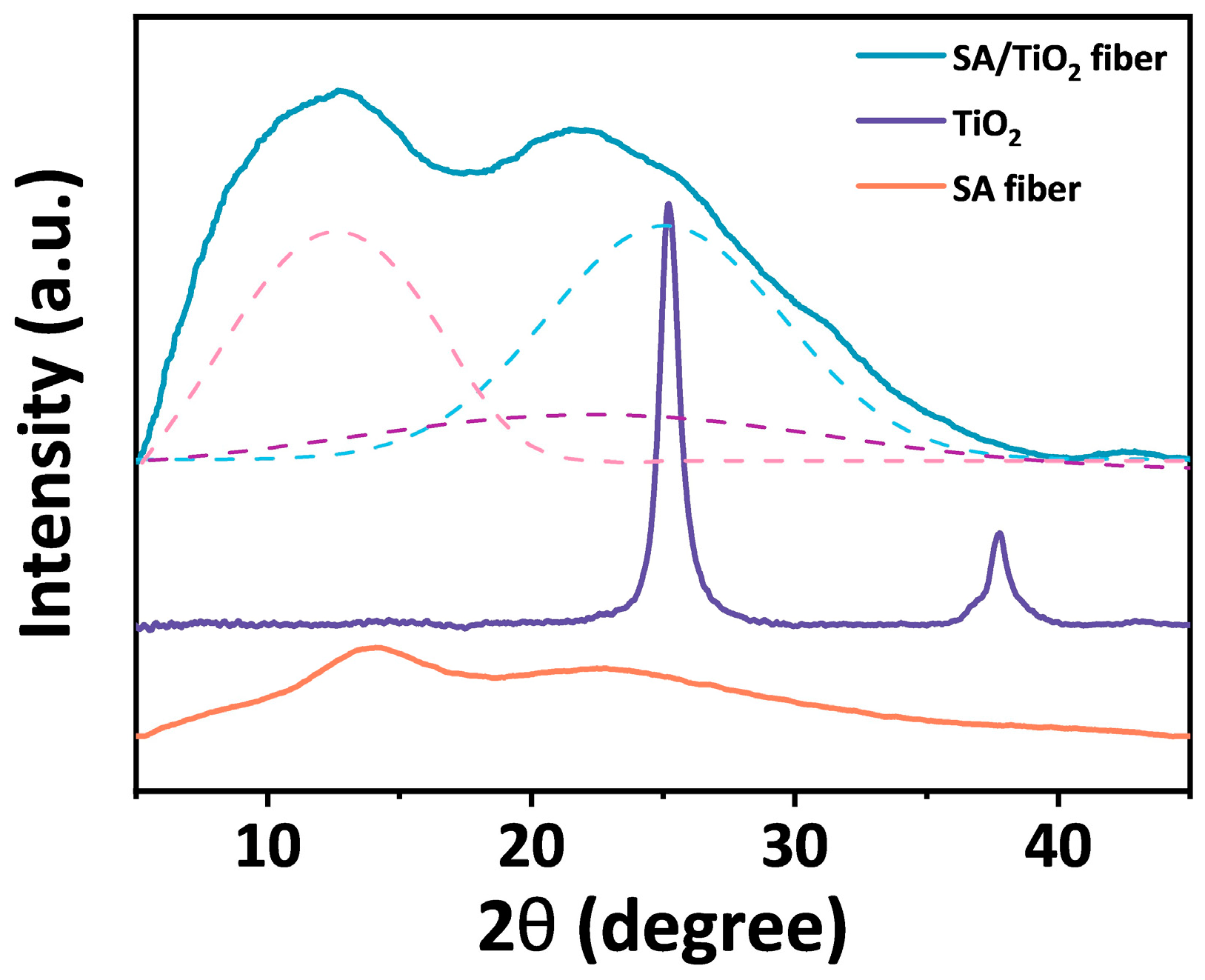
In order to confirm whether TiO2 nanoparticles have been incorporated into the composite fibers, XRD tests were performed on TiO2, pure alginate fibers and SA/TiO2 composite fibers (Figure 2). Due to the low crystallinity, the pure alginate fiber exhibits broad characteristic diffraction peaks at 2θ = 13.2° and 22.5°, with the peak intensity at 22.5° lower than that at 13.2°. On the other hand, TiO2 exhibits a sharp diffraction peak at 2θ = 25°. Peak deconvolution was performed on the XRD pattern of SA/TiO2 composite fiber, and the pattern was separated into the peaks at 13.2°, 22.5°, and 25°. The diffraction peaks at 13.2° and 22.5° are consistent with the diffraction peaks of pure SA fiber, while the diffraction peak at 25° corresponds to the diffraction peak of TiO2. The above results confirm that TiO2 nanoparticles are incorporated into the alginate fibers.
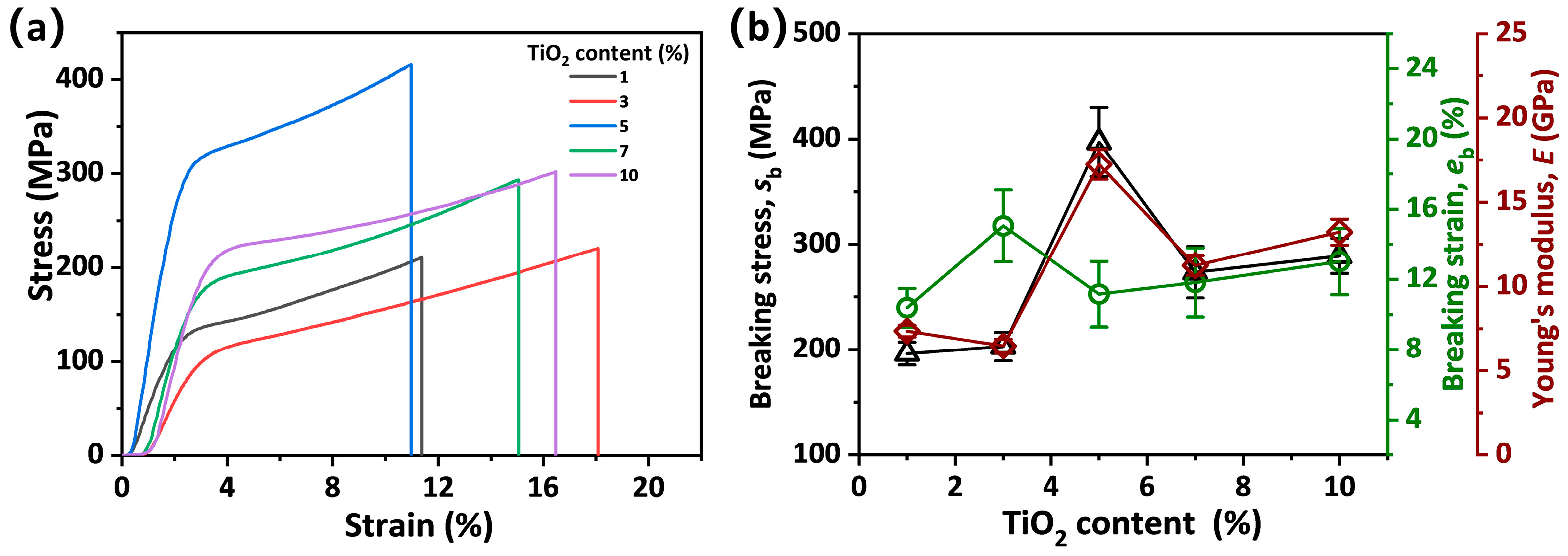
The mechanical properties of composite fibers with different TiO2 content were investigated. The stress-strain curves show a linear region below the strain of 2% and non-prominent yielding subsequently, followed by a strain softening region until the fibers break (Figure 3a). Figure 3b shows that the breaking stress (sb) of the composite fibers increases from 200 MPa at 1% TiO2 to 400 MPa at 5% TiO2. With a further increase in TiO2 content to 10%, the sb of the fiber decreases to 289 MPa. The Young’s modulus (E) of the fibers also shows an increasing trend from 7.3 GPa to 17.2 GPa and then decreases to 13 GPa with the further increase in TiO2 content. This is because a small amount of TiO2 can reinforce the SA fibers due to its large specific surface area and high stiffness, whereas the excessively high content causes TiO2 agglomeration, which acts as defects in the fibers and hinders the effective alignment of SA chains, reducing E and sb. Similar phenomena are also observed in other nanoparticle-reinforced fiber materials. For example, the mechanical properties of graphene oxide-modified cellulose fibers show a trend, with tensile strength increasing and then decreasing as the graphene oxide loading increases [37]. Moreover, with the increase in TiO2 solid content, breaking strain (eb) shows a slight overall upward trend, increasing from 10.4% to 13%. Therefore, the spinning solution with TiO2 solid content of 5% is selected for the preparation of SA/TiO2 composite fibers. This selection is based on the rheological behavior of the spinning solutions and mechanical properties of the fibers.

3.3. Morphology of SA/TiO2 Composite Fibers

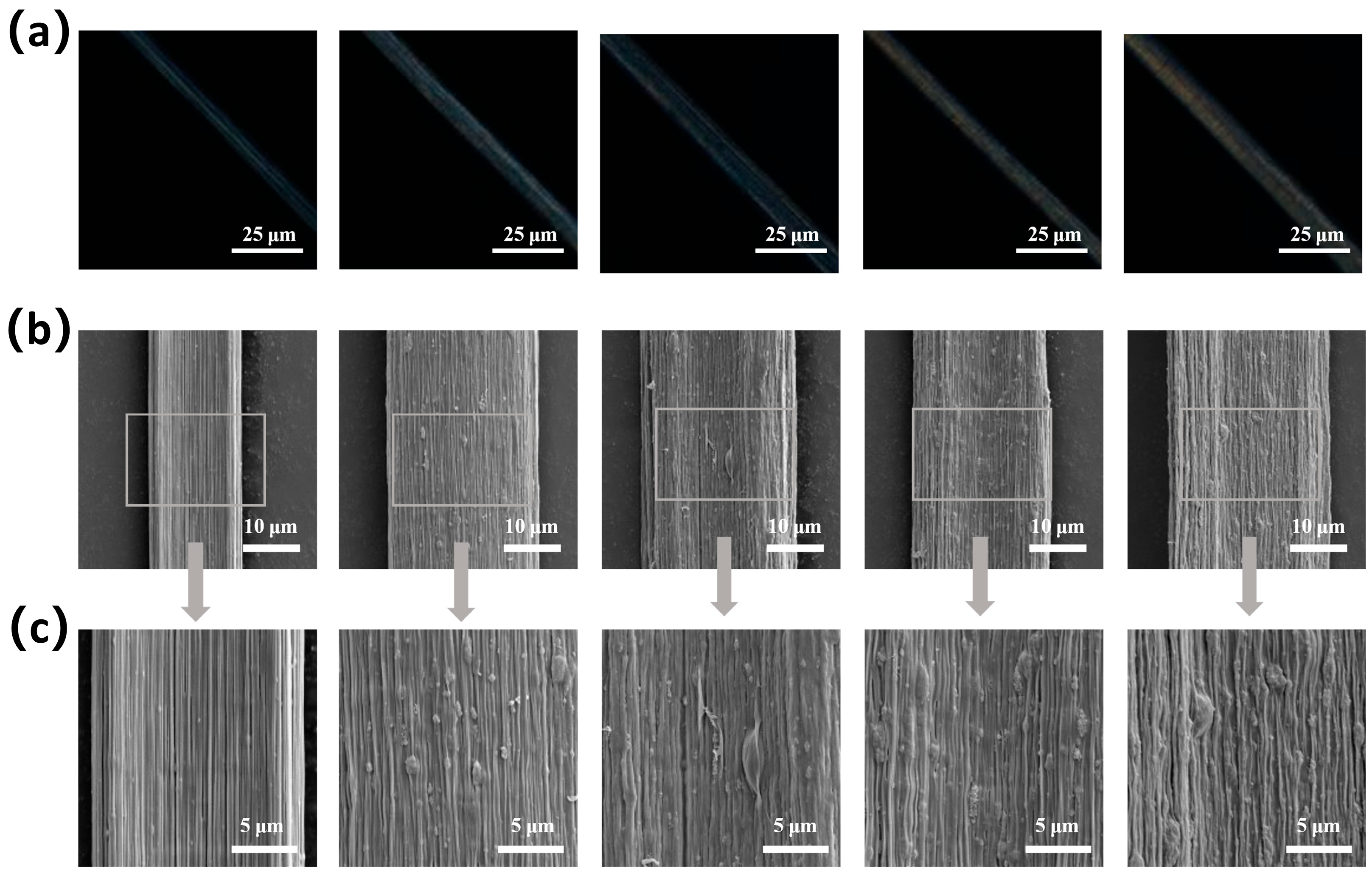
Figure S4 shows the photograph of continuously fabricated composite multifilaments with a TiO2 solid content of 5% after drying and collection. SA/TiO2 fibers exhibit an overall milky white appearance due to the incorporation of TiO2. The polarized micrograph of the composite fibers with different TiO2 contents shows a white birefringent color (Figure 4a). This is because SA chains in the fibers were oriented along the fiber axis due to the confined radial shrinkage. The composite fibers exhibit diameters ranging from 10 to 20 μm. Figure 4b,c are SEM of composite fibers, where microfibrillar structures distributed along the radial direction can be observed. Meanwhile, it can be clearly seen that the number of particles attached to the fiber surface increases significantly with the increase in TiO2 content. Notably, obvious particle aggregation of TiO2 appears on the surface of fibers with high TiO2 contents of 7% and 10%. This confirms that the decrease in tensile strength of composite fibers with high TiO2 content is caused by the agglomeration of nanoparticles. The elemental distribution of titanium on the composite fiber surface is presented through EDS images. As shown in Figure S5 and Table S1, with the increase in TiO2 content, the number of green bright spots representing the titanium element becomes larger. However, aggregation of titanium element can be observed in the images of composite fibers with high TiO2 content, which is consistent with the SEM observation. It should be noted that the content of titanium element obtained from EDS is lower than that in the spinning solutions. This is because EDS only analyzes the surface of the fiber. Moreover, during fiber formation, TiO2 nanoparticles may diffuse into the coagulation bath, which also reduces the TiO2 content.

3.4. Formaldehyde Degradation and Flame-Retardant Properties of SA/TiO2 Composite Fibers

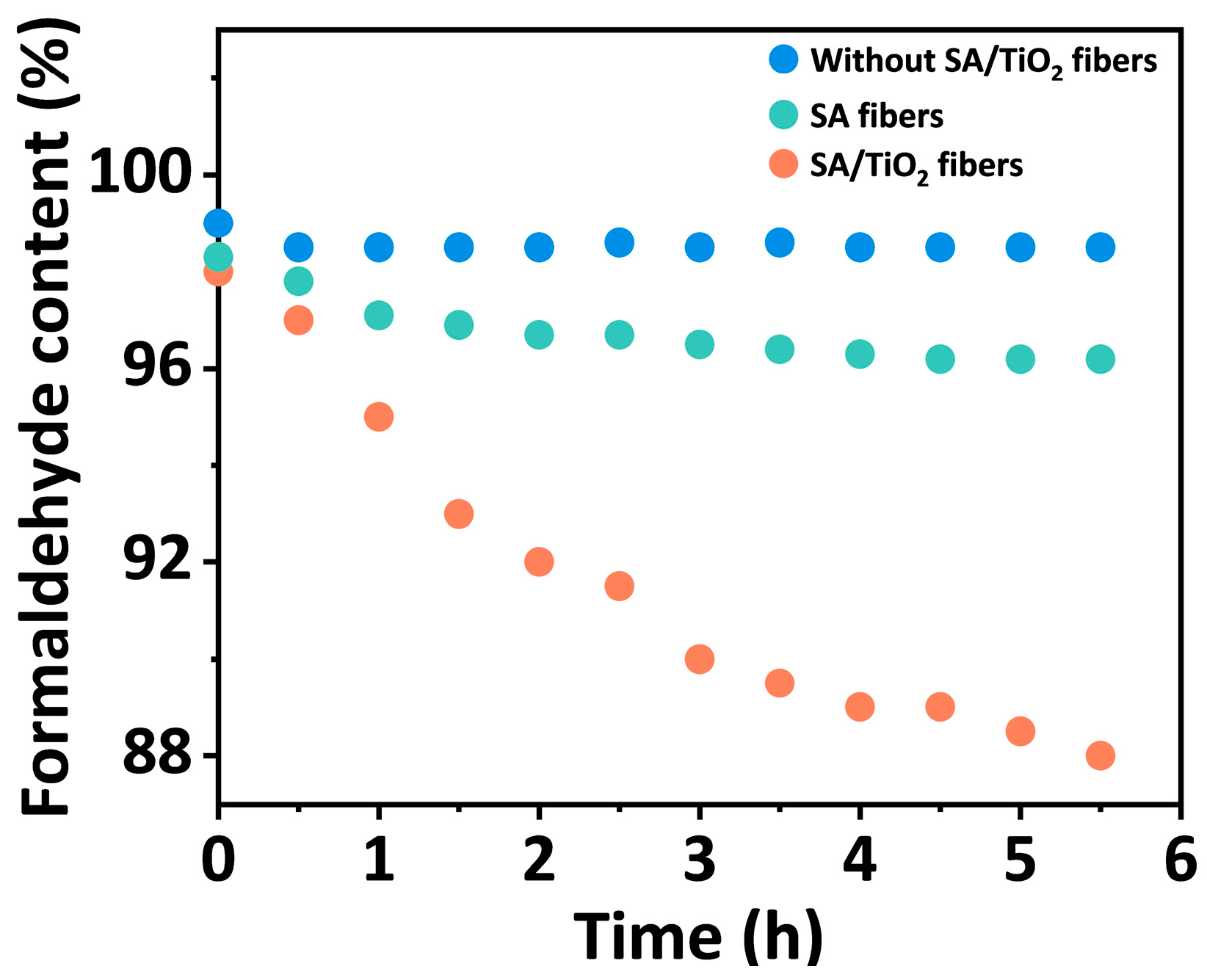
A self-made device was used to test the formaldehyde purification capacity of SA/TiO2 composite fibers (Figure S6). The airtightness of the device was ensured before the experiment. The test was conducted under daylight, utilizing the ultraviolet spectrum in the daylight to achieve photocatalytic degradation of formaldehyde. A total of 50 μL of formaldehyde standard solution was diluted to 1% and then added dropwise into a small petri dish using a pipette. After the solution was completely volatilized, the concentration change was continuously monitored by an air quality monitor. The measured concentrations were then normalized with the initial concentration to calculate the variation rate of formaldehyde content. The blue data points in Figure 5 represent the variation of formaldehyde concentration in the device without composite fibers. No obvious change in concentration is observed within 6 h. The green data points in Figure 5 represent the changes in formaldehyde concentration in the presence of pure SA fibers. Within 6 h, the formaldehyde concentration decreases from 98% to 96% due to the physical adsorption of formaldehyde by the fibers. By placing 5 g of SA/TiO2 composite fibers with 5% TiO2 solid content in the glass petri dish at the center of the test chamber, a distinct downward trend in the formaldehyde concentration within the test chamber was observed. After 6 h, the concentration decreases to approximately 90% of its initial value (orange data points in Figure 5).
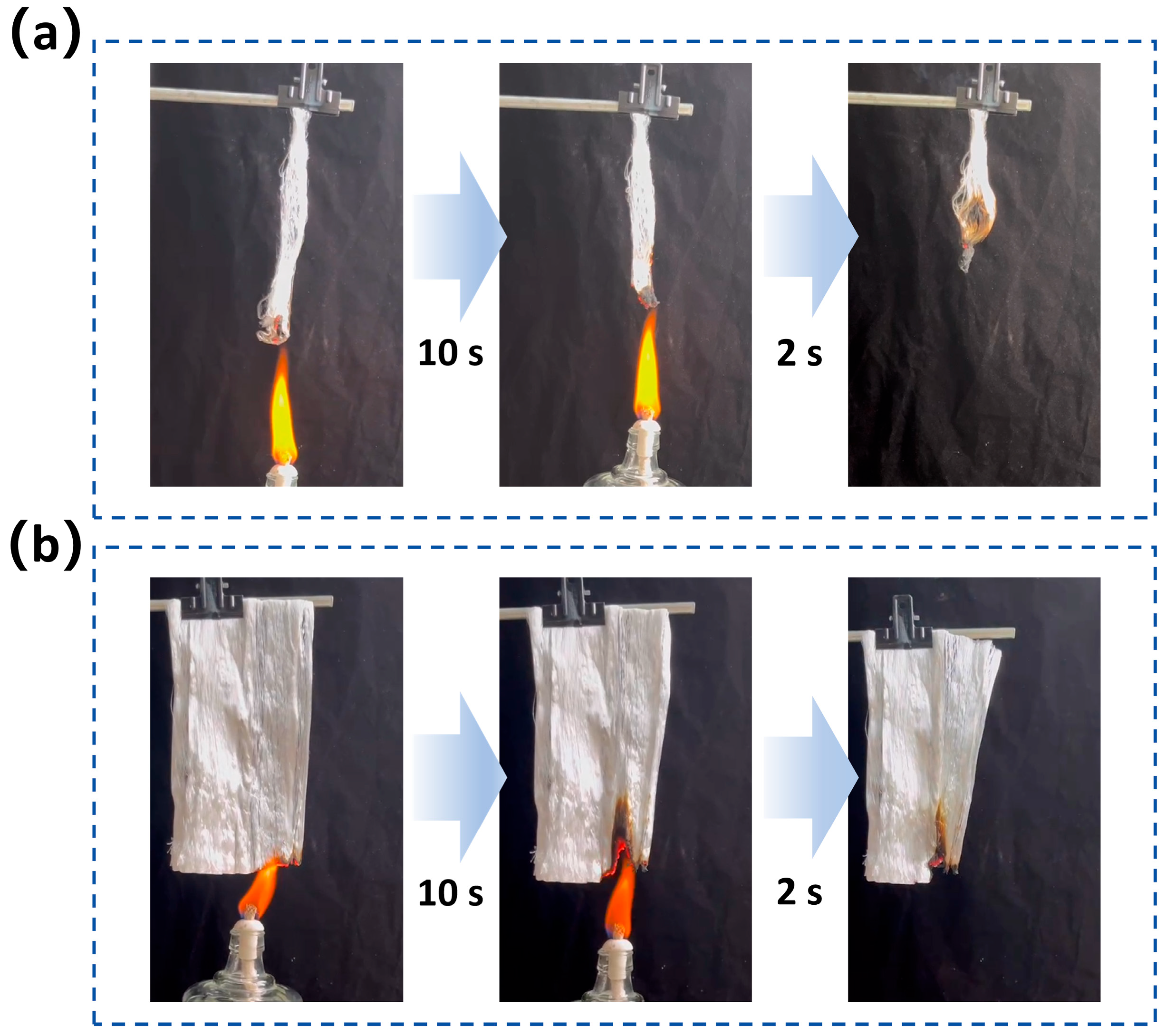
Because Ca2+ crosslinked SA and TiO2 nanoparticles both possess flame retardant properties [38,39,40,41,42], the SA/TiO2 composite fibers also have great potential in flame retardant fabrics. Flame retardant tests were conducted on the SA/TiO2 composite fibers (5% TiO2 content) and fabrics. The samples were suspended above an alcohol lamp flame for combustion observation. As shown in Figure 6a, after 10 s of exposure to the flame, no open flame was observed on the fibers, and blackish-gray ash formed in the burned area. After removing the fire source, the fiber bundle self-extinguished within 2 s. The SA/TiO2 composite fabric also exhibits excellent flame-retardant performance. A vertical combustion test was performed on an SA/TiO2 composite fabric with a size of approximately 15 cm × 10 cm (Figure 6b). After about 10 s of ignition, the fabric still maintained the structure after removing the alcohol lamp, and no open flame was observed. Moreover, the average LOI test of the composite fabrics is approximately 35%, confirming the flame-retardant properties of the composite fibers. The above observations demonstrate that SA/TiO2 composite fibers have excellent formaldehyde degradation and flame retardant capacity.

4. Conclusions

In summary, multifunctional alginate-based composite fibers are successfully designed and prepared in this study. TiO2 nanoparticles are incorporated into pre-crosslinked SA spinning solutions, which are subsequently used for the continuous fabrication of SA/TiO2 composite fibers via wet spinning. The shear and extensional rheological behaviors of pre-crosslinked SA/TiO2 solutions are systematically examined. It is shown that the pre-crosslinked SA/TiO2 solutions with TiO2 content of 5–10% exhibit a zero-viscosity of ~1300 mPa·s and pinch-off time of 0.5 s, ensuring a favorable spinnability of the fibers. The oriented and aligned microstructures of the alginate matrix and the dispersed TiO2 nanoparticles strengthen the mechanical performances of composite fibers. When the TiO2 content reaches 5%, the composite fibers exhibit optimal mechanical properties with a breaking stress of 400 MPa, breaking strain of 11%, and Young’s modulus of 17.2 GPa. The incorporation of TiO2 nanoparticles also endows the fibers with good formaldehyde degradation and flame-retardant capacity, demonstrating the potential applications of alginate fibers in formaldehyde removal and protective textiles.

Supplementary Materials

The following supporting information can be downloaded at: https://www.mdpi.com/article/10.3390/ma19101933/s1, Figure S1: Comparison of the XRD pattern of TiO2 used in this experiment with the standard XRD card of anatase TiO2. Figure S2: The size distribution of TiO2 nanoparticles. Figure S3: Optical microscopy images of pure SA solution (a) and SA/TiO2 solution with TiO2 content of 5% (b). Figure S4: Photo of SA/TiO2 composite fibers. Figure S5. EDS mapping images of titanium element distribution on the surface of SA/TiO2 composite fibers. Figure S6: Self-made formaldehyde removal rate testing device. Table S1: Titanium element content in SA/TiO2 composite fibers characterized by EDS.

Author Contributions

Conceptualization, C.D.; Methodology, C.D. and L.L.; Validation, L.L.; Investigation, L.L. and H.Z.; Data curation, H.Z. and L.L.; Writing—original draft, L.L.; Writing—review and editing, C.D.; Funding acquisition, C.D. All authors have read and agreed to the published version of the manuscript.

Funding

This research was funded by the Shandong Provincial Natural Science Foundation (No. ZR2025QB64), the National Natural Science Foundation of China (Nos. 52573027, 52361165657).

Data Availability Statement

The original contributions presented in this study are included in the article/Supplementary Material. Further inquiries can be directed to the corresponding author.

Conflicts of Interest

The authors declare no conflicts of interest.

References

  1. Belzagui, F.; Crespi, M.; Álvarez, A.; Gutiérrez-Bouzán, M.C.; Vilaseca, M. Microplastics’ Emissions: Microfibers’ Detachment from Textile Garments. Environ. Pollut. 2019, 248, 1028–1035. [Google Scholar] [CrossRef] [PubMed]
  2. Dissanayake, P.D.; Kim, S.; Sarkar, B.; Oleszczuk, P.; Sang, M.K.; Haque, M.N.; Ahn, J.H.; Bank, M.S.; Ok, Y.S. Effects of Microplastics on the Terrestrial Environment: A Critical Review. Environ. Res. 2022, 209, 112734. [Google Scholar] [CrossRef]
  3. Porta, R.; Sabbah, M.; Di Pierro, P. Bio-Based Materials for Packaging. Int. J. Mol. Sci. 2022, 23, 3611. [Google Scholar] [CrossRef] [PubMed]
  4. Thompson, R.C.; Courtene-Jones, W.; Boucher, J.; Pahl, S.; Raubenheimer, K.; Koelmans, A.A. Twenty Years of Microplastic Pollution Research—What Have We Learned? Science 2024, 386, eadl2746. [Google Scholar] [CrossRef]
  5. Cywar, R.M.; Rorrer, N.A.; Hoyt, C.B.; Beckham, G.T.; Chen, E.Y.X. Bio-Based Polymers with Performance-Advantaged Properties. Nat. Rev. Mater. 2022, 7, 83–103. [Google Scholar] [CrossRef]
  6. Laskar, N.; Kumar, U. Plastics and Microplastics: A Threat to Environment. Environ. Technol. Innov. 2019, 14, 100352. [Google Scholar] [CrossRef]
  7. Geyer, R.; Gavigan, J.; Jackson, A.M.; Saccomanno, V.R.; Suh, S.; Gleason, M.G. Quantity and Fate of Synthetic Microfiber Emissions from Apparel Washing in California and Strategies for Their Reduction. Environ. Pollut. 2022, 298, 118835. [Google Scholar] [CrossRef] [PubMed]
  8. Tirkey, A.; Upadhyay, L.S.B. Microplastics: An Overview on Separation, Identification and Characterization of Microplastics. Mar. Pollut. Bull. 2021, 170, 112604. [Google Scholar] [CrossRef]
  9. Zabala, A. Ocean Microfibre Contamination. Nat. Sustain. 2018, 1, 213. [Google Scholar] [CrossRef]
  10. Hossain, M.I.; Zhang, Y.; Haque, A.N.M.A.; Naebe, M. Fibrous Microplastics Release from Textile Production Phases: A Brief Review of Current Challenges and Applied Research Directions. Materials 2025, 18, 2513. [Google Scholar] [CrossRef]
  11. Janarthanan, M.; Senthil Kumar, M. Extraction of Alginate from Brown Seaweeds and Evolution of Bioactive Alginate Film Coated Textile Fabrics for Wound Healing Application. J. Ind. Text. 2018, 49, 328–351. [Google Scholar] [CrossRef]
  12. Duan, Y.; Wang, W.; Jia, J.; Tuo, X.; Gong, Y.; Quan, F. Preparation of Photothermal Alginate/Chitosan Derivative/CuS@Polydopamine Composite Fibers and Application in Desalination. Int. J. Biol. Macromol. 2024, 277, 134142. [Google Scholar] [CrossRef]
  13. Tariq, H.; Rehman, A.; Kishwar, F.; Raza, Z.A. Micellar Synthesis of Lime Oil-Loaded Chitosan Microstructures for the Sustainable Development of Antibacterial Cellulosic Fabric. Cellulose 2023, 30, 11177–11194. [Google Scholar] [CrossRef]
  14. Rees, D.A.; Samuel, J.W.B. The Structure of Alginic Acid. Part VI. Minor Features and Structural Variations. J. Chem. Soc. C Org. 1967, 2295–2298. [Google Scholar] [CrossRef]
  15. Hecht, H.; Srebnik, S. Structural Characterization of Sodium Alginate and Calcium Alginate. Biomacromolecules 2016, 17, 2160–2167. [Google Scholar] [CrossRef]
  16. Cao, L.; Lu, W.; Mata, A.; Nishinari, K.; Fang, Y. Egg-Box Model-Based Gelation of Alginate and Pectin: A Review. Carbohydr. Polym. 2020, 242, 116389. [Google Scholar] [CrossRef]
  17. Grant, G.T.; Morris, E.R.; Rees, D.A.; Smith, P.J.C.; Thom, D. Biological Interactions Between Polysaccharides and Divalent Cations: The Egg-Box Model. FEBS Lett. 1973, 32, 195–198. [Google Scholar] [CrossRef]
  18. Meng, C.; Li, H.; Zhu, G.; Cao, S.; Zhang, H.; Liu, Y.; Guo, J. Improvement in Mechanical and Hygroscopic Properties of Modified SA Fiber Crosslinking with PEGDE. J. Appl. Polym. Sci. 2018, 136, 47115. [Google Scholar] [CrossRef]
  19. Liu, J.; Zhang, R.; Ci, M.; Sui, S.; Zhu, P. Sodium Alginate/Cellulose Nanocrystal Fibers with Enhanced Mechanical Strength Prepared by Wet Spinning. J. Eng. Fibers Fabr. 2019, 14, 1558925019847553. [Google Scholar] [CrossRef]
  20. Han, Z.; Hao, J.; Du, C.; Yan, H.; Yuan, H.; Li, K.; Wang, L.; Xu, Z.; Tan, Y. Superior Strong and Stiff Alginate Fibers by Entanglement-Enhanced Stretching. Macromolecules 2023, 56, 6305–6315. [Google Scholar] [CrossRef]
  21. Li, S.; Chandra Biswas, M.; Ford, E. Dual Roles of Sodium Polyacrylate in Alginate Fiber Wet-Spinning: Modify the Solution Rheology and Strengthen the Fiber. Carbohydr. Polym. 2022, 297, 120001. [Google Scholar] [CrossRef]
  22. He, Y.; Zhang, N.; Gong, Q.; Qiu, H.; Wang, W.; Liu, Y.; Gao, J. Alginate/Graphene Oxide Fibers with Enhanced Mechanical Strength Prepared by Wet Spinning. Carbohydr. Polym. 2012, 88, 1100–1108. [Google Scholar] [CrossRef]
  23. Shan, J.; Guo, J.; Guan, F.; Li, F.; Di, C. Characteristics of Sodium Alginate/Antarctic Krill Protein Composite Fiber Based on Cellulose Nanocrystals Modification: Rheology, Hydrogen Bond, Crystallization, Strength, and Water-Resistance. Gels 2022, 8, 139. [Google Scholar] [CrossRef]
  24. Wang, Y.; Chen, H.; Cui, L.; Tu, C.; Yan, C.; Guo, Y. Toughen and Strengthen Alginate Fiber by Incorporation of Polyethylene Glycol grafted Cellulose Nanocrystals. Cellulose 2022, 29, 5021–5035. [Google Scholar] [CrossRef]
  25. Yan, M.; Shi, J.; Tang, S.; Liu, L.; Zhu, H.; Zhou, G.; Zeng, J.; Zhang, H.; Yu, Y.; Guo, J. Strengthening and Toughening Sodium Alginate Fibers Using a Dynamically Cross-Linked Network of Inorganic Nanoparticles and Sodium Alginate Through the Hydrogen Bonding Strategy. New J. Chem. 2021, 45, 10362–10372. [Google Scholar] [CrossRef]
  26. Vigani, B.; Rossi, S.; Milanesi, G.; Bonferoni, M.C.; Sandri, G.; Bruni, G.; Ferrari, F. Electrospun Alginate Fibers: Mixing of Two Different Poly(ethylene oxide) Grades to Improve Fiber Functional Properties. Nanomaterials 2018, 8, 971. [Google Scholar] [CrossRef]
  27. Hao, J.; Yan, S.; Yuan, H.; Du, C.; Tan, Y. High-Strength Alginate Fibers Wet-Spun from Pre-Crosslinked Sodium Alginate Solutions. Carbohydr. Polym. 2024, 342, 122386. [Google Scholar] [CrossRef]
  28. Boyjoo, Y.; Sun, H.; Liu, J.; Pareek, V.K.; Wang, S. A Review on Photocatalysis for Air Treatment: From Catalyst Development to Reactor Design. Chem. Eng. J. 2017, 310, 537–559. [Google Scholar] [CrossRef]
  29. Zhang, Q.; Du, R.; Tan, C.; Chen, P.; Yu, G.; Deng, S. Efficient Degradation of Typical Pharmaceuticals in Water Using a Novel TiO2/ONLH Nano-Photocatalyst Under Natural Sunlight. J. Hazard. Mater. 2021, 403, 123582. [Google Scholar] [CrossRef]
  30. Deng, X.-q.; Zhu, X.; Sun, Z.-g.; Li, X.-s.; Liu, J.-l.; Shi, C.; Zhu, A.-M. Exceptional Activity for Photocatalytic Mineralization of Formaldehyde over Amorphous Titania Nanofilms. Chem. Eng. J. 2016, 306, 1001–1009. [Google Scholar] [CrossRef]
  31. Yang, T.; Liu, Y.; Xia, G.; Zhu, X.; Zhao, Y. Degradation of Formaldehyde and Methylene Blue Using Wood-Templated Biomimetic TiO2. J. Clean. Prod. 2021, 329, 129726. [Google Scholar] [CrossRef]
  32. Shen, X.; Sun, X.; Liu, J.; Hang, J.; Jin, L.; Shi, L. A Facile Strategy to Achieve Monodispersity and Stability of Pigment TiO2 Particles in Low Viscosity Systems. J. Colloid Interface Sci. 2021, 581, 586–594. [Google Scholar] [CrossRef]
  33. Sun, S.; Bao, D.; Zhou, Y.; Cheng, C.; Zhang, S.; Zhao, M.; Guo, J. Sodium Alginate/Chitosan-Coated TiO2NPs Hybrid Fiber with Photocatalytic Self-Cleaning Property, UV Resistance and Enhanced Tensile Strength. Int. J. Biol. Macromol. 2023, 242, 124966. [Google Scholar] [CrossRef]
  34. Sui, Y.; Cui, Y.; Wei, P.; Cong, C.; Meng, X.; Ye, H.-M.; Zhou, Q. Nanoscale Effects of TiO2 Nanoparticles on the Rheological Behaviors of Ultra-high Molecular Weight Polyethylene (UHMWPE). Soft Matter 2023, 19, 5459–5467. [Google Scholar] [CrossRef]
  35. Kalathi, J.T.; Grest, G.S.; Kumar, S.K. Universal Viscosity Behavior of Polymer Nanocomposites. Phys. Rev. Lett. 2012, 109, 198301. [Google Scholar] [CrossRef]
  36. Zhang, M.; Lu, X.; Wang, M. Viscosity Reduction of HPAM Solutions Induced by Silica Nanoparticle Additives. Soft Matter 2026, 22, 2690–2703. [Google Scholar] [CrossRef]
  37. Gabryś, T.; Fryczkowska, B.; Biniaś, D.; Ślusarczyk, C.; Fabia, J. Preparation and Properties of Composite Cellulose Fibres with the Addition of Graphene Oxide. Carbohydr. Polym. 2021, 254, 117436. [Google Scholar] [CrossRef]
  38. Moafi, H.F.; Shojaie, A.F.; Zanjanchi, M.A. Flame-Retardancy and Photocatalytic Properties of Cellulosic Fabric Coated by Nano-Sized Titanium Dioxide. J. Therm. Anal. Calorim. 2010, 104, 717–724. [Google Scholar] [CrossRef]
  39. Kausar, A.; Rafique, I.; Anwar, Z.; Muhammad, B. Recent Developments in Different Types of Flame Retardants and Effect on Fire Retardancy of Epoxy Composite. Polym.-Plast. Technol. Eng. 2016, 55, 1512–1535. [Google Scholar] [CrossRef]
  40. Lam, Y.L.; Kan, C.W.; Yuen, C.W.M. Effect of Titanium Dioxide on the Flame-Retardant Finishing of Cotton Fabric. J. Appl. Polym. Sci. 2011, 121, 267–278. [Google Scholar] [CrossRef]
  41. Kong, Q.-s.; Wang, B.-b.; Ji, Q.; Xia, Y.-z.; Guo, Z.-x.; Yu, J. Thermal Degradation and Flame Retardancy of Calcium Alginate Fibers. Chin. J. Polym. Sci. 2009, 27, 807–812. [Google Scholar] [CrossRef]
  42. Zhang, J.; Ji, Q.; Shen, X.; Xia, Y.; Tan, L.; Kong, Q. Pyrolysis Products and Thermal Degradation Mechanism of Intrinsically Flame-Retardant Calcium Alginate Fibre. Polym. Degrad. Stab. 2011, 96, 936–942. [Google Scholar] [CrossRef]
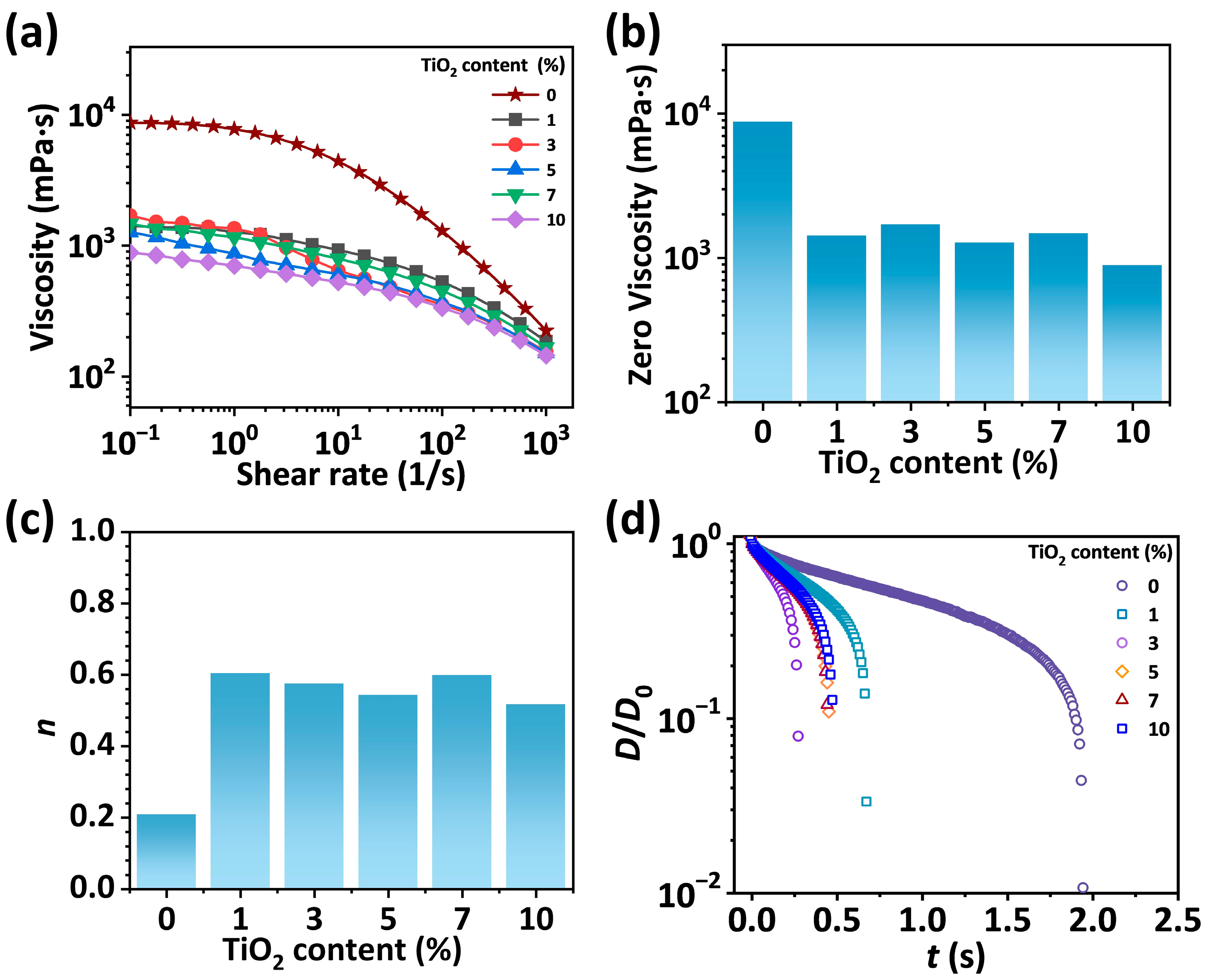
Figure 1. (a) Shear viscosity of pre-crosslinked SA/TiO2 solutions with f = 0.08 and different solid content of TiO2 at different shear rate. (b,c) Zero shear viscosity (b) and non-Newtonian index (c) of SA/TiO2 solutions. (d) The evolution of the normalized midpoint diameter of the SA/TiO2 solution filaments over time.
Materials 19 01933 g001
Figure 2. XRD patterns of TiO2 powder, SA fiber, and SA/TiO2 composite fiber. The dotted lines represent the deconvolved peaks of the pattern of SA/TiO2 composite fiber. The pink and purple dotted lines correspond to the characteristic peaks of SA fiber, and the blue dotted line corresponds the characteristic peak of TiO2.
Materials 19 01933 g002
Figure 3. (a) Tensile stress–strain curves of SA/TiO2 composite fibers with different solid content of TiO2. (b) Mechanical parameters of SA/TiO2 composite fibers with different solid content of TiO2.
Materials 19 01933 g003
Figure 4. (a) Polarized optical microscopy images of SA/TiO2 composite fibers with TiO2 solid content of 1%, 3%, 5%, 7%, and 10% from left to right, respectively. (b) SEM images of SA/TiO2 composite fibers with TiO2 solid contents of 1%, 3%, 5%, 7%, and 10% from left to right, respectively. (c) High-magnification SEM images of the enclosed areas in (b).
Materials 19 01933 g004
Figure 5. Comparison of the relative formaldehyde content over time without fibers, after placing SA fibers, and after placing SA/TiO2 composite fibers with TiO2 solid contents of 5%.
Materials 19 01933 g005
Figure 6. Flame-retardant testing of SA/TiO2 composite fibers (a) and fabrics (b) with TiO2 solid contents of 5%.
Materials 19 01933 g006
Disclaimer/Publisher’s Note: The statements, opinions and data contained in all publications are solely those of the individual author(s) and contributor(s) and not of MDPI and/or the editor(s). MDPI and/or the editor(s) disclaim responsibility for any injury to people or property resulting from any ideas, methods, instructions or products referred to in the content.