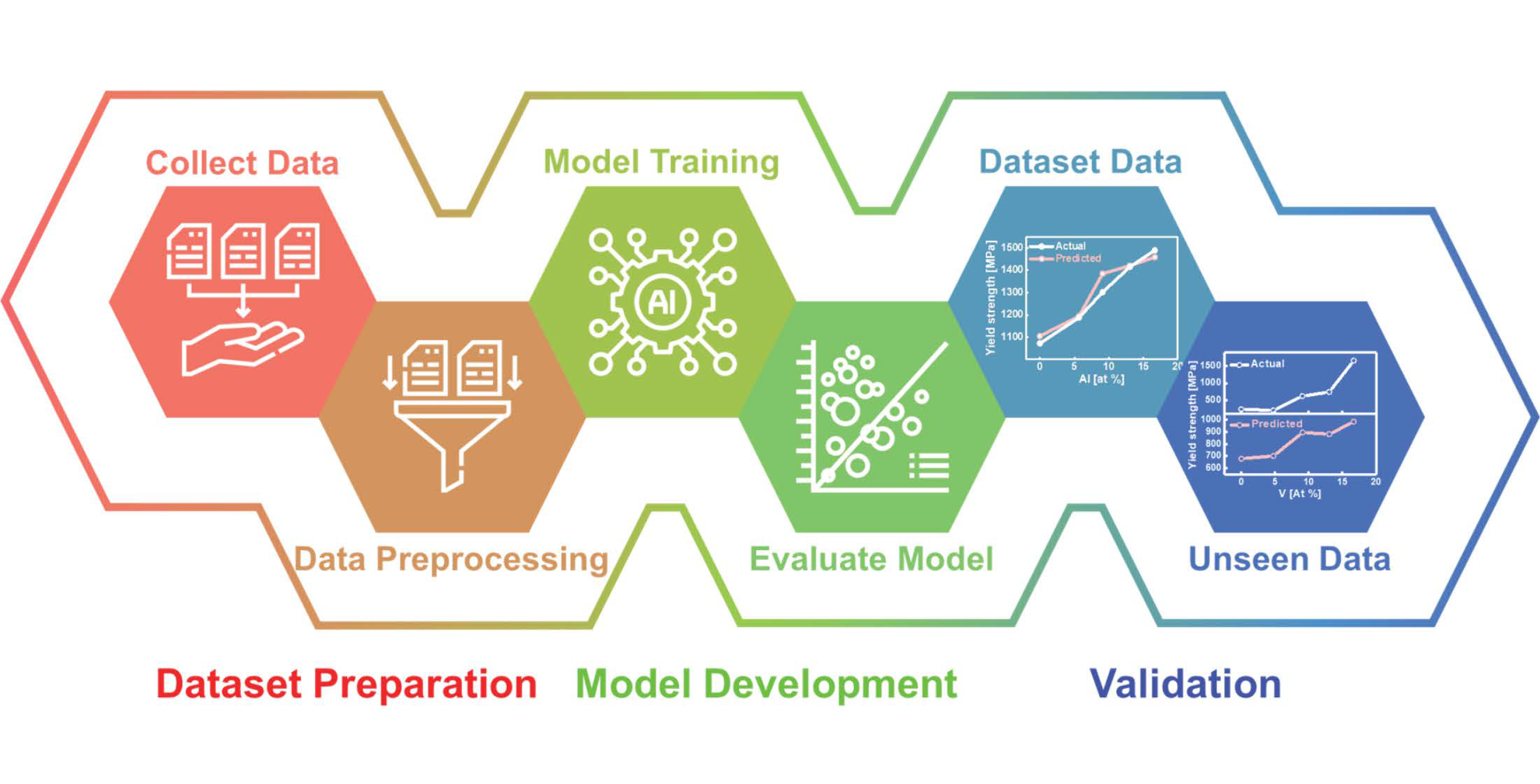
Accelerating High-Entropy Alloy Design via Machine Learning: Predicting Yield Strength from Composition



Highlights
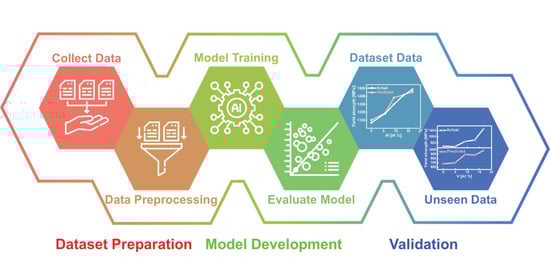
- Developed a machine learning model predicting HEA yield strength from composition.
- Gradient Boosting achieved the best performance with an R2 of 0.85.
- Model captures experimental yield-strength trends across diverse HEA categories.
- Enables fast screening of HEA compositions with targeted high yield strength.
- Reduces trial-and-error experiments, saving resources and energy in HEA design.
- Offers a general framework extendable to other mechanical properties of HEAs.
Abstract
1. Introduction
2. Materials and Methods
2.1. Data Collection and Preprocessing
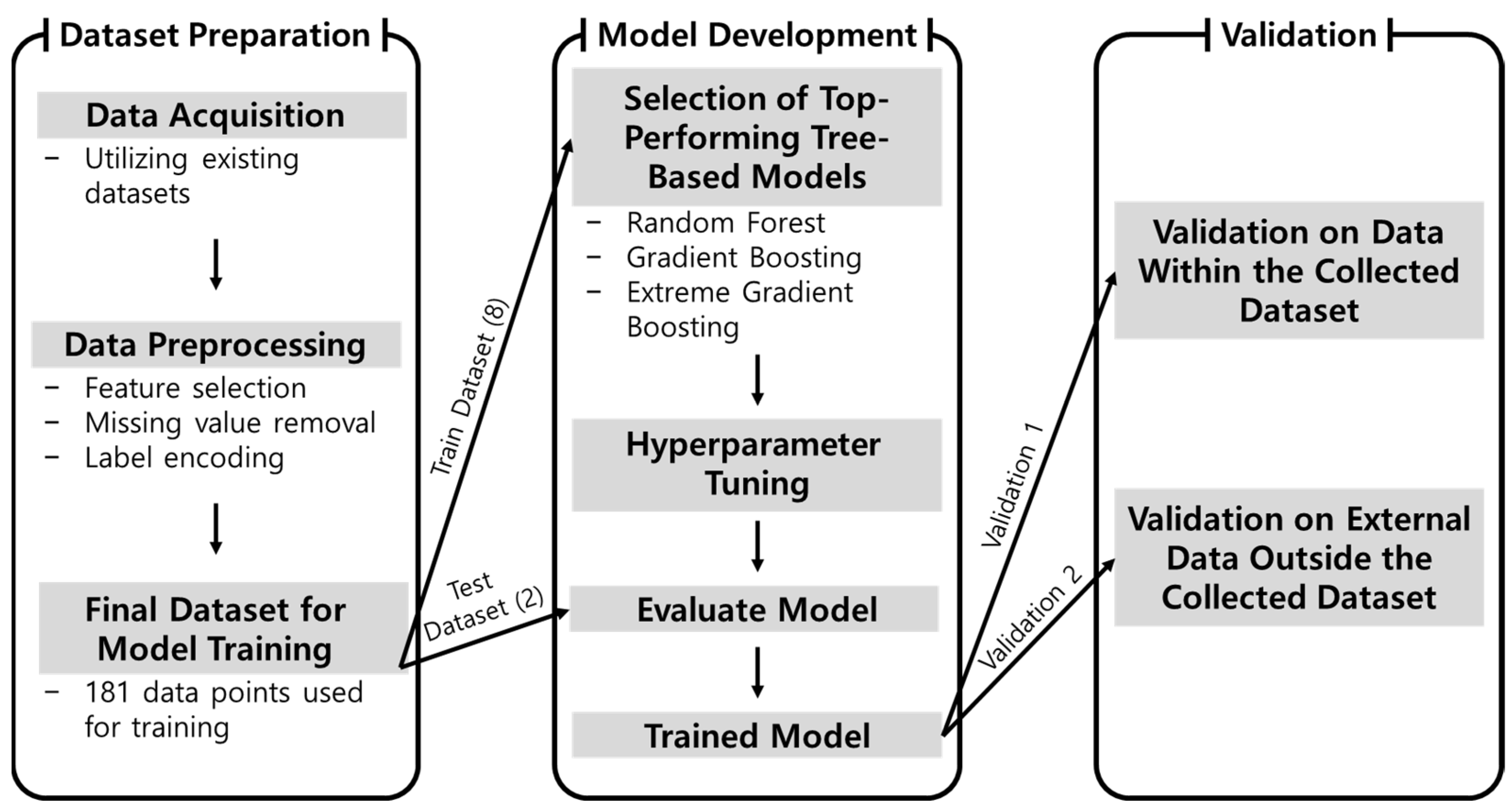
- Crystal structure: The crystal structure plays a crucial role in determining mechanical properties. For instance, face-centered cubic (FCC) structures exhibit high ductility and toughness due to the presence of multiple slip systems, whereas body-centered cubic (BCC) structures demonstrate higher strength but lower ductility because of fewer slip systems. In this study, crystal structures were categorized as BCC, FCC, or others, and subsequently label-encoded for model training.
- Mechanical testing method: Variability in mechanical testing can influence experimental outcomes, making it important to account for this factor in the dataset. In this study, only data obtained from room-temperature tests were included. The test types, tensile and compression, were processed using label encoding.
- Elemental composition: The atomic percentages (at%) of constituent elements, including Co, Cr, Fe, Mn, Ni, Nb, Ta, Ti, Zr, Al, Hf, W, Mo, V, Cu, and C, were recorded for each HEA.
2.2. Model Training and Evaluation
3. Results
3.1. Machine Learning Prediction Results
3.2. Model Application to the Collected Dataset
3.3. Model Application to Data Outside the Collected Dataset
3.3.1. Vanadium-Containing Modified Cantor Alloys
3.3.2. Refractory High Entropy Alloys
3.3.3. Eutectic High Entropy Alloys
3.3.4. Other High Entropy Alloys (AlxCoCrCuFeNi)
4. Discussion
- Deviations due to experimental process conditions: The applied machine learning model was developed using a simplified framework that did not account for detailed experimental processing parameters. Since yield strength is highly sensitive to specific process conditions, the absence of such information in the input data can lead to discrepancies between the predicted and experimentally measured yield strength values.
- Variation induced by environmental factors: Even under identical processing conditions, differences in experimental setups, equipment calibration, or testing environments can cause fluctuations in yield strength. Such environmental variations introduce additional uncertainty, further complicating the accurate prediction of yield strength values.
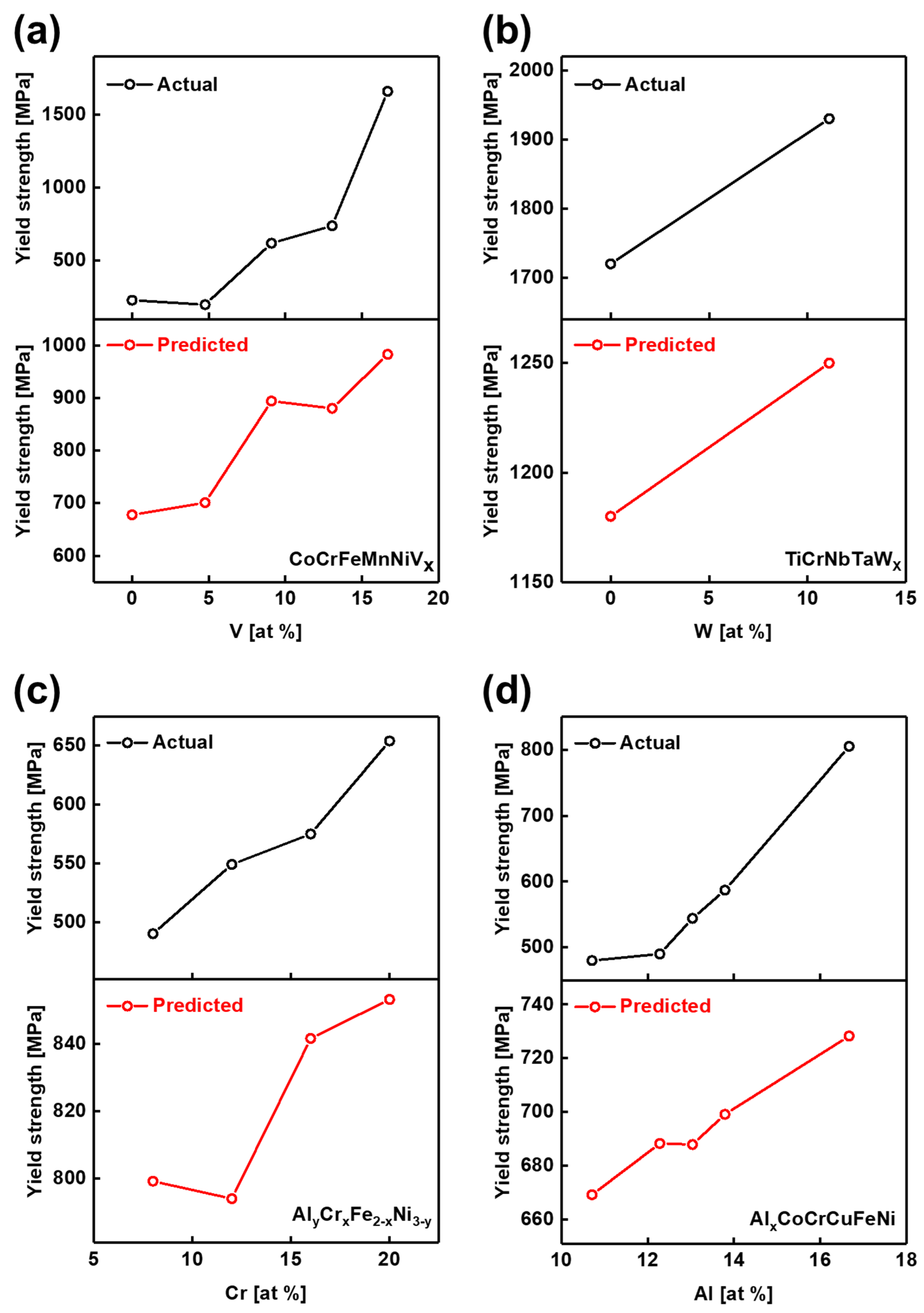
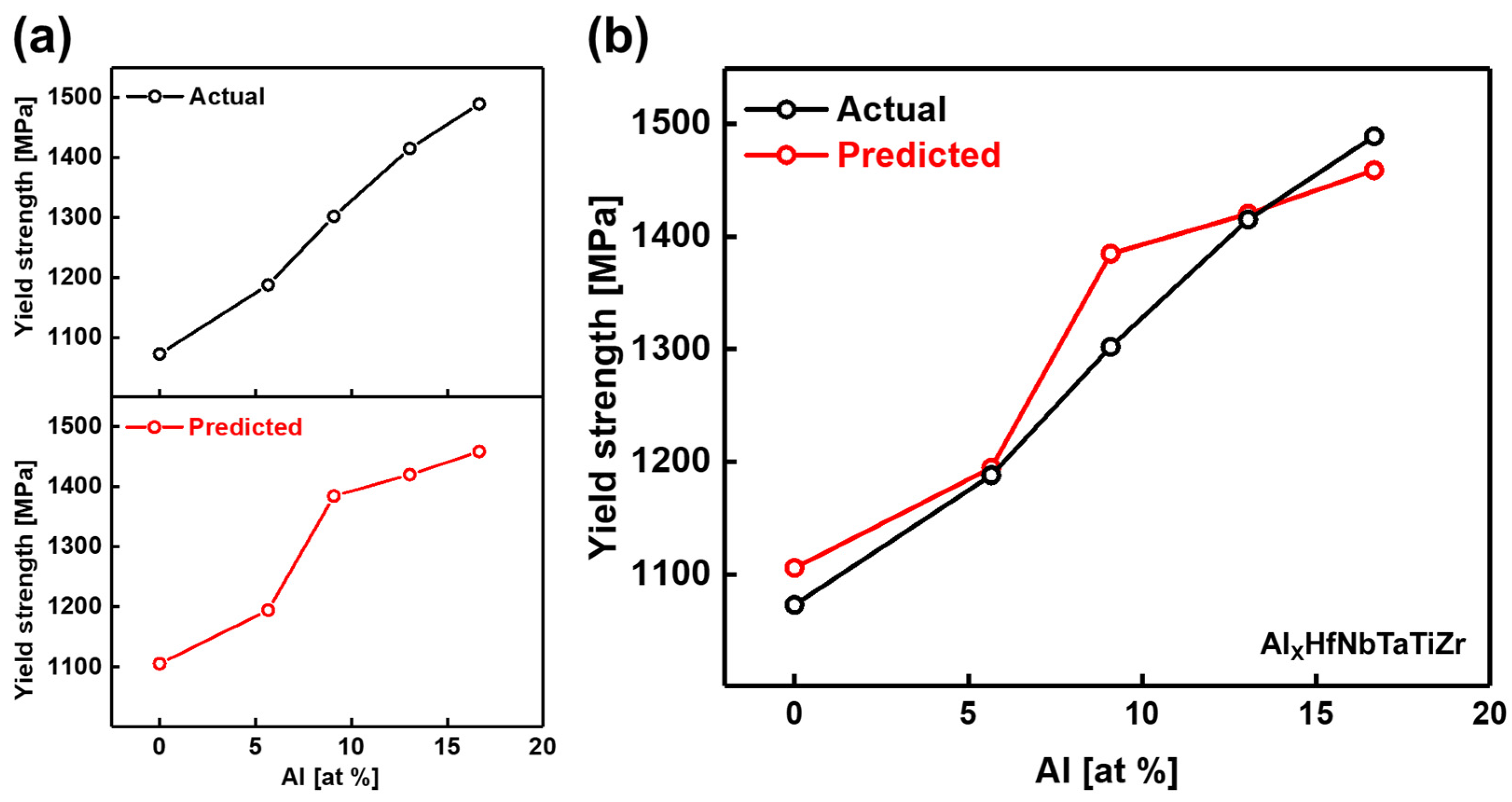
- Insufficient data availability: The performance of the machine learning model strongly depends on the quality and comprehensiveness of the input data. Limited data availability adversely affects prediction accuracy and amplifies the uncertainty arising from process conditions and environmental variations, reducing the model’s ability to produce generalized and reliable predictions. For instance, as shown in Figure S3, data points within the 12–13 at% range accounted for only 1.33% of the total dataset, and even when this range was expanded to 10–15 at%, the data represented only 4.11%. This scarcity of data, particularly near 12 at%, explains the prediction error observed in this region and underscores the challenges posed by data insufficiency in achieving accurate yield strength predictions.
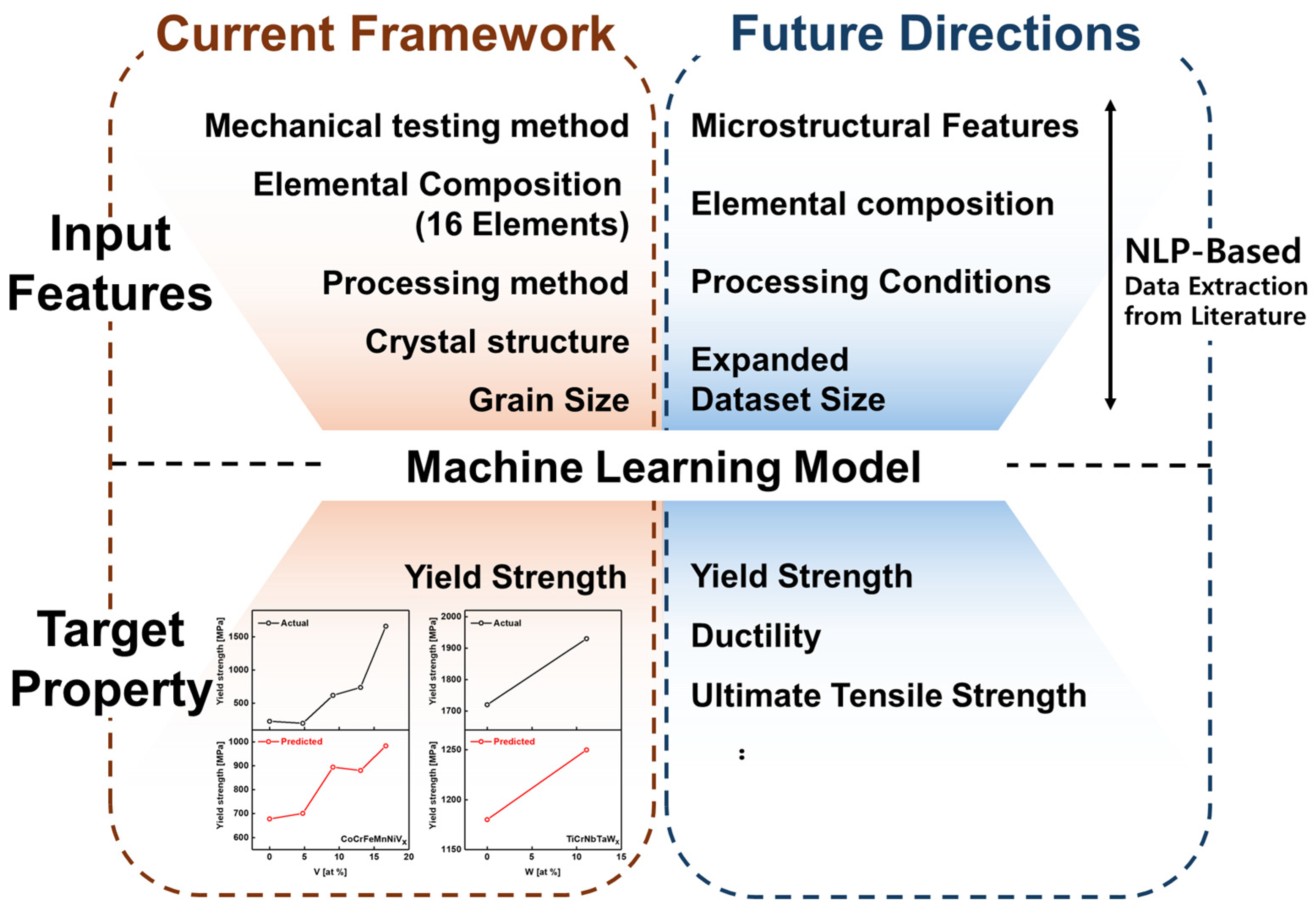
- Prediction of additional mechanical properties: In practical industrial applications, material selection is typically based on the comparison of multiple mechanical properties rather than a single property. However, in the present study, the analysis was intentionally limited to yield strength. By retaining the same methodology and replacing the target output from yield strength with other mechanical properties, such as ductility and ultimate tensile strength, the proposed framework can be extended to predict these properties. Such an extension to additional mechanical properties would provide more practical guidance for the industrial application of HEAs.
- Expansion of input features: Although this study primarily focused on composition-based prediction, the mechanical behavior of HEAs in practice is influenced not only by elemental composition but also by multiple interacting factors. These include microstructural morphology and its distribution across multiple length scales, grain size, grain boundary distribution, dislocation density, and detailed processing conditions, all of which are well known to have a direct influence on yield strength. Accordingly, incorporating microstructural and processing-related information is expected to further improve prediction accuracy. Such information may be obtained either through direct experimentation or manual data collection from the literature; alternatively, it can be more efficiently acquired by leveraging natural language processing tools, such as ChemDataExtractor [57,58,59], to automatically extract relevant data from existing studies.
- Experimental validation for model reliability: In this study, model validation was conducted using literature-based data. However, to verify that the proposed model operates reliably in practice, validation should extend to include experimental verification. Such experimental validation would be an important step toward demonstrating the proposed approach to real-world alloy design and industrial environments.
5. Conclusions
Supplementary Materials
Author Contributions
Funding
Data Availability Statement
Conflicts of Interest
Abbreviations
| AI | Artificial intelligence |
| AM | Amorphous phase |
| ANN | Artificial neural network |
| BCC | Body-centered cubic |
| DT | Decision tree |
| EHEAs | Eutectic high-entropy alloys |
| FCC | Face-centered cubic |
| GB | Gradient boosting |
| GBS | Grain boundary sliding |
| HEAs | High-entropy alloys |
| IM | Intermetallic compound |
| KNN | K-nearest neighbor |
| LR | Logistic regression |
| MAPE | Mean absolute percentage error |
| RF | Random forest |
| RHEAs | Refractory high-entropy alloys |
| RMSE | Root mean square error |
| R2 | Coefficient of determination |
| SHAP | Shapley Additive Explanations |
| SS | Solid solution |
| SVM | Support vector machine |
| XGBoost | Extreme gradient boosting |
References
- Callister, W.D., Jr.; Rethwisch, D.G. Materials Science and Engineering: An Introduction; John Wiley & Sons: Hoboken, NJ, USA, 2020. [Google Scholar]
- Ye, Y.F.; Wang, Q.; Lu, J.; Liu, C.T.; Yang, Y. High-entropy alloy: Challenges and prospects. Mater. Today 2016, 19, 349–362. [Google Scholar] [CrossRef]
- Yeh, J.-W.; Lin, S.-J.; Chin, T.-S.; Gan, J.-Y.; Chen, S.-K.; Shun, T.-T.; Tsau, C.-H.; Chou, S.-Y. Formation of simple crystal structures in Cu-Co-ni-Cr-Al-Fe-Ti-V alloys with multiprincipal metallic elements. Metall. Mater. Trans. A 2004, 35, 2533–2536. [Google Scholar] [CrossRef]
- George, E.P.; Raabe, D.; Ritchie, R.O. High-entropy alloys. Nat. Rev. Mater. 2019, 4, 515–534. [Google Scholar] [CrossRef]
- Tsai, M.-H.; Yeh, J.-W. High-entropy alloys: A critical review. Mater. Res. Lett. 2014, 2, 107–123. [Google Scholar] [CrossRef]
- Praveen, S.; Kim, H.S. High-entropy alloys: Potential candidates for high-temperature applications—An overview. Adv. Eng. Mater. 2018, 20, 1700645. [Google Scholar] [CrossRef]
- Barnett, M.R.; Gorsse, S. Sustainability of high entropy alloys and do they have a place in a circular economy? Metall. Mater. Trans. A 2025, 56, 4249–4263. [Google Scholar] [CrossRef]
- Hall, E.O. The deformation and ageing of mild steel: III discussion of results. Proc. Phys. Soc. B 1951, 64, 747–753. [Google Scholar] [CrossRef]
- Petch, N.J. The cleavage strength of polycrystals. J. Iron Steel Inst. 1953, 174, 25–28. [Google Scholar]
- Vegard, L. Die Konstitution der Mischkristalle und die Raumfüllung der Atome. Z. Physik 1921, 5, 17–26. [Google Scholar] [CrossRef]
- Li, L.; Fang, Q.; Li, J.; Liu, B.; Liu, Y.; Liaw, P.K. Lattice-distortion dependent yield strength in high entropy alloys. Mater. Sci. Eng. A 2020, 784, 139323. [Google Scholar] [CrossRef]
- Yao, H.W.; Qiao, J.W.; Hawk, J.A.; Zhou, H.F.; Chen, M.W.; Gao, M.C. Mechanical properties of refractory high-entropy alloys: Experiments and modeling. J. Alloys Compd. 2017, 696, 1139–1150. [Google Scholar] [CrossRef]
- Zhang, Z.; Sun, Q.; Li, C.; Zhao, W. Theoretical calculation of the strain-hardening exponent and the strength coefficient of metallic materials. J. Mater. Eng. Perform. 2006, 15, 19–22. [Google Scholar] [CrossRef]
- Rajendran, R.; Venkateshwarlu, M.; Petley, V.; Verma, S. Strain hardening exponents and strength coefficients for aeroengine isotropic metallic materials–a reverse engineering approach. J. Mech. Behav. Mater. 2014, 23, 101–106. [Google Scholar] [CrossRef]
- Zheng, X. Quantitative Theory of Metal Fatigue; Publishing House of Northwestern Polytechnical University: Xi’an, China, 1994. [Google Scholar]
- Zhu, X.-K.; Leis, B.N. Influence of yield-to-tensile strength ratio on failure assessment of corroded pipelines. J. Press. Vessel Technol. 2005, 127, 436–442. [Google Scholar] [CrossRef]
- Li, J.; Qiu, Y.-Y.; Wang, H.-D.; Wang, Z.-X. Estimation of the strength coefficient and strain hardening exponent from monotonic tensile properties of steels. Int. J. Steel Struct. 2019, 19, 1951–1968. [Google Scholar] [CrossRef]
- Esteva, A.; Kuprel, B.; Novoa, R.A.; Ko, J.; Swetter, S.M.; Blau, H.M.; Thrun, S. Dermatologist-level classification of skin cancer with deep neural networks. Nature 2017, 542, 115–118. [Google Scholar] [CrossRef]
- Jumper, J.; Evans, R.; Pritzel, A.; Green, T.; Figurnov, M.; Ronneberger, O.; Tunyasuvunakool, K.; Bates, R.; Žídek, A.; Potapenko, A.; et al. Highly accurate protein structure prediction with AlphaFold. Nature 2021, 596, 583–589. [Google Scholar] [CrossRef] [PubMed]
- Abramson, J.; Adler, J.; Dunger, J.; Evans, R.; Green, T.; Pritzel, A.; Ronneberger, O.; Willmore, L.; Ballard, A.J.; Bambrick, J.; et al. Accurate structure prediction of biomolecular interactions with AlphaFold 3. Nature 2024, 630, 493–500. [Google Scholar] [CrossRef]
- Bojarski, M. End to End Learning for Self-Driving Cars. arXiv 2016, arXiv:1604.07316. [Google Scholar]
- Mnih, V.; Kavukcuoglu, K.; Silver, D.; Rusu, A.A.; Veness, J.; Bellemare, M.G.; Graves, A.; Riedmiller, M.; Fidjeland, A.K.; Ostrovski, G.; et al. Human-level control through deep reinforcement learning. Nature 2015, 518, 529–533. [Google Scholar] [CrossRef]
- Li, H.; Zheng, H.; Yue, T.; Xie, Z.; Yu, S.; Zhou, J.; Kapri, T.; Wang, Y.; Cao, Z.; Zhao, H.; et al. Machine learning-accelerated discovery of heat-resistant polysulfates for electrostatic energy storage. Nat. Energy 2024, 10, 90–100. [Google Scholar] [CrossRef]
- Liu, Z.; Rolston, N.; Flick, A.C.; Colburn, T.W.; Ren, Z.; Dauskardt, R.H.; Buonassisi, T. Machine learning with knowledge constraints for process optimization of open-air perovskite solar cell manufacturing. Joule 2022, 6, 834–849. [Google Scholar] [CrossRef]
- Pyun, D.; Lee, S.; Lee, S.; Jeong, S.H.; Hwang, J.K.; Kim, K.; Kim, Y.; Nam, J.; Cho, S.; Hwang, J.S.; et al. Machine learning-assisted prediction of ambient-processed perovskite solar cells’ performances. Energies 2024, 17, 5998. [Google Scholar] [CrossRef]
- Lee, S.; Sim, M.; Kang, Y.; Kim, D.; Lee, H.-S. Bayesian-optimization-based approach for sheet-resistance control in silicon wafers toward automated solar-cell manufacturing. Mater. Sci. Semicond. Process. 2025, 198, 109759. [Google Scholar] [CrossRef]
- Lee, S.-W.; Lee, S.; Lee, S.; Hwang, J.-S.; Oh, W.; Winther, K.; Lee, D.U.; Kim, D.; Nielander, A.C.; Jaramillo, T.F.; et al. Bridging artificial intelligence with photovoltaics. Cell. Rep. Phys. Sci. 2025, 6, 102893. [Google Scholar] [CrossRef]
- Hou, S.; Sun, M.; Bai, M.; Lin, D.; Li, Y.; Liu, W. A hybrid prediction frame for HEAs based on empirical knowledge and machine learning. Acta Mater. 2022, 228, 117742. [Google Scholar] [CrossRef]
- Huang, W.; Martin, P.; Zhuang, H.L. Machine-learning phase prediction of high-entropy alloys. Acta Mater. 2019, 169, 225–236. [Google Scholar] [CrossRef]
- He, J.; Li, Z.; Lin, J.; Zhao, P.; Zhang, H.; Zhang, F.; Wang, L.; Cheng, X. Machine learning-assisted design of refractory high-entropy alloys with targeted yield strength and fracture strain. Mater. Des. 2024, 246, 113326. [Google Scholar] [CrossRef]
- Giles, S.A.; SenGupta, D.; Broderick, S.R.; Rajan, K. Machine-learning-based intelligent framework for discovering refractory high-entropy alloys with improved high-temperature yield strength. npj Comput. Mater. 2022, 8, 235. [Google Scholar] [CrossRef]
- Lee, J.A.; Figueiredo, R.B.; Park, H.; Kim, J.H.; Kim, H.S. Unveiling yield strength of metallic materials using physics-enhanced machine learning under diverse experimental conditions. Acta Mater. 2024, 275, 120046. [Google Scholar] [CrossRef]
- Sadhasivam, M.; Kumar, S.P.; Saha, M.; Mahata, C.; Pradeep, K.G. Combinatorial alloy design: Renaissance in the accelerated development of high-entropy alloys. Trans. Indian Natl. Acad. Eng. 2024, 9, 611–620. [Google Scholar] [CrossRef]
- Singh, R.; Sharma, A.; Singh, P.; Balasubramanian, G.; Johnson, D.D. Accelerating computational modeling and design of high-entropy alloys. Nat. Comput. Sci. 2021, 1, 54–61. [Google Scholar] [CrossRef]
- Borg, C.K.; Frey, C.; Moh, J.; Pollock, T.M.; Gorsse, S.; Miracle, D.B.; Senkov, O.N.; Meredig, B.; Saal, J.E. Expanded dataset of mechanical properties and observed phases of multi-principal element alloys. Sci. Data 2020, 7, 430. [Google Scholar] [CrossRef] [PubMed]
- Herring, C. Diffusional viscosity of a polycrystalline solid. J. Appl. Phys. 1950, 21, 437–445. [Google Scholar] [CrossRef]
- Nabarro, F. Report of a Conference on the Strength of Solids; The Physical Society: London, UK, 1948. [Google Scholar]
- Langdon, T.G. A unified approach to grain boundary sliding in creep and superplasticity. Acta Metall. Mater. 1994, 42, 2437–2443. [Google Scholar] [CrossRef]
- Figueiredo, R.B.; Kawasaki, M.; Langdon, T.G. Seventy years of Hall–Petch, ninety years of superplasticity and a generalized approach to the effect of grain size on flow stress. Prog. Mater. Sci. 2023, 137, 101131. [Google Scholar] [CrossRef]
- Diao, H.; Xie, X.; Sun, F.; Dahmen, K.A.; Liaw, P.K. Mechanical properties of high-entropy alloys. In High-Entropy Alloys; Gao, M.C., Yeh, J.W., Liaw, P.K., Zhang, Y., Eds.; Springer: Cham, Switzerland, 2016; pp. 181–236. [Google Scholar] [CrossRef]
- Alshataif, Y.A.; Sivasankaran, S.; Al-Mufadi, F.A.; Alaboodi, A.S.; Ammar, H.R. Manufacturing methods, microstructural and mechanical properties evolutions of high-entropy alloys: A review. Met. Mater. Int. 2020, 26, 1099–1133. [Google Scholar] [CrossRef]
- Grinsztajn, L.; Oyallon, E.; Varoquaux, G. Why do tree-based models still outperform deep learning on typical tabular data? Adv. Neural. Inf. Process. Syst. 2022, 35, 507–520. [Google Scholar]
- Shwartz-Ziv, R.; Armon, A. Tabular data: Deep learning is not all you need. Inf. Fusion 2022, 81, 84–90. [Google Scholar] [CrossRef]
- Lin, C.-M.; Juan, C.-C.; Chang, C.-H.; Tsai, C.-W.; Yeh, J.-W. Effect of Al addition on mechanical properties and microstructure of refractory AlxHfNbTaTiZr alloys. J. Alloys. Compd. 2015, 624, 100–107. [Google Scholar] [CrossRef]
- Cantor, B.; Chang, I.T.H.; Knight, P.; Vincent, A.J.B. Microstructural development in equiatomic multicomponent alloys. Mater. Sci. Eng. A 2004, 375–377, 213–218. [Google Scholar] [CrossRef]
- He, J.Y.; Liu, W.H.; Wang, H.; Wu, Y.; Liu, X.J.; Nieh, T.G.; Lu, Z.P. Effects of Al addition on structural evolution and tensile properties of the FeCoNiCrMn high-entropy alloy system. Acta Mater. 2014, 62, 105–113. [Google Scholar] [CrossRef]
- Li, M.; Zhang, Q.; Han, B.; Song, L.; Li, J.; Yang, J. Investigation on microstructure and properties of AlxCoCrFeMnNi high entropy alloys by ultrasonic impact treatment. J. Alloys Compd. 2020, 816, 152626. [Google Scholar] [CrossRef]
- Stepanov, N.D.; Shaysultanov, D.G.; Salishchev, G.A.; Tikhonovsky, M.A.; Oleynik, E.E.; Tortika, A.S.; Senkov, O.N. Effect of V content on microstructure and mechanical properties of the CoCrFeMnNiVx high entropy alloys. J. Alloys Compd. 2015, 628, 170–185. [Google Scholar] [CrossRef]
- Shih, S.-T.; Chen, P.-Y. Effects of Ti addition on the microstructure and mechanical properties of CoCrFeMnNi high-entropy alloy. In Proceedings of the International Symposium on Intelligent Signal Processing and Communication Systems (ISPACS), Hualien, Taiwan, 16–19 November 2021; IEEE: New York, NY, USA; pp. 1–2. [Google Scholar] [CrossRef]
- González, S.; Sfikas, A.K.; Kamnis, S.; John, S.E.; Barnard, N.C.; Gammer, C.; Eckert, J.; Garay-Reyes, C.G.; Martínez-Sánchez, R.; Naung, S.W.; et al. Investigation of the strain rate sensitivity of CoCrFeMnNiTix (x = 0, 0.3) high-entropy alloys using the shear punch test. Mater. Des. 2023, 233, 112294. [Google Scholar] [CrossRef]
- Senkov, O.N.; Wilks, G.B.; Scott, J.M.; Miracle, D.B. Mechanical properties of Nb25Mo25Ta25W25 and V20Nb20Mo20Ta20W20 refractory high entropy alloys. Intermetallics 2011, 19, 698–706. [Google Scholar] [CrossRef]
- Senkov, O.N.; Scott, J.M.; Senkova, S.V.; Meisenkothen, F.; Miracle, D.B.; Woodward, C.F. Microstructure and elevated temperature properties of a refractory TaNbHfZrTi alloy. J. Mater. Sci. 2012, 47, 4062–4074. [Google Scholar] [CrossRef]
- You, X.; Li, T.; Song, J.; Du, Y.; Wang, H.; Lin, P.; Zhou, W.; Zhang, Y.; Hu, L. A systematic study on wear behavior of TiCrNbTaWx refractory high-entropy alloy: Inducing amorphization to achieve anti-wear. Tribol. Int. 2025, 201, 110208. [Google Scholar] [CrossRef]
- Lu, Y.; Dong, Y.; Guo, S.; Jiang, L.; Kang, H.; Wang, T.; Wen, B.; Wang, Z.; Jie, J.; Cao, Z.; et al. A promising new class of high-temperature alloys: Eutectic high-entropy alloys. Sci. Rep. 2014, 4, 6200. [Google Scholar] [CrossRef]
- Mao, Z.; Jin, X.; Xue, Z.; Zhang, M.; Qiao, J. Understanding the yield strength difference in dual-phase eutectic high-entropy alloys. Mater. Sci. Eng. A 2023, 867, 144725. [Google Scholar] [CrossRef]
- Mahato, A.; Chahar, S.; Singh, R.; Bajargan, G.; Mula, S. Compositional engineering of CoCrCuFeNiAlx high entropy alloys to achieve superior yield strength–ductility synergy. Mater. Sci. Eng. A 2024, 915, 147235. [Google Scholar] [CrossRef]
- Swain, M.C.; Cole, J.M. ChemDataExtractor: A toolkit for automated extraction of chemical information from the scientific literature. J. Chem. Inf. Model 2016, 56, 1894–1904. [Google Scholar] [CrossRef] [PubMed]
- Mavračić, J.; Court, C.J.; Isazawa, T.; Elliott, S.R.; Cole, J.M. ChemDataExtractor 2.0: Autopopulated ontologies for materials science. J. Chem. Inf. Model 2021, 61, 4280–4289. [Google Scholar] [CrossRef] [PubMed]
- Kumar, P.; Kabra, S.; Cole, J.M. Auto-generating databases of yield strength and grain size using ChemDataExtractor. Sci Data 2022, 9, 292. [Google Scholar] [CrossRef]

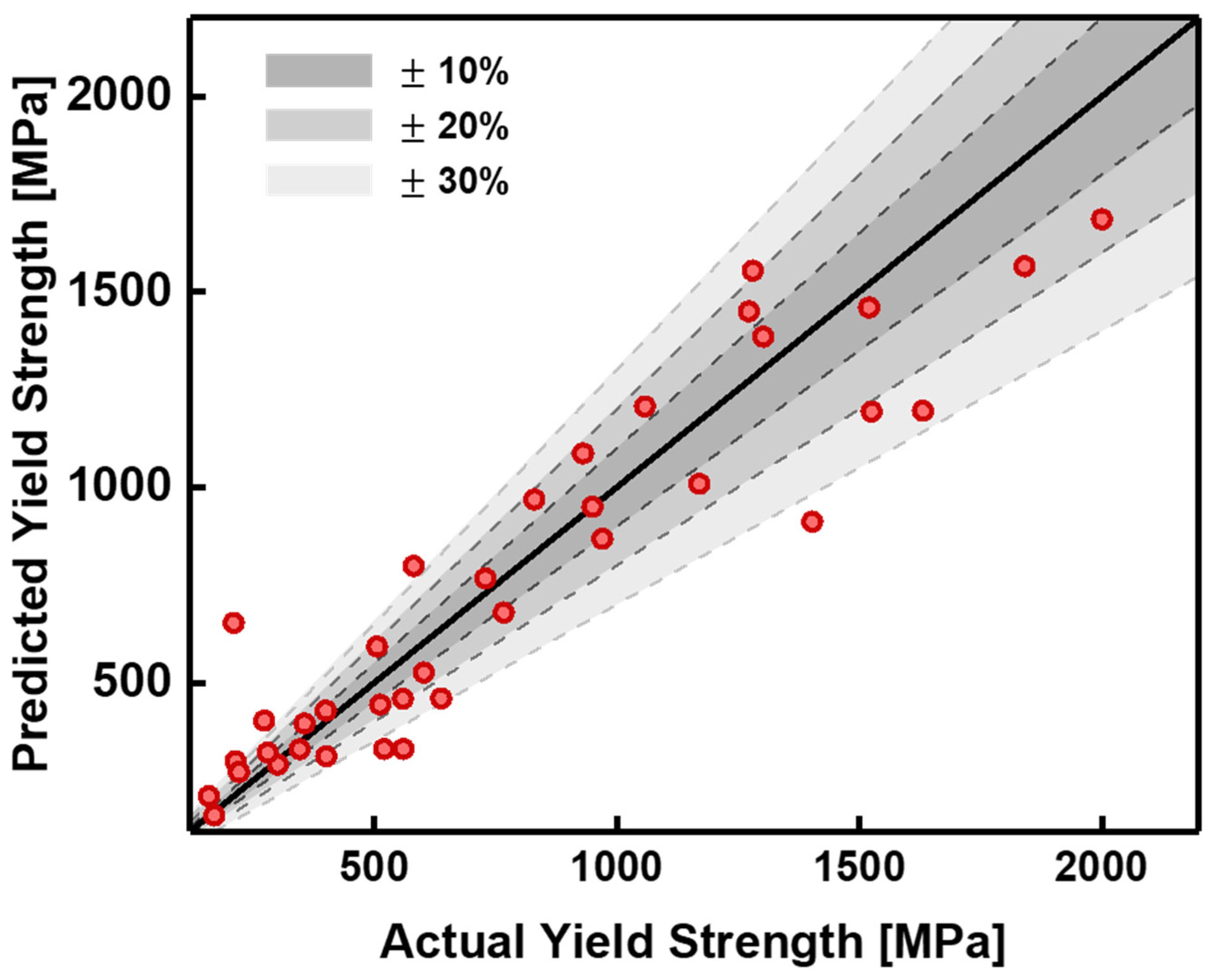



| Model | R2 | RMSE [MPa] | MAPE [%] |
|---|---|---|---|
| RF | 0.7865 | 233.2481 | 28.88 |
| XGBoost | 0.8173 | 215.7462 | 27.06 |
| GB | 0.8538 | 192.9876 | 23.62 |
Disclaimer/Publisher’s Note: The statements, opinions and data contained in all publications are solely those of the individual author(s) and contributor(s) and not of MDPI and/or the editor(s). MDPI and/or the editor(s) disclaim responsibility for any injury to people or property resulting from any ideas, methods, instructions or products referred to in the content. |
© 2026 by the authors. Licensee MDPI, Basel, Switzerland. This article is an open access article distributed under the terms and conditions of the Creative Commons Attribution (CC BY) license.
Share and Cite
Lee, S.; Sohn, S.S.; Lee, H.-S.; Kim, D.; Kang, Y. Accelerating High-Entropy Alloy Design via Machine Learning: Predicting Yield Strength from Composition. Materials 2026, 19, 196. https://doi.org/10.3390/ma19010196
Lee S, Sohn SS, Lee H-S, Kim D, Kang Y. Accelerating High-Entropy Alloy Design via Machine Learning: Predicting Yield Strength from Composition. Materials. 2026; 19(1):196. https://doi.org/10.3390/ma19010196
Chicago/Turabian StyleLee, Seungtae, Seok Su Sohn, Hae-Seok Lee, Donghwan Kim, and Yoonmook Kang. 2026. "Accelerating High-Entropy Alloy Design via Machine Learning: Predicting Yield Strength from Composition" Materials 19, no. 1: 196. https://doi.org/10.3390/ma19010196
APA StyleLee, S., Sohn, S. S., Lee, H.-S., Kim, D., & Kang, Y. (2026). Accelerating High-Entropy Alloy Design via Machine Learning: Predicting Yield Strength from Composition. Materials, 19(1), 196. https://doi.org/10.3390/ma19010196