Comparison of the Effectiveness of Paper Strengthening with Gelatin, Klucel G, and Tylose Solutions in Combination with Deacidification Using Magnesium Hydroxide Nanoparticles


Abstract
1. Introduction
2. Materials and Methods
2.1. Model Papers
- WhatmanTM 3MM Chr blotting paper (Merck, Darmstadt, Germany, catalog no. 3030-917), made from cotton linters containing 98% α-cellulose, with a basis weight of 180 g/m2 (the basis weight within the sheet area ranged between 180 and 184 g/m2) and a thickness of 0.35 mm, allowing for cross-sectional microscopic analysis and optical property measurements. The initial pH (cold water extract) of the paper was 7.36;
- WhatmanTM 2 Chr blotting paper (Merck, Darmstadt, Germany, catalog no. 3002-317), made from cotton linters containing 98% α-cellulose, with a basis weight of 100 g/m2 (the basis weight within the sheet area ranged between 100 and 107 g/m2) and a thickness of 0.19 mm, primarily used for strength testing (tensile strength) and intrinsic viscosity measurements. The initial pH (cold water extract) of the paper was 7.22. In the WhatmanTM model papers mentioned above, only trace amounts of magnesium (<0.0005 mass%, within the margin of measurement error) were detected using the ICP-AAS method. Furthermore, the XPS spectra did not show the presence of Mg on the surface of the acidified samples (the methodology for AAS and XPS determinations has been described elsewhere: [47,48].
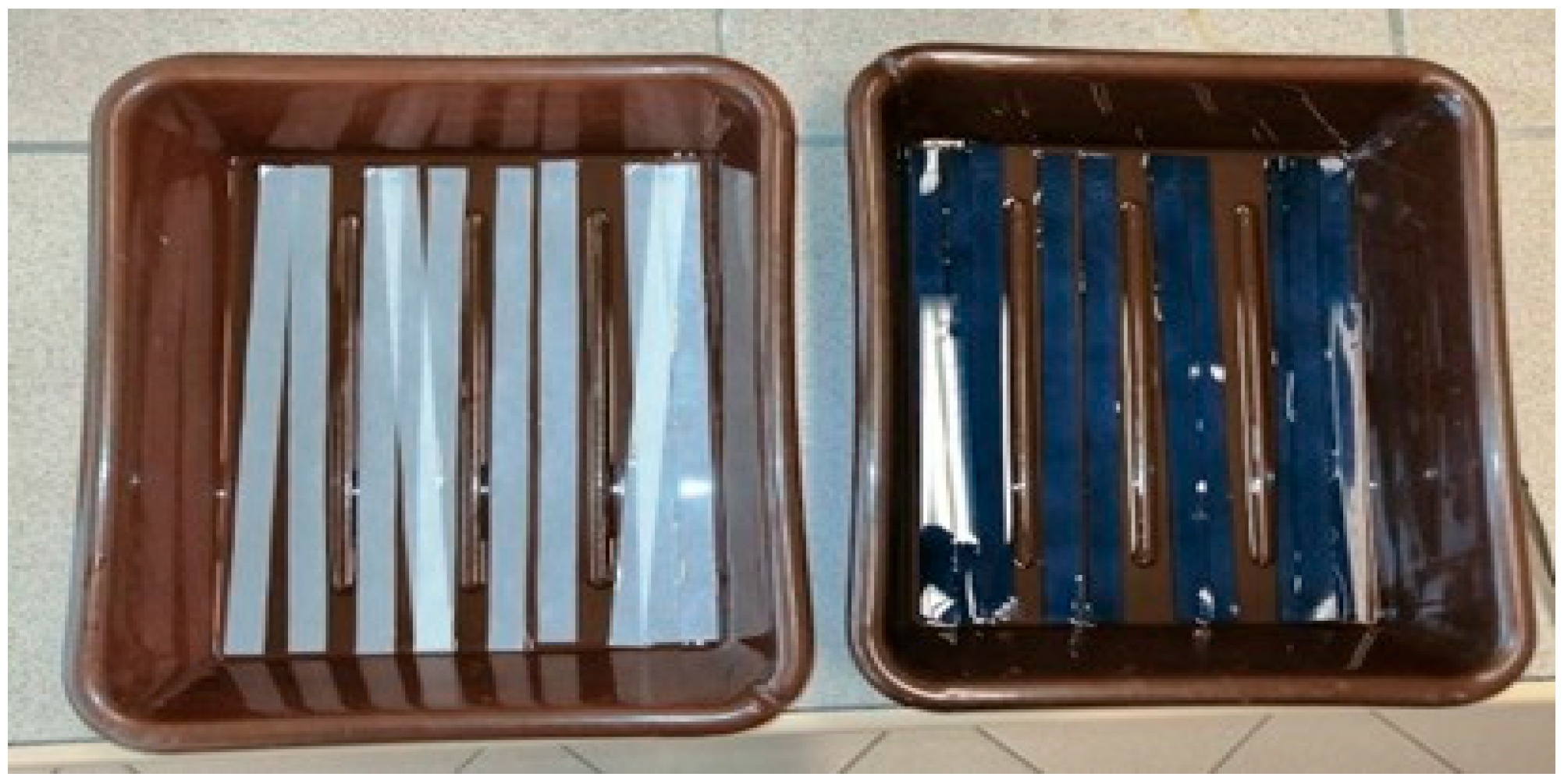
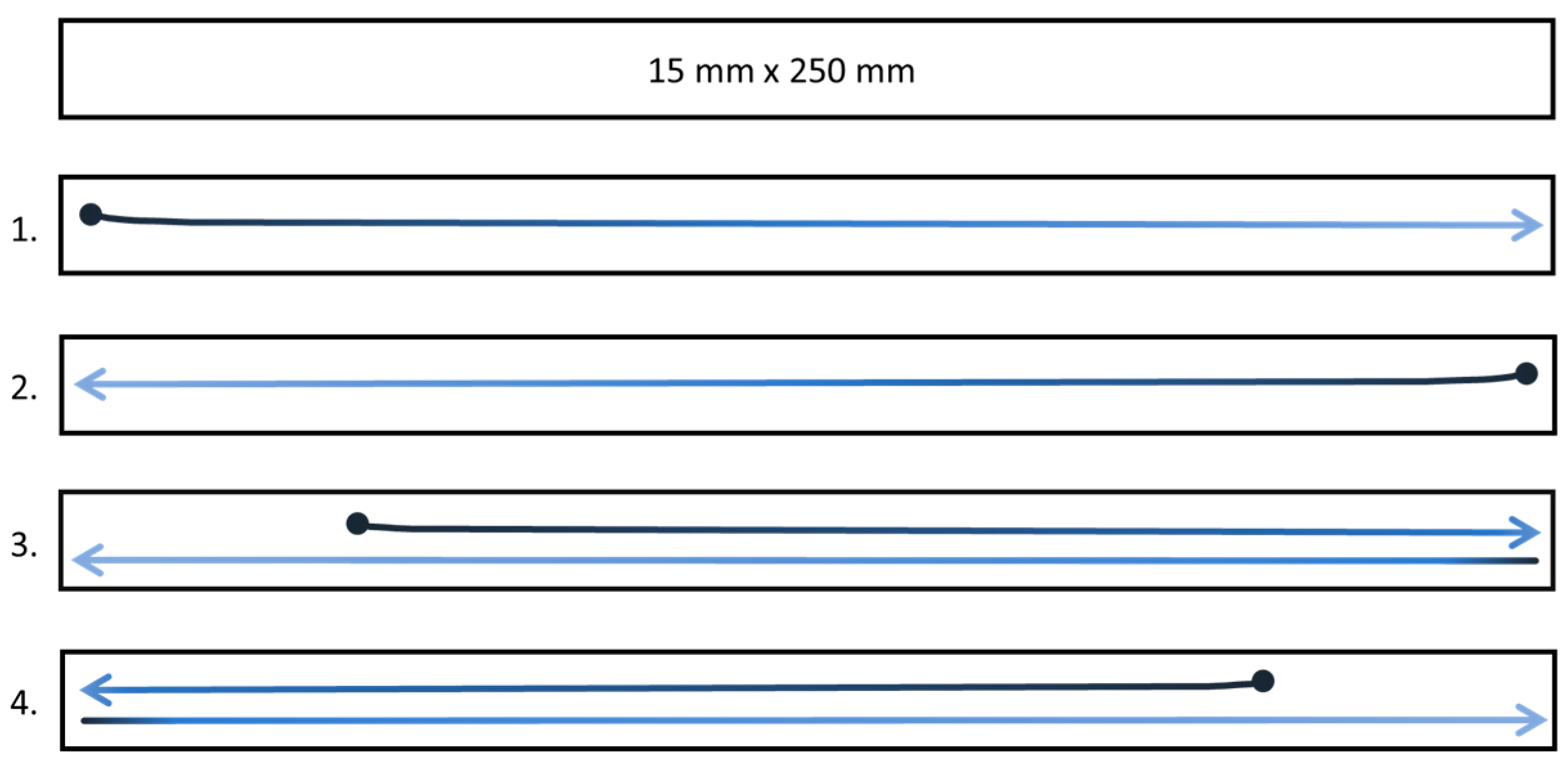
- The first immersion of the brush in the ink;
- The brush was positioned on the left side of the sample’s longer edge and, with a smooth motion, the ink was applied along its length to the end of the sample (1);
- The second immersion: the application process was similar, but this time, it started from the opposite side (2);
- The third immersion: ink application began five centimeters from the beginning of the left side of the sample; with a smooth motion, the brush was moved across 15 cm, then rotated and moved to the end of the sample (3);
- The fourth immersion: the ink was applied to the samples in the same manner as after the third immersion, but this time from the opposite side (4).
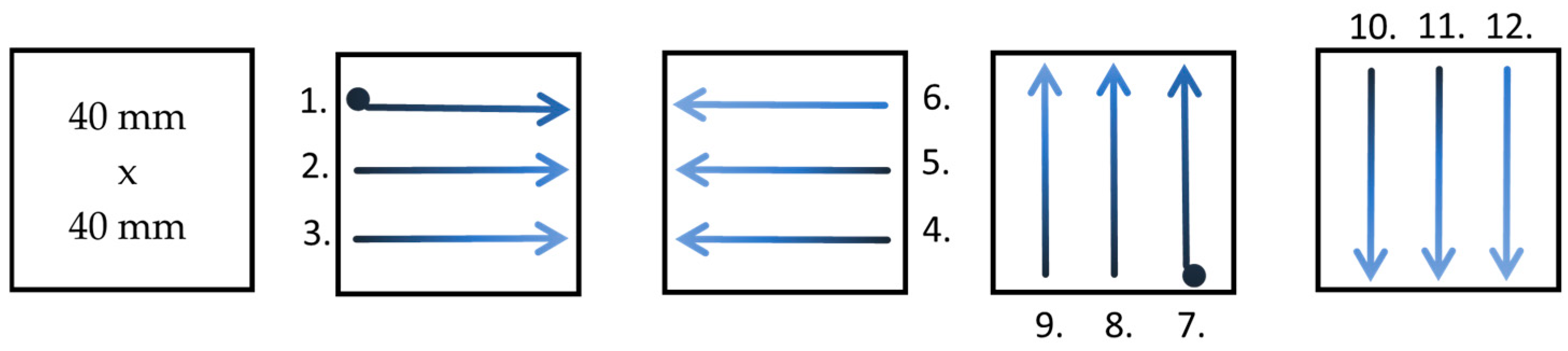
- The first immersion of the brush in the ink;
- The brush was positioned at the top left side of the sample and the ink was applied along the length of the sample to the end; this process was repeated three times, moving from left to right, each time placing the brush beneath the previous ink layer (1–3);
- At the point where the previous step ended, the brush was rotated, and the ink was applied from right to left three times, moving upward (4–6);
- The second immersion: the ink was applied from the right side of the sample, moving upward from bottom to top; the brush was positioned three times next to the preceding ink layer (7–9);
- Following the previous step, the ink was applied from top to bottom (10–12).
2.2. Deacidifier and Paper-Strengthening Agents
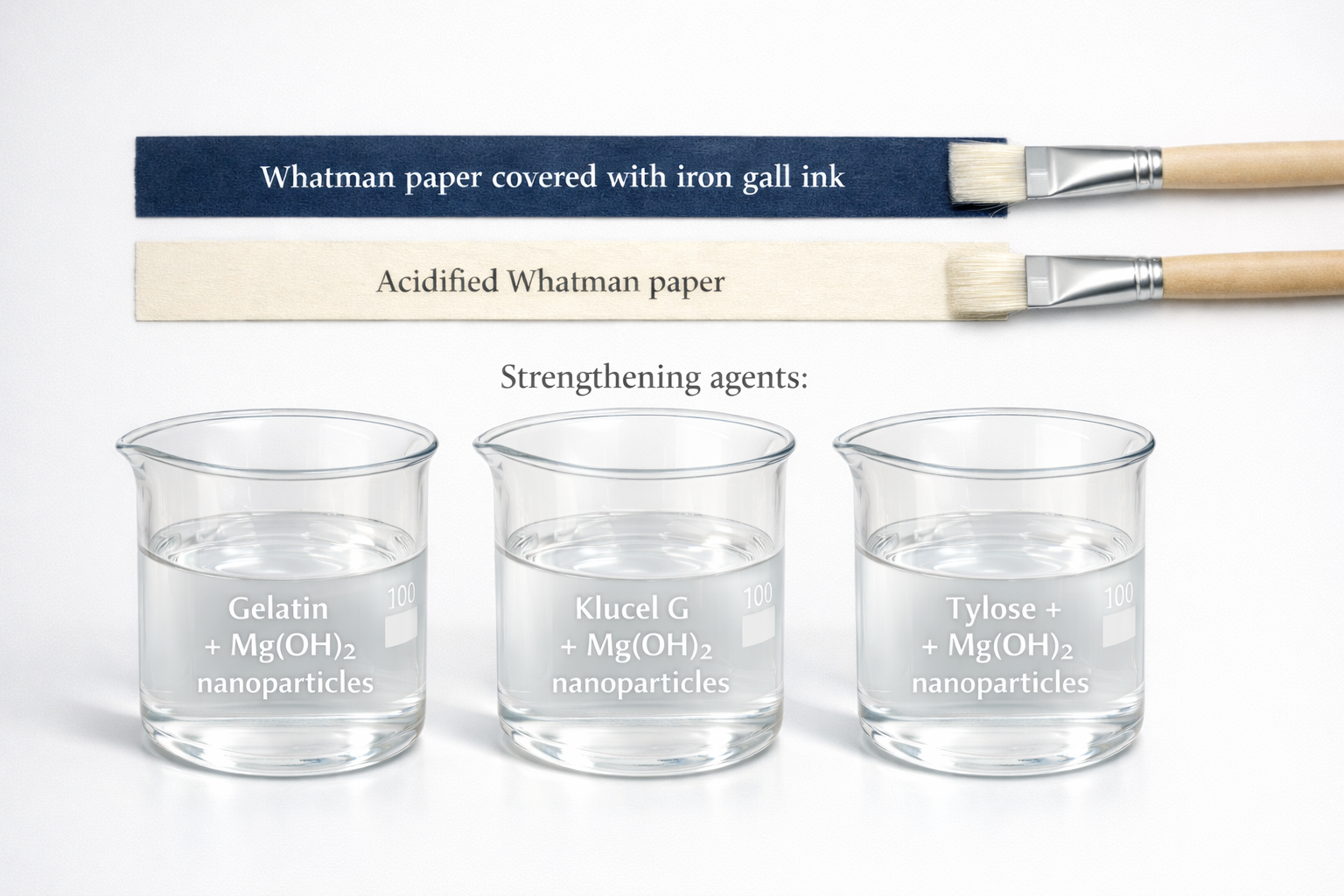
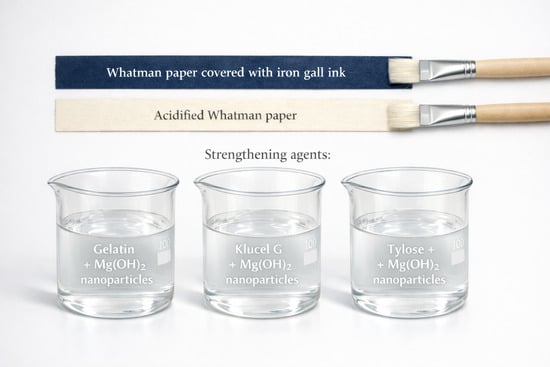
- some samples were strengthened using only a hydroalcoholic solution of gelatin obtained by the alkaline method (gelatin from bovine skin, Type B, AppliChem GmbH, Darmstadt, Germany, catalog no. A1693,0500) or a hydroalcoholic gelatin solution combined with Mg(OH)2 deacidifier;
- other samples were treated with either an alcoholic solution of hydroxypropyl cellulose (Klucel® G; Hercules Inc., Wilmington, WA, USA) or a hydroxypropyl cellulose solution combined with Mg(OH)2 deacidifier;
- the study also used hydroxyethyl methyl cellulose (Tylose® MH 300, [MHEC], SE Tylose GmbH & Co. KG, Wiesbaden, Germany), but Mg(OH)2 was introduced into the paper samples in a separate, initial stage of the experiment, followed by the strengthening treatment.
- 3% hydroalcoholic solution of gelatin;
- 1% solution of cellulose-based agent in 2-propanol (Klucel G) or in water (Tylose).
- 3 g of gelatin was weighed and added to a beaker containing 60 cm3 of distilled water, then mixed for 1 min. The gelatin was left to rest for 5 min and then heated in a water bath at 45 °C for 20 min. Every few minutes, the contents of the beaker were stirred with a glass rod to maintain the clarity of the solution. A 0.5 g sample of Mg(OH)2 nanoparticles was added to a beaker containing 20 cm3 of 2-propanol (analytical grade), stirred with a glass rod for 5 min, and then introduced into the gelatin solution. The entire contents of the beaker (gelatin and Mg(OH)2) were stirred for further 5 min, with the volume adjusted using 2-propanol until a gelatin concentration of 3% was achieved. The pH of the solution was 6.93 (without Mg(OH)2).
- 1 g of Klucel G (hydroxypropyl cellulose) was weighed in a weighing boat, while 0.5 g of nanoparticles was placed in a sealed container. Next, 100 cm3 of 2-propanol (analytical grade) was measured in a graduated cylinder and poured into the container with the weighed Mg(OH)2. The contents of the container were stirred for 5 min. Once a uniform dispersion of nanoparticles in 2-propanol was obtained, Klucel G was slowly added to the container while continuously stirring. The entire mixture was then stirred for an additional 5 min. The container was sealed and left for six days, with its contents being regularly stirred until a uniform consistency was obtained.
- 1 g of Tylose MH 300 (hydroxyethyl methyl cellulose) was dissolved in 100 cm3 of distilled water and stirred for 30 min. Since Tylose does not dissolve in 2-propanol, nanoparticles of Mg(OH)2 were not added to this solution. The deacidification of model acidic papers was carried out in the first stage of the experiment. Following this process, the paper samples were strengthened using a 1% Tylose solution (pH 8.10). Although EDX spectra of the surfaces of Whatman paper samples covered with Tylose revealed the presence of calcium compounds in only one out of four samples tested, the alkaline reaction should be unequivocally associated with the presence of Ca compounds in this solution.
- Stage I: washing of samples in a dispersion of Mg(OH)2 in 2-propanol at concentrations ranging from 0.0125% to 0.5% (2 × 30 min), followed by conditioning for 10 days [47];
- Stage II: application of the Tylose solution with a brush, followed by conditioning for 10 days.
- 1 cm3 of the solution was drawn into a syringe, then 0.5 cm3 was transferred from the syringe into a beaker; approx. half of the solution from the beaker was taken up by the brush and applied along the longer edge of the sample, starting from the left side, with the brush extending 2–3 mm beyond the strip’s edge, ensuring more thorough coverage; with a smooth motion, the solution was applied continuously to the end of the strip; the remaining half of the solution from the beaker was applied to the sample from the opposite side, following the method described above;
- half of the remaining 0.5 cm3 of the solution was taken up by the brush and applied approx. 5 cm from the beginning of the left side of the paper strip; with a smooth motion, the brush was moved across 15 cm, then rotated and moved in the opposite direction, applying the solution to the end of the sample; next, the remaining half of the solution was taken up by the brush and applied from the opposite side of the sample, following the method described above.
2.3. pH Measurements
2.4. SEM-SE-BSE-EDX
2.5. Thermal Ageing—Breaking Length
2.6. Degree of Polymerization (DP) After Thermal Ageing
2.7. Optical Properties
3. Results and Discussion
3.1. Remarks on the Preparation and Application of Strengthening Agents Combined with Mg(OH)2 Nanoparticles
- Gelatin–nanoparticles form dispersions within gelatin and do not precipitate. The formulation is easy to apply with a brush onto paper (more so than Tylose), providing good coverage and effectively penetrating the paper. During drying, the model paper (Whatman) tended to wrinkle and deform, as well as adhere to smooth surfaces (plexiglass) and other paper materials (Whatman blotting paper). The model papers dried very slowly and required weighting to prevent deformation.
- Klucel G—nanoparticles form dispersions and precipitate only after several minutes (without stirring). The formulation spreads easily and is readily applied with a brush, effectively penetrating the paper. The model papers (Whatman) dried quickly and, once dry, exhibited good dimensional stability (no deformation or signs of fiber shrinkage).
- Tylose—easily applied with a brush, spreads smoothly, and penetrates the paper well. However, the test samples wrinkled and bent during drying (shrinkage, deformation), and the paper took a long time to dry at room temperature and humidity.
3.2. Determination of Water Extract pH
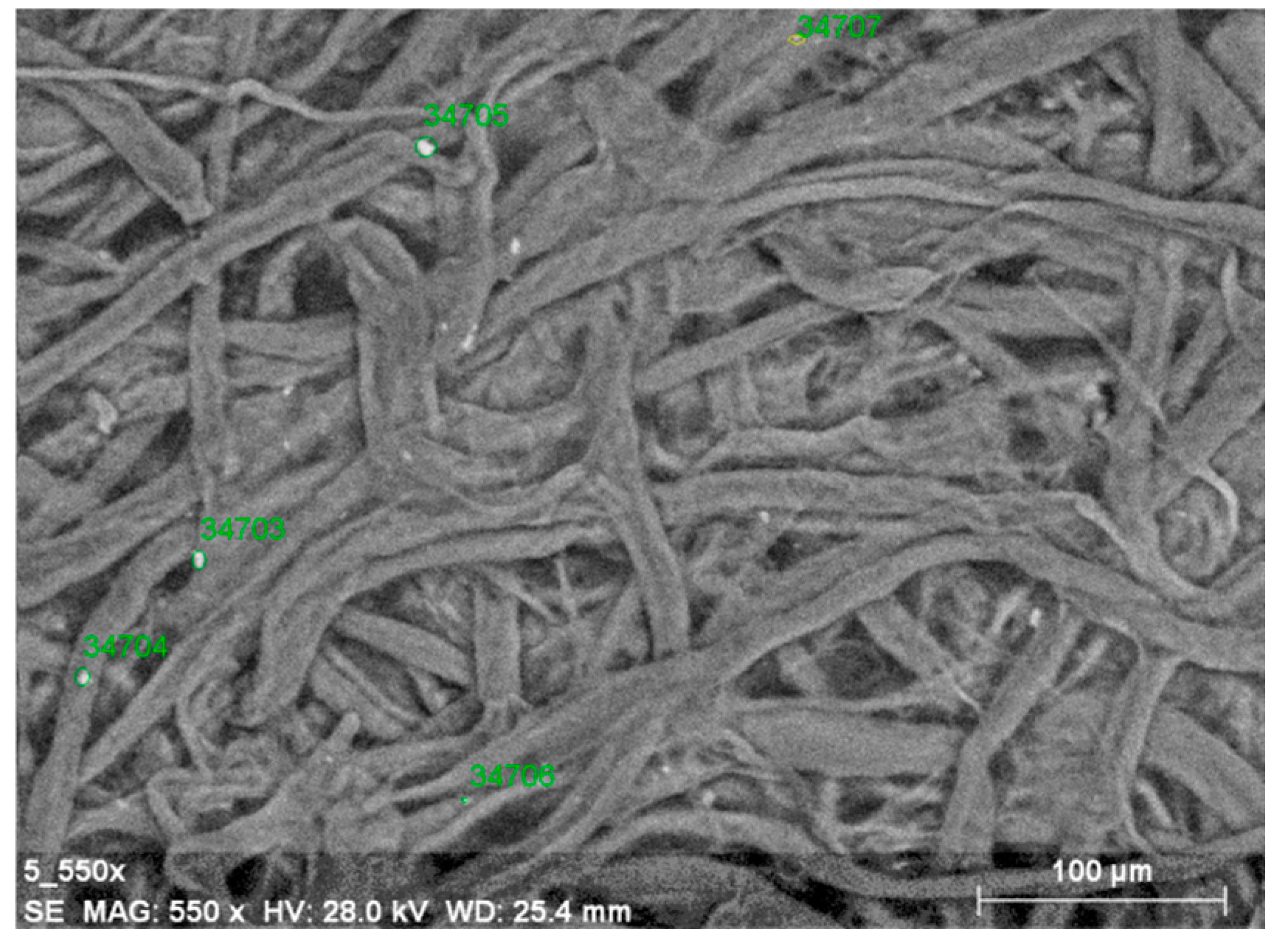
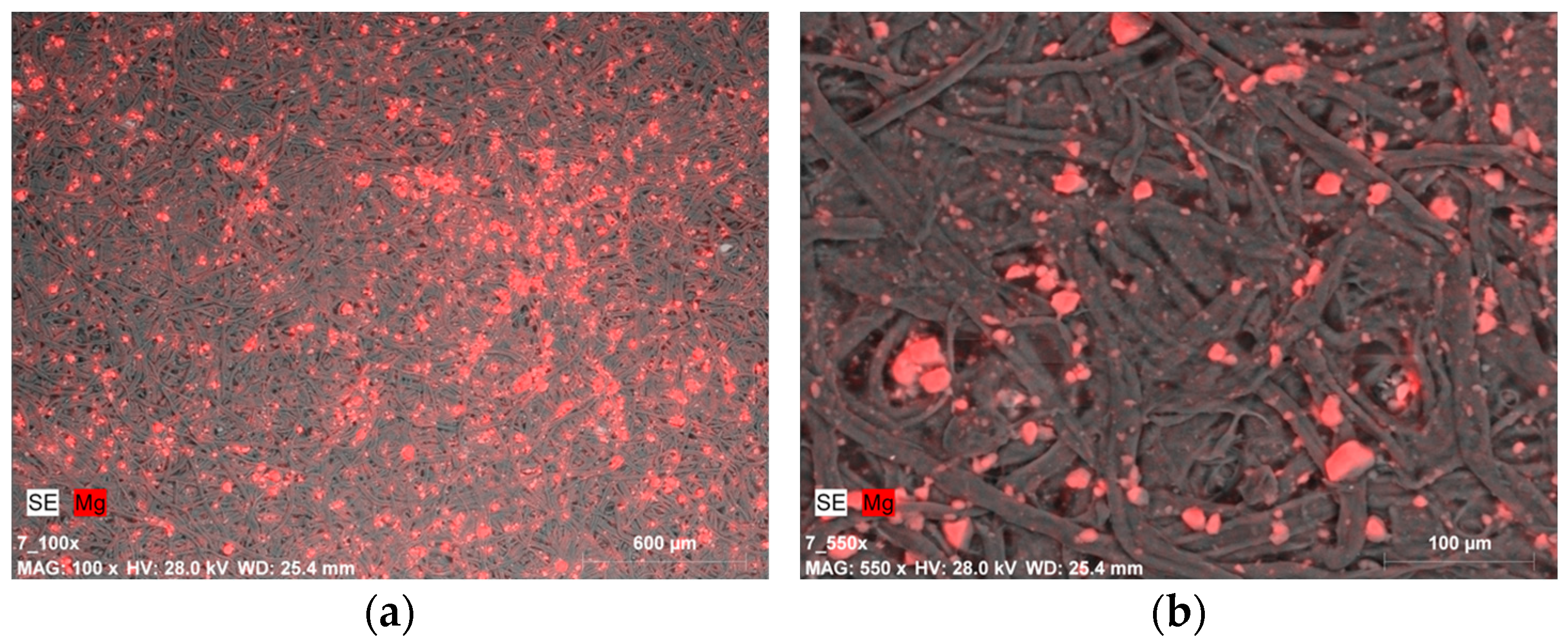
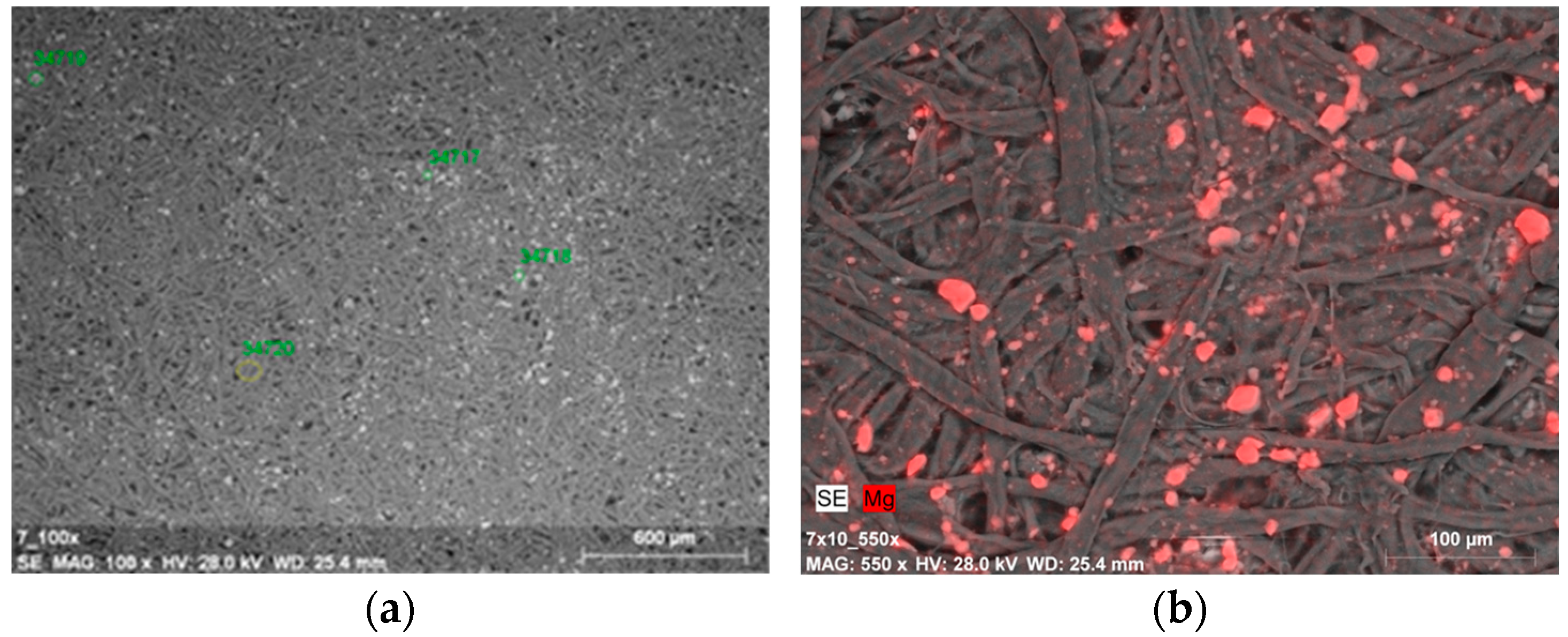
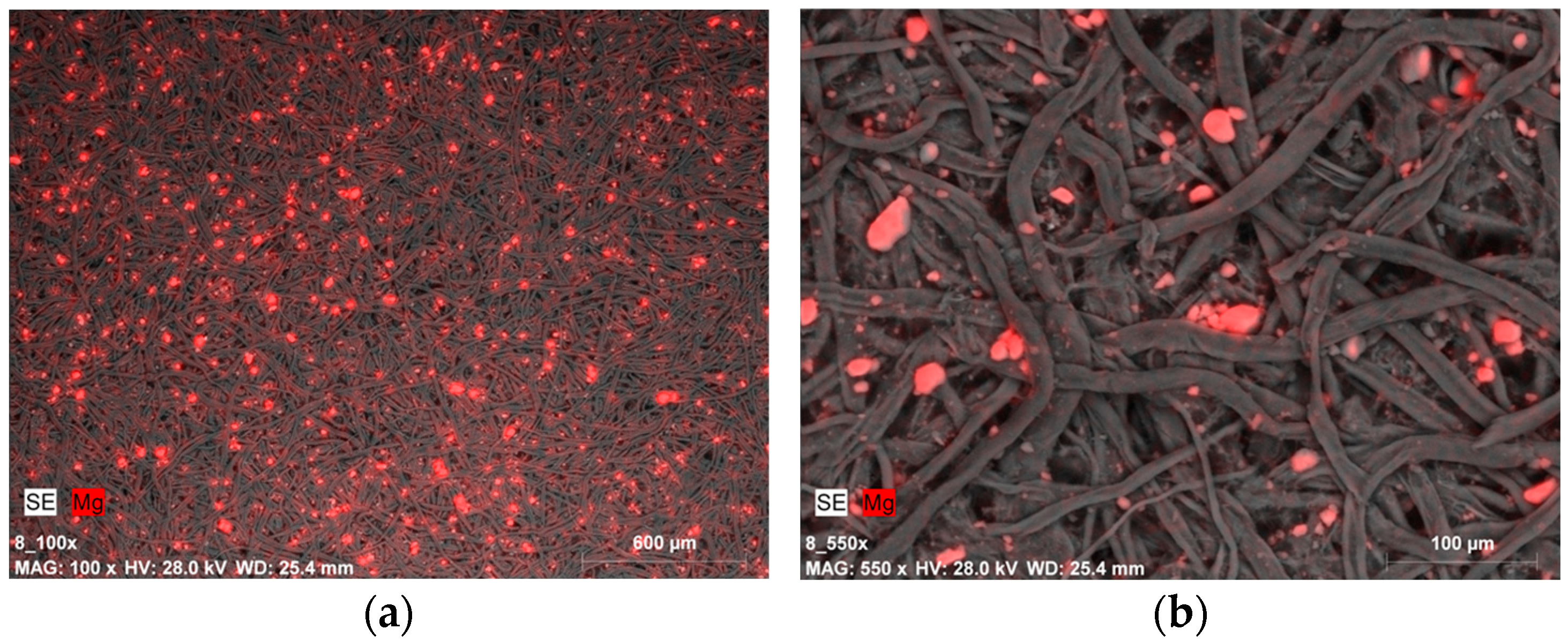
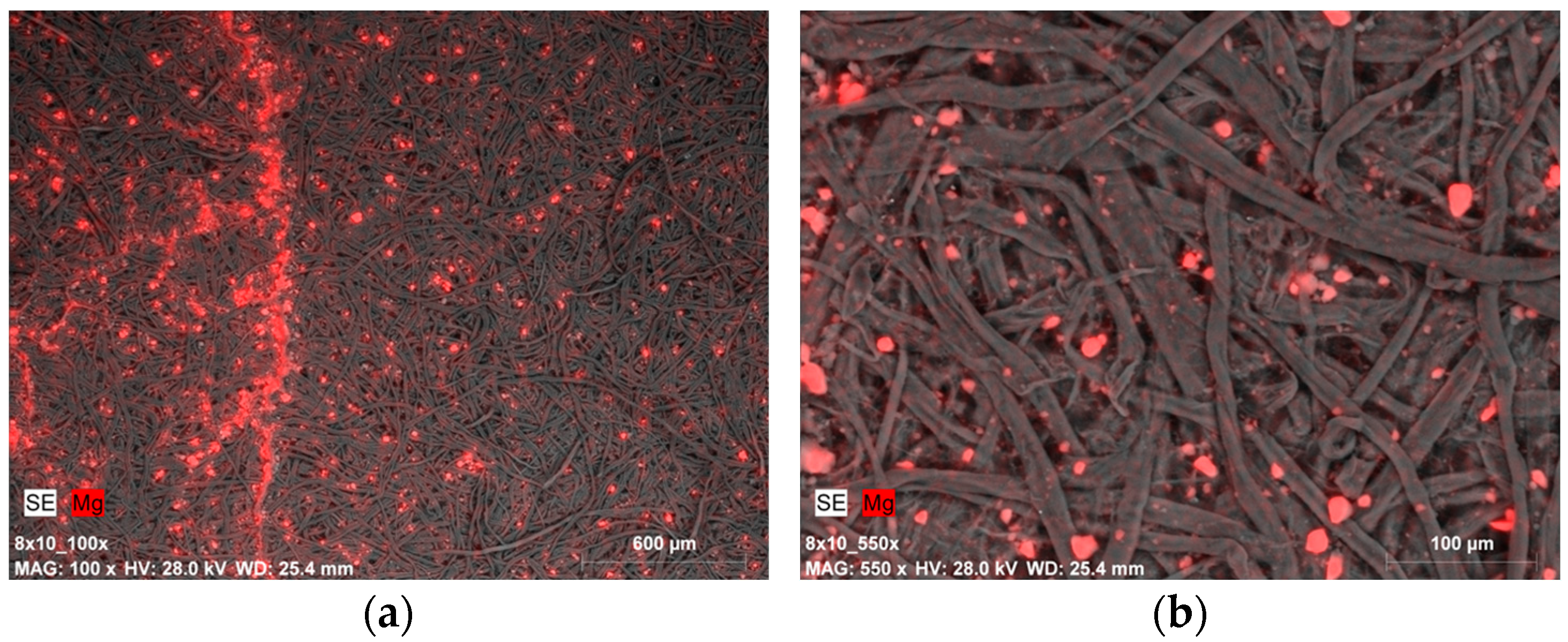
3.3. Microscopic Analyses—Distribution of Magnesium Compounds
3.4. Breaking Length and DP
3.5. Impact of the Solutions on the Optical Properties of the Model Papers
4. Conclusions
- Both gelatin and Klucel G form stable dispersions with magnesium hydroxide (Mg(OH)2) nanoparticles. The solutions are easy to apply with a brush onto paper (more so than Tylose), providing good coverage and effectively penetrating the paper. During drying, the model paper covered with gelatin, and to a lesser extent with Tylose, tended to wrinkle and deform, as well as adhere to smooth surfaces (plexiglass) and other paper materials (Whatman blotting paper). In the case of Klucel G, the model papers (Whatman) dried quickly and, once dry, exhibited good dimensional stability (no deformation or signs of fiber shrinkage);
- Gelatin and Klucel G, when used with an alcoholic dispersion of magnesium hydroxide (Mg(OH)2) nanoparticles, effectively deacidify acidic papers. The effectiveness of deacidification depends on the quantity of magnesium hydroxide nanoparticles used;
- All the strengthening agents tested caused an increase in paper strength—Tylose to the greatest extent, followed by gelatin, and Klucel G to the least extent. The quantity of Mg(OH)2 nanoparticles influenced the strength properties (breaking length) and DP of the model papers;
- Gelatin visibly darkens and yellows the paper and the ink inscription. These changes are perceptible to the average observer. Klucel G and Tylose also reduce paper brightness, but in a manner that is not perceptible to the average observer.
Author Contributions
Funding
Data Availability Statement
Acknowledgments
Conflicts of Interest
References
- Sundholm, F.; Tahvanainen, M. Paper Conservation Using Aqueous Solution of Calcium Hydroxide/methyl Cellulose: 1. Preparation of the solution. Restaurator 2003, 24, 1–17. [Google Scholar] [CrossRef]
- Sundholm, F.; Tahvanainen, M. Paper Conservation Using Aqueous Solution of Calcium Hydroxide/Methyl Cellulose 2. The influence of accelerated ageing temperature on properties of treated paper. Restaurator 2003, 24, 178–189. [Google Scholar] [CrossRef]
- Sundholm, F.; Tahvanainen, M. Paper Conservation Using Aqueous Solution of Calcium Hydroxide/methyl Cellulose. 3. The influence on the degradation of papers. Restaurator 2003, 25, 15–25. [Google Scholar] [CrossRef]
- Seki, M.; Sonoda, N.; Morita, T.; Okayama, T. A new techniques for strengthening book papers using cellulose derivatives. Restaurator 2005, 26, 239–249. [Google Scholar] [CrossRef]
- Seki, M.; Sonoda, N.; Hidaka, S.; Morita, T.; Okayama, T. A new techniques for strengthening book papers using cellulose derivatives. Part 2: Effect of cellulose derivatives on different types of paper. Restaurator 2010, 31, 126–141. [Google Scholar]
- Baty, J.W.; Maitland, C.L.; Minter, W.; Hubbe, M.A.; Jordan-Mowery, S.K. Deacidification for the conservation and preservation of paper based works: A review. BioResources 2010, 5, 1955–2023. [Google Scholar] [CrossRef]
- Chidichimo, G.; Crispini, A.; Tursi, A.; Basile, M.R.; Lania, I.; De Filpo, G.; Rossi, C.O.; Scarpelli, F. Water based aerosol for book deacidification: Experimental apparatus and theoretical interpretation of results. Molecules 2021, 26, 4249. [Google Scholar] [CrossRef]
- Hubbe, M.A.; Smith, R.D.; Zou, X.; Katuscak, S.; Potthast, A.; Ahn, K. Deacidification of Acidic Booksand Papers by Means of Non-aqueous Dispersions of Alkaline Particles: A Review Focusingon Completeness of the Reaction. BioResources 2017, 12, 4410–4477. [Google Scholar] [CrossRef]
- Hubbe, M.A.; Henniges, U.; Potthast, A.; Ahn, K. Nonaqueous Solution Deacidification Treatments to Prolong the Storage Life of Acidic Books: A Review of Mechanistic and Process Aspects. BioResources 2018, 13, 7110. [Google Scholar] [CrossRef]
- Zervos, S. Natural and accelerated ageing of cellulose and paper: A literature review. In Cellulose: Structure and Properties, Derivatives and Industrial Uses; Nova Science Publishers: New York, NY, USA, 2010; Volume 5, pp. 1–42. [Google Scholar]
- Barrett, T.D.; Mosier, C. The role of gelatin in paper permanence. J. Am. Inst. Conserv. 1995, 34, 173–186. [Google Scholar] [CrossRef]
- Banik, G.; Kolbe, G.; Wouters, J. Développement de procédésanalytiques pour évaluer les traitements de conservation du papier corrodé par les encresferrogalliques. In La Conservation à L’ére du Numérique, Proceedings of the Actes des Quatrièmesjournéesinternationalesd’études de l’ Association Pour la Recherchescientifique Sur Les Arts Graphiques (ARSAG), France, Paris, 27–30 May 2002; Capderou, C., Monod, S., Eds.; 2002; pp. 205–217. [Google Scholar]
- Kolbe, G. Gelatine in historical paper production and as inhibiting agent for iron-gall ink corrosion on paper. Restaurator 2004, 25, 26–39. [Google Scholar] [CrossRef]
- Poggi, G.; Sistach, M.C.; Marin, E.; Garcia, J.F.; Giorgi, R.; Baglioni, P. Calcium hydroxide nanoparticles in hydroalkoholicgelatin solutions (GeolNan) for the deacidification and strengthening of papers containing iron gall ink. J. Cult. Herit. 2016, 18, 253. [Google Scholar] [CrossRef]
- Gimat, A.; Michelin, A.; Massiani, P.; Rouchon, V. Beneficial effect of gelatin on iron gall ink corrosion. Herit. Sci. 2021, 9, 125–138. [Google Scholar] [CrossRef]
- Gimat, A.; Michelin, A.; Belhadj, O.; Pellizzi, E.; Massiani, P.; Rouchon, V. Paper sizing with gelatine: From the macro- to the nano-scale. Cellulose 2021, 28, 2419–2432. [Google Scholar] [CrossRef]
- Ardelean, E.; Bobu, E.; Niculescu, G.; Groza, C. Effects of Different Consolidation Additives on Ageing Behaviour of Archived Document Paper. Cellul. Chem. Technol. 2011, 45, 97–103. [Google Scholar]
- Feller, R.L.; Wilt, M. Evaluation of Cellulose Ethers for Conservation; The Getty Conservation Institute: Los Angeles, CA, USA, 1993; p. 148. [Google Scholar]
- Afsharpour, M.; Imani, S. Preventive protection of paper works by using nanocomposite coating of zinc oxide. J. Cult. Herit. 2017, 25, 142–148. [Google Scholar] [CrossRef]
- Cataldi, A.; Dorigato, A.; Deflorian, F.; Berglund, L.; Pegoretti, A. Polymer composite with micro- and nanocellulose for artwork protectionand restoration. In Proceedings of the ECCM16—16 th European Conference on Composite Materials, Seville, Spain, 22–26 June 2014. [Google Scholar]
- Camargos, C.H.M.; Figueiredo, J.C.D.; Pereira, F.V. Cellulose nanocrystal-based composite for restoration of lacunae on damaged documents and artworks on paper. J. Cult. Herit. 2017, 23, 170–175. [Google Scholar] [CrossRef]
- Dreyfuss-Deseigne, R. Nanocellulose Films in Art Conservation: A New and Promising Mending Material for Translucent Paper Objects. J. Pap. Conserv. 2017, 18, 18–29. [Google Scholar] [CrossRef]
- Gomez, N.; Santos, S.M.; Carbajo, J.M.; Villar, J.C. Use of Bacterial Cellulose in Degraded Paper Restoration: Effect on Visual Appearance of Printed Paper. BioResources 2017, 12, 9130–9142. [Google Scholar] [CrossRef]
- Santos, S.; Carbajo, J.; Gómez, N.; Quintana, E.; Ladero, M.; Sánchez, A.; Chinga-Carrasco, G.; Villar, J. Use of bacterial cellulose in degraded paper restoration. Part II: Application on real samples. J. Mater. Sci. 2017, 51, 1553–1561. [Google Scholar]
- Völkel, L.; Ahn, K.; Hähner, U.; Gindl-Altmutter, W.; Potthast, A. Nano meets the sheet: Adhesive-free application of nanocellulosic suspensions in paper conservation. Herit. Sci. 2017, 5, 5–23. [Google Scholar] [CrossRef]
- Amornkitbamrung, L.; Mohan, T.; Hribernik, S.; Reichel, V.; Faivre, D.; Gregorova, A.; Engel, P.; Kargl, R.; Ribitsch, V. Polysaccharide stabilized nanoparticles for deacidification and strengthening of paper. RSC Adv. 2015, 5, 32950–32961. [Google Scholar] [CrossRef]
- Lapierre, L.; Berry, R.; Bouchard, J. The effects of magnesium ions and chelants on peroxide bleaching. Holzforschung 2003, 57, 627–633. [Google Scholar] [CrossRef]
- Wójciak, A.; Kasprzyk, H.; Khmelinskii, I.; Krawczyk, A.; Oliveira, A.S.; Ferreira, L.F.; Weselucha-Birczynska, A.; Sikorski, M. Direct Characterization of Hydrogen Peroxide Bleached Thermomechanical Pulp Using Spectroscopic Methods. J. Phys. Chem. A 2007, 111, 10530–10536. [Google Scholar] [CrossRef] [PubMed]
- Brown, D.G.; Abbot, J. Magnesium as a stabilizer for peroxide bleaching of mechanical pulp. Appita 1994, 47, 211–220. [Google Scholar]
- Darčanova, O.; Tamutė, M.; Beganskienė, A.; Kareiva, A. Synthesis of magnesium oxide nanoparticles via sol–gel method and hydrolysis and application for paper deacidification treatment. Chemija 2016, 27, 170–178. [Google Scholar] [CrossRef]
- Bicchieri, M.; Valentini, F.; Calcaterra, A.; Talamo, M. Newly Developed Nano-Calcium Carbonate and Nano-Calcium Propanoate for the Deacidification of Library and Archival Materials. J. Anal. Methods Chem. 2017, 2017, 2372789. [Google Scholar] [CrossRef] [PubMed]
- Ariafar, A.A.; Afsharpour, M.; Samanian, K. Use of TiO2/chitosan nanoparticles for enhancing the preservative effects of carboxymethyl cellulose in paper-art-works against biodeterioration. Int. Biodeterior. Biodegrad. 2018, 131, 67–77. [Google Scholar]
- Cremones, P. A Note of Caution on the Use of Calcium Nanoparticle Dispersions as Deacidifying Agents. Stud. Conserv. 2021, 68, 128–135. [Google Scholar] [CrossRef]
- Hassan, R.R.A.; Mahmoud, S.M.A.; Nessem, M.A.; Abdel Aty, R.T.; Ramzy, M.G.; Dessoky, E.S.; Abdelkhalek, A.; Salem, M.Z.M. Hydroxypropyl cellulose loaded with ZnO nanoparticles for enhancing the mechanical properties of papyrus (Cyperus papyrus L.) strips. BioResources 2021, 16, 2607–2625. [Google Scholar] [CrossRef]
- Jarmulkiene, O.; Liubiniene, M.; Beganskienė, A. Stabilization of Iron Gall Ink Damaged Paper with Nanosized Magnesium Hydroxide and Antioxidants. Stud. Conserv. 2023, 69, 360–368. [Google Scholar] [CrossRef]
- Li, J.; Ma, R.; Wu, P.; Quan, M. CMC-Ca(OH)2-TiO2 Nanocomposite for Paper Relics Multifunctional Restoration: Strengthening, Deacidification, UV Effect Resistance, and Antimicrobial Protection. Coatings 2024, 14, 851–864. [Google Scholar]
- Bračič, M.; Malešič, J.; Brunčko, M.; Bračič, D.; Ojstršek, A.; Kapun, T.; Gyergyek, S.; Stana-Kleinschek, K.; Mohan, T. Functional coatings with ethyl cellulose-calcium carbonate alkaline nanoparticles for deacidification and mechanical reinforcement of paper artifacts. Surf. Interfaces 2025, 60, 106065. [Google Scholar] [CrossRef]
- Baglioni, P.; Chelazzi, D.; Giorgi, R.; Poggi, G. Colloid and Materials Science for the Conservation of Cultural Heritage: Cleaning, Consolidation, and Deacidification. Langmuir 2013, 29, 5110–5122. [Google Scholar] [CrossRef]
- Giorgi, R.; Dei, L.; Ceccato, M.; Schettino, C.; Baglioni, P. Nanotechnologies for Conservation of Cultural Heritage: Paper and Canvas Deacidification. Langmuir 2002, 18, 8198–8203. [Google Scholar] [CrossRef]
- Giorgi, R.; Bozzi, C.; Dei, L.; Gabbiani, C.; Ninham, B.W.; Baglioni, P. Nanoparticles of Mg(OH)2: Synthesis and application to paper conservation. Langmuir 2005, 21, 8495–8501. [Google Scholar] [CrossRef] [PubMed]
- Poggi, G.; Giorgi, R.; Toccafondi, N.; Katzur, V.; Baglioni, P. Hydroxide nanoparticles for deacidification and concomitant inhibition of metal-gall ink corrosion of paper. Langmuir 2010, 26, 19084–19090. [Google Scholar] [CrossRef] [PubMed]
- Poggi, G.; Baglioni, P.; Giorgi, R. Alkaline Earth Hydroxide Nanoparticles for the Inhibition of Metal Gall Ink Corrosion. Restaurator 2011, 32, 247–273. [Google Scholar] [CrossRef]
- Sequeira, S.; Casanova, M.; Cabrita, E. Deacidification of paper using dispersions of Ca(OH)2 nanoparticles in isopropanol. Study of efficiency. J. Cult. Herit. 2006, 7, 264–272. [Google Scholar] [CrossRef]
- Stefanis, E.; Panayiotou, C. Protection of lignocellulosic and cellulosic paper by deacidification with dispersions of micro- and nano-particles of Ca(OH)2 and Mg(OH)2 in alcohols. Restaurator 2007, 28, 185–200. [Google Scholar] [CrossRef]
- Stefanis, E.; Panayiotou, C. Study of the photochemical stability of paper deacidified with dispersions of Ca(OH)2 and Mg(OH)2 nanoparticles in alcohols. Restaurator 2008, 29, 125–138. [Google Scholar] [CrossRef]
- Stefanis, E.; Panayiotou, C. Deacidification of documents containing iron gall ink with dispersions of Ca(OH)2 and Mg(OH)2 nanoparticles. Restaurator 2010, 31, 19–40. [Google Scholar] [CrossRef]
- Wójciak, A. Washing, spraying and brushing. A comparison of paper deacidification by magnesium hydroxide nanoparticles. Restaurator 2015, 36, 14–19. [Google Scholar] [CrossRef]
- Wójciak, A. Deacidification of paper with Mg(OH)2 nanoparticles: The impact of dosage on process effectiveness. Wood Res. 2016, 61, 937–950. [Google Scholar]
- Neevel, J.G. Phytate: A potential conservation agent for the treatment of ink corrosion caused by iron gall inks. Restaurator 1995, 16, 143–160. [Google Scholar] [CrossRef]
- ISO 187:1990; Paper, Board and Pulps. Standard Atmosphere for Conditioning and Testing and Procedure for Monitoring the Atmosphere and Conditioning of Samples. International Organization for Standardization (ISO): Geneva, Switzerland, 1990.
- TAPPI T 509 om-02; Hydrogen Ion Concentration (pH) of Paper Extracts (Cold Extraction Method). Technical Association of the Pulp and Paper Industry: Peachtree Corners, GA, USA, 2002.
- Jablonský, M.; Katuščák, S.; Holúbková, S.; Hroboňová, K.; Lehotay, J. The Effect of Acetic and Formic Acid Formation during Accelerated Ageing on Embrittlement of Newsprint Paper. Restaurator 2011, 32, 318–347. [Google Scholar] [CrossRef]
- ISO 1924-2:2008; Paper and Board—Deteremination of Tensile Propertoes. Part 2: Constant Rate of Elongation Method (20 mm/min). International Organization for Standardization (ISO): Geneva, Switzerland, 2008.
- TAPPI T 230 om-89; Viscosity of Pulp (Capillary Viscometer Method). Technical Association of the Pulp and Paper Industry: Peachtree Corners, GA, USA, 1989.
- ISO 2470-1: 2016; Paper, Board and Pulps—Measurement of Diffuse Blue Reflectance Factor—Part 1: Indoor Daylight Conditions (ISO Brightness). International Organization for Standardization (ISO): Geneva, Switzerland, 2016.
- Wågberg, L. Chemistry of the Fibre Surface. In Pulp and Paper Chemistry and Technology, Vol. 3, Paper Chemistry and Technology; Ek, M., Gellerstedt, G., Henriksson, G., Eds.; Walter de Gruyter: Berlin, Germany, 2009; pp. 70, 147–157. [Google Scholar]





| Strengthening Agent | Paper Covered with Ink [g/cm2] | Acidified Model Papers [g/cm2] |
|---|---|---|
| Gelatin 3% + Mg(OH)2 0.5% | 0.0012 | 0.0013 |
| Klucel G 1% + Mg(OH)2 0.5% | 0.0004 | 0.0008 |
| Tylose 1% + Mg(OH)2 0.0125% | 0.0003 | 0.0005 |
| Tylose 1% + Mg(OH)2 0.025% | 0.0002 | 0.0004 |
| pH of Paper Samples | ||
|---|---|---|
| Samples No. | Artificially Acidified with H2SO4 | |
| pH After Month | pH After 4 Years | |
| 0 | 3.95 | 4.77 |
| 1 | 9.46 | 10.85 |
| 2 | 10.44 | 11.01 |
| 3 | 5.09 | 5.49 |
| 4 | 6.79 | 6.37 |
| 5 | 10.65 | 10.73 |
| Covered with Ink | ||
| 0 | 2.87 | 4.06 |
| 1 | 7.55 | 8.21 |
| 2 | 7.87 | 6.98 |
| 3 | 2.82 | 4.15 |
| 4 | 2.88 | 4.27 |
| 5 | 6.71 | 8.73 |
| Mg [Mass%] | ||
|---|---|---|
| Strengthening | Data Range for 3 Points on the Paper Sample Surface (Lowest and Highest Result) | |
| Paper Surface | After Ten Cycles of Tape Peeling | |
| Tylose + 0.025% Mg(OH)2 | 0.65–0.77 | Within the error |
| Gelatin (3%) + 0.5% Mg(OH)2 | 2.11–13.74 | 2.03–7.52 |
| Klucel G (1%) + 0.5% Mg(OH)2 | 2.07–13.11 | 1.80–8.74 |
| Samples No. | Breaking Length [km] | ||
|---|---|---|---|
| Mean Value | σ | 2σ | |
| 0 | 1.265 | 0.13 | ±0.26 |
| 1 | 3.109 | 0.25 | ±0.50 |
| 2 | 1.926 | 0.28 | ±0.56 |
| 3 | 2.800 | 0.47 | ±0.94 |
| 4 | 3.406 | 0.31 | ±0.62 |
| 5 | 8.462 | 0.70 | ±1.40 |
| DP First Measurement | Second Measurement | Third Measurement | |
| 0 | 256.23 | 283.32 | 283.32 |
| 1 | 404.57 | 443.96 | 431.32 |
| 2 | 282.60 | 282.60 | 322.06 |
| 3 | 365.54 | 379.60 | 392.15 |
| 4 | 437.38 | 423.01 | 463.06 |
| 5 | 555.05 | 555.05 | - |
| Samples No. | Breaking Length [km] | ||
|---|---|---|---|
| Mean Value | σ | 2σ | |
| 0 | 1.509 | 0.05 | ±0.10 |
| 1 | 3.059 | 0.10 | ±0.20 |
| 2 | 2.055 | 0.06 | ±0.12 |
| 3 | 1.814 | 0.10 | ±0.20 |
| 4 | 1.897 | 0.07 | ±0.14 |
| 5 | 5.894 | 0.95 | ±1.90 |
| DP First Measurement | Second Measurement | Third Measurement | |
| 0 | 207.60 | 234.76 | 234.76 |
| 1 | 314.57 | 342.05 | 327.46 |
| 2 | 263.52 | 263.52 | 277.40 |
| 3 | 261.50 | 261.50 | 261.50 |
| 4 | 258.90 | 272.53 | 272.53 |
| 5 | - | 355.82 | - |
| Samples No. | Before Strengthening | |||||||
|---|---|---|---|---|---|---|---|---|
| L* | σ | a* | σ | b* | σ | R457C | σ | |
| 1 | 96.65 | 0.14 | −0.42 | 0.020 | 2.78 | 0.073 | 87.84 | 0.067 |
| 2 | 96.75 | 0.117 | −0.42 | 0.020 | 2.77 | 0.087 | 88.12 | 0.017 |
| 3 | 96.71 | 0.091 | −0.44 | 0.009 | 2.71 | 0.073 | 88.10 | 0.025 |
| 4 | 96.79 | 0.086 | −0.42 | 0.017 | 2.8 | 0.031 | 88.15 | 0.021 |
| 5 | 96.88 | 0.085 | −0.43 | 0.006 | 2.75 | 0.028 | 88.45 | 0.088 |
| 6 | 96.8 | 0.060 | −0.42 | 0.013 | 2.73 | 0.073 | 88.28 | 0.19 |
| 7 | 96.72 | 0.096 | −0.44 | 0.011 | 2.83 | 0.037 | 87.95 | 0.083 |
| Samples No. | After Strengthening | |||||||
| 1 | 96.65 | 0.14 | −0.42 | 0.020 | 2.78 | 0.073 | 87.84 | 0.067 |
| 2 | 96.11 | 0.026 | −0.38 | 0.014 | 2.82 | 0.023 | 86.53 | 0.041 |
| 3 | 95.61 | 0.023 | −0.51 | 0.017 | 3.93 | 0.021 | 83.34 | 0.021 |
| 4 | 95.7 | 0.033 | −0.73 | 0.026 | 4.51 | 0.036 | 83.43 | 0.030 |
| 5 | 96.54 | 0.046 | −0.39 | 0.017 | 2.60 | 0.053 | 87.85 | 0.064 |
| 6 | 96.14 | 0.026 | −0.39 | 0.016 | 2.82 | 0.042 | 86.61 | 0.047 |
| 7 | 96.32 | 0.018 | −0.40 | 0.011 | 2.81 | 0.028 | 87.05 | 0.024 |
| Samples No. | Before Strengthening | |||||||
|---|---|---|---|---|---|---|---|---|
| L* | σ | a* | σ | b* | σ | R457C | σ | |
| 1 | 42.6 | 0.065 | 2.15 | 0.057 | −11.77 | 0.032 | 17.84 | 0.096 |
| 2 | 43.66 | 0.038 | 2.02 | 0.054 | −11.74 | 0.060 | 18.72 | 0.053 |
| 3 | 43.13 | 0.026 | 2.08 | 0.061 | −11.71 | 0.018 | 18.26 | 0.076 |
| 4 | 44.92 | 0.058 | 1.94 | 0.054 | −11.83 | 0.042 | 19.85 | 0.064 |
| 5 | 44.50 | 0.039 | 1.96 | 0.029 | −11.75 | 0.032 | 18.45 | 0.044 |
| 6 | 43.23 | 0.052 | 2.09 | 0.009 | −11.74 | 0.043 | 18.36 | 0.058 |
| 7 | 43.90 | 0.064 | 2.04 | 0.016 | −11.81 | 0.034 | 18.95 | 0.060 |
| Samples No. | After Strengthening | |||||||
| 1 | 42.60 | 0.065 | 2.15 | 0.057 | −11.77 | 0.032 | 17.84 | 0.096 |
| 2 | 40.08 | 0.025 | 2.04 | 0.018 | −11.23 | 0.020 | 15.64 | 0.041 |
| 3 | 30.04 | 0.058 | 2.45 | 0.043 | −7.89 | 0.047 | 8.24 | 0.067 |
| 4 | 25.63 | 0.032 | 1.77 | 0.039 | −2.49 | 0.052 | 5.10 | 0.048 |
| 5 | 41.26 | 0.012 | 1.57 | 0.008 | −10.82 | 0.021 | 16.36 | 0.016 |
| 6 | 38.09 | 0.024 | 1.57 | 0.019 | −10.72 | 0.027 | 14.01 | 0.034 |
| 7 | 39.22 | 0.017 | 1.30 | 0.025 | −11.01 | 0.044 | 14.94 | 0.052 |
| Sample | ΔE | ||
|---|---|---|---|
| 1 | 2 | 3 | |
| Gelatin | 2.17 | 1.12 | 13.64 |
| Gelatin + Mg(OH)2 | 1.95 | 2.05 | 21.43 |
| Klucel G | 0.58 | 0.64 | 3.62 |
| Klucel G + Mg(OH)2 | 0.51 | 0.37 | 3.39 |
| Tylose | 0.54 | 0.67 | 5.27 |
| Tylose + Mg(OH)2 | 0.05 | 0.4 | 4.81 |
Disclaimer/Publisher’s Note: The statements, opinions and data contained in all publications are solely those of the individual author(s) and contributor(s) and not of MDPI and/or the editor(s). MDPI and/or the editor(s) disclaim responsibility for any injury to people or property resulting from any ideas, methods, instructions or products referred to in the content. |
© 2025 by the authors. Licensee MDPI, Basel, Switzerland. This article is an open access article distributed under the terms and conditions of the Creative Commons Attribution (CC BY) license.
Share and Cite
Wojech, R.; Kwiatkowska, A.; Cofta, G.; Wójciak, A. Comparison of the Effectiveness of Paper Strengthening with Gelatin, Klucel G, and Tylose Solutions in Combination with Deacidification Using Magnesium Hydroxide Nanoparticles. Materials 2026, 19, 126. https://doi.org/10.3390/ma19010126
Wojech R, Kwiatkowska A, Cofta G, Wójciak A. Comparison of the Effectiveness of Paper Strengthening with Gelatin, Klucel G, and Tylose Solutions in Combination with Deacidification Using Magnesium Hydroxide Nanoparticles. Materials. 2026; 19(1):126. https://doi.org/10.3390/ma19010126
Chicago/Turabian StyleWojech, Renata, Aleksandra Kwiatkowska, Grzegorz Cofta, and Adam Wójciak. 2026. "Comparison of the Effectiveness of Paper Strengthening with Gelatin, Klucel G, and Tylose Solutions in Combination with Deacidification Using Magnesium Hydroxide Nanoparticles" Materials 19, no. 1: 126. https://doi.org/10.3390/ma19010126
APA StyleWojech, R., Kwiatkowska, A., Cofta, G., & Wójciak, A. (2026). Comparison of the Effectiveness of Paper Strengthening with Gelatin, Klucel G, and Tylose Solutions in Combination with Deacidification Using Magnesium Hydroxide Nanoparticles. Materials, 19(1), 126. https://doi.org/10.3390/ma19010126