Article

Molybdenum Nitride and Oxide Layers Grown on Mo Foil for Supercapacitors

Department of Chemistry, Yeungnam University, 280 Daehak-ro, Gyeongsan 38541, Republic of Korea
*
Author to whom correspondence should be addressed.
Materials 2025, 18(24), 5649; https://doi.org/10.3390/ma18245649
Submission received: 28 November 2025 / Revised: 10 December 2025 / Accepted: 13 December 2025 / Published: 16 December 2025

Abstract

In this study, thin molybdenum nitride (MoNx) layers were directly synthesized on molybdenum foil via thermal treatment under an NH3 atmosphere, and their phase evolution, structural characteristics, and electrochemical performance were investigated. The thickness and morphology of the MoNx layers were controlled by varying ammonolysis time and temperature, while subsequent annealing in N2 converted the nitride layer into MoO2. Meanwhile, oxidation in air yielded crystalline MoO3 layers. X-ray diffraction and X-ray photoelectron spectroscopy confirmed progressive oxidation of molybdenum, with Mo 3d binding energies increasing in the sequence of Mo < MoNx < MoO2 < MoO3, consistent with their nominal oxidation states. Electrochemical characterization revealed that both MoNx/Mo and MoO2/Mo electrodes exhibit notable pseudocapacitive behavior in 0.5 M H2SO4 electrolyte, with areal specific capacitances reaching up to 520 mF cm−2 at 10 mV s−1. Increasing layer thickness led to enhanced capacitance, likely due to an increase in the electrochemically accessible surface area and the extension of ion diffusion pathways. MoO2-coated samples showed stronger faradaic contribution and superior rate capability compared to MoNx counterparts, along with a gradual shift from predominantly electric double-layer capacitance toward hybrid pseudocapacitive charge storage mechanisms.

1. Introduction

With increasing global concern regarding energy sustainability and environmental impact, there is a growing demand for advanced technologies that enhance energy efficiency and power management. Energy storage plays a central role in modern power systems and is becoming increasingly important due to the rapid expansion of renewable energy sources [1,2]. Energy storage and conversion are realized through various device types such as rechargeable batteries, supercapacitors, and fuel cells, each distinguished by their working mechanisms and power/energy densities [3,4,5]. Supercapacitors represent a relatively recent energy storage strategy that offers high power delivery, rapid charge–discharge rates, and long cycle life [6,7,8]. However, their energy density generally remains lower than that of batteries. The electrochemical performance of supercapacitor electrodes can be significantly tuned not only by the selection of electroactive materials but also by the fabrication strategy employed. To date, promising supercapacitor electrodes have been developed predominantly using carbon-based materials (activated carbon, graphene, and nanotubes) [9,10,11,12] or transition metal-based compounds (oxides [13], oxynitrides [14,15], and sulfides [16]). Numerous studies therein have emphasized controlling the morphology to increase the specific surface area and maximize active sites for charge transfer [17,18,19]. At the same time, the adhesion quality between the active material and current collector has been identified as a critical factor affecting charge transport kinetics and cycling stability. Slurry-based drop casting is perhaps the most widely adopted approach due to its simplicity [20,21], but it often suffers from poor interfacial adhesion and mechanical instability. To overcome these drawbacks, thin film deposition methods such as electrodeposition [22,23,24], sputtering [25,26,27], chemical vapor deposition [28,29], and atomic layer deposition [30] have been employed, although these deposition techniques typically require sophisticated equipment and multistep processing. In this regard, the development of a simple, scalable, and robust strategy of fabricating binder-free supercapacitor electrodes is highly desirable.
Recently, we reported on the surface modification of titanium foil through ammonolytic nitridation, producing TiN/Ti structures with promising electrochemical performance [31]. This nitridation strategy is believed to be applicable to other transition metals. Among them, molybdenum (Mo) is a particularly attractive candidate due to its wide range of nitrides and oxides, as well as its diverse redox behavior. Molybdenum and nitrogen form several line compounds including β-Mo2N (tetragonal) [32], γ-Mo2N (cubic) [33], δ-MoN (hexagonal) [34], Mo5N6 (hexagonal) [34], and Mo2N3 (cubic) [35]. The cubic/tetragonal phases (β-Mo2N, γ-Mo2N, and Mo2N3) have a rock salt-type atomic arrangement, δ-MoN has a NiAs-like hexagonal lattice, and Mo5N6 is an intergrowth of WC and NiAs-type structures. The above structures tolerate high densities of atomic vacancies, favoring the formation of non-stoichiometric MoNx phases. This behavior is further facilitated by the strong covalency of Mo–N and Mo–Mo bonds along with the ability of Mo to adopt diverse oxidation states. Among the various molybdenum nitride phases, hexagonal MoN and cubic Mo2N have been frequently reported as promising electrode materials for supercapacitors owing to their high electrical conductivity and chemical stability in acidic electrolytes.
Molybdenum compounds such as MoN, Mo2N, MoO2, and MoO3 have been actively explored for supercapacitors [36,37,38,39,40], batteries [41,42], and electrocatalysts [43,44,45,46]. However, most studies rely on powder synthesis followed by slurry processing, which limits interfacial integrity. To achieve improved performances, however, more sophisticated techniques [47] were also exploited, such as hydrothermal loading of oxide precursor followed by ammonolysis [48], electrodeposition of oxide followed by ammonolysis [49], electrodeposition of MoO2 [50], and microwave irradiation for MoO2 [51]. Particularly, a recent study prepared a MoNx@Mo structure by thermal ammonolysis of Mo foil [39]. Therefore, investigating phase evolution and electrochemical behavior in directly transformed dense Mo foil offers an opportunity to develop mechanically robust and functionally efficient electrode architectures. In addition, it is intriguing to investigate the preferred phases that form when a dense Mo foil undergoes thermal treatment in different atmospheres. In this work, we investigate the thermal modifications of Mo foil in NH3, N2, and air atmospheres and evaluate the resulting phases using X-ray diffraction (XRD), X-ray photoelectron spectroscopy (XPS), and electrochemical methods. The relationship between phase composition, microstructure, and charge storage mechanism is elucidated, providing insight into capacitive behavior of Mo-based coatings.

2. Materials and Methods

Molybdenum foil was used as the starting material for synthesizing molybdenum nitrides and oxides. As-purchased Mo foil (Alfa Aesar (Ward Hill, MA, USA), 99.95%, 0.127 mm thick) was cut into 1.5 cm × 1.5 cm square pieces, immersed in 1 N HNO3(aq) for 5 min, rinsed with deionized water, and dried under N2 at 50 °C. Then, the Mo foil was placed inside an alumina tube and heated in NH3 flow (PSG Co. (Pusan, Republic of Korea), 99.9999%), N2 flow (Shumachemia (Yeongcheon, Republic of Korea), 99.999%), or static air. Particularly for ammonolytic nitridation, the alumina tube was purged with flowing NH3 for 15 min to remove residual air. Then, the furnace temperature was raised to the target temperature at a ramp rate of 10 °C min−1, and held for a designated reaction time. After completion of the ammonolysis, the furnace was allowed to cool naturally to room temperature. The NH3 flow was maintained at a constant rate during the entire heat treatment procedure.
The powder XRD pattern was collected in the Bragg–Brentano mode using a diffractometer (MiniFlex 600, Rigaku (Akishima, Japan)) with Cu Kα radiation generated at 40 kV, 15 mA. For select samples, synchrotron XRD was also measured in the high-resolution diffractometer installed at the beamline 9B of Pohang Accelerator Laboratory (PAL, Pohang, Republic of Korea), where parallel beam radiation with λ = 1.5219 Å was supplied from the storage ring (3.0 GeV, 250 mA). The diffraction pattern was collected in the Bragg–Brentano mode at a 2θ step of 0.01° and with a scan time of 1 s per step. The lattice constants of molybdenum nitride and oxide phases were refined by the Le Bail fitting [52] of the synchrotron XRD pattern, using the GSAS-I software suite [53,54].
The plane and fracture surfaces of the foil samples were examined using scanning electron microscopy (SEM; S-4200, Hitachi (Tokyo, Japan)). Ultraviolet–visible (UV–Vis) absorption spectra were obtained in a diffuse–reflectance spectrometer (Neosys 2000, Scinco (Seoul, Republic of Korea)) equipped with a 35 mm integrating sphere, using BaSO4 as a reference. The pseudo-absorbance (F) was retrieved from the diffuse–reflectance (R) following the Kubelka–Munk transformation, F = (1 − R)2/2R [55]. XPS was performed in a Thermo Scientific (Waltham, MA, USA) K-Alpha spectrometer using Al Kα source (hν = 1486.6 eV). The signal intensity was recorded at 0.1 eV intervals, and each spectrum was obtained by averaging the results of 20 scans. The XPS binding energy was calibrated using the C 1s peak at 284.6 eV, which originated from adventitious carbon.
The electrochemical properties of coated specimens were tested in a potentiostat/galvanostat (VersaSTAT 3, AMETEK (Oak Ridge, TN, USA)) using a three-electrode system employing 0.5 M H2SO4(aq) as an electrolyte. Molybdenum nitride/oxide-coated foil, Pt coil, and Ag/AgCl junction were used as the working, counter, and reference electrodes, respectively. The working electrode was constructed using a custom-made sample holder that exposed only one side of the coated foil (area 0.88 cm2). The cyclic voltammetry (CV) was carried out in the potential (E) range of −0.2 to +0.5 V vs. Ag/AgCl, at scan rates ( v ) of 10 to 200 mV s−1. The areal specific capacitance, Cs in F cm−2, was calculated as  j d E / v × Δ E × A  from CV, where  j Δ E , and  A  are areal current density, potential window width, and electrode area, respectively [56]. The galvanostatic charge–discharge (GCD) was conducted in the potential window between −0.1 and +0.5 V vs. Ag/AgCl, and a current density of 0.1 mA cm−2.

3. Results

3.1. Surface Modification of Mo Foil by Heat Treatment

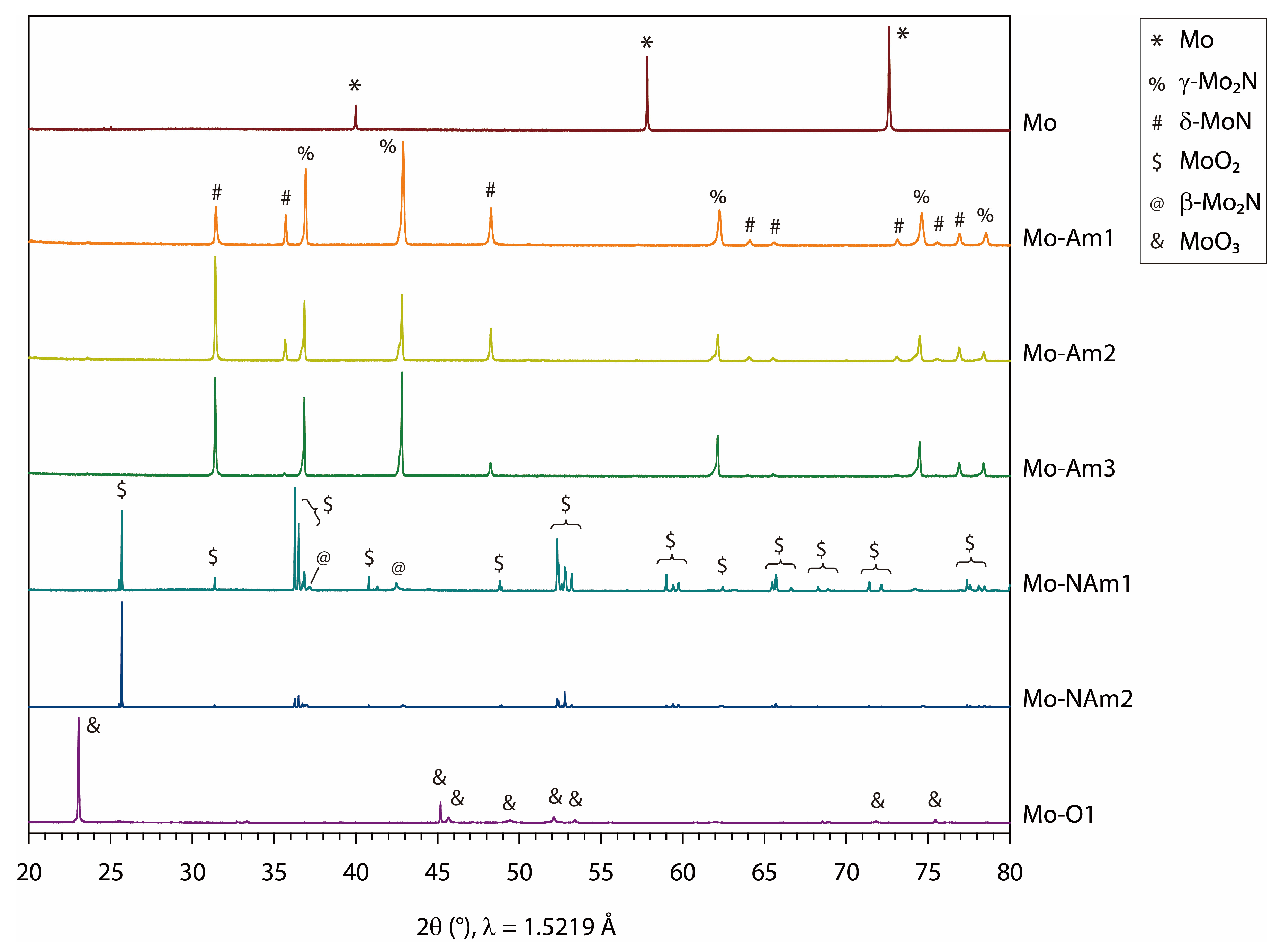
The thermal evolution of Mo foil was investigated in different atmospheres, that is, NH3, N2, and air, as briefly outlined in Figure 1. A list of representative samples is given in Table 1, and the corresponding synchrotron XRD patterns are presented in Figure 2.
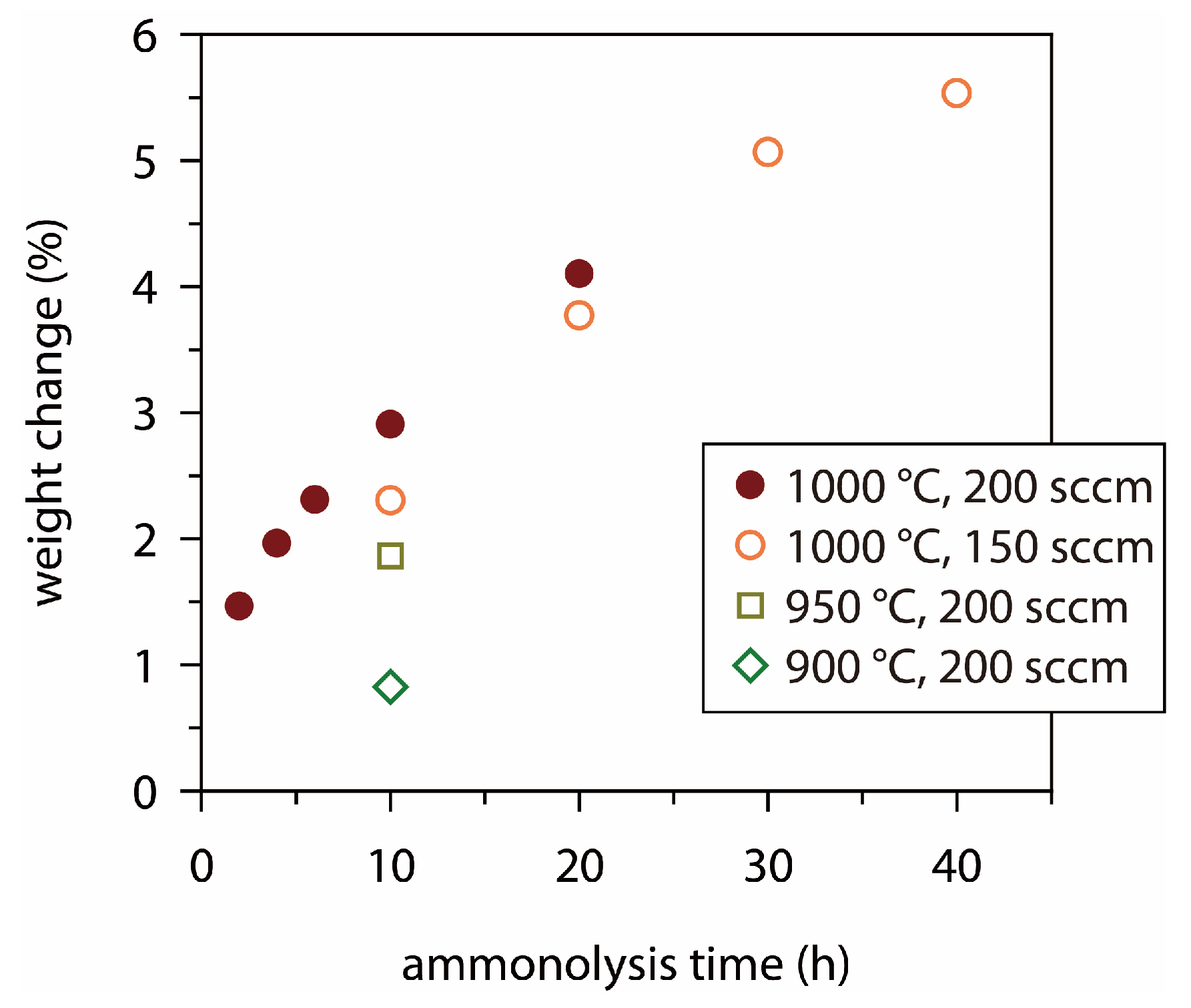
First, the thermal ammonolysis was carried out using various temperature (Tam = 900–1000 °C) and time (tam = 2–40 h) conditions while keeping the NH3 flow rate at 200 mL min−1. The ammonolysis resulted in molybdenum nitrides, where the extent of nitridation is directly reflected in the weight change (Δwt) in the foil during heat treatment. For example, a transformation of Mo (FW 95.94) to MoN (FW 109.95) corresponds to a Δwt of +14.6%. Figure 3 shows the experimental Δwt values, indicating that the more vigorous condition leads to the higher nitridation level. With Tam = 1000 °C and tam = 40 h, Δwt was observed to be 5.9%, corresponding to an atomic ratio of N/Mo ≈ 0.4, while with Tam = 1000 °C and tam = 2 h, Δwt was 1.4% (N/Mo ≈ 0.1). The above N/Mo ratios regard the entire foil specimen; therefore, the coated nitride layer will have a higher nitrogen content. As found by the XRD measurement, reactions with Tam ≤ 900 °C produced a mixture of various nitrides, while the ammonolysis at 1000 °C yielded better-defined products, composed primarily of δ-MoN and γ-Mo2N. Previously, bulk forms of molybdenum nitride have been synthesized by various routes, including ammonolysis of Mo powder [57] or MoCl5 [58,59], high-pressure and high-temperature reaction between MoO2 and NH4Cl [60], reduction-nitridation of (NH4)6Mo7O24∙4H2O-derived MoO3 under an N2/H2 mixture [61], and reaction between Na2MoO4∙2H2O and dicyanamide [35]. Most of these reactions led to a single-phase product of δ-MoN [34], γ-Mo2N [33], Mo2N3 [34], or Mo5N6 [33]. In several other studies, however, ammonolysis of Mo foil [39] or Mo wire [62] resulted in a mixture of various Mo-N phases. In the present study, we similarly obtained mixed phases of molybdenum nitrides through the ammonolysis of Mo foil. We speculate that the dense texture of the foil or wire impedes the diffusion of the nitriding molecules, leading to a mixture of kinetically accessible phases. The ammonolytic heating of Mo foil at 1000 °C produced two-component mixtures of δ-MoN and γ-Mo2N (Figure 2). Judging from the XRD intensity, the phase fractions of the two were similar for Mo-Am1 (tam = 2 h), Mo-Am2 (tam = 10 h), and Mo-Am3 (tam = 20 h). For the cubic γ-Mo2N, the relative peak intensities were not influenced by tam, but for the hexagonal δ-MoN, (00l) peaks were enhanced with an increase in tam (see Figure S1).
Second, the thermal evolution of Mo foil was examined in N2. Heating at 900 °C or below resulted in a poorly crystalline mixture of δ-MoN and γ-Mo2N. With the heating at 1000 °C in N2, the Mo foil was converted almost exclusively to Mo16N7 (sample Mo-N1) which is closely related with the γ-Mo2N phase [63]. With the heating at 1500 °C in N2, however, the Mo foil was converted to MoO2 (Mo-N2). The N2 gas used in this study was supplied with a nominal purity of 99.999% without additional purification. Nevertheless, possible oxygen sources during high-temperature treatment include residual oxygen or adsorbed species in the alumina tube, trace O2 impurities in the gas stream, and minute air leakage under prolonged heating at 1500 °C. These factors are believed to have contributed collectively to the formation of the MoO2 phase. The results of Mo-N1 and Mo-N2 indicate that the reactivity of O2 is much more dominant at 1500 °C than at 1000 °C. We also examined the modification of MoNx layers (Mo-Am2 and Mo-Am3) by a subsequent heating in N2, and observed the transformation to MoO2. Upon heating in the air, the surface of Mo foil was fully oxidized to MoO3, but that occurred only at below 600 °C. At higher temperatures such as 900 °C, sample specimens completely sublimed manifesting the volatility of MoO3. The synchrotron XRD data (Figure 2) was analyzed by the Le Bail refinement (Figure S2), in which the lattice constants of the coated nitrides and oxides agreed well with the literature data for the bulk phase (Table 2).

3.2. SEM, UV-Vis, and XPS

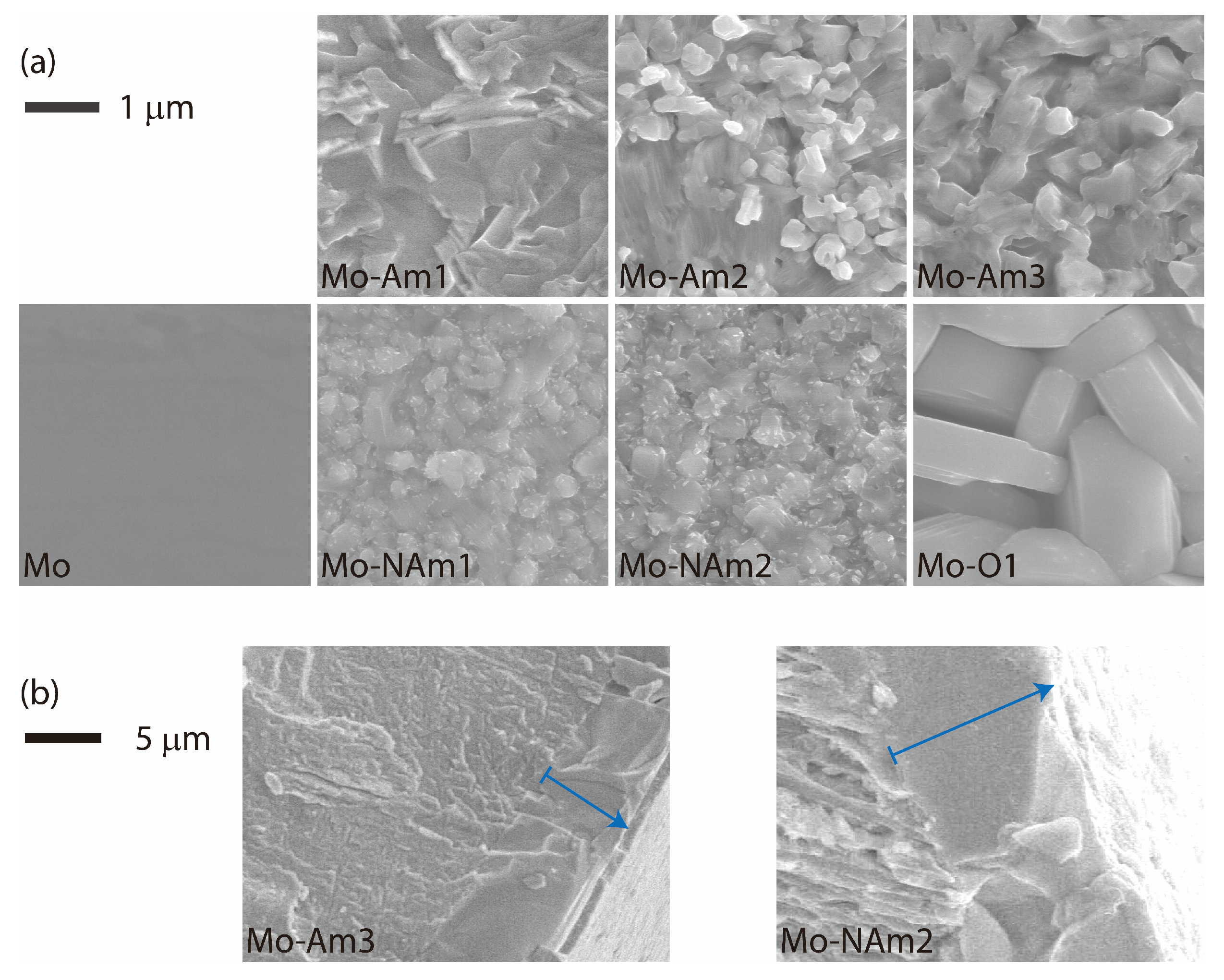
The morphology of the Mo-based coatings was examined by SEM. Figure 4 presents the top-view and cross-sectional micrographs of MoNx (Mo-Am), MoO2 (Mo-NAm), and MoO3 (Mo-O) layers. The raw Mo foil had a flat and smooth surface, but its nitride and oxide derivatives formed with distinct textures. The MoNx layers had both platelets and granular particles, presumably associated with hexagonal MoN and cubic Mo2N, respectively. The MoO3 layer contained large and angulate particles which had edge lengths of several micrometers, indicating a well-crystallized state. The MoO2 coatings contained relatively smaller grains with sharp vertices. Comparing between MoNx and MoO2, the former had larger grains along with higher porosity which can provide greater surface area for electrode activity. On the other hand, the smaller and particulate microstructure of MoO2 may provide more active sites for pseudocapacitive reactions.
The thickness of the coated layer increased with the time and temperature of heat treatment. In particular, Mo-Am3 and Mo-NAm2 (Figure 4b) had thicknesses of ≈12 μm and ≈18 μm, respectively. Above two coatings were prepared through somewhat similar paths. Compared with Mo-Am3, which was prepared by ammonolysis at 1000 °C for 20 h, Mo-NAm2 was obtained via an additional heat treatment in N2. The conversion of MoNx (Mo-Am3) to MoO2 (Mo-NAm2) was accompanied by a substantial volume expansion, which is consistent with the lattice volumes of γ-Mo2N (18.0 Å3 per Mo), δ-MoN (20.0 Å3 per Mo), and MoO2 (32.9 Å3 per Mo). Such structural expansion may contribute to the formation of additional electrochemically active sites and enhanced electrolyte accessibility within the coating layer.
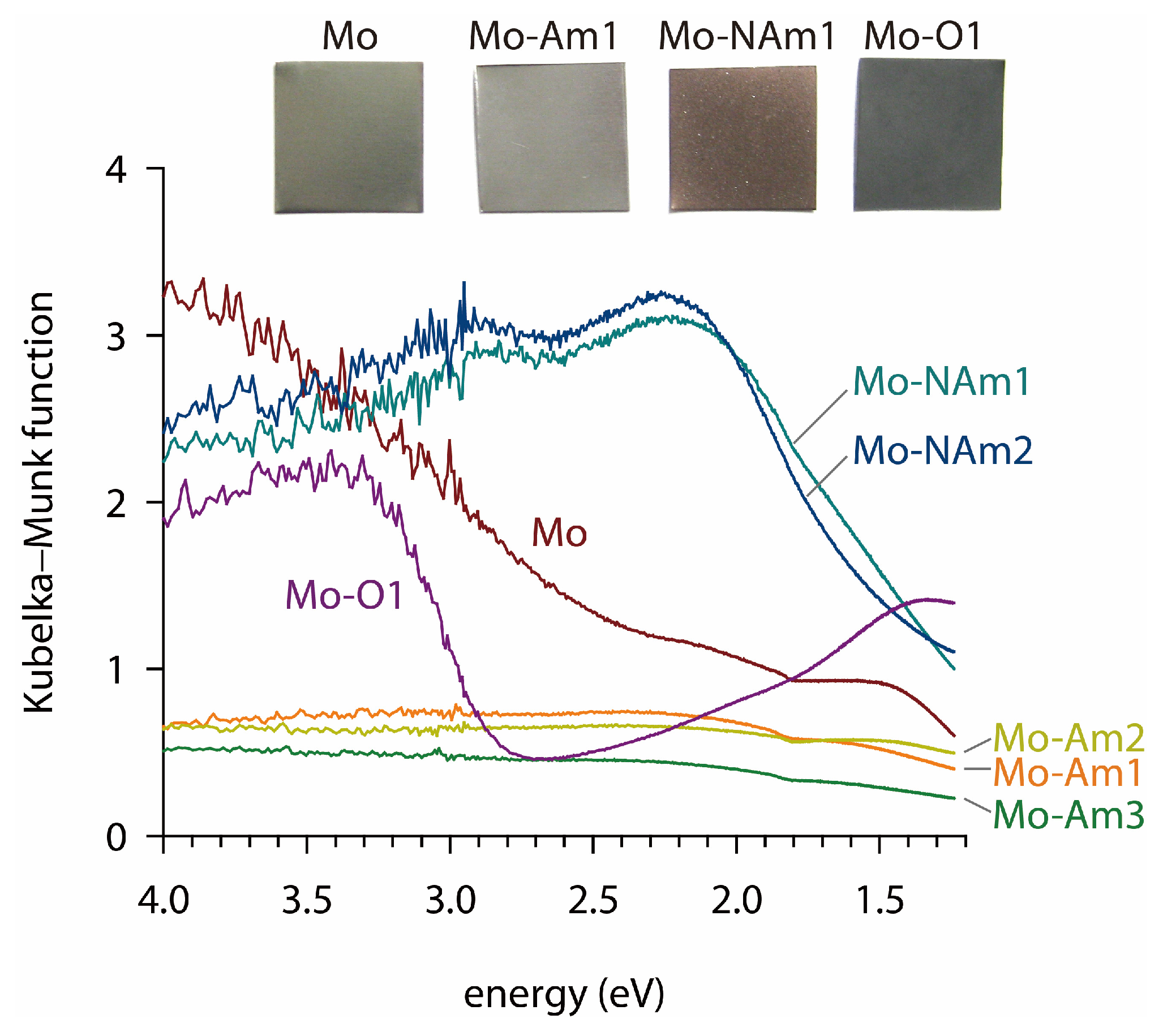
Figure 5 presents the UV-Vis spectra and photographic images of Mo foil and Mo-derived coatings. The pristine Mo foil, MoNx coating (Mo-Am1), and MoO2 coating (MoNAm1) exhibited significant absorption over the entire wavelength range of measurement (220–1000 nm), which is characteristic of a metallic or metallic-like electronic structures. The molybdenum in MoNx (x ≤ 1) has an oxidation number lower than 3, and can readily form metallic-like covalent bonding. Similarly, the MoO2 coating contains Mo4+ (4d2), and exhibited metallic-like optical characteristics, as established for the bulk MoO2 [65]. It is expected that the metallic-like electronic structures of MoNx and MoO2 are accompanied by high electrical conductivity, which is particularly beneficial for achieving enhanced rate capability and efficient charge storage in the supercapacitor electrodes. In contrast, the trioxide MoO3 (Mo-O1) with Mo6+ (4d0), was found to be semiconducting with an estimated band gap (Eg) of 2.8 eV. This value agrees well with that of bulk MoO3 [65]. The relatively dark appearance of the MoO3-coated sample (Mo-O1) is attributed to enhanced optical scattering from its thick and highly crystalline surface with micrometer-scale grains, despite its intrinsically semiconducting nature.
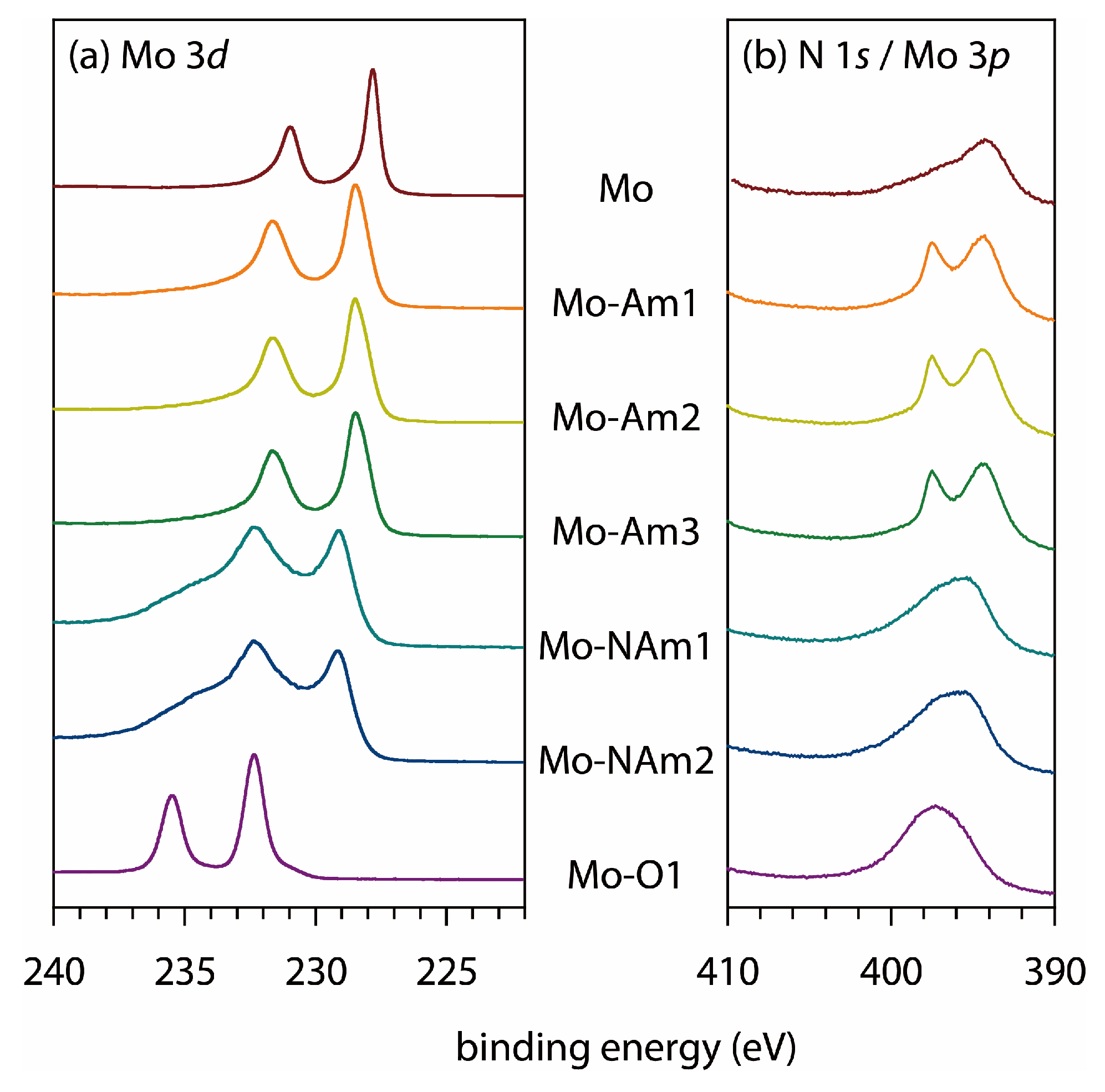
The core level XPS data were acquired at Mo 3d and N 1s regions (Figure 6). The binding energy of Mo 3d increased in an order, Mo < Mo-Am < Mo-NAm < Mo-O, in good agreement with the expected variations in the Mo oxidation number [66]. Comparing the two end-compositions, Mo and MoO3, both the Mo 3d3/2 and 3d5/2 peaks were separated by about 4 eV. The three MoNx samples (Mo-Am1, Mo-Am2, Mo-Am3) displayed similar spectra in terms of the peak position, and so did the two MoO2 samples (Mo-NAm1, Mo-NAm2). Therefore, the Mo 3d XPS corroborates the interpretation of the XRD analysis given above.
The N 1s and Mo 3p levels have similar binding energies to each other, as can be seen in Figure 6b. The N 1s line was clearly recognizable from the three MoNx samples but not from the others. The Mo 3p lines did not split clearly to 3p1/2 and 3p3/2 components; instead, they occurred as a broad asymmetric profile. The variation in the Mo 3p binding energy followed a similar trend to that of the Mo 3d line.

3.3. Electrochemical Analysis

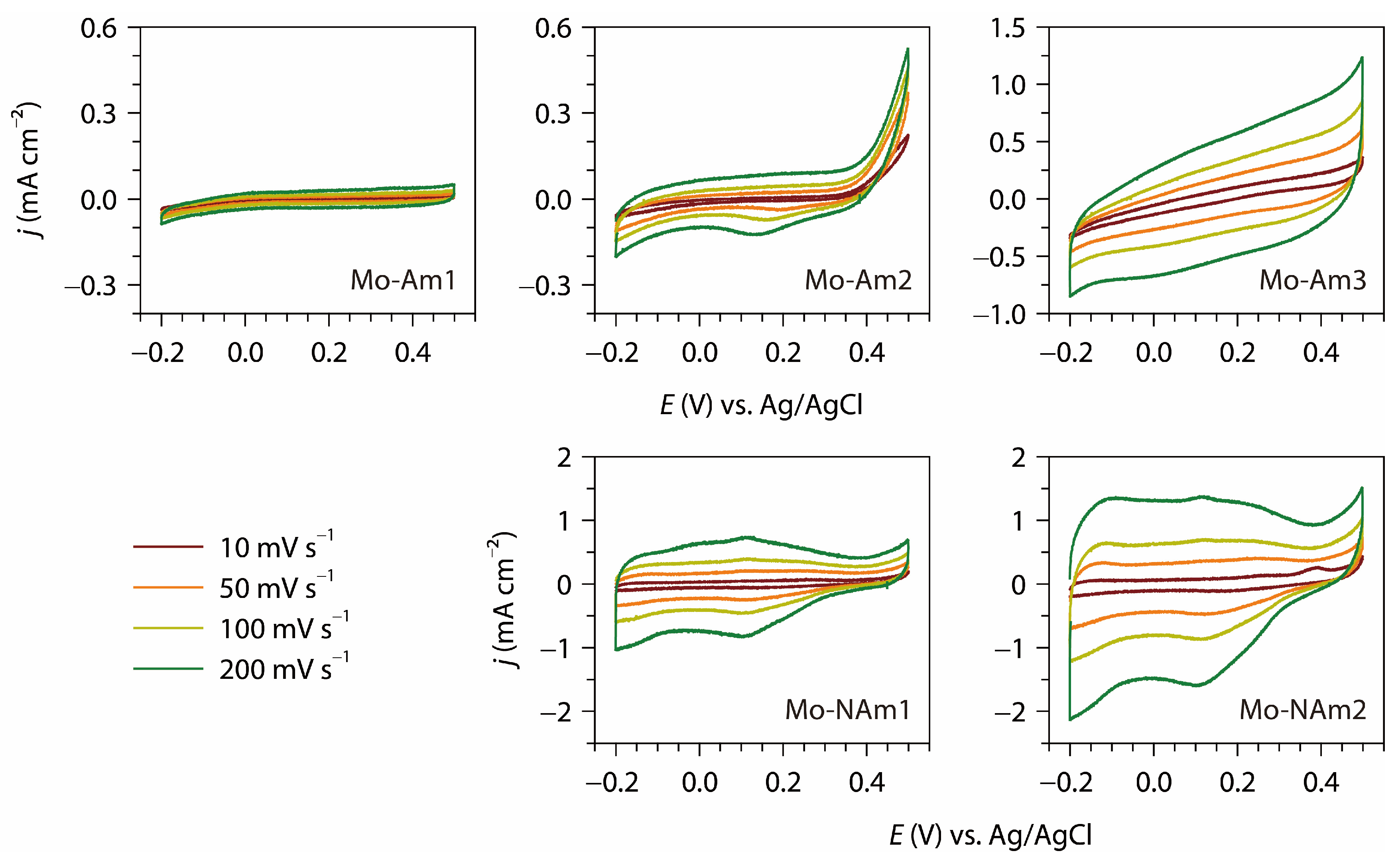
Figure 7 shows the CV diagrams of MoNx (Mo-Am1, Mo-Am2, Mo-Am3) and MoO2 (Mo-NAm1, Mo-NAm2) coatings on the Mo substrate, measured at scan rates ranging from 10 to 200 mV s−1. Among the three MoNx samples, the CV area increased accordantly with the ammonolysis time and thus the thickness of MoNx layer. This suggests that the coated layers permit electrolyte penetration, allowing internal surfaces to participate effectively in charge storage. A similar trend was observed from the MoO2 coatings, where the thicker layer led to the greater redox capacity. The shape of CV profiles reveals differences in the electrochemical behaviors. Mo-Am1 exhibits nearly rectangular and symmetric CV curves with very low current density and the absence of distinct redox peaks, indicating a typical electric double-layer capacitive (EDLC) behavior dominated by physical ion adsorption at the electrode/electrolyte interface. The weak current response suggests a limited electroactive surface area and poor charge storage capability. In contrast, Mo-Am2 and Mo-Am3 show progressively higher current densities accompanied by the appearance of broad humps in the CV curves, which indicates the involvement of faradaic redox reactions in addition to EDLC behavior. The occurrence of these redox features suggests the contribution of surface-controlled pseudocapacitance associated with reversible redox transitions of Mo species, that is, switching between Mo2+/Mo3+ ↔ Mo4+ (in MoNx) or Mo4+ ↔ Mo5+/Mo6+ (in MoO2). Notably, the suboxide samples (Mo-NAm1 and Mo-NAm2) exhibit markedly enhanced current responses and more pronounced redox characteristics. This improvement can be attributed to high electrical conductivity and the introduction of additional active sites, which facilitate rapid surface redox reactions. Among all samples, Mo-NAm2 demonstrates the largest CV area and the most distinct deviation from an ideal rectangular shape, indicating a hybrid charge storage mechanism involving both surface pseudocapacitive behavior and diffusion-controlled faradaic processes.
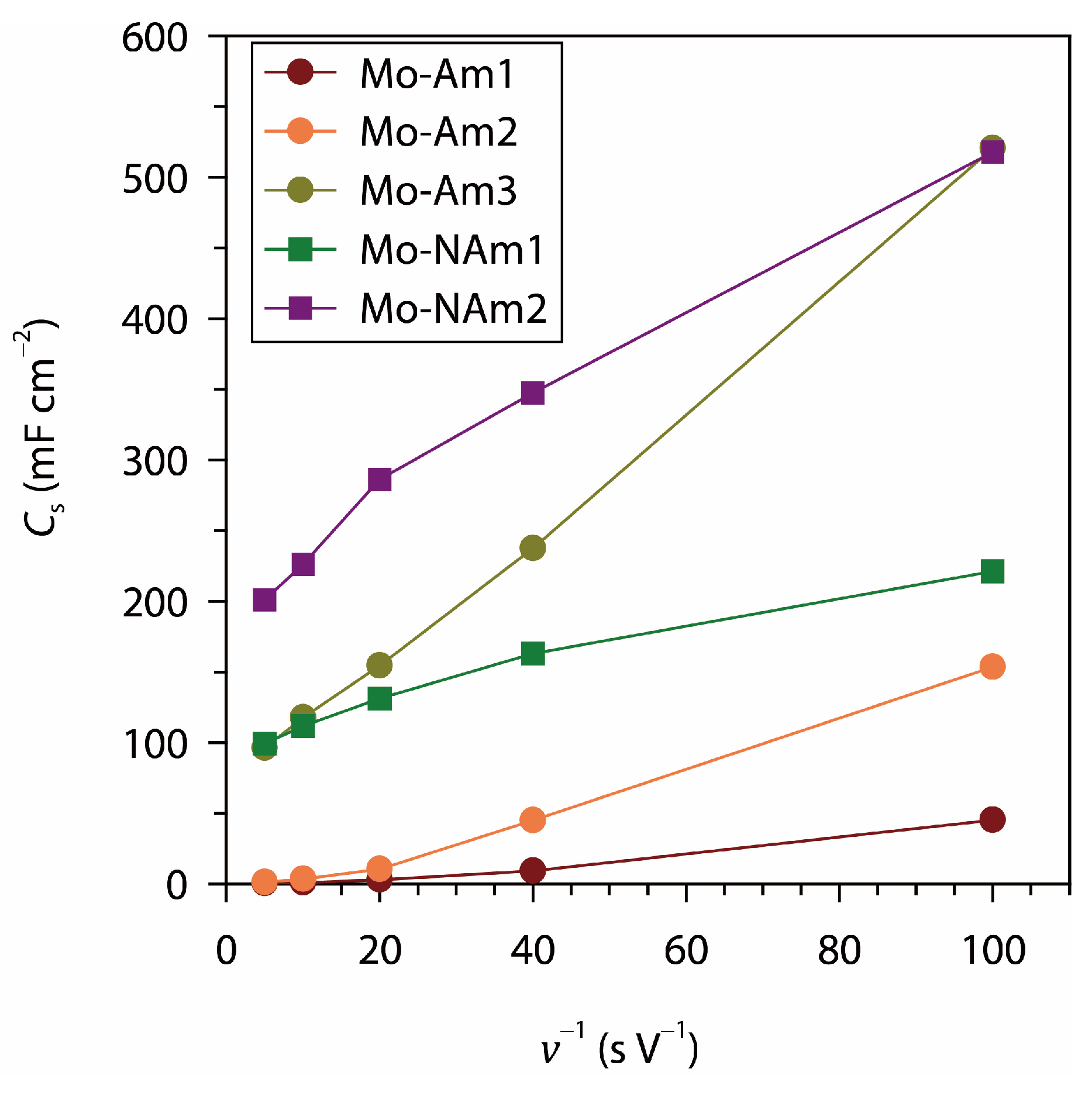
The specific capacitances were calculated based on the above CV, and Figure 8 presents the relationship between Cs and the reciprocal of the scan rate (v−1). This plot provides insight into the kinetic limitations and diffusion contribution during charge storage. An ideally pure EDLC system exhibits scan-rate-independent capacitance, while diffusion-controlled faradaic processes show a strong dependence on scan rate, typically leading to an increase in Cs at lower scan rates. In this context, the nearly invariant Cs values of Mo-Am1 with respect to v−1 indicate its EDLC-dominated behavior. Mo-Am2 and Mo-Am3 display a clear linear increase in Cs with increasing v−1, indicating the growing contribution of diffusion-controlled redox reactions. This behavior reflects the increased participation of electrochemically active species within the electrode bulk as slower scan rates allow sufficient time for ion diffusion into inner pores and active sites.
The MoO2 coatings exhibit significantly higher Cs values across all scan rates, with Mo-NAm2 showing the steeper slope in the Cs vs. v−1 plot than Mo-NAm1. This steep slope signifies a substantial diffusion-controlled contribution while maintaining a considerable capacitive component. With CV rate of 10 mV s−1, the Cs of Mo-Am3 (521 mF cm−2) and Mo-NAm2 (518 mF cm−2) were similar, but with faster CV scans, the latter exhibited significantly larger capacitances than the former. At 200 mV s−1, the Cs of Mo-NAm2 was evaluated to be 201 mF cm−2, as compared with 96 mF cm−2 of Mo-Am3. The enhanced performance of Mo-NAm2 can be attributed to its optimized microstructure and substantial electronic conductivity, which promotes efficient ion transport and rapid redox kinetics.
For comparison, the specific capacitances of various molybdenum compounds are compiled in Table 3, from which it can be seen that Mo-Am3 and Mo-NAm2 exhibit moderate capacitive properties. While their capacitance values are relatively lower compared to other Mo-based electrodes, most of which are in the form of nanocomposite structures, it is anticipated that fine-tuning the microstructure of Mo-Am3 and Mo-NAm2 could lead to improved performance.
Taking into account the weight change during the conversion from Mo to MoNx or MoO2, the mass of the active electrode layer was estimated to be 27.3 mg for Mo-Am3 and 31.7 mg for Mo-NAm2 (details in Supplementary Materials). Accordingly, the gravimetric specific capacitances, based on the CV scans at 10 mV s−1, were found to be 16.8 F g−1 for Mo-Am3 and 14.4 F g−1 for Mo-NAm2. The long-term stability of both Mo-Am3 and Mo-NAm2 was examined through extended CV tests at a scan rate of 200 mV s−1, which showed that Mo-Am3 and Mo-NAm2 electrodes retained 84% and 81% of their initial capacitance, respectively, after 5000 cycles of charge–discharge.
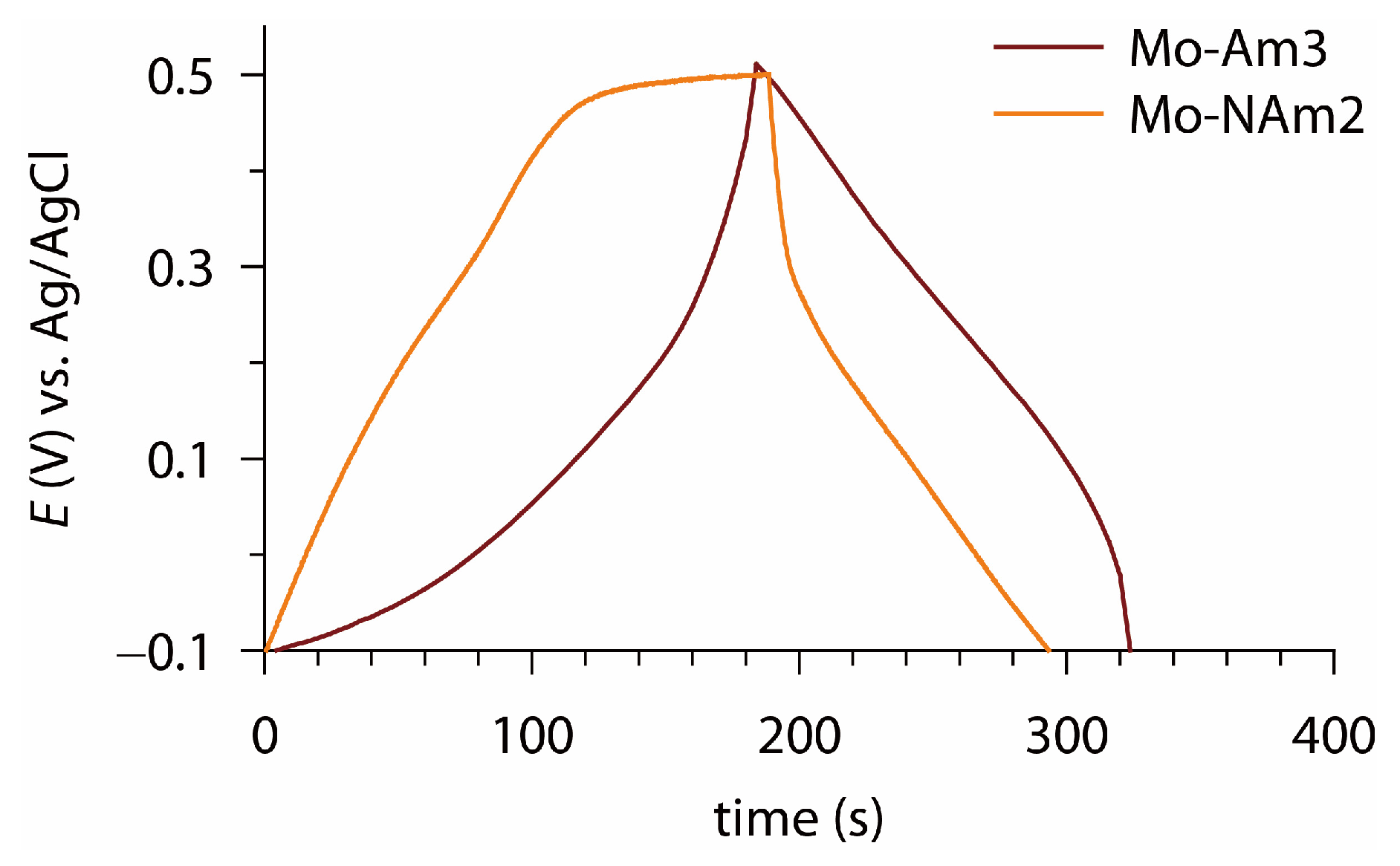
Figure 9 presents the GCD curves of Mo-Am3 and Mo-NAm2, recorded at a current density of 0.1 mA cm−2, which reveal distinct energy storage behaviors for the two electrodes. Mo-Am3 exhibits nearly symmetric triangular charge–discharge curves with minimal IR drop, indicating dominant capacitive behavior and superior electrical conductivity. In contrast, Mo-NAm2 shows noticeable voltage plateaus during charging and a pronounced voltage drop at the initial stage of discharge, suggesting a battery-like faradaic reaction associated with Mo redox transitions. These results indicate that the MoNx-based electrode is favorable for high-rate capacitive energy storage, while the MoO2-based electrode stores charge mainly through diffusion-controlled redox processes.
Similarly to the present work, a recent study by Ren et al. reported the ammonolysis of Mo foil to fabricate MoN supercapacitor electrodes [39]. However, the synthesis condition in that study differs slightly from those in the present work. Specifically, they treated Mo foil in NH3 gas at 500 °C for 3 h to form the MoN coating, which is significantly different in both temperature and duration compared to our conditions of 1000 °C for up to 20 h. Moreover, the thickness of the MoN layer formed in their study was not specified, but it is likely that a very thin layer was formed, resulting in a relatively low amount of MoN. In contrast, our study demonstrates the ability to achieve a much higher MoN loading, which represents a key distinction.

4. Conclusions

This study demonstrates a straightforward and scalable thermal strategy for producing molybdenum nitride and oxide layers directly on Mo foil, resulting in binder-free and self-supported electrodes with tunable structural and electrochemical properties. Controlled ammonolysis in NH3 yielded mixed phases of hexagonal MoN and cubic Mo2N, while subsequent treatment in N2 facilitated the transformation into MoO2, accompanied by microstructural evolution and volumetric expansion. Structural analyses confirmed that increasing nitrogen incorporation and oxidation state systematically influenced electronic structure and surface morphology. Electrochemical evaluation revealed that the charge storage behavior evolves from predominantly electric double-layer capacitance in thin MoNx layers to hybrid pseudocapacitive and diffusion-controlled mechanisms in thicker MoNx and MoO2 coatings. The MoNx and MoO2 electrode exhibited superior rate performance and achieved areal specific capacitances of ≈520 mF cm−2 at 10 mV s−1, highlighting the beneficial combination of enhanced conductivity and abundant redox-active sites.
Compared to conventional slurry-based processing methods, the present approach offers significant advantages in terms of interfacial adhesion and mechanical stability. In addition to its favorable electrochemical performance, the MoNx and MoO2 electrodes presented in this work offer several practical advantages for supercapacitor applications. The direct thermal conversion of commercially available Mo foil provides a simple, scalable, and cost-effective fabrication route without the need for polymer binders, conductive additives, or slurry processing. Moreover, the intrinsically high electrical conductivity of MoNx and MoO2, combined with their pseudocapacitive charge storage behavior, enables fast charge–discharge capability and robust rate performance. Overall, this work demonstrates that MoNx and MoO2 layers formed on thermally treated Mo foil constitute a promising platform for high-performance supercapacitor electrodes.

Supplementary Materials

The following supporting information can be downloaded at: https://www.mdpi.com/article/10.3390/ma18245649/s1, Figure S1: Synchrotron XRD patterns of Mo-derived coatings; Figure S2: Le Bail fitting of synchrotron XRD pattern for Mo-Am1, Mo-Am2, Mo-Am3, Mo-NAm1, and Mo-NAm2; Figure S3: Relationship between mass-normalized specific capacitance (Cs) and the reciprocal of CV scan rate (v−1) for MoNx (Mo-Am1, Mo-Am2, Mo-Am3) and MoO2 (Mo-NAm1, Mo-NAm2) coatings; Section S1. Estimating mass of coated MoNx and MoO2 layers on Mo foil.

Author Contributions

Conceptualization, writing, visualization, supervision, project administration, funding acquisition, Y.-I.K.; investigation, validation, formal analysis, D.H.L. All authors have read and agreed to the published version of the manuscript.

Funding

This work was supported by a Yeungnam University Research Grant in 2025 (225A380013).

Institutional Review Board Statement

Not applicable.

Informed Consent Statement

Not applicable.

Data Availability Statement

The data presented in this study are available on request from the corresponding author due to privacy.

Conflicts of Interest

The authors declare no conflicts of interest.

References

  1. Kandhasamy, M.; Duvaragan, B.K.; Kamaraj, S.; Shanmugam, G. An overview on classification of energy storage systems. In Materials for Boosting Energy Storage. Volume 2: Advances in Sustainable Energy Technologies; Kumar, S.S., Sharma, P., Kumar, T., Kumar, V., Eds.; American Chemical Society: Washington, DC, USA, 2024; pp. 1–25. [Google Scholar]
  2. Ahmed, S.; Ali, A.; D’Angola, A. A review of renewable energy communities: Concepts, scope, progress, challenges, and recommendations. Sustainability 2024, 16, 1749. [Google Scholar] [CrossRef]
  3. Najib, S.; Erdem, E. Current progress achieved in novel materials for supercapacitor electrodes: Mini review. Nanoscale Adv. 2019, 1, 2817–2827. [Google Scholar] [CrossRef]
  4. Poonam; Sharma, K.; Arora, A.; Tripathi, S.K. Review of supercapacitors: Materials and devices. J. Energy Storage 2019, 21, 801–825. [Google Scholar] [CrossRef]
  5. González, A.; Goikolea, E.; Barrena, J.A.; Mysyk, R. Review on supercapacitors: Technologies and materials. Renew. Sustain. Energy Rev. 2016, 58, 1189–1206. [Google Scholar] [CrossRef]
  6. Chen, J.; Lee, P.S. Electrochemical supercapacitors: From mechanism understanding to multifunctional applications. Adv. Energy Mater. 2021, 11, 2003311. [Google Scholar] [CrossRef]
  7. Forouzandeh, P.; Kumaravel, V.; Pillai, S.C. Electrode materials for supercapacitors: A review of recent advances. Catalysts 2020, 10, 969. [Google Scholar] [CrossRef]
  8. Maksoud, M.I.A.A.; Fahim, R.A.; Shalan, A.E.; Elkodous, M.A.; Olojede, S.O.; Osman, A.I.; Farrell, C.; Al-Muhtaseb, A.H.; Awed, A.S.; Ashour, A.H.; et al. Advanced materials and technologies for supercapacitors used in energy conversion and storage: A review. Environ. Chem. Lett. 2021, 19, 375–439. [Google Scholar] [CrossRef]
  9. Béguin, F.; Presser, V.; Balducci, A.; Frackowiak, E. Carbons and electrolytes for advanced supercapacitors. Adv. Mater. 2014, 26, 2219–2251. [Google Scholar] [CrossRef]
  10. Piñeiro-Prado, I.; Salinas-Torres, D.; Ruiz-Rosas, R.; Morallón, E.; Cazorla-Amorós, D. Design of activated carbon/activated carbon asymmetric capacitors. Front. Mater. 2016, 3, 16. [Google Scholar] [CrossRef]
  11. Karnan, M.; Raj, A.G.K.; Subramani, K.; Santhoshkumara, S.; Sathish, M. The fascinating supercapacitive performance of activated carbon electrodes with enhanced energy density in multifarious electrolytes. Sustain. Energy Fuels 2020, 4, 3029–3041. [Google Scholar] [CrossRef]
  12. Barakat, N.A.M.; Mahmoud, M.S.; Moustafa, H.M. Comparing specific capacitance in rice husk-derived activated carbon through phosphoric acid and potassium hydroxide activation order variations. Sci. Rep. 2024, 14, 1460. [Google Scholar] [CrossRef]
  13. Xiong, C.; Su, Y. Recent progress of transition metal-based oxide composite electrode materials in supercapacitor. Adv. Sustain. Syst. 2025, 9, 2400578. [Google Scholar] [CrossRef]
  14. Kumar, U.N.; Ghosh, S.; Thomas, T. Metal oxynitrides as promising electrode materials for supercapacitor applications. ChemElectroChem 2019, 6, 1255–1272. [Google Scholar] [CrossRef]
  15. Joseph, A.; Thomas, T. Recent advances and prospects of metal oxynitrides for supercapacitor. Prog. Solid State Chem. 2022, 68, 100381. [Google Scholar] [CrossRef]
  16. Zhu, M.; Wang, D.; Ge, Z.; Pan, L.; Chen, Y.; Wang, W.; Mitsuzaki, N.; Jia, S.; Chen, Z. Recent advances in transition metal sulfide-based electrode materials for supercapacitors. Chem. Commun. 2025, 61, 8314–8326. [Google Scholar] [CrossRef]
  17. Zhang, L.; Lin, H.; Zhai, L.; Nie, M.; Zhou, J.; Zhuo, S. Enhanced supercapacitor performance based on 3D porous graphene with MoO2 nanoparticles. J. Mater. Res. 2017, 32, 292–300. [Google Scholar] [CrossRef]
  18. Zhou, E.; Wang, C.; Zhao, Q.; Li, Z.; Shao, M.; Deng, X.; Liu, X.; Xu, X. Facile synthesis of MoO2 nanoparticles as high performance supercapacitor electrodes and photocatalysts. Ceram. Inter. 2016, 42, 2198–2203. [Google Scholar]
  19. Zhou, Y.; Lee, C.W.; Yoon, S. Development of an ordered mesoporous carbon/MoO2 nanocomposite for high performance supercapacitor electrode. Electrochem. Solid-State Lett. 2011, 14, A157–A160. [Google Scholar]
  20. Riaz, M.B.; Hussain, D.; Awan, S.U.; Rizwan, S.; Zainab, S.; Shah, S.A. 2-Dimensional Ti3C2Tx/NaF nano-composites as electrode materials for hybrid battery-supercapacitor applications. Sci. Rep. 2024, 14, 1654. [Google Scholar] [CrossRef]
  21. Mahmoudi-Qashqay, S.; Zamani-Meymian, M.R.; Maleki, A. A simple method of fabrication hybrid electrodes for supercapacitors. Sci. Rep. 2024, 14, 29105. [Google Scholar] [CrossRef] [PubMed]
  22. Abebe, E.M.; Ujihara, M. Simultaneous electrodeposition of ternary metal oxide nanocomposites for high-efficiency supercapacitor applications. ACS Omega 2022, 7, 17161–17174. [Google Scholar] [CrossRef]
  23. Jeong, J.; Park, J.W.; Lee, D.W.; Baughman, R.H.; Kim, S.J. Electrodeposition of α-MnO2/γ-MnO2 on carbon nanotube for yarn supercapacitor. Sci. Rep. 2019, 9, 11271. [Google Scholar] [CrossRef]
  24. Bobade, R.G.; Dabke, N.B.; Shaikh, S.F.; Al-Enizi, A.M.; Pandit, B.; Lokhande, B.J.; Ambare, R.C. Influence of deposition potential on electrodeposited bismuth-copper oxide electrodes for asymmetric supercapacitor. Batter. Supercaps 2024, 7, e202400163. [Google Scholar] [CrossRef]
  25. Tanapongpisit, N.; Wongprasod, S.; Laohana, P.; Sonsupap, S.; Khajonrit, J.; Musikajaroen, S.; Wongpratat, U.; Yotburut, B.; Maensiri, S.; Meevasana, W.; et al. Enhancing activated carbon supercapacitor electrodes using sputtered Cu-doped BiFeO3 thin films. Sci. Rep. 2024, 14, 27811. [Google Scholar] [CrossRef]
  26. Lim, J.H.; Choi, D.J.; Kim, H.; Cho, W.I.; Yoon, Y.S. Thin film supercapacitors using a sputtered RuO2 electrode. J. Electrochem. Soc. 2001, 148, A275–A278. [Google Scholar] [CrossRef]
  27. Liu, C.; Li, Z.; Zhang, Z. MoOx thin films deposited by magnetron sputtering as an anode for aqueous micro-supercapacitors. Sci. Technol. Adv. Mater. 2013, 14, 065005. [Google Scholar] [CrossRef] [PubMed]
  28. Li, X.; Zhao, T.; Chen, Q.; Li, P.; Wang, K.; Zhong, M.; Wei, J.; Wu, D.; Wei, B.; Zhu, H. Flexible all solid-state supercapacitors based on chemical vapor deposition derived graphene fibers. Phys. Chem. Chem. Phys. 2013, 15, 17752–17757. [Google Scholar] [CrossRef]
  29. Bláha, M.; Bouša, M.; Valeš, V.; Frank, O.; Kalbáč, M. Two-dimensional CVD-graphene/polyaniline supercapacitors: Synthesis strategy and electrochemical operation. ACS Appl. Mater. Interfaces 2021, 13, 34686–34695. [Google Scholar] [CrossRef]
  30. Li, Z.; Su, J.; Wang, X. Atomic layer deposition in the development of supercapacitor and lithium-ion battery devices. Carbon 2021, 179, 299–326. [Google Scholar] [CrossRef]
  31. Kim, S.H.; Kim, Y.-I. Growth of oxide and nitride layers on titanium foil and their electrochemical properties. Materials 2025, 18, 380. [Google Scholar] [CrossRef]
  32. Cardenas-Lizana, F.; Gomez-Quero, S.; Perret, N.; Kiwi-Minsker, L.; Keane, M.A. β-Molybdenum nitride: Synthesis mechanism and catalytic response in the gas phase hydrogenation of p-chloronitrobenzene. Catal. Sci. Technol. 2011, 1, 794–801. [Google Scholar] [CrossRef]
  33. Bull, C.L.; Kawashima, T.; McMillan, P.F.; Machon, D.; Shebanova, O.; Daisenberger, D.; Soignard, E.; Takayama-Muromachi, E.; Chapon, L.C. Crystal structure and high-pressure properties of γ-Mo2N determined by neutron powder diffraction and X-ray diffraction. J. Solid State Chem. 2006, 179, 1762–1767. [Google Scholar] [CrossRef]
  34. Ganin, A.Y.; Kienle, L.; Vajenine, G.V. Synthesis and characterisation of hexagonal molybdenum nitrides. J. Solid State Chem. 2006, 179, 2339–2348. [Google Scholar] [CrossRef]
  35. Demura, M.; Nagao, M.; Lee, C.-H.; Goto, Y.; Nambu, Y.; Avdeev, M.; Masubuchi, M.; Mitsudome, T.; Sun, W.; Tadanaga, K.; et al. Nitrogen-rich molybdenum nitride synthesized in a crucible under air. Inorg. Chem. 2024, 63, 4989–4996. [Google Scholar] [CrossRef]
  36. Chakraborty, M.; Biswal, A.; Beura, D.P.; Mohanty, D.; Mishra, T.T.; Mishra, S.; Roy, D.; Behera, J.N. Review on molybdenum-based negative electrodes for high-performance supercapacitors. Energy Fuels 2025, 39, 16715–16736. [Google Scholar] [CrossRef]
  37. Ruan, D.; Lin, R.; Jiang, K.; Yu, X.; Zhu, Y.; Fu, Y.; Wang, Z.; Yan, H.; Mai, W. High-performance porous molybdenum oxynitride based fiber supercapacitors. ACS Appl. Mater. Interfaces 2017, 9, 29699–29706. [Google Scholar] [CrossRef] [PubMed]
  38. Palraj, J.; Arulraj, A.; M, S.; Therese, H.A. Rapid and stable energy storage using MoN/Mo2N composite electrodes. Appl. Surf. Sci. Adv. 2024, 19, 100579. [Google Scholar]
  39. Ren, H.; Zhao, H.; Javed, M.S.; Siyal, S.H.; Zhang, X.; Zhang, X.; Ahmad, A.; Hussain, I.; Habila, M.A.; Han, W. Biodegradable MoNx@Mo-foil electrodes for human-friendly supercapacitors. J. Mater. Chem. B 2024, 12, 5749–5757. [Google Scholar] [CrossRef]
  40. Deng, Y.; Zhao, Y.; Peng, K.; Yu, L. One-step hydrothermal synthesis of MoO2/MoS2 nanocomposites as high-performance electrode material for supercapacitors. ACS Appl. Mater. Interfaces 2022, 14, 49909–49918. [Google Scholar] [CrossRef] [PubMed]
  41. Ji, W.; Shen, R.; Yang, R.; Yu, G.; Guo, X.; Peng, L.; Ding, W. Partially nitrided molybdenum trioxide with promoted performance as an anode material for lithium-ion batteries. J. Mater. Chem. A 2014, 2, 699–704. [Google Scholar]
  42. Hu, X.; Zhang, W.; Liu, X.; Mei, Y.; Huang, Y. Nanostructured Mo-based electrode materials for electrochemical energy storage. Chem. Soc. Rev. 2015, 44, 2376–2404. [Google Scholar] [CrossRef]
  43. Jaf, Z.N.; Miran, H.A.; Jiang, Z.-T.; Altarawneh, M. Molybdenum nitrides from structures to industrial applications. Rev. Chem. Eng. 2023, 39, 329–361. [Google Scholar] [CrossRef]
  44. Safeer, M.; Sathiskumar, C.; John, N.S. Metallic MoO2 as a highly selective catalyst for electrochemical nitrogen fixation to ammonia under ambient conditions. ChemistrySelect 2023, 8, e202203344. [Google Scholar]
  45. Kreider, M.E.; Stevens, M.B.; Liu, Y.; Patel, A.M.; Statt, M.J.; Gibbons, B.M.; Gallo, A.; Ben-Naim, M.; Mehta, A.; Davis, R.C.; et al. Nitride or oxynitride? Elucidating the composition-activity relationships in molybdenum nitride electrocatalysts for the oxygen reduction reaction. Chem. Mater. 2020, 32, 2946–2960. [Google Scholar] [CrossRef]
  46. Cao, B.; Neuefeind, J.C.; Adzic, R.R.; Khalifah, P.G. Molybdenum nitrides as oxygen reduction reaction catalysts: Structural and electrochemical studies. Inorg. Chem. 2015, 54, 2128–2136. [Google Scholar] [CrossRef]
  47. Shen, K.; Zhai, S.; Wang, S.; Ru, Q.; Hou, X.; Hui, K.S.; Hui, K.N.; Chen, F. Recent progress in binder-free electrodes synthesis for electrochemical energy storage application. Batter. Supercaps 2021, 4, 860–880. [Google Scholar]
  48. Li, Y.; Wei, X.; Chen, L.; Shi, J.; He, M. Nickel-molybdenum nitride nanoplate electrocatalysts for concurrent electrolytic hydrogen and formate productions. Nat. Commun. 2019, 10, 5335. [Google Scholar] [CrossRef] [PubMed]
  49. Lv, F.; Ma, H.; Shen, L.; Jiang, Y.; Sun, T.; Ma, J.; Geng, X.; Kiran, A.; Zhu, N. Wearable helical molybdenum nitride supercapacitors for self-powered healthcare smartsensors. ACS Appl. Mater. Interfaces 2021, 13, 29780–29787. [Google Scholar] [CrossRef]
  50. Ferrari, A.G.-M.; Pimlott, J.L.; Down, M.P.; Rowley-Neale, S.J.; Banks, C.E. MoO2 nanowire electrochemically decorated graphene additively manufactured supercapacitor platforms. Adv. Energy Mater. 2021, 11, 2100433. [Google Scholar] [CrossRef]
  51. Tian, Y.; Du, H.; Zhang, M.; Zheng, Y.; Guo, Q.; Zhang, H.; Luo, J.; Zhang, X. Microwave synthesis of MoS2/MoO2@CNT nanocomposites with excellent cycling stability for supercapacitor electrodes. J. Mater. Chem. C 2019, 7, 9545–9555. [Google Scholar]
  52. Le Bail, A. Whole powder pattern decomposition methods and applications: A retrospection. Powder Diffr. 2005, 20, 316–326. [Google Scholar] [CrossRef]
  53. Larson, A.C.; von Dreele, R.B. General Structure Analysis System; Los Alamos National Laboratory: Los Alamos, NM, USA, 1994. [Google Scholar]
  54. Toby, B.H. EXPGUI, a graphical user interface for GSAS. J. Appl. Crystallogr. 2001, 34, 210–213. [Google Scholar] [CrossRef]
  55. Kubelka, P.; Munk, F. Ein beitrag zur optic der farbanstriche. Z. Tech. Phys. 1931, 12, 593–601. [Google Scholar]
  56. Sun, N.; Ma, X.; Su, Y.; Jiang, P.; Zou, Y.; Zhou, D. TiN thin film electrodes on textured silicon substrates for supercapacitors. J. Electrochem. Soc. 2019, 166, H802–H809. [Google Scholar] [CrossRef]
  57. Hägg, G. Röntgenuntersuchungen über molybdän- und wolframnitride. Z. Phys. Chem. B 1930, 7, 339–362. [Google Scholar]
  58. Lengauer, W.J. Formation of molybdenum nitrides by ammonia nitridation of MoCl5. J. Cryst. Growth 1988, 87, 295–298. [Google Scholar] [CrossRef]
  59. Bull, C.L.; McMillan, P.F.; Soignard, E.; Leinenweber, K. Determination of the crystal structure of δ-MoN by neutron diffraction. J. Solid State Chem. 2004, 177, 1488–1492. [Google Scholar] [CrossRef]
  60. Zhao, X.; Range, K.J. High pressure synthesis of molybdenum nitride MoN. J. Alloys Compd. 2000, 296, 72–74. [Google Scholar] [CrossRef]
  61. Lilića, A.; Cardenasa, L.; Mesbaha, A.; Bonjourb, E.; Jameb, P.; Michelc, C.; Loridanta, S.; Perret, N. Guidelines for the synthesis of molybdenum nitride: Understanding the mechanism and the control of crystallographic phase and nitrogen content. J. Alloys Compd. 2022, 924, 166576. [Google Scholar]
  62. Saur, E.J.; Schechinger, H.D.; Rinderer, L. Preparation and superconducting properties of MoN and MoC in form of wires. IEEE Trans. Magn. 1981, MAG-17, 1029–1031. [Google Scholar]
  63. Karam, R.; Ward, R. The preparation of β-molybdenum nitride. Inorg. Chem. 1970, 9, 1385–1387. [Google Scholar] [CrossRef]
  64. Brandt, B.G. A refinement of the crystal structure of molybdenum dioxide. Acta Chem. Scand. 1967, 21, 661–672. [Google Scholar] [CrossRef]
  65. Scanlon, D.O.; Watson, G.W.; Payne, D.J.; Atkinson, G.R.; Egdell, R.G.; Law, D.S.L. Theoretical and experimental study of the electronic structures of MoO3 and MoO2. J. Phys. Chem. C 2010, 114, 4636–4645. [Google Scholar] [CrossRef]
  66. Moulder, J.F.; Stickle, W.F.; Sobol, P.E.; Bomben, K.D. Handbook of X-Ray Photoelectron Spectroscopy; Perkin-Elmer: Eden Prairie, MN, USA, 1992; pp. 112–113. [Google Scholar]
  67. Chen, L.; Liu, C.; Zhang, Z. Novel [111] oriented γ-Mo2N thin films deposited by magnetron sputtering as an anode for aqueous micro-supercapacitors. Electrochim. Acta 2017, 245, 237–248. [Google Scholar]
  68. Liu, J.; Huang, K.; Tang, H.L.; Lei, M. Porous and single-crystalline-like molybdenum nitride nanobelts as a non-noble electrocatalyst for alkaline fuel cells and electrode materials for supercapacitors. Int. J. Hydrogen Energy 2016, 41, 996–1001. [Google Scholar]
  69. Cheng, A.; Shen, Y.; Cui, T.; Liu, Z.; Lin, Y.; Zhan, R.; Tang, S.; Zhang, Y.; Chen, H.; Deng, S. One-step synthesis of heterostructured Mo@MoO2 nanosheets for high-performance supercapacitors with long cycling life and high rate capability. Nanomaterials 2024, 14, 1404. [Google Scholar] [CrossRef] [PubMed]
  70. Giardi, R.; Porro, S.; Topuria, T.; Thompson, L.; Pirri, C.F.; Kim, H.-C. One-pot synthesis of graphene-molybdenum oxide hybrids and their application to supercapacitor electrodes. Appl. Mater. Today 2015, 1, 27–32. [Google Scholar] [CrossRef]
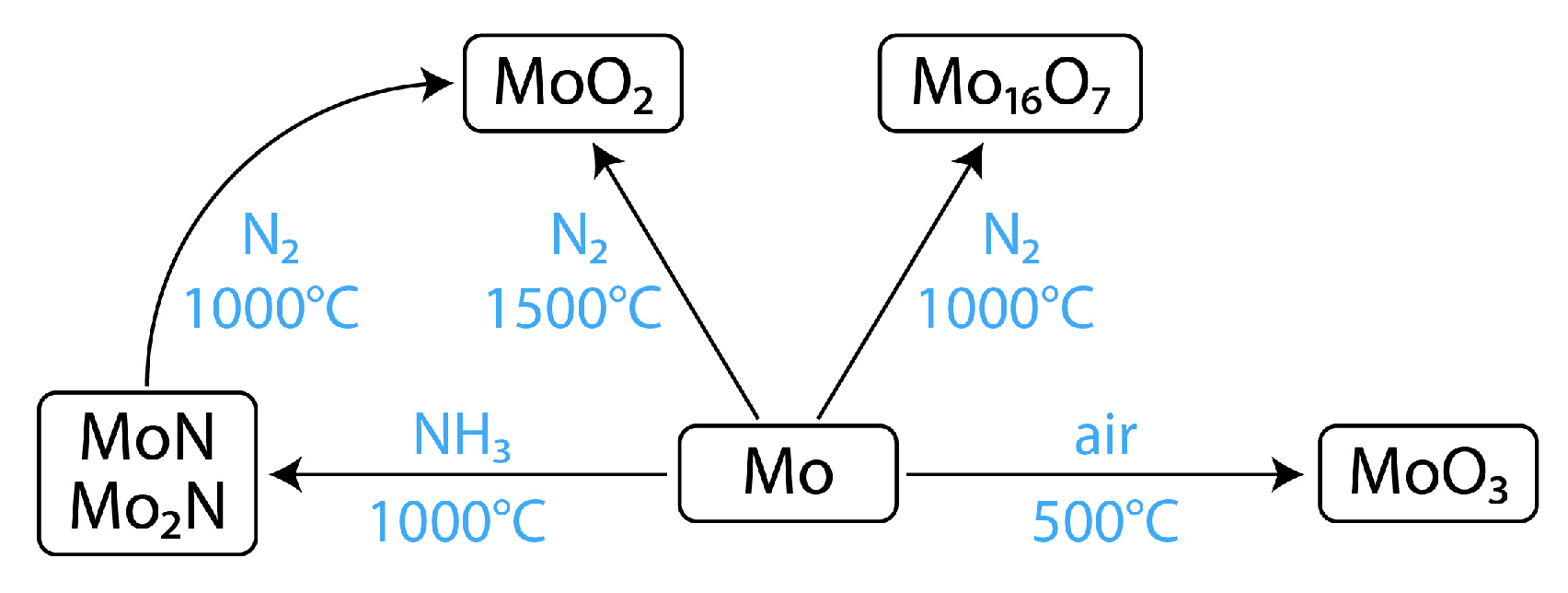
Figure 1. Transformation of molybdenum foil to molybdenum nitrides and oxides.
Materials 18 05649 g001
Figure 2. Synchrotron XRD patterns of Mo foil and Mo-derived coatings.
Materials 18 05649 g002
Figure 3. Weight change (Δwt) in Mo foil upon the ammonolytic nitridation, depending on temperature, time, and flow rate of NH3.
Materials 18 05649 g003
Figure 4. SEM images for (a) plane and (b) cross-sectional views of Mo foil and Mo-derived coatings. Arrows in (b) indicate the coated layers.
Materials 18 05649 g004
Figure 5. UV-Vis spectra and photograph images of Mo foil and Mo-derived coatings.
Materials 18 05649 g005
Figure 6. XPS profiles of Mo foil and Mo-derived coatings at the (a) Mo 3d and (b) N 1s/Mo 3p levels.
Materials 18 05649 g006
Figure 7. Cyclic voltammograms of MoNx (Mo-Am1, Mo-Am2, Mo-Am3) and MoO2 (Mo-NAm1, Mo-NAm2) coatings, measured in the potential window of −0.2 to 0.5 V (vs. Ag/AgCl) at scan rates of 10–200 mV s−1.
Materials 18 05649 g007
Figure 8. Relationship between areal specific capacitance (Cs) and the reciprocal of CV scan rate (v−1) for MoNx (Mo-Am1, Mo-Am2, Mo-Am3) and MoO2 (Mo-NAm1, Mo-NAm2) coatings.
Materials 18 05649 g008
Figure 9. Galvanostatic charge–discharge curves of Mo-Am3 and Mo-NAm2 electrodes measured at a current density of 0.1 mA cm−2, and in the potential window of −0.1 to +0.5 V vs. Ag/AgCl.
Materials 18 05649 g009
Table 1. Samples prepared by heating Mo foil under various conditions, and phase identification 1 by synchrotron XRD.
SampleHeat TreatmentXRD Phase
Mo-Am1(NH3) 1000 °C, 2 hδ-MoN, γ-Mo2N
Mo-Am2(NH3) 1000 °C, 10 hδ-MoN, γ-Mo2N
Mo-Am3(NH3) 1000 °C, 20 hδ-MoN, γ-Mo2N
Mo-N1(N2) 1000 °C, 10 hMo16N7
Mo-N2(N2) 1500 °C, 2 hMoO2
Mo-NAm1(NH3) 1000 °C, 10 h/(N2) 1000 °C, 2 hMoO2
Mo-NAm2(NH3) 1000 °C, 20 h/(N2) 1000 °C, 2 hMoO2
Mo-O1(air) 500 °C, 0.5 hα-MoO3
1 Based on the ICSD data for δ-MoN (no. 99452), γ-Mo2N (no. 172802), MoO2 (no. 24322), and MoO3 (no. 76651).
Table 2. Lattice constants determined by Le Bail fitting of the synchrotron XRD, compared with the literature data for δ-MoN [34], γ-Mo2N [33], and MoO2 [64].
Sampleδ-MoN (Hexagonal, Z = 8)γ-Mo2N (Cubic, Z = 2)
a (Å)c (Å)V3)a (Å)V3)
Mo-Am15.7412(1)5.625(1)160.56(6)4.16795(5)72.405(2)
Mo-Am25.738(1)5.622(1)160.28(6)4.1708(4)72.55(2)
Mo-Am35.738(2)5.622(1)160.29(8)4.1705(4)72.54(2)
Literature 5.73565.6281160.344.161672.07
SampleMoO2 (Monoclinic, Z = 4)
a (Å)b (Å)c (Å)β (°)V3)
Mo-NAm15.6119(4)4.8559(4)5.6267(4)120.935131.52(2)
Mo-NAm25.6121(5)4.8557(6)5.6274(5)120.944131.53(2)
Literature5.61094.85625.6285120.95131.52
Table 3. Brief review of the specific capacitances (Cs) per area (in mF cm−2) or per mass (in F g−1) of various Mo compounds.
ElectrodeCsTest ConditionRef.
MoN/Mo2N composite306.7 F g−1GCD (1 A g−1)[38]
MoN@Mo10 F cm−2GCD (1 A g−1)[39]
MoN on N-doped carbon cloth467.6 mF cm−2GCD (5 mA cm−2)[49]
Mo2N (dense film)55 mF cm−2CV (5 mV s−1)[67]
Mo2N (nanobelts)160 F g−1CV (5 mV s−1)[68]
Mo-Am3521 mF cm−2CV (10 mV s−1)1
MoON/TiN736.6 mF cm−2CV (10 mV s−1)[37]
Mo@MoO2205.1 F g−1GCD (1 A g−1)[69]
MoO2/graphene140 F g−1GCD (1 A g−1)[70]
Mo-NAm2518 mF cm−2CV (10 mV s−1)1
1 This work.
Disclaimer/Publisher’s Note: The statements, opinions and data contained in all publications are solely those of the individual author(s) and contributor(s) and not of MDPI and/or the editor(s). MDPI and/or the editor(s) disclaim responsibility for any injury to people or property resulting from any ideas, methods, instructions or products referred to in the content.