
A Century of General Lichtenecker Equation: Between Stringency and Empiricism, Accuracy and Approximability


Abstract
1. Introduction
2. Geometry and Percolation
3. Spectral Density Function Analysis
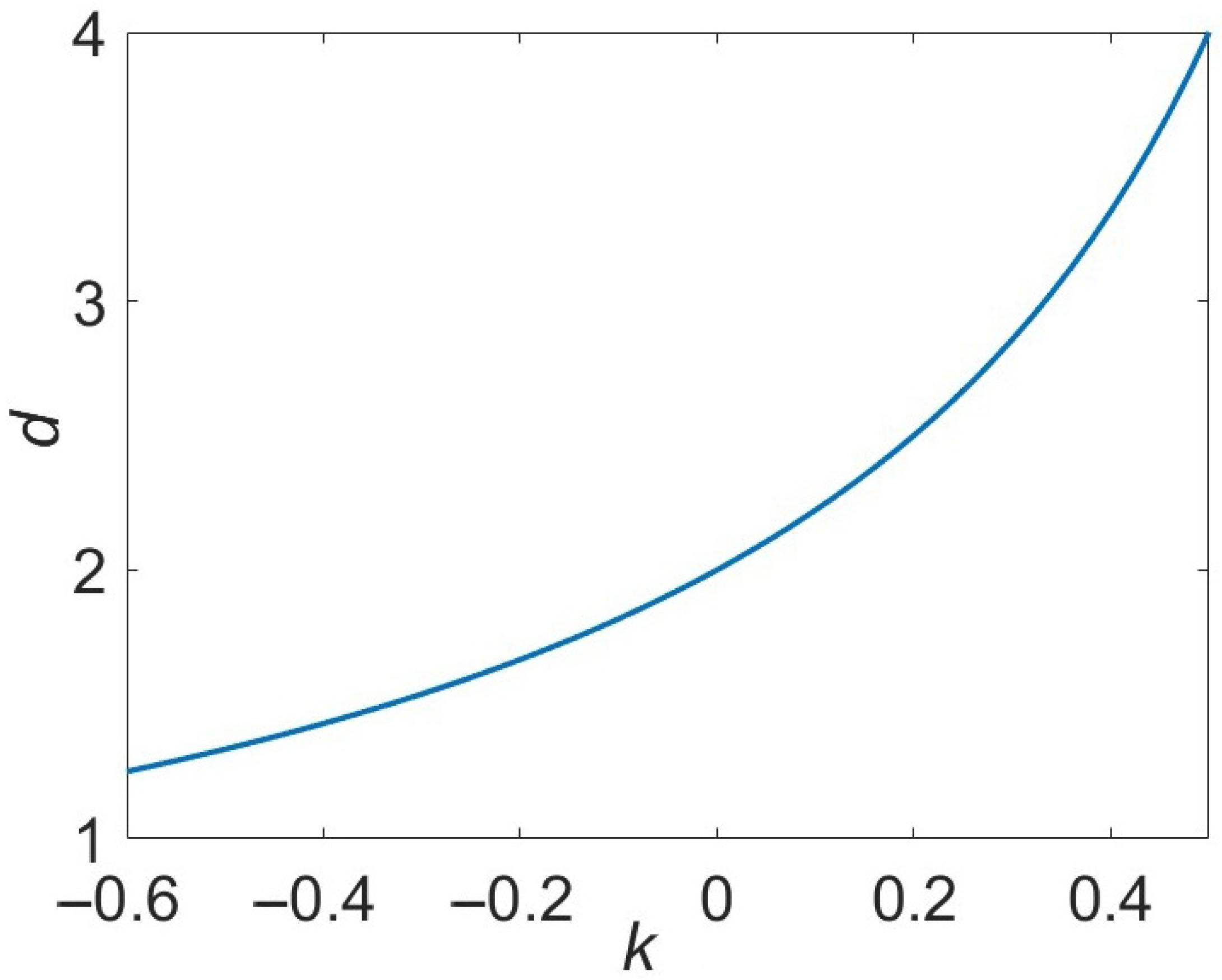
4. The Parameter k and the Issue of Dimensionality
5. Archie’s Law
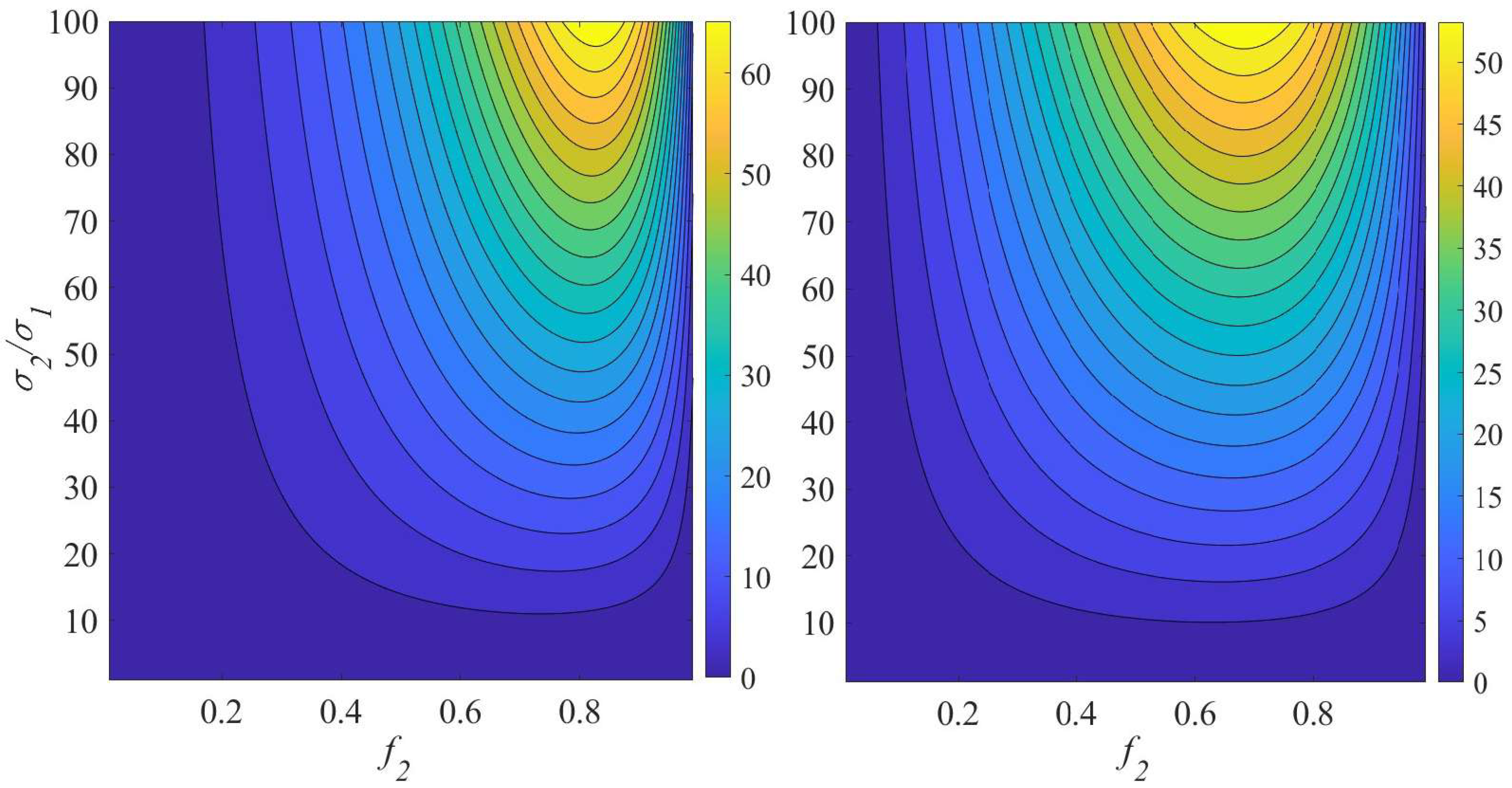
6. The Analysis of Uncertainties
7. Conclusions
- (1)
- The Lichtenecker equation is compatible with the spectral representation only at (logarithmic Lichtenecker equation) in 2D and (Landau-Lifshitz-Looyenga equation) in 3D.
- (2)
- In 3D, the Lichtenecker equation is applicable only for low contrast h, even for composites possessing phase-inversion symmetry.
- (3)
- Although Archie’s is confirmed in many experiments for porous media, this does not, by itself, validate the Lichtenecker equation.
- (4)
- If the empirical parameter k of the Lichtenecker equation is determined by fitting to experimental data, small errors in phase volume fractions and/or their conductivities and permittivities can lead to significant inaccuracies in k, especially when is close to 0 or 1, or when the contrast parameter h is low.
Author Contributions
Funding
Institutional Review Board Statement
Data Availability Statement
Conflicts of Interest
References
- Lichtenecker, K. Die Dielektrizitätskonstante natürlicher und künstlicher Mischkörper. Phys. Z. 1926, 27, 115–158. [Google Scholar]
- Lichtenecker, K. Der elektrische Leitungswiderstand künstlicher und natürlicher Aggregate. Phys. Z. 1924, 25, 225–233. [Google Scholar]
- Simpkin, R. Derivation of Lichtenecker’s logarithmic mixture formula from Maxwell’s equations. IEEE Trans. Microw. Theory Tech. 2010, 58, 545–550. [Google Scholar] [CrossRef]
- Erle, U.; Regier, M.; Persch, C.; Schubert, H. Dielectric properties of emulsions and suspensions: Mixture equations and measurement comparisons. J. Microw. Power Electromag. Energy 2000, 35, 185–190. [Google Scholar] [CrossRef]
- Yan, Y.; Gonzalez-Cortes, S.; Yao, B.; Slocombe, D.R.; Porch, A.; Cao, F.; Xiao, T.; Edwards, P.P. Rapid, non-invasive characterization of the dispersity of emulsions via microwaves. Chem. Sci. 2018, 9, 6975–6980. [Google Scholar] [CrossRef]
- Robinson, D.A.; Jones, S.B.; Wraith, J.M.; Or, D.; Friedman, S.P. A review of advances in dielectric and electrical conductivity measurement in soils using time domain feflectometry. Vadose Zone J. 2003, 2, 444–475. [Google Scholar] [CrossRef]
- Su, C.; Wu, C.C.; Yang, C. Developing the dielectric mechanisms of polyetherimide/multiwalled carbon nanotube/(Ba0.8Sr0.2)(Ti0.9Zr0.1)O3 composites. Nanoscale Res. Lett. 2012, 7, 132. [Google Scholar] [CrossRef] [PubMed]
- Headland, D.; Thurgood, P.; Stavrevski, D.; Withayachumnankul, W.; Abbott, D.; Bhaskaran, M.; Sriram, S. Doped polymer for low-loss dielectric material in the terahertz range. Opt. Mater. Express 2015, 5, 1373–1380. [Google Scholar] [CrossRef]
- Pérez-Campos, R.; Monzó-Cabrera, J.; Fayos-Fernández, J.; Díaz-Morcillo, A.; Martínez-González, A.; Lozano-Guerrero, A.; Pedreño-Molina, J.; García-Gambín, J. Dielectric characterization of fabric aggregates around the 2.45 GHz ISM band under various humidity, density, and temperature conditions. Materials 2023, 16, 4428. [Google Scholar] [CrossRef] [PubMed]
- Kiley, E.M.; Yakovlev, V.V.; Ishizaki, K.; Vaucher, S. Applicability study of classical and contemporary models for effective complex permittivity of metal powders. J. Microw. Power Electromag. Energy 2012, 46, 26–38. [Google Scholar] [CrossRef]
- Akhtar, M.J.; Tiwari, N.K.; Devi, J.; Mahmoud, M.; Link, G.; Thumm, M. Determination of effective constitutive properties of metal powders at 2.45 GHz for microwave processing applications. Frequenz 2014, 68, 69–81. [Google Scholar] [CrossRef]
- Xiao, X.; Ihamouten, A.; Villain, G.; Dérobert, X. Use of electromagnetic two-layer wave-guided propagation in the GPR frequency range to characterize water transfer in concrete. NDT E Intern. 2017, 86, 164–174. [Google Scholar] [CrossRef]
- Hickson, D.; Boivin, A.; Daly, M.G.; Ghent, R.; Nolan, M.C.; Tait, K.; Cunje, A.; Tsai, C.A. Near surface bulk density estimates of NEAs from radar observations and permittivity measurements of powdered geologic material. Icarus 2018, 306, 16–24. [Google Scholar] [CrossRef]
- Balčiūnas, S.; Ivanov, M.; Banys, J.; Ueno, S.; Wada, S. In search of an artificial morphotropic phase boundary: Lead-free barium titanate based composites. Lith. J. Phys. 2020, 60, 225–234. [Google Scholar] [CrossRef]
- Boughriet, A.; Allahdin, O.; Poumaye, N.; Tricot, G.; Revel, B.; Lesven, L.; Wartel, M. Micro-analytical study of a zeolites/geo-polymers/quartz composite, dielectric behaviour and contribution to Brønsted sites affinity. Ceramics 2022, 5, 908–927. [Google Scholar] [CrossRef]
- Anandakrishnan, S.S.; Nelo, M.; Tabeshfar, M.; Kraft, V.; Khansur, N.H.; Peräntie, J.; Bai, Y. Influence of the permittivity between fillers and binders on the properties of upside-down composites for recycling purposes. Mater. Adv. 2025, 6, 6694–6710. [Google Scholar] [CrossRef]
- de Lima, O.A.L.; Clennell, M.B.; Nery, G.G.; Niwas, S. A volumetric approach for the resistivity response of freshwater shaly sandstones. Geophysics 2005, 70, F1–F10. [Google Scholar] [CrossRef]
- Glover, P. A generalized Archie’s law for n phases. Geophysics 2010, 75, E247–E265. [Google Scholar] [CrossRef]
- Antepara, I.; Fiala, L.; Pavlík, Z.; Černý, R. Moisture dependent thermal properties of hydrophilic mineral wool: Application of the effective media theory. Mater. Sci. (Medžiagotyra) 2015, 21, 449–454. [Google Scholar] [CrossRef]
- Fuchs, S.; Schütz, F.; Förster, H.J.; Förster, A. Evaluation of common mixing models for calculating bulk thermal conductivity of sedimentary rocks: Correction charts and new conversion equations. Geothermics 2013, 47, 40–52. [Google Scholar] [CrossRef]
- Parke, L.; Hooper, I.R.; Hicken, R.J.; Dancer, C.E.J.; Grant, P.S.; Youngs, I.J.; Sambles, J.R.; Hibbins, A.P. Heavily loaded ferrite-polymer composites to produce high refractive index materials at centimetre wavelengths. APL Mater. 2013, 1, 042108. [Google Scholar] [CrossRef]
- Wang, Y.; Edwards, E.; Hooper, I.; Clow, N.; Grant, P.S. Scalable polymer-based ferrite composites with matching permeability and permittivity for high-frequency applications. Appl. Phys. A 2015, 120, 609–614. [Google Scholar] [CrossRef]
- Kočí, V.; Maděra, J.; Krejčí, T.; Kruis, J.; Černý, R. Efficient techniques for solution of complex computational tasks in building physics. Adv. Civil Eng. 2019, 2019, 3529360. [Google Scholar] [CrossRef]
- Guo, R.; Roscow, J.; Bowen, C.; Luo, H.; Huang, Y.; Ma, Y.; Zhou, K.; Zhang, D. Significantly enhanced permittivity and energy density in dielectric composites with aligned BaTiO3 lamellar structures. J. Mater. Chem. A 2020, 8, 3135–3144. [Google Scholar] [CrossRef]
- Schulgasser, K. On a phase interchange relationship for composite materials. J. Math. Phys. 1976, 17, 378–381. [Google Scholar] [CrossRef]
- Stroud, D.; Milton, G.W.; De, B.R. Analytical model for the dielectric response of brine-saturated rocks. Phys. Rev. B 1986, 34, 5145–5153. [Google Scholar] [CrossRef]
- Ghosh, K.; Fuchs, R. Spectral theory for two-component porous media. Phys. Rev. B 1988, 38, 5222–5236. [Google Scholar] [CrossRef] [PubMed]
- Ghosh, K.; Fuchs, R. Critical behavior in the dielectric properties of random self-similar composites. Phys. Rev. B 1991, 44, 7330–7333. [Google Scholar] [CrossRef]
- Tuncer, E. Geometrical description in binary composites and spectral density representation. Materials 2010, 3, 585–613. [Google Scholar] [CrossRef]
- Fuchs, R.; Ghosh, K. Optical and dielectric properties of self-similar structures. Phys. A 1994, 207, 185–196. [Google Scholar] [CrossRef]
- Goncharenko, A.V. Spectral density function approach to homogenization of binary mixtures. Chem. Phys. Lett. 2004, 400, 462–468. [Google Scholar] [CrossRef]
- Tuncer, E.; Bowler, N.; Youngs, I.J. Application of the spectral density function method to a composite system. Phys. B 2006, 373, 306–312. [Google Scholar] [CrossRef]
- Dmitruk, M.; Goncharenko, A.; Venger, E. Optics of Small Particles and Composite Media; Naukova Dumka: Kyiv, Ukraine, 2009. [Google Scholar]
- Goncharenko, A.V.; Lozovski, V.; Venger, E. Lichtenecker’s equation: Applicability and limitations. Opt. Commun. 2000, 174, 19–32. [Google Scholar] [CrossRef]
- Looyenga, H. Dielectric constants of heterogeneous mixtures. Physica 1965, 31, 401–406. [Google Scholar] [CrossRef]
- Landau, L.; Lifshitz, E. Electrodynamics of Continuous Media; Pergamon Press: Oxford, UK; New York, NY, USA; Beijing, China; Frankfurt, Germany, 1984. [Google Scholar]
- Keller, J.B. The theorem on the conductivity of a composite medium. J. Mathem. Phys. 1964, 5, 548–549. [Google Scholar] [CrossRef]
- Dykhne, A.M. Conductivity of a two-dimensional two-phase system. Sov. Phys. JETP 1971, 32, 63–65, Translation of Zh. Eksp. Teor. Fiz. 1970, 59, 110–115. [Google Scholar]
- Machavariani, V.S.; Voronel, A. Estimation of the intrinsic heterogeneity of ionic glass-forming melts. Phys. Rev. E 2000, 61, 2121–2124. [Google Scholar] [CrossRef] [PubMed]
- Machavariani, V.S. Universality in effective conductivity of regular 2D and 3D composites. J. Phys. Condens. Matter 2001, 13, 6797–6812. [Google Scholar] [CrossRef]
- Dube, D. Study of Landau-Lifshitz-Looyenga’s formula for dielectric correlation between powder and bulk. J. Phys. D Appl. Phys. 1970, 3, 1648–1652. [Google Scholar] [CrossRef]
- Bánhegyi, G. Comparison of electrical mixture rules for composites. Colloid Polym. Sci. 1986, 264, 1030–1050. [Google Scholar] [CrossRef]
- Soderberg, M.; Grimvall, G. Current distributions for a two-phase material with chequer-board geometry. J. Phys. Solid State Phys. 1983, 16, 1085. [Google Scholar] [CrossRef][Green Version]
- Yang, R.B.; Hsu, S.D.; Lin, C.K. Frequency-dependent complex permittivity and permeability of iron-based powders in 2–18 GHz. J. Appl. Phys. 2009, 105, 07A527. [Google Scholar] [CrossRef]
- Sreenivas, V.N.; Karthik, D.; Kumar, V.A. Determination of complex permittivity of fly ash for potential electronic applications. Appl. Mech. Mater. 2012, 110–116, 4292–4296. [Google Scholar] [CrossRef]
- Sainz-Menchón, M.; González de Arrieta, I.; Echániz, T.; Nader, K.; Insausti, M.; Canizarès, A.; Rozenbaum, O.; López, G. Quantifying lattice vibrational modes and optical conductivity in mixed magnetite–maghemite nanoparticles. Phys. Chem. Chem. Phys. 2025, 27, 8498–8509. [Google Scholar] [CrossRef]
- Cai, J.; Wei, W.; Hu, X.; Wood, D.A. Electrical conductivity models in saturated porous media: A review. Earth Sci. Rev. 2017, 171, 419–433. [Google Scholar] [CrossRef]
- Glover, P. What is the cementation exponent? A new interpretation. Lead. Edge 2009, 28, 82–85. [Google Scholar] [CrossRef]
- Glover, P.W.; Hole, M.J.; Pous, J. A modified Archie’s law for two conducting phases. Earth Planet. Sci. Lett. 2000, 180, 369–383. [Google Scholar] [CrossRef]
- Kantor, Y.; Bergman, D. Improved rigorous bounds on the effective elastic moduli of a composite material. J. Mech. Phys. Solids 1984, 32, 41–62. [Google Scholar] [CrossRef]
- Gelb, L.D.; Gubbins, K.E.; Radhakrishnan, R.; Sliwinska-Bartkowiak, M. Phase separation in confined systems. Rep. Prog. Phys. 1999, 62, 1573. [Google Scholar] [CrossRef]
- Dvoynenko, M.M.; Goncharenko, A.V.; Venger, E.F.; Pinchuk, A.O. Effects of dimension on optical transmittance of semicontinuous gold films. Phys. B 2001, 299, 88–93. [Google Scholar] [CrossRef]
- Mokhtari, M.; Zekri, L.; Kaiss, A.; Zekri, N. Effect of film thickness on the width of percolation threshold in metal-dielectric composites. Condens. Matter Phys. 2016, 19, 43001. [Google Scholar] [CrossRef]
- Chalyi, A.V. Effective fractal dimension at 2d-3d crossover. Fract. Fract. 2022, 6, 739. [Google Scholar] [CrossRef]


Disclaimer/Publisher’s Note: The statements, opinions and data contained in all publications are solely those of the individual author(s) and contributor(s) and not of MDPI and/or the editor(s). MDPI and/or the editor(s) disclaim responsibility for any injury to people or property resulting from any ideas, methods, instructions or products referred to in the content. |
© 2025 by the authors. Licensee MDPI, Basel, Switzerland. This article is an open access article distributed under the terms and conditions of the Creative Commons Attribution (CC BY) license (https://creativecommons.org/licenses/by/4.0/).
Share and Cite
Goncharenko, A.V.; Silkin, V.M. A Century of General Lichtenecker Equation: Between Stringency and Empiricism, Accuracy and Approximability. Materials 2025, 18, 5562. https://doi.org/10.3390/ma18245562
Goncharenko AV, Silkin VM. A Century of General Lichtenecker Equation: Between Stringency and Empiricism, Accuracy and Approximability. Materials. 2025; 18(24):5562. https://doi.org/10.3390/ma18245562
Chicago/Turabian StyleGoncharenko, Anatoliy V., and Vyacheslav M. Silkin. 2025. "A Century of General Lichtenecker Equation: Between Stringency and Empiricism, Accuracy and Approximability" Materials 18, no. 24: 5562. https://doi.org/10.3390/ma18245562
APA StyleGoncharenko, A. V., & Silkin, V. M. (2025). A Century of General Lichtenecker Equation: Between Stringency and Empiricism, Accuracy and Approximability. Materials, 18(24), 5562. https://doi.org/10.3390/ma18245562