Article

Eco-Friendly Fabrication of 2D a-SnOx Thin-Film Transistors Derived from Deep Eutectic Solvents

Department of Information Display, Advanced Display Research Center, Kyung Hee University, 26, Kyungheedae-ro, Dongdaemun-gu, Seoul 02447, Republic of Korea
*
Author to whom correspondence should be addressed.
Materials 2025, 18(23), 5349; https://doi.org/10.3390/ma18235349
Submission received: 17 October 2025 / Revised: 11 November 2025 / Accepted: 24 November 2025 / Published: 27 November 2025

Abstract

We have fabricated amorphous tin oxide (a-SnOx) thin-film transistors (TFTs) with Al2O3 gate insulator from deep eutectic solvents (DESs). DESs were formed using the chloride derivates of each precursor (SnCl2, or AlCl3) mixed with urea. The DESs were then used as precursors for the semiconductor and dielectric. Our target was to form extremely thin semiconductor film, and a sufficient high capacitance insulator. We characterized the physical and chemical properties of the DES-derived thin films by X-ray diffraction (XRD), atomic force microscopy (AFM), and X-ray photoelectron spectroscopy (XPS). We could evaluate that the highest content of metal–oxygen bonds was from the DES condition SnCl2–urea = 1:3. At a low 300 °C budget temperature, we could fabricate a 3.2 nm thick a-SnOx layer and 30 nm thick Al2O3, from which the TFT demonstrated a mobility of 80 ± 17 cm2/Vs, threshold voltage of −0.29 ± 0.06 V, and subthreshold swing of 88 ± 11 mV/dec. The proposed process is adequate with the back-end of the line (BEOL) process, but it is also eco-friendly because of the use of DESs.

1. Introduction

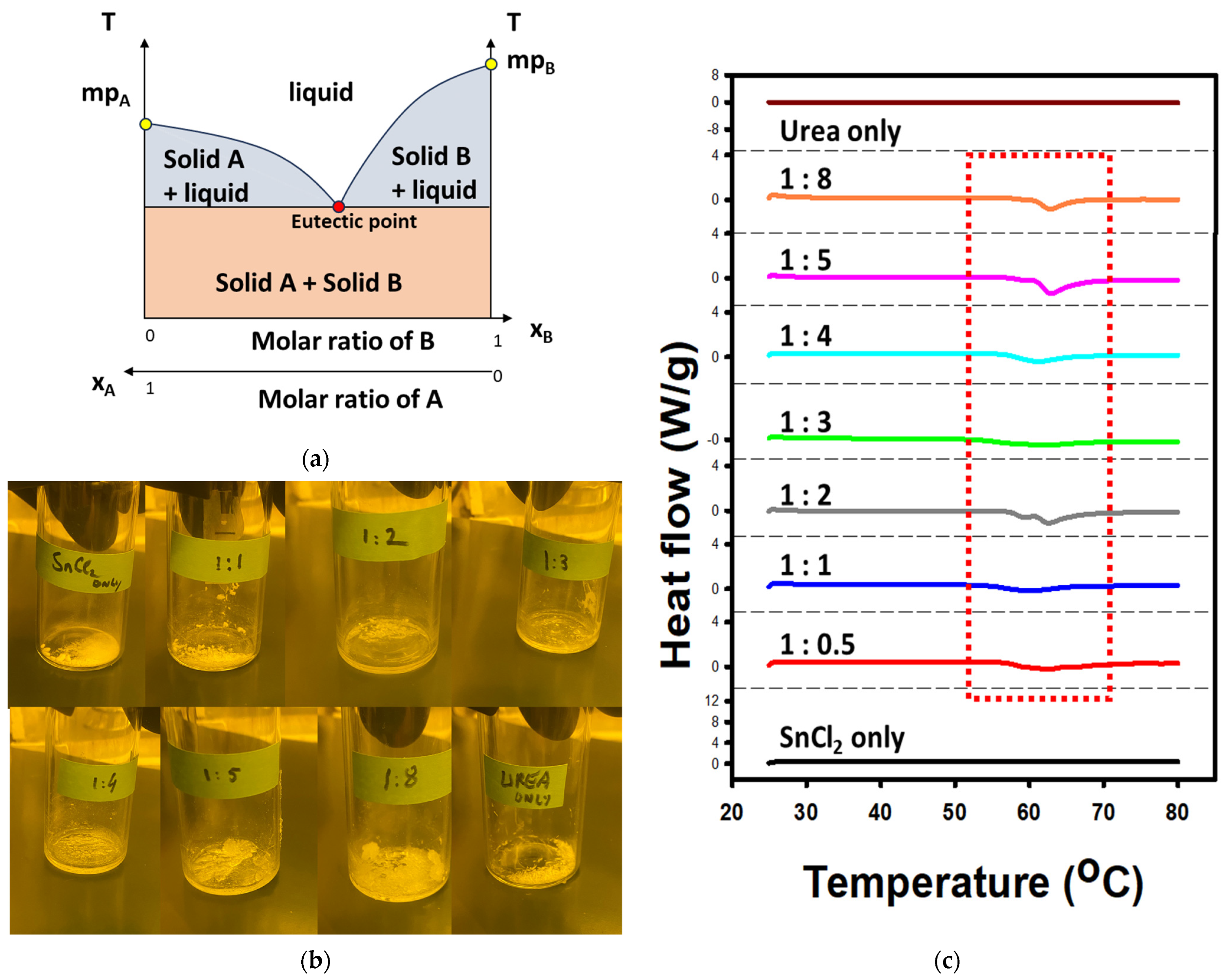
For the past 20 years, deep eutectic solvents (DES) have been studied. Deep eutectic solvents are mixtures of two materials having high melting points (usually above 200 °C) with their mixture having a melting point usually below 100 °C, with examples at room temperature (RT) [1,2]. Figure 1a shows the general concept of DES. When only solid A (B) is heated, the solid phase of A (B) exists until we reach the melting temperature mpA (mpB). When we mix together solid A and B, the melting temperature decreases as a function of the ratio of A and B. The minimum melting point is reached at one ratio of A and B, the eutectic. Below that temperature, whatever the ratio, both materials coexist in the solid phase. Above that temperature, for other ratios, a liquid phase and a solid phase coexist until the complete melting occurs.
One of the materials is a hydrogen bond donor (HBD), and the other one is a hydrogen bond acceptor (HBA). The HBD and HBA form hydrogen bonds responsible in part for the formation of a stable DES [1,2,3]. For example, the first reported HBA was choline chloride [1,2]. Other examples are ethylammonium chloride, glycine and so on [2,3,4]. Among HBD, urea was the first one used (with choline chloride), and others are for example acids or alcohols [1,2,3,4]. Contrary to common solvents, DESs are of low toxicity, greener, and can be used multiple times [1,2,3,4,5]. DES properties are high viscosity, low conductivity, and high density solvents. DESs can be used in a wide range of applications. DESs are solvents used in chemistry applications ranging from solvents for various chemical and physical applications [2,3], biology [4,5,6,7], electrodeposition of metals [2,3,4], and even sensors [8]
Thin-film transistors using amorphous oxide semiconductors (AOS) were introduced in 2004 by Nomura et al [9,10]. AOS like indium gallium zinc oxide (IGZO), zinc tin oxide (ZTO), and indium zinc oxide (IZO) have demonstrated their potential use for large-area electronics. These AOS are formed of two cations and one anion, making them usually amorphous. Recently, polycrystalline or crystalline oxide semiconductors have attracted attention due to their potential higher performances in TFTs, and potential use in scaled devices [11,12,13]. In2O3 and SnO2 are the most investigated polycrystalline oxide semiconductors.
Industrial applications like active-matrix organic light-emitting diodes (AMOLEDs) use devices manufactured by vacuum. Sputtering is the most widely employed technique. Recently, In2O3 has been highly investigated because of its potential use in future devices. Atomic layer deposition (ALD) has been employed to deposit the In2O3 layer [13]. Along with various doping atoms like Ga, or Sn, In2O3-based TFTs have reached field-effect mobilities over 50 cm2/Vs [14,15,16]. Let us note that various process strategies like CF4 plasma treatment [17,18], or various heterojunction channel [19,20]. layers can also help reach high mobilities above 5 m2/Vs. In2O3-based TFTs could even reach mobilities above 100 cm2/Vs. The possibility to reach such high mobilities are related to the understanding of the material itself, but also the development of various precursors for ALD.
To compete with the vacuum process, reported solution-processed TFTs have been investigated through two angles. The first one is related to thermal budget, the second one without any consideration of thermal budget. Considering then low temperature process (up to 300 °C), as would vacuum processed ALD or sputtered oxide semiconductor based TFTs, the solution process could reach mobilities of 10 cm2/Vs [21,22,23,24,25].
Compared to ALD where many precursors are available and have been developed either “in house” or else [26], the solution process of oxide semiconductors highly suffer from precursor novelties. Main strategies to obtain high performance TFT involve the combustion process [27]. or UV irradiation [28]. Indeed, the main precursors use nitrates as ligands. The combustion process of nitrate precursors can lead to reasonable mobilities of 1–10 cm2/Vs at a relatively low process temperature of 300 °C [28,29]. Recently, Quino et al. demonstrated the fabrication of nitrate derivatives out of Cl ligand-based precursors to reach the combustion process [30]. Other strategies involve substitutional doping, high annealing temperatures, double layer channel, or device engineering like dual gate TFT [14,15,16,19,20,31].
Along with vacuum process, solution process has been developed for AOS. Nowadays, spin-coating and spray coating can successfully obtain results in the same order of magnitude as non-vacuum process [10,19,32,33,34,35,36,37,38]. TFTs can reach mobilities over 30 cm2/Vs [19,32,33,36,37,38]. The solution process has also lead the path to the use of high-k dielectrics to enhance TFT characteristics [39,40].
Here, we report the use of DESs not as solvents, but as precursors of materials themselves. We propose an opportunity to use DESs for the fabrication of the semiconductor SnO2 and the insulator Al2O3. We then used the semiconductor and the dielectric in thin-film transistors (TFTs) and showed high performance with field-effect mobility of 80 cm2/Vs, with 2D amorphous tin oxide (a-SnOx) of a thickness of 3.2 nm. The process being kept at 300 °C, the TFTs can be used in further back-end of the line (BEOL) processes, which require a budget temperature of less than 400 °C.

2. Materials and Methods

2.1. DES and Solution Fabrications

We fabricated precursor solutions of SnO2 using DESs of SnCl2–urea with various ratios, namely 1:0, 1: 0.5, 1:1, 1:2, 1:3, 1:5, 1:8, where we used 0.5 mmol of SnCl2 in each case, and 0, 0,25, 0,5, 1, 1.5, 2.5, and 4 mmol of urea, respectively. First, we mixed the two powders and then placed them on a hot plate at 70 °C for 10 min so that the liquid form appears. Once the liquid phase is formed, we mixed the DES with 25 mL of ethyl acetate and stirred the solution at 70 °C for 1 h.
We also fabricated a precursor solution of Al2O3 using AlCl3–urea with a ratio of 1:1.3 mixed in 5 mL 2-methoxyethanol (2-Me) at RT. The DES appears at RT after 10 min of the mixture of AlCl3 and urea.
SnCl2 (CAS: 7772-99-8, purity 99.99%), urea (CAS: 57-13-6, purity: 99%), 2-Me (CAS: 109-86-4, purity: 99.8%), and ethyl acetate (CAS: 141-78-6, purity: ≥ 99.5%) were all purchased from Sigma-Aldrich (Yongin-Si, Republic of Korea). AlCl3 (CAS: 7446-70-0, purity: 99.999%) was manufactured by Thermo Fisher scientific (Ward Hill, MA, USA).

2.2. Thin-Film Transistor Fabrication and Evaluation

Thin-film transistors were fabricated by first depositing Mo (40 nm) by sputtering on glass. After patterning the metal as the gate, we spin-coated the Al2O3 precursor solution, cured at 150 °C for 5 min, and at 300 °C for 5 min. The step was repeated once to obtain a 30 nm thick Al2O3 layer. The Al2O3 layer was left to anneal on a hot plate at 300 °C for 2 h. We then spin-coated the SnO2 precursor solution and followed the same curing step as for the Al2O3 solution. After patterning and annealing at 300 °C for 2 h, via holes were formed and a 200 nm IZO layer was sputtered, and it was patterned as the source and drain (S/D). The final product was annealed at 300 °C for 6 h. Note that all patterning steps were performed by common photolithography.
We performed IV curve measurements on a 4156C Agilent semiconductor parameter analyzer (Agilent Technologies, Santa Clara, CA, USA). From the measurement, we extracted the subthreshold swing (SS) as V G S l o g ( I D S ) , the Vth defined as W/L × 10 − 10A, and the field-effect mobility µFE defined as I D S V G S L W C o x V D S , where W, L, Cox, VDS, VGS, and IDS are the width of the TFT, the length of the TFT, the capacitance of the insulator, the applied drain voltage, and the applied gated voltage, respectively [41,42].
We measured the capacitance–frequency (C-f) characteristics of the Al2O3 layer on a MIM structure (M = Mo, 40 nm, I: Al2O3, 30 nm) with an Agilent E4980A precision LCR meter (Agilent Technologies, Inc., Santa Clara, CA, USA). The TFTs had a width and length of 50 and 10 µm, respectively. The average values given in the text are from 30 TFTs.

2.3. DES and Thin-Film Analysis

The deep eutectic solvents (DESs) were analyzed by differential scanning calorimetry using a DSC-250 instrument (TA Instruments, New Castle, DE, USA). The mixtures were analyzed by increasing the temperature from room temperature to 80 °C. Surface roughness was analyzed by atomic force microscopy (AFM) using a XE-7 system (Park Systems, Suwon, South Korea) with a tapping method on a 5 μm × 5 μm area to obtain the root mean square roughness (RMS roughness). The O1s spectrum of SnO2 was analyzed by X-ray photoelectron spectroscopy (XPS) using a Phi 5000 Versaprobe system (ULVAC-PHI, Chigasaki, Kanagawa, Japan), calibrated at the 284.6 eV C1s peak. For depth profile measurements, the etching was performed by Argon ions at 2 kV with a sputter rate of 24 nm/min.
The crystallinity properties of the layers were evaluated by X-ray diffraction (XRD) (Rigaku, Tokyo, Japan). The Cu-Kα radiation (λ = 1.54 Å) was used for XRD measurements. Note that for XRD measurements, the thin films were 30–40 nm thick. Transmission electron microscopy (TEM) images were obtained using a Titan 80–300 microscope (Thermo Scientific™, former FEI, Hillsboro, OR, USA). The accelerating voltage was 300 kV, the detector was a OneView 1094 camera (Gatan, Inc., Pleasanton, CA, USA), and the vacuum level was 10−7 mbar.

3. Results and Discussions

3.1. DES Analysis

Figure 1b shows the various mixtures of SnCl2–urea at a temperature of 70 °C. Some mixtures appear formed of a liquid and a solid phase, while only the 1:3 ratio demonstrates a liquid phase, namely the eutectic point. The transparent and liquid form of the mixture demonstrate the formation of the DES. Let us note that the name DES is commonly used for any ratio [43,44].
We demonstrate the apparition of the liquid phase of the DES and other ratios under heat by differential scanning calorimetry (DSC) as shown in Figure 1c. We observed the formation of the liquid by the endothermic peak by ~55–65 300 °C for SnCl2–urea mixtures. Urea only and SnCl2 only do not show this peak. This confirms the apparition of the liquid phase of the DES in Figure 1b when the mixtures are heated at 70 °C. Note that other reports on the fabrication of DES use a temperature up to 80 °C because higher temperature would degrade the DES [1,2,3,4,5].
Figure 1. DES formation for mixtures of SnCl2–urea: (a) General concept of DES formation between two materials, A and B; (b) Photos of mixtures of fabricated mixtures of SnCl2–urea after being held on a hot plate at 70 °C for 10 min; (c) DSC analysis of various SnCl2–urea mixtures.
Materials 18 05349 g001

3.2. Thin-Film Analysis Results and Discussions

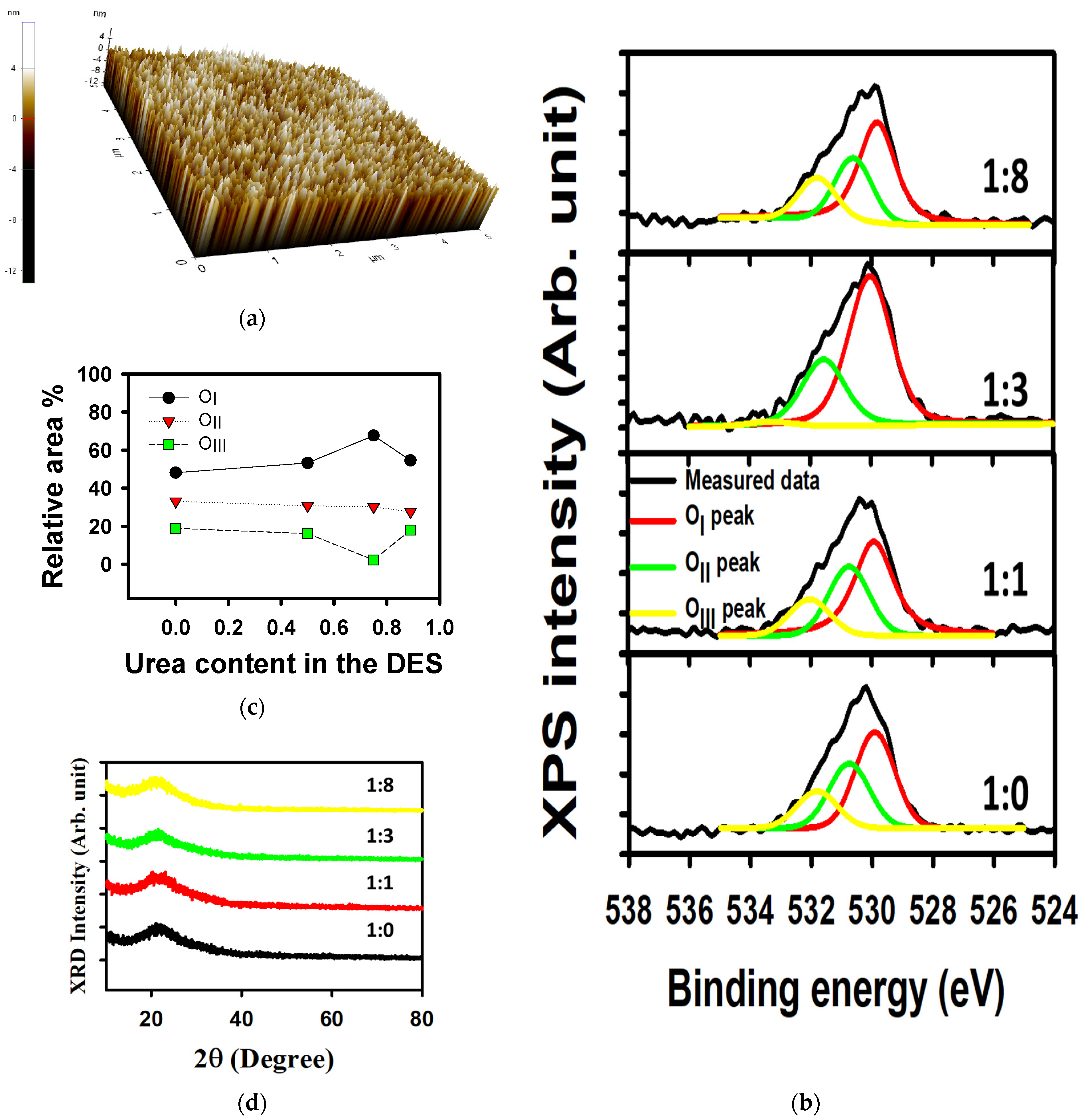
An important feature of a thin film is the surface morphology. We analyzed the surface by AFM on 5 μm × 5 µm sized samples. The AFM image of the thin film made from the solution with the DES composition (SnCl2–urea = 1:3) is shown in Figure 2a. Thin films made with other compositions are shown in Supplementary Figure S1. When increasing the SnCl2–urea ratio from 1:0 to 1:1, 1:3, and to 1:8, the root mean square (RMS) roughness of the layer varied from 1.705, to 1.643, 2.307, and to 2.038 nm, respectively. These RMS roughnesses are rather smooth and acceptable for microelectronic applications. Isakov et al. analyzed their In2O3 thin film made by spray pyrolysis with conventional nitrate precursors, and observed that the thinner their channel layer was, the rougher their surface was [45].
To have an insight into the thin-film compositions, we analyzed the O1s spectrum measured by X-ray photo-spectroscopy (XPS). The conventional analysis of the peak corresponds to a deconvolution of the contour into three main peaks: OI related to metal–oxygen (O-M) bonds, OII related to oxygen vacancies, and OIII related to -OH groups. Specifically, from SnCl2–urea = 1:0, 1:1, 1:3, and 1:8 OI ratios were 48.12, 53.20, 67.62, and 54.54%, respectively; OII ratios were 33.04, 30.70, 30.12, and 27.52%; and OIII ratios were 18.84, 16.10, 2.26, and 17.94%, respectively. The deconvoluted O1s peaks for films with various SnCl2–urea ratios are shown in Figure 2b. Therefore, the amount of M-O bonds (-OH bonds) is greatest (smallest) for the DES condition of SnCl2–urea 1:3. A summary of the various peak relative content in the films are shown in Figure 2c. Let us note that the carbon-related peak was present on the surface of each sample but not present inside the films as shown in Supplementary Figure S2. Reliability of the XPS experiment is necessary to be emphasized, as the resolution of the measurement system is ±0.5%. So, even though the XPS measurement demonstrates the absence of carbon, or other contaminants, let us keep in mind that the accuracy is for 1 atom per 200. Higher resolution measurement could be used, like time-of-flight secondary ion measurement spectrometry (TOF-SIMS) [38].
The crystallinity was investigated for the thin films fabricated from the SnCl2–urea = 1:0, 1:1, 1:3, and 1:8 by X-ray diffraction (XRD). The results are shown in Figure 2d. All films show an amorphous phase, consistent with previous work using SnCl2 as a precursor of tin oxide [38]. The observed broad peak is related to the amorphous phase of the glass substrate [9].
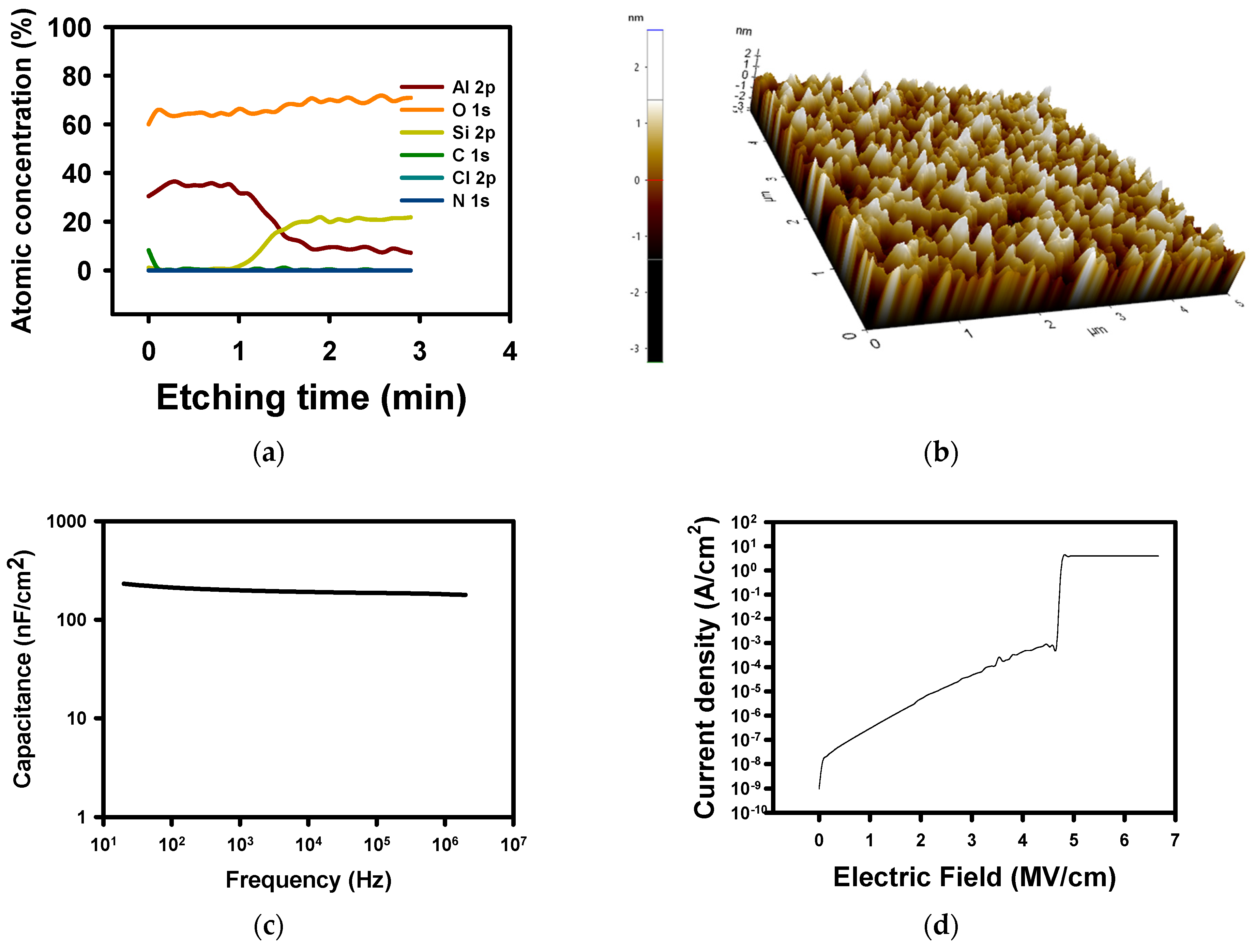
Following the successful fabrication of SnO2 thin films, we decided to investigate the properties of a DES-processed high-k dielectric. For this purpose, we demonstrate the possibility to make Al2O3 dielectric by a DES approach. We used a AlCl3–urea ratio of 1:1.3. (cf Supplementary Figure S3). The DES is obtained at RT, and no further heating is necessary. Let us note that other groups reported DES of AlCl3–urea for other applications like batteries [46,47,48]. We fixed the ratio at 1:1.3 as the purpose is to demonstrate the feasibility of fabrication of Al2O3 rather than an optimization. Figure 3a shows the XPS depth profile of the DES-derived Al2O3 thin film. The figure shows that C is present at the surface and not in the thin film. There is also no residue of N or Cl in the thin film, demonstrating that the DES-derived thin film leads to no residues or carbon contamination. As a decrease in Al content appears, the Si content increases. The Si peak comes from the glass substrate. The XPS measurement beam provides information not only on the surface atoms, but for a thickness of 10 nm. Therefore, we cannot see any abrupt variation in any atomic concentration. From the depth profile, we can understand the thickness of the Al2O3 layer is 30 nm. We could obtain a 30 nm Al2O3 thin film having an RMS roughness of 0.705 nm as shown in Figure 3b. We measured the capacitance characteristics of the dielectric from a MIM structure (cf. Figure 3c). The breakdown voltage measured for the Al2O3 dielectric was 4.81 ± 0.25 MV/cm (cf. Figure 3d), and a k value of 7.62 ± 2.16 (corresponding to a capacitance value of 225 ± 63.8 nF/cm2 at 20 Hz) close to the theoretical value of 9 [49]. Also, let us note the current density of 2.7 10−7 A/cm2 at 1 MV/cm. The results are largely better than the previously reported Al2O3 manufactured by solution processes with AlCl3 [34].

3.3. TFTs Results

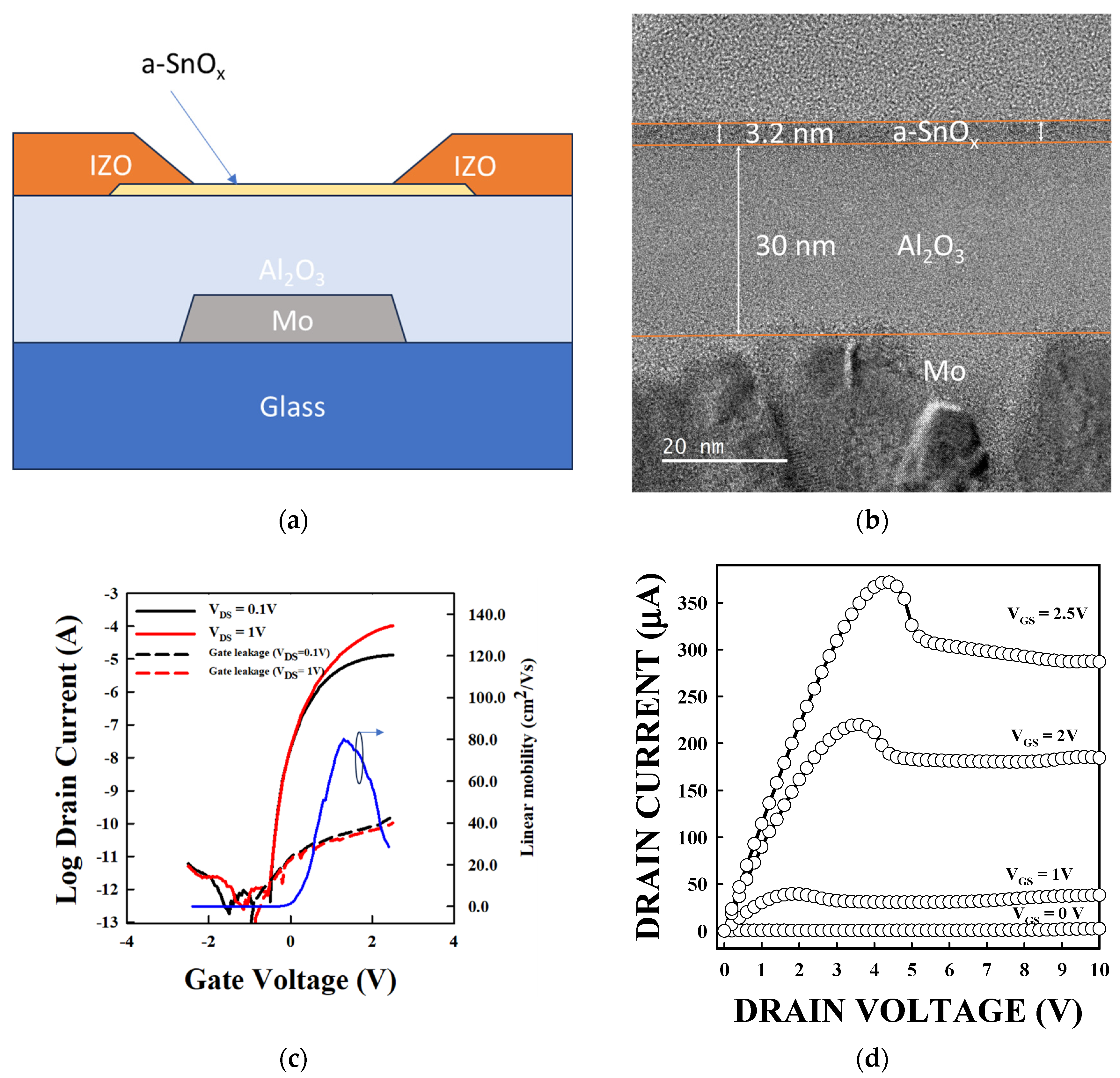
We used the Al2O3 and SnO2 layers to manufacture TFTs. Figure 4a shows a schematic of the TFT structure. Figure 4b shows a TEM image of a TFT made with DES-derived Al2O3 and DES-derived SnO2 (SnCl2–urea = 1:3). The image demonstrates a DES-derived Al2O3 of 30 nm, and a DES-derived a-SnOx of 3.2 nm. The image clearly demonstrates the possibility of fabricating an extremely thin semiconductor layer of a-SnOx. With SnCl2–urea ratio varying from 1:0 to 1:1, 1:3, and to 1:8, we obtained mobilities of 54 ± 10, 61 ± 8, 80± 17, 75 ± 15 cm2/Vs, Vth of −0.14 ± 0.02, −0.19 ± 0.04, −0.29 ± 0.06, and −0.25 ± 0.05 V, and SS of 86 ± 4, 90 ± 4, 88 ± 11, and 92 ± 10 mV/dec., respectively. The TFT with the highest performances is obtained at the DES condition (SnCl2–urea = 1:3). The mobility trend follows the M-O-M density revealed by the analysis of the O1s peak. It is understood that a higher overlap of the cation orbitals is therefore an indication of the higher current flow of the electrons leading to a higher mobility in the channel layer made from SnCl2–urea = 1:3 [9,10].
Figure 4c,d show the current–voltage (I–V) transfer and output curves of a TFT made from the SnCl2–urea = 1:3 DES condition, respectively. Supplementary Figure S4 shows the transfer and output curves of TFTs with a-SnOx made from SnCl2–urea = 1:0, 1:1, and 1:8. Let us note that even though the output shows saturation, a local maximum is present (by VDS = 4 V). This could be due to a local heating at/near the S/D due to the high current, as was also reported before in IGZO TFTs [50]. So further engineering of the S/D is necessary. Let us note that in terms of S/D engineering, Lin et al. demonstrated that the gate metal has an impact on the Vth, as, physically, the metal can create oxygen bonds, leading to oxygen vacancies in the channel [51].
In2O3 has been widely investigated compared to SnO2, and we will first discuss results of In2O3 TFTs. Processes like spray pyrolysis or ALD can also lead to thin layers, but require high temperatures, dual-gate TFT structures, or heterostructures as the channel layer. For example, a thin In2O3 below a thick ZnO can lead to a 2D electron gas (2DEG) layer with potentially high mobilities but require a thermal budget over 300 °C [19,35]. Spray pyrolysis of In2O3 demonstrated confinement effect and that the conduction of electrons is limited by the roughness of the (extremely) thin layer [45]. Conventionally, ALD is used to fabricate high-quality and smooth layers, for example, In2O3 thicknesses as low as 0.7 nm [13]. Our process clearly demonstrates the potential use of DES for the fabrication of a-SnOx leading to high-quality TFTs. SnO2 (or a-SnOx) has shown less interest. Comparatively, tin oxide thin films made by the solution process have a higher thermal budget than ours (usually at least 350 °C). G. Huang et al. fabricated SnO2 TFT on Al2O3 at 350 °C to reach a mobility of 96.4 cm2/Vs, Vth of 1.72 V, and SS of 0.26 V/dec., but they did not report the stability of their TFTs [36]. Shih et al. also reported mobility reaching 147.5 cm2/Vs for an annealing temperature of 400 °C [37].
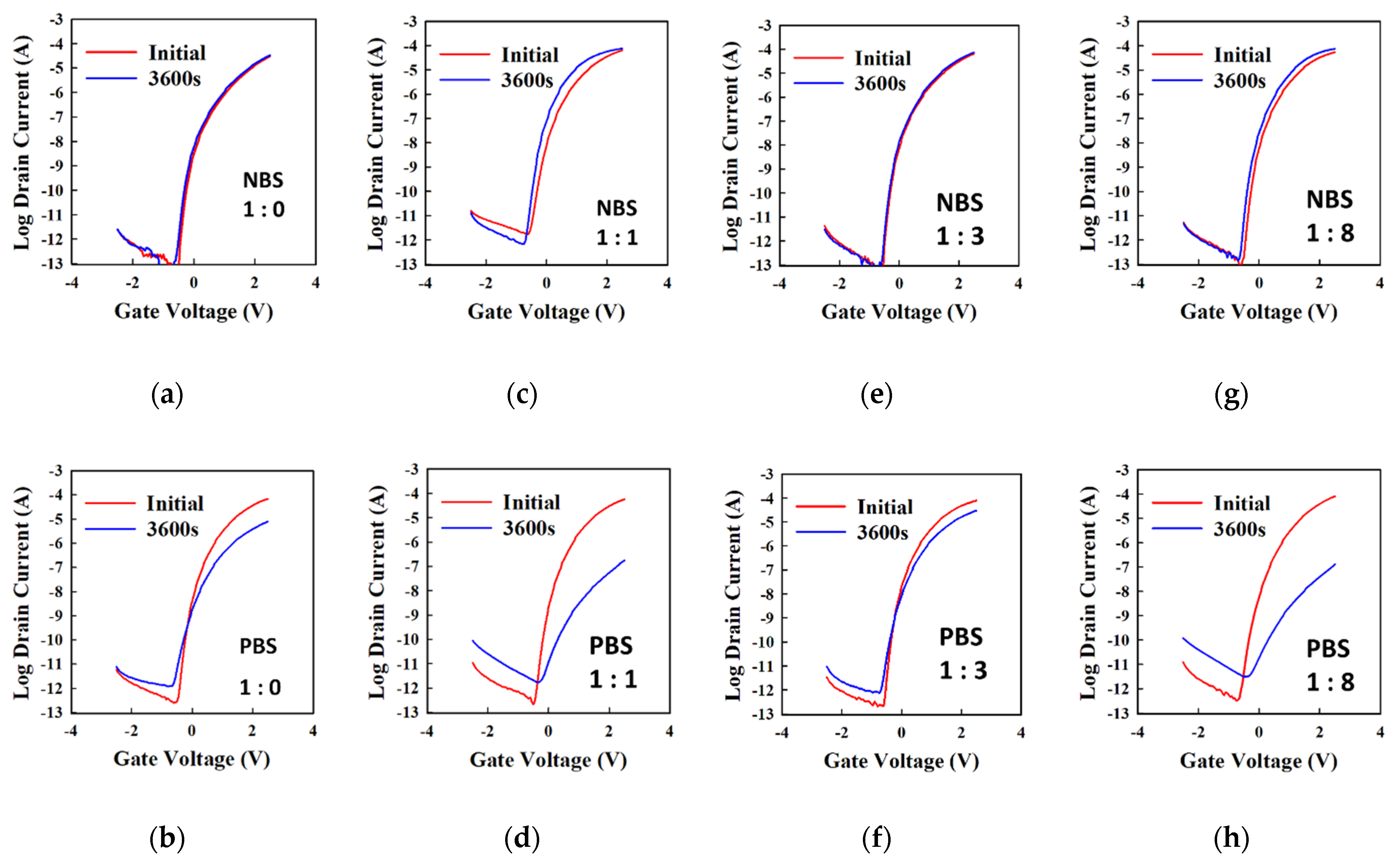
We also tested the TFT under conventional positive bias stress (PBS) and negative bias stress (NBS). PBS (NBS) was performed by applying + 2.5 V (−2.5 V) at the gate for 1 h. The results are shown below in Figure 5. Even though there is no significant shift under PBS, we do observe a decrease in the total current after 1 h of PBS, and a decrease in the OFF current. An increase in the OFF current reveals that the number of electrons available in the negative VGS region is higher. The slight increase in the SS demonstrates the creation of defect states. The defect states are usually oxygen vacancies, freeing electrons in the channel [9], but the number of defects can become too high, and because of scattering, the channel layer does not conduct electrons efficiently, leading to the reduction in ON current. The decrease in ON current is a problem observed in a previously reported a-SnOx TFT [38]. Under NBS, we do not observe a significant shift for the TFT with the DES condition (1:3) and for the TFT made from Sncl2 only. Therefore, urea can be introduced to enhance the TFT initial characteristics at exactly the 1:3 DES condition, and other SnCl2–urea leads to degradation of the TFT under PBS and NBS because of the creation of defects. Since the TFT stability does not relate to the a-SnOx oxygen environment, lower state creation for the TFT using SnCl2–urea of 1:0 and 1:3 is more related to the gate insulator/SnO2 interface than the SnO2 material itself.
Finally, we want to discuss the opportunity to fabricate new precursors for oxide semiconductors. Even though solution process has demonstrated many competitive results compared to the industry-preferred vacuum process, there has been an evident lack in new processes and precursors. It is easy to note by reading state-of-the-art solution-processed TFTs that the precursors employed are usually nitrates (NO3). State-of-the-art solution-processed oxide TFTs made from nitrate precursors can hardly reach 10 cm2/Vs at 300 °C, but can reach 20 cm2/Vs using combustion processes or other strategies like radiation [22,23,25,32,33,52]. Chloride precursors, on the other hand, are usually considered to be corrosive, and have been investigated by fewer numbers of researchers. Used in IGO (indium chloride as the precursor for indium), they can lead to TFTs having mobilities around 30 cm2/Vs [39,53]. Let us note the use of tin (II) 2-ethylhexanoate by Huang et al. to obtain high-performance SnO2 TFTs [36]. Nonetheless, there is an evident lack of new precursors, which is important in any semiconductor fabrication. As for ALD, many precursors have been developed for In2O3 [11], and the understanding of the relationship between precursor and TFT result is paramount. So, our strategy tries to participate in solving this problem and fabricate new precursors via the use of deep eutectic solvents serving as precursors, even though we did not remove the chloride ligands.

4. Conclusions

We fabricated DES, not to be used as solvents, but to manufacture thin films. DESs of SnCl2–urea and DESs of AlCl3–urea were used to make the semiconductor a-SnOx and the dielectric Al2O3. The method employs a thermal budget of 300 °C and can lead to high-quality thin films. The a-SnOx films are smooth and amorphous, and the DES (SnCl2–urea = 1:3)-derived thin films leads to the film with the higher density of O-M bonds. The Al2O3 derived from AlCl3–urea DESs demonstrated a smooth surface, and without N, Cl, and C residues that could have come from either the solvent or urea. As a dielectric, Al2O3 demonstrated a breakdown voltage of 4.65 MV/cm, and a k value of 7.62. We fabricated TFTs using both layers and obtained mobilities of 80 cm2/Vs, for the DES condition of SnCl2–urea = 1:3, and AlCl3–urea = 1:1.3. The TFTs show adequate responses under PBS and NBS. DES-derived thin films are an eco-friendly method to manufacture 2D a-SnOx and Al2O3 thin films for TFTs. They can also be applied to BEOL applications.

Supplementary Materials

The following supporting information can be downloaded at https://www.mdpi.com/article/10.3390/ma18235349/s1; Figure S1: AFM images of SnCl2–urea-derived thin films; Figure S2: C1s peak presence in films derived from various SnCl2–urea ratios, Figure S3: DES of a mixture of AlCl3–urea; Figure S4: TFT characteristics derived from various SnCl2–urea ratios.

Author Contributions

Conceptualization, C.A. formal analysis, investigation C.A.; resources, J.J.; funding acquisition, J.J. All authors have read and agreed to the published version of the manuscript.

Funding

This work was supported by the Technology Innovation Program Development Program (RS-2024-00410274, Development of equipment technology to bond RGB one-pixel microLED package with bonding tolerance less than ±3 µm) funded by the Ministry of Trade, Industry & Energy (MOTIE, Korea).

Data Availability Statement

The original contributions presented in this study are included in the article/Supplementary Material. Further inquiries can be directed to the corresponding author.

Conflicts of Interest

The authors declare no conflicts of interest.

References

  1. Abbott, A.; Capper, G.; Davies, D.; Rasheed, R.; Tambyrajah, V. Novel solvent properties of choline chloride/urea mixtures. Chem. Commun. 2003, 39, 70–71. [Google Scholar] [CrossRef]
  2. Achkar, T.; Greige-Gerges, H.; Fourmentin, S. Basics and properties of deep eutectic solvents: A review. Environ. Chem. Lett. 2021, 19, 3397–3408. [Google Scholar] [CrossRef]
  3. Hansen, B.; Spittle, S.; Chen, B.; Poe, D.; Zhang, Y.; Klein, J.; Horton, A.; Adhikari, L.; Zelovich, T.; Doherty, B.; et al. Deep Eutectic Solvents: A Review of Fundamentals and Applications. Chem. Rev. 2021, 121, 1232–1285. [Google Scholar] [CrossRef] [PubMed]
  4. Smith, E.; Abbott, A.; Ryder, K. Deep Eutectic Solvents (DESs) and Their Applications. Chem Rev. 2014, 114, 11060–11082. [Google Scholar] [CrossRef] [PubMed]
  5. Ferreira, C.; Sarraguca, M. A Comprehensive Review on Deep Eutectic Solvents and Its Use to Extract Bioactive Compounds of Pharmaceutical Interest. Pharmaceuticals 2024, 17, 124. [Google Scholar] [CrossRef] [PubMed]
  6. Stanisz, M.; Stanisz, B.; Piontek, J. A Comprehensive Review on Deep Eutectic Solvents: Their Current Status and Potential for Extracting Active Compounds from Adaptogenic Plants. Molecules 2024, 29, 4767. [Google Scholar] [CrossRef]
  7. Hadinoto, K.; Ling, J. Deep Eutectic Solvent as Green Solvent in Extraction of Biological Macromolecules: A Review. Int. J. Mol. Sci. 2022, 23, 3381. [Google Scholar] [CrossRef]
  8. Rabiei, M.; Hosseini, M.; Xu, G. Deep eutectic solvents: A review on their sensing applications. Microchem. J. 2024, 203, 110909. [Google Scholar] [CrossRef]
  9. Nomura, K.; Ohta, H.; Takagi, A.; Kamiya, T.; Hirano, M.; Hosono, H. Room-temperature fabrication of transparent flexible thin-film transistors using amorphous oxide semiconductors. Nature 2004, 432, 488–492. [Google Scholar] [CrossRef]
  10. Fortunato, E.; Barquinha, P.; Martins, R. Oxide Semiconductor Thin-Film Transistors: A Review of Recent advances. Adv. Mater. 2012, 24, 2945–2986. [Google Scholar] [CrossRef]
  11. Charnas, A.; Zhang, Z.; Lin, Z.; Zheng, D.; Zhang, J.; Si, M.; Ye, P. Review—Extremely Thin Amorphous Indium Oxide Transistors. Adv. Mater. 2024, 36, 2304044. [Google Scholar] [CrossRef]
  12. Kim, T.; Ryu, S.; Jeon, J.; Kim, T.; Baek, I.; Kim, S. Ultrahigh field-effect mobility of 147.5cm2/Vs in ultrathin In2O3 transistors via passivating the surface of polycrystalline HfO2 gate dielectrics. Appl. Phys. Lett. 2025, 126, 033501. [Google Scholar] [CrossRef]
  13. Si, M.; Hu, Y.; Lin, Z.; Sun, X.; Charnas, A.; Zheng, D.; Lyu, X.; Wang, H.; Cho, K.; Ye, P. Why In2O3 Can Make 0.7 nm Atomic Layer Thin Transistors. Nano Lett. 2021, 21, 500–506. [Google Scholar] [CrossRef]
  14. Rabbi, H.; Ali, A.; Park, C.; Jang, J. High performance amorphous In0.5Ga0.5O Thin-film transistor embedded with nanocrystalline In2O3 Dots for flexible display application. Adv. Electron. Mater. 2023, 9, 2300169. [Google Scholar] [CrossRef]
  15. Li, S.; Tian, M.; Gao, Q.; Wang, M.; Li, T.; Hu, Q.; Li, X.; Wu, Y. Nanometre-thin indium tin oxide for advanced high-performance electronics. Nat. Mat. 2019, 18, 1091–1097. [Google Scholar] [CrossRef] [PubMed]
  16. Magari, Y.; Kataoka, T.; Yeh, W.; Furuta, M. High-mobility hydrogenated polycrystalline In2O3 (In2O3:H) thin-film transistors. Nat. Commun. 2022, 13, 1078. [Google Scholar] [CrossRef] [PubMed]
  17. Chang, Y.; Wang, S.; Lee, Y.; Huang, C.; Hsu, C.; Weng, T.; Huang, C.; Chen, C.; Chou, T.; Chang, C.; et al. Breaking the Trade-Off Between Mobility and On–Off Ratio in Oxide Transistors. Adv. Mater. 2025, 37, 2413212. [Google Scholar] [CrossRef]
  18. Li, J.; Ju, S.; Tang, Y.; Li, J.; Li, X.; Tian, X.; Zhu, J.; Ge, Q.; Lu, L.; Zhang, S.; et al. Remarkable Bias-Stress Stability of Ultrathin Atomic-Layer- Deposited Indium Oxide Thin- Film Transistors Enabled by Plasma Fluorination. Adv. Funct. Mater. 2024, 34, 2401170. [Google Scholar] [CrossRef]
  19. Faber, H.; Das, S.; Lin, Y.; Pliatsikas, N.; Zhao, K.; Kehagias, T.; Dimitrakopulos, G.; Amassian, A.; Patsalas, P.; Anthopoulos, T. Heterojunction oxide thin-film transistors with unprecedented electron mobility grown from solution. Sci. Adv. 2017, 3, e1602640. [Google Scholar] [CrossRef]
  20. Saha, J.; Jang, J. Saturation Mobility of 100 cm2V−1s−1 in ZnO Thin-Film Transistors through Quantum Confinement by a Nanoscale In2O3 Interlayer Using Spray Pyrolysis. ACS Nano 2024, 18, 30484–30496. [Google Scholar] [CrossRef] [PubMed]
  21. Rao, M.; Meza-Arroyoa, J.; Reddy, K.; Murthy, L.; de Urquijo-Venturaa, M.; Garibay-Martínez, F.; Hsu, J.; Bon, R. Tuning the electrical performance of solution-processed In2O3TFTs by low-temperature with HfO2-PVP hybrid dielectric. Mater. Today Commun. 2021, 26, 102120. [Google Scholar] [CrossRef]
  22. Kirmani, A.; Roe, E.; Stafford, C.; Richter, L. Role of the electronically-active amorphous state in low-temperature processed In2O3 thin-film transistors. Mater. Adv. 2020, 1, 167. [Google Scholar] [CrossRef]
  23. Tewari, A.; Tukiainen, A.; Mäntysalo, M.; Berger, P. Direct PEALD Deposition of a HfO2 Gate Dielectric without the Passivation for TFTs on Rigid and Flexible Substrates. ACS Appl. Electron. Mater. 2025, 7, 7120–7130. [Google Scholar] [CrossRef]
  24. Park, J.; Park, W.; Na, J.; Lee, J.; Eun, J.; Feng, J.; Kim, D.; Bae, J. Atomically Thin Amorphous Indium–Oxide Semiconductor Film Developed Using a Solution Process for High-Performance Oxide Transistor. Nanomaterials 2023, 13, 2568. [Google Scholar] [CrossRef] [PubMed]
  25. Bhalerao, S.; Lupo, D.; Berger, P. Flexible, solution-processed, indium oxide (In2O3) thin film transistors (TFT) and circuits for internet-of-things (IoT). Mater. Sci. Semicon. Proc. 2022, 139, 106354. [Google Scholar] [CrossRef]
  26. Lee, H.; Hur, J.; Cho, I.; Choi, C.; Yoon, S.; Kwon, Y.; Shong, B.; Jeong, J. Comparative Study on Indium Precursors for Plasma-Enhanced Atomic Layer Deposition of In2O3 and Application to High Performance Field-Effect Transistors. ACS Appl. Mater. Interfaces 2023, 15, 51399–51410. [Google Scholar] [CrossRef] [PubMed]
  27. Kim, M.; Kanatzidis, M.; Facchetti, A.; Marks, T. Low-temperature fabrication of high-performance metal oxide thin-film electronics via combustion processing. Nat. Mat. 2011, 10, 382–388. [Google Scholar] [CrossRef]
  28. Kim, Y.; Heo, J.; Kim, T.; Park, S.; Yoon, M.; Kim, J.; Oh, M.; Yi, G.; Noh, Y.; Park, S. Flexible metal-oxide devices made by room temperature photo chemical activation of sol–gel films. Nature 2012, 489, 128–133. [Google Scholar] [CrossRef]
  29. Carlos, E.; Leppäniemi, J.; Sneck, A.; Alastalo, A.; Deuermeier, J.; Branquinho, R.; Martins, R.; Fortunato, E. Printed, Highly Stable Metal Oxide Thin-Film Transistors with Ultra-Thin High-κ Oxide Dielectric. Adv. Electron. Mater. 2020, 6, 1901071. [Google Scholar] [CrossRef]
  30. Quino, C.; Bermundo, J.; Kawanishi, H.; Uraoka, Y. Dual Role of AgNO3 as an Oxidizer and Chloride Remover toward Enhanced Combustion Synthesis of Low-Voltage and Low Temperature Amorphous Rare Metal-Free Oxide Thin-Film Transistors. ACS Appl. Electron. Mater. 2024, 6, 505–513. [Google Scholar] [CrossRef]
  31. Chakraborty, W.; Ye, H.; Grisafe, B.; Lightcap, I.; Datta, S. Low Thermal Budget (<250 °C) Dual-Gate Amorphous Indium Tungsten Oxide (IWO) Thin-Film Transistor for Monolithic 3-D Integration. IEEE Trans. Elec. Dev. 2020, 67, 5336–5342. [Google Scholar]
  32. Yang, J.; Lin, D.; Chen, Y.; Li, T.; Liu, J. Solution-Processed Metal Oxide Thin-Film Transistor at Low Temperature via A Combination Strategy of H2O2-Inducement Technique and Infrared Irradiation Annealing. Small Methods 2024, 8, 2301739. [Google Scholar] [CrossRef]
  33. Gupta, P.; Sharma, S. Facile DUV Irradiated Solution-Processed ZrO2/In2O3 for Low Voltages FET Applications. IEEE Trans. Elec. Dev. 2024, 71, 3705–3713. [Google Scholar] [CrossRef]
  34. Avis, C.; Jang, J. High-performance solution processed oxide TFT with aluminum oxide gate dielectric fabricated by a sol–gel method. J. Mater Chem. 2011, 21, 10649–10652. [Google Scholar] [CrossRef]
  35. Khim, D.; Lin, Y.; Nam, S.; Faber, H.; Tetzner, K.; Li, R.; Zhang, Q.; Li, J.; Zhang, X.; Anthopoulos, T. Modulation-Doped In2O3/ZnO Heterojunction Transistors Processed from Solution. Adv. Mater. 2017, 29, 1605837. [Google Scholar] [CrossRef]
  36. Huang, G.; Duan, L.; Dong, G.; Zhang, D.; Qiu, Y. High-Mobility Solution-Processed Tin Oxide Thin-Film Transistors with High κ Alumina Dielectric Working in Enhancement Mode. ACS Appl. Mater. Interfaces 2014, 6, 20786–20794. [Google Scholar] [CrossRef] [PubMed]
  37. Shih, C.; Chin, A.; Lu, C.F.; Su, W.F. Remarkably high mobility ultrathin-film metal-oxide transistor with strongly overlapped orbitals. Sci. Rep. 2016, 6, 19023. [Google Scholar]
  38. Avis, C.; Jang, J. Amorphous Tin Oxide Applied to Solution Processed Thin-Film Transistors. Materials 2019, 12, 3341. [Google Scholar] [CrossRef]
  39. Lee, S.; Chang, S.; Lee, J. Role of high-k gate insulators for oxide thin film transistors. Thin Solid Film. 2010, 518, 3030–3032. [Google Scholar] [CrossRef]
  40. Xu, W.; Wang, H.; Ye, Y.; Xu, J. The role of solution-processed high-κ gate dielectrics in electrical performance of oxide thin-film transistors. J. Mater. Chem. C 2014, 2, 5389–5396. [Google Scholar] [CrossRef]
  41. Kim, T.; Choi, C.; Hur, J.; Ha, D.; Kuh, B.; Kim, Y.; Cho, M.; Kim, S.; Jeong, J. Progress, Challenges, and Opportunities in Oxide Semiconductor Devices: A Key Building Block for Applications Ranging from Display Backplanes to 3D Integrated Semiconductor Chips. Adv. Mater. 2023, 35, 2204663. [Google Scholar] [CrossRef]
  42. Kuo, Y. Thin Film Transistors: Materials and Processes; Springer: New York, NY, USA, 2004. [Google Scholar]
  43. Zhang, F.; Wang, Z.; Xu, Y.; Zhao, B.; Shi, A.; Lao, J.; Wang, H.; Wu, Q.; Yu, H.; Liu, Y.; et al. One-pot realisation of reaction-extraction coupling: Innovative application and mechanistic insights of InCl3 deep eutectic solvents in Beckmann rearrangement reactions. Fuel 2025, 384, 133977. [Google Scholar] [CrossRef]
  44. Liu, X.; Li, X.; Zhao, R.; Zhang, H. A facile sol–gel method based on urea–SnCl2 deep eutectic solvents for the synthesis of SnO2/SiO2 with high oxidation desulfurization activity. New J. Chem. 2021, 45, 15901. [Google Scholar] [CrossRef]
  45. Isakov, I.; Faber, H.; Mottram, A.; Das, S.; Grell, M.; Regoutz, A.; Kilmurray, R.; McLachan, M.; Payne, D.; Anthopoulos, T. Quantum Confinement and Thickness-Dependent Electron Transport in Solution-Processed In2O3 Transistors. Adv. Electron. Mater. 2022, 6, 2000682. [Google Scholar] [CrossRef]
  46. Cvetkovic, V.; Vukicevic, N.; Jovicevic, N.; Stevanovic, J.; Jovicevic, J. Aluminium electrodeposition under novel conditions from AlCl3−urea deep eutectic solvent at room temperature. Trans. Nonferrous Met. Soc. China 2019, 30, 823–834. [Google Scholar] [CrossRef]
  47. Chen, W.; Xu, C.; Li, J.; Gu, D.; Zhang, Q.; Hua, Y. Eco-Friendly Electrodeposition of Al-Zn Alloy from AlCl3-Urea Deep Eutectic Solvent. J. Elec. Chem. Soc. 2024, 171, 022503. [Google Scholar] [CrossRef]
  48. Ammar, M.; Ashraf, S.; Gonzalez-casamachin, D.A.; Awotoye, D.T.; Baltrusaitis, J. Recent Progress of Urea-Based Deep Eutectic Solvents as Electrolytes in Battery Technology: A Critical Review. Batteries 2024, 10, 45. [Google Scholar] [CrossRef]
  49. Robertson, J. High dielectric constant oxides. Eur. Phys. J. Appl. Phys. 2004, 28, 265–291. [Google Scholar] [CrossRef]
  50. Tappertzhofen, S. Impact of electrode materials on the performance of amorphous IGZO thin-film transistors. MRS Adv. 2022, 7, 723–728. [Google Scholar] [CrossRef]
  51. Lin, J.; Niu, C.; Lin, Z.; Lee, S.; Kim, T.; Lee, J.; Liu, C.; Lu, J.; Wang, H.; Alam, M.; et al. Analyzing the Contact-Doping Effect in In2O3 FETs: Unveiling the Mechanisms Behind the Threshold-Voltage Roll-Off in Oxide Semiconductor Transistors. IEEE Trans. Elec. Dev. 2025, 72, 3004–3011. [Google Scholar] [CrossRef]
  52. Choi, C.-H.; Han, S.-Y.; Su, Y.-W.; Fang, Z.; Lin, L.-Y.; Cheng, C.-C.; Chang, C.-H. Fabrication of high-performance, low-temperature solution processed amorphous indium oxide thin-film transistors using a volatile nitrate precursor. J. Mater. Chem. C 2015, 3, 854. [Google Scholar] [CrossRef]
  53. Rabbi, M.; Ali, A.; Park, C.; Bae, J.; Jang, J. Growth of high quality polycrystalline InGaO thin films by spray pyrolysis for coplanar thin-film transistors on polyimide substrate. J. Alloys Comp. 2024, 1002, 175203. [Google Scholar] [CrossRef]
Figure 2. Analysis of DES-derived tin oxide thin films. (a) AFM image of the thin film derived from the SnCl2–urea 1:3 DES, (b) XPS O1s peak deconvolution, (c) summary of the deconvolution, and (d) XRD spectrum of the thin films made from SnCl2–urea = 1:0, 1:1, 1:3, and 1:8.
Materials 18 05349 g002
Figure 3. Analysis of the Al2O3 thin film made from AlCl3–urea = 1:1.3 DES. (a) XPS depth profile of the Al2O3 layer, (b) AFM image, (c) C-f characteristics, and (d) current density as a function of the voltage applied to determine the breakdown voltage.
Materials 18 05349 g003
Figure 4. Characteristics of a-SnOx TFT made from DES of SnCl2–urea = 1:3. (a) TFT structure, (b)TEM image, (c) transfer curve, and (d) output curve.
Materials 18 05349 g004
Figure 5. PBS and NBS results of SnO2 TFT with Al2O3 and SnO2 made by DES. (a,b), (c,d), (e,f), and (g,h) represent the transfer curves before and after NBS and PBS, respectively, for the TFT using a-SnOx made from SnCl2–urea = 1:0, 1:1, 1:3, and 1:8. The red (blue) curve represents the IV transfer curve measured at the beginning (end) of the stress.
Materials 18 05349 g005
Disclaimer/Publisher’s Note: The statements, opinions and data contained in all publications are solely those of the individual author(s) and contributor(s) and not of MDPI and/or the editor(s). MDPI and/or the editor(s) disclaim responsibility for any injury to people or property resulting from any ideas, methods, instructions or products referred to in the content.