Systematic Review

Evaluating the Clinical Efficacy of Membrane-Assisted Regenerative Therapy in Peri-Implantitis Management: A Comprehensive Review Incorporating Systematic Review Evidence


1
Mac Dental Clinic, Daegu 42117, Republic of Korea
2
Department of Periodontology, School of Dentistry, Kyungpook National University, Daegu 41940, Republic of Korea
3
Private Practice, New York, NY 10075, USA
4
Department of Oral & Maxillofacial Surgery, Boston University Henry M. Goldman School of Dental Medicine, Boston, MA 02118, USA
5
Private Practice, Gumi-si 39236, Republic of Korea
*
Authors to whom correspondence should be addressed.
These authors contributed equally to this work.
Materials 2025, 18(22), 5227; https://doi.org/10.3390/ma18225227
Submission received: 13 October 2025 / Revised: 5 November 2025 / Accepted: 13 November 2025 / Published: 18 November 2025
(This article belongs to the Special Issue Advanced Materials for Oral Application (3rd Edition))

Abstract

Peri-implantitis (PI) is characterized by inflammatory tissue destruction and alveolar bone loss surrounding dental implants, posing clinical challenges. To promote bone regeneration, clinicians often use resorbable or non-resorbable membranes in combination with bone grafts or biologic agents. Despite their widespread application in PI management, the clinical efficacy of these approaches remains uncertain. Therefore, this study aims to evaluate the role of membrane-assisted regenerative therapy in the management of PI. A systematic literature search was conducted in PubMed, Scopus, Cochrane Library, and Google Scholar following the Preferred Reporting Items for Systematic Reviews and Meta-Analyses (PRISMA 2020) guidelines, with the protocol registered in PROSPERO (CRD420251089276). Sixty-nine studies met the inclusion criteria. The primary outcomes assessed were bone-fill gain and reduction in probing pocket depth (PPD). Although some studies reported improved bone-fill and PPD reduction with membrane-assisted regenerative therapy, the findings were not consistently significant. Future research should validate the clinical efficacy of membranes through well-designed randomized trials and develop advanced decontamination techniques and implant surface modifications that could enhance treatment predictability and patient outcomes. Overall, while membranes show potential clinical value in regenerative therapy, their necessity remains uncertain owing to variability in the current evidence.

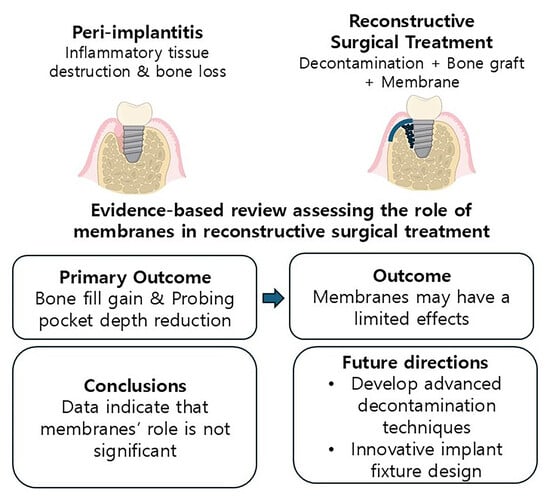
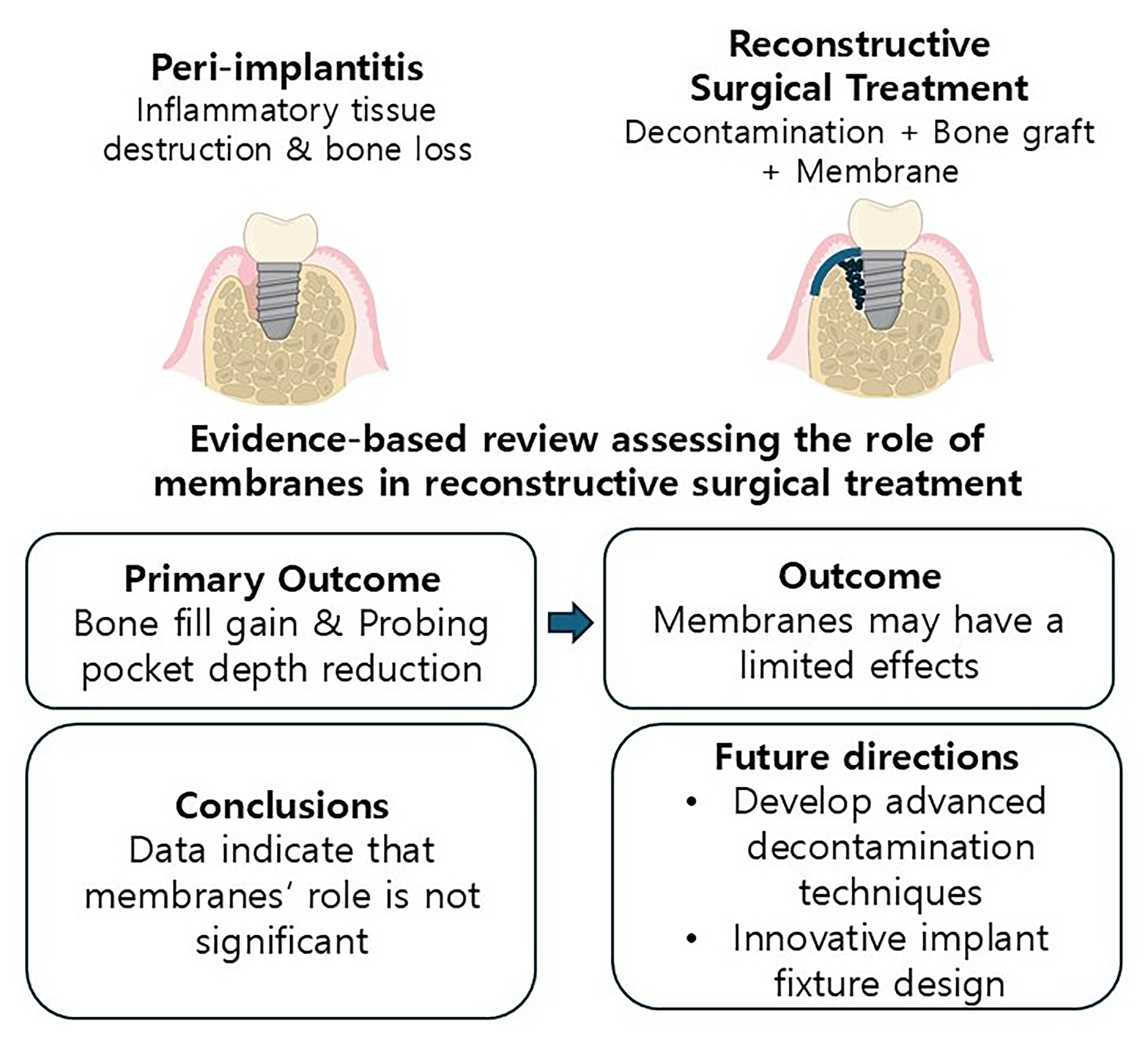
Graphical Abstract

1. Introduction

Peri-implantitis (PI), a pathological condition caused by the accumulation of dental plaque around dental implants, results in inflammation of the peri-implant mucosa and progressive deterioration of the supporting bone [1]. The accumulation of bacterial biofilm and the corresponding host immune response are the primary etiologic factors, placing patients with poor plaque control and infrequent maintenance visits at higher risk. Anti-infective interventions can reduce soft tissue inflammation and slow the progression of PI. However, once PI develops, complete decontamination of the infected implant surface is challenging, and the restoration of lost bone and re-osseointegration remains a clinical challenge. Despite advances in scaffold-based approaches for regenerating periodontal and peri-implant tissues [2], a standardized and consistently effective treatment protocol is still lacking. Similarly to periodontitis treatment, PI management includes nonsurgical and surgical therapies, with the latter further categorized into resective and reconstructive procedures. Among these, reconstructive therapy aligns with the primary objective of PI management—regeneration of the supporting peri-implant tissues. Traditional regenerative techniques, including guided bone regeneration (GBR), remain the primary approach [3,4]. However, studies investigating the role of membranes as essential components of GBR in PI remain limited, with no consensus reached regarding their optimal application. Previous research has primarily focused on membrane type, with limited consideration of other clinical factors influencing regenerative outcomes [3,4]. In contrast, the present review incorporates additional variables, including keratinized mucosa (KM) width, surface decontamination protocols, and prosthesis management during surgery. Therefore, this review aims to comprehensively assess the clinical effectiveness of membrane-assisted regenerative therapy in PI management. It examines recent advancements in surgical procedures and biomaterials, evaluating their efficacy in preclinical and clinical studies and highlighting the advantages and limitations of various graft materials and membrane-assisted approaches.
Despite the increasing number of clinical studies, evidence-based guidance remains limited regarding how membrane type, peri-implant soft tissue conditions, and decontamination techniques collectively influence clinical outcomes. Furthermore, previous reviews have primarily focused on membrane type alone, without integrating these modifying variables. Accordingly, a more comprehensive analysis that reflects the complexity of clinical decision-making in peri-implant regenerative surgery is needed [5]. Therefore, this review aims to address this gap by systematically integrating clinical and biological variables, including membrane type, defect morphology, KM width, and surface decontamination methods, into a unified framework for evaluating peri-implant regenerative outcomes.

2. Materials and Methods

2.1. Study Design

This comprehensive review aims to examine the effect of membrane-assisted regenerative therapy on clinical outcomes in the management of PI.

2.2. Protocol and Registration

This study was conducted following the Preferred Reporting Items for Systematic Reviews and Meta-Analyses (PRISMA) guidelines to ensure transparency in study selection and reporting (Figure 1). Table S1 provides the completed PRISMA checklist, which was used to ensure compliance with established reporting standards [6]. This study relied exclusively on previously published data; therefore, ethical approval and informed patient consent were not required. The study was registered with the International Prospective Register of Systematic Reviews (PROSPERO; registration ID: CRD420251089276). No additional formal protocol was prepared beyond the PROSPERO registration. A minor amendment was made after registration to expand the inclusion criteria, allowing the addition of preclinical (in vivo animal) studies that directly evaluated membrane-assisted regenerative therapy. All other components of the protocol remained unchanged. The PROSPERO registration entry outlines the study objective, inclusion and exclusion criteria, and planned outcomes.

2.3. PICO

2.3.1. Population

Patients diagnosed with PI.

2.3.2. Intervention

Membrane-assisted regenerative therapy for management of PI.

2.3.3. Comparison

Comparison between membrane-assisted and non–membrane-assisted regenerative therapy.

2.3.4. Outcome

The primary outcomes were radiographic bone-fill gain and PPD reduction, representing key indicators of peri-implant tissue healing.
The secondary outcomes included changes in KM width, prosthesis management, and the adjunctive application of implantoplasty as modifiers of regenerative outcomes.

2.4. Search Strategy

Table S2 provides the details of the electronic search conducted across four databases—PubMed, Scopus, Google Scholar, and the Cochrane Library—on 21 January 2025 MeSH terms and related keywords associated with peri-implantitis, regenerative, reconstructive, and membrane were used during search process. The inclusion period for the data spanned from 1990 to 2024, and the language was limited to English. The search strategy was as follows:

2.4.1. Medline via PubMed

The search terms used were: (periimplantitis OR peri-implantitis OR peri-implant infection OR peri-implant disease OR peri-implant defect OR peri-implant inflammation) AND (regenerative OR reconstructive) AND (surgery OR surgical OR membrane OR collagen membrane OR PTFE) NOT (Review) (Filter: English).

2.4.2. Cochrane Library

The search terms used were: (periimplantitis OR peri-implantitis OR peri-implant infection OR peri-implant disease OR peri-implant defect OR peri-implant inflammation) AND (regenerative OR reconstructive) AND (surgery OR surgical OR membrane OR collagen membrane OR PTFE) NOT (Review).

2.4.3. Scopus

The search terms used were: (TITLE-ABS-KEY (periimplantitis OR peri-implantitis OR peri-implant infection OR peri-implant disease OR peri-implant defect OR peri-implant inflammation) AND TITLE-ABS-KEY (regenerative OR reconstructive) AND TITLE-ABS-KEY (surgery OR surgical OR membrane OR collagen membrane OR PTFE) AND NOT TITLE-ABS-KEY (Review)).

2.4.4. Google Scholar

The search terms used were: (“periimplantitis” OR “peri-implantitis” OR “peri-implant infection” OR “peri-implant disease” OR “peri-implant defect” OR “peri-implant inflammation”) AND (“regenerative” OR “reconstructive”) AND (“surgery” OR “surgical” OR “membrane” OR “collagen membrane” OR “PTFE”).
The search results were subsequently filtered to include “Review articles” using the built-in filtering function of the database. Articles relevant to the study purpose not retrieved through the electronic search were also identified through a manual search conducted by two reviewers (Y.J.C. and Y.T.J.).

2.5. Study Selection, Assessment and Agreement

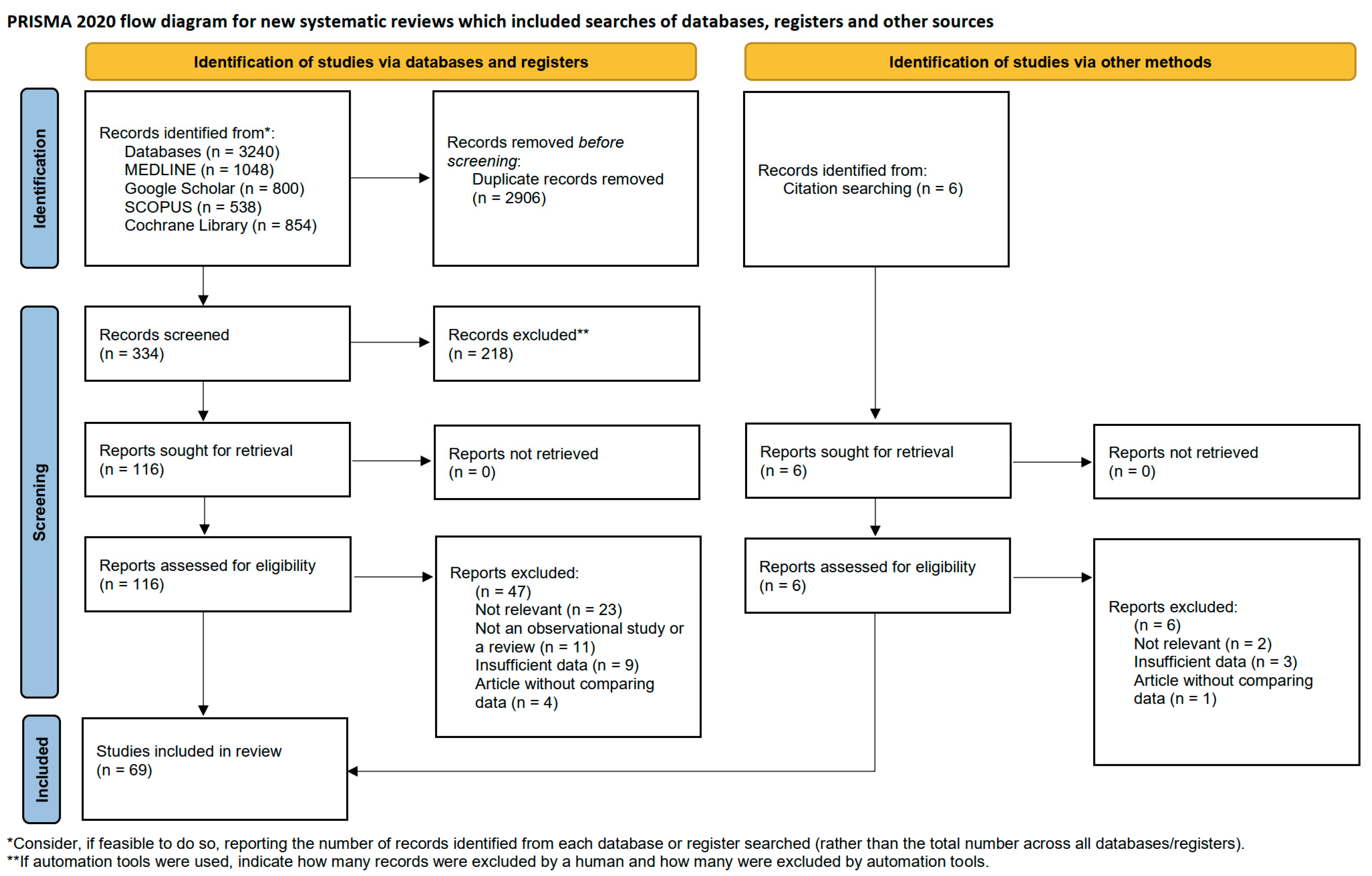
A total of 3240 records were retrieved from electronic databases, including MEDLINE (n = 1048), Google Scholar (n = 800), Scopus (n = 538), and the Cochrane Library (n = 854). After removing 2906 duplicate records, 334 unique records were screened based on their titles and abstracts. Of these, 218 records were excluded for being irrelevant to the study objectives.
A total of 116 full-text reports were assessed for eligibility. Of these, 47 were excluded for the following reasons: not being observational studies or reviews (n = 11), insufficient data (n = 9), lack of comparative data (n = 4), or other irrelevance (n = 23). Six additional records identified through citation searching were also screened but excluded for similar reasons: not relevant (n = 2), insufficient data (n = 3), and lack of comparative data (n = 1).
Ultimately, 69 studies met the eligibility criteria and were included in the final review. Figure 1 illustrates the complete selection process.
Screening was performed independently by two reviewers (Y.J.C. and Y.T.J.), starting with titles and abstracts, followed by full-text assessment. Discrepancies were resolved through discussion until consensus was achieved; studies were excluded if consensus could not be reached.

2.5.1. Inclusion Criteria

Table S2 provides the list of studies included in this review. These studies were selected based on predefined eligibility criteria applied to all retrieved records. Eligible studies included prospective or retrospective follow-up studies, clinical trials, cohort studies, case–control studies, and case series. Studies were considered if they provided a clear definition of PI and directly compared regenerative surgical outcomes with or without the use of membranes. In the absence of previous examination data, PI was defined as the presence of bleeding and/or suppuration upon gentle probing, PPD ≥ 6 mm, and bone levels ≥ 3 mm apical to the most coronal portion of the intraosseous part of the implant [7].

2.5.2. Exclusion Criteria

The exclusion criteria included studies published in languages other than English, studies with inaccessible data (inability to contact the authors), studies conducted on implant surfaces other than titanium, studies providing insufficient or non-comparative data, and those lacking a clear definition of PI.
Owing to the heterogeneity of study designs, defect characteristics, and outcome measures, this review was conducted using a comprehensive descriptive approach. For each clinical factor of interest (membrane-assisted regenerative therapy, KM width, decontamination methods, prosthesis removal), relevant outcomes were summarized descriptively (Table S2). No formal meta-analysis or predefined subgroup analyses were performed; thus, comparative interpretations should be considered exploratory and interpreted with caution.

2.6. Risk-of-Bias Assessment

The Cochrane Risk-of-Bias (RoB) assessment method was used to evaluate the risk of bias in the included studies [8], which evaluates domains such as randomization, blinding, and incomplete outcome data. Six specific domains were evaluated: random sequence generation, allocation concealment, blinding of participants and personnel, blinding of outcome assessment, incomplete outcome data, and selective reporting. Each domain was assessed for risk of bias and classified as low, unclear, or high. Two reviewers (Y.J.C. and Y.T.J.) independently evaluated all included studies, and discrepancies were resolved through discussion. Figure S1 presents a summary of the risk of bias assessments.

Risk-of-Bias Evaluation in Included Studies

A risk of bias assessment was performed for the 18 randomized controlled trials (RCTs) included in this review. Figure S1 illustrates that most trials exhibited a low risk of bias in random sequence generation, detection bias (blinding of outcome assessment), attrition bias (incomplete outcome data), and selective reporting. These findings indicate that the methodological rigor regarding randomization and data management was generally adequate across the included studies.
However, allocation concealment and blinding of participants and personnel were frequently rated as high or unclear risk of bias, which reflects the inherent limitations of surgical interventions where complete blinding is rarely feasible. While this bias is difficult to eliminate in clinical surgical studies, it may still influence subjective outcome measures, including PPD reduction and radiographic bone-fill.
Overall, the methodological quality of the included RCTs was acceptable, with the majority demonstrating robust study design and consistent reporting. Given the high or unclear risk associated with allocation and performance bias, the pooled evidence should be interpreted with caution, highlighting the need for more rigorously blinded and transparently reported trials in future research. In interpreting the clinical outcomes within the Section 5 and Section 10, these bias profiles were carefully considered to ensure that the strength of each finding reflected the quality of the underlying study.

2.7. Data Analysis

A descriptive comparative analysis was performed using studies that reported bone-fill gain and PPD reduction in comparable quantitative formats (mean ± standard deviation (SD) or convertible pre- and post-treatment values).
For each group (membrane-assisted vs. non-membrane-assisted regenerative therapy), the mean values, standard deviations, and 95% confidence intervals (CIs) were calculated when available. Owing to substantial heterogeneity in study designs and outcome measures, a formal meta-analysis was not conducted.
However, an exploratory pooled quantitative analysis was performed using RevMan version 5.4 (The Cochrane Collaboration, London, UK) to visualize overall trends in bone-fill gain and PPD reduction between treatment modalities. Weighted mean differences (WMDs) and 95% CIs were calculated descriptively under a random-effects model for visualization purposes only, and heterogeneity was expressed as I2, with values greater than 75% considered substantial. The pooled results and forest plots were interpreted cautiously due to methodological variability across studies.
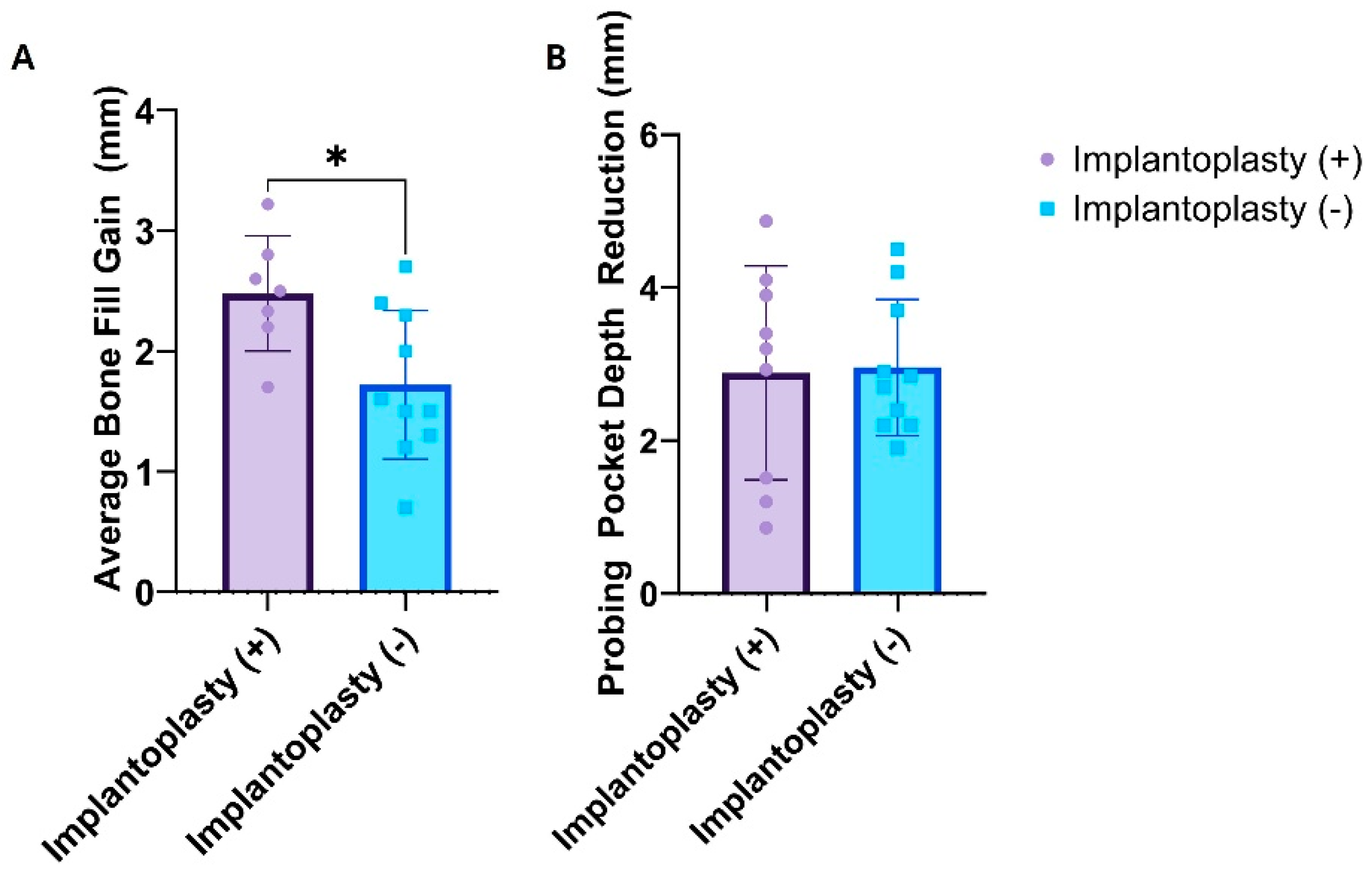
Additionally, to assess the efficacy of implantoplasty, a focused subgroup analysis was conducted in clinical studies with a 12-month follow-up that employed membrane-assisted regenerative therapy using resorbable membranes. For this subgroup, Welch’s t-test (GraphPad Prism, version 10.0 (GraphPad Software, San Diego, CA, USA)) was used to evaluate the between-group differences (implantoplasty vs. no implantoplasty) in bone-fill gain and PPD reduction.

3. Pathophysiology of Peri-Implantitis

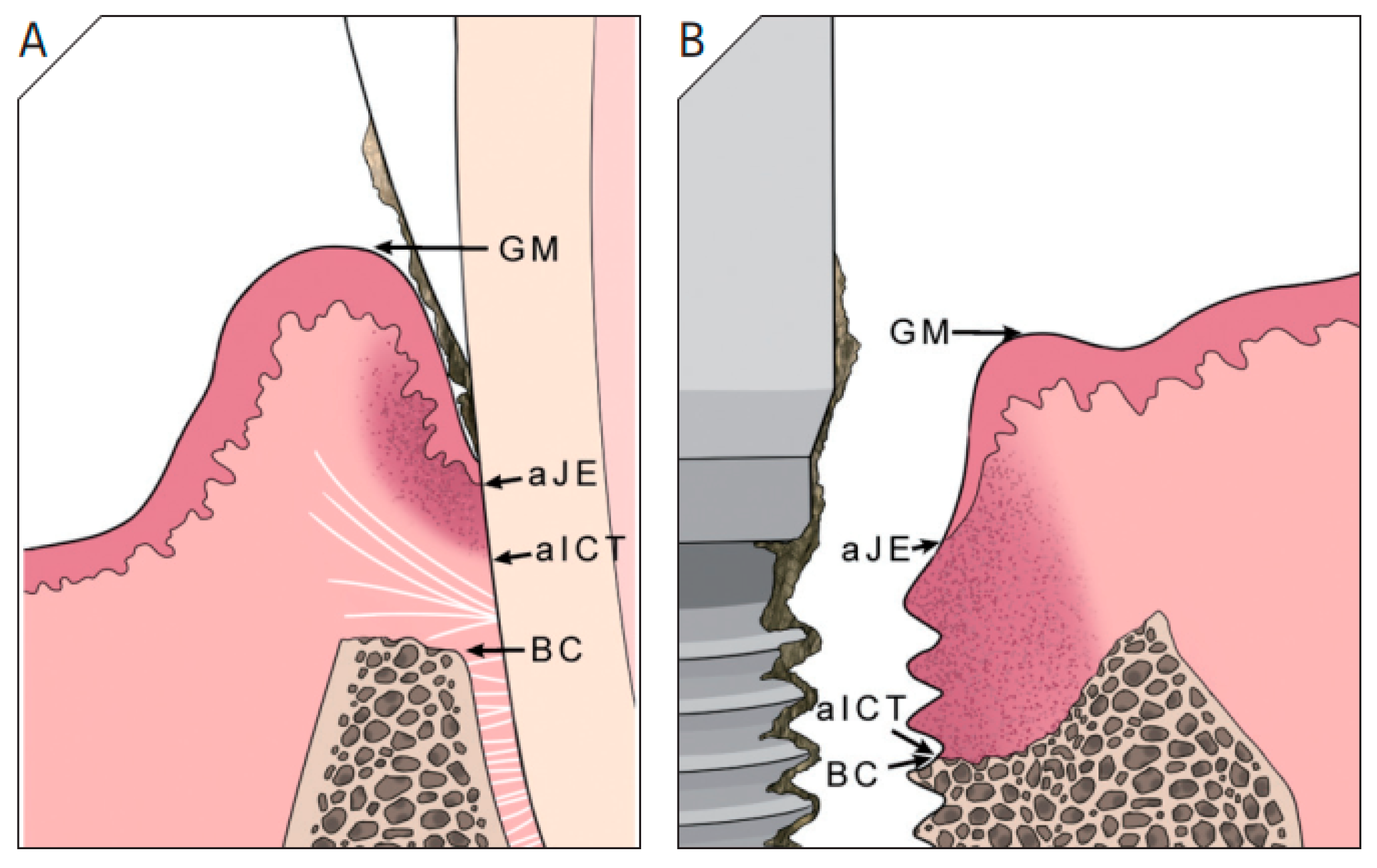
PI primarily arises from a bacterial biofilm-induced inflammatory response, resulting in inflammation and bone loss around dental implants [7]. Clinically, PI is characterized by progressive bone loss, bleeding on probing (BOP), and/or suppuration [9]. Inadequate plaque control and local prosthetic designs that impede effective oral hygiene promote infiltration of inflammatory immune cells in peri-implant soft tissues [10]. Continuous plaque control remains crucial during progression of PI, similar to its role in periodontitis [11,12,13]. Additional factors contributing to PI include excessive occlusal overload and the release of titanium particles from the implant surface [14,15]. In contrast to natural teeth, dental implants lack a perpendicular connective tissue fiber attachment, predisposing them to extensive inflammatory infiltration and accelerated bone loss [16,17,18,19] (Figure 2). Additionally, PI lesions are larger and exhibit higher densities of immune cells [20,21]. While PI shares several features with periodontitis, it also displays distinct immunopathological mechanisms, highlighting the need for further research into effective regenerative strategies.

4. Regenerative Therapeutic Approaches for Peri-Implantitis

Nonsurgical management of peri-implant bone defects often produces unpredictable outcomes owing to limited access to the implant surface, necessitating surgical intervention [22]. The surgical strategies for addressing peri-implant bone defects include resective, regenerative, and combined methods [23]. Treatment selection should be based on soft tissue conditions, defect morphology, and esthetic considerations [24]. Regenerative surgical procedures generally proceed as follows. First, a flap is raised to expose the contaminated implant surface, typically via a horizontal sulcular incision around the implant prosthesis or healing abutment, extending mesiodistally, with vertical incisions added as necessary [25,26]. A full-thickness flap is elevated, generally limited to either the buccal or lingual side. Inflammatory granulation tissue is carefully removed using curettes or rotary instruments. To facilitate bone regeneration, the exposed defect surface is perforated with a small round bur. The contaminated implant surface is subsequently decontaminated using various methods, and the defect is filled with bone graft material. In cases where the prosthesis is retained, the membrane is adapted around the implant neck [27]. For submerged cases, a cover screw is placed, and the membrane extends 2–3 mm beyond the defect margins [28]. Suturing should ensure proper flap adaptation around gingival penetrations, including prostheses or healing abutments, or achieve primary closure if the prosthesis is removed. Periosteal-releasing incisions may be performed as required.

5. Effects of Membrane-Assisted Regenerative Therapy

Bone regeneration and re-osseointegration in PI defects remain clinical challenges [29]. Recent studies have demonstrated the efficacy of treatment strategies adapted from guided tissue regeneration techniques used in periodontal therapy, involving various membrane types, bone grafts, and biologic materials for PI defects [25]. However, the clinical efficacy of membrane-assisted regenerative therapy in PI management remains uncertain [7,12].
Two primary membrane types are used—resorbable and non-resorbable membranes—often with or without bone grafts. Resorbable membranes—including collagen-based membranes (Bio-Gide® (Geistlich Pharma AG, Wolhusen, Switzerland)) [25,30,31,32,33,34,35,36,37,38], synthetic polymers (OsseoGuard® (Zimmer Biomet, Warsaw, IN, USA)) [4,39], and concentrated growth factor (CGF) matrices [32]—undergo gradual degradation and are resorbed by the body [40]. Their primary advantages include the elimination of a second surgical procedure for membrane removal, reduced postoperative complications, and improved patient comfort. A major limitation of resorbable membranes is susceptibility to premature exposure and degradation, which may compromise barrier function [40]. In contrast, non-resorbable membranes, including expanded polytetrafluoroethylene (e-PTFE) [25,27] membranes (Gore-Tex, W. L. Gore & Associates, Newark, DE, USA), provide greater long-term stability and structural integrity, thereby enhancing their ability to contain and support tissue regeneration, particularly in complex bony defects [40]. Nevertheless, the requirement for a secondary removal surgery and the increased risk of infection following early exposure remain major drawbacks [40].
Numerous studies have reported the effects of membrane-assisted regenerative therapy, typically used in combination with bone grafts and/or biologics in the surgical management of PI (Table 1). The use of bone grafts alone improves both bone-fill and PPD reduction in several studies, although the reported outcomes vary [41]. Among these, autogenous bone grafts were associated with the highest gains in bone-fill and PPD reduction [25,37,42,43,44]. The addition of biologics to bone grafts without membrane-assisted regenerative therapy further enhanced bone-fill and PPD reduction compared with bone graft alone; however, the available data were limited [45]. The most common approach involves the combination of resorbable membranes with bone grafts [4,25,31,32,33,34,37,38,39,44,46,47,48,49,50,51,52]. While results vary depending on the graft material used, these combinations generally produce outcomes comparable to or less effective than those observed without membrane-assisted regenerative therapy. The addition of biologics to membranes and bone grafts produced moderate improvements in PPD reduction and bone-fill [30,35,36,53,54,55,56]. Additionally, non-resorbable membranes combined with bone grafts demonstrate promising results [57]; however, the available evidence remains limited compared to that of resorbable membranes [25,58,59].
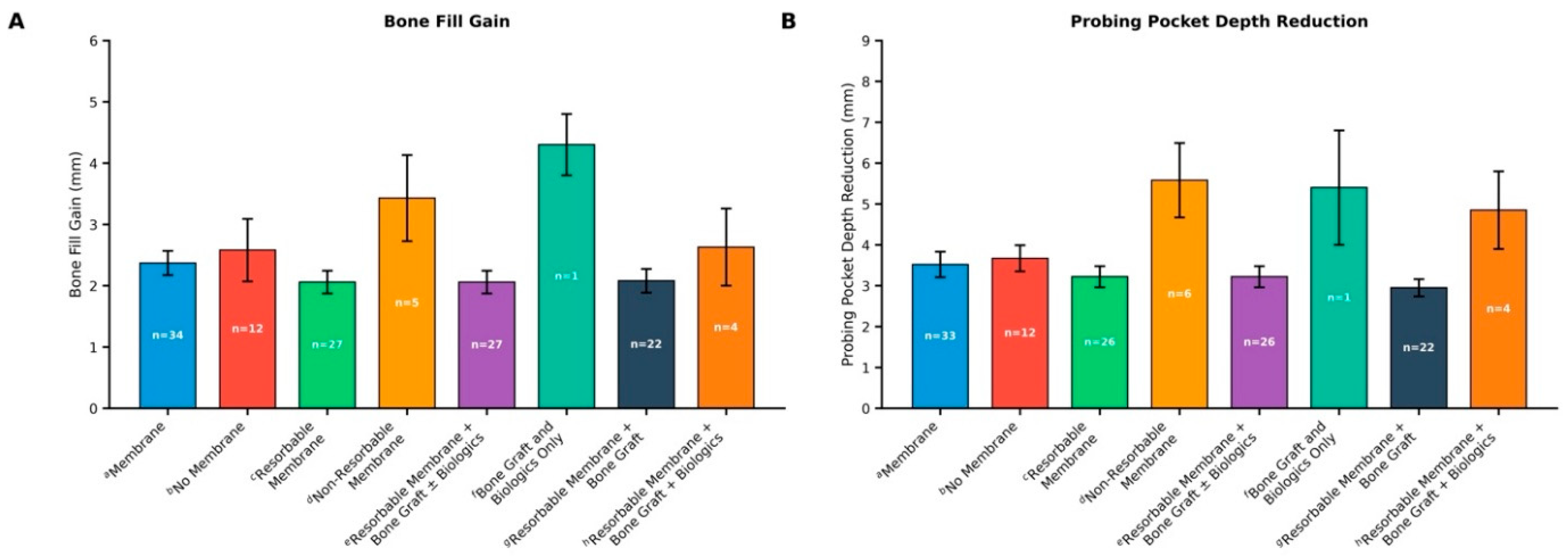
The mean bone-fill gain and PPD reduction across different treatment modalities were compared (Table 2).
Comparisons were made between membrane-assisted and non-membrane-assisted regenerative therapies; between bone-graft- or biologic-only procedures and those incorporating membrane-assisted regenerative therapy; and between resorbable membranes combined with bone grafts, with or without biologic adjuncts. These comparisons indicated similar or greater bone-fill gain outcomes (Figure 3A). Most treatments showed similar PPD reductions, with the combination of resorbable membranes, bone grafts, and biologics producing the greatest improvement (Figure 3B).
Although our analysis revealed membranes use in enhancing bone-fill and PPD reduction, some limitations must be acknowledged. The studies included in this review varied in their study designs, inclusion and exclusion criteria, and outcome measurement standardization, which may limit the generalizability of the findings. Moreover, the lack of meta-analytic data precludes formal statistical comparison between groups. Future studies should use standardized outcome measures and rigorous study designs to clarify the efficacy and indications of membrane-assisted regenerative therapy in PI.
An exploratory pooled analysis was performed using 14 RCTs with 12-month follow-up data selected from the 18 RCTs that met the inclusion criteria. The pooled findings suggested that membrane-assisted regenerative therapy yielded greater bone-fill gain and PPD reduction than non-membrane approaches (Figure S2). However, substantial heterogeneity was observed (I2 > 80%), likely due to variations in defect morphology, membrane type, and decontamination methods. Publication bias was evaluated using funnel plots (Figure S3). Panels A and B illustrate the distribution of studies for bone-fill gain and PPD reduction, respectively. Data points representing membrane-assisted (regenerative therapy) and non-membrane (bone-graft-only) groups are symmetrically scattered around the mean difference axis, and the inverted funnel shape appears balanced, indicating minimal publication bias. Because the analysis was exploratory rather than confirmatory, these pooled estimates should be interpreted as visual trends rather than statistically validated meta-analytic outcomes. Further randomized trials with standardized methodology are needed to confirm these observations.

6. Role of Keratinized Mucosa in Membrane-Assisted Regenerative Therapy

PI, a major complication of dental implants, is characterized by inflammation of the surrounding tissues that causes progressive bone loss and may lead to implant failure [7,70]. The presence of KM is essential for the biological stability and clinical management of PI. Several studies have shown that KM is critical for improving treatment outcomes [70,71,72]. In this section, the effects of KM on bone-fill gain and PPD reduction are evaluated in membrane-assisted regenerative therapy for PI (Table 3).
A KM width of ≥2 mm has been associated with greater PPD reduction and enhanced bone-fill in treatments combining membranes and bone grafts [44,47,48,72,73,74]. These improvements are observed across different membrane types and bone graft materials. Although available data are limited, a KM width of <2 mm is associated with less favorable treatment outcomes, including modest bone-fill gains [72]. A KM width of ≥2 mm is thought to promote soft-tissue stability, strengthen the epithelial seal, and maintain a protected environment around the membrane, collectively enhancing bone regeneration. Nevertheless, additional clinical and histological evidence is required to confirm this protective mechanism.
Although our analysis highlights the importance of KM width in membrane-assisted regenerative therapy for PI management, some limitations must be acknowledged. Variations in study design, surgical techniques, and outcome assessment limit the reliability of these findings. Additionally, the lack of meta-analytic methods limits our ability to quantify the statistical significance and consistency of effects across studies. Furthermore, interactions between KM width and clinical variables—including membrane type, surgical approach, and maintenance therapy—remain unclear because of heterogeneous study designs and limited reporting. Therefore, future studies should adopt standardized protocols and quantitative analyses to clarify the role of KM and define clinical thresholds for optimizing regenerative outcomes in PI management.

7. Efficient Decontamination Methods in Membrane-Assisted Regenerative Therapy

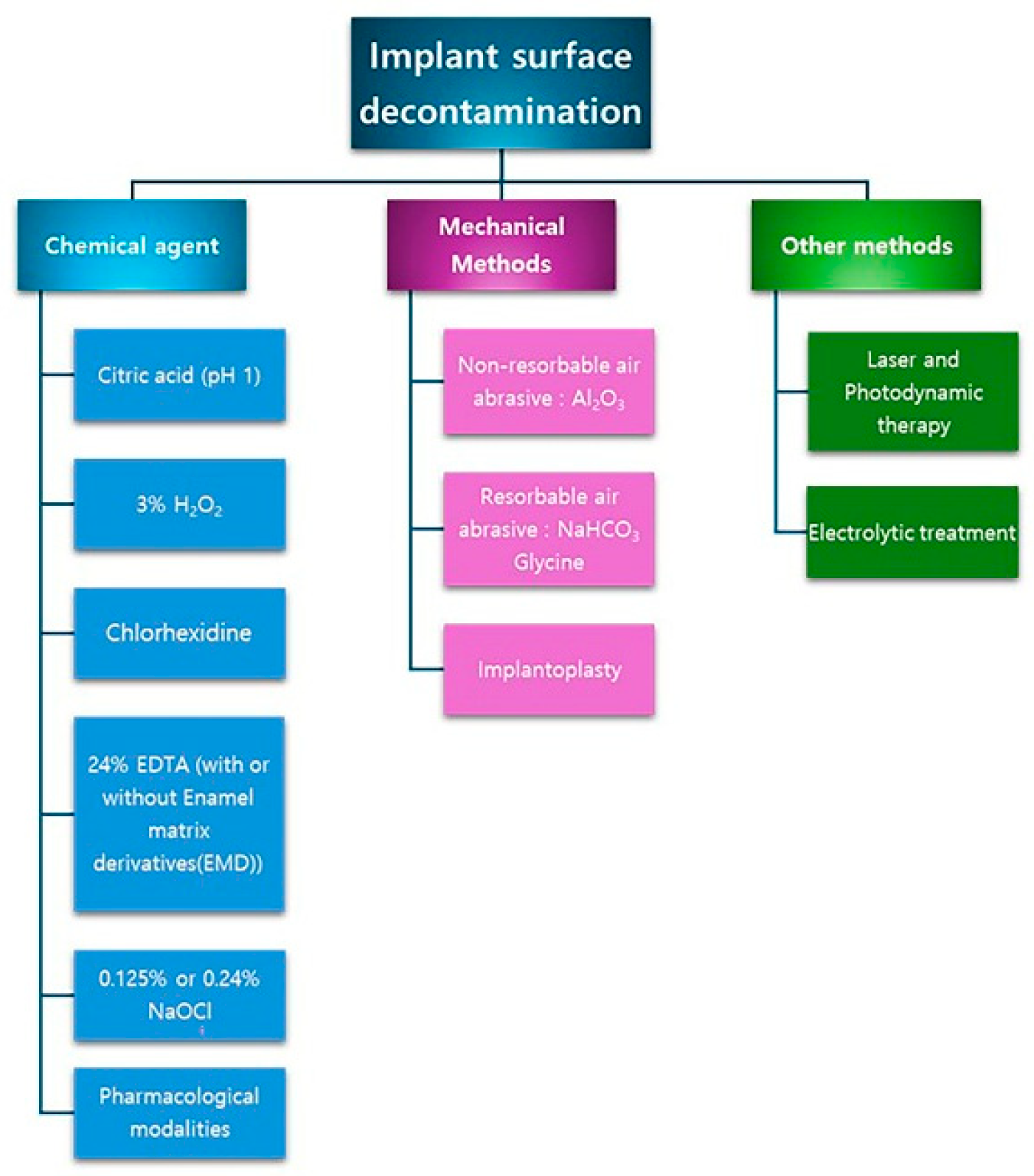
Effective decontamination of implant surfaces is essential for achieving successful re-osseointegration. Monje et al. [75] classified implant surface decontamination methods into three main categories—mechanical, chemical, and other—as illustrated in Figure 4. In reconstructive therapy, strict decontamination protocols are required because even minimal surface contamination can impair regeneration.

7.1. Mechanical Decontamination Methods

  • Air-Abrasive Techniques: The traditional use of Al2O3 particles has raised concerns about their potential embedding in surrounding tissues. Absorbable powders, such as glycine, NaHCO3, and CaCO3, are now preferred alternatives. Among them, glycine shows high efficacy with minimal implant surface damage. However, complete decontamination remains difficult, particularly in implant thread valleys.
  • Implantoplasty: This method mechanically smooths contaminated implant threads to reduce plaque accumulation and surface roughness. A 9-year follow-up study reports an 89% success rate [76]. However, potential limitations include heat generation, structural weakening of the implant, and titanium particle release, which may contribute to peri-implant inflammation. Despite the lack of a clear consensus and ongoing debate over its efficacy, implantoplasty is regarded as a beneficial adjunctive mechanical decontamination procedure that promotes bone-fill and reduces PPD in PI management. Regular post-treatment maintenance is essential for sustaining long-term outcomes (Table 4 & Figure 5).
  • The subgroup analysis of 12-month clinical studies using resorbable membranes revealed a quantitative trend favoring implantoplasty (Figure 5). The implantoplasty (+) group showed a significantly greater mean bone-fill gain than the implantoplasty (–) group (p < 0.05, Welch’s t-test), whereas the PPD reduction difference was not statistically significant. This finding suggests that implantoplasty mainly promotes hard-tissue regeneration by creating a smoother and cleaner implant surface that facilitates clot stabilization and bone matrix deposition beneath the membrane. In contrast, soft tissue changes such as pocket reduction appear more influenced by keratinized mucosa width, surgical access, and maintenance than by surface modification alone. In this standardized 12-month resorbable-membrane cohort, implantoplasty appeared to be an effective mechanical decontamination adjunct that enhances the predictability of guided bone regeneration. Nevertheless, some limitations should be acknowledged. The included studies varied in design, defect morphology, adjunctive biologics, decontamination methods, and maintenance protocols, resulting in inevitable heterogeneity. In addition, this analysis was based on study-level mean values rather than patient-level data; therefore, its findings should be interpreted cautiously as hypothesis-generating rather than definitive meta-analytic conclusions. These bone-fill trends are hypothesis-generating and require prospective, controlled trials with standardized protocol.

7.2. Chemical Decontamination Methods

Chemical agents are commonly used for enhancing the effectiveness of mechanical decontamination methods:
  • Citric Acid: Exhibits strong bactericidal activity but may adversely affect tissue regeneration due to its low pH and potential cytotoxicity.
  • 3% Hydrogen Peroxide: Reduces inflammation and supports re-osseointegration, particularly when combined with laser therapy.
  • Chlorhexidine (CHX): Provides long-term antimicrobial effects but demonstrates limited effectiveness when used alone.
  • EDTA (24%): Facilitates the removal of bacterial endotoxins and promotes tissue healing; however, it requires thorough rinsing to mitigate cytotoxic effects.
  • Sodium Hypochlorite (NaOCl): Effectively disrupts microbial biofilms; however, its optimal concentration for clinical safety remains under investigation.
  • Pharmacological Approaches: Effective bacterial control is critical for managing PI, with antibiotics commonly used as adjuncts to mechanical and chemical decontamination. Adjunctive systemic antibiotics (e.g., amoxicillin + metronidazole) have been reported to improve outcomes in some study [76]. However, antibiotic therapy alone is inadequate when plaque control is poor, as bacterial recolonization can lead to reinfection. Therefore, consistent, supportive PI maintenance is necessary to sustain therapeutic outcomes and prevent recurrence.

7.3. Laser-Based Applications

Laser-based therapies (e.g., CO2, Er:YAG) can reduce bacterial load with limited surface alteration and may enhance regenerative outcomes; however, long-term clinical evidence is limited, so they are best used as adjuncts. Despite these promising outcomes, long-term clinical evidence remains limited, and laser therapy is currently recommended as an adjunct rather than a standalone treatment. Photodynamic therapy, combining laser light with photosensitizing agents, shows potential as an adjunctive option in PI management.
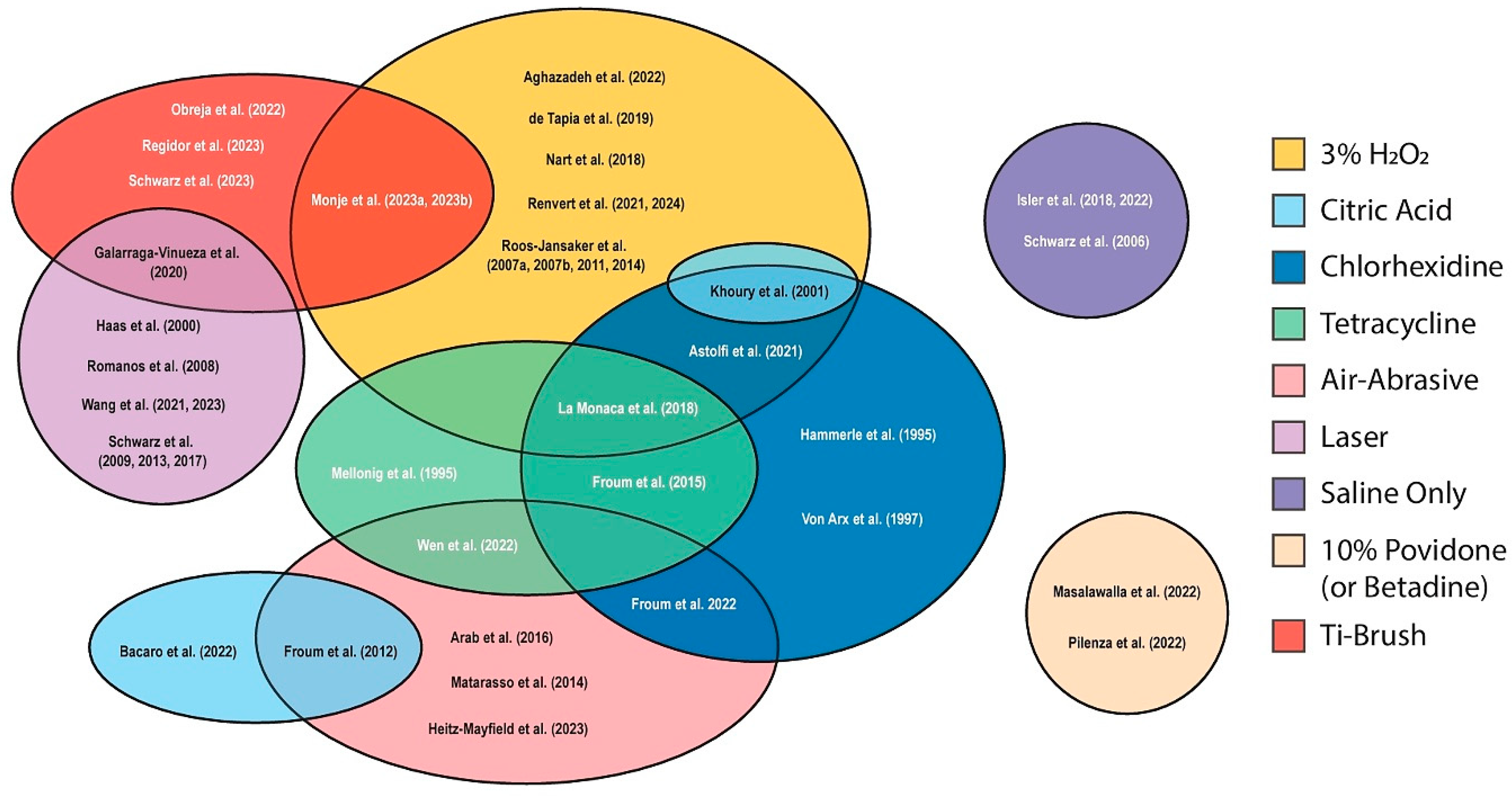
Optimal implant surface decontamination requires an integrated strategy incorporating mechanical, chemical, and laser-based methods (Figure 6). Each approach offers distinct strengths and limitations, highlighting the importance of personalized treatment planning.

7.4. Comparative Analysis of Decontamination Modalities

No single “gold standard” currently exists for implant surface decontamination. A comprehensive systematic review evaluating mechanical, chemical, and laser-based protocols reports that no single method demonstrates clear evidence of superiority. This finding highlights the need for a more targeted comparison of each specific limitation of the modality. Mechanical debridement remains the essential baseline therapy, but is often insufficient for thoroughly cleaning complex implant topographies. Clinicians often incorporate chemical agents as adjuncts to mechanical debridement to enhance decontamination. However, this practice lacks strong evidence. A recent meta-analysis reported that chemicals, such as CHX, offer no significant clinical benefit over mechanical debridement alone [85]. In contrast, adjunctive laser therapy remains a more dynamic and debated field. Lasers are investigated for their ability to effectively disrupt biofilms. A systematic review supports their adjunctive use [86], reporting greater improvements in key clinical outcomes (PPD reduction, BOP) than mechanical therapy alone. However, evidence supporting the use of lasers remains inconsistent. A separate meta-analysis provides a contrasting perspective [87], reporting that laser-assisted decontamination achieves outcomes similar to those of conventional mechanical therapy, with no statistically significant clinical advantage. This discrepancy in recent studies (Akerzoul et al., 2025 vs. Pisano et al., 2021) supports the previous findings by Baima et al. (2022) [86,87,88]. Currently, no single decontamination modality demonstrates definitive superiority for implant surface treatment. This persistent lack of consensus highlights the critical need for robust, evidence-based research. Standardized, reproducible protocols—as optimized monotherapies or rational multimodal combinations—are needed.

7.5. Clinical Implications of Surface Treatments in Membrane-Assisted Regenerative Therapy

The effectiveness of membrane-assisted regenerative therapy depends on the quality of implant surface decontamination. A clean, oxide-intact, and moderately rough surface promotes fibrin adhesion, osteoblast migration, and early extracellular matrix deposition, thereby establishing a stable foundation for bone regeneration under the membrane. Conversely, excessive polishing, uncontrolled acid etching, or thermal damage can disrupt the titanium oxide layer, diminish protein adsorption, and impair osteoconduction, ultimately reducing the predictability of membrane-assisted regenerative therapy. Therefore, decontamination strategies should balance thorough bacterial removal with preservation of the physicochemical surface characteristics supporting cellular adhesion and bone formation. Maintaining this balance is essential for achieving consistent, biologically favorable outcomes in membrane-assisted regenerative therapy.

8. Effect of Prosthesis Retention Versus Removal on Membrane-Assisted Regenerative Therapy

The effect of prosthesis removal during membrane-assisted regenerative therapy for PI bone defects remains inadequately investigated. In this section, studies comparing clinical outcomes between submerged and non-submerged healing post-regenerative management for PI are reviewed. Wen et al. reported that submerged healing results in superior outcomes, showing 0.9 mm greater clinical defect fill, 1.7 mm greater radiographic bone-fill, and 1.3 mm greater PPD reduction than the non-submerged healing [68,69,80]. In contrast, in a study involving 32 implants across 28 patients, Astolfi et al. report no significant difference in bone regeneration outcomes between cases with prosthesis removal and those where the prosthesis was retained post-surgery [81]. Similarly, Daugela et al., analyzing 18 systematic reviews, report no significant differences in radiographic bone level changes or PPD reduction between submerged and non-submerged healing sites [89].
Overall, the reported bone-fill values ranged from approximately 1.6 mm to 3.5 mm, while PPD reduction ranged from 1.5 mm to 2.9 mm, regardless of whether the prosthesis was removed (Table 5). Biologically, removing the prosthesis during regenerative therapy potentially facilitates the creation of a sealed and stable healing environment, reducing micromotion and minimizing bacterial infiltration under the membrane. This stability may enhance blood clot maturation and promote optimal adaptation of the barrier membrane, potentially improving early regenerative outcomes. Conversely, maintaining the prosthesis may preserve occlusal function, prosthetic stability, and patient comfort, potentially supporting long-term success when infection control is adequate.
Overall, current evidence suggests that, while prosthesis removal may enhance early tissue stability and membrane adaptation, overall clinical success in membrane-assisted regenerative therapy depends primarily on the effectiveness of surface decontamination, membrane stability, and infection control rather than on prosthesis removal alone. Future studies should further clarify the interaction among prosthesis management, defect morphology, and decontamination protocols to develop standardized clinical guidelines for optimizing regenerative outcomes in PI management.
Table 5. Studies Evaluating the Effect of Prosthesis Removal on Clinical Outcomes During Membrane-Assisted Regenerative Therapy for PI management.
Author (Year)Wen (2022a, 2022b, 2024)
[68,69,80]
Astolfi (2021) [81]Daugela (2016) [89] *
Study ModelProspective studyRetrospective studyMeta-analysis of systematic literature review
Crown RemovalRemoved & SubmergedRemoved, healing abutment maintainedRemoved & submergedCrown maintainedRemoved & submergedCrown or healing abutment maintained
Sample Size
(patients)
30 implants
(22 patients)
29 implants
(24 patients)
32 implants
(28 patients)
Deppe et al. (2007) [60]
Roos-Jansåker et al. (2007a, 2007b, 2014) [46,63,64]
Schwarz et al. (2009, 2010, 2013) [77,82,90]
Romanos et al. (2008) [83]
Roccuzzo et al. (2011) [91]
Froum et al. (2012, 2015) [30,53]
Aghazadeh et al. (2012) [92]
Wohlfahrt et al. (2012) [66]
Wiltfang et al. (2012) [65]
Matarasso et al. (2014) [31]
Jepsen et al. (2015) [11]
Mechanical Debridementcurettage,
implantoplasty,
air-powder
curettage,
implantoplasty
Surface Decontamination2.5 mL of 250 mg TC
(5 min)
3–5% H2O2
(2 min)
Bone Graft Type60% FDBA
(Maxgraft®),
20% mineralized bovine bone
(Cerabone®),
20% autobone
Bio-Oss®
Membrane TypedPTFE (Cytoplast®)Collagen membrane
(Jason®)
collagen membrane
(Jason®)
Follow-up or Re-entry8 mo 8–12 mo2 yr
Radiographic Bone-Fill
(mm)
3.47 ± 0.411.63 ± 1.72.18 ± 1.412.84 ± 1.782.17
(95% CIs 1.87–2.47)
1.91
(95% CIs 1.44–2.39)
Clinical Bone-Fill
(mm)
3.22 ± 0.412.33 ± 1.88
Probing Pocket Depth Reduction
(mm)
2.93 ± 0.251.51 ± 1.17 2.68
(95% CIs 1.71–3.64)
2.77
(95% CIs 2.23–3.3)
BOP Reduction to
(baseline 100%)
36.60%34.50%41.70%30%
* The review included all human prospective and retrospective follow-up studies and clinical trials, cohort studies, case–control studies, and case series studies on surgical regenerative management of PI, published between January 2006 and March 2016. Abbreviations: BOP, bleeding on probing; FDBA, freeze-dried bone allograft; dPTFE, dense polytetrafluoroethylene; mo, month(s); yr, year(s); CIs, confidence intervals. Maxgraft® (botiss biomaterials GmbH, Zossen, Germany), Cerabone® (Botiss Biomaterials GmbH, Zossen, Germany), Cytoplast® (Osteogenics Biomedical, Lubbock, TX, USA), Jason® (Botiss Biomaterials GmbH, Zossen, Germany).

9. Histological Insights into Membrane-Assisted and Non-Membrane Regenerative Therapy for Peri-Implantitis Management

Histological evaluation offers valuable insights into the biological response of PI tissues to regenerative interventions. Tissue-level healing outcomes of regenerative treatments were compared in preclinical studies conducted with and without membrane-assisted regenerative therapy (Table 6).
Studies employing non-resorbable membranes, such as e-PTFE, report favorable space maintenance and significant bone-fill. However, these membranes are often attributed to fibrous tissue encapsulation and a higher risk of membrane exposure, both of which may compromise re-osseointegration [93]. In contrast, resorbable membranes demonstrate improved soft-tissue integration and fewer postoperative complications but show greater variability in space maintenance and the predictability of bone regeneration [28,94,95].
In contrast, regenerative treatments performed without membranes often result in limited bone-fill, incomplete defect resolution, and increased epithelial downgrowth and inflammatory cell infiltration [96]. Nevertheless, these outcomes vary significantly and are highly influenced by factors such as defect morphology, the degree of surface decontamination, and the presence of KM.
Collectively, histological findings suggest that the application of barrier membrane facilitates organized bone and connective-tissue regeneration under well-controlled conditions, primarily by maintaining space and preventing soft-tissue invasion. However, these benefits are not consistently observed across all defect types. Ultimately, factors such as surgical access, infection control, and soft-tissue quality exert equal or greater influence on healing outcomes. Therefore, the use of membranes should be customized to defect morphology and clinical context, rather than considered a universally superior strategy for PI regenerative therapy.
Table 6. Histologic Studies in Membrane-Assisted Regenerative Therapy.
Animal TypeMembrane TypeBone Graft TypeKey Histologic FindingsRegenerative OutcomesYearAuthorReference
Beagle dogNon-Resorbable (Gore-Tex®)Resorbable HASpace maintenance under membrane; organized new bone formation; limited epithelial downgrowth (histologic observations).Structured bone fills with membrane support.1997Hürzeler et al. [97]
Beagle dogResorbable-Connective tissue encapsulation around the implant neck; no new bone formation at GTR-treated sites; similar outcome with or without submerging.No significant bone regeneration or re-osseointegration; GTR ineffective under study conditions1993Grunder et al.[93]
Cynomolgus monkeyNon-Resorbable (Gore-Tex®)AutogenousNew bone formation under the membrane; soft tissue encapsulation when exposed.Bone-fill present; integration limited when exposure occurs.2003aSchou et al.[94]
Cynomolgus monkeyNon-Resorbable (Gore-Tex®)AutogenousMature lamellar bone in protected areas; epithelial migration in unprotected zones.Stable augmentation with ~45% bone-to-implant contact; partial re-osseointegration.2003bSchou et al.[98]
Cynomolgus monkeyNon-Resorbable (Gore-Tex®)Bio-Oss®Bio-Oss particles integrated within new bone; occlusal particles surrounded by connective tissue; no osteoclastic activity near particles.Mean bone-to-implant contact 36%; stable bone-fill, slightly less than autogenous bone models.2003cSchou et al.[95]

Independent Evaluation of Preclinical and Clinical Studies

A stratified analysis of the studies included in this review, classifying them into preclinical and clinical groups, revealed a significant difference in the mean bone-fill gain (Table S3). The weighted mean for the preclinical group was 4.511 mm (95% CIs: 4.433–4.588), significantly higher than the 3.027 mm (95% CIs: 2.650, 3.404) observed in the clinical group. This disparity highlights the variability introduced when combining these two levels of evidence, suggesting that this aggregation potentially limits the direct clinical applicability of the findings.
Preclinical (animal) studies showed the maximum potential efficacy of non-resorbable membranes. However, the pooled SD (0.400) and the narrow 95% CIs for this preclinical group were based on a single study (n = 7) that reported SD. This represents a methodological limitation, restricting the ability to reliably assess the consistency of these results.
Theoretically, the high mean value (4.511 mm) observed in animal studies likely reflects the controlled experimental conditions of these models, typically exhibiting uniform biological characteristics and standardized defect morphologies. These findings indicate that, at the tissue level, the biological principles underlying the membrane can function effectively under well-regulated experimental conditions. However, directly extrapolating these ideal outcomes to the complex process of human tissue healing remains challenging.
In clinical (human) studies, a lower mean bone-fill of 3.027 mm was observed, accompanied by a wider, more rigorously calculated CIs and a higher pooled SD (1.666). This finding suggests that, in real-world clinical conditions, several uncontrollable variables influence outcomes, including systemic health, age, smoking status, defect complexity, post-operative care, and individual healing responses of the patient. Thus, while the high success rate observed in animal studies demonstrates the potential for clinical application, a lower mean gain with higher variability represents a more realistic expectation for patient outcomes.

10. Conclusions & Future Directions

PI management is currently at a pivotal stage, as emerging evidence increasingly challenges the routine use of membrane-assisted regenerative therapy. Current evidence does not consistently show that membrane-assisted regenerative therapy results in superior clinical outcomes compared to non-membrane-assisted approaches, prompting a re-evaluation of conventional protocols in favor of more targeted, evidence-based treatment strategies. While membranes are widely employed in PI regenerative therapy, their clinical benefits remain limited and inconsistent. Their effectiveness depends on case-specific factors, such as defect morphology and soft-tissue conditions, rather than universal applicability. Moreover, factors such as the width of KM may exert a greater influence on treatment outcomes. Therefore, the use of membranes should be guided by careful, individualized clinical judgment rather than routine application.

10.1. Proposed Framework for Clinical Decision-Making in Membrane-Assisted Regenerative Therapy

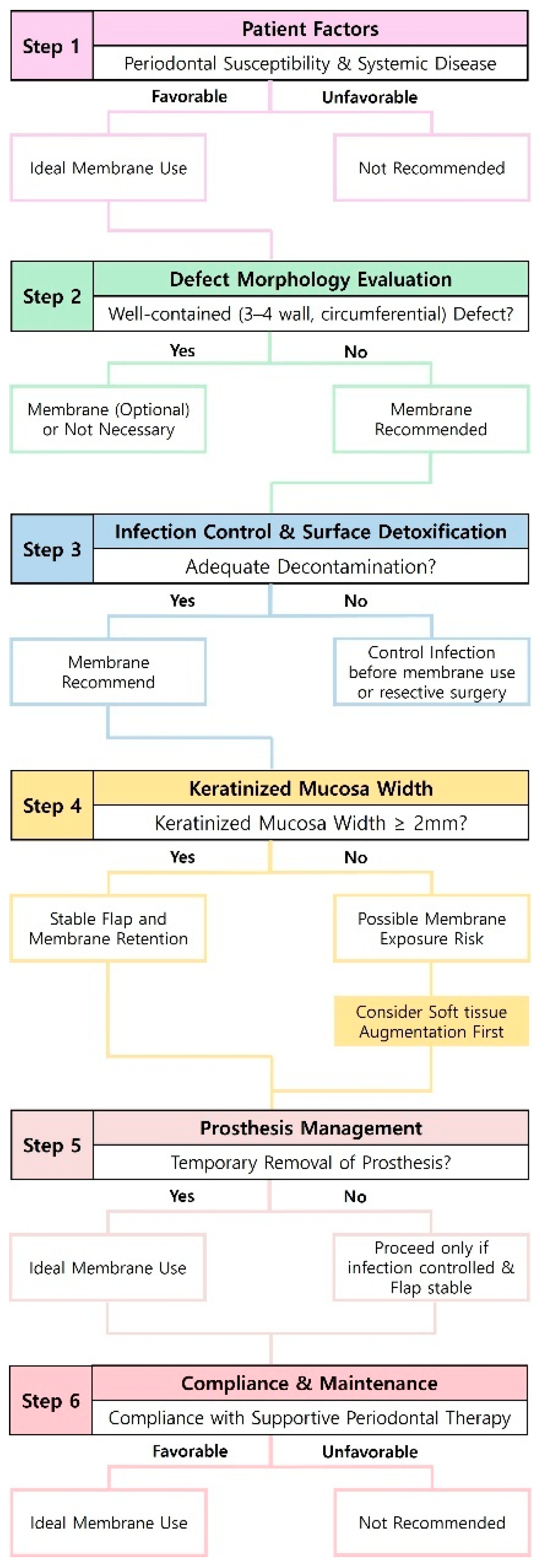
Implementation of membrane-assisted regenerative therapy should follow a case-specific, evidence-based approach rather than a fixed protocol. This review proposes a structured decision-making framework integrating key determinants—defect morphology, KM width, surface decontamination strategy, prosthesis management, and patient-maintenance compliance (Figure 7). The proposed flowchart provides a stepwise guide to determine when membrane-assisted regenerative therapy is indicated or contraindicated in peri-implantitis regenerative surgery, emphasizing the dynamic relationship among tissue conditions, defect configuration, and infection-control parameters.
The diagram summarizes decision pathways based on defect morphology, keratinized-mucosa width, decontamination strategy, prosthesis management, and maintenance compliance.
Furthermore, innovations in implant design, such as modular systems incorporating absorbable three-dimensional (3D) scaffold bands (Figure 8), may represent future alternatives to conventional membranes. These designs could simplify surgical procedures, minimize patient morbidity, and enhance long-term PI stability. Additionally, developing advanced decontamination techniques remains a critical priority, as safe and effective methods are essential for eliminating microbial biofilms from implant surfaces without compromising adjacent tissues.
Advancements in techniques and device innovations could enhance the predictability and long-term durability of PI management while minimizing invasiveness, reducing recovery time, and improving patient-centered outcomes.
Figure 8. Conceptual schematic of a modular implant fixture designed to replace membranes of uncertain effectiveness in membrane-assisted regenerative therapy for PI management. This proposed design includes a 3D scaffold-based, absorbable, replaceable band located on the upper 3 mm of the implant fixture, a region prone to PI (The 3D scaffold structure was adapted from Cho 2016 [99]). (A) Engineering of cementum on the implant surface using 3D-printed polycaprolactone (PCL) scaffolds. (B) Engineering of the periodontal ligament on the cementum-coated implant surface using 3D-printed PCL scaffolds. (C) Engineering of alveolar bone on the regenerated periodontal ligament using 3D-printed PCL scaffolds. (D) 3D-printed PCL scaffolds with embedded growth factors targeting cementum regeneration (left), PCL scaffolds with embedded growth factors targeting periodontal ligament regeneration (center), and PCL scaffolds with embedded growth factors targeting alveolar bone regeneration (right). a: oral epithelium; b: sulcular epithelium; c: junctional epithelium; d: lack of connective tissue attachment; e: hypocellular and hypovascular connective tissue zone adjacent to the implant; f: absence of blood supply to the periodontal ligament. Abbreviations: PDL, Periodontal ligament; CT, Connective tissue; 3D, 3-dimensional.
Materials 18 05227 g008

10.2. Limitations and Future Perspectives

Several limitations must be acknowledged. Because of marked heterogeneity in study designs and reporting, a formal meta-analysis was not feasible, and data synthesis relied primarily on descriptive analysis. Variations in surgical protocols, outcome definitions, and risk-of-bias profiles may further limit the robustness of the conclusions. Although most RCTs exhibited a low risk of bias in domains such as randomization and selective reporting, allocation concealment and blinding of participants or personnel were frequently rated as unclear or high-risk—an inherent limitation in surgical research. Performance bias is particularly relevant for regenerative procedures, in which complete blinding is challenging yet crucial for minimizing subjective interpretation of clinical outcomes such as PPD reduction and radiographic bone-fill. Accordingly, results from low-risk studies were prioritized, whereas evidence from studies with higher bias risk was regarded as exploratory. Overall, the certainty of evidence should be considered moderate, which is consistent with recent experimental and clinical observations reporting the reliability of post-treatment bone-level measurements, the potential benefits of membrane-assisted regenerative therapy, and the influence of biologic and graft-related factors on regenerative outcomes [84,100,101,102,103]. Collectively, these findings underscore the need for future well-designed studies with standardized methodology to clarify the specific indications and long-term predictability of membrane-assisted regenerative therapy. Future clinical studies should adhere to rigorous and transparent methodological standards, incorporating appropriate randomization, allocation concealment, and feasible blinding measures. Such improvements are essential for enhancing reproducibility and clinical applicability of membrane-assisted regenerative therapy in PI management.
In summary, the future of PI management depends on adopting innovative, evidence-based strategies. Advances in implant technology, regenerative biomaterials, and optimized decontamination protocols will allow clinicians to implement more predictable, efficient, and patient-centered approaches for long-term disease control and tissue regeneration.

Supplementary Materials

The following supporting information can be downloaded at: https://www.mdpi.com/article/10.3390/ma18225227/s1, Table S1. PRISMA 2020 checklist for reporting systematic reviews and meta-analyses. Table S2. Summary of studies reporting membrane-assisted regenerative therapy and bone graft-based approaches in PI management. The table presents follow-up duration, study design, membrane and graft types, bone-fill gain, PPD reduction, KM width, prosthesis removal or implantoplasty status, and decontamination protocols. Abbreviations: PPD, probing pocket depth; KM, keratinized mucosa; GTR, guided tissue regeneration; RTM, resorbable type membrane; e-PTFE, expanded polytetrafluoroethylene; dPTFE, dense polytetrafluoroethylene; DBBM, deproteinized bovine bone mineral; FDBA, freeze-dried bone allograft; β-TCP, beta-tricalcium phosphate; HA, hydroxyapatite; EMD, enamel matrix derivative; CGF, concentrated growth factor; Er:YAG, erbium-doped yttrium aluminum garnet laser Table S3. Weighted comparison of average bone-fill gain in preclinical and clinical studies evaluating non-resorbable membranes in membrane-assisted regenerative therapy for PI management. Abbreviations: HA, hydroxyapatite; mo, month(s); yr, year(s); SD, standard deviation; CIs, confidence intervals Figure S1. Risk-of-bias assessment for randomized controlled trials using the Cochrane RoB tool. Abbreviation: RoB, Risk of Bias Figure S2. Forest plots comparing membrane-assisted and non-membrane-assisted regenerative approaches for peri-implantitis. (A) Mean differences in average bone-fill gain. (B) Mean differences in PPD reduction. Each square represents an individual study, while the diamond indicates the pooled mean difference with a 95% CIs. Both analyses demonstrated statistically significant improvements favoring membrane-assisted regenerative therapy (p < 0.001); however, high heterogeneity (I2 > 80%) was observed across studies. Abbreviation: PPD, probing pocket depth Figure S3. Funnel plots assessing potential publication bias among the included studies. (A) Funnel plot for bone-fill gain outcomes. (B) Funnel plot for PPD reduction outcomes. Both plots exhibit near-symmetrical distributions around the mean effect size, indicating minimal publication bias and supporting the overall robustness of the pooled estimates. Abbreviation: PPD, probing pocket depth.

Author Contributions

Y.J.C. and Y.T.J. equally contributed to conception, literature search and study selection, data extraction, risk of bias assessment, and interpretation. Y.J.C. drafted the “Introduction,” “Efficient decontamination methods in Membrane-Assisted Regenerative Therapy,” and “Conclusions & Future Directions.” Y.T.J. drafted the “Materials and Methods,” “Pathophysiology of Peri-Implantitis,” and “Regenerative Therapeutic Approaches for Peri-implantitis.” H.N.W. prepared the sections on the “Effects of Membrane-Assisted Regenerative Therapy” and “Role of keratinized mucosa in Membrane-Assisted Regenerative Therapy.” M.G.K. wrote the section on the “Effect of Prosthesis Retention versus Removal on Membrane-Assisted Regenerative Therapy.” S.-M.H. contributed the section on “Histological Insights into Membrane-Assisted and Non-Membrane Regenerative Therapy for Peri-Implantitis Management.” H.W.C. and J.-M.L. contributed to data analysis and interpretation and critically revised the manuscript. All authors have read and agreed to the published version of the manuscript.

Funding

This research received no external funding.

Data Availability Statement

The original contributions presented in this study are included in the article/Supplementary Materials. Further inquiries can be directed at the corresponding authors.

Acknowledgments

The authors would like to express their gratitude to Daehee Jang, Byunghyun Kang, and Heechan Lee for their assistance in gathering data and organizing references.

Conflicts of Interest

The authors declare no conflicts of interest.

Abbreviations

PPD, probing pocket depth; GBR, guided bone regeneration; PRISMA, Preferred Reporting Items for Systematic Reviews and Meta-Analyses; RoB, Risk of Bias; PI, Peri-implantitis; BOP, bleeding on probing; e-PTFE, expanded polytetrafluoroethylene; KM, keratinized mucosa; GM: Gingival Margin; aJE: Apical extent of Junctional Epithelium; aICT: Apical extent of Inflammatory Cell Tissue; BC: Bone Crest; DBBM, deproteinized bovine bone mineral; PRF, platelet-rich fibrin; EMD, enamel matrix derivative; CGF, concentrated growth factor; HA, hydroxyapatite; β-TCP, beta-tricalcium phosphate; GEM21, growth factor enhanced matrix; RTM, resorbable type membrane; SD, standard deviation; PDL, Periodontal ligament; CT, Connective tissue; 3D, 3-dimensional; FDBA, freeze-dried bone allograft; dPTFE, dense polytetrafluoroethylene; mo, month(s); yr, year(s); CIs, confidence intervals; PCL, polycaprolactone; H2O2, Hydrogen Peroxide; Ti-brush, Titanium Brush; CHX, Chlorhexidine; Er:YAG, Erbium-doped Yttrium Aluminum Garnet Laser.

References

  1. Schwarz, F.; Alcoforado, G.; Guerrero, A.; Jönsson, D.; Klinge, B.; Lang, N.; Mattheos, N.; Mertens, B.; Pitta, J.; Ramanauskaite, A.; et al. Peri-implantitis: Summary and Consensus Statements of Group 3. The 6th EAO Consensus Conference 2021. Clin. Oral Implant. Res. 2021, 32, 245–253. [Google Scholar] [CrossRef]
  2. Woo, H.N.; Cho, Y.J.; Tarafder, S.; Lee, C.H. The Recent Advances in Scaffolds for Integrated Periodontal Regeneration. Bioact. Mater. 2021, 6, 3328–3342. [Google Scholar] [CrossRef] [PubMed]
  3. Renvert, S.; Giovannoli, J.-L.; Rinke, S. The Efficacy of Reconstructive Therapy in the Surgical Management of Peri-Implantitis: A 3-Year Follow-up of a Randomized Clinical Trial. J. Clin. Periodontol. 2024, 51, 1267–1276. [Google Scholar] [CrossRef] [PubMed]
  4. Aghazadeh, A.; Persson, G.R.; Stavropoulos, A.; Renvert, S. Reconstructive Treatment of Peri-Implant Defects-Results after Three and Five Years. Clin. Oral Implant. Res. 2022, 33, 1114–1124. [Google Scholar] [CrossRef]
  5. Cho, Y.J.; Jeong, Y.T.; Woo, H.N.; Cho, H.W.; Kang, M.G.; Hwang, S.-M.; Lee, J.-M. Reassessing the Use of Membranes in Peri-Implantitis Surgery: A Systematic Review and Meta-Analysis of In Vivo Studies. J. Funct. Biomater. 2025, 16, 262. [Google Scholar] [CrossRef]
  6. Page, M.J.; McKenzie, J.E.; Bossuyt, P.M.; Boutron, I.; Hoffmann, T.C.; Mulrow, C.D.; Shamseer, L.; Tetzlaff, J.M.; Akl, E.A.; Brennan, S.E.; et al. The PRISMA 2020 Statement: An Updated Guideline for Reporting Systematic Reviews. BMJ 2021, 372, n71. [Google Scholar] [CrossRef]
  7. Berglundh, T.; Armitage, G.; Araujo, M.G.; Avila-Ortiz, G.; Blanco, J.; Camargo, P.M.; Chen, S.; Cochran, D.; Derks, J.; Figuero, E.; et al. Peri-Implant Diseases and Conditions: Consensus Report of Workgroup 4 of the 2017 World Workshop on the Classification of Periodontal and Peri-Implant Diseases and Conditions. J. Clin. Periodontol. 2018, 45, S286–S291. [Google Scholar] [CrossRef]
  8. Higgins, J.P.T.; Altman, D.G.; Gotzsche, P.C.; Juni, P.; Moher, D.; Oxman, A.D.; Savovic, J.; Schulz, K.F.; Weeks, L.; Sterne, J.A.C.; et al. The Cochrane Collaboration’s Tool for Assessing Risk of Bias in Randomised Trials. BMJ 2011, 343, d5928. [Google Scholar] [CrossRef]
  9. Schwarz, F.; Derks, J.; Monje, A.; Wang, H.-L. Peri-Implantitis. J. Clin. Periodontol. 2018, 45, S246–S266. [Google Scholar] [CrossRef]
  10. Ericsson, I.; Persson, L.G.; Berglundh, T.; Marinello, C.P.; Lindhe, J.; Klinge, B. Different Types of Inflammatory Reactions in Peri-Implant Soft Tissues. J. Clin. Periodontol. 1995, 22, 255–261. [Google Scholar] [CrossRef]
  11. Jepsen, S.; Berglundh, T.; Genco, R.; Aass, A.M.; Demirel, K.; Derks, J.; Figuero, E.; Giovannoli, J.L.; Goldstein, M.; Lambert, F.; et al. Primary Prevention of Peri-Implantitis: Managing Peri-Implant Mucositis. J. Clin. Periodontol. 2015, 42, S152–S157. [Google Scholar] [CrossRef] [PubMed]
  12. Renvert, S.; Persson, G.R.; Pirih, F.Q.; Camargo, P.M. Peri-Implant Health, Peri-Implant Mucositis, and Peri-Implantitis: Case Definitions and Diagnostic Considerations. J. Clin. Periodontol. 2018, 45, S278–S285. [Google Scholar] [CrossRef] [PubMed]
  13. Fragkioudakis, I.; Tseleki, G.; Doufexi, A.-E.; Sakellari, D. Current Concepts on the Pathogenesis of Peri-Implantitis: A Narrative Review. Eur. J. Dent. 2021, 15, 379–387. [Google Scholar] [CrossRef] [PubMed]
  14. Lima, L.A.; Bosshardt, D.D.; Chambrone, L.; Araújo, M.G.; Lang, N.P. Excessive Occlusal Load on Chemically Modified and Moderately Rough Titanium Implants Restored with Cantilever Reconstructions. An Experimental Study in Dogs. Clin. Oral Implant. Res. 2019, 30, 1142–1154. [Google Scholar] [CrossRef]
  15. Irshad, M.; Scheres, N.; Crielaard, W.; Loos, B.G.; Wismeijer, D.; Laine, M.L. Influence of Titanium on in Vitro Fibroblast—Porphyromonas gingivalis Interaction in Peri-Implantitis. J. Clin. Periodontol. 2013, 40, 841–849. [Google Scholar] [CrossRef]
  16. Lindhe, J.; Berglundh, T.; Ericsson, I.; Liljenberg, B.; Marinello, C. Experimental Breakdown of Peri-implant and Periodontal Tissues. A Study in the Beagle Dog. Clin. Oral Implant. Res. 1992, 3, 9–16. [Google Scholar] [CrossRef]
  17. Berglundh, T.; Lindhe, J.; Ericsson, I.; Marinello, C.P.; Liljenberg, B.; Thornsen, P. The Soft Tissue Barrier at Implants and Teeth. Clin. Oral Implant. Res. 1991, 2, 81–90. [Google Scholar] [CrossRef]
  18. Carcuac, O.; Berglundh, T. Composition of Human Peri-Implantitis and Periodontitis Lesions. J. Dent. Res. 2014, 93, 1083–1088. [Google Scholar] [CrossRef]
  19. Salvi, G.E.; Stähli, A.; Imber, J.; Sculean, A.; Roccuzzo, A. Physiopathology of Peri-implant Diseases. Clin. Implant Dent. Relat. Res. 2023, 25, 629–639. [Google Scholar] [CrossRef]
  20. Carcuac, O.; Abrahamsson, I.; Albouy, J.-P.; Linder, E.; Larsson, L.; Berglundh, T. Experimental Periodontitis and Peri-Implantitis in Dogs. Clin. Oral Implant. Res. 2013, 24, 363–371. [Google Scholar] [CrossRef]
  21. Dionigi, C.; Larsson, L.; Carcuac, O.; Berglundh, T. Cellular Expression of DNA Damage/Repair and Reactive Oxygen/Nitrogen Species in Human Periodontitis and Peri-Implantitis Lesions. J. Clin. Periodontol. 2020, 47, 1466–1475. [Google Scholar] [CrossRef] [PubMed]
  22. Faggion, C.M.; Chambrone, L.; Listl, S.; Tu, Y. Network Meta-Analysis for Evaluating Interventions in Implant Dentistry: The Case of Peri-Implantitis Treatment. Clin. Implant Dent. Relat. Res. 2013, 15, 576–588. [Google Scholar] [CrossRef] [PubMed]
  23. Schwarz, F.; Jepsen, S.; Obreja, K.; Galarraga-Vinueza, M.E.; Ramanauskaite, A. Surgical Therapy of Peri-Implantitis. Periodontol. 2000 2022, 88, 145–181. [Google Scholar] [CrossRef] [PubMed]
  24. Noelken, R.; Al-Nawas, B. Bone Regeneration as Treatment of Peri-implant Disease: A Narrative Review. Clin. Implant Dent. Relat. Res. 2023, 25, 696–709. [Google Scholar] [CrossRef]
  25. Khoury, F.; Buchmann, R. Surgical Therapy of Peri-Implant Disease: A 3-Year Follow-Up Study of Cases Treated with 3 Different Techniques of Bone Regeneration. J. Periodontol. 2001, 72, 1498–1508. [Google Scholar] [CrossRef]
  26. Schwarz, F.; Bieling, K.; Latz, T.; Nuesry, E.; Becker, J. Healing of Intrabony Peri-Implantitis Defects Following Application of a Nanocrystalline Hydroxyapatite (Ostim) or a Bovine-Derived Xenograft (Bio-Oss) in Combination with a Collagen Membrane (Bio-Gide). A Case Series. J. Clin. Periodontol. 2006, 33, 491–499. [Google Scholar] [CrossRef]
  27. Hämmerle, C.H.; Fourmousis, I.; Winkler, J.R.; Weigel, C.; Brägger, U.; Lang, N.P. Successful Bone Fill in Late Peri-Implant Defects Using Guided Tissue Regeneration. A Short Communication. J. Periodontol. 1995, 66, 303–308. [Google Scholar] [CrossRef]
  28. Hürzeler, M.B.; Quiñones, C.R.; Morrison, E.C.; Caffesse, R.G. Treatment of Peri-Implantitis Using Guided Bone Regeneration and Bone Grafts, Alone or in Combination, in Beagle Dogs. Part 1: Clinical Findings and Histologic Observations. Int. J. Oral Maxillofac. Implant. 1995, 10, 474–484. [Google Scholar]
  29. Yan, Y.; Orlandi, M.; Suvan, J.; Harden, S.; Smith, J.; D’Aiuto, F. Association between Peri-Implantitis and Systemic Inflammation: A Systematic Review. Front. Immunol. 2023, 14, 1235155. [Google Scholar] [CrossRef]
  30. Froum, S.J.; Froum, S.H.; Rosen, P.S. Successful Management of Peri-Implantitis with a Regenerative Approach: A Consecutive Series of 51 Treated Implants with 3- to 7.5-Year Follow-Up. Int. J. Periodontics Restor. Dent. 2012, 32, 11–20. [Google Scholar]
  31. Matarasso, S.; Iorio Siciliano, V.; Aglietta, M.; Andreuccetti, G.; Salvi, G.E. Clinical and Radiographic Outcomes of a Combined Resective and Regenerative Approach in the Treatment of Peri-implantitis: A Prospective Case Series. Clin. Oral Implant. Res. 2014, 25, 761–767. [Google Scholar] [CrossRef]
  32. Isler, S.C.; Soysal, F.; Ceyhanlı, T.; Bakırarar, B.; Unsal, B. Regenerative Surgical Treatment of Peri-implantitis Using Either a Collagen Membrane or Concentrated Growth Factor: A 12-month Randomized Clinical Trial. Clin. Implant Dent. Relat. Res. 2018, 20, 703–712. [Google Scholar] [CrossRef]
  33. La Monaca, G.; Pranno, N.; Annibali, S.; Cristalli, M.P.; Polimeni, A. Clinical and Radiographic Outcomes of a Surgical Reconstructive Approach in the Treatment of Peri-Implantitis Lesions: A 5-Year Prospective Case Series. Clin. Oral Implant. Res. 2018, 29, 1025–1037. [Google Scholar] [CrossRef] [PubMed]
  34. Renvert, S.; Giovannoli, J.-L.; Roos-Jansåker, A.-M.; Rinke, S. Surgical Treatment of Peri-Implantitis with or without a Deproteinized Bovine Bone Mineral and a Native Bilayer Collagen Membrane: A Randomized Clinical Trial. J. Clin. Periodontol. 2021, 48, 1312–1321. [Google Scholar] [CrossRef] [PubMed]
  35. Froum, S.; Kim, S.-W. Regenerative Treatment of Advanced Peri-Implantitis: A Retrospective Case Series with 3 to 15 Years of Follow-Up. Int. J. Periodontics Restor. Dent. 2022, 42, 623–629. [Google Scholar] [CrossRef] [PubMed]
  36. Pilenza, D.; Filippi, A.; Walter, C.; Zitzmann, N.U.; Bornstein, M.M.; Kühl, S. Surgical Therapy of Peri-Implantitis with Adjunctive Hydroxyapatite and Enamel Matrix Derivative: A 1-Year Retrospective Case Series. Swiss Dent. J. 2022, 132, 238–246. [Google Scholar] [CrossRef]
  37. Regidor, E.; Ortiz-Vigón, A.; Romandini, M.; Dionigi, C.; Derks, J.; Sanz, M. The Adjunctive Effect of a Resorbable Membrane to a Xenogeneic Bone Replacement Graft in the Reconstructive Surgical Therapy of Peri-implantitis: A Randomized Clinical Trial. J. Clin. Periodontol. 2023, 50, 765–783. [Google Scholar] [CrossRef]
  38. Heitz-Mayfield, L.J.A.; Heitz, F.; Koong, B.; Huang, T.; Chivers, P. Surgical Peri-Implantitis Treatment with and without Guided Bone Regeneration. A Randomized Controlled Trial. Clin. Oral Implant. Res. 2023, 34, 892–910. [Google Scholar] [CrossRef]
  39. Aghazadeh, A. Impact of Bone Defect Morphology on the Outcome of Two Different Regenerative Procedures in the Treatment of Peri-implantitis. Clin. Oral Implant. Res. 2020, 30, 279. [Google Scholar] [CrossRef]
  40. Von Arx, T.; Kurt, B.; Hardt, N. Treatment of Severe Peri-Implant Bone Loss Using Autogenous Bone and a Resorbable Membrane. Case Report and Literature Review. Clin. Oral Implant. Res. 1997, 8, 517–526. [Google Scholar] [CrossRef]
  41. Rotenberg, S.A.; Steiner, R.; Tatakis, D.N. Collagen-Coated Bovine Bone in Peri-Implantitis Defects: A Pilot Study on a Novel Approach. Int. J. Oral Maxillofac. Implant. 2016, 31, 701–707. [Google Scholar] [CrossRef] [PubMed]
  42. Behneke, A.; Behneke, N.; d’Hoedt, B. Treatment of Peri-Implantitis Defects with Autogenous Bone Grafts: Six-Month to 3-Year Results of a Prospective Study in 17 Patients. Int. J. Oral Maxillofac. Implant. 2000, 15, 125–138. [Google Scholar]
  43. Roccuzzo, A.; Stähli, A.; Monje, A.; Sculean, A.; Salvi, G.E. Peri-Implantitis: A Clinical Update on Prevalence and Surgical Treatment Outcomes. J. Clin. Med. 2021, 10, 1107. [Google Scholar] [CrossRef] [PubMed]
  44. Monje, A.; Pons, R.; Sculean, A.; Nart, J.; Wang, H.-L. Defect Angle as Prognostic Indicator in the Reconstructive Therapy of Peri-Implantitis. Clin. Implant Dent. Relat. Res. 2023, 25, 992–999. [Google Scholar] [CrossRef]
  45. Mercado, F.; Hamlet, S.; Ivanovski, S. Regenerative Surgical Therapy for Peri-implantitis Using Deproteinized Bovine Bone Mineral with 10% Collagen, Enamel Matrix Derivative and Doxycycline—A Prospective 3-year Cohort Study. Clin. Oral Implant. Res. 2018, 29, 583–591. [Google Scholar] [CrossRef]
  46. Roos-Jansåker, A.-M.; Renvert, H.; Lindahl, C.; Renvert, S. Submerged Healing Following Surgical Treatment of Peri-Implantitis: A Case Series. J. Clin. Periodontol. 2007, 34, 723–727. [Google Scholar] [CrossRef]
  47. Monje, A.; Pons, R.; Roccuzzo, A.; Salvi, G.E.; Nart, J. Reconstructive Therapy for the Management of Peri-implantitis via Submerged Guided Bone Regeneration: A Prospective Case Series. Clin. Implant Dent. Relat. Res. 2020, 22, 342–350. [Google Scholar] [CrossRef]
  48. Nart, J.; De Tapia, B.; Pujol, À.; Pascual, A.; Valles, C. Vancomycin and Tobramycin Impregnated Mineralized Allograft for the Surgical Regenerative Treatment of Peri-Implantitis: A 1-Year Follow-up Case Series. Clin. Oral Investig. 2018, 22, 2199–2207. [Google Scholar] [CrossRef]
  49. de Tapia, B.; Valles, C.; Ribeiro-Amaral, T.; Mor, C.; Herrera, D.; Sanz, M.; Nart, J. The Adjunctive Effect of a Titanium Brush in Implant Surface Decontamination at Peri-Implantitis Surgical Regenerative Interventions: A Randomized Controlled Clinical Trial. J. Clin. Periodontol. 2019, 46, 586–596. [Google Scholar] [CrossRef]
  50. Masalawalla, V.; Rai, P.; Shetty, D.; Salvi, N. A Novel Approach to Treat Peri-Implantitis Using Sticky Bone: A Case Report. Int. J. Health Sci. 2022, 6, 1536–1543. [Google Scholar] [CrossRef]
  51. Nociti, F.H., Jr.; Caffesse, R.G.; Sallum, E.A.; Machado, M.A.; Stefani, C.M.; Sallum, A.W. Clinical Study of Guided Bone Regeneration and/or Bone Grafts in the Treatment of Ligature-Induced Peri-implantitis Defects in Dogs. Braz. Dent. J. 2001, 12, 127–131. [Google Scholar]
  52. Wang, C.-W.; Di Gianfilippo, R.; Kaciroti, N.; Ou, A.; Feng, S.-W.; Wang, H.-L. Stability of Peri-Implantitis Surgical Reconstructive Therapy-a (>2 Years) Follow-up of a Randomized Clinical Trial. Clin. Oral Investig. 2023, 28, 30. [Google Scholar] [CrossRef]
  53. Froum, S.; Froum, S.; Rosen, P. A Regenerative Approach to the Successful Treatment of Peri-Implantitis: A Consecutive Series of 170 Implants in 100 Patients with 2- to 10-Year Follow-Up. Int. J. Periodontics Restor. Dent. 2015, 35, 857–863. [Google Scholar] [CrossRef]
  54. Solakoglu, Ö.; Filippi, A. Regenerative Therapy of Peri-Implantitis: Clinical and Radiologic Documentation of 16 Consecutive Patients with a Mean Follow-Up of 3 Years. J. Oral Implantol. 2019, 45, 145–153. [Google Scholar] [CrossRef]
  55. González Regueiro, I.; Martínez Rodriguez, N.; Barona Dorado, C.; Sanz-Sánchez, I.; Montero, E.; Ata-Ali, J.; Duarte, F.; Martínez-González, J.M. Surgical Approach Combining Implantoplasty and Reconstructive Therapy with Locally Delivered Antibiotic in the Treatment of Peri-Implantitis: A Prospective Clinical Case Series. Clin. Implant Dent. Relat. Res. 2021, 23, 864–873. [Google Scholar] [CrossRef] [PubMed]
  56. Wang, C.-W.; Ashnagar, S.; Gianfilippo, R.D.; Arnett, M.; Kinney, J.; Wang, H.-L. Laser-Assisted Regenerative Surgical Therapy for Peri-Implantitis: A Randomized Controlled Clinical Trial. J. Periodontol. 2021, 92, 378–388. [Google Scholar] [CrossRef] [PubMed]
  57. Mellonig, J.T.; Griffiths, G.; Mathys, E.; Spitznagel, J., Jr. Treatment of the Failing Implant: Case Reports. Int. J. Periodontics Restor. Dent. 1995, 15, 384–395. [Google Scholar]
  58. Haas, R.; Baron, M.; Dörtbudak, O.; Watzek, G. Lethal Photosensitization, Autogenous Bone, and e-PTFE Membrane for the Treatment of Peri-Implantitis: Preliminary Results. Int. J. Oral Maxillofac. Implant. 2000, 15, 374–382. [Google Scholar]
  59. Bacaro, K.D.; Salomão, M.; Lourenço, D.; Filho, L.C.M.; Pedron, I.G. Bone Regeneration Using Polypropylene Membrane in Peri-Implant Bone Loss: Case Report with 4 Years of Follow-Up. SVOA Dent. 2022, 3, 162–167. [Google Scholar]
  60. Deppe, H.; Neff, A.; Horch, H.H. Conventional Versus CO2 Laser-Assisted Treatment of Peri-Implant Defects with the Concomitant Use of Pure-Phase -Tricalcium Phosphate: A 5-Year Clinical Report. Int. J. Oral Maxillofac. Implant. 2007, 22, 79–86. [Google Scholar]
  61. Monje, A.; Pons, R.; Vilarrasa, J.; Nart, J.; Wang, H. Significance of Barrier Membrane on the Reconstructive Therapy of Peri-implantitis: A Randomized Controlled Trial. J. Periodontol. 2023, 94, 323–335. [Google Scholar] [CrossRef]
  62. Roos-Jansåker, A.-M.; Lindahl, C.; Persson, G.R.; Renvert, S. Long-Term Stability of Surgical Bone Regenerative Procedures of Peri-Implantitis Lesions in a Prospective Case-Control Study over 3 Years. J. Clin. Periodontol. 2011, 38, 590–597. [Google Scholar] [CrossRef] [PubMed]
  63. Roos-Jansåker, A.-M.; Renvert, H.; Lindahl, C.; Renvert, S. Surgical Treatment of Peri-Implantitis Using a Bone Substitute with or without a Resorbable Membrane: A Prospective Cohort Study. J. Clin. Periodontol. 2007, 34, 625–632. [Google Scholar] [CrossRef] [PubMed]
  64. Roos-Jansåker, A.-M.; Persson, G.R.; Lindahl, C.; Renvert, S. Surgical Treatment of Peri-Implantitis Using a Bone Substitute with or without a Resorbable Membrane: A 5-Year Follow-Up. J. Clin. Periodontol. 2014, 41, 1108–1114. [Google Scholar] [CrossRef] [PubMed]
  65. Wiltfang, J.; Zernial, O.; Behrens, E.; Schlegel, A.; Warnke, P.H.; Becker, S.T. Regenerative Treatment of Peri-Implantitis Bone Defects with a Combination of Autologous Bone and a Demineralized Xenogenic Bone Graft: A Series of 36 Defects. Clin. Implant Dent. Relat. Res. 2012, 14, 421–427. [Google Scholar] [CrossRef]
  66. Wohlfahrt, J.C.; Lyngstadaas, S.P.; Rønold, H.J.; Saxegaard, E.; Ellingsen, J.E.; Karlsson, S.; Aass, A.M. Porous Titanium Granules in the Surgical Treatment of Peri-Implant Osseous Defects: A Randomized Clinical Trial. Int. J. Oral Maxillofac. Implant. 2012, 27, 401–410. [Google Scholar]
  67. Arab, H.; Shiezadeh, F.; Moeintaghavi, A.; Anbiaei, N.; Mohamadi, S. Comparison of Two Regenerative Surgical Treatments for Peri-Implantitis Defect Using Natix Alone or in Combination with Bio-Oss and Collagen Membrane. J. Long-Term Eff. Med. Implant. 2016, 26, 199–204. [Google Scholar] [CrossRef]
  68. Wen, S.; Barootchi, S.; Wang, H.; Huang, W.; Wen, S.-C.; Wang, H.-L.; Huang, W.-X. Non-Submerged Reconstructive Approach for Peri-Implantitis Osseous Defect with Removal of Implant Crowns: One-Year Outcomes of a Prospective Case Series Study. J. Periodontol. 2022, 93, 1250–1261. [Google Scholar] [CrossRef]
  69. Wen, S.; Barootchi, S.; Huang, W.; Wang, H.; Wen, S.-C.; Huang, W.-X.; Wang, H.-L. Surgical Reconstructive Treatment for Infraosseous Peri-Implantitis Defects with a Submerged Healing Approach: A Prospective Controlled Study. J. Periodontol. 2022, 93, 195–207. [Google Scholar] [CrossRef]
  70. Khoury, F.; Keeve, P.L.; Ramanauskaite, A.; Schwarz, F.; Koo, K.-T.; Sculean, A.; Romanos, G. Surgical Treatment of Peri-Implantitis—Consensus Report of Working Group 4. Int. Dent. J. 2019, 69, 18–22. [Google Scholar] [CrossRef]
  71. Monje, A.; Blasi, G.; Nart, J.; Urban, I.A.; Nevins, M.; Wang, H.-L. Soft Tissue Conditioning for the Surgical Therapy of Peri-Implantitis: A Prospective 12-Month Study. Int. J. Periodontics Restor. Dent. 2020, 40, 899–906. [Google Scholar] [CrossRef]
  72. Ravidà, A.; Saleh, I.; Siqueira, R.; Garaicoa-Pazmiño, C.; Saleh, M.H.A.; Monje, A.; Wang, H.-L. Influence of Keratinized Mucosa on the Surgical Therapeutical Outcomes of Peri-Implantitis. J. Clin. Periodontol. 2020, 47, 529–539. [Google Scholar] [CrossRef] [PubMed]
  73. Obreja, K.; Galarraga-Vinueza, M.E.; Müller, K.; Begic, A.; Ramanauskaite, A.; Schwarz, F. Volumetric Tissue Changes Following Combined Surgical Therapy of Peri-Implantitis: A 2-Year Follow-up Analysis. A Prospective Case Series. Clin. Implant Dent. Relat. Res. 2022, 24, 267–275. [Google Scholar] [CrossRef] [PubMed]
  74. Galarraga-Vinueza, M.E.; Obreja, K.; Magini, R.; Sculean, A.; Sader, R.; Schwarz, F. Volumetric Assessment of Tissue Changes Following Combined Surgical Therapy of Peri-Implantitis: A Pilot Study. J. Clin. Periodontol. 2020, 47, 1159–1168. [Google Scholar] [CrossRef] [PubMed]
  75. Monje, A.; Amerio, E.; Cha, J.K.; Kotsakis, G.; Pons, R.; Renvert, S.; Sanz-Martin, I.; Schwarz, F.; Sculean, A.; Stavropoulos, A.; et al. Strategies for Implant Surface Decontamination in Peri-Implantitis Therapy. Int. J. Oral Implant. 2022, 15, 213–248. [Google Scholar]
  76. Pommer, B.; Haas, R.; Mailath-Pokorny, G.; Fürhauser, R.; Watzek, G.; Busenlechner, D.; Müller-Kern, M.; Kloodt, C. Periimplantitis Treatment: Long-Term Comparison of Laser Decontamination and Implantoplasty Surgery. Implant Dent. 2016, 25, 646–649. [Google Scholar] [CrossRef]
  77. Schwarz, F.; Hegewald, A.; John, G.; Sahm, N.; Becker, J. Four-year Follow-up of Combined Surgical Therapy of Advanced Peri-implantitis Evaluating Two Methods of Surface Decontamination. J. Clin. Periodontol. 2013, 40, 962–967. [Google Scholar] [CrossRef]
  78. Schwarz, F.; John, G.; Schmucker, A.; Sahm, N.; Becker, J. Combined Surgical Therapy of Advanced Peri-Implantitis Evaluating Two Methods of Surface Decontamination: A 7-Year Follow-up Observation. J. Clin. Periodontol. 2017, 44, 337–342. [Google Scholar] [CrossRef]
  79. Schwarz, F.; Becker, K.; Albrecht, C.; Ramanauskaite, A.; Begic, A.; Obreja, K. Effectiveness of Modified and Control Protocols for the Surgical Therapy of Combined Peri-Implantitis-Related Defects. A Retrospective Analysis. Clin. Oral Implant. Res. 2023, 34, 512–520. [Google Scholar] [CrossRef]
  80. Wen, S.C.; Sabri, H.; Dastouri, E.; Huang, W.X.; Barootchi, S.; Wang, H.L. Submerged vs Nonsubmerged Reconstructive Approach for Surgical Treatment of Peri-Implantitis: Reanalysis of Two Prospective Clinical Studies. Int. J. Oral Maxillofac. Implant. 2024, 39, 526–536. [Google Scholar] [CrossRef]
  81. Astolfi, V.; Gómez-Menchero, A.; Ríos-Santos, J.V.; Bullón, P.; Galeote, F.; Ríos-Carrasco, B.; Bullón De La Fuente, B.; Herrero-Climent, M. Influence of Removing or Leaving the Prosthesis after Regenerative Surgery in Peri-Implant Defects: Retrospective Study: 32 Clinical Cases with 2 to 8 Years of Follow-Up. Int. J. Environ. Res. Public Health 2021, 18, 645. [Google Scholar] [CrossRef]
  82. Schwarz, F.; Sahm, N.; Bieling, K.; Becker, J. Surgical Regenerative Treatment of Peri-Implantitis Lesions Using a Nanocrystalline Hydroxyapatite or a Natural Bone Mineral in Combination with a Collagen Membrane: A Four-Year Clinical Follow-up Report. J. Clin. Periodontol. 2009, 36, 807–814. [Google Scholar] [CrossRef]
  83. Romanos, G.E.; Nentwig, G.H. Regenerative Therapy of Deep Peri-Implant Infrabony Defects after CO2 Laser Implant Surface Decontamination. Int. J. Periodontics Restor. Dent. 2008, 28, 245–255. [Google Scholar]
  84. Isler, S.C.; Soysal, F.; Ceyhanlı, T.; Bakırarar, B.; Unsal, B. Efficacy of Concentrated Growth Factor versus Collagen Membrane in Reconstructive Surgical Therapy of Peri-Implantitis: 3-Year Results of a Randomized Clinical Trial. Clin. Oral Investig. 2022, 26, 5247–5260. [Google Scholar] [CrossRef]
  85. Hart, I.; Wells, C.; Tsigarida, A.; Bezerra, B. Effectiveness of Mechanical and Chemical Decontamination Methods for the Treatment of Dental Implant Surfaces Affected by Peri-implantitis: A Systematic Review and Meta-analysis. Clin. Exp. Dent. Res. 2024, 10, e839. [Google Scholar] [CrossRef] [PubMed]
  86. Akerzoul, N.; Azzouz, Y.; Abidi, S.; Chbicheb, S. Effectiveness of Laser Therapy as an Adjunctive Treatment of Peri-Implantitis: A Systematic Review. Open Dent. J. 2025, 19, e18742106400224. [Google Scholar] [CrossRef]
  87. Pisano, M.; Amato, A.; Sammartino, P.; Iandolo, A.; Martina, S.; Caggiano, M. Laser Therapy in the Treatment of Peri-Implantitis: State-of-the-Art, Literature Review and Meta-Analysis. Appl. Sci. 2021, 11, 5290. [Google Scholar] [CrossRef]
  88. Baima, G.; Citterio, F.; Romandini, M.; Romano, F.; Mariani, G.M.; Buduneli, N.; Aimetti, M. Surface Decontamination Protocols for Surgical Treatment of Peri-implantitis: A Systematic Review with Meta-analysis. Clin. Oral Implant. Res. 2022, 33, 1069–1086. [Google Scholar] [CrossRef]
  89. Daugela, P.; Cicciù, M.; Saulacic, N. Surgical Regenerative Treatments for Peri-Implantitis: Meta-Analysis of Recent Findings in a Systematic Literature Review. J. Oral Maxillofac. Res. 2016, 7, e15. [Google Scholar] [CrossRef]
  90. Schwarz, F.; Sahm, N.; Schwarz, K.; Becker, J. Impact of Defect Configuration on the Clinical Outcome Following Surgical Regenerative Therapy of Peri-Implantitis. J. Clin. Periodontol. 2010, 37, 449–455. [Google Scholar] [CrossRef]
  91. Roccuzzo, M.; Bonino, F.; Bonino, L.; Dalmasso, P. Surgical Therapy of Peri-Implantitis Lesions by Means of a Bovine-Derived Xenograft: Comparative Results of a Prospective Study on Two Different Implant Surfaces. J. Clin. Periodontol. 2011, 38, 738–745. [Google Scholar] [CrossRef]
  92. Aghazadeh, A.; Rutger Persson, G.; Renvert, S. A Single-centre Randomized Controlled Clinical Trial on the Adjunct Treatment of Intra-bony Defects with Autogenous Bone or a Xenograft: Results after 12 Months. J. Clin. Periodontol. 2012, 39, 666–673. [Google Scholar] [CrossRef] [PubMed]
  93. Grunder, U.; Hürzeler, M.B.; Schüpbach, P.; Strub, J.R. Treatment of Ligature-Induced Peri-Implantitis Using Guided Tissue Regeneration: A Clinical and Histologic Study in the Beagle Dog. Int. J. Oral Maxillofac. Implant. 1993, 8, 83–105. [Google Scholar]
  94. Schou, S.; Holmstrup, P.; Jørgensen, T.; Stoltze, K.; Hjørting-Hansen, E.; Wenzel, A. Autogenous Bone Graft and ePTFE Membrane in the Treatment of Peri-Implantitis. I. Clinical and Radiographic Observations in Cynomolgus Monkeys. Clin. Oral Implant. Res. 2003, 14, 391–403. [Google Scholar] [CrossRef] [PubMed]
  95. Schou, S.; Holmstrup, P.; Jørgensen, T.; Skovgaard, L.T.; Stoltze, K.; Hjørting-Hansen, E.; Wenzel, A. Anorganic Porous Bovine-Derived Bone Mineral (Bio-Oss) and ePTFE Membrane in the Treatment of Peri-Implantitis in Cynomolgus Monkeys. Clin. Oral Implant. Res. 2003, 14, 535–547. [Google Scholar] [CrossRef]
  96. Namgoong, H.; Kim, M.; Ku, Y.; Rhyu, I.-C.; Lee, Y.M.; Seol, Y.J.; Gu, H.J.; Susin, C.; Wikesjö, U.M.E.; Koo, K.-T. Bone Reconstruction after Surgical Treatment of Experimental Peri-Implantitis Defects at a Sandblasted/Acid-Etched Hydroxyapatite-Coated Implant: An Experimental Study in the Dog. J. Clin. Periodontol. 2015, 42, 960–966. [Google Scholar] [CrossRef]
  97. Hürzeler, M.B.; Quiñones, C.R.; Schüpback, P.; Morrison, E.C.; Caffesse, R.G. Treatment of Peri-Implantitis Using Guided Bone Regeneration and Bone Grafts, Alone or in Combination, in Beagle Dogs. Part 2: Histologic Findings. Int. J. Oral Maxillofac. Implant. 1997, 12, 168–175. [Google Scholar]
  98. Schou, S.; Holmstrup, P.; Skovgaard, L.T.; Stoltze, K.; Hjørting-Hansen, E.; Gundersen, H.J.G. Autogenous Bone Graft and ePTFE Membrane in the Treatment of Peri-Implantitis. II. Stereologic and Histologic Observations in Cynomolgus Monkeys. Clin. Oral Implant. Res. 2003, 14, 404–411. [Google Scholar] [CrossRef]
  99. Cho, H.; Tarafder, S.; Fogge, M.; Kao, K.; Lee, C.H. Periodontal Ligament Stem/Progenitor Cells with Protein-Releasing Scaffolds for Cementum Formation and Integration on Dentin Surface. Connect. Tissue Res. 2016, 57, 488–495. [Google Scholar] [CrossRef]
  100. Almohandes, A.; Lund, H.; Carcuac, O.; Petzold, M.; Berglundh, T.; Abrahamsson, I. Accuracy of Bone-Level Assessments Following Reconstructive Surgical Treatment of Experimental Peri-Implantitis. Clin. Oral Implant. Res. 2022, 33, 433–440. [Google Scholar] [CrossRef]
  101. Derks, J.; Ortiz-Vigón, A.; Guerrero, A.; Donati, M.; Bressan, E.; Ghensi, P.; Schaller, D.; Tomasi, C.; Karlsson, K.; Abrahamsson, I.; et al. Reconstructive Surgical Therapy of Peri-Implantitis: A Multicenter Randomized Controlled Clinical Trial. Clin. Oral Implant. Res. 2022, 33, 921–944. [Google Scholar] [CrossRef]
  102. Polymeri, A.; Anssari-Moin, D.; van der Horst, J.; Wismeijer, D.; Laine, M.L.; Loos, B.G. Surgical Treatment of Peri-Implantitis Defects with Two Different Xenograft Granules: A Randomized Clinical Pilot Study. Clin. Oral Implant. Res. 2020, 31, 1047–1060. [Google Scholar] [CrossRef]
  103. Sato, R.; Matsuura, T.; Akizuki, T.; Fukuba, S.; Okada, M.; Nohara, K.; Takeuchi, S.; Hoshi, S.; Ono, W.; Maruyama, K.; et al. Influence of the Bone Graft Materials Used for Guided Bone Regeneration on Subsequent Peri-Implant Inflammation: An Experimental Ligature-Induced Peri-Implantitis Model in Beagle Dogs. Int. J. Implant Dent. 2022, 8, 3. [Google Scholar] [CrossRef]
Figure 1. PRISMA flow diagram illustrating the identification, screening, eligibility assessment, and inclusion of studies in this comprehensive review.
Materials 18 05227 g001
Figure 2. Differences in the short-term progression of inflammatory infiltration into connective tissue between experimental periodontitis (A) and PI (B) in dogs. In a natural tooth, the supracrestal fiber separates the connective tissue from the alveolar bone, while this structure is absent around a dental implant, allowing inflammation to directly involve the alveolar bone and extend into the bone marrow (adapted from Lindhe et al., 1992 [16]). Abbreviations: GM, Gingival Margin; aJE, Apical extent of Junctional Epithelium; aICT, Apical extent of Inflammatory Cell Tissue; BC, Bone Crest.
Materials 18 05227 g002
Figure 3. Comparison of Average Bone-Fill Gain and PPD Reduction among Different Treatment Approaches. (A). Average Bone Fill Gain. (B). PPD Reduction. Error bars represent ± SD, indicating variability across the included studies. a studies using any membrane type; b studies without membranes; c studies with resorbable membranes; d studies with non-resorbable membranes; e studies combining resorbable membranes and bone graft with or without biologics; f studies using bone grafts with or without biologics; g studies combining resorbable membranes and bone grafts; h studies combining resorbable membranes, bone graft, and biologics. For the bone graft and biologics-only group, values were extracted from a single study; therefore, CIs represent within-study variance only and should be interpreted with caution. Abbreviations: PPD, probing pocket depth; SD, standard deviation.
Materials 18 05227 g003
Figure 4. Classification of implant surface decontamination strategies into three categories (mechanical, chemical, and other methods).
Materials 18 05227 g004
Figure 5. Comparative clinical outcomes between implantoplasty-treated (+) and non-treated (−) groups in membrane-assisted regenerative therapy, based on human clinical studies with 12-month follow-up and use of resorbable membranes. (A) Average bone-fill gain and (B) PPD reduction. Each dot represents the mean value reported in an individual study; bars indicate the group mean ± standard deviation. The implantoplasty (+) group demonstrated a significantly higher average bone-fill gain (* p < 0.05, Welch’s t-test), while the difference in PPD reduction between groups was not statistically significant. Abbreviation: PPD, probing pocket depth.
Materials 18 05227 g005
Figure 6. Venn diagram illustrating the overlap among mechanical, chemical, and laser-assisted decontamination methods used in PI management involving membrane-assisted regenerative therapy. Abbreviations: H2O2, Hydrogen Peroxide; Ti-brush, Titanium Brush [3,4,25,26,27,30,31,32,33,34,35,36,37,38,40,44,46,48,49,50,52,53,56,57,58,59,61,62,63,64,67,69,73,74,77,78,79,81,82,83,84].
Materials 18 05227 g006
Figure 7. Proposed clinical decision-making algorithm for membrane-assisted regenerative therapy in PI management.
Materials 18 05227 g007
Table 1. Summary of Studies on Bone-Fill Gain and PPD Reduction across Different Membrane Types, Bone Grafts, and Biologic Materials.
Treatment ModalityMembrane TypeBone Graft TypeStudy ModelSample SizeAverage Bone-Fill Gain ± SD (mm)Average PPD
Reduction ± SD (mm)
PeriodYearAuthorReference
No membrane + Bone Graft Only ± Biologics-AutogenousProspective Clinical Study17 patients with 25 implants6.2
(SD not available)
3.5
(SD not available)
3 yr2000Behneke[42]
-Alloplast
(β-TCP)
Prospective Clinical TrialNine patients with 17 implants4.7 ± 1.13.8 ± 0.55 yr2007Deppe[60]
-AutogenousClinical Trialseven patients with 12 implants3.2 ± 2.45.1 ± 2.73 yr2001Khoury[25]
-Bio-Oss Collagen®Randomized Clinical Trial22 patients with 22 implants0.9 ± 1.34.2 ± 2.21 yr2023Regidor[37]
-Xenograft Granules
(EndoBon®)
Randomized Clinical Trial21 implants0.7 ± 0.24.0 ± 0.31 yr2018Renvert[12]
-Bio-Oss Collagen®Case Series64 patients with 51 implantsNot Available2.8 ± 0.55 yr2021Roccuzzo[43]
-AllograftRandomized Clinical Trial16 patients with 24 implants1.7 ± 0.84.0 ± 1.51 yr2023aMonje[61]
-Alloplast (Algipore®)Prospective Case–Control Study15 patients with 27 implants1.3 ± 1.3Not Available3 yr2011Roos-Jansåker[62]
-Alloplast (Algipore®)Prospective Cohort Study19 patients with 36 implants1.4 ± 0.42.2 ± 0.31 yr2007bRoos-Jansåker[63]
-Alloplast (Algipore®)Clinical Trial12 patients with 22 implants1.1 ± 1.23.3 ± 2.15 yr2014Roos-Jansåker[64]
-Bio-Oss collagen® +
Biologics (EMD®)
Prospective Cohort Study30 patients with 30 implants4.3 ± 0.55.4 ± 1.43 yr2018Mercado[45]
-Autogenous +
demineralized xenograft
Prospective Case Series22 patients with 36 implants3.5
(95% CIs: 2.7, 4.3)
(SD not available)
4.0
(95% CIs: 3.3, 4.6)
(SD not available)
1 yr2012Wiltfang[65]
-Porous Titanium GranuleRandomized Clinical Trial16 patients with 16 implants2.0 ± 1.71.7 ± 1.71 yr2012Wohlfahrt[66]
Resorbable membrane + Bone Graft ± BiologicsResorbableBio-Oss®Clinical Trial12 patients with 12 implants1.4 ± 1.12.4 ± 1.06 mo2016Arab[67]
Resorbable (Bio-Gide®)AutogenousClinical Trialseven patients with nine implants2.3 ± 1.62.6 ± 1.63 yr2001Khoury[25]
Resorbable
(OsseoGuard®)
AutogenousRandomized Clinical Trial16 patients with 25 implants−0.7 ± 1.51.7 ± 1.85 yr2022Aghazadeh[4]
Resorbable
(OsseoGuard®)
Autogenous or Bio-Oss®Randomized Clinical Trial39 patients with 74 implants1.2 ± 0.5
(95% CIs: 0.1, 2.4)
2.4 ± 0.5
(95% CIs: 1.3, 3.5)
1 yr2020Aghazadeh[39]
Resorbable (Osgide®)Alloplast (Osbone®)Prospective Case Series43 patients with 43 implants2.6 ± 0.13.2 ± 1.11 yr2021González Regueiro[55]
Resorbable (Creoss®)Autogenous + Bio-Oss®Prospective Case Series15 patients with 27 implants2.2 ± 0.43.9 ± 0.21 yr2020bMonje[47]
Resorbable (Bio-Gide®)Bio-Oss®MultiCenter Randomized Clinical Trial34 patients with 37 implants2.7 ± 1.31.9 ± 1.51 yr2021Renvert[34]
Resorbable (Bio-Gide®)Bio-Oss®MultiCenter Randomized Clinical Trial30 patients with 59 implants2.1 ± 1.31.6 ±1.93 yr2024Renvert[3]
Resorbable (Bio-Gide®)Bio-Oss®Prospective Case Series11 patients with 11 implants2.8 ± 1.54.1 ± 0.51 yr2014Matarasso[31]
Resorbable (Bio-Gide®)Bio-Oss®Randomized Clinical Trial20 patients with 20 implants2.4 ± 1.43.7 ± 1.91 yr2023Heitz-Mayfield[38]
Resorbable (Bio-Gide®)Bio-Oss®Randomized Clinical Trial21 patients with 21 implants1.5 ± 2.24.5 ± 2.61 yr2023Regidor[37]
Resorbable (Bio-Gide®)Bio-Oss®Randomized Clinical Trial26 patients with 26 implants2.0 ± 0.82.7 ± 0.41 yr2018Isler[32]
Resorbable (CGF)Bio-Oss®Randomized Clinical Trial26 patients with 26 implants1.6 ± 1.02.2 ± 0.21 yr2018Isler[32]
Resorbable
(OsseoGuard®)
Bio-Oss®Randomized Clinical Trial23 patients with 38 implants1.6 ± 1.82.8 ± 1.75 yr2022Aghazadeh[4]
Resorbable (Bio-Gide®)Allograft (Puros®)Prospective Case Series34 patients with 34 implants0.5 ± 0.41.3 ± 0.45 yr2018La Monaca[33]
Resorbable (RTM)AllograftRandomized Clinical Trial17 patients with 24 implants1.7 ± 0.73.4 ± 1.21 yr2023a and bMonje[44,61]
Resorbable (Ossix Plus®)Allograft + vancomycin and tobramycinCase Series13 patients with 17 implants3.8 ± 0.74.2 ± 1.71 yr2018Nart[48]
Resorbable
(Osseoquest®)
Alloplast (Algipore®)Case Series12 patients with 16 implants2.3 ± 1.24.2 ± 1.51 yr2007aRoos-Jansåker[46]
Resorbable
(Osseoquest®)
Alloplast (Algipore®)Prospective Cohort Study17 patients with 29 implants1.5 ± 1.22.9 ± 2.01 yr2007bRoos-Jansåker[63]
Resorbable
(Osseoquest®)
Alloplast (Algipore®)Prospective Case–Control Study17 patients with 29 implants1.6 ± 1.2Not Available3 yr2011Roos-Jansåker[62]
Resorbable
(Osseoquest®)
Alloplast (Algipore®)Clinical Trial13 patients with 23 implants1.3 ± 1.43.0 ± 2.45 yr2014Roos-Jansåker[64]
Resorbable (Cytoplast®)Alloplast (β-TCP + HA)Randomized Clinical Trial30 patients with 30 implants2.1 ± 3.02.8 ± 0.91 yr2019De Tapia[49]
Resorbable (Bio-Gide®)Alloplast (HA) +
Biologics (EMD®)
Case Series11 patients with 20 implants1.3 ± 0.62.2 ± 0.71 yr2022Pilenza[36]
Resorbable (Bio-Gide®)Bio-Oss® ± Allograft + Biologics (Gem21)Case Series38 patients with 51 implants3.8 ± 1.55.4 ± 1.53–7.5 yr2012Froum[30]
Resorbable (Bio-Gide®)BioOss ± Allograft + Biologics (Gem21S®)Case Series100 patients with 168 implants1.8 ± 2.05.1 ± 2.22–10 yr2015Froum[53]
Resorbable (Bio-Gide®)BioOss ± Allograft + Biologics (Gem21)Retrospective Case
Series
38 patients with 46 implants3.6 ± 2.46.7 ± 1.63–15 yrs2022Froum[35]
ResorbableAutogenous + Bio-Oss®Prospective Case Series29 patients with 24 implants2.3 ± 1.9
(8 mo)
1.5 ± 1.2
(1 yr)
8 mo–1 yr2022bWen[68]
Non-resorbable membrane + Bone Graft ± BiologicsNon-Resorbable
(Gore-Tex®)
AutogenousClinical Trial11 patients with 20 implants2.0 ± 1.9Not Available35 mo2000Haas[58]
Non-Resorbable
(e-PTFE)
AutogenousClinical Trial11 patients with 20 implants3.4 ± 2.45.4 ± 3.03 yr2001Khoury[25]
Non-Resorbable
(Gore-Tex®)
AllograftCase ReportsOne patient with one implantNot Available8.0
(SD not available)
1 yr1995Mellonig[57]
One patient with one implant6.0
(SD not available)
8.0
(SD not available)
8 mo
One patient with one implantNot Available6.0 ± 1.01 yr
Non-Resorbable
(Gore-Tex®)
Autogenous + Allograft + XenograftProspective Controlled Study22 patients with 30 implants3.5 ± 0.4
(8 mo)
2.9 ± 0.3 (
1 yr)
8 mo–1 yr2022aWen[69]
Non-Resorbable Membrane OnlyNon-Resorbable
(Polypropylene)
-Case ReportOne patient with two implantsNot AvailableNot Available4 yr2022Bacaro[59]
Non-Resorbable
(e-PTFE)
-Case SeriesTwo patients with two implants2.3
(SD not available)
3.2
(SD not available)
1 yr1995Hämmerle[27]
Abbreviations: EMD, enamel matrix derivative; CGF, concentrated growth factor; HA, hydroxyapatite; β-TCP, beta-tricalcium phosphate; e-PTFE, expanded polytetrafluoroethylene; GEM21, growth factor enhanced matrix; RTM, resorbable type membrane; mo, month(s); yr, year(s); SD, standard deviation; PPD, probing pocket depth; CIs, confidence intervals. Bio-Oss® & Bio-Oss Collagen® (Geistlich Pharma AG, Wolhusen, Switzerland); Puros® (Zimmer Biomet, Warsaw, IN, USA); Ossix Plus® (Datum Dental, Yavne, Israel); Cytoplast® (Osteogenics Biomedical, Lubbock, TX, USA); Creoss® (Nobel Biocare, Yorba Linda, CA, USA); OsseoQuest® and Gore-Tex® membranes (W. L. Gore & Associates, Newark, DE, USA); Endobon® (Zimmer Biomet, Berlin, Germany); Algipore® (Dentsply Sirona, Bensheim, Germany); GEM 21S® (Lynch Biologics, Franklin, TN, USA); Emdogain® (Straumann Group, Basel, Switzerland); Osbone® (curasan AG, Kleinostheim, Germany); Osgide® (curasan AG, Kleinostheim, Germany).
Table 2. Comparison of Average Bone-Fill gain and PPD reduction among Different Treatment Approaches.
Treatment ModalitySample SizeWeighted MeanSDStandard Error95% CIs
Average Bone-Fill Gain (mm)a Membrane342.41.20.2(2.0, 2.8)
b No Membrane122.61.80.5(1.6, 3.6)
c Resorbable Membrane272.11.00.2(1.7, 2.4)
d Non-Resorbable Membrane53.41.60.7(2.1, 4.8)
e Resorbable Membrane + Bone Graft ± Biologics272.11.00.2(1.7, 2.4)
f Bone Graft and Biologics Only14.30.50.5(3.3, 5.3)
g Resorbable Membrane + Bone Graft222.10.90.2(1.7, 2.5)
h Resorbable Membrane + Bone Graft + Biologics42.61.30.6(1.4, 3.9)
Average PPD Reduction (mm)a Membrane333.51.80.3(2.9, 4.1)
b No Membrane123.71.10.3(3.0, 4.3)
c Resorbable Membrane263.21.30.3(2.7, 3.7)
d Non-Resorbable Membrane65.62.20.9(3.8, 7.4)
e Resorbable Membrane + Bone Graft ± Biologics263.21.30.3(2.7, 3.7)
f Bone Graft and Biologics Only15.41.41.4(2.7, 8.1)
g Resorbable Membrane + Bone Graft223.01.00.2(2.5, 3.4)
h Resorbable Membrane + Bone Graft + Biologics44.91.91.0(3.0, 6.7)
a studies using any membrane type; b studies without membranes; c studies using resorbable membranes; d studies using non-resorbable membranes; e studies combining resorbable membranes and bone grafts with or without biologics; f studies using bone grafts with or without biologics; g studies combining resorbable membranes and bone grafts; h studies combining resorbable membranes, bone grafts, and biologics. Abbreviations: PPD, probing pocket depth; SD, standard deviation; CIs, confidence intervals.
Table 3. Comparison of KM Effects in Membrane-Assisted Regenerative Therapy for PI management.
KMMembrane TypeBone Graft TypeStudy ModelSample SizeAverage Bone-Fill Gain ±
SD (mm)
PPD Reduction ± SD (mm)PeriodYearAuthorReference
≥2 mmResorbable
(Bio-Gide®)
Bio-Oss®Prospective Case Series20 patients with 28 implants-1.6 ± 12 yr2022Obreja[73]
Resorbable
(Bio-Gide®)
Bio-Oss®Prospective Case Series20 patients with 28 implants-0.86 ± 12 yr2020Galarraga-Vinueza[74]
Resorbable (Creoss®)Autogenous + Bio-Oss®Prospective Case Series15 patients with 27 implants2.2 ± 0.43.9 ± 0.21 yr2020bMonje[47]
Resorbable
(Bio-Gide®)
Allograft (Puros®) or Bio-Oss®Retrospective Study40 patients with 29 implants0.6
(SD not available)
2.6
(SD not available)
1–12 yr2020Ravidà[72]
Resorbable (RTM)AllograftRandomized Clinical Trial17 patients with 24 implants1.7 ± 0.73.4 ± 1.21 yr2023aMonje[61]
Resorbable
(Ossix Plus®)
Allograft + antibioticsCase Series13 patients with 17 implants3.8 ± 0.74.2 ± 1.71 yr2018Nart[48]
<2 mmResorbable
(Bio-Gide®)
Allograft (Puros®) or Bio-Oss®Retrospective Study40 patients with 39 implants0.4
(SD not available)
1.4
(SD not available)
1–12 yr2020Ravidà [72]
Abbreviations: KM, keratinized mucosa; PI, Peri-Implantitis; yr, year(s); SD, standard deviation.
Table 4. Clinical Outcomes of Implantoplasty in Membrane-Assisted Regenerative Therapy.
Implantoplasty/Surface ProtocolMembrane TypeBone Graft TypeSample Size (Number of Implants)Period (Months)Average Bone-Fill Gain (mm)PPD Reduction (mm)Key FindingsYearAuthorReference
Implantoplasty (Diamond + Arkansas burs)Resorbable (Cytoplast)Alloplast
(β-TCP + HA)
30
(15 test/15 control)
122.5 ± 1.2 (test)/0.7 ± 1.3 (control)4.87 ± 1.55 (test)/2.85 ± 1.91 (control)Ti-brush adjunct to implantoplasty significantly enhanced bone-fill and PPD reduction. Both groups underwent implantoplasty.2019De Tapia[49]
Implantoplasty (Rotary burs)Resorbable
(Bio-Gide®)
Bio-Oss®2812-0.86 ± 1Laser-assisted implantoplasty improved soft-tissue integration and marginal bone stability.2020Galarraga-Vinueza[74]
Implantoplasty (Fine diamond burs)Resorbable (Osgide®)Alloplast (Osbone®)43122.6 ± 0.13.2 ± 1.1Polished implantoplasty surface yielded greater bone-fill and soft-tissue integration.2021González Regueiro[55]
Implantoplasty (Diamond burs + Arkansas + silicone polishers)Resorbable (Bio-Gide®)Bio-Oss®11122.8 ± 1.54.1 ± 0.5Combined resective + regenerative approach showed ~93% defect fill and marked PPD reduction.2014Matarasso[31]
Implantoplasty + soft-tissue conditioning-No graft3112-3.0 ± 0.7Soft-tissue conditioning with implantoplasty achieved 87% disease resolution when KM ≥ 2 mm.2020aMonje[71]
Implantoplasty (Meisinger burs)Resorbable (Creoss®)Autogenous + Bio-Oss®27122.2 ± 0.43.9 ± 0.2Submerged healing with MB and implantoplasty achieved ~85% disease resolution.2020bMonje[47]
Implantoplasty (Tungsten carbide bur (for uncontained defects))Resorbable (RTM)Allograft24121.7 ± 0.73.4 ± 1.2Defect angle < 40° predicted greater bone gain; implantoplasty improved surface stability.2023bMonje[44]
Implantoplasty + Er:YAGResorbableBio-Oss®2148-1.2 ± 1.94-year follow-up: implantoplasty + bone graft maintained stable results; no difference between laser and manual decontamination.2013Schwarz[77]
Implantoplasty + Er:YAGResorbableBio-Oss®1584-0.74 ± 1.89 7-year data: PPD and CAL gains stable; surface decontamination method not determinant.2017Schwarz[78]
Implantoplasty + Ti-brushResorbableBio-Oss® (collagen/spongiosa)2012-1.2 ± 0.5Ti-brush improved surface cleanliness and healing in the combined regenerative approach.2023Schwarz[79]
Implantoplasty at the supracrestal site ResorbableAllograft24 patients
(12 test/12 control)
61.27 ± 1.14 (test)/1.08 ± 1.04 (control)2.65 ± 2.14 (test)/1.85 ± 1.71 (control)The laser-assisted group showed greater PPD reduction.2021Wang[56]
Implantoplasty + Er:YAG laserResorbableAllograft24 302.82 ± 0.46 (Laser)/1.96 ± 0.46 (control) 3.04 ± 1.0 (Laser)/1.84 ± 1.0 (control)The laser group maintained greater PPD reduction and bone gain.2023Wang[52]
Implantoplasty (rotary + air-abrasive)Non-Resorbable
(Gore-Tex®)
Autogenous + Allograft + Xenograft308–123.5 ± 0.4
(8 months)
2.9 ± 0.3 (
1 year)
Submerged regenerative protocol achieved ≈ 3 mm bone gain and ≈ 3 mm PPD reduction.2022aWen[69]
Implantoplasty (Rotary + air-abrasive)ResorbableAutogenous + Bio-Oss®248–122.3 ± 1.9
(8 months)
1.5 ± 1.2
(1 year)
Non-submerged regenerative protocol (with crown removal) achieved significant bone gain and PPD reduction.2022bWen[68]
Implantoplasty (rotary Meisinger system)ResorbableAutogenous + Allograft + Xenograft59 implants (30 submerged/29 non-submerged)12Submerged: 3.22 ± 0.41/non-submerged: 2.33 ± 1.88Submerged: 2.93 ± 0.25/non-submerged: 1.51 ± 1.17The submerged approach showed 1.3 mm PPD gain compared to the non-submerged.2024Wen[80]
Implantoplasty (diamond under prosthesis)-Autogenous +
demineralized xenograft
36123.5 (SD not available)4.0 (SD not available)Etching-gel decontamination + autogenous/xenograft mix provided 3.5 mm bone gain and 4 mm PPD reduction at 1 year.2012Wiltfang[65]
Abbreviations: Er:YAG, Erbium-doped Yttrium Aluminum Garnet Laser; Ti-brush, Titanium Brush; β-TCP, Beta-Tricalcium Phosphate; RTM, Resorbable Type Membrane; SD, standard deviation; PPD, probing pocket depth.
Disclaimer/Publisher’s Note: The statements, opinions and data contained in all publications are solely those of the individual author(s) and contributor(s) and not of MDPI and/or the editor(s). MDPI and/or the editor(s) disclaim responsibility for any injury to people or property resulting from any ideas, methods, instructions or products referred to in the content.