Hydrophobic Modification of Thermoplastic Polyurethane for Application in Waterproof and Moisture-Permeable Membranes

 and
and
Abstract
1. Introduction
2. Materials and Methods
2.1. Materials
2.2. Synthesis of Hydrophobic TPU
2.3. Preparation of TPU Films
2.4. Preparation of the Microporous TPU Membrane
2.5. Testing and Characterization
3. Results
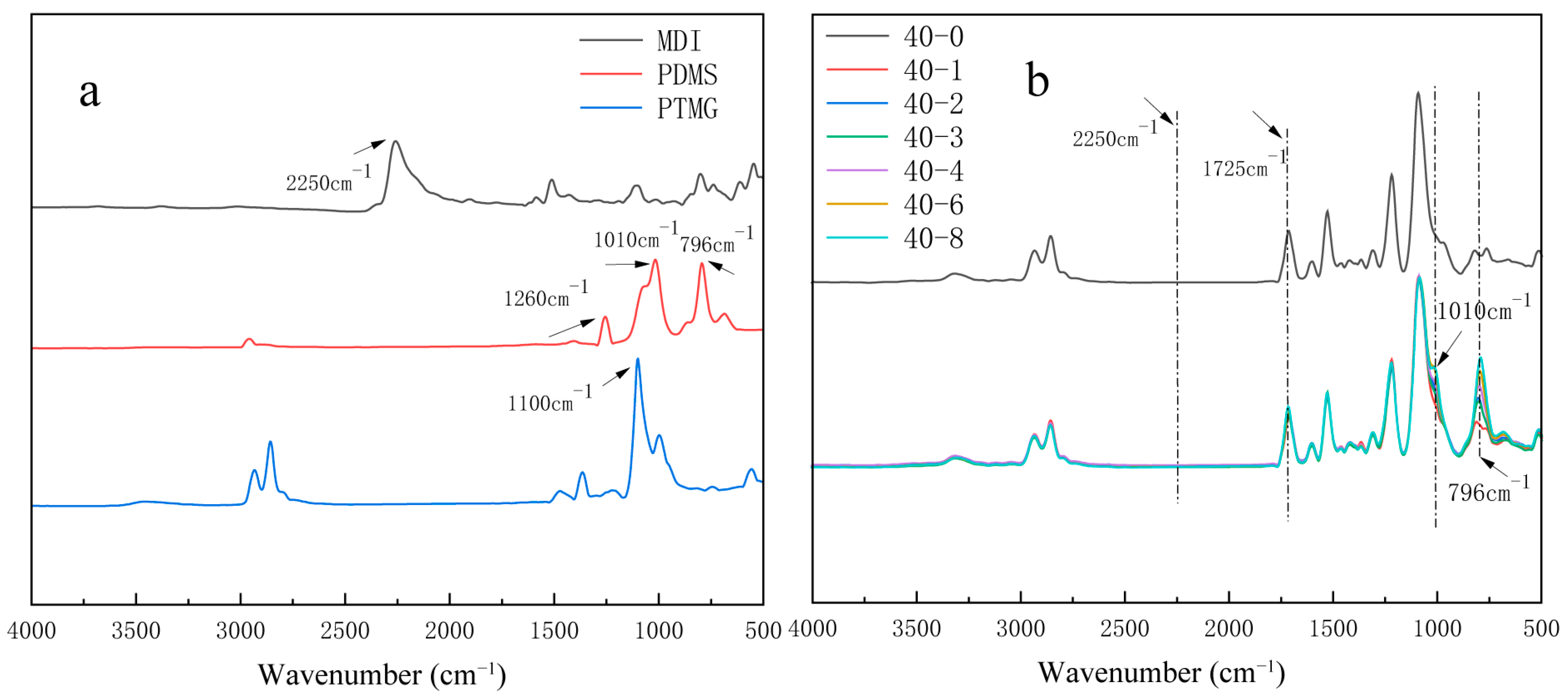
3.1. Synthesis and Characterization of Modified TPUs
3.2. Effects of the PDMS Content on the Hydrophobic Properties of TPUs
3.3. Microphase Separation
3.4. Mechanical Property Analysis
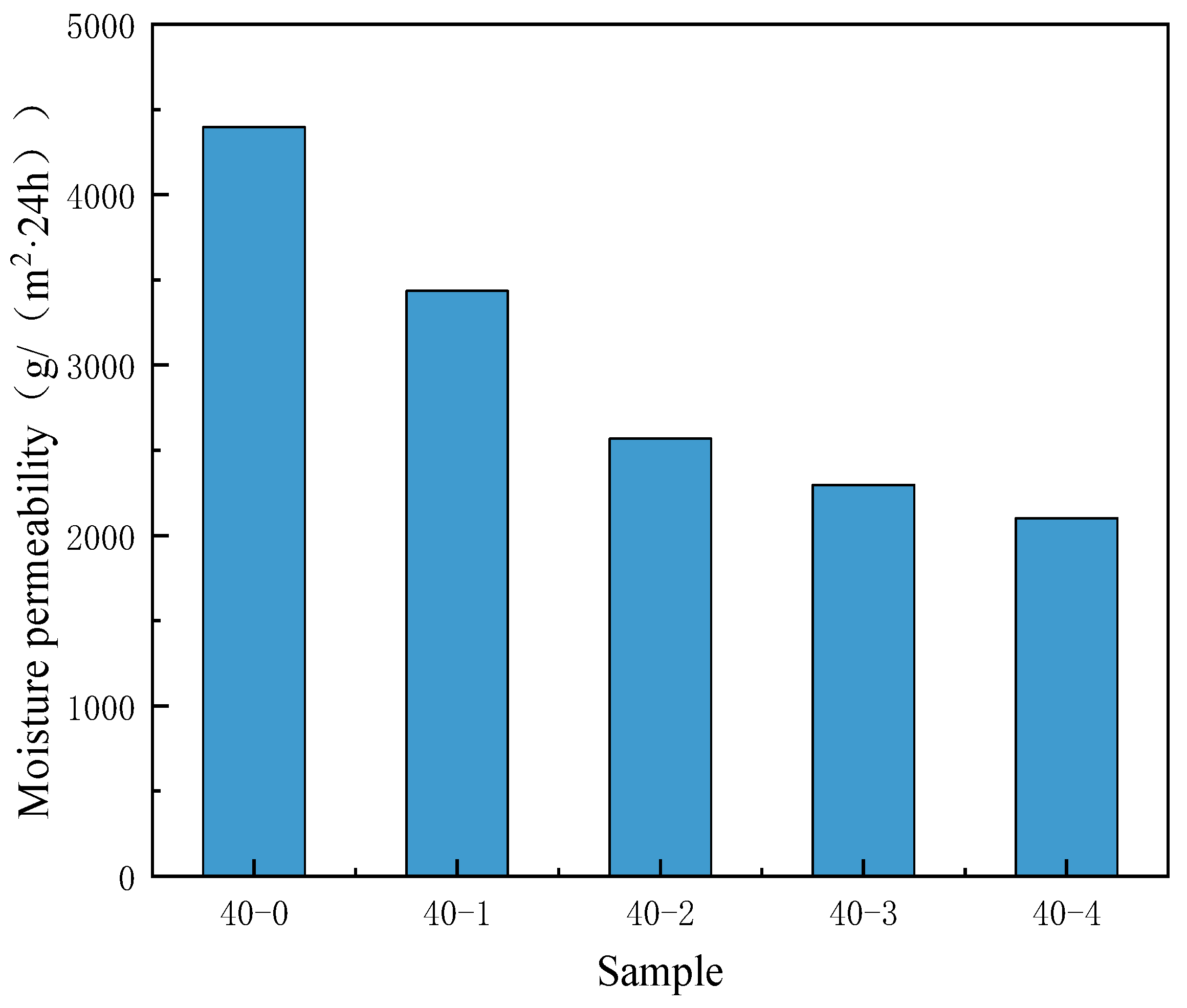
3.5. Effects of the PDMS Content on the Moisture Permeability of Nonporous TPU Membranes
3.6. Structural and Performance Analyses of Microporous Wet Phase Conversion Membranes
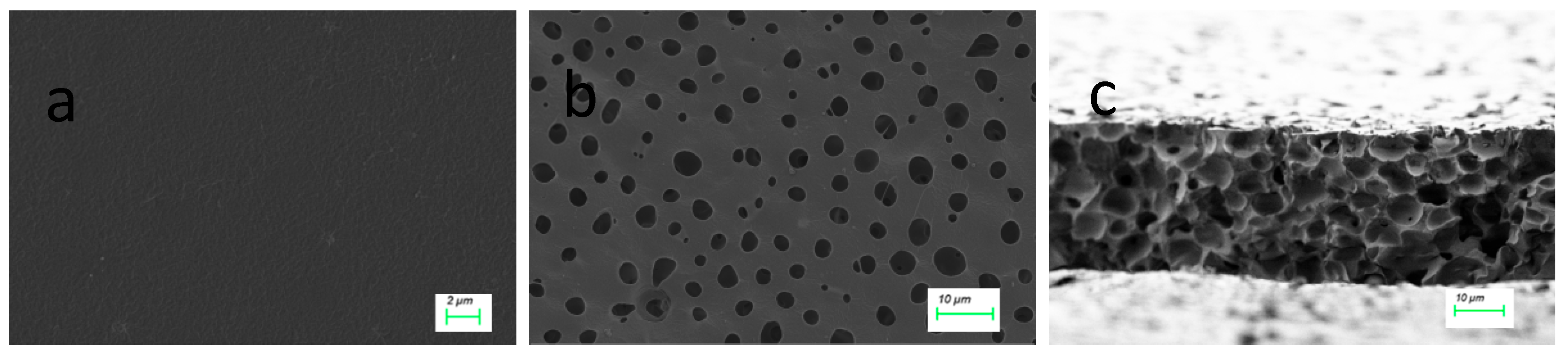
3.6.1. Characterization of the Microporous Membrane Structure
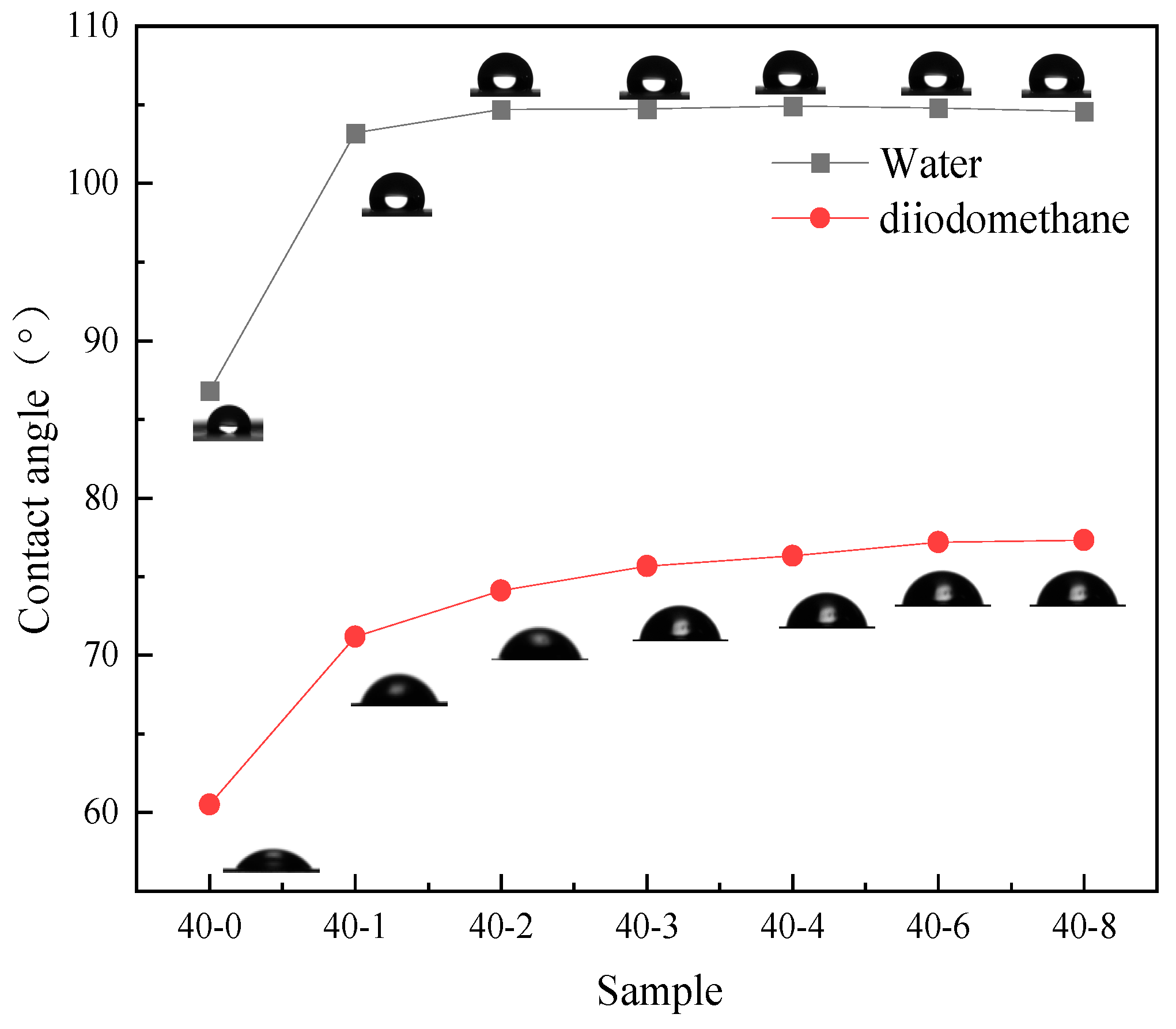
3.6.2. Contact Angle Analysis
3.6.3. Waterproof Ability and Moisture Permeability Analyses
4. Conclusions
Author Contributions
Funding
Data Availability Statement
Conflicts of Interest
References
- Yang, G.; Zhang, Q.; Li, X.; Li, S.; Chen, H.; Lu, C. Preparation and property optimization of waterproof andmoisture permeable membrane made from thermally inducedfusion bonded polyurethane/polydimethylsiloxane. Fangzhi Xuebao 2023, 44, 28–35. [Google Scholar]
- Qiu, H.; Yang, Q.; Cui, J.; Pei, L.; Hu, G. Research progress and application of waterproof and moisture permeable membranes on textiles. Xiandai Fangzhi Jishu 2023, 31, 244–255. [Google Scholar]
- Mates, J.E.; Ibrahim, R.; Vera, A.; Guggenheim, S.; Qin, J.; Calewarts, D.; Waldroup, D.E.; Megaridis, C.M. Environmentally-safe and transparent superhydrophobic coatings. Green Chem. 2016, 18, 2185–2192. [Google Scholar] [CrossRef]
- Cai, R.; Glinel, K.; De Smet, D.; Vanneste, M.; Mannu, N.; Kartheuser, B.; Nysten, B.; Jonas, A.M. Environmentally friendly super-water-repellent fabrics prepared from water-based suspensions. ACS Appl. Mater. Interfaces 2018, 10, 15346–15351. [Google Scholar] [CrossRef]
- Zhao, X.; Li, Y.; Li, B.; Hu, T.; Yang, Y.; Li, L.; Zhang, J. Environmentally benign and durable superhydrophobic coatings based on SiO2 nanoparticles and silanes. Colloid Interface Sci. 2019, 542, 8–14. [Google Scholar] [CrossRef]
- Wang, D.; Ma, Z.; Han, Z.; Wu, K.; Liu, Y.; Tian, X. Synthesis of high-temperature hydrophobic nanoparticles and their applications in superlyophobic coatings. J. Mater. Chem. A 2025, 13, 33264–33275. [Google Scholar] [CrossRef]
- Shi, H.; Liu, W.; Yang, M.; Liu, X.; Xie, Y.; Wang, Z. Hydrophobic waterborne epoxy coating modified by low concentrations of fluorinated reactive modifier. Macromol. Res. 2019, 27, 412–420. [Google Scholar] [CrossRef]
- Wang, P.; Zhao, T.; Bian, R.; Wang, G.; Liu, H. Robust superhydrophobic carbon nanotube film with lotus leaf mimetic multiscale hierarchical structures. ACS Nano 2017, 11, 12385–12391. [Google Scholar] [CrossRef] [PubMed]
- Chen, H.; Fan, H.; Su, N.; Hong, R.; Lu, X. Highly hydrophobic polyaniline nanoparticles for anti-corrosion epoxy coatings. Chem. Eng. J. 2021, 420, 130540. [Google Scholar] [CrossRef]
- Shen, X.; Gao, P.; Yang, W.; Ding, Y.; Bao, C.; Wei, Z.; Tian, K. Study on the hydrophobic modification of PVDF membrane by low-temperature plasma etching in combination with grafting in supercritical carbon dioxide. Vacuum 2023, 209, 111782. [Google Scholar] [CrossRef]
- Wan, X.; Li, Y.; Tian, C.; Zhou, J.; Qian, S.; Wang, L. Fabrication and properties of super-hydrophobic microstructures on magnesium alloys by laser–chemical etching. Appl. Phys. A 2022, 128, 899. [Google Scholar] [CrossRef]
- Wei, Z.; Yan, S.; Lin, J.; Hu, Q.; Cui, Y.; Wang, Q.; Li, Z.; Cheng, Z. Interiorly hydrophobic modification of electrodeposited self-supported ZnAg foam electrodes for CO2 electroreduction in a microchannel reactor. ACS Sustain. Chem. Eng. 2024, 12, 16453–16467. [Google Scholar] [CrossRef]
- Xue, M.; Zhou, D.; Ji, Y.; Xie, Y.; Li, C.; Zhao, J. The polydopamine-enhanced superadhesion and fracture strength of honeycomb polyurethane porous membranes. RSC Adv. 2020, 10, 1639–1647. [Google Scholar] [CrossRef]
- Gao, H.; Sun, W.; Wang, C.; Jing, M.; Yang, L.; Gao, H.; Zhao, R. Improving waterproof-breathable capability of degradable macroporous film/hemp hydroentangled nonwovens composite membranes by porous structure and surface wettability modification. Colloids Surf. A 2023, 674, 131963. [Google Scholar] [CrossRef]
- Wang, Q.; Yang, X.; Zhang, L.-Z. Development, testing, and molecular dynamics simulation of a membrane that resists fouling by gel pollutants for humidification–dehumidification–type seawater desalination. Desalination 2023, 561, 116686. [Google Scholar] [CrossRef]
- Pardo-Figuerez, M.; López-Córdoba, A.; Torres-Giner, S.; Lagaron, J.M. Superhydrophobic bio-coating made by co-continuous electrospinning and electrospraying on polyethylene terephthalate films proposed as easy emptying transparent food packaging. Coatings 2018, 8, 364. [Google Scholar] [CrossRef]
- Chen, X.; Song, L.; Jiang, X.; Zhang, X. Bioinspired superhydrophobic–superhydrophilic convertible film based on anisotropic red blood cell-like particles with protuberances. Colloids Surf. A 2019, 579, 123674. [Google Scholar] [CrossRef]
- Bernardini, C.; Stoyanov, S.; Cohen Stuart, M.; Arnaudov, L.; Leermakers, F. PMMA highlights the layering transition of PDMS in langmuir films. Langmuir 2011, 27, 2501–2508. [Google Scholar] [CrossRef]
- Chen, Y.; Liu, R.; Xu, J.; Yuan, X. Protection of wood in ancient timber construction by surface painting of waterborne siloxane-modified polyurethane against water destroy. Wood Mater. Sci. Eng. 2023, 18, 314–321. [Google Scholar] [CrossRef]
- Yao, N. Controlled Preparation and Performance Study of Fluorine-Free Nanofiber Waterproof and Breathable Membranes Modified by Organosilicon. Master’s Thesis, Donghua University, Shanghai, China, 2025. [Google Scholar]
- You, X.; Wang, H.; He, J.; Qi, K. Fluorine-free superhydrophobic breathable membranes with lotus-leaf/corncob-like composite structure for highly water-resistant fabrics. Chem. Eng. J. 2025, 506, 160214. [Google Scholar] [CrossRef]
- Cui, Y.; Xu, Z.; Li, Y.; Lang, X.; Zong, C.; Cao, L. Synergistic thermodynamic compatibility of polydimethylsiloxane block in thermoplastic polyurethane for flame retardant materials: Super flexible, highly flame retardant and low smoke release. Polymer 2022, 253, 124976. [Google Scholar] [CrossRef]
- Joki-Korpela, F.; Pakkanen, T.T. Incorporation of polydimethylsiloxane into polyurethanes and characterization of copolymers. Eur. Polym. J. 2011, 47, 1694–1708. [Google Scholar] [CrossRef]
- ISO 527-3:2018; Plastics—Determination of Tensile Properties—Part 3: Test Conditions for Films and Sheets. International Organization for Standardization: Geneva, Switzerland, 2018.
- GB/T 12704.2-2009; Textiles—Test Method for Water-Vapour Transmission of Fabrics—Part 2: Water Method. Standardization Administration of China: Beijing, China, 2009.
- Bhardwaj, N.; Kundu, S.C. Electrospinning: A fascinating fiber fabrication technique. Biotechnol. Adv. 2010, 28, 325–347. [Google Scholar] [CrossRef]
- Zhang, X.; Li, X.; Zhang, L. Preparation and properties of polyurethane nanofiber membrane composite fabric. Shanghai Fangzhi Keji 2021, 49, 20–23. [Google Scholar]
- Fan, H.; Liao, F.; Huang, S.; Zhang, K.; Zeng, D.; Liu, J. Exploration on the Surface Free Energy Testing Method of Paper Literatures. Zhongguo Zaozhi 2022, 41, 95–101. [Google Scholar]
- Yu, Y.; Xu, G.; Zhao, P.; Zhang, J. Biocompatible, robust, waterproof and breathable PDMS-based PU fibrous membranes for potential application in wound dressing. Mater. Today Commun. 2024, 38, 107870. [Google Scholar] [CrossRef]
- Zhangyang, J.; Feng, D.; Ma, R.; Zhang, M.; Wang, C.; Zheng, J. Synthesis and properties of silicone-modified polyurethane acrylate for magnetically driven blue light photocurable superhydrophobic coatings. J. Text. Inst. 2025, 116, 1521–1533. [Google Scholar] [CrossRef]
- Lin, Y.-F.; Wang, W.-W.; Chang, C.-Y. Environmentally sustainable, fluorine-free and waterproof breathable PDMS/PS nanofibrous membranes for carbon dioxide capture. J. Mater. Chem. A 2018, 6, 9489–9497. [Google Scholar] [CrossRef]
- Calolsa, R.S.; Sumangala, T.; Kalpathy, S.K.; Thomas, T.; Kahaly, M.U.; Rahaman, A. PDMS/Au/PDMS Multi-Layered Thin Film Composites for Hydrophobic and IR Filtering Applications. J. Appl. Polym. Sci. 2025, 142, e57014. [Google Scholar] [CrossRef]
- Chungprempree, J.; Charoenpongpool, S.; Preechawong, J.; Atthi, N.; Nithitanakul, M. Simple preparation of polydimethylsiloxane and polyurethane blend film for marine antibiofouling application. Polymers 2021, 13, 2242. [Google Scholar] [CrossRef]
- Zhao, N.; Xie, Q.; Weng, L.; Wang, S.; Zhang, X.; Xu, J. Superhydrophobic surface from vapor-induced phase separation of copolymer micellar solution. Macromolecules 2005, 38, 8996–8999. [Google Scholar] [CrossRef]
- Askari, F.; Barikani, M.; Barmar, M. Siloxane-based segmented poly (urethane-urea) elastomer: Synthesis and characterization. Appl. Polym. Sci. 2013, 130, 1743–1751. [Google Scholar] [CrossRef]
- Esteghlal, S.; Niakosari, M.; Hosseini, S.M.H.; Mesbahi, G.R.; Yousefi, G.H. Gelatin-hydroxypropyl methylcellulose water-in-water emulsions as a new bio-based packaging material. Int. J. Biol. Macromol. 2016, 86, 242–249. [Google Scholar] [CrossRef]
- Younes, G.R.; Maric, M. Moisture Curable Hybrid Polyhydroxyurethanes from Sugar-Derived Dicarbonates. Macromol. Mater. Eng. 2021, 306, 2000715. [Google Scholar] [CrossRef]
- Yang, J.; Zhou, S.; You, B.; Wu, L. Preparation and surface properties of silicone-modified polyester-based polyurethane coats. J. Coat. Technol. Res. 2006, 3, 333–339. [Google Scholar] [CrossRef]
- Aydin, A.; Demirci, F.; Orhan, M.; Kocer, H.B. Preparation of breathable polyurethane membranes with quaternary ammonium salt diols providing durable antibacterial property. J. Appl. Polym. Sci. 2019, 136, 47133. [Google Scholar] [CrossRef]
- Zhang, Q.; Liu, H.; Li, P.; Li, N. Preparation and waterproof and moisture-permeable properties of electrospun polyurethane/silica composite superfine fiber membrane. J. Text. Res. 2019, 40, 1–7. [Google Scholar]
- Wang, L.; Wen, Y. Preparation and Performances of Electrospun Waterproof and Wet-permeable Fabrics. J. Univ. Jinan (Sci. Technol.) 2023, 37, 223–227. [Google Scholar]
- Hernandez, R.; Weksler, J.; Padsalgikar, A.; Runt, J. Microstructural organization of three-phase polydimethylsiloxane-based segmented polyurethanes. Macromolecules 2007, 40, 5441–5449. [Google Scholar] [CrossRef]
- Atthi, N.; Sripumkhai, W.; Pattamang, P.; Thongsook, O.; Srihapat, A.; Meananeatra, R.; Supadech, J.; Klunngien, N.; Jeamsaksiri, W. Fabrication of robust PDMS micro-structure with hydrophobic and antifouling properties. Microelectron. Eng. 2020, 224, 111255. [Google Scholar] [CrossRef]
- Zhang, Y.; Shang, J.; Lv, F.; Chu, P.K. Synthesis and characterization of novel organosilicon-modified polyurethane. Appl. Polym. Sci 2012, 125, 1486–1492. [Google Scholar] [CrossRef]
- Qi, Z.; Ziyin, X.; Shiqing, H. Preparation and Properties of TPU/TiO2/PDMS CompositeFibrous Membranes. Hunan Gongcheng Xueyuan Xuebao 2023, 33, 65–70. [Google Scholar]
- Anjum, A.S.; Son, E.J.; Yu, J.H.; Ryu, I.; Park, M.S.; Hwang, C.S.; Ahn, J.W.; Choi, J.Y.; Jeong, S.H. Fabrication of durable hydrophobic porous polyurethane membrane via water droplet induced phase separation for protective textiles. Text. Res. J. 2020, 90, 1245–1261. [Google Scholar] [CrossRef]
- Wang, S.; Sun, J.; Liu, D.; Li, M. Preparation and wearability of non-porous moisture permeable TPU film. New Chem. Mater. 2019, 47, 220–224. [Google Scholar]


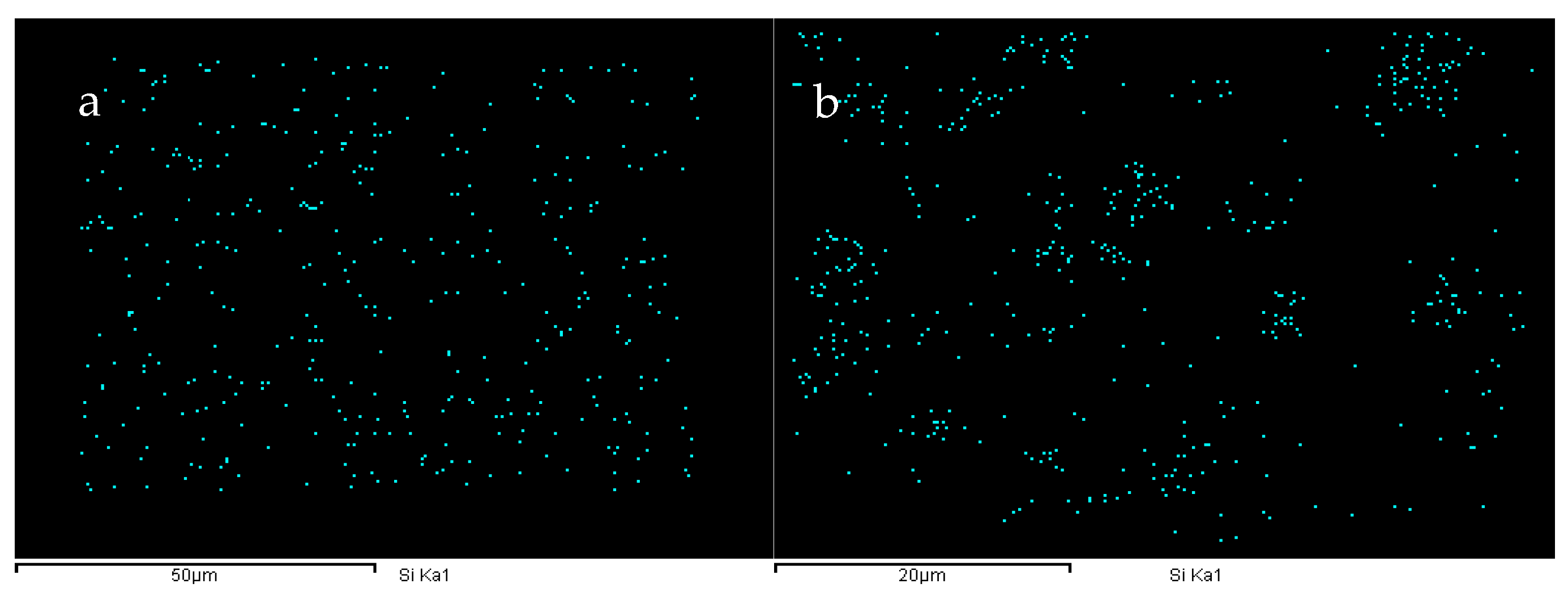


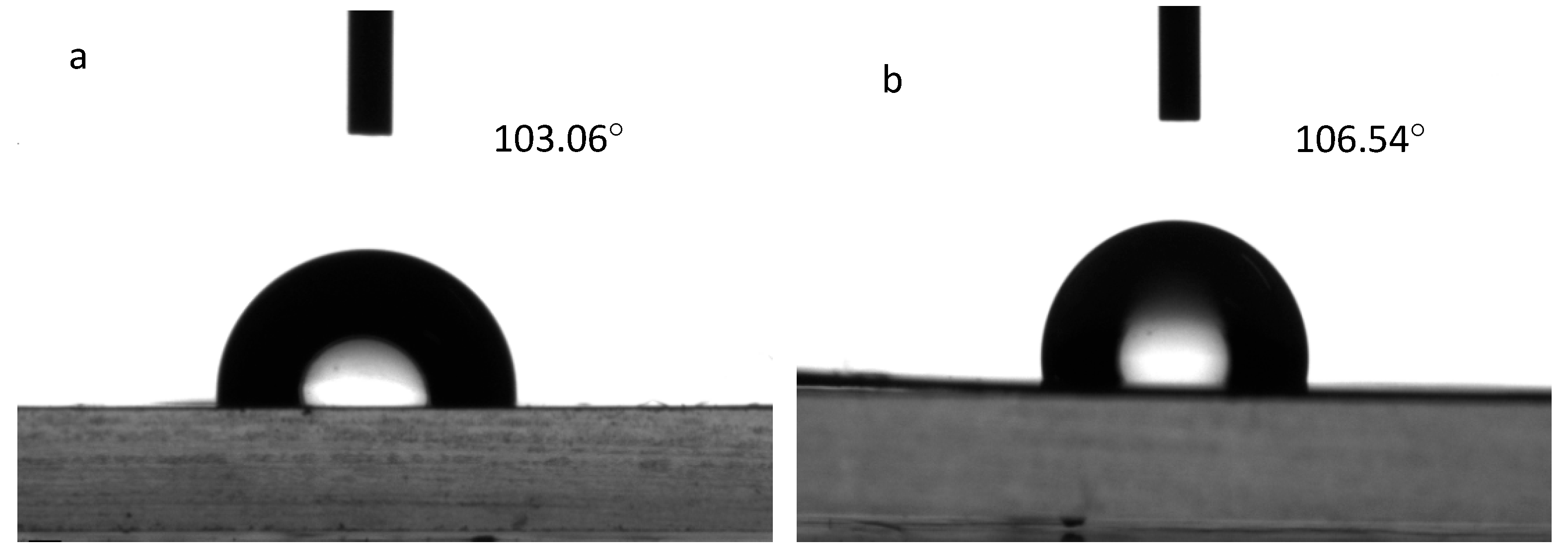

| Test Fluid | γL/mN·m−1 | γdL/mN·m−1 | γPL/mN·m−1 | Polarity |
|---|---|---|---|---|
| Water | 72.80 | 21.80 | 51.00 | Polar |
| Diiodomethane | 50.80 | 48.50 | 2.30 | Nonpolar |
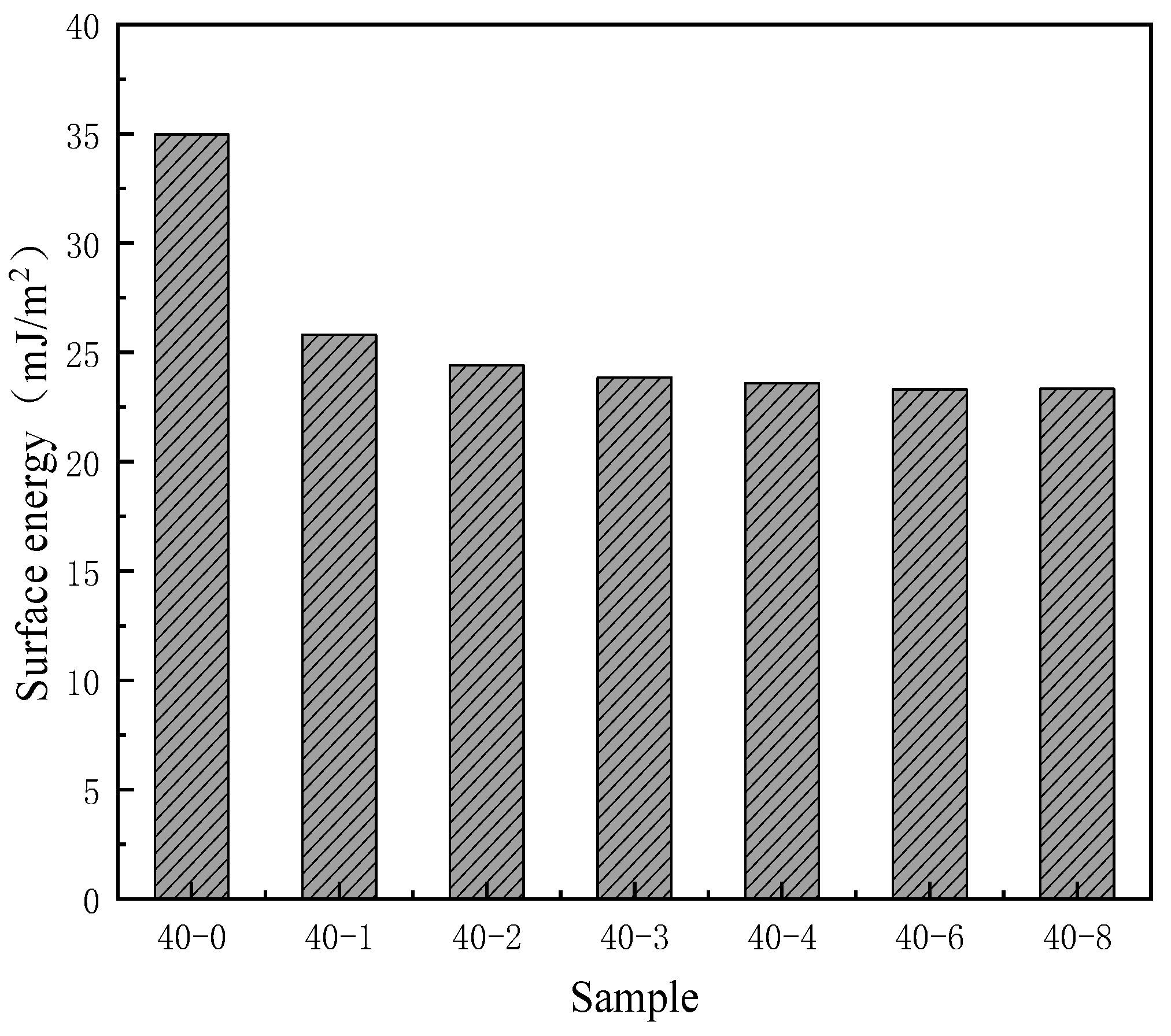
| Sample | Hard Segment Content % | PDMS Mass Fraction % | Surface Energy mJ/m2 |
|---|---|---|---|
| 40-0 | 35 | 0 | 34.97 |
| 40-1 | 35 | 3.09 | 25.81 |
| 40-2 | 35 | 5.91 | 24.41 |
| 40-3 | 35 | 8.48 | 23.85 |
| 40-4 | 35 | 10.83 | 23.58 |
| 40-6 | 35 | 15.00 | 23.32 |
| 40-8 | 35 | 18.57 | 23.34 |
| Sample | Water Pressure Resistance (kPa) | Moisture Permeability g/(m2·24 h) |
|---|---|---|
| Nonporous film | 31 | 2567.55 |
| Microporous membrane | 19.98 | 8651.34 |
Disclaimer/Publisher’s Note: The statements, opinions and data contained in all publications are solely those of the individual author(s) and contributor(s) and not of MDPI and/or the editor(s). MDPI and/or the editor(s) disclaim responsibility for any injury to people or property resulting from any ideas, methods, instructions or products referred to in the content. |
© 2025 by the authors. Licensee MDPI, Basel, Switzerland. This article is an open access article distributed under the terms and conditions of the Creative Commons Attribution (CC BY) license (https://creativecommons.org/licenses/by/4.0/).
Share and Cite
An, W.; Ma, R.; Zhang, S.; Wu, M.; Wang, C.; Zheng, J. Hydrophobic Modification of Thermoplastic Polyurethane for Application in Waterproof and Moisture-Permeable Membranes. Materials 2025, 18, 4998. https://doi.org/10.3390/ma18214998
An W, Ma R, Zhang S, Wu M, Wang C, Zheng J. Hydrophobic Modification of Thermoplastic Polyurethane for Application in Waterproof and Moisture-Permeable Membranes. Materials. 2025; 18(21):4998. https://doi.org/10.3390/ma18214998
Chicago/Turabian StyleAn, Weizhu, Ruihan Ma, Shujuan Zhang, Mingyue Wu, Chenglong Wang, and Jinhuan Zheng. 2025. "Hydrophobic Modification of Thermoplastic Polyurethane for Application in Waterproof and Moisture-Permeable Membranes" Materials 18, no. 21: 4998. https://doi.org/10.3390/ma18214998
APA StyleAn, W., Ma, R., Zhang, S., Wu, M., Wang, C., & Zheng, J. (2025). Hydrophobic Modification of Thermoplastic Polyurethane for Application in Waterproof and Moisture-Permeable Membranes. Materials, 18(21), 4998. https://doi.org/10.3390/ma18214998