
Abstract
The construction industry’s reliance on Portland cement (PC) significantly contributes to global CO2 emissions, driving the search for sustainable binder alternatives. This study develops and evaluates novel mineral binder systems for wood wool acoustic panels with a reduced carbon footprint. Alternative binders, including calcium aluminate cement (CAC), magnesium oxychloride cement (MOC), and gypsum–cement–pozzolan (GCP) hybrids, were combined with additives such as metakaolin and liquid glass. Mechanical testing demonstrated that 20–30% metakaolin and liquid glass composites achieved flexural strengths of up to 2.65 MPa and densities above 490 kg/m3. The GCP system showed synergistic improvements in flexural and compressive strengths by nearly 50%, along with enhanced dimensional stability and water resistance. Life cycle assessment indicated substantial CO2 emission increases, particularly for the MOC and CAC formulations, compared to conventional Portland cement-based panels. The carbon footprint of the binder system consisting of GCP is approximately 5.644 kg of CO2 equivalent per functional unit compared to magnesium chloride binder systems, which reach up to 10.84 kg CO2 eq., and white Portland cement systems, which are around 6.19 kg CO2 eq. The three-component GCP binder system offers the best balance of mechanical performance and minimised environmental impact. Key raw material contributors to the ecological load are cement (various types), MgO, MgCl2, and metakaolin, highlighting the importance of optimising binder formulations to reduce carbon emissions. The GCP system, in particular, demonstrates unprecedented synergistic improvements in flexural and compressive strengths, dimensional stability, and water resistance while minimising CO2 emissions. Current work sets a new benchmark for sustainable building materials by offering an eco-innovative pathway towards low-carbon, high-performance wood wool acoustic panels, aligning with global decarbonisation goals.
1. Introduction
Wood wool acoustic panels are an emerging class of sustainable building materials that have garnered attention due to their favourable acoustic performance, environmental benefits, and multifunctional properties. These panels, often referred to as wood wool cement boards, combine wood wool, typically obtained as excelsior or fine wood fibres, with Portland cement and water. The resulting composite exhibits a porous cellular structure, which is fundamental to its sound-absorption capabilities [1,2].
The acoustic performance of wood wool cement panels is primarily a function of their microstructure [3]. This porous structure facilitates the dissipation of acoustic energy through multiple internal reflections and frictional losses, thereby enhancing the panels’ efficacy in reducing noise.
In addition to their acoustic properties, wood wool acoustic panels offer desirable mechanical characteristics and environmental performance. Studies have shown that the bonding between wood fibres and the cementitious matrix yields a material with good structural stability and fire resistance, making these panels an attractive alternative to conventional mineral wools and synthetic absorbers [4]. The hygroscopic behaviour of the wood fibres, particularly when derived from spruce, contributes to dimensional stability and improved sound damping under fluctuating moisture conditions [5,6]. The classification and mechanistic understanding of wood-based composites elucidate the balance between sound absorption, porosity, and mechanical strength densification. Wood wool acoustic panels incorporating Portland cement are fabricated by combining wood wool—typically derived from wood fibres of various dimensions—with Portland cement; water; and, in some cases, additives that enhance workability and interfacial bonding [7]. This formulation produces a lightweight, highly porous composite that imparts the fire-retardant properties of Portland cement, owing to a hydrate layer that acts as a barrier against ignition [8]. Acoustic performance in wood wool cement panels is primarily achieved by creating an open cellular structure. The crucial role of the composite’s porosity and fibre distribution is reflected in the mechanical properties of wood–cement composites [1]. The hierarchical structure resulting from the interpenetration of fibres within the cementitious network imparts rigidity while maintaining a degree of flexibility, which is beneficial in applications requiring both load-bearing capacity and acoustic damping [9]. Additionally, wood wool cement boards are noted for their low density and high thermal insulation properties, making them suitable for interior cladding or partition elements in environments where thermal and acoustic comfort are priorities [10].
However, traditional acoustic panels often utilise petroleum-based or non-renewable resources, contributing to environmental degradation through high embodied energy and waste generation. Mineral wool, which encompasses both rock wool (also known as stone wool) and glass wool, serves as a crucial component in the field of acoustic insulation [11]. Its fibrous structure provides high acoustic absorption capabilities alongside important thermal insulation properties, making it integral in construction and engineering applications. Miškinis et al. [12] demonstrated that fibrous materials exhibit high absorption performance across various frequency ranges while also providing beneficial mechanical strength and thermal insulation.
Recent studies indicate that recycling waste materials and incorporating bio-based constituents, such as cellulose-nanocrystal-modified luffa structures, cork granulates, tree bark [13], and recycled tea bags, can yield acoustic panels with competitive sound absorption properties while significantly reducing their environmental footprint [3,14,15,16,17,18,19]. The integration of natural fibres and bio-based composites into acoustic panel design presents an eco-innovative solution that utilises renewable resources.
The integration of Portland cement ensures that the panels resist moisture-induced degradation and display improved fire resistance, a critical attribute derived from the cement’s barrier effect—as evidenced by performance evaluations conducted on cement-bonded materials [4]. This fire-retardant property, coupled with the natural biodegradability and recyclability of wood wool, underscores the environmental benefits of these composites. Integrating fly ash and ground granulated blast-furnace slag, pozzolans can lead to a reduction in the demand for Portland cement, thereby decreasing CO2 emissions [20,21,22] because up to 10% of worldwide anthropogenic CO2 emissions are attributed to cement production, highlighting its role as a major contributor to climate change [20,23,24,25].
The design of sustainable construction practices involves transitioning towards geopolymer concrete, which entirely replaces Portland cement [4,26,27], as well as eco-innovative binders, such as magnesium oxychloride cement (MOC), magnesium phosphate cement (MPC), calcium aluminate cement (CAC), and blended systems incorporating pozzolans and gypsum. These alternatives reduce CO2 emissions during production by utilising lower calcination temperatures and alternative chemistry and offer enhanced properties such as rapid curing, improved fire resistance, moisture durability, and compatibility with renewable fibrous materials like wood particles. These alternative binders also enable the use of renewable fibrous materials, such as wood wool, which enhance acoustic absorption through controlled porosity and fibre hybridisation techniques.
The transition from PC to these sustainable alternatives forms the foundation for developing next-generation composite materials designed for acoustic and structural applications in the built environment. Alternative binders, such as CAC and MOC, exhibit lower embodied carbon, resulting in a more sustainable lifecycle compared to PC. This supports global efforts to decarbonise the construction industry. Enhanced hydration and curing performance can be achieved by using CAC; MOC; and hybrid three-component binder systems that combine gypsum, cement, and pozzolans [28]. This encourages the development of rapid-setting binders and enables shorter production cycles and faster formwork removal, thereby improving manufacturing efficiency and reducing energy consumption. CAC’s excellent sulphate resistance and MOC’s fire retardancy and moisture resistance are crucial for long-term performance in diverse building environments.
Emphasising environmental sustainability, resource efficiency, and superior performance, these innovations represent critical steps toward mitigating the construction industry’s impact on climate change and advancing circular economy principles.
2. Materials and Methods
2.1. Raw Materials
Raw materials used: wood wool, Portland cement, metakaolin, liquid glass, calcium aluminate cement, Magnesium oxide, Magnesium chloride, gypsum, water.
The wood wool, made from pine, was used to create an acoustic wood wool panel with a mineral binder. The wood wool was produced by the company Stiga RM Ltd. (Tukums, Latvia). The sizes of the wood wool are presented in Table 1. Measurements have been made for 3 g of wood fibres.
Table 1.
Sizes of pine wood wool.
White PC CEM I 52.5 R is the binder base for developing wood wool boards. This cement has improved mechanical properties in comparison with ordinary PC and its decorative properties. It provides mechanical strength and durability essential for structural stability. Its production, however, is associated with high CO2 emissions, motivating the search for alternative binders. In contrast to ordinary cement, white cement is characterised by very low contents of transition metal oxides (e.g., iron and manganese), which results in a brilliant white colour and higher purity. The composition of white cement is presented in Table 2.
Table 2.
PC CEM I 52.5 R composition.
Metakaolin (MK) (Stikloporas Ltd., Druskininkai, Lithuania) was used as the source of aluminium silicate. MK is obtained via the endothermic reaction of kaolin. The analysis of the MK particle size distribution revealed that 90% of the particles were smaller than 76.0 µm, 50% of the MK particles were smaller than 6.0 µm, and 10% were smaller than 1.3 µm. MK is an aluminosilicate additive used as a partial replacement for OPC to enhance composite properties. The composition of MK is presented in Table 3.
Table 3.
Metakaolin composition.
Liquid glass (sodium silicate solution Na2O(SiO2)·xH2O) acts as a supplementary additive, improving composites’ durability and water resistance. It contributes to forming a denser, more cohesive microstructure with enhanced interfacial bonding between wood particles and binder, further increasing flexural strength and reducing porosity. Polyline, Latvia, Riga, produces liquid glass.
We used Calcium aluminate cement (CAC) under the brand name GÓRKAL 70 (Trzebinia, Poland). CAC offers rapid curing and early strength development, facilitating shorter production cycles. It shows excellent sulphate resistance, thermal stability, and fire resistance, making it well suited for particleboards exposed to moist or aggressive environments. It provides higher moisture–drought resistance and retains strength after long water exposure, broadening its applicability in humid conditions. The chemical composition of the CAC is presented in Table 4.
Table 4.
CAC composition.
Ordinary PC CEM I 42.5 R serves as the conventional binder base in producing wood wool boards. It provides mechanical strength and durability essential for structural stability. The composition of PC is presented in Table 5.
Table 5.
PC CEM I 42.5 R composition.
Magnesium oxide (MgO) is applied to produce magnesium oxide chloride cement (MOC). Magnesium chloride is an inorganic compound with the formula MgCl2. It forms hydrates MgCl2·6H2O. These salts are colourless or white solids that are highly soluble in water. MgO was applied to produce magnesium oxychloride cement (MOC).
Gypsum is a soft sulphate mineral of calcium sulphate dihydrate, with the chemical formula CaSO4·2H2O. Gypsum was produced by the company Knauf, Riga, Latvia.
2.2. Alternative Binder Systems
MOC has garnered attention due to its advantageous properties, including rapid setting and hardening, high strength-to-weight ratio, fire resistance, and overall low thermal conductivity [29,30,31]. Due to these properties and a comparatively low carbon footprint, MOC is an attractive alternative for durable, eco-friendly wood particleboard binders.
The gypsum–cement–pozzolan binder (GCP) ternary system synergistically combines gypsum, PC, and pozzolanic materials. Gypsum imparts rapid initial strength, while pozzolans contribute to long-term strength and improved water resistance; PC offers structural integrity. This three-component binder reduces shrinkage and cracking, enhances dimensional stability, and mitigates the formation of deleterious compounds such as ettringite and thaumasite, especially in sulphate-rich or humid environments. Panels with GCP retain higher strength and moisture resistance than those with gypsum or two-component systems, making GCP a more advantageous choice for specific acoustic panel applications.
Water is a crucial component in the processing of cementitious mixtures, facilitating hydration reactions and improving their workability. Its quantity is optimised to balance mixture consistency and mechanical properties across formulations, including those with alternative binders. Tap water (drinking water) was used for mixing preparation.
2.3. Key Properties of Raw Materials for Binder and Binder Systems
These raw materials and binders form the basis for developing eco-innovative wood particleboard composites with balanced mechanical performance, improved durability, enhanced fire safety, and significantly reduced environmental impact compared to traditional PC-based materials. The key properties of raw materials for binders and binder systems are presented in Table 6.
Table 6.
Key properties and environmental impact of selected binders.
2.4. Preparation of the Binder Systems and Wood Wool Panel Samples
2.4.1. Elaboration of the Mixtures
A base reference formulation was a commercial version of a wood wool panel prepared using ordinary PC (CEM I 42.5 R), liquid glass, and wood wool. This formulation serves as a benchmark for comparing the performance of alternative binders.
The wood wool is produced from pine wood.The amount of wood wool ranges from 1200 to 2100 g/m2.
The ratios between wood wool (WW) and mineral binder (MB) were in the range MB/WW = 2.93 ÷ 4.63 by weight.
Alternative binder formulation variations include different precursors mentioned above in various ratios. The considered precursors (marked with the symbol ✓) are presented in Table 7.
Table 7.
Composition of alternative binders.
- ASB—Partial replacement of white PC (CEM I 52.5 R) with metakaolin at 0%, 5%, 10%, 20%, and 30% with different PC–wood wool ratios to evaluate mechanical and physical enhancements. The composition of the binder consists of PC, metakaolin, liquid glass, and water.
- ASB-2—Partial replacement of PC with metakaolin at levels of 5% to 30% with a treatment mix of PC and metakaolin in the disintegrators, with a rotation speed of 2000 rpm, to evaluate mechanical and physical enhancements. The binder’s composition consists of PC with metakaolin, liquid glass, and water.
- ASB-5—Partial replacement of PC with metakaolin at levels of 5% to 30% with a treatment mix of PC and metakaolin in the disintegrators with a rotation speed of 5000 rpm to evaluate mechanical and physical enhancements. The binder’s composition consists of PC with metakaolin, liquid glass, and water.
- CACB—CAC replaces PC in the composition. We use different CAC–wood wool and water–CAC ratios for increased hardening speed to evaluate mechanical and physical enhancements. The binder’s composition consists of CAC with a different water–CAC ratio, liquid glass, and water.
- MOSB—Magnesium oxychloride cement (MOC) for moisture performance. The binder’s composition consists of magnesium oxide and magnesium chloride in different MOC–water ratios, as well as water.
- GCP binder system—A three-component mixture of gypsum, PC, and pozzolanic additives, formulated to balance rapid strength gain with long-term durability and dimensional stability. The composition of the binder consists of PC, gypsum, and metakaolin with different ratios; liquid glass; and water
2.4.2. Mixing and Forming
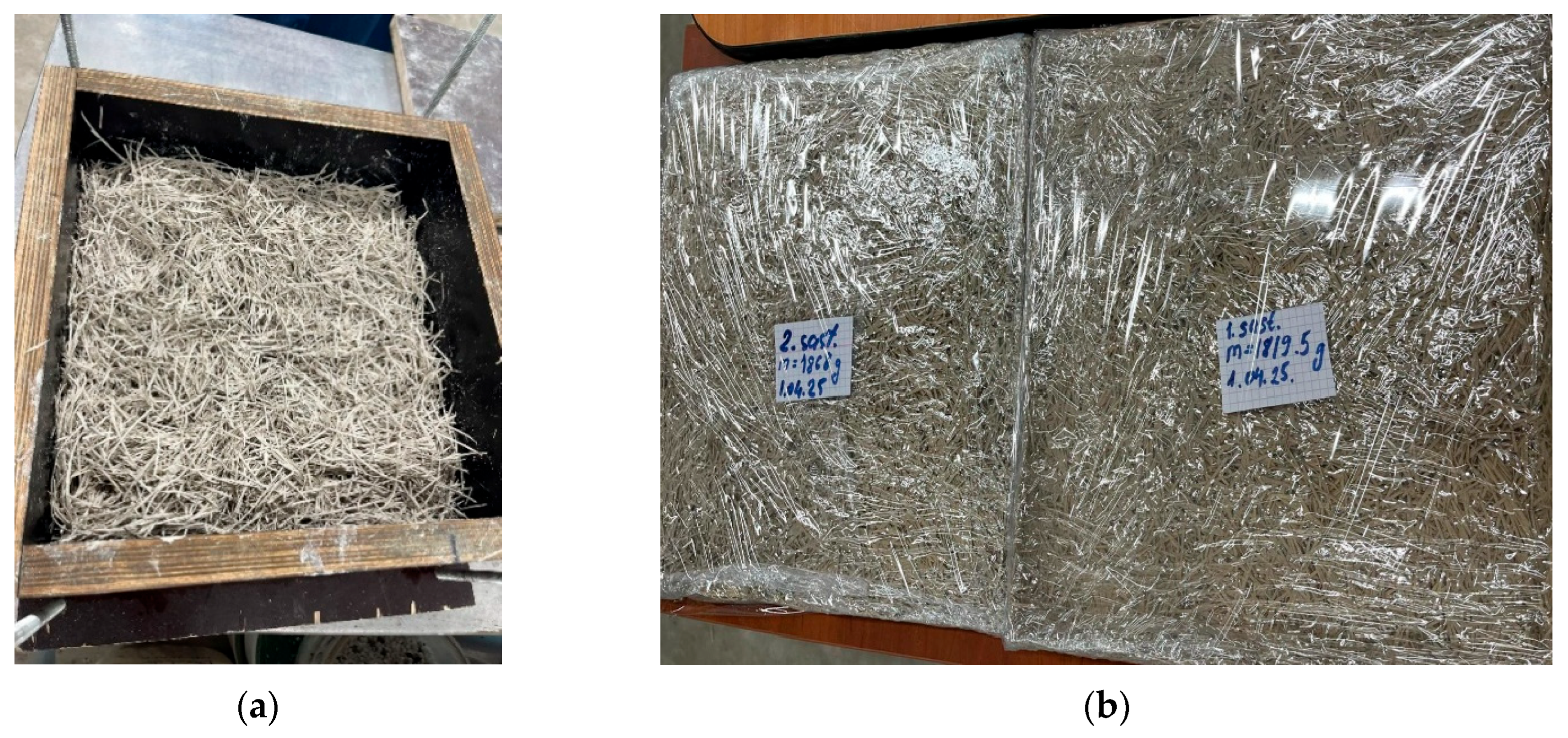
The wood wool is moistened with water, binder components are added, and the wood wool is thoroughly mixed with them. Necessary water and additives are then added to form a homogeneous slurry or mixture. The liquid glass additive, if used, is incorporated into the water. The mixture is placed in pre-prepared moulds or formworks (Figure 1a) and compacted under controlled pressures to produce acoustic panels that are 25 mm thick.
Figure 1.
(a) Wood wool mixture is placed into pre-prepared formwork. (b) Wood wool panels are cured in the film.
Forms are made from humidity-resistant plywood. Pressure and duration are applied based on the findings of a previous investigation. For binders such as MOC, the chemical reaction between magnesium oxide and magnesium chloride occurs during the formation and solidification of the matrix.
2.4.3. Curing and Hardening
The formed wood wool boards are left to cure under controlled temperatures and humidity, allowing the binder to hydrate and develop strength. CAC-based boards cure rapidly, reducing processing time, whereas GCP systems require monitoring to ensure dimensional stability. Typical curing regimes balance initial strength gains (primarily from gypsum or calcium aluminate cement) with long-term strength improvements due to pozzolans. The samples were demoulded after 24 h and then cured under film coverage (Figure 1b) for 7 days.
2.4.4. Testing
The cured particleboards underwent mechanical testing for bending and compression strength in accordance with EN 12089 and EN 826 standards [32,33]. Testing was performed using a Universal Testing System XWN-20 and Controls 3000, (Milan, Italy). Bulk density and thermal properties are evaluated to identify optimum formulations. Thermal conductivity was measured using the FOX600 equipment, produced by TA Instruments (New Castle, DE, USA).
Density was defined after 28 days, when the specimens were cured for 3 weeks at room temperature and 50% humidity. Based on the results, formulations are iteratively adjusted with varying binder ratios, additive treatments (e.g., disintegration intensity for mixtures of metakaolin and Portland cement), and wood wool amounts to maximise performance while minimising environmental impact.
2.5. Manufacturing Procedure for Particleboards with Different Binders: Hydration, Mixing, and Homogenisation Steps
The manufacturing process of eco-innovative wood particleboard, combining wood wool fibres and alternative binders with ordinary PC, involves several well-defined stages designed to produce boards with improved structural and environmental performance. The suggested manufacturing process comprises material homogenisation, precise binder mixing, controlled forming and curing conditions, and thorough testing to produce sustainable, high-performance wood wool particleboard composites that contribute to greener building materials.
Wood wool, as a filler, is hydrated to enhance moisture content and ensure stability and adhesion during subsequent processing.
Depending on the formulation, binders such as white PC (CEM I 52.5 R); CAC; magnesium oxychloride cement (MOC); or a three-component system consisting of gypsum, cement, and pozzolan (GCP) are prepared. Additives like metakaolin treated in a disintegrator and liquid glass may be incorporated to improve strength and durability. The hydrated wood wool fibres are mixed with the prepared binder components. A concentrated MgCl2 solution is diluted with purified water for magnesium chloride binders and added to the wood particles to distribute magnesium ions evenly. Magnesium oxide powder is then added to the moist wood shavings containing magnesium chloride, and the mixture is thoroughly mixed to form a homogeneous composite material. Dosed water is sprayed to optimise consistency and workability. Proper homogenisation ensures uniform moisture distribution, which is essential for chemical reactions and adhesion within the board matrix.
The resulting homogeneous mixture is placed into pre-prepared moulds or formworks. The mixture is compacted using manual presses. Compression was controlled by moulding forms that influence the thickness of the finished wood wool board.
During curing, chemical reactions occur between the binder components. For example, magnesium oxide reacts with magnesium chloride to form robust magnesium oxychloride cement structures in boards using magnesium chloride as a binder. For gypsum–cement–pozzolan (GCP) systems, gypsum provides rapid initial strength, while pozzolanic materials progressively enhance strength and water resistance over time. CAC-based binders cure rapidly, enabling faster demoulding and reduced construction times. Environmental conditions such as temperature and humidity are controlled to ensure optimal hydration and prevent shrinkage or cracking.
After curing, the particleboards are demoulded. The surface of the particleboard is trimmed to size or laminated for an enhanced appearance. Quality control tests, including mechanical strength, density, thermal conductivity, and visual inspections, are conducted to ensure compliance with specifications.
3. Results
3.1. Mechanical Properties of Composite Samples
The mechanical property evaluation reveals that white Portland cement and aluminosilicate binders offer enhanced structural strength. At the same time, CAC and magnesium chloride systems provide options for reduced weight or improved thermal characteristics. The results obtained for different samples are presented in Table 8. The results for the benchmark samples are taken from the commercial producer CEWOOD.
Table 8.
Physical–mechanical properties of wood wool composite samples with a thickness of 25 mm.
The composites developed with white Portland cement consistently surpass the benchmark compressive strength of 0.2 MPa at 10% strain and a flexural strength of 1.3 MPa, achieving flexural strength ranging from 1.31 to 2.00 MPa and compressive strength of up to 0.51 MPa. This indicates a superior load-bearing capacity and stiffness [34], making them well suited for structural applications that require robust mechanical integrity.
Aluminosilicate-based composites exhibit significant increases in flexural strength, ranging from 1.09 to 2.65 MPa, when subjected to high-energy disintegration processes. That suggests that microstructural enhancements via additive processing effectively improve resistance to bending stresses [35,36,37]. However, these gains were sometimes accompanied by slight increases in density, which may affect weight-sensitive applications.
The CACB presented compressive and flexural strengths comparable to white Portland cement, with density values close to the benchmark, indicating a promising balance between mechanical performance and composite weight [38,39]. On the other hand, MOCB exhibited relatively low densities and strength, suggesting potential for lightweight applications but highlighting a need for formulation optimisation to enhance their mechanical robustness.
While the white PC composites showed superior mechanical strength, their thermal resistance was slightly lower than that of other formulations. Conversely, aluminosilicate and GCP-based composites yielded enhanced thermal resistance and comparable mechanical properties. This suggests an inherent trade-off in composite design, where improvements in mechanical strength may coincide with reduced thermal insulation, necessitating optimisation based on the target application requirements.
The high rotation speeds during disintegrator processing (up to 5000 rpm for the ASB-5) appear to activate beneficial modifications in the microstructure, as reflected by improvements in flexural strength and mechanical density properties [35]. That underscores the importance of manufacturing parameters in tailoring composite materials to achieve desired mechanical characteristics.
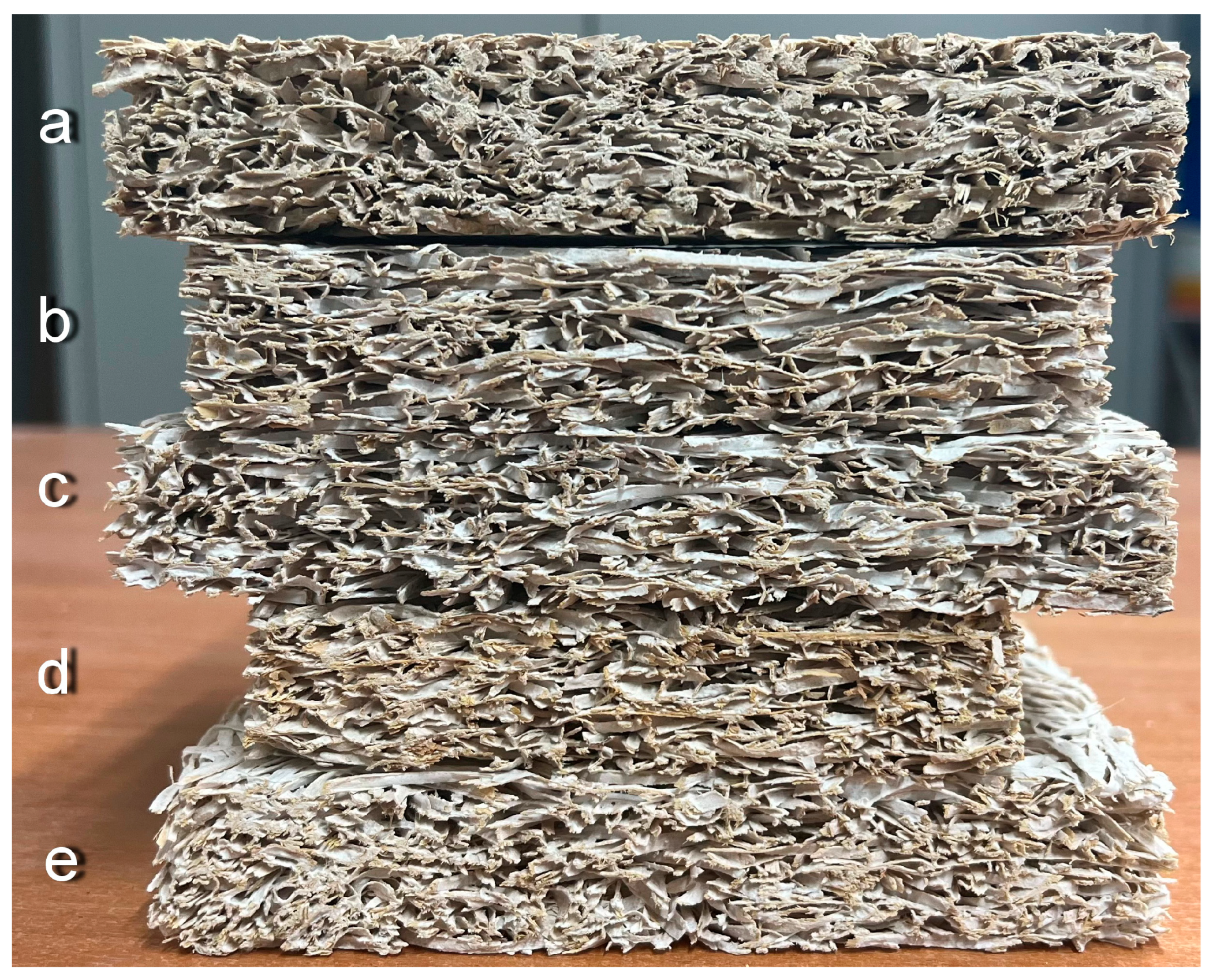
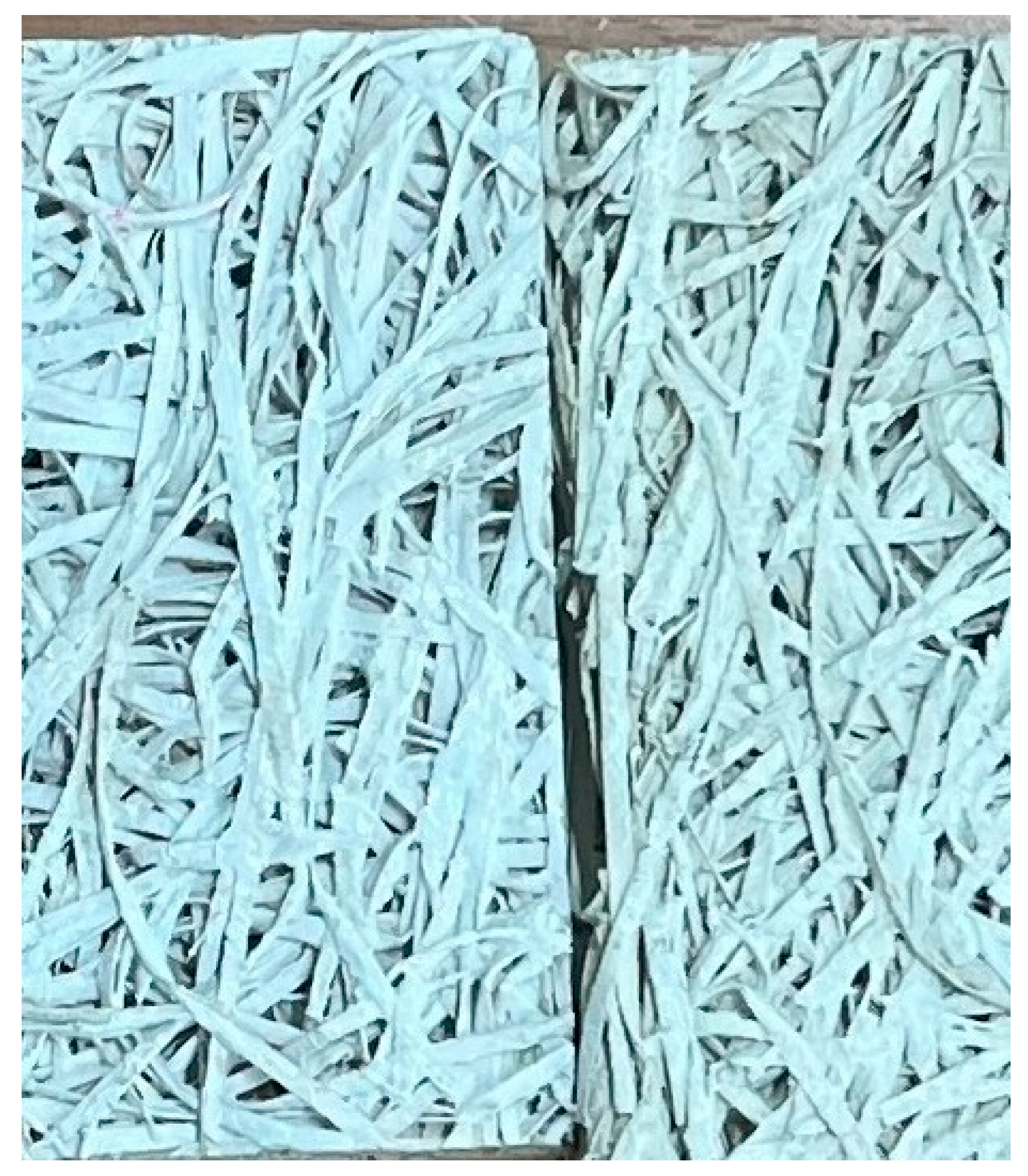
The cross-sections of the different kinds of samples are presented in Figure 2, where the bulk density varies from 380.5 to 495.5 kg/m3. A denser composition structure is observed in the sample with a higher volume density, which may be explained by the denser packing of the wood wool and a greater amount of mineral binder. The surface of the wood wool sampled made with CACB and ASB binders is presented in Figure 3.
Figure 2.
Cross-sections of the wood wool samples: (a) MOCB, bulk density: 380.5 kg/m3; (b) CACB, bulk density: 430.6 kg/m3; (c) CACB, bulk density: 380.3 kg/m3; (d) ASB, bulk density: 428.5 kg/m3; (e) WPC, bulk density: 495.5 kg/m3.
Figure 3.
Surface of the wood wool sampled made with CACB and ASB binders.
The physical-mechanical parameters of optimal wood wool samples with a thickness of 25 mm are presented in Table 9.
Table 9.
Physical–mechanical properties of optimised wood wool samples with a thickness of 25 mm.
The EN 634-2:2007 standard for cement-bonded particleboards [40] requires a density of 1000 kg/m3, a bending strength of 9 N/mm2, and a modulus of elasticity of 4500 N/mm2 for Class 1 boards. Comparing this with the experimental data for optimised wood wool samples of 25 mm thickness reveals some important differences. The experimental boards have densities ranging from approximately 389 to 484 kg/m3, which is less than half of the standard requirement of 1000 kg/m3. This indicates that the experimental composites are much lighter than the boards specified by EN 634-2. The standard requires a bending strength of 9 N/mm2, whereas the experimental boards exhibit flexural strengths ranging from 1.6 MPa to 2.24 MPa. This value is significantly lower than the standard (9 N/mm2 = 9 MPa). However, it is important to note that the experimental benchmark listed is ≥1.3 MPa, which the samples exceed. For Class 1 (general cement composites or normal-strength concrete), the standard requires a minimum of 4500 N/mm2. Experimentally, the moduli of elasticity range from 2600 to 4480 N/mm2, with some boards being close to, but generally lower than, the standard. The standard does not provide a direct compressive strength value here, but the experimental boards have values between 0.31 and 0.6 MPa, exceeding their benchmark of ≥0.3 MPa. The designed experimental boards demonstrate potential as low-density alternatives; however, they currently do not achieve the mechanical performance levels specified for cement-bonded particleboards in EN 634-2:2007.
The incorporation of MK and liquid glass significantly enhances the flexural strength of novel cementitious composites, with optimal compositions, particularly those featuring 20–30% MK, achieving strengths up to 2.65 MPa; this improvement is attributed to MK’s pozzolanic activity and densification effects, further amplified by liquid glass acting as filler, while high-energy disintegration pretreatment of MK contributes to improved reactivity [41]. However, resulting density increases must be carefully balanced against thermal insulation requirements for specific applications.
3.2. Effect of Binder Type (CAC, MOC, GCP vs. Portland Cement) on Durability and Thermal Properties
CAC enables rapid early strength gain, achieving high strength within 24 h, much faster than the 28 days required for PC [42]. This rapid curing contributes to faster construction cycles and improved early mechanical performance. CAC also offers excellent resistance to degradation under moist conditions due to its chemical composition, enhancing the panel’s durability in damp environments. Although specific thermal conductivity values are not provided, CAC’s rapid curing and chemical stability imply stable thermal behaviour during panel operation.
MOC cement exhibits excellent adhesion to organic fillers like wood wool, dramatically enhancing flexural and compressive strength, which improves impact resistance and overall panel structural performance [43]. MOC panels also demonstrate superior resistance to moisture, humidity, and mould growth, which provides enhanced durability, especially in wet and fire-prone environments. The superior mechanical strength results are supported by flexural strength values reported in the 1.4 to 2.0 MPa range. MOC has slightly lower thermal resistance compared to PC, which indicates a trade-off—the panels gain mechanical resilience but at the expense of minor insulation performance reduction. Additionally, MOC has a lower carbon footprint than PC, making it an environmentally attractive option.
The GCP binder synergistically combines gypsum, PC, and pozzolanic materials, resulting in rapid initial strength from gypsum and long-term strength from pozzolanic reactions with calcium hydroxide [44]. Compared to two-component systems, this leads to flexural and compressive strength improvements of up to 48–49%. The GCP system also mitigates shrinkage and cracking, significantly improving dimensional stability and moisture-drought resistance ratios. Moreover, it reduces the formation of deleterious compounds like ettringite and thaumasite [45], which enhances durability in sulphate-rich or humid environments. This makes GCP panels particularly well suited for challenging environmental conditions. While exact thermal values are not explicitly outlined for the GCP system, gypsum and pozzolan may influence thermal conductivity, balancing rapid initial strength and long-term stability.
PC is traditionally used for wood wool acoustic panels, with moderate mechanical and thermal performance, but comes with high CO2 emissions during production [46]. Thermal resistance and conductivity values for PC-based panels are reported as 0.35 m2-K/W and 0.066 W/m-K, respectively. These values serve as benchmarks to assess the alternative binders’ enhancements or trade-offs in thermal and mechanical properties.
3.3. Life Cycle Assessment (LCA) Calculations for Wood Wool Cement Panel
3.3.1. Core Components and Structure
All analysed acoustic panels follow a fundamental three-component structure: wood wool as the primary acoustic material, mineral binders for structural integrity, and chemical additives for processing optimisation. Wood wool, typically derived from sustainable forestry operations certified under FSC® or PEFC™ standards, comprises approximately 60% of the panel volume but minimises environmental impact across all formulations. The density of these panels ranges from 387.2 to 423.22 kg/m3, with variations primarily driven by binder composition and processing methods.
The fundamental challenge in acoustic panel design lies in striking a balance between performance requirements and environmental considerations. Wood wool provides excellent sound absorption properties due to its fibrous structure and natural porosity, creating air pockets that dampen sound waves. However, the binding system required to provide structural integrity, fire resistance, and durability represents the dominant environmental impact factor.
The seven panel types, considered for LCA, demonstrate diverse approaches to achieving structural bonding while maintaining acoustic performance:
- The reference cement–wood wool system, which employs standard PC CEM I 42.5 R, representing conventional construction practice with moderate environmental impact;
- A mineral–wood wool system with aluminosilicate systems, including metakaolin as a pozzolanic additive and white PC (CEM I 52.5 R);
- A mineral–wood wool system with aluminosilicate systems, including metakaolin as a pozzolanic additive and white PC (CEM I 52.5 R), where PC and MK were treated in the high-speed disintegrator at 2000 rpm;
- A mineral–wood wool system with magnesium chloride binders represents the most experimental approach, utilising MgO and MgCl2 to create alternative bonding;
- A mineral–wood wool system with CAC represents a speciality high-performance binder with superior fire resistance;
- A mineral–wood wool system with a three-component gypsum–cement–pozzolan (GCP) system.
3.3.2. LCA of the Binder System
The seven panel types, considered for LCA, demonstrate diverse approaches to achieving structural bonding while maintaining acoustic performance. The reference cement–wood wool system employs ordinary PC CEM I 42.5 R, representing a conventional construction practice with moderate environmental impact [47]. White PC formulations (CEM I 52.5 R) enhance aesthetic properties through their lighter colour but generate higher CO2 emissions due to more energy-intensive production processes.
Aluminosilicate systems incorporate MK as a pozzolanic additive, resulting in hybrid binder systems that may offer enhanced long-term durability. However, these formulations show varying environmental performance depending on whether disintegration treatments are applied during processing [47].
The CAC represents a speciality high-performance binder with superior fire resistance but significant environmental penalties.
The three-component gypsum–cement–pozzolan (GCP) system represents an innovative approach that combines multiple binding mechanisms to optimise performance and sustainability. Magnesium chloride binders represent the most experimental approach, utilising MgO and MgCl2 to create alternative bonding chemistry but resulting in the highest environmental impact among all options tested.
3.3.3. Carbon Footprint Analysis
The environmental assessment reveals that binder materials account for 95.3% to 98.2% of total carbon emissions across all panel types, with wood wool contributing only 2–3% to the overall environmental impact.
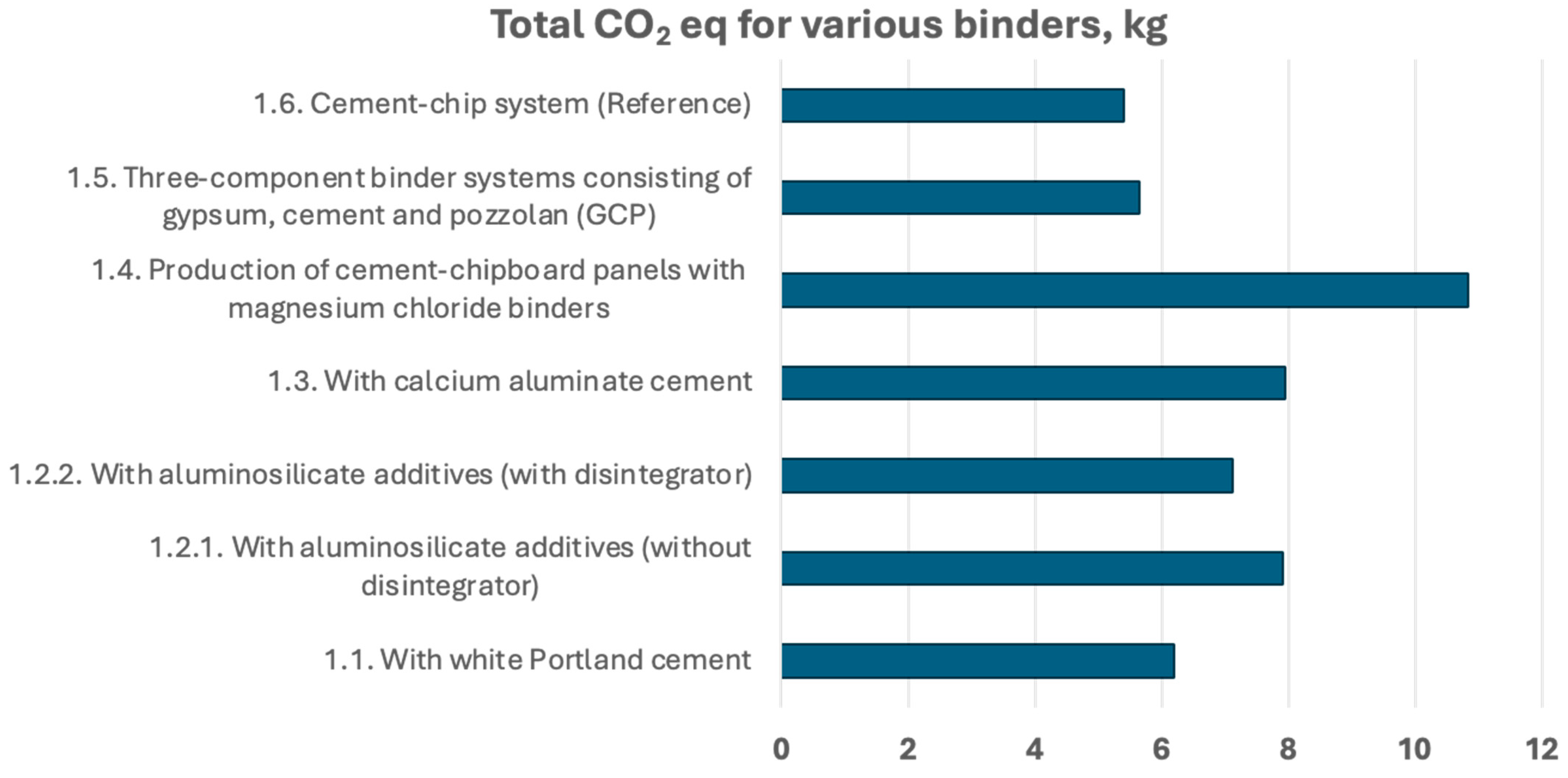
The reference cement–chip panels achieve the lowest environmental impact at 5.40 kg CO2 eq./m2, establishing a conventional acoustic panel production baseline. Three-component GCP systems perform similarly at 5.64 kg CO2 eq./m2, demonstrating that innovative multi-binder approaches can maintain competitive environmental performance while potentially offering enhanced functional properties.
White Portland cement panels generate 6.19 kg CO2 eq./m2, representing a 14.6% increase over the reference system, primarily due to the higher energy requirements for white cement production. This premium reflects the aesthetic benefits but questions the sustainability of appearance-focused material selections.
Aluminosilicate systems demonstrate variable performance, with disintegrator treatment reducing emissions to 7.11 kg CO2 eq./m2 compared to 7.92 kg CO2 eq./m2 without treatment. This suggests that processing modifications can provide meaningful environmental improvements, though both variants remain significantly above baseline performance.
CAC-based panels generate 7.94 kg CO2 eq./m2, the highest among PC-based systems, reflecting the specialised production requirements for this high-performance binder. While offering superior fire resistance and durability, the environmental cost raises questions about cost–benefit optimisation in standard applications (Figure 4).
Figure 4.
Comparison of CO2 emissions across different acoustic panel compositions, showing significant variation from 5.40 to 10.84 kg CO2 eq. per m2.
3.3.4. Worst-Case Environmental Impact
Magnesium chloride binder systems represent the environmental worst-case scenario at 10.84 kg CO2 eq./m2, contributing 100.8% higher emissions than the reference system. This dramatic increase is attributed to the energy-intensive production of MgO and MgCl2 components, as well as potential transportation impacts associated with these specialised materials. Despite potential advantages in specific applications, the environmental penalty makes these systems unsuitable for mainstream sustainable construction.
4. Discussion
4.1. Mechanical and Physical Property Enhancement Through Aluminosilicate/MOC/GCP Additives and Processing
Aluminosilicate additives, particularly MK combined with liquid glass, partially replace PC, contributing to significant improvements in composite strength and density. Mechanical activation through high-speed disintegration (up to 5000 rpm) dramatically enhances the pozzolanic activity of these additives by increasing the specific surface area through particle comminution and inducing structural changes in the additives and the cellulose fibres. This leads to denser packing and stronger interfacial bonding within the composite matrix. For instance, formulations containing 20–30% MK and liquid glass processed at 5000 rpm achieved peak flexural strengths of approximately 2.65 MPa and densities exceeding 490 kg/m3, a marked improvement compared to lower-strength, lighter-density samples without additives or with lower disintegration speeds (~1.09 MPa, 350 kg/m3).
Replacing PC with MOC binders provides rapid setting times and higher initial mechanical strength, facilitating shorter production cycles and earlier handling or installation. MOC-based panels exhibit excellent fire resistance and superior resistance to moisture, humidity, and mould, which prevent swelling, warping, or degradation in damp environments. MOC panels typically offer higher flexural and compressive strength than ordinary PC counterparts, enhancing structural resilience and impact resistance. These properties make MOC formulations particularly well suited for applications demanding durability under challenging environmental conditions.
The GCP binder leverages synergistic effects to enhance both mechanical performance and dimensional stability. The gypsum imparts rapid initial strength development, whereas pozzolan contributes to long-term strength gains by reacting with calcium hydroxide to produce additional cementitious compounds. This enhances water resistance and reduces degradation risks in wet environments. Experimental data have shown flexural strength increases of up to 48% and compressive strength improvements of up to 49% relative to two-component systems. Moreover, the system mitigates shrinkage and cracking, resulting in panels with superior dimensional stability and moisture-drought resistance ratios.
4.2. Improved Mechanical Resistance for Acoustic Panels Made with Wood Wool Filler and Alternative Binders
Improved mechanical resistance in acoustic panels made with wood wool filler is achieved primarily through alternative binders such as MOC and CAC. These binders provide several advantages over ordinary PC (Table 10).
Table 10.
Distinctive advantages of using MOC and CAC over PC.
4.3. Limitations and Suggestions for Further Optimisation and Industrial Scaling
Limitations and challenges for further optimisation and industrial scaling of acoustic panels with wood wool fillers and alternative binders are formulated in Table 11.
Table 11.
Limitations and challenges for further optimisation of wood wool panel.
In the current study, the focus was primarily on establishing baseline flexural and compressive strengths of wood wool composites with various binder systems and additives, assessed in short-term mechanical tests. Although direct experimental data on creep, fatigue, or impact resistance are not included in this work, we discuss the potential behaviour based on the composite microstructure and binder characteristics. The dense interfacial bonding achieved through mechanical activation and aluminosilicate additives, as well as rapid curing and superior fire and moisture resistance of alternative binders such as MOC and CAC, suggests enhanced structural stability that could positively influence resistance to deformation under sustained or cyclic loads. Furthermore, improved dimensional stability and reduced shrinkage afforded by the ternary gypsum–PC–pozzolan (GCP) system may help mitigate creep-related issues.
To fully address these long-term mechanical performance aspects, we recommend and plan to conduct dedicated creep and fatigue testing protocols, as well as impact resistance evaluations, in future work tailored to suspended panel applications. Such studies will complement our current findings and support reliable industrial scaling.
To comprehensively validate the acoustic performance of the developed wood wool panels with novel mineral binders, future experimental investigations will focus on acquiring standardised sound absorption coefficients in accordance with ISO 354 (measurement of sound absorption in a reverberation room) [48] and ISO 11654 (rating of sound absorption) [49]. These standardised methods provide repeatable and comparable acoustic characterisation that is critical for benchmarking material performance against existing commercial acoustic panels and for certification purposes.
4.4. Suggestions for Optimisation and Scaling
Enhance Water Resistance: Incorporate mineral additives, salts, or modified MgCl2 activators (e.g., magnesium sulphate substitution) to reduce hygroscopicity and improve the moisture resistance of MOC-based panels. Composite Design: Explore fibre hybridisation and the use of pozzolanic additives to optimise the strength-to-weight ratio. Surface Treatments: Apply sol–gel coatings or similar methods to stabilise thermal and acoustic properties under humidity fluctuations.
4.5. Life Cycle Assessment Outcomes
The LCA analysis of acoustic boards presented in this report reveals significant variations in environmental impacts depending on the binder composition used. Among the evaluated options, the binder system consisting of GCP demonstrated a relatively low total carbon footprint, with total CO2 equivalent emissions around 5.644 kg per functional unit, indicating an efficient combination in terms of climate impact. Conversely, systems based on magnesium chloride binders with MgO exhibited notably higher emissions, reaching total CO2 equivalents of up to approximately 10.84 kg due to the significant contribution of MgO and MgCl2 in raw material emissions. The white PC binder systems showed moderate impacts, with total emissions around 6.19 kg CO2 eq, mainly driven by cement production. The incorporation of aluminosilicate additives, with or without a disintegrator, led to somewhat higher impacts than the pure white PC binder case, primarily due to the contributions of MK. Overall, the three-component GCP binder system offers the best balance of mechanical performance and minimised environmental impact, making it the preferred choice among the studied compositions for sustainable acoustic board production. Key raw material contributors to the environmental load are cement (various types), MgO, MgCl2, and MK, highlighting the importance of optimising binder formulations to reduce carbon emissions.
5. Conclusions
This study has demonstrated the successful development of a new eco-innovative mineral binder system designed to produce acoustic panels with a significantly reduced carbon footprint compared to ordinary PC-based materials. The key findings include the following:
- Incorporating aluminosilicate additives, particularly MK and liquid glass, combined with a high-speed disintegration process (5000 rpm), significantly enhances the mechanical properties of wood particleboard composites. Samples containing 20–30% metakaolin and liquid glass achieved peak flexural strengths up to 2.65 MPa and densities exceeding 490 kg/m3, representing substantial improvements over control samples without additives.
- Alternative binder systems, such as CAC and MOC, were successfully evaluated, offering advantages in rapid curing, superior fire resistance, and enhanced moisture and mould resistance. These properties contribute to improved durability and broader application potential in environments prone to moisture and fire.
- The ternary binder system comprising gypsum, PC, and pozzolan (GCP) exhibited synergistic effects, improving flexural and compressive strengths by up to 48% and 49%, respectively; reducing shrinkage and cracking; and enhancing dimensional stability and water resistance of the panels.
- Contrary to earlier assumptions, life cycle assessment results reveal that MOC and CAC formulations exhibit higher embodied carbon than ordinary PC-based systems, with CO2 equivalent emissions of approximately 10.84 and 7.94 kg/m2, respectively, compared to 5.40 kg CO2 eq./m2 for the reference PC panel. This increase is mainly due to the energy-intensive production processes of MgO, MgCl2, and CAC. These findings highlight the importance of carefully balancing enhanced mechanical and fire-resistant properties against environmental impacts when selecting alternative binders for sustainable wood wool panel production.
- Process parameters such as precise dosing of water, optimised mixing techniques, and controlled curing regimes were instrumental in producing homogeneous composite mixtures, ensuring batch consistency and reliable material performance.
Author Contributions
Conceptualisation, A.K., V.L., and G.S.; methodology, A.K. and G.S.; software, V.L.; validation, A.K., I.P., J.P., V.L., and G.S.; formal analysis, A.K. and V.L.; investigation, A.K., I.P., J.P., V.L., and G.S.; resources, A.K.; data curation, A.K., I.P., J.P., and V.L.; writing—original draft preparation, V.L. and A.K.; writing—review and editing, A.K., I.P., G.S., J.P., and V.L.; visualisation, V.L. and A.K.; supervision, A.K.; project administration, A.K.; funding acquisition, A.K. All authors have read and agreed to the published version of the manuscript.
Funding
The financial support of the project “Development of a new eco-innovative composite material—Portland cement alternative binder for wood wool cement board (WWCB2) and the technology for its production to reduce carbon emissions”, Nr. 1.2.1.2.i.2/1/24/A/CFLA/004, is greatly acknowledged.
Data Availability Statement
The data presented in this study are available on request from the corresponding author due to the potential commercial use of the development.
Conflicts of Interest
The authors declare no conflicts of interest.
Abbreviations
The following abbreviations are used in this manuscript:
| CA/CACB | Calcium aluminate cement |
| MOC/MOCB | Magnesium oxychloride cement |
| GCP | Gypsum, cement, and pozzolan composition |
| ASB | Aluminosilicate without desintegrator |
| ASB-2 | Aluminosilicate with desintegrator, 2000 rpm |
| ASB-5 | Aluminosilicate with desintegrator, 5000 rpm |
References
- Botterman, B.; Doudart de la Grée, G.C.H.; Hornikx, M.C.J.; Yu, Q.L.; Brouwers, H.J.H. Modelling and Optimization of the Sound Absorption of Wood-Wool Cement Boards. Appl. Acoust. 2018, 129, 144–154. [Google Scholar] [CrossRef]
- Leewis, P. Things You Should Know About Wood Wool Cement Board|EcoMENA. Available online: https://www.ecomena.org/primer-wwcb/ (accessed on 18 September 2025).
- Aygun, H.; Gomez-Agustina, L.; Mundula, S. Acoustic Wave Propagation through Eco-Friendly Porous Panels at Normal Incidence. Build. Acoust. 2023, 30, 359–372. [Google Scholar] [CrossRef]
- Yin, C.; Li, X. Influence of Alkali Treatment on Properties of Bamboo Portland Cement Particle Board. ACS Omega 2022, 7, 16043–16048. [Google Scholar] [CrossRef]
- Sala, C.M.; Robles, E.; Kowaluk, G. Influence of the Addition of Spruce Fibers to Industrial-Type High-Density Fiberboards Produced with Recycled Fibers. Waste Biomass Valorization 2021, 12, 4033–4042. [Google Scholar] [CrossRef]
- Faktorová, D.; Stanciu, M.D.; Krbata, M.; Savin, A.; Kohutiar, M.; Chlada, M.; Năstac, S.M. Analysis of the Anisotropy of Sound Propagation Velocity in Thin Wooden Plates Using Lamb Waves. Polymers 2024, 16, 753. [Google Scholar] [CrossRef]
- Jorge, F.C.; Pereira, C.; Ferreira, J.M.F. Wood-Cement Composites: A Review. Holz Als Roh-Und Werkst. 2004, 62, 370–377. [Google Scholar] [CrossRef]
- Yu, Y.; Hou, J.; Dong, Z.; Wang, C.; Lu, F.; Song, P. Evaluating the Flammability Performance of Portland Cement-Bonded Particleboards with Different Cement–Wood Ratios Using a Cone Calorimeter. J. Fire Sci. 2016, 34, 199–211. [Google Scholar] [CrossRef]
- Claramunt, J.; Fernández-Carrasco, L.J.; Ventura, H.; Ardanuy, M. Natural Fiber Nonwoven Reinforced Cement Composites as Sustainable Materials for Building Envelopes. Constr. Build. Mater. 2016, 115, 230–239. [Google Scholar] [CrossRef]
- Doudart De La Grée, G.C.H.; Yu, Q.L.; Brouwers, H.J.H. Wood-Wool Cement Board: Potential and Challenges. In Proceedings of the 5th International Conference on Non-Traditional Cement and Concrete (NTCC2014), Brno, Czech Republic, 16–19 June 2014; pp. 279–282. [Google Scholar]
- Kozub, B.; Bazan, P.; Gailitis, R.; Korniejenko, K.; Mierzwiński, D. Foamed Geopolymer Composites with the Addition of Glass Wool Waste. Materials 2021, 14, 4978. [Google Scholar] [CrossRef] [PubMed]
- Miškinis, K.; Bliudžius, R.; Buska, A. Sound Insulation of Slabs in Dwellings. J. Phys. Conf. Ser. 2023, 2654, 012136. [Google Scholar] [CrossRef]
- Giannotas, G.; Kamperidou, V.; Stefanidou, M.; Kampragkou, P.; Liapis, A.; Barboutis, I. Utilization of Tree-Bark in Cement Pastes. J. Build. Eng. 2022, 57, 104913. [Google Scholar] [CrossRef]
- Sel, E.; Düzova, İ.; Gül, Z.S. From Waste to Design: The Potentials of Recycled Coffee, Tea Residue and Cardboard Cups as Acoustical Panels. In Proceedings of the 10th Convention of the European Acoustics Association Forum Acusticum 2023, Torino, Italy, 11–15 September 2023. [Google Scholar] [CrossRef]
- Kucukali-Ozturk, M.; Yalcin-Enis, I.; Sezgin, H. Development of 100% Recycled Thermoplastic Composites for Sound Insulated Acoustic Panels. Mater. Sci. Forum 2022, 1053, 352–357. [Google Scholar] [CrossRef]
- Kinasz, R.; Bilozir, V.; Shmyh, R.; Siltumens, K. Acoustic Performance of Panels Made from Recycled Polyester Fiber Derived from PET Bottles. IOP Conf. Ser. Earth Environ. Sci. 2025, 1474, 012011. [Google Scholar] [CrossRef]
- Ekbatani, S.; Rattanawongkun, P.; Klayya, S.; Papageorgiou, D.G.; Soykeabkaew, N.; Zhang, H. Hierarchical Natural Fibre Composites Based on Cellulose Nanocrystal-Modified Luffa Structures for Binderless Acoustic Panels. Polymers 2025, 17, 281. [Google Scholar] [CrossRef] [PubMed]
- Maderuelo-Sanz, R.; García-Cobos, F.J.; Sánchez-Delgado, F.J.; Meneses-Rodríguez, J.M.; Mota-López, M.I. Mechanical and Acoustical Evaluation of Bio-Based Composites Made of Cork Granulates for Acoustic Ceiling Tiles. Mater. De Construcción 2022, 72, e295. [Google Scholar] [CrossRef]
- Chojnacki, B.; Schynol, K.; Halek, M.; Muniak, A. Sustainable Perforated Acoustic Wooden Panels Designed Using Third-Degree-of-Freedom Bezier Curves with Broadband Sound Absorption Coefficients. Materials 2023, 16, 6089. [Google Scholar] [CrossRef]
- Pathak, A.; Ranjit, A.; Dhakal, B. Geopolymerization Behaviour of Red and White Clays. J. Nepal Chem. Soc. 2022, 43, 27–34. [Google Scholar] [CrossRef]
- Vyas, S.; Mohammad, S.; Pal, S.; Singh, N. Strength and Durability Performance of Fly Ash Based Geopolymer Concrete Using Nano Silica. Int. J. Eng. Sci. Technol. 2020, 4, 1–12. [Google Scholar] [CrossRef]
- Esparham, A. Investigation of the Effects of Nano Silica Particles and Zeolite on the Mechanical Strengths of Metakaolin-Based Geopolymer Concrete. Int. J. Innov. Eng. 2021, 1, 82–95. [Google Scholar] [CrossRef]
- Amoah, J.W.; Asante-Okyere, S.; Bentil, J.; Amoah, D.A.; Debrah-Pokuaa, E.; Yeboah, A.O. Improving the Sustainability of Oil Well Cementing Operations: Blending Portland Cement with Pozzolana. J. Ghana Inst. Eng. (JGhIE) 2023, 23, 76–81. [Google Scholar] [CrossRef]
- Almeida, F.; Cunha, V.M.C.F.; Miranda, T.; Cristelo, N. Indirect Tensile Behaviour of Fibre Reinforced Alkali-Activated Composites. Fibers 2018, 6, 30. [Google Scholar] [CrossRef]
- Alsaedy, S.M.; Aljalawi, N. The Effect of Nanomaterials on the Properties of Limestone Dust Green Concrete. Eng. Technol. Appl. Sci. Res. 2021, 11, 7619–7623. [Google Scholar] [CrossRef]
- Assi, L.N.; Anay, R.; Soltangharaei, V.; Ziehl, P. Effect of Partial Portland Cement Replacement on Geopolymerization Process and Mechanical Properties of Fly Ash-Based Geopolymer Concrete. In Proceedings of the Fifth International Conference on Sustainable Construction Materials and Technologies, London, UK, 14–17 July 2019. [Google Scholar]
- Namsone, E.; Sahmenko, G.; Namsone, E.; Namsone, E.; Korjakins, A. Research on Properties of Composites Based on Magnesium Binders. Environ. Technol. Resour. Proc. Int. Sci. Pract. Conf. 2019, 1, 192–197. [Google Scholar] [CrossRef]
- Sahmenko, G.; Puzule, L.; Sapata, A.; Slosbergs, P.; Bumanis, G.; Sinka, M.; Bajare, D. Gypsum–Cement–Pozzolan Composites for 3D Printing: Properties and Life Cycle Assessment. J. Compos. Sci. 2024, 8, 212. [Google Scholar] [CrossRef]
- Rawat, S.; Saliba, P.; Estephan, P.C.; Ahmad, F.; Zhang, Y. Mechanical Performance of Hybrid Fibre Reinforced Magnesium Oxychloride Cement-Based Composites at Ambient and Elevated Temperature. Buildings 2024, 14, 270. [Google Scholar] [CrossRef]
- Huang, T.; Yu, C.; Yuan, Q.; Liu, Z.; Deng, D. Effect of Alcohol Leachable Chloride on Strength of Magnesium Oxychloride Cement. J. Am. Ceram. Soc. 2020, 103, 5927–5938. [Google Scholar] [CrossRef]
- Wen, J.; Yu, H.; Xiao, X.Y.; Dong, J.M. Influence of Materials Ratio on the Hydration Process of Magnesium Oxychloride Cement. Mater. Sci. Forum 2015, 817, 180–184. [Google Scholar] [CrossRef]
- EN 826:2013—Thermal Insulating Products for Building Applications—Determination of Compression Behaviour. Available online: https://standards.iteh.ai/catalog/standards/cen/f54055a6-cacc-4d69-b85a-b190aea8ed7f/en-826-2013 (accessed on 31 October 2025).
- EN 12089:2013—Thermal Insulating Products for Building Applications—Determination of Bending Behaviour. Available online: https://standards.iteh.ai/catalog/standards/cen/a62fe23b-cc92-44c7-b6f0-5258a56497ef/en-12089-2013 (accessed on 31 October 2025).
- Chen, S.; Chen, Q.; Fan, H.; Liu, L.; Yan, Z.; Chen, Y.; Luo, L.; Li, J. Lightweight, Strong, and Sound Insulation Bio-Based Structural Material from Discarded Coconut Wood. Constr. Build. Mater. 2025, 458, 139765. [Google Scholar] [CrossRef]
- Pundienė, I.; Korjakins, A.; Pranckevičienė, J.; Kligys, M. Effect of Silicon Carbide Aggregate, Prepared by Different Methods, on the Properties of Refractory Concrete with Cenospheres. Ceram. Int. 2018, 44, 15944–15953. [Google Scholar] [CrossRef]
- Kalkan, Ş.O.; Gündüz, L. Silica Aerogel Added Lightweight Cement-Based Composite Mortars for Thermal Insulation Purposes in Sustainable Structures: A Comprehensive Study. Constr. Build. Mater. 2023, 409, 134066. [Google Scholar] [CrossRef]
- Nasreddine, H.; Salem, T.; Djerbi, A.; Dujardin, N.; Gautron, L. Durability and Hygrothermal Performance of Metakaolin-Based Geopolymer Composites Reinforced with Hemp Shiv and Miscanthus Fibers. Constr. Build. Mater. 2025, 494, 143461. [Google Scholar] [CrossRef]
- Pranckevičienė, J.; Pundienė, I. Use of Magnesium Silicate Contaminated with Organic Compounds in Ceramic Materials as a Pore Modifier. Materials 2022, 15, 8833. [Google Scholar] [CrossRef]
- Pundienė, I.; Pranckevičienė, J.; Kligys, M.; Kairitė, A.; Girskas, G. Effect of Adding Cenospheres on Heat-Resistant Lightweight Concrete Properties. Refract. Ind. Ceram. 2019, 59, 482–487. [Google Scholar] [CrossRef]
- EN 634-2:2007; Cement-Bonded Particleboards—Specifications—Part 2: Requirements for OPC Bonded Particleboards for Use in Dry, Humid and External Conditions. Available online: https://standards.iteh.ai/catalog/standards/cen/2c8ef11f-0882-4a80-98ae-c199f4913f44/en-634-2-2007 (accessed on 22 October 2025).
- Pundienė, I.; Pranckevičienė, J.; Kligys, M.; Girskas, G. Study of the Course of Cement Hydration in the Presence of Waste Metal Particles and Pozzolanic Additives. Materials 2022, 15, 2925. [Google Scholar] [CrossRef]
- Hongmei, J.; Hongwen, Y.; Zhiyong, F.; Longhui, S.; Shiyu, Z.; Yingliang, Z. Early Performance Modification of a Waste-Derived Super-Sulfated Cement from Arsenic-Containing Bio-Oxidation Waste via Calcium Aluminate and Calcium Sulfoaluminate Cement. Constr. Build. Mater. 2024, 441, 137529. [Google Scholar] [CrossRef]
- Chen, I.A.; Hargis, C.W.; Juenger, M.C.G. Understanding Expansion in Calcium Sulfoaluminate–Belite Cements. Cem. Concr. Res. 2012, 42, 51–60. [Google Scholar] [CrossRef]
- Rojas-Martínez, A.E.; González-López, J.R.; Guerra-Cossío, M.A.; Hernández-Carrillo, G. Sulphate-Based Activation of a Binary and Ternary Hybrid Cement with Portland Cement and Different Pozzolans. Constr. Build. Mater. 2024, 421, 135683. [Google Scholar] [CrossRef]
- Nguyen, V.H.; Leklou, N.; Aubert, J.E.; Mounanga, P. The Effect of Natural Pozzolan on Delayed Ettringite Formation of the Heat-Cured Mortars. Constr. Build. Mater. 2013, 48, 479–484. [Google Scholar] [CrossRef]
- Wang, S.; Yue, K.; Tian, Z.; Wei, C.; Wu, T.; Wu, P.; Li, Q.; Zhang, Z. Enhanced Fire Resistance in Light Wood Frame Walls Using Gypsum-Wheat-Straw Composites Sheathing. Constr. Build. Mater. 2024, 452, 138912. [Google Scholar] [CrossRef]
- Du, Y.; Korjakins, A.; Sinka, M.; Pundienė, I. Lifecycle Assessment and Multi-Parameter Optimization of Lightweight Cement Mortar with Nano Additives. Materials 2024, 17, 4434. [Google Scholar] [CrossRef]
- EN ISO 354:2004; Acoustics—Measurement of Sound Absorption in a Reverberation Room. ISO: Geneva, Switzerland, 2004.
- ISO 11654:1997; Acoustics—Sound Absorbers for Use in Buildings—Rating of Sound Absorption. ISO: Geneva, Switzerland, 1997. Available online: https://www.iso.org/standard/19583.html (accessed on 1 October 2025).
Disclaimer/Publisher’s Note: The statements, opinions and data contained in all publications are solely those of the individual author(s) and contributor(s) and not of MDPI and/or the editor(s). MDPI and/or the editor(s) disclaim responsibility for any injury to people or property resulting from any ideas, methods, instructions or products referred to in the content. |
© 2025 by the authors. Licensee MDPI, Basel, Switzerland. This article is an open access article distributed under the terms and conditions of the Creative Commons Attribution (CC BY) license (https://creativecommons.org/licenses/by/4.0/).