Article

Numerical Investigation on Effect of Chamfering on Mechanical Behaviors in Continuous Network Composite


1
Ningbo Global Innovation Center, Zhejiang University, Ningbo 315100, China
2
Institute for Composites Science Innovation (InCSI), School of Materials Science and Engineering, Zhejiang University, Hangzhou 310027, China
3
School of Materials and Energy, Foshan University, Foshan 528000, China
4
Institute of Intelligent Manufacturing Technology, Shenzhen Polytechnic University, Shenzhen 518055, China
*
Author to whom correspondence should be addressed.
Materials 2025, 18(20), 4810; https://doi.org/10.3390/ma18204810
Submission received: 17 September 2025 / Revised: 9 October 2025 / Accepted: 16 October 2025 / Published: 21 October 2025
(This article belongs to the Section Metals and Alloys)

Abstract

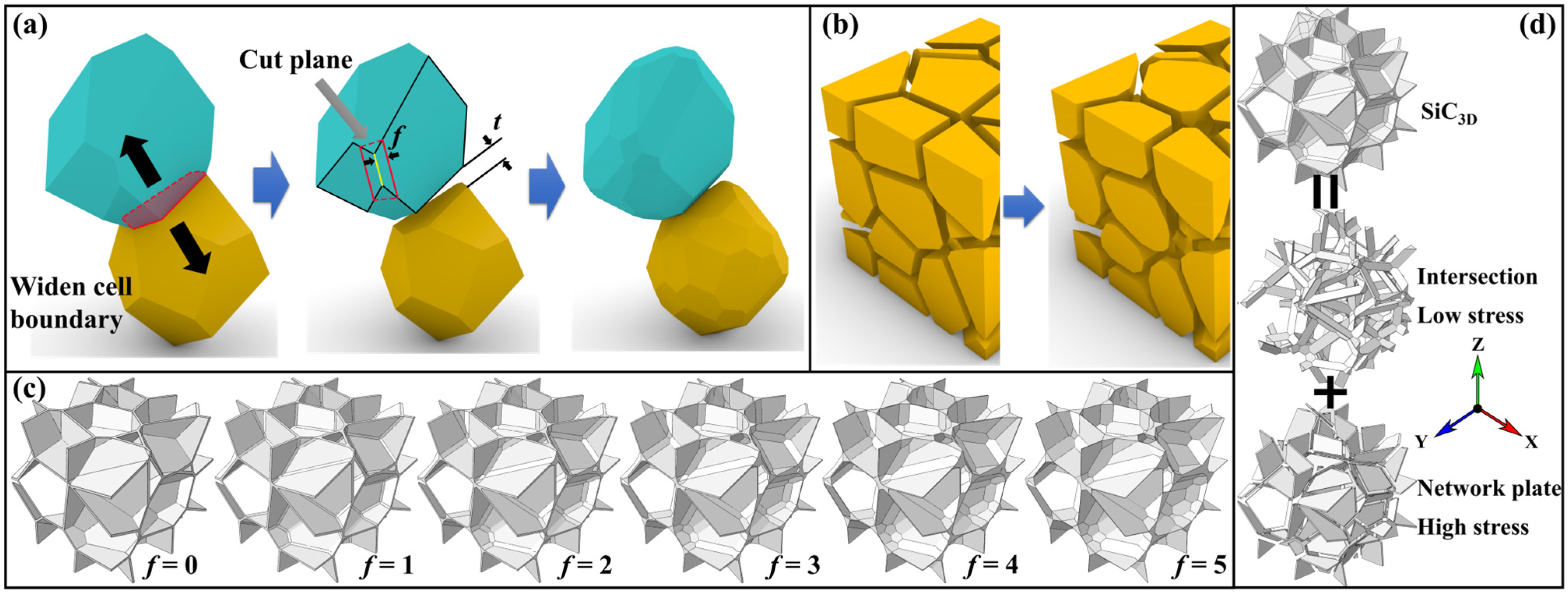
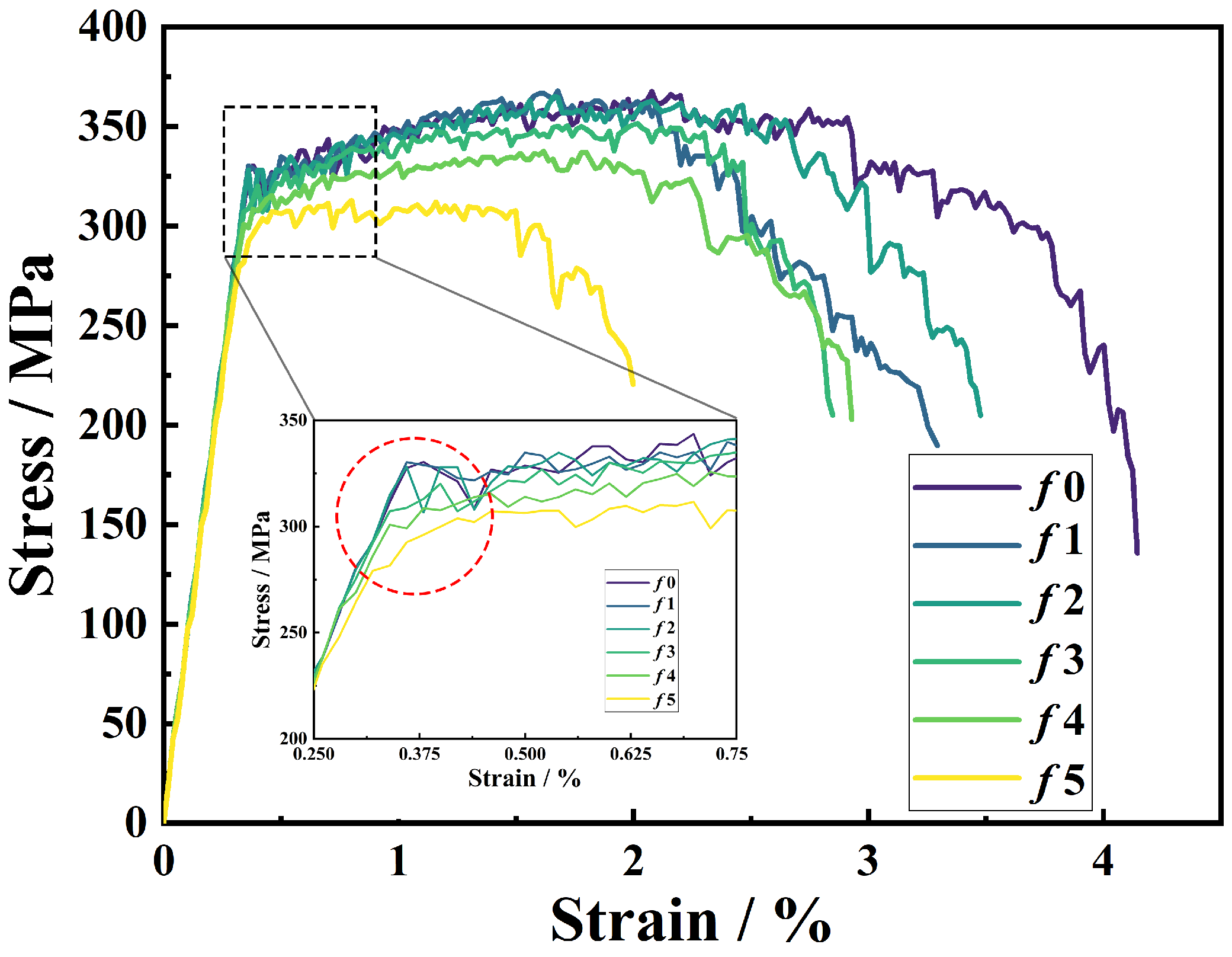
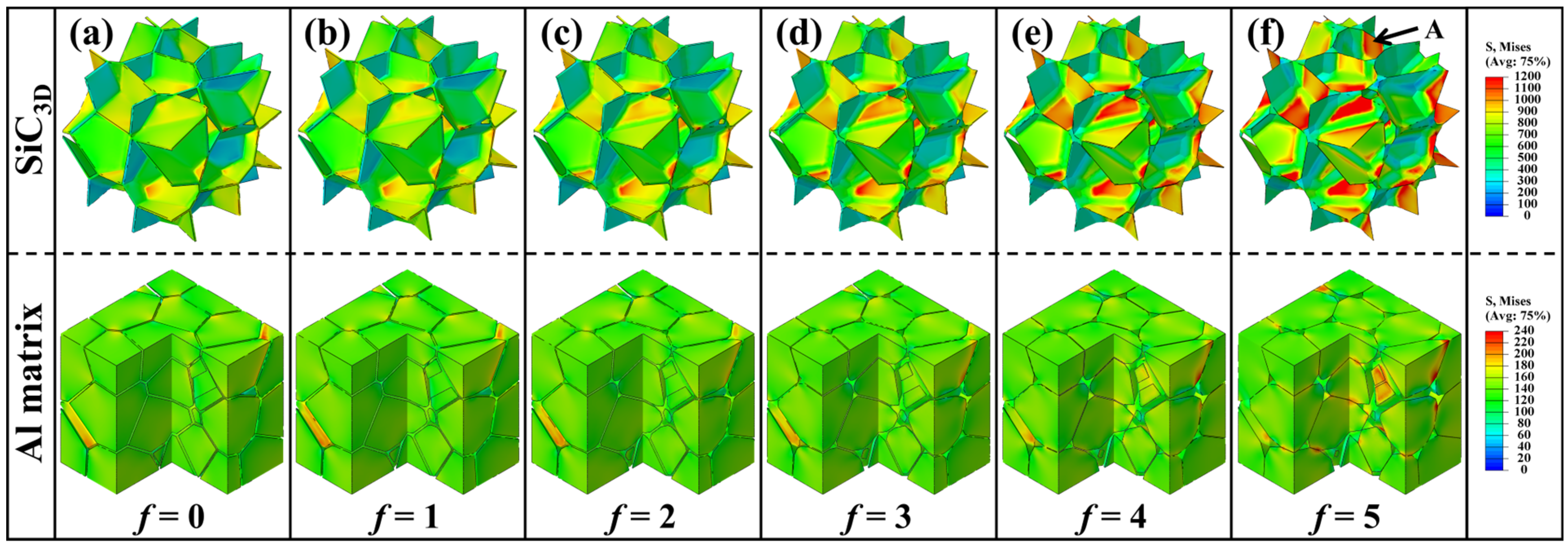
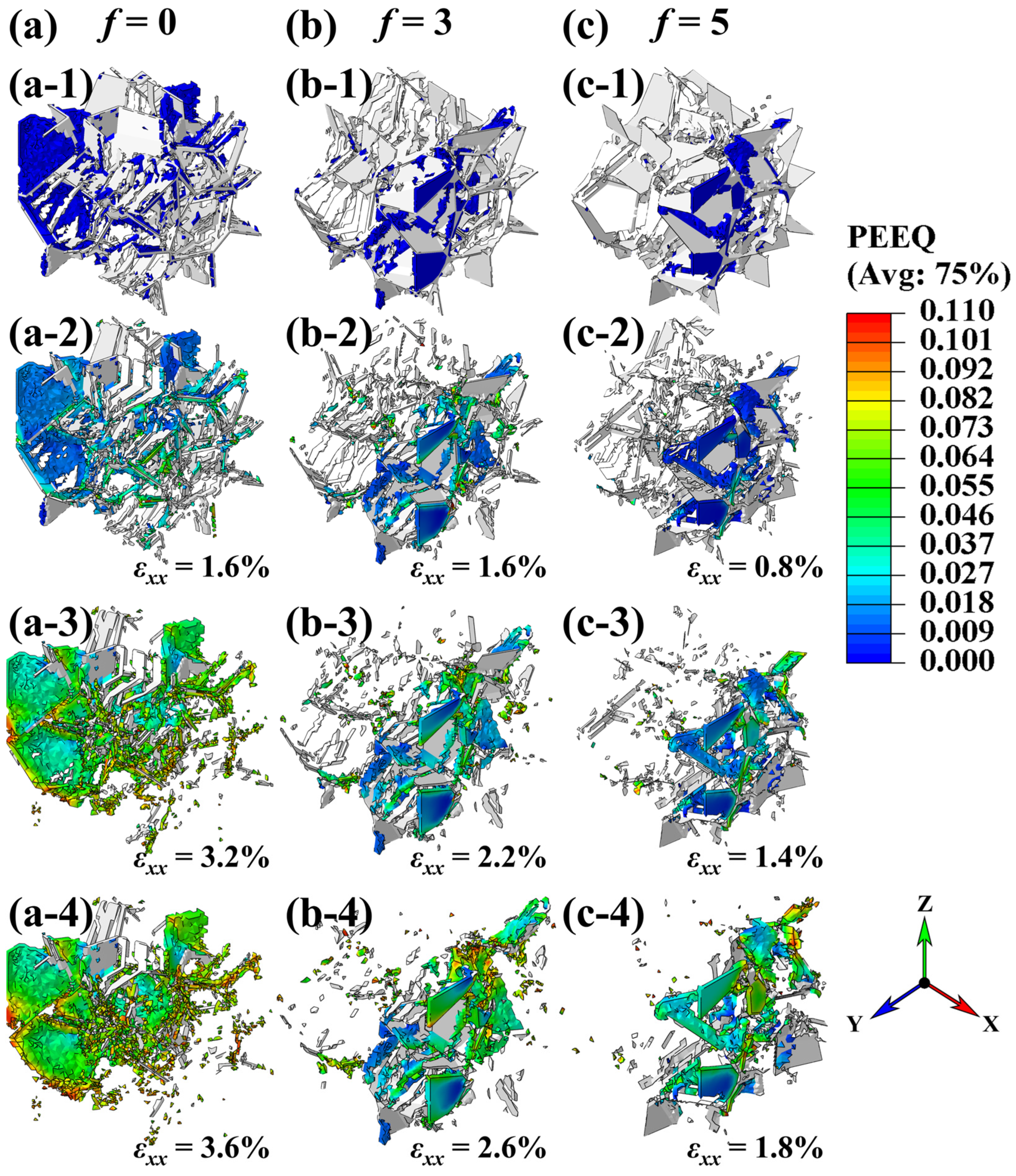
The network architecture has demonstrated considerable potential for enhancing the strength–ductility synergy in metal matrix composites (MMCs). Intuitively, the intersections of network layers are expected to induce a stress concentration, leading to premature brittle fractures. Introducing chamfers to round the network cells may mitigate the local stress concentration and thereby improve elongation. Here, a numerical simulation framework was developed to investigate the effect of chamfering on the mechanical behavior of a three-dimensional (3D) continuous SiC3D/Al composite with a network architecture. A Voronoi tessellation algorithm was employed to generate the continuous network structural SiC phase. By inducing ductile and brittle damage criterions in the matrix and reinforcement elements, respectively, the mechanical behavior can be predicted via the finite element method (FEM). The predicted mechanical properties reveal an unexpected trend: chamfering results in a simultaneous reduction in both strength (from 367 MPa to 312 MPa) and elongation (from 4.1% to 2.0%). With chamfering, the enlarged intersection of the network layer bears a lower load, whereas the narrower network plates exhibit higher stress concentrations. As a result, the overall load-bearing capacity of the SiC3D reinforcement decreases monotonically with an increasing chamfer size f. Furthermore, the non-uniform stress distribution promotes the premature fracture of the SiC3D, which reduces elongation. Additionally, the crack deflection behavior is suppressed in the chamfered models, leading to decreasing energy dissipation. This unanticipated outcome highlights an important architectural design principle: maintaining uniform geometric dimensions is critical for achieving optimal composite performance.
Keywords: metal-matrix composites (MMCs); Finite element analysis (FEA); network architecture; cell chamfering metal-matrix composites (MMCs); Finite element analysis (FEA); network architecture; cell chamfering