Article

Chitosan-Doped TiO2 Functionalized Asphalt Mixtures for NO2 Mitigation Under High Pollution Levels


by
Amanda Pontes Maia Pires Alcantara
1,
Larissa Virgínia Silva Ribas
1,2,
Débora Barbosa Silva
1,
Jairo Ivo Castro Brito
1,
Elisabete Fraga Freitas
3,*,
Francisco Wagner Sousa
4 and
Verônica Teixeira Franco Castelo Branco
1,*
1
Department of Transportation Engineering, Federal University of Ceará, Fortaleza 60440-900, Brazil
2
Department of Transportation and Geodesy Engineering, Federal University of Bahia, Salvador 40210-630, Brazil
3
Advanced Production and Intelligent Systems Associated Laboratory (ARISE), Department of Civil Engineering, Institute for Sustainability and Innovation in Structural Engineering (ISISE), University of Minho, Campus Azurém, 4800-058 Guimarães, Portugal
4
Department of Chemistry, Federal Institute of Ceará, Caucaia 60040-215, Brazil
*
Authors to whom correspondence should be addressed.
Materials 2025, 18(18), 4292; https://doi.org/10.3390/ma18184292
Submission received: 14 August 2025 / Revised: 4 September 2025 / Accepted: 9 September 2025 / Published: 12 September 2025

Highlights

  1. Chitosan-doped TiO2 composite reduced NO2 by 30%, remarkably under visible light;
  2. CS-TiO2 adhesion to asphalt surfaces increased by 18%;
  3. Low-cost sensors and reactor confirmed CS-TiO2 efficiency in NO2 reduction;
  4. CS-TiO2 has enhanced durability for urban air purification.

Abstract

Improving air quality is a significant environmental challenge. This research explored the potential of asphalt mixtures functionalized with a chitosan–TiO2 composite (CS-TiO2) to reduce high NO2 concentrations and improve durability. For the assessment of the photocatalytic efficiency of the new CS-TiO2 composite, a low-cost reactor adapted to accommodate asphalt Marshall-type specimens and high pollutant concentrations encompassing a passive sampling module was developed. The CS-TiO2 was synthesized using a wet impregnation method at a concentration of 2%, and asphalt mixtures were treated with aqueous solutions of the photocatalysts at 2.5 g/m2 and 5.0 g/m2. Laboratory tests using the photocatalytic reactor and passive sampling of NO2 revealed pollutant reductions of 21% with TiO2 and 28% with CS-TiO2. CS-TiO2 achieved 15% efficiency in visible light, reducing NO2 levels and offering UV protection to the asphalt mixtures. Additionally, the chitosan improved the photocatalyst’s adhesion by about 18%, as confirmed by tape test results, suggesting enhanced durability on pavement surfaces. The results achieved showcase the relevance of the proposed methodological improvements for supporting further research.

1. Introduction

The growing concern over air quality in urban areas has driven the search for solutions to mitigate atmospheric pollutants. Among these pollutants, nitrogen dioxide (NO2) stands out due to its adverse effects on human health and the environment [1]. NO2 is a critical air quality standard as it directly influences the formation of photochemical smog and particulate matter (PM2.5), as well as being a precursor to tropospheric ozone (O3) [1,2]. Moreover, there is a strong relationship between transport systems and air pollution. The transportation sector generates over 25% of global CO2 and 78% of NOx emissions [1]. High concentration and prolonged exposure to NO2 are associated with respiratory and cardiovascular diseases, making its mitigation a priority in environmental policies [3,4].
Environmental catalysis can become a crucial tool for promoting improvements in air quality. In this context, advanced oxidation processes (AOPs) are traditional in environmental depollution studies of aqueous matrices and have also been employed in research for the purification of industrial and agricultural gases [5,6,7]. AOPs are promising due to their reliability, cost-effectiveness, and safety as air depollution methodologies, as they directly degrade pollutants into less harmful substances without requiring additional steps [8].
Photocatalysis is a specific type of AOP in which a semiconductor material (or photocatalyst) converts solar energy into chemical energy to oxidize and reduce substances, transforming them into more useful forms. Among the existing semiconductors, TiO2 is one of the most used due to its strong oxidation capacity, ability to decompose organic pollutants, chemical stability, durability, non-toxicity, low cost, and availability in nature [9,10,11]. However, its energy absorption occurs preferably within the UV range (Eg = 3.2 eV ≈ 390 nm), which accounts for less than 5% of the solar spectrum. This limitation reduces the efficiency of these materials in applications utilizing natural light [12,13,14]. To overcome these limitations, surface modifications are often made to these materials through semiconductor doping to produce visible-light-sensitive photocatalysts [15].
Asphalt pavements are a suitable location for mitigating atmospheric pollutants due to their proximity to vehicle traffic and the extensive urban areas available [16,17,18]. This can be achieved by functionalizing these structures with semiconductor materials that act as photocatalysts to convert pollutants into less harmful substances, thereby reducing their availability in the atmosphere [19].
The semiconductor material can be incorporated into the asphalt mixture at two main stages of its construction: during asphalt mixture production or after compaction [20,21,22]. During production, photocatalysts can be included in the asphalt mixture as aggregates (filler) or dispersed in the asphalt binder. After compaction, they can be sprayed or spread as solutions on the pavement surface.
Functionalization after compaction typically results in a thin film deposited on the road’s surface. This approach improves radiation absorption and the adsorption of pollutant substances by the semiconductor, allowing for their chemical modification. This method achieves higher pollutant mitigation percentages than incorporation into the asphalt mixture; however, it also incurs significant losses of semiconductor material due to the low adhesion of photocatalysts to the pavement. In these types of functionalization, adhesion is primarily achieved through the physical anchoring of particles due to the natural roughness of pavement surfaces, with losses mainly occurring due to the modification of this surface layer caused by wind, rain, and traffic [17,23].
Besides TiO2, other types of photocatalysts have been tested to mitigate atmospheric pollutants using pavements as a substrate, including ZnO [24], g-C3N4 [25,26,27], TiO2/CeO2 composites [28], TiO2-Al2O3 [29], g-C3N4/TiO2 [25], as well as TiO2 doped with graphene [30] and metals like iron [31,32], copper [32,33], cerium [32,34], silver [35], and lanthanum [36]. Nevertheless, optimizing TiO2 doping strategies to enhance its photocatalytic performance remains an open field of research, in which the use of biobased materials presents a promising alternative due to their environmental appeal.
Environmental awareness has driven the search for green, renewable materials with less environmentally harmful processing routes. TiO2 can be incorporated into different organic matrices to form hybrid compounds with industrial and environmental potential [37]. Chitosan (CS) is an abundant biopolymer that has attracted attention in various fields due to its biodegradability, low cost, and wide applicability in composite materials [27,38].
Among the characteristics of CS, its adhesive properties are noteworthy, favoring its application as a bioadhesive [39,40] and its chemical compatibility with TiO2, which is used in composites for the photodegradation of aqueous pollutants (organic dyes) [41]. It has also been used to modify asphalt binder to produce asphalt emulsions [42,43]. These characteristics support the hypothesis that chitosan–TiO2 (CS-TiO2) composites could add new functionalities to asphalt mixtures, in terms of catalytic performance and adhesion improvement. Another relevant challenge concerns the methods used to evaluate or quantify photocatalytic efficiency.
The photocatalytic activity of these structures is commonly assessed in the lab through direct and indirect methods. The indirect method evaluates the efficiency of photocatalytic pavements immersed in aqueous solutions of organic dyes such as Rhodamine B, using photoreactors [23,34,44,45]. Despite its historical relevance, this approach is limited by the fact that it does not operate in the gas phase or involve the target pollutants (or adsorbates). The physicochemical properties of the species involved in the photocatalytic process influence the adsorbate–substrate interaction and, consequently, the surface dynamics during chemical reactions. This can lead to biased interpretations of results and misrepresent the expected performance of the technology in more realistic contexts.
The analysis of reaction products, or of the remaining concentration of the input pollutant, using chemiluminescence devices, chromatography, or electrochemical analyzers connected to the outlet of the photoreactors, is also a common approach in the testing of photocatalytic materials [35,46,47,48,49,50]. However, these analyses are time-consuming (in the case of chromatographic methods), costly, require specialized technical support, and cannot be conducted in situ where the materials are applied or during the actual service life of the structure. These analytical techniques are expensive and unsuitable for analyzing or quantifying pollutants—and therefore the photocatalytic process—in real-world scenarios.
Scientific efforts to develop alternative methods to certified protocols [49,50,51] for testing photocatalytic surfaces and evaluating their efficiency are diverse. For example, photocatalyst activity indicator inks (PAIIs) were developed using redox indicator dyes applied to photocatalytic surfaces. The change in color or discoloration correlates with the surface’s photoactivity and can be used in situ without requiring specialized equipment [52,53]. However, PAIIs are considered more qualitative than quantitative.
Other experimental setups have also been developed to facilitate photocatalytic testing in laboratories and to better align with specific research objectives [18,54,55,56]. The photocatalytic reactors currently available in the literature—including the ISO standard [50]—present significant limitations in terms of cost and adaptability to alternative analytical methods. Therefore, there is a clear need to develop an alternative photocatalytic reactor that prioritizes cost reduction and compatibility with diverse analytical techniques; it should be optimized for asphalt samples, such as Marshall specimens, and capable of treating various pollutant gases (NOx, SO2, and vehicle exhaust) at different concentrations. Therefore, there is a clear need to develop an alternative photocatalytic reactor that prioritizes cost reduction and compatibility with diverse analytical techniques.
In the laboratory, the concentration of the semiconductor and the influence of meteorological parameters can be simulated and evaluated using photocatalytic reactors specifically designed for this purpose. Several studies in the literature utilize ASTM D5116 [49], ISO 22197-1 [50] and JIS R 1701-1 [51], and photoreactors or adaptations thereof to test the performance of materials developed or synthesized for atmospheric pollutant mitigation [30,35,46,47,48].
Adapted photoreactors aim primarily to reduce the experimental costs of research, adapt the experimental conditions for the tested materials based on the understanding of the phenomenon, and vary relevant conditions for each use, creating alternative routes to obtain insights into the properties of tested materials during the laboratory phase.
The review performed unveils several main research gaps, such as the limited adhesion of photocatalytic films to asphalt surfaces, the low visible-light absorption of TiO2, the scarcity of biobased dopants that enhance both photocatalytic and adhesive properties, and the absence of cost-effective and versatile testing setups for photocatalytic efficiency under realistic gas-phase conditions. Moreover, current evaluation methods often do not reflect actual field conditions, making it difficult to assess the true performance of photocatalytic materials applied to pavements. This research aims to enhance the state of the art on: the development of hybrid chitosan–TiO2 composites to improve photocatalytic degradation of NO2 under simulated high-pollution environments; the adhesion performance of these composites when applied to asphalt pavements; the design and application of a low-cost, adaptable photocatalytic reactor compatible with different pollutant gases and analytical methods; and provide answers to the following questions:
  • Can chitosan doping improve both surface adhesion and the photocatalytic activity of TiO2 when applied to asphalt pavements?
  • How effective is the proposed functionalization in reducing NO2 concentrations under controlled gas-phase conditions using the adapted reactor?
The expected impacts are environmental and societal by using eco-friendly solutions and reducing harmful pollutants in the air through an accessible and scalable photocatalytic strategy. The proposed chitosan–TiO2 composite not only contributes to urban air quality improvement by targeting NO2, a critical and hazardous pollutant, but also incorporates a renewable biopolymer, aligning with circular economy and green chemistry principles.
Additionally, by developing a low-cost and customizable reactor for pollutant abatement tests, this research democratizes access to advanced testing methodologies, especially for research groups with limited resources. The outcomes may support public policy and infrastructure planning focused on sustainable urban mobility and climate change mitigation, especially in densely populated or high-traffic regions facing air quality challenges.

2. Materials and Methods

2.1. Overview

The following methodology was developed to investigate the research questions mentioned in the previous section (introduction). A schematic flowchart illustrating the overall methodology is provided in Figure 1 to facilitate the visualization of the sequential steps. Initially, the TiO2–chitosan composite was synthesized and characterized. These specimens were then functionalized by applying a solution containing the synthesized composite. Subsequently, the specimens were evaluated for adhesiveness, using the adhesion test, and for their photocatalytic activity in degrading high concentrations of NO2, employing an alternative, low-cost reactor specifically designed for this purpose.

2.2. Synthesis and Characterization of the CS-TiO2 Composite

A commercial high degree of purity TiO2 (Eleven Box®, Barueri, SP, Brazil) in the anatase phase was modified with low-molecular-weight chitosan (CS; 50,000–190,000 Da or >75%) (Sigma-Aldrich®, St. Louis, MO, USA) to produce the CS-TiO2 composite. The CS was incorporated into the TiO2 at a concentration of 2%, following an adapted methodology from Zubieta et al. [57], who utilized a wet impregnation method for surface modification of TiO2 with CS.
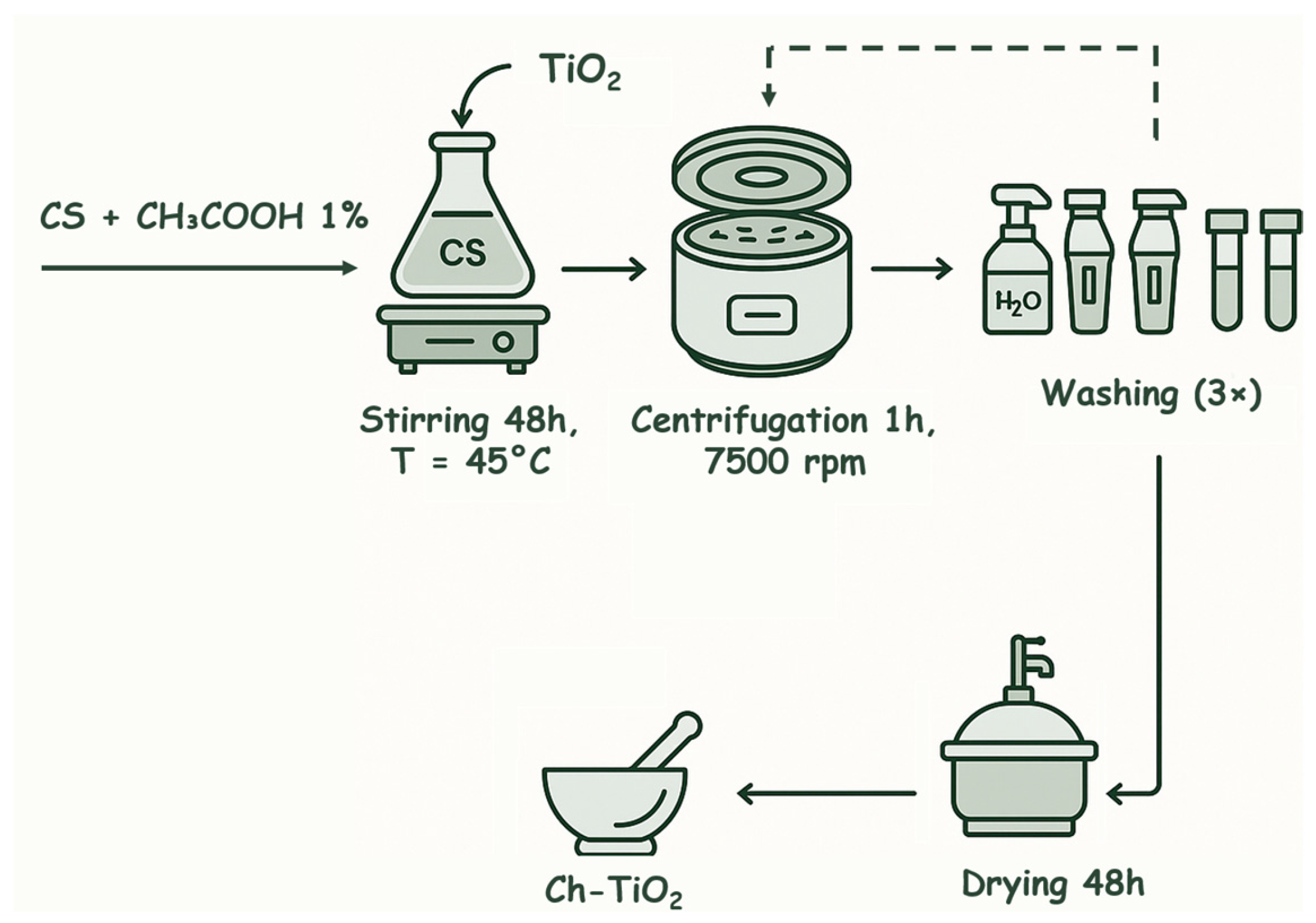
Therefore, CS was dispersed in 20 mL of diluted acetic acid (CH3COOH, 1% v/v; Dinamica®, Indaiatuba, SP, Brazil) to achieve a 2% (w/w) CS concentration in TiO2. After the complete dissolution of CS, 1 g of TiO2 was added, and the mixture was stirred vigorously at 45 °C for 48 h. The mixture was then centrifuged at 7500 rpm for 1 h (Centrifuge 5430; Eppendorf®, São Paulo, SP, Brazil) to achieve phase separation and isolate the synthesized composite. After centrifugation, the supernatant was removed, and distilled water (H2O) was used for sequential washing of the material to eliminate residual acid. The centrifugation process was repeated after each wash. The final solid (CS-TiO2) was dried in a vacuum desiccator for 48 h and subsequently ground to achieve disaggregation. The final product was not calcined to preserve the CS within the material’s composition. Figure 2 presents the process flow for the synthesis of the CS-TiO2 composite.
A set of analytical techniques was employed to characterize the synthesized composite. The surface morphology of the samples was analyzed using scanning electron microscopy with an energy dispersive detector (SEM-EDX) (Quanta 450 FEG, FEI®, Hillsboro, OR, USA). Structural analysis was conducted using X-ray diffraction (XRD) in powder mode with a D8 Advance diffractometer (Bruker Optics®, Billerica, MA, USA), using CuKα radiation (λ = 1.5406 Å), at 40 mA and 40 kV in Bragg–Brentano geometry. For particle size distribution and zeta potential measurements, 0.25 mg of TiO2 or CS–TiO2 was dispersed in 10 mL of ultrapure water (0.025 mg/mL), followed by 10 min of sonication. Particle size was measured using 900 μL of each suspension in polystyrene cuvettes (1 cm × 1 cm), while zeta potential was determined using capillary cuvettes (DTS1070, Malvern Panalytical®, Malvern, Worcestershire, UK), both analyzed in a Zetasizer Nano ZS (Malvern Panalytical®, Malvern, Worcestershire, UK). FT-Raman spectroscopy was performed using compressed powder samples in a VERTEX 70 spectrometer (Bruker Optics®) equipped with a Ram II module and an infrared laser (1064 nm). Scattered light was detected by a germanium detector, and spectra were recorded from 40 to 4000 cm−1 at room temperature to capture both low- and high-wavenumber Raman-active modes. Finally, FTIR spectroscopy was carried out in vacuum using a VERTEX 70 V spectrometer (Bruker Optics®, Billerica, MA, USA) with a Globar source for mid-infrared (MIR) and DLaTGS detectors. The system featured a HeNe laser (λ = 633 nm) for optical path calibration, operated at 2 cm−1 resolution with 128 scans and a wide-range Si beam splitter for MIR analysis. The use of vacuum enhanced the detector sensitivity.

2.3. Functionalization of Asphalt Mixture Specimens

The specimens used for functionalization consisted of hot mix asphalt (HMA) with a binder content (penetration grade 50/70 bitumen) of 4.5%. Aqueous solutions for functionalizing the specimens were prepared to deposit either 2.5 g/m2 or 5.0 g/m2 of the photocatalyst onto the surface. These application rates were selected based on previous literature and were inspired particularly by Wang et al. [54], who evaluated these concentrations as optimal for the degradation of vehicle exhaust gases using TiO2. Therefore, 0.08 g or 0.16 g of TiO2 or CS-TiO2 were dispersed in 2.5 mL of distilled water, and the solutions were applied using a paintbrush for surface coating.

2.4. Adhesion Test Method

To test the adhesion of the photocatalysts to the specimens, an adapted “tape test” method was used, based on ASTM D3359 [58] and ISO 2409 [59] standards. These standards assess the area detached from a coating film after abrupt peeling using adhesive tape applied over an “X” incision marking the evaluation area. There are no sufficiently rigorous tests for this specific purpose; however, the proposed method, although quick, is used in other areas and has already been used on pavements as well.
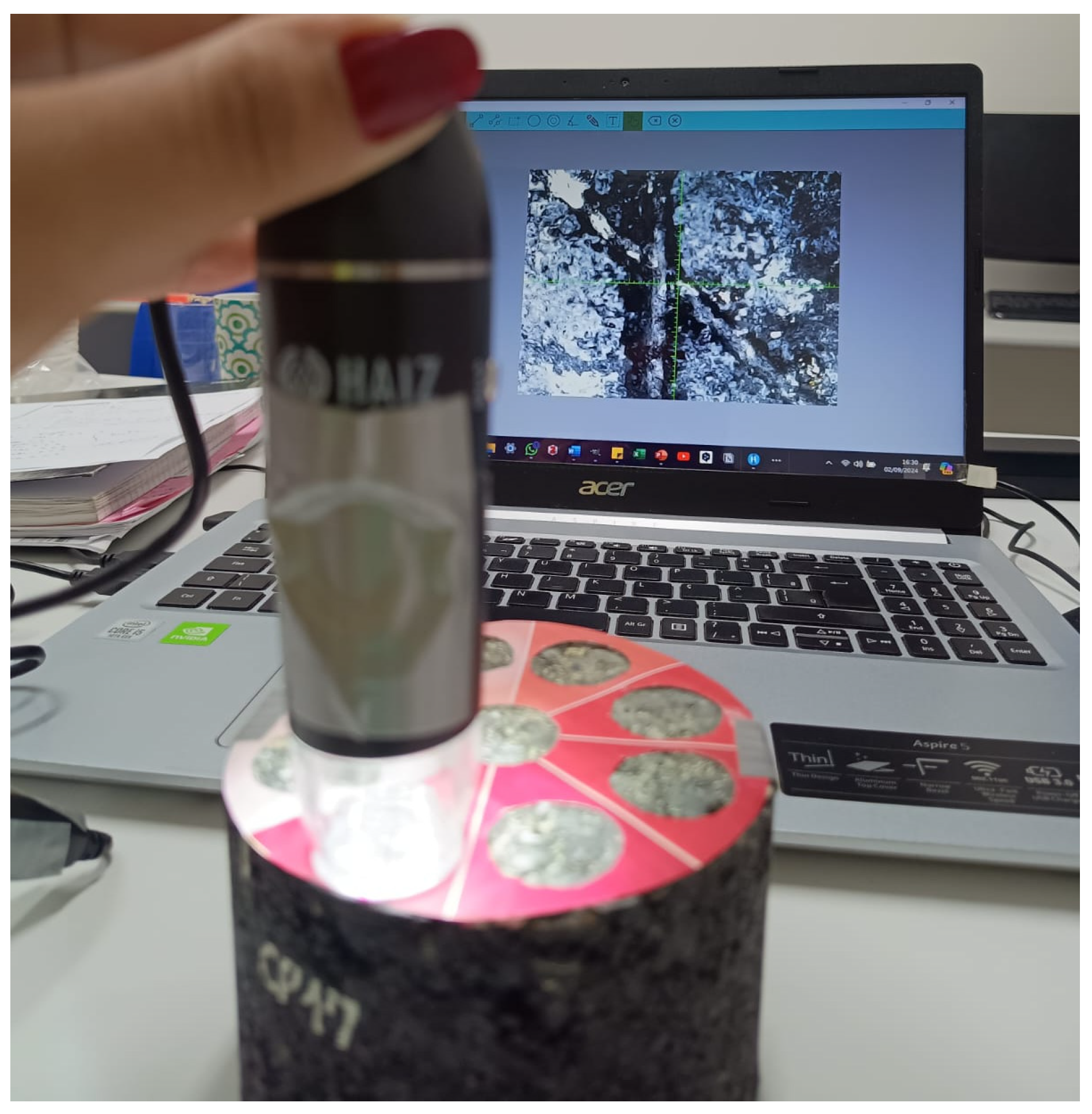
The test method involved evaluating the coating’s adhesion to the substrate by peeling off a transparent adhesive tape (model: polyester filament tape; brand: tesa SE®, Norderstedt, Schleswig-Holstein, Germany) with a width of 25 mm and adhesion strength of 9 N/cm on a steel plate. The specimen surfaces were analyzed using digital image processing (DIP). Images were obtained before and after the tape test using a USB digital microscope (model: Hz-1600X; brand: HAIZ®, Indaiatuba, SP, Brazil) (Figure 3). All images were captured using the device’s software (HiView20230724®, HAIZ®, Indaiatuba, SP, Brazil).
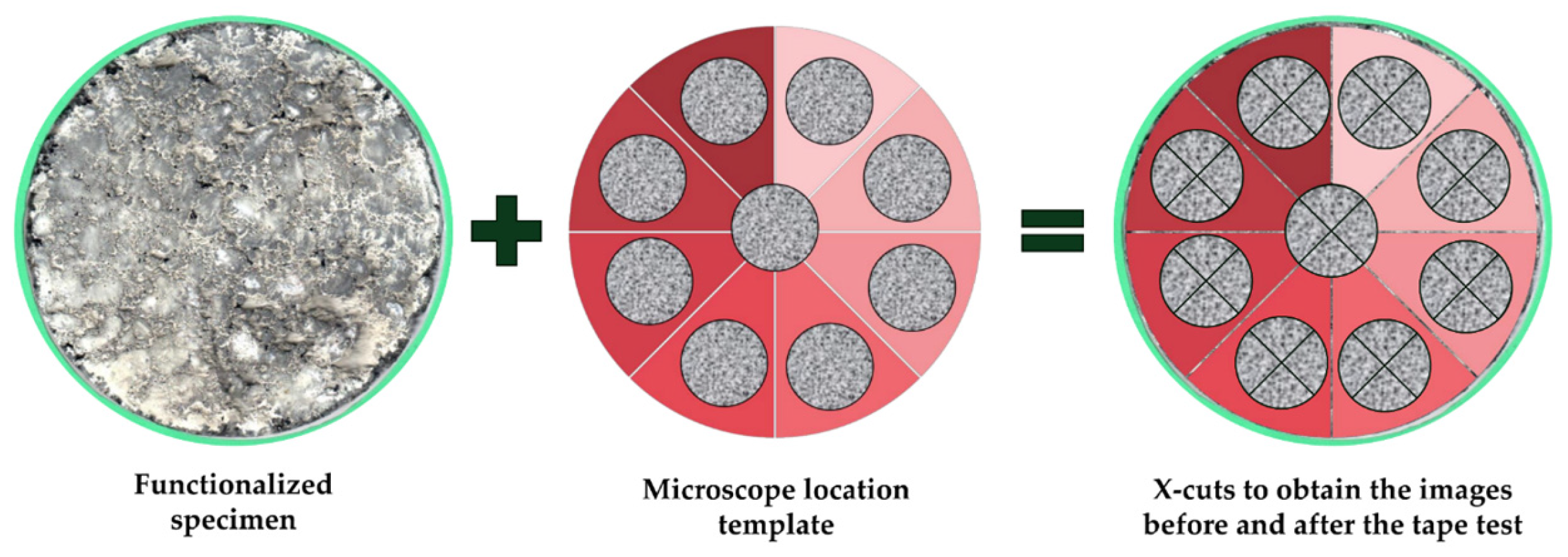
To standardize the area analyzed in DIP for the specimens, a cylindrical template with nine internal circles of 22 mm in diameter was used to capture images at the center of the “X” incision (Figure 4). The standards recommend choosing an area with minimal roughness for making the “X” incision, where the filament tape is applied for the peeling test and visual analysis of the detached area. Therefore, the internal circles were designed to select the ideal area for performing the “X” incision and adhesion test.
Subsequently, ImageJ® software (version 1.54g, National Institutes of Health, Bethesda, MD, USA). was used to calculate the percentages of the area initially covered by the photocatalyst and the remaining content on the specimen after the tape test, quantifying the area removed. DIP analyses have already been used in studies on the adhesion of materials, both for paints [60] and binder–aggregate systems [61].
Three images were taken in each chosen circle, and the microscope was repositioned between each capture. This procedure was repeated for three circles for each specimen. Additionally, the zoom, focus, and lighting of the microscope were kept constant during all image acquisitions. The photocatalyst loss was measured based on an adaptation of the adhesion test classification table outlined in ASTM D3359 [58].

2.5. Photocatalytic Testing Setup

The photocatalytic efficiency of the tested materials in reducing NO2 was assessed using a photocatalytic reactor specifically designed to analyze functionalized asphalt pavement samples. The reactor was adapted from ISO 22197-1 [50] to test cylindrical HMA specimens (Marshall-type) and to modify gas analysis and quantification methods, since acquiring a standardized reactor is generally expensive. Additionally, ISO-type reactors generally use rectangular reaction chambers; therefore, they are unsuitable for testing ordinary cylindrical specimens, which are most used in dosage, mechanical characterization, and extraction of field samples of HMA [62,63].
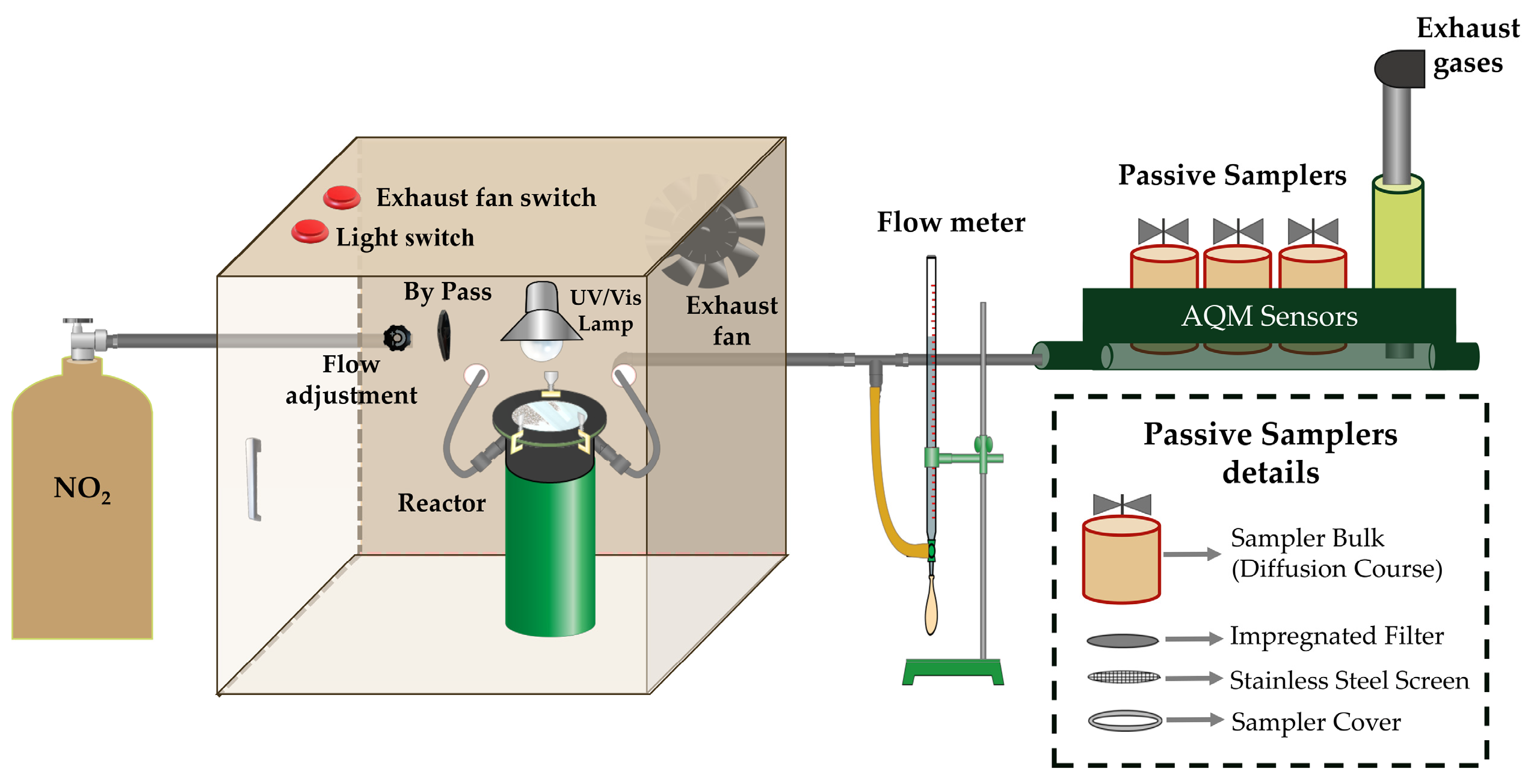
The system (Figure 5) included a NO2 cylinder with a standard concentration of 500 ppm NO2 balanced in helium (NO2/He), a nitrogen (N2) cylinder for diluting the input gas, a bubbler flask for humidity simulation, a cylindrical stainless-steel reaction chamber with a quartz window, UVC (5 W) and visible (25 W) lamps, a thin-film linear flow meter, flow control valves, and an exhaust unit. The specimen and quartz window were separated by a 5 mm ± 0.5 mm air gap through which the test gas flowed. Additionally, cost-effective methods were employed to monitor the photocatalytic reaction in the laboratory. The high-cost chemiluminescence analyzers were replaced with a multi-component detection system capable of using simultaneous qualitative and quantitative methods at medium/low costs. This system integrates several passive samplers and an air quality monitor (AQM) with low-cost sensors. The reactor was constructed using materials with low adsorption and UV resistance properties.
The passive sampling of NO2 was adapted from the methodologies proposed by [63,64,65,66,67]. Cellulose filters with a diameter of 25 mm were pre-washed in an ultrasonic bath using distilled water (H2O) and, subsequently, with methanol (MetOH) (NEON®, Suzano, SP, Brazil), in triplicate for both solvents. After drying, the filters were impregnated with 100 µL of a selective absorbing solution for NO2, composed of 0.5 mol·L−1 potassium iodide (KI) (Dinamica®, Indaiatuba, SP, Brazil) and 0.2 mol·L−1 potassium hydroxide (KOH) (Dinamica®, Indaiatuba, SP, Brazil) in methanol (NEON®, Suzano, SP, Brazil). Following complete drying in a vacuum desiccator, the filters were placed into the samplers housed in the reactor’s outlet box.
In a subsequent step, NO2 determinations on the collected filters were performed using a spectrophotometric method adapted from Saltzman [68]. Each filter was transferred to a Falcon tube, and 6 mL of a Griess–Saltzman reagent solution was added. This solution consists of 0.5% (w/v) sulfanilamide (NEON®, Suzano, SP, Brazil), 9% (v/v) phosphoric acid (H3PO4(Dinamica®, Indaiatuba, SP, Brazil), and 0.005% (w/v) N-(1-naphthyl)-ethylenediamine dihydrochloride (NEDA) (Sigma-Aldrich®,St. Louis, MO, USA).
The tubes containing the filter and reagent solution were homogenized using a vortex mixer (model: K45-2810 KASVI®, Pinhais, PR, Brazil) for 20 s. After 15 min, the supernatant was analyzed using a UV-Vis spectrophotometer (model: Specord 250 Analytik Jena®, Jena, Thuringia, Germany), configured to read the samples at 540 nm. The concentrations of NO2 in the monitored environment were calculated by applying Fick’s law according to Equation (1), where C is the concentration of NO2 in the air (µg·m−3), m is the mass of the analyte obtained from the UV-Vis analysis (µg), L is the length of the diffusion path (m), D is the molecular diffusion coefficient of NO2 (m2·h−1), A is the cross-sectional area of the passive sampler (m2), and t is the sampling time (h).
C = m × L D × A × t
The AQM was developed at the Transportation and Environment Laboratory (TRAMA) at the Federal University of Ceará. The AQM includes calibrated sensors to measure NO2, temperature, and humidity: the MiCS-6814 sensor (SGX Sensortech®, Shanghai, China) for NO2 detection and the BME280 sensor (Bosch®, Gerlingen, Baden-Württemberg, Germany) for temperature and humidity measurements (Table 1).
For the photocatalytic tests, fixed parameters of NO2 concentration (500 ppm), humidity (50%), temperature (25 °C), irradiance (20 W/m2), and gas flow rate (100 mL.min−2) were set. The initial NO2 concentration was set at 500 ppm to test efficiency under extreme gas concentration conditions, well above current legislation; humidity (%) was set at 50% because it is the typical minimum humidity for the city of Fortaleza during the dry season. The temperature was set at 25 °C because increasing the temperature could alter the chemical composition of the asphalt binder, and irradiance was set at 20 W/m2 to ensure adequate photocatalyst activation and avoid excessive thermal effects. The reactor gas flow rate was set at 0.1 L.min−1 based on the findings of the study by Mikyskova et al. [69], which demonstrated higher photocatalytic efficiency at lower space velocities than that proposed by ISO 22197-1 [50], which is 3 L.min−1. Additionally, two photocatalytic materials—TiO2 and CS-TiO2—were tested at two different application rates (2.5 and 5.0 g.m−2) under two radiation wavelengths (UV and visible) to assess the influence of flow and radiation on pollutant reduction. The influence of these variables on the pollutant degradation efficiency of the photocatalytic pavements was evaluated using a factorial design, optimizing experimental conditions to assess the effects of variables on NO2 conversion simultaneously (Table 2).
The photocatalytic conversion was subsequently calculated according to Equation (2), where: η is the NO2 conversion efficiency; Ci and Cf represent the concentration of the pollutant (in ppm) at the beginning (after 1 h without exposure to light) and at the end (after 1 h of exposure to light) of the photocatalytic process, respectively.
η % = C i C f C i × 100

3. Results

3.1. Characterization of the Synthesized Photocatalysts

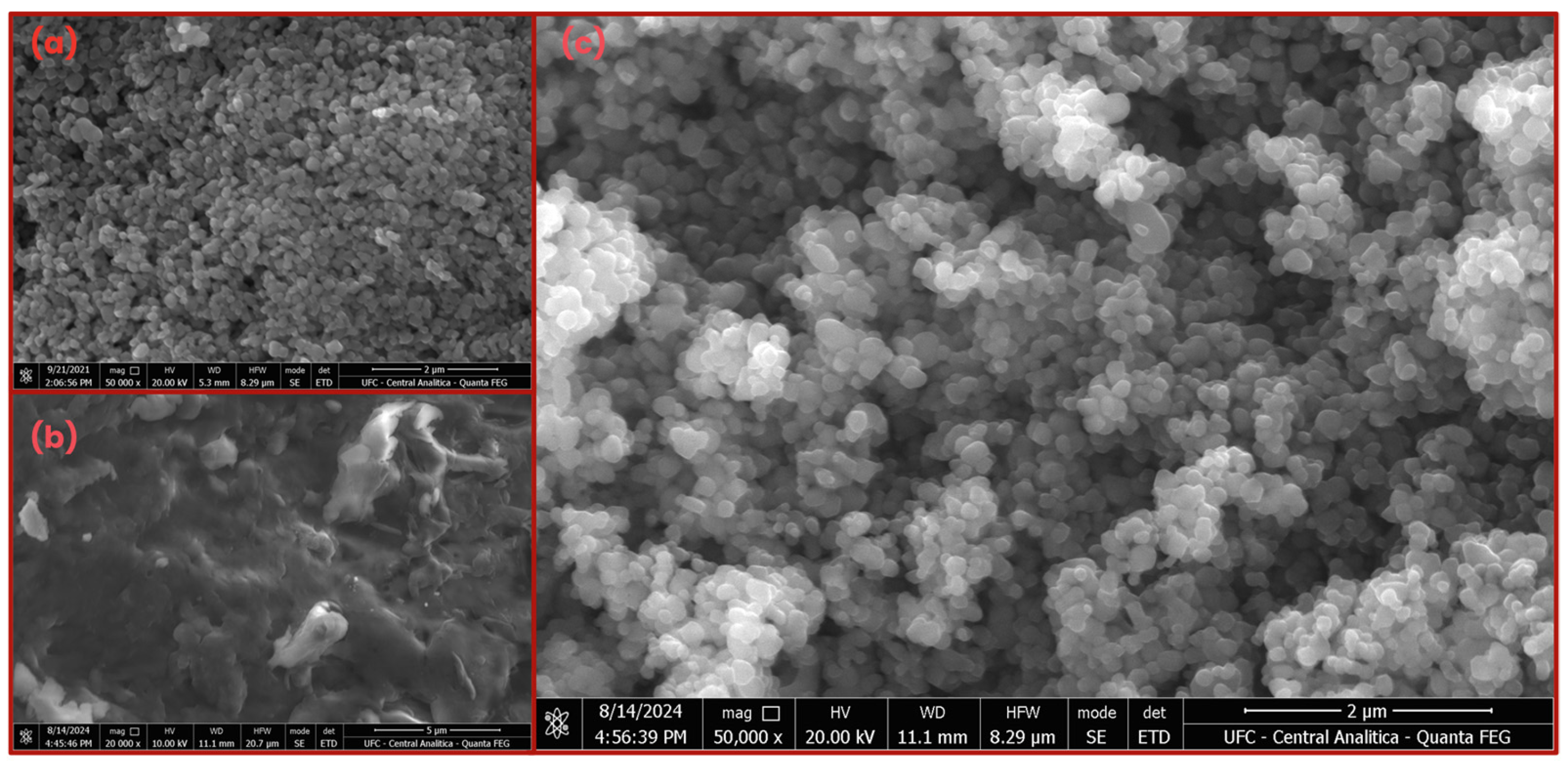
Figure 6 presents SEM images of TiO2, CS, and CS-TiO2, respectively, showing the shape and size of the materials. The morphology of TiO2 and CS-TiO2 particles is spherical-like, while CS appears to have a rougher and more amorphous surface. The average particle size of TiO2 and CS-TiO2 was approximately 80 and 190 nm; however, CS-TiO2 exhibited a few larger particles, ranging from 300 to 400 nm. Despite this, the analysis indicates that the synthesis slightly alters the nanometric profile of the CS-TiO2 composite. Additionally, the spherical profile of the composite suggests that CS may have attached to the surface of TiO2 in a core–shell-like structure, like the findings reported by [57,70,71].
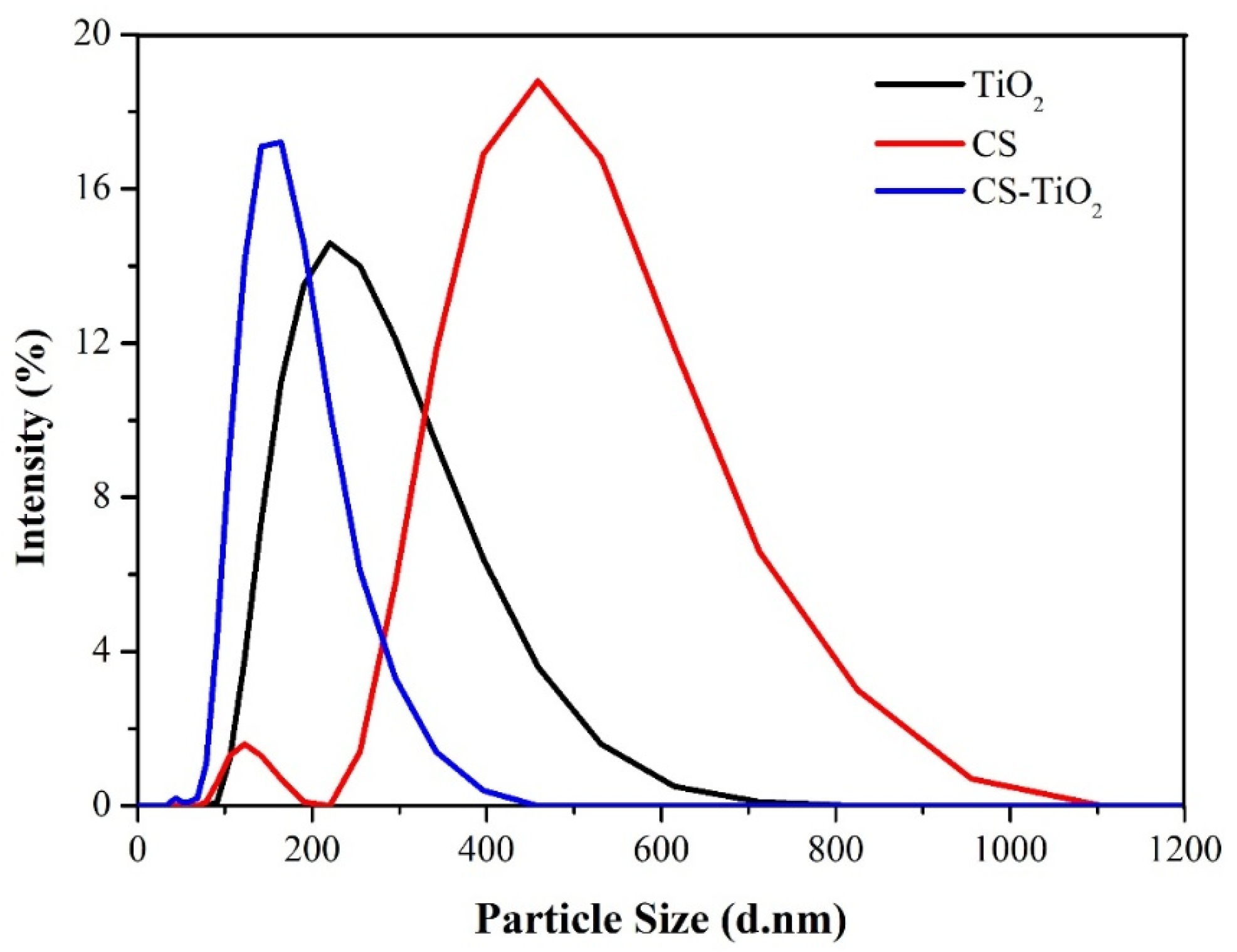
Figure 7 shows the results of DLS analysis and the particle size distribution of TiO2, CS, and CS-TiO2. Unlike SEM analysis, DLS measures particle size when dispersed or dissolved in a liquid, in this case, H2O. The average particle sizes measured for TiO2, CS, and CS-TiO2 were 217.6 nm ± 114.4 nm, 579.9 nm ± 136.8 nm, and 183.6 ± 559 nm, respectively.
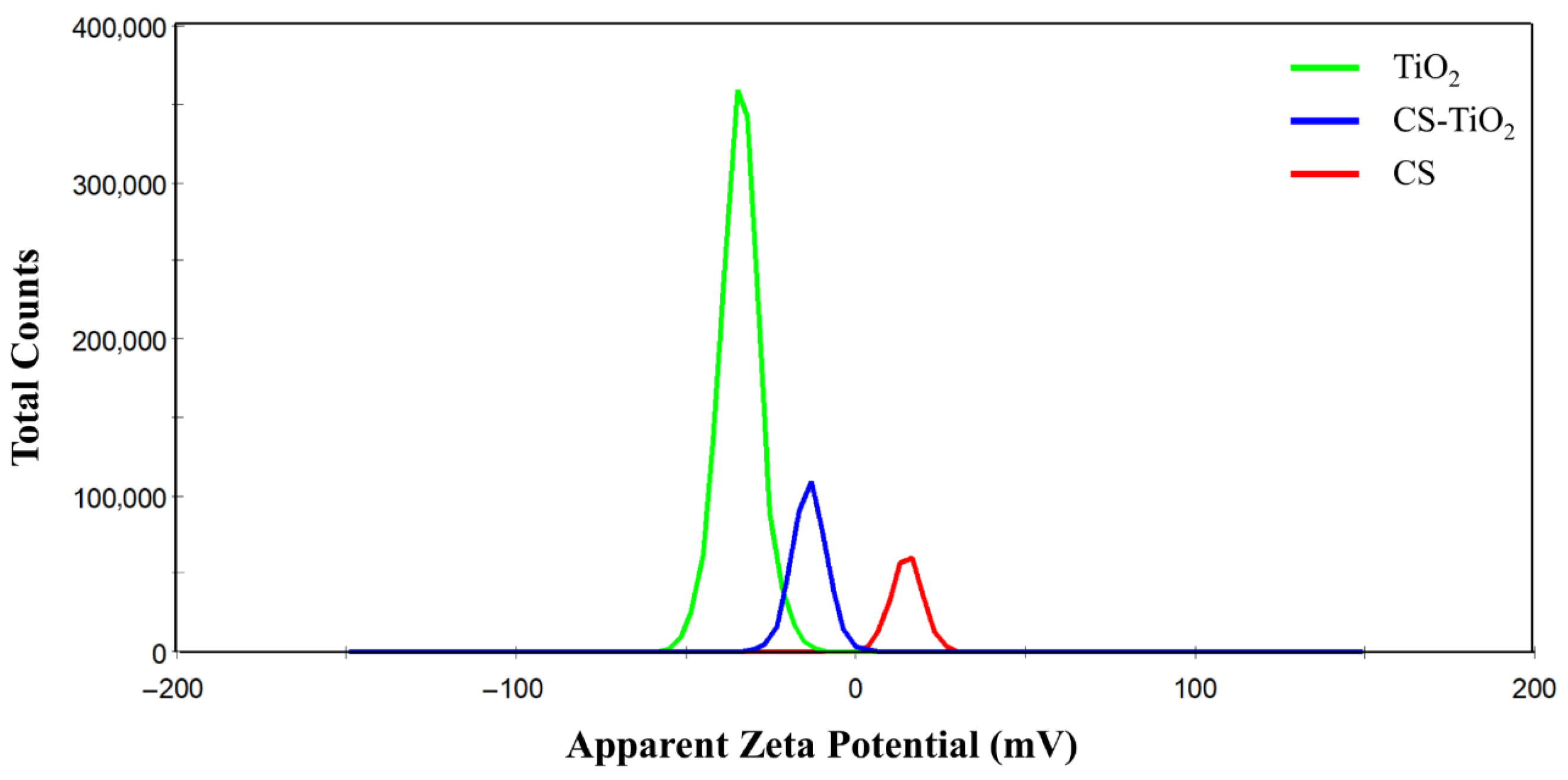
Figure 8 presents the zeta potential analysis results. The samples displayed distinct surface charges in ultrapure H2O. TiO2 exhibited a negative zeta potential with an average value of −341 ± 62 mV. CS showed a positive zeta potential with an average value of 138 ± 46 mV, while CS-TiO2 had a negative zeta potential of −136 ± 52 mV.
The magnitude of the zeta potential indicates the stability of the colloidal system. If the suspended particles have a high positive or negative zeta potential, they tend to repel each other, reducing the tendency to flocculate. Conversely, if the zeta potential is low, there are insufficient repulsive forces to prevent particles from aggregating and flocculating. The general threshold between stable and unstable suspensions is conventionally set at ±30 mV. Therefore, the obtained values show that TiO2 and CS-TiO2 tended to flocculate in aqueous formulations.
Moreover, the zeta potential values indicate that, when TiO2 is combined with CS, an interaction between the opposite charges of CS (positive) and TiO2 (negative) may occur, potentially forming ionic bridges, as suggested by Wiącek et al. [72]. This process is consistent with the increase in the magnitude of the zeta potential to −136 mV in the CS-TiO2 composite compared to TiO2 alone. This change suggests partial coverage of TiO2 particles by CS chains in a system stabilized by electrostatic and steric forces. This electrosteric stabilization was discussed by Hussein et al. [73], who reported similar effects of CS interaction with TiO2 particles.
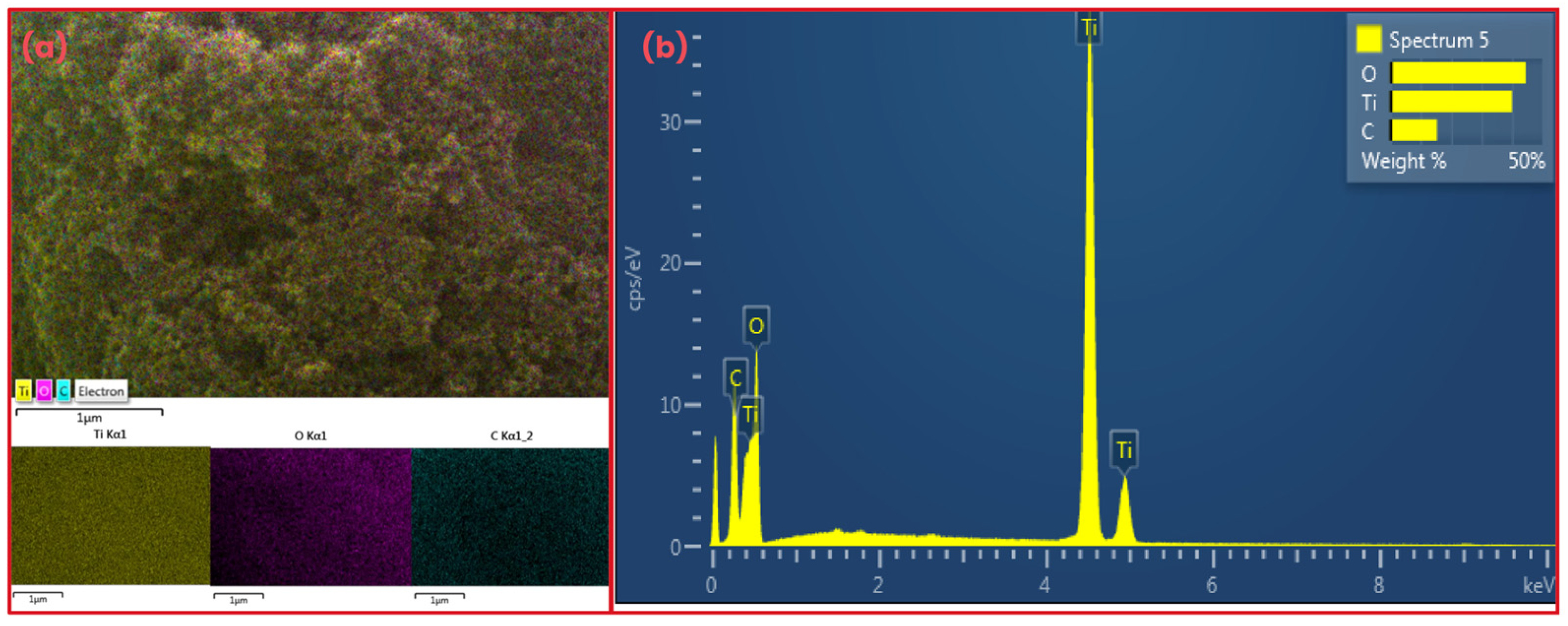
Figure 9 presents the elemental analysis of the TiO2 sample obtained by EDX. The presence of carbon is attributed to the support material used during sample preparation. The images and spectra confirm that the TiO2 sample is composed only of titanium (Ti) and oxygen (O). These results indicate the high purity of the TiO2 employed in the synthesis of the CS-TiO2 composite.
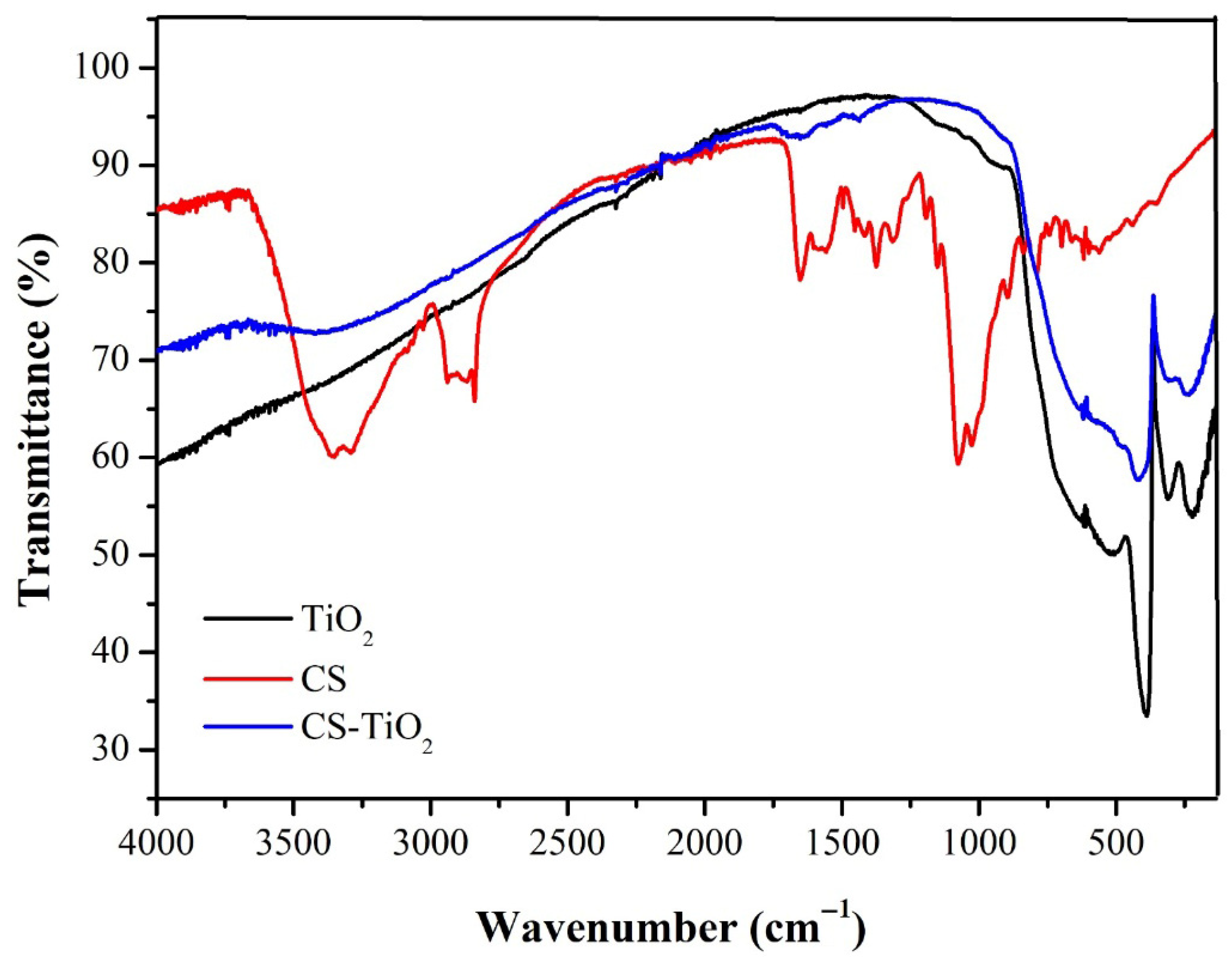
Figure 10 shows the FTIR spectra of TiO2, CS, and CS-TiO2 samples. The bands around 800 and 200 cm−1 correspond to the O-Ti-O stretching vibrations of TiO2; note that the intensity of these bands is reduced in the CS-TiO2 spectrum. The bands around 3360 and 3000 cm−1 correspond to the O-H and N-H stretching vibrations present in CS, respectively. The bands around 1650 and 1540 cm−1 correspond to the C=O stretching and N-H in-plane bending vibrations, respectively. They are associated with CS amides. Finally, the bands around 1060 and 1000 cm−1 correspond to C-O stretching in CS. These key vibrations from the CS and TiO2 spectra are also present, albeit subtly, in the CS-TiO2 spectrum, confirming the presence of CS and TiO2 in the synthesized photocatalyst. Spoială et al. [70] obtained similar FTIR spectra and results in their studies on CS-TiO2 synthesis.
The combined analysis of the results corroborates the formation of the CS-TiO2 composite via the proposed synthesis route. The composite, therefore, integrates the chemical and structural properties of both TiO2 and CS consistently.

3.2. Evaluation of Photocatalyst Film Adhesion to the Specimen Surface

The images captured before and after the tape test were processed using ImageJ®. The pre-test image was subtracted from the post-test image to isolate the detached photocatalyst layer. A thresholding technique was then applied to enhance contrast based on pixel intensity, allowing for the identification of the peeled areas while minimizing background noise. The number of pixels corresponding to the detached region was quantified to estimate the percentage of material removed, indicating the adhesion performance of the photocatalyst. The DIP results were analyzed for outliers (using boxplots) and measures of central tendency and dispersion. Table 3 shows the results for each photocatalyst evaluated in this study.
Comparing the types of photocatalyst solution between them, it can be observed that the percentage of material detached from the specimen’s surface is practically the same, regardless of the concentration. However, the CS-TiO2 formulations show a slight improvement of 18.1% and 10.5% in adhesion for CS-TiO2 at 2.5 g/m2 and 5.0 g/m2, respectively, compared to the TiO2 films.
Thus, from an adhesion standpoint, the CS-based formulations were considered more adherent to the HMA substrate. These results confirm the initial hypothesis suggesting a potential improvement in adhesion of the composite compared to the base photocatalyst film (TiO2).

3.3. Photocatalytic Tests

The initial gas concentrations were measured in the dark for 30 min; then, the lamp was turned on, and the concentrations were measured for 30 min more. Table 4 shows the results of the photocatalytic tests.
The photocatalytic NO2 conversion efficiency of TiO2 observed in this study (averaging 17%) was slightly lower than the typical range reported in the literature, which varies between approximately 20% and 30% [36,46,55,74,75]. A likely reason for this reduction could be the extremely high gas concentration introduced into the reactor (500 ppm), as typical concentrations used in the literature for evaluating photocatalytic pavements are in the range of 1 ppm or ppb. This observation aligns with the findings of Mikyskova et al. [69], who evaluated TiO2 (Degussa P25) and reported a reduction in NO2 conversion efficiency from 70% to 12% when pollutant concentration increased from 0.1 ppm (100 ppb) to 1 ppm.
However, testing at high NO2 concentrations can provide insights despite the challenges posed to photocatalytic efficiency. Under these conditions, the material surfaces were susceptible to saturation, which may have limited NO2 adsorption at active sites, essential for photocatalysis. High concentrations may also increase the presence of intermediates like NO species, which can compete for active sites and reduce conversion rates [30]. Additionally, elevated gas levels can intensify electron–hole recombination, restricting the formation of reactive species necessary for oxidation, while the buildup of byproducts could further inhibit photocatalytic activity [76]. Despite these effects, studying high-concentration conditions highlighted the material’s behavior under more extreme pollution scenarios, offering an assessment beyond the typical low-concentration conditions in photocatalytic pavement research.
Furthermore, increasing the concentration of both TiO2 and CS-TiO2, from 2.5 to 5.0 g/m2, reduced the NO2 conversion. This behavior was also observed by other researchers who studied the effect of photocatalyst concentration on the surface of pavement and other construction materials [54]. This effect is generally attributed to the overlapping of photocatalyst particles, increased agglomeration, and a consequent reduction or even blockage in radiation absorption by the photocatalyst, leading to no additional efficiency gain.
It was also observed that adding CS to TiO2 did not enhance NO2 conversion efficiency under UV radiation. A reduction in photocatalytic activity of CS on TiO2 under UV light has also been reported in studies by [37,76], explained as a “UV protection” or “UV barrier” effect. This behavior is beneficial and useful, particularly in applications that combine the biological properties of CS with the inorganic properties of TiO2, such as fabric modifications, packaging, and anti-acne sunscreens [37,77,78].
However, the CS-TiO2 composite demonstrated approximately 14% NO2 conversion efficiency in the visible light range. For photocatalytic field applications or experimental sections that rely on natural sunlight to photoactivate semiconductors, this additional absorption benefit, in the visible region, could make the composite relevant for reducing the presence of this pollutant in ambient air.

4. Conclusions

This study investigated the potential of HMA functionalized with a chitosan–TiO2 composite (CS–TiO2) to mitigate high concentrations of NO2 and improve the adhesion of the photocatalytic film to the asphalt mixture surface. To this end, HMA specimens were functionalized with either TiO2 or CS–TiO2, applied at two surface concentrations (2.5 and 5.0 g/m2). The photocatalytic efficiency of each material was tested under both visible and UV light conditions. The performance of these materials was successfully characterized using an adapted photocatalytic reactor designed to simulate real-world conditions and measure pollutant degradation efficiency. Low-cost NO2 sensors and passive samplers integrated with the system provided an accessible and practical solution for reaction monitoring. Finally, the adhesion of the photocatalytic film to the asphalt mixture surface was assessed, showcasing potential enhancements in the wearing performance of the tested alternatives.
The results indicated that lower photocatalyst concentrations (2.5 g/m2) provided the specimen with better homogeneity and coverage efficiency. It was observed that applying 2.5 g/m2 of photocatalysts resulted in a higher NO2 conversion rate under UV radiation for all photocatalysts and under visible light for CS-TiO2.
Another significant finding was the difference in performance between TiO2 and CS-TiO2 under different lighting conditions. CS-TiO2 showed lower NO2 conversion efficiency under UV light compared to visible light, possibly due to partial UV blocking by CS. However, from an adhesion perspective, CS-TiO2 formulations demonstrated better adhesion to the HMA, resulting in less material loss.
These results demonstrate that photocatalyst concentration and dopant choice are critical factors for optimizing photocatalytic efficiency and durability on pavement. CS-TiO2 functionalization showed potential for improving TiO2 adhesion and ensuring consistent performance, especially in environments with visible radiation.
To further advance the application of photocatalytic pavements, future studies could focus on:
  • Long-term Environmental Durability: Testing CS-TiO2-functionalized pavements under prolonged exposure to UV radiation and in real-world conditions.
  • Scaling and Application Techniques: Investigating methods for scaling the application of CS-TiO2, such as mechanized spray systems.
  • Evaluation of byproducts of the photocatalytic NO2 degradation reaction using CS-TiO2.
  • Enhanced Photocatalytic Formulations: Exploring additional dopants or composites that could further extend the photocatalytic activity of TiO2 to the visible light range.
  • Economic and Environmental Impact Analysis: Conducting life-cycle analyses to evaluate the economic feasibility, material costs, and potential environmental impacts associated with the production, application, and maintenance of CS-TiO2-coated pavements.
  • Photocatalyst Regeneration: Studying potential methods for regenerating the photocatalytic surface of the pavement, which could extend the material’s useful life and maintain its efficiency in pollutant abatement over time.

Author Contributions

A.P.M.P.A.: Writing—original draft, conceptualization, data curation, formal analysis, investigation, methodology, validation. L.V.S.R.: Writing—original draft. D.B.S.: Investigation. J.I.C.B.: Investigation, methodology, software. E.F.F.: Methodology, validation, resources. F.W.S.: Methodology, validation, resources. V.T.F.C.B.: Writing—review and editing, conceptualization, funding acquisition, project administration, resources, supervision. All authors have read and agreed to the published version of the manuscript.

Funding

This work was supported by Conselho Nacional de Desenvolvimento Científico e Tecnológico (CNPq), Coordenação de Aperfeiçoamento de Pessoal de Nível Superior (CAPES), and Fundação Cearense de Apoio ao Desenvolvimento Científico e Tecnológico (FUNCAP) Grants.

Institutional Review Board Statement

Not applicable.

Informed Consent Statement

Not applicable.

Data Availability Statement

The original contributions presented in this study are included in the article. Further inquiries can be directed to the corresponding authors.

Acknowledgments

Laboratório de Análises de Traços (LAT) from the Universidade Federal do Ceará (UFC). Laboratório de Contaminantes Orgânicos (LACOr) from the UFC. Central Analítica (CA) from the UFC. Laboratório de Transportes e Meio Ambiente (TRAMA) from the UFC. Institute for Sustainability and Innovation in Structural Engineering (ISISE), ref. UIDB/04029/2020, Associate Laboratory Advanced Production and Intelligent Systems (ARISE), ref. LA/P/0112/2020.

Conflicts of Interest

The authors declare no conflicts of interest.

References

  1. Vallero, D. Fundamentals of Air Pollution, 5th ed.; Academic Press: Boston, MA, USA, 2014. [Google Scholar]
  2. Geddes, J.A.; Murphy, J.G. The Science of Smog: A Chemical Understanding of Ground Level Ozone and Fine Particulate Matter. In Metropolitan Sustainability; Elsevier: Amsterdam, The Netherlands, 2012; pp. 205–230. [Google Scholar]
  3. Chen, T.-M.; Kuschner, W.G.; Gokhale, J.; Shofer, S. Outdoor Air Pollution: Nitrogen Dioxide, Sulfur Dioxide, and Carbon Monoxide Health Effects. Am. J. Med. Sci. 2007, 333, 249–256. [Google Scholar] [CrossRef] [PubMed]
  4. Manisalidis, I.; Stavropoulou, E.; Stavropoulos, A.; Bezirtzoglou, E. Environmental and Health Impacts of Air Pollution: A Review. Front. Public Health 2020, 8, 14. [Google Scholar] [CrossRef] [PubMed]
  5. Adnew, G.A.; Meusinger, C.; Bork, N.; Gallus, M.; Kyte, M.; Rodins, V.; Rosenørn, T.; Johnson, M.S. Gas-Phase Advanced Oxidation as an Integrated Air Pollution Control Technique. AIMS Environ. Sci. 2016, 3, 141–158. [Google Scholar] [CrossRef]
  6. Johnson, M.S.; Nilsson, E.J.K.; Svensson, E.A.; Langer, S. Gas-Phase Advanced Oxidation for Effective, Efficient in Situ Control of Pollution. Environ. Sci. Technol. 2014, 48, 8768–8776. [Google Scholar] [CrossRef]
  7. Meusinger, C.; Bluhme, A.B.; Ingemar, J.L.; Feilberg, A.; Christiansen, S.; Andersen, C.; Johnson, M.S. Treatment of Reduced Sulphur Compounds and SO2 by Gas Phase Advanced Oxidation. Chem. Eng. J. 2017, 307, 427–434. [Google Scholar] [CrossRef]
  8. Tai, X.H.; Lai, C.W.; Juan, J.C.; Lee, K.M. Nanocatalyst-Based Catalytic Oxidation Processes. In Nanomaterials for Air Remediation; Elsevier: Amsterdam, The Netherlands, 2020; pp. 133–150. [Google Scholar]
  9. Nakata, K.; Fujishima, A. TiO2 Photocatalysis: Design and Applications. J. Photochem. Photobiol. C Photochem. Rev. 2012, 13, 169–189. [Google Scholar] [CrossRef]
  10. Anucha, C.B.; Altin, I.; Bacaksiz, E.; Stathopoulos, V.N. Titanium Dioxide (TiO2)-Based Photocatalyst Materials Activity Enhancement for Contaminants of Emerging Concern (CECs) Degradation: In the Light of Modification Strategies. Chem. Eng. J. Adv. 2022, 10, 100262. [Google Scholar] [CrossRef]
  11. Sari, Y.; Gareso, P.L.; Armynah, B.; Tahir, D. A Review of TiO2 Photocatalyst for Organic Degradation and Sustainable Hydrogen Energy Production. Int. J. Hydrogen Energy 2024, 55, 984–996. [Google Scholar] [CrossRef]
  12. Baccaro, A.; Gutz, I. Fotoeletrocatálise Em Semicondutores: Dos Princípios Básicos Até Sua Conformação À Nanoescala. Química Nova 2018, 41, 326–339. [Google Scholar] [CrossRef]
  13. Yuan, L.; Zhang, N.; Xu, Y.-J.; Colmenares, J.C. Solar—Chemical Energy Conversion by Photocatalysis. In Heterogeneous Photocatalysis: From Fundamentals to Green Applications; Springer: Berlin/Heidelberg, Germany, 2016; pp. 249–282. [Google Scholar]
  14. Zhou, H.; Qu, Y.; Zeid, T.; Duan, X. Towards Highly Efficient Photocatalysts Using Semiconductor Nanoarchitectures. Energy Environ. Sci. 2012, 5, 6732–6743. [Google Scholar] [CrossRef]
  15. Ghosh, S. (Ed.) Visible-Light-Active Photocatalysis: Nanostructured Catalyst Design, Mechanisms, and Applications; John Wiley & Sons: Hoboken, NJ, USA, 2018. [Google Scholar]
  16. Li, X.; Wang, F.; You, L.; Wu, S.; Yang, C.; Zhang, L.; Maria Barbieri, D. A Review on Photocatalytic Asphalt Pavement Designed for Degradation of Vehicle Exhausts. Transp. Res. Part D Transp. Environ. 2023, 115, 103605. [Google Scholar] [CrossRef]
  17. Rocha Segundo, I.; Freitas, E.; Landi, S.; Costa, M.F.M.; Carneiro, J.O. Smart, Photocatalytic and Self-Cleaning Asphalt Mixtures: A Literature Review. Coatings 2019, 9, 696. [Google Scholar] [CrossRef]
  18. Huang, P.; Chen, F.; Cai, M.; Gong, X.; Huang, X.; Jiang, Y.; Liu, Z. Multi-Functional Composite Coating Based on the Dual Effects of Cooling and Exhaust Gas Degradation. Front. Mater. 2024, 11, 1321429. [Google Scholar] [CrossRef]
  19. Ayar, P.; Ruhi, A.; Baibordy, A.; Asadi Azadgoleh, M.; Mohammadi, M.M.; Abdipour, S.V. Toward Sustainable Roads: A Critical Review on Nano-TiO2 Application in Asphalt Pavement. Innov. Infrastruct. Solut. 2024, 9, 148. [Google Scholar] [CrossRef]
  20. Carneiro, J.O.; Teixeira, V.; Portinha, A.; Magalhães, A.; Coutinho, P.; Tavares, C.J.; Newton, R. Iron-Doped Photocatalytic TiO2 Sputtered Coatings on Plastics for Self-Cleaning Applications. Mater. Sci. Eng. B 2007, 138, 144–150. [Google Scholar] [CrossRef]
  21. Wei, Y.; Meng, H.; Wu, Q.; Bai, X.; Zhang, Y. TiO2-Based Photocatalytic Building Material for Air Purification in Sustainable and Low-Carbon Cities: A Review. Catalysts 2023, 13, 1466. [Google Scholar] [CrossRef]
  22. Segundo, I.R.; Freitas, E.; Branco, V.T.F.C.; Landi, S.; Costa, M.F.; Carneiro, J.O. Review and Analysis of Advances in Functionalized, Smart, and Multifunctional Asphalt Mixtures. Renew. Sustain. Energy Rev. 2021, 151, 111552. [Google Scholar] [CrossRef]
  23. Segundo, I.G.d.R.; Landi, S., Jr.; Oliveira, S.M.B.; de Freitas, E.F.; Carneiro, J.A.O. Photocatalytic Asphalt Mixtures: Mechanical Performance and Impacts of Traffic and Weathering Abrasion on Photocatalytic Efficiency. Catal. Today 2019, 326, 94–100. [Google Scholar] [CrossRef]
  24. Rocha Segundo, I.; Ferreira, C.; Freitas, E.F.; Carneiro, J.O.; Fernandes, F.; Júnior, S.L.; Costa, M.F. Assessment of Photocatalytic, Superhydrophobic and Self-Cleaning Properties on Hot Mix Asphalts Coated with TiO2 and/or ZnO Aqueous Solutions. Constr. Build. Mater. 2018, 166, 500–509. [Google Scholar] [CrossRef]
  25. Cao, X.; Deng, M.; Tang, B.; Ding, Y.; Yang, X. Development of Photocatalytic Chip Seal for Nitric Oxide Removal on the Surface of Pavement Using g-C3N4/TiO2 Composite. Road Mater. Pavement Des. 2021, 22, 1178–1194. [Google Scholar] [CrossRef]
  26. Shan, B.; Cao, X.; Yang, X.; Shang, T.; Ding, Y.; Tang, B. Highly Active Photocatalytic Asphalt Pavement for NOx Removal Using Iron-Doped g-C3N4. Road Mater. Pavement Des. 2022, 23, 2531–2546. [Google Scholar] [CrossRef]
  27. Yang, Y.; Ji, T.; Su, W.; Kang, Y.; Wu, Y.; Zhang, Y. Enhanced Washing Resistance of Photocatalytic Exposed Aggregate Cementitious Materials Based on g-C3N4 Nanosheets-Recycled Asphalt Pavement Aggregate Composites. Constr. Build. Mater. 2019, 228, 116748. [Google Scholar] [CrossRef]
  28. Wu, H.; Shen, A.; Yang, X.; He, Z.; Zhang, Y. Effect of TiO2/CeO2 on Photocatalytic Degradation Capability and Pavement Performance of Asphalt Mixture with Steel Slag. J. Mater. Civ. Eng. 2021, 33, 04021234. [Google Scholar] [CrossRef]
  29. Xu, P.; Gao, J.; Pei, J.; Li, R.; Chen, Z. Evaluation of NO2-Degradation by the Rubber-Titanium-Aluminum Ultrafine Grained Micro-Surfacing Material and Its Effect on Pavement Performance. Int. J. Pavement Res. Technol. 2019, 12, 70–77. [Google Scholar] [CrossRef]
  30. Xie, T.; He, Z.; Yu, H.; Huang, C.; Ou, J.; Dai, W.; Ge, J. The Preparation and Performance Analysis of Pavement Photocatalytic Material Based on Quantum Dot Heterostructures Technology. Constr. Build. Mater. 2024, 416, 135066. [Google Scholar] [CrossRef]
  31. Hu, Z.; Xu, T.; Liu, P.; Oeser, M. Developed Photocatalytic Asphalt Mixture of Open Graded Friction Course for Degrading Vehicle Exhaust. J. Clean. Prod. 2021, 279, 123453. [Google Scholar] [CrossRef]
  32. Jin, J.; Chen, B.; Liu, L.; Liu, R.; Qian, G.; Wei, H.; Zheng, J. A Study on Modified Bitumen with Metal Doped Nano-TiO2 Pillared Montmorillonite. Materials 2019, 12, 1910. [Google Scholar] [CrossRef] [PubMed]
  33. Mohammed, S.; Shnain, Z.; Alwasiti, A.; Abid, M.; Abed, K.; Mohammed, M.; Hameed, Z.; Faris, S.; Philib, P. The Photo-Oxidation of CO from Ambient Air Using Catalytic Asphaltic Pavement. Eng. Technol. J. 2023, 41, 529–542. [Google Scholar] [CrossRef]
  34. Cao, X.; Yang, X.; Li, H.; Huang, W.; Liu, X. Investigation of Ce-TiO2 Photocatalyst and Its Application in Asphalt- Based Specimens for NO Degradation. Constr. Build. Mater. 2017, 148, 824–832. [Google Scholar] [CrossRef]
  35. Liu, W.; Wang, S.; Zhang, J.; Fan, J. Photocatalytic Degradation of Vehicle Exhausts on Asphalt Pavement by TiO2/Rubber Composite Structure. Constr. Build. Mater. 2015, 81, 224–232. [Google Scholar] [CrossRef]
  36. Tang, B.; Liu, X.; Huang, W.; Cao, X. Preparation of La-Doped Nanometer TiO2 and Its Application for NO Removal on Asphalt Concrete. Road Mater. Pavement Des. 2017, 18, 43–53. [Google Scholar] [CrossRef]
  37. Anaya-Esparza, L.M.; Ruvalcaba-Gómez, J.M.; Maytorena-Verdugo, C.I.; González-Silva, N.; Romero-Toledo, R.; Aguilera-Aguirre, S.; Pérez-Larios, A.; Montalvo-González, E. Chitosan-TiO2: A Versatile Hybrid Composite. Materials 2020, 13, 811. [Google Scholar] [CrossRef] [PubMed]
  38. Trache, D.; Tarchoun, A.F.; Derradji, M.; Hamidon, T.S.; Masruchin, N.; Brosse, N.; Hussin, M.H. Nanocellulose: From Fundamentals to Advanced Applications. Front. Chem. 2020, 8, 392. [Google Scholar] [CrossRef] [PubMed]
  39. Gardner, D.J.; Oporto, G.S.; Mills, R.; Samir, M.A.S.A. Adhesion and Surface Issues in Cellulose and Nanocellulose. J. Adhes. Sci. Technol. 2008, 22, 545–567. [Google Scholar] [CrossRef]
  40. Mati-Baouche, N.; Elchinger, P.-H.; de Baynast, H.; Pierre, G.; Delattre, C.; Michaud, P. Chitosan as an Adhesive. Eur. Polym. J. 2014, 60, 198–212. [Google Scholar] [CrossRef]
  41. Hamad, H.; Bailón-García, E.; Morales-Torres, S.; Pérez-Cadenas, A.F.; Carrasco-Marín, F.; Maldonado-Hódar, F.J. Cellulose–TiO2 Composites for the Removal of Water Pollutants. In Bio-Based Materials and Biotechnologies for Eco-Efficient Construction; Elsevier: Amsterdam, The Netherlands, 2020; pp. 329–358. [Google Scholar]
  42. Irfan, M.; Ali, Y.; Ahmed, S.; Iqbal, S.; Wang, H. Rutting and Fatigue Properties of Cellulose Fiber-Added Stone Mastic Asphalt Concrete Mixtures. Adv. Mater. Sci. Eng. 2019, 2019, 5604197. [Google Scholar] [CrossRef]
  43. Mallawarachchi, D.R.; Amarasinghe, A.D.U.S.; Prashantha, M.A.B. Suitability of Chitosan as an Emulsifier for Cationic Bitumen Emulsions and Its Behaviour as an Additive to Bitumen Emulsion. Constr. Build. Mater. 2016, 102, 1–6. [Google Scholar] [CrossRef]
  44. Carneiro, J.O.; Azevedo, S.; Teixeira, V.; Fernandes, F.; Freitas, E.; Silva, H.; Oliveira, J. Development of Photocatalytic Asphalt Mixtures by the Deposition and Volumetric Incorporation of TiO2 Nanoparticles. Constr. Build. Mater. 2013, 38, 594–601. [Google Scholar] [CrossRef]
  45. Mendoza, C.; Valle, A.; Castellote, M.; Bahamonde, A.; Faraldos, M. TiO2 and TiO2–SiO2 Coated Cement: Comparison of Mechanic and Photocatalytic Properties. Appl. Catal. B Environ. 2015, 178, 155–164. [Google Scholar] [CrossRef]
  46. Al Jitan, S.; Brudecki, G.; Palmisano, G.; Lanotte, M. Photocatalytic Activity of Neat and Polymer-Modified Bitumen. Appl. Mater. Today 2020, 21, 100795. [Google Scholar] [CrossRef]
  47. Chen, X.; Zhang, H.; Zhang, D.; Miao, Y.; Li, G. Controllable Synthesis of Mesoporous Multi-Shelled ZnO Microspheres as Efficient Photocatalysts for NO Oxidation. Appl. Surf. Sci. 2018, 435, 468–475. [Google Scholar] [CrossRef]
  48. Wang, H.; Liu, H.; Chen, Z.; Veksha, A.; Lisak, G.; You, C. Interaction between SO2 and NO in Their Adsorption and Photocatalytic Conversion on TiO2. Chemosphere 2020, 249, 126136. [Google Scholar] [CrossRef] [PubMed]
  49. ASTM D5116; Standard Guide for Small-Scale Environmental Chamber Determinations of Organic Emissions from Indoor Materials/Products. American Society for Testing and Materials: West Conshohocken, PA, USA, 2017.
  50. ISO 22197-1; Fine Ceramics (Advanced Ceramics, Advanced Technical Ceramics)-Test Method for Air-Purification Performance of Semiconducting Photocatalytic Materials-Part 1: Removal of Nitric Oxide. International Organization for Standardization: Chicago, IL, USA, 2016.
  51. JIS R 1701-1; Fine Ceramics (Advanced Ceramics, Advanced Technical Ceramics)-Test Method for Air Purification Performance of Photocatalytic Materials-Part 1: Removal of Nitric Oxide. Japanese Industrial Standards: Tokyo, Japan, 2016.
  52. Mills, A.; Hawthorne, D.; Hazafy, D.; Wells, N. Photocatalyst Activity Indicating Adhesive Labels for Use in the Field. J. Photochem. Photobiol. A Chem. 2018, 356, 256–262. [Google Scholar] [CrossRef]
  53. Mills, A.; Wells, N. Reductive Photocatalysis and Smart Inks. Chem. Soc. Rev. 2015, 44, 2849–2864. [Google Scholar] [CrossRef]
  54. Wang, H.; Jin, K.; Dong, X.; Zhan, S.; Liu, C. Preparation Technique and Properties of Nano-TiO2 Photocatalytic Coatings for Asphalt Pavement. Appl. Sci. 2018, 8, 2049. [Google Scholar] [CrossRef]
  55. Khavandi Khiavi, A.; Yamini, N.; Asadi, M. Effect of Different Adding Methods of Nano-TiO2 to Micro-Surfacing Layer on NOx Degradation. Road Mater. Pavement Des. 2024, 25, 1270–1284. [Google Scholar] [CrossRef]
  56. Zhao, D.; Wu, X.; Gu, X.; Liu, J. Investigation into the Degradation of Air and Runoff Pollutants Using Nano G-C3N4 Photocatalytic Road Surfaces. Constr. Build. Mater. 2024, 411, 134553. [Google Scholar] [CrossRef]
  57. Zubieta, C.E.; Messina, P.V.; Luengo, C.; Dennehy, M.; Pieroni, O.; Schulz, P.C. Reactive Dyes Remotion by Porous TiO2-Chitosan Materials. J. Hazard. Mater. 2008, 152, 765–777. [Google Scholar] [CrossRef]
  58. ASTM D3359; Standard Test Methods for Rating Adhesion by Tape Test. American Society for Testing and Materials: West Conshohocken, PA, USA, 2023.
  59. ISO 2409; Paints and Varnishes – Cross-Cut Test. International Organization for Standardization: Chicago, IL, USA, 2020.
  60. Antonova, N.M.; Khaustova, E.Y.; Nebrat, A.A.; Puzanova, A.S. Rapid Assessment of Adhesion of Paint Coatings by Digital Image Analysis. IOP Conf. Ser. Mater. Sci. Eng. 2020, 971, 022043. [Google Scholar] [CrossRef]
  61. Cui, P.; Wu, S.; Xiao, Y.; Wang, F.; Wang, F. Quantitative Evaluation of Active Based Adhesion in Aggregate-Asphalt by Digital Image Analysis. J. Adhes. Sci. Technol. 2019, 33, 1544–1557. [Google Scholar] [CrossRef]
  62. Bernucci, L.L.; Motta, L.M.; Ceratti, J.A.; Soares, J.B. Pavimentação Asfáltica: Formação Básica Para Engenheiros; Petrobras; Abeda: Rio de Janeiro, Brazil, 2022. [Google Scholar]
  63. Alcantara, A.P.M.P.; Ribeiro, J.P.; Segundo, I.G.d.R.; da Silva, D.B.; de Carvalho, L.M.; Dognini, J.; Carneiro, J.A.S.A.O.; De Sousa, F.W.; Branco, V.T.F.C. Diagnóstico de Emissões de Poluentes Atmosféricos Na Produção de Misturas Asfálticas. Transportes 2023, 31, e2887. [Google Scholar] [CrossRef]
  64. Campos, V.P.; Cruz, L.P.S.; Godoi, R.H.M.; Godoi, A.F.L.; Tavares, T.M. Development and Validation of Passive Samplers for Atmospheric Monitoring of SO2, NO2, O3 and H2S in Tropical Areas. Microchem. J. 2010, 96, 132–138. [Google Scholar] [CrossRef]
  65. Ribeiro, J.P.; Cassiano, D.R.; Bertoncini, B.V.; Castelo Branco, V.T.F.; de Matos Sousa, F.F.L.; Quintanilha, W.F.L.; Cavalcante, R.M.; de Santiago, I.S.; Fernandes, G.M. Compreensão Da Formação de NO2 Proveniente Das Operações de Transporte Urbano e Suas Relações Com Agentes Causais. Transportes 2019, 27, 209–223. [Google Scholar] [CrossRef]
  66. Sousa, F.W.; Maia, M.L.; Quintanilha, W.F.L.; Cassiano, D.R.; Bertoncini, B.V.; Nascimento, R.F.; Oliveira, C.S.; Ribeiro, J.P. Estimation of Nitrogen Dioxide Levels on Streets from Fortaleza Brazil Using Passive Sampling and Multivariate Analysis. Eclet. Quim. 2024, 49. [Google Scholar] [CrossRef]
  67. Quirit, L.L.; Llaguno, E.C.; Pabroa, P.C.; Bello, F.B.; Gonzales, B.P. Comparison of Methods for Ambient Air Suitor Dioxide and Nitrogen Dioxide; Kimika: Miami, FL, USA, 2002; Volume 18. [Google Scholar]
  68. Saltzman, B.E. Colorimetric Microdetermination of Nitrogen Dioxide in Atmosphere. Anal. Chem. 1954, 26, 1949–1955. [Google Scholar] [CrossRef]
  69. Mikyskova, E.; Martiniakova, I.; Zouzelka, R.; Rathousky, J. Photocatalytic NOx Abatement: The Effect of High Air Flow Velocity. Environ. Technol. Innov. 2022, 28, 102820. [Google Scholar] [CrossRef]
  70. Spoială, A.; Ilie, C.-I.; Dolete, G.; Croitoru, A.-M.; Surdu, V.-A.; Trușcă, R.-D.; Motelica, L.; Oprea, O.-C.; Ficai, D.; Ficai, A.; et al. Preparation and Characterization of Chitosan/ TiO2 Composite Membranes as Adsorbent Materials for Water Purification. Membranes 2022, 12, 804. [Google Scholar] [CrossRef]
  71. Al-Taweel, S.S.; Saud, H.R.; Kadhum, A.A.H.; Takriff, M.S. The Influence of Titanium Dioxide Nanofiller Ratio on Morphology and Surface Properties of TiO2/Chitosan Nanocomposite. Results Phys. 2019, 13, 102296. [Google Scholar] [CrossRef]
  72. Wiącek, D.; Gozdecka, A.; Jurak, M. Physicochemical Characteristics of Chitosan/TiO2 Biomaterial Part I. Stability and Swelling Properties. Ind. Eng. Chem. Res. 2018, 57, 1859–1870. [Google Scholar] [CrossRef]
  73. Hussein, L.I.; Abdaleem, A.H.; Darwish, M.S.A.; Elsawy, M.A.; Mostafa, M.H. Chitosan/TiO2 Nanocomposites: Effect of Microwave Heating and Solution Mixing Techniques on Physical Properties. Egypt. J. Chem. 2020, 63, 449–460. [Google Scholar] [CrossRef]
  74. Papailias, I.; Todorova, N.; Giannakopoulou, T.; Dvoranová, D.; Brezová, V.; Dimotikali, D.; Trapalis, C. Selective Removal of Organic and Inorganic Air Pollutants by Adjusting the g-C3N4/TiO2 Ratio. Catal. Today 2021, 361, 37–42. [Google Scholar] [CrossRef]
  75. Lee, J.-W.; Baek, C. Evaluation of NOx Reduction Effect and Impact on Asphalt Pavement of Surface Treatment Technology Including TiO2 and Asphalt Rejuvenator. Appl. Sci. 2021, 11, 11571. [Google Scholar] [CrossRef]
  76. Sun, P.; Liu, Y.; Mo, F.; Wu, M.; Xiao, Y.; Xiao, X.; Wang, W.; Dong, X. Efficient Photocatalytic Degradation of High-Concentration Moxifloxacin over Dodecyl Benzene Sulfonate Modified Graphitic Carbon Nitride: Enhanced Photogenerated Charge Separation and Pollutant Enrichment. J. Clean. Prod. 2023, 393, 136320. [Google Scholar] [CrossRef]
  77. Chen, M.; Liu, Y. NOx Removal from Vehicle Emissions by Functionality Surface of Asphalt Road. J. Hazard. Mater. 2010, 174, 375–379. [Google Scholar] [CrossRef]
  78. Petrick, J.; Ibadurrohman, M.; Slamet. Development of Chitosan/ TiO2 Nanocomposite for Multifunctional Sunscreen Application. IOP Conf. Ser. Mater. Sci. Eng. 2020, 722, 012030. [Google Scholar] [CrossRef]
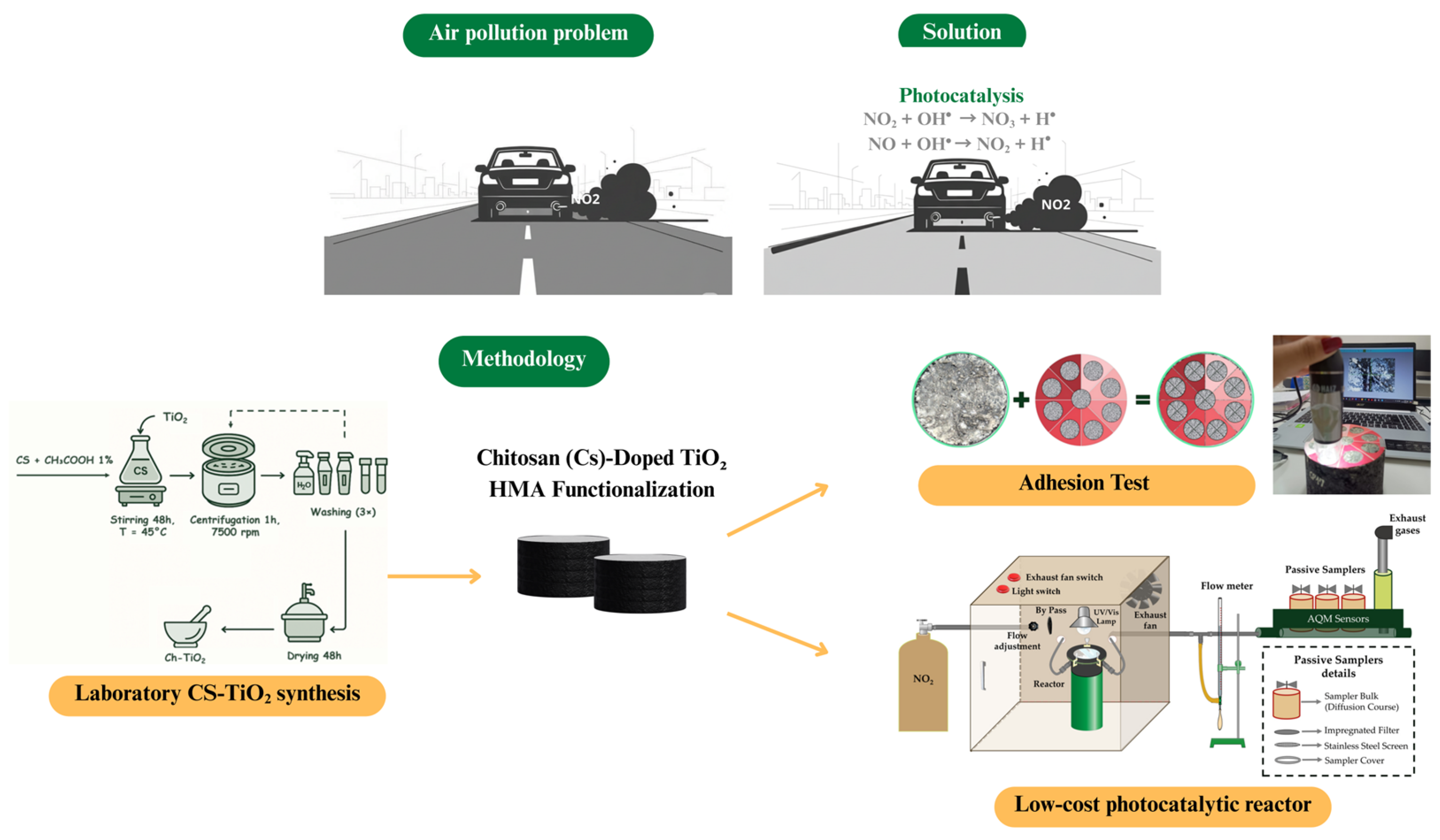
Figure 1. Method Summary Flowchart.
Materials 18 04292 g001
Figure 2. Flowchart of CS-TiO2 synthesis steps.
Materials 18 04292 g002
Figure 3. Digital microscope positioning and image capture for DIP.
Materials 18 04292 g003
Figure 4. Flowchart for preparing the samples for the tape test.
Materials 18 04292 g004
Figure 5. Photocatalytic reactor layout.
Materials 18 04292 g005
Figure 6. SEM image of (a) TiO2, (b) CS, and (c) CS-TiO2.
Materials 18 04292 g006
Figure 7. Particle Size Distribution of the Photocatalysts.
Materials 18 04292 g007
Figure 8. Zeta Potential of TiO2, CS, and CS-TiO2.
Materials 18 04292 g008
Figure 9. Images (a) and EDX spectrum (b) of TiO2.
Materials 18 04292 g009
Figure 10. FTIR Spectra of TiO2, CS, and CS-TiO2.
Materials 18 04292 g010
Table 1. Specifications of the AQM sensors used in the experiment.
Sensor TypeParameterSpecification
BME280Temperature−40 to +85 °C ± 1.0 °C
Humidity0 to 100% ± 3%
Pressure300 to 1100 hPa ± 1.0 hPa
MiCS-6814NO20.05 to 10 ppm
Table 2. Experimental Design Matrix for Evaluating NOx Degradation Efficiency in Photocatalytic Asphalt Mixtures.
RunControl FactorRandom Run
Order
PhotocatalystWavelengthApplication Rate (g/m2)
1TiO2UV2.5
2TiO2UV5.0
3CS-TiO2Visible2.5
4CS-TiO2Visible5.0
5CS-TiO2UV2.5
6CS-TiO2UV5.0
Table 3. Adhesion Test Results of Photocatalysts on Top of Specimen Surface.
PhotocatalystApplication Rate (g/m2)Pre-Tape TestPost-Tape TestPeeled Area (Threshold)Peeled Area (%)
TiO22.5Materials 18 04292 i001Materials 18 04292 i002Materials 18 04292 i00327.6 ± 2.0
5.0Materials 18 04292 i004Materials 18 04292 i005Materials 18 04292 i00628.5 ± 1.1
CS-TiO22.5Materials 18 04292 i007Materials 18 04292 i008Materials 18 04292 i00922.6 ± 1.1
5.0Materials 18 04292 i010Materials 18 04292 i011Materials 18 04292 i01225.5 ± 0.7
Table 4. Photocatalytic Test Results.
RunControl FactorConversion NO2
PhotocatalystWavelengthRate (g/m2)AQM (%)Passive Sampler (%)
1TiO2UV2.524 ± 2.121 ± 2.0
2TiO2UV5.016 ± 1.47 ± 0.5
3CS-TiO2Visible2.514 ± 2.818 ± 1.4
4CS-TiO2Visible5.08 ± 2.116 ± 0.6
5CS-TiO2UV2.515 ± 0.728 ± 0.7
6CS-TiO2UV5.06 ± 1.59 ± 0.9
Disclaimer/Publisher’s Note: The statements, opinions and data contained in all publications are solely those of the individual author(s) and contributor(s) and not of MDPI and/or the editor(s). MDPI and/or the editor(s) disclaim responsibility for any injury to people or property resulting from any ideas, methods, instructions or products referred to in the content.