Novel Cemented Carbide Inserts for Metal Grooving Applications



Abstract
1. Introduction
2. Materials and Methods
3. Results and Discussion
3.1. Laboratory Tests
3.2. Grooving Tests
4. Conclusions
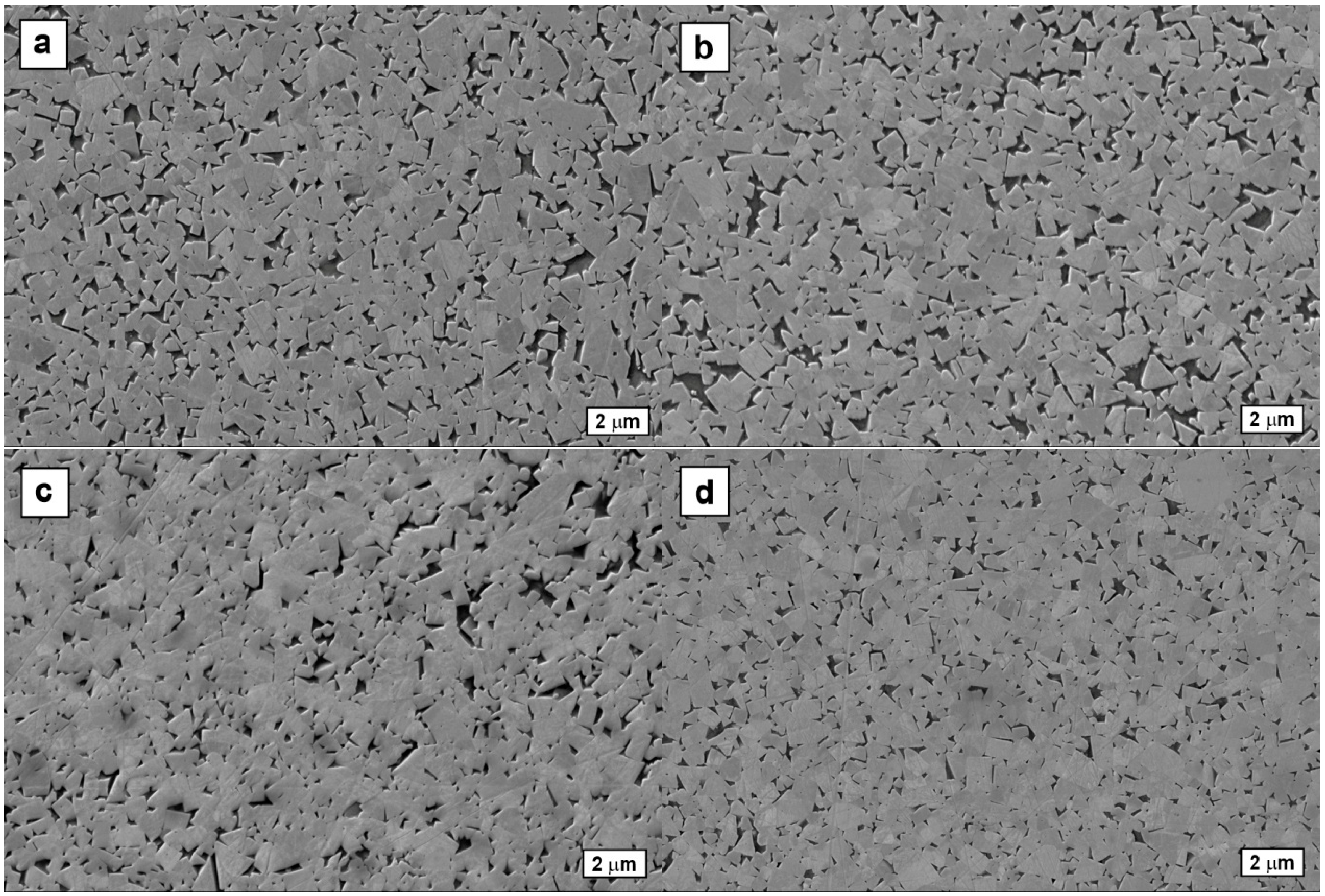
- Under the manufacturing conditions employed for the cemented carbide substrates, neither A- nor B-type porosity was detected, and similarly, neither uncombined carbon nor the eta-phase was found in the examined samples.
- The mechanical characteristics of the experimental cemented carbides, i.e., their hardness and fracture toughness, are comparable to those produced on a commercial scale by the leading tool manufacturers.
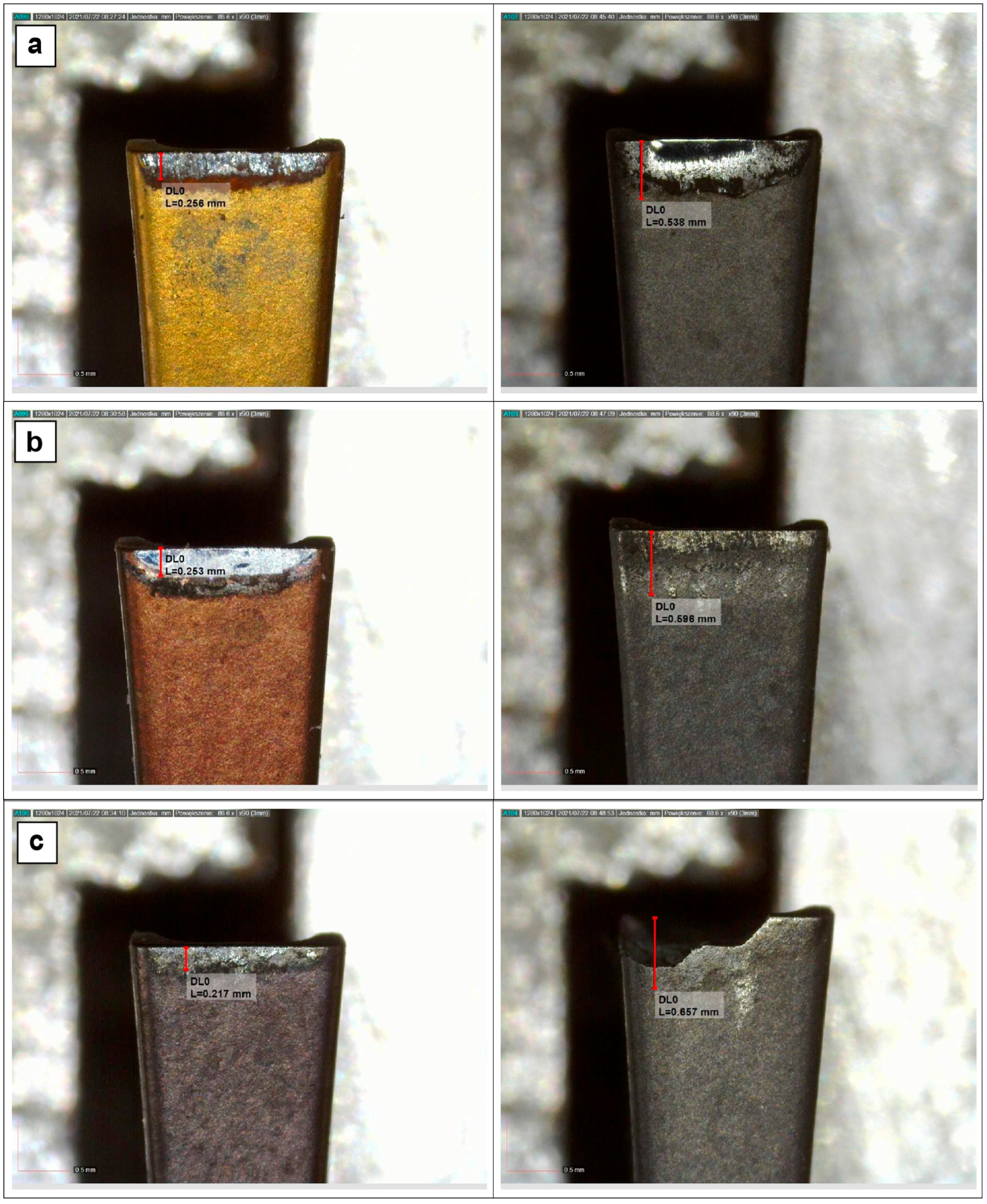
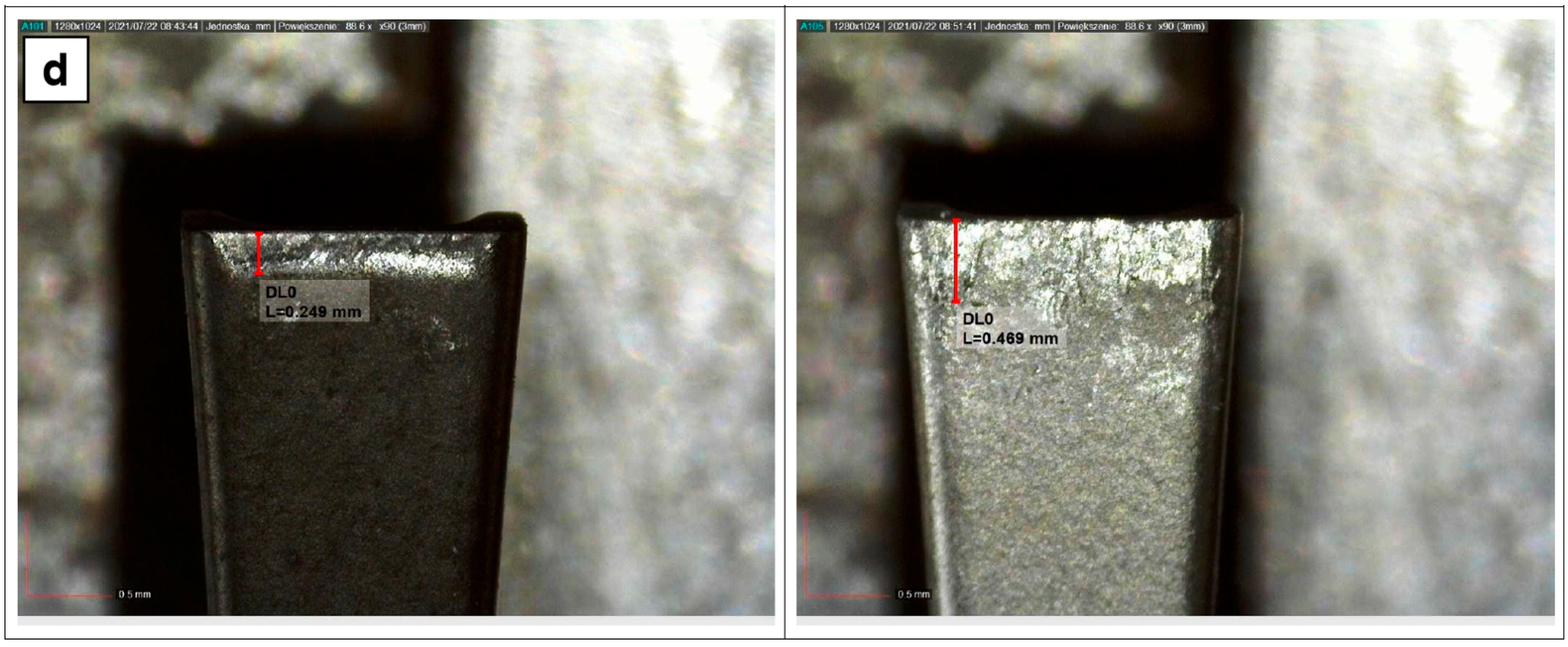
- The deposition of coatings on the cemented carbide grooving inserts had a negligible effect on the coefficient of friction but led to marked improvements in wear resistance. The decrease in wear rate was sensitive to the friction pair configuration ranging from 47 to 67% for the DLC-coated pin/Al alloy disc and AlTiN + TiB2-coated pin/cast iron disc, respectively.
- The grooving tests showed the superiority of the newly developed inserts compared to the other tested tools. They consistently outperformed their high-quality commercial counterparts in terms of tool life.
Author Contributions
Funding
Institutional Review Board Statement
Informed Consent Statement
Data Availability Statement
Conflicts of Interest
References
- Roebuck, B.; Prakash, L. Innovations in Tungsten Carbide-Cobalt Hardmetal Technology. In International Powder Metallurgy Directory 2012–2013, 15th ed.; Inovar Communications Ltd.: Shrewsbury, UK, 2012; pp. 107–126. [Google Scholar]
- Dabees, S.; Mirzaei, S.; Kaspar, P.; Holcman, V.; Sobola, D. Characterization and Evaluation of Engineered Coating Techniques for Different Cutting Tools—Review. Materials 2022, 15, 5633. [Google Scholar] [CrossRef] [Scilit]
- Tkadletz, M.; Schalk, N.; Daniel, R.; Keckes, J.; Czettl, C.; Mitterer, C. Advanced characterization methods for wear resistant hard coatings: A review on recent progress. Surf. Coat. Technol. 2016, 285, 31–46. [Google Scholar] [CrossRef] [Scilit]
- PalDey, S.; Deevi, S.C. Single layer and multilayer wear resistant coatings of (Ti, Al) N: A review. Mater. Sci. Eng. A 2003, 342, 58–79. [Google Scholar] [CrossRef] [Scilit]
- Vereshchaka, A.S.; Mgaloblishvili, O.; Morgan, M.N.; Batako, A.D. Nano-scale multilayered-composite coatings for the cutting tools. Int. J. Adv. Manuf. Technol. 2014, 72, 303–317. [Google Scholar] [CrossRef] [Scilit]
- Martinho, R.P.; Silva, F.J.G.; Martins, C.; Lopes, H. Comparative study of PVD and CVD cutting tools performance in milling of duplex stainless steel. Int. J. Adv. Manuf. Technol. 2019, 102, 2423–2439. [Google Scholar] [CrossRef] [Scilit]
- Yongqiang, W.; Xiaoya, Z.; Zhiqiang, J.; Xiubo, T. Characterization and mechanical properties of TiN/TiAlN multilayer coatings with different modulation periods. Int. J. Adv. Manuf. Technol. 2018, 96, 1677–1683. [Google Scholar] [CrossRef] [Scilit]
- Straumal, B.B.; Konyashin, I. Faceting/Roughening of WC/Binder Interfaces in Cemented Carbides: A Review. Materials 2023, 16, 3696. [Google Scholar] [CrossRef] [Scilit] [PubMed]
- Kupczyk, M.J. Cutting edges with high hardness made of nanocrystalline cemented carbides. Int. J. Refract. Met. Hard Mater. 2014, 974, 126–131. [Google Scholar] [CrossRef] [Scilit]
- Liu, W.; Chu, Q.; Zeng, J.; He, R.; Wu, H.; Wu, Z.; Wu, S. PVD-CrAlN and TiAlN coated Si3N4 ceramic cutting tools—1. Microstructure, turning performance and wear mechanism. Ceram. Int. 2017, 43, 8999–9004. [Google Scholar] [CrossRef] [Scilit]
- Ding, X.Z.; Samani, M.K.; Chen, G. Thermal conductivity of PVD TiAlN films using pulsed photothermal reflectance technique. Appl. Phys. A 2010, 101, 573–577. [Google Scholar] [CrossRef] [Scilit]
- Zhao, J.; Liu, Z.; Shen, Q.; Wang, B.; Wang, Q. Investigation of Cutting Temperature during Turning Inconel 718 with (Ti,Al)N PVD Coated Cemented Carbide Tools. Materials 2018, 11, 1281. [Google Scholar] [CrossRef] [Scilit]
- Falsafein, M.; Ashrafizadeh, F.; Kheirandish, A. Influence of thickness on adhesion of nanostructured multilayer CrN/CrAlN coatings to stainless steel substrate. Surf. Interfaces 2018, 13, 178–185. [Google Scholar] [CrossRef] [Scilit]
- Zhang, K.; Deng, J.; Guo, X.; Sun, L.; Lei, S. Study on the adhesion and tribological behavior of PVD TiAlN coatings with a multi-scale textured substrate surface. Int. J. Refract. Met. Hard Mater. 2018, 72, 292–305. [Google Scholar] [CrossRef] [Scilit]
- Palanisamy, S.; Rashid, R.R.; Brandt, M.; Sun, S.; Dargusch, M. Comparison of endmill tool coating performance during machining of Ti6Al4V Alloy. Adv. Mater. Res. 2014, 974, 126–131. [Google Scholar] [CrossRef] [Scilit]
- Palanisamy, S.; Rashid, R.R.; Brandt, M.; Dargusch, M.S. Tool life study of coated/uncoated carbide inserts during turning of Ti6Al4V. Adv. Mater. Res. 2014, 974, 136–140. [Google Scholar] [CrossRef] [Scilit]
- Rodríguez-Barrero, S.; Fernández-Larrinoa, J.; Azkona, I.; de Lacalle, L.N.L.; Polvorosa, R. Enhanced performance of nanostructured coatings for drilling by droplet elimination. Mater. Manuf. Process. 2016, 31, 593–602. [Google Scholar] [CrossRef] [Scilit]
- Pytlak, B. Optimization of tool wear during plunge turning of hardened 18CrMo4 steel. Adv. Manuf. Sci. Technol. 2015, 39, 5–13. [Google Scholar]
- Beake, B.; Ning, L.; Gey, C.; Veldhuis, S.; Kornberg, A.; Weaver, A.; Khanna, M.; Fox-Rabinovich, G. Wear performance of different PVD coatings during hard wet end milling of H13 tool steel. Surf. Coat. Technol. 2015, 279, 118–125. [Google Scholar] [CrossRef] [Scilit]
- Iqbal, A.; Zhao, G.; Cheok, Q.; He, N.; Nauman, M.M. Sustainable machining: Tool life criterion based on work surface quality. Processes 2022, 10, 1087. [Google Scholar] [CrossRef] [Scilit]
- Wojciechowski, S.; Talar, R.; Zawadzki, P.; Legutko, S.; Maruda, R.; Prakash, C. Study on Technological Effects of a Precise Grooving of AlSi13MgCuNi Alloy with a Novel WCCo/PCD (DDCC) Inserts. Materials 2020, 13, 2467. [Google Scholar] [CrossRef] [Scilit]
- Chinchanikar, S.; Choudhury, S. Wear behaviors of single-layer and multi-layer coated carbide inserts in high speed machining of hardened AISI 4340 steel. J. Mech. Sci. Technol. 2013, 27, 1451–1459. [Google Scholar] [CrossRef] [Scilit]
- Liew, W.Y.; Jie, J.L.L.; Yan, L.Y.; Dayou, J.; Sipaut, C.; Bin Madlan, M.F. Frictional and wear behaviour of AlCrN, TiN, TiAlN single-layer coatings, and TiAlN/AlCrN, AlN/TiN nano-multilayer coatings in dry sliding. Procedia Eng. 2013, 68, 512–517. [Google Scholar] [CrossRef] [Scilit]
- Wu, J.; Zhan, G.; He, L.; Zou, Z.; Zhou, T.; Du, F. Tribological Performance of Micro-Groove Tools of Improving Tool Wear Resistance in Turning AISI 304 Process. Materials 2020, 13, 1236. [Google Scholar] [CrossRef] [Scilit]
- Ananthakumar, R.; Subramanian, B.; Kobayashi, A.; Jayachandran, M. Electrochemical corrosion and materials properties of reactively sputtered TiN/TiAlN multilayer coatings. Ceram. Int. 2012, 38, 477–485. [Google Scholar] [CrossRef] [Scilit]
- Rezaee, S.; Arman, A.; Jurečka, S.; Korpi, A.G.; Mwema, F.; Luna, C.; Sobola, D.; Kulesza, S.; Shakoury, R.; Bramowicz, M.; et al. Effect of annealing on the micromorphology and corrosion properties of Ti/SS thin films. Superlattices Microstruct. 2020, 146, 106681. [Google Scholar] [CrossRef] [Scilit]
- Liu, L.; Jiang, X.; Yingam, E.; Sun, Z.; Geng, D.; Zhang, D. High-performance milling of Ti-6Al-4V through rotary ultrasonic elliptical milling with anticlockwise elliptical vibration. J. Zhejiang Univ. Sci. A 2025, 1–16. [Google Scholar] [CrossRef] [Scilit]
- Upadhyaya, G.S. Cemented Tungsten Carbides. Production, Properties, and Testing; Noyes Publications: Westwood, NJ, USA, 1998; pp. 288–308. [Google Scholar]
- Oberg, E.; Jones, F.D.; Horton, H.L.; Ryffell, H.H. Cemented Carbides. In Machinery’s Handbook, 26th ed.; Industrial Press Inc.: New York, NY, USA, 2000; pp. 747–757. [Google Scholar]
- Niihara, K.; Morena, R.; Hasselman, D.P.H. Evaluation of KIc of brittle solids by the indentation method with low crack-to-indent ratios. J. Mater. Sci. Lett. 1982, 1, 13–16. [Google Scholar] [CrossRef] [Scilit]
- PN-EN 843-4:2007; Advanced Technical Ceramics. Mechanical Properties of Monolithic Ceramics at Room Temperature. Part 4. Surface Hardness According to: Vickers, Knoop and Rockwell. PKN: Warsaw, Poland, 2007.
- Dickson, G. Ultrasonic Methods for Determination of Mechanical Properties of Dental Materials. National Bureau of Standards; Progress Report; NBS: Washington, DC, USA, 31 December 1969; pp. 3–9. [Google Scholar]
- PN-EN ISO 18754:2022; Fine Ceramics (Advanced Ceramics, Advanced Technical Ceramics)—Determination of Density and Apparent Porosity. PKN: Warsaw, Poland, 2022.
- Vander Voort, G.F. Metallography. In Principles and Practice; ASM International: Materials Park, OH, USA, 1999; pp. 436–465. [Google Scholar]
- ISO 4499-4:2016; Hardmetals—Metallographic Determination of Microstructure. Part 4: Characterisation of Porosity, Carbon Defects and Eta-Phase Content. ISO: Geneva, Switzerland, 2016.
- ISO 3685:1993; Tool-Life Testing with Single-Point Turning Tools. ISO: Geneva, Switzerland, 1993.
- Frydrych, H.; Konstanty, J.; Ratuszek, W. Microstructure and properties of sintered cobalt-chromium carbide materials. Arch. Metall. Mater. 2006, 51, 459–462. [Google Scholar]
- Polcomm® DEGroove. Reliable Polcomm Solutions for Parting & Grooving. Available online: https://www.polcomm.com.pl/wp-content/uploads/2023/04/Polcomm_DEGroove_Rowkowanie_Grooving.pdf (accessed on 18 May 2025).



| Material Designation (ISO Group) | Chemical Composition (a), wt.% | WC Grain Size, μm | PVD Coating | |||
|---|---|---|---|---|---|---|
| Co | (Ta,Nb)C | Cr3C2 | VC | |||
| P | 9.6–10.2 | - | 0.5–0.8 | 0.0–0.1 | 0.7–1.0 | AlTiN + AlCrN |
| M | 12.0–12.7 | 1.2–1.6 | - | - | 1.0–3.0 | TiAlSiN |
| K | 5.8–6.5 | - | 0.5–0.8 | 0.0–0.1 | 1.0–4.0 | AlTiN + TiB2 |
| N | 4.8–5.3 | - | 0.2–0.3 | 0.0–0.1 | 1.0–3.0 | DLC |
| Grooving Insert (ISO Group) | Machining Parameters | Workpiece | |||
|---|---|---|---|---|---|
| Cutting Speed, m/min | Feed Rate, mm/rev | Material | Diameter, mm | Hardness, HB | |
| P | 120 | 0.10 | C45 steel | 98 | 225 |
| M | 100 | 0.10 | X5CrNi18-10 stainless steel | 98 | 215 |
| K | 140 | 0.10 | GJL-250 cast iron | 98 | 250 |
| N | 300 | 0.08 | AW-7075 aluminium alloy | 98 | 150 |
| Grooving Inserts (ISO Group) | Density, g/cm3 | E, GPa | HV30 (b) | HV1 | KIc (b), MPa∙m1/2 |
|---|---|---|---|---|---|
| P | 14.42 ± 0.03 | 582 ± 6 | 1567 ± 10 (1500–1620) | 1630 ± 18 | 16.4 ± 0.2 (15.5–17.0) |
| M | 14.22 ± 0.01 | 559 ± 4 | 1352 ± 7 (1290–1370) | 1438 ± 22 | 18.6 ± 0.6 (18.0–19.0) |
| K | 14.90 ± 0.02 | 619 ± 5 | 1561 ± 14 (1525–1615) | 1650 ± 53 | 13.7 ± 0.3 (13.0–14.0) |
| N | 14.90 ± 0.01 | 624 ± 2 | 1728 ± 12 (1650–1740) | 1829 ± 20 | 11.6 ± 0.3 (11.0–12.0) |
| Grooving Inserts (ISO Group) | WC Grain Size (L̅3), μm | Pores (a) | Uncombined Carbon (a) (Graphite) | |
|---|---|---|---|---|
| ≤10 μm | 10–25 μm | |||
| P | 0.9 ± 0.1 | A00 | B00 | C00 |
| M | 2.0 ± 0.2 | A00 | B00 | C00 |
| K | 2.4 ± 0.2 | A00 | B00 | C00 |
| N | 2.0 ± 0.2 | A00 | B00 | C00 |
| Material Designation (ISO Group) | Chemical Composition Estimates (EDS), wt.% | |||
|---|---|---|---|---|
| Co | (Ta,Nb)C | Cr3C2 | WC | |
| P | 10.28 ± 0.35 | - | 0.55 ± 0.30 | bal |
| M | 10.30 ± 0.33 | 1.35 ± 0.24 | 0.48 ± 0.30 | bal |
| K | 5.50 ± 0.61 | - | 0.60 ± 0.19 | bal |
| N | 4.98 ± 0.35 | - | 0.18 ± 0.12 | bal |
| Material Designation (ISO Group) | Coating Composition | Adhesive Layer | Total Thickness (Assumed), μm | μHV0.025 (Assumed) | Coating Deposition | |
|---|---|---|---|---|---|---|
| Targets | Temperature Range, °C | |||||
| P | AlTiN + AlCrN | TiN | 5.0 | 3200 | Ti Al60Ti40 Al70Cr30 | 450–550 |
| M | TiAlSiN | TiN | 4.0 | 3500 | Ti Al60Ti40 TiSi34 | 450–550 |
| K | AlTiN + TiB2 | TiN | 4.5 | 3550 | Ti Al60Ti40 TiB2 | 450–550 |
| N | DLC | TiN | 1.5 | 5500 | Ti C | 180–200 |
| Material Designation (ISO Group) | Coating Composition | Total Thickness, μm | μHV0.025 | |
|---|---|---|---|---|
| Cross-Section | Outer Surface | |||
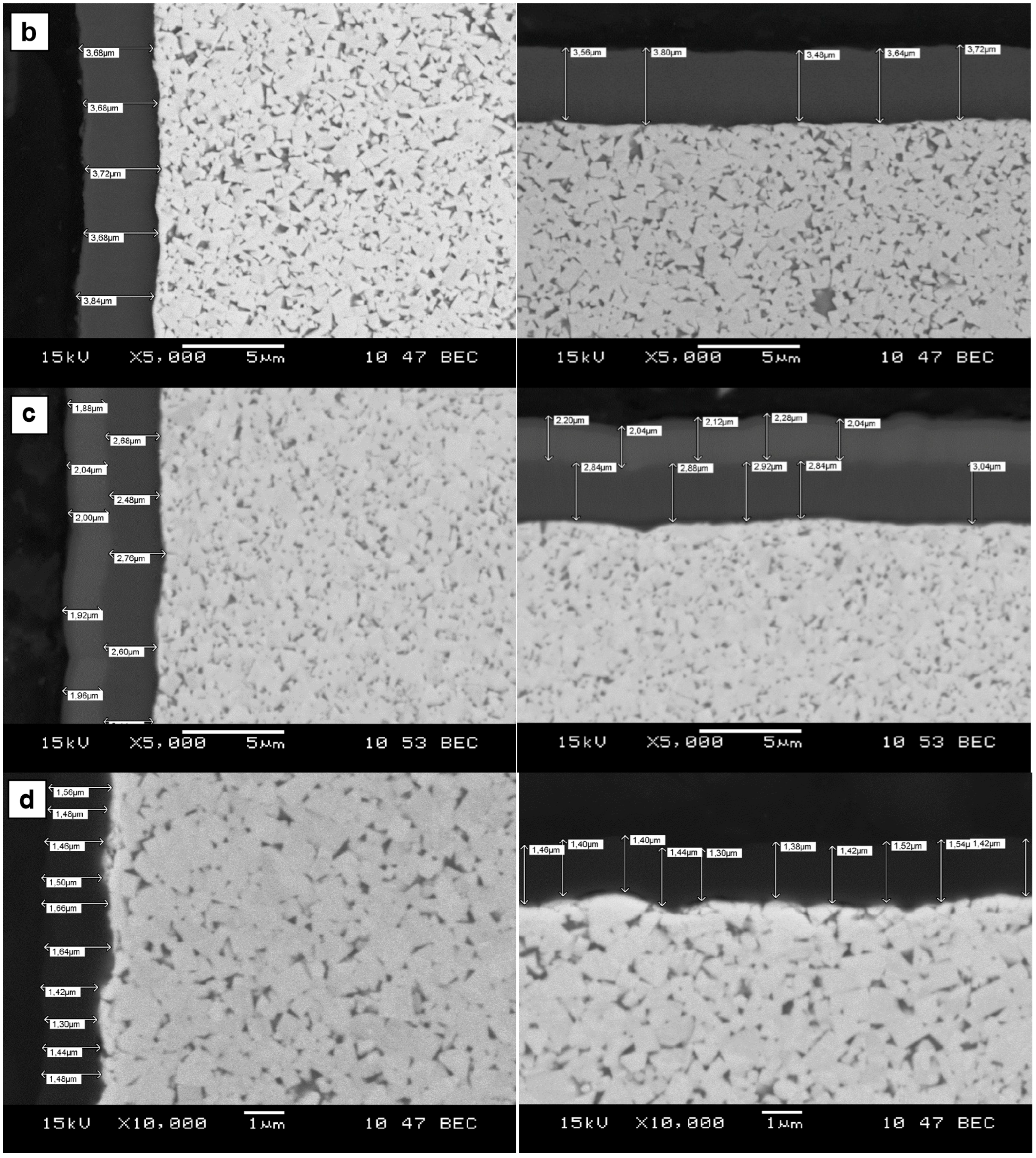
| P | AlTiN + AlCrN | 5.46 ± 0.13 | 3025 ± 303 | 3123 ± 293 |
| M | TiAlSiN | 3.68 ± 0.19 | 3350 ± 240 | 3376 ± 218 |
| K | AlTiN + TiB2 | 4.81 ± 0.47 | 3421 ± 196 | 3526 ± 230 |
| N | DLC | 1.46 ± 0.16 | - | 5389 ± 201 |
| Material Designation (ISO Group) | Coating Composition | |
|---|---|---|
| Inner Layer (a) | Outer Layer (a) | |
| P | Al0.53Ti0.47N (20%) | Al0.59Cr0.41N (80%) |
| M | Ti0.63Al0.3 Si0.07N | |
| K | Al0.58Ti0.42N (57%) | Ti0.91Al0.09B2 (43%) |
| N | 100%C | |
| Material Designation (ISO Group) | Coating Composition | Coefficient of Friction | Wear Land Width, μm | Decrease in Wear Rate Due to Coating |
|---|---|---|---|---|
| P | AlTiN + AlCrN | 0.54 | 256 | 52.4% |
| uncoated | 0.52 | 538 | ||
| M | TiAlSiN | 0.71 | 253 | 57.6% |
| uncoated | 0.77 | 596 | ||
| K | AlTiN + TiB2 | 0.31 | 217 | 67.0% |
| uncoated | 0.31 | 657 | ||
| N | DLC | 0.40 | 249 | 46.9% |
| uncoated | 0.47 | 469 |
| Grooving Insert | Workpiece | Cutting Speed (Vc) Feed Rate (f) | Flank Wear (VBB), mm | Working Time, min | Time to VBB = 0.3 mm (a), min |
|---|---|---|---|---|---|
| P/AlTiN + AlCrN | C45 steel | Vc = 120 m/min f = 0.1 mm/rev | 0.310 | 18.7 | 18.1 ± 0.1 (17.5) |
| 0.293 | 17.7 | ||||
| 0.312 | 18.9 | ||||
| 0.306 | 18.5 | ||||
| M/TiAlSiN | X5CrNi18-10 stainless steel | Vc = 100 m/min f = 0.1 mm/rev | 0.310 | 18.4 | 18.0 ± 0.4 (17.5) |
| 0.293 | 17.8 | ||||
| 0.312 | 18.6 | ||||
| 0.318 | 19.1 | ||||
| K/AlTiN + TiB2 | GJL-250 cast iron | Vc = 140 m/min f = 0.1 mm/rev | 0.303 | 18.1 | 17.9 ± 0.2 (17.5) |
| 0.321 | 19.2 | ||||
| 0.315 | 18.7 | ||||
| 0.298 | 17.9 | ||||
| N/DLC | AW-7075 aluminium alloy | Vc = 300 m/min f = 0.08 mm/rev | 0.314 | 18.8 | 18.1 ± 0.4 (17.5) |
| 0.286 | 17.5 | ||||
| 0.306 | 18.4 | ||||
| 0.312 | 18.7 |
Disclaimer/Publisher’s Note: The statements, opinions and data contained in all publications are solely those of the individual author(s) and contributor(s) and not of MDPI and/or the editor(s). MDPI and/or the editor(s) disclaim responsibility for any injury to people or property resulting from any ideas, methods, instructions or products referred to in the content. |
© 2025 by the authors. Licensee MDPI, Basel, Switzerland. This article is an open access article distributed under the terms and conditions of the Creative Commons Attribution (CC BY) license (https://creativecommons.org/licenses/by/4.0/).
Share and Cite
Konstanty, J.; Layyous, A.; Furtak, Ł. Novel Cemented Carbide Inserts for Metal Grooving Applications. Materials 2025, 18, 3674. https://doi.org/10.3390/ma18153674
Konstanty J, Layyous A, Furtak Ł. Novel Cemented Carbide Inserts for Metal Grooving Applications. Materials. 2025; 18(15):3674. https://doi.org/10.3390/ma18153674
Chicago/Turabian StyleKonstanty, Janusz, Albir Layyous, and Łukasz Furtak. 2025. "Novel Cemented Carbide Inserts for Metal Grooving Applications" Materials 18, no. 15: 3674. https://doi.org/10.3390/ma18153674
APA StyleKonstanty, J., Layyous, A., & Furtak, Ł. (2025). Novel Cemented Carbide Inserts for Metal Grooving Applications. Materials, 18(15), 3674. https://doi.org/10.3390/ma18153674