Article

Role of Woody Biomass Ash Material in Immobilization of Cadmium, Lead and Zinc in Soil
by
Elżbieta Rolka
,
Mirosław Wyszkowski
*,
Andrzej Cezary Żołnowski
and
Anna Skorwider-Namiotko
Department of Agricultural and Environmental Chemistry, Faculty of Agriculture and Forestry, University of Warmia and Mazury in Olsztyn, Łódzki 4 Sq., 10-727 Olsztyn, Poland
*
Author to whom correspondence should be addressed.
Materials 2024, 17(10), 2206; https://doi.org/10.3390/ma17102206
Submission received: 28 March 2024 / Revised: 29 April 2024 / Accepted: 6 May 2024 / Published: 8 May 2024

Abstract

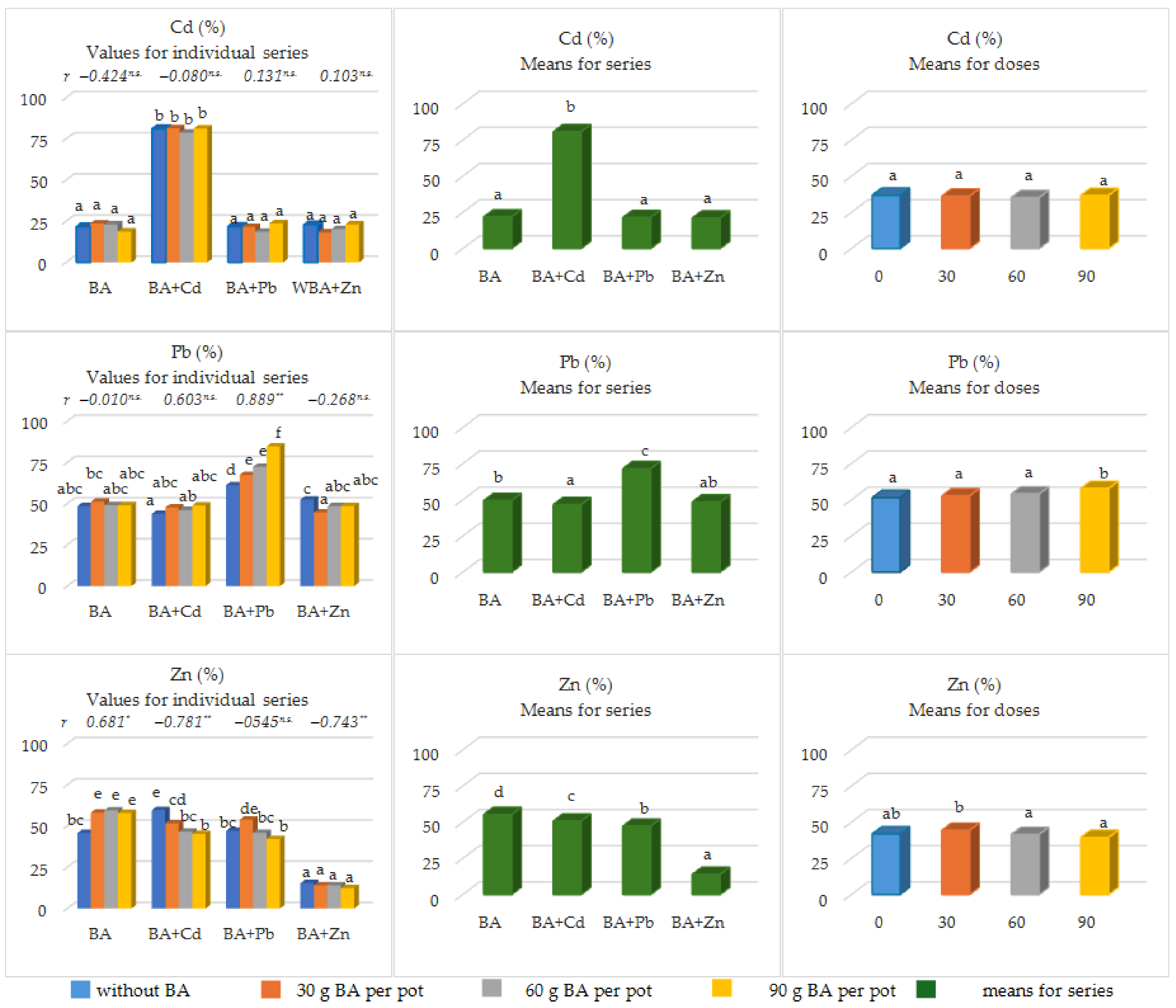
Nowadays, we have observed the dynamic development of bio-heating plants that use wood biomass for heating or energy purposes. The result of this process is a reduction in carbon dioxide emissions as well as in the production of biomass ash (BA). Despite the waste nature of BA, it should be carefully analyzed and assessed for various applications, including environmental ones. Due to the features attributed to BA, including its alkaline reaction, the high capacity of its sorption complex, relatively low salinity, and significant content of macro- and microelements, a hypothesis was put forward in this work undertaken about the positive role of BA as an immobilizing factor for Cd-, Pb-, and Zn-contaminated soils. This research was based on a pot experiment in which four series were considered: (1) BA; (2) BA + Cd; (3) BA + Pb; and (4) BA + Zn. BA was used at doses of 30, 60, and 90 mg pot−1, and metals at doses of 2 mg Cd, 100 mg Pb, and 300 mg Zn kg−1 of soil. The test plant was corn grown for green mass. The study took into account the influence of BA on the content of the total forms of heavy metals (Metot) and their available forms (Meav). In the soil without the addition of metals, a significant increase in the content of Cdtot and Cdav, and a decrease in the content of Zntot were observed due to the application of BA. The addition of metals against the background of the BA used resulted in a significant increase in Cdtot, Pbtot, and Zntot, as well as an increase in the available forms of Pbav but a decrease in Znav. However, there was no significant increase in the Cdav content. The obtained results may indicate the potentially immobilizing role of BA only in the case of zinc. They may constitute the basis for further, more detailed research aimed at determining the role of BA in the immobilization of various metals in soil.
Keywords: ash from wood biomass; soil contamination; immobilization; cadmium; lead; zinc ash from wood biomass; soil contamination; immobilization; cadmium; lead; zinc