4.1. The Formation Mechanism of Interfacial Carbides
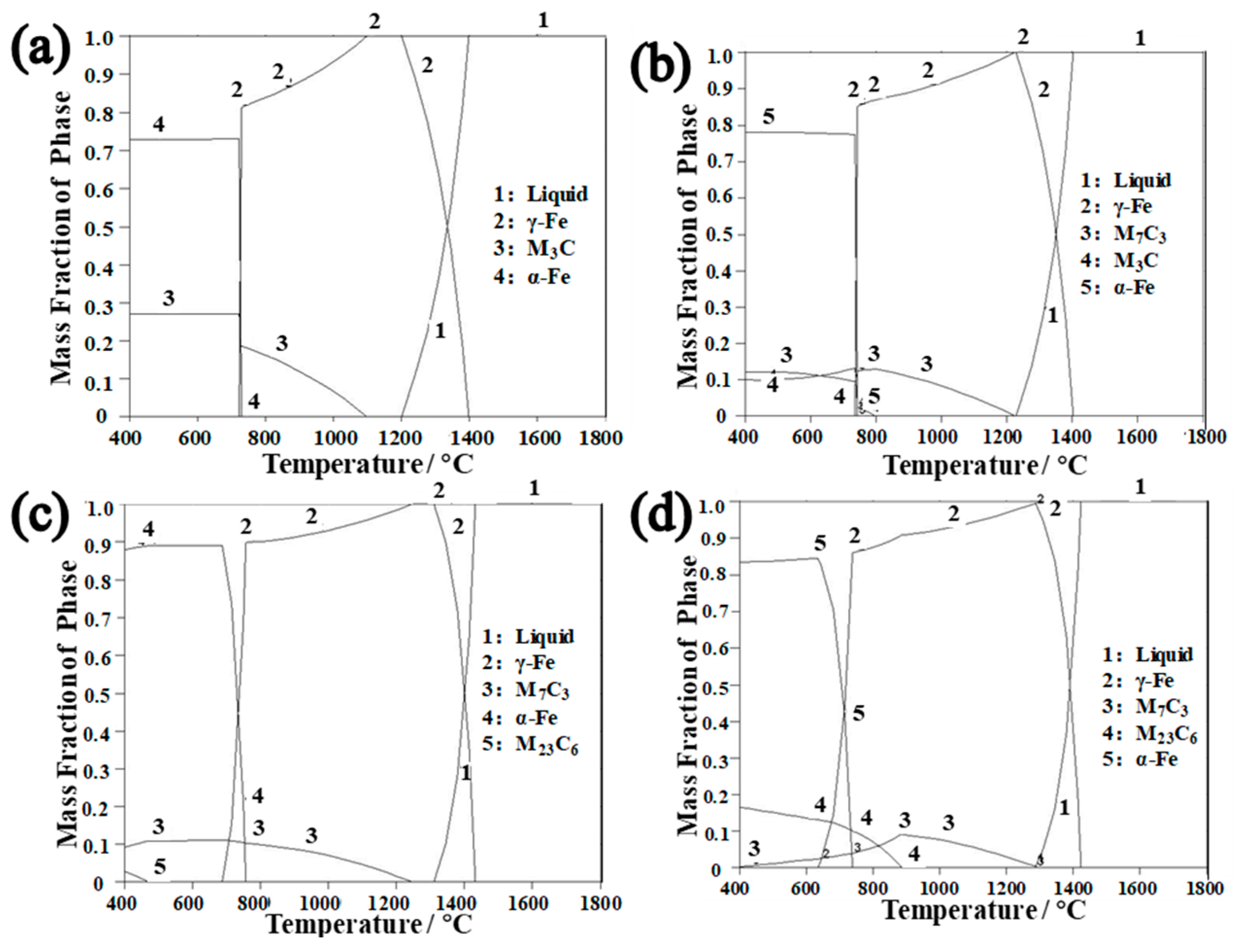
Figure 8 shows the results of the thermodynamic calculations at regions A, B, C, and D, which aligned with the chemical composition of the cladding interface in
Table 5. The formation mechanism of the interfacial carbides was analyzed by thermodynamic calculations in
Figure 8, revealing that the Cr content of the A region was low, the M
3C carbides precipitated in the austenite at 1097 °C, and the cladding interface consisted of ferrite and M
3C carbides (
Figure 8a). The Cr content of the B region increased, the M
7C
3 carbides precipitated in the austenite at 1223 °C, the cladding interface consisted of ferrite, M
3C, and M
7C
3 carbides at room temperature (
Figure 8b), and the width of the carbides increased. The Cr content of the C region increased, the M
7C
3 carbides precipitated in the austenite at 1243 °C, the M
7C
3→M
23C
6 transformation occurred at 469 °C, and a core(M
7C
3)–shell(M
23C
6) structure was formed (
Figure 8c). The Cr content of the D region increased, the M
7C
3 carbides precipitated in the austenite at 1289 °C, and the M
7C
3→M
23C
6 transformation occurred at 886 °C (
Figure 8d). The higher interfacial temperature led to the diffusion coefficient increasing and accelerated spheroidization of the carbides. The C gathered laterally in the place where the curvature radius of the carbides was large, so growth of the carbides was promoted laterally (
Figure 8d), but they gradually dissolved in the place where the curvature radius was small [
25], forming granular and blocky carbides.
4.2. Elimination of Carbides in the Carburized Layer of SS
The carbides in the carburized layer did not precipitate for several reasons. First, the cladding interface re-melted and formed a micro-melting zone, where the Cr and C mixed. The Cr diffused to the cladding interface, which led to the Cr/C increasing, and the formation of higher stability M
23C
6 carbides and stabilized interfacial C. Second, the chemical potential difference between the SS and the CS caused the diffusion of C, and C activity played a major role. Based on Equations (9) and (10), the C activity in the carburized layer of the SS, the cladding interface, and the decarburized layer of the CS was calculated when the carbides precipitated [
26]:
where
aC is the C activity,
fC is the C activity coefficient, and
yM is the mole fraction of the element. As shown in
Table 6, the C activity difference between the cladding interface and the SS decreased from 0.454 to 0.070, the chemical potential gradient of C decreased, and the C diffusion to the SS was weakened, with no obvious diffusion of C (
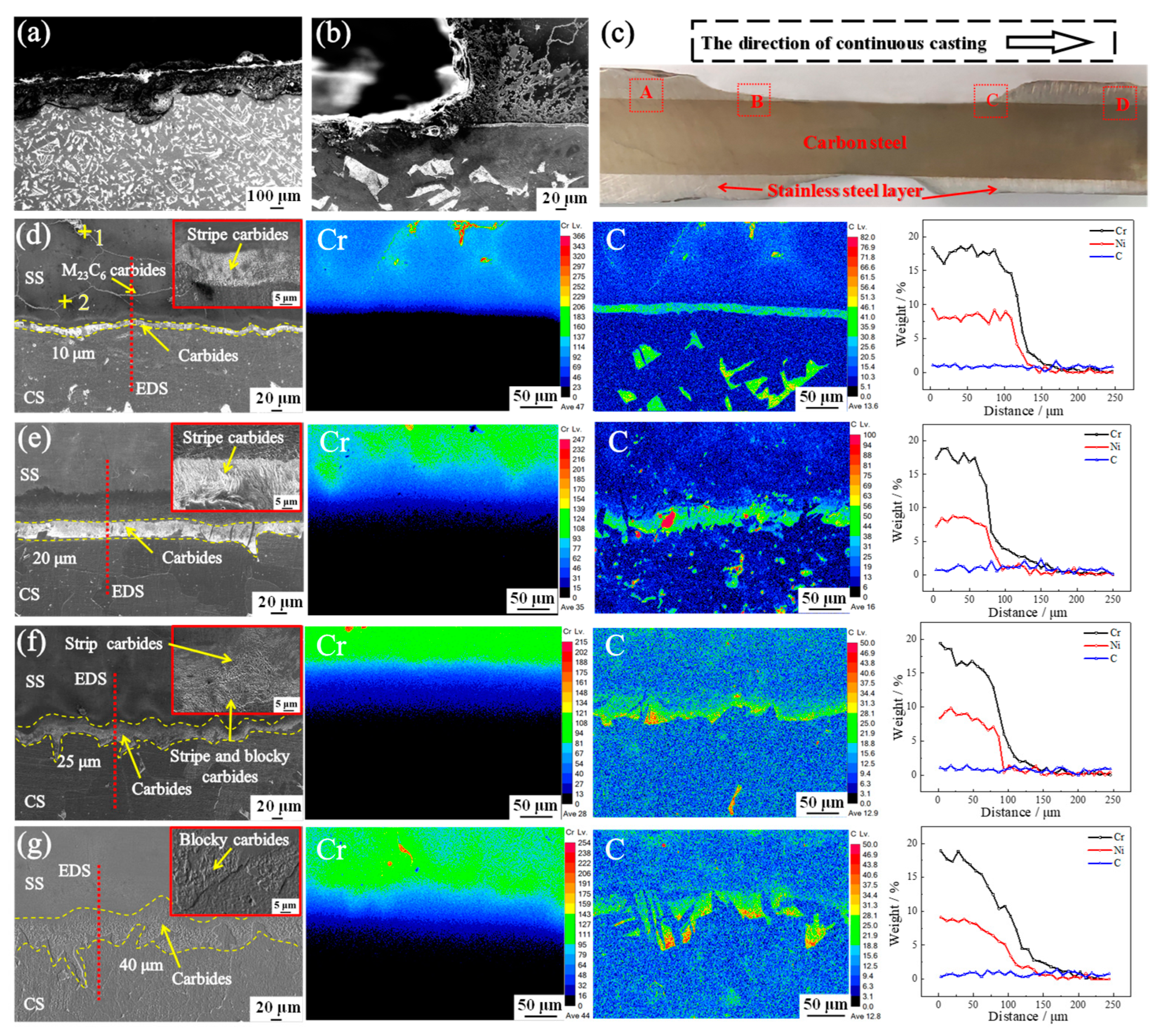
Figure 7g). In addition, the Cr content in the SS gradient decreased, the Cr continuously diffused to the cladding interface, the Cr/C increased, the Cr and C gathered in the CS near-interface, and carbides formed.
Hence, the interfacial carbide hindered the C diffused to the SS, limiting carbide precipitation in the carburized layer of the SS, and formed a coherent relationship with the matrix, thus improving the interfacial bonding strength.
4.3. The Strengthening Mechanism of Interfacial Carbides
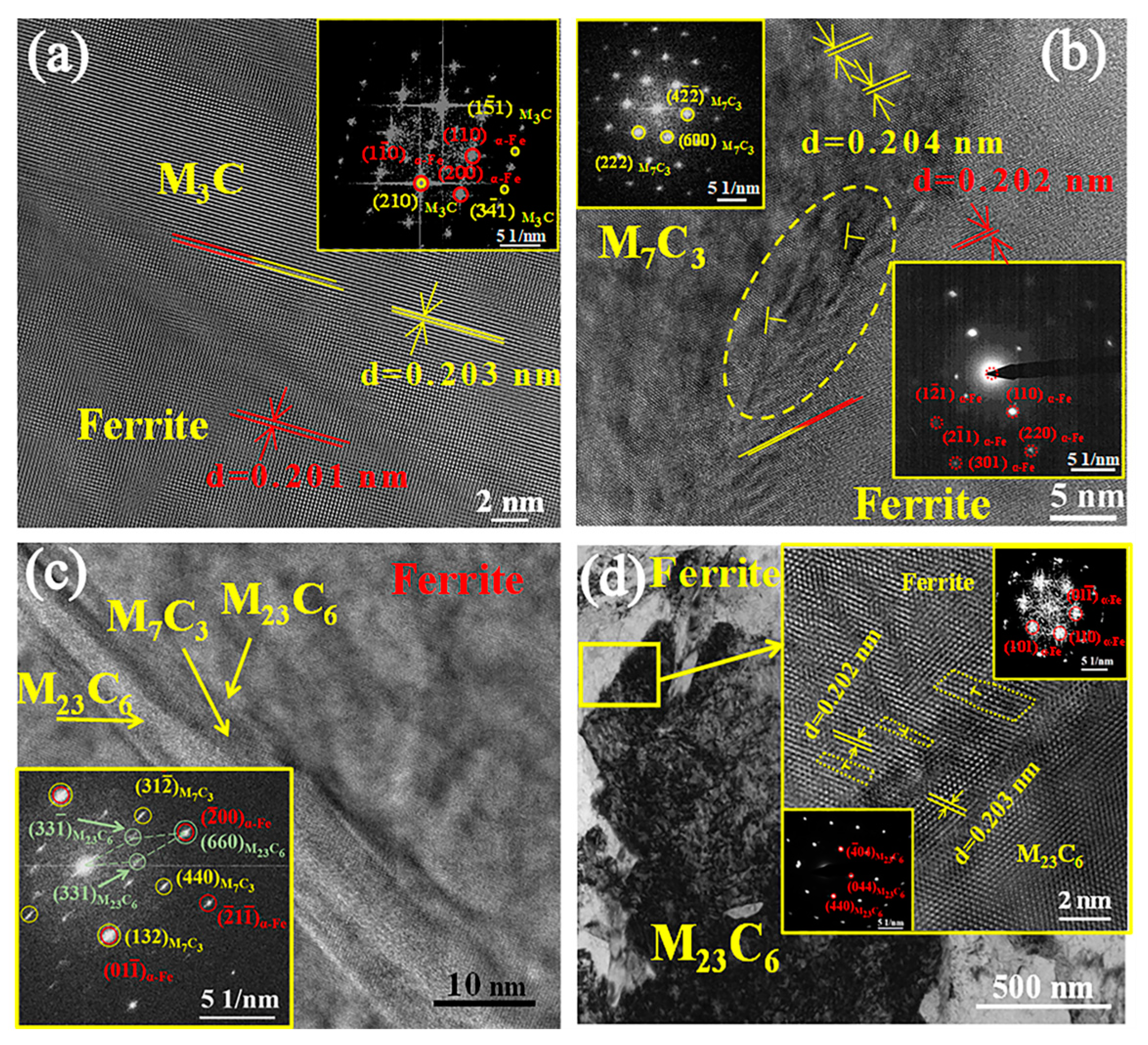
Figure 9 displays the microstructure of the carbides and relationship between the interfacial carbides and the interfacial ferrite matrix in the regions A, B, C, and D. The crystallographic relationships between the interfacial carbides and the interfacial ferrite matrix in regions A, B, C, and D were [−1211]
M3C∥[00−2]
α-Fe, (210)
M3C∥(1−10)
α-Fe, d
M3C = 0.203 nm, d
α-Fe = 0.201 nm (
Figure 8a); [01−1]
M7C3∥[−113]
α-Fe, (600)
M7C3∥(110)
α-Fe, d
M7C3 = 0.204 nm, d
α-Fe = 0.202 nm (
Figure 8b); [−11−1]
M7C3∥[−110]
M23C6∥[−011]
α-Fe, (132)
M7C3∥(01−2)
α-Fe, (660)
M7C3∥(−200)
α-Fe (
Figure 8c); [1−11]
M23C6∥[−111]
α-Fe, (440)
M23C6∥(110)
α-Fe, (40−4)
M23C6∥(110)
α-Fe, d
M23C6 = 0.203 nm, d
α-Fe = 0.202 nm (
Figure 8d), respectively. The lattice misfit
δ of the interfacial carbide and interfacial ferrite matrix could be calculated by Equation (11) [
27]:
where
δ is the lattice misfit, and d
1 and d
2 are the crystal plane spacings. In the experiment,
δM3C-(α-Fe) = 0.01,
δM7C3-(α-Fe) = 0.01, and
δM23C6-(α-Fe) = 0.005 less than 0.05. The interfacial M
3C, M
7C
3, and M
23C
6 carbides had a coherent relationship with the matrix.
A coherent relationship between the interfacial carbides and the interfacial ferrite matrix can significantly reduce the coherent stress. At the same time, dislocations between the carbides and the matrix can form a low-density lattice misfit, which reduces the interface energy and improves the interfacial stability and interfacial bonding strength [
28,
29,
30]. The synergistic deformation capacity between the interfacial carbides and the interfacial ferrite matrix could be improved by the precipitation of carbides, leading to the enhanced strength of the matrix. The strengthening effect of the carbides could be evaluated by the Ashby–Orowan equation [
31]:
where Δ
σAshby-Orowan is the increment of precipitation strengthening,
G is the shear modulus [
32],
b is the burgers vector [
32],
f is the volume fraction (
f = 11.7 vol.%), and
d is the average diameter of the precipitates (
d = 62.5 nm). Based on Equation (12), Δ
σAshby-Orowan = 288 MPa, the theoretical calculated value of interfacial bonding strength was 408 MPa (only the precipitation strengthening of carbides was considered). The blocky M
23C
6 carbides led to an increase of 240% in the interfacial ferrite strength (
σferrite = 120 MPa [
33]).
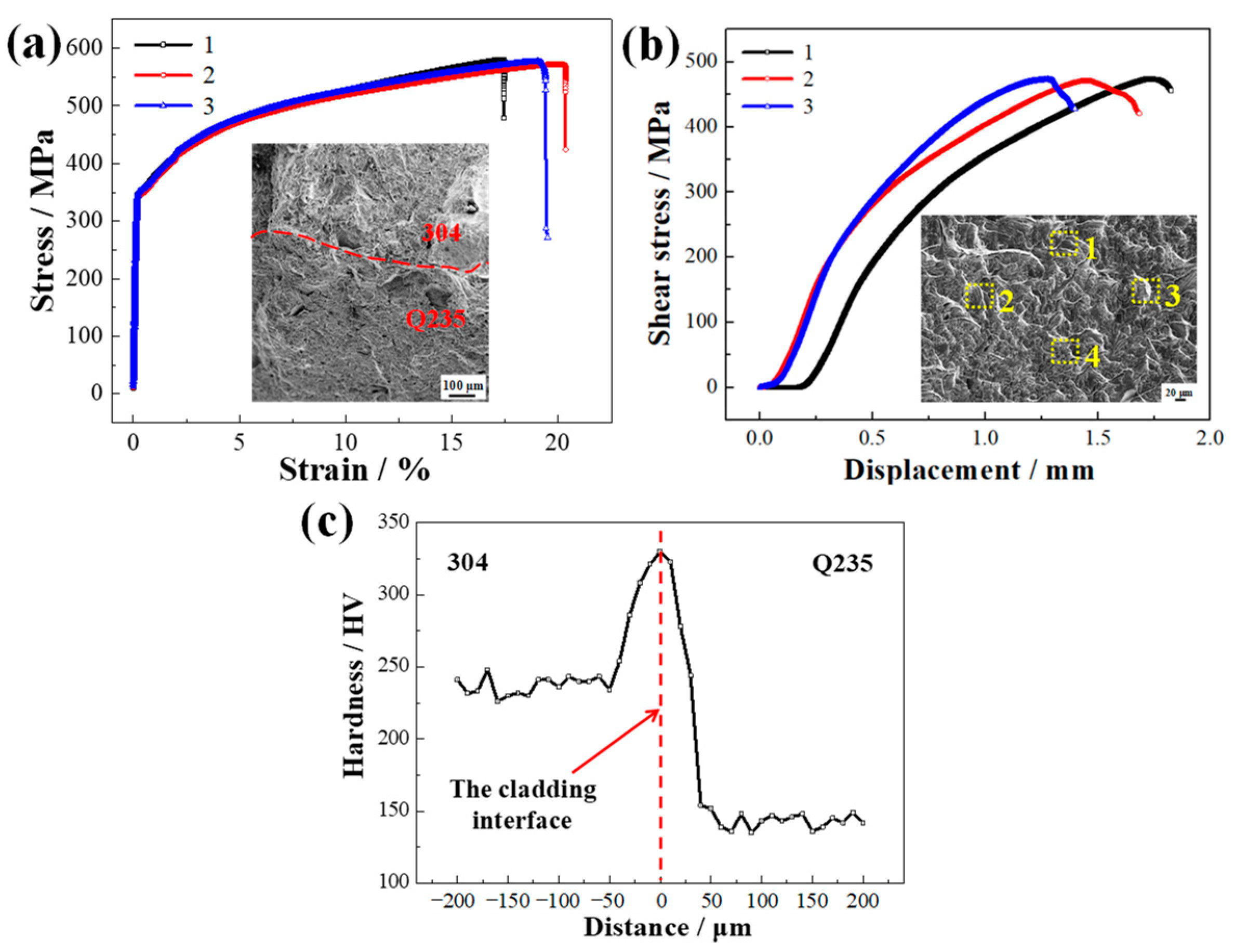
Figure 10 displays the tensile strength, interfacial shear strength, and micro-hardness near the cladding interface of the SS/CS clad plates with blocky M
23C
6 carbides formed at the cladding interface. Curves 1, 2, and 3 in
Figure 10a are the stress–strain curves of different specimens under the same process. Curves 1, 2, and 3 in
Figure 10b are the shear strain–displacement curves of different specimens under the same process. As shown in
Figure 10a, the yield and tensile strengths were 381 and 577 MPa, respectively. As shown in
Figure 10b, the interfacial tensile shear strength was 473 MPa, and the regions of 1-4 is the scanning area of EDS in (b). The interfacial tensile shear strength of the SS/CS clad plates prepared by vacuum welding hot rolling with a rolling temperature of 1150 °C and rolling reduction of 80% was 389 MPa [
2]. The cladding interface tensile shear strength of the clad plates prepared by HCLSCC was similar to the clad plates prepared by vacuum welding hot rolling. Combined with the fracture morphology, the tensile fracture was ductile with a large number of dimples, and the cladding and substrate layers were not delaminated, which further illustrated that limiting the precipitation of carbides in the carburized layer could limit the formation of cracks and improve the strength of the clad plate. At the same time, according to the compression–shear fracture morphology, the fracture occurred on the CS near-interface, with large numbers of tearing edges and dimples, which significantly improved the interfacial bonding strength.
Figure 10c shows the hardness distribution of the cladding interface. The maximum hardness at the cladding interface was 330 HV. The hardness gradually decreased from this point to the SS and CS. The average hardness values of the SS and CS were 237 HV and 143 HV, respectively.
Blocky carbides formed in steel or during the welding process can preferentially act as crack initiation centers and cause fractures. For SS/CS clad plates prepared by hot rolling or diffusion bonding, stress concentration occurs in the low-strength ferrite decarburization layer under stress conditions, where the crack will preferentially initiate, propagate, and finally fracture. As shown in
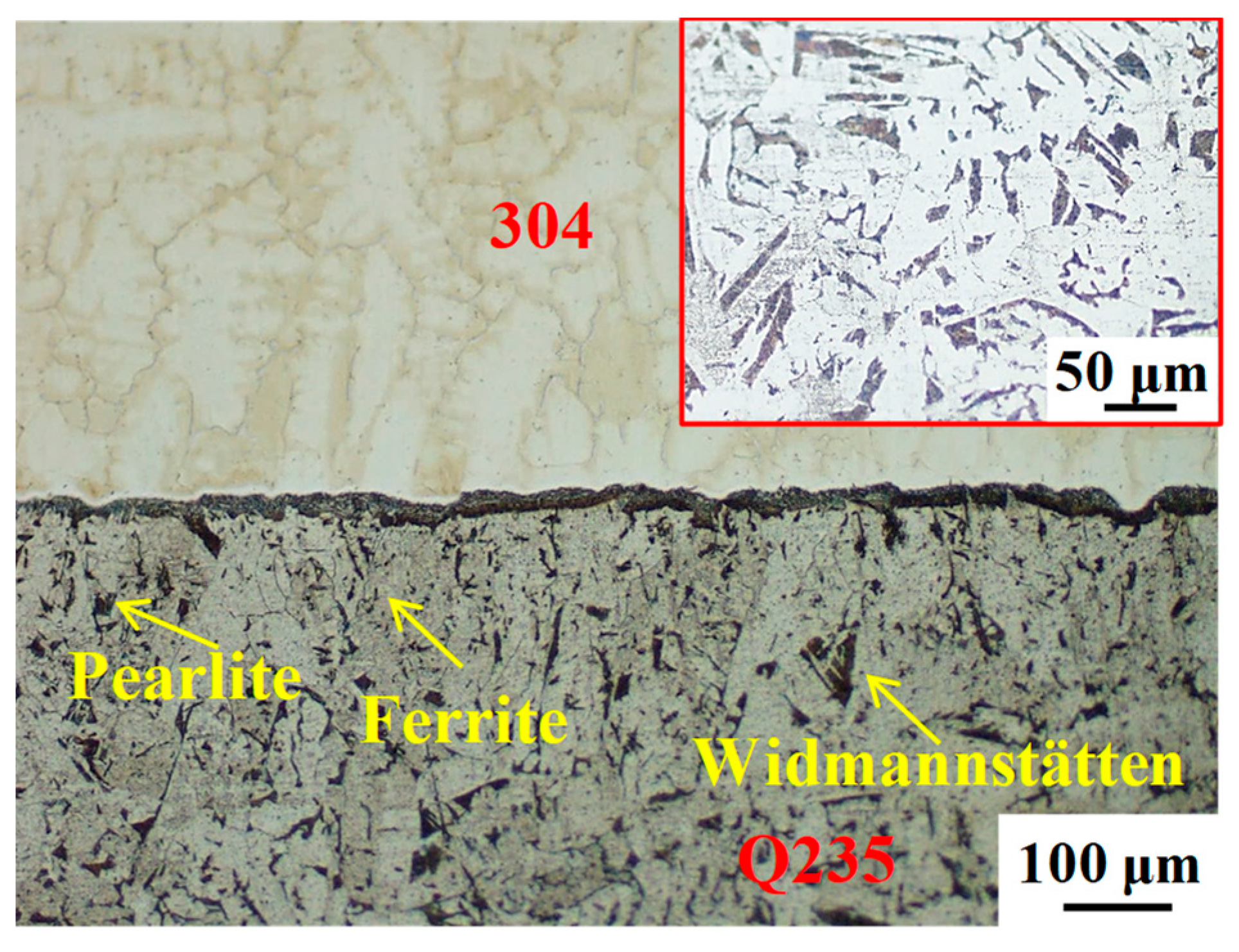
Figure 11, the interface region of the clad plate prepared by HCLSCC was composed of austenite on the SS, interfacial carbides, and widmannstätten, pearlite, and ferrite on the CS. For the SS/CS clad plate prepared by HCLSCC, the blocky carbides were constructed on the ferrite matrix near the cladding interface and eliminated in the ferrite decarburization layer, which strengthened the ferrite and improved the synergistic deformation ability of the clad plate. Under stress conditions, synchronous deformation of the interface reduced stress concentration at the interfacial carbides and delayed the formation of cracks. At the same time, the uniform distribution of carbides at the cladding interface can significantly alleviate the formation of cracks [
34,
35]. Compared with the blocky carbides formed at the cladding interface, the carbides in the widmannstätten of the CS were lamellar and provided a relatively easy path for the formation and propagation of cracks, making it easier to form cracks and resulting in fracture of the clad plate.
Table 7 shows the element content in the regions 1–4 of the shear fracture in
Figure 10b. The fracture surface contained a large amount of Fe and almost no Cr and Ni, indicating that the clad plate fractured at the CS due to the formation of cracks in the widmannstätten of the CS. Therefore, the interfacial blocky carbides reduced the probability of crack formation at the cladding interface of SS/CS clad plate prepared by HCLSCC. Additionally, the stress concentration caused by carbides was eliminated and the sensitivity of crack formation was reduced due to no lamellar carbides precipitating in the PFZ of the SS near-interface [
36]. Therefore, the interface bonding strength of the composite plate prepared by HCLSCC was significantly improved, and the cracking position was located in the widmannstätten zone far from the interface. The volume change caused by solidification shrinkage and phase transformation will lead to the formation of residual stress at the interface due to the different thermo-physical parameters of austenite and ferrite and uneven temperature distribution during HCLSCC [
22,
37].
The cladding interface formed the blocky M23C6 carbides was coherent with the matrix, which significantly enhanced the interfacial bonding strength. At the same time, the improvement of the interfacial bonding strength strengthened the clad plate. There was no decarburization layer on the CS near the cladding interface, and no carbides were formed on the carburized layer of the SS. There were no defects such as oxides and pores at the cladding interface, which further enhanced the strength of the clad plate.
Hence, high-quality SS/CS clad plates could be prepared by the HCLSCC process, which may introduce a promising method to integrate control of the microstructure and the performance of laminated composites.




 and
and