Article

Improved Thermo-Mechanical Fatigue Resistance of Al-Si-Cu 319 Alloys by Microalloying with Mo

1
Department of Applied Science, University of Quebec at Chicoutimi, Saguenay, QC G7H 2B1, Canada
2
Arvida Research and Development Centre, Rio Tinto Aluminum, Saguenay, QC G7S 4K8, Canada
*
Author to whom correspondence should be addressed.
Materials 2023, 16(9), 3515; https://doi.org/10.3390/ma16093515
Submission received: 13 April 2023 / Revised: 28 April 2023 / Accepted: 1 May 2023 / Published: 3 May 2023

Abstract

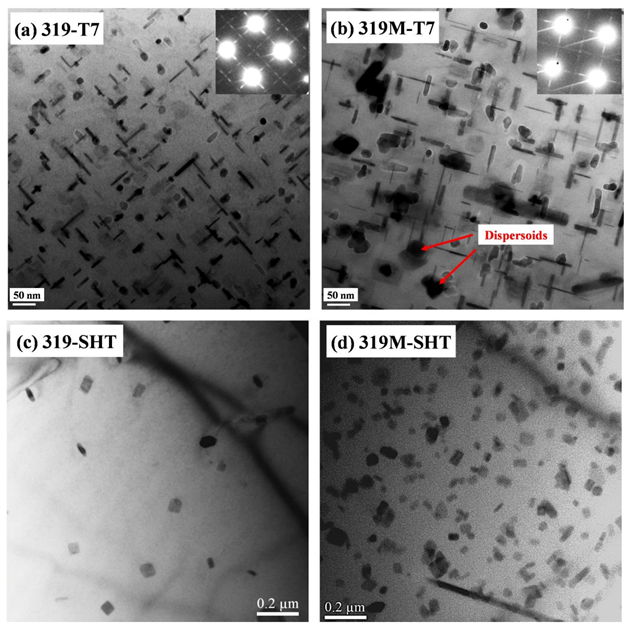
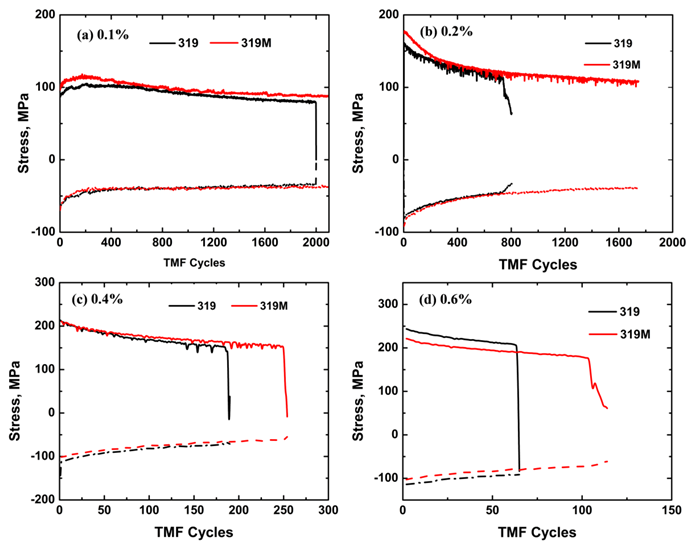
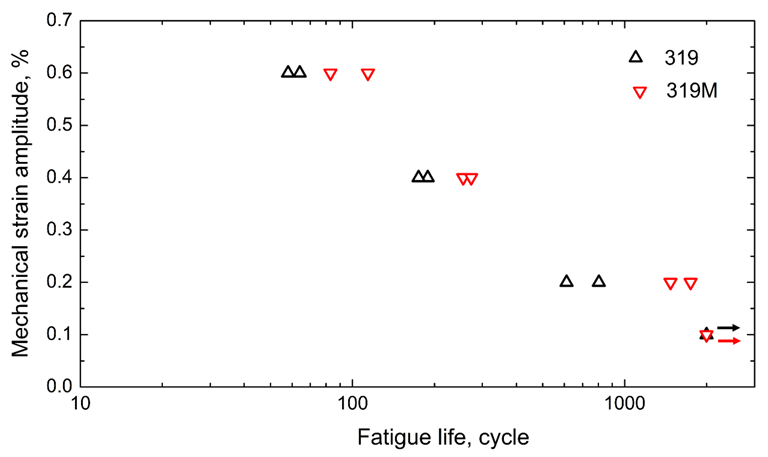
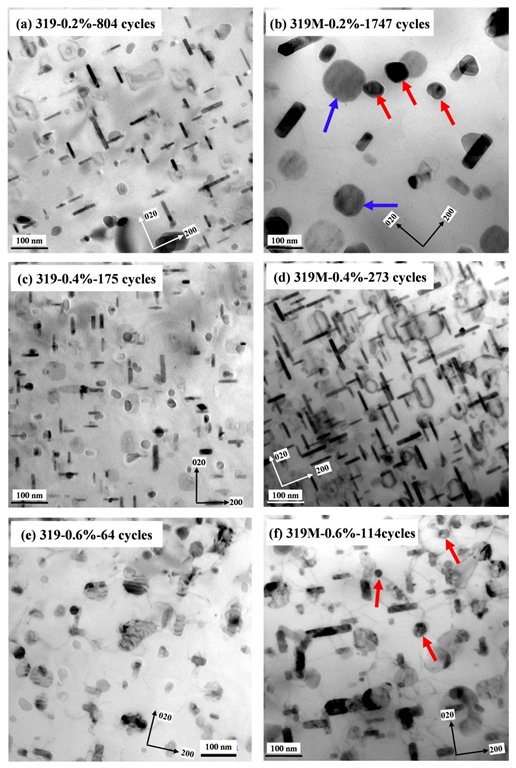
Thermo-mechanical fatigue (TMF) is one of the most detrimental failures of critical engine components and greatly limits their service life. In this study, the out-of-phase TMF (OP-TMF) behavior in Al-Si-Cu 319 cast alloys microalloyed with Mo was systematically investigated under various strain amplitudes ranging from 0.1–0.6% and temperature cycling at 60–300 °C and compared with the base 319 alloy free of Mo. Cyclic stress softening occurred in both experimental alloys when applying the TMF loading, resulting from the coarsening of θ’-Al2Cu precipitates. However, the softening rate of the Mo-containing alloy was lower than that of the base 319 alloy because of its lower θ’-Al2Cu precipitate coarsening rate per cycle. The Mo-containing alloy exhibited a longer TMF lifetime than the base alloy at the same strain amplitude. Microalloying 319 alloy with Mo enhanced the TMF resistance mainly by slowing the coarsening of θ’-Al2Cu precipitates and providing supplementary strengthening from thermally stable Mo-containing α-dispersoids distributed in the Al matrix. The energy-based model was successfully applied for predicting the TMF lifetime with a low life predictor factor, which agreed well with the experimentally measured fatigue cycles.
Keywords: Al-Si-Cu 319 alloy; thermo-mechanical fatigue; Mo addition; precipitation coarsening; dispersoids; energy-based prediction model Al-Si-Cu 319 alloy; thermo-mechanical fatigue; Mo addition; precipitation coarsening; dispersoids; energy-based prediction model