Article

Application of Mean Modulus in Three-Point Bending and Roll Forming

1
National Engineering Research Center for Equipment and Technology of Cold Strip Rolling, Yanshan University, Qinhuangdao 066004, China
2
Qinhuangdao Chen-Ming Special-shaped Tube Manufacturing Co., Ltd., Qinhuangdao 066000, China
*
Author to whom correspondence should be addressed.
Materials 2023, 16(7), 2571; https://doi.org/10.3390/ma16072571
Submission received: 2 December 2022 / Revised: 23 February 2023 / Accepted: 17 March 2023 / Published: 23 March 2023
(This article belongs to the Topic Advanced Forming Technology of Metallic Materials)

Abstract

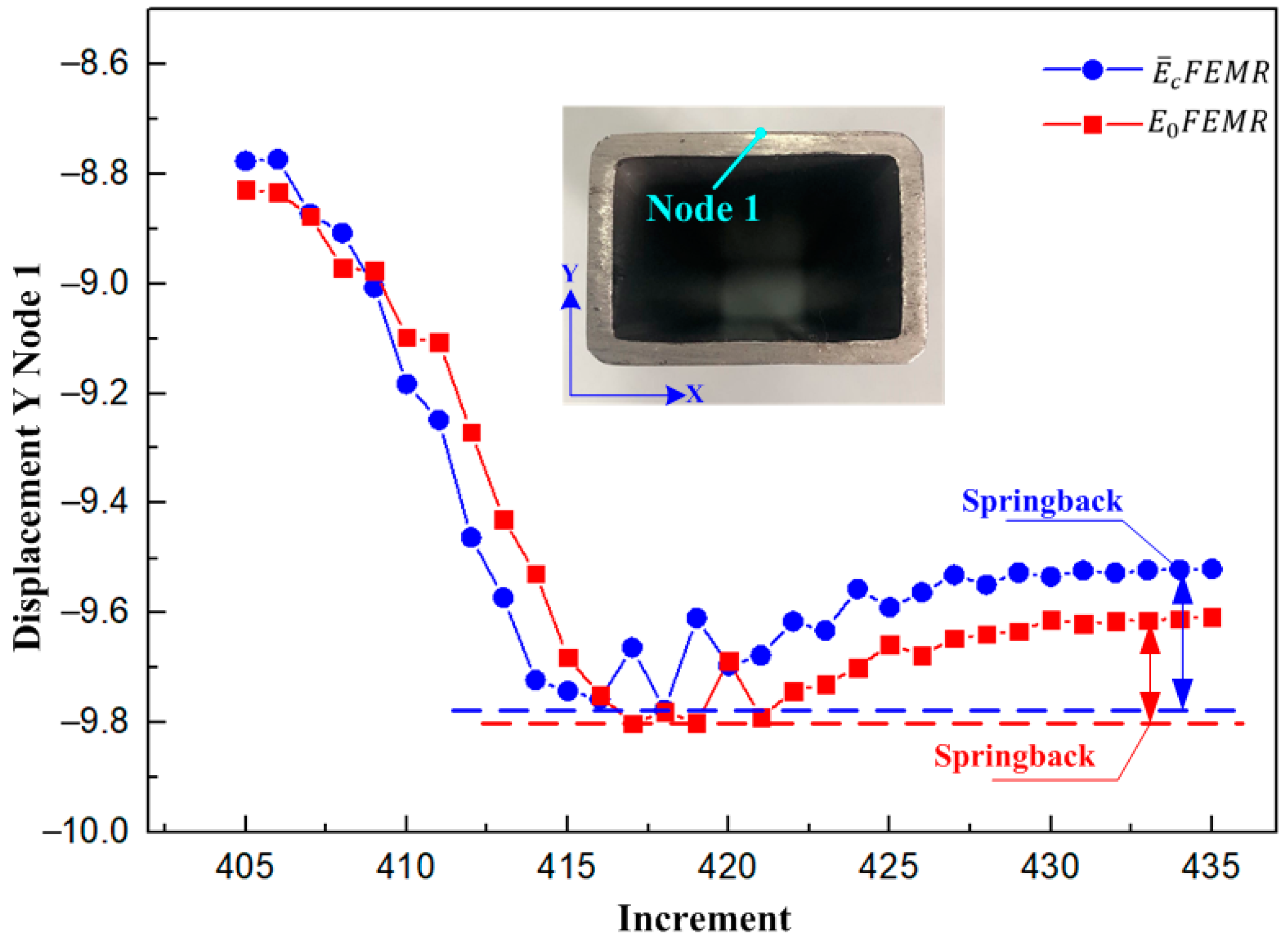
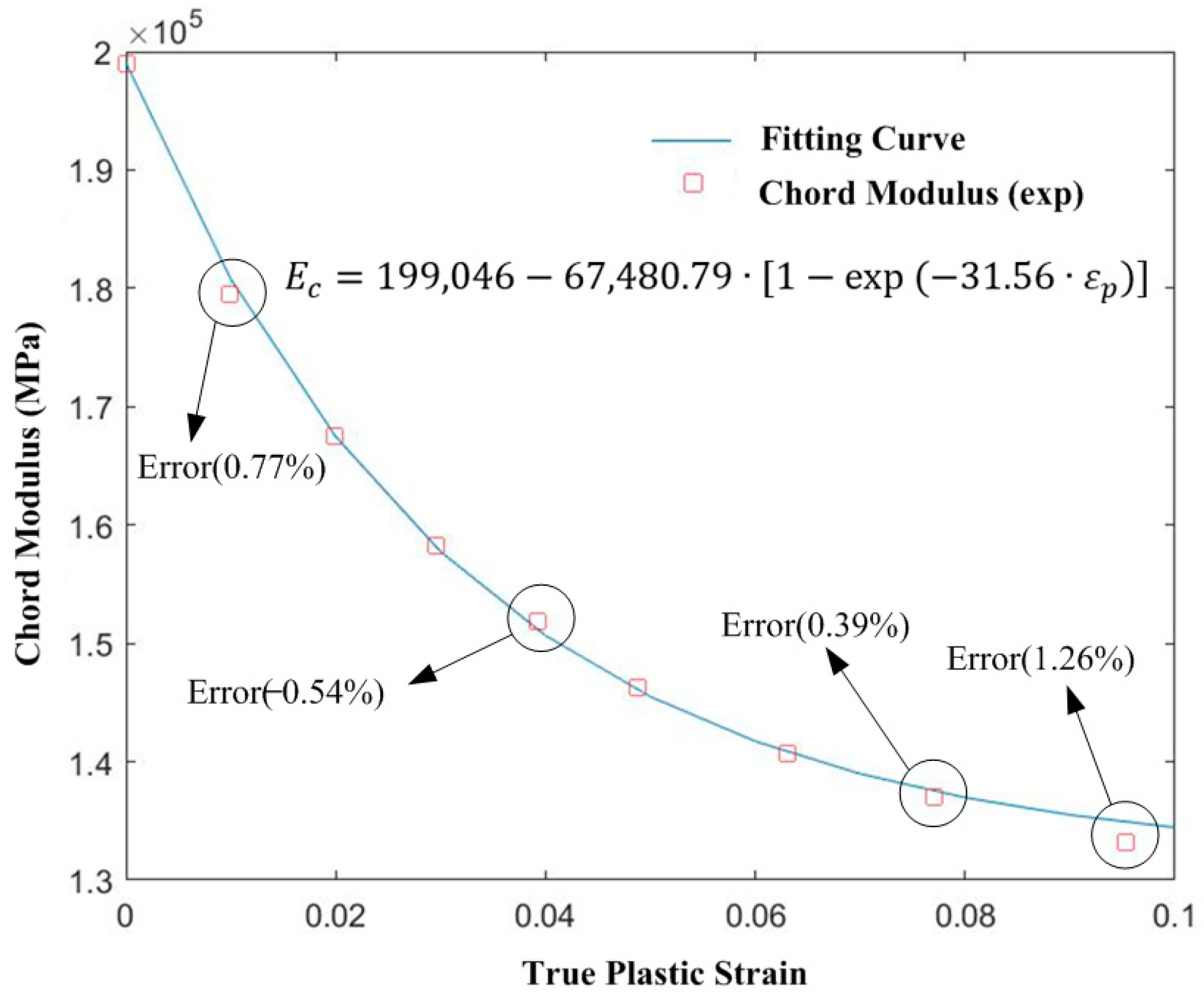
Nonlinear unloading plays an important role in predicting springback during plastic forming process. To improve the accuracy of springback prediction which could provide a guide for precision forming, uniaxial tensile tests and uniaxial loading–unloading–loading tensile tests on SUS304 stainless steel were carried out. The flow stress mathematical model and chord modulus mathematical model were calibrated according to the test results. A constant elastic modulus three-point bending finite element model (E0FEMB) and a constant elastic modulus roll forming finite element model (E0FEMR) were established in MSC.MARC. The chord modulus was output by the PLOTV subroutine to determine the mean modulus of different regions, and the mean modulus three-point bending finite element model (E¯cFEMB) and the mean modulus roll forming finite element model (E¯cFEMR) were defined. The constant modulus finite element model (E0FEM) simulation results and the mean modulus finite element model (E¯cFEM) simulation results were compared with the three-point bending tests and roll forming tests test results. The difference between the simulation results and the test results was small, indicating that the mean modulus was feasible to predict the springback, which verified the suitability of the E¯cFEM.
Keywords: mean modulus; finite element model; three-point bending tests; roll forming tests; springback prediction mean modulus; finite element model; three-point bending tests; roll forming tests; springback prediction