Article

The Effect of Alcohol Compound on the Solidification of Magnesium Oxysulfate Cement-Boron Mud Blends
1
Institute of Materials and Metallurgy, University of Science and Technology Liaoning, Anshan 114031, China
2
Research Institute of Keda Fengchi Magnesium Building Materials, Anshan 114031, China
*
Authors to whom correspondence should be addressed.
Materials 2022, 15(4), 1446; https://doi.org/10.3390/ma15041446
Submission received: 19 October 2021 / Revised: 5 January 2022 / Accepted: 28 January 2022 / Published: 15 February 2022
(This article belongs to the Special Issue Industrial Solid Wastes for Construction and Building Materials)

Abstract

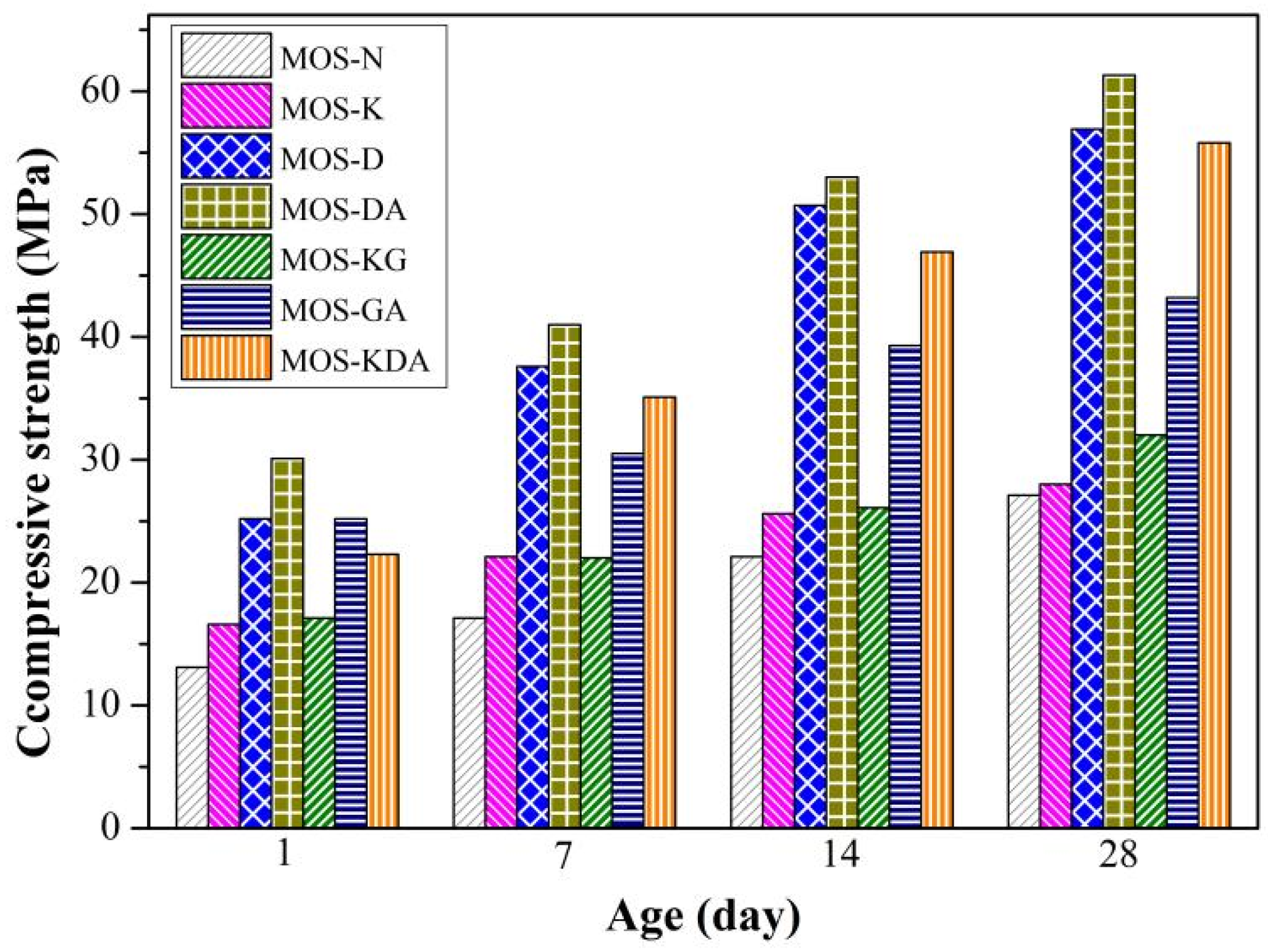
At present, the utilization of boron resources in China is increasing, and the problem of boron tailing pollution is becoming increasingly serious. To fundamentally solve the problem of boron tailing, many scholars at home and abroad have mainly studied the curing effect in terms of compressive strength, and little research has been carried out into the solidification effect and hydration products. This study explored the effects of adding different alcohol-based modifiers on the hydration products of magnesium oxysulfate cement-boron mud mixture, the microstructure, physical properties and curing effects of the samples. The results show that magnesium oxysulfate cement is beneficial to the solidification of boron in boron mud due to its low-alkali. Adding an alcohol-based modifier can increase the compressive strength of magnesium oxysulfate cement-boron mud blends. After adding acrylic acid and D-Mannitol, the 28-day compressive strength of the sample increased by 44.7 MPa. The blending of alcohol-based modifiers has a very good effect on the curing of boron in the whole system.
Keywords: magnesium oxysulfate cement-boron mud blends; KH550; mechanical strength; microstructure; solidification magnesium oxysulfate cement-boron mud blends; KH550; mechanical strength; microstructure; solidification