Concrete Containing Waste Glass as an Environmentally Friendly Aggregate: A Review on Fresh and Mechanical Characteristics

 ,
,  ,
,  , , , ,
Abstract
:1. Introduction
2. Research Significance
3. Properties of Glass
3.1. Chemical Properties of Glass
3.2. Physical and Mechanical Properties of Glass
4. Fresh Concrete Properties
4.1. Workability

| Refs. | Type of Composite | Source | Type of Sub. | WG Sub. Ratio% | WG Size (mm) | w/c or w/b | Addit. or Admix. | Outcomes |
|---|---|---|---|---|---|---|---|---|
| [74] | SCGC | LCD | F.A | 10, 20, & 30 (vol.%) | 11.8 | 0.28 | SP | Slump flow increased by 11%, 17%, and 21%, respectively. |
| [75] | HPGC | LCD | F.A | 10, 20, & 30 (vol.%) | 0.149–4.75 | 0.25, 0.32, & 0.34 | SP | Slump flow increased, ranged between 7–9%. |
| [76] | Steel slag concrete | WG | C.A | 16.5 & 17.5 (vol.%) | 4.9–10 & 4.9–16 | 0.4 & 0.55 | WR | Slump increased by 167%, for substitution 16.5% (w/c of 0.55, and size of 4.9–10 mm). Slump increased by 8%, for substitution 17.5% (w/c of 0.40, and size of 4.9–16 mm). |
| [77] | Cement concrete | WG & PVC | F.A | 5, 10, 15, 20, 25, & 30 (wt.%) | 0.15–0.6 | 0.44, 0.5, & 0.55 | - | Slump value changed by −7%, +33%, +47%, +31, +36, and +40%, respectively, for w/c of 0.5. |
| [78] | Waste glass concrete | WG | F.A | 18, 19, 20, 21, 22, 23, & 24 (vol.%) | 0.15–0.6 | 0.4 | SP | Workability decreased by increasing the WG ratio. |
| [79] | Waste glass concrete | CRT | F.A | 50 & 100 (vol.%) | ≤5 | 0.35, 0.45, & 0.55 | WR & AE | Slump increased by 55%, and 115%, respectively, for w/c of 0.45. |
| [80] | Waste glass concrete | WG | C.A | 10, 20, & 30 (wt.%) | ≤20 | 0.55 | - | Slump decreased by 3%, 5%, and 9%, respectively. |
| [73] | SCC | Windshield | C.A | 25, 50, 75, & 100 (vol.%) | 9.5 & 12.7 (mixed) | 0.6–0.69 | Marble filler & SP | Slump flow decreased by 3%, 8%, 9%, and 11%, respectively. |
| [81] | UHPC | WG | F.A | 25, 50, 75, & 100 (wt.%) | ≤0.6 | 0.19 | Steel fiber & HRWRA | Slump increased by 25%, 111%, 321%, and 532%, respectively. |
| [56] | UHPC | CRT | F.A | 25, 50, 75, & 100 (vol.%) | 0.6–1.18 | 0.19 | Steel fiber, SF, & SP | Flowability increased by 11, 14, 16, and 12 mm, respectively, compared to control (200 mm). |
| [82] | Waste glass concrete | WG | F.A | 15 & 30 (vol.%) | ≤4.75 | 0.5 | - | Slump decreased by 9%, and 39%, respectively. |
| [83] | Waste-based concrete | WG | F.A | 100 (vol.%) | ≤1.9 | 0.47 | SP & GBFS | Glass sand showed lower workability compared to Lead smelter slag (LSS). |
| [84] | Waste glass concrete | WG | F.A | 5, 15, & 20 (vol.%) | 0.15–4.75 | 0.55 | - | Slump decreased by 19%, 29%, and 35%, respectively. |
| [55] | SCC | WG | F.A | 10, 20, 30, 40, & 50 (vol.%) | 0.075–5 | 0.4 | SF & SP | Slump flow increased by 2%, 5%, 8%, 11%, and 85%, respectively. |
| [85] | Cement concrete | WG | F.A | 5, 10, 15, & 20 (vol.%) | 0.15–9.5 | 0.56 | - | Slump decreased by 1%, 3%, 4%, and 5%, respectively. |
| [86] | Waste glass concrete | Waste E-glass | F.A | 10, 20, 30, 40, & 50 (wt.%) | ≤4.75 | 0.68 | SF & F.A. | Slump decreased by 2%, 1%, 50%, 55, and 54%, respectively. |
| [87] | Waste glass concrete | WG | F.A | 10, 15, & 20 (vol.%) | 0.15–4.75 | 0.52 | - | Slump decreased by 24%, 23%, and 33%, respectively. |
| [88] | Waste glass concrete | WG | F.A | 15, 20, 30, & 50 (wt.%) | ≤5 | 0.52, 0.57, & 0.67 | - | Slump decreased by 0%, 0%, 13%, and 13%, respectively, for w/c of 0.57. |
| [89] | Waste glass concrete | Green waste glass | F.A | 30, 50, & 70 (wt.%) | ≤5 | 0.5 | AE | Workability decreased, ranged between 19–44%. |
| [65] | Waste glass concrete | Soda-lime glass | F.A | 50 & 100 (vol.%) | ≤5 | 0.38 | MK | Slump decreased by 0%, and 38%, respectively. |
| [48] | Waste glass concrete | WG | F.A & C.A | 10, 25, 50, & 100 (vol.%) | N.M | 0.48 | - | Slump value changed by −6%, +6%, +18%, and +6%, respectively. |
| [72] | LCDGC | LCD | F.A | 20, 40, 60, & 80 (vol.%) | ≤4.75 | 0.38, 0.44, & 0.55 | - | Slump flow decreased by 4%, 7%, 19%, and 26%, respectively. |
| [90] | Cement concrete | LCD | F.A | 20, 40, 60, & 80 (vol.%) | ≤4.75 | 0.48 | - | Slump value changed by 0%, −5%, −5%, and +20%, respectively. |
| [91] | Alkali-activated mortar | Cullet | F.A | 25, 50, 75, & 100 (vol.%) | ≤2.36 | 0.6 | F.A., GBFS, SH, & SS | Flowability increased, ranged between 4–15%. |
| [92] | Waste glass concrete | WG | F.A | 25, 50, 75, & 100 (wt.%) | ≤5 | 0.5 | - | Slump decreased by 9%, 7%, 15%, and 27%, respectively. |
4.2. Bulk Density

5. Mechanical Properties
5.1. Compressive Strength
| Refs. | Type of Composite | Source | Type of Subs. | WG Subs. Ratio | WG Size (mm) | w/c or w/b | Addit. or Admix. | Com. Str. of Control (MPa) | Outcomes |
|---|---|---|---|---|---|---|---|---|---|
| [74] | SCGC | LCD | F.A | 10, 20, & 30 (vol.%) | 11.8 | 0.28 | SP | 65 | Decreased by 2%, 5%, and 3%, respectively. |
| [75] | HPGC | LCD | F.A | 10, 20, & 30 (vol.%) | 0.149–4.75 | 0.25, 0.32, & 0.34 | SP | 56 | Decreased by 25%, 32%, and 29%, respectively, for w/c of 0.32. |
| [123] | Autoclaved aerated concrete | CRT | F.A | 5 & 10 (vol.%) | 2.16–3.3 | N.M | - | 29 | Decreased by 2%, and 0%, respectively. |
| [77] | Cement concrete | WG & PVC | F.A | 5, 10, 15, 20, 25, & 30 (wt.%) | 0.15–0.6 | 0.44, 0.5, & 0.55 | - | 34 | Decreased by 1%, 4%, 4%, 6%, 7%, and 9%, respectively, for w/c of 0.50. |
| [78] | Waste glass concrete | WG | F.A | 18, 19, 20, 21, 22, 23, & 24 (vol.%) | 0.15–0.6 | 0.4 | SP | 33 | Changed by +6%, +9%, +12%, +9%, +3%, −6% and −9%, respectively. |
| [79] | Waste glass concrete | CRT | F.A | 50 & 100 (vol.%) | ≤5 | 0.35, 0.45, & 0.55 | WR & AE | 28 | Decreased by 21%, and 32%, respectively, for w/c of 0.45. |
| [80] | Waste glass concrete | WG | C.A | 10, 20, & 30 (wt.%) | ≤20 | 0.55 | - | 24 | Decreased by 13%, 15%, and 23%, respectively. |
| [105] | Waste glass concrete | WG | F.A | 25, 75, & 100 (wt.%) | 0.15–5 | 0.48–0.66 | - | 38 | Changed by +5%, +8%, +3%, and −8%, respectively. |
| [124] | Waste glass concrete | Cullet | C.A | 25, 50, & 75 (wt.%) | 2.36–5 | 0.29 | SF | 32 | Decreased by 6%, 3%, 22%, and 25%, respectively. |
| [73] | SCC | Windshield | C.A | 25, 50, 75, & 100 (vol.%) | 9.5 & 12.7 | 0.6–0.69 | Marble filler & SP | 33 | Decreased by 15%, 24%, 24%, and 30%, respectively. |
| [125] | HSPC | WG | C.A | 25, 50, 75, & 100 (vol.%) | 2.36–5 | 0.14 | SF & SP | 50 | Decreased by 4%, 20%, 30%, and 36%, respectively. |
| [81] | UHPC | WG | F.A | 25, 50, 75, & 100 (wt.%) | ≤0.6 | 0.19 | Steel fiber & HRWRA | 108 | Increased by 2%, 17%, 34%, and 20%, respectively. |
| [56] | UHPC | CRT | F.A | 25, 50, 75, & 100 (vol.%) | 0.6–1.18 | 0.19 | Steel fiber, SF, & SP | 180 | Decreased by 7%, 11%, 16%, and 18%, respectively. |
| [115] | Glass aggregate concretes | WG | C.A | 12.5, 25, 50, & 100 (vol.%) | 10–20 | 0.52 | SP | 45 | Decreased by 4%, 16%, 20%, and 27%, respectively. |
| [82] | Waste glass concrete | WG | F.A | 15 & 30 (vol.%) | ≤4.75 | 0.5 | - | 48 | Decreased by 6%, and 0%, respectively. |
| [84] | Waste glass concrete | WG | F.A | 5, 15, & 20 (vol.%) | 0.15–4.75 | 0.55 | - | 33 | Decreased by 6%, 3%, and 0%, respectively. |
| [55] | SCC | WG | F.A | 10, 20, 30, 40, & 50 (vol.%) | 0.075–5 | 0.4 | SF & SP | 62 | Decreased by 5%, 15%, 18%, 23%, and 24%, respectively. |
| [85] | Cement concrete | WG | F.A | 5, 10, 15, & 20 (vol.%) | 0.15–9.5 | 0.56 | - | 32 | Increased by 9%, 44%, 25%, and 38%, respectively. |
| [87] | Waste glass concrete | WG | F.A | 10, 15, & 20 (vol.%) | 0.15–4.75 | 0.52 | - | 44 | Changed by −9%, −9%, and +5%, respectively. |
| [88] | Waste glass concrete | WG | F.A | 15, 20, 30, & 50 (wt.%) | ≤5 | 0.52, 0.57, & 0.67 | - | 48 | Decreased by 2%, 4%, 13%, and 19%, respectively, for w/c of 0.57. |
| [89] | Waste glass concrete | Green waste glass | F.A | 30, 50, & 70 (wt.%) | ≤5 | 0.5 | AE | 38 | Decreased by 3%, 13%, and 18%, respectively. |
| [48] | Waste glass concrete | WG | F.A & C.A | 10, 25, 50, & 100 (vol.%) | N.M | 0.48 | - | 40 | Changed by +38%, +3%, −5%, and −50%, respectively. |
| [72] | LCDGC | LCD | F.A | 20, 40, 60, & 80 (vol.%) | ≤4.75 | 0.38, 0.44, & 0.55 | - | 39 | Decreased by 3%, 10%, 13%, and 15%, respectively, for w/c of 0.44. |
| [90] | Cement concrete | LCD | F.A | 20, 40, 60, & 80 (vol.%) | ≤4.75 | 0.48 | - | 36 | Decreased by 6%, 11%, 22%, and 25%, respectively. |
| [107] | Waste glass concrete | CRT | F.A | 20, 40, 60, 80, & 100 (vol.%) | 4.75 | 0.45 | F.A. | 38 | Decreased by 5%, 8%, 8%, 11%, and 13%, respectively. |
| [126] | Resin concretes | WG | F.A | 0–100 (wt.%) | ≤2 | N.M | Epoxy resin | 95 | Decreased by 33%, for substitution of 100%. |
| [127] | Concrete blocks | WG | F.A | 100 (vol.%) | 4.75, 2.36, 1.18, & 0.6 | 0.23 | - | 34 | Decreased by 18%. |
| [91] | Alkali-activated mortar | Cullet | F.A | 25, 50, 75, & 100 (vol.%) | ≤2.36 | 0.6 | F.A., GBFS, SH, & SS | 70 | Decreased by 3%, 6%, 7%, and 10%, respectively. |
| [128] | Waste glass concrete | WG | F.A | 25, 50., 75, & 100 (wt.%) | ≤5 | 0.5 | - | 20 | Changed by +20%, +15%, −10%, and −35%, respectively. |
5.2. Splitting Tensile Strength
| Refs. | Type of Composite | Source | Type of Sub. | WG Sub. Ratio% | WG Size (mm) | w/c or w/b | Addit. or Admix. | Split ten. str. of Control (MPa) | Outcomes |
|---|---|---|---|---|---|---|---|---|---|
| [81] | UHPC | WG | F.A | 25, 50, 75, & 100 (wt.%) | ≤0.6 | 0.19 | Steel fiber & HRWRA | 11.7 | Increased by 1%, 3%, 11%, and 7%, respectively. |
| [82] | Waste glass concrete | WG | F.A | 15 & 30 (vol.%) | ≤4.75 | 0.5 | - | 4.5 | Changed by +4%, and −1%, respectively. |
| [84] | Waste glass concrete | WG | F.A | 5, 15, & 20 (vol.%) | 0.15–4.75 | 0.55 | - | 2.5 | Increased by 4%, 12%, and 24%, respectively. |
| [55] | SCC | WG | F.A | 10, 20, 30, 40, & 50 (vol.%) | 0.075–5 | 0.4 | SF & SP | 6.8 | Decreased by 9%, 15%, 16%, 24%, and 28%, respectively. |
| [85] | Cement concrete | WG | F.A | 5, 10, 15, & 20 (vol.%) | 0.15–9.5 | 0.56 | - | 3.9 | Decreased by 0%, 8%, 15%, and 23%, respectively. |
| [133] | Waste glass concrete | WG | F.A | 10, 20, 30, & 40 (wt.%) | ≤4.75 | 0.45 | - | 2.5 | Decreased by 2%, 8%, 10%, and 12%, respectively. |
| [72] | LCDGC | LCD | F.A | 20, 40, 60, & 80 (vol.%) | ≤4.75 | 0.38, 0.44, & 0.55 | - | 2.38 | Decreased by 1%, 7%, 8%, and 9%, respectively, for w/c of 0.44. |
| [107] | Waste glass concrete | CRT | F.A | 20, 40, 60, 80, & 100 (vol.%) | 4.75 | 0.45 | F.A. | 4.48 | Decreased by 6%, 6%, 13%, 15%, and 19%, respectively. |
| [128] | Waste glass concrete | WG | F.A | 25, 50., 75, & 100 (wt.%) | ≤5 | 0.5 | - | 3.6 | Decreased by 22%, 39%, 39%, and 44%, respectively. |
5.3. Flexural Strength
5.4. Modulus of Elasticity (MOE)
6. Conclusions
- The workability of waste-glass-containing concrete mixtures for fine or coarse aggregates was less than for natural aggregate-containing mixtures. Nevertheless, despite the poorer workability, some studies found that the mixtures were still workable.
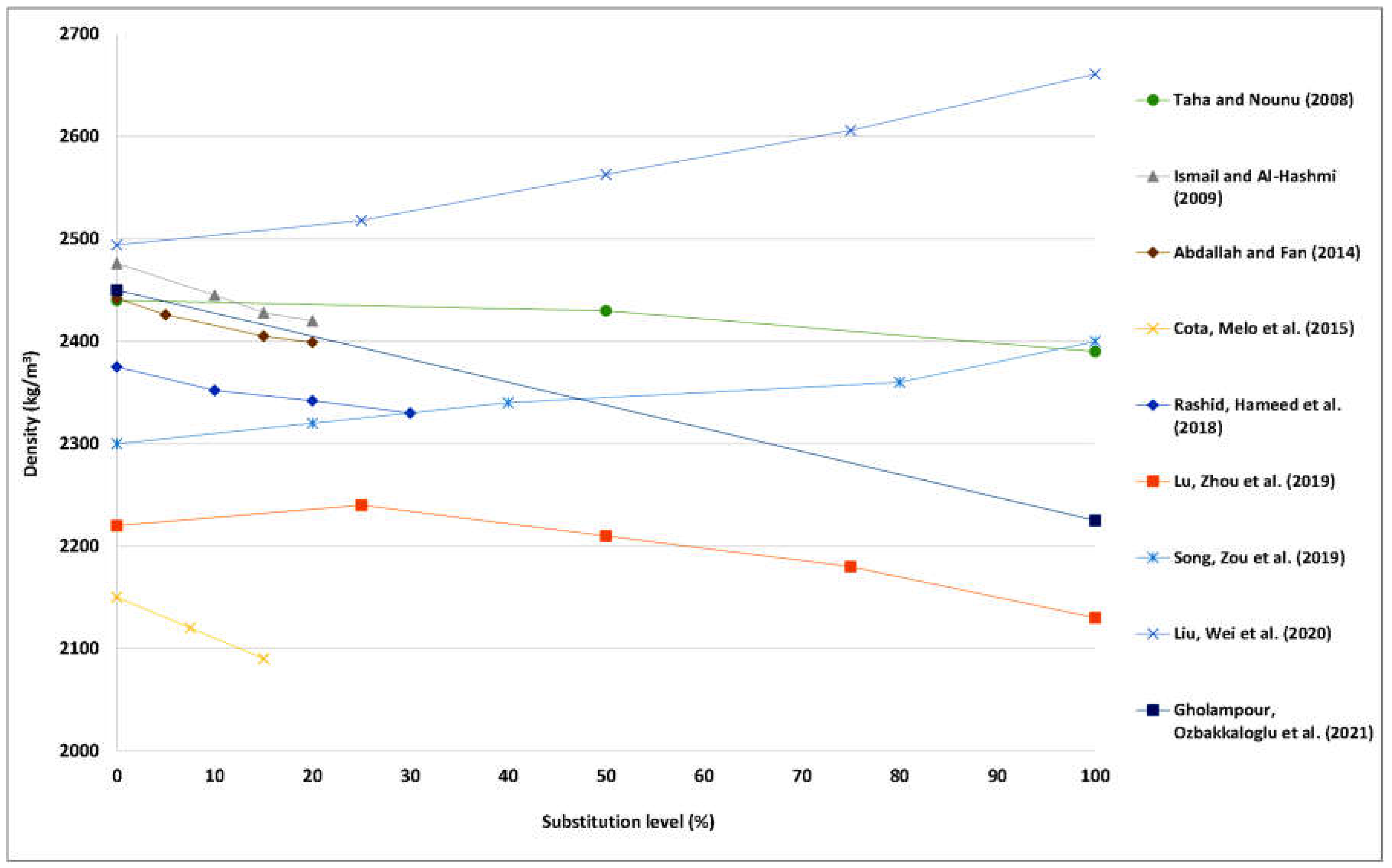
- Most studies indicated that with the introduction of WG, the density of concrete decreased due to the decreased density and specific gravity of waste glass aggregates.
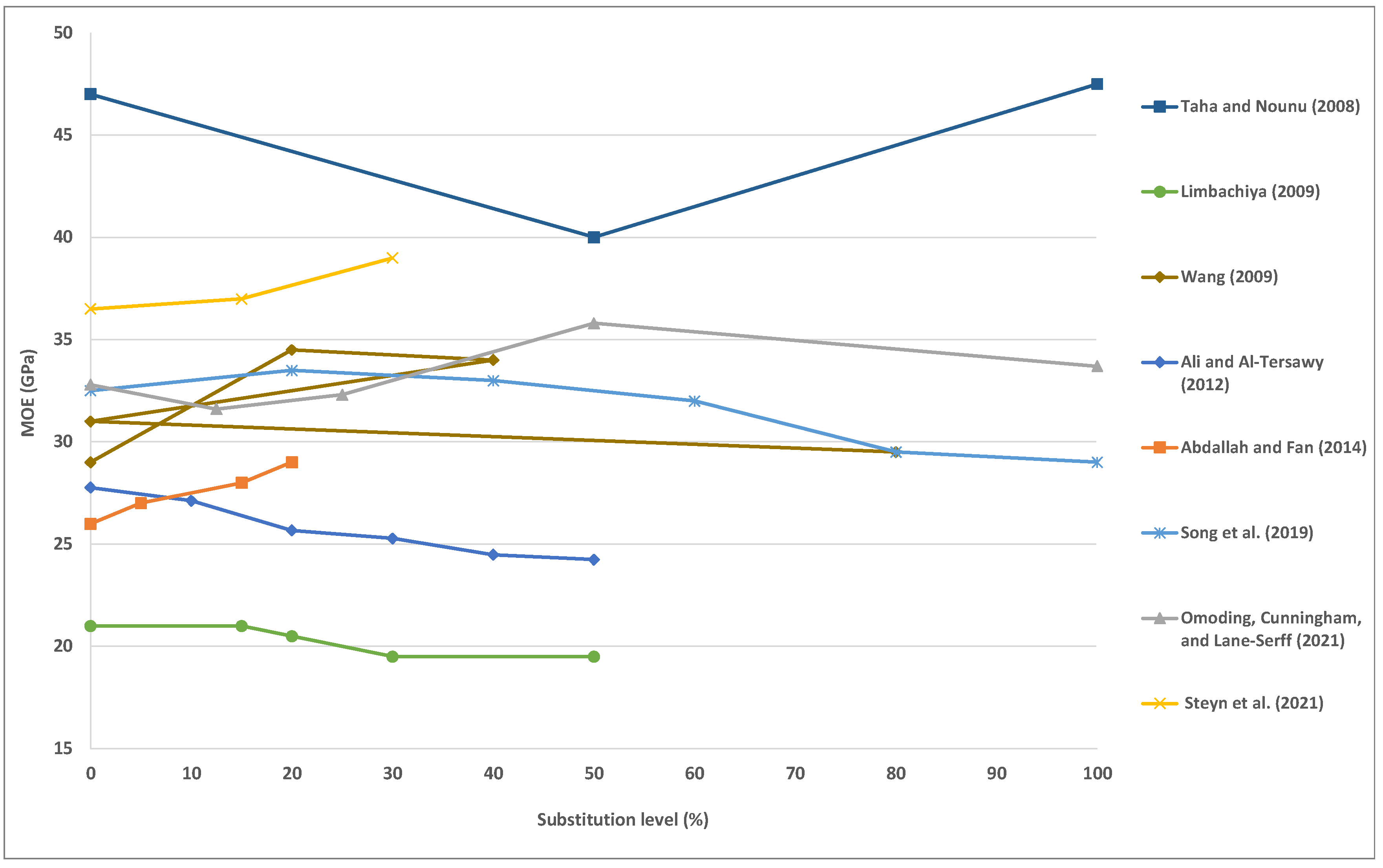
- The findings of the literature have been somewhat indecisive regarding the properties of concrete, such as compressive strength, splitting tensile strength, flexural strength, and modulus of elasticity.
- The findings revealed that the compressive strength, splitting tensile strength, and flexural strength of concrete deteriorated by integrating WG. Nevertheless, the findings concerning the elastic modulus of concrete were conflicting. This decrease was essential because of the sharp edges and smooth surface of the waste glass that caused the poorer bond between cement mortar and waste glass particles at the ITZ.
- Studies also showed that the optimal aggregate substitution level was about 20%. In addition, the glass color does not have a substantial influence on the strength. Although the results are indecisive, WG has the possibility to be an acceptable substitute for fine or coarse concrete aggregates in concrete.
- Adding waste glass to the concrete mixture may improve certain mechanical characteristics of concrete, reduce concrete dead load, and provide an ecological substitute for normal aggregates.
7. Recommendations
- More investigation is required into the mechanical characteristics of high-performance and high-strength waste-glass concrete.
- The effects of different glass kinds and colors on concrete mixes should be thoroughly investigated in the future.
- Test fewer common types of glass as aggregates in concrete because the vast majority of research only covers soda-lime glass.
- Conduct a comprehensive evaluation of the real environmental effects through life-cycle assessment to evaluate the feasibility of using this waste.
Author Contributions
Funding
Institutional Review Board Statement
Informed Consent Statement
Data Availability Statement
Acknowledgments
Conflicts of Interest
References
- Lu, J.-X.; Zhan, B.-J.; Duan, Z.-H.; Poon, C.S. Using glass powder to improve the durability of architectural mortar prepared with glass aggregates. Mater. Des. 2017, 135, 102–111. [Google Scholar] [CrossRef]
- Ahmad, J.; Aslam, F.; Martinez-Garcia, R.; de-Prado-Gil, J.; Qaidi, S.M.A.; Brahmia, A. Effects of waste glass and waste marble on mechanical and durability performance of concrete. Sci. Rep. 2021, 11, 21525. [Google Scholar] [CrossRef]
- Ahmed, H.U.; Mohammed, A.S.; Qaidi, S.M.A.; Faraj, R.H.; Sor, N.H.; Mohammed, A.A. Compressive strength of geopolymer concrete composites: A systematic comprehensive review, analysis and modeling. Eur. J. Environ. Civ. Eng. 2022, 1–46. [Google Scholar] [CrossRef]
- ICG. An Economic Argument for an IYOG 2022; The International Commission on Glass (ICG): Venice, Italy, 2020. [Google Scholar]
- Aslam, F.; Zaid, O.; Althoey, F.; Alyami, S.H.; Qaidi, S.M.A.; de Prado Gil, J.; Martínez-García, R. Evaluating the influence of fly ash and waste glass on the characteristics of coconut fibers reinforced concrete. Struct. Concr. 2022. [Google Scholar] [CrossRef]
- Martínez-García, R.; Jagadesh, P.; Zaid, O.; Șerbănoiu, A.A.; Fraile-Fernández, F.J.; de Prado-Gil, J.; Qaidi, S.M.A.; Grădinaru, C.M. The Present State of the Use of Waste Wood Ash as an Eco-Efficient Construction Material: A Review. Materials 2022, 15, 5349. [Google Scholar] [CrossRef]
- EPA. Advancing Sustainable Materials Management: 2018 Tables and Figures. Environ. Prot. Agency 2021, 1–80. [Google Scholar]
- Maglad, A.M.; Zaid, O.; Arbili, M.M.; Ascensão, G.; Șerbănoiu, A.A.; Grădinaru, C.M.; García, R.M.; Qaidi, S.M.A.; Althoey, F.; de Prado-Gil, J. A Study on the Properties of Geopolymer Concrete Modified with Nano Graphene Oxide. Buildings 2022, 12, 1066. [Google Scholar] [CrossRef]
- Ahmed, H.U.; Mohammed, A.A.; Rafiq, S.; Mohammed, A.S.; Mosavi, A.; Sor, N.H.; Qaidi, S.M.A. Compressive Strength of Sustainable Geopolymer Concrete Composites: A State-of-the-Art Review. Sustainability 2021, 13, 13502. [Google Scholar] [CrossRef]
- Eurostat. Packaging Waste Statistics; Eurostat: Luxemburg, 2020. [Google Scholar]
- Ahmad, J.; Majdi, A.; Elhag, A.B.; Deifalla, A.F.; Soomro, M.; Isleem, H.F.; Qaidi, S. A Step towards Sustainable Concrete with Substitution of Plastic Waste in Concrete: Overview on Mechanical, Durability and Microstructure Analysis. Crystals 2022, 12, 944. [Google Scholar] [CrossRef]
- Ahmad, J.; Kontoleon, K.J.; Majdi, A.; Naqash, M.T.; Deifalla, A.F.; Kahla, N.B.; Isleem, H.F.; Qaidi, S.M.A. A Comprehensive Review on the Ground Granulated Blast Furnace Slag (GGBS) in Concrete Production. Sustainability 2022, 14, 8783. [Google Scholar] [CrossRef]
- Rahim, N.L.; Amat, R.C.; Ibrahim, N.M.; Salehuddin, S.; Mohammed, S.A.; Rahim, M.A. Utilization of Recycled Glass Waste as Partial Replacement of Fine Aggregate in Concrete Production. Mater. Sci. Forum 2015, 803, 16–20. [Google Scholar] [CrossRef]
- Topçu, İ.B.; Canbaz, M. Properties of concrete containing waste glass. Cem. Concr. Res. 2004, 34, 267–274. [Google Scholar] [CrossRef]
- Zheng, K. 11-Recycled glass concrete. In Eco-Efficient Concrete; Pacheco-Torgal, F., Jalali, S., Labrincha, J., John, V.M., Eds.; Woodhead Publishing: Cambridge, UK, 2013; pp. 241–270. [Google Scholar]
- Tayeh, B.A.; Al Saffar, D.M.; Aadi, A.S.; Almeshal, I. Sulphate resistance of cement mortar contains glass powder. J. King Saud Univ. -Eng. Sci. 2020, 32, 495–500. [Google Scholar] [CrossRef]
- Ling, T.-C.; Poon, C.-S.; Wong, H.-W. Management and recycling of waste glass in concrete products: Current situations in Hong Kong, Resources. Conserv. Recycl. 2013, 70, 25–31. [Google Scholar] [CrossRef]
- Contrafatto, L.; Gazzo, S.; Purrazzo, A.; Gagliano, A. Thermo-mechanical Characterization of Insulating Bio-plasters Containing Recycled Volcanic Pyroclasts. Open Civ. Eng. J. 2020, 14, 66–77. [Google Scholar] [CrossRef]
- Meyer, B. Macroeconomic modelling of sustainable development and the links between the economy and the environment. In Final Report of the MacMod project (ENV. F. 1/ETU/2010/0033) to the European Commission; Institute of Economic Structures Research: Osnabrück, Germany, 2011. [Google Scholar]
- Khan, M.; Cao, M.; Ali, M. Experimental and Empirical Study of Basalt Fibber Reinforced Concrete. In Proceedings of the Building Tomorrow’s Society, Fredericton, NB, Canada, 13–16 June 2018. Paper ID–MA39_0610035833. [Google Scholar]
- Khan, M.; Lao, J.; Dai, J.-G. Comparative study of advanced computational techniques for estimating the compressive strength of UHPC. J. Asian Concr. Fed. 2022, 8, 51–68. [Google Scholar] [CrossRef]
- Parvez, I.; Shen, J.; Khan, M.; Cheng, C. Modeling and solution techniques used for hydro generation scheduling. Water 2019, 11, 1392. [Google Scholar] [CrossRef]
- Afshinnia, K.; Rangaraju, P.R. Influence of fineness of ground recycled glass on mitigation of alkali–silica reaction in mortars. Constr. Build. Mater. 2015, 81, 257–267. [Google Scholar] [CrossRef]
- Jiang, Y.; Ling, T.-C.; Mo, K.H.; Shi, C. A critical review of waste glass powder–Multiple roles of utilization in cement-based materials and construction products. J. Environ. Manag. 2019, 242, 440–449. [Google Scholar] [CrossRef]
- Qaidi, S.M.A.; Tayeh, B.A.; Ahmed, H.U.; Emad, W. A review of the sustainable utilisation of red mud and fly ash for the production of geopolymer composites. Constr. Build. Mater. 2022, 350, 128892. [Google Scholar] [CrossRef]
- Qaidi, S.M.A.; Atrushi, D.S.; Mohammed, A.S.; Ahmed, H.U.; Faraj, R.H.; Emad, W.; Tayeh, B.A.; Najm, H.M. Ultra-high-performance geopolymer concrete: A review. Constr. Build. Mater. 2022, 346, 128495. [Google Scholar] [CrossRef]
- Schmidt, A.; Saia, W. Alkali-aggregate reaction tests on glass used for exposed aggregate wall panel work. ACI Mater. J. 1963, 60, 1235–1236. [Google Scholar]
- Kozlova, S.; Millrath, K.; Meyer, C.; Shimanovich, S. A suggested screening test for ASR in cement-bound composites containing glass aggregate based on autoclaving. Cem. Concr. Compos. 2004, 26, 827–835. [Google Scholar] [CrossRef]
- Oliveira, R.; de Brito, J.; Veiga, R. Incorporation of fine glass aggregates in renderings. Constr. Build. Mater. 2013, 44, 329–341. [Google Scholar] [CrossRef]
- Khan, M.; Cao, M.; Chu, S.; Ali, M. Properties of hybrid steel-basalt fiber reinforced concrete exposed to different surrounding conditions. Constr. Build. Mater. 2022, 322, 126340. [Google Scholar] [CrossRef]
- Khan, U.A.; Jahanzaib, H.M.; Khan, M.; Ali, M. Improving the tensile energy absorption of high strength natural fiber reinforced concrete with fly-ash for bridge girders. In Key Engineering Materials; Trans Tech Publ.: Cham, Switzerland, 2018; pp. 335–342. [Google Scholar]
- Arshad, S.; Sharif, M.B.; Irfan-ul-Hassan, M.; Khan, M.; Zhang, J.-L. Efficiency of supplementary cementitious materials and natural fiber on mechanical performance of concrete. Arab. J. Sci. Eng. 2020, 45, 8577–8589. [Google Scholar] [CrossRef]
- Khan, M.; Cao, M.; Xie, C.; Ali, M. Hybrid fiber concrete with different basalt fiber length and content. Struct. Concr. 2022, 23, 346–364. [Google Scholar] [CrossRef]
- Dyer, T.D.; Dhir, R.K. Chemical Reactions of Glass Cullet Used as Cement Component. J. Mater. Civ. Eng. 2001, 13, 412–417. [Google Scholar] [CrossRef]
- Shayan, A.; Xu, A. Value-added utilisation of waste glass in concrete. Cem. Concr. Res. 2004, 34, 81–89. [Google Scholar] [CrossRef]
- Karamberi, A.; Moutsatsou, A. Participation of coloured glass cullet in cementitious materials. Cem. Concr. Compos. 2005, 27, 319–327. [Google Scholar] [CrossRef]
- Sobolev, K.; Türker, P.; Soboleva, S.; Iscioglu, G. Utilization of waste glass in ECO-cement: Strength properties and microstructural observations. Waste Manag. 2007, 27, 971–976. [Google Scholar] [CrossRef]
- Shand, E.B. Glass Engineering Handbook; Amazon: Seattle, WA, USA, 1958. [Google Scholar]
- Mohajerani, A.; Vajna, J.; Cheung, T.H.H.; Kurmus, H.; Arulrajah, A.; Horpibulsuk, S. Practical recycling applications of crushed waste glass in construction materials: A review. Constr. Build. Mater. 2017, 156, 443–467. [Google Scholar] [CrossRef]
- Park, S.-B.; Lee, B.-C. Studies on expansion properties in mortar containing waste glass and fibers. Cem. Concr. Res. 2004, 34, 1145–1152. [Google Scholar] [CrossRef]
- Lam, C.S.; Poon, C.S.; Chan, D. Enhancing the performance of pre-cast concrete blocks by incorporating waste glass–ASR consideration. Cem. Concr. Compos. 2007, 29, 616–625. [Google Scholar] [CrossRef]
- Lee, G.; Poon, C.S.; Wong, Y.L.; Ling, T.C. Effects of recycled fine glass aggregates on the properties of dry–mixed concrete blocks. Constr. Build. Mater. 2013, 38, 638–643. [Google Scholar] [CrossRef]
- de Castro, S.; de Brito, J. Evaluation of the durability of concrete made with crushed glass aggregates. J. Clean. Prod. 2013, 41, 7–14. [Google Scholar] [CrossRef]
- Serpa, J.d.B.D.; Jorge, P. Concrete Made with Recycled Glass Aggregates: Mechanical Performance. ACI Mater. J. 2015, 112, 29–38. [Google Scholar] [CrossRef]
- Disfani, M.M.; Arulrajah, A.; Bo, M.W.; Hankour, R. Recycled crushed glass in road work applications. Waste Manag. 2011, 31, 2341–2351. [Google Scholar] [CrossRef] [PubMed]
- Ooi, P.S.K.; Li, M.M.W.; Sagario, M.L.Q.; Song, Y. Shear Strength Characteristics of Recycled Glass. Transp. Res. Rec. 2008, 2059, 52–62. [Google Scholar] [CrossRef]
- Ali, M.M.Y.; Arulrajah, A. Potential Use of Recycled Crushed Concrete-Recycled Crushed Glass Blends in Pavement Subbase Applications; GeoCongress: Los Angeles, CA, USA, 2012; pp. 3662–3671. [Google Scholar]
- Terro, M.J. Properties of concrete made with recycled crushed glass at elevated temperatures. Build. Environ. 2006, 41, 633–639. [Google Scholar] [CrossRef]
- Ling, T.-C.; Poon, C.-S. A comparative study on the feasible use of recycled beverage and CRT funnel glass as fine aggregate in cement mortar. J. Clean. Prod. 2012, 29–30, 46–52. [Google Scholar] [CrossRef]
- Qaidi, S.M.A.; Mohammed, A.S.; Ahmed, H.U.; Faraj, R.H.; Emad, W.; Tayeh, B.A.; Althoey, F.; Zaid, O.; Sor, N.H. Rubberized geopolymer composites: A comprehensive review. Ceram. Int. 2022, 48, 24234–24259. [Google Scholar] [CrossRef]
- He, X.; Yuhua, Z.; Qaidi, S.; Isleem, H.F.; Zaid, O.; Althoey, F.; Ahmad, J. Mine tailings-based geopolymers: A comprehensive review. Ceram. Int. 2022, 48, 24192–24212. [Google Scholar] [CrossRef]
- Faraj, R.H.; Ahmed, H.U.; Rafiq, S.; Sor, N.H.; Ibrahim, D.F.; Qaidi, S.M.A. Performance of Self-Compacting mortars modified with Nanoparticles: A systematic review and modeling. Clean. Mater. 2022, 4, 100086. [Google Scholar] [CrossRef]
- Ling, T.-C.; Poon, C.-S.; Kou, S.-C. Feasibility of using recycled glass in architectural cement mortars. Cem. Concr. Compos. 2011, 33, 848–854. [Google Scholar] [CrossRef]
- Ling, T.-C.; Poon, C.-S. Effects of particle size of treated CRT funnel glass on properties of cement mortar. Mater. Struct. 2013, 46, 25–34. [Google Scholar] [CrossRef]
- Ali, E.E.; Al-Tersawy, S.H. Recycled glass as a partial replacement for fine aggregate in self compacting concrete. Constr. Build. Mater. 2012, 35, 785–791. [Google Scholar] [CrossRef]
- Liu, T.; Wei, H.; Zou, D.; Zhou, A.; Jian, H. Utilization of waste cathode ray tube funnel glass for ultra-high performance concrete. J. Clean. Prod. 2020, 249, 119333. [Google Scholar] [CrossRef]
- Khan, M.; Ali, M. Earthquake-Resistant Brick Masonry Housing for Developing Countries: An Easy Approach. Available online: https://www.nzsee.org.nz/db/2017/P2.43_Ali.pdf (accessed on 30 July 2022).
- Khan, M.; Cao, M.; Hussain, A.; Chu, S.H. Effect of silica-fume content on performance of CaCO3 whisker and basalt fiber at matrix interface in cement-based composites. Constr. Build. Mater. 2021, 300, 124046. [Google Scholar] [CrossRef]
- Zhang, N.; Yan, C.; Li, L.; Khan, M. Assessment of fiber factor for the fracture toughness of polyethylene fiber reinforced geopolymer. Constr. Build. Mater. 2022, 319, 126130. [Google Scholar] [CrossRef]
- Khan, M.; Rehman, A.; Ali, M. Efficiency of silica-fume content in plain and natural fiber reinforced concrete for concrete road. Constr. Build. Mater. 2020, 244, 118382. [Google Scholar] [CrossRef]
- Rashad, A.M. Recycled waste glass as fine aggregate replacement in cementitious materials based on Portland cement. Constr. Build. Mater. 2014, 72, 340–357. [Google Scholar] [CrossRef]
- Emad, W.; Mohammed, A.S.; Bras, A.; Asteris, P.G.; Kurda, R.; Muhammed, Z.; Hassan, A.M.T.; Qaidi, S.M.A.; Sihag, P. Metamodel techniques to estimate the compressive strength of UHPFRC using various mix proportions and a high range of curing temperatures. Constr. Build. Mater. 2022, 349, 128737. [Google Scholar] [CrossRef]
- Almeshal, I.; Al-Tayeb, M.M.; Qaidi, S.M.A.; Bakar, B.H.A.; Tayeh, B.A. Mechanical properties of eco-friendly cements-based glass powder in aggressive medium. Mater. Today Proc. 2022, 58, 1582–1587. [Google Scholar] [CrossRef]
- Al-Tayeb, M.M.; Aisheh, Y.I.A.; Qaidi, S.M.A.; Tayeh, B.A. Experimental and simulation study on the impact resistance of concrete to replace high amounts of fine aggregate with plastic waste. Case Stud. Constr. Mater. 2022, 17, e01324. [Google Scholar] [CrossRef]
- Taha, B.; Nounu, G. Properties of concrete contains mixed colour waste recycled glass as sand and cement replacement. Constr. Build. Mater. 2008, 22, 713–720. [Google Scholar] [CrossRef]
- Tan, K.H.; Du, H. Use of waste glass as sand in mortar: Part I–Fresh, mechanical and durability properties. Cem. Concr. Compos. 2013, 35, 109–117. [Google Scholar] [CrossRef]
- Yildizel, S.A.; Tayeh, B.A.; Calis, G. Experimental and modelling study of mixture design optimisation of glass fibre-reinforced concrete with combined utilisation of Taguchi and Extreme Vertices Design Techniques. J. Mater. Res. Technol. 2020, 9, 2093–2106. [Google Scholar] [CrossRef]
- Al Saffar, D.M.; Tawfik, T.A.; Tayeh, B.A. Stability of glassy concrete under elevated temperatures. Eur. J. Environ. Civ. Eng. 2020, 26, 1–12. [Google Scholar] [CrossRef]
- Akeed, M.H.; Qaidi, S.; Ahmed, H.U.; Faraj, R.H.; Mohammed, A.S.; Emad, W.; Tayeh, B.A.; Azevedo, A.R.G. Ultra-high-performance fiber-reinforced concrete. Part IV: Durability properties, cost assessment, applications, and challenges. Case Stud. Constr. Mater. 2022, 17, e01271. [Google Scholar] [CrossRef]
- Akeed, M.H.; Qaidi, S.; Ahmed, H.U.; Faraj, R.H.; Mohammed, A.S.; Emad, W.; Tayeh, B.A.; Azevedo, A.R.G. Ultra-high-performance fiber-reinforced concrete. Part I: Developments, principles, raw materials. Case Stud. Constr. Mater. 2022, 17, e01290. [Google Scholar] [CrossRef]
- Akeed, M.H.; Qaidi, S.; Ahmed, H.U.; Faraj, R.H.; Mohammed, A.S.; Emad, W.; Tayeh, B.A.; Azevedo, A.R.G. Ultra-high-performance fiber-reinforced concrete. Part II: Hydration and microstructure. Case Stud. Constr. Mater. 2022, 17, e01289. [Google Scholar] [CrossRef]
- Wang, H.-Y. A study of the effects of LCD glass sand on the properties of concrete. Waste Manag. 2009, 29, 335–341. [Google Scholar] [CrossRef]
- Arabi, N.; Meftah, H.; Amara, H.; Kebaïli, O.; Berredjem, L. Valorization of recycled materials in development of self-compacting concrete: Mixing recycled concrete aggregates–Windshield waste glass aggregates. Constr. Build. Mater. 2019, 209, 364–376. [Google Scholar] [CrossRef]
- Wang, H.-Y.; Huang, W.-L. Durability of self-consolidating concrete using waste LCD glass. Constr. Build. Mater. 2010, 24, 1008–1013. [Google Scholar] [CrossRef]
- Chen, S.-H.; Chang, C.-S.; Wang, H.-Y.; Huang, W.-L. Mixture design of high performance recycled liquid crystal glasses concrete (HPGC). Constr. Build. Mater. 2011, 25, 3886–3892. [Google Scholar] [CrossRef]
- Yu, X.; Tao, Z.; Song, T.-Y.; Pan, Z. Performance of concrete made with steel slag and waste glass. Constr. Build. Mater. 2016, 114, 737–746. [Google Scholar] [CrossRef]
- Patel, H.G.; Dalal, S.P. An Experimental Investigation on Physical and Mechanical Properties of Concrete with the Replacement of Fine Aggregate by Poly Vinyl Chloride and Glass Waste. Procedia Eng. 2017, 173, 1666–1671. [Google Scholar] [CrossRef]
- Bisht, K.; Ramana, P.V. Sustainable production of concrete containing discarded beverage glass as fine aggregate. Constr. Build. Mater. 2018, 177, 116–124. [Google Scholar] [CrossRef]
- Kim, I.S.; Choi, S.Y.; Yang, E.I. Evaluation of durability of concrete substituted heavyweight waste glass as fine aggregate. Constr. Build. Mater. 2018, 184, 269–277. [Google Scholar] [CrossRef]
- Rashid, K.; Hameed, R.; Ahmad, H.A.; Razzaq, A.; Ahmad, M.; Mahmood, A. Analytical framework for value added utilization of glass waste in concrete: Mechanical and environmental performance. Waste Manag. 2018, 79, 312–323. [Google Scholar] [CrossRef]
- Jiao, Y.; Zhang, Y.; Guo, M.; Zhang, L.; Ning, H.; Liu, S. Mechanical and fracture properties of ultra-high-performance concrete (UHPC) containing waste glass sand as partial replacement material. J. Clean. Prod. 2020, 277, 123501. [Google Scholar] [CrossRef]
- Steyn, Z.C.; Babafemi, A.J.; Fataar, H.; Combrinck, R. Concrete containing waste recycled glass, plastic and rubber as sand replacement. Constr. Build. Mater. 2021, 269, 121242. [Google Scholar] [CrossRef]
- Gholampour, A.; Ozbakkaloglu, T.; Gencel, O.; Ngo, T.D. Concretes containing waste-based materials under active confinement. Constr. Build. Mater. 2021, 270, 121465. [Google Scholar] [CrossRef]
- Abdallah, S.; Fan, M. Characteristics of concrete with waste glass as fine aggregate replacement. Int. J. Eng. Tech. Res. 2014, 2, 11–17. [Google Scholar]
- Batayneh, M.; Marie, I.; Asi, I. Use of selected waste materials in concrete mixes. Waste Manag. 2007, 27, 1870–1876. [Google Scholar] [CrossRef] [PubMed]
- Chen, C.H.; Huang, R.; Wu, J.K.; Yang, C.C. Waste E-glass particles used in cementitious mixtures. Cem. Concr. Res. 2006, 36, 449–456. [Google Scholar] [CrossRef]
- Ismail, Z.Z.; Al-Hashmi, E.A. Recycling of waste glass as a partial replacement for fine aggregate in concrete. Waste Manag. 2009, 29, 655–659. [Google Scholar] [CrossRef]
- Limbachiya, M.C. Bulk engineering and durability properties of washed glass sand concrete. Constr. Build. Mater. 2009, 23, 1078–1083. [Google Scholar] [CrossRef]
- Park, S.B.; Lee, B.C.; Kim, J.H. Studies on mechanical properties of concrete containing waste glass aggregate. Cem. Concr. Res. 2004, 34, 2181–2189. [Google Scholar] [CrossRef]
- Wang, H.-Y.; Zeng, H.-h.; Wu, J.-Y. A study on the macro and micro properties of concrete with LCD glass. Constr. Build. Mater. 2014, 50, 664–670. [Google Scholar] [CrossRef]
- Khan, M.N.N.; Sarker, P.K. Effect of waste glass fine aggregate on the strength, durability and high temperature resistance of alkali-activated fly ash and GGBFS blended mortar. Constr. Build. Mater. 2020, 263, 120177. [Google Scholar] [CrossRef]
- Naeini, M.; Mohammadinia, A.; Arulrajah, A.; Horpibulsuk, S. Recycled Glass Blends with Recycled Concrete Aggregates in Sustainable Railway Geotechnics. Sustainability 2021, 13, 2463. [Google Scholar] [CrossRef]
- Taha, B.; Nounu, G. Utilizing Waste Recycled Glass as Sand/Cement Replacement in Concrete. J. Mater. Civ. Eng. 2009, 21, 709–721. [Google Scholar] [CrossRef]
- Tayeh, B.A. Effects of marble, timber, and glass powder as partial replacements for cement. J. Civ. Eng. Constr. 2018, 7, 63–71. [Google Scholar] [CrossRef]
- Borhan, T.M. Properties of glass concrete reinforced with short basalt fibre. Mater. Des. 2012, 42, 265–271. [Google Scholar] [CrossRef]
- Akeed, M.H.; Qaidi, S.; Ahmed, H.U.; Faraj, R.H.; Majeed, S.S.; Mohammed, A.S.; Emad, W.; Tayeh, B.A.; Azevedo, A.R.G. Ultra-high-performance fiber-reinforced concrete. Part V: Mixture design, preparation, mixing, casting, and curing. Case Stud. Constr. Mater. 2022, 17, e01363. [Google Scholar] [CrossRef]
- Akeed, M.H.; Qaidi, S.; Ahmed, H.U.; Emad, W.; Faraj, R.H.; Mohammed, A.S.; Tayeh, B.A.; Azevedo, A.R.G. Ultra-high-performance fiber-reinforced concrete. Part III: Fresh and hardened properties. Case Stud. Constr. Mater. 2022, 17, e01265. [Google Scholar] [CrossRef]
- Aisheh, Y.I.A.; Atrushi, D.S.; Akeed, M.H.; Qaidi, S.; Tayeh, B.A. Influence of polypropylene and steel fibers on the mechanical properties of ultra-high-performance fiber-reinforced geopolymer concrete. Case Stud. Constr. Mater. 2022, 17, e01234. [Google Scholar] [CrossRef]
- Aisheh, Y.I.A.; Atrushi, D.S.; Akeed, M.H.; Qaidi, S.; Tayeh, B.A. Influence of steel fibers and microsilica on the mechanical properties of ultra-high-performance geopolymer concrete (UHP-GPC). Case Stud. Constr. Mater. 2022, 17, e01245. [Google Scholar] [CrossRef]
- Ahmed, S.N.; Sor, N.H.; Ahmed, M.A.; Qaidi, S.M.A. Thermal conductivity and hardened behavior of eco-friendly concrete incorporating waste polypropylene as fine aggregate. Mater. Today: Proc. 2022, 57, 818–823. [Google Scholar] [CrossRef]
- Ahmed, H.U.; Mohammed, A.S.; Faraj, R.H.; Qaidi, S.M.A.; Mohammed, A.A. Compressive strength of geopolymer concrete modified with nano-silica: Experimental and modeling investigations. Case Stud. Constr. Mater. 2022, 16, e01036. [Google Scholar] [CrossRef]
- Qaidi, S. Ultra-High-Performance Fiber-Reinforced Concrete: Fresh Properties. Preprints 2022. [Google Scholar] [CrossRef]
- Qaidi, S. Ultra-High-Performance Fiber-Reinforced Concrete: Applications. Preprints 2022. [Google Scholar] [CrossRef]
- Qaidi, S. Ultra-high-performance fiber-reinforced concrete (UHPFRC): A mini-review of the challenges. Sci. Prepr. 2022. [Google Scholar] [CrossRef]
- Lu, J.-X.; Zhou, Y.; He, P.; Wang, S.; Shen, P.; Poon, C.S. Sustainable reuse of waste glass and incinerated sewage sludge ash in insulating building products: Functional and durability assessment. J. Clean. Prod. 2019, 236, 117635. [Google Scholar] [CrossRef]
- Cota, F.P.; Melo, C.C.D.; Panzera, T.H.; Araújo, A.G.; Borges, P.H.R.; Scarpa, F. Mechanical properties and ASR evaluation of concrete tiles with waste glass aggregate. Sustain. Cities Soc. 2015, 16, 49–56. [Google Scholar] [CrossRef]
- Song, W.; Zou, D.; Liu, T.; Teng, J.; Li, L. Effects of recycled CRT glass fine aggregate size and content on mechanical and damping properties of concrete. Constr. Build. Mater. 2019, 202, 332–340. [Google Scholar] [CrossRef]
- Ling, T.-C.; Poon, C.-S. Properties of architectural mortar prepared with recycled glass with different particle sizes. Mater. Des. 2011, 32, 2675–2684. [Google Scholar] [CrossRef]
- Ali, M.H.; Dinkha, Y.Z.; Haido, J.H. Mechanical properties and spalling at elevated temperature of high-performance concrete made with reactive and waste inert powders. Eng. Sci. Technol. Int. J. 2017, 20, 536–541. [Google Scholar] [CrossRef]
- Polley, C.; Cramer, S.M.; de la Cruz, R.V. Potential for Using Waste Glass in Portland Cement Concrete. J. Mater. Civ. Eng. 1998, 10, 210–219. [Google Scholar] [CrossRef]
- Khan, M.; Ali, M. Improvement in concrete behavior with fly ash, silica-fume and coconut fibres. Constr. Build. Mater. 2019, 203, 174–187. [Google Scholar] [CrossRef]
- Khan, M.; Ali, M. Optimization of concrete stiffeners for confined brick masonry structures. J. Build. Eng. 2020, 32, 101689. [Google Scholar] [CrossRef]
- Cao, M.; Khan, M. Effectiveness of multiscale hybrid fiber reinforced cementitious composites under single degree of freedom hydraulic shaking table. Struct. Concr. 2021, 22, 535–549. [Google Scholar] [CrossRef]
- Xie, C.; Cao, M.; Guan, J.; Liu, Z.; Khan, M. Improvement of boundary effect model in multi-scale hybrid fibers reinforced cementitious composite and prediction of its structural failure behavior. Compos. Part B Eng. 2021, 224, 109219. [Google Scholar] [CrossRef]
- Omoding, N.; Cunningham, L.S.; Lane-Serff, G.F. Effect of using recycled waste glass coarse aggregates on the hydrodynamic abrasion resistance of concrete. Constr. Build. Mater. 2021, 268, 121177. [Google Scholar] [CrossRef]
- Najm, H.M.; Ahmad, S. The Use of Waste Ceramic Optimal Concrete for A Cleaner and Sustainable Environment - A Case Study of Mechanical Properties. Civ. Environ. Eng. Rep. 2022, 32, 85–102. [Google Scholar]
- Qaidi, S. Behaviour of Concrete Made of Recycled Waste PET and Confined with CFRP Fabrics; University of Duhok: Duhok, Iraq, 2021. [Google Scholar]
- Qaidi, S.M.A. Ultra-High-Performance Fiber-Reinforced Concrete: Fresh Properties; University of Duhok: Duhok, Iraq, 2022. [Google Scholar]
- Shao, Y.; Lefort, T.; Moras, S.; Rodriguez, D. Studies on concrete containing ground waste glass. Cem. Concr. Res. 2000, 30, 91–100. [Google Scholar] [CrossRef]
- Qaidi, S.M.A. Ultra-High-Performance Fiber-Reinforced Concrete: Hydration and Microstructure; University of Duhok: Duhok, Iraq, 2022. [Google Scholar]
- Qaidi, S.M.A. PET-Concrete; University of Duhok: Duhok, Iraq, 2021. [Google Scholar]
- Degirmencia, N.; Yilmazb, A.; Cakirc, O.A. Utilization of waste glass as sand replacement in cement mortar. Indian J. Eng. Mater. Sci. 2011, 18, 303–308. [Google Scholar]
- Walczak, P.; Małolepszy, J.; Reben, M.; Szymański, P.; Rzepa, K. Utilization of Waste Glass in Autoclaved Aerated Concrete. Procedia Eng. 2015, 122, 302–309. [Google Scholar] [CrossRef]
- Lu, J.-X.; Yan, X.; He, P.; Poon, C.S. Sustainable design of pervious concrete using waste glass and recycled concrete aggregate. J. Clean. Prod. 2019, 234, 1102–1112. [Google Scholar] [CrossRef]
- Shen, P.; Zheng, H.; Liu, S.; Lu, J.-X.; Poon, C.S. Development of high-strength pervious concrete incorporated with high percentages of waste glass. Cem. Concr. Compos. 2020, 114, 103790. [Google Scholar] [CrossRef]
- Dębska, B.; Lichołai, L.; Silva, G.J.B. Effects of waste glass as aggregate on the properties of resin composites. Constr. Build. Mater. 2020, 258, 119632. [Google Scholar] [CrossRef]
- Yang, S.; Ling, T.-C.; Cui, H.; Poon, C.S. Influence of particle size of glass aggregates on the high temperature properties of dry-mix concrete blocks. Constr. Build. Mater. 2019, 209, 522–531. [Google Scholar] [CrossRef]
- Olofinnade, O.M.; Ede, A.N.; Ndambuki, J.M.; Ngene, B.U.; Akinwumi, I.I.; Ofuyatan, O. Strength and microstructure of eco-concrete produced using waste glass as partial and complete replacement for sand. Cogent Eng. 2018, 5, 1483860. [Google Scholar] [CrossRef]
- Qaidi, S.M.A. PET-Concrete Confinement with CFRP; University of Duhok: Duhok, Iraq, 2021. [Google Scholar]
- Qaidi, S.M.A. Ultra-High-Performance Fiber-Reinforced Concrete: Principles and Raw Materials; University of Duhok: Duhok, Iraq, 2022. [Google Scholar]
- Qaidi, S.M.A. Ultra-High-Performance Fiber-Reinforced Concrete: Applications; University of Duhok: Duhok, Iraq, 2022. [Google Scholar]
- Qaidi, S.M.A. Ultra-High-Performance Fiber-Reinforced Concrete: Challenges; University of Duhok: Duhok, Iraq, 2022. [Google Scholar]
- Malik, M.I.; Bashir, M.; Ahmad, S.; Tariq, T.; Chowdhary, U. Study of concrete involving use of waste glass as partial replacement of fine aggregates. IOSR J. Eng. 2013, 3, 8–13. [Google Scholar] [CrossRef]
- Qaidi, S.M.A. Ultra-High-Performance Fiber-Reinforced Concrete: Cost Assessment; University of Duhok: Duhok, Iraq, 2022. [Google Scholar]
- Qaidi, S.M.A. Ultra-High-Performance Fiber-Reinforced Concrete: Durability Properties; University of Duhok: Duhok, Iraq, 2022. [Google Scholar]
- Qaidi, S.M.A. Ultra-High-Performance Fiber-Reinforced Concrete: Mixture Design; University of Duhok: Duhok, Iraq, 2022. [Google Scholar]
- Qaidi, S.M.A. Ultra-High-Performance Fiber-Reinforced Concrete: Hardened Properties; University of Duhok (UoD): Duhok, Iraq, 2022. [Google Scholar]
- Mansi, A.; Sor, N.H.; Hilal, N.; Qaidi, S.M. The impact of nano clay on normal and high-performance concrete characteristics: A review. In IOP Conference Series: Earth and Environmental Science; IOP Publishing: Bristol, UK, 2022; p. 012085. [Google Scholar]

| Color | Chemical Compositions | Refs. | ||||||||||
|---|---|---|---|---|---|---|---|---|---|---|---|---|
| SiO2 | CaO | Na2O | Al2O3 | MgO | Fe2O3 | K2O | SO3 | TiO2 | Cr2O3 | Others | ||
| White | 70.39 | 6.43 | 16.66 | 2.41 | 2.59 | 0.32 | 0.23 | 0.19 | 0.08 | - | 0.04 (MnO), 0.02 (Cl) | [34] |
| Clear | 72.42 | 11.50 | 13.64 | 1.44 | 0.32 | 0.07 | 0.35 | 0.21 | 0.035 | 0.002 | - | [35] |
| Flint | 70.65 | 10.70 | 13.25 | 1.75 | 2.45 | 0.45 | 0.55 | 0.45 | - | - | - | [36] |
| Amber | 70.01 | 10.00 | 15.35 | 3.20 | 1.46 | - | 0.82 | 0.06 | 0.11 | - | 0.04 (MnO) | [34] |
| Brown | 71.19 | 10.38 | 13.16 | 2.38 | 1.70 | 0.29 | 0.70 | 0.04 | 0.15 | - | - | [37] |
| Green | 72.05 | 10.26 | 14.31 | 2.81 | 0.90 | - | 0.52 | 0.07 | 0.11 | - | 0.04 (MnO) | [34] |
| Type | Uses | Chemical Compositions | |||||||||
|---|---|---|---|---|---|---|---|---|---|---|---|
| SiO2 | K2O | Na2O | Al2O3 | MgO | PbO | BaO | CaO | B2O3 | Others | ||
| Barium glasses | Optical-dense barium crown | 36 | 4 | 41 | 10 | 9% ZnO | |||||
| Color TV panel | 65 | 9 | 7 | 2 | 2 | 2 | 2 | 2 | 10% SrO | ||
| Soda-Lime Glasses | Containers | 66–75 | 0.1–3 | 12–16 | 0.7–7 | 0.1–5 | 6–12 | ||||
| Light bulbs | 71–73 | ||||||||||
| Float sheet | 73–74 | ||||||||||
| Tempered ovenware | 0.5–1.5 | 13.5–15 | |||||||||
| Lead glasses | Color TV funnel | 54 | 9 | 4 | 2 | 23 | |||||
| Electronic parts | 56 | 9 | 4 | 2 | 29 | ||||||
| Neon tubing | 63 | 6 | 8 | 1 | 22 | ||||||
| Optical dense flint | 32 | 2 | 1 | 65 | |||||||
| Aluminosilicate glasses | Combustion tubes | 62 | 1 | 17 | 7 | 8 | 5 | ||||
| Resistor substrates | 57 | 16 | 7 | 6 | 10 | 4 | |||||
| Fiberglass | 64.5 | 0.5 | 24.5 | 10.5 | |||||||
| Borosilicate | Chemical apparatus | 81 | 4 | 2 | 13 | ||||||
| Tungsten sealing | 74 | 4 | 1 | 15 | |||||||
| Pharmaceutical | 72 | 1 | 7 | 6 | 11 | ||||||
| Property | Refs. | |
|---|---|---|
| Specific gravity | 2.4–2.8 2.51 (Green), 2.52 (Brown) | [40] |
| Fineness Modulus | 4.25 0.44–3.29 | [41,42] |
| Bulk Density | 1360 kg/m3 | [43,44] |
| Shape Index (%) | 30.5 | |
| Flakiness Index | 84.3–94.7 | [45] |
| Property | Refs. | |
|---|---|---|
| CBR (California bearing ratio) (%) | Approx. 50–75. | [46] |
| Los Angeles Value (%) | 38.4 | [43,45] |
| 24.8–27.8 | [44] | |
| 27.7 | [47] | |
| Friction Angle | critical = 38 (Loose recycled glass) | [46] |
| critical = 51–61 (Dense recycled glass) | ||
| Refs. | Type of Composite | Source | Type of Sub. | WG Sub. Ratio% | WG Size (mm) | w/c or w/b | Addit. or Admix. | Flex. str. of Control (MPa) | Outcomes |
|---|---|---|---|---|---|---|---|---|---|
| [74] | SCGC | LCD | F.A | 10, 20, & 30 (vol.%) | 11.8 | 0.28 | SP | 5.1 | Changed by +16%, −12%, and −2%, respectively. |
| [78] | Waste glass concrete | WG | F.A | 18, 19, 20, 21, 22, 23, & 24 (vol.%) | 0.15–0.6 | 0.4 | SP | 4.84 | Changed by +5%, +6%, +8%, +7%, +1%, −5% and −6%, respectively. |
| [79] | Waste glass concrete | CRT | F.A | 50 & 100 (vol.%) | ≤5 | 0.35, 0.45, & 0.55 | WR & AE | 4.4 | Decreased by 9%, and 14%, respectively, for w/c of 0.45. |
| [81] | UHPC | WG | F.A | 25, 50, 75, & 100 (wt.%) | ≤0.6 | 0.19 | Steel fiber & HRWRA | 21 | Increased by 2%, 1%, 5%, and 1%, respectively. |
| [56] | UHPC | CRT | F.A | 25, 50, 75, & 100 (vol.%) | 0.6–1.18 | 0.19 | Steel fiber, SF, & SP | 39 | Decreased by 5%, 8%, 18%, and 21%, respectively. |
| [84] | Waste glass concrete | WG | F.A | 5, 15, & 20 (vol.%) | 0.15–4.75 | 0.55 | - | 4.7 | Increased by 6%, 11%, and 15%, respectively. |
| [55] | SCC | WG | F.A | 10, 20, 30, 40, & 50 (vol.%) | 0.075–5 | 0.4 | SF & SP | 7.4 | Decreased by 3%, 11%, 12%, 23%, and 24%, respectively. |
| [87] | Waste glass concrete | WG | F.A | 10, 15, & 20 (vol.%) | 0.15–4.75 | 0.52 | - | 5.89 | Increased by 4%, 7%, and +11%, respectively. |
| [88] | Waste glass concrete | WG | F.A | 15, 20, 30, & 50 (wt.%) | ≤5 | 0.52, 0.57, & 0.67 | - | 4.5 | Decreased by 11%, 22%, 33%, and 44%, respectively, for w/c of 0.57. |
| [72] | LCDGC | LCD | F.A | 20, 40, 60, & 80 (vol.%) | ≤4.75 | 0.38, 0.44, & 0.55 | - | 3.5 | Decreased by 6%, 9%, 10%, and 11%, respectively, for w/c of 0.44. |
| [126] | Resin concretes | WG | F.A | 0–100 (wt.%) | ≤2 | N.M | Epoxy resin | 24.3 | Decreased by 1%, for substitution of 100%. |
Publisher’s Note: MDPI stays neutral with regard to jurisdictional claims in published maps and institutional affiliations. |
© 2022 by the authors. Licensee MDPI, Basel, Switzerland. This article is an open access article distributed under the terms and conditions of the Creative Commons Attribution (CC BY) license (https://creativecommons.org/licenses/by/4.0/).
Share and Cite
Qaidi, S.; Najm, H.M.; Abed, S.M.; Özkılıç, Y.O.; Al Dughaishi, H.; Alosta, M.; Sabri, M.M.S.; Alkhatib, F.; Milad, A. Concrete Containing Waste Glass as an Environmentally Friendly Aggregate: A Review on Fresh and Mechanical Characteristics. Materials 2022, 15, 6222. https://doi.org/10.3390/ma15186222
Qaidi S, Najm HM, Abed SM, Özkılıç YO, Al Dughaishi H, Alosta M, Sabri MMS, Alkhatib F, Milad A. Concrete Containing Waste Glass as an Environmentally Friendly Aggregate: A Review on Fresh and Mechanical Characteristics. Materials. 2022; 15(18):6222. https://doi.org/10.3390/ma15186222
Chicago/Turabian StyleQaidi, Shaker, Hadee Mohammed Najm, Suhad M. Abed, Yasin Onuralp Özkılıç, Husam Al Dughaishi, Moad Alosta, Mohanad Muayad Sabri Sabri, Fadi Alkhatib, and Abdalrhman Milad. 2022. "Concrete Containing Waste Glass as an Environmentally Friendly Aggregate: A Review on Fresh and Mechanical Characteristics" Materials 15, no. 18: 6222. https://doi.org/10.3390/ma15186222
APA StyleQaidi, S., Najm, H. M., Abed, S. M., Özkılıç, Y. O., Al Dughaishi, H., Alosta, M., Sabri, M. M. S., Alkhatib, F., & Milad, A. (2022). Concrete Containing Waste Glass as an Environmentally Friendly Aggregate: A Review on Fresh and Mechanical Characteristics. Materials, 15(18), 6222. https://doi.org/10.3390/ma15186222